Some mornings, the air feels rehearsed. The sun rises on cue. Even my breath sounds like someone else’s prayer.
I want something less tidy — a god with a scar, a truth with bad grammar.
What is this ache that won’t name itself? It hums under the skin, a small rebellion against stillness.
I’ve tried silence. It behaves well until it starts to echo. I’ve tried love. It arrives barefoot, then asks for shoes.
Still, something in me keeps choosing the risk of aliveness — the heartbreak, the astonishment, the tremor in the voice that says nothing, but means everything.
Maybe that’s enough — this pulse that refuses to explain why it’s still pulsing.
Annwesa Abhipsa Pani is a poet, a Senior Manager in Organisation and People development and a student of English Literature based in Pune. Her work explores silence, belonging, and the delicate negotiations between inner and outer worlds. Her poems often linger at the intersections of tenderness and restraint, drawing from everyday moments to uncover quiet revelations.
.
PLEASE NOTE: ARTICLES CAN ONLY BE REPRODUCED IN OTHER SITES WITH DUE ACKNOWLEDGEMENT TO BORDERLESS JOURNAL
Five poems by Satrughna Pandab have been translated to English from Odia by Snehaprava Das
Satrughna Pandab
SUMMER JOURNEY

Does this journey begin in summer?
After the mango buds go dry
And the koel’s voice trails away…
When simuli, palash and krishna chuda
Blaze in red?
Does it begin when the blood
After reveling in the festivities of flesh
Crosses over the bone-fencing
And gets cold,
When the burning soul yearns for
The fragrant and cool sandalwood paste?

And the soothing monsoon showers?
 Where lies the destination --
At what border, which estuary,
Which desolate island of wordlessness?
The journey perhaps itself decides
The appropriate hour.
 You embark upon this journey alone --
Without friends, without kins,
Without allies without adversaries.

You yourself are the mendicant here.
You are the violin, you too are the ektara.
You are the alms too.
And what are the alms after all?
At that ultimate point,
When the end would wear the
Garb of blue ascetism,
The scorch of summer
Turns to
Sandalwood paste,
 Besmears the breath that
Leaves you overwhelmed
With its exotic fragrance.

A SKETCH OF FAMINE

The white wrap of the clouds
 Is ripped into shreds.
The pieces are blown away in the wind.

The sky spreads out like
A grey cremation ground,
Where the sun, like some kapalika
Performs a tantric ritual
A sacrificial act,
And slits the throat of a virgin cloud --
Moon:  The skull of a man just died,
Constellations: A crowd of beggars,
 Night:                        A Ghost Land
 Fissured farmlands: Human skeletons.

Flames leap.
Green vegetations char.
The blue of the sky turns ashy.
The tender earth
Lamenting its bruised honour
Sprawls in a pathetic, arid sprawl.

WAR (I)
 (FROM KURUKSHETRA TO KUWAIT)

All the Dhritarasthras
Between Kurukshetra and Kuwait
Are blinded kings,
Pride boiling in their blood,

Not a single weapon misses the target
Each Ajatasatru fights another
Ceaselessly,
Neither of them returns from the battlefield,

The weapons have no ears for
 The mantra of love
Or of brotherhood,
Nor does the blood recognise its kinsmen.
The battlefield does not care to know
Which warrior belongs to which camp.

Not a soul could be seen on the bank of
The bottomless river of blood
That flows across the battlefield
Desolate and forlorn.

And there is always an Aswatthama,
Ready with his Naracha, the iron arrow,
Awaiting the Parikshitas yet to be born.


AUTUMN

Is this river your body
Flowing, calm and pristine,
A translucent green?
Are the dazzling streamers of sunlight
Hanging from the sky of
Your glowing skin?
Are the rows of paddy fields
Stretching to the horizon,
Your sari?
Do you smell like the paddy buds?
Do the delicate murmur of the river waves
Or the cheery chirpings of the birds
Carry your voice?
The glimmering stars of the night --
Are they your ear-studs?
Do your eyes sparkle
Like those of some goddess?
Do you ever cry?
Really?
Are the dew drops clustering
On the grass your tears, then?

And the pool of blood under your
Lotus-like feet --
Whose blood is that?
Ripping apart the night
Coloured like the buffalo’s skin,
Your lotus-face gleams like stars,
My breath smells of the lotus, too.


A FAMILY MAN’S DAILY ROUTINE

The man stands
His back turned to the sun,
Or is it the wind?

A bare back, always
Rough hair, dry, windblown,
May be there is a hunch on his back,
Or, is it a load of some kind?
Heavy and sagging,
His toils do not show on his face.

He stands like a scarecrow,
Waving aimless, hollow hands
Warding off the emptiness
Around him, or the void within?

His face does not show it,
Or he does not have a face at all?
Just a headless body
Moves about here and there,
 Brushing the dust off,
Mopping the sweat beads away.
The cracks on his palms and his heels
 Could be seen, indistinct though.
There are, however, times, when
A face fixes itself to the headless torso,
When he comes to know
About the pregnancy of his unwed daughter,
Or, when he has to carry his dead son
Over his shagging shoulders,
The pair of eyes in that face look like marbles
 Deadpan, stiff and blank.

How does a family man take it
When the harvest succumbs
To the tyranny of flood and famine,
When a dividing wall is raised
 In the house or in the fields,
Does it matter to the family man?
May be,
A dagger rips his heart apart,
The pain does not show on the face.

Sometimes one can see something like
A basket on his back --
Who does the family man carry in that?
 His blind parents? His kids?
Perhaps his name is Shravan Kumar
And he is on a pilgrimage,
Perhaps not!

He buries his already sinking feet
Some more under earth,
Beads of sweat shine like pearls on him.
His beards hang off his face,
Like the aerial roots of a Banyan tree,
Does he move on carrying
A dead sun on his back?
His face reveals not much.

Who does the man stand
Showing his bare back to?
To the sun or to the wind?
Who knows?
Nothing shows clear on the family man’s face.
Satrughna Pandab is a conspicuous voice in contemporary Odia poetry. A poet working with an aim to define the existential issues man is confronted with in all ages, he adopts a style that embodies traditionalism and modernity in a proportionate measure. Highly emotive and poignant, his poetry that reveals a fine synthesis of the experiences both individual and universal, are testimonies of a rare poetic skill and craftmanship. A recipient of the Odisha Sahitya Akademi Award, the Sarala Award, and several such accolades the poet has nine anthologies of poems and several critical and nonfictional writing to his credit.
Dr.Snehaprava Das, is a noted writer and a translator from Bhubaneswar, Odisha. She has five books of poems, three of stories and thirteen collections of translated texts (from Odia to English), to her credit.
PLEASE NOTE: ARTICLES CAN ONLY BE REPRODUCED IN OTHER SITES WITH DUE ACKNOWLEDGEMENT TO BORDERLESS JOURNAL
The idea of spring heralds hope even when it’s deep winter. The colours of spring bring variety along with an assurance of contentment and peace. While wars and climate disasters rage around the world, peace can be found in places like the cloistered walls of Sistine Chapel where conflicts exist only in art. Sometimes, we get a glimpse of peace within ourselves as we gaze at the snowy splendour of Himalayas and sometimes, in smaller things… like a vernal flower or the smile of a young child. Inner peace can at times lead to great art forms as can conflicts where people react with the power of words or visual art. But perhaps, what is most important is the moment of quietness that helps us get in touch with that inner voice giving out words that can change lives. Can written words inspire change?
Our featured bookstore’s owner from Bangladesh, Amina Rahman, thinks it can. Rahman of Bookworm, has a unique perspective for she claims, “A lot of people mistake success with earning huge profits… I get fulfilment out of other things –- community health and happiness and… just interaction.” She provides books from across the world and more while trying to create an oasis of quietude in the busy city of Dhaka. It was wonderful listening to her views — they sounded almost utopian… and perhaps, therefore, so much more in synch with the ideas we host in these pages.
Our content this month are like the colours of the rainbow — varied and from many countries. They ring out in different colours and tones, capturing the multiplicity of human existence. The translations start with Professor Fakrul Alam’s transcreation of Nazrul’s Bengali lyrics in quest of the intangible. Isa Kamari translates four of his own Malay poems on spiritual quest, while from Balochi, Fazal Baloch bring us Munir Momin’s esoteric verses in English. Snehprava Das’s translation of Rohini K.Mukherjee poetry from Odia and S.Ramakrishnan’s story translated from Tamil by B.Chandramouli also have the same transcendental notes. Tagore’s playful poem on winter (Sheeth) mingles a bit for spring, the season welcomed by all creatures great and small.
We have good news to share —Borderless Journal has had the privilege of being listed on Duotrope – which means more readers and writers for us. We are hugely grateful to all our readers and contributors without who we would not have a journal. Thanks to our wonderful team, especially Sohana Manzoor for her fabulous artwork.
Hope you have a wonderful month as we move towards the end of this year.
As I watched -- She wrapped the rainbow round her finger, and drifted away -- slowly, ever so slowly. Yet The Heavens saw nothing.
EVENING
The wind wanders, seeking the fragrance of your musk: My heart and a fading leaf are carried along.
SPRING
The poor larks that returned this year peck at the scent of your bosom, still drifting through the footprints along the path of yesteryear.
JUNGLE
Such terror stirs within, none dare to face themselves. The road runs deep with fear— no one walks it alone.
THE WAIT
Shall I open a window? Will you come—or the moon?
Munir Momin is a contemporary Balochi poet widely cherished for his sublime art of poetry. Meticulously crafted images, linguistic finesse and profound aesthetic sense have earned him a distinguished place in Balochi literature. His poetry speaks through images, more than words. Momin’s poetry flows far beyond the reach of any ideology or socio-political movement. Nevertheless, he is not ignorant of the stark realities of life. The immenseness of his imagination and his mastery over the language rescues his poetry from becoming the part of any mundane narrative. So far Munir has published seven collections of his poetry and an anthology of short stories. His poetry has been translated into Urdu, English and Persian. He also edits a literary journal called Gidár.
Fazal Baloch is a Balochi writer and translator. He has translated many Balochi poems and short stories into English. His translations have been featured in Pakistani Literature published by Pakistan Academy of Letters and in the form of books and anthologies.Fazal Baloch has the translation rights to Munir Momin’s works.
.
PLEASE NOTE: ARTICLES CAN ONLY BE REPRODUCED IN OTHER SITES WITH DUE ACKNOWLEDGEMENT TO BORDERLESS JOURNAL
Title: India in the Second World War: An Emotional History
Author: Diya Gupta
Publisher: Rupa Publications
When we think of the Second World War, the images that most often come to mind are those of Europe’s ruin — the Blitz in London, the camps in Poland, the victory parades in Paris. India, though one of the largest contributors of men and material to the Allied cause, usually slips to the margins of that global story.
Diya Gupta’s India in the Second World War: An Emotional History sets out to correct that imbalance — and does so not by recounting battles or strategies, but by uncovering the feelings, memories, and private sufferings that shaped India’s wartime experience.
In this groundbreaking work, Gupta turns away from generals and governments to listen instead to soldiers, families, poets, and activists. Through letters, diaries, photographs, memoirs, and literary texts in both English and Bengali, she reconstructs the emotional life of a country caught in the contradictions of fighting for freedom while serving an empire. Her book is as much about the inner weather of a people at war as it is about history itself.
The story begins with the strange binary of India’s position in the 1940s. The British declared India a participant in the war without consulting its leaders. While nationalist politics in the country were reaching their boiling point, over two million Indian men were dispatched to fight on foreign fronts — from North Africa to Burma — under the Union Jack. They fought for a cause that was not their own, for a government that denied them liberty.
Gupta’s focus on emotion allows her to expose this moral paradox with nuance. The letters of sepoys from the Middle East reveal homesickness, confusion, and occasional pride; families back home are haunted by anxiety, caught between imperial propaganda and the whisper of rebellion. The result is a portrait of divided loyalties — of men and women who inhabited both the empire’s war and the nationalist struggle at once.
But it was the Bengal Famine of 1943 that made the war’s cost most brutally visible. Triggered by colonial economic mismanagement and wartime policies, it claimed nearly three million lives. Gupta’s chapter, ‘Every Day I Witness Nightmares’, captures this catastrophe through eyewitness accounts and literature that tried to make sense of it. Hunger, she suggests, became not only a physical condition but an emotional state — an emblem of the moral starvation of empire.
In poems and essays by writers such as Sukanta Bhattacharya and Mulk Raj Anand, the famine appears as a mirror held up to civilisation’s collapse. Tagore’s haunting late work, ‘Crisis in Civilisation’, forms a central thread in Gupta’s narrative — the poet’s disillusionment with humanity, his grief at the world’s descent into barbarism, and his call for renewal through compassion.
One of Gupta’s greatest achievements lies in her ability to braid together the intimate and the historical. The war years, she shows, were also years of reflection and redefinition. In the chapter named ‘The Thing That Was Lost’, she explores how the idea of “home” was transformed by displacement — whether through the departure of men to distant fronts or through the forced migrations caused by famine and air raids. Home, once a site of safety, became a space of longing and loss.
Another chapter, ‘Close to Me as My Very Own Brother”, turns the spotlight on male friendships in Indian war writing. Here, Gupta uncovers the tenderness that often underpinned comradeship — relationships that blurred the lines between duty and affection, and that offered emotional sustenance amid violence and uncertainty. In these pages, she challenges the stereotypes of stoic masculinity, showing that vulnerability and empathy were also part of the soldier’s story.
While the battlefield has long been the focus of war history, Gupta gives equal weight to those who remained behind. The women who waited, worked, and wrote — often in silence — emerge as witnesses in their own right.
Activists such as Tara Ali Baig, nurses and doctors on the Burma front, and countless unnamed mothers and wives populate the emotional landscape she paints. Through their letters and memoirs, we see how war invaded domestic spaces, transforming everyday life into a theatre of endurance.
Gupta writes of “anguished hearts” not as metaphor but as historical evidence. The fear of air raids, the sight of hungry children, the absence of loved ones — these, too, were the realities of India’s war. By restoring emotion to the historical record, she argues that feelings are not soft data but vital clues to understanding how societies survive crisis.
What makes the book so compelling is its insistence on looking at the global war from the Indian perspective. For Britain, the war was a fight for democracy and civilisation; for India, it was also a confrontation with the hypocrisy of those ideals. As Gupta notes, the same empire that called for liberty in Europe jailed Gandhi and suppressed the Quit India movement at home.
Seen from Calcutta rather than London, the war ceases to be a heroic narrative of Allied victory and becomes instead a story of moral contradictions and human cost. Gupta’s intervention is both historiographical and ethical: she reminds us that global history must include the emotions of those who bore its burdens without sharing in its glory.
A historian with literary sensibility, Gupta writes with precision, empathy, and grace. Her prose balances academic rigour with narrative warmth, allowing the reader to move effortlessly between archival fragments and the larger questions they evoke. Each chapter unfolds like a story, yet the cumulative effect is that of a symphony — voices rising and blending, carrying echoes of pain, pride, and endurance.
Gupta’s work has been widely celebrated for its originality and emotional depth. Shortlisted for the 2024 Gladstone Book Prize, it has drawn praise from scholars and critics alike for its fresh approach to war history. What distinguishes her study is not only its range of sources but its refusal to treat emotion as peripheral. For Gupta, feelings are the connective tissue of history — the invisible threads binding individuals to events, memory to nationhood.
The book is more than the war. It is about the human capacity to feel in times of fracture — to love, mourn, and imagine even amid devastation. It shows that the emotional life of a people can illuminate their political choices, their artistic expressions, and their vision of freedom.
By reassembling scattered memories and forgotten emotions, Diya Gupta offers a new way of reading both India and the world in the 1940s. Her India is not a passive colony swept along by imperial tides, but a living, feeling community navigating grief and hope in equal measure. The war, as she reminds us, did not just redraw maps; it reshaped minds and hearts.
In giving voice to those who seldom found one in history books — the sepoy writing from the desert, the poet confronting famine, the mother waiting for news — Gupta transforms statistics into stories, and stories into testimony. Her book stands as a reminder that history is not only written in treaties or timelines but in tears, silences, and the fragile language of feeling.
It ensures that those emotional histories, too long buried under the dust of archives, are heard again — quietly, insistently, and with the full weight of their truth.
.
Bhaskar Parichha is a journalist and author of Cyclones in Odisha: Landfall, Wreckage and Resilience, Unbiased, No Strings Attached: Writings on Odisha and Biju Patnaik – A Political Biography. He lives in Bhubaneswar and writes bilingually. Besides writing for newspapers, he also reviews books on various media platforms.
PLEASE NOTE: ARTICLES CAN ONLY BE REPRODUCED IN OTHER SITES WITH DUE ACKNOWLEDGEMENT TO BORDERLESS JOURNAL
Parry Lines was an ordinary fellow, so much so that even his friends couldn’t be bothered to find out his actual name and were content to call him “Parallel,” his nickname since childhood. Regular, indeed nondescript features were surmounted by his trademark bald pate; the most you could say was that occasionally he wore a bright plaid shirt in neon pastels to liven things up a bit.
Ten weeks A.G. (After Gherkin)
Yet his death (by gherkin) caused a butterfly effect that changed the world. Until the incident with the gherkin, the most notable thing that had ever happened to Parry was when his surprisingly dashing teenaged son had consumed an entire teacup full of gravy during Thanksgiving dinner. Honoured guests had watched in horror as Parry Jr. (PJ for short), notable for his twinkling hazel eyes and flowing chestnut hair, gulped down the rich, brown fluid–though they should have expected something of the kind when he poured the gravy from the pitcher on the table into the China cup ready at his place setting for after-dinner tea.
Present at that event, and at the gherkin incident as well, was Mrs. Honoria Tadpole, English professor and amateur sleuth. Her demure, conservative appearance (she always wore a smart, tailored suit–or at least the best the local thrift shop could provide–and had her silver-blonde hair cut in a perky, short bob) and her self-effacing manner and diminutive (if plump) stature belied the sharpest mind north of California. It would fall to her to unravel the complicated mystery that the local paper dubbed “Gherkingate.”
Interviewed by the features’ editor, as the criminal trial of the alleged murderer dragged on, Mrs. Tadpole was asked the inevitable question of how it had all started. The interview took place in Mrs. Tadpole’s well-appointed parlour, a room replete with Victorian bric-a-brac. With characteristic hospitality, she poured out a strong brew of BC Bold to accompany the delicate sandwiches (ham, egg, and cucumber) and homemade oatmeal cookies that were her signature “high tea,” known to local islanders as a four o’clock tradition at the old manse where Mrs. Tadpole rented a small suite.
“Now, Mrs. Catchpole, I understand you were part of the original party that travelled to Moany Bay,” the interviewer began.
“Tadpole,” Mrs. Tadpole corrected. A veteran instructor of nineteen- and twenty-year-olds, she was used to misspellings and mispronunciations. Marpole, Rumpole, Toadpole: she had heard and seen it all, and could make the necessary correction without even flinching anymore. She cast her mind back almost three months to a mid-summer weekend off British Columbia’s Sunshine Coast.
She began with an allusion to classic culture: “Just sit right back and you’ll hear a tale, a tale of a fateful trip…”
Sadly, the features’ editor of the Island Gleaner failed to catch the reference to Gilligan’s Island, one of the best sit-coms of the 1960s. Mrs. Tadpole had been a toddler when the series was first aired, but its popularity throughout her childhood made it a touchstone for, really, almost everything in life, according to her observations. She knew that some people accorded such a status to the iconic, original Star Trek, but what did Captain Kirk have that “the Skipper” did not? Not much, thought Mrs. Tadpole.
The premise of Gilligan’s Island was classic: a small number of people, randomly-assorted, stranded on an island together with no real prospect of deliverance. After all, wasn’t that just the paradigm of human existence? You didn’t need to be an English proffessor (though Mrs. Tadpole was one, of course) to figure that out.
That fateful weekend, when the seeds of the gherkin incident was sown, had been rife with undertones of Gilligan’s Isle.
Breathing deeply of the fresh Pacific breeze, the passengers sat out on the deck of the vessel as it hugged the rugged BC coastline. The rushing water behind the Skirmish flumed out into a fan of spray, while the murky depths offshore spat out seals and sealions–even the occasional humpback whale–with random irregularity. Black bears hid among the rocks and evergreens in the uninhabited areas; cabins dotted the beaches in the populated areas of cottage country. On the way up the coast, the party of friends and family had composed their own version of the theme song, with each member of the group assigned to a role from the original cast. Mrs. Tadpole was the Professor, of course. Never mind that the community college where Mrs. Tadpole worked had opted not to accord academic titles to their teachers, or that the original Professor in the TV series was a man. (As Mrs. Tadpole had been known to say to her first-year college students, we live in a post-gender, post-glass-ceiling world. And if we don’t, we should).
Aboard the Bayliner, Skirmish, Parry Lines was the Skipper, and his hapless, gravy-drinking son was typecast as the irrepressible Gilligan, full of mischief and ridiculous ideas. Mrs. Tadpole could only hope that her adorable niece, Mary Anne (same name as her Gilligan’s Island counterpart!), was immune to his sauce-swilling charms.
The Millionaire role was assumed by the reclusive entrepreneur Deadhead, Mickey Garcia (if that were in fact his real name), accompanied by his charming wife, Penelope, a voluptuous brunette. Together they had built an empire founded on tribute bands and biopics. The rumour mill had it that there was trouble in paradise, but no one outside his immediate family had seen Mickey for years, so it was difficult to substantiate the gossip.
The cast was fleshed out (so to speak) with a bona fide movie star, the internet sensation who began as one of the central figures in a YouTube series called Project Man Child (“For the price of a cup of coffee… you can buy this underemployed househusband a cup of coffee!”) and had gone on to a viral barrage of TikToks under the sobriquet of “The Naked Gardener”. Mrs. Tadpole was relieved (as no doubt were the others) to note that all the passengers aboard the Skirmish, including this one, appeared to be fully clothed.
At least, all whom she could see wore conventional travelling attire: Mr Garcia, recovering from surgery and groggy with heavy opiates, was shrouded in a blanket and wearing dark glasses. He slumped a little to the side, and his heavy breathing attested to a well-earned reputation for napping as a pretense in order to ignore his surroundings.
As Mrs Tadpole later told the Gleaner interviewer, the real concern of the trip quickly emerged: not the rapprochement of Mary Anne and Parallel Jr., but the burgeoning, even violent antagonism between Parry Sr. and Penelope Garcia, whom the latter insisted on calling “Cherry” with a suggestive leer while her husband languished in his bunk. “Is he grateful? Or just dead?” quipped Lines. One night, Penelope went so far as to brandish a knife in Lines’ general direction and had to be restrained by Mrs Tadpole and Mary Anne in tandem.
Although Madame Garcia was the only one to meet his taunts with open animosity, no one was spared the self-proclaimed wit of Parallel Lines.
He had the nerve to call Mrs Tadpole’s beloved niece, whose sunny disposition was outshone only by the sweet, fair face that perched above her perfect figure, “Mistress Mary, Quite Contrary” –nothing could have been further from the truth! Of course, Mary Anne merely smiled and shrugged it off, as if no insult could penetrate her cheerful exterior … but others were less armour-clad.
The bully referred mercilessly to the Naked Gardener as “Jamie Oliver, the Naked Chef” (whom he slightly resembled) a slur that obviously got under the man’s skin (“I couldn’t boil an egg to save my life!” he protested angrily. “That’s not my brand at all! He’d better watch his back…”).
Even Mrs. Tadpole (surprisingly resilient after having been bullied through her shy youth as resembling a chubby little toad) came in for her share of abuse, rechristened as “Mrs Toad” after making her one of specialties, toad-in-the-hole, for her shipmates. (Once she discovered that the galley of the Bayliner was stocked with a potato ricer and La Ratte potatoes, there was no holding her back. A ring of caramelized onions surrounded each serving dish, with two nut-brown sausage-ends sticking out of the centre, for all the world like a couple of froggy eyes.) “No one calls me Toad,” she intoned ominously.
Cruelly and unaccountably, Parallel Lines saved his worst tirade for his own son. Recalling that terrible moment of youthful folly, that mind-gripping shame that only time could heal, the father saluted the son like a champion hog-caller summoning his prize sow. “Sooooo-Eeeeee! Want some gravy with that?” Alternatively, he would break into song to the tune of ‘Hey, Jude’:
"Au jus,
Just make it fat,
Take some gravy
And make it wetter..."
It was pitiful to see the boy’s response, especially in front of Mary Anne. His pale face was suffused with a ruddy glow beneath his chestnut fringe, and hot, angry tears rose in his sensitive, hazel eyes.
“I’ll kill him,” PJ muttered under his breath.
And now the tranquil Mary Anne, who couldn’t have cared less about any vitriol directed her way, was at last roused to fury in defense of her maligned and helpless friend. “I’ll do it for you!” she offered. “By G—!”
Two Hours B.G. (Before Gherkin)
Suffice it to say, no one was all that distressed when Parallel Lines failed to return to the Skirmish after an afternoon in the seaside village of Egmont (pronounced with an “egg” and not an “edge”).
Penelope had steered Mickey off in a collapsable wheelchair they had stowed on the boat; “the millionaire and his wife” were off for lunch al fresco, heading for a picnic table in an accessible, though private, spot. Roast beef sandwiches and condiments, along with champagne and a couple of plastic flutes, had been assembled into a decorative yet sturdy straw basket which the amazon-like Penelope slung easily over one arm as she manouevred the wheelchair down the forest path.
The movie star had gone in search of Egmont’s famous cream cheese cinnamon buns, hoping to be recognised at the Forest Cafe by someone who would do a double take and exclaim, “Hey! Wait! Aren’t you that man child?”
Mrs Tadpole and her niece decided to go for a refreshing swim in the brisk waters of the bay, washing off the grime of shipboard life before stopping at the Village Green Room for a bowl of veggie curry soup and some fresh, hot rolls.
As for PJ, he declared himself too upset to leave the Skirmish, and was hoping to curl up with a graphic novel, a diet soda, and a bag of Doritos, to forget all his cares for a few hours while the rest of the party looked around Egmont Village.
But where was Parallel? It was time to cast off. If they didn’t leave soon, they wouldn’t make it to the Coastal Lodge before dark. And–not to mention–P. Lines was the skipper!
“I’m perfectly capable of getting us there,” insisted PJ, fortified by his power nap. “I’ll bet you anything, dad’s holed up at the Drifter Pub, and he’ll crash at the hotel there. I’m sure he’s as tired of us as we are of him. Let’s just go. We’ll all have cooled off by tomorrow morning, and I’ll swing back and get him then, bring him up to the Lodge for the rest of the weekend.”
The plan sounded good, and all agreed to it willingly. Off they set for the rustic cabin someone had dubbed the Coastal Lodge in hopes (quite justified, as it turned out) of charging a tidy sum in AirBnB rates. Never mind that it featured a remote outhouse and a camp kitchen; the setting was beyond beautiful, and the (now) congenial group looked forward to beach and forest walks, blazing bonfires, and midnight swims. Mrs Tadpole insisted on taking charge of the outdoor kitchen: she had brought the ingredients for her famous moussaka and looked forward to the challenge of cooking it in a casserole dish on the barbecue. PJ and Maryanne diced feta, tomatoes, onions and cucumbers for a Greek salad, while the movie star tried in vain to get a cell signal and the millionaires played cribbage by the big bay window in the cabin.
Parallel Lines could cool his heels at the Drifter until morning, thought PJ and crew.
G.T. (Gherkin Time)
“So,” said Mrs. Tadpole to her interviewer, “Can you guess who did it?”
“Uh,” said the Features editor. “Nope.”
“I’ll give you a hint: don’t ask who was the perpetrator. Ask who was the victim!”
“Well, that would be Mr. Lines, would it not?”
“Would it? What if the wheelchair-bound invalid, Mr. Garcia, was really Parallel Lines in disguise?”
“But–”
“He was wrapped in a blanket, wearing dark glasses and a mask, slumped in his chair. And there was a switcheroo.”
“A what?”
“A switch. In the forest.”
“Well, I’ll be jiggered. Why haven’t you said anything?”
“Blackmail.”
“You’re blackmailing the unlikely lovers? Parry Lines and Madame G?”
“No, they’ve been blackmailing me. But it’s time to come out. My trans-formation is at hand!”
“Mrs Tadpole! What a story for the Gleaner–and for the world! May I be the first to congratulate you?”
“You may.”
Deborah Blenkhorn is a poet, essayist, and storyteller living in Canada’s Pacific Northwest. Her work fuses memoir and imagination, and has been featured in over 40 literary magazines and anthologies in Canada, the United States, Britain, the Netherlands, Germany, Australia, Brazil, India, and Indonesia.
PLEASE NOTE: ARTICLES CAN ONLY BE REPRODUCED IN OTHER SITES WITH DUE ACKNOWLEDGEMENT TO BORDERLESS JOURNAL
“Contrary to common perceptions, Lhasa is not forbidden to outsiders” – M.A.Aldrich
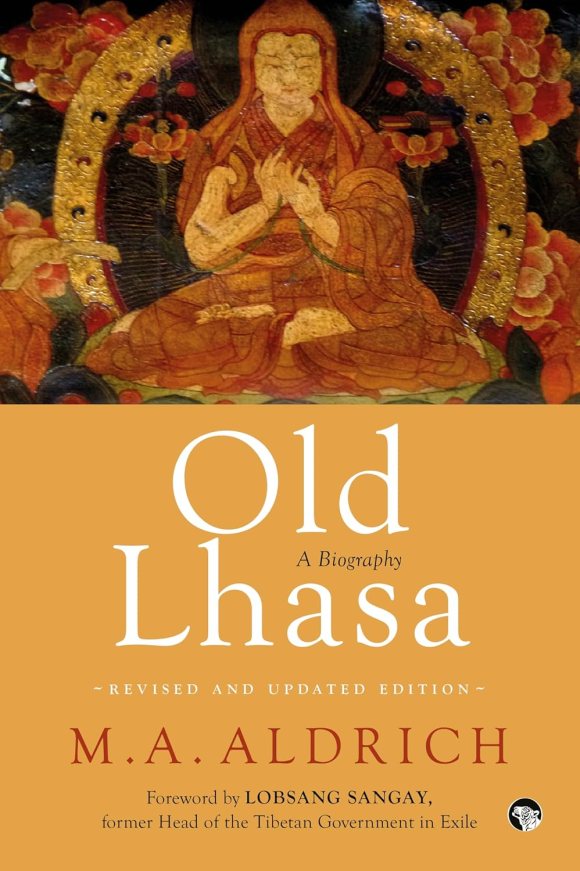
Old Lhasa: A Biography, (a revised edition published in 2025 for the South Asian market of a book originally published in 2023), is a voluminous 615-page book that combines historical research, travel writing, religion, and culture to offer a comprehensive account of Lhasa, the capital city of Tibet. The author, M. A. Aldrich, is a lawyer who has lived and worked in Asia since the 1990s and had earlier published books on cities like Peking and Ulaanbaatar. Written on the basis of his multiple trips to Lhasa and its surroundings (the last one as late as September 2024), he is happy to discover that Old Lhasa has stood the test of time and still accurately captures the sight, sounds, and feelings of the city and foreigners can wander about freely without a minder so long as their papers are in order. As this book slowly emerged, it grew into both a portrait of the history and culture of that city as well as a serviceable guidebook for readers who are able to go to Tibet when political and regulatory circumstances permit.
Aldrich paints an intricate portrait of Lhasa, a storied city and its history, by giving us the evolution of how the Tibetan script came to be, with inspiration from ancient India and at the same time livens up the narrative with humorous anecdotes, interesting legends and charming fables that makes this book blend many genres into one. Divided into 49 chapters and enriched with several maps and black and white photographs, the chronological narration rightfully begins with the first chapter titled ‘Prelude to Lhasa’ where we are told that with Lhasa as the geographical focal point of their faith, Tibetans believe the dharma[1] has always been connected to their country. He begins the journey in the seventh century during the final moments of the life of Buddha, mentions specific Buddhist virtues such as compassion, wisdom, and benevolent power, among other essential qualities for the path to awakening. For Tibetan followers of the dharma, the history of Tibet is the history of the Bodhisattva of Compassion, which is simultaneously woven into the story of Lhasa.
In the 1920s, when Tibet enjoyed its greatest freedom from outside interference in the modern era, Lhasa had a population of only around twenty-five thousand. It was divided into two districts: one that is now the Old Town, with its seventh-century Jokhang Temple (or, more simply, the “Jokhang,” meaning the “House of the Lord”) at its centre; and the other being Shol Village, which is at the foot of Marpo Ri (Red Mountain). These administrative districts were divided by a north-south boundary that ran through the Turquoise Bridge, another structure dating to the seventh century. The Old Town was not much larger than two- or three-square kilometers, while Shol was even tinier. The residents of Lhasa at that time took immense pride in the religious heritage of their city. Nearly every luminary in Tibetan history had come to Lhasa because of the importance of the Jokhang as the focal point from which Tibetan civilization evolved and expanded. No other city could rival it.
Lhasa grew organically outward in concentric circles. Around 1160, a monk built the Nangkhor, a pilgrim’s circuit (korlam) directly adjacent to the inner sanctum of the Jokhang, so that devotees could practice the religious ritual of circumambulation. It is from this kernel that the boundaries of Old Lhasa came into existence. By the 14th century, Lhasa was enclosed within the Barkhor, a kilometre-long korlam circling the temple and a monastery among other buildings. By the 1650s, Lhasa’s outer limits had been expanded to the Lingkhor, a ten-kilometre pilgrimage route. And so, the boundaries of the city remained until recently.
Lhasa’s significance also drew heavily upon the nearby presence of government buildings and monastic sects of learning. The Potala Palace, with its superb representation of Tibetan architecture, is a massive and dazzlingly beautiful fortress-like monastery that had been the residence of the Dalai Lama and the seat of the Tibetan government since 1648. Three monasteries outside the city were centres of the so-called Yellow Hat or Gelukpa School of Tibetan Buddhism, preserving a venerable tradition of scholasticism and monastic training that had been imported to Tibet from the universities at Nalanda, Odantapuri and Vikramshila in Northern India. Daily life in early 20th century Lhasa was mostly grounded in religion for both the laity as well as the clergy. The Lhasa calendar year revolved around a sequence of religious festivals that tracked the flow of one month into another in a never-ending cycle of faith and devotion. Though religion permeated society, Lhasa was not an “other-worldly” place. In 1951, when the People’s Liberation Army marched into Lhasa behind portraits of Chairman Mao Zedong, Zhou Enlai, and Liu Shaoqi, the days of the city with its self-administered culture were numbered. During the 1959 Tibetan Uprising, the Chinese Communist Party reacted to the civil unrest as if Tibet should be taught a lesson. The Party continues to do so despite brief intermittent periods of slightly relaxed policies. Though Chinese modernity has been imported wholesale into Lhasa, the author opines that Old Lhasa is still there in its people who maintain their centuries-old faith and customs. One just needs to know where and how to look.
In the Prologue, Aldrich had confessed that this is not a “serious book” about Lhasa as the term is understood within the narrow confines of modern academia, since its objective is only to share what he had learned about Lhasa with simpaticos. His audience is the general reader or armchair traveller with a basic understanding of the tenets of Buddhism and the broad outlines of Asian history. He does not go into great depth on religious theory, and he hopes his views might also be of interest to Tibetans who have come of age in the diaspora and are curious about what a non-Tibetan thinks of this fabled city. He attempts to avoid the excessive solemnity and despair that attends much writing about Tibet. It is not that he is ignorant of ongoing atrocities and the appallingly cruel policies of the Party, but he has no doubt Tibet will have a renaissance. He opines Tibetans will overcome the current dark cycle just as they have overcome other bleak phases in their history.
In conclusion, it can be said that even after reading it thoroughly and enjoying it, this book as the author rightly states, “will nudge readers to learn more about Tibet and Tibetan culture.” Also, as Dr. Lobsong Sangay, former head of the Tibetan Government in Exile, rightfully mentions in the ‘Foreword’
, “Though the story of Tibet is an ongoing tale of tragedy, it also is a tale of the human spirit and the resilience of the Tibetan people. …this book is a window for seeking genuine access that will help you make meaningful discoveries of your own, whether you are physically travelling through the streets of Lhasa or traveling through the pages of this book far away from Lhasa.”
Prof. Sarbeswar Das (1925–2009): A scholar of depth, a teacher of light. Photo Provided by Bhaskar Parichha
In the intellectual history of modern Odisha, Professor Sarbeswar Das stands as one of those rare figures who seamlessly bridged scholarship, ethics, and social commitment. A luminous teacher, an erudite writer, and a quiet Gandhian, his life and work embodied the moral seriousness and intellectual curiosity that marked a generation shaped by the freedom struggle and the promise of a newly independent India.
Born in Sriramchandrapur village in the Puri district of Odisha in 1925, Sarbeswar Das grew up in a milieu where simplicity, discipline, and community values were deeply ingrained. His brilliance shone early—he topped the matriculation examination across Odisha and Bihar, a distinction that foreshadowed a lifetime of academic excellence.
His educational journey took him first to Ravenshaw College, Cuttack, the cradle of higher education in Odisha, where he absorbed the liberal spirit and rigorous intellectual training that the institution was known for. He later studied at Allahabad University, one of India’s foremost centers of learning, before proceeding to the University of Minnesota, for advanced studies in English literature.
His exposure to American academia at a time when few Indian scholars ventured abroad profoundly shaped his intellectual orientation. The years in Minnesota opened to him a new world of thought—modern literary criticism, American fiction, and the philosophy of democratic humanism—all of which left a deep imprint on his teaching and writing in later years.
On returning to India, Das joined the teaching profession, which he would pursue with remarkable dedication and grace for several decades. He served as a professor of English in some of Odisha’s most respected institutions—Christ College (Cuttack), SCS College (Puri), Khallikote College (Berhampur), and Ravenshaw College (Cuttack).
As a teacher, he was known not only for his formidable command of English but also for his clarity of expression, quiet humour, and empathetic engagement with students. He could bring Shakespeare and Emerson alive in the classroom, weaving them into the moral fabric of everyday Indian life. His pioneering initiative was the introduction of American Literature as a formal subject of study in Indian universities, long before it became fashionable to do so.
In an age when English studies in Odisha were largely confined to the British canon, he expanded its horizons by introducing writers like Walt Whitman, Emily Dickinson, William Faulkner, and Mark Twain to Indian classrooms.
Das believed that literature must connect with lived experience. He often told his students: “Language is not just a means of expression; it is a mirror of our moral imagination.” This conviction shaped generations of students who went on to become writers, teachers, and civil servants. Among them was the late Ramakanta Rath, later one of Odisha’s most celebrated poets, who fondly remembered Prof. Das as a teacher who inspired intellectual courage and aesthetic sensitivity.
Alongside his teaching, Prof. Das was a prolific writer and scholar. He authored around twenty-five books spanning essays, literary criticism, translations, and reflections on education and society. His writings in English and Odia reveal a mind steeped in both classical and modern traditions. Fluent in English, Odia, and Sanskrit, he was at ease quoting from the Bhagavad Gita and Hamlet in the same breath.
His essays in English reflected on the role of language in education, the cultural responsibility of intellectuals, and the need for moral clarity in modern life. He consistently argued for a vernacular humanism—a belief that English education must not estrange Indian students from their cultural roots but rather help them view their own traditions through a broader, universal lens.
As a principal, he brought administrative efficiency and human warmth to his role. His tenure is remembered for reforms that encouraged academic discipline, faculty collaboration, and student participation. He believed that education was not merely about acquiring degrees but about shaping ethical citizens.
Prof. Das’s intellectual life was inseparable from his moral and civic commitments. As a young man, he participated in the Quit India Movement, aligning himself with the Gandhian values of simplicity, non-violence, and service throughout his life.
Late in life, Prof. Das turned inward to recount his journey in his autobiography, Mo Kahani (My Story), which has since acquired the stature of a modern Odia classic. Spanning eight decades of personal and social history, it offers not only a memoir of a life well-lived but also a vivid ethnography of Odisha across the twentieth century.
In Mo Kahani, he paints rich, affectionate portraits of his family—his parents and sisters, Suruji and Hara Nani—and evokes the rhythms of village life, with its festivals, hierarchies, and hardships. His account of the great famine of 1919, passed down through family memory, is a haunting narrative of suffering and resilience.
The autobiography captures the moral universe of rural Odisha—its compassion, faith, and silent endurance—while chronicling the social changes wrought by modernity, education, and political awakening.
The book transcends personal recollection to become a social document of rare authenticity, preserving the voices and values of an era in transition. Scholars have hailed it as a valuable resource for understanding Odia social and cultural history, as well as a significant contribution to Indian autobiographical writing.
Prof. Sarbeswar Das passed away in 2009 at the age of 84, leaving behind a legacy of intellectual depth and human kindness. Those who knew him remember his calm demeanour, his Gandhian simplicity, and his unwavering belief in the power of education as a moral force. His students and colleagues regarded him not merely as a teacher but as a guide who exemplified integrity and humility in every aspect of life.
His contributions to English literary education in Odisha were transformative. By introducing American literature, promoting cross-cultural study, and insisting on a pedagogy grounded in ethical reflection, he helped modernise the study of English in the state and inspired a generation to approach literature as a bridge between worlds.
Even today, his writings—both critical and autobiographical—continue to speak to the challenges of our times: the search for meaning in education, the reconciliation of global and local cultures, and the enduring need for moral clarity in a rapidly changing world.
In the final measure, Prof. Sarbeswar Das remains not only a scholar and educator but also a moral historian of his age—one who chronicled the soul of Odisha with the sensitivity of a poet and the precision of a teacher. His Mo Kahani endures as his final lesson: that learning is not a mere accumulation of knowledge, but a lifelong practice of understanding, empathy, and truth.
.
Bhaskar Parichha is a journalist and author of Cyclones in Odisha: Landfall, Wreckage and Resilience, Unbiased, No Strings Attached: Writings on Odisha and Biju Patnaik – A Political Biography. He lives in Bhubaneswar and writes bilingually. Besides writing for newspapers, he also reviews books on various media platforms.
PLEASE NOTE: ARTICLES CAN ONLY BE REPRODUCED IN OTHER SITES WITH DUE ACKNOWLEDGEMENT TO BORDERLESS JOURNAL
Five poems by Rohini K.Mukherjeehave been translated from Odia by Snehaprava Das
Rohini K.Mukherjee
AT THE MYSTICAL SANCHI

An unknown voice beckons
At the early hours of the morning.
Moved by a new surprise
Buddha relapses into meditation.
A crystal dawn, cold as marble,
Is traced
On his hands and feet
And his eyes and forehead.
Some instant, invisible signal prompts him
To turn on his side and sleep.

After Buddha’s Nirvana,
Calm settles in the valley, slowly.
Thousands of
Branches and branchlets
Radiate blissful divine light.
The trees too, in a lavish growth,
Spread out everywhere --
From the earth below to the sky above --
And meditate!


THE EXECUTIONER

No one could predict
The next scene.
But in the one enacted now
The executioner has
A prominent presence.

The executioner stalks the moon,
 His face hidden in the veil of clouds,
Knife in hand, a gleam of smile
On a phony face,
A sharp, keen gaze under the glasses,
Exuding the smell of
An expensive perfume.

The indistinct footfalls may
Prompt one to flick a look back
 But there would be no one behind
Only clouds clad in midnight blue
Sailing in the sky.
From somewhere far floats in the music
Of a mountain stream.
 Slowly, sorrow dissipates and a
 Path opens up for the spring,
 A wonderland of fairies.
In his unguarded moments,
The knife in the executioner’s grip
Glitters in the furtive moonlight.
Any moment that poison-coated knife
Could find the moon’s throat,
The moon knows that well.
But it forgives,
Because it also knows well
That the executioner cannot
Hide for long
And will be trapped in
The moonlit garden of tangled clouds.


THE DEATH OF A HAPPY MAN

One day, the eyes lost sleep
And all the locusts flew away,

Not one spectator had guessed
That one day
The man will sprawl out on
On the sea beach sands
Washed away by the waves
From distant lands.

The eyes lost sleep one day.
The flock of locusts flew away.

But no one could guess
The pains, the sobs
That seared that forlorn soul.

Petals drifted in piles
To make him a delicate shroud.
The smell of sandalwood came wafting
In the sea-breeze from the north.
Seagulls flocked around the body,
Unintimidated by the crowd in the beach,
Drowning the voice of
The living men there
With their loud squawks of dissent.
Ooh! What a long wished-for
Happy death
On a cool and blissful sea beach!

After the flock of locusts flew away
Carrying all the dreams back
On their wicked wings,
The eyes lost sleep!


ANKLETS OF THE NIGHT

There is still time for the nightfall.
But the air tinkles with the sound of
The anklets of the night
 As if someone is retreating from
An ineffectual, moon-washed garden,
 As if someone from the grave
Watching the landscape,
Or someone standing at the riverside
Hums the tune of a departed season,
Or someone hurrying aimlessly away
To escape the approaching dawn.

It is not yet night,
But the night’s anklets ring.
You are probably returning
To your shelter of old times
In search of a new hope.
Just take a look behind to see
The painting of a conflicting wind
Fluttering across the courtyard.

It is not yet night
But its anklets begin to jingle in the air.

How cool you appear in your
Evening chanting of the mantras!
 How calm and steady you are
In the pure fragrance of the descending steps
As you set out on the journey
Holding your heart on your palm
Like a burning clay-lamp.
May be when you arrive there
The dawn around you would be sonorous
With the notations of Raga Bhairavi.

There is still time for the nightfall
But the night’s anklets tinkle in the air!


THEY DID NOT COME

I waited for them, but
They did not come,
I waited all this time in vain, and
Knowingly, let myself fall a victim
To the first rays of the sun.
The sun’s whiplash spurred me on
To the jungle.
It forced me to cut wood
And tie them in bundles.
The hunger of the sunset hour
Prodded me back to where
I had started.
The smell of soaked rice, and the aroma of
Onions and oil
 Drifted thick in the air of my house.

The sun came in, an intruder,
Sat by me and watched.
Then it devoured all the food,
Leaving nothing,
Not even a single dried-up onion-peel.

Because they did not come,
For me the morning was
Meaningless in its futility.
I knew I was never one
In the list of their ultimate interests
When their tenure of life here ended.

The footfall of the light
Trod easy on my skin.
Days rolled on this way
In sun and light.
The sun was everywhere, all the time.
Whenever the door opened,
The sun stood there.
When the meteor came shooting down,
When words rode over
the waves of sleep to float in the air,
The treacherous sun always appeared.

And for me, there was
No hope of their coming back.

But, one day as I leapt up in a hurry
At the Sun’s summon,
I discovered the Sahara Desert
That I believed had
Remained hidden in my
School Geography book,
Lying face down all these days
Under my own hooves!
Rohini Kanta Mukherjee has authored, edited and co-edited several volumes of poetry and short stories in Odia and English. Many of his poems have been translated and published in various Indian languages , broadcast over several stations of All India Radio and Doordarshan . Some of his poems and translations have appeared in Wasafiri, Indian Literature, The Little Magazine , Purvagraha, Samasa among others. He retired as Associate Professor of English, from B.J.B Autonomous College, Bhubaneswar, Odisha.
Dr.Snehaprava Das, is a noted writer and a translator from Bhubaneswar, Odisha. She has five books of poems, three of stories and thirteen collections of translated texts (from Odia to English), to her credit.
PLEASE NOTE: ARTICLES CAN ONLY BE REPRODUCED IN OTHER SITES WITH DUE ACKNOWLEDGEMENT TO BORDERLESS JOURNAL








 Borderless