Categories
Musings

Islands that Belong to the Seas

By Paul Mirabile

Islands belong to oceans and seas and lakes. They are born within the deepest depths of the marine underworld like infants in the depths of their mothers’ wombs. Born often from surging volcanic eruptions, the molten lava hardens into rock. The rock is smoothed by ocean-swept sands that turn fecund over time. They are gradually populated by migrating birds who rest their weary wings and deposit seeds from which sprout rich and luxuriant vegetation. To these shingled or sandy shores, little by little, pirates, buccaneers, conquistadors, renegades, the exiled or self-exiled, slaves, missionaries and migrant workers come to explore and eventually settle.

They all come flocking to this primordial land floating in the waters of the world, birds and humans, animals too follow. Bees buzz their contentment, donkeys hee-haw, goats baa and mosquitoes whine. And yet the islands do not belong to any one of these creatures. They belong to the oceans and seas and lakes — their creators and benefactors.

Ah! The birth of an island! The centre of which rises high above those shingled or sandy shores, the dense jungles or arid scrub, where Vulcan in rampant rage had spat out smouldering rock and tongues of lava. There they now waft as if levitating from their aqueous-bed, home to a new Humanity …

Since my childhood, whenever I poured over maps my eyes would invariably fall on the islands that dotted the oceans or seas or lakes of our world. They held a more significant, a more imaginative, a stronger attraction for me, ones with which I could empathise. For Sicily was my genealogical point of attachment on those maps, a legacy of thirteen civilisations or so which had landed, settled or departed, leaving their immemorial traces both on the land, in the architecture, in our very mixed genes. Sicily is a perfect ‘officina[1] which I translate as the ‘melding of Humanity’ !

I day-dreamed while pouring over those frazzled maps and islands, whilst reading Jules Vernes’ Mysterious Island and Daniel Defoe’s Robinson Crusoe. Actually, I don’t believe that I love islands because of those novels (or any other), but they did arouse in me a sense of friendship, affection and human compassion towards islands because of the extraordinary diversity of their errant or settled communities, their many languages and customs, their manifold landscapes. Languages that have forged the hybrid compositions of Creole, forged inter-marriages, forged populations whose quotidian merges into the hybrid species of fauna and flora.

I read and read again and again the fabulous tale of Hayy Ibn Yaqzān[2] who lived on his uninhabited island amongst the plants, trees and animals, all alone in wondrous solitude, learning from them: his human qualities, his religion, his love of humanity and sympathy for every quintessential being or object that came into contact with him — be it mineral, vegetal, animal or eventually human …

Islands are bursting with nature and nature is a friend of humanity, thus islands are bursting with friendship — bursting with hybrid species … like their ethnicities and their languages. Even when Nature can become an enemy, this enmity offers islanders the possibility of strength and force through trial and error. When storms arise, they build sturdier homes. When dangerous interlopers reach their shores, they offer hospitality and eventual integration. Perilous sea creatures and beating waves against boulders demand of islanders to muster their ingenuity and imagination. To cultivate friendship, virtue ; to draw closer to one another ; to be able to live only in a way that conforms to Nature … to an island’s generous and bountiful treasures ; to befriend Nature and Humanity, for they are equal in diversity and disinterestedness.

I suddenly stopped dreaming of islands as they pinched with patriotism, narrow nationalism, circumscribed communitarianism. I stopped dreaming of islands and with my fingers touched Sicily, Cuba, Cyprus, Malta, Madeira, and the Princess Islands stringing out in the Marmara Sea. I slid them upon the island of Olkhon on Lake Baikal in Russia, the oldest and deepest in the world; an island where Shamanism, the oldest religion of the world, and Orthodox Christianity vie in relative peacefulness. There my fingers brushed against layers of civilisation, of ethnic blending, of howling winds and raging white-crested waves off boulders and high cliffs and laughing seagulls on the wing. There I heard a myriad of languages spoken by the communities of Humanity both in the public and the private domains: Greek, Turkish, Sicilian, Spanish, Italian, Maltese, Russian, Arabic, Jewish-Spanish, Norman, Armenian and so on. There swelled dark secrets of mythical creatures, of legendary figures whose wild wisdom infused a shroud of enigma that piqued my curiosity towards the universal sympathy that exudes from those aforesaid islands: the fragrance of bougainvillaea, wisteria, honeysuckle and jasmine, of ossified forests laden with the ice of deep winter, of the briny sea spray of stoic rocks, of cries of fishermen at the docks and those of traders at the markets. When I lift my finger that sacred moment, that spell which has been cast upon me vanishes from my waking state …

To Sicily, Cuba, Malta, Madeira Cyprus, Olkhon and to the Princess Islands I weighed anchor and set sail on various shaped vessels — ships that cleaved the high seas or navigated the coasts. At dawn upon disembarking, the colours of the skies drip from violet to orange to red to blue. The fishermen at the harbours or docks always asked me: “How do you like it ?”

“What, the island ?”

“Yes.”

“There is no point on Earth that rivals an island,” I would always repeat in sympathetic earnest.

On shore, wherever that shore be, we would drink coffee or tea in one of the wooden cooperatives for fishermen, traders and sailors. Chickens cackled, dogs barked, seagulls laughed whilst glasses and conversation chimed out the tunes of the islanders’ community spirit: tunes chanted in many tongues, gesticulated in many forms. I broke bread and filled my glass, observing the leathern faces of these hard-working tradesmen mending their nets, fitting their poles, scraping or painting their sea vessels … accomplishing their livelihood together as a whole.

“The wind is blowing from the southeast,” a rough-looking chap declared for all to ponder upon.

“That’s rain !” shouted another with a slight nod of his head.

And then I fell asleep in my bungalow and dreamt of dancing boats and throngs of fishermen talking about their fortunes or misfortunes. Villagers living near the rising waves filled my sleep with their colourful robes or coiffeurs, their daily gestures of sympathy to both nature and humanity.

Pouring over maps filled my childhood. Fingering the points that we call islands submerged me in oceanic rhapsody. Entire archipelagos coiling from North to South and West to East pervaded my soul with the rhythmic cadence of their tides. And as the tides beat out cosmological tunes, my dreams ended. I woke and embarked on many an island adventure in Sicily, Madeira, Cuba, Cyprus, Olkhon, Malta and on the Princess Islands. Points on the map became the unchartered lands of my great middle age sympathetic adventure. I had returned to the lands of my ancestors ! Ships had bore me to those points of human sympathy, exploring fantastic landscapes, communicating in innumerable tongues. There I breathed the air of island sovereignty, simplicity, silence and solitude.

I lived happily on all those islands. And in spite of certain prejudices and intolerances, I rejoiced living with the islanders who are good, heroic, honest and fair in their daily commerce. Who earn their daily living by the sweat of their brow and by the devotion to one another, whoever be that one or other. Inside the cafés faces furrowed by wind and sun concentrated on their drink or their cards or dominoes, whilst outside, hands hardened by generations of toil and moil, mended nets, built boats, cut fish, rowed boats. I rejoiced at all those acts of universal friendship.

I lived happily, intermingling with the melded species of plants, birds and humanity — not only as a spectator, but as an actor: the spectator who observes himself acting, and the actor who perceives his observations. Like in a dream … day and night !

It seemed to me like paradise. Paradise, a word derived from the Old Persian ‘pairidaëza‘ which meant ‘enclosure, a place walled in’: walled in or enclosed by its creator — the water ! But its meaning shifted when read by the Hebrews and became ‘pardēs‘ ‘a garden’. The Garden of Eden ? Yes, a garden so pristine and divine, yet possessing that infamous apple tree of the forbidden fruit. All paradises can descend into the bowels of Hell if tempted by a slithering, sly, snaky and insidious interloper … As we shall soon see !

At present the tides of time have consumed my youth, so I have decided to write a humble meditation about my mingling amongst the islanders of so many islands, of so many archipelagoes. I see them all from the porch of my bungalow, stretching out like a necklace of pearls. A pearly necklace cast in its oceanic casket. So I write and wander upon the silent, deserted roads of the many islands that I have treaded; that I have seen, touched, smelt and tasted. The time has hence come to render homage to those islands, to the nature of those islands, to the nature of those populations.

At this point, I expect readers will retort and point out that not all islands should benefit from such a distinguished homage: How about Cyprus, and the Turkish-Greek conflict ? And Sri Lanka and the terrible war that raged between 1983 and 2010 ? Japan and England, too, big islands indeed but islands, nevertheless. Was the subjugation of Welsh, Scot and Irish not enough? No, those English islanders set out on the high seas to subjugate other ethnic communities … other islands! The first being Ireland, invaded in the XIVth century and conquered uninterruptedly by Henry the Eighth and Oliver Cromwell. The ‘de-Irelandising’ of the island, or more appropriately formulated, the genocidal ‘civilising mission’ produced exile, persecution, misery and death until the founding of the Irish Free State in 1921 and finally the Republic of Ireland in 1949![3]

Were the Japanese not content to eliminate any foreign intrusion on their precious island ? No, they set out to decimate and enslave the ethnic communities that thrived on the islands of the Pacific: Guam, Wake Island, the Philippines, the Solomon Islands, the Aleutian Islands, etc. Japan’s violent and bloody imperialism during WW II, and England’s century’s long brutal colonisation have marked all our History books and memories of their so called ‘civilising missions’. Be it the imperialistic brutality in the lands of the rising sun or that of the setting, as the French say: c’est bonnet blanc et blanc bonnet ![4]

Yes, these counter examples are, alas, historically documented. Are they then accidents of history or sorrowful exceptions? I will answer that in the case of Cyprus, the Cypriots, a fine blend of Greek and Turkish ethnic commingling since the Middle Ages, with a sprinkling of English since King Richard the Lion Heart (1191), became the unfortunate victim of Britain’s ‘civilising mission’. One needs only to read Lawrence Durrell’s Bitter Lemons of Cyprus[5]to understand the sad and tragic events that erupted in the 1950s and their never-ending aftermath and continuity. Cyprus belongs neither to Greece nor to Turkey (and certainly not to Great Britain), but to the Cypriot Greek and Turk, who in turn know perfectly well that their grand island for centuries has always belonged and will always belong to the brilliant whiteness of the Mediterranean Sea! The tragedy that befell this island sprang from the combined effort of British cynicism, Greek nationalism and Turkish overweening military reaction.

As to Sri Lanka, Sinhalese and Tamils had been living together since the twelfth century, assuredly not under the most perfect idyllic neighbourly conduct, yet the intermingling populations, be they Hindu, Christian or Budddhist, carried out their daily lives without too many eruptive disturbances. It was only with the full British conquest in 1815, and their fancied game of pitting one community against another, there, favouring the Tamil populations of the island, that a slow but steady bitterness, rancour and animosity grew within the Sinhalese population. The pent-up enmity exploded as soon as the British abandoned their ‘mission’, leaving both communities in a sort of political vacuum: Who was to govern? Who was to replace the ‘civilisers’ once they decamped without preparing Sinhalese and Tamil for self-rule, as the British had always done in the benignity and magnanimity of their decolonisation? The vacant legacy they left behind was rapidly filled with ethnic rivalry, exposed to Sinhalese vindictiveness and Tamil claims to share power and land in spite of their minority status. Each community claimed their rights as the deprived community at the expense of one another, a situation so similar to the void left behind by the British in Cyprus. The dramatic events that followed became the final act in the history of Britain’s ‘civilising mission’ performance …

In these two cases, the two communities, forsaken victims of the British colonial mindset, instead of achieving ethnic unity, wallowed in the abysmal chasm of oblivion. Islands that could be paradises plunged into the throes of Hell !

To conclude, an island belongs to the vast waters that enshrine it, as its etymology translates: a ‘land’ in ‘water’. Islands do not belong to imperialists or colonialist powers ; they belong to the oceans or seas or lakes that give birth to them, to the nature that stretches its silken carpet over them, to the ethnic groups or communities that gradually settle upon them, intermingling, trading, marrying, creating together a hybrid or Creole culture worthy of any ‘continental’ civilisation. For this very reason, there should not be any dominate power on an island, or official boundaries which sever communities from one another save the natural one that has nurtured and provided for its very existence: the surging billows and silent tides of their eternal creator …  

.

[1]‘Factory’ or ‘workshop’ of production. It is of Latin origin

[2] An allegory written by Alī Ibn Sinā or Avicenna (950-1037) Hayy Iby Yazqān, the Bird Salāmān and Absāl interpreted and adapted by Ibn Tufayl with the same title, born in Muslim Spain in the XIIth century. See Lenn Evan Goodman, Ibn Tufayl’s Hayy Ibn Yaqzān, gee tee bee, Los Angelos, CA, 2003.

[3]The slaughter of all Irish aristocrats, the prohibition of inter-marriage between Anglo-Normand and Irish and the prohibition of the Gaelic written language in 1592 were part of the English ‘civilising mission’ in Ireland.

[4]‘It all amounts to the same thing’ or ‘It’s six of one and half a dozen of the other’.

[5] Lawrence Durrell, Bitter Lemons of Cyprus, 1957.

Paul Mirabile is a retired professor of philology now living in France. He has published mostly academic works centred on philology, history, pedagogy and religion. He has also published stories of his travels throughout Asia, where he spent thirty years.

.

PLEASE NOTE: ARTICLES CAN ONLY BE REPRODUCED IN OTHER SITES WITH DUE ACKNOWLEDGEMENT TO BORDERLESS JOURNAL

Click here to access the Borderless anthology, Monalisa No Longer Smiles

Click here to access Monalisa No Longer Smiles on Kindle Amazon International

Categories
Poets, Poetry & Rhys Hughes

What I Thought I Knew About India When I was Young

Courtesy: Creative Commons

I had a jigsaw of a map of India but it wasn’t a proper map. It had the names of cities on it but it was covered in pictures too, scenes of ‘typical everyday life’ for people who lived in various parts of the country. This jigsaw introduced me to India. I saw lots of elephants and tigers and women picking tea and men drinking the tea and coconut trees and mountains and a few deserts. The trees, elephants, tigers, women and mountains were all the same size. Sri Lanka was included in the map and because it is a much smaller landmass it only had room to show one elephant and one woman picking tea.

This jigsaw was one of several jigsaws that I had in the same series. They were all the same size too, so that I came away with the mistaken impression that India, Australia, New Zealand, Japan and South America were all as large as each other. I have checked just now and I see that these jigsaws were made by Waddingtons and called ‘jig-maps’ and now I also learn that the Indian one didn’t contain Sri Lanka after all. The fallibility of memory! Looking at it for the first time in almost fifty years I discover that Bangalore is represented by a man playing a flute to two cobras in a basket while a wise mongoose looks on. Was Bangalore ever really like that? Was it like that when the jigsaw was made? Clearly a lot has changed in half a century.

The jigsaw was only the starting point of my intellectual discovery of the Indian subcontinent. Films augmented my growing awareness. Films showed me that the meaning of India could be found in elephants, tigers and women picking tea, not to mention men drinking tea, coconut trees, mountains, deserts. The place seemed marvellous. I decided to go there one day. But when? The thing to do was to consult a proper atlas, not a jigsaw, in fact a battered old atlas bound in ripped green cloth that dated from the 1920s and was probably a book once owned by my great-grandfather.

India seemed far away, yes, but not as far as Australia, and because I had cousins in Australia who had come to visit (bringing me a boomerang as a gift), I knew the voyage was feasible. First, I would reach France, that was the first step, and I felt confident I could walk to France. There was the inconvenience of a stretch of open sea between Britain and France, but I believed I could construct a raft from driftwood and sail across without too much trouble. Once I arrived in France the remainder of the journey would look after itself. I equipped myself for the walk. I took a penknife and a flask of orange squash, and I set off. There was woodland near the house where I grew up and I walked for ten minutes or so before meeting a boy I knew who was unsuccessfully trying to climb a tree. He came down with a crash, asked me for a drink and I obliged. Half the squash went down his gullet and I knew I could never hope to reach France on a half empty canteen. I returned home.

But I never abandoned the quest to reach India, I merely postponed it. The country had snakes in baskets! How could I resist that? Where I came from, the only stuff you found in wicker baskets was laundry. Boring in comparison! The snakes in India were musical and loved flute melodies. That also was amazing. It occurred to me that snakes were flute-like themselves and perhaps had even evolved from flutes (or vice versa) which explained the association. What if the strong resemblance led to a flautist accidentally trying to play a snake instead of a flute? The question alarmed me for days.

Maybe the music produced as a result would be the best ever heard by any human ear? Or perhaps it would be the worst! Yet another thing to find out for myself when I got to India. In the meantime, to continue my research, I spent a lot of time with a toy called a ‘View-Master Stereoscope’ that showed images on slides in 3-D. It was a plastic box with two lenses and a lever that rotated a disc on which the images were fixed.

One of the discs in my possession was an arrangement of “spectacular views” from around the globe. It included Banff in Canada, the Golden Horn in Turkey (those are the only other two I remember) and yes, a frontal view of the Taj Mahal. I studied the Taj Mahal carefully. It was vast and white. What clues could I glean from it? I wasn’t sure. Someone told me it was constructed by elephants. I accepted this but wondered what use elephants had for such a grand monument. It wasn’t edible. It wasn’t a bun.

On a school trip I was taken on a bus to Bristol Zoo, which seemed to lie at an extraordinary distance from the small town where I lived. We were shown an elephant and informed by a teacher that it was an Indian elephant, because it had small ears. Those ears looked vast to me and from that moment I had no choice but to regard the teacher as incompetent, a fool who didn’t know the difference between big and small. The incompetence of adults was something I learned the hard way, like most children. For instance, another teacher told us that crude oil was ‘liquid gold’ but I knew he was wrong. Oil was black and gold was golden, they couldn’t be the same. He had neglected to explain it was a metaphor. That might have helped his credibility.

My grandmother knew a little about India because one of her uncles was a sailor and had been there. He came back full of stories about it. People in India were able to levitate cross-legged, he had told her, after studying a thing called yoga. But yoga was dangerous. Some men had tied themselves in knots doing it and couldn’t be untied. They had spent the rest of their lives as a knot. Only the lightest men could levitate as far as the ceiling. Occasionally one of them would go up the chimney and drift away on the breeze. He had sometimes been far out at sea and watched them drifting over his ship. He had waved to them but if they broke their concentration they would come back down and make a splash, so his cheerful greetings were ignored. No offence taken, he said, he understood their predicament. Well, that was India for you.

In Calcutta he had seen a magician with a rope who had thrown it up high in the air and it had become rigid. Then he climbed it and vanished at the top. It was an impressive trick but he couldn’t see the point of it. He preferred the men who slept on nails instead of mattresses. Had he actually seen any of these chaps himself? No, not exactly. Nails grew on trees in that country and during his stay there had been a drought and a bad harvest and there weren’t enough nails to spare and those magic men had to sleep on porcupines instead. It was better than nothing, he supposed. My grandmother passed these tales onto me, uncritically and with evident approval. She always regretted not being born a man and going to sea herself. She wanted to be a pirate.

My grandmother’s uncle knew all about curries but I didn’t and I waited a long time before I tasted my first. It blew off the roof of my mouth, but looking back, I imagine, it was a very mild curry. Like most British men I soon acquired a taste for spices and eventually I became what is known in common parlance as a ‘chilli head’, going so far as to munch on the spiciest raw chillies available and insisting through a forced grin that they were “nothing special”, but that was later. My first curry was an eye opener. On second thoughts, it was more of an eye shutter, as I squeezed back the tears into my ducts. Yet this experience is a necessary rite of passage for all British males. It is the ‘test of fire’ and no less important than ‘the test of liquid’ (one’s first beer in a pub) and the ‘test of hair’ (the first shaving of the chin). These are the three essential tests, although there might be some others of lesser importance.

It must also be admitted, and I don’t say this cheerfully, that Kipling had a deep influence too on what I thought I knew about ‘India’. He is a problematic author now, one who made too many assumptions about how acceptable it was to work within the rigid structures of an imperialist system and only petitioning for greater humanity within that system. We can look back now and chide him for not opposing the system itself, but as a young British boy, I had no thoughts about systems of any kind. I was unhistorical despite my interest in history. The past was a place of knights bashing each other with maces, the distant past was a place where cavemen bashed each other with clubs. The present could never be history because it wasn’t the past, a simple equation in my head, and when Kipling wrote of his contemporary India, I received his impressions in my own time. Therefore, his India became mine too. ‘Gunga Din’ was exactly the sort of chap one might meet in the streets today. It never occurred to me that Kipling was a relic, an antique, for the reason that his books stood on my bookshelves now, and thus had contemporary relevance.

My sister’s best friend at school was an Indian girl, Joya Ghosh by name, but because we lived in a small town in Wales, I don’t think it registered in my mind that her parents had come from elsewhere. I didn’t think about the matter very much, if at all. She was merely a person with a deep laugh, much deeper than the laugh any child ought to have, thinking back on it now. It rumbled. It was the sort of laugh I later came to associate with hearty men with big beards, Captain Haddock or Taras Bulba types. She didn’t have a big beard or even a small one, at least I don’t recall seeing one.

She once courageously interceded in order to stop a pillow fight between myself and my sister. Her diplomacy in maintaining her neutrality as she did so impressed me considerably. But I never asked her anything about India. Maybe she wouldn’t have known much, but that is beside the point. I never even made the attempt. Nor do I remember meeting her parents or siblings, though I surely must have. She was here and India was elsewhere, so no connection could be logically made. The Jungle Book cartoon film filled in all the gaps anyway. I learned that in India wolves held conferences, that monkeys had kings, and that vultures were willing to join forces with humans to frustrate the machinations of tigers. This seemed perfectly reasonable.

When I was 14 years old, a brief article on Buddhism in an encyclopaedia captured my imagination. I wanted to know more about this philosophy. Where should I turn in order to find out more? There were no books on the subject in my local library, which was the only source of reading material in the town, and no adults I asked knew anything about it. The Buddha had found enlightenment under a tree in India. Would I have to travel to India to find enlightenment about his enlightenment? That seemed probable. My grandmother’s uncle hadn’t said anything to her about it, strangely enough, so I had to extrapolate from that one encyclopaedia article. It mentioned reincarnation and I liked this idea. To get an opportunity to be every other animal under the sun! To understand that already I had been many of those animals. Sublime!

The deeper aspects of the philosophy were passed over in that article. But my mind was made up, I would henceforth be a vegetarian, and I have been one ever since. There was familial opposition to my decision, of course. If I was no longer going to eat meat, what would I eat? British food back then was famous for being terrible (some would say it still is) and there was no tradition of tasty vegetarian meals. A vegetarian meal was simply an ordinary meal but without a lump of meat included, in other words a plate of boiled potatoes, boiled carrots, boiled cabbage, sprinkled with salt and pepper. This was years before the Curry Revolution that shook our island nation to the core, threw out our complacency and shattered our culinary blandness.

I now decided that I was a Buddhist and would go to live in a monastery in the mountains when I was older. Unlike my first attempt at walking to India, my second attempt would see me equipped with more than just a penknife and flask of orange squash. I would go equipped with inner tranquillity. That was the idea anyway. If I met with an accident during the journey, savaged by wild beasts or attacked by bandits on mountain slopes, it wouldn’t matter too much because I would be reborn as some other animal, maybe a squirrel or goose, and have an interesting life in a new form. I might even be reborn as an animal with enough strength to turn the tables on my attackers. A rhinoceros or hippopotamus. That would be fun and I regretted that I wouldn’t be there to see what happened, even though in another sense I was there…

But I kept putting off the day of my departure. There were too many other things to do first, such as pass my school exams and save enough pocket money to buy a new bicycle. Also, I didn’t want to shave my head. Time and tide wait for no man, or so they say, and weeks turned into months, months into years, and then I lost interest in walking seven thousand kilometres overland because I had started to go on hiking trips with friends and was learning what distance really meant to legs and feet. My first proper manly hike was 28 Km through forested hills and my feet were blistered on the soles so badly that for the next three days I walked on tiptoes like a conspirator but while making noises that no conspirator would make, “Ouch!” and “Yow!”

I grew up even more than I already had, went to university, graduated and travelled. I had friends who went to India and came back and they told me tales of their adventures. These adventures were suspiciously devoid of canyon rope bridges and cobras swaying to flute music, and equally suspiciously full of ghee-laden sweets and cheap beer. I eventually made it to India, but I went first to Sri Lanka, for reasons too complicated to outline in an article of such a short length. Yes, there were ghee-laden sweets and cheap beer shortly after I landed in Bangalore, but I think that was just coincidence. As for canyon rope bridges I still haven’t encountered any, but I did see an incredibly rickety broken bridge when I went to Coorg, absolutely the sort of thing one finds in old adventure novels or in the films adapted from them.

And now I sit under a magnificent banyan tree and consider how all my current knowledge about India deviates from what I thought I knew about the country in my distant youth. I think I have only really learned one thing, which is that India is simply too large to comprehend. There is too much of it, and it is full of people doing things, and those things are baffling even when explained because the explanations, no matter how lucid they are, are also baffling. This is a complicated way of saying I haven’t found any snakes in my bed yet, no bears in my bathroom, and I still haven’t been eaten by a tiger and reincarnated as a mongoose. But anything at all can happen.

Rhys Hughes has lived in many countries. He graduated as an engineer but currently works as a tutor of mathematics. Since his first book was published in 1995 he has had fifty other books published and his work has been translated into ten languages.

.

PLEASE NOTE: ARTICLES CAN ONLY BE REPRODUCED IN OTHER SITES WITH DUE ACKNOWLEDGEMENT TO BORDERLESS JOURNAL

Click here to access the Borderless anthology, Monalisa No Longer Smiles

Click here to access Monalisa No Longer Smiles on Kindle Amazon International

Categories
Poets, Poetry & Rhys Hughes

India Pale Ale

Courtesy: Creative Commons

I thought that I didn’t like India Pale Ale until I came to India. I wasn’t pale at the time but I was certainly ale (and arty)[1] because I had just spent three months in Sri Lanka and had acquired something of a tan. Maithreyi, my companion, took me to a place that sold ‘craft’ beers and I changed my mind about the merits of India Pale Ale and my mind has been changed ever since.

The notion of a ‘craft’ beer is one that intrigues and baffles me. I think of a craft as something involving working with wood, chiselling it, shaving it like an orthogonal chin with a plane, drilling it, fitting it together into a chair, table, ark for animals, or something beautiful but useless that looks like furniture but also might conceivably be a petrified tree stump.

Therefore, how can one ‘craft’ a beer? The foam on the surface of the brew once it has been poured into a glass can be removed with a flat tool, the blade of a knife or a metre long ruler or even a credit card. Yes, that is plausible and once or twice I have seen it done. But what other crafty actions remain to be taken in regard to the beer in order that it should be regarded as ‘crafted’? Drilling a beer is a futile exercise. We have all done that with our noses and understand the lack of permanent effect. Who among us has never surrendered to the temptation to dip our noses into the meniscus of our beers?

Let me adjust that hasty statement. Many or at least some of us have done that with our noses, at one time or another, probably long ago when we were the callowest of youths, students at some college or other and fairly new to the rite of drinking beer. The dipping of the nose might even have been accidental. Who can be a harsh judge in such circumstances?

So, it is settled that beer can’t be drilled, nor can it be sawn in half. We have all heard the wise saying that the optimist regards the glass as ‘half full’ and the pessimist regards it as ‘half empty’ and we instinctively know that the liquid in those philosophical glasses is beer. What kind of beer is less clear. If it is totally unclear then it must be a dark beer, but I suspect it is only unclear with a foggy opaqueness, which tends to lead me to conclude it is India Pale Ale. It becomes easier now to picture the scene in the drinking den, whether that den is posh and plush or crude and rude. We see the optimist and the pessimist, good friends but mismatched, holding up their depleted glasses.

Both are drinking India Pale Ale and have consumed exactly fifty percent of the contents of what once were brimming vessels. The optimist looks down at his glass with a large smile, “Ah, it is still half full. What excellent luck!” while the pessimist looks at his own glass with a deep frown, “It’s half empty already, what a blasted nuisance the world is!” But something strange has happened, and we have only just noticed it. We suppose that a ‘half empty’ glass contains beer in the bottom half and air in the top half.

Because this is a vision we are having, and visions aren’t subject to all the laws of physics, especially not gravity, we are amazed to peer closer and see the beer in the pessimist’s glass is confounding our (unreasonable) expectations. It contains the air at the bottom and the beer at the top. The optimist is impressed and cries, “What marvellous luck! You don’t need to tilt your glass at a steeper angle anymore in order to receive the India Pale Ale into your mouth. You can slurp it up from the summit of the glass.”

I am sure the pessimist will object to this positive interpretation of a beery situation and find some convoluted reason why this defiance of gravity is a bad outcome. But I am weary of these two fellows now. Let us leave them in peace to get drunk together, the optimist thinking that being drunk is good, his friend concluding that it’s not as good as he was led to believe it is, and head to a quite different location for a drink of our own.

The place Maithreyi took me to that sells ‘craft’ beers, including the India Pale Ale that is the subject of this small essay, was somewhere in Bangalore not far from Blossom Book House. We had bought books in that house, as we often do, a decent haul, and went to celebrate with beer and nibbles, and later, when we were just a little tipsy, we hurried back to Blossom Book House and bought more books. But this isn’t an article about books. It’s an article, or what passes in my mind for an article, about beer, specifically about the type of beer that is known as India Pale Ale. Where was I?

Oh yes, I was in that place that sold craft beers, and I have decided at this point to stop writing the word ‘craft’ in inverted commas. There were too many craft beers on offer for an easy selection to be made, so we ordered a sampler of many kinds, and they came on a big tray. They were in small glasses, dark beers and golden, reddish beers and greenish, fizzy beers and still beers, and perched on the end of the rectangular tray, two glasses of the mythic India Pale Ale. My reluctance to try these hangers-on is comprehensible when one considers how dreadful a non-craft India Pale Ale can be.

Back in Britain, decades ago, when first I allowed beer to pass the gates of my lips without turning it back, IPA was fairly popular among those unfortunate drinkers who lacked taste buds. Why they lacked taste buds was never explained to anyone’s satisfaction. Presumably they had lost them overboard while sailing from the Far East on packet steamers. It was a long time before I knew that IPA was an acronym for India Pale Ale. I assumed it was a word in its own right and that its own right was wrong. I would say that most beers sold in pubs in Britain in the 1970s were abominable, but this suggests that the Abominable Snowman would like them, and I doubt that he would.

I have done a little research (a very little, almost too little to be regarded as anything other than mildly faffing around) and I learn that India Pale Ales were once a noble style of beer, invented in the 18th Century for export by the sneaky imperialists of the East India Company. It was flavoured with hops, lots and lots of hops, more hops than a kangaroo would do, if it had a chance, and the adding of these extra hops had some effect that meant the ale would mature or whatever the word is during the difficult sea voyage.

I don’t really understand the chemistry of it, and I don’t really want to, I am merely repeating what I found out just now. IPA was an EIC product, proving to my own satisfaction that acronyms aren’t relatively modern inventions but have been around for a very long time. The decline in the quality of IPA, and all beers for that matter, during the 20th Century, is perhaps a mysterious one or maybe it has something to do with the big breweries rapaciously wanting to increase their profits by using less lovely ingredients and processes. I don’t especially like the taste of hops at the best of times. At the worst of times hops make me wince and frown like some kind of wincing frowner, a very lazy comparison, true, but my powers of simile and metaphor are temporarily on hold, for I haven’t recovered from a rather severe bout of acutely remembering the IPA and other beers of my early days on this gracious planet of ours.

A strongly hopped beer tastes, to me, like mouldy bread. The IPA of those long-gone days tasted like a sack of mouldy loaves swung around the head of a gorilla and used to bash one on the bonce. My powers of simile and metaphor, such as they are, seem to have returned. And yet when I took a cautious gulp of the IPA in the place that Maithreyi had guided me to, my preconceptions and established prejudices melted with the delightfulness of the taste that confronted me. What a magnificent India Pale Ale! I tried the other IPA on offer. Golly, this was even more wondrous! Let’s order more!

I say, my dear, we have bought books in our favourite bookshop. Isn’t it an astonishingly beneficial way to pass the time, obtaining books? And it’s not as if we buy them but never read them. We read them! Wouldn’t it be a jolly romp to return to the bookshop, once we have consumed more beers here, and engage in the act of purchasing more books? Indeed!

A final observation from an unobservant chap (myself). Any British fellow who guzzles IPA with gusto and ends up with a sodden moustache and beard as a consequence can be regarded as a ‘Pale Ale Face’ which is what ‘Indians’ in old Westerns almost called cowboys on occasion. Anyway, this essay appears to be over now, and the page on which this final paragraph has been written is an empty glass at last, the brew of its words fully consumed by your eyes, leaving only the dregs of a footnote at the bottom.

[1] Hale and hearty, a description used frequently in my youth, but which seems to have fallen out of favour. Falling out of favour is easily done if the speeding favour brakes to a sudden halt and the thing that was in favour isn’t strapped in properly. When it falls out of favour it often lands with a painful bump and favour drives off with a monstrous laugh. Even flavours can fall out of favour or back into it.

Rhys Hughes has lived in many countries. He graduated as an engineer but currently works as a tutor of mathematics. Since his first book was published in 1995 he has had fifty other books published and his work has been translated into ten languages.

.

PLEASE NOTE: ARTICLES CAN ONLY BE REPRODUCED IN OTHER SITES WITH DUE ACKNOWLEDGEMENT TO BORDERLESS JOURNAL. 

Click here to access the Borderless anthology, Monalisa No Longer Smiles

Categories
Editorial

And Wilderness is Paradise Enow…

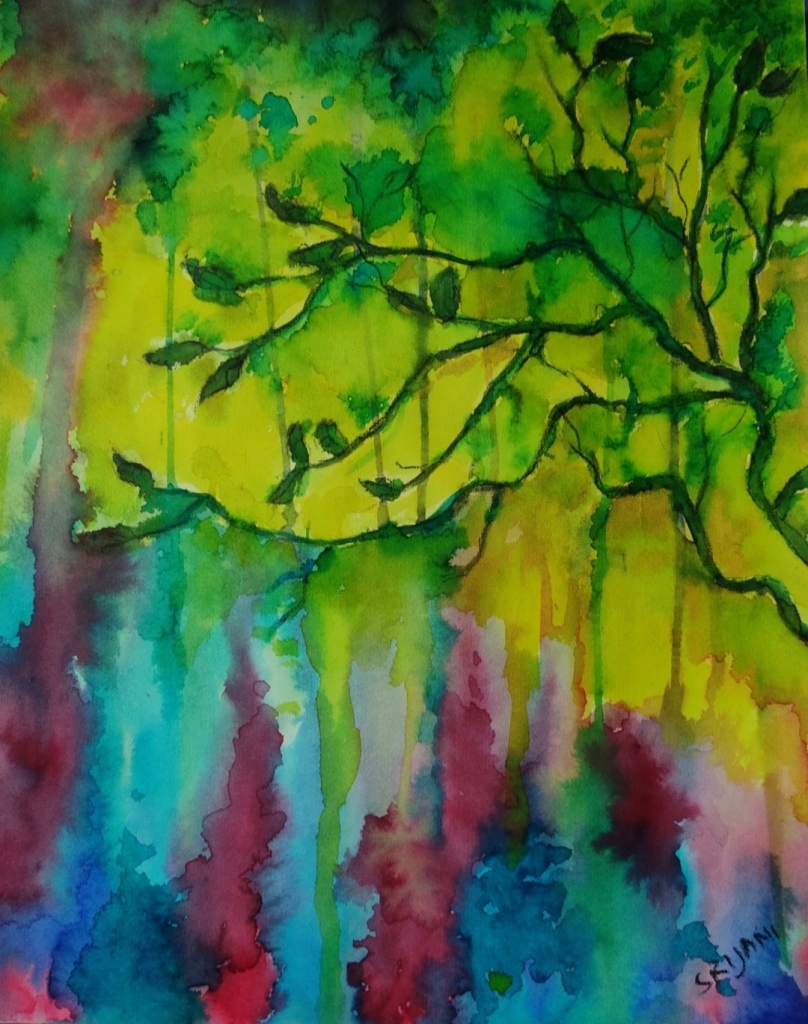
Hope in Winter(2020) by Srijani Dutta
“Here with a Loaf of Bread beneath the Bough,
A Flask of Wine, a Book of Verse -- and Thou
Beside me singing in the Wilderness --
And Wilderness is Paradise enow.”

― Omar Khayyám (1048-1131); translation from Persian by Edward Fitzgerald (Rubaiyat, 1859)

I wonder why Khayyam wrote these lines — was it to redefine paradise or just to woo his beloved? I like to imagine it was a bit of both. The need not to look for a paradise after death but to create one on Earth might well make an impact on humankind. Maybe, they would stop warring over an invisible force that they call God or by some other given name, some ‘ism’. Other than tens of thousands dying in natural disasters like the recent earthquake at the border of Turkiye and Syria, many have been killed by wars that continue to perpetrate divides created by human constructs. This month houses the second anniversary of the military junta rule in Myanmar and the first anniversary of the Ukrainian-Russian war that continues to decimate people, towns, natural reserves, humanity, economics relentlessly, polluting the environment with weapons of mass destruction, be it bombs or missiles. The more weapons we use, the more we destroy the environment of our own home planet. 

Sometimes, the world cries for a change. It asks to be upended.

We rethink, reinvent to move forward as a species or a single race. We relook at concepts like life and death and the way we run our lives. Redefining paradise or finding paradise on Earth, redefining ‘isms’ we have been living with for the past few hundred years — ‘isms’ that are being used to hurt others of our own species, to create exclusivity and divisions where none should exist — might well be a requisite for the continuance of our race.

Voices of change-pleaders rang out in the last century with visionaries like Tagore, Gandhi, Nazrul, Satyajit Ray urging for a more accepting and less war-bound world. This month, Ratnottama Sengupta has written on Ray’s legendary 1969 film, Goopy Gyne, Bagha Byne: “The message he sent out loud and with laughter: ‘When people have palatable food to fill their belly and music to fill their soul, the world will bid goodbye to wars.’” Shantanu Ray Chaudhuri has given an essay on one of the greatest pacifists, Gandhi, and his attitudes to films as well as his depiction in movies. What was amazing is Gandhi condemned films and never saw their worth as a mass media influencer! The other interesting thing is his repeated depiction as an ethereal spirit in recent movies which ask for changes in modern day perceptions and reforms. In fact, both these essays deal with ghosts who come back from the past to urge for changes towards a better future.

Delving deeper into the supernatural is our interviewee, Abhirup Dhar, an upcoming writer whose ghost stories are being adapted by Bollywood. While he does investigative stories linked to supernatural lore, our other interviewee, Andrew Quilty, a renowned journalist who has won encomiums for his coverage on Afghanistan where he spent eight years, shows in his book, August in Kabul: America’s Last Days in Afghanistan and the Return of the Taliban, what clinging to past lores can do to a people, especially women. Where does one strike the balance? We also have an excerpt from his book to give a flavour of his exclusive journalistic coverage on the plight of Afghans as an eyewitness who flew back to the country not only to report but to be with his friends — Afghans and foreigners — as others fled out of Kabul on August 14 th 2021. While culturally, Afghans should have been closer to Khayyam, does their repressive outlook really embrace the past, especially with the Taliban dating back to about only three decades?

The books in our review section have a focus on the past and history too. Meenakshi Malhotra’s review of Priyadarshini Thakur Khayal’s Padmini of Malwa: The Autobiography of Rani Rupmati, again focusses on how the author resurrects a medieval queen through visitations in a dream (could it be her spirit that visited him?). Somdatta Mandal writes of a book of history too — but this time the past and the people are resurrected through objects in Sudeshna Guha’s A history of India through 75 Objects. Bhaskar Parichha has also reviewed a history book by culinary writer-turned-historian Colleen Taylor Sen, Ashoka and The Maurya Dynasty: The History and Legacy of Ancient India’s Greatest Empire.

This intermingling of life and death and the past is brought to life in our fiction section by Sreelekha Chatterjee and Anjana Krishnan. Aditi Yadav creates a link between the past and our need to travel in her musing, which is reminiscent of Anthony Sattin’s description of asabiyya, a concept of brotherhood that thrived in medieval times. In consonance with wanderlust expressed in Yadav’s essay, we have a number of stories that explore travel highlighting various issues. Meredith Stephens travels to explore the need to have nature undisturbed by external interferences in pockets like Kangaroo Island in a semi-humorous undertone. While Ravi Shankar travels to the land’s end of India to voice candid concerns on conditions within Kerala, a place that both Keith Lyons and Rhys Hughes had written on with love and a sense of fun. It is interesting to see the contrasting perspectives on Southern India.

Hughes of course brings in dollops of humour with his travel to Adam’s Peak in Sri Lanka as does Devraj Singh Kalsi who writes about camel rides in Chandigarh, a place I known for its gardens, town planning and verdure. Suzanne Kamata colours Japan with humour as she writes of how candies can save the day there! Sengupta continues to travel to the past delving into the history of the last century.

Poetry that evokes laughter is rare but none the less the forte of Hughes as pensive but beautiful heartfelt poetry is that of Asad Latif. This February, the edition features poetry by Ryan Quinn Flanagan that borders on wry humour and on poignancy by George Freek. More poems by Pragya Bajpai, Sanjukta Dasgupta, Chad Norman, John Grey, Amit Parmessur, Sister Lou Ella Hickman, Saranyan BV and many more bring in varied emotions collected and honed to convey varieties that flavour our world.

Professor Fakrul Alam has also translated poetry where a contemporary Bengali writer, Masud Khan, cogitates on history while Ihlwha Choi has translated his own poem from Korean. A translation of Tagore’s poem on the ocean tries to capture the vastness and the eternal restlessness that can be interpreted as whispers carried through eons of history. Fazal Baloch has also shared a poem by one of the most revered modern Balochi voices, that of Atta Shad. Our pièce de resistance is a translation of Premchand’s Balak or the Child by Anurag Sharma.

This vibrant edition would not have been possible without all the wonderful translators, writers, photographers and artists who trust us with their work. My heartfelt thanks to all of you, especially, Srijani Dutta for her beautiful painting, ‘Hope in Winter’, and Sohana for her amazing artwork. My heartfelt thanks to the team at Borderless Journal, to our loyal readers some of whom have evolved into fabulous contributors. Thank you.

Do write in telling us what you think of the journal. We look forward to feedback from all of you as we head for the completion of our third year this March.

Best wishes,

Mitali Chakravarty

borderlessjournal.com

Click here to access the Borderless anthology, Monalisa No Longer Smiles

Categories
Poets, Poetry & Rhys Hughes

Climbing Sri Pada

I climbed Sri Pada on the 10th of January of the year 2023. I was still calling the mountain Adam’s Peak when I went up it, but on the way down I decided that it was more respectful to call it by the name the locals use. I had first glimpsed the mountain during my first visit to Sri Lanka, a year earlier. I saw it through a car window in the distance. “One day I will return and climb it,” I told myself, but I never imagined that I would do so just twelve months later. I often create lists of ‘things to do’ and items on those lists tend to remain on those lists for decades. I can be slow at compiling these lists and I found myself in the position of having to scratch out the words ‘Climb Sri Pada’ before I had even added them. Life is full of such ironies, luckily or unluckily.

Climbing mountains is one of the greatest delights of my existence, but the number of mountains I climb per year is low, on average just one, and I attribute my lack of drive to the typical mountaineer’s ‘peak lassitude’, which isn’t like the ‘peak performance’ of other kinds of athletes. You go up a mountain, stand on the summit and take a good look, then you climb down and look up, to see where you have been, and it is the theory of the climb, which has just been done in practice, that seems to be so exhausting. That’s my theory, anyway, or maybe it’s not quite deserving of the name ‘theory’. Perhaps it’s just a speculation or an excuse. But as I’ve always said, an excuse is as good a reason as any. I climbed Sri Pada and am still enjoying my fatigue.

Having arrived in Colombo by modern jet aeroplane, as one usually does, I caught a bus to the village of Maskeliya in the Central Province of the island, or rather a series of buses, as I couldn’t work out how to catch a direct bus there.

In fact, I first went to Kandy, a city on the way, or almost on the way, and stayed in a pleasant and cheap hotel for one night. I went to the Royal Bar for a meal and a drink, one of my favourite pubs in the world, and a place with strong nostalgic overtones for me. It’s a restored colonial building and I often feel like a restored colonial man, so it matches me perfectly. What I mean by this is that I’m getting old and cranky, but my foundations are solid, and my façade can be regarded as a noble one. There was a power cut while I was sitting at a chair on a balcony that overlooks an inner courtyard and the chef wasn’t able to prepare hummus in the dark, so I made do with chips and ketchup.

Sri Lanka was still reeling from the effects of economic mismanagement. I was expecting food and fuel shortages and disruption of public transport, as well as frequent power cuts, but I experienced little inconvenience, and I wouldn’t complain even if I had. Stiff upper lip and all that. A few days later, my British legs were stiffer than any lip has any right to be. But now I am jumping ahead. I couldn’t jump anywhere when my legs were stiff. I could hardly walk. But now I am drifting off the point, just as I drifted off the route when I was hiking to the base of the mountain. I am jumping ahead again. Let me go back a little and let me explain that all the inconvenience I didn’t experience because of economic mismanagement is still there, adversely affecting the people of the island, even if visitors don’t notice it. It’s important to be aware, even if the only thing we’re aware of is that we aren’t really aware.

From Kandy I caught a bus to Hatton. Every seat of this bus was occupied, and I had to stand. I wasn’t alone in standing, many other passengers were doing the same thing, and it was only the pressure from all these other standing bodies that prevented me from falling over on the winding road to the town of Hatton. I say ‘road’ but in fact it was just a series of bends that climb higher into the hills, an impressive drop on one side, no barriers, and a driver who liked to accelerate on those bends, presumably to teach them a lesson, or to teach us a lesson, about inertia and maybe some other laws of physics. It is cheaper than paying to use a rollercoaster and rather more sociable.

But the landscapes are beautiful. Tea plantations on undulating slopes with mountains in the background, and plenty of lakes. We reached Hatton and I tried to find another bus that would carry me the remaining distance to Maskeliya but I failed in this endeavour and caught a tuk-tuk with a talkative driver who acted as a tour guide on the way. “That’s a mountain over there, don’t know its name, and down there you can see a lake, not sure what it’s called, and reflected in the water is that very mountain. Imagine!”

At the time I had no idea that Hatton was the birthplace of one of my mightiest heroes, the explorer Eric Shipton, a man who climbed for real all the mountains I just gape at in picture books, and who probably found genuine evidence of the yeti, unless he was playing a prank and made the footprints himself. Who knows?

The tuk-tuk arrived in Maskeliya, which turned out to be a small place in which all the restaurants were closed, and it was impossible to secure a cup of tea or coffee. The fact we were surrounded by tea plantations and innumerable coffee bushes meant little, for all the tea and coffee was exported to Britain. I should have had a cup before I left my own country, I was informed. I replied that I had come from India where tea and coffee are daily occurrences, or even hourly occurrences, if necessary. There are numerous similarities between India and Sri Lanka, but also some differences. No snow-covered mountains on the island, for instance, therefore no yetis.

My tuk-tuk driver dropped me off on a dusty street full of holes over which his vehicle had been bouncing like a distorted rubber ball, and I found the place where I was staying. I was warmly greeted by my hosts and their two dogs. My room was above a garage and this building was the very last one in the village. I was given a pot of tea and a plate of biscuits to celebrate my arrival in such an obscure location. So, there was tea to be had in Maskeliya after all! I found it to have a pleasant but unorthodox flavour.

After I had drunk half a pot of the stuff, I was told it was coffee. So, there was coffee to be had in Maskeliya after all! Coffee that tastes like tea. Or rather, coffee that tastes like tea that doesn’t taste quite like tea. I learn something new every day, or nearly every day, even if it’s only that I don’t learn something new every day but only once a week. Does that make sense? I won’t say the altitude had affected my mind, because although we were quite high, we weren’t really very high. Maskeliya has an elevation of approximately 1205 metres. Nothing to write home about. But I only have an elevation of 1.74 metres, so who am I to pass judgement? I drank more of the tea.

For a few days, I prepared myself mentally and physically for the coming climb. I played with the dogs and read some books. One of the dogs had a habit of sunning himself on the roof of the house and I couldn’t work out how he got up there, onto the corrugated iron. Maybe he turned into a monkey by the light of the moon and turned back to a dog once he reached the roof. Magic is always a useful explanation for such mysteries.

At least it is useful until we know better. And often that ‘better’ turns out to be worse. Whatever the solution to the mystery, he was a nice dog and that’s what ultimately counts. An abacus also counts, but rarely ultimately, because it is limited by the number of beads on its wires. I went for a walk at a waterfall on the far side of the enormous lake that dominates the region horizontally, in the same way that Sri Pada dominates the region vertically. That was also part of my preparation. I drank more coffee.

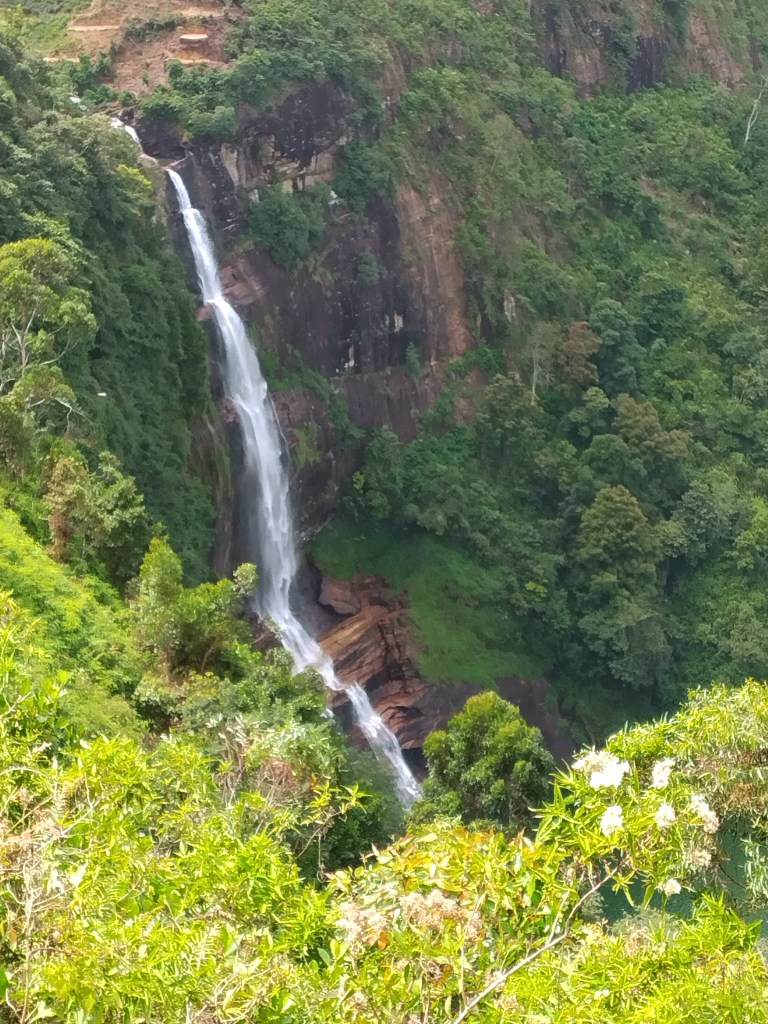
During my walk to the waterfall, it began raining and I ran for shelter. It’s a terrible thing to get wet on the way to a plummeting column of water that fills the air with spray and wets the onlookers. Almost as if the sky is trying to spoil the surprise. I found shelter too, in a lookout point with a roof. Two young men were sheltering there and they had a drum with them and they invited me to play it, which I did, while they did a peculiar dance. Perhaps it was the opposite of a rain dance? I didn’t think to ask, but I should have. The rain stopped. We left the shelter and went our separate ways. I ambled along a narrow path to the top of the waterfall and looked down.

Lots of gushing water making a roar. The world is God’s bathroom and he had left the tap on. That’s what it was like, a little anyway. I ambled back the way I had come and caught a bus to Maskeliya. An old man waiting at the stop thanked me for being British. It was the British, he told me, who brought tea to Sri Lanka. Before we came along, they only had mango juice and coconut water to drink. Appalling! I am uncomfortable when I am thanked for being British, and it does happen, more often than one might suppose. When the bus arrived, he was too emotional to board it and decided to wait for the next one. Personally, I like mango and coconut.

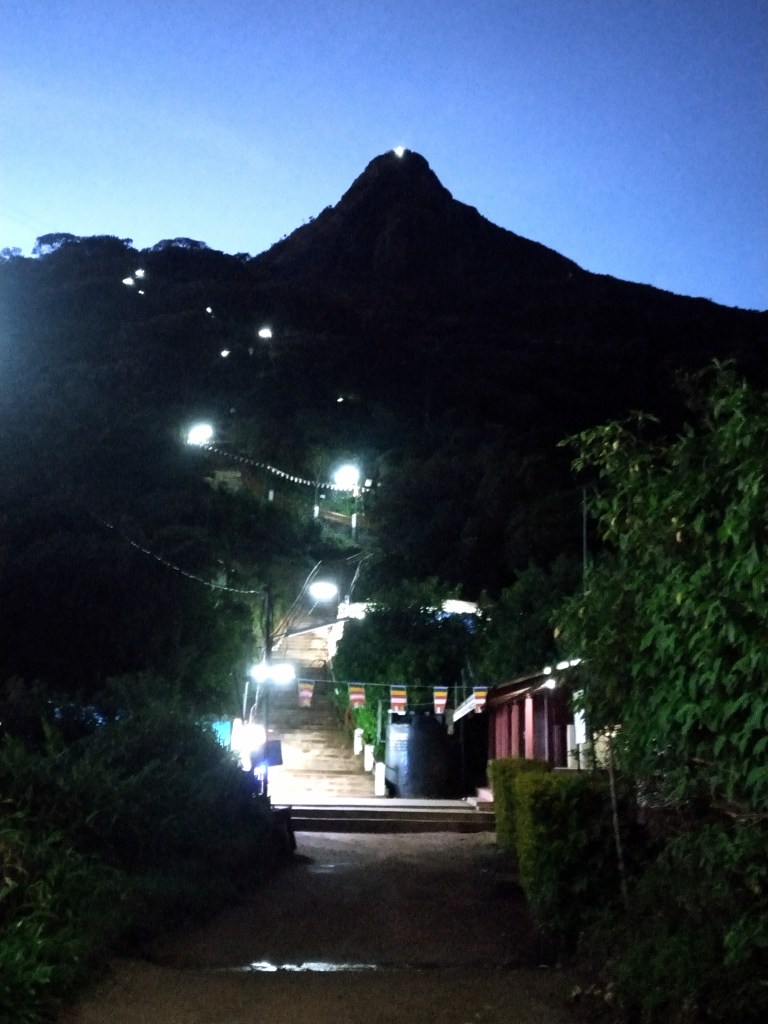
The day of the big climb arrived, or rather the night, for I had to depart my comfortable room at 2:30 in the morning and sit in a less comfortable tuk-tuk for an even less comfortable ride to a mountain that I could very uncomfortably climb to the top. I later wrote a poem about my climb which asked the question, why do I climb mountains at night in order to see the sunrise? The punchline of my poem was that I didn’t know the answer until I reached the top and then it dawned on me. Many or most poems don’t have punchlines, mine do. But this doesn’t mean mine are in the right. Sometimes I imagine they are punch drunk and that’s surely wrong. Punch can be made with mango and coconut as added ingredients, but probably not with tea.

The tuk-tuk stopped and I dismounted and began my hike to the base of the mountain. There are several routes to the base of Sri Pada. Some are easier than others, and some of the easier ones are much longer than the harder ones, making them harder in some ways. That’s mountains for you. I walked up a stony path and into a forest. I began to suspect that this was the dry bed of a stream rather than a proper path and I thought of my own dry bed in my room in Maskeliya. Too late, I was committed to the climb. It was a forest where leopards and elephants roam, but I didn’t know that until later, for there was no sign of them as I trudged up the inclines.

After a few hours I wondered if I had taken a wrong turn. The mountain should have loomed above me, but it wasn’t to be seen. That was weird, but I am used to getting lost on hikes and climbs. I even get lost in cities when I have maps. I’m not saying that I am a terrible navigator, but I would be very unlikely to employ myself as a guide to anywhere. I decided to push on in order to see how lost I actually was. The only way of doing this efficiently is to become even more lost and then compare the degrees of lostness, if lostness is a real word, which probably it isn’t. Ah well! I noticed a light far ahead that was a beacon of hope, and I increased my speed.

The light belonged to the isolated hut of a tea picker. At least I assumed the hut was a worker’s shelter, but it might have been something else, of course. I had hiked out of the forest and into a tea plantation. Yes, I had taken a wrong turn somewhere, and now I needed to go back and find that somewhere. But if I looked for it, I probably wouldn’t find it. Best not to look for it and stumble on it by pure chance. That was my strategy.

And it worked. I wandered off the path again, the wrong path, and luckily managed to end up by accident on the right path. The Buddha told us to follow the middle path, but there were only two paths here. I would worry about this at the top of Sri Pada, where there is a shrine to him. Incidentally I am extremely interested in Buddhism, it’s a religion I find most compelling, the one with the most reasonable ideas, but what do I know?

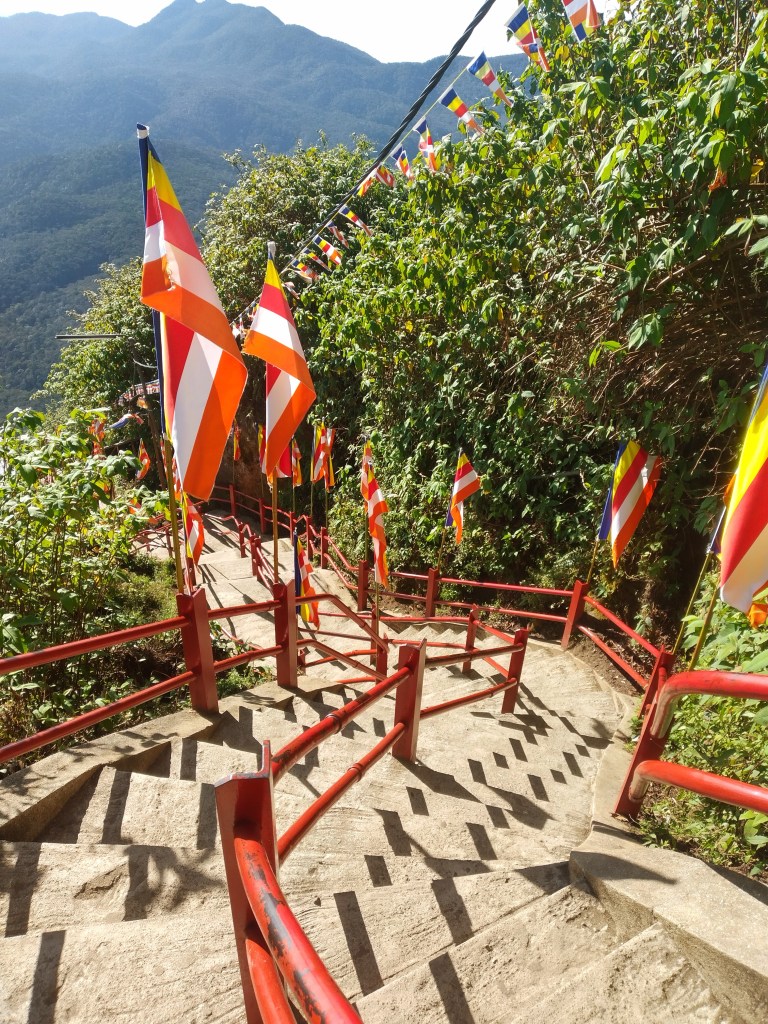
I can’t honestly say that my attempt to climb Sri Pada was a pilgrimage as well as a minor adventure. It would be nice to make that claim, but it would be dishonest. Maybe one day I will return in a more spiritual frame of mind and try again. I finally reached the 5500 steps that led up the side of the mountain and I climbed them and was rather astonished to find tea shops on the way, tea shops open all night. So, this is where the tea really went! Then I asked myself, how are these shops supplied? The tea must be carried up on foot, step by step, as there’s no other way of doing it, unless it is dropped by parachute, which is so improbable an option we can disregard it.

Five thousand five hundred steps up and five thousand five hundred steps down makes eleven thousand in total, and that’s a lot of steps. At first it seemed easy, because it was easy, then it began to seem more difficult, because it was more difficult. When things are exactly the way they seem, I find that it focuses my mind acutely. My legs were tired halfway to the top, but I told them to take heart and not let down the other parts of my body, which still wanted to get to the summit and were relying on them. I also told my heart to take heart. It didn’t really require that advice, as it happens.

Finally, I reached the top. The sun came up. It came up effortlessly, without the need for steps. The sun is five billion years old but acts like a youth, setting a good example to us all. Funny how it sets this example when it is rising. But I am wandering off the point, and the point is not a path. I took off my boots and approached the shrine, which stands on a small area at the very apex of Sri Pada and overlooks the other mountains and hills in every direction. Inside this shrine is the footprint, but it has been covered over with a golden seal in the shape of a foot and I can’t report on what it actually looks like. I also rang the bell that has been provided for the use of summiteers.

I don’t know if ‘summiteers’ is a real word. I could check but I worry that it might not exist in the lexicons and then I would feel obliged to change it, and I don’t want to do that. Musketeers is a real word, so I don’t see why lexicons should feel a need to pick on summiteers. If they picked on musketeers, they’d soon be sorry! The bell at the summit of Sri Pada should be rung the number of times the ringer has climbed the mountain. I rang it once. Then I began the long descent. I found this harder than the climb because my knees were sore, and my legs were shaky. They wibbled and wobbled like jellies in the shape of limbs, a very cunning pair of jellies no doubt, but a feeble set of legs. Nonetheless, down I managed to go, slowly, surely, puffingly.

On the descent, two boars crossed my path. They were very casual, a more nonchalant couple of wild pigs can hardly be imagined. They trotted out of the undergrowth on one side, stopped to admire the view, then carried on into dense undergrowth on the other side. I noticed that their legs didn’t wibble or wobble. It’s true that I might not be able to tell a wibble from a wobble when it comes to a pig because I’m not a trained vet. I’m not even a wild vet. I am no kind of vet. That goes without saying. I went without saying too, downwards again, until at long last I reached the bottom, exhausted.

All the photographs have been provided by Rhys Hughes

Rhys Hughes has lived in many countries. He graduated as an engineer but currently works as a tutor of mathematics. Since his first book was published in 1995 he has had fifty other books published and his work has been translated into ten languages.

.

PLEASE NOTE: ARTICLES CAN ONLY BE REPRODUCED IN OTHER SITES WITH DUE ACKNOWLEDGEMENT TO BORDERLESS JOURNAL. 

Click here to access the Borderless anthology, Monalisa No Longer Smiles

Categories
Review

The Birth Lottery and Other Surprises

Book Review by Somdatta Mandal

Title: The Birth Lottery and Other Surprises

Author: Shehan Karunatilaka

Publisher: Hatchette India

When Hatchette India sent the reviewer’s copy of Sri Lankan author Shehan Karunatilaka’s collection of short stories, The Birth Lottery and Other Surprises, it had two eulogies on the cover, namely “From the Commonwealth Book Prize Winner” and “Booker-Shortlisted author,” assuming both would add to the USP[1] of the volume. Karunatilaka’s debut novel Chinaman: The Legend of Pradeep Mathew had received a lot of critical acclaim when it was first published in 2010 and received the Commonwealth Prize. In the meantime, on 17 October 2022, the author did manage to win this year’s Booker Prize for his third novel, The Seven Moons of Maali Almeida, set against the backdrop of the civil war in Sri Lanka. This award definitely garners more attention to read this new book of short stories. According to the publishers, The Birth Lottery and Other Surprises offers a pointed conversation “about religious fanaticism, social prejudices, and the devolving state of democratic order in the Indian subcontinent”. Replete with unexpected twists, it is a “vivid and engaging commentary on privilege, class, and societal ills” and offers a collection of fantastic short stories that serves up fantasies for both doomsday and everyday, marking the return of one of South Asia’s most compelling storytellers.

As a writer with an English literature background and having studied in Sri Lanka and Australia and lived and worked in London, Amsterdam, and Singapore, Karunatilaka’s style of writing is unique. He has not only written about the Tamil-Sinhala conflict plaguing the island nation both from an insider and an outsider’s point of view but has, at the same time, experimented with the postmodern literary form where many entries resemble the magic realistic mode of narration. Ranging from short entries of half a page to stories covering several pages, it seems that the author has put together all his assorted unpublished writing within the two covers of this volume. In an interesting entry at the beginning titled ‘How to Read This Collection’ the author with all his blessings to the readers prescribes seven different categories in which to read his work and clearly tells us not to read them in sequence – “I don’t with other people’s work. Why should anyone with mine?” He then tells us, “If you like stories with twists, try …. If you prefer tales where things happen, go for …. If you enjoy fiction, where nothing happens, start with …. If you’re okay with tales that force the author’s worldview down your throat, read …. If you prefer stories that hope there’s a God, try …. For ones that allow you to accept godlessness, read ….and if you like stories that everyone hates, start with ….”

With such a prescription, it becomes clear that the author himself is at a loss to classify the multifarious nature of the thirty stories of differing length under specific categories.  There is the story of unpleasant truths that await a Sri Lankan president in the back of a London cab. In ‘Small Miracles’, an advertising agency must come to terms with a blown-up collection of pictures of the employees’ penises. ‘If you’re Sad and You Know It’ talks about suicidal tendencies in poetry form. A man presumed missing, quietly journals by the sea – “while he sat alone, free of noise, on an island not far from here, writing his story in a yellowing journal…Staring at sunsets through large binoculars, surrounded by books and fruit and no one.”

Written in an interesting format in the nature of mobile text messages, ‘Easy Tiger’ has a husband and wife cheating each other while attending a movie show on Sylvester Stallone with someone else. With the background firing in the movie, the man pretends he is in the war front where the shooting has started and his phone would die soon; he knows adultery is a crime but doesn’t want a divorce, but his story of being in the warfront in the east is busted by his wife who came to watch the same movie with her paramour and a special camera and films her husband with another woman and asks, “Who’s the hag next to you?” Looks like everyone texts at the movies these days.” In ‘The Colonials’, an Englishman, a Dutchman and a Portuguese walk into a Ceylon bar and profess their grand narcotic designs and counter proposals–“Let us plant our poppies while we can.”

Karunalilaka experiments with the narrative mode once again in the title story ‘The Birth Lottery’ where he tries to depict the historical past and present condition of Sri Lanka through the point of view of forty-two different men and animals each written in the first person. For example, in entry number 27, we read:

“It is the first alliance between the Tamils, Cholas, Moors, Malays and Sinhalese, and I, the Great Arasaratnam, am charged with leading it. With an army of four thousand, we rout the Portuguese and hold the Sithawaka kingdom for three hundred moons. Then they return with bigger cannons, eviscerate us all, and erase our names from history.”

Entry number 29 states:

“I am the justice who signs as a witness the agreement between Wimaladharmasuriya and Joris Van Spillbergen. The one that hands the coast to the Dutch and the kingdom to Ceylon. A treaty that both parties break. I never marry, never amass wealth, never create. Never do anything aside from putting my name on a document that will outlast anything you have ever touched.”

The plight of indentured labourers becomes clear once again in entry number 32:

“I am brought to the hill country as a slave and made to pluck the sweet leaf. I am imprisoned with coolies from South India, even though my family has lived here for centuries. I bear children for five different masters, and each are taken from me. I take my life before my ovaries dry up. I am not unhappy to go.”

Wry humour is also revealed in entry number 37:

“I am an elephant in the Kandyan kingdom, and every few months, to celebrate being conquered by foreign invaders, they parade me in chains and walk me miles carrying burning objects that scald. I don’t mind, because I get to go home to Ravani, who lives with me all my life and bears me many calves.”

It is not possible to point out further details of other stories within the short span of this review. But one needs to mention two excellent long entries, ‘Time Machine. I have Built A (Part One)’ and ‘Time Machine. I Have Built A (Part Deux)’. In the first part the author speaks about stealing the time machine though he was not the one who built it. That credit belongs to Professor Cyril Ponnambalam, Dr Kumar Thiruchelvam and Chancellor Sivaram Duraiappah. Though some would say not. …All three resigned from their posts in 2004 to return to Sri Lanka, though not with their families. Two were executed by the Tiger leadership a week before the end of the war, five years later. One was reported missing in action.

“They weren’t the only scientists, engineers, financiers and logisticians from the diaspora to return to Sri Lanka following the 2002 ceasefire. Many came on humanitarian missions or for peace conferences, most to assist with reconstructing the north and the east, fractured from decades of war and about to be pounded by a tsunami. A majority were recruited by the LTTE, some by force, some by extortion, some by the memory of wrongs.”

The author’s political allegiances become clear in several places in the narrative. He says he “pondered whether this government would want to share examples of Tamil brilliance, when they were trying to convince the world of the enemy’s savagery.” Again, in another place he writes, “The Sinhala bullies had over the decades chased some of the brightest Tamil minds from the island and Prabhakaran had electoral rolls in 75 countries and conscripts to track down long names ending in consonants.”

Karunatilaka  ends the story by saying that he does not have any clue how time or history moves. If he assassinates a Milosevic, a Pinochet or a Cheney, how sure would he be that another butcher would not rise in their stead? Maybe certain destinies are made to play out as written and it is not their place to meddle. So he concludes, “Maybe the only thing I can affect and take responsibility for is my own could-have-been-better life.”

Karunatilaka begins the second part of the story with a more personal and direct statement:

“The history of Sri Lanka since 1945 is a catalogue of me missing out on sex. In 1958, when SWRD was sprouting the vitriol that would divide a nation, I was going to Aunty Sumana’s piano class. She used to put her hand on my shoulder as I played Chopin…. When the 1962 military coup was taken down with whimper and without bang, I was also whimpering and not getting banged in my first year of cadetting…. When the 1971 insurrection happened, I had a girlfriend in Polonnaruwa who only let me touch them under the umbrella. When the island changed from Ceylon to Sri Lanka in ’72, I fell into a whorehouse in Nikaweratiya along with nine other cadets and even though I ended up with the prettiest I was unable to spark the flame. By the time the ’83 riots came along, I was married with three, transformed into my wife’s peon and unable to raise a flag nor fire a gun.”

In an interview Karunatilaka had admitted that he took almost two decades to finish the entries in this book. The oldest story was written during the millennium bug and the newest during a global pandemic. These were stories that he wrote while procrastinating on things he never finished, or to win prizes that he never entered, or to try out ideas that wouldn’t leave him alone. All in all, Karunatilaka’s love and concern for his homeland comes out in different ways through these multifarious vignettes and he can certainly be labelled as a current spokesperson of this small, beleaguered nation of Sri Lanka, a strong and concerned South Asian voice indeed. Reading the book is surely recommended.

[1] Unique Selling Proposition

Somdatta Mandal, critic, reviewer, and translator, is a former Professor of English at Visva-Bharati, Santiniketan, India.

.

PLEASE NOTE: ARTICLES CAN ONLY BE REPRODUCED IN OTHER SITES WITH DUE ACKNOWLEDGEMENT TO BORDERLESS JOURNAL.

Categories
Interview

Rhys Hughes Unbounded

In conversation with Rhys Hughes

I have always wanted to interview Ruskin Bond who lives in Landour, near the hill-station of Mussoorie in India. Bond, now 87, grew up in Dehradun, tried a stint in England and returned to the country that had nurtured him to write stories that make us laugh and yet bring out the flavours of love and kindness in the Himalayas. Sadly, no one seems to be able to get me an online interview with him. So, I did the next best thing…

I interviewed Rhys Hughes.

Rhys Hughes in Srilanka

You have to see it from my perspective, here was a humourist migrating from UK to India, just like Bond. Both their names begin with R — Ruskin wrote of monkeys conducting a fashion parade in colourful pyjamas borrowed from him, perhaps permanently and Rhys wants to interview a monkey who took a bottle of coconut oil from his current home. Only, Hughes’ monkey happens to be in Sri Lanka and Bond’s monkeys were in India. In fact, I told Hughes he could be the next Bond and could perhaps get into an apprenticeship. He has the basic compassion and humour in his writing that endears Bond to so many hearts. However, Hughes has not made it across to India as yet. He waits on the lush shores of Sri Lanka to make a landfall on the Coromandel Coast or … maybe the Himalayas… as the pandemic continues to upheave in tsunami-like waves. Maybe, Rhys Hughes will become the Ruskin Bond of Sri Lanka! Let us tread into the world of Hughes to check out what he thinks.

Tell us since when have you been writing? What gets your muse going?

I began writing when I was six years old or so. My earliest stories were inspired by films and comics I enjoyed and mostly were about monsters, adventures, space travel, robots, dinosaurs and ghosts. I doubt if any of them made much sense.

The first short story I wrote with a plot I remember was about a man who jumps off a cliff so that he will turn into a ghost and can create mischief in his village, which he does, but the twist is that he survives the fall and only thinks he is a ghost. The enraged villagers chase him back over the same cliff, and he isn’t frightened because he believes he can float on air, but he can’t and this time he doesn’t survive. I was about ten years old when I wrote that. But I didn’t begin writing short stories in earnest until I was fourteen. That was the real beginning of my writing career. I have been writing regularly ever since. I don’t require prompting to write these days. It has become a habit, a reflex, something I just do. I still write about the same old things as always, monsters, adventures, space travel, etc, but I have added a few more themes since I was a young child and my style has improved considerably. At least I hope it has!

That story you wrote as a ten-year-old definitely has potential! And we enjoy your writing as we read it now.  Now tell us why do you write?

Ideas come unbidden into my mind and they won’t leave me alone unless I put them into stories. The moment I embody these ideas in a work of fiction they stop bothering me. I get ideas all the time, especially when I am walking or travelling somewhere, but also in the middle of the night. I try to make notes so I can use them later but sometimes I neglect to note them down and I forget them. Then the ideas go away temporarily but return days, weeks, months or years later and bother me again. Only when I pin them down into a narrative of some kind will they go away forever. So writing is a compulsion for me as well as a voluntary activity. It wasn’t always like this.

In the beginning I found it difficult to come up with original ideas. I had to work hard at it. I would say that most of my ideas back then were fairly ordinary ones and only occasionally truly original. But I persisted and exercised my mind, and just like muscles do, the parts of my mind responsible for the invention of original ideas got bigger and stronger, and now the ideas come without effort. As it happens, not all these ideas turn out to be as original as I like to think they are. Sometimes I get excited that I have come up with a totally new concept only to later discover that some other author beat me to it years ago. But I do believe that originality is possible.

The oft-repeated maxim that there are no new ideas simply isn’t true. If originality is impossible, how were any ideas generated in the first place? I don’t mean to say that originality is the ultimate objective of writing, of course not, there are a great many other reasons to write, but I am talking about it from my own particular point of view. And all I am really saying here is that practice is the most important thing, the only essential thing. I write a lot and the very act of writing regularly seems to make writing in the future easier and smoother.

What is your favourite genre for writing and for reading?

The genre question is a difficult one to answer but I am going to say that if I had to choose only one genre to describe my own writing I would answer “comedy”. This doesn’t mean that everything I write is comedic, but a large percentage of it certainly is. And I don’t necessarily mean laugh-out-loud comedy but other types of comedy too, whether subtle irony, philosophical farce, absurdist and surrealist works. There are many grades of comedy, from wit to parody, and I enjoy most of them. When it comes to reading, I still have a focus on comedy, I suppose, but I will read very sober and serious works too. If I made a list of my favourite works of fiction, comedic works would be at the top of the list.

Broadly speaking there are two types of humorous literature, one in which incidents are funny and one in which it is the telling that is comic. Writers who combine both types tend to win my deepest admiration. Yet quite a few of my favourite books have no comedy in them at all, neither in subject nor in style, for example The Adventures and Misadventures of Maqroll by Alvaro Mutis ( 1993, translated by Edith Grossman, 2002) which is a sequence of tropical and troubling narratives, often sombre in tone, that nonetheless remains an enthralling and uplifting read.

Which writers have influenced your work? Are you influenced by other art forms?

I wanted to become a professional writer because of Robert Louis Stevenson. It was Treasure Island (1883) that opened the gates into the entire world of literature for me. I still admire him hugely but I have had much bigger influences since then. Delving deeper into the novels and short stories that were available to me, I was lucky enough to find authors who resonated with some deep part of my being and made me not only want to continue trying to be a writer, but to be a writer who wrote as they did. Of course, it’s better to develop one’s own style, but I suspect that ‘distinctive’ styles are really the result of amalgams of influences, a blend of prior styles. Italo Calvino (1923-1985) has been my favourite writer for more than thirty years, with Donald Barthelme (193i-1989), Boris Vian (1920-1959), Flann O’Brien (1911-1966) and Stanislaw Lem (1921-2006) not far behind. At the moment I am a keen reader of the work of Mia Couto (1955-2013). Alasdair Gray (1934-2019) is another favourite.

To answer the second part of your question, I have definitely been influenced by art forms other than writing, in particular music and visual art. I might even say that the paradoxical imagery in the artwork of M.C. Escher (1898-1972) has been at least as big an influence on me as the prose of any author. I was astounded and captivated when I first saw his graphic designs and have loved them ever since.

You have travelled to many places. How many countries have you visited? Has travel impacted your writing? How?

I have lost count of the number of countries I have visited. I used to keep a map and colour in the countries that I had been to, but I lost the map years ago. The truth is that probably the total isn’t as high as I think it is. Most of my travelling has been done in Africa and Europe, and I have only really dipped my toes into the vastness of Asia, and I haven’t even been to the Americas at all. No one is so well-travelled that they really know the world.

Travel has certainly impacted my writing, though. I can state that with confidence. I am often inspired to write stories set in the places I have visited and I guess I probably wouldn’t do so if I hadn’t been there. Having said that, I do occasionally set a story in a location I have never visited. Such stories can work well but there is nearly always a vital element missing, some immediacy that a certain level of familiarity gives to a work of prose. It’s far easier to create a convincing atmosphere when you are writing from experience rather than from research. Little details will give some solidity to the evocation of scenes, details that can’t be easily imagined without first-hand experience. This doesn’t mean that I think travelling is necessary for the creation of good fiction. Good fiction can be centred in nowhere, almost in no space or time if the author is talented enough. And there’s a paradox in the nature of travel, which is that even though the particulars of your surroundings might change, the essentials remain the same. We can put a lot of effort into the act of travelling only to discover that people are people everywhere. And would we have it any other way?

Tell us a bit about the world you grew up in — we have an interesting piece by you called ‘Dinosaurs in France’ — which claims you grew up in a world of different value systems. Would you see those as better or the present as better?

The past is another country. That’s one of the pithiest and truest maxims anyone has devised. In only half a century I have seen many changes, but in fact most of these changes came so gradually I didn’t notice that things were changing at the time. Only now, looking back, do I see the vast gulf between the present and my past. I was youthful in a world where information was much more difficult to obtain. There were rumours and suppositions and often no way of confirming or refuting them. People believed strange things and adjusted their attitudes to match these odd beliefs. People still do the same now, of course, but it somehow feels different. One can more easily check assertions now than before and learn much more quickly if they are true or false. The world I grew up in was one in which you had no choice but to take another person’s word at face value. So if a supposedly responsible adult, like the postman, told you with a straight face that he lived in a house made entirely from marshmallows, there was no easy way of disproving the claim. You had to take his word for it. I can’t say it was a better world and I don’t want to suggest it was a worse one. It was simply different, a world lacking ready access to information.

You have written a lot of humour. Not too many people do that nowadays. Could you tell us why your funny bone is tickled to create humour as it does? Do you think humour is a good way to address major issues?

Humorous writing has gone out of fashion to a certain extent in the anglophone world, yes, but it’s still there, in the background. There was a great tradition of British humorous writing that lasted about a century or so, and I was fortunate enough to grow up at the end of that phase. I am talking about a particular type of humour, dryly ironic but also theatrical, a sort of blend of surrealism and the old musical hall routines. J.B. Morton (1873-1979) was one of the masters of the form, and he was an influence on many of my favourite comedic writers, such as Spike Milligan (1918-2002), Maurice Richardson (1907-1978) and W.E. Bowman (1911-1985). These humorists also took the language and played with it a little, transforming it into something new, though I feel ultimately that such comedy derives more from the rhythms than the melodies of wordplay.

The entire range of comedic devices might be used but new ones invented as well. There can be over reaction to minor incidents and under reaction to major ones, constant misunderstandings, amplification of repetition, parody of existing forms. W.E. Bowman’s The Ascent of Rum Doodle is my favourite humorous novel, and its sequel, The Cruise of the Talking Fish, is also high on my list of best comedic literature. Bowman apparently wrote a third volume in the series that remains unpublished and is in the safe keeping of his son. If this is true, I hope it will appear one day.

Are you influenced by any specific humourist? If so, who?

Flann O’Brien is probably my biggest influence in terms of comedic prose. His work is quirky, inventive, curiously erudite, absurdist and often metafictional. I am staggered by the wealth of invention in his novels, the supremely silly but also highly ingenious conceits and concepts, and the bone-dry irony contrasted with farcical exuberance, the light touch and the dark tone. W.E. Bowman and Maurice Richardson are another two favourites. That is prose but when it comes to poetry I love Don Marquis (1878-1937), Ogden Nash (1902-1971) and Ivor Cutler (1923-2006) best, all of them with radically different approaches to comedy. Marquis in particular pushed humour in his free verse to a point where it often became profound, serious and socially critical. You asked if humour can be used to address major issues. Yes, sometimes it can, even with great force, but it doesn’t have to.

Tell us the extent of your work. How many books have you written?

I have published many books. The question is how do I count them. I tend not to count the self-published books. It seems to me that self-publishing is too easy. On the other hand, traditional publishing is maybe too difficult. I have forty or so traditionally published books and twenty self-published books out there, so I am going to give forty as my answer. Most of my books are collections of short stories. I have only written a few novels. My poetry collections so far have been self-published with the exception of one single volume called Bunny Queue.

It is one of my goals to have all the short stories I have ever written appear in my books. At the moment there are many of my short stories that exist in magazines and anthologies that have never been collected. And there are many unpublished short stories in my files too. My plan is to write exactly a thousand short stories and consider them as part of one big story-cycle. This project is almost done. In a few more months, with luck, I will finish writing my thousandth story. Thirty years in total it has taken. When that last story is finished I will devote myself entirely to novels, plays, poetry and articles. No more short stories! So, in reply to your question, I can say that I have written a great deal of work, maybe too much, but as I said earlier, writing has been something of a compulsion for me.

What are your future plans?

I plan to finish my big story-cycle of one thousand stories. Then I will write a few novels that I have been planning for a long time. One of these novels will be called The Hippy Quixote and will be about a young, deluded fellow who in his mind is living in the 1960s. He takes a guidebook written in that decade and follows the old hippy trail to India, blissfully unaware that so many things have changed in terms of societal attitudes and geopolitics. This idea seems to me to be a fruitful one for the creation of comic scenes.

I also have to finish a novel I began a long time ago, The Clown of the New Eternities, sections of which have already been published. It’s long overdue for completion. This novel is about a highwayman who has accidentally outlived his own age and is forced to adjust to the modern world. Another variant of Quixote, I suppose. I think that many or most of my longer narratives are a blend of the Quixote and Candide models with a bit of Gulliver thrown in. We can talk about our future plans all day, of course, but whether we are lucky enough to have a chance to make them real is another question altogether. I intend to do my best, as I have always done, but nothing is certain in this world of ours.

Thanks Rhys Hughes for your time and lovely answers.

Click here to read prose & poetry by Rhys Hughes.

(This is an online interview conducted by Mitali Chakravarty.)

PLEASE NOTE: ARTICLES CAN ONLY BE REPRODUCED IN OTHER SITES WITH DUE ACKNOWLEDGEMENT TO BORDERLESS JOURNAL