Poetry by Quazi Johirul Islam, translated from Bengali by Fakrul Alam
The Creation of Adam by Michelangelo(1475-1564), Sistine Chapel. Courtesy: Creative Commons
One day I too burst into protest like marginal people do
Clamouring for longevity.

Despite evolving for millions of years
How could us civilised, highly intelligent creatures
 have such short life spans?
This should never have happened!
When a man succeeds to stand tall on his own merit
Comes the call: “Exit from this world….”
How ridiculous! No way one should accept such a summon!
A man with a life span of only 60, 70 or 80?
Maximum 90, or—with an exception or two—a century—
Does this make any sense?

Humans should live as long as they want to.
Like a ruler of any impoverished nation,
God has seemingly dictated even our retirement age!
Look at the developed countries of the world, O God,
No retirement age there! One retires when one wants to
And no one is forced into retirement.
Humans should live or die as long as they want to.
I want the freedom to choose death
I called out to all at the top of my voice—
“Let us all die only when we want to!”
To my protests the Compassionate Almighty paid heed
And came down to our protest meet.
Putting a hand on my shoulder, he said,
“How long would you like to live?”
I could have asked Him then to give me
Four or five hundreds, or even a thousand years of life,
But I didn’t, not being the kind of opportunistic leader
Who’ll slow down a movement by accepting bribes!
I had confronted the Almighty face to face
And told him: “Till the time you can ensure the right
To die, only when a human being wants to die,
Our movement for this cause will go on and on!
A smile on his face, God said: “Haven’t you realised yet
It’s up to every human being to decide his or her fate!
I’ve shark bone hangers holding up millions of fleshy dresses
All kinds of fleshy dresses sway in the breeze,
But what makes you think such dresses equate life?”

“Life, for sure, is strewn across the ways of the world
Marked by the footsteps of your kind
Every day you fidget and frown
And draw images one way or the other
Serve those who are in distress or need help
Embrace trees and burst into tears
Such going-on typify your lives.

“Clothes wear and tear
There comes a day when they have to be thrown away
Do you want eternal life for your attire?

“You’ll live by the footsteps you etch on earth
Didn’t your predecessors themselves decide on how long they would live?
Didn’t Moses, Christ, Mohammed, Buddha, Socrates, Rabindranath and Einstein
Decide in their own ways how long they would be living?

“Decide on your own how long you want to live
Stop worrying about how long your clothes will last!”
Quazi Johirul Islam has been writing for over 3 decades. He has published more than 90 books, 39 of them are collections of poetry. His travelogues are very popular. He has been with United Nations, has traveled all over the world, worked in conflict zones, his bag is full of colourful experiences. In 2023, Quazi was awarded Peace Run Torch Bearer Award by Sri Chinmoy Centre, New York. He has also received many awards and honours in Bangladesh, India and abroad.
Going up from East River to all heated up 46 Street,
Crossing quite a few avenues one after another,
Just where 5th Avenue comes into view jarringly,
One comes across America’s biggest bookstore, Barnes and Nobles,
Poised at this point of the city like an ancient philosopher.
And when I say “biggest”, I mean one store of a really big bookshop chain.
There may perhaps be a bigger shop than this one somewhere else,
Or perhaps there may be none comparable in size!

On weekdays I stand there for some time around ten
Perhaps because of its proximity to Diamond District,
The morning sunlight here—an amalgam of diamond and gold—
Streams onto the 5th Avenue pavement.

Perhaps to pick them up,
Causal and loosely clad, white-skinned women flood the street.
Usually, I buy a glass of smoothie from the Mohican youth
Making energy drinks on his machine,
Savouring afterwards a glass of the diamond-gold drink.

I can take many roads to come to F train station,
But I always use this particular crossing point.
On evenings, while returning from the UN building,
Unthinkingly, I enter Barnes and Noble’s cavernous stomach
Two concrete monsters cover the orange-coloured cloud.
What can a man possibly need in a bookshop?
It is quite one thing if it is a bar or a meat shop!
Of course, Americans crowd vegan shops nowadays,
Who knows if one day vegans will alter the American language?

From some aisle of the shop, on any given day, I’ll pick up any one.
The other day it was that old man from the Vermont Hills, Frost.
As soon as I picked him up, he wanted to make me wise in my ways.
“Try and fathom out the music of verse—that is it essence!”
What rubbish! The guy is still stuck in the 1960s!
The world of poetry has marched forward a lot,
And has been crossing all sorts of holes and pits nowadays,
And prose’s highs and lows.
The old man is such an ignoramus!

Holding a milk-honey concoction on her lap sat the Punjabi girl, Rupi Kaur.
Seeing me, she sprang into my lap.
India seemed to tremble as fingers touched soft dark skin.
Though someone who was still in her teens only yesterday,
She couldn’t resist dishing out advice. She said:
“Forge a knife on your own dear poet; hold the weapon in your hand,
The time has come to slice things with one stroke after another!”

The day I banged against Rae Armantrout, was the day I learnt about her verse,
About how in their silences became representative of language movement poetry.

I saw many others in their welcoming aisle as well!

I saw Ezra Pound trying to suppress a smile when I entered,
For sure I did not dare go near him out of fear
But let me whisper this into your ears:
I sure did mangle his poetry in trying to translate it!

I saw Amiri Baraka’s unruly beard fly in the air conditioner’s wind.
Nude Ginsberg was walking up the stairs leading to the second floor,
Shouting as he did so, “They don’t understand people’s sufferings
So obsessed are they with “development”!
John Ashberry was looking at the Hudson with one eye,
His tears stonily registering some hidden pain there
The other eye was all ablaze
All of a sudden, like a scene in some animation film,
The man’s eye’s fire made Manhattan burn.

I fled the fire that was burning so
Thinking as I did then—
How could Barnes and Nobles accommodate such hostile pronouncements,
                                                                                              such wrath!

				Holliswood, New York
				24 June, 2022
Quazi Johirul Islam has been writing for over 3 decades. He has published more than 90 books, 39 of them are collections of poetry. His travelogues are very popular. He has been with United Nations, has traveled all over the world, worked in conflict zones, his bag is full of colourful experiences. In 2023, Quazi was awarded Peace Run Torch Bearer Award by Sri Chinmoy Centre, New York. He has also received many awards and honours in Bangladesh, India and abroad.
Poem by Quazi Johirul Islam, translated from Bengali by Professor Fakrul Alam
Quazi Johirul Islam
As a boy I heard the same story from my father again and again:
My grandfather hadn’t left behind for his son any kind of plot
Where seeds could be planted that would yield a garden full of yummy stories.
In the same vein, a hunger for stories engrossed me in my childhood and teens.

I know that all ye still to be born children
Will cry glumly like I once had, hungry for stories.
That is why I’d braved cresting, roaring waves,
Cooked soups of stories on immigrant cookers on wintry nights;
Diving to the bottom of the sea, I’d seen how marine species
Dance to the rhythm of hidden waves,
And write on whale bodies of the sea!
From empty spaces, I captured wild African stories of desert bisons;
Standing in the chilling North Pole blizzards,
I was able to divine stories of stormy nights;
From Gibraltar, I fetched the bright light of new stories
Which I then strewed on Casablanca’s ancient eyes!

Out of my sweat and blood, I create endless stories for coming generations
For I know that even though all other causes of hunger may die,
What will only survive in the dark is the hunger for more and more stories.

From wintry prairies to grey Savannahs,
And in all pathways of the world,
I’ve been sowing seeds of new stories every day.
Climbing down from the lap of juicy fruit-filled gardens,
Seated on the soft mat that is earth,
They keep developing the craving for new stories endlessly.
Endlessly, the hunger for untold stories
Vibrate all sleepy pathways of the world!
Quazi Johirul Islam has been writing for over 3 decades. He has published more than 90 books, 39 of them are collections of poetry. His travelogues are very popular. He has been with United Nations, has traveled all over the world, worked in conflict zones, his bag is full of colourful experiences. In 2023, Quazi was awarded Peace Run Torch Bearer Award by Sri Chinmoy Centre, New York. He has also received many awards and honors in Bangladesh, India and abroad.
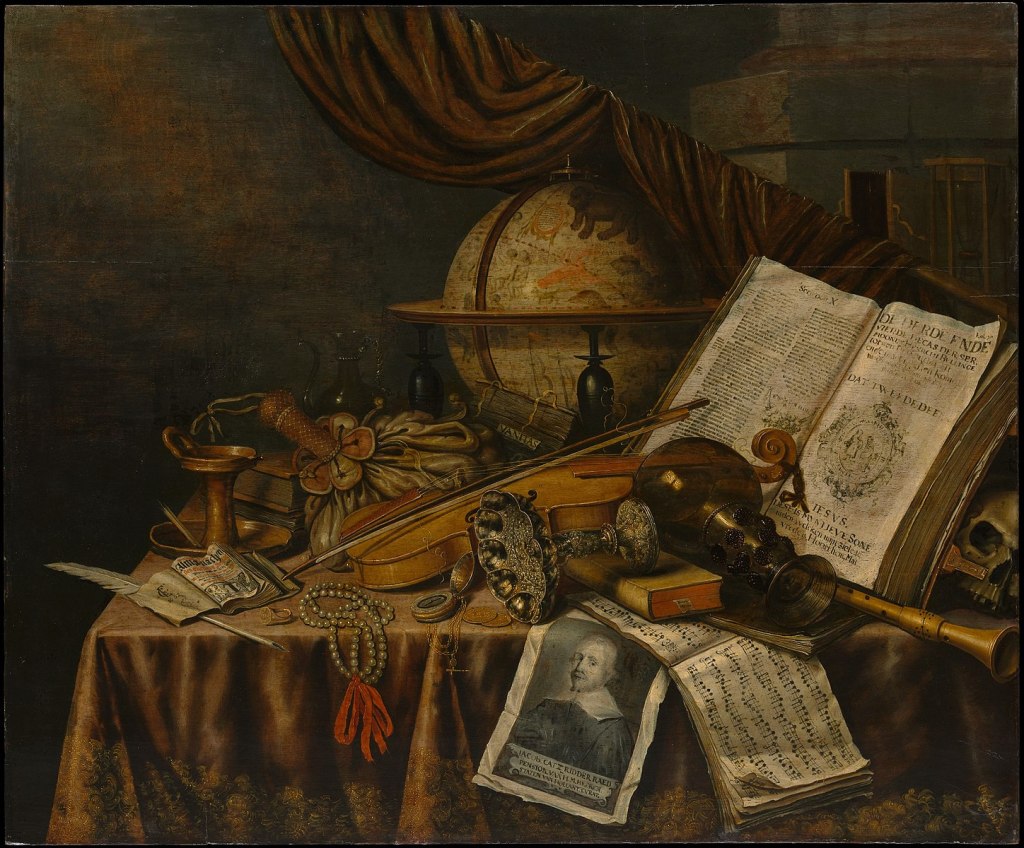
Vanitas Still Life, painting by Evert Collier(1640 –1708). Courtesy: Creative Commons
Back home in Madrid, having abandoned Adamov Plut to his posthumous fate, I was a bit surprised that neither the New York Times nor the Washington Post reported anything about the murder, not even a paragraph, or as the French so imagitively put it, an entre-filet ! I soon realised, due to this journalistic silence, that the time had come for me to give a full account of my relation to Mr Plut ; that the time had come for me to expose, publicly, by way of this revelation, his ‘mysterious murder’.
My information is of the surest sources for the simple reason that it was I who had Mr Plut murdered ! Yes, I ! And for reasons that shall be shortly disclosed. A mysterious man he might have been; however, his methods of acquiring priceless books and other inestimable valuables can hardly be called mysterious: Mr Plut was a vulgar thief, a scoundrel, an ingenious trickster whose singular flair caused much grief to many individuals, enraged those whose trust had been flouted.
It was in Istanbul, where I was invited to sojourn with an Armenian merchant, that I witnessed Mr Plut’s dupery. And if my naive friend fell for his crooked smile, I certainly didn’t swallow his high tale of returning to pay him for the two illuminated manuscripts my friend had graciously offered the blighter on condition that he be held accountable for them. His thick, coarse lips translated a smile that held contempt and disdain towards those who trusted him. So infuriated and insulted did I feel on behalf of my friend that that I reacted on a lightning urge and decided to follow him. I said nothing of this to my disbelieving companion, but left immediately in pursuit of my game — and game it was — for I, to tell the truth, had nothing more substantial to do at the moment and felt disposed for a good hunt.
I said that Mr Plut was a genius. Yes, in his own way. However, genius has its limitations. His arrogance and haughtiness knew no bounds, although he knew that his foul doings had attracted the attention of police and Interpol. Some may surmise that a certain paranoia drove him to invent individuals tracking him down like a wild boar or moose. No, no one was tracking him down except me, and that as subtlety as possible. In Uzbekistan, I actually chatted with him over a cup of coffee on two occasions disguised as a professor of Slavic philology, dressed in a quilted chapan robe and silk embroidered tubeteyka cap. There we sat in Samarkand, sipping our thick beverages in the vaulted bazaar at one of the storied cafés that dot the town. He was all smiles, obsequious and gold-toothed. I had the impression that I was dealing with a child or a mentally-dwarfed man whose sense of reality lacked all discernment or sagacity. I concluded that he had come into quite a bit of money, and never having had to work for a livelihood, traipsed about the world at his leisure, buying or stealing books, cheating people out of their invaluable collections. So self-indulgent and confident was he that he never saw through my masquerade as we conversed in broken Russian.
It was at that café where I learned about his fabulous treasure, as he called his book hoard. Only an idiot would have divulged this information to a perfect stranger, but as I said, Mr Plut’s contemptible demeanour caused him to fall into the most infantile traps. Traps that I began laying out for him, and that would lead to his downfall. For I had begun to design my own plan to relieve the rogue of his fabulous possessions, all the more so since he also let slip that his parents had passed away, and he had inherited the house. How I would make his treasure mine and ‘disinherit’ the owner still remained vague in my mind.
We departed as ‘friends’, as two strangers seeking an answer to the mystery of their existence. Or so I made him believe. Mr Plut appeared to me a dying species, a worldly aesthete, in spite of his extreme vulgarity and ponderous gait, whose debonair demeanour masked a loathing for his victims, a bent for the lowest duplicity, a gratification in spinning the most treacherous stratagems in order to allay his desire to prevail.
Mr Plut slipped out of Uzbekistan without my knowing it. He probably used his Russian passport, one of the four of five in his possession. I felt a twinge of misgiving. Had the fat fellow got on to me? After many enquiries, I finally discovered that he had crossed into China at the Xinjiang border, and was hastening towards the Yunnan. Why ? I hadn’t the faintest idea …
His brief sojourn in the town of Lijiang enabled me to catch up with him. My Chinese was fluent enough not only to query his whereabouts in that lovely town, but more important still, to learn of his new ‘purchases’, once I had questioned the director of the Dongba Museum of Culture. Mr Plut had planned to gone there to acquire several Naxi pictographic sacred books, which he did from a rather corrupt priest with whom he had been corresponding for some time, using a special code so as not to be unmasked by the Chinese authorities of the Centre. The director only learned of this a week after the unlawful negotiations had occurred, and three or four very valuable Dongba liturgical books had been stolen. It goes without saying that the rapacious priest was severely punished.
I immediately left Lijiang much to my displeasure for it was indeed a quiet, pleasant place, and set out in hot pursuit of the marauder. I followed his all too familiar scent through Nepal into North-western India to the Zanskar region where he put up for a while at the Phuktal Gompa[1], a strange spot to make a halt. But a perfect hideout to gain time in order for planning his next move, whilst at the same time inveigling in the most repulsive manner his generous hosts.
The monastery is nestled in the most remotest of valleys, ensconced within a cliff of tuft of fairy chimneys, crags and honey-combed spires which bulge black and red against the background of sandy, dazzling ash and cinerous tones of hemp. I had trekked there from Lamayuru in twenty days, and as I was to learn, Mr Plut had arrived there three days ahead of me, but by way of Padum. To gain the main entrance of the gompa, the pilgrim had to climb a steep path, keeping his or her right shoulder to the seventeen chortens[2] that mark the steep climb towards the vaulted entrance. I had shaved my head, grown a long beard and donned a woollen chuba tightened around my waist with a long colourful sash. It kept me warm, for in spite of it being Summer, the nights were very cold, and my cell had only a small wood-burning stove to keep me warm.
I spent three weeks at the monastery, sleeping on a ratten matting, eating skieu, tsampa and chappatti, drinking steaming salt-buttered tea off a chopsey — a low, small table — reading or gazing out of the little window that offered me a full view of the dusty, treeless courtyard below, where monks would mutter their mantras, and beyond into soundless nights whose stars were generally veiled.
Without Mr Plut’s slightest suspicions, I assisted at all the ceremonies, mornings and evenings, even vigils, while in the afternoon, I would venture out into the monastic complex, twisting and turning in the warren of lanes, under the low archways and high ladders, at times pursuing my promenades upon the rather precipitous mountain paths. As to Mr Plut, he hardly left his cell, and when we did cross paths, he most probably took me for a Buddhist pilgrim. Once or twice I sat near him in the prayer hall in the meditation grotto, but he never attempted to communicate with me, albeit he did not seem very deep in prayer or contemplation. He was probably scheming his next miserable move. His face had become terribly pale and flabby. His darting, black eyes seemed to have sunk deeper into their sockets. Unable to sit cross-legged on the low benches at the back of the prayer hall, he sat ‘western style’, staring off into the clusters of chanting monks, tilting his huge, bobbing head every so often to the banging drums, blowing ox-horns and tinkling triangles. Observing him from afar, I sought to sound his soul, to wring out his innermost thoughts, to extract from his evident lassitude and apathy his flight from both his victims and himself. But Mr Plut was a sphinx. Would he rise out of his own ashes when his hour came ?
I left the good monks three days after his departure, a hasty one indeed. And they were furious! The scoundrel had stolen several pustuks[3] and thangkas, and failed to pay for the prayer masks that he ‘purchased’. They implored me to find the culprit, inform the police and recover their stolen property. It was perhaps the beseeching words of the infuriated monks, after having received such incomparable hospitality from them, that my plans to have the thief killed began to germinate ! The theft was not only gratuitous, it exposed the very ugliness of the man’s heart, blackened by greed, cynicism and remorselessness. It would only be a matter of time before he tasted a soupçon of his own medicine.
Meanwhile the cat would play with the mouse, a rather fat mouse at that ! I boarded the cargo ship that took the fugitive from Karachi to Oakland via Japan. On the long, monotonous voyage across the Pacific, my ominous shadow crossed his at the most unsuspecting moments. Attired as a Pashtun merchant, bearded, long-haired and turbaned, Mr Plut sensed an onerous presence whenever he laboriously carried his huge body across the decks. How many times had my eyes penetrated his anguish, his torment, his pangs, not of compunction, but of incomprehension. He scented a sleepless menace pressing him. Fear inflamed his dark, beady, mirthless eyes like the burning incision of the trenchant knife.
Oakland … Sacramento … Reno … Tombstone … Boulder … Santa Fe … Saint Louis … Chicago … New Orleans … Birmingham … Miami … Atlanta and finally New York. Yes, New York, where the curtains would finally fall on this tragic fat figure. Where upon the stage of 8 million walk-ons, and against the backdrop of the grottiest of hotels, the last act of Mr Plut’s abominable performance would be played out.
His infatuation with Louis Wolfson amused me, as well as his grandiose project to write twelve stories in twelve different languages signed by twelve different authors. I found all this quite pompous and pathetic. A real exercise in self-indulgence to say the least. All this information I culled when I ‘accidentally’ met him in the ill-lit corridor of that hotel on Water street in downtown Manhattan. In New York, I played the role of a French researcher in mediaeval literature, a field that he completely ignored, in spite of possessing several manuscripts of Anglo-Norman stamp, apparently purchased (so he said ?) from a London book-seller. I pretended to be interested, taking the opportunity to study him closely. Besides, he was such an inveterate liar how could one believe anything he said ? He lied to curry favour and win confidence, only to swindle and steal from the naive and simple-hearted. Better to observe his eyes, his gestures, his bouncing from one tongue to another. These were all genuine signs of his distorted psychological make-up. To play my part well, I sported an immaculate white suit, orange tie, a pair of silver-rimmed glasses and spanking new alligator shoes. I had shaved my beard and moustache and had my hair cut very short, leaving a few gossamer wisps which touched the tips of my ears and fell bouncily on my forehead.
Every day I followed his Humpty Dumpty gait as he waddled to and from the public library, in and out of Central Park. And it was there, in Central Park, that I noted two blond-haired rough fellows slouching on a bench, eating the remains of fried chips or chicken sandwiches, cursing and making gross signs at the passers-by, drinking beer and spitting. They were seated at the same bench daily — the bench that Mr Plut walked by every day. They seemed to know him because they would hoot at him, call him names and ask for money. Fatso passed by without even a glance at them.
One Saturday, I decided to approach the two ruffians. They sized me up with obvious contempt, and made it perfectly clear that I was intruding on their ‘territory’. I sat down none the less, and exposed my scheme to be rid of Mr Plut once and for all, explaining how the culprit had cheated and robbed so many people. The two burly blokes, former marines in the Green Beret (or so they vaunted!) listened attentively as I unfolded my plan: Three thousand dollars for each if they would simply walk up to his room in the early morning hours, the night porter always being asleep, knock at his door and kill him, however, without any blood shed or theft of his belongings. It must be a murder without reason, without any sign of bestial violence. One of them suggested strangulation. Yes, excellent idea. It would thus be a ‘clean’ murder.
And so it was, very professional at that I must say. They were paid off, as agreed. And I left New York two days later, as planned, a very satisfied man indeed …
This all happened five years ago. Now … well, here is where my account ends and my confession begins. For you see, Mr Plut was never really murdered ! Those two ‘ruffians’ were in fact F.B.I. agents who had been trailing me since disembarking in California. To tell the truth, Interpol and local police had been following me since the Istanbul affair. How and why they began doing so I cannot say. During my trial neither the judge nor the prosecuting attorney afforded any information as how the F.B.I. learnt of my scheme, nor why they had decided, at one point in time, to cooperate with Plut. What was I convicted of ? What was my indictment ? As to my appointed lawyer, a young short-sighted clerk more than a seasoned lawyer, who could be easily cajoled by the ‘evidence’ against me, pliantly manipulated by the prosecutor, after he had taken the floor and had made an absolute fool of himself. He let out a sigh of relief when the judge pronounced a sentence of fifteen years instead of twenty-five! The wigged judge, a grotesque figure studded with huge warts, yawned throughout my lawyer’s deplorable speech for the defense, as well as during my feeble plea. There was no jury either to lament or to applaud his verdict. It was a trial held at ‘huis clos’[4], military style. I buried my face in my hands. As expected, my lawyer made no effort to appeal.
Had Plut sensed my innermost aversion towards him ? Or seen through my many disguises ? He was a clever man, and probably had hired detectives to learn why I was following him. The hotel room murder was staged. Plut lay recumbent on the floor, waiting for me to steal his papers so that I would be indicted for premeditated murder (although there was no murder!), of paying off hoodlums to commit this murder (although they were F.B.I. agents!) and the theft, which indeed it was (but fifteen years for that?) of his household papers, keys, and other official documents concerning his inheritance … and that vile short story of his.
So here I sit in my rancid smelling cell in Madrid, having been arrested at the aeroport on my arrival some five years ago, writing out this confession. I do not to repent mind you, I have no intention of atoning for my doings, nor avowing my sins. These words wrenched from my pen seek to vent the animosity and hatred I harbour towards that fat impostor who had the cheek to write me a letter from the Seychelles revealing how he had got on to me since Uzbekistan, and how our little cat and mouse game had amused him greatly : “You thought me a fool, deary, but I sawthrough your pusillanimous scheme in Samarkand ; that was some outfit, but you forgot the galoshes ! Not to mention your pilgrim weeds at Phuktal which truly charmed me, and your blazing orange tie in New York. Come, come, what French professor would ever sport an orange tie with a badly tailored, cheap white suit ?” The vicious irony underlining these sentences, along with a soupçon of cynicism caused me to gag. The blighter added in a post-script that he had sold all his books for a fabulous sum of money, and had retired from the world’s wearisome fair. In the envelope I found a photo of him sipping coconut juice, lying on the golden sands of a crescent-shaped beach under groves of swaying palm trees and an indigo blue sky. I laughed bitterly, and yet, in spite of my nettled nerves, pinned up the blasted photo in my lonely cell, a sort of souvenir of our enshrouded relationship …
One day at the prison library, browsing idly through a dull, detective story, I thought of Plut’s or Hilarius Eremita’s story The Enchanted Garden, which I had taken and read to amuse myself on the aeroplane to Buenos Aires. Had anyone ever published such ridiculous trash? To my horror, the answer came three days later whilst I rummaged through a new batch of literary magazines, some of which contained short stories in English, French and German. And there it was — The Enchanted Garden, by Hilarius Eremita, Plut’s pen name. I couldn’t believe my eyes — someone had published that rubbish ! Plut indeed had the last laugh, adding insult to injury, salt to my festering wounds.
I savagely tore out the pages of his story from the magazine, went to the toilet, ripped them into tiny pieces and flushed the filth down the bowl. So much for hiss ‘first of the twelve’ ! I shan’t be punished for it, no inmate in this prison reads any language besides Spanish, and that with a dictionary … I’m sure it was Plut who sent me that magazine to drive the knife deeper into my wounded pride. The miserable rat !
So here I sit at my iron table, staring at Plut’s photo as he sips his coconut drink under the blue skies and swaying palm trees whilst I sip my wretched thin noodle soup with strips of hard, nervy beef under a cracked, peeling, dirty grey prison ceiling …
[2] The Tibetan word for stûpa, a Buddist shrine which initially housed the relics of the Buddha.
[3] Books used for Buddhist ceremonies written in Tibetan.
[4] Behind closed door without any public participation or observers. It is a French legal term.
Paul Mirabile is a retired professor of philology now living in France. He has published mostly academic works centred on philology, history, pedagogy and religion. He has also published stories of his travels throughout Asia, where he spent thirty years.
.
PLEASE NOTE: ARTICLES CAN ONLY BE REPRODUCED IN OTHER SITES WITH DUE ACKNOWLEDGEMENT TO BORDERLESS JOURNAL
“If only you had some wisdom, then you would not have raised that issue. I am going to block you. I am going to sever all ties with you. Bye!” The harsh words kept echoing in Farzana’s head. Her eyes moistened. She could not control the incessant tears rolling down her cheeks. The man behind the counter looked at her sympathetically. Farzana tried to smile back but her face distorted. She had never ever been able to control her emotions.
She was standing in the immigration line to board the next plane to New York from Dhaka.
The last one year came flashing back.
She had come in contact with Tariq during an official online meeting in Bangladesh.
He was a man of great repute. They had to contact each other often for business purpose. Gradually, their relationship changed from that of an acquaintance to very close friends. They would talk almost every day. He would go on telling her about his life. How he had built a million dollar business. How unfortunate he had been in his personal life. She would listen patiently.
She met him twice during two workshops on financial management. Tariq had invited her many times but somehow they had never been able to meet in the real world.
Tariq was a short squarely built man. But there was an air of personality that was undeniably magnetic. His well-articulated deep voice and the twinkling smile in his eyes were enough to make women swoon over him. He was witty and had a sense of humour that made him very attractive. He had sharp twinkling eyes but something told Farzana that he was a sad man, hiding behind his witty and jovial nature.
Their professional relationship turned into friendship.
Tariq would tell her details of the problems he faced in life and ask her to pray for him. Farzana became emotionally attached to him as a friend and would pray for him religiously every day.
Four months passed. One day they were chatting lightly and having fun in an online conversation on Messenger. Suddenly, Tariq got irritated and muted the Messenger box. She had never faced anything like this before. She felt insulted. She called and urged him to unmute, but he was reluctant.
A week later Farzana sent Tariq birthday wishes on his phone.
He called her and apologised. He told her he was very sick that day and couldn’t control his anger and, hence, had muted her.
Life became normal. Months passed. Farzana would wait for him to call or message her. When he called he would go on talking about his problems, his life and sometimes even flirt with her. Farzana knew he was just having fun. She would ask him to be serious and then again they would have the normal conversations.
She never called him because he was a busy person and he would remain sick for days too. Sometimes Farzana had doubts that he was lying to her.
“Why? We are not romantically involved. We are just friends so why does he lie to me?” she would ponder.
*
She was getting ready to meet Tariq today. He had invited her for a candle light dinner in one of the fanciest restaurants ‘Rose La France’. This was the first friendly meeting with him. Farzana wore a pink chiffon blouse and saree. The white pearl necklace set with earrings and bangles were a perfect match: simple, yet elegant. As she looked in the mirror, a smile curled up on her face. The reflection of a tall fair woman with an athletic supple and strong physique with a pair of hazel coloured eyes and thick black eyelashes stared back. She brushed her shoulder length wavy auburn hair. She was an attractive woman in her 30s. She was aware of the fact that her presence, anywhere, made quite a few heads turn.
Tariq picked her from her home and they drove to the restaurant. Somehow Farzana felt very conscious of herself as Tariq smiled at her.
“You look ravishing.”
“Thank you,” she smiled.
“Is it happening? Is he falling in love with me?” Farzana was quiet for a while.
Farzana wanted to change the topic, “You can recite so well. Please recite the poem you were reciting on that day over the phone.”
“First you have to kiss me,” Tariq said mischievously.
Farzana burst into laughter. She couldn’t stop laughing.
Tariq looked intently at her.
*
“Why do you text? Don’t text me.” suddenly Tariq fumed one day.
Click!No sound on the other end. Farzana called every other day to check but the calls would only show ‘calling’, no ‘ringing’ sign. The messages she sent also didn’t pass through.
After trying a few days she realised he had blocked her everywhere without any reason that she could think of. She would cry long nights. No one knew that she was suffering inwardly as she would act totally normal in front of her family.
Farzana knew that Tariq was the only child and couldn’t control his emotions, but deep down he was a compassionate man. He always made amends so sweetly and genuinely that it was impossible to resist.
*
Tariq loved the way Farzana talked. The smile on her lips and twinkle of her eyes somehow vibrated through the calls. He could visualise the innocent smile on her happy face talking with fervour. She would also listen to him talk patiently for hours.
“Oh Lord I am in love with this angel!” The moment it popped in his head, he felt his nerves playing havoc in his mind. He cut off the line. He blocked every single thing: Telephone, Facebook, WhatsApp and Viber.
“No, I cannot destroy her life. She is such a kind soul. I am not suitable for her. I am a devil, and she is an angel. What if I propose her and get married? What then?” He kept rambling, “I am sick and she will suffer seeing my illness. I cannot let anything sadden her.”
Tariq had a very traumatic childhood. His father was an alcoholic and mother was on drugs. Almost each day they would have fights. The fights did not end just in verbal abuse but would turn into physical scuffles.
He lived in terror of such violence as sometimes he would also become the victim.
His father would point at him and say: “Ah. This bastard! Who is his father? Tell me now or I will kill him.”
His mom would just sit there and keep laughing and say. “Why? aren’t you man enough to have a child of your own?”
His father would then push away Tariq and start kicking his mother.
One day Tariq’s grandparents came and took him away. That was the turning point for him. He had a loving aunt who started looking after him. Slowly his life became more meaningful. He started to have great results at school.Soon he got involved in sports. The confidence in him attracted the attention of his teachers and they started mentoring him for inter school competitions.
Success followed him everywhere. It was as if he was with vengeance erasing his past life and pouring the best that he had into his present. Rather than being defeated by the harsh childhood he had had, he became adamant to succeed. But the trauma remained with him. Often he would have panic attacks and it was difficult to calm him down.
On top of that he was diagnosed with bi-polar disorder on his 39th birthday. Occasionally, he would become violent and would hurl abuses at anyone who came in contact with him. It seemed as if his parents’ demons overpowered him during those times. He seldom remembered what he had done. He was an informed man and knew the consequences and symptoms of this disease.
As he had suffered in his childhood, he didn’t want anyone to be hurt by his behaviour. So he asked his caretaker to tell him everything that happened during those attacks. Later when he regained sanity, he would beg forgiveness in such a gentle way that no one could stay angry with him.
Though he was a famous and moneyed man, his compassionate nature earned him respect from everyone who came in contact with him.
*
For some days she had been having stomach aches. She saw a doctor and had to do some tests.
“You have appendicitis and need surgery,” the doctor informed.
“If something goes wrong and I die?” she mused.
She knew it involved a major surgery. Though fatality was rare but it could happen.
She didn’t want to leave the world with the regret of not having talked with Tariq. So she contacted Tariq’s friend, told him about her surgery and requested him to tell Tariq to call.
That evening Tariq called. He was very rude with her and threatened that he would not unblock her. She pleaded that she wanted just to talk normally with him before the surgery. She wanted to be mentally strong and prepared. She just wanted him to be friends again. He cut off the line.
The next evening Farzana called him. He had unblocked her. They talked for an hour. Farzana disclosed to him about the surgery next morning. The call ended on a friendly note of wishes and prayers.
The next morning, as Farzana was getting ready, he called her and wished her. These small little gestures made him irresistibly charming.
The surgery was successful.
Days passed. Farzana was happy. Sometimes in the mornings Farzana would see that Tariq had called her at night, knowing fully well that she did not take calls at night. She would say “sorry” in her texts.
“Has he fallen in love?” She would muse.
Another evening he called and told her that he was sick. Farzana was concerned.
“You know I have been praying the whole night for your…”
Stop! She was cut short in the middle of her sentence.
“You know what? This is why I don’t want to talk to you. If only you had some wisdom, then you would not have raised that issue. I am going to block you; I am going to sever all ties with you. Bye!”
*
Tariq knew that Farzana had developed a soft corner for him over time. He had fallen madly in love with her. She was there all the time in his heart.Whatever he did he could not get her out of his head. Her gentle sweet smile was like a magnet and oh her eyes! Those had so much innocence and concern that they were irresistible. He had fallen madly in love with her.
He knew that if she saw his condition when he had those panic attacks, she would not be able to bear it. She was too gentle. She would be heartbroken for him and he could not let that happen.
He would call her but somehow it was so painful not to be with her that he would become rude and cut the line off. There was an unbearable silence as Farzana sat dumbfounded. She couldn’t say a word.
Suddenly all emotions dried up. She knew that Tariq was a self-made man. Though soft at heart, it had made him proud and egoistic too. But it did not give him the right to be so discourteous and ungrateful towards her. He knew fully well that she wished him well unconditionally and his welfare had always been a priority for her.
“This is the end,” she muttered. “I have been supportive of him all through, prayed for him every day. Yet, he treats me like trash. He knows that I care for him too much. Perhaps, this is why he has taken me for granted.”
The thought of abandoning him suddenly made her realise that she was in love with him. It would be unbearable for her to part with him.
She couldn’t take it anymore. “I have been sympathetic all through but there’s a limit to being compassionate. He has his tantrums, but I am also human. I have my pride.”
In her heart she knew that she loved him. But there was no hope for this love to materialise. So she needed to leave him before she did anything irrational.
Her decision was final.
She decided to go back to the USA. She knew if he was ever alone and needed her, she would come back to help him; give him company in his old age. But right now she needed to leave.
“Your ticket Madam.”
“Oh, sorry,” Farzana replied unmindfully. She showed the ticket and passport to the immigration officer.
Leaving Tariq without telling him was painful. She couldn’t hold back her tears. The man behind the counter looked concerned. Farzana gave him a reassuring smile and wiped away her tears confidently.
She felt a heavy stone lifted away from her chest. Too much neglect and verbal abuse had made her strong. She was free now.
“Thank you,” she smiled and waved. “Have a wonderful day!”
As she walked towards the shuttle bus, she felt the warmth of the sun on her face. Everything around her wore a brighter look. She was ready to face the world: alone but stronger. The needle pricked her heart and she flinched in pain.
“Is he thinking about me and in pain?”
Whenever Tariq needed her she had this feeling inside.
“It can’t be!” Her pace slowed down.
Tariq stood behind the glass looking at the girl whom he loved with all his heart. He prayed silently. Teardrops rolled down his cheek for the first time
She would never know…
.
Tasneem Hossain is a multilingual poet, op-ed, columnist, fiction writer, translator and trainer. Her writings have appeared in different countries. She has authored two poetry books and a book of prose.
PLEASE NOTE: ARTICLES CAN ONLY BE REPRODUCED IN OTHER SITES WITH DUE ACKNOWLEDGEMENT TO BORDERLESS JOURNAL
This is a delightful book for two reasons: One, it is a reminiscence of a civil service official with the princely state of Mysore and Gwalior, and later with the government of British India. Secondly, the stream of language and the lucidness with which the author has penned his recollections is remarkable. What is more, it reflects on the administrative practices of the former princely states of India.
M.A. Sreenivasan (1897-1998) lived through almost the entire 20th century and was among the very few people who witnessed at close quarters the enormous changes that took place in India during this period. Born in Madras, he belonged to a family that traced his subsequent generations of Pradhans (ministers) of successive kings of Mysore for 150 years. Sreenivasan joined the Mysore Civil Service in 1918 and, after a varied career both with the Mysore Government and the Government of British India. He became a Pradhan of the Maharaja of Mysore in 1943. In 1947, he was invited by the Maharaja of Gwalior to become the Dewan of that State. During that momentous year, he was a member of the Constituent Assembly of India and in regular touch with many of the leading figures (including Mountbatten) involved in the transfer of power from British to Indian hands.
Much more than an autobiography, the bookis a rare portrait of India during and immediately after the British Raj. The princely States of India have been neglected by scholars, many of whom have tended to be unfairly critical. There is much in this book on the effectiveness of administration in two major princely States. It redresses the balance and makes the book a valuable document on the subject. Further, Sreenivasan provides sharp insights into the negotiations that led to the end of the Raj, and into the new polity that emerged after Independence.
Writes Sreenivasan about Louis Mountbatten: “I had seen and talked to Mountbatten at lunch parties in Viceroy’s House and meetings of the Chamber of Princes. Tall of stature, with an enviable reputation as Supreme Commander of the Allied Forces during the War, he impressed everyone with his fine personality and pleasing manner. Standing on the dais that day, wearing his bright, white naval uniform, festooned with medals and decorations, he addressed the gathering as Crown Representative of His Majesty, the King of Great Britain, his cousin, and spoke of the King’s concern for the Princes of India with whom the Crown’s long-standing associations and obligations were soon to come to an end.”
Elsewhere in the book he writes about Sir CP Ramaswamy Iyer: “He was a remarkable man. Endowed with a fine personality and a keen intellect, he was learned and brilliant, an eloquent speaker, and a brave and dynamic administrator. In his early years, he was a much sought-after lawyer and one of the first, most ardent, champions of Home Rule for India. CP, as he was called by friends, was among the leaders and statesmen whose views were sought by successive British missions. He did not, however, take part in the Constituent Assembly or its committees. I knew he had plans of making Travancore an independent maritime State. I had always held him in esteem as a distinguished elder statesman and called on him at Travancore House in New Delhi, asking him why he had not agreed to the accession of Travancore.”
Write Shashi Tharoor in the foreword: “This book is simultaneously an exploration of the region’s glorious past and present and a memorable personal history, tracing Sreenivasan’s life and career, which was as challenging as it was deeply interesting. From the ups and downs of local politics to navigating the bureaucracy of nascent independent India, not to mention moving forays into Sreenivasan’s home life particularly relating to his beloved and constantly supportive wife, Chingu, there is little that is not covered. The reader follows the author through his myriad journeys, from Mysore to New York and London, to the Chambal Valley and beyond.”
The last few chapters of the book are notable. Whether it is the merger of the princely states or Prime Minister Nehru, Sardar Patel and the two Nobel laurates- CV Raman and Dalai Lama – Sreenivasan’s chronicles make for an absorbing read.
In the epilogue, he writes: “The years have witnessed revolutionary changes in India. There has been impressive progress in many directions and many remarkable achievements. The scourge of smallpox and plague has been eradicated. The shame of human beings carrying night soil has ended in many cities and towns. Infant mortality has been reduced, and life expectancy enhanced.
“The production of food grains and other needed crops has vastly increased. Thanks to generous foreign aid and increased revenues, huge dams and reservoirs have been built. Hydro-and thermal power generating stations installed. An industrial revolution has taken place. Thousands of mills and factories turn out myriads of products, from cotton cloth and silk to telephones, television sets, computers, locomotives, motorcars, and aeroplanes. Transport and communication have also been revolutionized. Scores of universities, hundreds of engineering and medical colleges and research institutions have been started and equipped. India can boast of having perhaps the largest surplus of scientists and technologists in the world for export. But progress has not come with both hands full. With great gains have come great losses. An irreparable loss is the grievous vivisection of India.”
This captivating life story will be of particular interest to students and scholars of modern Indian history as well as the general reader.
Bhaskar Parichha is a journalist and author of Unbiased, No Strings Attached: Writings on Odisha and Biju Patnaik – A Political Biography. He lives in Bhubaneswar and writes bilingually. Besides writing for newspapers, he also reviews books on various media platforms.
.
PLEASE NOTE: ARTICLES CAN ONLY BE REPRODUCED IN OTHER SITES WITH DUE ACKNOWLEDGEMENT TO BORDERLESS JOURNAL
The new Oculus transportation hub was spectacular! Spacious, roomy, bright, and inviting. A vision in white. The building was designed by the Spanish architect, Santiago Calatrava and consists of interlocking ribs that meet high above the ground. I was visiting the One World Trade Center and had taken the New York metro to the station.
One World Trade Centre
Built on the site of the twin towers, it is the tallest building in the western hemisphere. The height is 1776 feet, a reference to the year of American independence. The One World observatory is right at the top (100 to 102nd floors). The elevator ride to the observatory was fast. The history of New York is shown on the elevator panels during the 47-second ride to the hundred and second floor. The view of the New York skyline from the observatory was spectacular. The observatory has a lot to offer but most extra attractions are charged.
New York is infamous for even charging passengers to use the baggage trolleys at JFK airport. This is a service that is free in most of the world and something I could never get used to. The 22-story Flatiron building was the first skyscraper completed in 1903. Many iconic New York skyscrapers were seen, and their history was explained. The view down to the street level projected to the floor in the Skyportal was scary. City Pulse provided an opportunity to interact with the city ambassadors (locals with an intimate knowledge of the city). The collection of high-definition monitors provided me with an intriguing view of New York.
I enjoyed taking the New York (NY) buses. There are different types of buses; most allow for easy wheelchair access. The next bus stop is displayed on the screen of the bus. Bus stops also have screens showing when the next bus is expected. Jamaica, where I was staying, had articulated buses. I did go on some long walks in the city. The weather was getting colder but was still tolerable. Cold is something you must factor in when visiting New York in the winter. The trees become bare ghosts stripped off their leaves. With the advent of spring, the dormant trees wake up. Coming from tropical climes a tree totally devoid of leaves, fruits, and flowers was a unique sight.
The Baisley Pond Park was very near where I was staying. The 109-acre park includes the 30-acre Baisley Pond in the centre. Most trees were already bare. The park is a popular venue for sporting events and get-togethers in the summer. The weather greatly influences people’s lives in the northern climes. I enjoyed taking long walks in the park. Jamaica had people from all regions. There were African Americans, Hispanics, South Asians, East Asians, Africans, and others. I was staying in an AirBnB (a house owned by an African American gentleman named Kevin). The room was in the basement of Kevin’s house. We eventually became good friends. There were a few eating places located around Kevin’s house.
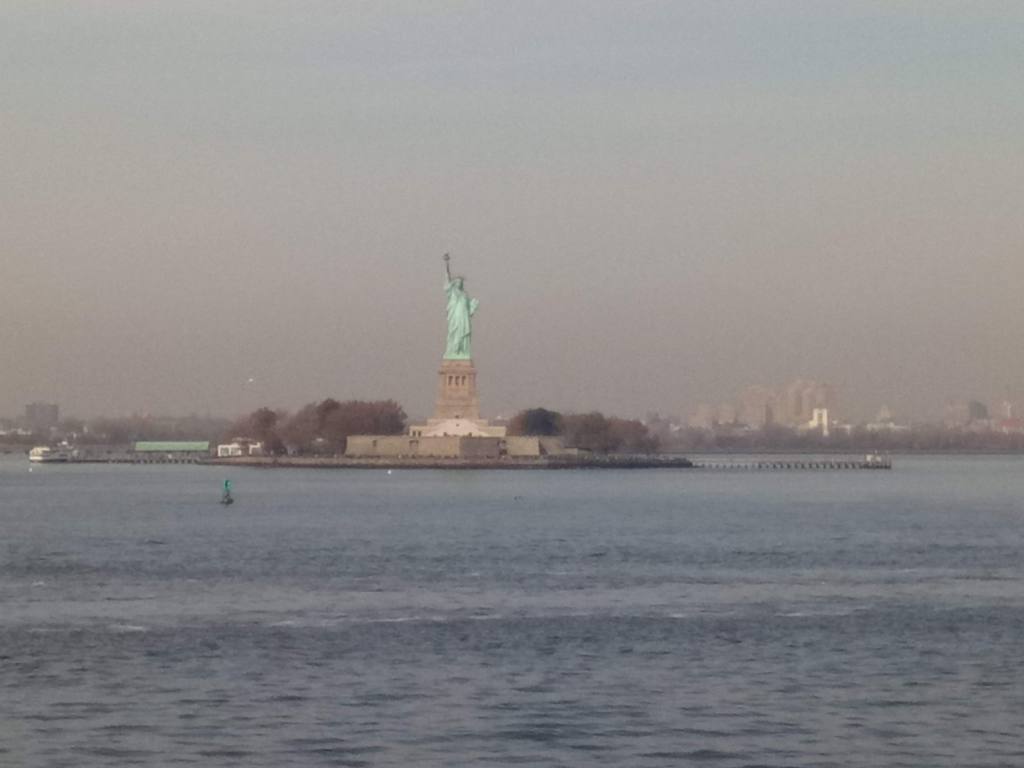
I decided to spend a few days in the quietest borough in New York, Staten Island. NY has five boroughs – the Bronx, Brooklyn, Manhattan, Queens, and Staten Island. Staten Island is the southernmost and for a long time was predominantly agricultural. Staten Island is not commonly visited by tourists. I took the bright, orange-coloured Staten Island ferry. The travel time is about twenty minutes. The ferry travels close to the Statue of Liberty, a gift from
Statue of Liberty from the ferry
the French people to the people of the United States. I took a bus from the ferry terminal to the house where I would be staying. The area had a large Hispanic population and I enjoyed food from the Dominican Republic and Mexico. The room was nice and warm, and the bay windows provided a good view of the street.
The Staten Island Zoo is an eight-acre urban zoo open throughout the year. The zoo is also called Barrett Park and is located on the estate grounds of a US war hero, Colonel Harden. The zoo is run by the Staten Island zoological society founded in 1933. The zoo holds frequent educational sessions. Winter was starting and many animals had been shifted to warmer enclosures. A lot of effort had been expended on recreating the native environment of most animals. Zoologists now know a lot about different animals and their habitats. I had seen similar effort being put in at the zoos in Taiping.
One of the highlights of my visit was the afternoon spent at Richmond Old Town. The site was for more than two centuries the seat of the Staten Island government. The government was shifted to the northern part of the island after the island became one of the boroughs of New York. The former county clerk’s office serves as a historic museum. I enjoyed stepping back in time. The visitor’s centre is in the third county courthouse. There are several historic structures.
There were individuals dressed as historical characters enacting different roles and speaking the lingua of the past. One of the highlights of the afternoon was the guided tour of different properties led by the museum curator. New York was originally settled by the Dutch and called New Amsterdam. The houses were built in the old Dutch style. People lived much more simply in those days and closer to the land. I saw straw beddings that attracted vermin easily and had to be disposed of periodically. I was reminded of a night spent sleeping on a straw mattress in a Nepalese trekking lodge when I was devoured alive by bed bugs. Bed bugs are a resilient species and I read they were making a comeback even in upmarket hotels in developed nations. The massive brick ovens used to bake bread were intriguing as was the old, solid furniture.
The afternoon was getting cloudy and windy as I took the bus back to my room. The next morning, I took the ferry back to Queens. Soon it was time for me to fly back. Terminal 4 at JFK airport can be very crowded. Luckily due to my frequent flier status with Kuwait airways, I had access to the Etihad lounge. Dusk was slowly settling on the airport and the sleek modern control tower was being lit in various fluorescent colours. This was an interesting visit to the Big Apple. NY is sprawling, rough, busy, rushed, kind, and individualistic.
People come to chase their dreams from all over the world. I was reminded of the famous song by Billy Joel and Tony Bennett titled ‘Í am in a New York state of mind’ as the plane gathered height and slowly left the lights of the big apple far, far below!
.
Dr. P Ravi Shankar is a faculty member at the IMU Centre for Education (ICE), International Medical University, Kuala Lumpur, Malaysia. He enjoys traveling and is a creative writer and photographer.
.
PLEASE NOTE: ARTICLES CAN ONLY BE REPRODUCED IN OTHER SITES WITH DUE ACKNOWLEDGEMENT TO BORDERLESS JOURNAL
VAGARIES

I have seen houses
that went dark early
and you heard your footfall on the tile
but I did not know I would come to live in one.

Have you seen houses
where the shadows of evening
started after noon
but did you know you would come to live in one?


EMPATHY FOR HUMANITY

I walk down the lonely street.
A breeze is blowing—
which is welcome in this heat.
I know where I’m going.

A man and a woman
are standing on the sidewalk,
staring at someone
at the end of the block.

In the trees that intersect
at the entrance
a worker and I connect
from a distance;

off the repair truck he climbs down
and his red face nods,
he knows I’m down,
he knows the odds.

I head toward the boulevard.
A whiff of garbage bin
hits me in the nose hard
and it’s good…it’s all good again.


IGNORANT MAN

Listening to the music
he wouldn’t know how to put the violins together
how to harmonise their parts

He knows the place
the ensemble came from
but how did they arise from there?

Into it, its refinement
mystifies: he half-gets it
but decides he doesn’t like it

He looks so sad
as only a human can
as only a settled nomad…


OBSERVATIONS (FROM A NOCTURNAL PATIO)

The ivy twists upon
itself on the wrought-iron fence—
summer night.

Where’s the light come from
shining on the tabletop
amidst these shadows?

The tattoo parlor
is open—the church next door
is closed, I presume.

A very slight breeze
wavers the sunflower
drooping from its own weight.

The toppling buses
are gone—one with a single
passenger shies home.

The shadow of one
on the brick floor—alone at
a table for four.

A shaky table
but it doesn’t bother me
in this mood somehow.

Lighted from within
those windows must have a curious
life only glimpsed.

Living the moment
is a cliché except when
it’s not a cliché.

Takes one to know one—
I judge harshly and smugly
overheard rubbish.

Shallowness survives
the shadowy depths of the
most romantic night.

The kinds of laughter—
like crocodile tears—hyenas
also devour.

A shadow-flecked face
rattles on from its mouth like
a worm-eaten hole.

Given half a chance
some people will talk like a
stuck horn or siren.

The lone bicyclist
runs the red light to stay ahead
of the traffic.

Exquisite voices
are rare but a desired voice
has tones on reserve.

Coveting gardens
can make one under-appreciate
the dogwood.

Hoarse from over-talk—
some persons talk as if they’re
always in a bar.

Houses that are close
to an all-night establishment
always seem sad.
David Francis has produced seven music albums, Always/Far: a chapbook of lyrics and drawings, and Poems from Argentina (Kelsay Books). He has written and directed the films, Village Folksinger (2013) and Memory Journey (2018). He lives in New York City.
.
PLEASE NOTE: ARTICLES CAN ONLY BE REPRODUCED IN OTHER SITES WITH DUE ACKNOWLEDGEMENT TO BORDERLESS JOURNAL
Ideally, I would love to start the New Year with laughter and happiness! Then perhaps, the whole year would be dotted with humour …
Laughter clubs often practice laughing for health benefits. I know the pandemic makes both guffawing outdoors or in a group hard but think of the funniest possible thing and, perhaps, you will start laughing. For me what works other than children’s and monkeys’ antics, are my trips to the dentist, especially the trip where I wondered on the fringe benefits of ‘laughing gas’ (as given in the PG Wodehouse novel of the same name), only to be informed that it was used exclusively for young children. For me, an adult, there was only — you have guessed it — the jab that numbs your lip function to lubber. I discovered if I could make light of a dentist drilling by learning from Harry Potter (the spell to get rid of the terrifying boggart, who took the shape of the thing you feared most, was to imagine the funniest thing, focus on the humour in it, and shout ‘Riddikulus’ with a wand pointed at the creature in the form of your worst nightmare), then I could pretty much get rid of most fears.
The other thing I have been wondering for sometime is can one write an editorial that is humorous when the content is serious? I would have wanted to ask that question to many, including Ruskin Bond, who continues as one of my idols. I would love to touch hearts with the humour and the sensitivity that flavours his writing. It is tough to convey a complex thought with the simplicity and elegance of a writer who can be read and understood easily. I think we have a few of them around and I interviewed one. You all probably know him well— Rhys Hughes. I have given the reasons for the interview in lieu of Mr Bond, who continues a distant star beyond the horizon of online interviews. We discussed humour and its role in literature, leaving out completely in the cold, the fictional Mr Bond who answers to the names of James and 007 and has made entertaining films, which can be seen as serious or non-serious.
Hughes has of course, given some writerly advice not just in the interview but in ‘Making Something of Nothing’ – pretty much the advice that God had probably been given when he asked an unspecified friend on how to create the universe and multiple realities. Hughes has also added to our galaxy of poets where Michael Burch, Ryan Quinn Flanagan, Anasuya Bhar, Vernon Daim, William Miller, Pramod Rastogi, Mike Smith, Jay Nicholls and many more continue to sparkle. Taking up the theme of God’s creations, Devraj Singh Kalsi has added to more humour with a dream of divine intervention to make the ‘New Normal’ in 2022 – a plan for this year. Will it ever be real?
Another major issue in this world currently is climate change. In keeping with the need for acceptance of this reality, Keith Lyons introduced us to a nature lover, author and adventurer Kenny Peavy, who loved the fictional adventurer called Indiana Jones and has been working towards living in harmony with nature. He moved to Indonesia from America and is trying to raise awareness. You can find much, though not elephants, in the interview that encompasses the story of a man who cycled across a continent on a bike made of bamboo. However, you can find some writing on a king who acquired the skill to ride and tame elephants in our book excerpt from Shazi Zaman’sAkbar: A Novel of History. The excerpt does not showcase his elephant taming skills as did the Bollywood blockbuster Jodha Akbar but is focussed on bringing out the syncretism in the Mughal monarch’s outlook which made him seek out exponents of other religions. Sangita Swechcha’s and Andrée Roby’s anthology, A Glimpse Into My Country, with excerpts of short stories from Nepal and Zimbabwe, like Kenny Peavy, cycle across multiple borders as does our fiction. We feature stories from within and without the continent with Fazal Baloch recombining a couple of folklores from Balochistan to a single tale. Fiction from young writers highlight compassion and a varied perspective. Steve Ogah has a story from Nigeria which almost rings with overtones of Alex Haley’s Roots. Sohana Manzoor has given us a poignant narrative with an inspiring twist at the end, an absolute antithesis of the humorous one she rolled out for us last month. Candice Louisa Daquin has also given us an exceptional short fiction along with her column where she discusses the changing face of families in the current context.
While Daquin’s focus is mainly towards the West, we have an essay from Sanjay Kumar on families that live in the greyer zones of big cities, children from an outcropping called Nithari in Delhi, where they or theirs suffered neglect, abuse, carnage and cannibalism in their formative years. Introducing the impacted children, Kumar explains how they transcended the wounds that lacerated their lives. This piece is a precursor to a column called ‘Children of Nithari’. Starting February, the abuse victims will give us a story a month which will be translated by young volunteers from pandies’, an activist theatre group founded by Kumar, and published in Borderless. Another article from Balochistan reflects on the lack of literacy and efforts to bring children into the folds of schooling. Pakistan ranked 99th out of 132 countries on the literacy survey in 2021. We are privileged to be the voice of the unheard.
Two essays that ring of concerns raised in the Kenny Peavy interview are to do with climate crisis in the Sunderbans and waste disposal in Delhi. Both of these are written by researchers who are working on these issues.
We have travel pieces from Australia – one is a sailing adventure by Meredith Stephens and the other is about a trip to the Sand Dunes of Western Australia by Shernaz Wadia. Ravi Shankar has also taken us through winters from the Everest to New York with his globe-trotting non-fiction. Penny Wilkes takes us on a flight of creativity with beautiful photography.
We have a stellar layout of translations. Professor Fakrul Alam translated another poem by Jibananada Das and Borderless is honoured to publish it to the world for the first time. We have a translation from Korea and another of a Brahmo hymn, Aji Shubho Dine, by Tagore, which is sung often during festivals. The icing in our Tagore section in this issue is Ratnottama Sengupta’s translation of the Kobiguru’s ‘Two Birds’ (Khanchar Pakhi Chhilo) along with a musing which reflects on the perspectives of the two contemporaries, Tagore and Saratchandra. She has also translated a well-known Bengali poet, Michael Madhusudan Dutt. Dutt wrote just before the advent of Tagore and had an interesting past which has been vividly depicted by Sunil Gangopadhyay in Those Days (Sei Somoy in Bengali), a novel that has been translated by Aruna Chakravarti. Bhaskar Parichha has given us a tribute on the occasion of the birth anniversary of Fakir Mohan Senapati, who, he claims, has the same standing in Odia literature as Tagore in Bengali or Premchand in Hindi.
Parichha has also reviewed Amit Ranjan’sJohn Lang; Wanderer of Hindoostan; Slanderer in Hindoostanee; Lawyer for the Ranee. It looks like an interesting read where an immigrant Australian came supported Rani of Jhansi in India. Rakhi Dalal has reviewed Selma Carvalho’s Sisterhood of Swans, again a story of migrants and their lives. The theme seems to echo among the books that have been reviewed this time, including Gracy Samjetsabam’s take on Anuradha Kumar’s The Hottest Summer in Years, a story about a German immigrant to India in the twentieth century. Meenakshi Malhotra’s review of Somdatta Mandal’s translation of A Bengali Lady in England by Krishnabhabini Das (1885) highlights the views of a traveller rather than an immigrant as the lady did return home after a ten-year sojourn in Britain. As Meenakshi contends, “The process of travel offers opportunities for emancipation where exposure to other cultures offers her a way of viewing and of gaining a perspective on her own experiences and that of her sisters in India. Krishnabhabini constantly refers to her Indian sisters and bemoans their sorry state and ignorance when she sees how active British women were in their families and societies…”
I was supposed to try my hand at a humorous editorial, but I realise that is tough when the ground is small. For humour, we need rolling acres where we can etch out each detail till it cannot be milked further for laughter. But I promise you I will keep trying to please the readers till one evolves to write like Ruskin Bond.
I would like to thank my fabulous team who even if not actively contributing to content are always at hand to advise and help. I would especially want to thank both Sohana Manzoor and Sybil for their fantastic artwork, which is as wonderful as their writings. I would like to give heartfelt thanks to all the contributors who have made this journal possible and each reader who comes back to our journal for more every month. Some of the pieces remain unmentioned adding to the mystery of the content, just like, Christmas gifts which need to be unwrapped and continue a reality even in January in some parts of the world – the Russians celebrate on January 7th and the Spaniards extend their festivities to January 6th.
Do take a look at this month’s edition for not just the stories mentioned here but for more.
I wish you all a wonderful New Year filled with laughter.
P. Ravi Shankar shuttles through winters from Everest to New York to Keralato Arubain the Caribbean
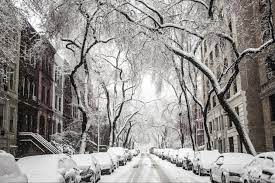
New YorkKeralaMount EverestWinters around the world. Courtesy: Creative Commons
My friend and colleague was turning blue. The cold wind hit me with the force of a sledgehammer. We both had on all the warm clothes we could bring. I had on me a woollen blazer, a full sleeve sweater, my shirt, a half sleeve sweater, and underneath it a thermal. The freezing wind cut through these layers like the proverbial knife through butter. I was beginning to lose sensation on my nose and extremities. We were in freezing weather for less than a minute crossing the road to where the car was parked. We were inadequately dressed for a February morning in New York city. A nor’easter had hit a day before and the temperature was below minus 24 degrees Celsius. The news channels mentioned it was the coldest day in over two decades. Luckily for us, the car was heated, and the seats could also be warmed. We slowly thawed after the flash freeze.
We had flown from sunny Aruba (Dutch Caribbean) the previous day. Miami had perfect weather, but New York was freezing. Manhattan is full of skyscrapers. There is no direct rail line from the airport to Manhattan. New York has a decent public transport infrastructure but no airport metro. The city’s infrastructure does need some serious investment on upgrade and maintenance. The hotel room was warm and toasty. Outside, it was snowing. I saw the homeless on the freezing sidewalks trying to shelter from the bitter cold. Poverty amid opulent wealth.
I have mostly lived in warm places where your major concern is staying cool in the humid heat. In Kerala, in the south of India, a mundu or a lungi wrapped around the waist was the common male attire. The mercury in most areas never goes below 20 degrees Celsius. In New York during winter, the major concern was staying warm. Suddenly, common English expressions began to make sense. Warm welcome, warm greetings make sense when you are coming in from a freezing weather. When you are all hot and sweaty, the warmth seems unwelcome. Also, the European style of dressing was designed to minimise heat loss. Socks, hats, gloves, coats, tie, scarf. The buildings all had double doors to keep out the cold and keep in the warmth. Central heating kept the inside warm.
Keeping warm is expensive. I did some rough calculation and worked out that I would have to spend USD 1500 on winter clothing and over USD 250 monthly on heating bills. The tempo and rhythm of life changes in the northern latitudes with the change of seasons. Winters mean short days and time spent mostly indoors. The wily COVID virus is capitalising fully on this human behaviour. Summers translate to warm temperatures and long days. With global climate change, the highs in summer and the lows in winter are becoming extreme.
On another occasion I was strolling by the shores of Lake Michigan in Chicago enjoying the early morning view. There were gardens and walking paths by the shoreline. Suddenly a cold wind blew across the lake from Canada. Despite all the winter clothing I donned, I was frozen. In cold weather, it is important to have a waterproof and wind proof outer shell. These are expensive however, and as occasional visitors to cold climates, we were unwilling to invest in such clothing. Upstate New York is even colder than New York city, and Rochester is said to be among the snowiest cities in America.
New York city is relatively well-prepared for snowy weather with double doors, central heating, winter clothing and snow ploughs. So is Chicago. Some of the southern cities in the US also experience snowy weather due to climate change and are not prepared for occasional winter storms. The plains of northern India experience cold weather from December to March. A thick layer of smog blankets the plains. Trains and planes are delayed, and driving could become hazardous. Air pollution rises and the air becomes dangerous to breathe. The sun succeeds in clearing the fog only after ten in the morning. Kathmandu in Nepal also experience fog and increased pollution during winter. Pokhara is a Nepalese city without fog in winters. I have often wondered why. With beautiful views of the Annapurna range, winter mornings in Pokhara are occasions to be savoured. In these places there is no central heating. Quilts are widely used. I enjoy the quilt which slowly warms you up using your own body heat.
In the mountains of Nepal, external heating devices are common. In the Everest region, there is the yak dung burning cast iron stove in dining rooms. In the Annapurna region north of Pokhara, wood burning stoves are common. In Thak Khola, charcoal burning stoves under the table are used. The bedrooms, however, are unheated and freezing. I had stayed in Lobuche in the Everest region, at around 4900 m for over a month for a research project and the nights were freezing. The water bottle used to freeze. If you wanted something to not freeze, you kept it beside you on the bed inside the quilt.
Watching snow fall is relaxing. The snowflakes glide down and blanket the trees and the ground in white. The cold reduces a bit. Rain is more noisy and violent and often accompanied by thunder and lightning. Walking on snow is difficult. Soon the snow melts during the day and refreezes again at night and turns into ice. Ice is extremely slippery and dangerous to walk on. Snow is a rare treat for persons from tropical climates. However, living in snow covered regions is challenging.
Near the equator the climate is constant throughout the year. The rains cool down the atmosphere, but the hours of sunlight do not vary much. Life is not influenced by the seasons. The further north or south you go from the equator, seasons begin to colour your life. Summer brings long days, sometimes extreme heat and more time spent outdoors. Winter brings longer nights, snow, and more time indoors. In both New York and Chicago, in winter, the trees were totally bare, bereft of leaves. I could not believe they were still alive. With the coming of spring the green twigs would sprout again and the cycle of life resumes. The writing of poets and authors from temperate countries about the dreariness of winter and the warmth of spring and summer began to make sense to me — a person from and living in the tropics.
.
Dr. P Ravi Shankar is a faculty member at the IMU Centre for Education (ICE), International Medical University, Kuala Lumpur, Malaysia. He enjoys traveling and is a creative writer and photographer.
.
PLEASE NOTE: ARTICLES CAN ONLY BE REPRODUCED IN OTHER SITES WITH DUE ACKNOWLEDGEMENT TO BORDERLESS JOURNAL












 Borderless