Categories
Slices from Life

Instrumental in Solving the Crime

By Meredith Stephens

“This is just like Midsomer Murders without the murders!” I quipped to Alex.

Midsomer Murders was one of my favourite British crime shows. In particular, I loved the depiction of English village life, where villagers gossiped on the village green. The only problem was when the happy village life was interrupted by a gruesome and unexpected murder. Then I had to place my hands before my eyes to block out the scene of the murder in case the camera lingered there too long.

Alex, Verity and I were visiting the Mypunga Markets in the South Australian countryside. The first vendor was selling a wide selection of eye-wateringly delectable Greek cakes. To our right was an Italian wine-grower selling his wines, such as Pinot Grigio, from a nearby vineyard. A Korean stall holder was selling kimchi[1]. Perhaps the offerings were a tad more multicultural that those depicted on the village green in Midsomer Murders. Farmers sold organic vegetables and local dairies sold cheeses. We stopped to soak in the sounds of a group of elderly ukulele players. Shoppers were wearing home-spun hand-knitted jumpers, scarves and beanies, carrying shopping bags made of cheesecloth. I revelled at being on the set of the South Australian equivalent of the village green in Midsomer.

Our purpose for driving into the countryside was twofold. After the market, we went to the shed at Alex’s hobby farm to collect some firewood. Alex unlocked the gates at the roadside entrance, and we drove through the spotted eucalypts, wound up and down the hill through the gorge to eventually arrive at the shed. The roller door was wide open. This was the first time we had been greeted by an open roller door. We parked and peeked inside.

“Don’t go in, Dad!” screamed Verity.

Plastic tubs had their lids off. Children’s toys were scattered. Furniture was tipped over. The new off-grid battery modules, in the process of being installed, had been ripped out and strewn on the floor. We could not turn on the lights because they were powered by the batteries.

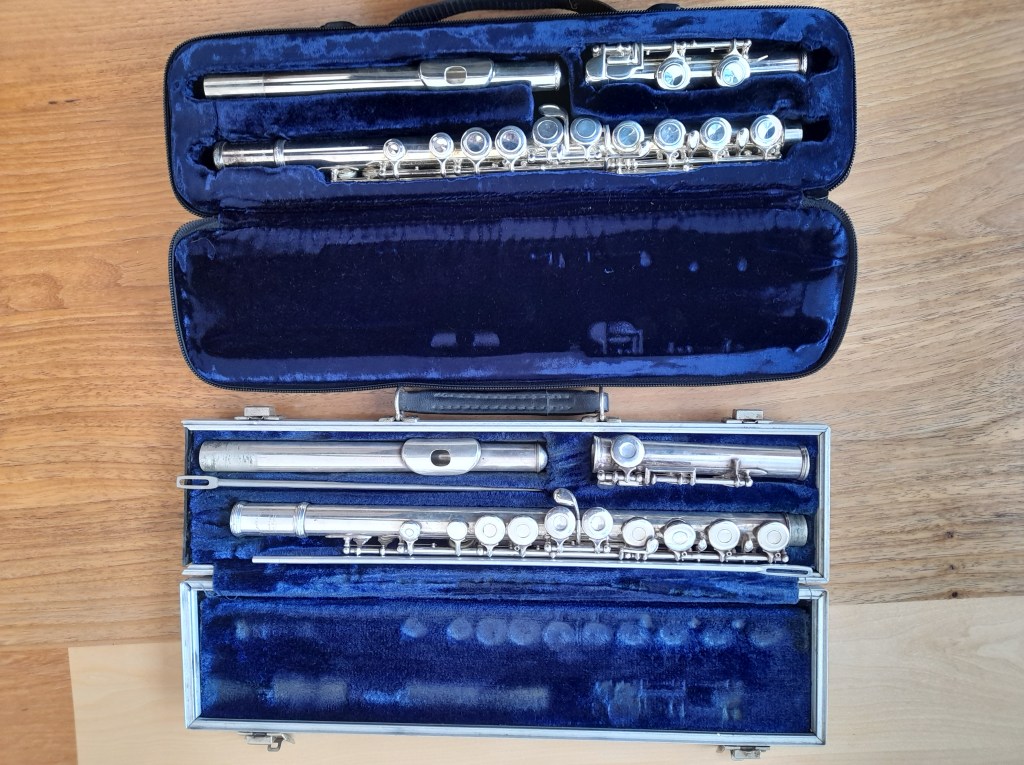
We carefully continued our entry into the huge dark shed lest we surprise the burglars and become a victim ourselves. No-one was there. I looked in the ancient sideboard I had inherited from my grandmother and opened the top drawers. My forty-year-old flutes were missing. Were the burglars flautists?

We righted the upturned furniture, returned the toys to the plastic tubs, affixed the lids and stacked them neatly. Then Alex got on the phone to his young employee, Troy.

“Would you mind getting hold of a battery-powered camera and placing it up high in the gum tree facing the shed door?” he asked. “We need surveillance.”

It was Saturday and Troy’s day off, but he was willing to assist Alex, and by 9 pm that evening he had purchased a camera and placed it where requested. He used the drop-down menu to ensure that notifications of camera images would come to his phone.

We returned home with the firewood. At least the burglars hadn’t stolen that. We lit a fire in the fireplace and luxuriated in front of it, savouring the delights we had purchased at the Mypunga markets. Now we had a camera installed, surely, we would be safe.

At 5 am the next morning the telephone rang. It was Troy. Alex’ phone had been on bedtime mode, and he could not have received calls any earlier.

“They’ve broken in again,” said Troy. “At 2.38 am. This time with a car. The footage came to my phone.”

“Are you there now?” asked Alex.

“Yes. I came straight here when I got the notification.”

“OK. We’ll head over there this morning. Have you called the police?”

“Yes. They’re coming shortly.”

Usually, I savour sleeping in on the weekend, or in fact on any day, but suddenly I had no desire to continue nestling between the brushed cotton sheets. I had been jolted awake.

“Are we going now?” I asked Alex.

“Soon. I have to wait for the hardware store to open. I want to buy some metal reinforcements to secure the shed door. Because we have no power, I’ll have to buy an inverter to power my tools.”

We drove towards Mypunga, first stopping at the hardware store en route to buy the bolts and then at an electronic’s store to buy the inverter. When we arrived at the farm we stopped at the gates to check the locks. The chain had been cut with bolt cutters. Then came a phone call from Troy.

“Are the police here?” asked Alex.

“Yes. They have collected fingerprints and DNA samples. They are coming out now to talk to you.”

Soon we were joined at the gates by four detectives and Troy. It was 11 am. Troy had been on the site for at least six hours, not to mention having been there at 9 pm the night before to install the cameras. He excused himself and the detectives explained to Alex the evidence they had found. The visit from the previous day had been a stake-out on foot. Once they had discovered the batteries, they had resolved to return with a car. The batteries were too heavy to have been carried out on foot. But not the flutes. They were much lighter than the batteries.

The police promised to examine the footage carefully. It captured the arrival of the car, and three men with torches circling the shed. One of the men had spied the camera, seized it, and thrown it down the hill. After that the images from the camera were of the surrounding grass. The detectives left and Alex and I drove up and down the winding track to the shed. The roller door was wide open. We entered, and the carefully stacked boxes again were opened and the lids strewn around the shed. Toys and hats were scattered. The drawer from which my flutes had been removed was now firmly wedged against the sideboard. They had clearly opened and shut it again, even after having removed the flutes the day before.

Unlike in Midsomer, no-one had been murdered, but there was a strong sense of violation. Burglars had staked out Alex’s shed, upturned the contents, and left with the roller door still open. Returning the very next day after having staked out the property was brazen. There was a dark underside in this countryside location despite the peaceful scene we had observed the previous day in Mypunga, with shoppers in their home-spun hand-knitted jumpers carrying their organic produce in cheesecloth bags. Most likely the thieves were from elsewhere and had followed the battery installer’s vehicle emblazoned “Remote Power Australia”.

A few days later Alex received a call from the detectives requesting a DNA sample, in order to rule him out. Some tools in the shed had been used to remove the batteries, and they had produced a DNA sample from these. Alex agreed, and a constable arrived at the house the next day to take a swab.

“Have you made any progress on the case?” asked Alex.

“We’ve identified the car the burglars used from the footage. It’s a Ford Maverick. That narrows it down quite a bit.”

Meanwhile Alex and Troy restored the camera to the eucalyptus tree, and bought another one which they affixed it to another tree one hundred and fifty feet away. At the detective’s suggestion, the second camera was aimed at the first one. If a burglar took down the first camera they would be filmed by the second camera. Since the batteries had been stolen and there was no power in the shed, the cameras were operated by solar panels. Alex could regularly check for notifications on his phone.

Two months later Alex received a phone call from a constable with a strong northern English accent that transported you to a distant time and place. It was the kind of English you would hear on a British detective show, although not the southeastern English accent of the fictional Midsomer.

“This is Senior Constable Jane Michaels. We have found two flutes. They may be yours. Can you identify them from the photo? I took it with my bodycam.”

Alex showed me his phone. I couldn’t identify them from the photo. However, they had to be mine. Flute theft must be a much rarer crime than battery theft. More people are in need of batteries than a flute.

“If you prefer to identify them in person, I can make myself available next week,” explained the Senior Constable. “The burglars were not what you would call a musical family,” she quipped.

“I’ll give you my partner’s number so that you can contact her directly,” offered Alex.

The next Wednesday a call came from an unknown number. I let it ring out because I never answer unless I know who is calling. Then I listened to the recorded message the caller had left behind.

“It’s Senior Constable Jane Michaels from the Camden Police Station. I’m hoping you can identify those flutes. Please call me back.”

Hearing this English accent made me feel like I was on the set of Midsomer Murders. A frisson of excitement tingled up my spine. It was a warm, old-world and unpretentious accent that I associated with the north of England. (When you hear an English accent by a worker in South Australia, you may feel like you are on the set of a detective show like me, or you may assume they are in the health or policing professions because of the recruitment drives in Britain in these professions.)

“Can you come to Camden Station to identify them? We’ll be there in half an hour.”

I drove to the address she provided, entered through the imposing gates, and parked outside a giant warehouse. I entered the building and pressed a button marked ‘Property recovery’. A constable greeted me from behind a glass partition.

“What have you come to collect?” he asked.

“Two flutes.”

He looked at me quizzically. Flute theft is probably an uncommon crime.

“What?” he asked again.

“Flutes,” I repeated.

He disappeared to the room behind, and Senior Constable Jane Michaels appeared bearing the flutes in their cases. Despite her old-world accent on the phone, she was surprisingly young.

“Are these in fact yours?”

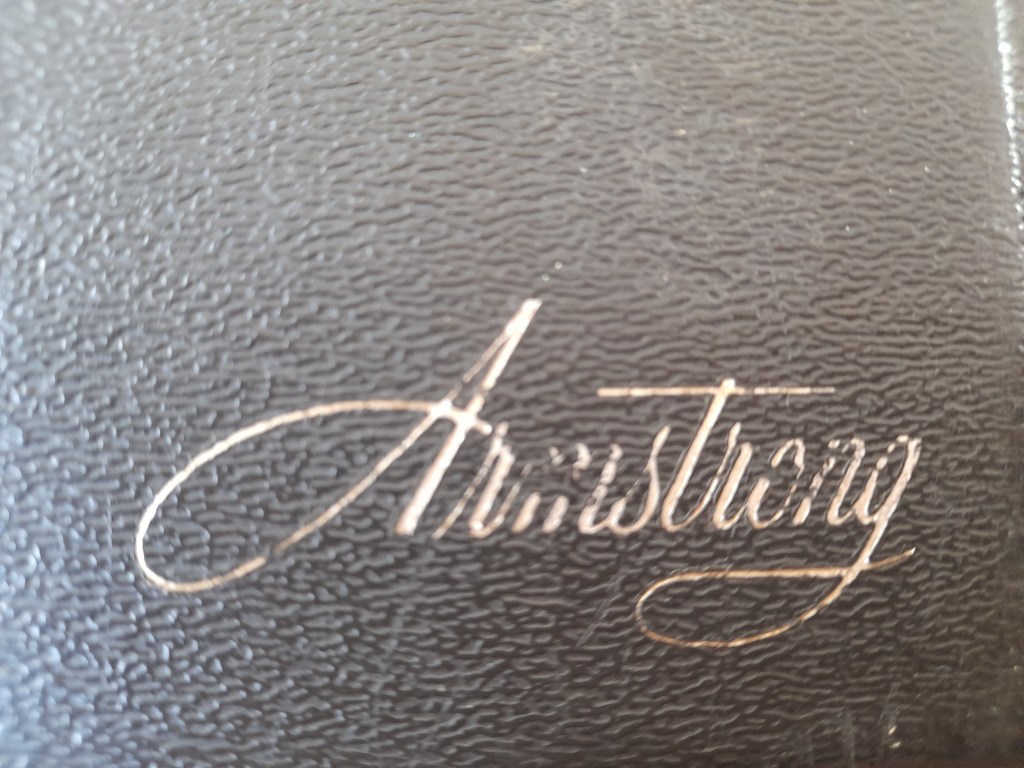
I looked at the cover of the box for the brand, and sure enough, ‘Armstrong’ was written in faded silver letters. This was the flute I had owned since my teenage years.

“How about the batteries? Are you likely to find them?” I asked hopefully.

“We didn’t find them at the property, but it’s an ongoing investigation,” she explained. I could tell from her apologetic tone that she thought we would be unlikely to retrieve them.

I thanked her and left. I returned to my car, the sole one in the enormous car park. As I drove off two constables headed to close the enormous gates behind me, smiling and waving, happy that I had been reunited with my stolen flutes.

I have to hope for Alex’ sake that the batteries will be found. Meanwhile, I haven’t played my Armstrong flute in over forty years, but now that it has been stolen and recovered in a raid, I feel compelled to take it up again. What’s more, who knows whether the recovered flutes will be instrumental in solving the crime of the stolen batteries?

[1] A spicy Korean salad

Meredith Stephens is an applied linguist from South Australia. Her recent work has appeared in Syncopation Literary Journal, Continue the Voice, Micking Owl Roost blog, The Font – A Literary Journal for Language Teachers, and Mind, Brain & Education Think Tank. In 2024, her story Safari was chosen as the Editor’s Choice for the June edition of All Your Stories.

PLEASE NOTE: ARTICLES CAN ONLY BE REPRODUCED IN OTHER SITES WITH DUE ACKNOWLEDGEMENT TO BORDERLESS JOURNAL

Click here to access the Borderless anthology, Monalisa No Longer Smiles

Click here to access Monalisa No Longer Smiles on Kindle Amazon International

Categories
Contents

Borderless, August 2025

Art by Sohana Manzoor

Editorial

Storms that Rage… Click here to read.

Translations

Nazrul’s Jonomo, Jonomo Gelo (Generations passed) has been translated from Bengali by Professor Fakrul Alam. Click here to read and listen to a rendition by the famed Feroza Begum.

Ajit Cour‘s short story, Nandu, has been translated from Punjabi by C Christine Fair. Click here to read.

The Scarecrow by Anwar Sahib Khan has been translated from Balochi by Fazal Baloch. Click here to read.

Five poems by Aparna Mohanty have been translated from Odia by Snehprava Das. Click here to read.

Angshuman Kar has translated some of his own Bengali poems to English. Click here to read.

Sunflower, a poem by Ihlwha Choi,  has been translated from Korean by the poet himself. Click here to read.

Tagore’s Shaishabshanda (Childhood’s Dusk) has been translated from Bengali by Mitali Chakravarty. Click here to read.

Poetry

Click on the names to read the poems

Ron Pickett, Fakrul Alam, William Miller, Meetu Mishra, Heath Brougher, Laila Brahmbhatt, Luis Cuauhtémoc Berriozábal, Snigdha Agrawal, George Freek, Ashok Suri, Scott Thomas Outlar, Dustin P Brown, Rajorshi Patranabis, Ryan Quinn Flanagan

Poets, Poetry & Rhys Hughes

From the Vale of Glamorgan are two poems on the place where Rhys Hughes grew up. Click here to read.

Musings/Slices from Life

Menaced by a Marine Heatwave

Meredith Stephens writes of how global warming is impacting marine life in South Australia. Click here to read.

The Man from Pulwama

Gowher Bhat introduces us to a common man who is just kind. Click here to read.

More than Words

Jun A. Alindogan writes on his penchant for hardcopy mail. Click here to read.

To Bid or Not to Bid… the Final Goodbye?

Ratnottama Sengupta ponders on Assisted Dying. Click here to read.

Musings of a Copywriter

In Syrupy Woes, Devraj Singh Kalsi looks at syrupy health antidotes with a pinch of humour. Click here to read.

Essays

‘Verify You Are Human’

Farouk Gulsara ponders over the ‘intelligence’ of AI and humans. Click here to read.

Does the First Woman-authored Novel in Bengali Seek Reforms?

Meenakshi Malhotra explores Somdatta Mandal’s translation of Manottama, the first woman-authored Bengali novel published in 1868. Click here to read.

Bhaskar’s Corner

In Bidyut Prabha Devi – The First Feminist Odia Poet, Bhaskar Parichha pays a tribute to the poet. Click here to read.

Stories

The Sixth Man

C. J. Anderson-Wu tells a story around disappearances during Taiwan’s White terror. Click here to read.

I Am Not My Mother

Gigi Baldovino Gosnell gives a story of child abuse set in Philippines where the victim towers with resilience. Click here to read.

The Archiver of Shadows

Hema R explores shadows in her story set in Chennai. Click here to read.

Ali the Dervish

Paul Mirabile weaves the strange adventures of a man who called himself Ali. Click here to read.

The Gift

Naramsetti Umamaheswararao moulds children’s perspectives. Click here to read.

Notes from Japan

In American Wife, Suzanne Kamata gives a short story set set in the Obon festival in Japan. Click here to read.

Conversation

Neeman Sobhan, author of Abiding City: Ruminations from Rome, discusses shuttling between multiple cultures and finding her identity in words. Click here to road.

Book Excerpts

An excerpt from M.A.Aldrich’s From Rasa to Lhasa: The Sacred Center of the Mandala. Click here to read.

An excerpt from Neeman Sobhan’s An Abiding City: Ruminations from Rome. Click here to read.

Book Reviews

Somdatta Mandal reviews Chhimi Tenduf-La’s A Hiding to Nothing. Click here to read it.

Madhuri Kankipati reviews O Jungio’s The Kite of Farewells: Stories from Nagaland. Click here to read.

Bhaskar Parichha reviews Snehaprava Das’s Keep it Secret: Stories. Click here to read.

.

Click here to access the Borderless anthology, Monalisa No Longer Smiles

Click here to access Monalisa No Longer Smiles on Amazon International

Categories
Editorial

Storms that Rage

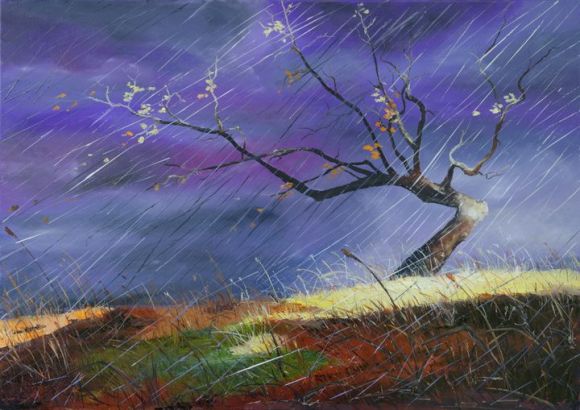
Storm in purple by Arina Tcherem. From Public Domain

If we take a look at our civilisation, there are multiple kinds of storms that threaten to annihilate our way of life and our own existence as we know it. The Earth and the human world face twin threats presented by climate change and wars. While on screen, we watch Gaza and Ukraine being sharded out of life by human-made conflicts over constructs made by our own ‘civilisations’, we also see many of the cities and humankind ravaged by floods, fires, rising sea levels and global warming. Along with that come divides created by economics and technology. Many of these themes reverberate in this month’s issue.

From South Australia, Meredith Stephens writes of marine life dying due to algal growth caused by rising water temperatures in the oceans — impact of global warming. She has even seen a dead dolphin and a variety of fishes swept up on the beach, victims of the toxins that make the ocean unfriendly for current marine life. One wonders how much we will be impacted by such changes! And then there is technology and the chatbot taking over normal human interactions as described by Farouk Gulsara. Is that good for us? If we perhaps stop letting technology take over lives as Gulsara and Jun A. Alindogan have contended, it might help us interact to find indigenous solutions, which could impact the larger framework of our planet. Alindogan has also pointed out the technological divide in Philippines, where some areas get intermittent or no electricity. And that is a truth worldwide — lack of basic resources and this technological divide.

On the affluent side of such divides are moving to a new planet, discussions on immortality — Amortals[1] by Harari’s definition, life and death by euthanasia. Ratnottama Sengupta brings to us a discussion on death by choice — a privilege of the wealthy who pay to die painlessly. The discussion on whether people can afford to live or die by choice lies on the side of the divide where basic needs are not an issue, where homes have not been destroyed by bombs and where starvation is a myth, where climate change is not wrecking villages with cloudbursts.  In Kashmir, we can find a world where many issues exist and violences are a way of life. In the midst of such darkness, a bit of kindness and more human interactions as described by Gower Bhat in ‘The Man from Pulwama’ goes some way in alleviating suffering. Perhaps, we can take a page of the life of such a man. In the middle of all the raging storms, Devraj Singh Kalsi brings in a bit of humour or rather irony with his strange piece on his penchant for syrups, a little island removed from conflicts which seem to rage through this edition though it does raise concerns that affect our well-being.

The focus of our essays pause on women writers too. Meenakshi Malhotra ponders on Manottama (1868), the first woman-authored novel in Bengali translated by Somdatta Mandal whereas Bhaskar Parichha writes on the first feminist Odia poet, Bidyut Prabha Devi.

Parichha has also reviewed a book by another contemporary Odia woman author, Snehaprava Das. The collection of short stories is called Keep it Secret. Madhuri Kankipati has discussed O Jungio’s The Kite of Farewells: Stories from Nagaland and Somdatta Mandal has written about Chhimi Tenduf-La’s A Hiding to Nothing, a novel by a global Tibetan living in Sri Lanka with the narrative between various countries. We have an interview with a global nomad too, Neeman Sobhan, who finds words help her override borders. In her musing on Ostia Antica, a historic seaside outside Rome, Sobhan mentions how the town was abandoned because of the onset of anopheles mosquitos. Will our cities also get impacted in similar ways because of the onset of global ravages induced by climate change? This musing can be found as a book excerpt from Abiding City: Ruminations from Rome, her book on her life as a global nomad. The other book excerpt is by a well-known writer who has also lived far from where he was born, MA Aldrich. His book, From Rasa to Lhasa: The Sacred Center of the Mandala is said to be “A sweeping, magnificent biography—which combines historical research, travel-writing and discussion of religion and everyday culture—Old Lhasa is the most comprehensive account of the fabled city ever written in English.”

With that, we come to our fiction section. This time we truly have stories from around the globe with Suzanne Kamata sending a story set in the Bon festival that’s being celebrated in Japan this week for her column. From there, we move to Taiwan with C. J. Anderson-Wu’s narrative reflecting disappearances during the White Terror (1947-1987), a frightening period for people stretched across almost four decades.  Gigi Gosnell writes of the horrific abuse faced by a young Filipino girl as the mother works as a domestic helper in Dubai. Paul Mirabile gives us a cross-cultural narrative about a British who opts to become a dervish. While Hema R touches on women’s issues from within India, Sahitya Akademi Award Winner, Naramsetti Umamaheshwararao, writes a story about children.

We have a powerful Punjabi story by Ajit Cour translated by C.Christine Fair. Our translations host two contemporary poets who have rendered their own poems to English: Angshuman Kar, from Bengali and Ihlwha Choi, from Korean. Snehaprava Das has brought to us poetry from Odia by Aparna Mohanty. Fazal Baloch has translated ‘The Scarecrow’, a powerful Balochi poem by Anwar Sahib Khan. While Tagore’s Shaishabshandha (Childhood’s Dusk) has been rendered to English, Nazrul’s song questing for hope across ages has been brought to us by Professor Fakrul Alam.

Professor Alam has surprised us with his own poem too this time. In August’s poetry selection, Ron Pickett again addresses issues around climate change as does Meetu Mishra about rising temperatures. We have variety and colour brought in by George Freek, Heath Brougher, Laila Brahmbhatt, Luis Cuauhtémoc Berriozábal, Snigdha Agrawal, William Miller, Ashok Suri, Scott Thomas Outlar, Dustin P Brown, and Ryan Quinn Flanagan. Rajorshi Patranabis weaves Wiccan lore of light and dark, death and life into his delicately poised poetry. Rhys Hughes has also dwelt on life and death in this issue. He has shared poems on Wales, where he grew up— beautiful gentle lines.

 In spring warm rain will crack
the seeds of life: tangled
roots will grow free again.

('Tinkinswood Burial Chamber' by Rhys Hughes)

With such hope growing out of a neolithic burial chamber, maybe there is hope for life to survive despite all the bleakness we see around us. Maybe, with a touch of magic and a sprinkle of realism – our sense of hope, faith and our ability to adapt to changes, we will survive for yet another millennia.

We wind up our content for the August issue with the eternal bait for our species — hope. Huge thanks to the fantastic team at Borderless and to all our wonderful writers. Truly grateful to Sohana Manzoor for her artwork and many thanks to all our wonderful readers for their time…

We wish you all a wonderful reading experience!

Gratefully,

Mitali Chakravarty.

borderlessjournal.com

[1] Homo Deus: A Brief History of Tomorrow (2015) by Yuval Noah Harari

.

Click  here to access the contents for the August 2025 Issue

.

READ THE LATEST UPDATES ON THE FIRST BORDERLESS ANTHOLOGY, MONALISA NO LONGER SMILES, BY CLICKING ON THIS LINK.
Categories
Slices from Life

Menaced by a Marine Heatwave

By Meredith Stephens

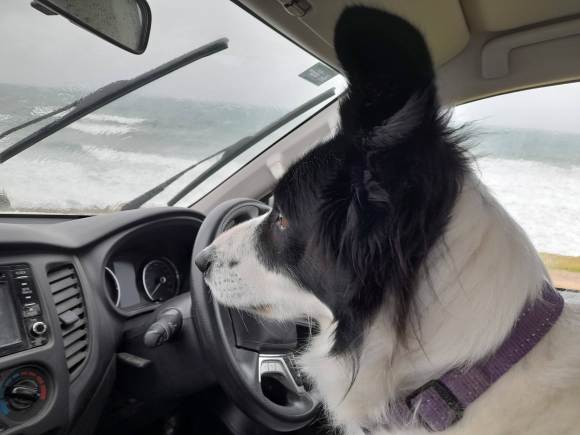
In an ideal world I would sleep in every morning and enjoy a leisurely breakfast, but I can indulge in no such luxury because I have a border collie. Her name is Haru. She has an elongated body, a pointy white snout scattered with black dots, one black ear and one black and white spotted ear, all-knowing brown eyes, feathered forelegs, and a bushy tail with a white tip. She looks more like a cross between a fox and a border collie than a pure border collie. As soon as she hears my voice when I wake up, she starts whining from the courtyard below, nagging me to take her for a walk. I much more looking forward to my breakfast than the walk, but Haru is the opposite.

Haru. Photograph by Meredith Stephens

One Tuesday, as usual, I affixed her leash and walked her towards the esplanade. Haru has memorised the route. She strained in front of me to the point where we crossed the road and then continued to drag me towards the pedestrian crossing. Then she made a beeline for the stairs leading down to the beach. I released the leash and threw the ball down to the sand. She raced down the stairway ahead of me and ran to catch the ball. In the winter months along this coastline, dogs are allowed to run off the leash as long as they are under the owner’s control. I was joined by a throng of other dog lovers and their canines, running to catch balls. Haru is interested neither in other dogs nor other people. All she cares about is the ball. Other dogs approached her and chased her, but she’s indifferent, solely focused on the ball in my hand.

This is good for me because I get exercise when I otherwise would not, and experience vicarious pleasure in her excitement at retrieving the ball. Maybe this is more fun than breakfast after all. However, my walk last Tuesday was unlike those of previous weeks. I spotted an entire fish washed up on the shore amongst the seaweed. I had never seen this before on my daily beach walks over the last five years. Then I looked up and saw a rounded shape of a mammal a few hundred metres in the distance. I walked towards it, and once up close I realised that it was the head of a dolphin. “Sorry,” I said, feeling complicit in the damage wreaked by climate change. Haru was normally quick to sniff out a carcass and chew it, but she showed no interest.

The next day I chatted to a neighbour who told me that on her beach walk she had seen a range of species washed up on the beach that she didn’t know existed. We were witnessing the aftermath of an algae bloom, known as Karenia Mikomotoi, from September 2024. This had arisen in response to a rise in the sea surface temperatures of 2.5 degrees. The recent storms in June 2025 had washed the bodies of these sea creatures ashore. On my next beach walk I came across a small stingray, completely intact, directly in my path. I had seen stingrays before swimming in the shallows but never washed up on the beach. It was so beautifully formed that I could tell it had met an untimely death. Something untoward and unusual had happened. Again, Haru showed no interest in the stingray, despite usually being interested in decaying fish or animals.

Weeks later I continued to spot fish washed up on the shore that I have never seen before. I came across much smaller fish a couple of centimetres long, some slightly larger fish, and another small stingray. These were the kind of colourful fish that I would see when snorkelling in pristine waters, not washed up on a suburban beach. Haru continued to ignore these dead creatures and skipped along the beach anticipating my ball-throwing. Or perhaps she somehow sensed they contained toxins. At least she was unlikely to be poisoned by eating them.

She delights in catching not only one ball that I throw her, but sometimes two. She doesn’t like to relinquish a ball, so I have another one on hand to throw her so that she can chase all the while holding the first one in her mouth. After chewing the ball down to a smaller size and squashing it, she can sometimes fit two into her mouth. Once she has managed this, she runs away from me into the wintry waters, oblivious to the cold, triumphant that she has two balls and trying to get as far away from me as she can in case, I try to take one away from her. Sometimes she skips through patches of the dirty foam left by the algal bloom.

I wish I could provide a happy ending to this story, but the algal bloom is not predicted to end soon, so my idyllic morning and evening beach walks with the oblivious Haru are likely to be punctuated with sightings of innocent marine creatures being washed ashore, victims of climate change and warming temperatures.

One consolation occurred the day my fiancé, Alex, and I left the mainland to sail across Investigator Strait to Kangaroo Island. Over the years there has never been a crossing during which we have not seen dolphins. In the back of my mind, I feared that this would be the first time. An hour into our crossing, Alex heard the familiar splash of breaking water and sighted a pod of dolphins. Not only that, once in the bay at Kangaroo Island, we spotted a sea lion. Thankfully, the marine life that can escape the algae is still undisturbed. I hope the scientists will find a way to address the marine heatwave so that life in our oceans can again thrive, and beachgoers can be spared the sight of these innocent creatures being washed up on local beaches. We can’t simply delegate to the scientists, though. Witnessing this marine carnage is a strong impetus for ordinary citizens to live more sustainably.

Meredith Stephens is an applied linguist from South Australia. Her recent work has appeared in Syncopation Literary Journal, Continue the Voice, Micking Owl Roost blog, The Font – A Literary Journal for Language Teachers, and Mind, Brain & Education Think Tank. In 2024, her story Safari was chosen as the Editor’s Choice for the June edition of All Your Stories.

PLEASE NOTE: ARTICLES CAN ONLY BE REPRODUCED IN OTHER SITES WITH DUE ACKNOWLEDGEMENT TO BORDERLESS JOURNAL

Click here to access the Borderless anthology, Monalisa No Longer Smiles

Click here to access Monalisa No Longer Smiles on Kindle Amazon International

Categories
Contents

Borderless, July 2025

Art by Sohana Manzoor

Editorial

‘…I write from my heart of the raging tempest…’.Click here to read.

Translations

Jibanananda Das’s poem, Given the Boon of Eternity, has been translated from Bengali by Professor Fakrul Alam. Click here to read.

Karim Dashti’s short poems have been translated from Balochi by Fazal Baloch. Click here to read.

Five poems by Sangram Jena have been translated from Odia by Snehprava Das. Click here to read.

Surya Dhananjay’s story, Mastan Anna, has been translated from Telugu by Rahimanuddin Shaik. Click here to read.

The Last Letter, a poem by Ihlwha Choi  has been translated from Korean by the poet himself. Click here to read.

Tagore’s Probhatey (In the Morning) has been translated from Bengali by Mitali Chakravarty. Click here to read.

Poetry

Click on the names to read the poems

Luis Cuauhtémoc Berriozábal, Snehaprava Das, David R Mellor, Snigdha Agrawal, George Freek, Laila Brahmbhatt, Tracy Lee Duffy, John Swain, Amarthya Chandar, Craig Kirchner, Shamim Akhtar, Jason Ryberg, Momina Raza, Ryan Quinn Flanagan, Shahriyer Hossain Shetu, Rhys Hughes

Musings/ Slices from Life

What is Great Anyway?

Farouk Gulsara explores the idea of ‘greatness’ as reflected in history. Click here to read.

From Cape Canaveral to Carnarvon

Merdith Stephens writes of her museum experiences with photographs from Alan Nobel. Click here to read.

A Journey through Pages

Odbayar Dorj writes of library culture in Japan and during her childhood, in Mongolia. Click here to read.

By the Banks of the Beautiful Gomti

Prithvijeet Sinha strolls through the park by the riverfront and muses. Click here to read.

Dhruba Esh & Amiyashankar

Ratnottama Sengupta muses on her encounter with the writings of eminent artist and writer, Dhruba Esh, and translates one his many stories, Amiyashankar Go Back Home from Bengali. Click here to read.

Musings of a Copywriter

In Gastronomy & Inspiration? Sherbets and More…, Devraj Singh Kalsi looks at vintage flavours. Click here to read.

Notes from Japan

In Summer Vacation in Japan: Beetle Keeping and Idea Banks, Suzanne Kamata narrates her experience of school holidays in Japan. Click here to read.

Essays


It doesn’t Rain in Phnom Penh

Mohul Bhowmick writes of his trip to Phnom Penh and Siem Reap. Click here to read.

Haunted by Resemblances: Hunted by Chance

Aparajita De introspects with focus on serendipity. Click here to read.

Stories

Blue Futures, Drowned Pasts

Md Mujib Ullah writes a short cli-fi based on real life events. Click here to read.

Unspoken

Spandan Upadhyay gives a story around relationships. Click here to read.

Misjudged

Vidya Hariharan gives a glimpse of life. Click here to read.

Nico Returns to Burgaz

Paul Mirabile writes about growing up and reclaiming from heritage. Click here to read.

Feature

A review of Anuradha Kumar’s Wanderers, Adventurers, Missionaries: Early Americans in India and an interview with the author. Click here to read.

Book Excerpts

An excerpt from Rhys Hughes’ The Eleventh Commandment And Other Very Short Fictions. Click here to read.

An excerpt from Snehprava Das’s Keep It Secret. Click here to read.

Book Reviews

Somdatta Mandal reviews Dilip K Das’s Epidemic Narratives: The Cultural Construction of Infectious Disease Outbreaks in India. Click here to read.

Rakhi Dalal reviews Rajat Chjaudhuri’s Wonder Tales for a Warming Planet. Click here to read.

Gower Bhat has reviewed Neha Bansal’s Six of Cups. Click here to read.

Bhaskar Parichha reviews Jagadish Shukla’s A Billion Butterflies: A Life in Climate and Chaos Theory. Click here to read.

.

Click here to access the Borderless anthology, Monalisa No Longer Smiles

Click here to access Monalisa No Longer Smiles on Amazon International

Categories
Editorial

‘…I write from my heart of the raging tempest…’

I can see the heartbreak, 
Hear the wailing, the awakening,
I write from my heart
Of the raging tempest.

— Translation of Probhatey or ‘In the Morning’ by Rabindranath Tagore (1906)

All around us, we hear of disasters. Often, we try to write of these as Tagore seems to do in the above lines. However, these lines follow after he says he draws solace and inspiration from a ‘serene lotus’, pristine and shining with vibrancy. He gazes at it while looking for that still point which helps him create an impact with words. That is perhaps what we can hope to do too — wait for a morning where clarity will show us the path to express not just what we see, but to find a way to heal and help. Finding parallels in great writings of yore to our own attempts at recreating the present makes us realise that perhaps history is cyclical. In Rome, new structures rear up against thousand-year walls, reflecting how the past congeals into the present.

Congealing the past into our present in this July’s issue are stories of American migrants — like Tom Alter’s family who made India their home — by Anuradha Kumar in her new non-fiction Wanderers, Adventurers, Missionaries: Early Americans in India. We feature this book with a review and an interview with the author where she tells us how and why she chose to write on these people. We have more people writing of their own wanderings. Mohul Bhowmick wanders into Cambodia and makes friends over a local sport while Prithvijeet Sinha strolls by the banks of the River Gomti in Lucknow. Meredith Stephens not only takes us to the Prime Meridien in Greenwich but also to Carnarvon which houses a science and technology centre in Australia. Devraj Singh Kalsi wanders with humour to discover gastronomical inspiration and hopes for sweeter recompense.

The dialogue started by Professor Fakrul Alam on libraries earlier with his essay and by Kalsi (with a pinch of humour) has been continued by Odbayar Dorj. She talks of the fading culture of libraries in Mongolia, her home country, and the vibrant culture that has blossomed in Japan. Suzanne Kamata writes of the rituals of summer holidays in Japan… including looking after a pet dung beetles.

Farouk Gulsara muses on ‘greatness’ as a concept with irony. Aparajita De muses on the word serendipity, applying it to her own situation while Ratnottama Sengupta muses on her encounter with the writings of eminent cover artist and writer who is not only a recipient of the Bangla Academy literary award but also immensely popular with children, Dhruba Esh, and translates one his many stories from Bengali.

In translations, Professor Alam has brought to us a beautiful poem by Jibanananda Das. Karim Drashti’s Balochi short poems have been rendered in English by Fazal Baloch and Snehaprava Das has found for us Odia poems of Sangram Jena in translation. Ihlwha Choi has rendered his own Korean poem to English while Tagore’s poem, ‘Probhatey (In the Morning)’ winds up the poetry in this section. We have more in prose — Surya Dhananjay’s story, Mastan Anna, translated from Telugu by Rahimanuddin Shaik.

In fiction, we have stories from around the world. Paul Mirabile sets his story in Burgaz. Spandan Upadhyay gives a mysterious narrative set in a world outside our waking consciousness and Vidya Hariharan gives us a glimpse of life in modern day India. From Bangladesh, Md Mujib Ullah writes a short cli-fi based on real life events.

Taking up the theme of cli-fi, Rajat Chaudhuri’s Wonder Tales for a Warming Planet seems to bring hope by suggesting adapting to changing climes. Rakhi Dalal tells us in her review: “It dares to approach the climate crisis through the lens of empathy and imagination rather than panic or guilt. In doing so, Rajat Chaudhuri gives us what many adult climate narratives fail to deliver—a reason to believe that another world is not only possible but already being imagined by the young. All we need to do is listen.” Bhaskar Parichha has discussed the autobiography of a meteorologist and Distinguished University Professor at George Mason University, Jagadish Shukla. In A Billion Butterflies: A Life in Climate and Chaos Theory, he claims Shukla has “revolutionised monsoon forecasting.” Somdatta Mandal has written about Dilip K Das’s Epidemic Narratives: The Cultural Construction of Infectious Disease Outbreaks in India. And Gower Bhat reviews Neha Bansal’s best-selling poetry collection, Six of Cups.

Poetry awakens myriad of hues in Borderless with verses from across the world. We have poems from Luis Cuauhtémoc Berriozábal, Ryan Quinn Flangan, Snehprava Das, George Freek, Laila Brahmbhatt, Tracy Lee Duffy, Amarthya Chandar, Jason Ryberg, Momina Raza, Shahriyer Hossain Shetu and more. Snigdha Agrawal gives a fun-filled poem about a duck and Rhys Hughes has given us a collection of verses like puzzles where we need to guess the animals! We also have an excerpt from Hughes’ The Eleventh Commandment And Other Very Short Fictions and Das’s short stories, Keep It Secret.

With that, we wind up the contents of this month’s issue. Do pause by our content’s page to check it out in more details.

This month’s edition would not have been possible without all our contributors, our fabulous team and especially Sohana Manzoor’s artwork. Huge thanks to all of them and to our wonderful readers who make it worthwhile for us to write and publish. Do write in to us if you have any feedback. Five years ago, we chose to become a monthly from a daily… We have come a long way from then and grown to host writers from more than forty countries and readers from almost all over the world. For this, we owe you all – for being with us and encouraging us to find fresh pastures.

Enjoy the reads!

Wishing you peace and happiness,

Mitali Chakravarty,

borderlessjournal.com

Click here to access the contents for the July 2025 Issue

READ THE LATEST UPDATES ON THE FIRST BORDERLESS ANTHOLOGY, MONALISA NO LONGER SMILES, BY CLICKING ON THIS LINK.
Categories
Slices from Life

From Cape Canaveral to Carnarvon

Narrative by Meredith Stephens & photographs by Alan Noble

The Prime Meridian Line.

Whenever we visit another city, Alex and I always head straight for a science or maritime museum. When we spent a day in London several years ago, Alex insisted that we visit the National Maritime Museum in Greenwich, and then the Royal Observatory. The highlight of the latter was John Harrison’s marine timekeepers, which made the calculation of longitude at sea possible, therefore making navigation safer. A fun part of visiting the Observatory was standing on either side of the Prime Meridian Line, which defines zero longitude and divides the eastern and western hemispheres of the earth. If you are facing north, the person on the left is in the western hemisphere, and the person to the right is in the eastern hemisphere. We had to queue behind other couples to stand either side of the line. The couple in front of us were taking an inordinate amount of time to have their photo taken here, from which global time is calculated.

“Time’s up!” quipped someone behind us.

“What’s time?” came a philosophical comment from someone else.

The quick banter between strangers is one of the many reasons why I love visiting London.

During our short stay we devoted hardly any time to visiting any other tourist sites. The changing of the guard at Buckingham Palace held little allure. After visiting the Royal Observatory, we strolled past the historic British clipper ship “Cutty Sark” and then caught a ferry back from Greenwich to Central London. We briefly hopped off to see the Houses of Parliament, but after having visited the Royal Observatory Alex’s curiosity was sated.

Fast forward to March 2025 and we found ourselves in a remote town in Western Australia called Carnarvon. The first attraction Alex wanted to visit was the Carnarvon Space and Technology Museum. Carnarvon has a little-known relationship to Cape Canaveral in Florida. Many people have heard of Cape Canaveral and its rocket launching site, but who has heard of the not dissimilar-sounding town of Carnarvon?

Unlike the grand public museums in Western Australia, this one is self-funded and run by volunteers. NASA established a tracking station at Carnarvon in 1964, which played a critical role for both the Gemini and Apollo programs. Carnarvon was strategically located as the most distantly located site on the earth diametrically opposite from Cape Canaveral, providing the ability to track spacecraft over the Indian Ocean that were out of range from Cape Canaveral. The most famous launch was Apollo 11 in July 1969, which achieved humanity’s dream of landing humans on the Moon and safely returning them to Earth.

This museum was different from public museums in that when we visited it was managed by a grey nomad couple from the east coast. (“grey nomad” is an Aussie term for retirees who embark on an extended period of travel around the country, usually in a caravan.) A resident cat curled himself into a ball proudly on the reception desk. It was the only museum we visited in Western Australia that required a fee to enter. The first experience we sought was to hop in the replica of the Apollo capsule to get a feel for the astronauts during the July 1969 launch. I was worried about a panic attack coming on in a confined space but the manager assured me that he would open the door to let me out at any time if I felt uncomfortable. We lay down with the lower half of our bodies propped up on a platform in what we hoped was an astronaut launching posture, while footage from the 1969 launch played out on the screen in front of us. Countdown on the screen was followed by lift-off. Not only did I not have a panic attack, it felt exhilarating to be transported to Cape Canaveral in 1969. Having watched this on black and white television when we were in primary school, it was all the more meaningful to watch it as adults. After touring the rest of the museum, we returned to the Apollo capsule to experience it a second time, like the space nerds we were.

We braced ourselves to face the oppressive heat as we headed outside to view the original satellite dish. Rather than languishing as ancient technology the dish has been leased to an overseas company who were upgrading it to track satellites orbiting Earth.

After viewing numerous 1960s space memorabilia, such as a replica of a Gemini capsule, which had preceded the Apollo series of capsules, and a life-sized replica of the lunar lander module, we bought some tourist T-shirts, chatted with the manager couple, and bade farewell to the resident cat. This was the most thrilling of the magnificent museums we visited in Western Australia. Thanks to Alex, we had a bias to visit maritime museums, including The WA Maritime Museum in Fremantle, The Museum of Geraldton, and The WA Shipwrecks Museum. They provided rich accounts of the many arrivals from distant lands to the west Australian shores since Dutchman Dirk Hartog’s nearby landing at Shark Bay in 1616. All visits were immensely educational and informative, but somehow the less glamorous Carnarvon Space and Technology Museum stood out. Unlike the public museums, it was somewhat ramshackle, but this was more than made up for in terms of authenticity and charm. Who would have thought that this outpost in regional Western Australia that even many Australians have not heard of, could have played such a pivotal role in the tracking of Apollo 11? This museum enjoys none of the fame of the Royal Observatory in Greenwich, but the role it played in history is just as moving.

.

Meredith Stephens is an applied linguist from South Australia. Her recent work has appeared in Syncopation Literary Journal, Continue the Voice, Micking Owl Roost blog, The Font – A Literary Journal for Language Teachers, and Mind, Brain & Education Think Tank. In 2024, her story Safari was chosen as the Editor’s Choice for the June edition of All Your Stories.

PLEASE NOTE: ARTICLES CAN ONLY BE REPRODUCED IN OTHER SITES WITH DUE ACKNOWLEDGEMENT TO BORDERLESS JOURNAL

Click here to access the Borderless anthology, Monalisa No Longer Smiles

Click here to access Monalisa No Longer Smiles on Kindle Amazon International

Categories
Contents

Borderless, June 2025

Art by Sohana Manzoor

Editorial

‘How do you rebuild a life when all that remains is dust?’… Click here to read.

Translations

The Great War is Over and A Nobody by Jibanananda Das have been translated from Bengali by Professor Fakrul Alam. Click here to read.

Sukanta Bhattacharya’s poem, Therefore, has been translated from Bengali by Kiriti Sengupta. Click here to read.

 Five poems by Soubhagyabanta Maharana  have been translated from Odia by Snehaprava Das. Click here to read.

Animate Debris, a poem by Sangita Swechcha has been translated from Nepali by Saudamini Chalise. Click here to read.

Lost Poem, a poem by Ihlwha Choi  has been translated from Korean by the poet himself. Click here to read.

Sonar Tori (Golden Boat), a poem by Tagore, has been translated from Bengali by Mitali Chakravarty. Click here to read.

Poetry

Click on the names to read the poems

Allan Lake, Shobha Tharoor Srinivasan, Ron Pickett, Ananya Sarkar, George Freek, Bibhuti Narayan Biswal, Jim Bellamy, Pramod Rastogi, Vern Fein, Saranyan BV, Ryan Quinn Flanagan, Juairia Hossain, Gautham Pradeep, Jenny Middleton, Mandavi Choudhary, Rhys Hughes

Musings/Slices from Life

Where Should We Go After the Last Frontiers?

Ahamad Rayees writes from a village in Kashmir which homed refugees and still faced bombing. Click here to read.

The Jetty Chihuahuas

Vela Noble takes us for a stroll to the seaside at Adelaide. Click here to read.

Hope Lies Buried in Eternity

Farouk Gulsara muses on hope. Click here to read.

Undertourism in the Outback

Merdith Stephens writes from the Australian Outback with photographs from Alan Nobel. Click here to read.

Musings of a Copywriter

In Driving with Devraj, Devraj Singh Kalsi writes of his driving lessons. Click here to read.

Notes from Japan

In The Tent, Suzanne Kamata visits crimes and safety. Click here to read.

Essays

Public Intellectuals Walked, So Influencers Could Run

Lopamudra Nayak explores changing trends. Click here to read.

Where No One Wins or Loses a War…From Lucknow with Love

Prithvijeet Sinha takes us to a palace of a European begum in Lucknow. Click here to read.

Bhaskar’s Corner

In Can Odia Literature Connect Traditional Narratives with Contemporary Ones, Bhaskar Parichha discusses the said issue. Click here to read.

Feature

The story of Hawakal Publishers, based on a face-to-face tête-à-tête, and an online conversation with founder Bitan Chakraborty with his responses in Bengali translated by Kiriti Sengupta. Click here to read.

Stories

The Year the Fireflies Didn’t Come Back

Leishilembi Terem gives a poignant story set in conflict-ridden Manipur. Click here to read.

The Stranger

Jeena R. Papaadi writes of the vagaries of human relationships. Click here to read.

The Opening

Naramsetti Umamaheswararao relates a value based story in a small hamlet of southern India. Click here to read.

Book Excerpts

An excerpt from Wendy Doniger’s The Cave of Echoes: Stories about Gods, Animals and Other Strangers. Click here to read.

An excerpt from Mohua Chinappa’s Thorns in My Quilt: Letters from a Daughter to Her Father. Click here to read.

Book Reviews

Somdatta Mandal reviews Madhurima Vidyarthi’s Job Charnock and the Potter’s Boy. Click here to read.

Rakhi Dalal reviews Dhruba Hazarika’s The Shoot: Stories. Click here to read.

Satya Narayan Misra reviews Bakhtiyar K Dadabhoy’s Honest John – A Life of John Matthai. Click here to read.

Bhaskar Parichha reviews David C Engerman’s Apostles of Development: Six Economists and the World They Made. Click here to read.

.


Click here to access the Borderless anthology, Monalisa No Longer Smiles

Click here to access Monalisa No Longer Smiles on Amazon International

Categories
Editorial

‘How do you rebuild a life when all that remains is dust?’

The Great War is over
And yet there is left its vast gloom.
Our skies, light and society’s soul have been overcast…

'The Great War is Over' by Jibanananda Das (1899-1954), translated from Bengali by Professor Fakrul Alam.

Jibanananda Das wrote the above lines in the last century and yet great wars rage even now. As the world struggles to breathe looking for a beam of hope to drag itself out of the darkness induced by natural calamities, accidents, terror attacks and wars that seem to rage endlessly, are we moving towards the dystopian scenario created by George Orwell in 1984, which would be around the same time as Jibanananda Das’s ‘The Great War is Over’?

Describing such a scenario, Ahmed Rayees writes a moving piece from the Kashmiri village of Sheeri, the last refuge of the displaced refugees who were bombarded after peace was declared in their refuge during the clash across Indo-Pak borders. He contends: “People walked back not to homes, but to ruins. Entire communities had been reduced to ash and rubble. Crops were destroyed, livestock gone, schools turned into shelters or craters. How do you rebuild a life when all that remains is dust?”

People could be asking the same questions without finding answers in Gaza or Ukraine, where the cities are reduced to rubble. While we look for a ray of sunshine, amidst the rubble, Farouk Gulsara muses on hope that has its roots in eternity. Vela Noble wanders on nostalgic beaches in Adelaide. And Meredith Stephens travels to the Australian outback. Devraj Singh Kalsi brings in lighter notes writing of driving lessons while Suzanne Kamata creeps back to darker recesses musing on likely ‘criminals’ and crimes in her neighbourhood.

Lopamudra Nayak writes on social media and its impact while Bhaskar Parichha writes of trends that could be brought into Odia literature.  What he writes could apply well to all regional literature, where they lose their individual colouring to paint dystopian realities of the present world. Does modernising make us lose our ethnic identity and how important is that? These are questions that sprung to the mind reading his essay. As if in an attempt to hold on to the past ethos, Prithvijeet Sinha wafts around old ruins in Lucknow and sees a cemetery for colonial soldiers and concludes: “Everybody has formidable stakes, and the dead don’t preach the gospel of victory or sombre defeat.”

Taking up a similar theme of death and war is a poem from Saranyan BV. In poetry, we have colours from around the world with poems from Allan Lake, Ron Pickett, Ananya Sarkar, George Freek, Jim Bellamy, Ryan Quinn Flanagan, Juairia Hossain, Gautham Pradeep, Jenny Middleton, Mandavi Choudhary and many more. Multiple themes are woven into a variety of perspectives, including nature and environment, with June hosting the World Environment Day. Rhys Hughes gives a funny poem on the Welsh outlaw, Twm Siôn Cati.

We have mainly poetry in translation this time. Snehaprava Das has brought to us Soubhagyabanta Maharana’s poems from Odia and Ihlwha Choi has translated his own poem from Korean. Sangita Swechcha’s poem in Nepali has been rendered to English by Saudamini Chalise. From Bengali, other that Jibanananda Das’s poems translated by Professor Fakrul Alam, we have Tagore’s pensive and beautiful poem, Sonar Tori (the golden boat). Yet another Bengali poet, one who died young and yet left his mark, Sukanta Bhattacharya (1926-1947), has been translated by Kiriti Sengupta. Sengupta has also translated the responses of Bitan Chakravarty in a candid conversation about his dream child — the Hawakal Publishers. We also have a feature on this based on a face-to-face conversation, giving the story of how this publishing house grew out of an idea. Now, they publish poetry traditionally, without costs to the poet. Their range of authors are spread across continents.

Our fiction again returns to the darkness of war. Young Leishilembi Terem has given a story set in conflict-ridden Manipur from where she has emerged safely — a story that reiterates the senselessness of violence and politics. While Jeena R. Papaadi writes of modern human relationships that end without commitment, Naramsetti Umamaheswararao relates a value-based story in a small hamlet of southern India. 

From stories, our book excerpts return to the real world, where a daughter grieves her father in Mohua Chinappa’s Thorns in My Quilt: Letters from a Daughter to Her Father while Wendy Doniger’s The Cave of Echoes: Stories about Gods, Animals and Other Strangers, dwells on demystifying structures that create borders. We have two non-fiction reviews. Parichha writes about David C Engerman’s Apostles of Development: Six Economists and the World They Made. And Satya Narayan Misra discusses Bakhtiyar K Dadabhoy’s Honest John – A Life of John Matthai. Somdatta Mandal this time explores a historical fiction based around the founding of Calcutta, Madhurima Vidyarthi’s Job Charnock and the Potter’s Boy while Rakhi Dalal looks at fiction born of environmental awareness, Dhruba Hazarika’s The Shoot: Stories.

We have more content. Do pause by our contents page and take a look.

Huge thanks to all our contributors without who this issue would not have materialised. Heartfelt thanks to the team at Borderless for their support, especially Sohana Manzoor for her iconic artwork that has almost become a signature statement for Borderless.

Let’s hope that next month brings better news for the whole world.

Best wishes,

Mitali Chakravarty

borderlessjournal.com

Click here to access the contents for thJune 2025 Issue

READ THE LATEST UPDATES ON THE FIRST BORDERLESS ANTHOLOGY, MONALISA NO LONGER SMILES, BY CLICKING ON THIS LINK.
Categories
Slices from Life

Undertourism in the Outback

Narrative by Meredith Stephens & Photographs by Alan Noble

I have read about overtourism in Spain and Greece. Locals have been overwhelmed with the visitors, and some even displayed signs for tourists to go home. According to Fortune magazine (17 July 2024), some locals in Barcelona turned on tourists with water pistols, and others in the Canary Islands embarked on a hunger strike in response to the numbers of tourists. Images of overtourism in Santorini, Greece prompted me to search for an unpopulated area, and I didn’t have to look much further than our own state of South Australia. We hoped to visit deserted towns, dotted with ruins, where there are more sheep than people.

Alex, Verity and I headed out of Adelaide on a bleak wintery day, caravan in tow, to the outback. First stop was Burra, a former mining town where copper was mined from 1845 until 1877. Copper brought prosperity to the state of South Australia saving it from bankruptcy. The small town centre featured a proudly-standing rotunda. Businesses were open, and there were grand buildings and churches which overwhelmed this small town, standing testament to a thriving past.

The caravan was too big for a parking spot, so we parked it parallel to the kerb straddling several spots. We entered the tourist bureau, and as there was no-one in line, headed straight to the desk. We were greeted warmly by the assistant, who handed us a map and explained the various places where we could stay overnight in a caravan. There were free sites, a caravan park, and if you bought a meal at the pub you could camp in their grounds.

Then she pointed out the many historic sites on the map, fixing her eyes on me with a wide smile. I could sense Alex pulling away ever so slightly, as he was anxious to secure a caravan site and do some sightseeing before nightfall, but I was captivated by the enthusiasm of the guide and tried to remember as much as I could of what she was telling us. We headed to one of the recommended sites for the night and investigated the former mining sites with original equipment that had been shipped out from Cornwall, England, in the1800s. We were the only tourists at the site.

The next day we drove through Peterborough and Orroroo. We entered the cafe in Orroroo for lunch and asked the assistant what there was to see there. She gave us a map and explained that we absolutely had to see a spectacularly large 500-year-old tree on the outskirts of town.

Tree outside Orroroo

Next, we headed to the very small town of Hallet. There at the general store we asked for a key which would open the door to the now deserted birthplace of the polar explorer and aviator, Sir Hubert Wilkins. It was the first time we had been given a key to let ourselves into a tourist attraction, and we felt very privileged. We drove twenty kilometres to the home along dirt roads. Again, we were the only visitors. We made our way to the front door and unlocked it. This home, formerly rubble, had been lovingly restored by the Australian Geographic Society as a tribute to the explorer.

We continued to the Parachilna Gorge in the Flinders Ranges where we spent the night. Alex made a campfire, and we dined outside. Again, we were surrounded by ancient trees with generous girths in a dry riverbed. In the morning Alex woke to spot families of emus passing by, camouflaged by the foliage.

Emu family in Parchina Gorge

We continued onto the deserted nineteenth-century town of Farina that day. People started to abandon the town in the late 1800s, and the last of the inhabitants had left by the 1960s. Fortunately volunteers are keen to preserve the history and the ruins and manage the town during the school holidays. We were given a hearty welcome by a volunteer at the entrance to the bakery and received a map of the town.

Finally, on the 700kilometre drive back to Adelaide, we were low on diesel and made a brief detour to a small town off the highway. After putting the diesel in the car, I went inside to pay.

“Thanks, darling!” the cashier gushed.

“I like your dog! Is he a kelpie?” I asked.

Then I was given an enthusiastic account of how the kelpie had been rescued from a shelter. I think the owners may have been deprived of human company and were glad to see a new face. Alex came in because he was wondering what had become of me, engrossed in conversation. We had the impression that we were their only clients for the day. Eventually, I managed to extricate myself.

On this trip we had no experience of overtourism. Rather we visited sites where few tourists could be seen. Guides were so enthusiastic that they fawned over us. One reason that there were so few tourists is that it was the middle of winter and there was intermittent rain. Another was the geographical isolation of the outback. Australia is distant from countries with large populations. South Australia is distant from the large Australian cities on the east and west coasts and the outback further still—although closer to Adelaide than any other Australian capital city.

The landscape of the outback feels as different as another country. Our city, Adelaide, has a multitude of houses and new freeways, but the outback has few houses and many ruins. These ruins attest to a time of optimism when settlers believed the rains would be consistent. We enjoy hitching up the caravan and driving to the outback, where there are so few tourists that the sight of another human being results in an effusive welcome.

.

Meredith Stephens is an applied linguist from South Australia. Her recent work has appeared in Syncopation Literary Journal, Continue the Voice, Micking Owl Roost blog, The Font – A Literary Journal for Language Teachers, and Mind, Brain & Education Think Tank. In 2024, her story Safari was chosen as the Editor’s Choice for the June edition of All Your Stories.

PLEASE NOTE: ARTICLES CAN ONLY BE REPRODUCED IN OTHER SITES WITH DUE ACKNOWLEDGEMENT TO BORDERLESS JOURNAL

Click here to access the Borderless anthology, Monalisa No Longer Smiles

Click here to access Monalisa No Longer Smiles on Kindle Amazon International