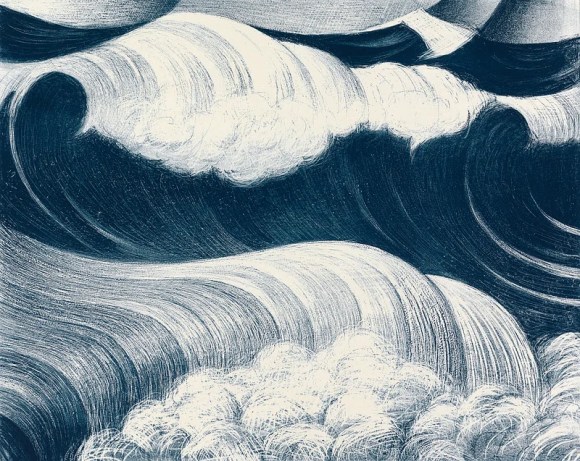
The Wave (1917), vintage illustration by C. R. W. Nevinson. From Public Domain
On world poetry day, we gather the colours of humanity to bring to you flavours of peace, compassion and love. With these poems, we seek solace and a future laced with the vibrant shades of humanity living in harmony with nature, the Earth and the Universe. These poems bring together not just writers from across the world but also some writings that are cross-cultural. Some of the poems express the condition of people living across the world. In this one page, we meet poets and translators from more than 25 countries fand translations from a dozen languages… Enjoy!
The Dragonfly, a poem by Ihlwha Choi, has been translated from Korean by the poet himself. Click here to read.
Four of his ownMalay poemshave been translated by Isa Kamari. Clickhere to read.
Hotel Acapulco, has been composed and translated from Italian by Ivan Pozzoni. Click hereto read.
Poetry in Bosnianfrom Bosnia & Herzegovina, written and translated by Maid Corbic. Click here to read.
Amalkantiby Nirendranath Chakraborty has been translated from Bengali by Debali Mookerjea-Leonard. Click hereto read
Poems of Longing by Jibananada Das homes two of his poems translated from Bengali by Professor Fakrul Alam. Clickhereto read.
Masud Khan’s poem,In Another Galaxy, has been translated from Bengali by Professor Fakrul Alam. Click hereto read.
Quazi Johirul Islam’s The White-Coloured Book has been translated from Bengali by Professor Fakrul Alam. Click here to read.
Four cantos from Ramakanta Rath’sSri Radha, translated from Odiya by the late poet himself, have been excerpted from his full length translation. Click here to read.
For Sanjay Kumar: To Sir — with Love has been written for the founder of pandies’ theatre by Tanvir, a youngster from the Nithari village where pandies’ worked with traumatised victims.
Miathili Poetryby Vidyanand Jha has been translated from Maithil by the poet himself. Click hereto read.
Six years ago, a few of us got together to bring out the first issue of Borderless Journal. We started as a daily blog and then congealed into a monthly journal offering content that transcends artificial borders to meet with the commonality of felt emotions, celebrating humanity and the Universe. Today as we complete six years of our existence in the clouds, we would like to celebrate with all writers and readers who made our existence a reality. We invite you to savour writings collected over the years that reflect and revel in transcending borders, touching hearts and some even make us laugh while exploring norms.
In this special issue. we can only offer a small sample of writings but you can access many more like these ones at our site…Without further ado, let us harmonise with words. We invite you to lose yourselves in a borderless world in these trying times.
Rebel or ‘Bidrohi’, Nazrul’s signature poem, ‘Bidrohi‘, translated by Professor Fakrul Alam. Click here to read.
Manish Ghatak’s Aagun taader Praan (Fire is their Life) has been translated from Bengali by Indrayudh Sinha. Click here to read.
Tagore’s poem, Tomar Shonkho Dhulay Porey (your conch lies in the dust), has been translated from Bengali by Mitali Chakravarty as ‘The Conch Calls’. Click here to read.
Ihlwha Choi spent some time in Santiniketan and here are poems he wrote in reaction to his observations near the ‘home of R.Tagore’, as he names Santiniketan and the Kobiguru. Click here to read Nandini.
Rituals in the Garden: Marcelo Medone discusses motherhood, aging and loss in this poignant flash fiction from Argentina. Click here to read.
Navigational Error: Luke P.G. Draper explores the impact of pollution with a short compelling narrative. Click here to read.
Henrik’s Journey: Farah Ghuznavi follows a conglomerate of people on board a flight to address issues ranging from Rohingyas to race bias. Click hereto read.
The Magic Staff , a poignant short story about a Rohingya child by Shaheen Akhtar, translated from Bengali by Arifa Ghani Rahman. Click here to read.
A Cat Story : Sohana Manzoor leaves one wondering if the story is about felines or… Clickhere to read.
When West Meets East & Greatness Blooms: Debraj Mookerjee reflects on how syncretism impacts greats like Tagore,Tolstoy, Emerson, Martin Luther King Jr, Gandhi and many more. Click here to read.
The Day Michael Jackson Died: A tribute by Julian Matthews to the great talented star who died amidst ignominy and controversy. Click here to read.
Potable Water Crisis & the Sunderbans: Camellia Biswas, a visitor to Sunderbans during the cyclone Alia, turns environmentalist and writes about the potable water issue faced by locals. Click here to read.
My Love for RK Narayan, Rhys Hughes discusses the novels by ths legendary writer from India. Click here to read.
Travels ofDebendranath Tagore: These are travel narratives by Debendranath Tagore, father of Rabindranath Tagore, translated from Bengali by Somdatta Mandal. Click here to read.
Baraf Pora (Snowfall): This narrative gives a glimpse of Tagore’s first experience of snowfall in Brighton and published in the Tagore family journal, Balak (Children), has been translated by Somdatta Mandal . Clickhere to read.
The Day of Annihilation: An essay on climate change by Kazi Nazrul Islam has been translated from Bengali by Radha Chakravarty. Clickhereto read.
Reminiscences from a Gallery: The Other Ray: Dolly Narang muses on Satyajit Ray’s world beyond films and shares a note by the maestro and an essay on his art by the eminent artist, Paritosh Sen. Click here to read.
The Bauls of Bengal: Aruna Chakravarti writes of wandering minstrels called bauls and the impact they had on Tagore. Click here to read.
Most people like you and me connect with the commonality of felt emotions and needs. We feel hungry, happy, sad, loved or unloved and express a larger plethora of feelings through art, theatre, music, painting, photography and words… With these, we tend to connect. And yet, larger structures created over time to offer security and governance to the masses—of which you and I are a part — have grown divisive, and, by the looks of it, the fences nurtured over time seem insurmountable. To retain these structures that were meant to keep us safe, wars are being fought and many are getting killed, losing homes and going hungry. We showcase such stories, poems and non-fiction to create an awareness among those who are lucky enough to remain untouched. But is there a way out, so that all of us can live peacefully, without war, without hunger and with love and a vision towards surviving climate change which (like it or not) is upon us?
Creating an awareness of hunger and destruction wreaked by war is a heartrending story set in Gaza by JK Miller. While Snigdha Agrawal’s narrative gives a sense of hope, recounting a small kindness by a common person, Sayan Sarkar shares a more personal saga of friendship and disillusionment — where people have choice. But does war leave us a choice as it annihilates friendships, cities, homes and families? Naramsetti Umamaheswararao’s story reiterates the belief in the family – peace being an accepted unit. Vela Noble’s fantastical fiction and art comes like a respite– though there is a darker side to it — with a touch of fun. Perhaps, a bit of fantasy and humour opens the mind to deal with the more sombre notes of existence.
The translation section hosts a story by Hamiruddin Middya, who grew up as a farmer’s son in Bengal. Steeped in local colours, it has been rendered into English by V Ramaswamy. Nazrul’s song revelling in the colours of spring has been translated from Bengali by Professor Fakrul Alam. Atta Shad’s pensive Balochi lines have been brought to us in English by Fazal Baloch. Isa Kamari continues to bring the flavours of an older, more laid-back Singapore with translations of his own Malay poems. A couple of Persian verses have been rendered into English by the poet, Akram Yazdani, herself. Questing for harmony, Tagore’s translated poem while reflecting on a child’s life, urges us to have the courage to be like a child — open, innocent and willing to imagine a world laced with trust and hope. If we were all to do that, do you think we’d still have wars, violence and walls built on hate and intolerance?
Mario Fenech takes a look at the idea of time. Amir Zadnemat writes of how memory is impacted by both science and humanities while Andriy Nivchuk brings to us snippets from Herodotus’s and Pericles’s lives that still read relevant. Ravi Varmman K Kanniappan gives the journey of chickpeas across space and time, asserting: “The chickpea does not care about your ideology, your portfolio, or your meticulously curated identity. It will grow, fix nitrogen, feed someone, and move on without a press release.” It has survived over aeons in a borderless state!
In book excerpts, we have a book that transcends borders as it’s a translation from Assamese by Ranjita Biswas of Arupa Kalita Patangia’s Moonlight Saga. Any translation is an attempt to integrate the margins into the mainstream of literature, and this is no less. The other excerpt is from Natalie Turner’s The Red Silk Dress. Keith Lyons has interviewed Turner about her novel which crosses multiple cultures too while on a personal quest.
Holding on to that idea, we invite you to savour the contents of our February issue.
Huge thanks to all our contributors and readers for making this issue possible. Heartfelt thanks to our wonderful team, especially Sohana Manzoor for her fabulous artwork.
Enjoy the reads!
Let’s look forward to the spring… May it bring new ideas to help us all move towards more amicable times.
Torn clothes, rough hair, a burn scar— I wonder where she is.
Maybe adopted by a safe land, still afraid of the dark, the smoke, and a voice too high.
Lying with hollow eyes, staring at the starry sky— I wonder where she is.
Maybe in a refugee haven, still starving to feed one younger than her.
Alongside a graveyard of dreams and desires… I wonder where she is.
In a wrecked shelter once called home— not warm enough to battle the cold inside.
You may wonder why I am so optimistic.
Because—
I was her doll, and she was mine. There is no mortality in Doll Land
From Public Domain
Manahil Tahir is an MBBS student from Pakistan whose writing explores memory, conflict, and quiet resilience at the intersection of humanity and psychology.
.
PLEASE NOTE: ARTICLES CAN ONLY BE REPRODUCED IN OTHER SITES WITH DUE ACKNOWLEDGEMENT TO BORDERLESS JOURNAL



 Borderless