Meenakshi Malhotra writes of the diverse ways histories can be viewed, reflecting on the perspective from the point of view of water, climate, migrations or women. Click here to read.
Sometimes, we have an idea, a thought and then it takes form and becomes a reality. That is how the Borderless Journal came to be six years ago while the pandemic raged. The pandemic got over and takeovers and wars started. We continued to exist because all of you continue to pitch in, ignoring the differences created by certain human constructs. We meet with the commonality of felt emotions and aesthetics to create a space for all those who believe in looking beyond margins. We try to erase margins or borders that lead to hatred, anger, violence and war. Learning from the natural world, we believe we can be like the colours of the rainbow that seem to grow out of each other or the grass that is allowed to grow freely beyond manmade borders. If nature gives us lessons through its processes, is it not to our advantage to conserve what nurtures us, and in the process, we save our home planet, the Earth? We could all be together in peace, enjoying nature and nurture, living in harmony in the Universe if only we could overlook differences and revel in similarities.
A young poet Nma Dhahir says it all in her poem that is a part of our journal this month —
This is how we stay human together: by refusing the easy damage, by carrying each other without calling it sacrifice, by believing that what we protect in one another eventually protects the world.
Translations has more poetry with Professor Fakrul Alam bringing us Nazrul’s Bengali lyrics in English and Fazal Baloch familiarising us with beautiful Balochi poetry of the late Majeed Ajez, a young poet who left us too soon. Isa Kamari translates his own poems from Malay, capturing the colours of the community in Singapore to blend it with a larger whole. And of course, we have a Tagore poem rendered into English from Bengali. This time it’s a poem called ‘Jatra (Journey)’ which reflects not only on social gaps but also on politics through aeons.
Christine C Fair has translated a story from Punjabi by Lakhvinder Virk, a story that reflects resilience in women who face the dark end of social trends, a theme that reverberates in Flanagan’s poetry and Meenakshi Malhotra’s essay, which while reflecting on the need of different perspectives in histories – like water and nomads — peeks into the need to recall women’s history aswell. This is important not just because March hosts the International Women’s Day (IWD) but because one wonders if women in Afghanistan are better off now than the suffragettes who initiated the idea of such a day more than a century ago?
This time our non-fiction froths over with scrumptious writings from across continents. Tamara-Lee Brereton-Karabetsos muses on looking at numbers and beyond to enjoy the essence of nature. Farouk Gulsara ideates about living on in posterity through deeds and ideas. Gower Bhat shares how he learns story writing skills from watching movies. Meredith Stephens talks of her experience of a fire in the Australian summer. Bhaskar Parichha writes with passion about his region, Odisha. We have a heartfelt tribute to Mark Tully, who transcended borders, from Bhowmick. And an essay on Arundhati Roy’s memoir, Mother Mary Comes to Me, from Somdatta Mandal, which explores not just the book but also the covers which change with continents. Prithvijeet Sinha travels beyond Lucknow and Suzanne Kamata brings to us stories about her trip to Phnom Penh.
Keith Lyons draws from the current crises and writes about changing times, suggesting: “Changes aren’t endings, but thresholds.” Perhaps, if we see them as ‘thresholds of change’, the current events are emphasising the need to accept that human constructs can be redefined. I am sure a Neolithic or an Australopithecus would have been equally scared of evolving out of their system to one we would deem ‘superior’. Life in certain ways can only evolve towards the future, even if currently certain changes seem to be retrogressive. We can never correctly predict the future… but can only imagine it. And Devraj Singh Kalsi imagines it with a dollop of humour where tails become a trend among humans again!
Humour and absurdity are woven into a series of short fables by Hughes while Naramsetti Umamaheswarao weaves a fable around acceptanceof differences. In fiction, we have stories of resilience from Jonathon B Ferrini and Terry Sanville. Bhat gives us a story set in Kashmir and Sohana Manzoor gives us one set in Dhaka, a narrative that reminds one of Jane Austen… and perhaps even an abbreviated version of the 2001 film, Monsoon Wedding.
In reviews we have, Mohammad Asim Siddiqui discussing Anisur Rahman’s The Essential Ghalib. Rituparna Khan has written on Malashri Lal’s poetry collection reflecting on women, Signing in the Air. And Bhaskar Parichha has reviewed Deepta Roy Chakraverti’s Daktarin Jamini Sen: The Life of British India’s First Woman Doctor, a book that reflects on the resilience that makes great women. Thus, weaving in flavours of the IWD, which applauds women who are resilient while urging humans for equal rights for one half of the world population.
While we ponder on larger realities, Borderless Journal looks forward to a future with more writings centred around humanity, climate change, our planet and all creatures great and small. This year has not only seen a rise in readership and contributors — and the numbers rose further after our unsolicited Duotrope listing in October 2025 — but has also attracted writers from more challenged parts of the world, like Ukraine, Iran, Tunisia and Kurdistan. We are delighted to home writing from all those who attempt to transcend borders and be a part of the larger race of humanity. I would like to quote Margaret Atwood to explain what I mean. “I hope that people will finally come to realize that there is only one ‘race’—the human race—and that we are all members of it.” And I would like to extend her view to find solidarity with all living beings. I hope that there will be a point in time when we will realise there’s not much difference between, a lizard, a fly, a human or a tree… All these lifeforms are necessary for our existence.
I would want to hugely thank all our team for stretching out and making this a special issue for our sixth anniversary and Manzoor for her fabulous artwork. Huge thanks to all our contributors and readers for being with us through our journey. Let’s change the world with peace, love and friendship!
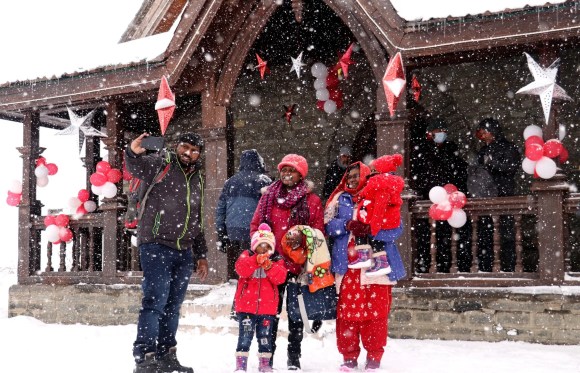
The holiday market buzzed with life, bathed in the golden glow of string lights that twisted like ribbons between the stalls. Vendors hawked hot cider, the air thick with the scent of cinnamon and cloves. Children, bundled in puffy coats, raced around, their fingers clutching candy canes, their laughter mingling with the low hum of holiday songs. The warmth of the season wrapped the world in a festive embrace.
Shafi clutched her coffee tightly, the warmth of the cup unable to quell the cold gnawing at her insides. The heat of the liquid contrasted sharply with the chill that had settled deep within her…. a coldness that not even the bright lights or holiday cheer could dispel. She scanned the lively scene, but her focus was elsewhere, far from the twinkling stalls and cheerful music.
“You’re too quiet again,” Amir said, nudging her elbow gently. “You okay?”
Shafi tried to smile, but it didn’t reach her eyes. “Just thinking.”
Amir frowned. “It’s Christmas. You’re supposed to feel warm and fuzzy, not… whatever this is. What’s going on?”
“I don’t know,” she whispered. “It just feels… off.”
Amir gave a small laugh. “Paranoia. Classic Shafi.”
But Shafi couldn’t shake the weight pressing down on her chest. The world felt too loud and too quiet at the same time. The joy around her seemed distant, muffled by a creeping unease. She wanted to feel the warmth of the season, to laugh and enjoy the festivities like everyone else, but all she could think about was the shadow of her past, looming just out of reach.
As they walked toward her apartment, the streets emptied, and the festive energy of the market gave way to the solitude of falling snow. The sky had turned a deep shade of indigo, and the streetlights cast long shadows across the quiet pavement. The snow, falling gently at first, began to collect, blanketing the city in soft, white layers. Each flake seemed to carry its own quiet story, falling in silence but adding to the growing weight of the world.
When they reached her door, Shafi stopped dead in her tracks.
“Wait,” she whispered.
Amir followed her gaze, his expression shifting from concern to confusion. The door to her apartment was slightly ajar. Her heart skipped a beat.
“Stay back,” he said firmly. “We don’t know what’s inside.”
Shafi grabbed his arm, urgency flashing in her eyes. “No. I’m going in.”
They stepped inside together. The apartment was eerily quiet. The usual hum of the fridge, the faint rustling of curtains in the breeze, was absent. Everything seemed untouched—except for a single set of dusty footprints leading from the door to the table.
Amir moved cautiously toward the table, his eyes scanning the room for danger. On the table lay a folded piece of paper. It seemed ordinary, yet in the context of the silence and the unusual circumstances, it felt like a warning.
“Shafi,” he said softly. “You need to see this.”
Her name was scrawled on the front in jagged handwriting, the ink slightly smeared. The paper felt heavy in her hands as she took it, her fingers trembling.
“Shafi,” Amir read aloud, his voice steady but concerned. “The snow may bury, but the truth always thaws. You can’t hide forever.”
Shafi staggered back as though the words themselves had struck her, each letter cutting deep. A cold shiver ran down her spine. The past rushed at her with the force of an avalanche.
“What does it mean?” Amir asked, his voice tense.
Shafi didn’t respond. Her mind raced, the weight of her past crashing down like a flood. The words weren’t just a threat—they were a reminder of the life she had tried to leave behind, of the man she had betrayed, and the secrets she had buried.
“Shafi,” Amir said gently, insistent. “Talk to me. Who sent this?”
She clenched her fists, struggling to speak. The truth felt like a lump in her throat, burning to get out, but fear kept her silent. She had buried this secret for so long, hoping it would stay hidden. Now, it was all coming to the surface.
“It’s not that simple,” she whispered, trembling.
“Make it simple,” Amir said softly, kneeling beside her. “Please.”
She looked at him, eyes glistening with unshed tears. She had carried this burden alone for years, but now, in Amir’s unwavering presence, the walls she had built began to crumble.
“There was a man,” she began, voice breaking. “Rafiq. Years ago, I…” She paused, breath hitching. “I betrayed him.”
Amir’s brow furrowed. “Betrayed how?”
“I lied,” she admitted, voice heavy with guilt. “I framed him for something he didn’t do. It was him or me, and I chose myself.”
Amir stared silently. His quiet presence asked no questions; he simply waited.
“Why?” he asked softly.
“Because I was scared,” she whispered. “I thought it was the only way out. It worked—he went to prison, and I walked free. But now he’s out, and I think he’s come for me.”
Silence hung between them, suffocating. Shafi could barely breathe, the weight of her confession pressing down.
Finally, Amir spoke. “And this note… it’s from him?”
Shafi nodded, throat tight. “It has to be.”
Amir knelt, taking her hands gently. His touch grounded her. “Listen. Whatever you did, whatever he’s planning, we’ll handle it. Together.”
Tears streamed down her face. “You don’t understand. He has every right to hate me. I ruined his life.”
“And hiding will only make it worse,” Amir said firmly. “You need to face this. We need to face this.”
Shafi looked into his eyes, searching for doubt, for hesitation, and found none. Only resolve. Only support.
“What if he wants revenge?” she asked, barely audible.
“Then we’ll stop him. But first, we need to talk to him. No more running, Shafi.”
She nodded slowly. For the first time in years, the weight of her guilt began to lift not because the past had changed, but because she wasn’t facing it alone.
Outside, the snow continued to fall, blanketing the world in quiet beauty. Inside the apartment, something new took root: hope.
.
Gowher Bhat writes fiction and non-fiction. He’s a a columnist, freelance journalist, and educator from Kashmir. His writing explores memory, place, and the quiet weight of the things we carry, delving into themes of longing, belonging, silence, and expression. A senior columnist for several local newspapers across the Kashmir Valley, he is also an avid reader and book reviewer. He believes that books and writing can capture the subtleties of human experience.
PLEASE NOTE: ARTICLES CAN ONLY BE REPRODUCED IN OTHER SITES WITH DUE ACKNOWLEDGEMENT TO BORDERLESS JOURNAL
There was a time when watching films was nothing more than rest, an evening comfort after work, a temporary escape into worlds beyond my own. Like most people raised in an era saturated with visual storytelling, I consumed narratives without questioning their construction. I laughed, worried, and wondered alongside characters, yet I rarely asked how those emotions were engineered or how those journeys were shaped. Stories simply happened, and I accepted them as complete experiences rather than crafted designs.
My relationship with cinema began to change when my relationship with writing deepened. As I started shaping my own manuscripts and essays, I discovered that watching films could be far more than entertainment. They could instruct how to be subtle, practical, and immediate. Gradually, the screen became a classroom where narrative structures revealed themselves through observation rather than formal lectures. This transformation did not occur overnight. It emerged from habit, curiosity, and a need to look beyond spectacle into construction.
I did not learn storytelling theory in abstraction. I learned it by noticing patterns and by asking why certain stories held my attention while others dissolved into forgetfulness. The first lesson I absorbed was that nearly every compelling narrative rests upon a recognisable arc, a beginning, a middle, and an end. This realisation might seem elementary yet seeing it repeatedly across films gave it clarity and emotional substance. I began recognising this structure not as formula but as rhythm, the natural pulse of storytelling that guides audience engagement.
In the beginning of a story, I observed how filmmakers introduce their worlds with efficiency and intention. Characters appear within contexts that suggest their ordinary reality. Atmosphere, tone, and relationships are established with subtle precision. Tensions are hinted at, even when not fully expressed. Soon an event disturbs equilibrium. Something shifts irreversibly, and the narrative awakens. I came to understand this as the true starting point of storytelling. Watching this transition repeatedly taught me how crucial it is to establish stakes early in writing. Without disruption, there is no curiosity, and without curiosity, there is no reader commitment.
As I continued observing, the middle portion fascinated me most, because here stories breathe and struggle. I noticed how conflicts deepen, relationships evolve, and obstacles accumulate. Rarely does tension remain static. Instead, it escalates, twists, and transforms. Films helped me grasp pacing, how narrative momentum must be sustained without overwhelming or exhausting the audience. I learned to appreciate shifts in direction where revelations redirect expectations and intensify engagement. Translating this insight into writing helped me maintain movement in long narrative stretches that might otherwise drift.
This exploration also introduced me to the art of foreshadowing, those delicate hints planted early that later bloom into significance.
At first, I experienced these moments subconsciously, feeling satisfaction without understanding its source. Later, I trained myself to detect them consciously. A line of dialogue, a recurring symbol, or a passing gesture might appear trivial, yet later return with emotional resonance. Observing this taught me the elegance of preparation and restraint. Foreshadowing became a lesson in trust, demonstrating how writers guide readers gently rather than instructing them bluntly. It is not manipulation. It is anticipation crafted with care.
From foreshadowing I moved toward understanding twists. Watching narratives unfold, I realised that satisfying surprises rarely appear without groundwork. Effective twists do not betray logic. They reinterpret it. They cause viewers to revisit earlier scenes mentally and perceive them differently. This discovery reshaped my own approach towards writing. I began questioning whether my narrative turns felt earned or merely sudden. Films revealed that the most powerful twists balance unpredictability with inevitability. They shock the mind while satisfying the intellect.
Eventually, the story advances toward culmination, the climax. I learned to recognise this convergence where tension peaks and decisions crystallise. Cinema often dramatises this moment visually, yet its structural importance remains universal. Climax is not spectacle alone. It is consequence. It represents the meeting point of character, conflict, and choice. Observing this repeatedly helped me appreciate emotional resolution as much as narrative resolution. Writing began to feel less about describing events and more about guiding emotional progression toward meaningful closure.
Then comes the ending, not merely stopping the story but settling it. Watching endings taught me that resolution does not require complete explanation. Instead, it must honour the journey undertaken. Closure arises through thematic harmony rather than exhaustive answers. Some endings comfort, some provoke reflection, and some remain deliberately open. Each variation revealed to me that endings must resonate rather than conclude mechanically. This awareness influenced how I approach narrative responsibility in my own work.
Beyond structural awareness, films broadened my understanding of storytelling elements intertwined within that structure. Dialogue revealed character identity through vocabulary and rhythm. Settings shaped emotional atmosphere and influenced decision making. Secondary characters reflected or challenged protagonists, often revealing hidden dimensions. Physical gestures conveyed interior conflict that words might obscure. Observing these layers expanded my appreciation for narrative texture and encouraged me to incorporate similar awareness into my writing.
Yet while learning from cinema, I also became aware of its limitations in comparison with the written form. Films often rely on action and expression to communicate thought, whereas writing allows direct entry into the interior life of characters. This distinction reminded me that visual storytelling could inform craft without replacing literary strengths. The purpose was not imitation, but adaptation. I absorbed lessons about pacing and structure while preserving the depth of introspection unique to prose.
One practice that accelerated my learning was revisiting familiar films analytically. Knowing outcomes freed me to examine construction rather than suspense. I studied how scenes transitioned, how tension was distributed, and how narrative clues were planted. Sometimes I watched without sound, observing gestures and movement alone. At other times I focused exclusively on dialogue patterns. These exercises sharpened my sensitivity to storytelling architecture and strengthened my capacity for conscious observation.
Reflecting on this journey, I recognise that films can never replace reading or scholarly study. They complemented them. In a cultural moment where visual narratives dominate collective imagination, ignoring their instructional potential would be wasteful. The screen became not a distraction from writing, but a partner in understanding it.
Today, when I sit to write, echoes of those observations accompany me. I think about beginnings that invite curiosity, middles that sustain tension, and endings that resonate emotionally. I consider foreshadowing that prepares revelation, twists that deepen understanding, and climaxes that honour investment. These insights have become instinctive rather than theoretical, woven into my creative process through attentive viewing and reflection.
The screen, once merely entertainment, became an unexpected mentor. And perhaps that is the quiet gift of storytelling in all its forms. It teaches those willing to observe. For me, learning structure through films did not diminish the magic of writing. It enriched it, providing shape to imagination and confidence to craft.
I still watch films for enjoyment. I also watch with awareness. Somewhere between these two experiences lies growth, the gradual shaping of a writer who learns not only from books and lived experience, but from the stories unfolding in light and motion before him. In that space between viewing and reflection, I continue discovering new dimensions of narrative, reminding myself that learning, like storytelling, never truly ends.
.
Gowher Bhat is a a columnist, a freelance journalist, and educator from Kashmir. He writes about memory, place, and the quiet weight of the things we carry, often exploring themes of longing, belonging, silence, and expression. A senior columnist in several local newspapers across the Kashmir Valley, he is also an avid reader and book reviewer. He believes the smallest moments can carry the deepest truths.
PLEASE NOTE: ARTICLES CAN ONLY BE REPRODUCED IN OTHER SITES WITH DUE ACKNOWLEDGEMENT TO BORDERLESS JOURNAL
I did not grow up wanting to be famous. I grew up wanting to read. Books entered my life quietly, persistently, and stayed. They were never mere ornaments on a shelf. They were companions, confidants, and windows to other worlds. I read late into the night, bent and underlined pages in hand, learning early that a book could be as vital as breath. Reading became a habit, then a need, then a lens through which I understood life itself.
But reading is not always easy. Even as a child, I struggled with the distractions of the world around me, the noise, the pull of tasks, and the sense that books were a luxury rather than a necessity. Many children grow up without sustained access to literature or quiet spaces to engage with ideas. Many adults, too, lose the habit of reading amidst digital noise, constant demands, and a culture that prizes speed over reflection. In such a world, cultivating a relationship with words becomes an act of devotion, of care, and of patience.
I read widely and without rules: fiction first, then mystery, later thrillers, philosophy, psychology, literary novels, family dramas, clean romance, cozy mysteries, science fiction, and books about the craft of writing itself. I read what interested me, what unsettled me, what slowed me down. Each genre teaches something different. Mystery teaches pacing. Literary fiction teaches restraint. Philosophy teaches patience. Psychology teaches observation. Good writing, no matter the category, teaches honesty. And yet, for many, access to books, time to read, and the encouragement to do so are rare privileges.
Reading and writing have always been companions. To write well, I must read widely. To read well, I must be attentive to language and nuance. When I read, I am listening to other writers. When I write, I try to answer, in my own way, the questions they pose on the page. Books that stay with me longest shape my own sentences, not by imitation, but by instilling rhythm, precision, and empathy.
Reading shaped the way I think and the way I write. It taught me rhythm. It taught me silence. It taught me that a sentence does not need decoration if it carries truth. Over time, reading stopped being separate from writing. One fed the other. I read to learn how others solved problems on the page. I wrote to see if I could do the same.
But the act of reading and writing is more than personal; it is communal. Stories, essays, novels, poems, reflections—they connect us. They allow us to see beyond our immediate experiences and inhabit others’ lives. They create empathy in societies that can often feel distracted or rushed. They challenge assumptions, expand understanding, and remind us of shared humanity. Yet, in a time when attention is fragmented, cultivating space for reading and writing is an ongoing challenge.
Writing arrived quietly. I began by writing notes to myself: observations, small scenes, feelings I could not explain out loud. Writing became a place to sit with things without having to perform. There was no audience then, just the page and me. Even a short paragraph, carefully written, could provide clarity where speech often failed. It could contain emotion without spectacle, simplicity without emptiness.
I am an English educator by profession. Over the years, I have guided students in navigating language, finding their voice, and understanding the weight of words. Teaching sharpened my attention. It made me careful with words. When you teach, you learn how fragile confidence can be. You learn how much words matter. You learn that clarity is kindness. The classroom has also taught me patience and observation, qualities essential to writing. Students’ struggles, triumphs, and quiet moments often inspire characters or scenes in my own work. More importantly, it has shown me that access to words, encouragement, and mentorship can transform lives, opening doors to reflection, creativity, and understanding.
My writing grew in that same vein.
I am drawn to ordinary lives, to quiet moments, to people who carry more than they say. I am not interested in spectacle. I am interested in what happens at the table, in the hallway, during a phone call that lasts too long. The smallest moments often reveal the most. A pause, a glance, a question left unasked often speaks louder than any dramatic event. Writing, I have discovered, is about noticing these details and offering them gently to the reader.
I read Jane Austen years ago and understood something important. You do not need to explain everything. You do not need to impress. You only need to tell the truth and step back. That lesson stayed with me. My writing aims for simplicity, not emptiness. Austen’s writing taught me that character, dialogue, and subtle observation can carry a story, even without dramatic plot twists. This resonates deeply as I try to develop my own voice.
I write literary fiction, family drama, and clean romance. I write about relationships between parents and children, husbands and wives, people and their inner lives. I am interested in homecoming, in belonging, in the idea of home as something emotional rather than geographical.
Many of my characters search for peace without naming it. They live in ordinary spaces yet carry extraordinary emotions. Through their stories, I explore love, hope, and resilience, not as abstract ideas, but as lived experience. These themes are not only literary; they reflect challenges we face in real life, in understanding each other, and in finding space for reflection, empathy, and connection.
I read widely to guide my writing. I still read every day, sometimes for hours, sometimes only a few pages. I return often to books that once moved me deeply: Pride and Prejudice, Man’s Search for Meaning, Tuesdays with Morrie. Each rereading feels different. That is how I know books grow with us. Revisiting a familiar story allows me to notice things I had missed before, to understand new perspectives, and to refine my sense of narrative and character development.
I read craft books not to copy technique, but to understand intention. Why does this sentence work? Why does that scene linger? Reading teaches humility. There is always someone writing better, clearer, braver. Instead of discouraging me, that comforts me. It means the work is endless, and that is a good thing. There is always more to learn, always room to grow. This realisation keeps me grounded and committed to the long journey of writing.
I am part of some anthologies, and I have authored many articles over the years. These small contributions are part of my learning and practice, a way to keep writing while I work on larger projects. They are exercises in discipline and experimentation, testing different voices, formats, and perspectives. Each piece, no matter how short, teaches me something about structure, clarity, and the rhythm of language.
The life of a writer is not glamorous. Most of it is quiet. You sit. You doubt. You write. You delete pages you once loved. You rewrite. You keep going. There is no certainty, only commitment. Writing requires discipline more than inspiration. Inspiration visits. Discipline stays.
There were periods in my life when writing was the only stable thing I had. Work challenges, writer’s block, my daughter’s health issues, long waits—writing did not solve these problems, but it gave me a place to stand. It reminded me who I was when everything else felt fragile. Writing became a companion, a place to breathe, a way to make sense of the world. More than that, it showed me that writing, reading, and reflection are tools we all need, as societies and as individuals, to engage with ourselves and others.
My faith plays a central role in my life and writing. It teaches patience and surrender. Writing is similar. You do your part and let go of the outcome. You write honestly and accept that the work will find its reader when it is meant to. Writing, like prayer, requires consistency, trust, and humility.
I do not measure success by recognition. I measure it by sincerity. If a reader feels empathetic, the work has succeeded. If a sentence stays with someone longer than expected, that is enough. Every story, every paragraph, every sentence is a small offering, an attempt to communicate honestly, and that is enough.
I am still learning. Still reading. Still writing. That, for me, is a full life.
And it began, simply, with a book opened in silence.
Gowher Bhat is a a columnist, a freelance journalist, and educator from Kashmir. He writes about memory, place, and the quiet weight of the things we carry, often exploring themes of longing, belonging, silence, and expression. A senior columnist in several local newspapers across the Kashmir Valley, he is also an avid reader and book reviewer. He believes the smallest moments can carry the deepest truths.
PLEASE NOTE: ARTICLES CAN ONLY BE REPRODUCED IN OTHER SITES WITH DUE ACKNOWLEDGEMENT TO BORDERLESS JOURNAL
If language were a haircut, “saloon” got a buzz cut and a blow-dry and came out as “salon.” That change in spelling is the visible tip of a larger style transformation: one rough, male-only ritual space has been trimmed, straightened, scented and repackaged into a gleaming, multi-service, mostly woman-centred retail experience. Along the way, the loud, fragrant, argument-heavy mini-parliaments of small-town India — the saloons — have been politely ushered into warranties, playlists and polite small talk.
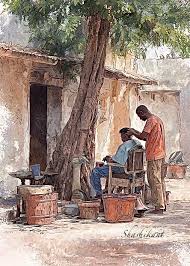
Barbers in India are almost as old as conversation itself. The profession of the barber — the nai or hajam — is embedded in pre-colonial life: scalp massage (champi), shaves, tonsure at rites of passage, and quick fixes between chores. These services were usually delivered in open-fronted shops or under trees, with tools that were portable and livelihoods that were local.
The “saloon” as a distinctive, Western-flavoured, male gathering place began to consolidate during the 19th and early 20th centuries. Port cities and colonial cantonments — Bombay (Mumbai), Calcutta (Kolkata), Madras (Chennai) — saw the rise of dedicated shops selling not only shaves and haircuts but also imported tonics, straight razors and a distinctly public atmosphere shaped by newspaper reading, debate and gossip. Over time, that form blended with older local practices and spread inland. By the mid-20th century, the saloon — a recognisable, chair-lined, mirror-fronted social stage — existed in towns from Kashmir to Kanyakumari and from Gujarat’s chawls to Assam’s market roads.
So ancient barbering traditions fed into a colonial-era intensification of the barbershop as public forum; by the 1950s–70s, the saloon as we remember it was firmly a part of India’s social furniture. The precise start date is a quilt of custom and commerce rather than a single founding ceremony — and that is part of the saloon’s charm.
Walk into a saloon in Nagpur, Nellore, Shillong or Surat and you’ll notice an uncanny resemblance. The reasons are simple and human:
Low price point: Saloons survive on quick volumes and walk-ins. That encourages many chairs, fast turnover, and layouts that invite waiting men to talk rather than sit quietly.
Ritual services: Shave, cut, champi. These are short encounters that thread customers through the same communal space repeatedly — ideal for gossip to collect and ferment.
Social role: The barber doubles as ear, counsellor, news-disseminator and crossword referee. That role is culturally consistent across regions: a saloon’s psychic geography is the same whether the tea is masala or lemon.
The result is that a saloon in Kutch and a saloon in Kerala will differ in language, politics and local jokes — but both will produce that same satisfying racket of opinion, repartee and advice. They are India’s unofficial, peripatetic fora for public life.
Enter the salon: padded seats, curated playlists, appointment-booking and a menu so long it reads like a restaurant wine list (colour, rebonding, keratin, facials, pedicures, threading, and sometimes a minor festival of LED lights). A couple of business realities did most of the heavy lifting:
Women’s services earn more and recur more often. Regular facials, hair treatments and beauty routines translate into steadier, higher bills. The money follows the customer, and the space follows the money.
Franchising and professional training created standardized staff who follow brand scripts — which tighten conversation and reduce the barber-confessor vibe.
Unisex salons consolidated footfall, but that consolidation shrank male-only territory. Men who once had a semi-public living room now sit in chic, quieter spaces that discourage loud, extended debate.
The practical upshot: the saloon’s boisterous mini-parliaments were replaced by stylists with laminated menus, muted background music and an etiquette that favours privacy over political salvoes.
What we miss (and what we gained)
We miss the moralisers, the wisecracks, the boisterous consultancy of unpaid experts who knew which councillor was friendly with which shopkeeper and which wedding was scandalous; the loud education in rhetoric and local affairs; the bench-seat apprenticeship in how to perform masculinity in public.
We gain in expanded choices for women, more professional hygiene and techniques, new livelihoods for trained stylists (especially women), and spaces where people can pursue personalised care without the social cost that used to attend public rituals.
It’s not a zero-sum game — but it does reorder who feels proprietorial about public grooming spaces. The new economics say: she who pays more — and pays more often — gets the say.
Not all saloons are extinct. In smaller towns they still hum. In cities, they’ve evolved into hybrid forms:
Old-school saloons persist where price sensitivity and cultural habit remain strong: walk-ins, communal benches, loud conversation and a barber who’ll recommend both a haircut and the correct candidate for local office.
Nostalgic barbershops in urban pockets lean into the past with “vintage” decor, whiskey-bar vibes and sports on TV — except now they charge a premium and call the barber a “grooming specialist.”
Some entrepreneurs stage “men’s nights” or open-mic gossip hours in neighbourhood shops, trying to recapture the civic pulse while keeping the modern business model.
If you want the old saloon spark, look for places without appointment apps, with too many phones in sight but none in use, and with a tea flask on the counter.
What’s lost isn’t only a loud, male-only gossip pit; it’s a training ground for public argument and a place where local memory was kept live and messy. The saloon taught people how to spar without a referee; the salon teaches how to look good while being politely neutral. If you mourn for the saloon’s barbed banter, you can grieve — but also take action: host a “Salon for Men” in your local café, revive a community noticeboard at the barber, or convince your neighbourhood salon to schedule a weekly “open-chair” hour for community talk (and maybe offer tea).
And until then, if you miss the salty, pungent chorus of small-town democracy, go to any saloon that still has a kettle on the stove and a barber who knows the mayor’s schedule by heart. Sit down, get a shave, and watch a mini-parliament assemble around you. You’ll leave clean-faced, better informed, and maybe a little animated — exactly how democracy used to feel.
From Public Domain
.
Charudutta Panigrahi is a writer. He can be contacted at Charudutta403@gmail.com.
.
PLEASE NOTE: ARTICLES CAN ONLY BE REPRODUCED IN OTHER SITES WITH DUE ACKNOWLEDGEMENT TO BORDERLESS JOURNAL
It has been a strange year for all of us. Amidst the chaos, bloodshed and climate disasters, Borderless Journal seems to be finding a footing in an orphaned world, connecting with writers who transcend borders and readers who delight in a universe knit with the variety and vibrancy of humanity. Like colours of a rainbow, the differences harmonise into an aubade, dawning a world with the most endearing of human traits, hope.
A short round up of this year starts with another new area of focus — a section with writings on environment and climate. Also, we are delighted to add we now host writers from more than forty countries. In October, we were surprised to see Borderless Journal listed on Duotrope and we have had a number of republications with acknowledgement — the last request was signed off this week for a republication of Ihlwha Choi’s poem in an anthology by Hatchette US. We have had many republications with due acknowledgment in India, Bangladesh, Pakistan and UK too among other places. Our team has been active too not just with words and art but also with more publications from Borderless. Rhys Hughes, who had a play performed to a full house in Wales recently, brought out a whole book of his photo-poems from Borderless. Bhaskar Parichha has started an initiative towards another new anthology from our content — Odia poets translated by Snehaprava Das. We are privileged to have all of you — contributors and readers — on board. And now, we invite you to savour some of our fare published in Borderless from January 2025 to December 2025. These are pieces that embody the spirit of a world beyond borders…
I Am Not My Mother: Gigi Baldovino Gosnell gives a story of child abuse set in Philippines where the victim towers with resilience. Click here to read.
Persona: Sohana Manzoor wanders into a glamorous world of expats. Click here to read.
In American Wife, Suzanne Kamata gives a short story set set in the Obon festival in Japan. Click here to read.
Sandy Cannot Write: Devraj Singh Kalsi takes us into the world of advertising and glamour. Click here to read.
Reminiscences from a Gallery: The Other Ray: Dolly Narang muses on Satyajit Ray’s world beyond films and shares a note by the maestro and an essay on his art by the eminent artist, Paritosh Sen. Click here to read.
A discussion of Jaladhar Sen’s The Travels of a Sadhu in the Himalayas, translated from Bengali by Somdatta Mandal, with an online interview with the translator. Click here to read.
In winters, birds migrate. They face no barriers. The sun also shines across fences without any hindrance. Long ago, the late Nirendranath Chakraborty (1924-2018) wrote about a boy, Amalkanti, who wanted to be sunshine. The real world held him back and he became a worker in a dark printing press. Dreams sometimes can come to nought for humanity has enough walls to keep out those who they feel do not ‘belong’ to their way of life or thought. Some even war, kill and violate to secure an exclusive existence. Despite the perpetuation of these fences, people are now forced to emigrate not only to find shelter from the violences of wars but also to find a refuge from climate disasters. These people — the refuge seekers— are referred to as refugees[1]. And yet, there are a few who find it in themselves to waft to new worlds, create with their ideas and redefine norms… for no reason except that they feel a sense of belonging to a culture to which they were not born. These people are often referred to as migrants.
At the close of this year, Keith Lyons brings us one such persona who has found a firm footing in New Zealand. Setting new trends and inspiring others is a writer called Harry Ricketts[2]. He has even shared a poem from his latest collection, Bonfires on the Ice. Ricketts’ poem moves from the personal to the universal as does the poetry of another migrant, Luis Cuauhtémoc Berriozábal, aspiring to a new, more accepting world. While Tulip Chowdhury — who also moved across oceans — prays for peace in a war torn, weather-worn world:
I plant new seeds of dreams for a peaceful world of tomorrow.
Fiction in this issue reverberates across the world with Marc Rosenberg bringing us a poignant telling centred around childhood, innocence and abuse. Sayan Sarkar gives a witty, captivating, climate-friendly narrative centred around trees. Naramsetti Umamaheswararao weaves a fable set in Southern India.
A story by Nasir Rahim Sohrabi from the dusty landscapes of Balochistan has found its way into our translations too with Fazal Baloch rendering it into English from Balochi. Isa Kamari translates his own Malay poems which echo themes of his powerful novels, A Song of the Wind (2007) and Tweet(2017), both centred around the making of Singapore. Snehaprava Das introduces Odia poems by Satrughna Pandab in English. While Professor Fakrul Alam renders one of Nazrul’s best-loved songs from Bengali to English, Tagore’s translated poem Jatri (Passenger) welcomes prospectives onboard a boat —almost an anti-thesis of his earlier poem ‘Sonar Tori’ (The Golden Boat) where the ferry woman rows off robbing her client.
We have plenty of non-fiction this time starting with a tribute to Jane Austen (1775-1817) by Meenakshi Malhotra. Austen turns 250 this year and continues relevant with remakes in not only films but also reimagined with books around her novels — especially Pride and Prejudice (which has even a zombie version). Bhaskar Parichha pays a tribute to writer Bibhuti Patnaik. Ravi Varmman K Kanniappan explores ancient Sangam Literature from Tamil Nadu and Ratnottama Sengupta revisits an art exhibition that draws bridges across time… an exploration she herself curated.
Farouk Gulsara — with his dry humour — critiques the growing dependence on artificial intelligence (or the lack of it). Devraj Singh Kalsi again shares a spooky adventure in a funny vein.
We have a spray of colours from across almost all the continents in our pages this time. A bumper issue again — for which all of the contributors have our heartfelt thanks. Huge thanks to our fabulous team who pitch in to make a vibrant issue for all of us. A special thanks to Sohana Manzoor for the fabulous artwork. And as our readers continue to grow in numbers by leap and bounds, I would want to thank you all for visiting our content! Introduce your friends too if you like what you find and do remember to pause by this issue’s contents page.
Wish all of you happy reading through the holiday season!
Nun chai, traditional pink tea from Kashmir. From Public Domain
The father sat across from me in a small tea shop in Srinagar, stirring his cup of nun chai. His face was lined with worry. His daughter had just enrolled in a well-known coaching centre, aiming to crack the NEET exam[1]. “The fees are high,” he said quietly. “We’ve had to dip into our savings. But what choice do we have?”
In Kashmir, the pursuit of higher education has led to a boom in private coaching centres. These institutions promise success in competitive exams, which have become almost essential for aspirants to institutions of higher learning. But this trend has brought significant financial and emotional burdens to families and students alike.
Over the past decade, Kashmir has seen a rapid increase in private coaching centres, especially in Srinagar. The cost of enrolling in these coaching centres is substantial. Fees can range from Rs50,000 to Rs150,000 per year, depending on the course and the institution’s reputation. For many families in the region, this represents a significant portion of their annual income. The financial strain is even greater when multiple children in a family seek such coaching, leading to difficult choices and sacrifices.
In theory, competitive exams are merit-based. But in reality, access to quality coaching has become a deciding factor. This has led to concerns that the system unfairly favours the wealthy. Children from less privileged backgrounds are often unable to afford the coaching necessary to compete, widening the educational divide.
The intense pressure to succeed in these exams takes a toll on students’ mental health. The relentless pursuit of high scores, coupled with the fear of failure, has led to increased anxiety and stress among students. In extreme cases, this pressure has resulted in self-harm or suicidal tendencies, highlighting the tragic dimensions of this educational race.
Another casualty of the coaching culture is the traditional schooling system. Many students attend school just for attendance and exams. The ‘real studying’ is perceived to take place in coaching classes. Some students even drop out of regular schools entirely, enrolling in “dummy” schools that allow them to focus solely on coaching. This shift undermines the holistic development that traditional schooling aims to provide.
Coaching institutes have turned into lucrative businesses. They hire aggressive marketing teams, use toppers’ faces on billboards, and charge extra for “elite” batches. Some teachers in these institutes earn significantly more than professors in universities. The focus has shifted from education to profit, raising concerns about the commercialisation of learning.
The rapid growth of private coaching centres has posed challenges for regulators. Concerns have been raised over the lack of a proper mechanism to regulate fee structures and ensure basic facilities for students. The absence of effective oversight has allowed some centres to prioritize profit over quality education, further exacerbating the issues faced by students and parents.
Addressing these challenges requires a multifaceted approach:
1. Strengthening Public Education: Improving the quality of education in public schools can reduce the dependency on private coaching. This includes enhancing infrastructure, updating curricula, and providing continuous teacher training.
2. Affordable Alternatives: Promoting online educational platforms that offer affordable or free resources can provide students with additional learning support without the hefty price tag associated with traditional coaching centres.
3. Mental Health Support: Integrating counselling services within schools and coaching centres can help students manage stress and build resilience, ensuring their well-being alongside academic pursuits.
4. Community Awareness: Educating parents and students about diverse career paths and the importance of holistic development can shift the focus from a narrow definition of success to a more inclusive one.
For now, parents will keep paying. Students will keep pushing. Coaching centres will keep expanding. And the question will remain—are we cracking an exam, or emptying our bank account?
The burgeoning private coaching industry in Kashmir reflects the aspirations and anxieties of a society striving for educational excellence. Balancing these ambitions with financial realities and mental well-being is crucial. As the region moves forward, a collective effort from educators, policymakers, parents, and students is essential to create an equitable and supportive educational environment.
.
[1] The NEET (National Eligibility cum Entrance Test) is a national entrance examination in India for admission to undergraduate medical programs.
Gowher Bhat is a published author of both fiction and non-fiction, a columnist, freelance journalist, and educator from Kashmir. He writes about memory, place, and the quiet weight of the things we carry, often exploring themes of longing, belonging, silence, and expression. A senior columnist in several local newspapers across the Kashmir Valley, he is also an avid reader and book reviewer. He believes the smallest moments can carry the deepest truths.
.
PLEASE NOTE: ARTICLES CAN ONLY BE REPRODUCED IN OTHER SITES WITH DUE ACKNOWLEDGEMENT TO BORDERLESS JOURNAL
Not Ptolemy’s Kasperia, nay, not Kashyap Mar – Kasheer is the abode of irrevocable loss. Homes razed to ground by centuries of betrayal: we stand as mute specters – the ruins and I.
Kalhana, your word is lost! Spiritual defeat has finally come to pass. The era of pit dwellers and sun worshippers is gone, And now the faithless grave worshippers abound.
“In time past, we were; in time future, we shall be; Throughout the ages, we have been,” quoth Laila Arifa. I shove back the diggers, frantic to cover the long-lost city buried in my mind.
Kasheer might have forgotten the monster Jalodbhava, Were it not for the wine bottles dangling from barbed wires. I had happily lost my memory of you, until It was revived by the fish bones on mountain tops.
The mythical, the legendary -- that Kasheer is non-existent. The snow endures longer than the memory of the dead. It’s getting way too dark. Tell me a new story– of Kasheer – the land reclaimed from the sea of sighs.
From Public Domain
Glossary
Kasperiais the ancient Greek name of Kashmir as mentioned by Ptolemy
Kashyap Mar is he abode of Kashyap, Kashmir, in Kashmiri
Kasheer is Kashmir in Kashmiri
Kalhan wrote Ratnagiri, an account of the history of Kashmir
Laila Arifa is a 14th century poetess who wrote in Kashmiri
Jalodbhava or Waterborn was a mythical demon who tormented the inhabitants of Lake Satisar in Kashmir. He was destroyed by the joint efforts of the sage Kashyap, Parvati and Vishnu. His destruction destroyed the lake and led to the formation of Srinagar, the current capital of Kashmir.
.
Saba Zahoor, an engineer from Kashmir and self-styled peasant poet, views poetry as a portal to alternate realities and has been published in several literary outlets.
.
PLEASE NOTE: ARTICLES CAN ONLY BE REPRODUCED IN OTHER SITES WITH DUE ACKNOWLEDGEMENT TO BORDERLESS JOURNAL.










 Borderless