Categories
Essay

Cinema, Cinema, Cinema!

By Gayatri Devi

Is it appropriate to speak of transnational glee as a legitimate audience response to a film? If so, that might be a fitting label for the global spectator reaction to the blockbuster Indian film, Jailer, released worldwide on August 10, 2023.  The film whose OTT rights were purchased by Amazon Prime is streaming online while simultaneously playing to packed theatres in India, Sri Lanka, Malaysia, China, the Middle East, Australia, Canada, the US, the UK, France, and other countries. In its first month of theatrical release, Jailer brought in an impressive 300 crores in India alone with over 600 crores and counting (just shy of 22 million US dollars) as its worldwide earnings. Many Indian blockbuster films have had a worldwide high-performance index recently with the likes of Ponniyin Selvan, Pathaan, Bahubali etc. thriving on an exoticised glamour of an India of kings and queens and palaces and freedom fighters and medieval breakdance routines, a sort of mystified enchanting India of the travel brochure version for viewers both inside and outside India. Even a mediocre film like RRR had a localised transnational success in the United States during the academy award season as well.

Unlike these historical and revisionist costume dramas, Jailer is a full-on pop culture phenomenon, a movie of the moment, a tale of its time; it is as au courant as cellphones and police corruption. It is full of attitude, and packed chockful of allusions and homages to both Indian and western movies in what is essentially a fun romp. Shot mostly in sumptuous wide shots and rhythmic cuts, it establishes an onscreen India, dry and dusty, with industrial warehouses running forgery, guns and knives, roadside ice cream vendors, fly-by beheadings, and struggling gardens along with elementary school YouTube influencers.  Its real distinction is that people all over the world get it. But it is as Indian, specifically, it is as Tamil as a Tamil can be, and it puts a smile on the face of anyone anywhere who watches it. The international blockbuster with no pretensions to anything other than cinematic entertainment is back, thanks to Jailer and its vibrant young director Nelson Dilipkumar.

Jailer tells the story of two men, a hero and a villain, a retired police officer Tiger Muthuvel Pandian, the eponymous jailer, and a criminal mastermind Varman who runs an art forgery ring. They make counterfeit Indian statuary and sells them in the international market. Their encounter becomes complicated when the jailor’s son, a corrupt police officer, starts working for the villain, the male melodrama of father-son conflict being a favorite trope in Tamil cinema from older films like Thangappathakkam (The Golden Badge, 1974) that starred an earlier era’s superstar Shivaji Ganesan. Jailer belongs to the same pedigree of male melodramatic films. The hero is played by the Tamil superstar Rajnikanth and the villain, the psychopathic leader of the forgers by Vinayakan from the nearby Malayalam film industry in Kerala.

Both Rajnikanth and Vinayakan belong to the highly successful world of mainstream, commercial Indian cinema with strong populist reception while also maintaining a certain level of middle-class entertainment sophistication. When compared to Rajnikanth, Vinayakan is relatively a newcomer, but one who has very quickly claimed his own space in Mollywood, Kerala’s film industry that produces Malayalam language-based films.

Vinayakan’s breakout performance as an underworld operative, an executioner and strongman, a complex character who is right, wrong and everything in between in Kammatti Padam[1] (2016) earned him a Kerala State Film Award for Best Actor.  Jailer sees him as a criminal psychopath with unpredictable ticks like instructing his lackeys to dance for him, drowning his enemies in big vats of sulphuric acid, delivering his Tamil-Malayalam pidgin with menacing comic timing etc.  The overall excesses of his character have the potential to turn him into a stereotypical villain, especially since the sulphuric acid dunking trope has a colourful cinematic legacy in Indian popular culture. (The “sulphuric acid joke” is an instantly recognisable film joke in Indian pop culture attributed to the persona of an outlandish villain played by the erstwhile Bollywood star Ajit who is credited with asking his henchman Raabert (Hindi pronunciation of Robert) the following purely apocryphal lines: “Raabert, is haraami ko liquid oxygen mein dal do; liquid ise jeene nahin dega, oxygen ise marna nahin dega”  (Robert, drown him in Liquid Oxygen; the Liquid won’t let him live, and the Oxygen won’t let him die!”). Jailer abounds in many such recognisable “quotation marks” throughout the film, including an ear-slicing scene, an evident homage to Quentin Tarantino’s Reservoir Dogs(1992), and “Stuck in the Middle with You”. These artfully placed allusions create an enjoyable self-reflexive layer in the film where Jailer talks to film materials that have provided evident inspiration. The self-conscious scripting and direction, and the sheer enjoyment and abandonment with which Vinayakan embraces the deranged psyche of Varman makes him a bonafide villain and not a caricature.

Rajnikanth who plays the title role of the jailer is the 72-year-old veteran superstar of Tamil cinema known to his massive adoring fan base as thalaivar (“Leader/Chief” in Tamil). Rajanikanth started his film career with the 1975 romantic drama Apoorva Ragangal (Rare Melodies), a far cry from the action crime thriller genre which would soon become synonymous with his name in the industry. With his trademark moustache, lopsided pursed lips, thick mop of straight black hair swiped across the forehead, lean frame, and long lanky legs, Rajnikanth from the 80s onwards played the righteous underdog on both sides of the law who took on the snobbish elite as well as the violent underworld players and won. He played orphans, rickshaw drivers, underworld consigliere, police officer, milkman, engineer, writer, grandfather, father, son, brother, husband, lover – he played the full spectrum of masculine roles in mainstream Indian cinema.

There is an underacknowledged colour line in Indian films where the relatively whiter-complexioned actors and actresses are considered stardom material. Rajnikanth with his dark-complexion and Midas touch at the box office demolished this industry practice and became the mirror for the ordinary darker Dravidian face on the Indian silver screen.  Jailer sees him aged but fuller and lighter than his earlier years, though what has not changed are his instantly recognisable dance moves; underworld or the penthouse, underdog or the aggressor, Rajnikanth’s dance moves set the tone in his films. The standing jogs, the high kicks, the hip shake, the robotic arm movements and hand props like dark glasses and hand towels showed a new definition of “cool” to his fans.  His tentative dance performance in Jailer is reminiscent of another accomplished dancer who exhibits a pretend stage fright; John Travolta in Pulp Fiction dancing with Uma Thurman to Chuck Berry’s “You Never Can Tell.”

Other significant performances include Vasanth Ravi as the jailor’s corrupt and clueless son, Ramya Krishnan as the jailer’s visibly irritated wife, along with hilarious cameos by Malayalam superstar, Mohanlal, Bollywood star, Jackie Shroff, and Kannada star, Shiva Rajkumar — all of them act as outlaws who help the jailer in his fight against Varman. An equally hilarious subplot involves a love triangle between the dancing beauty Kamna, her lecherous costar “Blast” Mohan, and her lover, the timid film director.

The film clocks an impressive two hours and fifty minutes on the strength of these men and their vivacious performances, smart, sharp, and funny dialogue, over-the-top violence, and a sizzling cameo dance sequence, popularly known in Indian film lingo as an “item number” by the alluring Bollywood actress Tamannah. The single “Kaavaala[2] composed by the music director, Anirudh, is a proper earworm turned worldwide viral hit with the young and the old alike shaking their hips to its mood altering percussive rhythm, the latest being a Japanese version of the song. Perhaps as a testament to the song’s instant infectious popularity, the original dance features dancers of multiple ethnicities, a global potpourri as it were, with a set reminiscent of the production design of Raiders of the Lost Ark[3] (1981) as well as a flute intro that calls out to Andean musicians. If any song can bring the world together, “Kaavaala” can.

Indeed, the multiple references to Quentin Tarantino, Reservoir Dogs and Pulp Fiction are unavoidable while watching Jailer. As with Tarantino, director Nelson (as he is popularly known) too operates inside a similar vision of cinematic storytelling.

The proper subject of Jailer is cinema, cinemas of India, cinemas of the world. Tamil melodramas of the 1970s, the middle class Tamil comedies of the eighties and the nineties, Bollywood action flicks, Hollywood adventure films, the black  crime comedies of Quentin Tarantino, the epic blood splatter of Robert Rodriguez, the bumbling and menacing sociopathic capers of Guy Ritchie films  – Jailer tips its hat to all of these crime-as-entertainment influences through its multilayered dense scripting, the large cast of characters, and the no holds barred display of gory violence. It is a refreshingly confident film without any false notes though some of the repeated explosion scenes could be tightened.

Jailer tells an old story familiar to the Tamil audience, a story as old as Shivaji Ganesan in Thangappathakkam(1974)—the upright police officer father and the fallen corrupt son. The film chugs through its dense thicket of plot and counterplot towards an inevitable moral resolution to this impasse. This is where the power of the star system in Indian cinema, a status equal to that of gods, plays its trump card. With Rajnikanth playing the jailer father there can be only one moral resolution, son, or no son. It is a formula that never fails, and speaks of a justice perhaps unique to cinema.

.

[1]  Kammatti Paadam — is the name of a slum in Kochi, Kerala. It is a place name. Kammatti is a proper noun without any traceable etymology.  Paadam means “field” in Malayalam. “The Slum Fields” of “The Slum” could be an appropriate translation.

[2] Kaavaalaya — A Telugu phrase, “I Want You, Man”

[3] Set in 1936

.

Gayatri Devi is a teacher, translator and writer living and working in Savannah, Georgia.

.

PLEASE NOTE: ARTICLES CAN ONLY BE REPRODUCED IN OTHER SITES WITH DUE ACKNOWLEDGEMENT TO BORDERLESS JOURNAL

Click here to access the Borderless anthology, Monalisa No Longer Smiles

Click here to access Monalisa No Longer Smiles on Kindle Amazon International
Categories
Celebrating Translations

We are the World

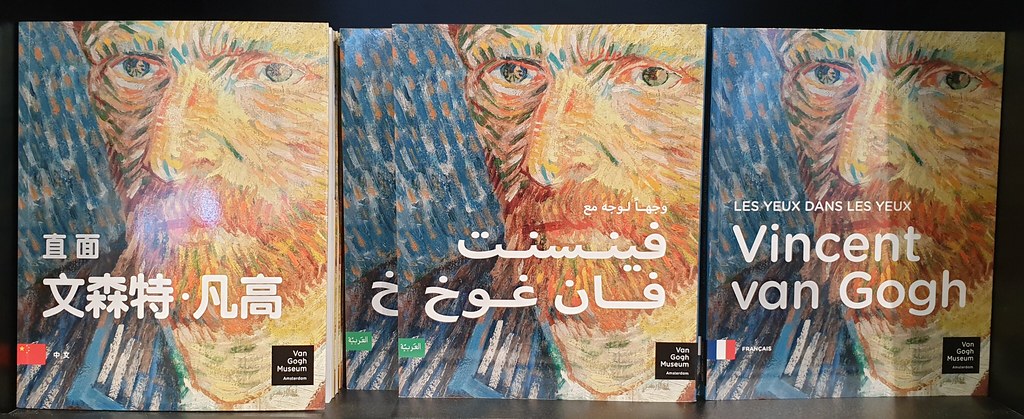
Vincent Van Gogh written is different scripts. Courtesy: Creative Commons

The whole world opens up in the realm of ideas that have existed wafting and bridging across time and space. Sometimes they find conduits to come to the fore, even though they find expression in different languages, under varied cultural milieus. One way of connecting these ideas is to translate them into a single language. And that is what many have started to do. Celebrating writers and translators who have connected us with these ideas across boundaries of time and place, we bring to you translated writings in English from twenty eight languages on the International Translation Day, from some of the most iconic thinkers as well as from contemporary voices. 

Prose

Tagore’s short story, Aparichita, has been translated from Bengali as The Stranger by Aruna Chakravarti. Click here to read. 

Travels & Holidays: Humour from Rabindranath, have been translated from Bengali by Somdatta Mandal. Click here to read.

Hena, a short story by Nazrul, has been translated from Bengali by Sohana Manzoor. Click hereto read.

Munshi Premchand’s Balak or the Child has been translated from Hindi by Anurag Sharma Click here to read.

Munshi Premchand’s Pus Ki Raat or A Frigid Winter Night  has been translated from Hindi by C Christine Fair. Click here to read.

Nadir Ali’s The Kabbadi Player has been translated from Punjabi by Amna Ali. Click here to read.

Kamaleswar Barua’s Uehara by  has been translated from Assamese and introduced by Bikash K. Bhattacharya. Click here to read.

S Ramakrishnan’s Muhammad Ali’s Singnature has been S. Ramakrishnan, translated from Tamil by Dr B. Chandramouli. Click here to read. 

PF Mathews’ Mercy,  has been translated from Malayalam by Ram Anantharaman. Click here to read.

Road to Nowhere, an unusual story about a man who heads for suicide, translated from Odiya by the author, Satya Misra. Click here to read.

An excerpt from A Handful of Sesame by Shrinivas Vaidya, translated from Kannada by Maithreyi Karnoor. Click here to read.

Writings from Pandies’ Corner highlight the ongoing struggle against debilitating rigid boundaries drawn by societal norms. Each piece is written in Hindustani and then translated by a volunteer from Pandies’ in English. Click here to read.

Rakhamaninov’s Sonata, a short story by Sherzod Artikov, translated from Uzbeki by Nigora Mukhammad. Click here to read.

Of Days and Seasons, a parable by the eminent Dutch writer, Louis Couperus (1863-1923), translated by Chaitali Sengupta. Click here to read.

The Faithful Wife, a folktale translated from Balochi by Fazal Baloch. Click here to read.

An excerpt from Ramy Al-Asheq’s Ever Since I Did Not Die, translated from Arabic by Isis Nusair, edited by Levi Thompson. The author was born in a refugee camp. Click here to read.

Poetry

Two songs by Tagore written originally in Brajabuli, a literary language developed essentially for poetry in the sixteenth century, has been translated by Radha Chakravarty. Click here to read. 

Rebel or ‘Bidrohi’, Nazrul’s signature poem,Bidrohi, translated from Bengali by Professor Fakrul Alam. Click here to read.

Banlata Sen, Jibananada Das’s iconic poem, translated from Bengali by Professor Fakrul Alam. Click here to read. 

Poetry of Michael Madhusudan Dutt has been translated from Bengali by Ratnottama Sengupta. Click here to read.

Our Children, a poem by well-known Iranian poet, Bijan Najdi, has been translated from Persian by Davood Jalili. Click here to read.

Akbar Barakzai’s Be and It All Came into Being has been translated from Balochi by Fazal Baloch. Click here to read.

Biju Kanhangad’s The Girl Who Went Fishing has been translated from Malayalam by Aditya Shankar. Click here to read.

Jitendra Vasava’s Adivasi Poetry,  translated from the Dehwali Bhili via Gujarati by Gopika Jadeja. Click here to read.

Sokhen Tudu’s A Poem for The Ol Chiki, translated from the Santhali by Hansda Sowvendra Shekhar. Click here to read.

Thangjam Ibopishak’s Gandhi & Robot translated from the Manipuri by Robin S Ngangom. Click here to read.

 Rayees Ahmad translates his own poem, Ab tak Toofan or The Storm that Rages, from Urdu to English. Click here to read.

Poetry by Sanket Mhatre has been translated by Rochelle Potkar from Marathi to English. Click here to read.

An excerpt from Evening with a Sufi: Selected Poemsby Afsar Mohammad, translated from Telugu by Afsar Mohammad & Shamala Gallagher. Click hereto read.

Ihlwha Choi’s Universal Language written at Santiniktan, translated from Korean by the poet himself. Click here to read.

Sangita Swechha’s Motherhood: A Tiny Life inside Me has been translated from Nepali by Hem Bishwakarma. Click here to read.

Rosy Gallace’s Two poems from Italy  have been translated from Italian by Irma Kurti. Click here to read.

Poetry in Bosnian written and translated from Bosnian by Maid Corbic. Click here to read.

Lesya Bakun translates three of her own poems from Ukranian and Russian to English. Click here to read.

Poems from Armenia by Eduard Harents translated from Armenian by Harout Vartanian. Click here to read.

Categories
Stories

The Trial of Veg Biryani

By Anagha Narasimha

A cloud of dust erupted as the grand hall with chandeliers and decorated wall paintings was opened for the first time in a decade. The Council of Biryanis last gathered when they uncovered the advent of Biryani Ice-Cream and passed a unanimous resolution against it. Alas, if only the current controversy were as simple as that one! Biryanis have reigned over the entire region of India for the past one and a half centuries by adapting to the various cultures and traditions in this vast country. As the cliché goes, they have exhibited unity in diversity in the way they have stood the onslaught of noodles, momos, sushis, pizzas, burgers, etc. Yet, it is only now, in the era of social media, that their unity is truly being tested. Finally, they are faced with a bunch of conflicting views that have forced them to resolve it amicably before it takes the form of a full-fledged war.

The reason for the conflict was a simple tweet and the comments that ensued. One of the stand-up comedians, letting go of their fear of being jailed, took a dig at vegetable biryani. Their post read: The world now has 8 billion people and 0 veg (or vegetarian) biryanis”. Nowadays, a tweet is mightier than a tabloid front cover, and that stand-up comedian learnt it the hard way. Meat lovers cheered, vegetarians/vegans booed, and some even claimed their religious sentiments were hurt (stand-up comics keep finding new ways to get behind bars!). Out of nowhere, self-designated linguistic experts showed up in the comments section to provide gyaan[1] on the etymology of the word “Biryani”. There was no dearth of prime-time news hour debates and they all debated the existence of Veg Biryani as that’s what the Nation wanted to know. A combined effect of all these pushed Biryanis to an existential crisis, and they gathered in the grand hall to settle it once and for all by putting the Veg Biryani through trial.  

Mutton Biryani, the proud recipient of the “Most Popular Biryani Award”, sat at the centre of the table, displaying its aristocratic demeanour. Next to it, Beef Biryani sat thinking about the bleak future that lay ahead of it. It held a firm footing in certain parts; Whereas, had no existence, or even shunned because of its existence in other parts. Chicken Biryani sat opposite the Mutton Biryani, eyeing to replace the Mutton Biryani from being the most popular Biryani. Next to it, Fish Biryani sat with a smirk on its face, whose dominance in the coastal region was unparalleled (probably the reason behind the smirk).

While they were growing tired of the awkward silence, our central character, Veg Biryani, who does not command the same loyalty as that of his contemporaries, but manages to be in the good books of all, made its entrance.

“Do not tell me we are here because of the tweet of a buffoon!” Veg Biryani’s frustration knew no bounds.

Mutton Biryani, was ready with a reply in a sonorous voice, “We are afraid that is indeed the case.”

To which, Fish Biryani added, “We have entered the era of social media trial,” which elicited laughter from everyone.

Mutton Biryani quickly brought everyone back to the issue with its question, “So tell us why we should consider you a Biryani?”

For every “Why?” out there, the most convenient answer would be “Why not?” Veg Biryani started with the same. A few minutes of silence ensued, which forced Veg Biryani to elaborate. “The essence of Biryani is in the process of making it in layers. As long as you stick to the process, what you add to it is of no consequence.”

Chicken Biryani intervened: “That’s just one of the ways of cooking Biryani. You have the popular Biryanis originating from Tamil Nadu that aren’t layered.”

Beef Biryani added: “The Bengaluru’s beloved Donne Biryani isn’t layered.”

“So, put them on trial.” Veg Biryani ejaculated.

Mutton Biryani responded: “We are aware of the intersectionality and how different attributes such as place of origin, the type of rice, the spices, the aroma, and various other markers of difference intersect and reflect large social structures of gastronomic preference; However, our current issue is to decide whether meat is an essential and necessary requirement of Biryani?”

Veg Biryani wasted no time replying, “Well, in that case, you should answer that in the negative.”

Chicken Biryani responded, “We would be glad to do that once you present your argument.”

Veg Biryani tried everything at its disposal to not get furious and said, “What arguments are you asking for? This is a classic case of petitio principii[2]– your premises presume the very conclusion that you ask me to demonstrate. You define what amounts to a Biryani. You exclude me from the said definition. Then you ask me to prove why I must be considered a Biryani. This is preposterous.”

Beef Biryani, who was a mute spectator, could not resist its growing frustration at the fact that it had to lose out on a holiday to listen to this and muttered, “At the end of the day we all rely on some preposition which can neither be proved nor be disproved. Why can’t you skip to the part where you actually help us in deciding the issue at hand?”

Veg Biryani sighed and started, what seemed to be a long elaborated speech, “Traditionally…”

Which was cut short by Fish Biryani’s jape, “Traditionally there was no such thing as Veg Biryani.”

Ignoring the intended joke, Veg Biryani continued, “Traditionally, Biryani is supposed to be cooked with the bottom layer containing marinated meat, or any substitute, and the next layer consisting of rice along with all the spices. Remember what it means to be a Biryani. We always stood up to the grand ideals of inclusivity. Biryani finds a place in every household and on all occasions. It can embellish a royal feast, at the same time, satisfy the appetite of a common working human, yearning for comfort food. It can feature in the scintillating menu of a five-star restaurant, and at the same time, be the crowd puller in a small low-key food joint on the corner of a street. It is perhaps the only dish that can be served as breakfast, lunch, and dinner. Demographers refer to it as Omnipresent. It’s preferred all over India – North, South, East, West, and across all castes and religions. Secular in its letter and spirit. I beg you not to limit it to one particular strand of society by snatching away their Veg Biryani from them. Stay true to our vision – ‘Ghar Ghar Biryani Har Ghar Biryani[3].’

“Moreover, seventy per cent of Indians become vegetarians on Mondays or Thursdays or Saturdays. Some on all three days. And then there is Navratri, Shravana, Karthika[4], etc. etc. Don’t they deserve their Biryani during these long arduous days of staying a vegetarian? Do you want to further their suffering by making them feel like they are eating Pulao[5]?

“Now they are coming up with plant-based meat Biryani. How would you classify them? We are living in the era of neo-liberalisation. If you want to be truly global and compete with Pizzas and Burgers, you got to have Veg Biryani just like they have Veg Pizzas and Burgers. Especially when the whole world is going bonkers over veganism…”

Mutton Biryani interjected saying, “But the majoritarian sentiments are against it.”

Veg Biryani continued, “Since when did we start acting as per the majority?”

Fish Biryani said, “Ah, I’m not sure. But, my bet would be, when we accepted democracy.”

Veg Biryani replied, “Oh come out of the fantasy. When has the majority ever taken the right decision? That’s the reason we have this counsel. That is the reason why we have gathered here today.”

Mutton Biryani interjected, “All right. We have had enough. Let’s take a time out and get back in fifteen minutes with a decision.” Mutton Biryani walked out lighting a cigarette.

Veg Biryani, although, made an elaborate argument for inclusivity, somewhere felt it wasn’t convincing. That’s usually the case with ethos. You don’t let lengthy arguments cluttered with jargon cloud your judgment. It is the guiding principle differentiating truth from justification, which is embedded in all of us, where logic or reason holds little or no relevance. Veg Biryani was no different and was aware that the way to win the trial was not through sophisticated arguments. It was shrewd enough to know the politics that led to the trial and decided to play the same game as others in the trial. Chicken Biryani’s ambition to replace Mutton Biryani as the Most Popular Biryani was a piece of common knowledge and all that Chicken Biryani had to do was to push the right buttons to convert that ambition into animosity.

Veg Biryani, through highly reliable sources, got hold of a video clipping where Mutton Biryani displayed its contempt for Chicken Biryani openly. Mutton Biryani was heard saying, “Chicken Biryani was invented out of an accident. They invented it when one fine day there were more guests and they ran out of Mutton. Now this bugger wants to replace me. Biryani is synonymous with Mutton Biryani, and Chicken Biryani exists only because everyone can’t afford Mutton Biryani.” Veg Biryani made sure that the said video clipping reached Chicken Biryani’s mobile and they could hear Mutton Biryani and Chicken Biryani fighting over it outside. Fish Biryani, who was scrolling through social media, and Beef Biryani, who was going through account statements, were surprised that Mutton Biryani and Chicken Biryani were fighting over something as trivial as the result of this trial. Only Veg Biryani knew better and the fight reassured that its status as a Biryani continued un-besmirched. It had made a pact with Chicken Biryani and knew that Mutton Biryani would accede to Chicken Biryani’s demand to avoid a civil war.

Both, Mutton Biryani and Chicken Biryani entered the hall holding each other’s hand, with a hideous grin carved onto their countenance. Although Mutton Biryani wielded authority, it had no option but to pronounce Chicken Biryani’s verdict.

“It’s now time to put this squabble, masquerading as a trial, to rest. Whatever may be the dissensions, the practical needs and the ramification of denouncing the Veg Biryani from our closely-knit community, outweighs the trivial speculation as to the essential attributes of a Biryani; Wherefore, I declare that Veg Biryani…. remains a Biryani.”

Chicken Biryani was proud, Veg Biryani was relieved, and Mutton Biryani was dejected. As they all started to walk out, Fish Biryani proposed to make the concluding remarks. “Well, what I would like to say, gathering all the humility at my disposal, without an iota of intention to hurt anyone’s sentiment, while remaining steadfast to the ideals of truth and justice, upholding the true essence of Biryani, is… Crap! I forgot what I wanted to say…” None even waited to hear what Fish Biryani had to say as they were already at the door.

[1] knowledge

[2] Begging the question

[3] Translates to ‘Every home should have Biryani’.

[4] Festivals where some turn vegetarian

[5] The primary difference between a pulao and biryani is the method of preparation. Biryani is normally more spiced than a pulao.

.

Anagha Narasimha C N, an advocate by profession, is also a poet and writer. His poems in Kannada and English are published in various online journals and he is actively involved in playwriting and theatre production. 

PLEASE NOTE: ARTICLES CAN ONLY BE REPRODUCED IN OTHER SITES WITH DUE ACKNOWLEDGEMENT TO BORDERLESS JOURNAL

Click here to access the Borderless anthology, Monalisa No Longer Smiles

Click here to access Monalisa No Longer Smiles on Kindle Amazon International

Categories
Review

Is Time Future Contained in Time Past?

A Book Review by Rakhi Dalal

Title: A Handful of Sesame

Author: Shrinivas Vaidya

Translator: Maithreyi Karnoor

Publisher: Gibbon Moon Books

Originally written and published in Kannada as Halla Bantu Halla by Shrinivas Vaidya, this book won the Karnataka Sahitya Academy Award in 2004 and Central Sahitya Akademi Award in 2008. The author of many critically acclaimed literary collections, Vaidya is also the recipient of Karnataka Rajyotsava Award.

The English translation A Handful of Sesame by Maithreyi Karnoor was shortlisted for the Lucien Stryk Asian Translation Prize. Karnoor is the recipient of the Charles Wallace India Trust Fellowship for creative writing and translation. She has also won the Kuvempu Bhasha Bharati prize for translation.

Written with the backdrop of India’s struggle for independence, spanning a time period of almost a hundred years from the mutiny of 1857 to Mahatma Gandhi’s assassination, this book chronicles the life of a Hindu Brahmin family over a century in a town called Navalgund in Karnataka. It is the narrative of a family, whose seed originated in Kanpur in Northern India but which took roots in the small Southern Indian town of Navalgund during a period of political upheaval and then made it a home for generations to come. This story, as Tabish Khair notes in the foreword, thus also becomes a story of internal migration, recording the adoption and assimilation of cultural and religious practices in everyday living. More than that, it offers us a window into the socio-cultural mores of a family affected and shaped by changing times. 

Vasudevaachar is the son of Kamalanabh-panth of Kanpur who marries the daughter of a Brahmin from Navalgund and stays back during the chaotic times brought about after the suppression of 1857 mutiny. Like his father, he practiced medicine and takes on the responsibility of the entire household after Kamalanabh’s demise. The narrative deals with a detailed account of the struggles of running of the household with regular events like birth, death, marriages and so on in the big joint family with Vasudevaachar at the centre even as various occurrences like natural calamities, fight for freedom, world war and political turmoil keep altering the contours of their daily life.

Vaidya essentially creates a Brahmin household, suffusing the narrative with a rich language, idioms and slangs and vivid description of rituals, food and daily practices which are rendered in a delightful manner to the non-native reader through a fine translation by Maithreyi Karnoor. It palpitates with both rhyme and rhythm, of language and everydayness, concocting a gripping tale that captivates imagination.

The major characters that inhabit the world of A Handful of Sesame are diverse and non uni-dimensional. They evolve with the progressing narrative, forging the complex web of relationships within a large family that change as the time moves. Vaidya’s skilful portrayal brings forth the nuances in their interactions and connections which tie them as a family.  

Vasanna or Vasudevaachar, the head of the family, a religious and orthodox Brahmin is shown to be burdened by perpetual looming financial burdens of the family. Tulsakka, his wife, is a quiet yet determined woman. Ambakka, sister of Vasanna, is a shaven widow who lives with them. Impatient and irritable, she however assumes bigger role in caring for the newborns of the family. Venkanna, younger brother of Vasanna and a widower too, instead of marrying again keeps a relationship with a Muslim woman. A firm and resolute man, he shares the financial burden of his brother. Rukkuma, an orphan adopted by Panth family and belonging to a lower caste, lives as a house-help while Narayana, another orphan adopted by the family and son of a distant relative lives with them too.

As the world around them keeps changing, family dynamics change too. When English schools open up in Dharwad, the young sons of the family are sent for an education there. With opening of newer avenues for livelihood, the next generation keeps moving onto newer and bigger places, adopting new ways of life but remaining connected with their roots.  

Struggle for freedom, which remains a constant in the background, is employed to portray the rising collective consciousness across the nation which influenced the lives of ordinary people. We are offered glimpses into how the events like Salt Satyagraha or Congress meetings had an effect on the routine life of people of a small town like Navalgund.  The author also offers a peek into the larger social construct surrounding the Panth family, which though fragmented by caste and religion, lived in harmony with each other. An orthodox Brahmin like Vasanna goes to a dargah to offer sugar to ward off evil eye. In the present context, this might appear contradictory to the very definition of an orthodox, but it simply means that a rigidness in following one’s own rituals did not translate to a dislike of others’ and the minds were more open to accepting the customs believed to bring a greater good. 

Such times did exist. How wonderful it would be able to have access to more such works written in regional languages — works which open up bridges to the past of distant lands, connecting to our present, making the present improbable possible and bridging the divide; works which bring to us the account of lived lives of a people separated only by language. Perhaps this is why it becomes important that these works be made available to varied readers through translation.   

For an English reader, Maithreyi Karnoor’s perceptive translation presents a view of the ‘most underrepresented region in Kannada literature’, thereby offering us not only the linguistic nuances neglected by mainstream Kannada but also a compassionate insight into the regional life which is critical for a better understanding of the period.

Rakhi Dalal is an educator by profession. When not working, she can usually be found reading books or writing about reading them. She writes at https://rakhidalal.blogspot.com/ .

.

PLEASE NOTE: ARTICLES CAN ONLY BE REPRODUCED IN OTHER SITES WITH DUE ACKNOWLEDGEMENT TO BORDERLESS JOURNAL. 

Click here to access the first Borderless anthology, Monalisa No Longer Smiles

Categories
Contents

Borderless, October 2022

Art by Sohana Manzoor

Editorial

The Sky … Click here to read.

Conversations

Anthony Sattin, an award winning journalist and travel writer in conversation about Nomads: The Wanderers Who Shaped our World, his recent book published by Hachette, India. Click here to read.

VR Devika talks of the dynamic Muthulakshmi Reddy, the first woman in the world to preside over a Legislative Assembly who sought justice for Devadsis and prostitutes and discusses her book, Muthulakshmi Reddy: A Trailblazer in Surgery and Women’s Rights published by Niyogi Books. Click here to read.

Translations

Daridro or Poverty by Nazrul has been translated from Bengali by Professor Fakrul Alam. Click here to read.

The Browless Dolls by S.Ramakrishnan, has been translated from Tamil by B Chandramouli. Click here to read.

Two poems from Italy by Rosy Gallace have been translated from Italian by Irma Kurti. Click here to read.

Flowers of Love Bloom Everywhere, a poem for peace, written by and translated from Korean by Ihlwha Choi. Click here to read.

Aalo Amar Aalo (Light, My Light) a song by Tagore, has been translated by Mitali Chakravarty from Bengali. Click here to read.

Pandies Corner

Songs of Freedom: Moh-Reen is an autobiographical story by Amreen, translated from Hindustani by Janees. These stories highlight the ongoing struggle against debilitating rigid boundaries drawn by societal norms, with the support from organisations like Shaktishalini and Pandies. Click here to read.

Poetry

Click on the names to read

Michael R Burch, Kirpal Singh, Ryan Quinn Flanagan, Jonathan Chan, Ron Pickett, Saranyan BV, George Freek, Pramod Rastogi, Mike Smith, Gayatri Majumdar, John Grey, Vandana Kumar, Ahmad Al-Khatat, Rhys Hughes

Poets, Poetry & Rhys Hughes

In Crossing the Date Line, Rhys talks of his fascination with this imagined construct. Click here to read.

Essays

Epaar Bangla, Opaar Bangla:  Bengals of the Mind

Asad Latif explores if homeland is defined by birth. Click here to read.

The Wabi-Sabi of Making a Living

Aditi Yadav calls for taking a break from hectic work schedules. Click here to read.

Just a Face on Currency Notes?

Debraj Mookerjee writes of Gandhi’s relevance and evolution. Click here to read.

A Mother, a Daughter & a Demon Slayer?

Meenakshi Malhotra checks out the festival of Durga Puja, declared the a heritage festival by UNESCO. Click here to read.

The Observant Immigrant

Candice Lousia Daquin explores festivals and the God gene in We had Joy, We Had Fun…. Click here to read.

Musings/Slices from Life

KL Twin Towers near Kolkata?

Devraj Singh Kalsi visits the colours of a marquee hosting the Durga Puja season with its spirit of inclusivity. Click here to read.

A Five Hundred Nautical Mile Voyage to Tasmania

Meredith Stephens writes of sailing to Tasmania when the pandemic had just started loosening its grip. Click here to read.

Keep Walking…

Ravi Shankar recommends walking as a panacea to multiple issues, health and climate change and takes us on a tour of walks around the world. Click here to read.

The Matriarch of Hirronk

Ali Jan Maqsood introduces us to a strong matriarch from a Balochi village. Click here to read.

Musings of a Copywriter

In Drill, Fill, Just Chill, Devraj Singh Kalsi gives us humour while under a dentist’s drill. Click here to read.

Notes from Japan

Suzanne Kamata writes of her A Ramble on Bizan, focussing on a writer, also by the surname of Moraes, who lived on Mount Bizan more than century ago, moving to Japan from Portugal having fallen violently in love. Click here to read.

Short Stories

Half-Sisters

Sohana Manzoor explores the darker regions of human thought with a haunting psychological narrative about familial structures. Click here to read.

Homecoming

Rituparna Mukherjee gives a poignant story about missing home. Click here to read.

The Phosphorescent Sea

Paul Mirabile journeys with his protagonist into the depths of the ocean. Click here to read.

The Literary Fictionist

In Deathless are the Words, Sunil Sharma explores madness and ideators who believe in the power of words. Click here to read.

Book Excerpts

An excerpt from Taranath Tantrik and Other Tales from the Supernatural by Bibhutibhushan, translated from Bengali by Devalina Mookerjee. Click here to read.

An excerpt from A Handful of Sesame by Shrinivas Vaidya, translated from Kannada by Maithreyi Karnoor. Click here to read.

Book Reviews

Somdatta Mandal has reviewed BM Zuhara’s The Dreams of a Mappila Girl: A Memoir, translated from Malayalam by Fehmida Zakir. Click here to read.

Basudhara Roy has reviewed Taranath Tantrik: And Other Tales from the Supernatural by Bibhutibhushan, translated from Bengali by Devalina Mookerjee. Click here to read.

Bhaskar Parichha has reviewed Satyajit Ray Miscellany: On Life, Cinema, People & Much More, a collection of the maestro’s writings and illustrations. Click here to read.

Categories
Excerpt

A Handful of Sesame

Title: A Handful of Sesame

Author: Shrinivas Vaidya

Translator: Maithreyi Karnoor

Publisher: Gibbon Moon Books

Although Navalgund had been roused from its slumber by the Mainavati elopement episode, in a few days after the eloping couple returned, going by the saying, ‘she becomes of this earth when she starts lighting the hearth’ the scandal lost steam and the town went back to sleep again.

The people returned to their busy routines of asking each other in the mornings if they were up, and turning their faces to the skies in the afternoon and saying “What do you know? There’s not a hint of rain yet.” They went back to sitting on the knoll near the Lalgade temple until darkness stepped in and until the concluding strains of the raag Bhairavi  of the Magdum’s band rehearsal became thin air, they discussed such pressing matters as the ghost in the tamarind tree beside the Sankawwa pond, or the yard-long wheat-hued cobra that had slithered into the rock cluster before the Taluk office, or the Halladmatha’s Sire’s persistent cough, or Mamlatdar’s minor wife Mandakini, or the plague mice falling dead in Hubballi, or Bal Gangadhar Tilak. After ruminating over these never-ending topics, they would hasten home to eat their evening meals and shut their doors upon the darkness outside and turn in before the wicks in the kerosene lamps in their respective homes went off with a phtt.  The womenfolk kept themselves busy with hearth, childbirth, and a little mirth of water’s worth on their way to the pond. Once in a while, they created their own entertainment with gossip and slander and quarrels – scold this one, taunt that one or mock another one. 

Navalgund has grown considerably in the thirty or forty years since the mutiny. Fleeing the Company’s oppression, many families from Nargund are now settled in Navalgund. With the increase in population, more merchants have set up shops. Earlier, Adoni’s was the only trading family in all of Navalgund. Now, with the addition of Mhantshetty, Mhankali, and Yirapakshimath, there are four merchant families. The Queen’s government had laid down with great care gravel roads because of which trade and businesses are growing. Open-topped and covered bullock carts and even horse-drawn carts are now plying from town to town on these roads. The municipality that has been there for a while has now started a school, a library and — can you believe it — even an English hospital! But no one goes to that hospital because it is rumoured that they put the flesh of chickens, sheep, and donkeys in their medicines. Hence, Vasudevaachar’s patients are constantly growing in number. Bullock carts crowd at the Panths’ door every morning. Moaning, groaning and coughing patients covered in woollen blankets wait in their veranda. Vasudevaachar walks among them bare-chested, stroking his sacred thread with both hands and advising the patients on their medication, treatment and diet, offering soothing words of courage or stern reprimands as the occasion demanded.

“Ningawwa, if give up garlic chutney for two days the sky won’t fall on your head”

“Krishtya, I’ll give you a Shankhvati. Powder it, mix it with lemon juice and lick it. Your stomach will be alright. You won’t die if you cut down on your food for a couple of days”

“Bharmya, I’m giving you this bottle of Balantsyrup. Give it to your wife and don’t drink it yourself, you whoreson…”

“Basangauda, you have the sugar disease. Fire two of your farmhands and do their work yourself. You must also eat less…”

“Subbi, I told you that feeding your daughter-in-law the red figs of the Banyan tree will beget her children. But I don’t remember promising they would be male children!”

“Do not eat or drink undrinkable and uneatable things, you sons of unwed mothers!”

“Goudra, your lady is showing signs of consumption. See if her spittle is red-tinted. It’s a terribly infectious disease. Stay away for a few days – it’s good for you and also for her.”

“It’s not just medicines that will cure you, Shambhu. You must also have faith in god. Here, repeat after me, medicine is the waters of the Ganges, the doctor is a manifestation of god’. Now, once more…”

Such medical jargon could be heard in the halls of the Panth house every day. 

From early morning to the ripening afternoon, Vasudevaachar sits in the outer hall attending to his patients. He then heads to the backyard, draws seven or eight pots of water from the well and pours it over himself completing his bath before heading to the altar and sitting down for a two-hour long, uninterrupted prayers. Sometimes the municipality’s three o’clock bell would have rung before his prayers are complete. Then, after a meal and a short siesta, with only a thin shawl covering his bare chest, he heads to the Lalgade Hanamappa temple for prayers in the late afternoon. Sometimes, if there is a sermon or sacred storyrecitation on, he sits down to listen to it. If not, he sits a while on the stone bench that’s open to the skies outside and lets himself afloat in Magdum’s melodies before slowly heading back home.

On one such rippleless evening, Tulsakka and Vasudevaachar sat chatting on the porch outside the house. The children who had gone out to play hadn’t returned yet and Ambakka was at Antambhatta’s corner house, when suddenly Rukuma rushed from the backyard to the main-door looking excited and coughed a couple of times to draw Tulsakka’s attention. She then called out to her sotto voce, “Tulsakka… tssst… come here… come quickly…” Sensing her excitement and strange expression, Tulsakka left Vasudevaachar behind and walked over looking quizzically at Rukuma who began gushing and flailing her arms animatedly.

“She’s here!” she said.

“Who ay Rukuma? Who is here?” Tulsakka asked in her normal calm voice.

“She… she!” Rukuma insisted.

“She who?” asked Tulsakka as calm as before.

Rukuma came close to Tulsakka and said with wide eyes, “She! The one from Annigeri”

Taken aback by her words, “What’s this new drama now” Tulsakka exclaimed and followed her to the backyard.

Covering the child in her lap with the loose end of her sari, she sat by the stack of cotton twigs in the backyard, her poignant face both nervous and hopeful. As soon as Tulsakka and Rukuma came close, she stood up and held the child out and her eyes filled with tears.

“Please don’t be angry, my lady… it’s three days since he’s burning with a fever. Even the master of my home hasn’t visited in a while. Do what it takes but please save my child. I heard the master of your home is a great doctor with healing hands. So I came running here. Please don’t tell my master that I was here… he will be very angry. This is my only son please save him for me…” she implored them.

Tulsakka hesitated for a moment and then said, “Come, sit here…” and showed her to the holy basil pedestal. The Annigeri woman sat down where she was asked to. Then spotting someone else, she suddenly covered her face with her sari, handed the baby to Rukuma and stood back in fright. Even Rukuma and Tulsakka were a little scared as they turned around and saw that it was Vasudevaachar. He fixed a dark gaze upon them for a moment before looking at Rukuma and saying “Bring the child in, I’ll take a look.” He walked back to his desk in the outer hall and Rukuma followed with the baby.

The Annigeri baby’s fever was owing to a knot in the stomach. Vasudevaachar gave a handful of small sachets to Rukuma and said, “Tell her to mix this in thin, watered-down milk to make a paste and feed it to the baby four times a day. Children often get fevers. Tell her not to worry. The baby will be well in a couple of hours. Open one of the sachets and give it to the baby yourself so she can learn how it’s done. Also, tell the mother to drink boiled water and to feed the baby a little less for the next four days.” He sent Rukuma away and went back to sit on the porch outside.

As Vasudevaachar’s instructions were being carried out, Rukuma and Tulsakka had formed an easy friendship with the Annigeri woman as only women could with one another. ‘Where are you from? How many years since you came to Annigeri? What did you say your name was? Mhaashaabi? What does it mean? Where did you meet Venkanna? Is this your only child?’ they were asking her. ‘How many grandchildren? I hear you haven’t seen your own lands in Annigeri… why don’t you visit once? If the baby gets well soon, I will go to the annual fairat the mausoleumof the Yamanoor saint…’ she was saying to them when suddenly Ambakka walked in through the backyard door straightening the parting in her sari. Upon finding out who the stranger was, Ambakka sprung back as if stung by a scorpion. “Ayya may her pyre be lit!” she started shrieking, “That thing may have no sense, but what about you? You have let it in like this! Hey, you! Get up… you have polluted the holy basil with your touch… pick your child up…” Rukuma and Tulsakka were saddened to see the Annigeri woman’s plight. Tulsakka spoke with her usual calm and dignified voice.

“Ambakka, please be quiet. Is this how you treat a guest?” At this Ambakka suddenly came into her wild avatar and started yelling in a shrill, sarcastic tone.

“Ayya… who’s stopping you, my lady? It’s your home… do what you like in it. Who am I to tell you anything? Venkanna mistress is your sister-in-law after all, isn’t she? She’s brought her son home moreover… it’s the procession of the family’s heir. Get the cradle out. Welcome him in, bestow gifts into her lap, give her a new sari– you haven’t given her one on her wedding, have you? Who am I to stop you…?”

“I don’t understand what she’s saying” exclaimed Mhaashaabi alarmed by the scene Ambakka was making. She said a hasty “I’ll take your leave, madam” to Tulsakka and left quickly.

The next day, after the atmosphere had cleared a bit, Rukuma went up to Tulsakka and said in a low voice, “Did you notice the baby’s nose, Tulsakka? Wasn’t it exactly like Venkanna’s?” and smiled knowingly.

A few days since then, Venkanna cornered Ambakka in the backyard. “Ambi, this is the last time. If you stick your nose in my affairs again, I’ll erase all traces of you. Be warned” he said menacingly.

ABOUT THE BOOK

A sweeping historical novel. Shortlisted for the Lucien Stryk Asian Translation Prize, 2019. The original work Halla Bantu Halla won the Central Sahitya Akademi Award.

It is the year 1857. A great uprising — what would come to be known as the first war of Indian independence — has broken out. Two brothers, emissaries of a northern king, on a mission to garner the support of the southern rulers, wander lost and hungry in a forest not far from their destination. They are captured and one of them is hung by the British. Caught in the rough and tumble of the mutiny, the other brother settles down in a place that was never meant to be more than a temporary refuge. He spends his life far away from home among people who do not speak his language. The novel spans the story of three generations of his family living under the burden of inherited nostalgia, a story that unfolds with all its flying fancies and stumbling follies on the threshold between tradition and modernity. Set against the backdrop of the freedom movement, the novel explores the lives of the people of the Dharwad region of Karnataka; their acts of faith and the realpolitik of ritual. Masterfully and sensitively translated from the Kannada, A Handful of Sesame is funny, tragic, ironic, satirical, lyrical and deeply allegorical of a young, modern nation. 

ABOUT THE AUTHOR

Shrinivas Vaidya was born in the Dharwad district of Karnataka. He conceived of the plot of Halla Bantu Halla — inspired in part by the history of his own family — a long time ago, but it wasn’t until he retired from his four-decade long career in banking that he managed to sit down and write it. The novel won the Sahitya Akademi award – the highest honour by India’s National Academy of Letters. He has written several collections of short fiction since then.  

ABOUT THE TRANSLATOR

Maithreyi Karnoor is the recipient of the Charles Wallace India Trust Fellowship for creative writing and translation at Literature Across Frontiers, University of Wales Trinity Saint David. She has won the Kuvempu Bhasha Bharati prize for translation and has been shortlisted for the Lucien Stryk Asian Translation Prize and is a two-time finalist of the Montreal International Poetry Prize. Sylvia: Distant Avuncular Ends is her debut novel.

PLEASE NOTE: ARTICLES CAN ONLY BE REPRODUCED IN OTHER SITES WITH DUE ACKNOWLEDGEMENT TO BORDERLESS JOURNAL