Categories
Interview Review

The Subliminal World of Radha Chakravarty’s Poetry

In conversation with Radha Chakravarty about her debut poetry collection, Subliminal, published by Hawakal Publishers

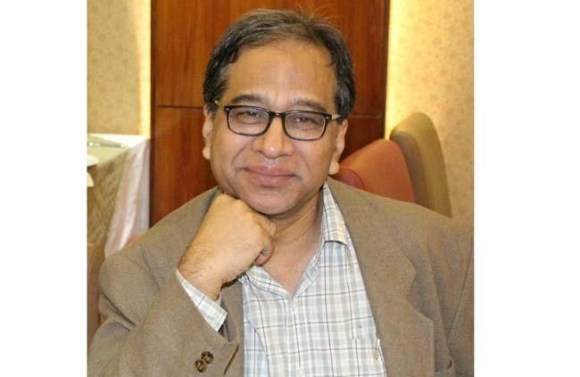
Radha Chakravarty

Words cross porous walls
In the house of translation—
Leaf cells breathe new air.

We all know of her as a translator par excellence. But did you know that Radha Chakravarty has another aspect to her creative self? She writes poetry. Chakravarty’s poetry delves into the minute, the small objects of life and integrates them into a larger whole for she writes introspectively. She writes of the kantha — a coverlet made for a baby out of soft old sarees, of her grandmother’s saree, a box to store betel leaves… Her poetry translates the culture with which she grew up to weave in the smaller things into the larger framework of life:

Fleet fingers, fashioning
silent fables, designed to swaddle
innocent infant dreams, shielding
silk-soft folds of newborn skin
from reality’s needle-pricks,
abrasive touch of life in the raw.

--'Designs in Kantha’

She has poignant poems about what she observes her in daily life:

At the traffic light she appears 
holding jasmine garlands
selling at your car window for the price
of bare survival, the promise
of a love she never had, her eyes
emptied of the fragrance
of a spring that, for her, never came.

--‘Flower Seller’

Some of her strongest poems focus on women from Indian mythology. She invokes the persona of Sita and Ahalya — and even the ancient legendary Bengali woman astrologer and poet, Khona. It is a collection which while exploring the poet’s own inner being, the subliminal mind, takes us into a traditional Bengali household to create a feeling of Bengaliness in English. At no point should one assume this Bengaliness is provincial — it is the same flavour that explores Bosphorus and Mount Everest from a universal perspective and comments independently on the riots that reft Delhi in 2020… where she concludes on the aftermath— “after love left us    and hate filled the air.”

The poems talk to each other to create a loose structure that gives a glimpse into the mind of the poetic persona — all the thoughts that populate the unseen crevices of her being.

In Subliminal, her debut poetry book, Radha Chakravarty has brought to us glimpses of her times and travels from her own perspective where the deep set tones of heritage weave a nostalgic beam of poetic cadences. Chakravarty’s poems also appear in numerous journals and anthologies. She has published over 20 books, including translations of major Bengali writers such as Rabindranath Tagore, Bankim Chandra Chatterjee, Mahasweta Devi and Kazi Nazrul Islam, anthologies of South Asian writing, and several critical monographs. She has co-edited The Essential Tagore (Harvard and Visva-Bharati), named ‘Book of the Year’ 2011 by Martha Nussbaum.

In this conversation, Radha Chakravarty delves deeper into her poetry and her debut poetry book, Subliminal.

Your titular poem ‘Subliminal’ is around advertisements on TV. Tell us why you opted to name your collection after this poem.

Most of the poems in Subliminal are independent compositions, not planned for a pre-conceived anthology. But when I drew them together for this book, the title of the poem about TV advertisements appeared just right for the whole collection, because my poetry actually delves beneath surfaces to tease out the hidden stories and submerged realities that drive our lives. And very often, those concealed truths are startlingly different from outward appearances. I think much of my poetry derives its energy from the tensions between our illusory outer lives and the realities that lurk within. In ‘Memories of Loss’, for example, I speak of beautiful things that conceal painful stories:

In a seashell held to the ear
the murmur of a distant ocean

In the veins of a fallen leaf
the hint of a lost green spring

In the hiss of logs in the fire,
the sighing of wind in vanished trees

In the butterfly’s bold, bright wings,
The trace of silken cocoon dreams

So, when and why did you start writing poetry?

I can’t remember when I started. I think I was always scribbling lines and fragments of verse, without taking them seriously. Poetry for me was the mode for saying the unsayable, expressing what one was not officially expected to put down in words. In a way, I was talking to myself, or to an invisible audience. Years later, going public with my poems demanded an act of courage. The confidence to actually publish my poems came at the urging of friends who were poets. Somehow, they assumed, or seemed to know from reading my published work in other forms, that I wrote poetry too.

Did being a translator of great writers have an impact on your poetry? How?

Yes, definitely. In particular, translating Tagore’s Shesher Kabita (as Farewell Song), his verses for children, the lush, lyrical prose of Bankimchandra Chatterjee (Kapalkundala) and the stylistic experiments of contemporary Bengali writers from India and Bangladesh (in my books Crossings: Stories from India and Bangladesh, Writing Feminism: South Asian Voices, Writing Freedom: South Asian Voices and Vermillion Clouds) sensitised me to the way poetic language works, and how the idiom, rhythm and resonances change when you translate from one language to another. Translating poetry has its challenges, but it also refined my own work as a poet. Let me share a few lines of poetry from Farewell Song, my translation of Tagore’s novel Shesher Kabita:

Sometime, when you are at ease, 
When from the shores of the past,
The night-wind sighs, in the spring breeze,
The sky steeped in tears of fallen bakul flowers,
Seek me then, in the corners of your heart,
For traces left behind. In the twilight of forgetting,
Perhaps a glimmer of light will be seen,
The nameless image of a dream.
And yet it is no dream,
For my love, to me, is the truest thing …

What writers, artists or musicians have impacted your poetry?

For me, writing is closely associated with the love for reading. Intimacy with beloved texts, and interactions with poets from diverse cultures during my extensive travels, has proved inspirational.

Poetry is also about the art of listening. As a child I loved the sound, rhythm and vivacity of Bengali children’s rhymes in the voice of my great-grandmother Renuka Chakrabarti. She has always been a figure of inspiration for me, a literary foremother who dared to aspire to the world of words at a time when women of her circle were not allowed to read and write. A child bride married into a family of erudite men, and consumed by curiosity about the forbidden act of reading, she took to hiding under her father-in-law’s four-poster bed and trying to decipher the alphabet from newspapers. One day he caught her in the act. Terrified, she crept out from her hiding place, and confessed to the ‘crime’ of trying to read. Things could have gone badly for her, but her father-in-law was an enlightened individual. He understood her craving to learn, and promised that he would teach her to read and write. Under his tutelage, and through her own passion for learning, she became an erudite woman, equally proficient in English and Bengali, an accomplished but unpublished poet whose legacy I feel I have inherited. Subliminal is dedicated to her.

As a child I absorbed both Bengali and English poetry through my pores because in our home, poetry, and music were all around me. I was inspired by Tagore and Nazrul, but also by modern Bengali poets such as Jibanananda Das, Sankho Ghosh and Shamsur Rahman. In my college days, as a student of English Literature, I loved the poetry of Shakespeare, Donne, Yeats, T. S. Eliot and the Romantics.

Later, I discovered the power of women’s poetry: Emily Dickinson, Sylvia Plath and Adrienne Rich, to name a few. I am fascinated by the figure of Chandrabati, the medieval Bengali woman poet who composed her own powerful version of the Ramayana. Art and music provide a wellspring of inspiration too, for poetry can have strong visual and aural dimensions.

You translate from Bengali into English. How is the process of writing poetry different from the process of translation, especially as some of your poetry is steeped in Bengaliness, almost as if you are translating your experiences for all of us?

Translation involves interpreting and communicating another author’s words for readers in another language. Writing poetry is about communicating my own thoughts, emotions and intuitions in my own words. Translation requires adherence to a pre-existing source text. When writing poetry, there is no prior text to respond to, only the text that emerges from one’s own act of imagination. That brings greater freedom, but also a different kind of challenge. Both literary translation and the composition of poetry are creative processes, though. Mere linguistic proficiency is not enough to bring a literary work or a translated text to life.

English is not our mother tongue. And yet you write in it. Can you explain why?

Having grown up outside Bengal, I have no formal training in Bengali. I was taught advanced Bengali at home by my grandfather and acquired my deep love for the language through my wide exposure to books, music, and performances in Bengali, from a very early age. I was educated in an English medium school. At University too, I studied English Literature. Hence, like many others who have grown up in Indian cities, I am habituated to writing in English. I translate from Bengali, but write and publish in English, the language of my education and professional experience. Bengali belongs more to my personal, more intimate domain, less to my field of public interactions.

Both Bengali and English are integral to my consciousness, and I guess this bilingual sensibility often surfaces in my poetry. In many poems, such as ‘The Casket of Secret Stories,’ ‘The Homecoming’ or ‘In Search of Shantiniketan’, Bengali words come in naturally because of the cultural matrix in which such poems are embedded. ‘The Casket of Secret Stories’ is inspired by vivid childhood memories of my great-grandmother’s  daily ritual of rolling paan, betel leaves stuffed with fragrant spices, and arranging them in the metal box, her paaner bata[1]. When she took her afternoon nap, my cousins and I would steal and eat the forbidden paan from the box, and pretend innocence when she woke up and found all her paan gone. Of course, from our red-stained teeth and lips, she understood very well who the culprits were. But she never let on that she knew. It was only later, after I grew up, that I realised what the paan ritual signified for the housebound women of her time:

In the delicious telling,
bright red juice trickling
from the mouth, staining
tongue and teeth, savouring
the covert knowledge
of what life felt like in dark corners
of the home’s secluded inner quarters,
what the world on the outside looked like
from behind veils, screens,
barred windows and closed courtyards
where women’s days began and ended,
leaving for posterity
this precious closed kaansha* casket,
redolent with the aroma of lost stories

*Bronze

But I don’t agree that all my poetry is steeped in Bengali. In fact, in most of my poems, Bengali expressions don’t feature at all, because the subjects have a much wider range of reference. As a globe trotter, I have written about different places and journeys between places.

Take ‘Still’, which is about Mount Everest seen from Nagarkot in Nepal. Or ‘Continental Drift’, about the Bosphorus ferry that connects Asia with Europe. Such poems reflect a global sensibility. My poems on the Pandemic are not coloured by specific Bengali experiences. They have a universal resonance. I contributed to Pandemic: A Worldwide Community Poem (Muse Pie Press, USA), a collaborative effort to which poets from many different countries contributed their lines. It was a unique composition that connected my personal experience of the Pandemic with the diverse experiences of poets from other parts of the world. The poem was nominated for the Pushcart Prize. I guess my poems explore the tensions between rootedness and a global consciousness.

What are the themes and issues that move you?

I tend to write about things that carry a strong personal charge, but also connect with general human experience. My poems are driven by basic human emotions, memory, desire, associations, relationships, and also by social themes and issues. Specific events, private or public, often trigger poems that widen out to ask bigger questions arising from the immediate situation.

Sometimes, poetry can also become for me what T. S. Eliot calls an “escape from personality,” where one adopts a voice that is not one’s own and assume a different identity. ‘The Wishing Tree’ and the sequence titled ‘Seductions’ work as “mask” poems, using voices other than my own. This offers immense creative potential, similar to creating imaginary characters in works of fiction.

There are a lot of women-centred poems in Subliminal. Consider, for example, ‘Designs in Kantha’, ‘Alien’, ‘River/Woman’, ‘That Girl’, ‘The Severed Tongue’ and ‘Walking Through the Flames’. These poems deal with questions of voice and freedom, the body and desire, and the legacy of our foremothers. Some of them are drawn from myth and legend, highlighting the way women tend to be represented in patriarchal discourses.

The natural world and our endangered planet form another thematic strand. I am fascinated by the hidden layers of the psyche, and the unexpected things we discover when we probe beneath the surface veneer of our exterior selves. My poems are also driven by a longing for greater connectivity across the borders that separate us, distress at the growing hatred and violence in our world, and an awareness of the powerful role that words can play in the way we relate to the universe. ‘Peace Process’, ‘After the Riot’ and ‘Borderlines’ express this angst.

How do you use the craft of poetry to address these themes?

Poetry is the art of compression, of saying a lot in very few words. Central to poetry is the image. A single image can carry a welter of associations and resonances, creating layers of meaning that would require many words of explanation in prose. Poems are not about elaborations and explanations. They compel the reader to participate actively in the process of constructing meaning. Reading poetry can become a creative activity too. Poems are also about sound, rhythm and form. I often write “in form” because the challenge of working within the contours of a poetic genre or form actually stretches one’s creative resources. In Subliminal, I have experimented with some difficult short forms, such as the Fibonacci poem, the Skinny, and the sonnet. Take, for instance, the Skinny poem called ‘Jasmine’:

Remember the scent of jasmine in the breeze?
Awakening
tender
memories
bittersweet,
awakening
buried
dormant
desires,
awakening,
in the breeze, the forgotten promise of first love. Remember?

The last two lines of the poem use the same words as the beginning, but to tell a different story. The form demands great economy.

I pay attention to the sound, and even when writing free verse, I care about the rhythm.  Endings are important. Many of my poems carry a twist in the final lines. I mix languages. Bengali words keep cropping up in my English poems.

Are your poems spontaneous or pre-meditated?

The first attempt is usually spontaneous, but then comes the process of rewriting and polishing, which can be very demanding. Some poems come fully formed and require no revision, but generally, I tend to let the first draft hibernate for some time, before looking at it afresh with a critical eye. Often, the final product is unrecognisable.

Which is your favourite poem in this collection and why? Tell us the story around it.

It is hard to choose just one poem. But let us consider ‘Designs in Kantha’, one of my favourites. Maybe the poem is important to me because of the old, old associations of the embroidered kantha with childhood memories of the affection of all the motherly women who enveloped us with their loving care and tenderness. Then came the gradual realisation, as I grew into a woman, of all the intense emotions, the hidden lives that lay concealed between those seemingly innocent layers of fabric. The kantha is a traditional cultural object, but it can also be considered a fabrication, a product of the creative imagination, a story that hides the real, untold story of women’s lives in those times. Behind the dainty stitches lie the secret tales of these women from a bygone era. My poem tries to bring those buried emotions to life.

As a critic, how would you rate your own work?

I think I must be my own harshest critic. Given my academic training, it is very hard to silence that little voice in your head that is constantly analysing your creative work even as you write. To publish one’s poetry is an act of courage. For once your words enter the public domain, they are out of your hands. The final verdict rests with the readers.

Are you planning to bring out more books of poems/ translations? What can we expect from you next?

More poems, I guess. And more translations. Perhaps some poems in translation. My journey has taken so many unpredictable twists and turns, I can never be quite sure of what lies ahead. That is the fascinating thing about writing.

Thank you for giving us your time.

[1] Container for holding Betel leaves or paan

(The online interview has been conducted through emails and the review written by Mitali Chakravarty.)

Click here to read poems from Subliminal.

PLEASE NOTE: ARTICLES CAN ONLY BE REPRODUCED IN OTHER SITES WITH DUE ACKNOWLEDGEMENT TO BORDERLESS JOURNAL. 

Click here to access the Borderless anthology, Monalisa No Longer Smiles

Click here to access Monalisa No Longer Smiles on Kindle Amazon International

Categories
Poetry

Fire Engine

Masud Khan’s poem, Dhamkal (Fire Engine), translated from Bengali by Fakrul Alam

Having fled the madhouse, the lunatic darted up the tree.
Nothing would make him come down, he said,
Except for the pleas of that midget-sized nurse!

The nurse came running, quick as a fire engine,
Waving wildly at him. Her gestures were coded messages,
Inducing the lunatic to climb down from the tree top
Just as a koi fish descends on the dining plate.
Entranced by the smell of steaming curry,
He descended easily and freely
As consecutive numbers do when one counts down.

The lunatic’s thoughts flickered across the nurse’s consciousness.

This day that mad man will return once more to his asylum.
Placing his head on the confessional,
He will soundlessly suffer thirteen electric shocks
Designed to induce thirteen confessions from him
At the directive of the calm and composed health priest!

Masud Khan (b. 1959) is a Bengali poet and writer. He has, authored nine volumes of poetry and three volumes of prose and fiction. His poems and fictions (in translation) have appeared in journals including Asiatic, Contemporary Literary Horizon, Six Seasons Review, Kaurab, 3c World Fiction, Ragazine.cc, Nebo: A literary Journal, Last Bench, Urhalpul, Tower Journal, Muse Poetry, Word Machine, and anthologies including Language for a New Century: Contemporary Poetry from the Middle East, Asia, and Beyond (W.W. Norton & Co., NY/London); Contemporary Literary Horizon Anthology,Bucharest; Intercontinental Anthology of Poetry on Universal Peace (Global Fraternity of Poets); and Padma Meghna Jamuna: Modern Poetry from Bangladesh(Foundation of SAARC Writers and Literature, New Delhi). Two volumes of his poems have been published as translations, Poems of Masud Khan(English), Antivirus Publications, UK, and Carnival Time and Other Poems (English and Spanish), Bibliotheca Universalis, Romania.  Born and brought up in Bangladesh, Masud Khan lives in Canada and teaches at a college in Toronto.

Fakrul Alam is an academic, translator and writer from Bangladesh. He has translated works of Jibonananda Das and Rabindranath Tagore into English and is the recipient of Bangla Academy Literary Award (2012) for translation and SAARC Literary Award (2012).

PLEASE NOTE: ARTICLES CAN ONLY BE REPRODUCED IN OTHER SITES WITH DUE ACKNOWLEDGEMENT TO BORDERLESS JOURNAL

Click here to access the Borderless anthology, Monalisa No Longer Smiles

Click here to access Monalisa No Longer Smiles on Amazon International

Categories
Celebrating Translations

We are the World

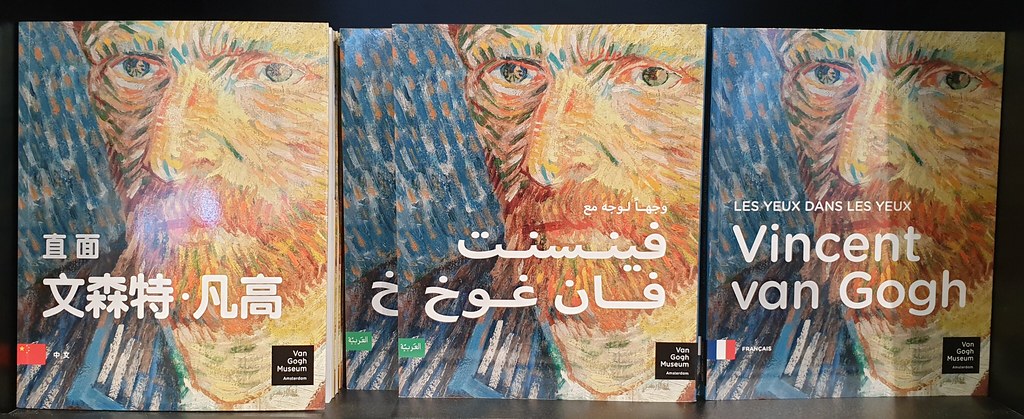
Vincent Van Gogh written is different scripts. Courtesy: Creative Commons

The whole world opens up in the realm of ideas that have existed wafting and bridging across time and space. Sometimes they find conduits to come to the fore, even though they find expression in different languages, under varied cultural milieus. One way of connecting these ideas is to translate them into a single language. And that is what many have started to do. Celebrating writers and translators who have connected us with these ideas across boundaries of time and place, we bring to you translated writings in English from twenty eight languages on the International Translation Day, from some of the most iconic thinkers as well as from contemporary voices. 

Prose

Tagore’s short story, Aparichita, has been translated from Bengali as The Stranger by Aruna Chakravarti. Click here to read. 

Travels & Holidays: Humour from Rabindranath, have been translated from Bengali by Somdatta Mandal. Click here to read.

Hena, a short story by Nazrul, has been translated from Bengali by Sohana Manzoor. Click hereto read.

Munshi Premchand’s Balak or the Child has been translated from Hindi by Anurag Sharma Click here to read.

Munshi Premchand’s Pus Ki Raat or A Frigid Winter Night  has been translated from Hindi by C Christine Fair. Click here to read.

Nadir Ali’s The Kabbadi Player has been translated from Punjabi by Amna Ali. Click here to read.

Kamaleswar Barua’s Uehara by  has been translated from Assamese and introduced by Bikash K. Bhattacharya. Click here to read.

S Ramakrishnan’s Muhammad Ali’s Singnature has been S. Ramakrishnan, translated from Tamil by Dr B. Chandramouli. Click here to read. 

PF Mathews’ Mercy,  has been translated from Malayalam by Ram Anantharaman. Click here to read.

Road to Nowhere, an unusual story about a man who heads for suicide, translated from Odiya by the author, Satya Misra. Click here to read.

An excerpt from A Handful of Sesame by Shrinivas Vaidya, translated from Kannada by Maithreyi Karnoor. Click here to read.

Writings from Pandies’ Corner highlight the ongoing struggle against debilitating rigid boundaries drawn by societal norms. Each piece is written in Hindustani and then translated by a volunteer from Pandies’ in English. Click here to read.

Rakhamaninov’s Sonata, a short story by Sherzod Artikov, translated from Uzbeki by Nigora Mukhammad. Click here to read.

Of Days and Seasons, a parable by the eminent Dutch writer, Louis Couperus (1863-1923), translated by Chaitali Sengupta. Click here to read.

The Faithful Wife, a folktale translated from Balochi by Fazal Baloch. Click here to read.

An excerpt from Ramy Al-Asheq’s Ever Since I Did Not Die, translated from Arabic by Isis Nusair, edited by Levi Thompson. The author was born in a refugee camp. Click here to read.

Poetry

Two songs by Tagore written originally in Brajabuli, a literary language developed essentially for poetry in the sixteenth century, has been translated by Radha Chakravarty. Click here to read. 

Rebel or ‘Bidrohi’, Nazrul’s signature poem,Bidrohi, translated from Bengali by Professor Fakrul Alam. Click here to read.

Banlata Sen, Jibananada Das’s iconic poem, translated from Bengali by Professor Fakrul Alam. Click here to read. 

Poetry of Michael Madhusudan Dutt has been translated from Bengali by Ratnottama Sengupta. Click here to read.

Our Children, a poem by well-known Iranian poet, Bijan Najdi, has been translated from Persian by Davood Jalili. Click here to read.

Akbar Barakzai’s Be and It All Came into Being has been translated from Balochi by Fazal Baloch. Click here to read.

Biju Kanhangad’s The Girl Who Went Fishing has been translated from Malayalam by Aditya Shankar. Click here to read.

Jitendra Vasava’s Adivasi Poetry,  translated from the Dehwali Bhili via Gujarati by Gopika Jadeja. Click here to read.

Sokhen Tudu’s A Poem for The Ol Chiki, translated from the Santhali by Hansda Sowvendra Shekhar. Click here to read.

Thangjam Ibopishak’s Gandhi & Robot translated from the Manipuri by Robin S Ngangom. Click here to read.

 Rayees Ahmad translates his own poem, Ab tak Toofan or The Storm that Rages, from Urdu to English. Click here to read.

Poetry by Sanket Mhatre has been translated by Rochelle Potkar from Marathi to English. Click here to read.

An excerpt from Evening with a Sufi: Selected Poemsby Afsar Mohammad, translated from Telugu by Afsar Mohammad & Shamala Gallagher. Click hereto read.

Ihlwha Choi’s Universal Language written at Santiniktan, translated from Korean by the poet himself. Click here to read.

Sangita Swechha’s Motherhood: A Tiny Life inside Me has been translated from Nepali by Hem Bishwakarma. Click here to read.

Rosy Gallace’s Two poems from Italy  have been translated from Italian by Irma Kurti. Click here to read.

Poetry in Bosnian written and translated from Bosnian by Maid Corbic. Click here to read.

Lesya Bakun translates three of her own poems from Ukranian and Russian to English. Click here to read.

Poems from Armenia by Eduard Harents translated from Armenian by Harout Vartanian. Click here to read.

Categories
Interview

Translation as an Act of Possession: Fakrul Alam

Professor Fakrul Alam discusses his new book of Tagore translations, Gitabitan: Selected Song-Lyrics of Rabindranath Tagore, published by Journeyman Books, Dhaka

Professor Fakrul Alam translates Tagore songs with a passion, refers to them as ‘song-lyrics’. In a recent essay, he claimed his favourite book is the Gitabitan, which houses 2232 songs by Tagore. The first edition of the book was published in 1931 and 1932 in three volumes. Over a period of time, Vishwa Bharati combined the three into one single volume.

During the pandemic, Professor Alam — a translator who has been lauded for his translation of Jibananda Das and also something as diverse from poetry as the autobiography of the founding father of Bangladesh, Sheikh Mujibur Rahman — took to translating Tagore songs to make a 300 strong collection, which has been published recently. When asked what was the basis for his selection of the songs, he responded: “What was the basis of my selections? Most important was my love for them. I listen to Rabindra Sangeet, that is to say, the songs of Rabindranath Tagore, every day without fail, unless I am travelling outside Bangladesh. Over the years, some songs by a few singers became so much a part of me that I began translating them. As was the case with my Jibanananda Das translations, you could say that translation was an act of homage as well as a way of coming really close to what you love. It strikes me also that many of the songs I ended up translating are by my favourite Tagore song singers — artistes like Debabrata Biswas and Kanika Bandhopadhyay for instance.  Once again, translation as an act of possession!”

Professor Alam has been the recipient of  both the Bangla Academy Literary Award for translation and the SAARC Literary Award. He has published around a hundred translations of Tagore songs and poems, edited and translated The Essential Tagore with Radha Chakravarty and lectured in a number of countries about Tagore. In his recently published translation, Gitabitan: Selected Song-Lyrics of Rabindranath Tagore, he brings to us a wide variety of songs which he has grouped into different sections. In this interview, he discusses his translated works, especially his new book.

You have translated Sheikh Mujibur Rahman, and Jibanananda Das, Nazrul and Tagore. What turned you towards translating poetry from prose?

Actually, I translated poetry first and then switched to translating prose. The first literary pieces I translated were poems by Jibanananda Das—surely the greatest Bengali poet of the twentieth century, if we leave aside Rabindranath Tagore who, of course, began writing poems towards the end of the nineteenth century and stood out among Bengali poets till his death in 1941. I then turned to translating some Tagore poems and songs for The Essential Tagore (2011) that I co-edited with Radha Chakravarty.

Also, from the time my book of translations of Das’s poems came out I either ventured into translating some poems by contemporary Bangladeshi poets from time to time either because I felt like doing so, or as responses to requests of a few poets to translate their verse. An example is Masud Khan, some of whose poems you have published in my translations in Borderless.    

What moved you into translating?

I have to begin answering this question by once again naming the person I mentioned at the beginning of my answer to your previous question—Jibanananda Das. It was when I came across his works in Abdul Mannan Syed’s selection of his poems in the mid-1990s, and was so swept away by them, that I felt like translating Das’s verse. This was translation as an act consequent to being possessed—or if you like—gripped. Poems like “Banalata Sen” or “Abar Ashibo Pheere[1] or “Bodh[2]” or “Aat Bachor Age Ek Deen[3]” seemed to want me to translate them. In fact, my translation of the word “Bodh” for the English poem is “Overwhelming Sensation” and that is how I would say I was taken by these works. And once I started with these poems I felt like translating a whole lot more.   

You have a book of Das’s poetry and many poems of Tagore in various anthologies and sites. What made you decide to do a book of Tagore translations?

Rabindranath, of course, is the summit as far as Bengali poetry and song-lyrics are concerned. Because I grew up in a house where his songs were either being performed on the radio or on television, or sung by one of my sisters, in retrospect it appears to me that I was destined to translate them sooner or later. Once I had published Jibanananda Das: Selected Poems in 1999, I began to translate a poem or song by Rabindranath every once in a while. When I heard some of Rabindranath’s songs being sung by a singer like Debabrata Biswas or Kanika Badopadhyay, I felt I had to translate them. And that is how I ended up with the nearly 300 songs that constitute Gitabitan: Selected Song-Lyrics.  

Is translating Tagore different from translating other poets?

Of course, and inevitably! Almost every great poet writes differently from his predecessor or contemporary poets and composes uniquely. As the great American critic, Harold Bloom, has put it in talking about Western canonical poets, they suffer from “the anxiety of influence” and must destroy all vestiges of their predecessor poets in them. They may begin conventionally but will soon find their distinctive voice or voices. They will as well move away from their earlier works all the time and not get stuck with one style. Thus, Tagore kept experimenting and, so to speak, shifting gears and taking new routes in versifying all the time. This is also true of Jibanananda. That makes the early Tagore or Das different from the later versions of these poets. In Tagore’s case, let me stress that he was particularly polymathic and kept opting for distinct poetic directions all the time. But as far as I can tell what makes him truly different is the musician in him. In particular, the songs have melodic components that take them away from established poetic forms. In fact, I would be happier with the term “song-lyrics” for his songs. Only in his later verses, did he move away from a melodic base towards relatively free verse or prose-poems. And so a translator of Tagore must strive to capture the music in his poetry, especially the songs, which makes the task of translating him quite a distinct as well as challenging task.         

Tell us about this new book of Tagore translations. Are the translations a collection of your earlier publications or do you have new songs?

My new book is the result of years and years of translating the song-lyrics, something I do mostly during weekends. A few of them I published in Bangladeshi English language newspapers and a few came out in periodicals like Six Season Review, which I co-edited.

A few in have come out in Borderless. But all these years, I translated not with a definite plan but unsystematically. It was during the enforced period of home confinement during the pandemic years, however, that my translations of the songs gained momentum. I began at around this time to post my translations on FB regularly, hoping that the comments I receive would include constructive ones that would enable me to revise my work, if and when necessary. Nabila Murshed, an ex-student now living in the United States, then came up with the idea of forming a FB group called “Gitabitan in Translation” for not only my translations of the songs but also those of others who might be interested in contributing their own translations, or sharing their responses to the translated songs posted. She also decided to complement the translations with recorded versions of the songs that she collected from YouTube. All these things eventually led me to the idea of publishing a full book of translations.

I then hired an ex-student as a kind of assistant to sort out the songs I had been translating, according to the divisions and sequencing Tagore imposed on them in his collection. There are thus 13 divisions in my book, one of which, “Prokriti” or “Nature”, is itself divided into six sections following the six seasons of the Bengali calendar. But to sum up my answer to your question, the majority of the song-lyrics are going to see in print for the first time. I would say no more than 100 of them have been printed before.

Sometimes, your republications change from the earlier publications. The words change. Have you done that in this anthology too?

Occasionally. As I said previously, I translate a song when I hear it on YouTube. I might listen to the same song a couple of years later and feel like translating it again, forgetting at times that I had translated it before. This led occasionally to 2 or 3 versions of the same songs. Inevitably, while these versions would be close to each other, they would never end up being exactly similar. For the final round of selections for my book, however, I have chosen only one version of what I did, that is to say, the one I think was definitive. And, of course, I revised what I had done for the final print version.

Would you consider translating Tagore’ prose?

Of course. And I have translated a few already. For The Essential Tagore I translated “Hindus and Muslims” and “The Tenant Farmer”. And for Shades of Difference: Selected Writings of Rabindranath Tagore, I translated “The Co-operative Principle” and “The Divinity of the Forest.” As these titles indicate, Rabindranath is a writer whose works you can mine for topics that have continuing thematic relevance. That is why all translators will go back to him every now and then for essays and prose extracts relevant for our time.

Would you like to bring out a book of Nazrul translations too?

Who knows? I have translated about 12 of his poems and a short story by this great Bengali writer, who is also Bangladesh’s national poet. But at present I feel more inclined towards going back to Jibanananda Das and will continue to translate more of Rabindranath’s song-lyrics. This is because around the time I published my translations of his poems at the turn of the century, a trunk full of new poems by Das were discovered. Most of them have been published by now. If and when I can, I would like to bring out a new edition of my Das poems, incorporating some of these newly discovered ones. This is because I have already come across some that are truly memorable and deserve to be translated. Certainly, he is a poet the best of whose unpublished as well as published works need to be introduced everywhere.    

Tagore is unique in as much he was socially committed to improving the lot of the villagers in Bengal. He practically created Santiniketan and Sriniketan. At a point, he wrote: “My path, as you know, lies in the domain of quiet integral action and thought, my units must be few and small, and I can but face human problems in relation to some basic village or cultural area. So, in the midst of worldwide anguish, and with the problems of over three hundred millions staring us in the face, I stick to my work in Santiniketan and Sriniketan hoping that my efforts will touch the heart of our village neighbors and help them in reasserting themselves in a new social order. If we can give a start to a few villages, they would perhaps be an inspiration to some others—and my life work will have been done.” This was in a letter in 1939 to Leonard Elmhirst, an agricultural scientist who helped him set up Sriniketan. Has any other poet done work of this kind in Bengal? What do you see as his greatest contribution —poetry or his ideals of human excellence and the work he did to realise his ideals?

Very few writers can come close to Tagore as far as the variety of his works are concerned. Such a polymath dedicated to the world of the spirit and the mind as well as human welfare is surely rarely to be found anywhere in any period of world history. Once he took charge of his father’s estates in what was then East Bengal and is now Bangladesh, Tagore plunged into work for the betterment of the people there and the surrounding areas. But he kept writing poems, fictional and nonfictional prose, plays and wrote all sorts of things for the amelioration of his people as well as his own need to articulate beauty and depict the Sublime in all its manifestations. And he would combine theory with practice, carrying out experiments and introducing new ideas for his tenants and others to implement in their farms and lives. His greatest contribution, however, was not only his poetry and prose but also his contribution to Bengali language and literature. I remember Dryden on Chaucer at this point: “He [Chaucer] found it [English writing] brick and left it marble.”

Thank you for giving us your time.

(The online interview has been conducted by emails by Mitali Chakravarty)

Tagore articles & Translations by Professor Fakrul Alam

My Favourite Book by Fakrul Alam

The essay is a journey into Fakrul Alam’s fascination with Tagore’s Gitabitan. Click here to read.

Rabindranath’s Monsoonal Music 

Fakrul Alam brings to us Tagore songs in translation and in discussion on the season that follows the scorching heat of summer months. Click here to read.  

Songs of Seasons: Translated by Fakrul Alam: Fakrul Alam, translates seven seasonal songs of Tagore. Click here to read.

Endless Love: Tagore Translated by Fakrul AlamAnanto Prem (Endless Love) by Tagore, translated from Bengali by Professor Fakrul Alam. Click here to read.

Monomor Megher Songi (or The Cloud, My friend) has been translated by Professor Fakrul Alam. Click here to read.

Giraffe’s Dad by TagoreGiraffer Baba (Giraffe’s Dad), a short humorous poem by Tagore, has been translated from Bengali by Professor Fakrul Alam. Click here to read. 

Oikotan (Harmonising) has been translated by Professor Fakrul Alam and published specially to commemorate Tagore’s Birth Anniversary. Click here to read.

.

[1] Fakrul Alam translates this as ‘Beautiful Bengal’, but lietrally, it means I will return again

[2]  Fakrul Alam translates this as ‘An Overwhelming Sensation’, but literally, it means sensation.

[3] Translates to — eight years ago, this day

PLEASE NOTE: ARTICLES CAN ONLY BE REPRODUCED IN OTHER SITES WITH DUE ACKNOWLEDGEMENT TO BORDERLESS JOURNAL. 

Click here to access the Borderless anthology, Monalisa No Longer Smiles

Click here to access Monalisa No Longer Smiles on Kindle Amazon International
Categories
Earth Day

Celebrating Our Planet

To care,
Nurture and
Cherish till
Death do us part —

A day to celebrate the
Fecundity
Fertility and the
Rites of the passage of
Time.

-- Earth Day, Countercurrents,org

Earth Day is a celebration of our planet that has been our cradle and our home for the last 200,000 years, though the Earth itself is much, much older. It is more 4.5 billion years in age…Perhaps a number unimaginable in the small speck of our existence…

Our oeuvre for this occasion starts with non-fiction that celebrates the beauty, the fecundity of the planet along with its colours — travel stories from Himalayas to Antarctica. We meet whales and sail or climb mountains to see what we have done to Earth and its other residents. Through poetry and fiction, including translations of greats like Tagore, Jibanananda Das and Nazrul, we quest to understand the needs of our planet better… Do join us in celebrating our home — yours and mine…

Non-Fiction

In A view of Mt Everest, Ravi Shankar travels in the freezing cold of Himalayan splendour and shares magnificent photographs of Mt Everest. Click here to read.

In Four Seasons and an Indian Summer, Keith Lyons travels to Antarctica and shares magnificent photographs. Click here to read.

In Sails, Whales, and Whimsical Winds, Meredith Stephens writes of her sailing adventures in New South Wales and spots some sporting whales. Click here to read. 

In Climbing Sri PadaRhys Hughes takes us on a trek to the hilltop with unusual perceptive remarks which could evoke laughter. Click here to read.

Poetry

Rows of Betel Vines by My Window by Nazrul has been translated from Bengali by Professor Fakrul Alam. Click here to read.

Jibananda Das’s Where have all these Birds Gone & On the Pathways for Long has been translated from Bengali by Professor Fakrul Alam. Click here to read.

Fiction

The Parrot’s Tale by Rabindranath Tagore has been translated by Radha Chakravarty Click here to read

A Curse by San Lin Tun is set in the woods of Myanmar. Click here to read.

Navigational Error by Luke P.G. Draper explores the impact of pollution with a short compelling narrative. Click here to read.

Categories
Poetry

Many Splendored Love

Short poems by Masud Khan, translated from Bengali by Professor Fakrul Alam

Courtesy: Creative Commons
Magic
(Leela)


Like when a piece of iron falls in love with a piece of wood 
Causing the iron to float on water,
Or like when the magic of love casts a spell 
Making stone float on liquid,
For ages, in nation after nation, 
People contrive to float stones, 
For diverse reasons and occasions,
 
Letting love and desire take diverse forms 
In manifold texts and discourses...
 

A Fragrant Tale
(Sugandho-kahini)

The world is full of misleading, minus signs and foul smells   
                                                                                     
At times, the world feels as heavy and unbearable
As the weight of a son’s dead body on his dad’s shoulder,
Or as stressful as playing the role of a dead soldier, 
Or as formidable as a physically challenged person’s ascent up a mountain
Or as painful as caring for a precocious, traumatised child...
 
Nevertheless, occasionally such stress-laden memories will blur,
And suddenly, wafting on the wind’s sudden mood swing, 
A fragrant moment comes one’s way! 
 

Love
(Prem)
 
‘After all words die away, the heart starts speaking.’
 
When all heartbeats and hullabaloo die down,
Little by little the heart starts fluttering in a distinct metronome 
When all words ends, silence begins to reign.
 
Where mathematics ends, music begins.
 

Gradually the Role of the Third Actor Becomes Clear
(Kromosho Spasto Hoye Othe Triteeyo Praneer Bhumika)
 
Like in magic, in a seemingly miraculous move,
Two strangers will come together 
While a third will have to disappear
To remain awol forever— in reality!

Masud Khan (b. 1959) is a Bengali poet and writer. He has, authored nine volumes of poetry and three volumes of prose and fiction. His poems and fictions (in translation) have appeared in journals including Asiatic, Contemporary Literary Horizon, Six Seasons Review, Kaurab, 3c World Fiction, Ragazine.cc, Nebo: A literary Journal, Last Bench, Urhalpul, Tower Journal, Muse Poetry, Word Machine, and anthologies including Language for a New Century: Contemporary Poetry from the Middle East, Asia, and Beyond (W.W. Norton & Co., NY/London); Contemporary Literary Horizon Anthology,Bucharest; Intercontinental Anthology of Poetry on Universal Peace (Global Fraternity of Poets); and Padma Meghna Jamuna: Modern Poetry from Bangladesh(Foundation of SAARC Writers and Literature, New Delhi). Two volumes of his poems have been published as translations, Poems of Masud Khan(English), Antivirus Publications, UK, and Carnival Time and Other Poems (English and Spanish), Bibliotheca Universalis, Romania.  Born and brought up in Bangladesh, Masud Khan lives in Canada and teaches at a college in Toronto.

Fakrul Alam is an academic, translator and writer from Bangladesh. He has translated works of Jibonananda Das and Rabindranath Tagore into English and is the recipient of Bangla Academy Literary Award (2012) for translation and SAARC Literary Award (2012).

PLEASE NOTE: ARTICLES CAN ONLY BE REPRODUCED IN OTHER SITES WITH DUE ACKNOWLEDGEMENT TO BORDERLESS JOURNAL

Click here to access the Borderless anthology, Monalisa No Longer Smiles

Click here to access Monalisa No Longer Smiles on Kindle Amazon International

Categories
Nazrul Translations

Thorns & Flowers

Kazi Nazrul Islam’s Keno Dile E Kanta translated by Professor Fakrul Alam

Nazrul: Courtesy: Creative Commons

Born in united Bengal, long before the Partition, Kazi Nazrul Islam (1899-1976) was known as the  Bidrohi Kobi, or “rebel poet”. Nazrul is now regarded as the national poet of Bangladesh though he continues a revered name in the Indian subcontinent. In addition to his prose and poetry, Nazrul wrote about 4000 songs.

WHY PROVIDE THORNS

Why provide thorns as well as flowers?
Wouldn’t lotuses bloom if thorns didn’t prick?

Why must fluttering eyes become moist with tears?
Why provide hearts if hearts won’t unite?

Why do cool wet clouds allure the swallow
Only to greet it with thunder and lightning?

Why allow buds to blossom if flowers wither?
Why stain the moon’s brow with a frown?

Why must desire for beauty be mired in lust?
Won’t faces look beautiful without the dark mole?

Poet, keep imaging bliss in this bower of thorns,
While restraining yourself within your moist eyes.   

(First published in the Daily Star, 2007)
Keno Dile E Kanta rendered in Bengali by Khairul Anam Shakil

Fakrul Alam is an academic, translator and writer from Bangladesh. He has translated works of Jibonananda Das and Rabindranath Tagore into English and is the recipient of Bangla Academy Literary Award (2012) for translation and SAARC Literary Award (2012).

PLEASE NOTE: ARTICLES CAN ONLY BE REPRODUCED IN OTHER SITES WITH DUE ACKNOWLEDGEMENT TO BORDERLESS JOURNAL

Click here to access the Borderless anthology, Monalisa No Longer Smiles

Categories
Essay

My Favourite Book by Fakrul Alam

Professor Fakrul Alam

My favourite book? Over the years, I have had many favourite books, and have been totally captivated by at least one of them at any one period of time. Indeed, once I began to take literature in English seriously, I was completely swept away by one book or the other that I came across at the University of Dhaka B. A. (Hons.) and M. A. English department syllabuses year after year. In my first year as an undergraduate, for instance, I read D. H. Lawrence’s Sons and Lovers (1913)compulsively, finding in its protagonist Paul Morel’s growing up into a young man’s storyline parallels with mine—although he was a miner’s son in Nottingham in the early twentieth century and I a boy growing up in Dhaka in the 1950s and 60s and the son of middle-class parents. A couple of years later, it was Jane Austen’s Pride and Prejudice(1813), for the story of the Bingley girls and their marriage encounters sounded familiar to me, for I too had four sisters whose marriages had become central to my parents’ thinking in all kinds of ways. And in my M. A. I read a book which harpooned me fully for many a decade—this was Melville’s Moby Dick (1851)—a whale of a book, I’m sure many of you in the virtual audience will agree. In all three cases, I read not only the novels I mentioned but almost everything by Lawrence, Austen and Melville I came across. Indeed, Melville’s fiction became the subject of my M. A. dissertation at Simon Fraser University.

But in the 1990s, I began to pay attention to Bangla writing seriously —something I had neglected for long, thanks first to an English medium education exclusively geared to the “O” levels that scanted our own literature and then my specialisation in literature in English afterwards. I began to read Bangla poetry intensively for the first time in this decade, although I had read some fiction in the language over the years. And it was sometime in the middle of the 1990s that I came across Jibanananda Das’s verse in an edition of his selected poems by the Bangladeshi poet-critic Abdul Mannan Syed. I would like to stress that this poet was born in 1899 in Borishal, a very green district crisscrossed by innumerable rivers all heading ultimately for the nearby Bay of Bengal; he died in what seemed to be an accidental death in Kolkata in the mid-1950s. Das’s verse possessed me completely, leaving me, who had till then read only some Bangla poetry but had concentrated mostly in fiction and non-fictional prose in English, with the urge to translate his verse into English. For the next three years, I kept going back to Das’s poems for their beauty, for the way they immortalised in verse the beauty of Bengal, and for the way they made me the poet’s intimate, for it is only when one translates intensely, all caught up in the source text, that one comes closest to the mind speech as well as the deep emotional life of the poet.

Having translated Jibanananda Das—surely the greatest modern Bengali poet—I felt I had to try to translate Rabindranath Tagore’s poetry—the greatest poet and literary personality Bengal has produced. Even though in the 1960s and 1970s, I had only paid sustained attention to poetry, fictional and nonfictional prose and plays in English, how could I have escaped Tagore then? He was everywhere in the Dhaka I experienced and very much part of the mindscape of us Bangladeshis as we moved towards becoming citizens of Bangladesh. His work was championed in the media; his songs were sung in events such as the Bangla new year festivities in mid-April; cultural events everywhere spurred by nationalism highlighted him in one way or the other. Besides, my father was addicted to Rabindranath’s songs and listened to him on the radio whenever he could, making us share his delight in the melodies then. My mother, for her part, quoted him all the time to give her children a sense of what we should be emulating and where we were going wrong.

In other words, Rabindranath was very much part of my consciousness, although I had occluded him till now. As I began to read him in the turn of the decade after translating Jibanananda, I felt I had to read as much of his works as I could. Inevitably, I began to translate many of his poems. By the time his sesquicentenary came up in 2011, I was invited to co-edit an anthology of his works and that led to the extensive reading of the myriad-minded writer’ work and increasing familiarity with this wonderful personality as well as writer.

And this is how I came to my favourite book of the last decade or so—Tagore’s Gitabitan. It is a book that is always on my study cum desktop computer table’s shelf over ten years now. It is something I resort to every time I listen to a Rabindranath song on YouTube in my desktop’s audio system. Sung melodiously and passionately by a favourite singer, a song by Tagore so allures me into rendering its spirit in another language that I feel I have to come as close to it as possible by translating it to the best of my ability. This means not only listening to the song again and again but also reading it on the printed page repeatedly, word by word, line by line, and stanza by stanza, time after time, till I feel I have been able to capture every aspect of it nuanced by Tagore by blending the tune and the song lyric as well as I could in the English language. In the end, of course, I fail to do so after a point, but the fascination of what is so appealing when heard, even if in the last analysis the task is an impossible one, induces me to render it into an alien language system after repeated readings and attempts to come up with a version that is close to the original in every way. I hope thereby to come to the heart of the song and am content to spend an hour or so on a few lines so that I can make its meaning clear to myself and then to others.                

Truly, there is a magical quality in the songs collected in my favorite book of this time—Tagore’s Gitabitan. It is a book that has also kindled the imagination of quite a few people—singers, musicians and translators— over eighty years now, making them represent the song-lyrics either as songs to be sung or as translations meant for foreign and even Bengal language speakers who might otherwise listen to a song swept away by the tune and opening lines without bothering with the later lines or making no attempt to understand its content.  The net result at the end of a few hours spent first reading many of the song closely, then reading my own translation again and again, is the satisfaction that I have been able to capture its essence in English through my translations. After all, and as Tagore himself has said, “the essence of a song is universal, even if its dress is local and national” (77). Why should I as a translator then not attempt to translate his songs for the world at large as well as myself even if their loveliness is uncatchable in the last analysis? He himself had led the way, and had learnt lessons along the process that were worth considering for later translators. I am hoping to bring out my own collection of translations of 350 plus songs by Tagore by the beginning of next year.

Let me point out that the title Tagore gave to the volume indicates that Gitabitan is meant to invite readers and musical devotees of the poet-composers to his “garden of songs.”  In all, the volume contains over 2,300 songs, nearly 1800 of whose tunes can be found in the musician-poet’s Swarabitan with their musical notations. In fact, there are sites now that you can google and access where you can find the Bengali words, some English translations, and notations, and even brief histories of the origins of the most commonly heard songs.

Let me point out too that Gitabitan itself is divided into six sections—songs of devotion, love, the six seasons of Bengal, patriotic songs, songs for festive and miscellaneous occasions, songs written for his plays and other publications. In their final form, the Gitabitan was published in 1941—the year the poet died. By now it has been reprinted, with new inclusions from scattered sources, innumerable times.

To conclude, why is Rabindranath Tagore’s Gitabitan my favourite book? He had himself said to Bengalis in 1939, “You can forget me, but how can you forget my songs?” Tagore’s collection of songs connects me to him endlessly, becoming a way of linking me as well with the universe and the Supreme Being and even my departed parents. They stir my patriotic side and make me one with the seasons of my country and its landscape and whatever is still romantic in me. And as I head towards the Great Unknown, they console me that there are possibilities of communion after we depart from this world as well!   

Fakrul Alam is Supernumerary Professor of English at the University of Dhaka

Click here to access the Borderless anthology, Monalisa No Longer Smiles

PLEASE NOTE: ARTICLES CAN ONLY BE REPRODUCED IN OTHER SITES WITH DUE ACKNOWLEDGEMENT TO BORDERLESS JOURNAL.

Categories
Poetry

Rows of Betelnut Trees by My Window

Written by Kazi Nazrul Islam in 1929 in Chittagong, translated from Bengali by Professor Fakrul Alam

Areca nut or betel nut trees. Courtesy: Creative Commons
Farewell, neighbours of my nightly vigil, 
Standing aloft next to my window,
Companions, the night of parting elapses.
From this day ceases our secret exchanges,
From this day ends our quiet conversations....

Putting its worn forehead on the porch of the setting sky
The moon cries, “Traveler awake, night is all but over”
Night spreads across the forest deep; overcome with sleep,
It glances back, clasping in its hand its dark disheveled hair!

Startled, I wake up, wondering: whose breath brushes my forehead?
Who fans my warm forehead, who wakes up by my bedside?
I rise seeing by my window the sentinel of my dreams,
Companions of my dark nights, the row of betel nut trees!

Hadn’t we once viewed each other through fluttering eyelids?
Friends, I recall what we said to each other all night long!
When tears flowed from weary eyes beginning to burn,
Your leaves appear to me to be like the cooling palms
Of my beloved. The rustling of your leaves reminded me
Of her plaintive voice, calling out mournfully.
I saw in your leaves the kohl-dark shape of her eyes.
Your bodies in silhouette suggested her slim shape.
The gentle breeze wafting by evoked her delicate air.
Your branches seem to be draped with her sari’s borders.
And you fanned me as tenderly as she did with her hands!

These thoughts troubled me as I entered sleep’s domain.
As I slept, I felt the frill of your dark blue dresses lying
Unfurled besides my pillow. I saw in my dream you entering,
Furtively and fervently kissing my warm forehead.

Perhaps in the dream I extended my hands to touch you
Only to touch the window. Then I clasped your hands shyly.
Companions, now that window will have to be shut.
The path beckons, fellow travelers shout, “time to depart!”

This day before I take my leave
I feel like revealing myself to you as well as knowing you.
I feel close to your feelings; yet why does my insatiable mind
Yearn to hear from you the thoughts lodged in your bosom?
I know—we will never get to know each other physically,
Our hearts will only keep playing a tune of pain mournfully! 
 Perhaps I’ve seen a vision of you that is not like you at all.
But how can that harm you, if it does enough to swell my heart?
If my tears transform you into a thing of beauty,
If I can build a monument stirred by love of someone
As the Taj Mahal was built from the pain of losing Mumtaz,
Tell me, what harm will that do to anyone?
I won’t adorn my room with you, won’t create a paradise.... 

Perhaps birds never lighted on your branches,
In your bower, amidst your foliage, cuckoos never sang. 
Looking up to the heavens in exaggerated appeal
You kept vigil in the dark, though none stayed up
To open the window. But I was always the first to arrive,
And look at you in rapt attention in the dark. Departing lovingly,
On your leaves I wrote my first letters of love.
Let that be my consolation, whether I meet her or not....

Companions, I’ll never wake up again to look at you
I won’t interrupt anyone’s trance after a tumultuous day.
Silently, all alone, I’ll burn the incense of my suffering.

I shouldn’t ask, but can’t help doing so before leaving today—
From behind your wooden screen, did you view me lovingly too?
Did you also take a look at me when I opened the window?
Was it the wind or my love that made your leaves sway?
When behind your green borders, the moon will go to sleep,
And I will have to repress all happy feelings—
In your joyous moments, will you recall this passerby’s brief visit?
Will your voice resound in this empty room in loud lamentations?
Will the moonlight become insipid in your vision then?
Will you open shutters and look at the formless world outside?
Or will you keep standing rapt in your thoughts all day long?

Tied to exhausted earth, you’ve become a row of helpless trees,
Your feet are soiled with dust, your heads enveloped in emptiness.
Your days scald in the sun’s heat, your night’s chill in the dew,
You lack the strength to cry, you seem to be in a deathlike stupor.
If your problems fail to arouse you, companions, and stir you,
What can I hope to gain by burdening you with my gift of pain?...

*                  *                  *                 *                 

If I come to your mind by mistake, try to forget me,
If by mistake my windows open again,
Please shut them again.... Don’t look out in the dark at all
Through your wooden screen—for the one no longer on earth

The poem recited by Nazrul’s son, Kazi Sabyasaachi, in Bengali

Born in united Bengal, long before the Partition, Kazi Nazrul Islam (1899-1976) was known as the  Bidrohi Kobi, or “rebel poet”. Nazrul is now regarded as the national poet of Bangladesh though he continues a revered name in the Indian subcontinent. In addition to his prose and poetry, Nazrul wrote about 4000 songs.

.

Fakrul Alam is an academic, translator and writer from Bangladesh. He has translated works of Jibonananda Das and Rabindranath Tagore into English and is the recipient of Bangla Academy Literary Award (2012) for translation and SAARC Literary Award (2012).

.Click here to access the Borderless anthology, Monalisa No Longer Smiles

PLEASE NOTE: ARTICLES CAN ONLY BE REPRODUCED IN OTHER SITES WITH DUE ACKNOWLEDGEMENT TO BORDERLESS JOURNAL

Categories
Tagore Translations

Autumnal Songs Translated by Fakrul Alam

These are songs of Tagore centred around autumn, a season that is split into two parts in Bengal. Early autumn is called Sarat and late autumn Hemonto. The first two songs are descriptive of Sarat and the last one of Hemonto.

Autumn: Art by Sohana Manzoor
SAY WHAT YOU WILL (Tomra Ja Bolo tai bolo, written in 1921)

Say what you all will, I don’t mind
My time flies, and hours pass, aimlessly
The wild wind stirs me to a song
And spreads its tune across this deep-blue sky.
That song has stuck in my mind.
What nectar do I seek in the humming of bees?
Whose sky-pervading gaze seeks me out
And settles on my sight thus this day?
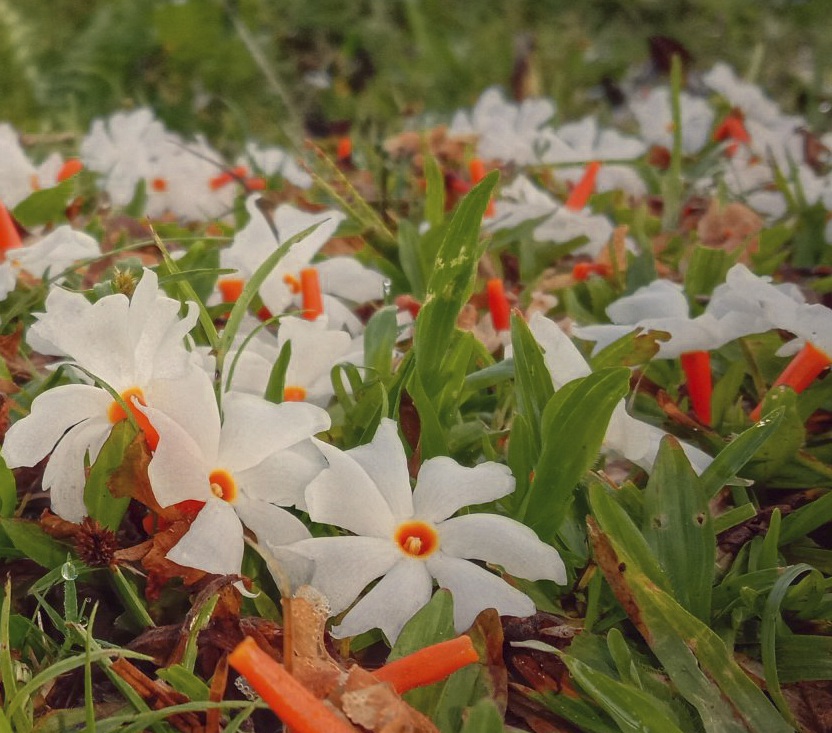
Shiuli flower that bloom in autumns in Bengal. Courtesy: Creative Commons
THE HEART WAS AWAKE (Hridoye Chheele Jege, written in 1921)

You were wide awake in my heart 
But I see you in autumnal clouds this day!
How was it you stole so quietly away at dawn,
Letting only your dress’s borders caress the dew?
            What song is it that I should sing?
            I simply can’t find words for it now!
They lie scattered with shiuli flowers under forest canopies
They’ve flown away with the gusting winds in sudden showers.
                        ***
Shiuli-Jasmine
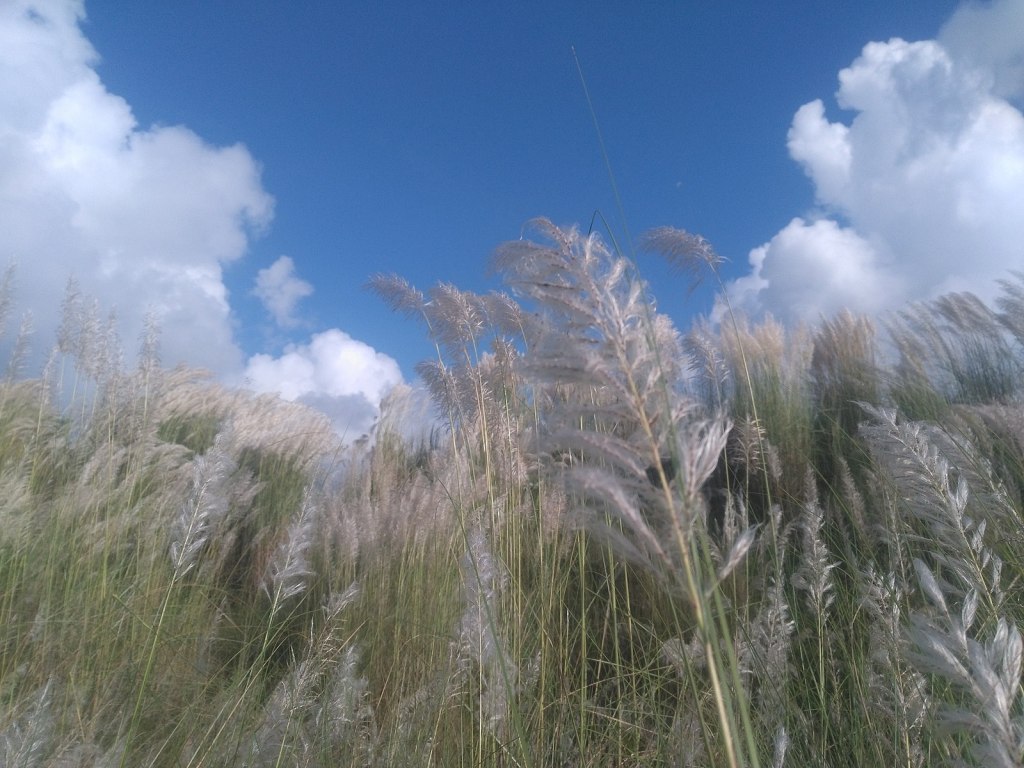
Flowering Kash grass. Courtesy: Creative Commons
AUTUMNAL NIGHTS (Himer Raate, 1927)

On such cool autumnal nights
Hemonto hides heaven’s lamps with its cloak.
To every house it gives this call,
“Light festive lamps, make bright the night,
Shine your own lights, illuminate the world.”
Gardens are flowerless now; cuckoos sing no more;
Kash reed flowers keep falling by riverbanks,
But let go of darkness, despair and misery; light festive lamps-- 
Shine your own lights and proclaim the triumph of light
The gods look on — sons and daughters of earth, arise,
Illuminating the night,
Darkness may descend and day end but light festive lamps,
Shine your own light and triumph over this dark night
                         ***
Hemonto-Late autumn
Kash-Long grass

Below is a Youtube upload of Autumnal night or Himer Raate sung by the legendary singer Debabrata Biswas (1911-1980)

Fakrul Alam is an academic, translator and writer from Bangladesh. He has translated works of Jibonananda Das and Rabindranath Tagore into English and is the recipient of Bangla Academy Literary Award (2012) for translation and SAARC Literary Award (2012).

.

PLEASE NOTE: ARTICLES CAN ONLY BE REPRODUCED IN OTHER SITES WITH DUE ACKNOWLEDGEMENT TO BORDERLESS JOURNAL