Categories
Stories

Ali the Dervish

By Paul Mirabile

Whirling Dervishes, painting by Jean Baptiste Vanmour (1671-1737). From Public Domain

In 1976, I bought a small country cottage very pleasantly located near the town of Sheffield at Dronfield in South Yorkshire from an elderly woman who informed me she that had travelled quite extensively throughout Asia in the nineteen twenties and thirties before settling down here. She never married. The learned woman left no forwarding address.

Settling in took much time and energy because of my abundant belongings. At last, one rainy afternoon having nothing to do, I climbed the shaky stairway that led to the garret. The door had been left ajar. Inside the low-ceiling, ill-lite space, there was nothing but a large chest placed in the middle. The lid lay aslant. Its hinges were broken. 

Curious about its contents, I began rummaging through the numerous newspaper and magazine clippings, booklets, letters and other documents. A particular envelop caught my eye because the red wax seal had been broken. Wax-sealed letters are very out-dated these days. When I opened the envelop I understood why it was sealed. A seven-page letter had been written in fine, elegant script, by Lady Sheil, dated 1869. Lady Sheil was quite a prominent woman in her time[1] . This indeed was a remarkable find. It baffled me why the former proprietor would leave in a chest of documents a letter of such archival interest. Since there was little light in the garret, I took the letter downstairs to read it. Unfortunately there was no addressee, so I assumed it was sent to the former proprietor. I must confess that a feeling of guilt touched me when I began my reading. Luckily I overcame this sensation because the contents of the letter proved extraordinary …

Lady Sheil details a very peculiar adventure of an Englishman who named himself Ali the Dervish -or as she spelt it, Deervish — who had undertaken a voyage to ‘Balochestan, Persia’[2]. As I read through her letter, I came to realise that the Englishman had abandoned his British ways entirely, adopting those of the semi-nomad Balochi. To such an extent was his assimilation that he even married a Balochi woman, something utterly unthinkable at that time — in the year 1856. Why Lady Sheil would write a long letter about this chap to an unknown reader or readers heightened my curiosity.

I began investigations at the Sheffield library and found Lady Sheil’s Glimpses of Persian[3] though I found nothing at all about Ali the Dervish. Lady Sheil mentioned something about his diary but nothing substantial came of this. Be that as it may, the letter fascinated me by its mysterious allusions and ellipses, especially concerning this unusual identity change. Not a simple task for a European in the nineteenth century, or even in our century for that matter. This Ali even outdid Sir Richard Burton’s bursts of outlandish impersonation …

Examining the letter carefully, I felt a strange, slight tremor goading me to do justice to this eccentric Ali. Something unsaid in the sentences urged me to read between them, to scrutinize the margins and the paragraph indents as if Lady Sheil had deliberately left out parts of her narrative for her reader to fill in those blank, yellowing spaces.

I picked up my pen, imagining myself to be both Lady Sheil and Ali the dervish, and began filling in the those blanks, writing in the gaps, the lacuna, the untold events and details so to speak. Indeed, I had convinced myself that the letter had been destined for me. And this resolution was enough for me to divulge the mystery of Ali …

Ali, whose English-born name was left unknown, had had the best of aristocratic educations in the fine arts, especially languages. He was fluent in Hindustani, Persian, Pashtun and Turkish, besides having mastered four or five European languages, including Hungarian. This was quite a linguistic feat, second only to Richard Burton whom, by the way, Ali had the occasion to meet in Lahore. A meeting which lasted two or three weeks according to a friend of Burton’s memoirs. Little, however, is reported about their relationship.

Prior to Ali’s arrival in India and that fortuitous encounter with Burton, he apparently had led a rather lukewarm existence in England, and this in spite of his family wealth, or perhaps because of it. His accumulation of capital was analogous to his successive accumulations of prolonged bouts of depression. They left him utterly exhausted. How and when he left England is not written in the letter, although he probably reached India by ship, then on horseback or foot into Northwestern India, accompanied often by erring minstrels and story-tellers. From whom Ali learned the art of dancing, chanting and story-telling. It was not a question of imitating these rituals and customs. Ali had integrated them as if they had been part of some distant, latent self that required jolts of recollection to surge up from the depths of the unconscious. In fact, Burton was quite taken aback by Ali’s very ‘unEnglish’ appearance. His manner of speaking English, too, possessed a curious twist of Persian and Hindustani syntax — a ring of their tonal stress.

To Ali’s pleasant surprise, he no longer suffered from bouts of violent depressions. The former Englishman on leaving Burton, perhaps in 1849, rid himself of paper money, donating it to missionaries, then rode off into the verdant valleys of North-western India towards Afghanistan carrying only the clothes on his back, two gourds of fresh water, several loaves of acorn-bread and a pouch of Arabic gum. Ali carried no weapon.

Ali’s sound knowledge of Hindustani, Pashtun and Persian offered him unparallel glimpses of these undomesticated lands. Lands of shifting desert sands whose rising heat conjured in the distance illusions of ravishing oases and sparkling cascades off tree-laden crags. Ali had been warned about these deceitful mirages (by Burton?) whose marvellous vision had been the death of many a brave adventurer.

He kept to the clayey track, accepting food and board from the hospitable villagers or sleeping under the silver stars on his woven kilim-saddle cloth. He rode days or nights penetrating landscapes of indescribable beauty, of terrifying singularity, of unbearable heat in the day and equally freezing nights. At one point in his wanderings, Ali, slumbering on his horse due to the rising heat and lack of food, looked up to discover a gigantic Buddha hewn into a tuft-like cliff. A small stream ran in front of the lithic niche along which flourished many date trees. There the Buddha stood, calm, reposed, sedentary, encased in his stone casket, home to a myriad birds who had made their nests on his rounded shoulders and shaven head. Ali jumped off his horse, filled his gourds with clean water, scouted about for fresh dates. With one last look at the towering Enlightened One he set off towards Persia, filled with equivocal sensations. He felt that his nomad days would soon be numbered …

A month or two passed. Now villagers tilling their fields or collecting wood no longer greeted or spoke Pashtun to him, but in Dehwari or Persian. He welcomed this language shift. Ali felt more at ease in Persian, albeit it be the Dehwari dialect, which he had learnt from one or two erring Zarathustrian talebearers in India. By then his uncombed beard touched his chest and his hair his shoulders. In one village he traded his khaki-coloured shorts for a shalwar[4] and his boots for goat-skin sandals. In another his Safari sun hat for a turban and his heavy flax shirt for a long, cotton tunic. Whenever he met tillers or merchants they would greet him with the customary ‘hoş amati’[5]. By their pronunciation and vocabulary Ali knew he was travelling southwards into Balochestan. Temperatures rose and rose — 37° C … 42° C. His horse trotted slower and slower. Her rider drooped soporifically over her mane. Ali no longer calculated his wanderings in farsakhs[6] but by the risings and settings of the sun …

Notwithstanding these discomfitures, the persevering Ali carried on. To his delight the track widened, hospitable shepherds driving before them their herds of sheep or goats offered the solitary traveller the warmth of their camp-fires, goat’s milk, cheese and acorn-bread. Caravans of transhumance nomads pressing towards the high plateaus nodded to him. The stony-faced herdsmen chanted in their own language which translated means —

 A breath of mountain breeze,
A breath of wind from the Sea,
In the middle,
We trudge
The pilgrims of the fountain…

Then they called after their huge, savage dogs. Ali seized upon that admirable chant and intoned it to himself or aloud …

One sparkling, azure day, Ali, road-weary, alighted from his horse in a large settlement of tents, called Sa’idi. There both Persian and Dehwari were spoken, judging from the scores of people who came to greet him. It was a charming settlement, surrounded by fields of red poppies, iris, bluer than the blue of the sky, crown imperials whose orange tints glowed like lit candles, and tulips. Horses, sheep and goats dotted the terraced rows of poppies on the hills and skirts of the low-laying piebald mountains, motionless. Ali, both dazzled and comforted by the undulating kaleidoscope colours decided to halt for the night in this welcoming settlement to rest his fatigued physical and mental state and his horse.

When he asked for the elder of the settlement, he was directed to a very large white tent. In fact, since his arrival the snowy-bearded elder had been eyeing the stranger askance. He threw open the flap of his tent and greeted him in Persian as custom would have it, inviting his visitor inside for tea. Sipping their respective glasses of sugared tea, the snowy-bearded elder’s deep-set black eyes peered into those hazel-brown of Ali’s. Though he was pleased to meet this curious traveller, he was confused about his identity. Finally he put the question point blank to his sipping visitor: “Are you Persian?”  

Ali nodded neither yes nor no. His ambiguous nod set off the string of events that followed. events that transformed the already transforming Ali into a rather ambiguous Other …

The snowy-bearded elder had read that ambiguous nod as a sign of belonging. Ali’s sun-mat complexion, his extraordinary command of both Persian and Dehwari, his knowledge of social and religious habits and practices, mostly acquired during his years on the road, opened the elder’s heart and those of the Balochi people of Sa’idi, people who now had stepped into the tent, forming a large circle round Ali and the snowy-bearded elder. Out of this wide circle came the elder’s three sons and daughter to lead him to his own red tent at the outskirts of the settlement. His horse was led to pasture with the others.

On the thick carpets of his medium-sized tent, Ali sat and meditated upon that ambiguous nod. Had he really become the one of them? Deep within his heart, the former Englishman rejoiced … rejoiced at his ‘crossing over’. He had become what he really was …  

Several years passed. Ali no longer felt guilty about leaving his past behind. His immersion seemed complete. He sang and danced round the ritual fire at night. He told stories night after night after a hard day’s work in the poppy fields, apple and peach orchards and the vineyards, the tribesmen chanted their chants of ancestral lore, joined him in his whirling dance, one palm to the Heavens and the other to the Earth, eyes staring into a void of quiescence …

It was in Sa’idi that he began to be called Ali the Dervish, whirling as he did before and behind the leaping flames. Ali taught his dance to the snowy-bearded elder’s three sons. In turn, the elder offered his daughter to him in marriage — a privilege since this signified entrance into the chieftain’s family.

Once the three-day marriage ceremonies were over, his lovely bride — for she was truly lovely — sat next to him in the nuptial red tent. His wife, whose name has never been recorded, demanded nothing of him. She accepted all his nightly hesitations … ‘failings’ … Her fruity laugh and obsidian back eyes spoke a language that communicated higher values … loftier treasures than uncertainty, physical gratification or hereditary obligations.

Ali slowly discovered that his young bride possessed the quality of a seer, perhaps even belonged to a long lineage of Central Asian mystics. Intense were her meditations and visions of the Other World, of events passed and those to come … His past … Their future … Ali, both bewildered and beguiled by this power of prophesy, would timidly question his bride about her unusual gifts. She would answer enigmatically: “One must remove the Husk before bringing in the Bride,” an adage he never fully understood, nor would she ever elucidate.

On other moonlit nights, alone within the sanctuary of their intimacy, Ali’s wife would envision scenes of his long aristocratic lineage, each member afflicted by physical or mental atrophies, plagued by wasting ennui. The Dervish listened in awe as she revealed events quite unknown to him. Yet, he remained speechless, peering into the almond-shaped eyes of this woman depicting scenes that could very well cost him his life. She said nothing. He yearned to avow everything to her but some fey voice prevented him each time. She read his mind and laughed her fruity laugh, delving ever deeper into his life … theirs !

Ali accompanied her with his eyes then turned them to the dying embers of the stove fire, the glowing logs sizzled lightly in the silence. Was he deluding himself? He knew that his wife had discovered his native idenity. But were all those past scenes his true identity? He indeed stemmed from that hoary lineage, the last scion. Was he the last to play a role on this world stage of masquerade and mummery? No ! He was Ali the Dervish … Here amongst these hearty tribesmen he played no role. He had overcome the hardships of childhood as a fatherless boy. That unknown gentleman had left for Africa never to return! Never a letter nor a message brought by acquaintances. Before dying of grief, his poor mother repeated to him everynight: “Look to the stars.” And the sullen boy looked, and believed that they would lead him to another life … another identity !

Once Ali began to cry softly listening to the sizzling embers and the light, rhythmical breathing of his strange wife.

Many years had passed and yet, they had no children. His hair and beard had greyed. Yet, no reprimand, no rebuke, no judgement ever came from the community, especially from her aging father. Was the power of her revelations known to him ? Would he be the last branch of that gnarled and rotten aristocratic tree ?

Ali rode often into the fields and mountains to gather wood to build tent-frames or glean fruit from the many apple and peach trees. During these solitary moments his past crept up on him, making him feel guilty. There seemed only one solution : speak openly, candidly to his wife about his British birth, his genuine desire to become the Other. She would surely understand since she had already read his former life by sounding his heart. That night he would go straight to his wife.

But, just then out of the blue sky his wife came galloping towards him, whipping up her stead. She jumped off, an odd expression wrinkling her forehead. Ali ran up to her, took her shoulders gently, admiring the sapphire blue that framed them so perfectly like a painting. There she stood, basking in the soft glow of the mellowing, evening sun. Before he could utter his rehearsed confession she put a hand to his lips.

“Father has just passed away,” she whispered softly, without emotion. “He has been freed from the trammels of worldly existence.” She smiled. “Now you too are free to divest yourself of a personage that has been conferred to you by the stars and the strength of your will.”

“But who am I really, my dear?” her husband wondered. She caressed his bearded, burning cheeks. She answered: “If you want the horse to neigh, you must slacken the reins.” Turning round, she rode back to the settlement to wash the body of her deceased father and prepare the three-day funeral rites with her brothers. Ali puzzled by that enigmatic counsel trudged to his horse.

He rode back far behind her, meditating his ‘freedom’. What other choice had he?

This sentence was the last in Lady Sheil’s long, detailed letter. On further investigation into this strange fellow at the London library, I discovered that Ali the Dervish had divorced and remarried his bride to one of her brother’s mates, then left Sa’idi. He was last seen in Tabriz, Persia. No document reports his whereabouts after his reaching that northwestern town in the lands of the Azeri people. 

I have often wondered whether Lady Sheil ever knew who Ali the Dervish really was. I have my doubts. Only his Balochi wife knew, and of course, that mysterious person could have never been questioned. It’s also odd that Ali himself — whatever self that be– had never woven his thoughts and experiences into a book, never enlightened a Western public on integration and assimilation into a foreign culture.

As time went by I even considered that this letter might have been a hoax to hoodwink a naive fellow like myself into clothing Ali in legendary fashion. On second thought, though, who’s to arbitrate between fact and fiction ? Not I, in any case. For isn’t it a refreshing act of freedom to slip from one to the other without a pinch of guilt ?     

.

[1]        1803-1871.

[2] Balochistan is in Pakistan but the Baloch community spreads to Iran and Ali’s story dates before the formation of Pakistan.

[3]        Published in 1856.

[4]        Large, light baggy trousers.

[5]        ‘Welcome’ in Persian.

[6]        A Persian measurement equivalent to 5.35 kilometres

.

Paul Mirabile is a retired professor of philology now living in France. He has published mostly academic works centred on philology, history, pedagogy and religion. He has also published stories of his travels throughout Asia, where he spent thirty years.

.

PLEASE NOTE: ARTICLES CAN ONLY BE REPRODUCED IN OTHER SITES WITH DUE ACKNOWLEDGEMENT TO BORDERLESS JOURNAL

Click here to access the Borderless anthology, Monalisa No Longer Smiles

Click here to access Monalisa No Longer Smiles on Kindle Amazon International

Categories
Poetry

Cherry Tomatoes

By Meetu Mishra

A spontaneous plan to travel,
from Dehradun to Auli,
the mini Switzerland of India,
brew with sheer excitement.

We embarked on a road trip.
We thought we’d witness,
nature at its pristine best --
to our horror, we were greeted,
with plumes of thick black smoke.

On our way up the mountains,
patches of dry grass burnt --
green covers of hills lost,
black, gazing naked, with apathy.

Road constructions, housing development,
road blocks, traffic jams, a bumpy ride,
not to forget, the scorching sun
glaring by our side.

Quickly we rolled up the taxi windows.
One got stuck, our bad luck!
We covered our faces, only to turn,
into cherry tomatoes, later in the evening.
From Public Domain

Meetu Mishra is extremely fond of reading and writing poetry, as it truly inspires her.

.

PLEASE NOTE: ARTICLES CAN ONLY BE REPRODUCED IN OTHER SITES WITH DUE ACKNOWLEDGEMENT TO BORDERLESS JOURNAL

Click here to access the Borderless anthology, Monalisa No Longer Smiles

Click here to access Monalisa No Longer Smiles on Amazon International

Categories
Bhaskar's Corner Tribute

Bidyut Prabha Devi – The First Feminist Odia Poet

By Bhaskar Parichha

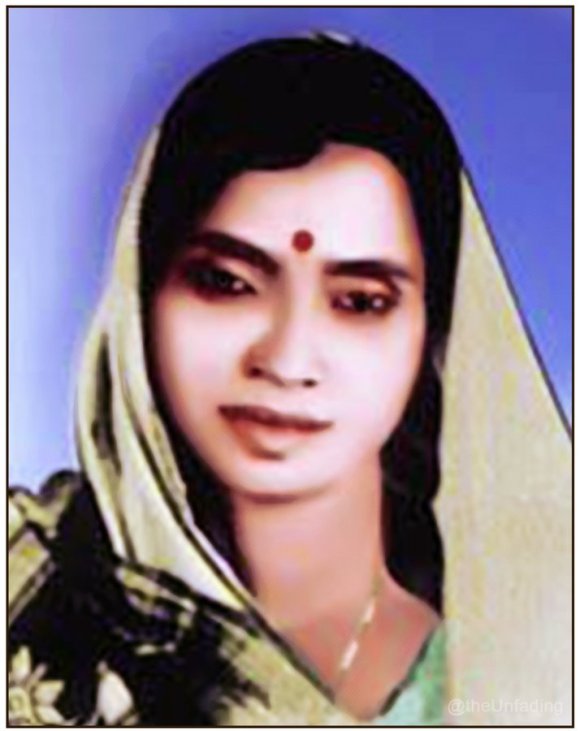
Bidyut Prabha Devi

Bidyut Prabha Devi (1926 – 1977) is celebrated as one of the most prominent female poets in Odia literature. Hailing from Natara village in the Kendrapara district, she was the second daughter of the esteemed writer, Nimai Charan Das, and Rekha Devi.

Raised in a traditional family in Bamphisahi, Cuttack, she received most of her education independently, attending Ravenshaw Girls’ School until the ninth grade. Inspired by her father and notable Odia poets like Nanda Kishore Bal and Kunja Bihari Das, she began her journey into poetry in 1940.

Her first collection, released in 1944 when she was merely 18 years old, featured patriotic poems that celebrated the cultural and natural heritage of Odisha. It highlighted her early ability to create vivid imagery and convey emotional depth, drawing from her rural background and the literary traditions of Odia.

Her 1950 collection, Utkal Saraswata[1], was recognised as a significant contribution to education, being included as a poetry textbook at Utkal University. In addition to poetry, she also wrote for children, for which she was awarded by the Government of India in 1955, acknowledging her impactful contributions to children’s literature.

Bidyut Prabha’s poetry explores the challenges faced by women, societal limitations, and the theme of empowerment, weaving together both personal and universal experiences. It embodies her feminist viewpoint, tackling matters such as gender inequality within a conservative framework, all while preserving a lyrical and approachable style.

She authored numerous plays, although specific titles are not extensively recorded. Her theatrical pieces frequently conveyed social messages, resonating with her socialist and feminist principles. Her writings were recognized for their clarity and moral depth, rendering literature accessible to younger audiences. Some of these later works are less documented but showcase her reflective and philosophical nature.

Influenced by socialist principles, her poetry examined social disparities and advocated for the marginalised. Her self-taught approach was characterised by clear and evocative language, rendering her work both relatable and profound.

Bidyut Prabha’s writings were revolutionary for their era, especially in their focus on women’s issues within Odia literature. Her son, Sachidananda Mohanty, a distinguished educationist and litterateur, has translated her works, thereby preserving her legacy.

Writes Sachidananda Mohanty[2]: “In recent decades, feminist historiography in eastern India has paid welcome attention to issues of education, creativity, and sisterhood across linguistic barriers. It has recognised women’s pivotal role in shaping the public space at the intersection between feminist history and literary creativity. Scholars like Judith Walsh, Tanika Sarkar, Malavika Karlekar, and others have brought to our attention forgotten life-narratives of literary women of the region who have created a tradition of their own.  Bidyut Prabha Devi, recognised as a major female voice in pre-modern Odia poetry, belongs to a poetic tradition represented by an illustrious sisterhood, comprising Reba Ray, Kuntala Kumari Sabat, Haripriya Devi, Debahuti Devi, Nirmala Devi, Tulasi Das, and Brahmotri Mohanty, among others. 

“While Bidyut Prabha may be known in Odisha, her feminist poems, based on her deep understanding of domesticity and patriarchy, have not been sufficiently read outside the state. Even in Odisha, her ‘romantic poems’ are widely anthologised at the cost of the more powerful compositions that address the woman’s position and identity in terms of the entrenched power structures in society.”

According to Mohanty, Bidyut Prabha’s feminist poetry stands out distinctly from the prevalent ‘Advice-for-Women’ genre in the region. She bases her work on her own life experiences and resonates with the growing feminist consciousness in Odisha, which is championed by literary feminists and social reformers like Sarala Devi[3], who played a pivotal role as a mentor to Bidyut Prabha. This journey was marked by its transnational influences. Sarala Devi had a strong connection with poet Annada Shankar Ray, a key figure in the Odia Romantic movement.

Her impact on Odia literature is significant, particularly as one of the earliest notable female poets in a predominantly male literary environment. Her contributions are rooted in her capacity to merge lyrical elegance with social critique, enhancing the inclusivity, reflection, and cultural relevance of Odia literature. Her work continues to serve as a foundational element for feminist and regional narratives in Odisha.

She was married to Panchanan Mohanty. Following health challenges in 1966, her literary output took on a spiritual dimension, shaped by her connection to the Sri Aurobindo Ashram, Pondicherry. Unfortunately, she took her own life.

Bidyut Prabha Devi’s poetry, deeply rooted in feminist and socialist ideals, continues to motivate and inspire, with her centenary of birth being commemorated in 2025 as a representation of women’s empowerment in Odisha.

[1] Odia Literature

[2] A literary sisterhood, Vol. 65, No. 6 (326) (November-December 2021), Published By: Sahitya Akademi

[3] Sarala Devi (1904-1986) – Odisha’s first Satyagrahi, first female legislator and first feminist writer.

.

Bhaskar Parichha is a journalist and author of Cyclones in Odisha: Landfall, Wreckage and ResilienceUnbiasedNo Strings Attached: Writings on Odisha and Biju Patnaik – A Political Biography. He lives in Bhubaneswar and writes bilingually. Besides writing for newspapers, he also reviews books on various media platforms.

PLEASE NOTE: ARTICLES CAN ONLY BE REPRODUCED IN OTHER SITES WITH DUE ACKNOWLEDGEMENT TO BORDERLESS JOURNAL

Click here to access the Borderless anthology, Monalisa No Longer Smiles

Click here to access Monalisa No Longer Smiles on Amazon International

Categories
Editorial

‘…I write from my heart of the raging tempest…’

I can see the heartbreak, 
Hear the wailing, the awakening,
I write from my heart
Of the raging tempest.

— Translation of Probhatey or ‘In the Morning’ by Rabindranath Tagore (1906)

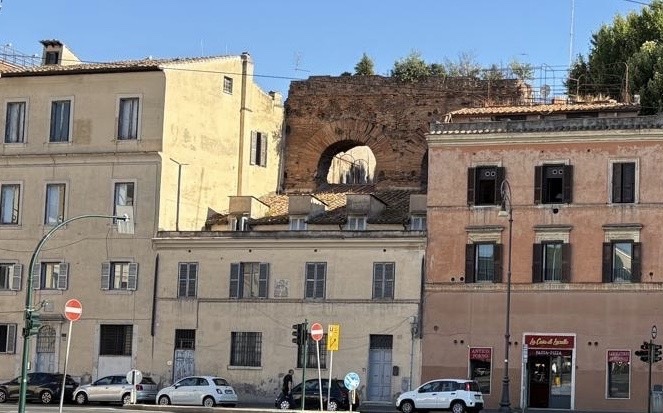
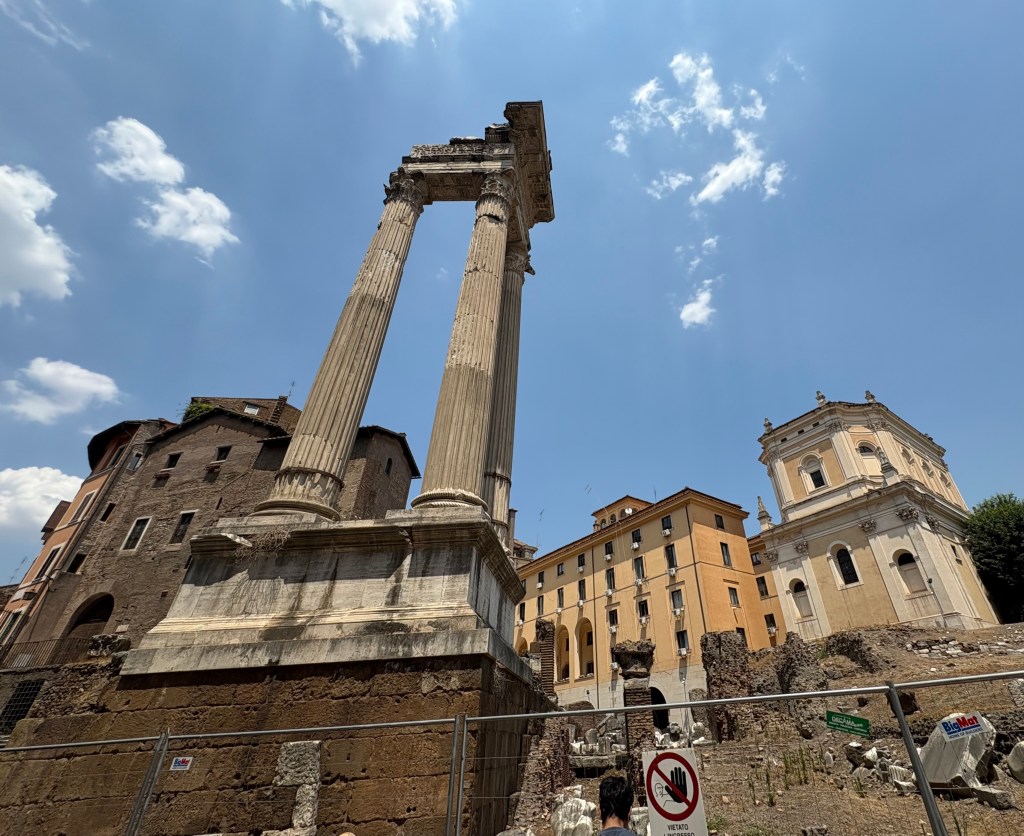
All around us, we hear of disasters. Often, we try to write of these as Tagore seems to do in the above lines. However, these lines follow after he says he draws solace and inspiration from a ‘serene lotus’, pristine and shining with vibrancy. He gazes at it while looking for that still point which helps him create an impact with words. That is perhaps what we can hope to do too — wait for a morning where clarity will show us the path to express not just what we see, but to find a way to heal and help. Finding parallels in great writings of yore to our own attempts at recreating the present makes us realise that perhaps history is cyclical. In Rome, new structures rear up against thousand-year walls, reflecting how the past congeals into the present.

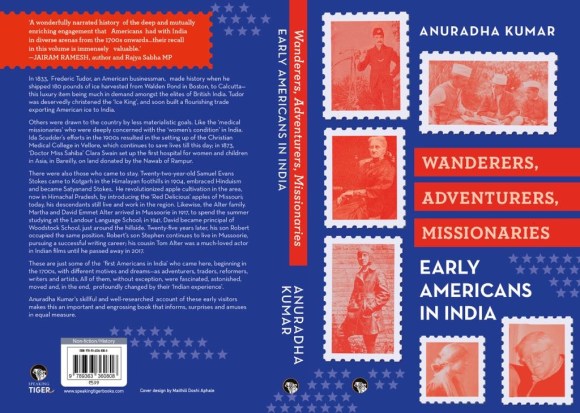
Congealing the past into our present in this July’s issue are stories of American migrants — like Tom Alter’s family who made India their home — by Anuradha Kumar in her new non-fiction Wanderers, Adventurers, Missionaries: Early Americans in India. We feature this book with a review and an interview with the author where she tells us how and why she chose to write on these people. We have more people writing of their own wanderings. Mohul Bhowmick wanders into Cambodia and makes friends over a local sport while Prithvijeet Sinha strolls by the banks of the River Gomti in Lucknow. Meredith Stephens not only takes us to the Prime Meridien in Greenwich but also to Carnarvon which houses a science and technology centre in Australia. Devraj Singh Kalsi wanders with humour to discover gastronomical inspiration and hopes for sweeter recompense.

The dialogue started by Professor Fakrul Alam on libraries earlier with his essay and by Kalsi (with a pinch of humour) has been continued by Odbayar Dorj. She talks of the fading culture of libraries in Mongolia, her home country, and the vibrant culture that has blossomed in Japan. Suzanne Kamata writes of the rituals of summer holidays in Japan… including looking after a pet dung beetles.

Farouk Gulsara muses on ‘greatness’ as a concept with irony. Aparajita De muses on the word serendipity, applying it to her own situation while Ratnottama Sengupta muses on her encounter with the writings of eminent cover artist and writer who is not only a recipient of the Bangla Academy literary award but also immensely popular with children, Dhruba Esh, and translates one his many stories from Bengali.

In translations, Professor Alam has brought to us a beautiful poem by Jibanananda Das. Karim Drashti’s Balochi short poems have been rendered in English by Fazal Baloch and Snehaprava Das has found for us Odia poems of Sangram Jena in translation. Ihlwha Choi has rendered his own Korean poem to English while Tagore’s poem, ‘Probhatey (In the Morning)’ winds up the poetry in this section. We have more in prose — Surya Dhananjay’s story, Mastan Anna, translated from Telugu by Rahimanuddin Shaik.

In fiction, we have stories from around the world. Paul Mirabile sets his story in Burgaz. Spandan Upadhyay gives a mysterious narrative set in a world outside our waking consciousness and Vidya Hariharan gives us a glimpse of life in modern day India. From Bangladesh, Md Mujib Ullah writes a short cli-fi based on real life events.

Taking up the theme of cli-fi, Rajat Chaudhuri’s Wonder Tales for a Warming Planet seems to bring hope by suggesting adapting to changing climes. Rakhi Dalal tells us in her review: “It dares to approach the climate crisis through the lens of empathy and imagination rather than panic or guilt. In doing so, Rajat Chaudhuri gives us what many adult climate narratives fail to deliver—a reason to believe that another world is not only possible but already being imagined by the young. All we need to do is listen.” Bhaskar Parichha has discussed the autobiography of a meteorologist and Distinguished University Professor at George Mason University, Jagadish Shukla. In A Billion Butterflies: A Life in Climate and Chaos Theory, he claims Shukla has “revolutionised monsoon forecasting.” Somdatta Mandal has written about Dilip K Das’s Epidemic Narratives: The Cultural Construction of Infectious Disease Outbreaks in India. And Gower Bhat reviews Neha Bansal’s best-selling poetry collection, Six of Cups.

Poetry awakens myriad of hues in Borderless with verses from across the world. We have poems from Luis Cuauhtémoc Berriozábal, Ryan Quinn Flangan, Snehprava Das, George Freek, Laila Brahmbhatt, Tracy Lee Duffy, Amarthya Chandar, Jason Ryberg, Momina Raza, Shahriyer Hossain Shetu and more. Snigdha Agrawal gives a fun-filled poem about a duck and Rhys Hughes has given us a collection of verses like puzzles where we need to guess the animals! We also have an excerpt from Hughes’ The Eleventh Commandment And Other Very Short Fictions and Das’s short stories, Keep It Secret.

With that, we wind up the contents of this month’s issue. Do pause by our content’s page to check it out in more details.

This month’s edition would not have been possible without all our contributors, our fabulous team and especially Sohana Manzoor’s artwork. Huge thanks to all of them and to our wonderful readers who make it worthwhile for us to write and publish. Do write in to us if you have any feedback. Five years ago, we chose to become a monthly from a daily… We have come a long way from then and grown to host writers from more than forty countries and readers from almost all over the world. For this, we owe you all – for being with us and encouraging us to find fresh pastures.

Enjoy the reads!

Wishing you peace and happiness,

Mitali Chakravarty,

borderlessjournal.com

Click here to access the contents for the July 2025 Issue

READ THE LATEST UPDATES ON THE FIRST BORDERLESS ANTHOLOGY, MONALISA NO LONGER SMILES, BY CLICKING ON THIS LINK.

Categories
Interview Review

Of Wanderers and Migrants & Anuradha Kumar

A review of Anuradha Kumar’s Wanderers, Adventurers, Missionaries: Early Americans in India (Speaking Tiger Books) and an interview with the author

Migrants and wanderers — what could be the differences between them? Perhaps, we can try to comprehend the nuances. Seemingly, wanderers flit from place to place — sometimes, assimilating bits of each of these cultures into their blood — often returning to their own point of origin. Migrants move countries and set up home in the country they opt to call home as did the family the famous Indian actor, Tom Alter (1950-2017).

Anuradha Kumar’s Wanderers, Adventurers, Missionaries: Early Americans in India captures the lives and adventures of thirty such individuals or families — including the Alter family — that opted to explore the country from which the author herself wandered into Singapore and US. Born in India, Kumar now lives in New Jersey and writes. Awarded twice by the Commonwealth Foundation for her writing, she has eight novels to her credit. Why would she do a whole range of essays on wanderers and migrants from US to India? Is this book her attempt to build bridges between diverse cultures and seemingly diverse histories?

As Kumar contends in her succinct introduction, America and India in the 1700s were similar adventures for colonisers. In the Empire Podcast, William Dalrymple and Anita Anand do point out that the British East India company was impacted in the stance it had to colonisers in the Sub-continent after their experience of the American Revolution. And America and India were both British colonies. They also were favourites of colonisers from other European cultures. Just as India was the melting pot of diverse communities from many parts of the world — even mentioned by Marco Polo (1254-1324) in The Kingdom of India — America in the post-Christopher Columbus era (1451-1546) provided a similar experience for those who looked for a future different from what they had inherited. The first one Kumar listed is Nathaniel Higginson (1652-1708), a second-generation migrant from United Kingdom, who wandered in around the same time as British administrator Job Charnock (1630-1693) who dreamt Calcutta after landing near Sutanuti[1].

Kumar has bunched a number of biographies together in each chapter, highlighting the commonality of dates and ventures. The earliest ones, including Higginson, fall under ‘Fortune Seekers From New England’. The most interesting of these is Fedrick Tudor (1783-1864), the ice trader. Kumar writes: “In Calcutta, Dwarkanath Tagore, merchant and patron of the arts (Rabindranath Tagore’s grandfather), expressed an interest to involve himself in ice shipping, but Tudor’s monopoly stayed for some decades more. Tagore was part of the committee in Calcutta along with Kurbulai Mohammad, scion of a well-established landed family in Bengal, to regulate ice supply.”

Also associated with the Tagore family, was later immigrant Gertrude Emerson Sen (1890-1982, married to Boshi Sen). She tells us, “Tagore wrote Foreword to Gertrude Emerson’s Voiceless India, set in a remote Indian village and published in 1930. Nobel Laureate Rabindranath Tagore called Emerson’s efforts, ‘authentic’.” She has moved on to quote Tagore: “The author did not choose the comfortable method of picking up information from behind lavish bureaucratic hospitality, under a revolving electric fan, and in an atmosphere of ready-made social opinions…She boldly took in on herself unaided to  enter a region of our life, all but unexplored by Western tourists, which had one great advantage, in spite of its difficulties, that it offered no other path to the writer, but that of sharing the life of the people.’” Kumar writes of an Afro-American scholar, called Merze Tate who came about 1950-51 and was also fascinated by Santiniketan as were some others.

Another name that stuck out was Sam Higginbottom, who she described as “the Farmer Missionary” for he was exactly that and started an agricultural university in Allahabad. Around the same time as Tagore started Sriniketan (1922), Higginbottom was working on agricultural reforms in a different part of India. In fact, Uma Dasgupta mentions in A History of Sriniketan: Rabindranath Tagore’s Pioneering work in Rural Reconstruction that Lord Elimhurst, who helped set up the project, informed Tagore that “another Englishman” was doing work along similar lines. Though as Kumar has pointed out, Higginbottom was a British immigrant to US — an early American — and returned to Florida in 1944.

There is always the grey area where it’s difficult to tie down immigrants or wanderers to geographies. One such interesting case Kumar dwells on would be that of Nilla Cram Cook, who embraced Hinduism, becoming in-the process, ‘Nilla Nagini Devi’, as soon as she reached Kashmir with her young son, Sirius. She shuttled between Greece, America and India and embraced the arts, lived in Gandhi’s Wardha ashram and corresponding with him, went on protests and lived like a local. Her life mapped in India almost a hundred years ago, reads like that of a free spirit. At a point she was deported living in an abject state and without slippers. Kumar tells us: “Her work according to Sandra Mackey combined ‘remarkable cross-cultural experimentation’ and ‘dazzling entrepreneurship.’”

The author has written of artists, writers, salesmen, traders (there’s a founder/buyer of Tiffany’s), actors, Theosophists, linguists fascinated with Sanskrit, cyclists — one loved the Grand Trunk Road, yet another couple hated it — even a photographer and an indentured Afro-American labourer. Some are missionaries. Under ‘The Medical Missionaries: The Women’s Condition’, she has written of the founders of Vellore Hospital and the first Asian hospital for women and children. Some of them lived through the Revolt of 1857; some through India’s Independence Movement and with varied responses to the historical events they met with.

Kumar has dedicated the book to, “…all the wanderers in my family who left in search of new homes and forgot to write their stories…” Is this an attempt to record the lives of people as yet unrecorded or less recorded? For missing from her essays are famous names like Louis Fischer, Webb Miller — who were better known journalists associated with Gandhi and spent time with him. But there are names like Satyanand Stokes and Earl and Achsah Brewster, who also met Gandhi. Let’s ask the author to tell us more about her book.

Anuradha Kumar

What made you think of doing this book? How much time did you devote to it? 

These initially began as essays for Scroll; short pieces about 1500-1600 words long. And the beginnings were very organic. I wrote about Edwin Lord Weeks sometime in 2015. But the later pieces, most of them, were part of a series.

I guess I am intrigued by people who cross borders, make new lives for themselves in different lands, and my editors—at Scroll and Speaking Tiger Books—were really very encouraging.

After I’d finished a series of pieces on early South Asians in America, I wanted to look at those who had made the journey in reverse, i.e., early Americans in India, and so the series came about, formally, from December 2021 onward. I began with Thomas Stevens, the adventuring cyclist and moved onto Gertrude Emerson Sen, and then the others. So, for about two years I read and looked up accounts, old newspapers, writings, everything I possibly could; I guess that must mean a considerable amount of research work. Which is always the best thing about a project like this, if I might put it that way.

What kind of research work? Did you read all the books these wanderers had written?

Yes, in effect I did. The books are really old, by which I mean, for example, Bartolomew Burges’ account of his travels in ‘Indostan’ written in the 1780s have been digitized and relatively easy to access. I found several books on Internet Archive, or via the interlibrary loan system that connects libraries in the US (public and university). I looked up old newspapers, old magazine articles – loc.gov, archive.org, newspapers.com, newspaperarchive.com, hathitrust.org and various other sites that preserve such old writings.

You do have a fiction on Mark Twain in India. But in this book, you do not have very well-known names like that of Twain. Why? 

Not Twain, but I guess some of the others were well-known, many in their own lifetime. Satyanand Stokes’ name is an easily recognisable still especially in India, and equally familiar is Ida Scudder of the Vellore Medical College, and maybe a few others like Gertrude Sen, and Clara Swain too. I made a deliberate choice of selecting those who had spent a reasonable amount of time in India, at least a year (as in the case of Francis Marion Crawford, the writer, or a few months like the actor, Daniel Bandmann), and not those who were just visiting like Mark Twain or passing through. This made the whole endeavour very interesting. When one has spent some years in a foreign land, like our early Americans in India, one arguably comes to have a different, totally unique perspective. These early Americans who stayed on for a bit were more ‘accommodating’ and more perceptive about a few things, rather than supercilious and cursory.

And it helped that they left behind some written record. John Parker Boyd, the soldier who served the Nizam as well as Holkar in Indore in the early 1800s, left behind a couple of letters of complaint (when he didn’t get his promised reward from the East India Company) and even this sufficed to try and build a complete life.

How do these people thematically link up with each other? Do their lives run into each other at any point? 

Yes, I placed them in categories thanks to an invaluable suggestion by Dr Ramachandra Guha, the historian. I’d emailed him and this advice helped give some shape to the book, else there would have been just chapters following each other. And their lives did overlap; several of them, especially from the 1860s onward, did work in the same field, though apart from the medical missionaries, I don’t think they ever met each other – distances were far harder to traverse then, I guess.

What is the purpose of your book? Would it have been a response to some book or event? 

I was, and am, interested in people who leave the comforts of home to seek a new life elsewhere, even if only for some years. Travelling, some decades ago, was fraught with risk and uncertainty. I admire all those who did it, whether it was for the love of adventure, or a sense of mission. I wanted to get into their shoes and see how they felt and saw the world then.

Is this because you are a migrant yourself? How do you explain the dedication in your book? 

I thought of my father, and his cousins, all of whom grew up in what was once undivided Bengal. Then it became East Pakistan one day and then Bangladesh. Suddenly, borders became lines they could never cross, and they found new borders everywhere, new divisions, and new homes to settle down in. They were forced to learn anew, to always look ahead, and understand the world differently.

When I read these accounts by early travellers, I sort of understood the sense of dislocation, desperation, and sheer determination my father, his cousins felt; maybe all those who leave their homes behind, unsure and uncertain, feel the same way.

You have done a number of non-fiction for children. And also, historical fiction as Aditi Kay. This is a non-fiction for adults or all age groups? Do you feel there is a difference between writing for kids and adults? 

I’d think this is a book for someone who has a sense of history, of historical movements, and change, and time periods. A reader with this understanding will, I hope, appreciate this book.

About the latter half of your question, yes of course there is a difference. But a good reader enters the world the writer is creating, freely and fearlessly, and I am not sure if age decides that.

You have written both fiction and non-fiction. Which genre is more to your taste? Elaborate. 

I love anything to do with history. Anything that involves research, digging into things, finding out about lives unfairly and unnecessarily forgotten. The past still speaks to us in many ways, and I like finding out these lost voices.

What is your next project? Do you have an upcoming book? Do give us a bit of a brief curtain raiser. 

The second in the Maya Barton-Henry Baker series. In this one, Maya has more of a lead role than Henry. It’s set in Bombay in the winter of 1897, and the plague is making things scary and dangerous. In this time bicycles begin mysteriously vanishing… and this is only half the mystery!

We’ll look forward to reading a revival of the characters fromThe Kidnapping of Mark Twain: A Bombay Mystery. Thanks for your time and your wonderful books.

.

[1] Now part of Kolkata (Calcutta post 2001 ruling)

Click here to read an excerpt from Wanderers, Adventurers, Missionaries: Early Americans in India

(This review and online interview is by Mitali Chakravarty)

PLEASE NOTE: ARTICLES CAN ONLY BE REPRODUCED IN OTHER SITES WITH DUE ACKNOWLEDGEMENT TO BORDERLESS JOURNAL

Click here to access the Borderless anthology, Monalisa No Longer Smiles

Click here to access Monalisa No Longer Smiles on Kindle Amazon International
Categories
Essay

It Doesn’t Rain in Phnom Penh

By Mohul Bhowmick

Phnom Penh: From Public Domain

Blank faces welcome me in Phnom Penh. That the people smile at all is a miracle; years of haggard living, tortured upbringing, and painful deprivations have reduced this golden city of Indochina to one filled with figurative corpses. What America could not achieve, Pol Pot did in a flash and years of oppression turned into that of a blood-filled regime that the Mekong did not even try to wash away. For all its salubriousness, this river, among the greatest in the world, stood by and watched its children be consumed by an ephemeral fire that could only be extinguished in 1979.

Then the Vietnamese intervened, returning only after being loathed by almost everyone in Cambodia. The former, among other benedictions, took apart whatever little credibility the Democratic Kampuchea (Khmer Rouge) government had amassed in three and a half years in power. Pol Pot’s name, quite naturally, does not feature on the political billboards and hoardings that seem to have made themselves inconspicuous in Phnom Penh today. The national dish, Amok, made of fish or several vegan accoutrements to serve the European traveller, takes up the spot left by those of the beggars in the parking spot north of the royal palace.

As I sip my umpteenth sugarcane juice, fortified with cubes of ice that may have once come out of Tibet, I wonder whether the king curls his lips in distaste seeing the beggars and rag-pickers waiting outside the golden gates of his palace. But the official line in Cambodia is that Sihamoni is a staunch Buddhist who likes the occasional bit of Czech opera, and all my thoughts of irreverence — born out of weeks of living in Indochina — flush down the confluence of the Mekong and the Tonle Sap while looking past Sisowath Quay to the east.

This river, the lifeblood of Indochina, had once emerged as a trickle in Tibet, and I am perplexed by the lack of cohesion it shows while merging with the Tonle Sap, which also shares its name with a large freshwater lake in Siem Reap. During the monsoon season, the Mekong forces the Tonle Sap to reverse its water with such gushing force that the latter is left with no choice but to flood itself with fish.

It doesn’t rain in Phnom Penh; I had heard this phrase before but am accosted with it with painful lucidity for the first time when visiting the Tuol Sleng primary school that served, for years, as a torture centre for the Khmer Rouge. Had it rained on the frangipani-filled lush gardens of the school — belittling the despair and agony that went on inside — I would not have noticed. I envy the frangipani blooms and their ability to distance themselves from such emotions as those that afflict men. Outside, a survivor of the Khmer Rouge years sells his story for a few pennies; recognition from the foreigner seems more validating to him than acceptance from his countrymen, who have long forgotten his ordeals. I am told that a McDonald’s might soon open across the street.

When encountering the fabled ‘baby-killing tree’ in the ignominious Killing Fields in Cheoung Ek outside Phnom Penh, there is a numbing sensation which I have scarcely felt before. The tears fall heavier than the unseasonal rains I would have wished to encounter in Phnom Penh; it was not too long ago when I could have claimed that I had not cried in ten years. That this tree is also a Pipal, a cousin of the one under which Sakyamuni attained enlightenment, seems a cruel joke to me. That there is still some sign of life on it, populated by the innumerable butterflies and twittering sparrows, exacerbates this feeling all the more.

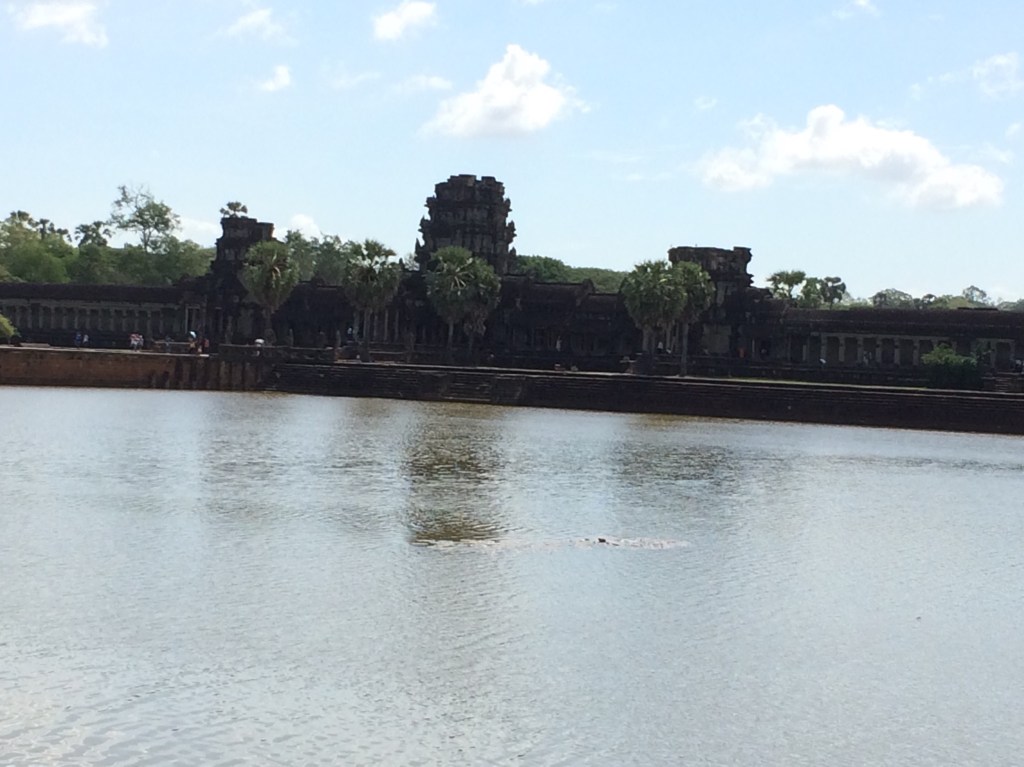
Angkor[1], a few days later, seems resplendent at dawn, but I am unable to escape the reality that the men who built this monument had also given birth to the reality that the Khmer Rouge would later become. Indeed, Pol Pot was known for his selective readings of the classics of the Khmer kingdom of Angkor — if building this city was possible, anything was, even his vastly unerudite idea of returning the country to a year ‘zero’, doing away with the market economy, abolishing money and persecuting intellectuals for wearing spectacles.

The rain that evades me in Phnom Penh finally catches up with me in Angkor Wat; unable to make a visit early one morning on a bicycle in a thunderstorm through the black jungle, I remain rooted to my guesthouse and eventually fall asleep.

On my first visit to Angkor Wat, I am stunned by the intricacies and details that seem to have permeated every angle of Khmer design. The frescoes on the walls and the images on the gates of the large temple complex depict wars fought and construction projects undertaken; for all its virility in eventually losing its grasp over modern-day Cambodia, the Hindu-Buddhist Khmer kingdom — of whose ilk Jayavarman VII had been, and whose predecessor Suryavarman II had ordered this temple made in 1150, at first as a tribute to Vishnu, and eventually, a mausoleum for himself — was remarkable in its aesthetic sensibilities. 

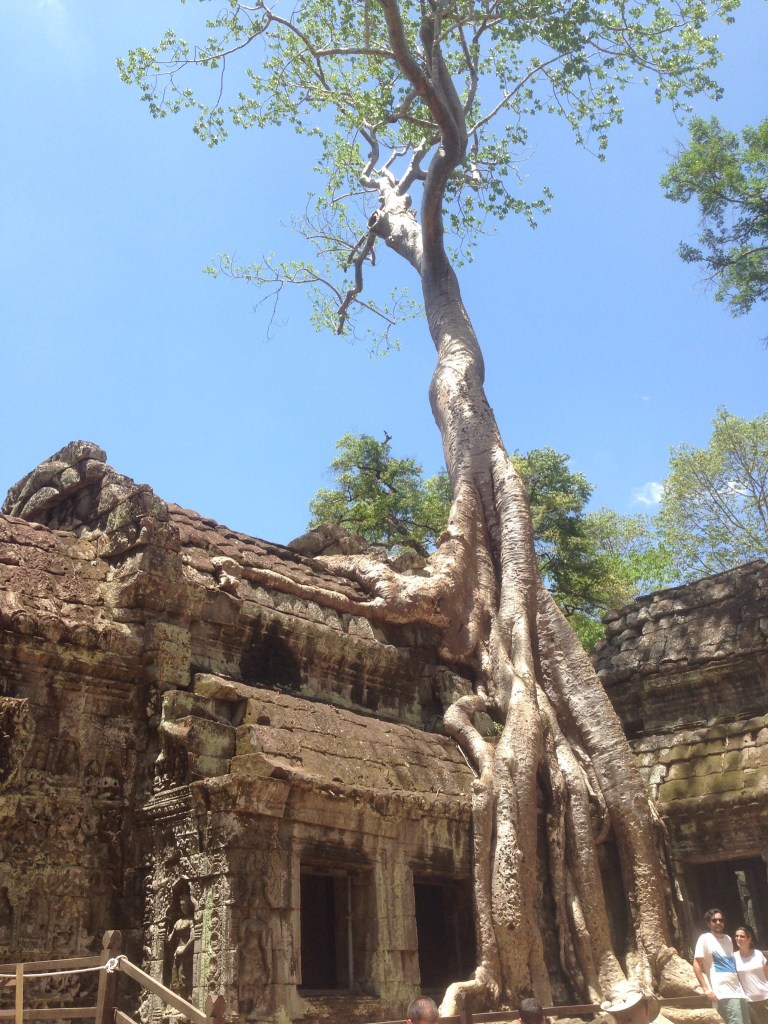
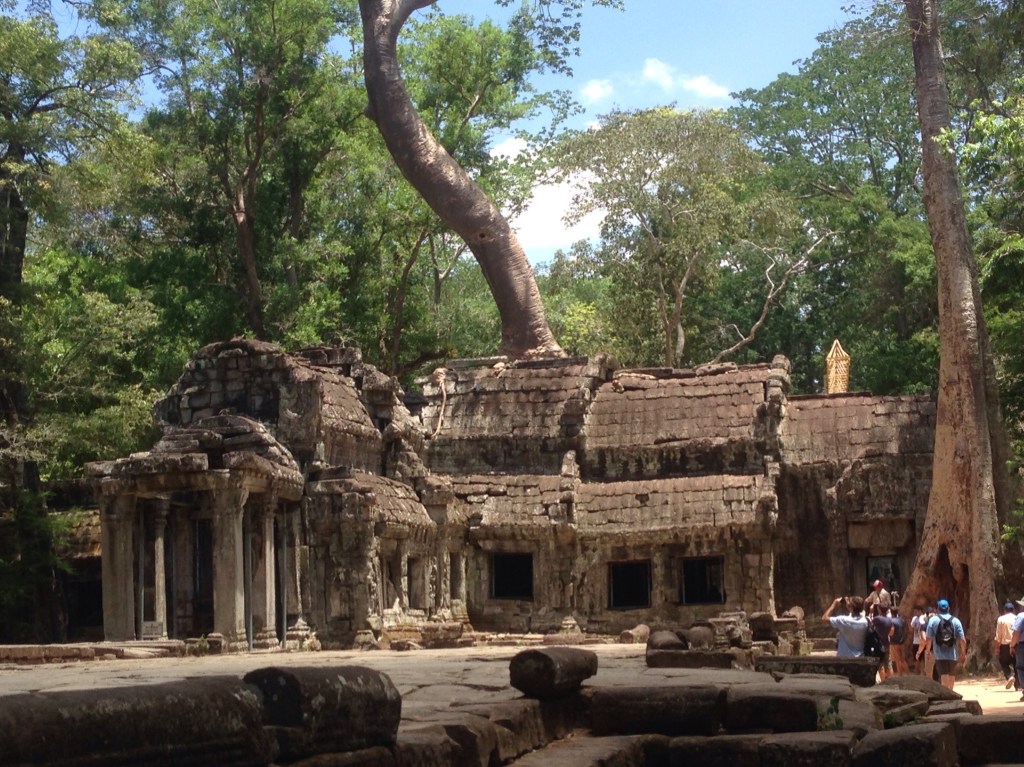
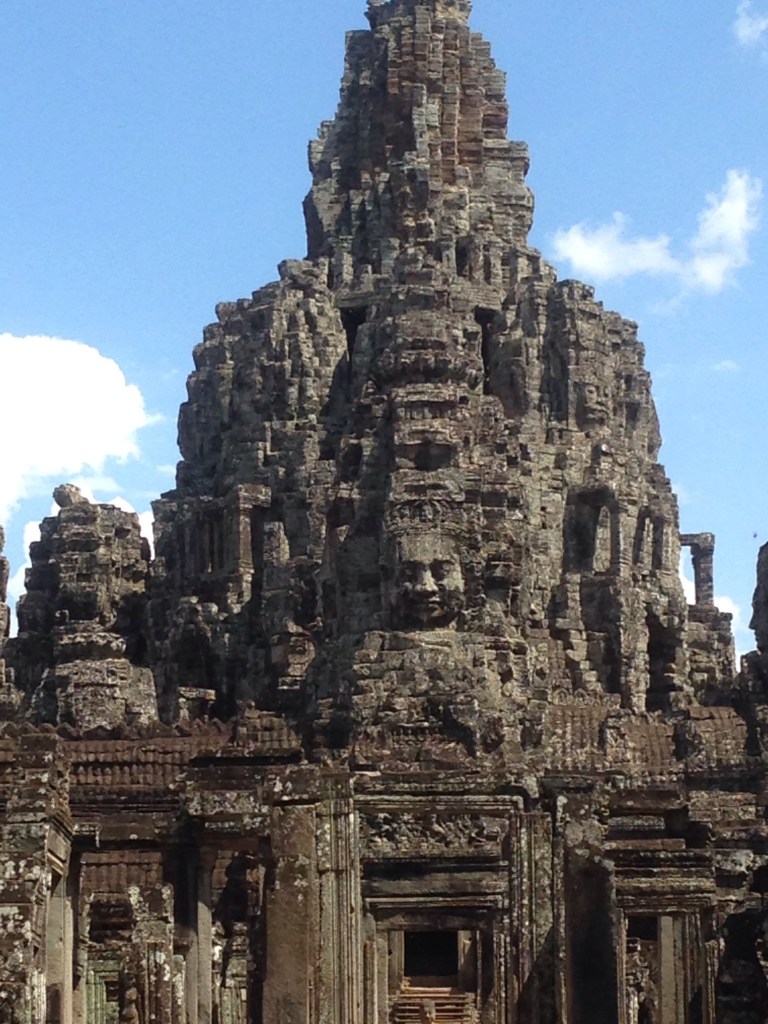
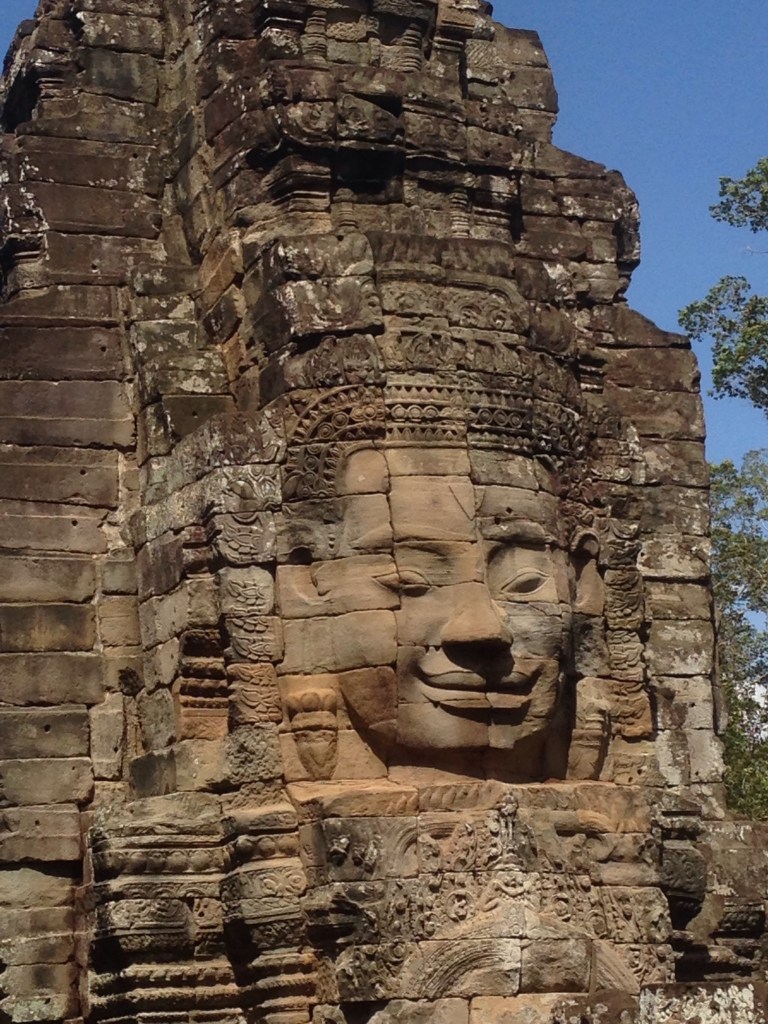
The several other temples in the area, including the great Bayon, Ta Phrom and Prasat Preah Khan — not to mention the gigantic meadows located in the heart of the old city of Angkor Thom — attract and drive my senses even as I struggle to cycle on flat roads in the deadening midday heat. The meadows, which feature statues of elephants attired in regal resplendence, remind me of a time simpler than this, when a thousand parasols could be had for cheap and held over the head of the king. The climate of Indochina, I surmise, may not have been too different from what it is now; I look yonder for concrete jungles mimicking the ones that seem to have sprung up choc-a-bloc in west Hyderabad, but encounter only lush blackness.

In effect, understanding Khmer society or the part of it which is shown to the visitor, is a challenging affair unless one undertakes a voyage of the heart that infrequently involves short-changing between lives of a different kind. The Mekong, which makes no appearance in Siem Reap, slithers away from the intemperate nature one finds in Angkor.

When I walk past Sisowath Quay one night under a moonless sky, I am reminded of my own idea of happiness, which seems to have been torn to shreds on this journey; a group of middle-aged Khmer men, devoid of languor in this dark hour and well-fortified with Angkor, the brew and not the temple, beckon me over to join in their game of sai[2]. It is then that I know it is time to put the killing tree to bed. For now.

[1] Angkor Wat is in the city of Siem Reap

[2] Played with the foot with a shuttlecock-like structure

Mohul Bhowmick is a national-level cricketer, poet, sports journalist, essayist and travel writer from Hyderabad, India. He has published four collections of poems and one travelogue so far. More of his work can be discovered on his website: www.mohulbhowmick.com.

PLEASE NOTE: ARTICLES CAN ONLY BE REPRODUCED IN OTHER SITES WITH DUE ACKNOWLEDGEMENT TO BORDERLESS JOURNAL. 

Click here to access the Borderless anthology, Monalisa No Longer Smiles

Click here to access Monalisa No Longer Smiles on Kindle Amazon International
Categories
Contents

Borderless, June 2025

Art by Sohana Manzoor

Editorial

‘How do you rebuild a life when all that remains is dust?’… Click here to read.

Translations

The Great War is Over and A Nobody by Jibanananda Das have been translated from Bengali by Professor Fakrul Alam. Click here to read.

Sukanta Bhattacharya’s poem, Therefore, has been translated from Bengali by Kiriti Sengupta. Click here to read.

 Five poems by Soubhagyabanta Maharana  have been translated from Odia by Snehaprava Das. Click here to read.

Animate Debris, a poem by Sangita Swechcha has been translated from Nepali by Saudamini Chalise. Click here to read.

Lost Poem, a poem by Ihlwha Choi  has been translated from Korean by the poet himself. Click here to read.

Sonar Tori (Golden Boat), a poem by Tagore, has been translated from Bengali by Mitali Chakravarty. Click here to read.

Poetry

Click on the names to read the poems

Allan Lake, Shobha Tharoor Srinivasan, Ron Pickett, Ananya Sarkar, George Freek, Bibhuti Narayan Biswal, Jim Bellamy, Pramod Rastogi, Vern Fein, Saranyan BV, Ryan Quinn Flanagan, Juairia Hossain, Gautham Pradeep, Jenny Middleton, Mandavi Choudhary, Rhys Hughes

Musings/Slices from Life

Where Should We Go After the Last Frontiers?

Ahamad Rayees writes from a village in Kashmir which homed refugees and still faced bombing. Click here to read.

The Jetty Chihuahuas

Vela Noble takes us for a stroll to the seaside at Adelaide. Click here to read.

Hope Lies Buried in Eternity

Farouk Gulsara muses on hope. Click here to read.

Undertourism in the Outback

Merdith Stephens writes from the Australian Outback with photographs from Alan Nobel. Click here to read.

Musings of a Copywriter

In Driving with Devraj, Devraj Singh Kalsi writes of his driving lessons. Click here to read.

Notes from Japan

In The Tent, Suzanne Kamata visits crimes and safety. Click here to read.

Essays

Public Intellectuals Walked, So Influencers Could Run

Lopamudra Nayak explores changing trends. Click here to read.

Where No One Wins or Loses a War…From Lucknow with Love

Prithvijeet Sinha takes us to a palace of a European begum in Lucknow. Click here to read.

Bhaskar’s Corner

In Can Odia Literature Connect Traditional Narratives with Contemporary Ones, Bhaskar Parichha discusses the said issue. Click here to read.

Feature

The story of Hawakal Publishers, based on a face-to-face tête-à-tête, and an online conversation with founder Bitan Chakraborty with his responses in Bengali translated by Kiriti Sengupta. Click here to read.

Stories

The Year the Fireflies Didn’t Come Back

Leishilembi Terem gives a poignant story set in conflict-ridden Manipur. Click here to read.

The Stranger

Jeena R. Papaadi writes of the vagaries of human relationships. Click here to read.

The Opening

Naramsetti Umamaheswararao relates a value based story in a small hamlet of southern India. Click here to read.

Book Excerpts

An excerpt from Wendy Doniger’s The Cave of Echoes: Stories about Gods, Animals and Other Strangers. Click here to read.

An excerpt from Mohua Chinappa’s Thorns in My Quilt: Letters from a Daughter to Her Father. Click here to read.

Book Reviews

Somdatta Mandal reviews Madhurima Vidyarthi’s Job Charnock and the Potter’s Boy. Click here to read.

Rakhi Dalal reviews Dhruba Hazarika’s The Shoot: Stories. Click here to read.

Satya Narayan Misra reviews Bakhtiyar K Dadabhoy’s Honest John – A Life of John Matthai. Click here to read.

Bhaskar Parichha reviews David C Engerman’s Apostles of Development: Six Economists and the World They Made. Click here to read.

.


Click here to access the Borderless anthology, Monalisa No Longer Smiles

Click here to access Monalisa No Longer Smiles on Amazon International

Categories
Editorial

‘How do you rebuild a life when all that remains is dust?’

The Great War is over
And yet there is left its vast gloom.
Our skies, light and society’s soul have been overcast…

'The Great War is Over' by Jibanananda Das (1899-1954), translated from Bengali by Professor Fakrul Alam.

Jibanananda Das wrote the above lines in the last century and yet great wars rage even now. As the world struggles to breathe looking for a beam of hope to drag itself out of the darkness induced by natural calamities, accidents, terror attacks and wars that seem to rage endlessly, are we moving towards the dystopian scenario created by George Orwell in 1984, which would be around the same time as Jibanananda Das’s ‘The Great War is Over’?

Describing such a scenario, Ahmed Rayees writes a moving piece from the Kashmiri village of Sheeri, the last refuge of the displaced refugees who were bombarded after peace was declared in their refuge during the clash across Indo-Pak borders. He contends: “People walked back not to homes, but to ruins. Entire communities had been reduced to ash and rubble. Crops were destroyed, livestock gone, schools turned into shelters or craters. How do you rebuild a life when all that remains is dust?”

People could be asking the same questions without finding answers in Gaza or Ukraine, where the cities are reduced to rubble. While we look for a ray of sunshine, amidst the rubble, Farouk Gulsara muses on hope that has its roots in eternity. Vela Noble wanders on nostalgic beaches in Adelaide. And Meredith Stephens travels to the Australian outback. Devraj Singh Kalsi brings in lighter notes writing of driving lessons while Suzanne Kamata creeps back to darker recesses musing on likely ‘criminals’ and crimes in her neighbourhood.

Lopamudra Nayak writes on social media and its impact while Bhaskar Parichha writes of trends that could be brought into Odia literature.  What he writes could apply well to all regional literature, where they lose their individual colouring to paint dystopian realities of the present world. Does modernising make us lose our ethnic identity and how important is that? These are questions that sprung to the mind reading his essay. As if in an attempt to hold on to the past ethos, Prithvijeet Sinha wafts around old ruins in Lucknow and sees a cemetery for colonial soldiers and concludes: “Everybody has formidable stakes, and the dead don’t preach the gospel of victory or sombre defeat.”

Taking up a similar theme of death and war is a poem from Saranyan BV. In poetry, we have colours from around the world with poems from Allan Lake, Ron Pickett, Ananya Sarkar, George Freek, Jim Bellamy, Ryan Quinn Flanagan, Juairia Hossain, Gautham Pradeep, Jenny Middleton, Mandavi Choudhary and many more. Multiple themes are woven into a variety of perspectives, including nature and environment, with June hosting the World Environment Day. Rhys Hughes gives a funny poem on the Welsh outlaw, Twm Siôn Cati.

We have mainly poetry in translation this time. Snehaprava Das has brought to us Soubhagyabanta Maharana’s poems from Odia and Ihlwha Choi has translated his own poem from Korean. Sangita Swechcha’s poem in Nepali has been rendered to English by Saudamini Chalise. From Bengali, other that Jibanananda Das’s poems translated by Professor Fakrul Alam, we have Tagore’s pensive and beautiful poem, Sonar Tori (the golden boat). Yet another Bengali poet, one who died young and yet left his mark, Sukanta Bhattacharya (1926-1947), has been translated by Kiriti Sengupta. Sengupta has also translated the responses of Bitan Chakravarty in a candid conversation about his dream child — the Hawakal Publishers. We also have a feature on this based on a face-to-face conversation, giving the story of how this publishing house grew out of an idea. Now, they publish poetry traditionally, without costs to the poet. Their range of authors are spread across continents.

Our fiction again returns to the darkness of war. Young Leishilembi Terem has given a story set in conflict-ridden Manipur from where she has emerged safely — a story that reiterates the senselessness of violence and politics. While Jeena R. Papaadi writes of modern human relationships that end without commitment, Naramsetti Umamaheswararao relates a value-based story in a small hamlet of southern India. 

From stories, our book excerpts return to the real world, where a daughter grieves her father in Mohua Chinappa’s Thorns in My Quilt: Letters from a Daughter to Her Father while Wendy Doniger’s The Cave of Echoes: Stories about Gods, Animals and Other Strangers, dwells on demystifying structures that create borders. We have two non-fiction reviews. Parichha writes about David C Engerman’s Apostles of Development: Six Economists and the World They Made. And Satya Narayan Misra discusses Bakhtiyar K Dadabhoy’s Honest John – A Life of John Matthai. Somdatta Mandal this time explores a historical fiction based around the founding of Calcutta, Madhurima Vidyarthi’s Job Charnock and the Potter’s Boy while Rakhi Dalal looks at fiction born of environmental awareness, Dhruba Hazarika’s The Shoot: Stories.

We have more content. Do pause by our contents page and take a look.

Huge thanks to all our contributors without who this issue would not have materialised. Heartfelt thanks to the team at Borderless for their support, especially Sohana Manzoor for her iconic artwork that has almost become a signature statement for Borderless.

Let’s hope that next month brings better news for the whole world.

Best wishes,

Mitali Chakravarty

borderlessjournal.com

Click here to access the contents for thJune 2025 Issue

READ THE LATEST UPDATES ON THE FIRST BORDERLESS ANTHOLOGY, MONALISA NO LONGER SMILES, BY CLICKING ON THIS LINK.

Categories
Slices from Life

Where Should We Go After the Last Frontiers?

By Ahmad Rayees

It was late evening in the Valley—the kind of dusky calm that usually tucks our village into a blanket of silence before nightfall. But that night, the situation wasn’t peaceful. It was tense, suffocating. A silence not of rest, but of retreat. A silence that echoed with the footsteps of the displaced, the sobs of children, and the distant rumble of a war edging ever closer.

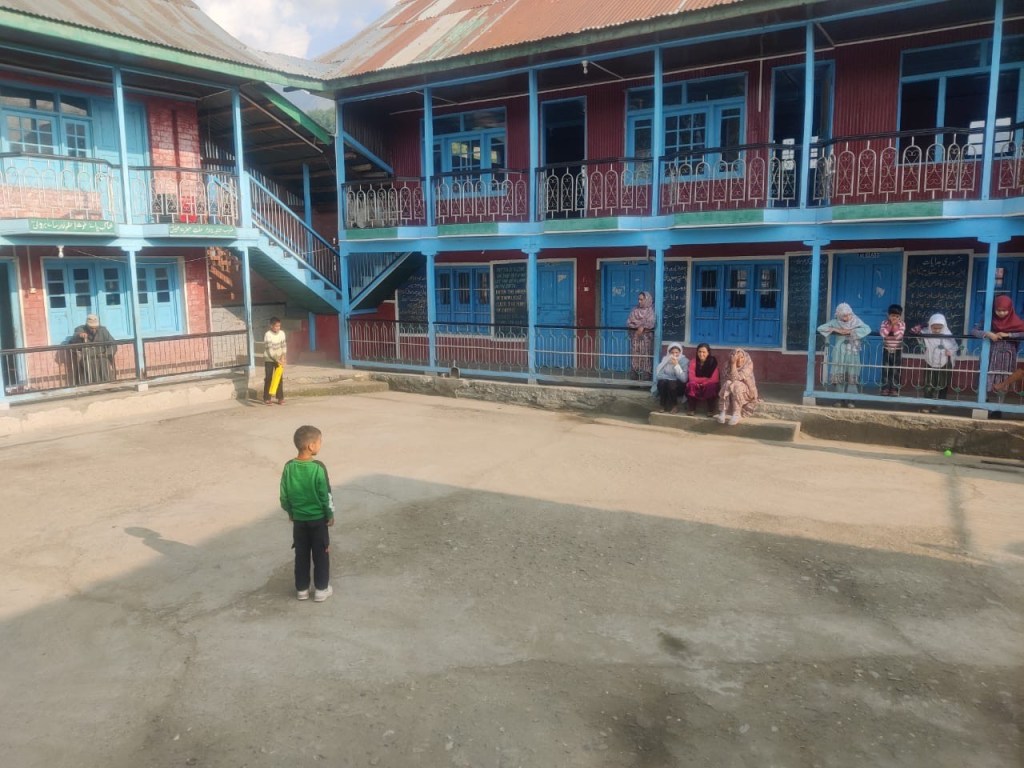
Nestled along the Srinagar-Muzaffarabad Highway, my village (Sheeri) had never imagined becoming a place of refuge. But over the past few days, it had slowly transformed into a shelter—not by design, but out of sheer necessity. It wasn’t a government-built camp or an official safe zone. It was a modest private school—its classrooms stripped of desks, Its walls were painted green, and its floors were covered with modest mats. The blackboard still bore lessons from a world that now felt impossibly far away.

They came by the dozens—families from the frontier town of Uri and other nearby hamlets, fleeing the deadly storm that had erupted along the Line of Control. The shells and gunfire hadn’t spared anyone. Mothers clutching newborns, elderly men barely able to walk, children with dust in their hair and tears in their eyes—each carried with them a fear that couldn’t be packed away. Their homes? Gone or abandoned. Their cattle? Lost. Their belongings? Scattered to the wind. All they had brought with them was survival.

We did what little we could, each small act stitched together into a fragile lifeline—volunteers arriving with rations and essential supplies, neighbours wrapping strangers in donated blankets, and someone rigging a single battery-powered generator in the school courtyard to pierce the darkness—just enough light to charge phones and confirm what we already feared through shaky mobile updates: India and Pakistan were at war again.

Just as we began preparing food that night, the sky above us erupted into unnatural color—bursts of red and orange, glowing like fireworks. For a breathless second, we hoped it was a celebration somewhere far away. But the thunderous roar that followed shattered that hope. These were no celebrations. They were drones. Missiles. Rockets. Tools of destruction lighting up the sky like angry constellations.

Panic was instant. Some people ran instinctively, nowhere in particular. Others froze. Mothers clutched children closer. Prayers spilled into the night air like smoke. The school—our fragile sanctuary—quaked with fear. And so did we.

I had heard stories of war. I had seen its images in books and on screens. But that night, war had a smell. A taste. A sound. That night, war breathed down our necks.

We stayed awake through the dark hours, huddled close under a full moon that bore witness to everything. The distant mountains glowed—not from moonlight, but from mortar fire.

The explosions echoed back and forth across the valley like angry giants arguing. Sleep was impossible. For many, so was hope.

For four harrowing days, the shelling continued. Relentless. Unforgiving. As India and Pakistan traded fire, villages on both sides were emptied. The front-lines moved like ghosts—never visible, always fatal. Each explosion wasn’t just an act of violence; it was a theft. It stole security, trust, homes, futures.

The ones who suffered weren’t the architects of war. They weren’t the men in polished suits or behind mahogany desks. They were farmers, schoolteachers, shopkeepers, daily wage earners. The ones who raised goats and crops, not guns. The ones who wanted nothing more than to be left alone.

And yet, here they were—broken by a war they didn’t start, begging for a peace that never came.

The soldiers too—barely out of their teens—were casualties in a different way. Sent to defend lines drawn generations ago, they carried weapons they barely understood, defending ideologies they didn’t create. On both sides, the blood spilled looked the same. The mothers’ grief sounded the same.

And as the bombs fell, something else collapsed quietly: Faith. Faith in leaders who promise peace and deliver bullets. Faith in ceasefires that last only until the next provocation. Faith that tomorrow would be better.

When the ceasefire was finally announced, there was no celebration. There were no cheers. Just silence—and not the comforting kind. It was the silence of disbelief, of loss too deep for words. People walked back not to homes, but to ruins. Entire communities had been reduced to ash and rubble. Crops were destroyed, livestock gone, schools turned into shelters or craters.

How do you rebuild a life when all that remains is dust?

These are the questions that haunt the air like the smoke refusing to clear —

Where should the birds fly after the last sky?
Where should we go after the last frontiers?
Where should the plants sleep after the last breathe of air? – Mahmoud Darwish

Ahmad Rayees is a freelance journalist and a fellow at Al-Sharq Youth fellow program. 

.

PLEASE NOTE: ARTICLES CAN ONLY BE REPRODUCED IN OTHER SITES WITH DUE ACKNOWLEDGEMENT TO BORDERLESS JOURNAL

Click here to access the Borderless anthology, Monalisa No Longer Smiles

Click here to access Monalisa No Longer Smiles on Kindle Amazon International
Categories
Feature

In Translation: Bitan Chakraborty

The story of Hawakal and a conversation with the founder, Bitan Chakraborty, whose responses have been translated from Bengali by Kiriti Sengupta.

Hawakal Publishers grew out of the compulsive need young Bitan Chakraborty had to express and connect. This was a young man who was willing to labour at pasting film hoardings to fund his dreams. An Information Technology professional by training, Chakraborty realised early he did not want to tread on trodden paths and started his journey as a creative individual. Now, he not only writes and publishes but also designs the most fabulous covers and supports local craftsmen.

Over the last nearly two decades, the brand Hawakal has become synonymous with traditional poetry publication from India. They do not offer buy back deals or ask to be paid like most publishers but pick selectively. No one seems to know what it is they look for. All Chakraborty says is – “We aimed to introduce a fresh wave in publishing.”

Chakraborty writes fully in Bengali which is why the dentist-turned-writer-turned-publisher, Kiriti Sengupta, had to chip in with the translation of his responses in Bengali. Their friendship matured over the last decade when Sengupta approached Chakraborty to publish a book of critical essays, which along with essays on Sharmila Ray’s poetry homed critical writing on his too. This was the first English publication of Hawakal.

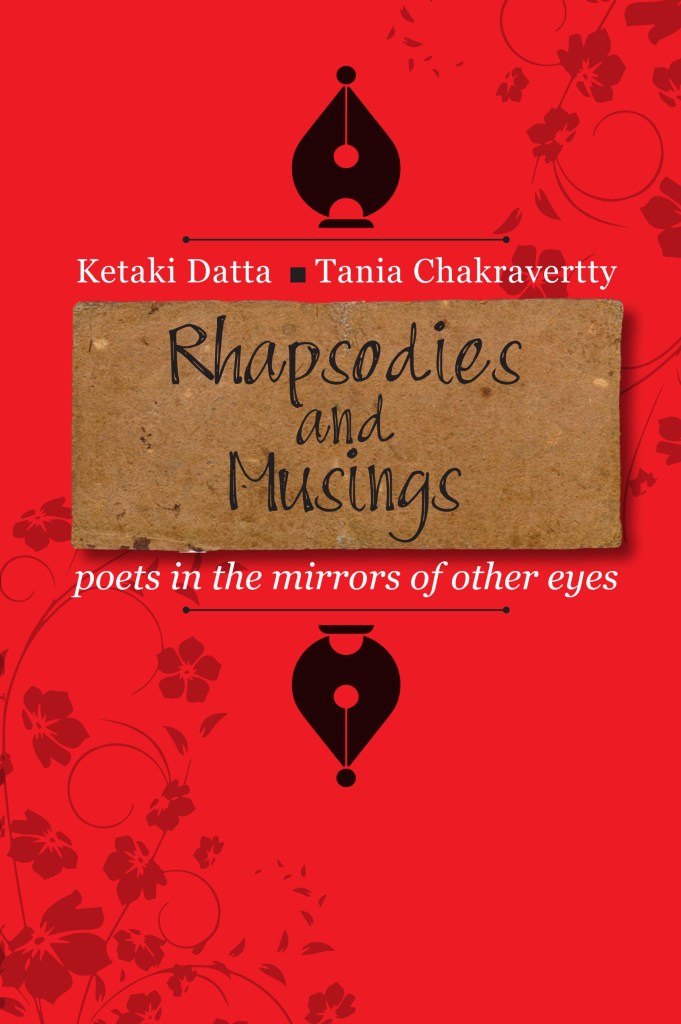
Sengupta had given up dentistry by then and was living in a hostel on a packet of Maggi a day to indulge his creative passions.  A skilled poet with a number of books under his belt, he eventually joined Chakraborty to run the English section of Hawakal.  He also translates from Bengali to English. We have one of his translations of Chakraborty’s short story, Disappearance. A powerful reminder of social gaps that exist in the Subcontinent, it’s a poignant and frightening narrative, the kind someone writes and imagines out of a passion to reform.

Some of Bitan’s works are available in English. His style — by the translations — seems graphic. The deft strokes make the landscape and the stories almost visual, like films. 

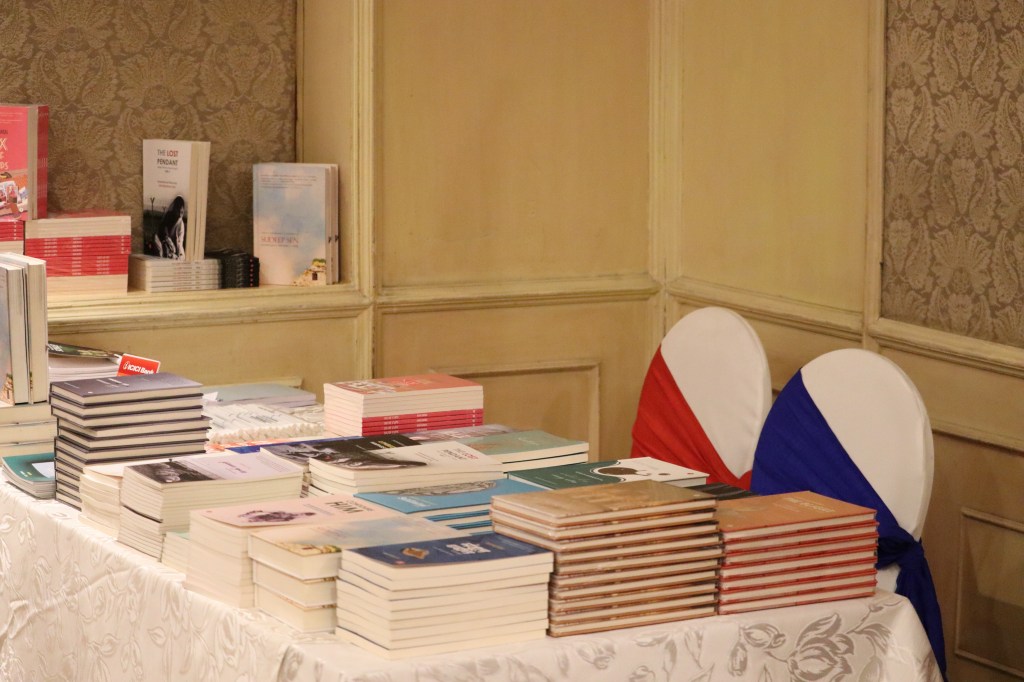
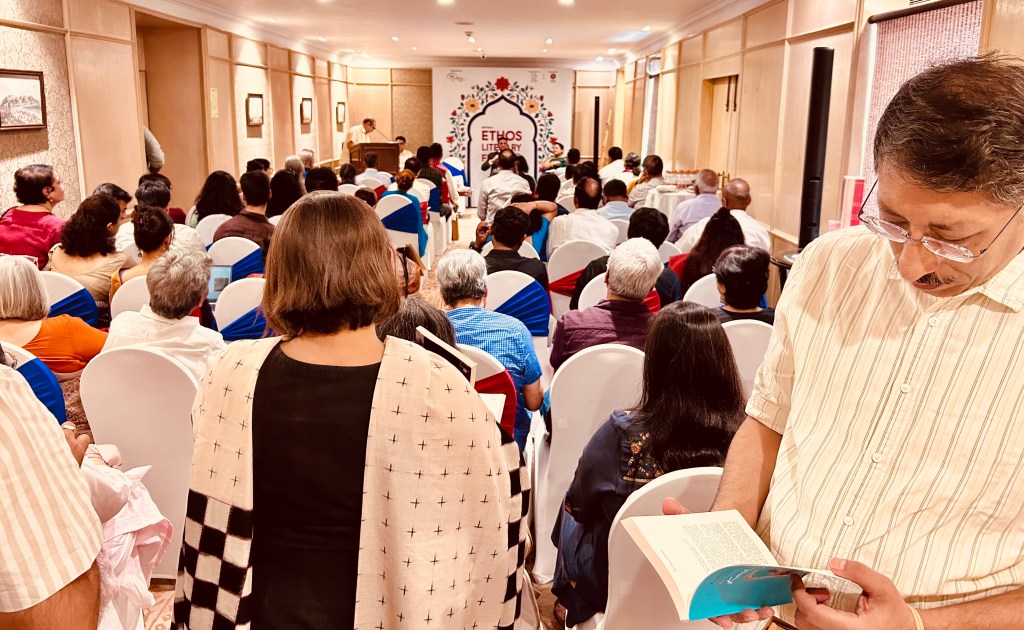
Chakraborty worked with ‘Little Magazines’ for some time. Then he made his way into publishing full time. Though he found it hard to make ends meet, he started his adventure without compromising his beliefs. He wanted to take books to readers and, with that spirit, they started the Ethos Literary Festival, where they host writers published by them. In fact, in the 2025 festival, Hawakal sold more than 400 books in seven hours! Who said poetry doesn’t sell?

Chakraborty and Sengupta have yet another hallmark. They wear matching clothes. These are tailored with material sourced from handloom weavers. They resorted to this when they found that commercialisation was killing the traditional homeborn handlooms. In that spirit, they started a clothes venture too, Mrinalika Weaves. 

Chakraborty is an unusual person – as the interview will reveal – humble, stubborn with aims like no other publisher or writer in this day and age! He doesn’t talk of money, survival, politics, awards or glamour, but what matters to him. He is direct and straightforward and perhaps, his directness is what makes his outlook appealing. He translates a few to Bengali for his own growth. But these are poets who are known for their terse writing. Maybe, that is what he looks for… Let’s find out!

Conversation
Bitan Chakraborty. Photo Courtesy: Kiriti Sengupta

Bitan, you are a multifaceted person: a writer, an artist, a photographer, and, most importantly, a publisher for all writers. What is it you most love to do and why?

I need to talk. What I observe or learn from my experiences compels me to express myself. Therefore, regardless of the medium I use, I strive to convey meaningful messages. Nevertheless, the range I enjoy in weaving words is unparalleled.

What sparked your interest in writing? Please elaborate. Do you only use Bengali to communicate with others? Do you translate from other languages to Bengali?

I felt emotionally down when I began writing. What a dreadful time it was! I believe it must be the emotional turmoil of my youth. However, writing has never left me since then. It’s more accurate to say that I have never managed to rid myself of my urge to write. During the early period, my writings contained more emotion than substance. In my college years, I was engaged in student movements that helped me discover the purpose of words. Society, socio-economic status, politics, and human dissatisfaction are the themes that run through my stories. Bengali is my mother tongue: I think, speak, dream, and curse in Bengali. I find it challenging to derive the same pleasure from using another language; it is my shortcoming.

Nevertheless, when I meet outstanding works in English, I attempt to translate them into Bengali. Not everything I read, but I have translated poems by Sanjeev Sethi and Kiriti Sengupta. I have consistently translated Gulzar into Bengali, but it has yet to be published in book format. Translation is a mental exercise; it particularly helps when I am experiencing writer’s block. I read poetry when I wish to untangle my thoughts, and when I come across fine poems in another language, I try to make them my own — bring them into my culture through translation.

Do you write only prose or poetry too?

I have been writing stories and essays for the past fifteen years. Interestingly, I began with poems, but they turned out to be junk. Therefore, I focussed on writing fiction.

Many of your stories focus on the Bengali middle class. What inspires your muse the most? People, art, nature, or is it something else?

I grew up in a lower-middle-class environment. Poverty, unemployment, and debt were parts of my formative years. I witnessed how this economic disparity allowed a particular segment of society to insult and humiliate others. Consequently, I have developed a strong affinity for those who are underprivileged. Later, when I began writing fiction, my political awareness enhanced my observations — I was able to merge the existing economic inequality with the nation’s political perspectives. The lessons I have learned over the years motivate me to write.

You design fabulous book covers. Do you have any formal training, or is it a natural flair?

When I entered the publishing industry, I had no funds to commission professionals for book covers or layouts. I had been involved with Little Magazines since my college days. I used to spend hours with the printers, meticulously observing how they designed cover spreads and interior text files. This experience proved useful when I began producing books. For the past several years, I have frequented bookstores, picking up a book or two — I also purchase books online, especially those that help me stay abreast of recent developments in book architecture. In my early years, I was unable to learn design formally due to financial constraints.

When and why did you decide to go into publishing? Could you tell us the story of Hawakal?

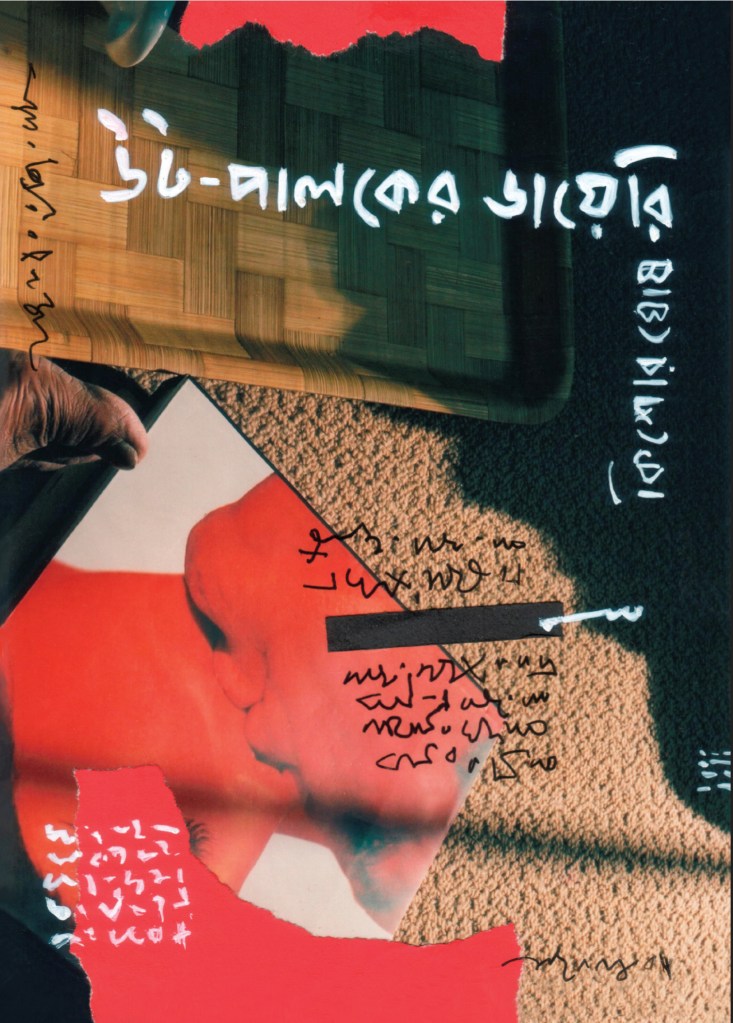
From 2003 to 2008, I was involved with four Little Magazines. Bengali Little Magazines thrive on minimal funds. Therefore, we (the team) managed everything necessary to publish a little magazine. We oversaw printing, distribution, book fairs, and other activities. By the middle of 2007, I realised I wasn’t suited for a day job. I understood that I would struggle to survive the conventional 10 am to 5 pm career. During that time, my family was in financial difficulties. Suddenly, we had the opportunity to publish Kishore Ghosh’s debut collection of poems, Ut Palaker Diary. It was published under the banner of the little magazine I was actively working with. As we worked on the book, I learned that publishing a magazine and publishing a book were entirely different endeavours. A little magazine is primarily sold through the efforts of its contributing writers and poets, while a book is sold through the combined efforts of the author and the publisher. I decided to pursue publishing as my career after we successfully sold 300 copies of Ghosh’s book in 10 months. That was the beginning.

Why did you opt to name your firm after a windmill — Hawakal in Bengali? Please elaborate.

We spent days selecting a name for our publishing concern. Finally, we chose the title of one of Kishore Ghosh’s poems as our company name. Hawakal, in English, means windmill. It signifies an alternative source of energy. We aimed to introduce a fresh wave in publishing. As an independent press, we have consistently operated ahead of our time. From developing a fully-fledged e-commerce hub (hawakal.com) in 2016 to producing the highest number of books during the pandemic (2020-2021), Hawakal has accomplished it all.

The first logo of Hawakal designed by contemporary artist, Hiran Mitra and then modified over time by Bitan Chakraborty.

You have boutique bookshops in Kolkata, Delhi — any other places? I believe you started a collaboration to get your books into the USA? Could you tell us a bit about your outlets and how you connect writers with the people? Are your boutique shops different from other bookshops? Do they only stock Hawakal books?

As you know, Hawakal has two functional ateliers in Delhi and Kolkata, while our registered office is located in New Delhi. We do not have any plans for an additional studio in India. We also have a bookstore in Gurgaon called Bookalign. There is a small outlet in Nokomis, Florida. It is a new unit in the United States. We primarily stock books published by Hawakal and its imprints (Shambhabi, CLASSIX, Vinyasa). However, we carefully select titles from other publishers for our store. We have sufficient seating in the store, allowing readers to browse the books before making a purchase. Since we publish non-mainstream authors, readers need to make a conscious choice. This not only benefits the authors we publish, but it also helps us evaluate the effectiveness of our selection process.

You started as a Bengali publisher, if I am not mistaken, and then forayed into English; now you are bringing out a translation in Hindi? How many languages do you cover? Do you plan to go into publishing in other languages?

We initially focused on Bengali books. Our venture into English titles began when Kiriti Sengupta joined Hawakal as its Director. Publishing a Hindi book was unexpected. However, we will not release books in other languages that we cannot read or speak. It is essential, as a publisher, to be well-versed in the language of the books we publish.

What kind of writers do you look for in Hawakal?

Would you like me to reveal the truth? We expect more than just satisfactory work from our writers: we want writers who will value their work passionately and take the necessary steps to reach a wider readership. Please don’t assume that what we expect from our authors is not something we adhere to ourselves. We expect this because we understand what it means to be truly passionate about one’s writing.

I heard that Hawakal was diversifying into textiles. How does that align with your writerly and publishing journey?

We opened our first kiosk in Mathabhanga, North Bengal, back in 2016. We simultaneously sold books and sarees from that small outlet. We had to close the shop due to a lack of staff. Kiriti Sengupta has long cherished the dream of representing the fine textiles of Bengal. Our family has grown larger. Bhaswati Sengupta and Lima Nayak have joined the team; they are the ones who established Mrinalika, collaborating with artisans from remote regions of India to showcase their creations to a wider audience.

Where do you envision yourself and Hawakal, your most extraordinary creation, ten years from now?

We aim to publish fifty timeless books over the next decade.

Thanks for your time and for the service you render to readers and writers.

[1] Ut Palaker Diary – Diary of a Camel Herder

Click here to read Disappearance, a story by Bitan translated from Bengali by Kiriti Sengupta.

(This feature — based on a face to face conversation — and online interview is by Mitali Chakravarty)

PLEASE NOTE: ARTICLES CAN ONLY BE REPRODUCED IN OTHER SITES WITH DUE ACKNOWLEDGEMENT TO BORDERLESS JOURNAL. 

Click here to access the Borderless anthology, Monalisa No Longer Smiles

Click here to access Monalisa No Longer Smiles on Kindle Amazon International