Standing in the Expanse Under the Neem Tree Cluster

I wait with a bundle of tinder logs rolled in a hessian sack.
It’s raining, the air humid, the dust in the air settled.
I wait for the pilgrims to pass, the coast town is overfilled.
I wait for today’s angels to avail my service,
Angels who arrive with spices and groceries,
They never bring the firewood. I cook their food with love.

I stand waiting at the crossroad with a jerrycan of petrol,
The fuel’s brown looking like gold, no sediments in there,
No decisions to be made by the private car users,
Except to notice the quality of my fuel,
And ask me if I could take over the wheels.
I drive with love. Whatever I do, I do with love.

All this waiting is about being and the essence of being
And finding means to make ends meet;
When the need stops, you would no longer find me
Standing in the expanse under the neem tree cluster;
The hessian sack or the jerrycan would continue
In the hands of another good person, waiting to learn.
Saranyan BV is poet and short-story writer, now based out of Bangalore. He came into the realm of literature by mistake, but he loves being there. His works have been published in many Indian and Asian journals. He loves the works of Raymond Carver.
.
PLEASE NOTE: ARTICLES CAN ONLY BE REPRODUCED IN OTHER SITES WITH DUE ACKNOWLEDGEMENT TO BORDERLESS JOURNAL
I sat in the railway station leaning on a chair.
The evening was pleasant with orange-violet cotton clouds.
The chairs were meant for the passengers waiting for the 5.45 pm shuttle.
The passengers carried veggies and sweetmeats in yellow bags to take home.
Most of the passengers were old and capable of coughing the phlegm of life.
One or two well-to-do walked up the refreshment stall and slurped the hot brew.
I never went to that side because it reeked of sour milk.
Aroma of guavas rented the air where I was seated. It is the season, though late.
The bill advertising the tabloid press said,
‘An engineer from the public works department was found dead in the reservoir.’
I have seen only fishes in those turbid waters, big and small ones snapping their tails.
Sometimes pachyderms appeared from the thick groove on the banks for a drink.
Doubts were raised if the engineer committed suicide, or was it a murder?
A crow wearing a grey collar flew under the roof. It pecked at crumbs fallen off
The potato wafers people bought, ate from polythene bags to kill hunger
While the wait pounded blue vessels and produced dreariness.
The fritters would be swept away before sunset
By the station cleaning staff enveloped in bellow-like overalls.
These particles would soon be part and parcel of the purple carboys in which garbage collects.
The crow has to make a quick dash for its supper. It did not pause to read the bill.
The news of the engineer’s death did worry the crow or anyone. We were not like the crow with the grey collar.
We sat craning our necks and knitting brows, not knowing what to do with what is left.
One of us returned and said the post-mortem is done. The pyre is lit without a trace.
Saranyan BV is poet and short-story writer, now based out of Bangalore. He came into the realm of literature by mistake, but he loves being there. His works have been published in many Indian and Asian journals. He loves the works of Raymond Carver.
.
PLEASE NOTE: ARTICLES CAN ONLY BE REPRODUCED IN OTHER SITES WITH DUE ACKNOWLEDGEMENT TO BORDERLESS JOURNAL
Imagine a situation,

where Earth instructs the gravitational force

to stop wasting its energy

holding together earthlings…

Earth is not God,

yet it speaks against God’s own subjects.

The earthlings comprised of us --

we always come as primary --

then the animals, the flora

-- the trees, plants the shrubs --

and the pale green cloud of fungus,

the water, the seas, the oceans,

the rivers, the lakes with or without bunds,

dams, reservoirs, dead tree-trunks sprouting from under,

the loose sand, the tight sand, the clay, the quartz, rocks

tnd the angry embryo of core --

the magma, anything in that or any other order.


Imagine a situation,

where the gravitational force decides

to stop wasting energy…

We would all be flying -- away from one another,

trying to wrest air in our lungs, those of us living beings,

try and find happiness for the left-over period of our life --

which is the primary purpose of everything,

of being alive, of breathing and of being. In that short time,


we delight in listing our achievements,

listing them as pinnacles to the sun,

to the moon and to that God, who has no ear for trivia,

and to God’s keeper of records,

who watches earthlings disintegrate. Some atone, atone and atone--

atoning for everything, in no particular order,

for the fear of truth behind some halfwits propounding

that death would place us at the crossroad,

between hell and paradise in which we no longer have a say.
Saranyan BV is poet and short-story writer, now based out of Bangalore. He came into the realm of literature by mistake, but he loves being there. His works have been published in many Indian and Asian journals. He loves the works of Raymond Carver.
.
PLEASE NOTE: ARTICLES CAN ONLY BE REPRODUCED IN OTHER SITES WITH DUE ACKNOWLEDGEMENT TO BORDERLESS JOURNAL
The rich golden-brown skin peeled off easily to expose the pink flesh underneath. The ‘frita’ was a perfect symphony of flavours with every note being in the right place. I enjoyed the entire fish including the bones and the head. I was having a ‘trucha frita’ (fried trout) at a restaurant in Magdalena del Mar, Lima, Peru. The fish was large and had been fried without much oil. Peru is known for its food, and I enjoyed my lunch (almuerzo) throughout my visit. Lunch is the major Peruvian meal. There were special lunch menus and for around 8 nuevo soles (around 2 US dollars and fifty cents). I got an entrada (usually a soup or a salad) and a segundo (seconds with a big variety of dishes) with a drink and often a dessert.
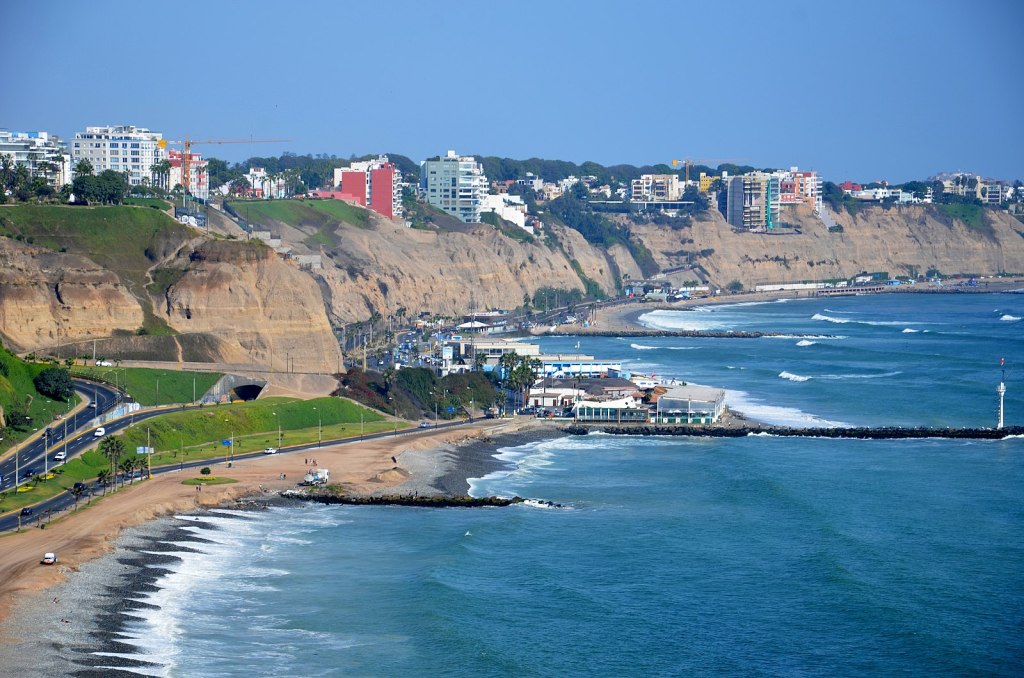
I landed at Lima’s Jorge Chavez International Airport late at night late in September. The airport is not very large by international standards but functions quite well. Taxi fares from the airport are on the higher side. I had taxi-hailing apps on my phone, but they did not seem to work at the airport. Lima is a city of around 11 to 12 million people. About a third of Peru’s population lives in the capital. There has been a recent influx of Venezuelan refugees to the city. The city is crowded but most of it is well-planned with squares, roundabouts, parks, and sidewalks.
I liked Lima. For a large city, it is not very polluted though some areas are dusty. The city is usually covered by haze or fog till late in the morning. The weather is usually cloudy though it rarely rains. About 40% of Peru’s population lives in the arid coastal region (la Costa). You see a lot of cambios or shops where you can change money. You also see a lot of restaurants. Lima is the third largest city in Latin America and recently has gained a reputation for its food. Peru has a lot of Japanese and Chinese immigrants (most of whom arrived at the end of the nineteenth and beginning of the twentieth century) and may be the most ‘Asian’ country in Latin America. Many Chinese run Peruvian Chinese restaurants called ‘chifas’.
Lima gained in importance during the Spanish rule and was the capital of the viceroyalty of Peru which included parts of modern-day Ecuador, Colombia, Bolivia, Chile, and Argentina. The city became very wealthy. During my different visits, I stayed in three different parts of the city — Pueblo Libre (Free town), Magdalena del Mar, and Jesus Maria. Lima is divided into several municipalities.
In Pueblo Libre, I stayed near the Plaza de la Bandera (Plaza of the Flag), a huge roundabout. The archeological ruins of Mateo Salado were nearby. Peruvians take great pride in their rich heritage. Following the Spanish conquest, the pre-Hispanic religions and cultures were violently suppressed by the Spaniards. They do continue to influence modern Peru in several ways but there is a stark discontinuity.
In the museum…
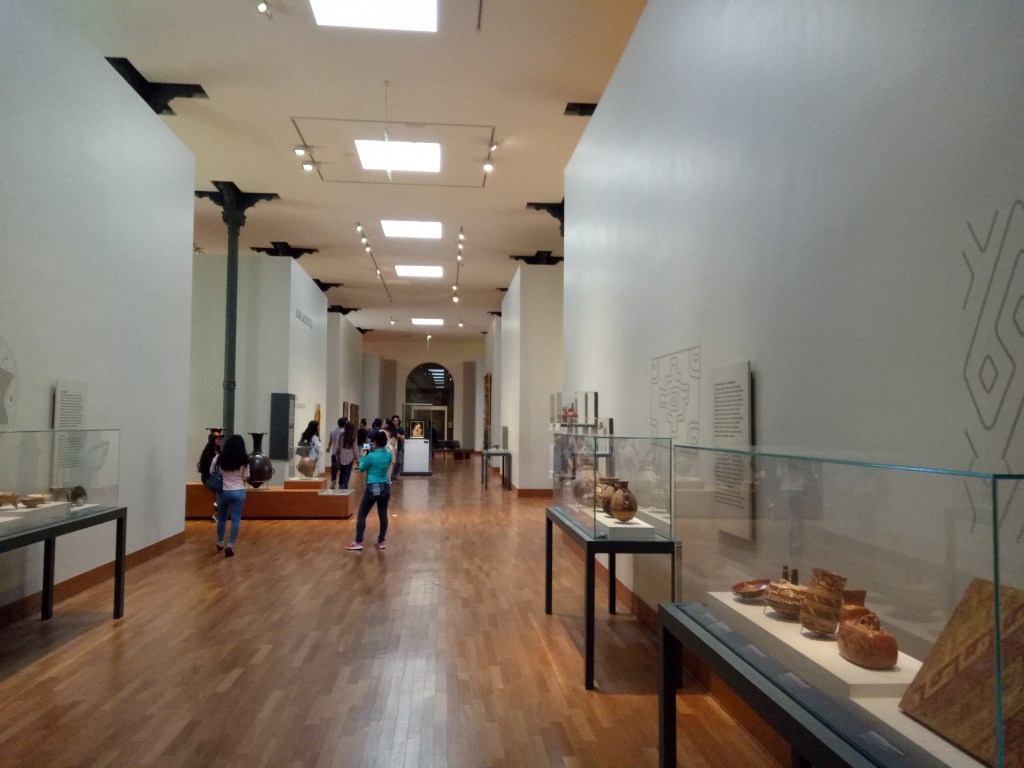
The Larco Museum is one of the many fine museums in the city. The museum has a rich collection of pre-Columbian art, is well-maintained, and is very appealing to the senses. Many civilisations took root on the arid coast. The Paracas and Nazca civilisations were prominent. The population had to learn to harness and use water from underground sources. The Anthropology Museum was under renovation, and I could only see the section commemorating the life of the liberator, Simon Bolivar. Bolivar is very popular in South America with several streets and buildings named after him. There is even a detergent named after him.
The Parque de la Leyendas (Park of Legends) is the zoo. The zoo is huge and is structured according to the three regions of Peru, the coast (costa), the mountains (sierra), and the jungle (selva). The Amazon rainforest constitutes the largest part of the country by land area. The largest city, Iquitos, can be reached only by boat or by air. The zoo also has a huge garden with plants from all over the world and a huge archeological site.
Plaza de Armas
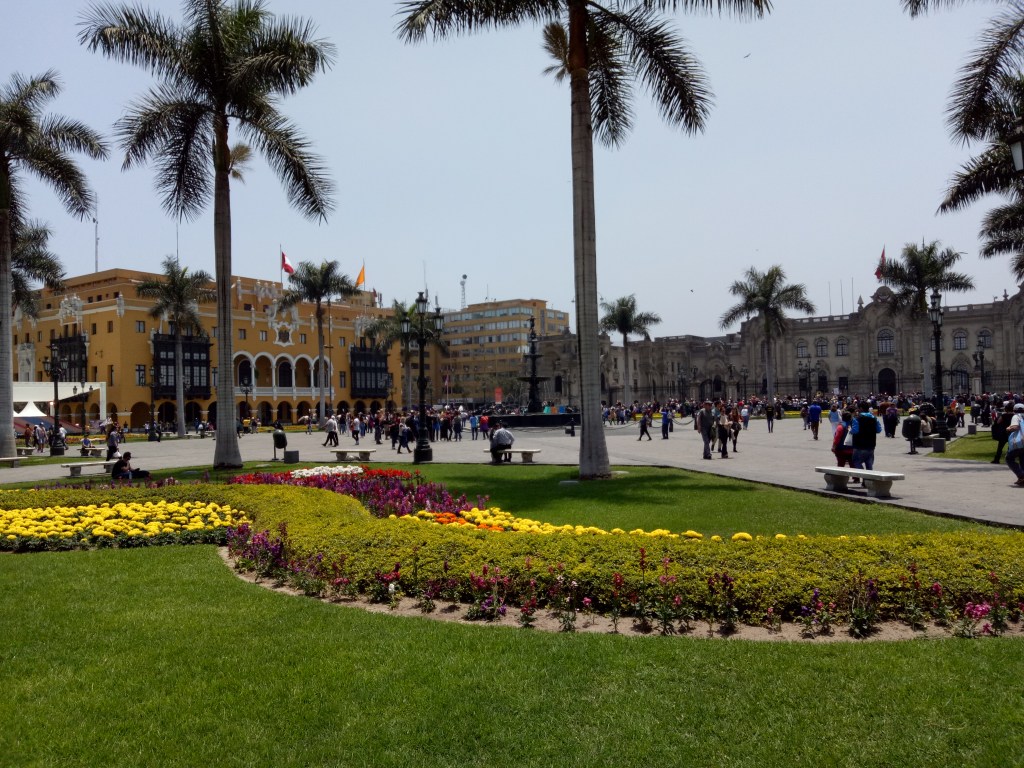
Plaza de Armas de Lima (Plaza Mayor lof Lima) is the main square of the city surrounded by fine Spanish colonial buildings. Every town in Peru has a Plaza de Armas. Town planning is mostly good with numbered sectors and streets within the city. I was fortunate to see the changing of the guard at the Presidential palace which takes place around noon. What a show of pomp, colour, and pageantry on horseback! The synchronisation was perfect. The cathedral of Lima, the municipal palace, and the palace of the Union are major historical buildings.
Changing of Guards
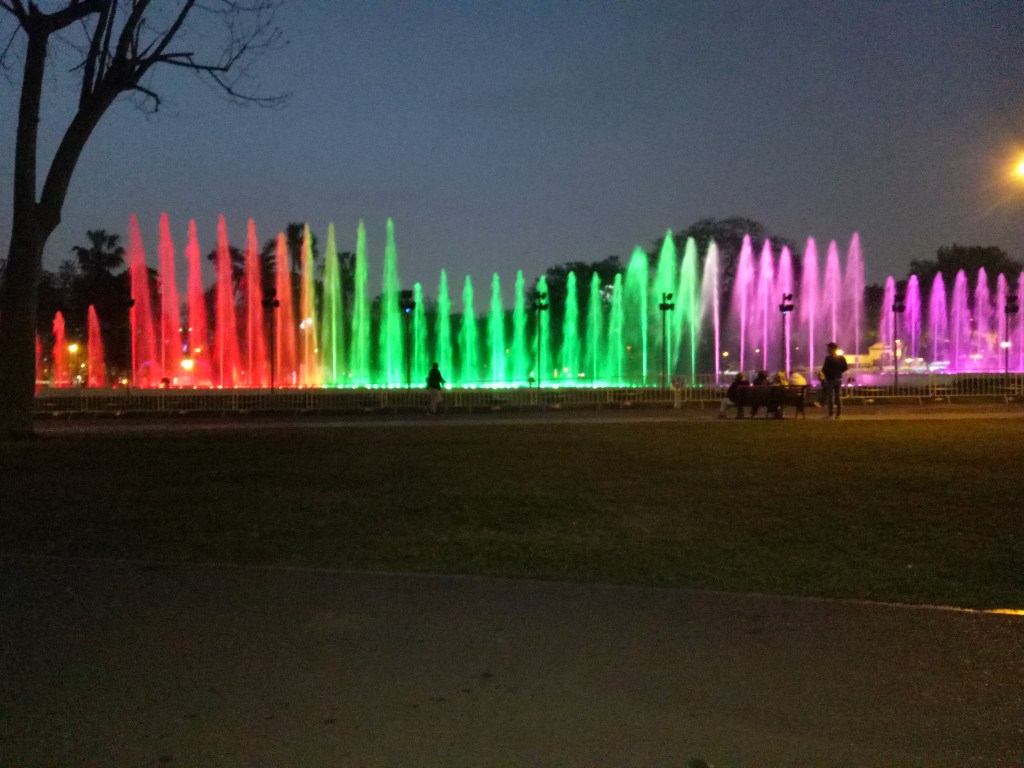
I had heard and read a lot about one of the more recent attractions of Lima – the magical water fountain. The Circuito Magico de Agua creates magic with water. I reached the place mainly known for the spectacular fountains around 5 p.m. You can walk underneath a tunnel of water. As the sun began to set the lights were turned on. The lights at the main fountain could reproduce an extravagant palette of colors and different scenes were created in tune with the music. There was a light show at 7.15 pm. Crowds began to gather around the main fountain. The light and sound show using lasers and lights was spectacular and provided a brief introduction to the rich tapestry of Peru.
Magical Fountains
Chicha morada is a drink from the Andes region and is made from purple corn. Rich in antioxidants, the drink is refreshing and healthy. Chicha morada is smooth and beautifully complements various Peruvian dishes. The alcoholic variety plays an important role in different religious and other ceremonies from ancient times to the present day. There is a legend about the corn (mama jora, mother corn) plant from which these drinks are derived.
The legend about the chicha[1] is especially popular in Cuzco, the ancient capital of the Inca empire, and also in other cities in Peru. In ancient times the God Viracocha (the creator) saw people working hard. He wanted to help them, so he came down from Hanaq Pacha (the world above) to place in a single plant the powers he wanted to give humans. He chose a weak plant that struggled to grow amidst spiny weeds. To give his power to this plant, Viracocha took from his bag a sliver of huaranguay wood, a puma hair, a condor feather, and the fox’s brain. He put them together and placed them on the small plant.
The city that treats visitors like kings with its sumptuous meals and friendliness, creates mystery with magical legends, like the one about Viracocha. Perhaps, that is why a sense of lingering longing and gratitude fills my being as I think of the colourful capital of that distant country on the other side of the globe.
Acknowledgment: Senor Fernando needs to be thanked for his hospitality and help during my visit — Dr P Ravi Shankar
Dr. P Ravi Shankar is a faculty member at the IMU Centre for Education (ICE), International Medical University, Kuala Lumpur, Malaysia. He enjoys traveling and is a creative writer and photographer.
.
PLEASE NOTE: ARTICLES CAN ONLY BE REPRODUCED IN OTHER SITES WITH DUE ACKNOWLEDGEMENT TO BORDERLESS JOURNAL
Can anyone say for sure, when Japan and Kerala or, for that matter, Japanese and Malayalam languages, came into contact for the first time? No, it is all buried in the chronicles of yore! This is so, in spite of the legendary Bodhidharma travelling from somewhere in the South-West part of India (Kerala?) to China on its way to Japan in AD 520, albeit still disputed!
With the arrival of the Portuguese in Southern Japan from Cochin(?) during AD 1543, there was obviously a possibility of Malayalee priests or laymen including ‘horse trainers’ and cooks, reaching Japan along with Portuguese navigators. But records of such visits are yet to be made public, being either in Portuguese, Chinese or Japanese archives.
However, according to Takako Mulloor, a daughter-in-law from Japan living in Kerala for the past half a century, such obscurities need not always be the case. She remembers the story of four Japanese youths who happened to visit Quilon and from there to North Kerala, sometime during the reign of Ōtomo Sōrin (1530-1587).
Sorin was one of the few feudal lords of Japan (Daimyo), to embrace Catholicism under the influence of Portuguese missionaries. Originally known as ‘Fujiwara-no-Yoshishige’, he was very powerful at the time, ruling most of Japan. Apparently, he thought it apt to ascertain the ‘truth’ behind the new religion that was spreading fast in his domain. Thus, he is said to have deputed four Japanese youths to Rome and Europe – a new world — to meet the Holy Pope and report back to him.
These youths, after completing their mission successfully, landed in Quilon, on their return voyage. Quilon was a flourishing port of that period. Due to some unknown reasons, they proceeded further north towards Cochin by local crafts, called ‘Kettuvalloms’. Unfortunately, one of them caught malaria and died somewhere on the way and was buried.
According to personal communication from Takako, such records are available with the NHK ( Nippon Hōsō Kyōkai) Brodcasting Corporation of Japan. She remembered that a TV team from NHK had visited Kerala sometime in 1979-80, to make a documentary on these youths and to locate the grave of the one who had lost his life. Takako was their interpreter on this mission, being fluent in Malayalam, Japanese and English.
While I was in Japan from 1965 to 1969, very little information was available in Kerala about Japan. Prior to leaving India, except for some writings by the renowned author MT Vasudevan Nair, the knowledge of Japanese language or culture was scanty.
On joining Osaka University of Foreign Languages (Ōsaka Gaidai), I was fascinated by the general manners of people in and out of the university. They were always kind, polite and willing to help especially students and others from abroad.
Despite having an advanced ‘Language Laboratory’ and excellent faculty, my language proficiency was mostly strengthened by the people on the street or in the villages of the Osaka suburbs. From the very beginning, I was also struck with an inexplicable quality in their language, with its unaccented delivery and melodious intonations that always reminded me nostalgically, of Malayalam!
Amazingly, both these languages were similar in several respects such as the order of alphabets, vowels and structure of sentences that usually didn’t end in a consonant.
We foreign students had to learn some special topics namely ‘Things Japanese’ that included Flower arrangement (Ikebana); Japanese theatre traditions Kabuki, Bunraku and the oral Rakugo and so on. In general, most of them including folk arts, proverbs, and day to day practices, reminded me of the village life in Kerala.
For instance, ‘banishing’ evil spirits from home was just the same as practiced in villages here. Above all, I could also recognise a few Japanese words more or less similar in meaning and pronunciation, synonymous with Malayalam!
That was when the idea of a Japanese-Malayalam Dictionary germinated in me. But, back in Tokyo University after completing six months’ language course, my attention was mainly focused on research, to earn a doctorate. Still, I was able to hone my Japanese speaking skills by constant interaction with the local people who were always enthusiastic about teaching foreigners, their language.
During the second year in Tokyo, unexpectedly one day, the Indian Embassy in Tokyo called me to enquire if I could teach a few senior Japanese government officials, Malayalam.
Didactic skill being not my forte with Malayalam, my first response was a polite ‘no’, despite the attractive remuneration offered. But the potential pupils would not be dissuaded. Thus started my part-time job as ‘Malayalam Teacher’, in Tokyo. Nearly three years of teaching came to an end on my completing my doctoral research, so as to return home.
Contacts with my erstwhile students were soon reduced to almost nil. One exception was an exchange of communication with a Shyoichi Itoh, who retained his interest in Malayalam as also Kerala. Occasionally, he used to write to me in Malayalam to my great delight, for comments and correction. He had also written some articles on Kerala in Japanese journals, on topics of interest to Japanese readers, based on his experience.
The unique Writers’ Co-operative of Kerala (SPCS) was one of such topics covered. Similarly, at my request and as suggested by the editor M T Vasudevan Nair, he wrote an article for the Malayalam weekly, Mathrubhoomi, focusing on the ritual suicide of the famous Japanese writer Yukio Mishima, in 1970. He had also written a guide book for Japanese students interested in learning Malayalam entitled ‘Malayalam for Beginners’.
Subsequently in 1974, Itoh made a surprise visit to me in Poona where I was working at the time. In fact, he came with the happy news of joining The Tokyo University of Foreign Studies (TUFS) as Professor and Head of the Department of Malayalam. That was a deserving recognition of his dedication to the study of Malayalam. His Malayalam for Beginners is still in use in the University and elsewhere.
My last meeting with Prof. Itoh was during early 1982, when he visited my official residence in Tokyo, with his dear daughter. At that time, I was on a government of India assignment (1981-’85), renewing old contacts as well.
Sadly, Prof. Itoh passed away rather prematurely, in 1998.
After taking superannuation from my employer — an international organisation at that time – at the beginning of the current millennium, I settled down in Cochin, India. Still, the dictionary dream was alive and efforts for bringing Japanese and Malayalam closer, was always a passion!
During the early nineties, despite being immersed in professional activities, I had undertaken the translation of Nobel Laureate Yasunari Kawabata’s [1]novel, Yama no Oto or ‘Sound of the Mountain’ (1971) directly from Japanese to Malayalam as Malayute Shabdam.
Published by Current Books (Trissur) in 1994, the translation was well received by Malayalee readers, resulting in more editions. Considering the fact that such translations are usually based on the English version due to language constrains, my work, directly from the original Japanese, is thought to be the first of its kind, in Malayalam.
However, the dictionary project could not be taken up immediately even after retirement, due to personal preoccupations. Ultimately, work on this long-awaited project was started in 2002, two years after retirement, in right earnest.
An old dictionary of Japanese-English-Japanese format, brought along from my ‘student’ days in Osaka was used as the first reference source. Published in 1950 by the Obunsha Company of Tokyo, it was the only one available for me at that juncture.
Following untiring work, the first draft was ready in two years. It was prepared in the Japanese-English-Malayalam format covering some 2000 foolscap pages and nearly a hundred thousand head-words. The meaning of each word and phrase was given in English and Malayalam with Japanese pronunciation in Malayalam fonts. The entire manuscript was compiled in long hand, without using a typewriter or computer!
Thereafter, attempts to get a competent publisher in Kerala was futile mainly due to the non-availability of Japanese fonts for printing. As a final solution, it was felt necessary to obtain fonts from Japan. However, the impasse was broken finally when my old friend and great historian Prof (Dr.) M.G.S. Narayanan introduced Toshie Awaya, a faculty member of the TUFS, as a conduit for assistance from that university.
While discussing various possibilities with Awaya, it was a pleasant surprise to know that late Prof. Itoh, my ‘old student’, used to be her Malayalam Professor!
Subsequently, on visiting Japan with my wife, a meeting was arranged with the late Indologist and renowned historian, Prof. Noboru Karashima, whom I knew during Tokyo University days. He was living in Kamakura, and Awaye took us to his very impressive residence for discussion.
On that occasion, as he suggested, it was decided we meet Prof. Jun Takashima and Prof. Makoto Minegishi engaged in dictionary-related research, in TUFS. They were attached to the Institute of Languages and Cultures of Asia and Africa (ILCAA). Established in 1964 within TUFS, this institute was engaged in promoting academic exchanges between Japan and other Asian-African nations, having been recognised as competent to carry out that task.
The two Professors during a meeting that ensued in the Institute, were amazed to see the sample manuscript of the dictionary that was shown to them. Firstly, use of ‘long hand’ instead of typing or computer printing, seemed out of this world to them.
Another fact, of more importance, was that the dictionary used as reference source material was outdated. It was pointed out that in view of the fast-evolving nature of languages with the addition of new words incessantly, the earlier work had become redundant.
While agreeing to discard the manuscript, we decided to start afresh using a latest dictionary as source to digitalise the new version with the help of a software developed by Prof. Takashima! It was also agreed that the manuscript thus produced with my data would be arranged in a ‘camera-ready’ copy at the ILCAA, that could be suitably published in Kerala.
After several exchanges of visits from India to Japan and Japan to India followed by umpteen number of corrections and revisions, the promised ‘final’ product was ready by the end of 2018.
Then, it was a matter of finding a qualified publisher. The Kerala State Institute of Languages, Thiruvananthapuram, that readily agreed, was found to be the most appropriate one to accomplish that task, in an excellent manner.
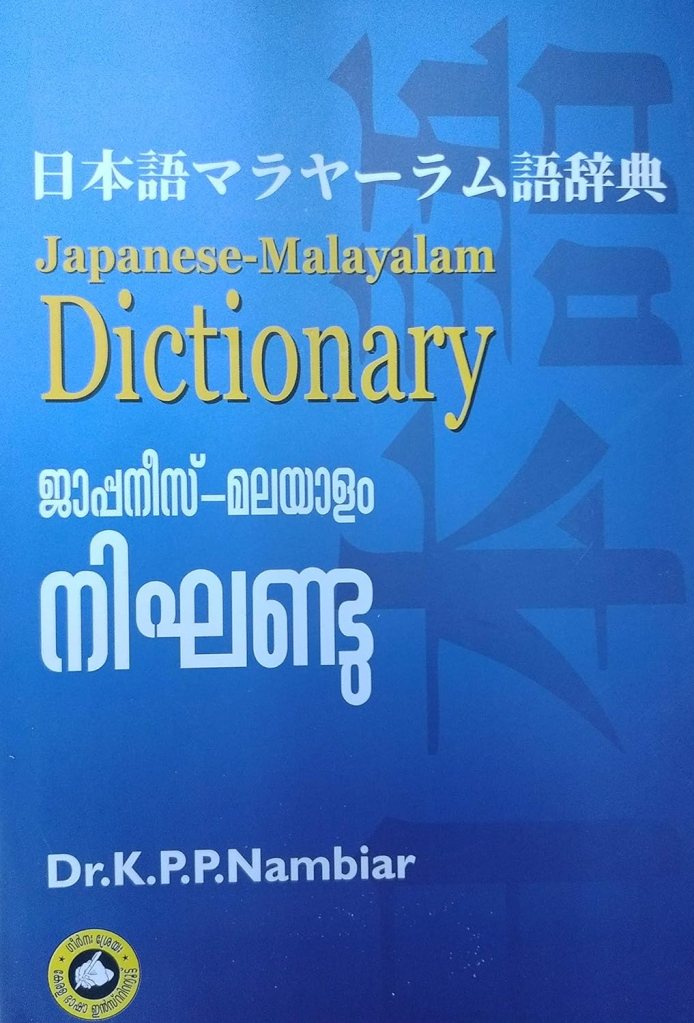
The formal release of the beautifully printed and bound Japanese-Malayalam Dictionary of some 1500 pages was formally carried out in the presence of the ILCAA Professors, by Kerala State Cultural Minister A.K. Balan. Hideki Asari, Minister and Dy. Chief of Mission, Japanese Embassy, New Delhi and several other dignitaries were present on the occasion in Thiruvananthapuram on March 8, 2019.
With such a happy finale of a hard work put in during some sixteen years of my post-retirement years, the dictionary may represent a milestone in the annals of Japanese-Malayalam affinities.
During the half a century that elapsed from the time of my first landing in Japan and the release of the dictionary, major changes are manifested in the ethos of Japan-Kerala interactions. Exchange of visits by artists, academics, writers and common people, resulted in the publication of several travelogues, translations, studies, and so forth enabling people of these two parts of the world to come closer, as I dreamt in the 1960s.
Several literary works from Japanese were translated into Malayalam by eminent writers from Kerala including M.K. Menon (Vilasini), K. Kunhikrishnan and others! General studies were also published about Japan, in Malayalam. An in-depth study of Kerala-Japan cultural relations is available in the remarkable book, ‘The Throne of Chrysanthemums’ by the gifted writer and artist, K. Asok Kumar.
In addition to such developments, many professionals from Kerala are now finding gainful employment in Japan, something unheard of a few years back.
In conclusion, it has to be emphasised that the age-old affinity between Japanese and Malayalam needs to be studied afresh by our linguists and historians, in the light of significant evidence emerging from various new studies.
When Rev.(Dr.) Robert Caldwell (1814-1891) postulated the theory of possible origin of Japanese and Tamil languages from the same root, there was no mention of Malayalam, in particular. So also Japanese professors – Akira Fujiwara (1981) and Susumu Ohno (2007) — who revived that hypothesis recently, were also not referring to the Malayalam connection.
Meanwhile, some of our erudite linguists such as Prof. Naduvattom Gopala Krishnan, were able to prove the ancient origin of Malayalam, from the same root as modern Tamil, proving eligibility of both these languages to be included in the ‘Classical Languages’ category, already accepted officially.
According to Prof Gopala Krishnan, the very fact that some ‘Malayalam only’ words were identified in ‘Sangam Literature’ of 300 BCE- 300 ACE, reaffirms its classical position. Even epigraphical evidence from the Edakkal Caves of Wayanad (Malabar), that go back to 6000 BCE, are said to be supportive of ancient origin of Malayalam, together with Tamil.
As such, there is an urgent need for a relook into our perspective of the gamut of Japanese-Malayalam affinities!
[1] Yasunari Kawabata (1899-1972) was the first Japanese to win a Nobel prize in 1968
Dr. KPP Nambiar, formerly a Consultant/Technocrat at the UN Food and Agriculture Organisation, is the author of many scientific papers and books, including a 1500-page Japanese-Malayalam dictionary.
PLEASE NOTE: ARTICLES CAN ONLY BE REPRODUCED IN OTHER SITES WITH DUE ACKNOWLEDGEMENT TO BORDERLESS JOURNAL.
Getting old is like climbing a mountain, you get a little out of breath
but the view is much better!
                                                                     - Ingrid Bergman, actress
He arrived in the morning. He was carrying a small bag but enough to contain things to stay for three to four days. His visit was unannounced. Although he was cordial, I didn’t inquire into the purpose of his visit. I invited him inside and showed him the spare room where he could rest a while. He was seventy-nine years and could do with some rest. His body language showed he was grateful, yet he didn’t offer a reason for his presence in the morning. I went inside the kitchen so that I could prepare a cup of coffee for him. I heard him move inside his room, the footsteps of an old man. I could hear him take things out from the bag and push some back. After a while, the sounds stopped. The house turned silent. It sounded silent and silence sounds like death. My eyes roved over the kitchen table to check on the things available to make a decent breakfast for uncle. He was in need. He looked famished.
I pushed open the door leading to the backyard, in the kitchen garden, the plants were unkempt. It was a messy area of about forty-four square feet. I plucked brinjals and tomatoes to make the sambar respectable and to add on to the coconut chutney which was already done. There was also coriander, not ready for plucking, but at times like this it could be useful. I heard the sound of the cistern flush, the water drained without giving inkling of anger. I handed him the cup, he took it and kept looking at the floor. He drew an arc with the toe of his right foot. I could not understand what the act meant except he was disturbed. There would be time later to get to know. For the time being I let him feel at home. He didn’t inquire about my husband’s whereabouts. My husband was his nephew. Uncle might have assumed Shyam has gone to office. Actually, Shyam has gone to handover his Renault Kwid for the first unpaid service. He would be late today. Shyam too would have to have his breakfast before starting for work. Maybe they could have it together. We all could.
I hoped uncle would spruce himself and be ready before Shyam returned. I was not going to rush him.
Shyam would be in a terrible hurry. He could catch up with his uncle while he is pushing the idlis[1] down his throat. I have to keep requesting Shyam time and again to eat slowly. Food is meant to be enjoyed and not be dealt with as if it is a task to be completed. Breakfast is the only meal Shyam has at the dining table. He took his lunch in the office canteen and the night meal was invariably at the bar he frequented. I had rehearsals for the coming play at Ranga Shankara in Jayanagar. Most evenings, I was out. I think he ate only fritters and no proper dinner. I never questioned him about his activities. He found that convenient.
I went past the room in which the uncle was lodged. I pretended to go out under some pretext. The garbage collector had entered the street. The garbage needed to be in cans outside the gate. I peered in. The door was open. Uncle was seated on the mattress leaning back on his hands. He was looking up at the ceiling fan, at his own reflection on the chromium plated hub-cap. He had not switched the fan on, the weather was fine. I collected the compost bag and kept tossing handfuls on the potted plants in the courtyard. That was my weekly routine. The plants responded to the manure but the moment the plants shoot buds, insects destroyed them. I tried to give uncle some privacy by remaining in the garden. He looked rather pulled down. If he wanted to make some calls in my absence, I’d rather facilitate it; but he didn’t.
Uncle lived in Hebagoddi with his only son, his house overlooking the wholesale fruit market. Whenever we visited, I found him standing on the open terrace upstairs and watching the trucks loading and unloading. Ajay resigned his job in Hosur and had left to take up new assignment in Abu Dhabi. He told us he wanted to move with his family to Abu Dhabi. I wondered if he could take his father as well. Maybe that was what made uncle preoccupied – the thought of being left alone without his son, who was also his caregiver. Uncle had a handsome pension as a retired school master. He was not dependent monetarily, but he needed someone to assure him everything was going to be fine. An old man required assistance and supervision. My dad’s brother had dementia from being lonely they said. since He had no one to talk to. He was a bachelor with lots of money but dementia doesn’t check the wallet before setting in.
I went back to the kitchen. The decoction had filtered down. I mixed the coffee and took it along with two Marie biscuits. He took it and placed it on the table. His hand shook. He said, “Thanks.” He wasn’t curious about Shyam’s absence. I was surprised he did not inquire. He was Shyam’s uncle not mine.
I told him, “Shyam would be back shortly, I will serve breakfast when he comes.”
“That’s nice”, he said. “In that case I will have the coffee after breakfast. I took Pantacid just now. Let the medicine do the job.” He took the two biscuits, placed them on the paper napkin and returned the cup.
I said, “Fine.” I lifted my chin to scrutinize his face.
“Its difficult to live with Ajay’s wife,” he said. Uncle moved towards the window turning face away from me. The top two panes of the window were open. They overlooked the vegetable garden I was ambitious about curating. Beyond that was a small 30 feet road. I did not attempt to mollify him. I left the job to Shyam. He was Shyam’s his uncle.
Uncle said, “I can grow enough vegetables in my house in the terrace, I mean in Ajay’s house. People these days grow vegetables in plastic grow-bags you know. I can grow enough for the family or even more. She wouldn’t allow.” He meant Ajay’s wife. Growing vegetables is my passion. My conviction is one should try to grow food in lifetime instead of only consuming. It’s my desire to grow at least one kilo of rice with my bare hands at least once in my life, I told this to uncle in order to keep him cheerful until Shyam returned.
“We should find a place in our village and try doing growing the rice there. Being in city, you can’t”, he said and curbed his instinct say more. The conversation cheered him and I believed took his mind away from Ajay wanting to shift his family to Abu Dhabi. I was not sure if Ajay was planning to take his dad there. It may not have been a workable proposition.
I said, “Its good to try, to think on those lines. I guess Shyam would agree to the idea post his retirement. As of now I have this theatre group which pegs me here.”
A car entered the lane, the sound of its engine was echoing from the between the compound walls. The colony would have looked more impressive without the compound walls. The car stopped in front. The driver’s face seemed familiar but I could not place him. Shyam got down from the other side. He thanked the driver and entered. The car sped away, it was an old red-coloured Punto. The driver smiled on seeing I was trying to place him.
I was not sure if I should inform Shyam about the unannounced guest or leave him to find out for himself. Maybe he knew of the arrival and had forgotten to inform me.
Shyam said, “I must rush, Sundar has promised to pick me on the way. Can’t make Sundar wait.” He went straight into the washroom. He was the type who would expect his wife to keep his clothes ready when he came out of the bath. Before that, he would want the towel. I did that part of the chore, returned to the living room from where I could see uncle. He was not affronted by Shyam’s behavior. He seemed to understand. He smiled sympathetically upon seeing my distress.
“Let me set the table for breakfast,” I told him and went about doing so. I wanted to tell Shyam to eat slowly — to get up only when uncle finished. Uncle came out of the room for the first time. He sat quietly in front of the dining table where Shyam sat normally. He leaned using his elbows on the table. He saw me arranging the plates. He opened the lid where idli was stacked. He smiled again. There was plenty. I too sat pretending to remove the speck on my plate.
“I have to find an old age home,”he said nodding his head.
“It would do you good. you can be all by yourself,” I said.
“You don’t understand the point Kamala,” he said. I could hear Shyam coming out of the bathroom. He started dressing. He dressed himself first before using the hair drier and combing his hair. I knew as soon as he finished, he would head for the dining table. I waited for the sound of the drier being switched off. I had not informed Shyam about uncle’s presence as yet. Waiting at the breakfast table, I was not sure I should make the effort. He obviously was not expecting to find uncle. I hoped he would be polite to his uncle.
Shyam came in. He had heard our voices, if not the subject of our conversation. He was pleased perceptibly to see his uncle, he went behind him, put his hand over uncle’s shoulders and gave him a hug from behind. He said, “What a surprise! How is Ajay doing? Is he really liking it out there, it is a dangerous country, not meant for one with his kind of temperament.” Shyam rushed with his words, he wanted to convey whatever he wanted quickly without giving scope for his uncle to respond. He looked at me and said, “I promised uncle that I would find him a comfortable old age home. Better that Ajay takes his family quickly to Abu Dhabi. He has the knack of getting into trouble if left alone.”
Uncle didn’t want to prolong the conversation about his son. He said, “Something that fits my pension, not a paise more, I don’t want to take help from Ajay though he may be earning in Dinars now.”
He craned his neck to see when I would start serving. Shyam pulled the chair away from the table to sit, the chair made a grating noise on the floor. I switched the fan on and started serving. The three of us ate quietly. Shyam kept stuffing idlies as was his habit. He choked a bit but managed to swallow without any issues. I had only one idli. I got up to prepare coffee. Sundaram could arrive any moment, though Shyam had not stated the time of his arrival. Shyam took his uncle to the verandah in front. I could hear them talking, though I could not make out what they discussed. It sounded like they wanted to keep me out.
Uncle left our house after three days. He never went back to Ajay’s house. He went straight to the old age home. I felt sad. Shyam had arranged accommodation where uncle could stay in relative comfort. That’s what Shyam told me the previous night.
Whatever the comfort and care the old age home offered, such homes for the aged could not offer hope. Inmates kept falling sick, became invalids and sunk to death slowly. Besides they all had their own tales of woe which each would share, deepening the shadows in others lives. A home could not offer hope.
Shyam said the three days stay with us had restored uncle’s faith in humanity. It was a tall statement, though I suspected it was true. We tend to seek our own space in the kingdom of self-righteousness, we feed on such feelings. During the afternoons we had watched movies together on Netflix or Prime Video. Uncle made the selection. He always chose a crime thriller or science fiction, avoided movies focused on family relationships.
He took me into confidence and confessed on the last day. Shyam was to drop him at an old-age home named after Mother Theresa the next day. Uncle told me almost in whispers after the movie, as if he didn’t believe what he said, “Ajay’s wife is very loving, I can’t say she was wanting in that faculty.” I wanted to believe uncle.
When uncle left, there were tears in his eyes. He didn’t try to mask his feelings. I could not figure if it was on account of a feeling of gratefulness or of grief. He sprayed the insecticide on the rose plants in the courtyard while Shyam was loading his things in the car. I had presented him warm blanket in case the home didn’t provide one. Shyam promised to visit him often, though he did not specify how often.
Ajay’s family had left. He sent uncle photos of their new home. I had half a mind to tell uncle to stay with us, though I didn’t. He was not a bother, was really not a bother. He would have helped with the kitchen and courtyard garden as well as the proposed one in the terrace upstairs. During his brief stay, he helped to water the plants, folded the laundry, cut vegetables for cooking, he cut such perfect cubes. He enjoyed peeling garlic pods. He loved it. One day when the daily maid absented herself, I even found him doing the dishes quietly without letting me know. I had closeted myself in our room to memorise lines and cues of a new play.
Uncle could have stayed with us if it was not too long. Life looks interminable if we don’t know how long. We didn’t know how long all this would go on had he stayed. He looked healthy though he was seventy-nine. You never know. Love without willingness to take on the responsibility was an aborted child, that much I knew.
Saranyan BV is Bangalore based poet and short-story writer. His works are being published in Indian and Asian journals regularly. He came to the realm of English by mistake but loves being there. He is a big fan of Raymond Carver and Charles Bukowski. He thinks that the genre short story is going to rule literature in the days to come, if the writers are ready to take up the challenge.
.
PLEASE NOTE: ARTICLES CAN ONLY BE REPRODUCED IN OTHER SITES WITH DUE ACKNOWLEDGEMENT TO BORDERLESS JOURNAL
Saranyan BV is poet and short-story writer, now based out of Bangalore. He came into the realm of literature by mistake, but he loves being there. His works have been published in many Indian and Asian journals. He loves the works of Raymond Carver.
.
PLEASE NOTE: ARTICLES CAN ONLY BE REPRODUCED IN OTHER SITES WITH DUE ACKNOWLEDGEMENT TO BORDERLESS JOURNAL
Phosphenes are the colourful depictions of lights that we sense with our eyes closed. Courtesy: Creative Commons
Naïve are the phosphenes

Asleep, when our eyes close,
It is not darkness as we imagine --
A night of timelessness and of starry wisdom unfolds,
In whose halcyon ambience,
Eyes link to ears to
Compose lilt-lyre music of intriguing feathers.
The mind is more alert than when we are awake.
The kind breeze throws up phantasmagorias.
The swank phosphenes,
Unlimited by and native to parameters of the iris’s womb,
Rove with infinite images,
Roving the planet and roving the universe,
Chariots of legitimacy, more beautiful than the colours of rain --
Naïve are the phosphenes, that we have seen, known and never embraced.
Saranyan BV is poet and short-story writer, now based out of Bangalore. He came into the realm of literature by mistake, but he loves being there. His works have been published in many Indian and Asian journals. He loves the works of Raymond Carver.
.
PLEASE NOTE: ARTICLES CAN ONLY BE REPRODUCED IN OTHER SITES WITH DUE ACKNOWLEDGEMENT TO BORDERLESS JOURNAL
The night has nearly come to an end.
The old year is almost past.
Under this dust, it will lay down
Its worn-out life at last.
Whether friend or foe,      wherever you go,
Old wrongs cast
Away. On this auspicious day,
Old grievances shed as the old year parts.

— Nobo Borshe or on New Year by Tagore
Art by Sohana Manzoor
Mid-April, Thailand celebrates Songkran and Cambodia, Thingyan — water festivals like Holi. These coincide with the celebration of multiple New Years across Asia. Sikhs celebrate Baisakhi. Kerala celebrates Bishu and Tamil Nadu, Puthandu. Nepal celebrates Nava Varsha and Bengal Nobo Borsho or Poila Boisakh. A translation of Tagore’s poem on the Bengali New Year in spirit asks us to dispense with our past angst and open our hearts to the new day — perhaps an attitude that might bring in changes that are so needed in a world torn with conflicts, hatred and anger. The poet goes on to say, “I want to tie all lives with love” but do we do that in our lives? Can we? Masud Khan’s poems on love translated by Professor Fakrul Alam explore this from a modern context. From Korea, Ihlwha Choi tells us in his translation, “Loving birds is like loving stars”. But the translation that really dwells on love bringing in changes is Nabendu Ghosh’s ‘Gandhiji’, translated by Ratnottama Sengupta, his daughter. The short story by Ghosh highlights the transformation of a murderous villain to a defender of a victim of communal violence, towering above divides drawn by politics of religion.
Another daughter who has been translating her father’s works is Amna Ali, daughter of award-winning Punjabi writer, Nadir Ali. In ‘Khaira, the Blind‘, the father-daughter duo have brought to Anglophone readers a lighter narrative highlighting the erasure of divides and inclusivity. A folktale from Balochistan, translated by Fazal Baloch, echoes in the footsteps of ‘Emperor’s New Clothes’ — a story that can found in the Andersen’s Fairy Tales published in the nineteenth century. I wonder which narrative had come first? And how did it cross cultures retaining the original ideas and yet giving it a local colour? Was it with traders or immigrants?
That such narratives or thoughts are a global phenomenon is brought to the fore by a conversation between Keith Lyons and Asian Australian poet Adam Aitken. Aitken has discussed his cross-cultural identity, the challenges of travel, writing, and belonging. Belonging is perhaps also associated with acceptance. How much do we accept a person, a writer or his works? How much do we empathise with it — is that what makes for popularity?
Cross cultural interactions are always interesting as Rhys Hughes tells us in his essay titled ‘My Love for RK Narayan’. He writes: “Narayan is able to do two contradictory things simultaneously, namely (1) show that we are all the same throughout the world, and (2) show how cultures and people around the world differ from each other.” The underlying emotions that tie us together in a bond of empathy and commonality are compassion and love, something that many great writers have found it necessary to emphasise.
Mitra Phukan’sWhat Will People say?: A Novel is built around such feelings of love, compassion and patience that can gently change narrow norms which draw terrifying borders of hate and unacceptance. We carry an excerpt this time from her ‘Prologue’. Somdatta Mandal has reviewed Chitra Banerjee Divakurni’s latest , Independence. Starting from around the time of the Indian Independence too is Song of the Golden Sparrow – A Novel History of Free India by Nilanjan P. Choudhary, which has been discussed by Rakhi Dalal. The Partition seems to colour narratives often as does the Holocaust. Sometimes, one wonders if humanity will ever get over the negative emotions set into play in the last century.
Closer to our times, when mingling of diverse cultures is becoming more acceptable in arts, Basudhara Roy introduces us to Bina Sarkar Ellias’s Ukiyo-e Days…Haiku Moments, a book that links poetry to a Japanese art-form. While a non-fiction that highlights the suffering of workers by enforcing unacceptable work ethics, Japanese Management, Indian Resistance: The Struggles of the Maruti Suzuki Workersby Anjali Deshpande and Nandita Haksar has been reviewed by Bhaskar Parichha. The narrative, he writes, “tells the story of the biggest car manufacturer in India through the voices of the workers, interviewed over three years. They give us an understanding that the Maruti Suzuki revolution wasn’t the unmitigated success it was touted to be when they tell us about their resistance to being turned into robots by uncompromising management.” That lack of human touch creates distress in people’s hearts, even if we have an efficient system of management and mass production is well elucidated in the review.
These changes are reflected in our musings too. Sengupta has written on how change is wrought on a murderous villain by the charisma of Gandhi in her father’s fiction, as well as this world leader’s impact on Ghosh and her. Devraj Singh Kalsi addresses food fads with a pinch of sarcasm. From Japan, Suzanne Kamata has written of a little island with Greek influences, a result of cultural ties brought in by the emperor Hirohito. Ravi Shankar takes us to Pokhara, Nepal, and Meredith Stephen expresses surprise on meeting a shipload of people from Colorado in the far reaches of the Southern Hemisphere while on her sailing adventures with beautiful photographs. Stories by moderns reflect diverse nuances depicting change. While Brindley Hallam Dennis writes of the passing of an era, PG Thomas integrates the past into the present to reflect how they have a symbiotic structure in the scheme of creating or recreating natural movements through changes wrought over time in his story. Paul Mirabile explores the darker recesses of the human existence in his fiction. As if in continuation, the excerpt from Rhys Hughes’ The Wistful Wanderings of Perceval Pitthelmseems to step out of darker facets of humanity with a soupçon of wit at its best.
To create a world that endures, one looks for values that create inclusivity as reflected in these lines from Charles Chaplin’s My Autobiography, “Mother illuminated to me the kindliest light this world has ever known, which has endowed literature and the theatre with their greatest themes: love, pity and humanity.” This quote starts off a wonderful essay from film-buff Nirupama Kotru. Her narrative carries the tenor of Chaplin’s ‘themes’ to highlight not only her visit to the actor’s last home in Switzerland but also glances at his philosophy and his contributions to cinema across borders.
Our issue rotates around changes and the need for love and compassion to rise in a choral crescendo whirling with the voices of Tagore, Charles Chaplin as well as that of twenty-first century writers. Perhaps this new year, we can move towards a world – at least an imagined world — where love will wipe away weapons and war, where love will take us towards a future filled with the acceptance of myriad colours, where events like the Partition and the Holocaust will be history, just like dinosaurs.
Huge thanks to all our readers and contributors, some of whom may not have been mentioned here but are an integral and necessary part of the issue. Do pause by our April edition. I would also like to give my thanks to our indefatigable team whose efforts breathe life into our journal every month. Sohana Manzoor needs a special mention for her lovely artwork.
There are times in life you want
Grandkids crowding around your legs,
And you want to be patient with them.
And times when you don’t want all this.
Want to quietly read books,
To punch the pedals on your bicycle.
There are times when neighbour’s kids
Come to play, they are old enough
To know this is not their home,
But they can come and go.
Fill your life with borrowed joy,
And fill it with space.
It’s time to feel like grandpa
When the road is wet
And without potholes.
Saranyan BV is poet and short-story writer, now based out of Bangalore. He came into the realm of literature by mistake, but he loves being there. His works have been published in many Indian and Asian journals. He loves the works of Raymond Carver.
.
PLEASE NOTE: ARTICLES CAN ONLY BE REPRODUCED IN OTHER SITES WITH DUE ACKNOWLEDGEMENT TO BORDERLESS JOURNAL







 Borderless