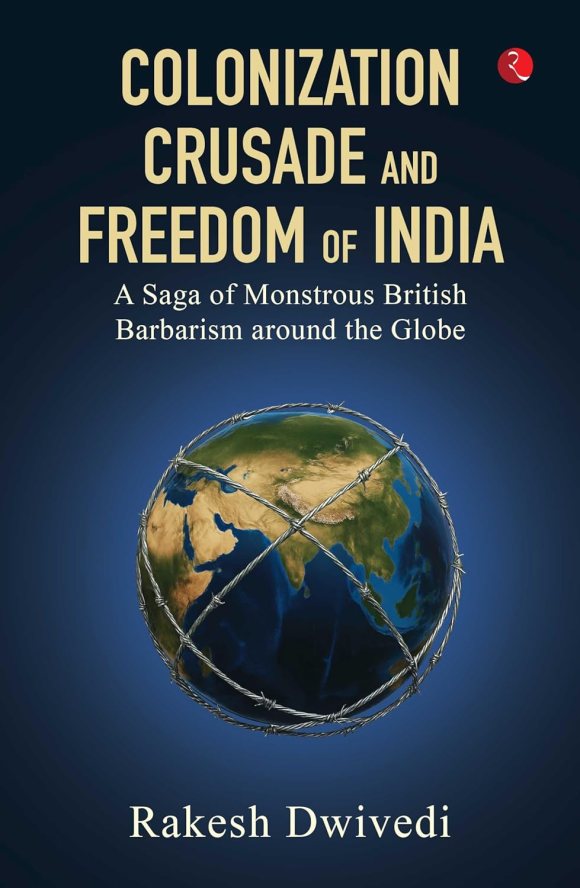
Title: Colonization Crusade and Freedom of India: A Saga of Monstrous British Barbarianism around the Globe
Author: Rakesh Dwivedi
Publisher: Rupa Publications
Rakesh Dwivedi’s Colonization Crusade and Freedom of India is an unflinching indictment of British imperialism and a forceful challenge to the long-standing narrative of colonialism as a “civilizing mission”. Written with the precision of a seasoned constitutional lawyer and the moral urgency of a historian disturbed by selective memory, the book seeks to dismantle the myths surrounding the British Empire while situating India’s freedom struggle within a wider global context of colonial violence.
At its core, the book argues that British rule in India was not an aberration of excesses but a carefully structured system of exploitation sustained by economic plunder, engineered famines, racial hierarchies, and institutionalised violence. Dwivedi rejects euphemisms such as “benevolent administration” or “rule of law,” insisting instead on naming colonialism for what it was: a barbaric enterprise masked by moral rhetoric. In doing so, he aligns himself with a growing body of postcolonial scholarship that seeks to recover suppressed histories of suffering and resistance.
One of the book’s notable strengths is its global frame. Dwivedi does not treat India in isolation but links the subcontinent’s experience to British imperial conduct in America, Africa, the Middle East, and Asia. By drawing parallels between policies of extraction, demographic manipulation, and divide-and-rule strategies across continents, he underscores the systemic nature of empire. This comparative approach lends weight to his claim that colonial brutality was not incidental but intrinsic to imperial governance.
The chapters dealing with famines, wartime exploitation, and economic drain are particularly compelling. Using archival material, parliamentary debates, and secret British records, Dwivedi exposes how starvation and deprivation were often outcomes of deliberate policy choices rather than natural calamities. His discussion of India’s role during the World Wars—both as a resource base and as expendable manpower—adds a crucial geopolitical dimension to the freedom struggle, reminding readers that independence was shaped as much by global power shifts as by internal resistance.
Dwivedi’s legal background is evident in his methodical narrative. He builds his case like a prosecution brief—marshalling evidence, anticipating counter-arguments, and dismantling colonial apologetics with forensic rigor. This gives the book a distinctive voice, though at times the prosecutorial tone may feel relentless. Readers looking for narrative subtlety or emotional restraint may find the language uncompromising, even polemical. Yet this stylistic choice appears deliberate: the book is less concerned with balance than with moral clarity.
The treatment of Partition is another significant aspect. Dwivedi views it not merely as a tragic inevitability but as a consequence of imperial betrayal and strategic manipulation. His critique of British exit policies challenges sanitized accounts of decolonisation and raises uncomfortable questions about responsibility, culpability, and historical accountability.
That said, the book’s sweeping scope occasionally works against it. The ambition to cover centuries of imperial history across multiple regions can lead to dense passages that demand close attention. Some readers may also wish for greater engagement with alternative historiographical perspectives. However, these limitations do not diminish the book’s central achievement: forcing a re-examination of colonial history stripped of nostalgia and imperial self-congratulation.
Colonization Crusade and Freedom of India is not a neutral history—it is a corrective one. It speaks directly to contemporary debates about historical memory, reparations, and the politics of remembrance. In an age when empire is often romanticised in popular culture and public discourse, Dwivedi’s work serves as a necessary provocation.
This book will resonate most with readers interested in colonial studies, Indian history, geopolitics, and the ethics of empire. Whether one agrees with all of Dwivedi’s conclusions or not, his argument compels engagement. It stands as a powerful reminder that freedom was not gifted to India—it was wrested from an empire whose legacy must be confronted, not softened.
.
Bhaskar Parichha is a journalist and author of Cyclones in Odisha: Landfall, Wreckage and Resilience, Unbiased, No Strings Attached: Writings on Odisha and Biju Patnaik – A Political Biography. He lives in Bhubaneswar and writes bilingually. Besides writing for newspapers, he also reviews books on various media platforms.
PLEASE NOTE: ARTICLES CAN ONLY BE REPRODUCED IN OTHER SITES WITH DUE ACKNOWLEDGEMENT TO BORDERLESS JOURNAL
While mankind started out perhaps speaking the same language in the heart of Africa, now there are more than 7, 100 languages in the world. The differences in languages, cultures and rituals could be fanned as unsurmountable divides for political needs. However, translators build bridges with cultural and linguistic comprehension to create an overarching rainbow that shimmers with the colours of shared emotions. We celebrate International Translation Day with a discussion with five translators from South Asia on how they create links not just across vernaculars, but across cultures, time and space. We also have gathered together the colours of 28 languages and cultures and some unique discussions about books that have been translated recently.
Bridging Cultures across Time and Space: An exclusive discussion with Aruna Chakravarti, Radha Chakravarty, Somdatta Mandal, Fakrul Alam and Fazal Baloch. Click hereto read.
We are the World: Celebrating writers and translators who have connected us with these ideas across boundaries of time and place, we bring to you translated writings in English from twenty eightlanguages. Clickhereto read.
Professor Fakrul Alam discusses his new book of Tagore translations, Gitabitan: Selected Song-Lyrics of Rabindranath Tagore. Click here to read.
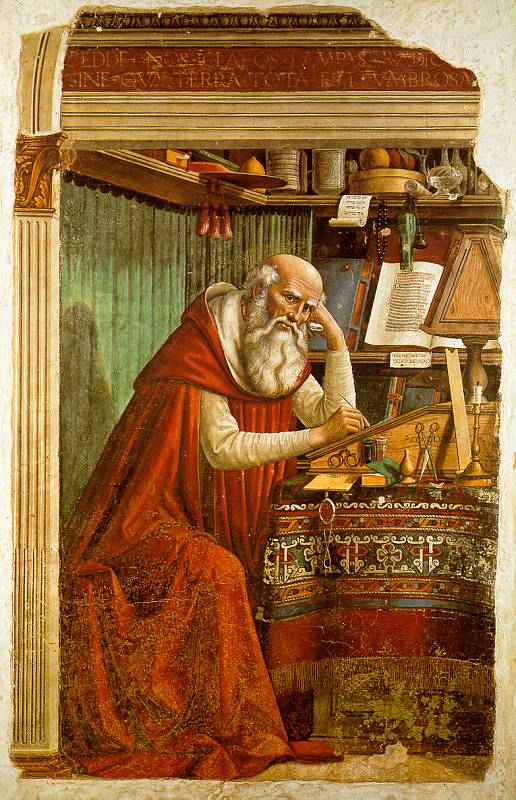
Saint Jerome (the patron saint of translators) by Domenico Ghirlandaio (1448-1494). The International Translation Day is celebrated on the the feast day of St Jerome, 30th September each year. From Public Domain
On our third morning in the Lowveld, my travel companion and I woke up at 4:00 A.M. for our third game drive in Kruger National Park. We’d signed up for this over a year ago when we first booked ourselves on this group tour. We didn’t know then that it would be raining.
The other ten members of our group had chosen other options. Some were planning to hang out at the lodge, probably anticipating a day of lounging by the pool while kudu and impalas lingered nearby nibbling grass. Another cohort had signed up for a different sightseeing tour, involving waterfalls, with a later starting time. My friend and I were here, however, for the animals.
She and I had first met in Japan. We’d lived in the same town. Our kids had gone to the same schools, and we’d taught at the same universities. When she had moved back to Australia, we’d remained in touch. Both of us loved to travel, and both had dreamed of going on safari in Africa. Neither of us knew of anyone else who shared the same dream, so we vowed to go together. I had imagined that it would be years before I would be able to afford such a trip, but a little over a year ago, she’d come across a great deal. And now here we were, in South Africa.
Half-asleep, we quickly dressed, stuffed our sack-breakfasts into our backpacks, and stumbled out the heavy wooden door into the still dark morning. A light rain was falling. Although signs warned of roaming wild animals, and we’d seen plenty, it seemed safe to walk up to the office building to find our driver. His Toyota safari truck was already parked outside. After a few minutes, he appeared, and we climbed into the back middle seats of the open-sided truck, hoping to stay clear of the rain.
Our driver and guide, a local who drove 20-40 kilometers per hour over the speed limit and doled out one interesting animal fact per sighting, handed us lined ponchos to keep us warm on the forty-minute drive to the park. Then we zoomed off, passing pecan and macadamia groves, on the way to Numbi Gate. People were already waiting at bus stops along the way, probably on their way to work.
As the sky gradually lightened, we could make out the names of the shops along the road: Dragon Flame Car Wash, No Error Driving School, Drama’s Sneaker Wash, God is Able Beauty Salon, and an alarming number of small businesses offering funeral services.
When we finally reached the entrance to the game park, the guide parked and got out to register. Although the parking area had been crowded the previous two days, on this morning, we were the only ones there.
We had seen quite a few animals over the past two days, including elephants, giraffes, zebras, a rare white rhino, and a mama lion and cubs, albeit from a distance. We rattled off our wish list to the guide.
“A hippo out of the water,” my friend said. “And a male lion.”
I had been lucky enough to see both on a previous trip to Rwanda, but I had yet to see a leopard, one of the so-called “big five,” or a cheetah.
“When is the last time you saw a leopard or a cheetah?” I asked.
“I saw a leopard a week ago,” he said. “And a cheetah yesterday.”
He warned us, however, that because of the rain, we might not see anything at all. The animals might be seeking shelter. We understood and accepted that.
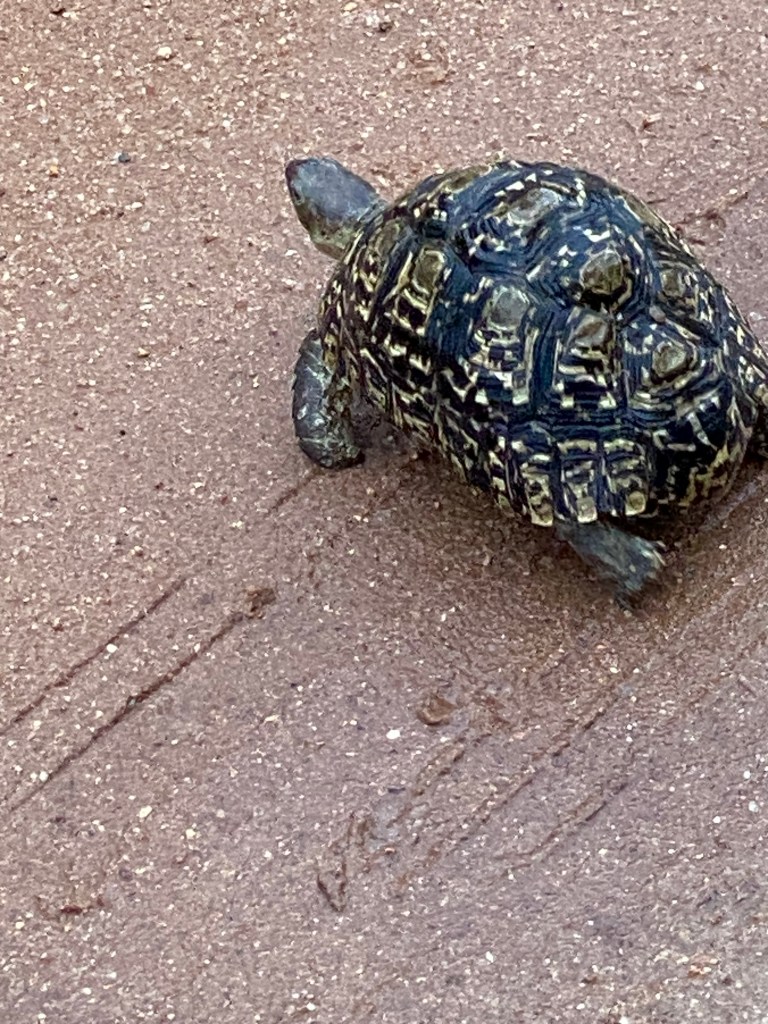
A few minutes into our drive, he braked the truck and pointed out a turtle making its way across the road. Understanding that this might be our biggest sighting of the day, I took a video of the creature with my smartphone. Soon after, we spotted some impalas. Although we’d seen so many the two days before that the guide no longer stopped for them, on this morning, we gave them our full attention.
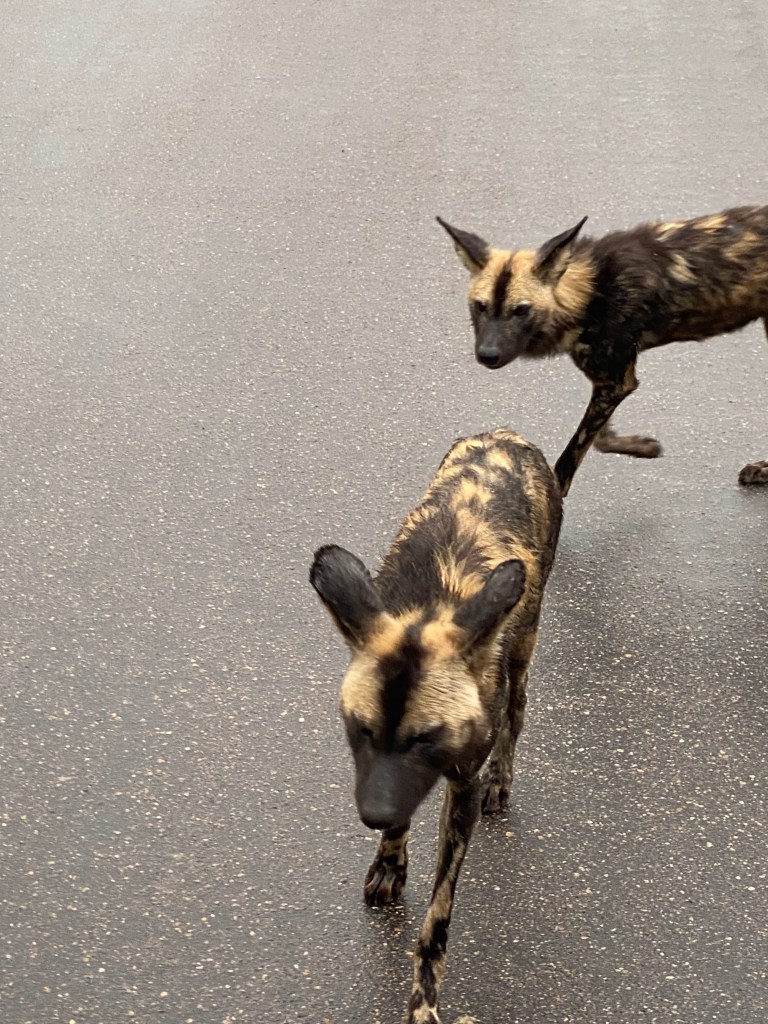
And then we saw something unusual—a pack of African wild dogs alongside and in the middle of the road. I had never seen canines with such colouring. Their fur was brown and black, almost tortoiseshell. These dogs were featured on a signboard at the park entrance indicating the day’s sightings.
“There are only about 150 of these dogs in the park,” our guide told us. He mentioned that they were expert hunters, that they attacked in groups. Since Kruger National Park is vast, with an area of 19,485 square kilometers, much of the terrain being well away from the road, I realized how lucky we were to see these dogs. They trotted along, sniffing at the road, mindless of the truck slowly following them.
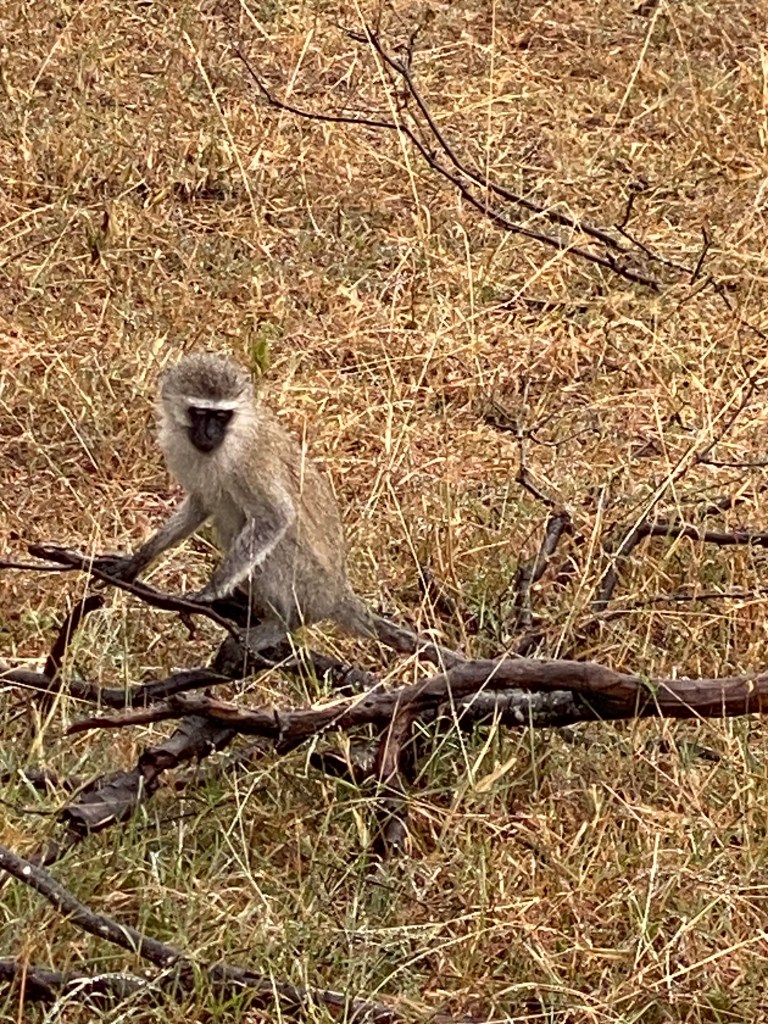
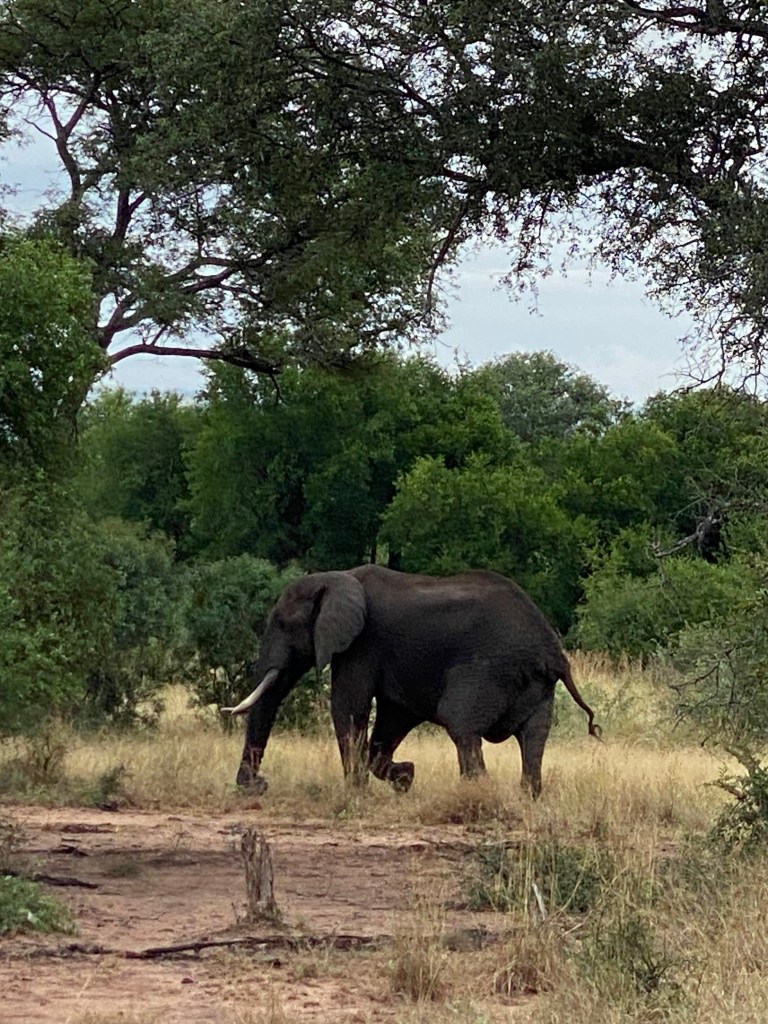
By this time, the rain had let up. Although we did not manage to see any hippos out of the water (they mostly come out at night to eat grass), we did see a herd of wildebeest, some vervet monkeys, an elephant, a water buffalo, baboons, and a Martial eagle perched on a high bare branch. And then our guide got a message on his phone and said, “From now, we’re not stopping for anything. Someone has spotted some cheetahs.”
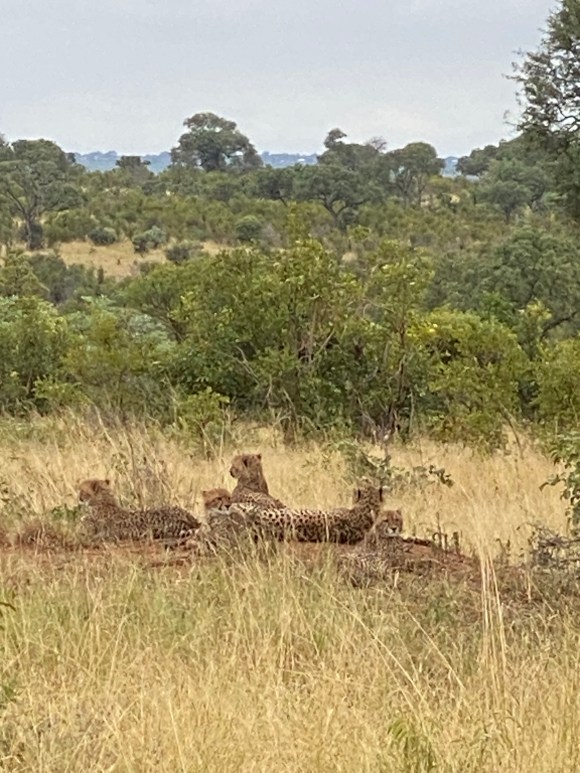
As he sped ahead, we crossed our fingers and readied our cameras. I expected the cheetahs to be far off in the distance, where they wouldn’t be scared off by the sound of cars, as the lions were. Why else would they stay in one place long enough for us to reach them? As it turned out, however, five cheetah cubs were gathered together, sitting still, gazing intently into the bush. They were near the road, only about fifty meters away.
“They’re waiting for their mother,” the guide said. “Maybe she will come back while we are waiting.”
My friend and I took turns admiring them through binoculars. How patiently they watched the impalas nearby. How diligently they groomed themselves. They were gorgeous, leaving us breathless.
We waited awhile, but there were others eager to see them, so our guide suggested it was time to move on. “Are you happy?” he asked us.
“Yes, very,” we both said.
Later, as we returned to the lodge, we thought about how jealous the rest of the group would be when they heard about the cheetahs. The rain started to fall again.
Suzanne Kamatawas born and raised in Grand Haven, Michigan. She now lives in Japan with her husband and two children. Her short stories, essays, articles and book reviews have appeared in over 100 publications. Her work has been nominated for the Pushcart Prize five times, and received a Special Mention in 2006. She is also a two-time winner of the All Nippon Airways/Wingspan Fiction Contest, winner of the Paris Book Festival, and winner of a SCBWI Magazine Merit Award.
PLEASE NOTE: ARTICLES CAN ONLY BE REPRODUCED IN OTHER SITES WITH DUE ACKNOWLEDGEMENT TO BORDERLESS JOURNAL
Jibanananda Das’ poems on war and for the common masses have been translated from Bengali by Professor Fakrul Alam. Click here to read.
A Scene with an Aged Queen, a poem by Ihlwha Choi has been translated from Korean by the poet himself. Clickhere to read.
Tagore’sEsho Bosonto, Esho Aj Tumi(Come Spring, Come Today) has been translated from Bengali by Mitali Chakravarty. Click here to read.
Pandies’ Corner
For Sanjay Kumar: To Sir — with Love has been written for the founder of pandies’ theatre by Tanvir, a youngster from the Nithari village where pandies’ worked with traumatised victims. Over time, these kids have transcended the trauma to lead fulfilling lives. The late Sanjay Kumar passed on this January. This is a tribute to him by one of his students. It has been translated from the Hindustani original by Lourdes M Surpiya. Click here to read.
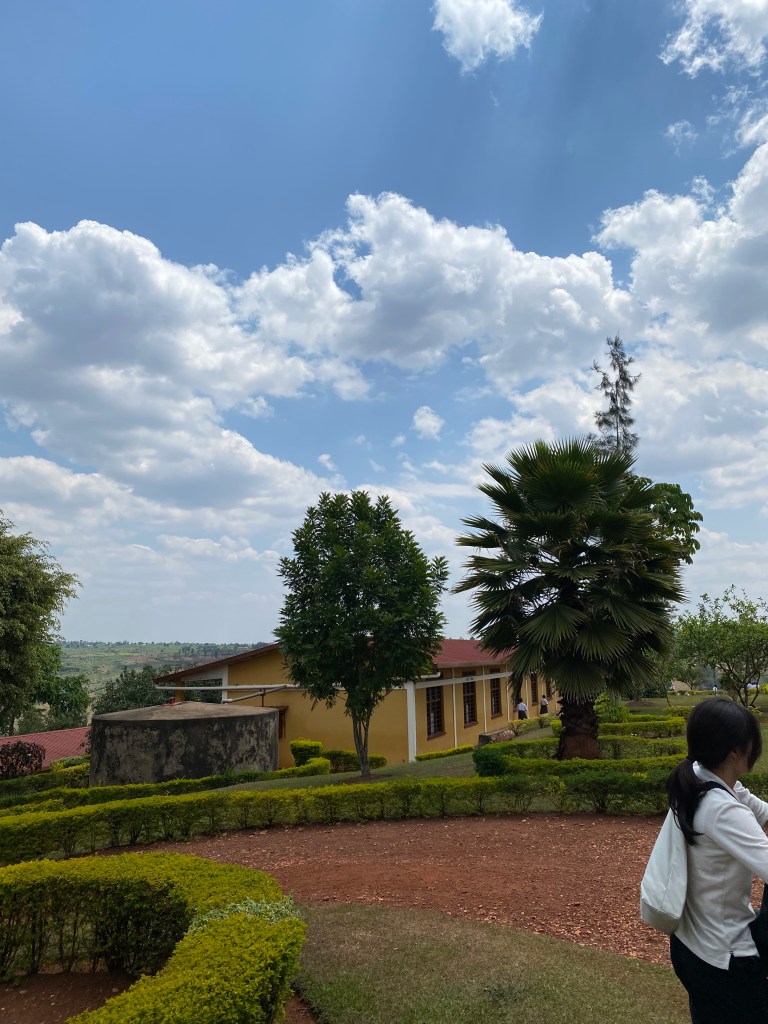
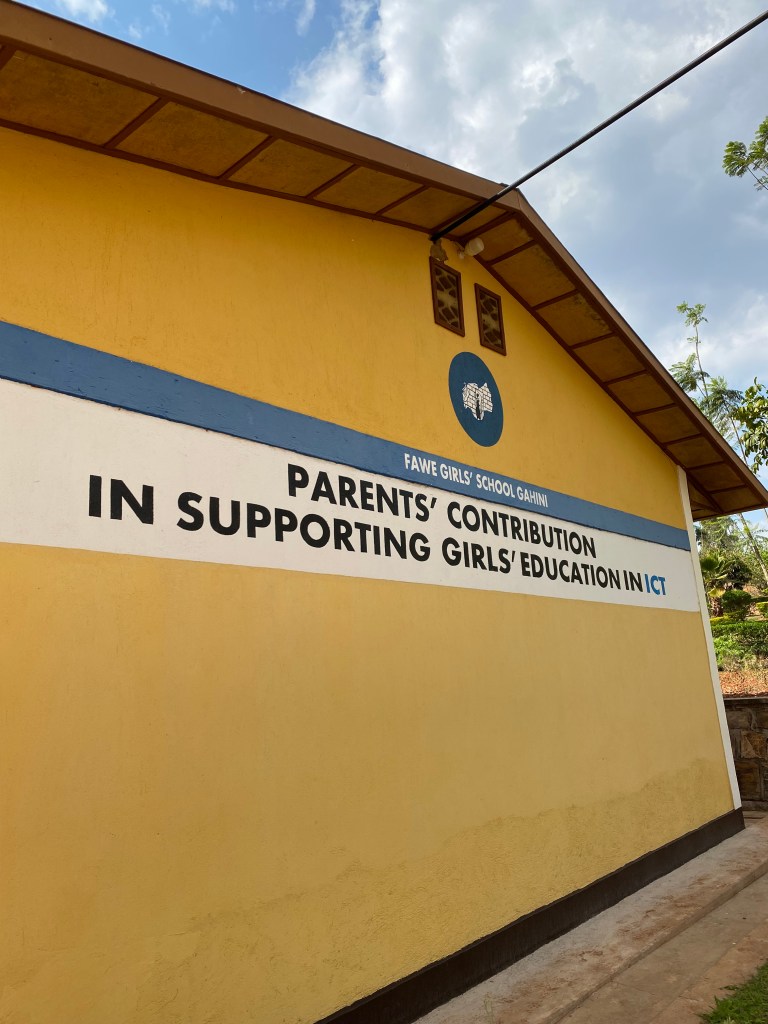
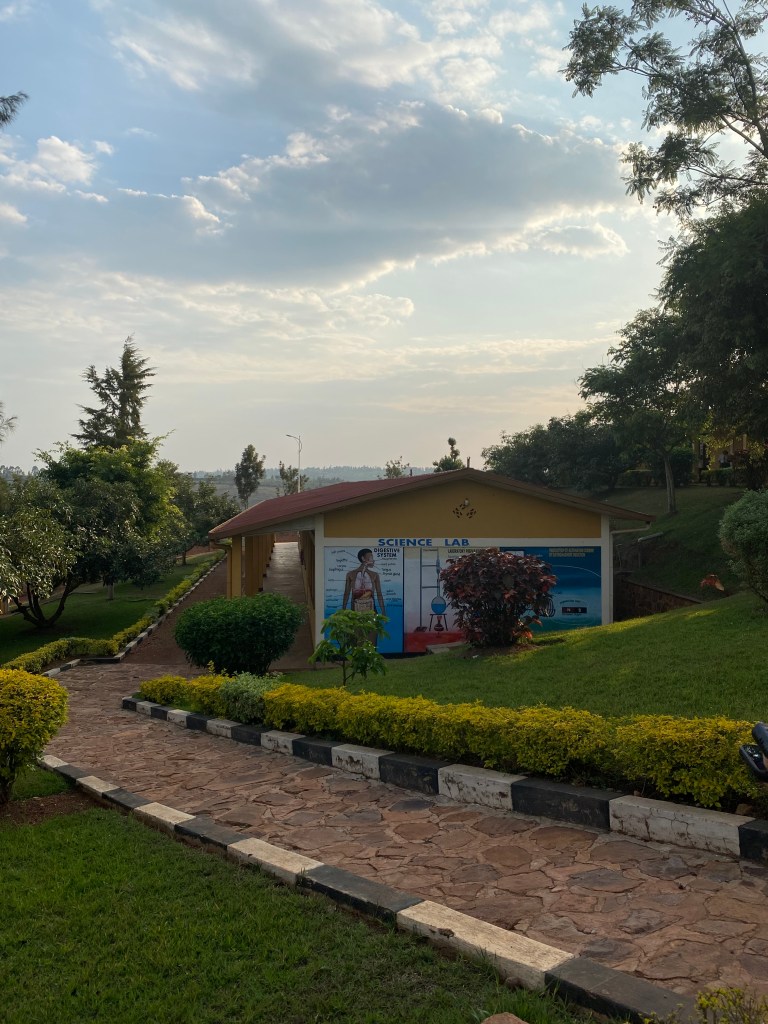
FAWE Girls’ School Gahini is in the Kayonza District of Rwanda, up a bumpy red-soiled road, on a hill overlooking acres of green. Various kinds of trees and shrubbery decorate the campus, which is made up of several small buildings painted yellow and roofed in red connected by walkways. Some are painted with murals or words extolling the importance of education. The outer wall of the Science Lab, for example, features a detailed diagram of the digestive system.
A male teacher in a white lab coat comes out to greet my three Japanese traveling companions and I as we alight from the air-conditioned Prado. Our driver Eugene, hired for this week by my colleague Satoshi, remains behind.
We have traveled here from Naruto, on the Japanese island of Shikoku, where two of us are professors and two, graduate students at a small teacher’s college, for a one-week research trip. Satoshi is going to conduct a survey on metacognition in solving math problems. This is part of an ongoing project for which he has visited Rwanda several times already. Last year, when he was about to embark on his trip, I mentioned that I had always wanted to go to Africa. Without hesitation, he said, “Let’s go!”
Of course, it was impossible for me to join him on such short notice, but he checked in with me periodically, telling me the dates of his next trip. I assured him that I was still eager to accompany him. For years I had included my dream of visiting Africa in my first day self-introduction to incoming students. Here was my chance.
I am not a math professor. I have an MFA in creative writing, but I have few chances to teach Japanese students how to write poems and short stories. Mainly, I teach English conversation, and academic writing courses. In the one class I devote to non-academic writing, an elective, I am lucky if even one undergraduate enrolls. Last year, the class included a visiting teacher from the Philippines and a graduate student, both of whom were auditing the class. Even the aspiring English teachers at our university mostly hate reading and writing. If it isn’t manga in Japanese, forget it! I keep a variety of popular novels in my office and press them into students’ hands when they ask me how they can improve their TOEIC[1] scores, but I feel victorious if even one student a year comes back for more.
During the trip, we would be visiting schools, and I would have the chance to conduct a few lessons. We would be visiting a private girls’ boarding school on the second day.
“You can do whatever you want,” Satoshi assured me.
Mostly, what I knew of Rwanda was from media reports about the 1994 genocide in which over a million Rwandans from the Tutsi ethnic group were killed by fellow Rwandans who identified as Hutu. I’d seen movies about the genocide, such as Hotel Rwanda, which the director of one of the memorials we visited would declare “a scam,” and read several books by the acclaimed Rwandan writer, Scholastique Mukasonga, who lost 37 family members in the massacre.
I boned up on education in Rwanda and found that as in some other African nations, such as Kenya, the country didn’t have much of a reading culture, although efforts are afoot to change that. In the epilogue to her poetry collection, Requiem, Rwanda, Laura Apol writes that in April 2009, at the International Symposium on the Genocide against Tutsi, the prime minister spoke of “the historical and literary necessity of having survivors not only tell their stories, but for the sake of history and art, write their stories as well.” Apol conducted writing workshops through a writing-for-healing project to help survivors and perpetrators process their grief and trauma. She’d helped Rwandans develop their writing over a week. I only had 30-40 minutes. Maybe I could get them to write a haiku.
Although there is still occasional violence by so-called Hutus against Tutsis (now simply Rwandans, according to their documents), the atrocities — which made up the genocide — occurred thirty years ago. The girls that I would be meeting hadn’t been born yet. I didn’t want to dwell on that sad historical event. I wanted to encourage Rwandan joy.
I prepared a PowerPoint presentation on haiku with photos, choosing examples that I thought would appeal to teenaged girls — a poem about eating ice cream, another about meeting a boy with “pirate eyes” on a beach, a poem featuring robots and a rainbow. I also included a sad haiku about violence against children in the United States, wanting to give them permission to write about tragedy, if they really wanted to.
I was hoping that they would write distinctly African poems, maybe featuring the gorillas that lived in the Western region, or the trees bearing mangoes, bananas, and avocadoes that seemed to grow everywhere. Perhaps they would write about the many people I saw bringing yellow plastic jerry cans to the river to gather water for daily use, the vendors of kitenge cloth in the markets, or the women who balanced loads upon their heads, or tended the fields with their hoes. They might write about the goat that they had sold to pay for their education, or the wild animals they’d seen on safari in Akagera National Park. But maybe all these things were cliches of Africa. I would not suggest these topics, would not insist that they reinforce my stereotypes.
On the day of the school visit, we are introduced to the smiling head teacher, a tall man who tells me that he has written both haiku and waka, the traditional five-lined Japanese poem. He seems bemused by our presence at his school. Nevertheless, he is affable and game to have us try to teach some girls something about Japan.
We are led to a dimly-lit classroom with four long tables. Laptops for each student’s use are on the tables connected to a power source. The English teacher, another man in a lab coat, sets up a projector, and I hand over my USB drive.
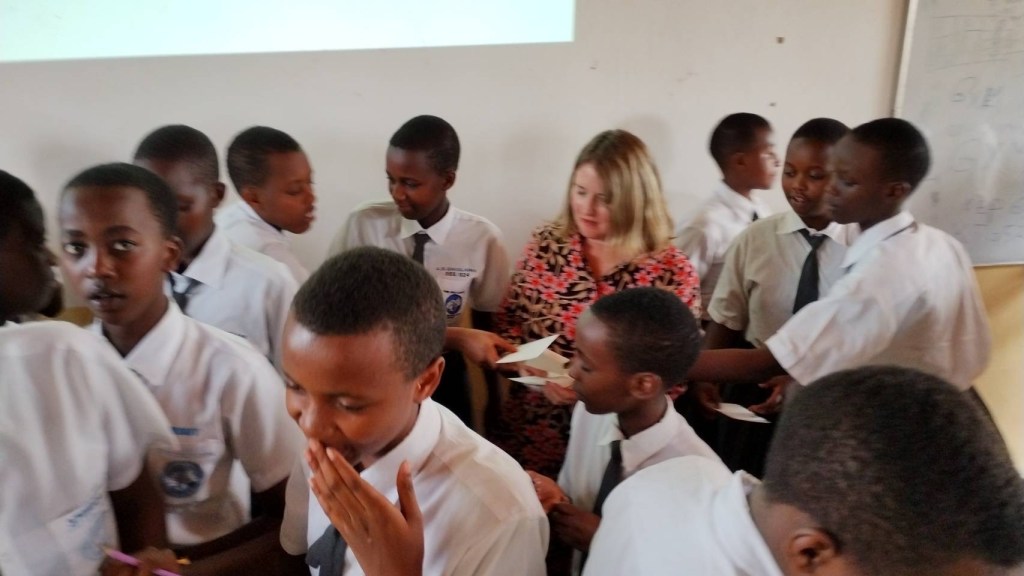
The girls file in, sit down, and automatically open the laptops. Their hair is shorn, and they are wearing white short-sleeved shirts, pleated gray skirts, and matching neckties. To get things started, Satoshi introduces our group and asks a few what they want to be in the future.
“Surgeon,” says one.
“Banker,” says another.
I remember how, when I had first arrived in bubble-era Japan as an assistant high school English teacher, the female students had replied “A good wife and mother.”
Okay. So these girls are good at English, and they are ambitious.
“Please close your laptops,” I say. I personally prefer to write poetry by hand, and I am always worried about students using generative AI, so I have brought pink and lavender pencils, which I bought at Daiso and sharpened back in Japan, and loose leaf lined paper.
I introduce myself briefly, explaining that I am an American, but I married a Japanese man, and have now lived in Japan for over thirty years. I also tell them that I am a writer, and I have brought some books by myself and others which I will donate to their library.
“A haiku,” I tell them, “is a short Japanese poem, usually consisting of 17 syllables, and including a kigo, or seasonal word.”
Their forty or so faces are turned toward me, but I can’t tell if they are engaging. When I ask if any of them have ever written poetry, four raise their hands. When I ask if they have ever written haiku, or even heard of it, the hands stay down. I go through my PowerPoint, noting their interest in a poem about Girls’ Day in Japan, on which families with daughters display ornate dolls representing the emperor, empress, and court.
“And now it’s your turn,” I tell them when I reach the last slide. “Let’s try to write a haiku.”
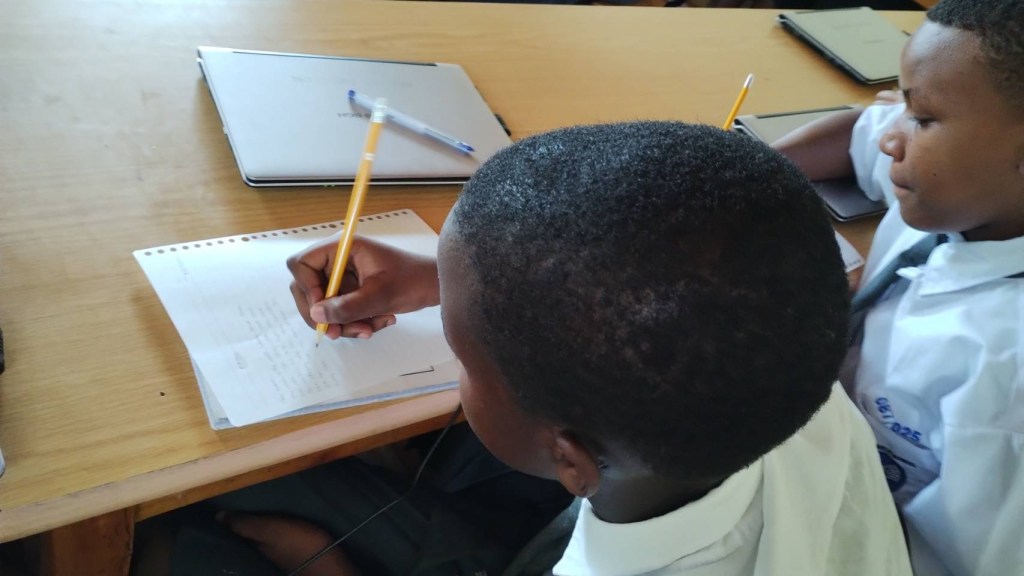
I ask them to think of an event, or a moment, and write whatever related words come into their heads over the next five minutes. They begin to scribble. When the timer on my phone goes off, I remind them that it’s okay to ignore the five-seven-five syllable rule, and that they don’t have to stick to seasonal topics. I tell them that if they are having trouble, they can use a poem from the PowerPoint as a template.
While they ponder and write, I wander along the rows, looking over their shoulders. I’m pleased to see that some have taken my suggestion to model their poem by one by Masaoka Shiki, about eating and drinking with friends on an autumn evening. But pizza? Ice cream? I’m a little disappointed that they didn’t use a more African dish, like brochettes, and banana beer. Then again, that is just my stereotype. Rwandans eat pizza, too.
Instead of writing a haiku, one girl writes a longer poem, which is clearly about the genocide. I realize that even though I want to encourage them to move on, to look to the future, to laugh and dance and celebrate, the trauma caused by the slaughter persists, hanging like a cloud over the country. Their parents probably lived through it, and there are reminders everywhere. Everyone has a story. Our driver tells me later that his father, sister, and brother were murdered. Rwandan students visit genocide memorials on school excursions as part of their education, just as Japanese students visit Hiroshima and Nagasaki. Peace education is deemed very important here, and, during this time of division, I can’t help thinking that it would be good in my own country as well.
At the end of the lesson, I tell them that what they have created belongs to them. I want them to keep their poems, but I also want to read them. I ask them to copy their haiku onto another piece of paper and give it to me.
“I hope you will keep writing haiku,” I tell them, my grandiose idea of promoting Rwandan literature in mind. I tell them of where they can send their poems for publication to an international audience. We pose for a group photo.
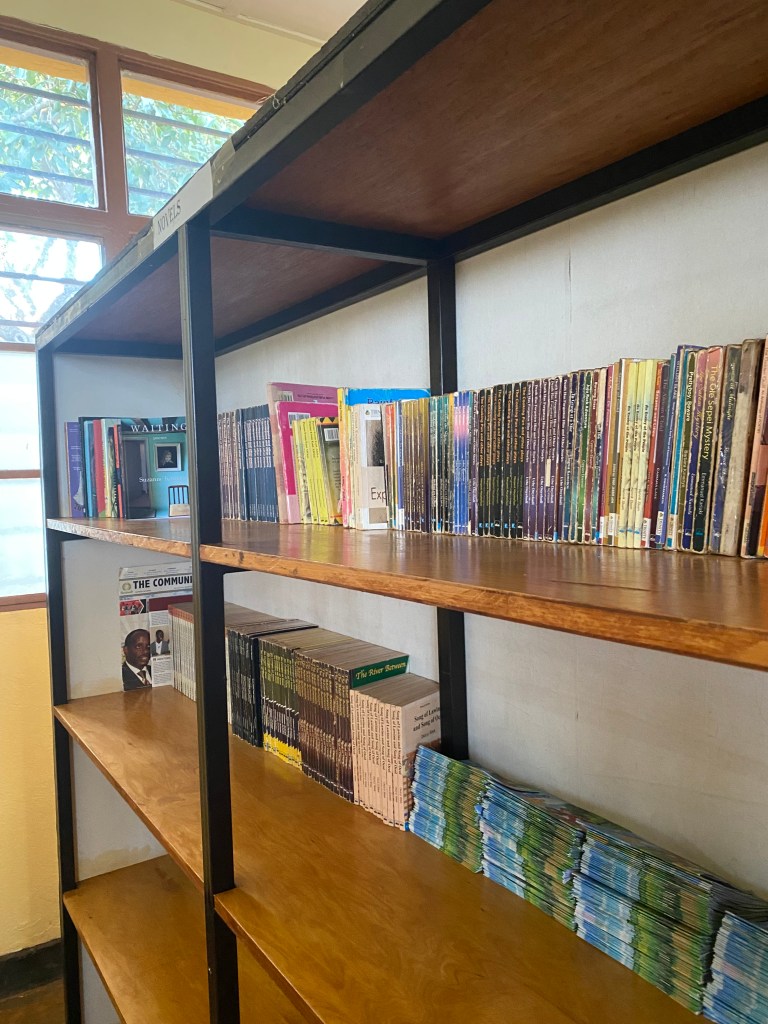
Later, I bring my books to the library.
“Bonjour,” says the nun librarian, who must have been schooled when French was the official medium of education.
I had not realised that this was a Catholic institution. I hope that no one takes offence that one of the books I am donating, which has been banned in some places in the United States, is about a Muslim girl. In another, a novel by a contemporary Zimbabwean writer, a teenaged girl confesses to having had premarital sex. A character is one of my own novels is a gay figure skater.
The nun accepts the books graciously and tells some tag-along students to place them on the fiction shelf. I stand back, noting that the ones already there are old and worn. Perhaps they do most of their reading online? In any case, there are no young adult novels for girls, nothing published in the past few years, and I know how expensive imported books are.
“I hope you will read them,” I say, thinking of my students back in Japan who hate to read.
“We will,” the girls promise.
I imagine a single girl, coming upon these novels and greedily devouring them one after another, perhaps seeking out more, and then beginning to write her own stories. I imagine coming across a novel in a bookstore written by a girl who grew up in Kayonza, who attended the FAWE Girls’ School Gahini. I imagine reading that book and posting about in on Instagram. And then I try to let go of my expectations, and say “murakoze,“ which means “thank you” in Kinyarwanda, and “goodbye.”
Hamburgers and fries
Speakers blare Billie Eilish
--lunch in Kigali

A Haiku by Suzanne Kamata
[1] The Test of English for International Communication
Suzanne Kamatawas born and raised in Grand Haven, Michigan. She now lives in Japan with her husband and two children. Her short stories, essays, articles and book reviews have appeared in over 100 publications. Her work has been nominated for the Pushcart Prize five times, and received a Special Mention in 2006. She is also a two-time winner of the All Nippon Airways/Wingspan Fiction Contest, winner of the Paris Book Festival, and winner of a SCBWI Magazine Merit Award.
PLEASE NOTE: ARTICLES CAN ONLY BE REPRODUCED IN OTHER SITES WITH DUE ACKNOWLEDGEMENT TO BORDERLESS JOURNAL
Borderless Journal started on March, 14, 2020. When the mayhem of the pandemic had just set in, we started as a daily with half-a-dozen posts. Having built a small core of writings by July, 2020, we swung to become a monthly. And we still continue to waft and grow…
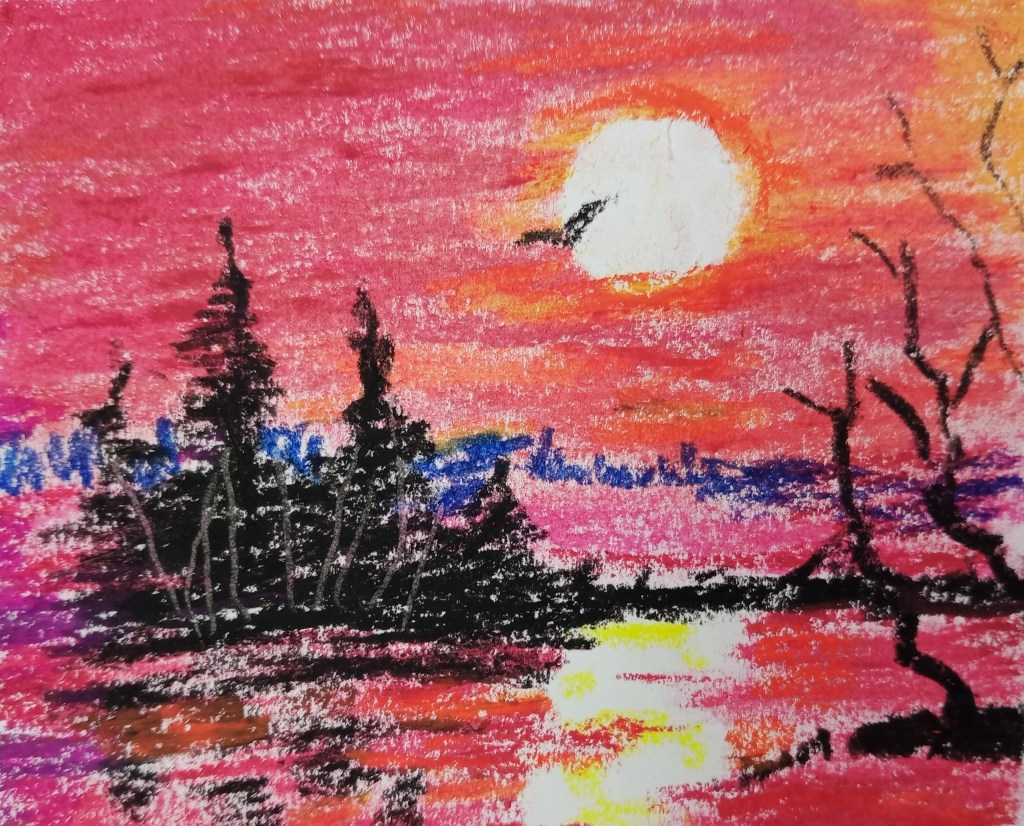
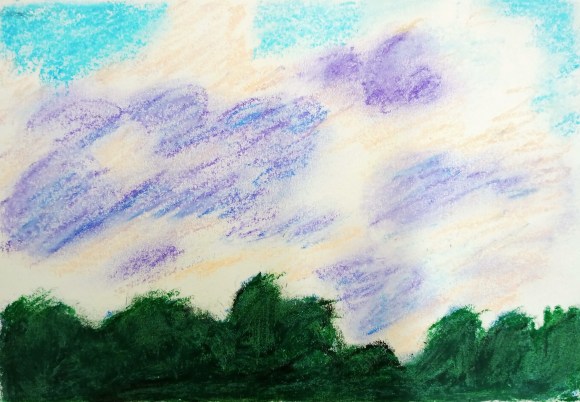
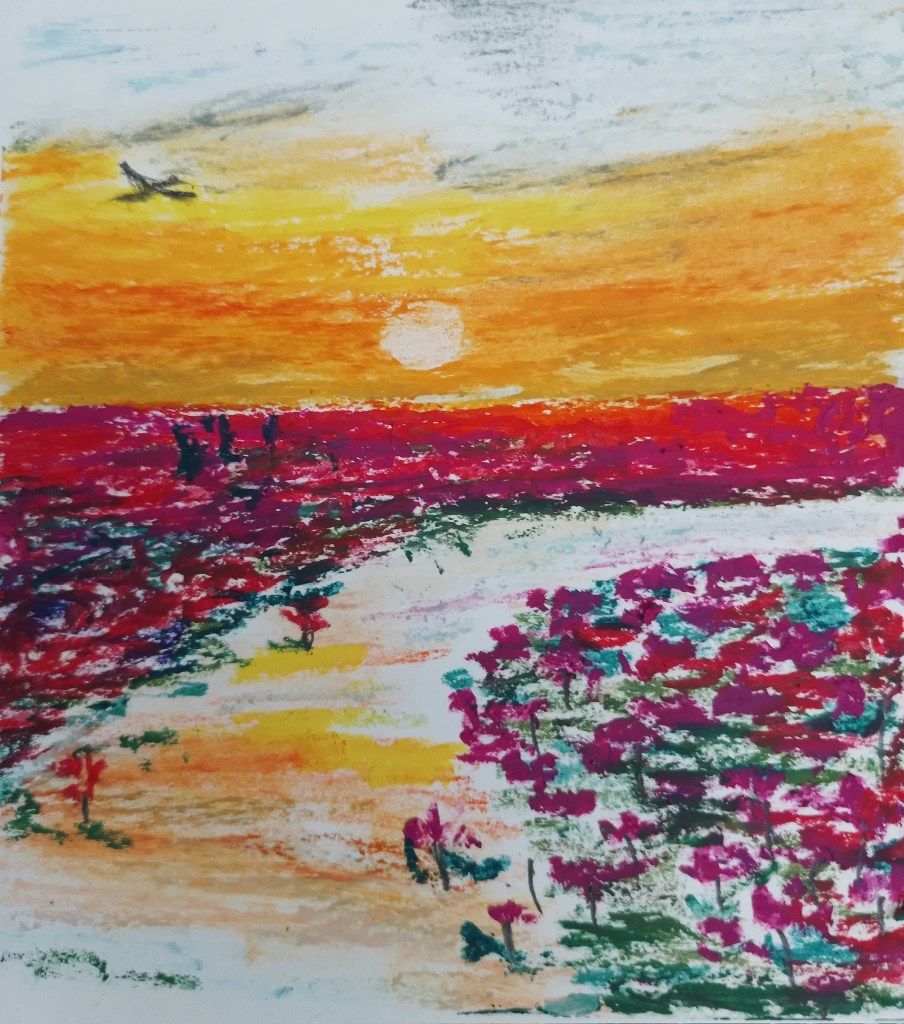
Art by Sohana Manzoor
We like to imagine ourselves as floating on clouds and therefore of the whole universe. Our team members are from multiple geographies and we request not to be tied down to a single, confined, bordered land. We would welcome aliens if they submitted to us from another galaxy…
On our Fifth Anniversary, we have collected celebratory greetings from writers and readers stretched across the world who share their experience of the journal with you and offer suggestions for the future. We conclude with words from some of the team, including my own observations on being part of this journey.
Aruna Chakravarti
Heartiest congratulations to Borderless on the occasion of its fifth anniversary! Borderless, an international journal, has the distinction of carrying contributions from many eminent writers from around the world. From its initiation in 2020, it has moved from strength to strength under the sensitive and skillful steering of its team. Today it is considered one of the finest journals of its kind. I feel privileged to have been associated with Borderless from its very inception and have contributed substantially to it. I wish to thank the team for including my work in their distinguished journal. May Borderless move meaningfully towards the future and rise to greater and greater heights! I wish it every success.
Professor Fakrul Alam
Five years ago, when Borderless set out on its literary voyage, who would have imagined the length and breadth of its imaginative crossings in this span of time? The evidence, however, is digitally there for any reader who has seen at least some of its issues. Creative writing spanning all genres, vivid illustrations, instant links giving resolute readers the option to track a contributor’s creative voyaging—here is boundless space always opening up for those seeking writing of considerable variety as well as originality. The best part here is that unlike name-brand journals, which will entice readers with limited access and then restrict their spaces unless you subscribe to them, all of Borderless is still accessible for us even though it has attracted a wide readership in five years. I certainly hope it will stay that way.
And what lies ahead for Borderless? Surely, more opportunities for the creative to articulate their deepest thoughts and feelings in virtual and seemingly infinite space, and innumerable avenues for readers to access easily. And let us hope, in the years to come Borderless will extend itself to newer frontiers of writing and will continue to keep giving space to new as well as emerging writers from our parts of the world.
May the team of Borderless, continue to live up to their claim that “there are no boundaries to human imagination and thought!”
Radha Chakravarty
Since its inception, Borderless Journal has remained true to its name, offering a vital literary space for writers, artists and scholars from around the world to engage in creative dialogue about their shared vision of a world without borders. Congratulations Borderless, and may your dream of global harmony continue to inspire.
Somdatta Mandal
According to the famous Chicana academic and theorist Gloria Anzaldua, the Borderlands are physically present wherever two or more cultures edge each other, where peopIe of different races occupy the same territory, where under, lower, middle and upper classes touch, where the space between two individuals shrinks with intimacy. Hatred, anger and exploitation are the prominent features of this landscape. There, at the juncture of cultures, languages cross-pollinate and are revitalized; they die and are born. Borders are set up to define the places that are safe and unsafe, to distinguish us from them. A border is a dividing line, a narrow strip along a steep edge. A borderland is a vague and undetermined place created by the emotional residue of an unnatural boundary. It is in a constant state of transition. The prohibited and forbidden are its inhabitants.
About five years ago, when a new online journal aptly called Borderless Journal was launched, these ideas which we had been teaching for so long were simply no longer applicable. Doing away with differences, with limits, it became a suitable platform where disparate cultures met, where people from all disciplines could express their views through different genres, be it poetry, translation, reviews, scholarly articles, creative writing and so on. Many new writers from different parts of the world became regular contributors to this unique experimentation with ‘borderlessness’ and its immense possibilities are very apt in this present global context where social media has already changed many earlier notions of scholarship, journalism, and creativity.
Jared Carter
In its first five years Borderless has become an important witness for international peace and understanding. It has encouraged submissions from writers in English based in many different countries, and has offered significant works translated from a wide range of national literatures. Its pages have featured writers based in India, Pakistan, China, Taiwan, Japan, South Korea, Australia, the UK, and the US. In the future, given the current level of world turmoil, Borderless might well consider looking more closely toward Africa and the Middle East. As the magazine continues to promote writing focused on international peace and freedom, new horizons beckon.
Teresa Rehman
The best part of this journal is that it is seamless and knows no margins or fringes. It is truly global as it has cut across geographical borders and has sculpted a novel literary genre called the ‘borderless’. It has climbed the mountains of Nepal, composed songs on the Brahmaputra in Assam, explored the hidden kingdom of Bhutan, walked on the streets of Dhaka, explored the wreckage of cyclones in Odisha, been on a cycling adventure from Malaysia to Kashmir, explored a scenic village in the Indo-China border, taken readers on a journey of making a Japanese-Malayalam dictionary, gave a first-hand account of the war in Bosnia-Herzegovina and described the syncretic culture of Bengal through its folk music and oral traditions. I hope it continues telling the untold and unchartered stories across mountains, oceans and forests.
Kirpal Singh
In a world increasingly tending towards misunderstandings across borders, this wholesome journal provides a healthy space both for diverse as well as unifying visions of our humanity. As we celebrate five distinguished years of Borderless Journal, we also look forward to another five years of such to ensure the underlying vision remains viable and visible as well as authentic and accurate.
My heartfelt Congratulations to all associated with this delightful and impressive enterprise!
Asad Latif
The proliferation of ethnic geographies of identity — Muslim/Arab, Hindu/Indian, Christian/Western, and so on — represents a threat to anything that might be called universal history. The separation and parcelling out of identities, as if they are pre-ordained, goes against the very idea (proclaimed by Edward Said) that, just as men and women create their own history, they can recreate it. Borders within the mind reflect borders outside it. Both borders resist the recreation of history. While physical borders are necessary, mental borders are not. This journal does an admirable job in erasing borders of the mind. Long may it continue to do so.
Anuradha Kumar
I have been one of Borderless’ many readers ever since its first issue appeared five years ago. Like many others, I look forward with great anticipation to every issue, complete with stories, , reviews, poems, translations, complemented with interesting artwork.
Borderless has truly lived up to its name. Within its portal, people, regardless of borders, but bound by common love for literature, and the world’s heritage, come together. I would wish for Borderless to scale even greater heights in the future. As a reader, I would very much like to read more writers from the ‘Global South’, especially in translation. Africa, Asia and Australasia are host to diverse languages, many in danger of getting lost. Perhaps Borderless could take a lead in showcasing writers from these languages to the world. That would be such an invaluable service to readers, and the world too.
Ryan Quinn Flanagan
To me, Borderless Journal is a completely free and open space. Topics and styles are never limiting, and the various writers explore everything from personal travelogues to the limp of a helpful druggist. Writers from all corners of the globe contribute, offering a plethora of unique voices from countless circumstances and walks of life. Because of this openness, Borderless Journal can, and likely will continue to grow and expand in many directions simultaneously. Curating and including many new voices along the way. Happy 5th Birthday to a truly original and wonderfully eclectic journal!
George Freek
I feel the Borderless Journal fills a special spot in the publishing world. Unlike many journals, which profess to be open-minded and have no preference for any particular style of poetry, Borderless actually strives to be eclectic. Naturally, it has its own tastes, and yet truly tries to represent the broad spectrum which is contemporary poetry. I have no advice as to where it should go. I can only say keep up the good work, and stooping to a cliche, if it’s not broken, why try to fix it?
Farouk Gulsara
They say time flies when one is having fun. It sure does when a publication we love regularly churns out its issues, month after month, for five years now.
In the post-truth world, where everybody wants to exert their exclusivity and try to find ways to be different from the person standing next to them, Borderless gives a breath of fresh air. At a time when neighboring countries are telling the world they do not share a common history, Borderless tries to show their shared heritage. We may have different mothers and fathers but are all but “ONE”!
We show the same fear found in the thunderous sounds of a growling tiger. We spill the exact hue of blood with the same pain when our skin is breached. Yet we say, “My pain is more intense than yours, and my blood is more precious.” Somehow, we find solace in playing victimhood. We have lost that mindfulness. One should appreciate freedom just as much as we realise it is fragile. Terrorism and fighting for freedom could just be opposing sides of the same coin.
There is no such thing as a just war or the mother of all wars to end all wars as it has been sold to us. One form of aggression is the beginning of many never-ending clashes. Collateral damage cannot be justified. There can be no excuse to destroy generations of human discoveries and turn back the clock to the Stone Age.
All our hands are tainted with guilt. Nevertheless, each day is another new day to make that change. We can all sing to the tune of the official 2014 World Cup song, ‘Ola Ola,’ which means ‘We are One.’ This is like how we all get together for a whole month to immerse ourselves in the world’s favourite sport. We could also reminisce about when the world got together to feed starving kids in Africa via ‘Band-Aid’ and ‘We Are the World’. Borderless is paving the way. Happy Anniversary!
Ihlwha Choi
I sincerely congratulate Borderless Journal on its 5th anniversary. I am always delighted and grateful for the precious opportunity to publish my poetry in English through this journal. I would like to extend my special thanks for this.
Through this journal, I can read a variety of literary works—including poetry, essays, and prose—from writers around the world. As someone for whom English is a foreign language, it has also been a valuable resource for improving my English skills. I especially enjoy the frequent features on Rabindranath Tagore’s poetry, which I read with great joy. Tagore is one of my favourite poets.
I have had the privilege of visiting Santiniketan three times to trace his legacy and honor his contributions to literature and education. However, one aspect I find a little disappointing is that, despite having published over 30 poems, I have yet to receive any feedback from readers or fellow writers. It would be wonderful to have such an opportunity for engagement.
Additionally, last October, a Korean woman received the Nobel Prize in Literature—the first time an author from South Korea has been awarded this honor by the Swedish Academy. She is not only an outstanding novelist but also a poet. I searched for articles about her in Borderless Journal but was unable to find any. Of course, I understand that this is not strictly a literary newspaper, but I would have been delighted to see a feature on her.
I also feel honoured that one of my poems was included in the anthology Monalisa No Longer Smiles: An Anthology of Writings from across the World. I hope such anthologies will continue to be published. In fact, I wonder if it would be possible to compile and publish collections featuring several poems from contributing poets. If these were made available on Amazon, it would be a fulfilling experience for poets to reach a broader audience.
Moving forward, I hope Borderless Journal will continue to reach readers worldwide, beyond Asia, and contribute to fostering love and peace. Thank you.
Prithvijeet Sinha
The journey of authorship, self-expression and cultural exchange that I personally associate with Borderless Journal’s always diverse archives has remained a touchstone ever since this doorway opened itself to the world in 2020. Going against the ramshackle moods of the 2020s as an era defined by scepticism and distances, The journal has upheld a principled literary worldview close to the its pages and made sure that voices of every hue gets representation. It’s also an enterprise that consistently delivers in terms of goodwill and innocence, two rare traits which are in plenteous supply in the poems, travelogues, essays and musings presented here.
The journey with Borderless has united this writer with many fascinating, strikingly original auteurs, buoyed by a love for words and expression. It is only destined for greatness ahead. Happy Birthday Borderless! Here’s to 50 more epochs.
From Our Team
Bhaskar Parichha
As Borderless Journal celebrates its fifth anniversary, it is inspiring to see its evolution into a distinguished platform for discourse and exploration. Over the years, it has carved a unique niche in contemporary journalism, consistently delivering enlightening and engaging content. The journal features a variety of sections, including in-depth articles, insightful essays, and thought-provoking interviews, reflecting a commitment to quality and fostering dialogue on pressing global issues. The diverse contributions enrich readers’ understanding of complex topics, with a particular focus on climate change, which is especially relevant today. By prioritising this critical issue, Borderless informs and encourages engagement with urgent realities. Having been involved since its inception, I am continually impressed by the journal’s passion and adaptability in a changing media landscape. As we celebrate this milestone, I wish Borderless continued success as a beacon of knowledge and thoughtful discourse, inspiring readers and contributors alike.
Devraj Singh Kalsi
Borderless Journal has a sharp focus on good writing in multiple genres and offers readable prose. The platform is inclusive and does not carry any slant, offering space to divergent opinions and celebrating free expression. By choosing not to restrict to any kind of ism, the literary platform has built a strong foundation in just five years since inception. New, emerging voices – driven by the passion to write fearlessly – find it the ideal home. In a world where writing often gets commercialised and compromised, Borderless Journal is gaining strength, credibility, and wide readership. It is making a global impact by giving shape to the dreams of legendary poets who believed the world is one.
Rakhi Dalal
My heartiest congratulations to Borderless and the entire team on the fifth Anniversary of its inception. The journal which began with the idea of letting writing and ideas transcend borders, has notably been acting as a bridge to make this world a more interconnected place. It offers a space to share human experiences across cultures, to create a sense of connection and hence compassion, which people of this world, now more distraught than ever, are sorely in need of. I am delighted to have been a part of this journey. My best wishes. May it continue to sail through time, navigating languages, literature and rising above barriers!
Keith Lyons
Is it really five years since Borderless Journal started? It seems hard to believe.
My index finger scrolls through Messenger chats with the editor — till they end in 2022. On the website, I find 123 results under my name. Still no luck. Eventually, in my ‘Sent’ box I find my first submission, emailed with high hopes (and low expectations) in March 2020. ‘Countdown to Lockdown’ was about my early 2020 journey from India through Thailand, Malaysia, Indonesia, and Australia to New Zealand as COVID-19 spread.
Just like that long, insightful trip, my involvement with Borderless Journal has been a journey. Three unique characteristics stand out for me.
The first is its openness and inclusiveness. It features writers from all over the globe, with various contributions across a wide range of topics, treatments and formats.
The second feature of the journal is its phenomenal growth, both in readers and writers, and in its reach. Borderless really does ‘walk the talk’ on breaking down barriers. It is no longer just a humble literary journal — it is so much bigger than that.
The third unique aspect of Borderless is the devotion endowed in nurturing the journal and its contributors. I love the way each and every issue is conceived, curated, and crafted together, making tangible the aspiration ‘of uniting diverse voices and cultures, and finding commonality in the process.’
So where can we go from here? One constant in this world is change. I’d like to think that having survived a global pandemic, economic recession, and troubling times, that the core values of Borderless Journal will continue to see it grow and evolve. For never has there been a greater need to hear the voices of others to discover that we are all deeply connected.
Rhys Hughes
I have two different sets of feelings about Borderless Journal. I think the journal does an excellent job of showcasing work from many different countries and cultures. I want to say it’s an oasis of pleasing words and images in a troubled sea of chaos, but that would be mixing my metaphors improperly. Not a troubled sea of chaos but a desert of seemingly shifting values. And here is the oasis, Borderless Journal, where one can find secure ideals of liberty, tolerance, peace and internationalism. I appreciate this very much. As for my other set of feelings, I am always happy to be published in the journal, and in fact I probably would have given up writing poetry two years ago if it wasn’t for the encouragement provided to me by regular publication in the journal. I have written many poems especially for Borderless. They wouldn’t exist if Borderless didn’t exist. Therefore I am grateful on a personal level, as a writer as well as a reader.
Where can Borderless Journal go from here? This is a much harder question to answer. I feel that traditional reading culture is fading away year after year. Poets write poetry but few people buy poetry books. They can read poems at Borderless for free and that is a great advantage. I would like to see more short stories, maybe including elements of fantasy and speculative fiction. But I have no strategic vision for the future of the journal. However, one project I would like to try one day is some sort of collaborative work, maybe a big poem with lots of contributors following specific rules. It’s an idea anyway!
Meenakshi Malhotra
Borderless started with a vision of transcending the shadow lines and has over time, evolved into a platform where good writing from many parts of the world finds a space , where as “imagination bodies forth/ The forms of things unknown, the poet’s pen/Turns them to shapes and gives to airy nothing/A local habitation and a name.”
It has been a privilege to be a part of Borderless’s journey over the last few years. It was a journey based on an idea and a vision. That dream of creating solidarity, of transcending and soaring over borders and boundaries, is evident in almost every page and article in the journal.
Mitali Chakravarty
Looking at all these responses, thinking on what everyone has said, I am left feeling overwhelmed.
Borderless started as a whimsical figment of the imagination… an attempt to bring together humanity with the commonality of felt emotions, to redefine literary norms which had assumed a darker hue in the post Bloomsbury, post existentialist world. The journal tried to invoke humour to brings smiles, joys to create a sense of camaraderie propelling people out of depression towards a more inclusive world, where laughter brings resilience and courage. It hoped to weave an awareness that all humans have the same needs, dreams and feelings despite the multiple borders drawn by history, geographies, academia and many other systems imagined by humans strewn over time.
Going forward, I would like to take up what Harari suggests in Homo Deus — that ideas need to generate a change in the actions of humankind to make an impact. Borderless should hope to be one of the crucibles containing ideas to impact the move towards a more wholesome world, perhaps by redefining some of the current accepted norms. Some might find such an idea absurd, but without the guts to act on impractical dreams, visions and ideas, we might have gone extinct in a post-dino Earth.
I thank the fabulous team, the wonderful writers and readers whose participation in the journal, or in engaging with it, enhances the hope of ringing in a new world for the future of our progeny.
To conquer fear is the beginning of wisdom.
—Bertrand Russell, Unpopular Essays (1950)
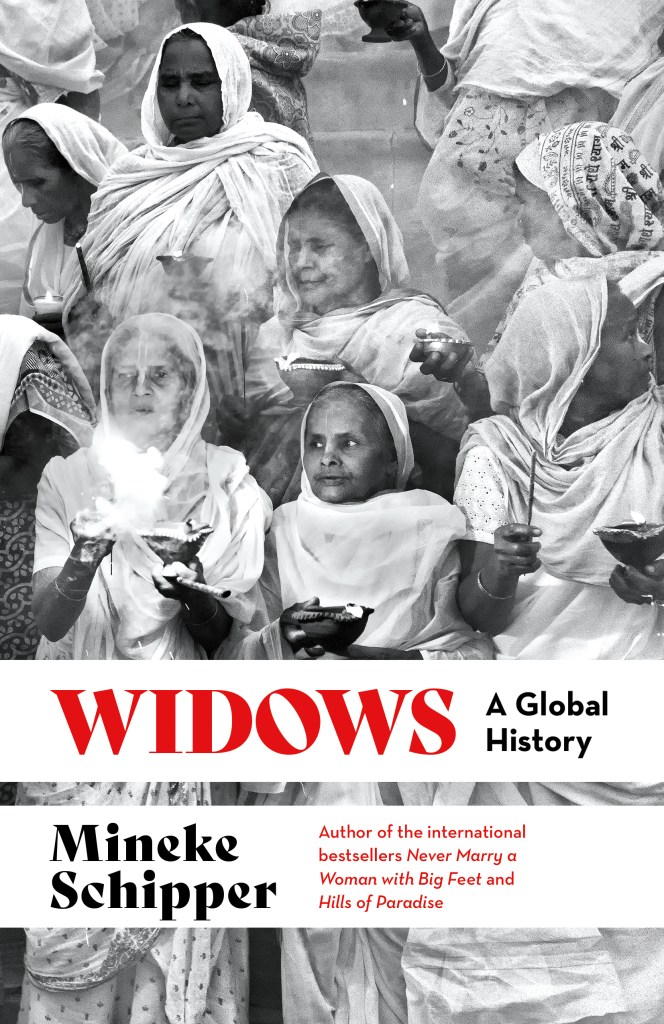
This is one of the dedications that precedes the narrative of Mineke Schipper’s non-fiction, Widows: A Global History. Her description of misapprehensions and the darkness around widowhood, as well as the actions that have been taken and suggestions on how more can be done to heal, weave a narrative for a more equitable society.
Starting with mythological treatment of widows, the book plunges into an in-depth discussion, not just with case studies but also with a social critique of the way these women are perceived and treated around the world, their need to heal from grief or a sense of devastation caused by their spouse’s death, concluding with stories that reflect the resilience of some of those who have overcome the odds of being repulsed. It is a book that inspires hope… hope for a world where despite all stories of misogyny covered in media, there are narratives that showcase both the human spirit and humanity where the ostracised are moving towards being integrated as a part of a functional social sphere.
Schipper, best known for her work on comparative literature mythologies and intercultural studies, navigates through multiple cultures over time and geographies to leave a lingering imprint on readers. She writes: “In Book V of his Histories, Herodotus (485-425/420 BCE) described life among the Thracians: Each man has many wives, and at his death there is both great rivalry among his wives and eager contention on their friends’ part to prove which wife was best loved by her husband. She to whom the honour is adjudged is praised by men and women alike and then slain over the tomb by her nearest of kin. After the slaying she is buried with the husband.” And yet she tells us of the dark past of Europe, “A Polish text asserts with great certainty that, after the burning of the body of her husband, ‘every wife allowed herself to be beheaded and went with him into death’.” She tells us stories of wife burning, killing and dark customs of yore across the world that seem like horror stories, including satis in India. The “motivation” is often greed of relatives or customs born of patriarchal insecurities. She contends, “wherever desperate poverty reigns, widows are at an increased risk.”
She argues: “The story is much the same everywhere; widows who are well educated know what rights they have or are able to find the right authorities to approach with their questions, while women with little or no education continue to suffer from malevolent practices.”
She has covered the stories that reflect the need for the welfare of widows, of how early marriages lead to widowhood even in today’s world ( “ Every year around twelve million girls under the age of eighteen get married, one in five of all marriages.”), of social customs like dowry, which can be usurped by a widow’s spouse’s family, of steps that are being taken and changes that need to be instituted for this group of women often regarded in the past and even in some places, in the present, as witches. In fact, she has written of such ‘witch villages’ in Africa, which have been developed to help widows who have been treated badly and turned away from their homes. Such stories, she tells us prevail all over the world, including India, where widows are sent or go to Varanasi.
She asserts that despite these efforts, “there is often still a significant gap between declarations of gender equality and their day-to-day enforcement and application.” She ends with case studies of four women: “Christine de Pisan, Tao Huabi, Laila Soueif and Marta Alicia Benavente examples of widows who dared to fully throw themselves into a new life following the death of their husbands.” And with infinite wisdom adds: “We cannot change history, but we can look to the past with new knowledge and to the future with new eyes.” She concludes with a profound observation: “Time does not heal sorrow, but out of the centuries-old ashes, grief, strict commandments and prohibitions, new prospects can also rise. The fact that every person’s life is finite makes every day unique and precious. The same goes for widows.”
In this interview Mineke Schipper (née Wilhelmina Janneke Josepha de Leeuw), an award-winning writer from Netherlands, tells us what started her on her journey to uncover the stories of this group of people.
What got you interested in widows as a group from around the world? Why would you pick this particular group only for a whole book?
Yes, whence this topic? The widow had been a tiny part of Never Marry a Woman with Big Feet. Women in Proverbs From Around the World (Yale UP 2004), an earlier book I wrote about proverbs referring to women’s lives, from girl babies to brides, wives and co-wives, mothers and mothers-in-law, grandmothers and old women. It was a long and breathtaking study about more than 15,000 proverbs, collected over many years, apparently widely appreciated and translated with two relatively recent editions published in India, in English and in Marathi. For those interested: the complete collected material is accessible and searchable at www.womeninproverbsworldwide.org, including proverbs about widows. That small but striking section about widows had made me curious, but other books, as it goes, pushed ahead, before I came back to them. In January 2020, I had to look up something in that book about proverbs, and the pages about widows looked so weird that I proposed the widow as my new topic to my Dutch publisher who responded enthusiastically.
You have written of so many cultures and in-depth. How long did it take you to collect material for this book and put it together?
All over I found obvious warnings and distrust viz a viz a woman whose husband dies. Interestingly, a widow was associated with death—and a widower was not. Take heed, suitor, when you replace the dead husband in the widow’s conjugal bed! Better not! Was it the fear that she had killed him? Or the creepy thought that the dead man’s hovering ghost was still hanging around? A widow was supposed to mourn intensely over her husband, preferably the rest of her life. In the meantime, proverbial messages openly expressed the widower’s happiness at the news of his wife’s death: ‘Grief for a dead wife lasts to the door’ (all over Europe) or ‘A wife’s death renews the marriage’ (Arabic). I came across well-known names—such as Confucius, Herodotus, Boniface, and Ibn Battuta—and lesser-known names of early travellers, historians, and philosophers with their commentaries on widows, compulsory or non-mandatory prolonged mourning, voluntary or prescribed chastity, and a surprisingly common choice of suicide as the best option for her. Amazingly many widows obediently followed their husbands to death. In all continents, monuments and documents witness how women joined dead men—buried or burnt alive, hanged, strangled or beheaded, drowned, stabbed or shot. A preference for strangling was inspired by the idea that the victim would enter the next world ‘intact’. So, from the narrow diving board of no more than a few dozen proverbs I plunged into the hidden history of widowhood for about three years.
How do women perpetrate the victimisation of widows? Would you say that widows as a group are more victimised against than other groups of women?
Conceptions about women as interchangeable objects were widespread. If a woman was ‘no longer of use’, a man would need to get a new one, much as you would do with a broken watch, rifle, knife or whip. A man cannot or will not do without a wife, but what about when the tables are turned? The need to present women without husbands as inept and dependent must have been great. A widow managing all by herself was rather met with obvious disapproval. Widowhood has traditionally been associated with emptiness. In Sanskrit, the word vidhua means ‘destitute’, and the Latin viduata (‘made destitute, emptied’) is the root of the word for widow in many European languages, including Witwe (German), veuve (French) and weduwe (Dutch).
Nonetheless there have always been plenty of widows who have lived wonderfully independent lives, but this is not the image seared into the public consciousness. The notion that a woman is unable to live her own life after the death of her husband is an amazingly deep-rooted one. The Japanese word for widow (mibōjin) literally means ‘she who has not yet died’, that is, a widow is simply sitting in Death’s waiting room for her own time to come. Interestingly, the status of widower on the other hand was usually so short-lived and temporary that some languages even lack a word for it all together!
What makes widows more vulnerable than others?
Every widow has her own story, but social systems play an important role. In traditions where goods, land and property are inherited through the mother’s family line with matrilocality, a groom comes to live with his bride’s family, although this often ended up working out slightly differently as men were not best pleased with this living arrangement, so in reality there would be negotiation. However, over the centuries patrilineal systems, lineage and inheritance significantly became the dominant system. According to the patrilocal rules, a man had to remain ‘at home’, a system which to this day obliges countless brides to move in with their parents-in-law, an environment foreign to them. They are forced to comply with the demands and expectations of their family-in-law, while the husbands remain comfortable in the familiar surroundings they grew up in, with major consequences for the lives of women who become widows. This patrilocal living situation has often resulted in greater inequality between marital partners and harsh rules for widows, often preventing a wife from any material heritage after her husband’s death. According to the work of evolutionary psychologists, married women who live with or in close contact with their matrilineal family run a significantly lower risk of violence in the form of (physical) abuse, rape and exploitation than those who move in with their husband’s family. This is all the more true for a widow with a distrustful family-in-law who accuse her of killing her husband, a danger that is greatest in areas where poverty reigns.
At a point you have said, “The Aryan period, which preceded later negative social developments, saw a differently structured society in which there was more space for women: to a certain extent women had religious autonomy, they were entitled to education at all levels (with some even becoming celebrated authors), they participated in public life and also held important positions… However, by the year 200 AD, their position had considerably worsened.” Do you have any idea why their condition worsened in India? What were the ‘negative social developments’ you mention?
In matters of religion the woman was increasingly dependent on the services of her husband or of priests, possibly also on her sons or male relatives, to carry out the rituals she required. Simultaneously she became largely excluded from all types of formalised education. This lasting effect can be seen even today in the global difference in the rate of female and male literacy. The negative stance towards women in India dates back to Brahmin commentaries of ancient Vedic texts, which referred to women as lesser humans; widows subsequently occupied an even lower rung on the social ladder and were forced to work hard towards their religious salvation through extreme asceticism. One example: ‘At her pleasure [after the death of her husband], let her emaciate her body by living only on pure flowers, roots of vegetables and fruits. She must not even mention the name of any other men after her husband has died.’ (Manusmriti Kamam 5/160) Patriarchal relations have developed gradually in different parts of the world and at different times, but not everywhere in the same rigorous forms.
In the Abron-Kulango culture in the northeast of his native Côte d’Ivoire, you have told us “[B]oth widows and widowers were required to accompany their spouse to the next world” but eventually due to societal realisations, such practices stopped. Do you think this can happen in other cultures too. Have you seen it happen in other cultures?
As far as I know, such practices do not exist anywhere anymore. The most problematic obstacle for the rights of widow’s in less-well off regions is the unfortunate combination of illiteracy, fear of witchcraft and covetous in-laws, particularly during periods of mourning and grief. The good news is that even in the most unexpected places initiatives are emerging to help inform women in rural areas of their equality before the law. Self-aware widows become inspiring role models; conscious of their rights, they share their knowledge with others so that more of their fellow widows can find the right legal aid when injustice rears its head.
Would you hold as culprit people who enforce the death of widows? Would you address these people too as criminals in today’s context? Please elaborate.
It wouldn’t help much to do this! Marriage is still frequently presented as the utmost peak that a woman can achieve during her life. From this supposed top spot married women often still look at single and widowed women in a new light—with pity, contempt, suspicion or even hostility: they are out to seduce your own husband! When death comes calling, not only men’s but also women’s negative feelings easily bubble up from the morass of fear at the dreaded prospect of becoming a widow. Over the centuries such reactions towards widows have become part of the constrictive hierarchy meant to keep so many women in their place.
Can sati be justified[1](even though they are deemed illegal as is suicide) by saying the widow immolated herself willingly? Please explain.
The social pressure on widows must have been immense, but we are living now and no longer in the past. It is true that in poorer regions far out of the reach of cities, countless numbers of widows still have to traverse a long road towards a humane and dignified existence. However, instead of justifying the willingness to immolate herself as her own choice, it is better to insist on the positive news that, after the loss of their partner, today not only men but also women have the right to stay alive and further explore their own talents and new possibilities.
You have told us dowry started as a European custom. Is it still a custom there as it is in parts of South Asia, even if deemed illegal? Was it brought into Asia by Aryans/colonials or a part of the culture earlier itself?
The dowry is the gift that the bride’s family would contribute to the couple’s new home. Even though colonisation may have reinforced this ancient custom, but in many communities, it was already a custom and still is in many parts of the world. In Europe it stayed on until the late nineteenth century. In cultures where the bride provided a dowry, the death of a wife would bring benefits to a widower, as a new wife with a new dowry would enrich his home with new assets such as silver tableware, jewellery, bed linen and other valuables. For centuries, among Christians, divorce was forbidden, and from the perspective of widowers the prospect of a second chance provoked a sense of euphoria, as expressed in quite some sayings where his sadness does not go beyond the front door. Across Europe such messages confirm a husband’s profit of his wife’s death: ‘Dead wives and live sheep make a man rich.’ (French; UK English). However, most widows were denied such liberating feelings or didn’t experience any profit from the change. Often, they did not even allow themselves to get over her loss and indulge in any new freedom. They usually were subject to the paralysing fear of other people’s gossip.
In many places a widow who remarried would even lose entitlement to her own dowry or other input she had contributed to her marriage. Many women who remarried felt unable to invoke any right they had on the property of their deceased husband. Little wonder, therefore, that widows were heavily discouraged from remarrying, for example in China. The use of far-reaching laws still re-enforced the highly recommended chaste and sexless existence of widows after the death of her husband. Of course, the considerable number of child marriages in sub-Saharan Africa and South Asia easily robbed child widows from the legal rights wherever they had. According to the World Widows Report, the situation for widows with children is still exceptionally alarming in many parts of the world. Daughters, in particular, remain a huge problem in traditions where women have to contribute a dowry when daughters get married. For this reason alone, poorer parents have a preference for sons: they are more likely to inherit from their father’s family, while their widowed mother can expect little.
Has the condition of widows across the world improved over time? Please elaborate.
Over the centuries far too many widows have been convinced that their only future was conditioned by their dead husband. In my book there are examples from different areas of courageous widows who changed their own lives. Looking around in one’s own neighbourhood, there are always exemplary models of independent widows who do not let themselves be deterred by the doom of whatever prejudiced people think or say.
All emancipation starts with the opportunity to acquire knowledge, but if we are to believe what tradition tells us, women had little need for that, based on an assumption that knowledge did nothing to encourage and promote female obedience, and even less for virtue. ‘Knowledge goes before virtue for men, virtue before knowledge for women’ is an old saying in Europe, while a Chinese saying also agrees that a woman without knowledge is already doing very well. The fact that this message has had such a wide-ranging effect can be seen in the vast difference in levels of education and training among boys and girls in global education statistics.
What did a man look out for when it came to finding a wife? In order to facilitate control over women, various warnings have been passed down to men. One such proverb found the world over clearly expresses this sentiment: ‘Never marry a woman with big feet.’ It comes from the Sena language in Malawi and Mozambique. In China, India and other parts of the world, I came across literal iterations of this proverb. In spite of geographic or cultural distances and differences, this saying reflects a widespread consensus: hierarchy in male-female relations seemed to be essential, and someone had to be in charge. Should he become the main breadwinner for the duration of their married life, his wife will be even more dependent on him.
Significantly the big feet metaphor points to male fear of female talents and power. Hardly surprising therefore that becoming a widow was the worst possible catastrophe for women. Worldwide the solidarity between wives and widows is growing and literacy support within local communities as well, while the former unwavering prejudices against widows are shrinking, and more and more widows with big feet do manage. The old anti-widow stronghold of local prejudice is slowly but surely crumbling into ruins. We cannot change history, but widows can look to the past with new knowledge and into the future with new eyes and new hope.
Tagore’s poem translated from Bengali by Debali Mookerjea-Leonard
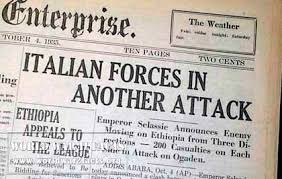
Rabindranath Tagore composed the poem ‘Africa‘ in response to Mussolini’s invasion of Abyssinia (modern-day Ethiopia) in 1935. Written in 1937, this poem was included in his collection Patraput (‘cup of leaves’) published in 1938.
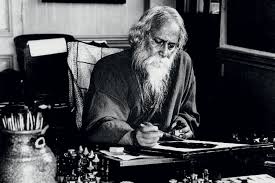
Rabinmdranath Tagore (1861-1941)From Public Domain
  In that bewildering, ancient time
         When the discontent Creator,
Repeatedly took apart his new creation
     In those days of His impatient head-shakes,
The arms of the turbulent seas
     Wrested you away from the bosom
Of the Orient, Africa—
      Bound you in the dense watchful woodlands,
In the deepest interiors, where light is meagre.
     Immersed in that profound solitude,
You gathered the mysteries of the obscure,
     Deciphered the enigmas of earth-water-sky,
  Nature’s concealed magic inspired in you,
    Incantations, from someplace beyond consciousness.
In the disguise of the hideous,
    You mocked the terrible;
In the intense majesty of the dreadful,
    You aspired to defeat fear, making yourself fierce
To the drumbeats of a cataclysmic dance.

   Oh, woman in the shadows
Under the dark veil
   Your humanity went unrecognised,
Invisible in chaotic disregard.
    Then, they came with iron manacles,
They, whose nails are sharper than your wolves’ claws
    Came the captors of humanity
Blinded with pride, a blindness darker than your sunless wilderness.
    The barbaric greed of the civilised
Stripping naked their shameless inhumanity.
     Your wordless weeping wet the jungle paths,
Muddied the dust in your tears and blood
      That under the plunderers’ hobnailed boots
Turned to grisly sludge,
     Marking for all eternity your disgraced history.

At that moment, across the seas, their church bells
     Pealed at daybreak and dusk
In calls to prayer, in the name of compassionate God;
      Children played on mother’s laps
And poets’ songs lauded
       The beautiful.

    Today, when on the western horizon
Twilight holds its breath at the impending tempest,
   And beasts slink out of their secret lairs—
    To declare with ominous howls, the end of day,
     Come, poet of the end-time,
      In the last light before nightfall
   Stand at the door of that dishonoured woman;
        Beg -- “Forgive me”—
     In the midst of vicious rants
Let that be the final sacred utterance of your civilisation.
Debali Mookerjea-Leonard is the Roop Distinguished Professor of English at James Madison University. Together with research and teaching, she also translates Bengali poetry and fiction.
.
PLEASE NOTE: ARTICLES CAN ONLY BE REPRODUCED IN OTHER SITES WITH DUE ACKNOWLEDGEMENT TO BORDERLESS JOURNAL



 Borderless