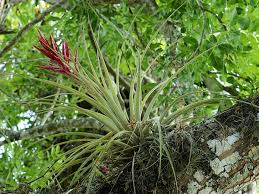
Tillandsia, A plant with herbal roots. From Public Domain
Once, on a dark snowy day in a strange land,
I metamorphosed to an air plant.
First, I lost my tongue; then I lost my limbs;
My brown trunk swirled into itself.
A crusty mossy green veneer over my fern-like body.
I lay still, a green cocoon– I am going back.


  This chip based plastic card is my DNA barcode.
  It lets the rootless ausländer reside in this land,
  to breathe it's AQI certified perfect-for-a walk air
  for these exact contractual work years.
  It keeps me safe -- a new sample specimen,
  well preserved in a laboratory bell jar.
  A permit -- a hermit immersed in nirvana liquid.
  I gaze outside through the transparent glass --
  everything magnified, everything distorted.
  An enticing pool of sunlight at the far end of the lab,
  beyond the windows, there are patches of green.
  I look for familiar faces, long lost cousins and neighbours --
  Is that the rabbit-ear-leafed* herb?
  (the long wanderings on monsoon mornings to cure the little one’s cough)
  the small-flowery-leafed* one?
  (the herbal decoction for feverish nights)
  the crawl-on-the-ground-palm* and down-the-stream-gooseberry*?
  (a folk song, a ritual, the cure for yellow-fever)
  The patches of green remained as aloof as they were.
  They denied my identification procedure –
  “Wir bist nicht deine ‘name-place-animal-thing’,
   we are google lens-approved rational scientific botanic beings,
   we were featured in Systema Naturae and
   we are alien to your wobble-gobble”.

I swayed away and stared at the supermarket herbs section for hours.
Familiar fragrances -- dried and powdered and renamed.
And the authentic all-rounder -- “Indische Curry-Englisch style”
Black pepper from my backyard would disown me for this affair.
I reside, breathe in and breathe out the AQI verified air.
I reside, observe and wait, in this permitted residence of mine.
To live -- to live and thrive one should go back or grow roots.
(And then, herbs are no longer a supermarket section
they are an image of your soul in green,
a fibrous embrace that warms your blood.)

*Literal translations of medicinal herbs from author’s mother tongue
Lakshmi Chithra is a PhD student at the University of Augsburg, Germany. When academic life allows she welcomes her writer-ego to take over. She is from Kerala and is a lover of the monsoon, the Arabian Sea and Chai.
.
PLEASE NOTE: ARTICLES CAN ONLY BE REPRODUCED IN OTHER SITES WITH DUE ACKNOWLEDGEMENT TO BORDERLESS JOURNAL
Christopher Columbus (1451-1506)From Public Domain
I, Roberto Mendoza, in this year 1550, ship’s boy on Christopher Columbus’ first and second voyages to the West Indies before my promotion to sailor on his third and fourth voyages, testify to the veracity of the eye witness events that I record for posterity. And in spite of their devastating raw truth, it is my troubled conscious that has conducted my hand, goaded my intelligence to write down these sorrowful facts. For facts they are, regardless of the prestige and boons that Columbus received from his protectors and admirers.
Where shall I begin? How do I burrow through the layers of unquestionable fame that has marked that name to reverberate with the clanking of the slave chains, the death rattles in the gold and silver mines, the gnashing of teeth, the hangings and dismemberments … the insensible apathy of the subjugation or submission of the Indian masses?
It has always appeared to my young eyes that Columbus’ achievements were enveloped in an aura of mystery or incomprehension. I may even add an aura of fantastic falsifications, mainly initiated and authorised by Columbus himself and his unquestioning gallants.
I knew him well, too well to be duped by those seductive charms of his, that subtle cunning, a mask donned whenever a fruitful occasion arose, yet under which lay a brutal, tyrannical individual bent on attaining his greatest ambition: wealth and glory, and this at any price. What was the little ditty that some fool invented for innocent children and naive adults to recite: “In fourteen ninety-two Columbus sailed the ocean blue?” A ridiculous rime to recall that wretched year. Yes, I say that wretched year for it celebrated the Genoan hero’s glorious voyage.
During that fatal year of 1492, two other major events occurred in Spain which I believe to be in relation to Columbus’ conniving his way into Isabella’s confidence: the expulsion of the Jews to North Africa, Italy and Constantinople, and the capitulation of Granada, the last stronghold of the Muslims in Spain, to the Christian kings. Henceforth, Spain rid herself of those ‘impure’, centuries-laden ‘foreign’ plunderers. Did not Columbus write in his logbook (if we are to believe Bartolomé de Las Casas’s transcribed copy of it) that he was overjoyed by those two events: ”thus you (the Monarchs) have turned out all the Jews from your kingdoms and lordships”, and ”the royal banners have been placed on the towers of Alhambra”[1].
This being said, because of the expulsion and the reconquest, Columbus’ true birthplace had to be concealed, for any negotiation with Isabella or Ferdinand. This hero was not born in the city of spaghetti and banks, Genova, as commonly known. The darling of the Spanish monarchy was born in the land of the corsairs, in Calvi, a lovely port town in Northern Corsica, indeed conquered by the Genovans and governed by them during five centuries, but none the less born and bred far from the banks of Italy. Corsica, where for centuries Vandals, Ostrogoths, Greeks and Lombards, and ill-bred Aragonese and Genovans vied for domination, intermingling, integrating and assimilating.
Why would Columbus lie about his place of birth? Was it out of fear of a possible ‘corsair descent’? One that connoted piratry, pillage and other misdeeds [2]? Be that as it may, the rogue managed to cajole Queen Isabella into giving him enough maravedis[3]to undertake a voyage that would heighten the glory of the conquering Spanish Monarchy and the new-founded kingdom.
And that was how Admiral Don Christopher Columbus frayed his way to fame and fortune!
With the Queen’s glittering maravedis he commissioned three caravels : the Nina, the Pinta and the Santa Maria, the third of which he navigated himself, the other two by the Pinzón brothers. How I happened to be aboard the Santa Maria is a long story with which I shall not bore my readers.
So there he stood at the prow, mantled in a vaporous circle of pride and arrogance whilst we, his sea-faring companions, sweated away on deck or in the hold, were fed rotten food, furled and unfurled the sails without respite, hunted out the innumerable rats that ran amok below, withered under the insufferable heat of September. I myself almost fainted under the long, long hours of tedious work, boredom and especially fear; fear that we and our tiny caravel, surrounded by thousands of leagues of far from blue waters, would be food for the horrible undersea monsters that had swallowed many a brave crew and their vessels with yawning jaws and leathery tentacles. All of us were terrified, and the five weeks we spent crossing a swelling ocean towards the East, or so we all thought, triggered a feeling of panic, alienness and remorse. The admiral described the ocean like a river; I myself felt like a cork in a rainswept pond, jostled and jolted, no land in sight, our water and meat, taken aboard at the Canary Islands, foul-tasting, half-eaten by the enormous black rats.
Did the great Admiral not consult the stars? Eastward? There was nothing — only rolls and rolls of higher and higher walls of water battering the fragile sides of our vessels. And I, so young, asked myself time and time again, how did an incompetent sea-faring fellow like Columbus ever win the confidence of Isabella and Ferdinand ? Oh how I recall his bulky figure at the prow, oftentimes behind the helm, screaming orders or simply staring out into the watery vastitude, dreaming no doubt of gold … gold … and more gold … He had written the word ‘gold’ seventy-five times in his logbook during the first two weeks of our crossing!
How many of our poor sailors had been beaten for insubordination, had suffered the excruciating trial of keelhauling[4], one or two even hanged for attempting mutiny, so fearful were they of being devoured by sea monsters, dying of thirst or hunger or being bitten by the furry rats that thrived below in our beds of straw?
At long last I heard the cry “Land ahoy!” coming from the crow’s nest. Yes, we finally reached a cluster of islands that would be named Guanahani[5], Cuba, Haiti and the Dominican Republic on the maps of future cartographers. It was on these islands that my first glimpses of a barbaric and despotic Columbus would not only be corroborated, but magnified to the heights of psychopathic insanity. For it became more and more evident to me that the Admiral, whom I considered in my youthful age as a hero, had no intentions of treating the indigenous peoples of these islands either as equals or with a soupçon of humane sympathy. He indeed judged them somewhat higher than animals, yet whose only human value was how much they would bring him as slaves sold in Spain, or how much gold and silver they would extract for him from the mines and rivers. All he saw in these peaceful peoples was the glitter of gold fastened to their noses and the rings of equal glitter hanging off their ears and arms. He saw gold everywhere, even gold stones shining in the rivers! He wrote in his logbook that gold grew in clusters and could be plucked off trees like fruit!
The way in which he ferreted information out of the Indians about gold deposits turned my stomach. His obsession with gold drove him into periodical frenzies during which time he would beat, even torture the poor indigenous man or woman who failed to locate the deposits. He spent his sweltering nights tossing and turning in bed, totally possessed by this maniacal craving.
But his brutality was not limited in this direction: The Spaniards or other Europeans who disobeyed him or sought to outmanoeuvre him in the pursuit of power or riches were tracked down and hanged, accused of criminal acts. His barbarity knew no bounds, nor his slave-selling which began to enrich him immensely.
On our second and third voyages, which led us to the islands of Granada and Tobago, the abundance of gold extracted was tantamount to the number of Indians he enslaved for his own ‘household’ purposes, and those he sold into a slavery which by then had become a thriving, lucrative business. We navigated from island to island sowing the seeds of destruction as the stoic Admiral described their beauty, the exotic animals and birds, and especially the immense, awaiting riches buried under that beauty. How many of the indigenous he had killed when several tribes revolted against him, and how many committed suicide cannot be accurately tallied. I would learn much later that Las Casas put that tally at 1,500 Taion Arawaks.
Indeed, as time went by Columbus’ wrath found merciless outlets against Indians and Europeans alike as the settlements grew in economic and political importance. Indians who failed to extract enough gold from the mines had one of their arms cut off[6]. On many occasions he had rebellious Spaniards dismembered in public much to the outrage of the governors appointed to the settlements by the Spanish Monarchy.
The governors of these settlements began sending reports to the King and Queen relating the horrendous behaviour of Columbus, his obsession for power and riches, his masquerading as a ruling god-like figure over the ignorant natives. Testimonies piled higher and higher on the Queen’s pearl-inlaid writing-table, relating cases of rape, murder and mutilation.
On his return trip to Spain she immediately had him seized, chained and thrown into prison. She also expropriated all his extorted possessions, be they gold or land. There he rotted away for six weeks, so enraged was the Queen, betrayed by this ‘foreigner’. However, his brother Bartholomew, on his knees, pleaded tearfully in favour of his brother’s heart of gold, his innocence in all matters of governance, having been slandered by the governors and their lackeys who wrote defamatory reports to wreak vengeance upon a man whose glory and greatness surpassed theirs. The Queen hesitated. It was King Ferdinand who decided to have him released.
His release from prison had puffed up his ego, unlocked his megalomania.
Columbus’ fourth and last voyage, between 1502 and 1504 with four caravels, took us to Martinique, Honduras, Jamaica, Costa Rica and Nicaragua. I had been appointed a full-fledged sailor by then and relished the idea of accompanying the Admiral, jotting down all his actions, prudently of course, so that I would not to be arrested for bearing witness to his ruthlessness, perhaps even hanged as a traitor. The ‘civilising’ process undertaken by him included plundering, murdering, enslaving and mutilation. Amidst the unbridled violence and sadism, he posed as an evangelist, a disinterested zealot deeply desirous to convert the ‘savages’ into God-fearing Christians, into ‘civilised’ beings like himself.
Columbus returned to Spain a hero of piety, magnanimity, sanctity. The impostor even wrote two books : the Book of Privileges[7] in 1502, an indecent mass of statistics which enumerate all his accumulated rewards wrested from the Crown under which lay the beaten and mutilated bodies of the indigenous, and the Book of Prophecies[8] in 1505, a shameful scream of smut comprising hundreds of citations from the Bible, all of which spell out in his vapid style his Christian ‘mission’ in the New World, ever so charitable and lenient towards the ignorant, child-like ‘natives’ ; a mission, indeed, pure in spirit, rightful in act.
With Columbus’ death the unwarrantable fervour that he had kindled slowly shrivelled into ashes. I retired from sea-life and found work in the Custom’s Bureau, a most comfortable employment. Besides, I was disgusted by all the tales told about him by the sailors, especially their bawdy narratives about the native women in the New World. I wished to leave my sea-legs behind and tread more earthy paths. Furthermore, my new tasks gave me ample time to read the posthumous reports about Columbus[9], many of which belied the benignant deeds and bountiful achievements of the monarchial and New World idol. It was after these important readings that I decided to begin my memoirs …
The rogue’s Book of Prophecies created quite a stir amongst the aristocratic castes : Columbus’ fantasies of promoting Isabella and Ferdinand as heads of a new crusade to the Holy Lands to defeat the Muslims, and there spread Christianity kindled many a nostalgic and gun-ho heart. The monarchs, wary of the old Admiral’s apocalyptic inaccuracies and religious bigotry, never took him seriously. I wonder if they had even read his book …
None the less, Columbus certainly provided an excellent example for other freebooters to follow in the wake of his doughty adventures. The slave trade between the Old and the New World thrived as well as the gold and silver that flooded the Spanish markets. It is no mere metaphor that this period in Spain was called as El Siglo de Oro (The Golden Century).
.
[1] Bartolome de Las Casas (1484-1566) a Dominicain priest who spent forty years in Hispaniola (Haiti and the Domican Republic) transcribed an abstract of Columbus’ lost logbook. How accurate or truthful is this copy is difficult to assess. Journal of the First Voyage of Christopher Columbus (1492-1493), translated by Clements R. Markhma : London, Hakluyt Society, 1893, pp. 15-93
[2] Corsica : Columbus’ Isle, Joseph Chiari, edition Barrie and Rockcliff, 1960.
[3] Gold coins used in mediaeval Spain during the 11th and 14th centuries.
[4] A maritime punishment by which the sailor is ‘hauled’ under the ‘keel’ of the ship with ropes.
[5] As called by the Indians. Columbus called this island San Salvador. Today it is called Watling.
[6] On this point see Howard Zinn, Christopher Columbus and Western Civilization, Open Magazine Pamphlet Series, 1992.
[7]El Libro de Privilegios. The English edition : Book of Privileges, The Claiming of the New World, John W. Hessler, 2014.
[8]El Libro de Profesías. The English edition : Book of Prophecies, Repertorium Columbianum, Blair Sullivan, 2004.
[9] Columbus and Las Casas : Two Readings on the Legacy of Columbus(1542 (The Devastation of the Indians. A brief Account) and 1550 (In Defense of the Indians).
Paul Mirabile is a retired professor of philology now living in France. He has published mostly academic works centred on philology, history, pedagogy and religion. He has also published stories of his travels throughout Asia, where he spent thirty years.
PLEASE NOTE: ARTICLES CAN ONLY BE REPRODUCED IN OTHER SITES WITH DUE ACKNOWLEDGEMENT TO BORDERLESS JOURNAL
I’m a rough tongued kitty.
Many blades, many languages.
I’ve licked the globe like it’s my very own
Catnip filled toy --
Yet forever remained an alien, exotic breed.
“You speak meow so well,”
Say the domestics.
“It doesn’t fit.”
I’m a sharp-clawed kitty.
Declawed, I’m defenceless.
Where beauty remains the ultimate weapon -- do I fit?
Do I fit -- among these manicured personas
Moulded into the shapes of patriarchal desire?
My feral femininity,
My felinity
Trying to go hand in paw --
But it doesn’t fit.
Arshi Mortuza was made in Bangladesh but moulded in the U.K, U.S.A, Sweden, China, Thailand and Canada. Many of her poems explore the theme of alienation, drawn from her experiences of being raised in multiple countries. You can find her on instagram as @poetessarshi
.
PLEASE NOTE: ARTICLES CAN ONLY BE REPRODUCED IN OTHER SITES WITH DUE ACKNOWLEDGEMENT TO BORDERLESS JOURNAL
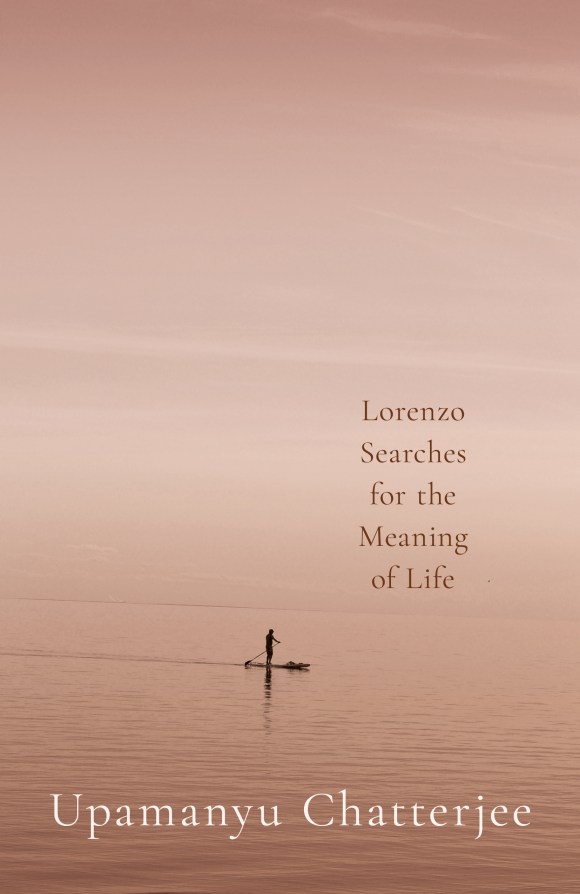
Several years ago, probably around the 1990s, the critic Nilanjana S Roy had defined the current crop of Indian Writing in English novelists as a ‘Doon School-St. Stephens’ conspiracy’. It was an interesting but true observation since the writers who were popular at that time were all products of these elite institutions and were quite adept at imitating western culture and simultaneously wrote in a style that was quite polished and urban. Upamanyu Chatterjee, belonging to this category, and at present a retired Indian civil servant, had shot into fame way back in 1988 by writing a definitive urban Indian coming-of-age story with his first novel, English August: An Indian Story. Several years later in 2000, he won the Sahitya Akademi Award for Mammaries of a Welfare State. His seventh novel Villany focused on a new class of post-liberalisation, westernised urban Indians who were hitherto ignored in the regional as well as the English fiction of India. This meticulously crafted literary thriller, a riveting story of crime and retribution, now stands at the other end of the spectrum when we read Chatterjee’s latest novel Lorenzo Searches for the Meaning of Life (2024). Narrating the life-story of an Italian Benedictine monk Lorenzo Senesi, who is on a spiritual quest to find the meaning in life, this meticulously detailed story is based on the life of Italian Fabrizio Senesi, an acquaintance of Chatterjee in Sri Lanka for the last few years, who turned out to be “a good friend” of his and who is now a European bureaucrat and a Development expert residing in Phnom Penh leading a successful professional as well as a blissful family life. As Chatterjee states in his foreword, “It is a true story, that is to say, like many true stories, it is a work of fiction.”
Divided into nine chapters, the locale of his story moves from Italy to London and then to Bangladesh. This is how things begin. One summer morning in 1977, nineteen-year-old Lorenzo Senesi of Aquilina, Italy, drives his Vespa motor-scooter into a Fiat and breaks his forearm. It keeps him in bed for a month, and his boggled mind thinks of unfamiliar things: where he has come from, where he is going, and how to find out more about where he ought to go. When he recovers, he enrolls for a course in physiotherapy. He also joins a prayer group, and visits Praglia Abbey, a Benedictine monastery in the foothills outside Padua. Detailing this part of his life we are told how this monastery will become his home for ten years, its isolation and discipline the anchors of his life. The first three chapters are full of quotes from the teachings of Saint Benedictine, the different vocations that Lorenzo follows, and give us details of monastic life as led in different Catholic institutions spread throughout Italy.
In the fourth chapter titled ‘The Visitor at the Abbey’, Lorenzo listens to a talk by one Luca Rossini, a Benedictine monk native of Bergamo, who since 1976 has been staying a little over seven thousand kilometers to the east in a place called Phulbari Para near the town of Khulna in Bangladesh where he runs an ashram as a dependent of the Praglia monastery. So, after eight long years of the introspective silence of a monastery, Lorenzo decides to go to Khulna. But before that he must spend eight months in England attending English-to-Speakers of-Other-Languages courses at an Academy there, till Luca would come to pick him up and take him to Bangladesh.
Upon arriving in Dhaka, the cacophony and different aspects of an alien culture that Lorenzo faces is described very beautifully by Chatterjee in great details. He starts wearing a lungi, eating with the fingers of his right hand, washing his clothes in a public tank along with female strangers, studying Bengali in the library with Luca, and tries to acclimatise with the place, the weather, and the people as quickly as possible. Apart from praying seven times a day, he also spends a lot of time decorating the walls of the chapel with different tempura paintings.
After some time, he visits another ashram called Rishilpi run by Enzo and Laura, an Italian missionary couple in Satkhira, some sixty kilometers away. Seeing the multifarious social upliftment activities that are being undertaken at their place, Lorenzo is intrigued by the idea of worming one’s way into a community and working for its betterment from within. Though remaining a Benedictine at heart, he decides to quit the Order and continue his search for some purpose to his life.
At Rishilpi he joins as Deputy Director, Health Services, and opens a sorely needed physiotherapy clinic that would attempt to instill a little meaning in the lives of the disabled and would educate the rest in matters of hygiene, sanitation, medical care and physical well-being. After surviving quite comfortably without money for the past eleven years and living a strict, disciplined monastic life, Lorenzo gradually undergoes a change when he starts interacting with people from all strata of society. Concealing his religion within his heart, he goes on working with a missionary zeal and after some time realises that even working with women felt marvellous.
In due course, he even falls in love and proposes to Dipti, the Headmistress of the same institution, and thus an ex-priest goes on to marry an ex-nun, both remaining devout Catholics forever. They spend the six happiest years of their lives at Rishilpi, till Lorenzo realises it is also life that is holding him back. With children, his responsibilities increase, he cannot go his own way. He needs money to survive and is called upon more and more often to lecture trainees in Dhaka at the Centre for the Rehabilitation of the Paralysed. In this manner, he slowly broadens his acquaintance with the developing world, and becomes the ideal person to build a bridge between the first world donors and third world recipients.
In the brief concluding chapter of the book, Chatterjee tells us that if one ended Lorenzo’s story here, it is because, even though twenty-nine years have passed since his marriage and he and Dipti are alive and well in Phnom-Penh, he has not in essential changed and he is still in spirit, Benedictine. But what is most interesting is the fact that “he still continues, though, to live his life anti-clockwise, as it were, for (as we have seen) after passing his youth in search of direction for his spirit, he turned outward to the community – and to the joys and responsibilities of the domestic life – only in his mid-thirties; and it was not till his early forties that he properly set about addressing the matter of money. It is – broadly – the trajectory of the typical human life but lived in reverse.”
Chatterjee’s tour-de-force is his storytelling and imaginative prose combined with his trademark wit and attention to detail. In the acknowledgement section he thanks his friend Fabrizio Senesi for providing him innumerable clarifications about life in Italy and in Bangladesh. The long list of books that Chatterjee read and mentioned in the end provides ample proof that he undertook his research rather seriously and this is clearly reflected in the intricate details that he provides of places and people throughout the novel. The book is not a page-turner, and one must read it rather seriously to savour the meticulous effort that Chatterjee made to provide us a fascinating tale about an ordinary human being who finds that a life of service to God is enough, and that it is not enough.
It's over a hundred. Trees droop close to melting. Air-conditioners whirr and whine. The electrical grid sputters close to blackout.
Air is slow to get around and some climate skeptic in a row house on Broadway wipes his brow, unpeels his shirt, thinks maybe this really is the hottest it's ever been.
In my house, with every window open, I imagine a crystal blue stream cascading down from mountains. Even in my mind, it turns to steam in an instant.
LET ME TELL YOU ABOUT THE MOUNTAIN
It was gold up there and my head could see clear to the next state and to the people I knew in childhood.
Forget the wind and the soughing boughs and the cold rocks and the clotted dry grass -- there were sounds like bells ringing and steps that penetrated clouds.
It was like a table set for me. And lit by one candle, one sun.
I approached gods fit to worship and they thanked me for my kind words but then directed me to deities even greater.
When I reached the peak, the sky was a wide blue altar. I climbed so high just so I could drop to my knees.
John Grey is an Australian poet, US resident, recently published in New World Writing, North Dakota Quarterlyand Lost Pilots. His latest books are Between Two Fires, Covert and Memory Outside The Head are available through Amazon.
.
PLEASE NOTE: ARTICLES CAN ONLY BE REPRODUCED IN OTHER SITES WITH DUE ACKNOWLEDGEMENT TO BORDERLESS JOURNAL
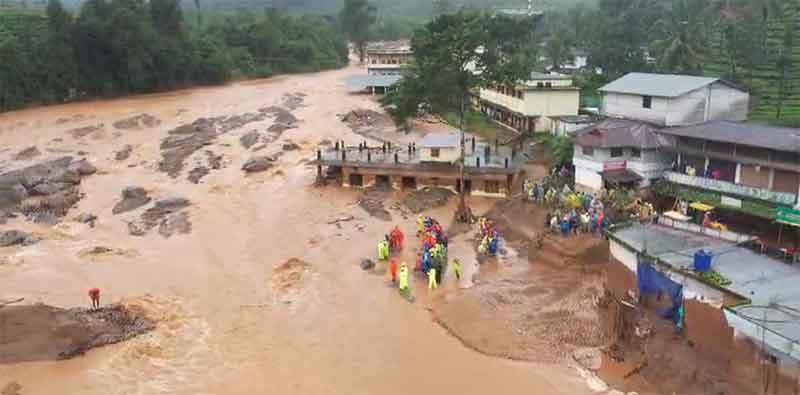
Landslide at Wayanad: Photo Courtesy: Countercurrents
On the morning of July 30, a huge landslide occurred at Mundakkai, in the mountainous district of Wayanad, Kerala, India. 282 people have been confirmed dead and many hundreds are still missing. It is the worst landslide in the history of Kerala and perhaps one of the worst in the history of India. A whole village was washed away in the flood and the flow of earth and rocks. A government higher secondary school and a bridge also got washed away. The rescue operations are still going on.
According to data released by India Meteorological Department Wayanad district received as much as 7% of its entire seasonal rainfall in 24 hours (from Monday morning to Tuesday morning). The Mundakkai region received 572 mm of rainfall in the past 48 hours prior to the landslide. This clearly points to an extreme climate change-induced disaster.
Experts like Madhav Gadgil are saying that it was due to the environmental degradation that the disaster occurred. The fact of the matter is that the landslide happened inside a deep forest which was not affected by human intervention.
The disaster area belongs to the Western Ghats, a UNESCO World Heritage Site, which is a very fragile ecologically sensitive area. This is also a region prone to frequent landslides. The Western Ghats starting from the Southern tip of the Indian subcontinent to the Konkan region is home to about 50 million people. In the parts belonging Kerala alone at least 5 million people live. Human habitation has caused a lot of ecological damage to the region. After the liberalisation of Indian economy, tourism has become a major industry in the region. Lots of tourist resorts have come up in the last 30 years, leading to stone quarrying in a major way. The stones from Western Ghats are used to build new roads, bridges, houses even in the lower land area and even the Adani port in Vizhinjam, Trivandrum.
If you look at the history of the Kerala part of Western Ghats, it was the Britishers who started huge tea, coffee and rubber plantations starting from late 19th century. It has caused huge environmental degradation in the region. Tata and Harrison Malayalam are the big planters now in the region. They behave like feudal lords, giving paltry sums in lease to the government and even encroach government lands to plant monocrops. The landslide affected Mundakkai also is a tea estate area owned by Harrison Malayalam company.
The farmers migrated to Wayanad and other parts of the Western Ghats of Kerala during the independence period due to the acute famine of that time. The government also promoted the migration of farmers. It is the descendants of these farmers who are killed by the landslide. They are the unsuspecting victims of unchecked development model and climate change caused by the Global North.
No place can withstand the kind of rain that was received in the landslide area. Yes, of course, wrong development model and environmental degradation has contributed to the disaster but it is not the root cause. It is the climate change caused by global warming for which the Global North is primarily responsible.
Present CO2 level in the atmosphere is 421 parts per million (ppm), which is similar to the CO2 level of Pliocene Epoch was a period in Earth’s history that lasted from 5.333 million to 2.58 million years ago. During the Pliocene epoch, CO2 levels in the Earth’s atmosphere were between 380 and 420 (ppm) during the warmest period. The global mean sea level during the early Pliocene Epoch was around 17.5 ± 6.4 meters which means that we are locked in for a sea level rise of at least 6.5 meters, 17 meters being the upper limit. Also CO2 levels in the atmosphere are rising 2.9 ppm per annum. This also means that we are moving into an unchartered territory in the climate crisis.
Most of our coastal cities will be under water very soon. Kerala which has one third of the landmass very close to the sea will be submerged under water. As the ocean warms more and more drastic climate events like Mundakkai will be a regular phenomenon. As Himalayan glaciers melt, the rivers originating from the Himalayas will dry up. Most of North India will be a desert. As the permafrost melts in the Arctic, Methane which is 28 times more potent than Carbon Dioxide will be released into the atmosphere and we will lead to a feedback loop, meaning more and more greenhouse gases will be released into the atmosphere without any human intervention. Another dangerous scenario is that as the permafrost melts, viruses and bacteria buried millions of years ago will be released into the atmosphere causing pandemics like COVID. Forest fires will be a regular occurrence in the dry seasons.
Do you think that climate change would be just weather events? No. Not at all. It will spread into social relations and human relations. We might see water wars, famines, and even civil wars in the name of nationality, ethnicity, language etc. Do you think that the present population of 8 billion people will survive the coming climate catastrophe? I think it will not. Many researchers are saying that we are in the middle of the Sixth Great Extinction. The sixth great extinction, also known as the Holocene extinction, is an ongoing mass extinction event that is caused by human activity. It is thought to be the sixth mass extinction event in Earth’s history, following the Ordovician–Silurian, Late Devonian, Permian–Triassic, Triassic–Jurassic, and Cretaceous–Paleogene extinction events.
Courtesy: Countercurrents
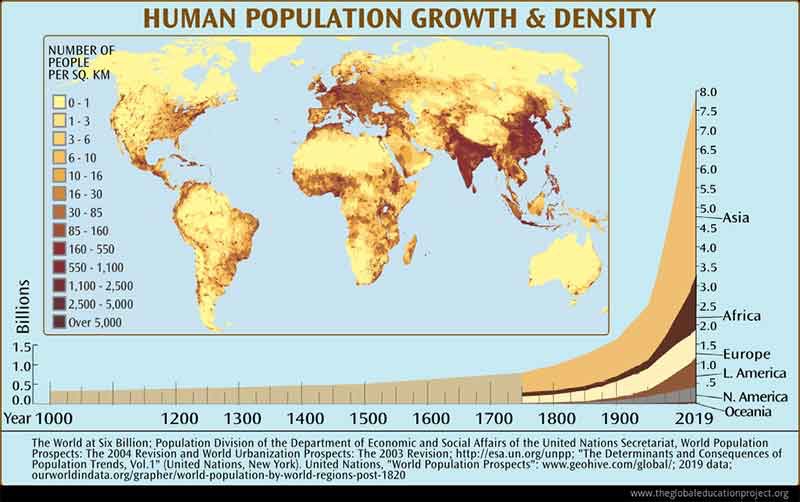
In the beginning of the 20th Century, the human population was only 2 Billion. Now we are 8 Billion. The huge spike in population growth that we saw recently is an aberration in human history. Nature will correct itself. That means we are going to see millions or even billions of deaths, if not in our lifetime, definitely in the lifetime of our children and our grandchildren. That means thousands of Mundakkai events will play in a loop in front of our eyes! What is most devastating is that there would be some of our dear and near ones too.
What happened in Mundakkai, Wayanad is not an aberration. It’s the new normal. It’s the beginning!
Binu Mathew is the Editor of Countercurrents.org. He can be reached at editor@countercurrents.org. This article was first published in Countercurrents.org.
.
PLEASE NOTE: ARTICLES CAN ONLY BE REPRODUCED IN OTHER SITES WITH DUE ACKNOWLEDGEMENT TO BORDERLESS JOURNAL
Disclaimer: The opinions expressed are solely that of the author and not of Borderless Journal.
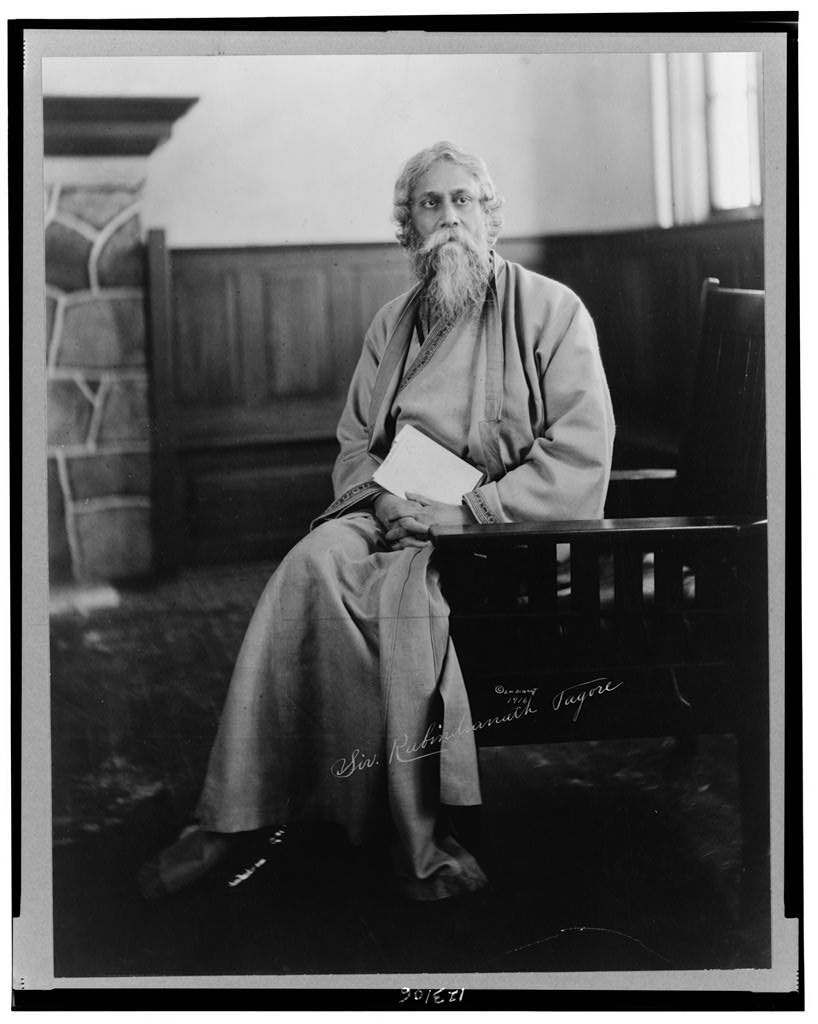
Rabindranath Tagore (May 7th 1861-August 7 1941). From Public Domain.
One of the greatest minds of centuries, Tagore wondered about life and death… about posterity. He lost his wife, some of his children and many more loved ones in his lifetime. He took a philosophical stance on death. On his death anniversary, we bring to you his ideas on death and life too…
As a salute to his pen, we start with his poems and stories, mostly in translation, and move on to tributes by Nazrul (translated by Professor Fakrul Alam), by Aruna Chakravarti , by the late Sunil Gangopadhyay and more…
Tagore’s Poetry
The Child, a poem by Tagore originally written in English. Click here to read.
Tagore in Translation
Tagore’sAchhe Dukhu, Achhe Mrityu, (Sorrow Exists, Death Exists): These lyrics were composed by the poet when on the death of his wife. It has been translated by Fakrul Alam. Click hereto read.
Mrityu or Death,a poemby Tagore has been translated by Mitali Chakravarty. Click here to read.
One Small Ancient Tale: Rabindranath Tagore’s ‘Ekti Khudro Puraton Golpo (One Small Ancient Tale)’ from his collection Golpo Guchcho ( literally, a bunch of stories) has been translated by Nishat Atiya. Click here to read.
Tributes
Nazrul’sGhumaite Dao Shranto Robi Re(Let Robi Sleep in Peace) has been translated from Bengali by Professor Fakrul Alam. Click here to read.
Rabindranath Tagore: A Universal Bard :This conversation between Aruna Chakravarti and Sunil Gangopadhyay that took place at a Tagore Conference organised by the Sahitya Akademi in Kochy in 2011. Click here to read.
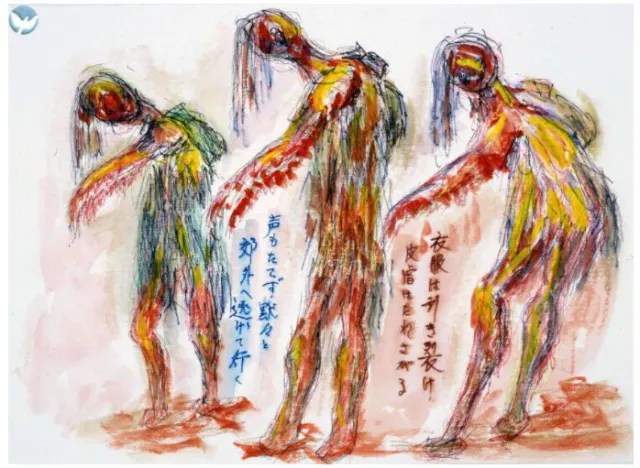
This painting/drawing is from artist Kichisuke Yoshimura, who said of it, “Their clothes ripped to shreds, their skin hanging down. On the riverbank I saw figures that seemed to be from another world. Ghost-like, their hair falling over their faces, their clothes ripped to shreds, their skin hanging. A cluster of these injured persons was moving wordlessly toward the outskirts.” Courtesy: Public domain
Almost eight decades after the Atomic Holocaust in Hiroshima and in Nagasaki, we still are looking for peace. These blasts destroyed humanity and the tenor of human lives. While nuclear treatise are still holding up, many parts of the world are warring over different issues… for borders we ourselves have drawn, for ideologies and pedagogies we ourselves have created. It has become difficult now to keep track of the terrors and horrors unleashed on unsuspecting citizens and innocents. There was a point of time, where kings settles their conflicts by fighting outside the cities with rules of war. But despite all the treatise and the deals, children are still dying in bomb blasts. Innocents are still being killed by missiles. One would have thought, humanity would have learnt from the past… But have we?
Showcasing the need for peace, we bring to you, recent poetry about the ensuing conflicts and some poems on the blast that killed innocents and maimed generations to come. We have an essay on an age-long conflict which does not seem to get resolved and the interview of a second generation Hibakusha who still suffers from the impact of the blast that had destroyed her mother’s world and left its imprints on the later generations.
Ratnottama Sengupta,comments on the current situation in Ukraine while dwelling on her memorable meeting with folk legend Pete Seeger, a pacifist, who wrote ‘Where have all the Flowers gone’, based on a folk song from Ukraine. Click here to read.
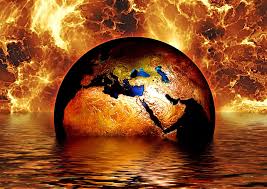
The description in ‘Hot Dry Summers’ is not of hell but what is perceived as happening on certain parts of Earth due to global warming or climate change. Forest fires. Nearer the equator, the storms have become harsher with lightning strikes that seem to connect the Earth to the sky. Trees get uprooted as the soil is softened from excessive rain. Sometimes, they fall on passers-by killing or injuring them. There is no rain in some places, forest fires or flooding in others… The highest temperatures touched 55 degrees Celsius this year. Instead of worrying about losing our homes lodged on land masses to the oceans that continue to rise, becoming dark heat absorbers due to loss of white ice cover, we persistently fight wars, egged on by differences highlighting divisive constructs. It feels strange that we are witness to these changes which seem to be apocalyptic to doomsday sayers. Are they right? Our flora, fauna and food will also be impacted by global climate change. How will we survive these? Will we outlive these as a species?
Poetry in our translations’ section travels to Balochistan, from where a Hafeez Rauf translated from Balochi by Fazal Baloch, talks of burning tyres, again conflicts. It takes on a deeper hue as Ihlwha Choi translates his poignant poem from Korean, reflecting on the death of his mother. We have a translation of Tagore’s less popular poem, Mrityu[1], reflecting on the same theme. His reflections on his wife’s death too have been translated by Professor Fakrul Alam who has also shared a song of Nazrul, written and composed on the death of Tagore. Another lesser-known poet but brilliant nonetheless, Nirendranath Chakraborty, has been translated for us by Debali Mookerjea-Leonard. And what a tremendous poem it is when the person called Amalkanti wanted to be sunshine! We have a story too — ‘Speech Matters’ by Naramsetti Umamaheswararao translated by Johny Takkedasila.
Our stories as usual travel around the world — from Holland (by Paul Mirabile) to Hyderabad (by Mohul Bhowmick) and with a quick pause at Bangalore (by Anagha Narasimha). Travels in the real world are part of our non-fiction. Sai Abhinay Penna takes to a the second largest mangrove forest in the world and Ravi Shankar to Colombo. Madhuri Bhattachrya gives us a glimpse of an Indian summer and Snigdha Aggrawal explores the impact of climate change in her part of the world. Farouk Gulsara actually writes his reflections at a traffic junction. And it reads droll…
We have an in memoriam by Keith Lyons on Morgan Spurlock, the documentary maker who ate McDonald fare for a month and then made a film on it. We have two tributes to two legends across time. Wayne F Burke has given a brief piece on the iconic illustrator, Norman Rockwell. And Aruna Chakravarti, the queen of historic fiction who brought the Tagore family alive for us in her two very well researched novels, Jorasanko and Daughters of Jorasanko, has given us a fabulous tribute to Tagore on the not-so common aspects of him.
Suzanne Kamata, the novelist who does a column from Japan for us normally, has spoken to us about her new novel, Cinnamon Beach, which overrides multiple manmade constructs. It’s an interesting read from someone who lives her life across multiple cultures and transcends many boundaries.
This is a bumper issue, and it is difficult to convey the vibrant hues of words that colour this edition. Please do pause by our contents page for a more comprehensive look.
This issue would not have been possible without all our fabulous contributors and a wonderful, dedicated team. We are delighted that Rakhi Dalal — who has done many reviews and shares her poetry with us in this issue — has agreed to be a writer-in-residence with us. A huge thanks to all of you, and especially Sohana Manzoor for her artwork. I am truly grateful to our readers for popularising our efforts to put together an online space with free and vibrant reads.
I would like to end with a few lines that gives me hope despite climate change, wars and doomsday predictions.
There’s more to life, he says to me, than what you choose to see.





 Borderless