Halloween returns, bringing back memories of trick or treating with children collecting candies, celebrating — celebrating perhaps to get over the fear of darkness, the unknown or perhaps, even the experience of global disasters ? The Bengali equivalent of Halloween — Bhoot Chaturdashi — was celebrated a day before Diwali. And as people do up ‘haunted homes and dress as witches, zombies and ghosts, I wonder, why do we celebrate such dark festivals and also enjoy them?
Perhaps, the answer is given in an essay by Candice Louisa Daquin that we have a gene that helps us enjoy such occasions… And then there is always the necessary adjunct of ghost stories and spooky rhymes that makes us feel ooky as our hearts beat and nervous snots of laughter explode from chests beating in anticipation…Wafting on borderless clouds that float mysteriously on Halloween nights, we invite you to visit a few spooks, ghosts, goblins, witches and spirits…
“Light festive lamps, make bright the night,
Shine your own lights, illuminate the world.”

— Tagore’s Autumnal Nights, translated by Professor Fakrul Alam
Courtesy: Creative Commons
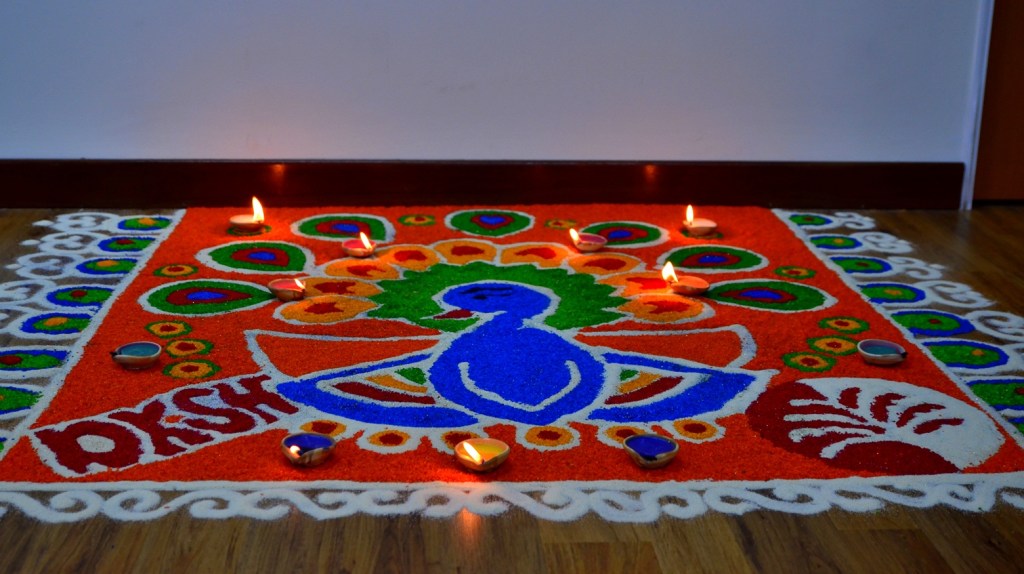
Celebrating and reinforcing the victory of the human spirit over darker forces is a cathartic experience in a world reeling under the impact of senseless wars, depression and economic crises. While the Earth too upheaves changes to create new lores, we draw comfort from the perpetuation of rituals that have solaced us over centuries. These festivals are celebrated in different ways across the world on different days. But, the festival of lights has become a major one, celebrated by a diaspora across all continents. The rituals were varied but the celebrations include lighting of lamps across the board.
The Combat of Rama and Ravana (late 18th century) Courtesy: Creative Commons
Lamps were lit to celebrate Rama’s return home after destroying darker forces as Diwali among North Indians. Among those from the South and West, it was the victory of Krishna over demon Narakasur that warranted the celebration of Deepavali. And yet those from the East, celebrate Kali’s victory over the rakshasas with lamps, sparklers and prayers. The Jain and Buddhist communities also have their special observances on this day.
To bring to you a flavour of these festivals, we have writings by Farouk Gulsara from Malaysia on the celebration of Deepavali during his childhood; Debraj Mookerjee on Kali Puja celebrations in his ancestral home and a sample of Bibhutibhushan’s stories on the darker tantric practices — intrinsically linked to the worship of Kali along with Basudhara Roy’s review of the translation of his book by Devalina Mookerjee.
We begin our selection to jubilate this festival of lights with a translation of Tagore’s poem on light and another by Mike Smith.
In my naive childhood, I thought that Deepavali was one big celebration all over India and of those of the Indian diaspora the world over, at least of those of the Hindu faith. Bizarrely, I must have thought the whole of India would be up in jubilation anticipating the arrival of the festival of lights. Obviously not: the discussions surrounding the recent UNESCO recognition of Durga Puja as an Intangible Cultural Heritage are anything but unison. Now the Gujaratis want Navaratri[1] as a cultural loom. Interestingly, the people in power in Tamil Nadu want the harvest festival of Pongal as the main Tamil festival.
Indians who were brought in by the British to work in the Malayan rubber estates in the 1930s were mainly from Tamil Nadu. They celebrated Thaipusam[2] and Deepavali with much pomp and fanfare. Both days were soon declared holidays in many states of Malaysia.
I do not particularly remember my childhood memory of Deepavali being particularly joyous. Deepavali was another unnecessary expenditure in my home. We were a lower middle-class Malaysian Indian family of the 1970s. My thrifty Amma looked at this merrymaking as a hindrance. It was also the busiest time of the year for her. She was a kind of Indian Auntie Scrooge. She would drum up upon us at every moment that if one is healthy and wealthy, every day would be Deepavali. Deepavali comes once a year, right. But then, it comes every year.
Amma was a kind of local rock star amongst the flat dwellers when it came to stitching saree blouses. She was the go-to person for the aunties to enhance their assets and anatomy to look good in their sarees, even though most of them were overtly oversized and out of shape, to look trim and alluring, in their eyes, of course. Amma would use her talent to supplement Appa’s meagre take-home after the creditors’ scavenging.
She took in more orders than she could chew in her zeal to make hay while the sun was out. As the days grew nearer, she would become edgier and edgier. She would burn the midnight oil trying to finish the orders, as her customers would trickle in, demanding in desperation for their Deepavali blouses. She would smile apologetically to her clientele, but once they left, all of us, including Appa, would be the brunt of her frustrations. She would go on a monologue about the hopelessness of life, blaming all the people in her life, including God, for her miseries.
My sister, Sheela, grudging, had to help her, cutting loose ends, stitching buttons, edgings, and general tidying the blouses. Occasionally, Amma would cut or sew something wrongly, and that was when all hell would break loose. No one was spared of her screaming tirade. The smacking of children was legal then.
Deepavali was generally not what Malaysian Indian students, that is, those keen to score well in the Malaysian public examinations, looked forward to. Most, if not all, major public examinations were held at the end of the year. It made perfect sense as that was when the rest of the school would have finished their academic year, and there would be peace and quiet to conduct examinations. The trouble is that Deepavali mainly falls in late October or early November. Sometimes, the celebrations fell right smack between papers. The school would also be holding their end-of-year examinations if it was not for the public papers. Hence, we thought Deepavali was just another off-day to cramp up for the tests.
We, the children, could look forward to our annual sort of ‘pilgrimage’ thronging the bargain-hunting haven of Penang’s Campbell Street’s cheap sale’s stores two to three weeks before the auspicious day. We could look forward to the only two sets of new attire they would buy for the next twelve months. Seeing Amma bargain with the shopkeepers for the best price, I sometimes pitied the sellers. Sometimes, I feel like telling Amma to just pay what he asked. No, she would not do that. She would go to another shop, start another boxing match, loose, and return to the first shop smiling sheepishly.
As the days got closer, Amma would get even more and more high-strung. The children would be at the receiving end as the sewing orders piled up, and she could not find the correct thread colours for her blouses. In the midst of all that, some cloth piece or button would go missing, and then there would be a ruckus. Everyone would be roped in to search only to find the missing item right under her nose, where it would have been all the while.
Amma would become more desperate. The children, all preparing for the examinations, would be nagged for not helping enough, unlike other children – as if we were the only children in the world who needed to study! The sewing sessions would go on and on till the morning of Deepavali. On one occasion, probably due to fatigue, she actually cut out the wrong design for the wrong customer, and Amma had to replace the material later. Probably that customer must have ‘celebrated’ Deepavali that year with no saree blouse! She might have passed it off as another new fad – as an empress in ‘new clothes’, perhaps!
About a week before Deepavali, cookies would have to be prepared in the middle of this entire melee. By tradition, the first to be cooked must be oil based; hence the opening ceremony was done by pressing murukku (a deep-fried snack made from rice flour and spices) and ghee balls (ney orundei). With a traditional and cumbersome murukku squeezing device, I would be assigned to give my muscle power to press down the murukku dough. A few other cookies would be baked in the then-spanking-new electric oven. To add to the local flavour, Amma would stir up sticky glutinous in brown sugar for a delicacy called ‘wajik‘.
One particular Deepavali eve, I remember an incident that triggered a stir in my neighbourhood. We were living on the 15th floor of a 17-storey low-cost flat. Residents were packed into tiny pigeonholes we called home. Privacy was the most diminutive of the priorities as we paved through life. Sheela was left to guard the fortress as my parents went off to the evening market to get groceries for the big day. I had gone off to school. I was in the afternoon session[3] that year.
I returned home to a big commotion outside my flat. Most of the neighbours were standing outside the unit, banging on the door, calling for Sheela and talking loudly amongst themselves. I peeked through the blind panel of the door. I could see Sheela slouched cosily on a sofa with her hands on her right cheek deep in slumberland. The television in front of her was blaring loudly, further drowning all the commotion outside. She was not too far from the door, but she continued snoozing. I guess all the late nights helping Amma must have gotten to her.
Residents getting locked out was nothing new in our neighbourhood. I suppose it is one of the events that got the neighbours together to mingle and get to know each other. Among us were self-appointed ‘specialists’ who devised their own gadgets to deal with any locked-out situation. The most typical item used by most was a charcoal stirrer. I guess that is how laparoscopic surgeons got the idea of performing keyhole surgery. One with hyper-flexible joints was sometimes sorted after to insert his hand through the door blinds!
Yours truly saved the day when I managed to manoeuvre my hand through the door to flip the lock open. All through the melee, my sister was in total bliss. Finding her snoring, oblivious to all the pandemonium outside, Appa went on to reprimand her in the usual way – KABOOM! (i.e. smack).
With all that build-up, preparation and countdown, Deepavali was actually an anti-climax – except for the new clothes, the food and the angpows (money packets) we received after distributing cookies to our neighbours. Amma would be sleeping after finally finishing her sewing and cooking. Appa would catch his forty winks on his easy chair, and we, the children, would watch all the special programmes on TV. Nobody actually came to visit us, even on Deepavali day. The afternoon would come, and the family would again manifest in front of the idiot box to watch the Deepavali special Tamil movie on TV. When this was over, essentially Deepavali was over and reality bit in. It was time to prepare for school the following day. On Deepavali nights, we would fire up a couple of Chinese sparklers.
All the money collected in the angpows would go straight into our Post Office Savings accounts in the next few days. The grand finale of the Deepavali curtain would fall a few days later with the family outing to the movies, a Tamil movie, packed with cookies that Amma had prepared as viewing snacks. Then, it was the school holidays, and another school year would come.
[1] A Western Indian festival in honour of the Goddess Durga, celebrated around the same time as Durga Puja
[2] The festival in January- February (called Thai in the Tamil calendar) commemorates the occasion when Durga gave her son, Murugan (or Kartikeya) a divine spear to defeat a demon. It is also commonly believed that Thaipusam marks Murugan’s birthday. It is a national holiday in many countries such as Malaysia, Sri Lanka and Mauritius. In India, in Tamil Nadu, it is declared as a holiday but not celebrated in other parts of India.
[3] Schools in Malaysia and Singapore often ran two session – morning and afternoon.
Farouk Gulsara is an occasional writer who blogs at riflerangeboy.com. Whenever he gets nostalgic about the time that whisked by, he pens down whatever his grey cells are still able to retrieve.
.
PLEASE NOTE: ARTICLES CAN ONLY BE REPRODUCED IN OTHER SITES WITH DUE ACKNOWLEDGEMENT TO BORDERLESS JOURNAL
Anthony Sattin, an award winning journalist and travel writer in conversation about Nomads: The Wanderers Who Shaped our World, his recent book published by Hachette, India. Click hereto read.
VR Devika talks of the dynamic Muthulakshmi Reddy, the first woman in the world to preside over a Legislative Assembly who sought justice for Devadsis and prostitutes and discusses her book, Muthulakshmi Reddy: A Trailblazer in Surgery and Women’s Rights published by Niyogi Books. Click hereto read.
Translations
Daridro or Poverty by Nazrul has been translated from Bengali by Professor Fakrul Alam. Click here to read.
The Browless Dolls by S.Ramakrishnan, has been translated from Tamil by B Chandramouli. Click hereto read.
Two poems from Italy by Rosy Gallace have been translated from Italian by Irma Kurti. Click hereto read.
Aalo Amar Aalo (Light, My Light) a song by Tagore, has been translated by Mitali Chakravarty from Bengali. Click hereto read.
Pandies Corner
Songs of Freedom: Moh-Reenis an autobiographical story by Amreen, translated from Hindustani by Janees. These stories highlight the ongoing struggle against debilitating rigid boundaries drawn by societal norms, with the support from organisations like Shaktishalini and Pandies. Click hereto read.
Ravi Shankar recommends walking as a panacea to multiple issues, health and climate change and takes us on a tour of walks around the world. Click here to read.
Ali Jan Maqsood introduces us to a strong matriarch from a Balochi village. Click here to read.
Musings of a Copywriter
In Drill, Fill, Just Chill, Devraj Singh Kalsi gives us humour while under a dentist’s drill. Click here to read.
Notes from Japan
Suzanne Kamata writes of herA Ramble on Bizan, focussing on a writer, also by the surname of Moraes, who lived on Mount Bizan more than century ago, moving to Japan from Portugal having fallen violently in love. Click hereto read.
It stretches without borders, without interruptions, without contentions, unifying all under its life-giving ambience. We live nurtured by the sky, the water and the Earth. If we think back to times before humans made constructs and built walls to guard their own, to times when their ancestors roamed the Earth and moved to meet their needs, the population was not huge, and resources were abundant. Our species lived in consonance with nature. People revered natural forces and found trends that evolved into traditions and constructs which eventually made their progeny forget that the sky, water and Earth did not belong to them. These belong or perhaps exist for some reason that we do not comprehend despite the explanations given by science and religions. Being merely transient passers-by through these, humanity, unlike dinosaurs, has an urge to survive and be like the sky — with a past, present and future and a sense of the eternal. Though we all have short lives compared to the sky, Earth or universe, we continue to find ourselves in a homo centric world that considers all else to be made to meet their aspirations. But there was a time, when humans lacked this arrogance. They just tried to survive. And move with shifting rivers in an unbordered world.
Exploring such times, is Anthony Sattin’s profound book, Nomads: The Wanderers Who Shaped our World. He converses to reinforce reviving the concept of asabiyya or bonding between humans so that they find it in their hearts to move forward with necessary changes to avoid following in the footsteps of mammoths. A change maker who redefined constructs for humankind, a devdasi’s[1] daughter who rose to become a pioneering doctor and activist a hundred years ago, is Dr Muthulakshmi Reddy. We have an interview with her recent biographer, R Devika, who authored Muthulakshmi Reddy: A Trailblazer in Surgery and Women’s Rights.
The books reviewed this time include one featuring the writings by the greatest change maker in cinema — Satyajit Ray. Bhaskar Parichha has reviewed Satyajit Ray Miscellany: On Life, Cinema, People & Much More while Professor Somdatta Mandal has given us a candid opinion on BM Zuhara’s The Dreams of a Mappila Girl: A Memoir, translated from Malayalam by Fehmida Zakir. Taranath Tantrik and Other Tales from the Supernatural by Bibhutibhushan, translated from Bengali by Devalina Mookerjee brings unexplored dark mysterious forces into play and has been reviewed by Basudhara Roy. We have an excerpt from the titular stories of Tarantath Tantrik. Bibhutibhushan Bandopadhyay(1894-1950) was a legendary writer from Bengal. He wrote stories and novels, some of which were immortalised in cinema, such as the Apu triology by Satyajit Ray. The other book excerpt is from a translation from Kannada by an upcoming voice that needs to be heard, Maithreyi Karnoor. She has brought to the anglophone world Shrinivas Vaidya’s Handful of Sesame.
Evoking humour is not easy, but we do have a few such writers who manage it very well. Hughes has given us a tongue-in-cheek piece on the dateline, which has more than humour. And Devraj Singh Kalsi has shared his discovery that laughter is the best medicine to shrug off a dentist’s drill. He has also visited the colours of Durga Puja which, with its spirit of inclusivity, transported visitors in one marquee near Kolkata to the iconic Malaysian Twin Towers. Thus, bringing festivals in October into our purview. Candice Lousia Daquin has actually explored why we celebrate festivals and the God gene… Did you know we have a biological need for spirituality?
Suzanne Kamata has introduced us to Mount Bizan, which houses a writer by the surname of Moraes – Wenceslau José de Souza de Moraes, an expat writer who lived in Japan at the turn of the twentieth century. Wonder if he could have been related to the Anglo Indian writer, Dom Moraes? Aditi Yadav has also given us an essay on the Japanese philosophy of Wabi-sabi with its world view centred on imperfections and transience. Ravi Shankar has suggested walks for all of us, sharing his experiences in the Himalayas, the Caribbean island of Aruba and in many more places. Meredith Stephens has written of sailing to Tasmania.
The essay that brought back a flavour of home for me is one by Asad Latif, now a journalist in Singapore but long ago, he was an icon in India. We are very privileged to have his writing on what borders do for us… a piece exploring the idea on which we base our journal, also perhaps with a touch of Anthony Sattin’ s asabiyya. ‘Pandies’ Corner‘ starts another run, showcasing women’s tryst for freedom. Amreen’s ‘Moh-Reen’, her own story, translated from Hindustani by Janees, is a brave start to the series. The voices ring out asking for a change, to heal social norms to accommodate love and kindness with the backing of Shaktishalini and Pandies as does the unsupported solo voice of an older woman from Balochistan, Ganji Baloch, brought to our notice by Ali Jaan Maqsood.
We have fiction from Sohana Manzoor – again bringing to fore strange stories of women rebelling against social norms. Paul Mirabile explores death and the sea in a horrific story. Sunil Sharma’s fiction explores madness and ideators, making a social comment on recent happenings. As the sky stretches out to accommodate all kinds of writings, all creatures great and small, we try our best to give voice to a fair cross section from around the world as we have done thistime too.
There are as usual pieces that we have not mentioned in this note but they are all worth a read. Do drop in to check out our contents in this October issue. We are truly grateful to our contributors who continue to connect with words and thoughts that waft along with clouds. We would like to thank Sohana Manzoor especially for her wonderful artwork. The journal would not be a possibility without the support of the whole team and our valuable readers who make writing worth the effort. It is lovely to be read and remembered for the words we write.
Anthony Sattin, an award winning journalist and travel writer in conversation about Nomads: The Wanderers Who Shaped our World, his recent book published by Hachette, India.
A breath-taking narrative that travels with the freedom of nomads, drawing from folklore, history and modern movements to give voice to an idea that might help move towards a more progressive and hopeful future — Anthony Sattin has achieved all this in a single book called Nomads: The Wanderers Who Shaped our World, a non-fiction that touches the heart with the concept of unifying humanity beyond the borders of ‘isms’ drawn over time. It explores the history of people who often have not been chronicled in conventional texts.
We are living in times where floods, forest fires, wars and divides are ravaging humanity as it wakes up from the coils of a pandemic that had almost stilled all normal interactions and economic activities for more than two years. The unrests and the changes attributed to “climate change” call for “continued solidarity” and a united front from all humanity as indicated by UN Secretary-General Antonio Gueterres and global guru Harari. In times such as these, an attempt to revive the concept of asabiyya, or bonds based on felt interests, is laudable and a necessity for the world to move forward. And that is exactly what Sattin has done in his recent book.
He has travelled with nomads; folklores, starting with Cain and Abel, Gilgamesh and Enkidu; history, Gobelki Tepe or Potbelly Hill, the place where he locates what might have been Eden, Achaemenid kings, Persian nomads, Mongols, Mughals to global nomads — spanning 12, 000 years of history.
In his book, Sattin tells us: “We are living at a time when the world — our world — shaped by the age of Reason and Enlightenment, powered by industrial and technological revolutions is faltering. Social contracts are fraying and communications are breaking down. The raw materials and natural resources are becoming scarce, and the consequence of our actions … are written large across landscapes, the climate, the fabric of our lives…Change is needed.”
Sattin “traces the shifting relationships between people who move and those who were settled” to find the concept of asabiyya or the sense of bonding popularised by an Arab philosopher called Ibn Khaldun (1332-1406). Perhaps, this is an ideal that could benefit humankind if we were all to see ourselves as one tribe. He has mentioned modern attempts at asabiyya, like the call given by ‘Black Lives Matter’, to contextualise the concept for us and to show how a movement born from within the hearts of people could touch and change attitudes.
The book is divided into three parts after an initial introduction from Mount Zagros, where Sattin was rescued from a bout of sunstroke by nomads: the first part is called ‘The Balancing Act’, where he explores ancient folklore and history, Huns, Hyksos, Scythians, Xiongnu and more: the second part is called ‘The Imperial Act’, from ‘The rise of the Arabs to the Fall of Mongols’ where kingdoms and world history is brought into play and the importance of asabiyya is introduced with historic instances and the last part is called ‘The Act of Recovery’, where changes towards redefining the world in terms of ideals aligned with asabiyya are explored.
The scope of the non-fiction is clarified at the start of the book from Mount Zagros. He starts the first section interestingly in a locale, termed by him as “Paradise” in 10,000 BC with a global population of ‘Perhaps 5 million’, of which he lists the nomad population as ‘Most of the number’. As he unfolds the history of mankind, from the past we find echoes of what could be called mobile or nomadic bonds that embrace to expand and heal civilisations. Sattin has been exploring such bonds for the last forty years.
Described as “a cross between Indiana Jones and a John Buchan hero” and “one of the key influences on travel writing today”, Sattin started his interactions with bedouins at age nineteen and found them nurturing. He elucidates: “After I left school, I went travelling in the Middle East. In the Sinai Peninsula, at that time, there were no hotels or other facilities outside of Sharm el Sheikh. So, I and the friend I was travelling with relied on the Bedouins for many things — they brought us fish and other food, they told us stories about the magical places in the desert mountains and although we had been told that they would rob us, they looked after us.”
Anthony Sattin. Photo Courtesy. John Murray/Hachette India.
Sattin has several non-fictions under his belt and is an award-winning journalist, who writes in a number of well-known journals, like the Sunday Times, the Conde Nast Traveller and the Financial Times. An editorial advisor to the Geographical magazine, he is also a fellow of the Royal Geographical Society and a founder-member of Travel Intelligence and ASTENE (the Association for the Study of Travel in Egypt and the Near East). He was the director of the Principal Film Company, has written, advised and presented on television and radio productions, including the BBC.
In this exclusive conversation, Sattin discusses Nomads, and tells us how the book came to be.
What made you think of writing a book on nomads, who — you have stated in your book — now constitute only 40 million in a world of 7.8 billion humans?
Every book has its moment, and this is the right time for Nomads. It came out of a lifelong interest in people who live on the move and on the problems of settled society, especially with cities – some of the first thoughts in Nomads occurred decades back when I read Lewis Mumford’s The City in History[1]. But I also have many ideas for books in my head at any one time and they don’t all get written! And some of them sit around for ages and then it seems to me to be the right moment to write. The way our world has changed in the past decade helped shape my sense that this is the moment to write about open borders and freedom of movement. I also wanted to write something that would stretch me more than anything else I had written. Twelve thousand years of history seemed like a big enough challenge…
How long did it take you to research and write the book? What kind of research did you do?
I began shaping the idea nine years ago, after I finished my previous book, Young Lawrence[2], about how the second son of an anonymous, middle class Oxford family became Lawrence of Arabia. The proposal took more than a year to get right – as my editor at WW Norton in New York pointed out, a subject this big can be about everything and nothing. Then there were years of research, particularly in the Bodleian Library at Oxford and the London Library, which is a wonderful place, the largest private library in the world and which serves as my home from home. I had many conversations over the years with scholars, people in publishing, fellow writers, travellers and nomads. And then there was the travelling with nomads, the writing and rewriting.
You travelled and lived among nomads for some time? How many years? Were your travels affected by the pandemic? If so, how did you bypass that?
I have been meeting nomads for more than forty years, particularly in North Africa and the Middle East, where I have travelled extensively. When I was 19, I was looked after by Bedouin in the Sinai Desert. In 2010, I was back there on a camel trek with a guide who impressed me because he knew every mountain, every watering place and every cave, including one which he pointed out as the place where he was born.
In Mali, I spent time with Touareg nomads, who came together each year at a place in the desert beyond Timbuktu – these tribes used to be at war with central government (and are again), but a treaty had been brokered and one of the terms was that tribal and government leaders would meet once a year to sort out grievances. They also played music, danced, raced camels… How could one not be swept away?
Specifically for Nomads, I went to Iran to spend some time with the Bakhtiari, a large nomad tribe who I had chosen in part because they claim lineage that goes back millennia, because they had played a part in the making of modern Iran but also because in the 1920s, a movie[3] was made of their annual migration into the Zagros Mountains, amazingly by the director and producer[4] whose next movie was the original King Kong! The Bakhtiari taught me much about the challenges facing nomads today.
Can you tell us of a few interesting experiences while moving with nomads which are not part of the book?
When I first went into the Zagros Mountains to meet the Bakhtiari, I was taken by a guide (being British, I had to have a guide for my entire stay in Iran) and he could not understand why I would waste my money and my time going into the mountains. He was from the city and exhibited age-old prejudices against people who lived on the move, whom he called ‘primitives”. But I am not a nomad and although I don’t find them primitive, I do find some aspects of their lives very challenging: years ago, on a camel trek in the Thar Desert, I caught what I now assume was sunstroke and thought I was going to pass out. My guide – there were just the two of us travelling – got me out of the desert. At the first village we reached, he had someone bring a bed out of a house and placed in the shade of a tree. I lay down and remember no more until about four hours later when I woke to find myself surrounded by the whole village. They had been angry with the guide for bringing me to them – think of all the trouble they would face if I died! When I woke, in the middle of this scene, the whole crowd burst into cheers like a scene out of a Bollywood movie.
You have spoken of ‘asabiyya’ taught by Ibn Khaldun. Can you explain the concept briefly and tell us if this can be of relevance in the current global situation?
Asabiyya is a sense of group feeling, something that binds people together. Ibn Khaldun thought it had shaped the world and found that it was most powerful among nomads and people who lived in the desert, in part because they must rely absolutely on each other. When this group feeling is channelled by a leader – the Prophet Muhammed, for instance – it can lead the group towards extraordinary achievements, as when the first Arabs overcame the might of the better-trained and armed Byzantine and Persian armies. It might all sound like something from long ago but I think there is a sense, in our own time, of someone like Greta Thurnberg having channelled that same feeling to force our leaders to pay attention to the climate emergency.
At a point you tell us that “…cities posed existentialist risks, and their temptations could overwhelm the asabiyya and nomads would lose their identity.” Why was maintaining their identity for the nomads so essential? Do you think this is something that needs revival in the present?
The existential risks I mention are the ones that rob nomads of their asabiyya and therefore of their power. Ibn Khaldun had seen this first hand: in North Africa, several small reformist movements had come out of the harsh desert or mountains to the south and overwhelmed the courts and kingdoms along the north coast. But each of those movements had fallen apart within a few generations as the pure people of the desert found themselves corrupted by living in cities. As for identity, it is important for all of us to know who we are and where we have come from — that was one reason to write the book, because very little is taught about nomads in western schools.
Your book touches upon number of issues — including faith. Given the fact that the great Khan had a Nestorian church, a mosque and a Buddhist temple in his capital city despite following the Shamanistic faith, would you say that an openness or tolerance in beliefs and faiths led to a more strongly tethered kingdom, as they did not really seem to have concepts of permanent national boundaries then? Is this not a dichotomy that you create a strongly tethered kingdom and yet are open to move on, leaving the old capital behind? And is it not wasteful?
I think there are two things going on here. On the one hand, a belief in freedom of conscience, the right to follow any or no religion. This was certainly something the great Mongol khans believed in. They were mostly animists, believing in the Sky Father and reliant on signs and omens, but they were not adverse to being prayed for and blessed by an imam or priest. Even the Ottomans, who came out of a nomadic tradition and were clearly Muslims, thought it important to allow freedom of conscience in their empire. What mattered was not who you prayed to, but whether you were prepared to acknowledge the sovereignty of the khan or the sultan. Some of the most successful periods in human history have flourished because of this idea.
A strongly tethered kingdom is another issue. For nomads, cities and capitals were not as important as lands, particularly hunting and grazing lands. The Mongol khans, like ancient Persian emperors and many other nomad leaders, recognised the need for a pivotal meeting place, a capital, but they were mostly more interested in spending time elsewhere and on the move. A leader such as Attila, the Hun ruler, had no interest in the cities he conquered.
You mention British author,Bruce Chatwin(1940-1989), as having said “we are born to move, that we must move or die.” Can you explain what that would mean? In the current context, people talk of roots and homeland. If they keep moving what happens to their firm conviction in homeland?
It depends what sort of ‘moving’ we are talking about. On a mundane and personal level, research now tells us that we are less likely to get ill and more likely to live longer if we walk 10,000 steps a day. On a national and global scale, we need interaction, we need to live lighter, we need to be nimble on our feet and in our thoughts.
You have divided the world into two groups — nomads and settlers — and said we need a bit of both. Can you tell us how and why?
Humans began to settle and cultivate some 12,000 years ago and since then, like Cain and Abel, humans have broadly been divided into those who stay in one place, usually either cultivating the land or living in towns/cities, and those who live on the move. For most of history they have lived in a state of mutual dependence and often even in harmony. A world without nomads, with everyone fixed in one place – which seems to be where we are heading – is a smaller, less rich, less fertile world.
In a post-pandemic world, would the nomadic lifestyle you have written of be feasible, especially with all the governmental issues creeping in?
The word nomad comes from a very old Indo-European word meaning pasture or a fixed area, which suggest the right to graze. But if you take a broad view of what it means to be a nomad in the 21st century, you might also include digital nomads and others who move to work or just because that is how they want to or have to live. That might not have been possible during the pandemic, when we were all locked down, but the number of people on the move now in many parts of the world is right back up and that can only be a good thing – we need to mix and meet, to exchange experiences and opinions.
If we opt for a mobile lifestyle, would we need to redefine borders as of old? Would that take us back to a pre-nationalistic era? Do you think we should be redefining our mindsets and our isms? Do you suggest we all go back to an intermittent nomadic lifestyle?
We should always be questioning mindsets and isms! Happily, we are living through a golden age of revisionist history shaped by a number of forces, decolonialism, Black Lives Matter and #MeToo among them. We also live in an age of misinformation on a massive scale. Nomads has come out of a need I had to shine some light on a way of life that is either entirely missing, or misrepresented in our histories.
Are you planning to write more on this issue or move on to something else? Would you share with us your next project?
There is much more to be written about this issue, but after spending most of the past eight years working on Nomads, it is time for me to look elsewhere. I hope I have stimulated a debate about nomads that will encourage others to look further. Meanwhile my thoughts are turning to Egypt — and to Italy, from where I am writing today.
Thanks for giving us your time during your travels.
If nations are imagined (but not therefore imaginary) communities, Bengal is a nation. The reality of nationhood rests on the quality of the imagination that goes into it.
Calcutta, where I was born in 1957, provided me with a cartographic point of entry into the imagined geography of Bengal. My Bengal began with West Bengal, within which lay a rough face-to-face society rich in visual and oral provenance. The everyday homeliness of rural thatched mud huts were reflected in the high gabled roofs which contoured the spiritual skyline of Dakshineswar. Minstrel bauls walked through the soul, half-starved on their way to seeking salvation for everyone. The very soil of Bengal broke out in bhatiali song. The chau dancers of Purulia dramatised Hindu epics in a language emotively accessible to all. The energy of santhali dances invoked the performative agency of a tribal culture that refused to let pre-industrial and pre-state time lapse into contemporary irrelevance.
Agricultural West Bengal encompassed the legacy of a land whose grasp was much longer and larger than the social circumference of middle-class life in Calcutta. In my own ancestral village in Hooghly district, a short train journey from Howrah station, boys my age could climb trees and run barefoot and naked across scorching soil, outpacing the shy urbanite in me. Young women, taught to avoid the roving gaze of male strangers, lowered their eyes to the ground in modest contemplation when men passed by. Farmers could bend unbearingly long to till the land, standing upright for only a few minutes before they resumed their toil. No one spoke English. No one needed to. No one needed me. I needed them.
To the west of West Bengal lay the rest of India. The “rest of the Indians” were decipherable. In Bihar and Odisha, once a part of Bengal Presidency, rump Bengal lived on in the linguistic and cultural traces of the colonial past. Farther west, West Bengal vanished into an eclectic Indian nationalism. I must say, though, that on a long train journey from Calcutta to Cochin in Kerala as a teenager, I thought (rightly or wrongly) that the particular shade of green found in the vegetation of West Bengal was lost till it was found in Kerala again. The renewed connection between Calcutta and Cochin made it possible for me to extend my Bengali-ness vicariously all the way to Kerala, making me quite a pan-Indian Bengali, I suppose. The connective nationalism of Indian Railways (like that of the State Bank of India) plays no small part in protecting the unitary reality of contemporary India.
Farther to the west of the rest of India lay the lands of Islam. They began with forbidden territory: Pakistan. Pakistan embodied the Partition of India, the departure of space from Indian time. For me, West Pakistan was unknown terrain: No one I loved or hated lived there. But if, indeed, there was an “Islamic world”, then I certainly inhabited it subliminally. I was (and am) a Muslim. I belonged to the global efflorescence of a great faith that had spread into my birth and self-recognition. West Pakistan had nothing to do with it. My mother was a practising Muslim (after a fashion), my father was a practising atheist. As a five-day-old, I had been “adopted” by a childless Hindu couple who lived in the same block of flats as my parents. Nilima Kurup (née Bose) took me to temples, and Parameshwara Raghava Kurup, well-versed in the Vedas, stayed away from the Puranas. But no one made me anything but a Bengali indebted forever to the Islamic religiosity of South Asia, Central Asia, the Middle East, and beyond. Certainly, I belonged to the lands of Islam. There was nothing vicarious about this. It is just that West Pakistan had nothing to do with my identity. I respected its existence even as it stayed indifferent to mine (since it had no idea that I existed). That was all.
East Pakistan was different. I had relatives there on both my mother’s side and my father’s. I remember a childhood visit to my paternal uncle’s home in Narayanganj. It was raining. Unlike West Bengal (where rain falls on people), the people of East Bengal fall on the rain. A female cousin, all of six years old, made an excuse of going to the bathroom: instead, she took a bath in a roomful of rain as wide as the skies outside, within sight of the elders, dancing with the abandon of the water that flowed through her tresses, kissed her eyes, drenched her frock, and caused an uproar that led her to be dragged back to lunch, laughing unrepentantly. Meanwhile, her elder brother wanted to go to the “bathroom” as well. He was held back by his hair and resisted violently, raining cries of recrimination on everyone. Watching my wild bangal (native East Bengali) cousins in righteous ghoti (native West Bengali) awe, I decided that East Pakistan was too Bengali for me.
But it was not to be.
Bangladesh
Baker-ul Haque came to live next door to our flat in Nasiruddin Road, Park Circus, Calcutta, in 1971. A year younger, he caught up with me in historical time with vivid stories of how he and his family had escaped Bogra, trudging through forests as the Pakistani air force strafed fleeing civilians, people fell dead on the left and the right, his mother held on his elder sister’s hand, he grasped his younger siblings firmly, his father led on, and all of them made their way — to me. I doubted specific details of his heroic journey, but not his visceral courage. I witnessed it when my pet dog chased him to the fourth-storey terrace, he climbed on to the parapet and kept walking on it calmly, I held the dog back, and I implored Baker to climb down. He smiled at me insouciantly. It was only when he saw tears in my eyes that he relented. Once he was safely down, I wanted to give him a hearty kick, but settled for a rib-shattering hug instead. Epaar Bangla[1]wins when Opaar Bangla[2]is safe.
Baker and his family lived next door, in the third-storey flat which the writer Syed Mujtaba Ali had occupied briefly earlier. Given his literary reputation, I stayed away from him, but he was rather fond of me, and I invaded his rooms whenever I found the door ajar. The family which stayed with my own family was that of Lutfar Rahman, an Awami League Member of the National Assembly from Khulna. Chachaji[3] smiled a lot but was fierce, chachiamma[4] was benign to a fault, their elder son Ornob took after his mother and their younger son Tulu (his pet-name) took after his father. Both brothers, who were much younger than I was, became mini companions on laughing excursions to the same terrace on which Baker had reduced me to tears.
The liberation of Bangladesh on December 16, 1971 (which happily and sadly soon saw Baker’s and Lutfar Chacha’s families returning to Bogra and Khulna) was my rebirth as a Bengali. I had been born into the bifurcated mythos of Bengal, which was first partitioned administratively in 1905 in an act rescinded in 1911, and then partitioned along national lines in 1947 to produce Pakistan. The partition of that Pakistan in 1971 produced an independent Bengali nation called Bangladesh. It is only in the years to come that I would understand the reasons for the ontological security of Bangladesh: it is a sated or satisfied nation because its borders guarantee the two conditions of its existence — that it be Bengali and Muslim in co-determinate measure — with provision being made for the rights of non-Bengalis and non-Muslims within its borders. Indeed, so successful has Bangladeshi nationalism been that its majority population finds it unnecessary to seek links with West Bengal to achieve cultural completion. That attitude is reciprocated in West Bengal, whose incorporation into the Indian ethos makes Bangladesh its closest neighbour, but a neighbour nevertheless.
Yet, to look across the border within Bengal, to see its integrity, is to un-see its divisions. Bengal is named ground: To walk on it, even vicariously, is to recover the insights of Walter Benjamin [5]on his visit to Moscow. Benjamin’s delineation of Russia as named ground (in his Reflections) leads him to proclaim that “you can only see if you have already decided… Only he who, by decision, has made his dialectical peace with the world can grasp the concrete. But someone who wishes to decide ‘on the basis of facts’ will find no basis in the facts”. The facts are always too many. The facts are contested. The facts might not even be facts. But Bengal is decidedly one — not because of its successes but because of its vulnerabilities.
The Refugee Within
The fragile figure of the refugee straddles the two Bengals. Achintya Kumar Sengupta’s[6] poem,Udvastu[7], rendered unforgettably in the recitation by Kazi Sabyasachi[8], is a part of an aural tradition without which it is impossible to re-imagine the Bengal that existed once. What makes the refugee central to the idea of Bengal as a state of mind is that she embodies the land’s biological unity and integrity in the very act of losing her place in its stolen geography. Bearing the scars of uprooting, dispossession and exile, the refugee socialises the pain which lasts long after the immediate displacement of enforced migration has passed. To seek refuge is to pass from basha to bari. Basha is a temporary place of residence, no matter how long that temporarity lasts. Bari is an inherited abode which is both ancestrally personal and nationally interchangeable with desh, the native land. The udvastu or vastuhara[9] from East Bengal seeking refuge in West Bengal since 1947 had to contend with what Nilanjana Chatterjee calls “epistemological denial in India”, wherein those who had crossed the border were treated as an economic burden.
The epilogue to the story of the refugees of 1947 was written in 1971, when it was the turn of Bengali Muslims from East Pakistan to join Bengali Hindus in seeking refuge in West Bengal. While the vast majority of refugees spent months in harrowing conditions, professional and other middle-class families were often hosted by middle-class families in West Bengal who could afford to do so. It was not unknown for the family of a Bengali Hindu, who himself had come from East Bengal in 1947, to share its basha with a Bengali Muslim family. The Bengali Muslim knew that he would return home if Bangladesh won the war. His Hindu host kept dreaming of a bari relegated forever to the nostalgic lay of a lost land.
My family was more lucky. Our first trip to Bangladesh was to Lutfar Chacha‘s home in Khulna across the land crossing in Benapole. Of course, I enjoyed the royal spreads at breakfast, lunch, tea and dinner. But what filled my eyes was the sight of Ornob, Tulu and their little sister (by then), strutting about their home as if it was theirs. It was theirs. Bangladesh restored in me my extended sense of myself, my identity as a resident of Epaar Bangla who sought completion in the autonomy of Opaar Bangla. Soon after, I visited Baker in Bogra. At one dinner, his mother sat down just the two of us together. Naturally, I got the larger piece of fish in a bowl. I cooked up an excuse for Baker to go and look for something. I exchanged the bowls. He returned to eat. When we began with the vegetables, he exchanged the bowls. That insouciant smile again. I hate him. He has outwitted me always inspite of being a year younger.
The refugee is the first citizen of imagined Bengal. She will also be the last. That is, without Bangladesh and West Bengal being the ultimate refuge of the transitional Bengali self, there will be no Bengal.
There will be no me.
Birth matters. No one can be born in two places.
In his essay, “Englands of the Mind”, Seamus Heaney[10] registers the birthing role of place in the “interlacing and trellising of natural life and mythical life”; what a land does is to afford a man “nurture that he receives by living among his own”. Bengal forms a similar geography of the mind. It received me among my own. Life was material, which is to say that it veered from the banal to the brutal, but it was redeemed by the furtive companionship of the imagination. The trellising which Heaney notes does not have to be idyllic. It rarely is. Australian writer Dorothea Mackellar’s[11] poem, “My Country“, written while she was homesick in Britain, captures the native lore of a land that her ancestors supposedly discovered for her. She writes: “I love a sunburnt country,/ A land of sweeping plains,/ Of ragged mountain ranges,/Of drought and flooding rains.” Australia is nothing without its enervating drought and its equally uncaring rain. Mackellar dismisses the pastoral epiphanies of a promised expatriate land, particularly “When sick at heart, around us/ We see the cattle die”. Natural disasters provoke her to reclaim art from nature. She redeems a wayward landscape by offering it refuge in her lines.
I am no Heaney or Mackellar. Bengal has no need to find refuge in my words. May these English words of mine find refuge in the lap of Bengal from which I sprung into life.
[1] Epaar Bangla: This side of Bengal (West Bengal)
[2] Opaar Bangla: That side of Bengal (East Bengal or Bangladesh)
[3] Father’s younger brother is chacha and ji is an honorific in chachaji
Written by Kazi Nazrul Islam in 1926, translated from Bengali by Professor Fakrul Alam
Nazrul’s statue in Bangladesh: Courtesy: Creative Commons
POVERTY

Poverty, you’ve empowered me,
Endowed me with Christ’s dignity
And adorned me with a thorny crown,
Ascetic one, you’ve inspired me
To speak out and eye the world boldly
Deliver messages as incisively as a knife;
Your curse has made my veena a sword!

Arrogant hermit, your scorching flame
Has shorn my golden visage of its glitter,
Shrinking its sap and drying the soul early,
When I try grasping with emaciated hands
Beauty’s bounty, O Impoverished One,
You step forward and lap it up.
A forlorn desert is all you leave
For my imagination to play with.
My eyes blaze at my own beauty!

My desires, tinged with pain-yellow buds,
Would rather bloom like the soft, white,
Fragrant shefali flower.  But Cruel One,
Like an unfeeling woodcutter, you break
All branches and destroy all blossoms,
My heart glistens like an autumnal dawn,
Wet with dew shed by sympathetic earth.

You are the sun -- your heat dries up
Every dewdrop of pity. I shrink
Inside the shade that earth affords.
Dreams of Beauty and the Good shatter.
Pouring liquid poison down the throat
You ask, “What good is nectar now?
There is no parching sensation,
No intoxication, no madness.
Weakling that you are, not for you
To seek manna from heaven
In this sorrow-laden world!
You are a serpent, in birth singed
By pain! In a thorny garden you weave
Garlands. On your forehead
I leave this mark of woe!”


I sing songs, weave garlands, and feel my throat burn,
Snakebites have left their marks all over my body!

Like unforgiving Durbasha*, you wander
From door to door with a beggar’s bowl.
Even as newlywed couples embark
On their night of Happiness, you cry out:
“Dumb ones, Listen: this world
Is no bower of bliss but full of sorrow,
Of want and the pangs of parting,
Of thorns that underlie bridal beds
And are embedded even in the Beloved’s arms,
Take your fill of them now!”
Instantly, cries of anguish overwhelm,
In that bower of bliss light fades,
And dreadful night overwhelms!

Exhausted, worn out by hunger, you peer,
Surveying earth with knotted eyebrows
When, suddenly, something strikes you,
And your eyes dart out fiercely.
Whole kingdoms are devastated then
By Plagues, Famines, and Cyclones,
Pleasure Gardens burn, palaces topple—
The only verdict you know is death!

You never stoop to modest displays,
But revel in revealing yourself naked.
You know no hesitation or shame
But raise the heads of those bent low.
At your wish, people condemned to die
Tie nooses around their neck gladly.
Despite burning in the fire of penury daily
They embrace death with devilish glee.

From goddess Lakshmi’s head you snatch
Her crown and throw it to the dust.
O Champion, what tune do you strum
So deftly on your veena? All I hear is lamentation!

Yesterday morning I heard the shehnai wail
A melancholy note, as if a dear one
Hadn’t returned home yet. The shehnai
Seemed to cry out to him to come back.
Some bride’s heart wafted away with the tune
As if searching for her beloved.
Her friends wondered why she should cry,
And let her kohl dissolve with her tears....

Even this morning I woke up to hear
The shehnai call plaintively: “come, come”
Sad-faced, shefalika flowers drop off—
Like a widow whose smile keeps fading—
Their delicate fragrances overwhelm
Butterflies fluttering on restless wings,
Intoxicated with the scent of flowers
They kissed! Bees yellow their wings
With pollen and wet their bodies with honey.

My soul overflows in all directions!
Unconsciously I sing out welcoming songs
Happily! My eyes fill with tears unaccountably
Someone seems to tie the knot,
Uniting me with earth. With hands full of flowers,
Earth appears to step forward with its bounty.
It is as if she is my youngest daughter!
I wake up suddenly in wonder! Alas, my child
Has been up all night and is crying in my home,
Famished and hands full of soot.  O Cruel One,
You’ve brought perpetual tears to my home!
I haven’t been able to give my dear child,
My loved one, a drop of milk!

Familial duty is no delight! Poverty is intolerable,
As it cries endlessly as one’s son or wife
Clasping one’s door! Who will play the flute?
Where will one get radiant smiles of bliss?
Where will one taste a rich bouquet of wine?
Rather swallow a glass of the poisonous dhutura
To make the tears flow....

Till this day I hear the shehnai’s overture wailing
Seemingly saying: nothing, nothing has survived!

*Durbasha: A legendary rishi who was revered but was rather hot tempered
Born in united Bengal, long before the Partition, Kazi Nazrul Islam(1899-1976) was known as the Bidrohi Kobi, or “rebel poet”. Nazrul is now regarded as the national poet of Bangladesh though he continues a revered name in the Indian subcontinent. In addition to his prose and poetry, Nazrul wrote about 4000 songs.
I have long been fascinated by the International Date Line, which I have never yet crossed but still intend to. I have unreasonable qualms that crossing it will change a person in some way, will project them into the past or future by a day and that some part of them will always remain displaced from the present. Even if they cross the line again in the opposite direction, they won’t entirely be back in alignment with themselves. It is difficult to explain without resorting to vague words such as ‘soul’ and the idea is without any basis in fact anyway. Yet it is a feeling that persists beyond logical thought.
I suppose that the origins of my excessive interest in the Date Line can be found in one of Jules Verne’s best novels, Around the World in Eighty Days, a book with one of the best twist endings ever devised. Phileas Fogg the explorer makes a bet that he can circumnavigate the Earth in only eighty days and thanks to an unfortunate set of circumstances he fails by one day. Or does he? He has crossed the Date Line from the east in order to enter the western hemisphere and thus has gone back in time one day. When he realises this fact, he uses the extra day to win the bet. Geometry saves him.
For a long time, I wondered why Verne wasn’t praised more highly for this brilliant plot device, but now I ask myself if it wasn’t a conceit he borrowed from Edgar Allan Poe, of whom he was a great admirer. Verne’s novel was first published in 1872 but thirty years earlier Poe’s short story ‘Three Sundays in a Week’ utilised the same ingenious idea for quite a different purpose. When the name of Poe is mentioned, we imagine tales of horror and bitter despair, morbid scenes, grotesque irony, but he also wrote strange comedies and ‘Three Sundays in a week’ is one of his lightest and happiest.
The narrator, Bobby, wishes to marry Kate, but her obstreperous father, Mr Rumgudgeon, is against the match while pretending to approve of it. He offers a generous dowry with his blessings but when Bobby asks that a date be fixed for the wedding, Mr Rumgudgeon replies that it will happen “when three Sundays come together in a week!”. This impossible condition is a cruelly humorous attempt to forestall the wedding. But Bobby is a clever young man. He knows a way in which the unfair condition can be met.
He arranges a dinner for himself, Kate and her father, and two guests, both of them sea captains who had lately returned from voyages around the world. The crucial point is that Captain Smitherton and Captain Pratt sailed in different directions while circumnavigating the globe. The dinner is held on a Sunday, but it is only Sunday for Bobby, Kate and Mr Rumgudgeon: for Captain Smitherton yesterday was Sunday and for Captain Pratt the next day would be Sunday. Thus, the impossible condition is met. It is a week with three Sundays in it and no further objection to the marriage can be made.
Poe was very clear in his mind about the technicalities of time difference in such voyages, as was Verne, but confusion about east/west crossings of the Line forms one of the recurrent absurdist jokes in W.E. Bowman’s The Cruise of the Talking Fish, in which the crew of a pioneering raft accidentally disrupt, at great cost, the launching of an experimental rocket from a remote Pacific island. This book was published in 1957 (one century after the midpoint date between Poe’s short story and Verne’s novel). It is a magnificent comedy that manages to make the reader doubt their own knowledge of how the Date Line works. And in truth the mechanics of the crossing still confuse me.
Yet another novel that utilises the Date Line and the oddities surrounding it is Umberto Eco’s The Island of the Day Before in which a becalmed sailor on a ship near an island that lies on the other side of the Line indulges in speculation as to the physical and metaphysical significance of our conventions of time. The island is unreachable but remains as an anchor that tethers his mind to the topic and he is unable to stop wondering (and extrapolating this wonder) until flights of fancy turn into mathematically-based obsessions. There is always the lurking suspicion that the Line is not just a human convention but something true that is now embedded in nature as a thriving paradox.
Deep down, I still believe that crossing the Line is an act of time travel, not only in terms of human timekeeping but also in relation to the natural world, so that a man who sails into tomorrow can find out the news of the day and learn such things from the newspapers or radio as to who has won a cricket match, then recross the Line in the opposite direction and lay bets on that team, raking in huge winnings. Or a man who has suffered an accident and is badly wounded can be carried back one day into the past, where he is well again and when the following day dawns, he can take evasive action.
I know that none of this is true, but I feel it is right nonetheless, and I have written my own stories in which the Date Line features, one of them being ‘The International Geophysical Ear’, which is about a gigantic ear positioned on the Line itself that can hear both backwards and forwards in time, and another being ‘The Chopsy Moggy’, concerning a talking cat who unfortunately turns up late for an inter-species conference that will determine the future of humanity. There are others and undoubtedly more will be written.
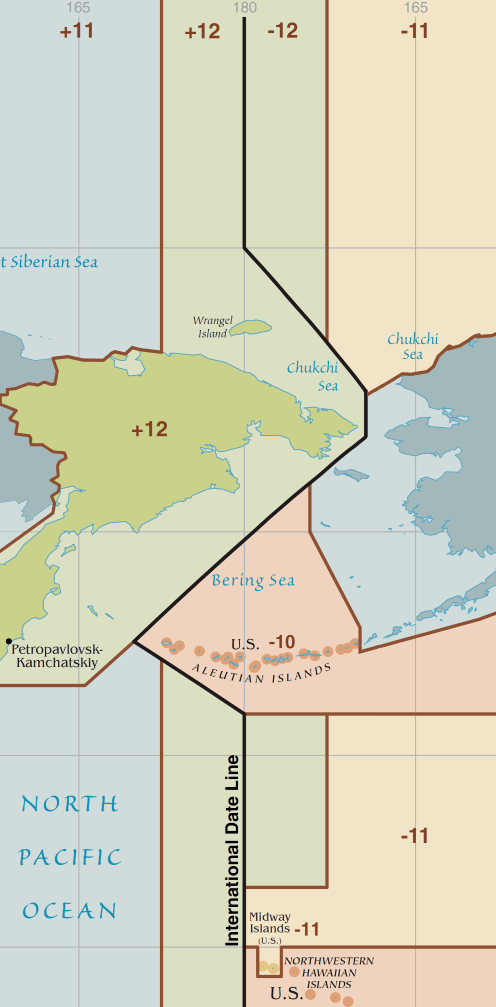
The Date Line has been host to rather strange happenings in reality as well as in fiction. On the map, it is no longer a straight line that follows the longitude of 180 degrees east and west. It veers abruptly to avoid landmasses, taking wide detours around islands. But once it deviated not one inch. It speared through the atolls and islands it encountered, dividing them in half, so that a person had the opportunity of standing with one leg in today and the other in yesterday or even tomorrow. Wrangel Island in the Arctic Ocean, the last dwelling place of woolly mammoths (still around when the pyramids were being constructed in Egypt), was one of these special places. Three Fijian islands too: Vanua Levu, Taveuni and Rambi, where unscrupulous plantation owners forced workers to cross the Line on Sundays to prevent them having a day off.
There is also the interesting fact that the equator crosses the Date Line and that a point therefore exists where it is summer and winter simultaneously while also being today and tomorrow (or yesterday). The SS Warrimoo was a ship that routinely travelled between Canada and Australia. On the last day of December 1899, the ship was very close to the point where the equator meets the Date Line and Captain Phillips realised that if he positioned the SS Warrimoo exactly on that point, something very curious could be achieved. He gave instructions for this to happen and on the stroke of midnight his vessel lay at 0 degrees latitude and 180 degrees longitude. Magical coordinates…
The forward part of the ship was now in the southern hemisphere and thus in summer while the rear remained in the northern hemisphere and in winter. Half of the SS Warrimoo was in the year 1899 (December) while the other half was now in the year 1900 (January). Captain Philipps was skipper of a vessel that was in two different days, two different months, two different seasons, two different hemispheres and two different centuries. Of course, the objection can be raised that December 30 is not the last day of a year. But the Captain waited until midnight before reaching the miracle point. December 31 did come but it flashed past in less than the blink of a mermaid’s eye. The ship leapfrogged an entire day, or at least the vast majority of it.
My hope is that there was a copy of Around the World in Eighty Days on board the ship when it made that spectacular crossing, or maybe a collection of the short stories of Poe. It is highly unlikely this was the case, of course. And I have just now had another thought. Suppose you are reading Verne’s novel on a ship that crosses the Line in an easterly direction. You have been reading it all day and have reached the last few chapters. Suddenly the ship crosses the Line and you are back in yesterday and find yourself only on the first page again. You might be frustrated not to know the ending to the book. Let me assist you. The hero and the heroine do get married.
Rhys Hughes has lived in many countries. He graduated as an engineer but currently works as a tutor of mathematics. Since his first book was published in 1995 he has had fifty other books published and his work has been translated into ten languages.
.
PLEASE NOTE: ARTICLES CAN ONLY BE REPRODUCED IN OTHER SITES WITH DUE ACKNOWLEDGEMENT TO BORDERLESS JOURNAL
Aalo Amar Aalo (Light, My Light) was part of Tagore’s collection titled by him as Bichitro (Amazing) which appeared in 1911, and later as part of Geetabitan(1932)
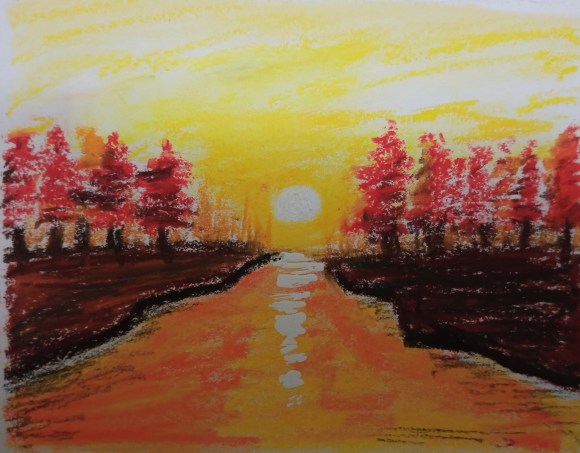
Art by Sohana Manzoor
TO LIGHT

Light of mine, O light, the universe is filled with your effulgence,
My heart is yours; my eyes drown in your refulgence.
The light danced — danced amid my being.
It sings — sings amid my heartstrings.
The sky awakens, the breeze flits, the Earth laughs.
As luminous currents surge, thousands of butterflies take flight.
Mallika-Malati* dance in waves of light.
The clouds are coloured with gold, infinite gems glitter.
The leaves laugh intoxicated with elation.
Your nectar floods the shores by the river of tunes.

*Names of fragrant flowers
We present the song in Bengali by Chinmoy Chatterjee (1930-1987), also known as Chinmoy Chattopadhyay, an eminent singer from the past.
This song has been translated by Mitali Chakravarty with editorial input from Sohana Manzoor and Anasuya Bhar.







 Borderless