Persian poems written and translated by Akram Yazdani
UNTRAVELED SUITCASE

The suitcase never left.
Its lock held untold stories,
its corners heavy with silence.
Each day, the road waited, empty,
while unseen journeys
moved quietly beneath its lid.

MULTI-VOICED MIND

In his mind,
multiple voices whispered at once—
not to command,
not to warn—
but to open windows
that led to different times.

Moments
folded over one another,
like two seasons unfolding
simultaneously on a single page,
and every choice
breathed silently in the hidden world
before it could find a word.

There,
there were birds,
half-formed,
with feathers unaccustomed to the world,
yet knowing the weight of flight;
birds whose path
was neither toward sky
nor toward earth—
but somewhere between decision and fear.

He paused.
He breathed.
And gazed at the path passing through him.
And there, in the impartial silence,
one of those half-formed birds
called his name—
not from the past,
not from the future,
but from a moment yet to arrive,
already decided.
Akram Yazdani is a poet and writer from Mashhad, Iran. She writes her works in Persian and provides English translations for publication. Her writing explores silence, memory, and minimal moments of perception, seeking to connect personal reflection with shared human experiences.
PLEASE NOTE: ARTICLES CAN ONLY BE REPRODUCED IN OTHER SITES WITH DUE ACKNOWLEDGEMENT TO BORDERLESS JOURNAL
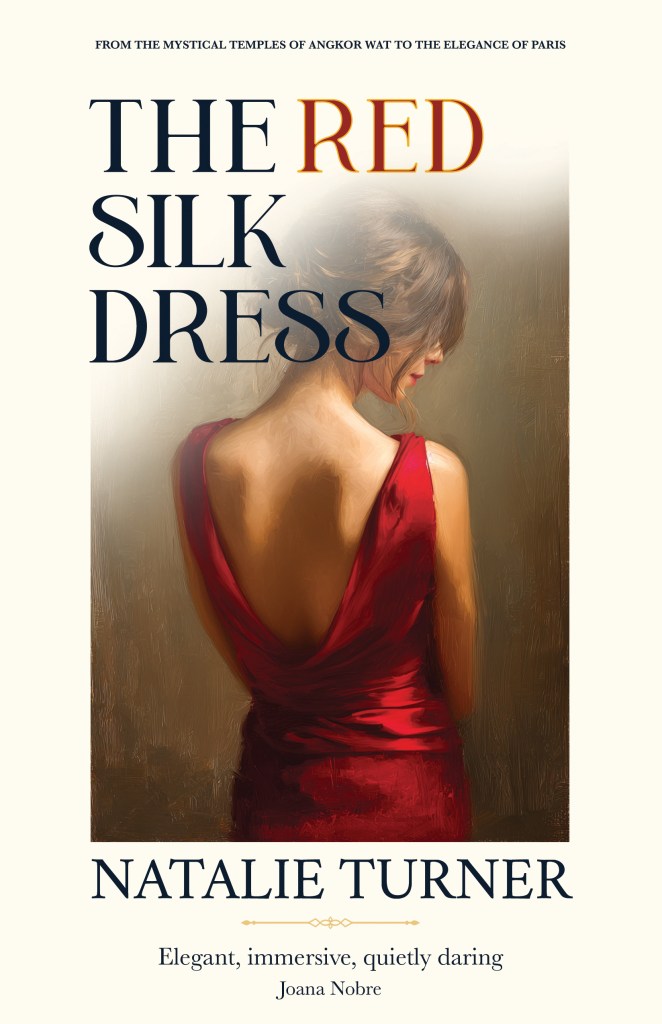
Keith Lyons in conversation with Natalie Turner, author of The Red Silk Dress
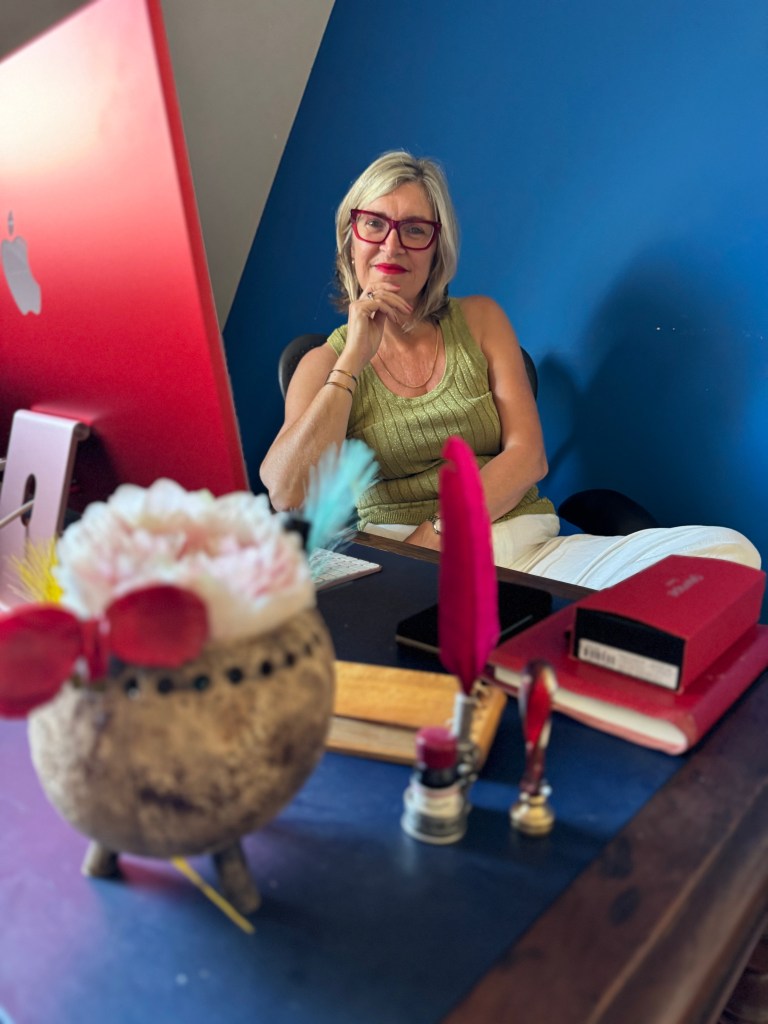
Natalie Turner in Lisbon
Tell us about your background and life. If you had to give a relatable elevator pitch to readers, what would you say?
I was born in 1968, a year of social upheaval, into a life shaped early by movement, belief, and questioning. My parents were Christian missionaries, so I grew up immersed in faith, travel, and a strong inner world. From a young age, I wanted to be a writer. I was also restless, resistant to fixed paths, and fiercely independent, which meant that desire took many shapes before it found its way home.
As a young adult, I travelled and worked across Asia and Latin America, experiences that expanded my worldview and quietly dismantled many of the belief systems I had inherited. I later studied politics, economics, and social psychology, worked in Parliament, and then moved into business and innovation, where I continue to help organisations navigate change. Writing stayed alive throughout, mostly through journals and ideas, even when it wasn’t centre stage.
The red thread running through my life has always been transformation. A willingness to question what no longer fits, and the courage to follow what is asking to emerge. Writing fiction felt like the most honest way to bring that thread home.
What first inspired The Red Silk Dress?
The inspiration came from living inside a world that looked complete from the outside but felt fractured beneath the surface. In Southeast Asia, I was surrounded by what’s often called the expat life, glamorous settings, elegant events, and success on display. Yet in quieter moments, especially in conversations with women, a very different story would surface.
Many were intelligent, capable, outwardly fulfilled, yet privately wrestling with a sense of loss. They had raised families and built impressive lives, yet somewhere along the way they felt they had misplaced themselves. The contrast between the polished exterior and the unspoken interior stayed with me.
At the same time, I recognised a parallel in myself. From the outside, my life also looked full and successful. Inside, I sensed something unfinished, something buried. The novel grew from that convergence. From the tension between what we show the world and what quietly asks for attention. Cambodia, and a writing retreat in Siem Reap, became the place where that question could no longer be ignored.
Why did you choose Claudette, a French woman living overseas, as the heart of this story?
I didn’t choose Claudette in a deliberate way. I wasn’t designing a character or thinking about nationality or backstory. She arrived. On the outskirts of Angkor Wat, during a writing retreat, surrounded by experienced writers and acutely aware of my own inexperience, this woman appeared fully formed in my imagination.
She was elegant and guarded, wearing a wide-brimmed white hat and dark glasses. She introduced herself as Claudette, from Paris, and asked me to write her story. When she removed her glasses, what struck me was the sadness in her eyes. That moment carried a quiet insistence. It wasn’t dramatic, but it was unmistakable.
I wrote the opening paragraph that day, and it remains the opening paragraph of the novel. Claudette wasn’t invented to make a point. She was the right vessel for the story that wanted to be told.
The novel explores longing, desire, and reinvention. What drew you to these themes?
Reinvention has always fascinated me because I’ve lived it. I’ve moved countries, changed careers, and rebuilt my life more than once. That capacity for agency, for choosing to become something new, has been a quiet through-line in my work and my thinking.
Longing and desire entered the novel more subtly. At the time, I was living in Penang, Malaysia, immersed in colour, texture, heat, and beauty. I began to experience desire not as something reckless or romanticised, but as a form of intelligence. A way back into memory, creativity, and the parts of us that go dormant when life becomes crowded with too much to do.
Longing, for me, is a signal. If we ignore it, we stay as we are. If we listen, it draws us inward, into an interior journey that can quietly change the course of our lives.
Is The Red Silk Dress a love story, or is it really about something deeper?
It’s about something deeper than a conventional love story. The love affair in The Red Silk Dress isn’t a romance in the usual sense, and it isn’t about escape or transgression for its own sake. It functions as a catalyst. Love, in Claudette’s case, is what wakes her up to herself.
What interested me was eros in its older meaning. A sensual awakening of the body and the senses, of attention and aliveness. A pause that draws us back into ourselves and allows us to inhabit moments more fully.
In that sense, eros doesn’t just awaken desire. It awakens attention. And sustained attention inevitably sharpens conscience. When we feel more alive, more present, more attuned, we become more aware of misalignment. Of what we are complicit in. Of what no longer feels bearable. That awareness naturally turns outward into questions of responsibility.
Places feel very alive in the book. Why were Cambodia, Malaysia, and Paris important settings?
The places are alive in the novel, as much a character as the people who inhabit it. Geography isn’t a backdrop for Claudette’s journey; it actively shapes it.
Cambodia is where the story begins because it is where her inner life is first disturbed and opened. I was deeply affected by Cambodia’s layers of history, from the ancient Angkor civilisation to the energy of contemporary artists, designers, and entrepreneurs rebuilding culture with pride and imagination. There is a sensuality and generosity in the country that opens Claudette.
Malaysia is her lived world. It is where I spent many years, moving between lush, gated communities, international enclaves, and the daily crossings into Singapore. That environment, with its contrasts between order and improvisation, privilege, and dislocation, shaped how Claudette learned to belong and not belong at the same time.
Paris represents origin and memory. It carries sensuality, identity, and an earlier version of herself. It is where Claudette must reckon with who she has been and who she is becoming, not nostalgically, but honestly.
And then there is Portugal, which sits quietly behind the book rather than inside the story. It is where the novel was edited, refined, and completed. After the intensity of Asia, it offered a different rhythm. More space. More listening. It was here that what had been awakened elsewhere could be integrated and shaped with patience.
For me, the locale is never decorative. Each country asks something different of Claudette. Cambodia opens her. Malaysia tests her sense of belonging. Paris calls her to reckon with her past.
What’s your connection with Malaysia, Cambodia, and Singapore, and what was your experience living and working there?
I moved to Singapore in 2010, initially for work. It was still a time when the traditional expat package existed, and the city was dazzling, ordered, and highly curated. I was fascinated by it, not because it was my life, but because of what it revealed about status, success, and performance.
We moved to Malaysia largely for practical reasons. In Johor Bahru, we became part of a more entrepreneurial, improvised community, shaped by people building lives across borders. I crossed into Singapore several times a week, so the contrast between those two societies became part of my daily rhythm.
Penang was where something settled. It was slower, textured, steeped in history. It was also where I returned fully to writing and committed to the novel. After years of living between worlds, Penang became the place where the book could finally be written.
You’ve lived and worked across many countries. How has that shaped the way you write about identity and belonging?
Living across countries has made identity feel less fixed and more relational. Belonging isn’t something you arrive at once and for all. It shifts depending on place, people, and season of life.
Being immersed in different cultures sharpened my sensitivity to belief systems, values, and the ways we construct meaning. Living now in Portugal has added another layer. After years of movement, it has offered a sense of feeling grounded without confinement. A rhythm where I can listen differently.
I now find myself writing more reflective cultural pieces that explore place, memory, and creativity. Belonging, I’ve learned, is not about fitting in neatly. It’s about learning how to be changed by place while remaining true to yourself.
You often write about moments when life quietly asks us to change. Where does that fascination come from?
From my own life. I’ve reinvented not just what I do, but how I think. What interests me most are the subtle moments when something no longer fits and begins to ask different questions.
Real change rarely arrives loudly. It comes as a discomfort, a quiet misalignment. Innovation, like personal change, requires the courage to step beyond conformity and tolerate uncertainty. I’ve always been drawn to that edge because it is where life becomes most alive.
Your professional work focuses on creativity and transformation. Did those ideas find their way into this story?
Yes, though not in a literal way. My work has always been about how change unfolds as lived experience. Claudette’s journey follows that inner arc. Awareness, awakening, investigation, and consequence.
Creativity also enters the novel through the senses. Fabric, silk, touch, style. I wanted creativity to live in the body, not just the mind. In that sense, the story becomes a meeting place between beauty and transformation.
Did writing The Red Silk Dress change how you see yourself or your work?
The act of writing, and the way the book moved me emotionally and sensorially, awakened a level of creative energy I hadn’t experienced before. When I finished the novel, I realised I had opened a door into a new phase of my life.
It also reoriented my work. I no longer separate creativity, leadership, and transformation into neat categories. They belong together. Writing the novel didn’t replace my previous work. It gave it a deeper centre.
In parallel, I continue my work with women in leadership, creating spaces where they can step back from performance and certainty and listen more deeply to themselves. In many ways, those spaces and the novel are in a subtle, mutually reinforcing conversation. Both are about reconnecting with agency, voice, and purpose, not as theory but as lived experience.
Who do you think this book is for?
It will likely resonate most strongly with women who are curious, reflective, and drawn to immersive stories. Readers who want to be transported into another world and enjoy discovering history, culture, and meaning through story.
That said, men have responded deeply too. Several have shared how meaningful it was to inhabit a woman’s inner world so intimately. While it is a woman’s journey, the relationships and portrayals of masculinity are layered and intentional.
At heart, it’s for readers standing at a threshold. Those who sense a quiet unease and are open to being moved by a story that stays with them.
If a reader recognises themselves in Claudette’s struggle, what would you want them to take from her story?
I would want them to pause first. To take a breath and turn inward. Claudette’s story isn’t a prescription or a manifesto. It’s an invitation to reflect.
If there is one thing I hope readers take from her journey, it’s the understanding that feeling trapped does not mean being powerless. Agency often begins quietly, with hope, courage, and a willingness to trust what is asking to emerge.
And that emergence isn’t just personal. It shapes how we show up in our families, our work, our communities. Change, in this story, is not about abandoning life, but about stepping back into it with greater responsibility for the world we are helping to shape.
What do you hope readers feel or reflect on after turning the final page?
Above all, I hope the book creates a pause. A moment of deeper listening. Not a rush to act or decide, but an invitation to sit with what is emerging.
What’s your advice to aspiring writers?
I think writing begins with attention. Being open to life, to what keeps circling at the edges of consciousness, to the story that wants to be told. Craft matters enormously, of course. Writing a novel asks for depth, endurance, and commitment well beyond beautiful prose. Technique only comes alive when it is in the service of something true, something rooted in vulnerability. Finding your story is about learning how to listen, and then having the courage and patience to give it form.
.
Keith Lyons (keithlyons.net) is an award-winning writer and creative writing mentor originally from New Zealand who has spent a quarter of his existence living and working in Asia including southwest China, Myanmar and Bali. His Venn diagram of happiness features the aroma of freshly-roasted coffee, the negative ions of the natural world including moving water, and connecting with others in meaningful ways. A Contributing Editor on Borderless journal’s Editorial Board, his work has appeared in Borderless since its early days, and his writing featured in the anthology Monalisa No Longer Smiles.
She stepped out of the limousine. The brim of her white Panama hat brushed the car door, and dust from the spinning wheels of a departing silver Mercedes hung in the air like a shroud. She shot an irritated glance at the receding car. Why did everything have to feel so rushed? She exhaled slowly, a familiar weight pressing against her chest. She looked down at her Jimmy Choos, now dusted with sand—a small detail, yet enough to deepen her annoyance. Determined to regain a sense of control, she pulled a tissue from her bag and stooped to wipe them clean. Shielding her eyes with oversized black sunglasses, she lifted her gaze to the sun.
Surrounded by meticulously manicured gardens, the Grand Hotel d’Angkor, an elegant cream mansion with a red slate roof and white veranda, stood before her. Its old-world charm softened her irritation. Finally, a touch of class. Claudette hadn’t realised just how much she had missed it.
Beside the limousine stood Andrew, her husband, his tall frame casting a long shadow. Wiping sweat from his freckled forehead, the lines on his face betrayed stress and fatigue. She knew it was the toll of his work, and she couldn’t help but feel a pang of sadness.
“I’ll check in,” he said, frowning. Pulling a handful of US dollars from the pocket of his sun-bleached khaki shorts, Claudette watched as he paid the driver, a knot of emotion tightening in her chest. There had been a time when he was light-hearted—playful even—but those days were long gone. Now his frown served only as a reminder of how distant they had become. His efforts to avoid meaningful conversation only deepened her frustration, and their relationship rarely stretched beyond the children’s schedules and his business travel plans.
“Monique, Pierre, wait!” she called to their ten-year-old twins. Overcome with excitement, they ignored her and sprinted up the hotel steps. Waving to catch their attention, she dropped her mobile. “Mon Dieu. Can you tell the children to stop for a moment?” Andrew turned his back and waved dismissively. Why does the burden of responsibility always fall on me? It was a familiar pattern. She was tired of feeling unheard and unimportant. Picking up her phone, she tucked a strand of long dark hair behind her ear and lowered her hat to shield her face from the sun. Following the twins up the steps, she entered the hotel.
“Ma’am.” A butler bowed as he offered a cold-pressed towel. Grateful for his attentiveness, she thanked him and pressed it to her face. Its cardamom-infused aroma lingered on her lips, and her fingers tingled from its cool, damp texture. Wiping her hands, she smiled and placed the towel on a small bronze plate. Determined to shake off her discomfort, she followed him into the cool, air-conditioned lobby and stepped into the lounge. Notes of Duke Ellington’s ‘Sophisticated Lady’ drifted through the air, accompanying her inside. It was one of her favourite songs. A wave of nostalgia, stirred by Sarah Vaughan’s mellow voice, carried her back to her days as a fashion student in a Parisian jazz bar. How she missed those days—when everything felt simple, possibilities stretching ahead like an open road. Days before she met Andrew, when her dreams were bright and believable. For a moment, the memories wrapped around her like a warm embrace. For a moment, she forgot where she was. She wanted more than the façade of a glamorous life; she longed to feel alive again. She sat down on a muted gold velvet sofa, hoping this weekend she might rediscover the Claudette she once was.
ABOUT THE BOOK
From the mystical temples of Angkor Wat to the glittering expat communities of Malaysia and the elegance of Paris, the novel is a story of longing, courage and transformation. Claudette, a French expat trapped in a loveless marriage, is captivated by Som, a charismatic Cambodian whose passion for his homeland awakens desires she thought were lost. Torn between duty and an awakening that promises freedom, but at a cost, Claudette must choose or risk losing the life calling her name. An intimate journey through the beauty and ache of second chances, the risks we take for love, and the secrets we keep, even from ourselves. For everyone longing to reclaim identity, this story will linger long after the final page.
ABOUT THE AUTHOR
Natalie Turner is a British author based in Lisbon. Her debut novel, The Red Silk Dress, is an upmarket literary exploration of longing, courage, and awakening, set across Cambodia, Malaysia, and Paris. Alongside her fiction, she writes a reflective cultural column exploring creativity, imagination, and the human dimensions of change. She is also the author of the award-winning non-fiction book Yes, You Can Innovate. Drawing on years living across Southeast Asia and Europe, she writes about women at thresholds, the landscapes that shape us, and the quiet moments where life begins to change.
The bag I carry to work everyday is a sole witness to my cheers and jeers.
Cheers.
Cheers to moments when a thought-provoking quote in discovered in a new book,
In Margret Atwood’s On Writers and Writings, enlightening my dim brain, feeling fogged in this northern nippy weather.
Cheers to spaces where marigolds are spotted gyrating to gushy chilled winds of January
In a lawn in front of my college library, shining in its morning dewy glory.
Cheers to lunch time when home-cooked food restores my faith in selfless love --
Love of my husband, who diligently cooks and packs and wraps and locks my lunch box.
Cheers to a noon, brimming with camaraderie of all who throng college --
The younglings, the chatty students, basking in the sun with all their trinkets and dogeared books.
Jeers.
There are many jeers too.
Jeers to the whims and fancies of a parent of two,
Her unmooring position with respect to the others, whiling away their day, nonchalantly.
Jeers to the mounting to-do lists of an aspiring poet,
The puerile blurbs or the clunky compositions being on the back burner for some time.
Jeers to the rising indifference and disdain among mortals,
The dereliction of what ought to be done and the celebration of the snivelling obscurity.
Jeers to the fact that your best friend lives in a far distant city.
The companionship and the tickles you shared are always remembered amidst the fissures and cracks of the day.
Jeers to the decreasing number of cold winter days,
The diminishing charm of winters, the apparently irreparable climate change taking its toll on all that is nature and human.
Jeers to the scouring it takes to cleanse the mind of daunted blankness and the silence of boredom.
The incessant frenzy of ever day hustle, and disorderly nests of imaginative abodes, far away from the maddening crowd.
The bag I carry to work brims with cheers and jeers,
Hopes and hues,
Sighs and trials,
And my relentless efforts to be better, calmer and quieter.
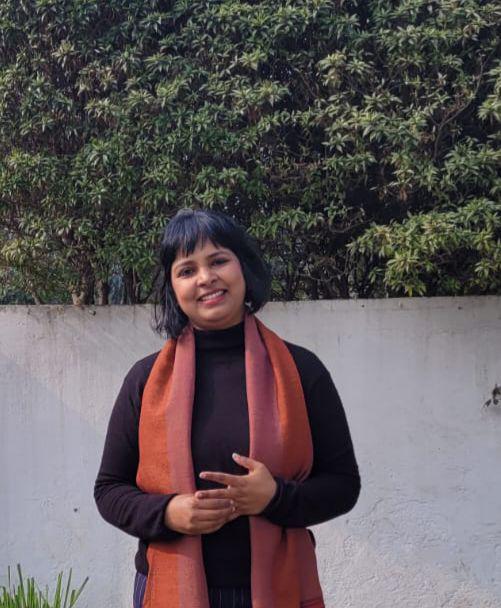
Alpana teaches in a government college of Gurugram, Haryana. She is a parent of two and is busy rummaging lost pieces of toys during her waking hours.
.
PLEASE NOTE: ARTICLES CAN ONLY BE REPRODUCED IN OTHER SITES WITH DUE ACKNOWLEDGEMENT TO BORDERLESS JOURNAL
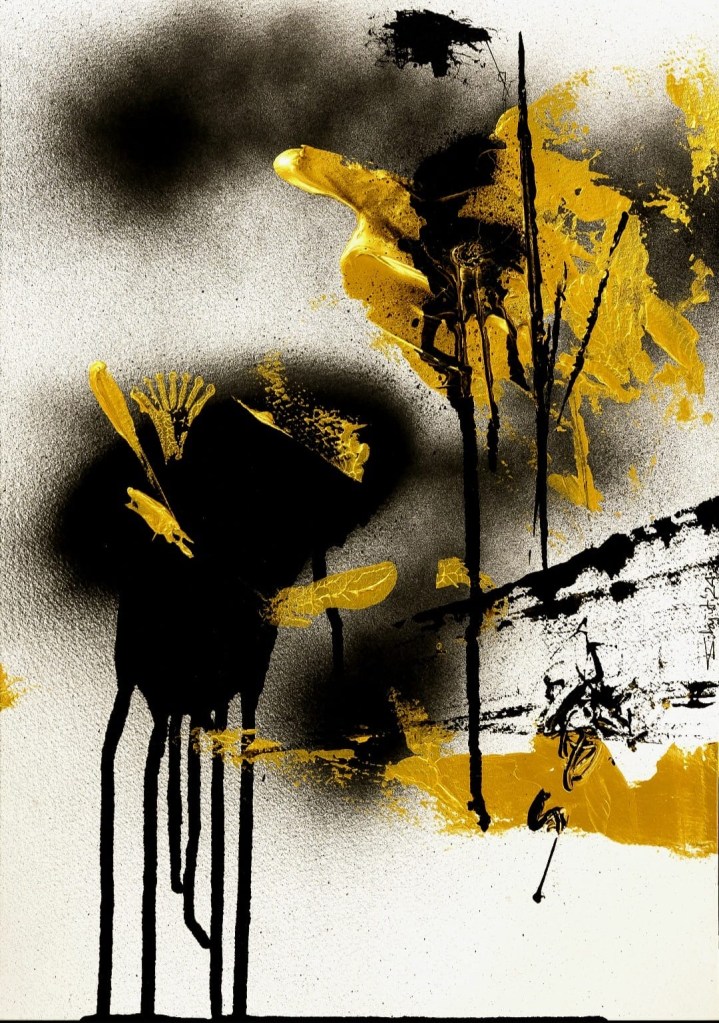
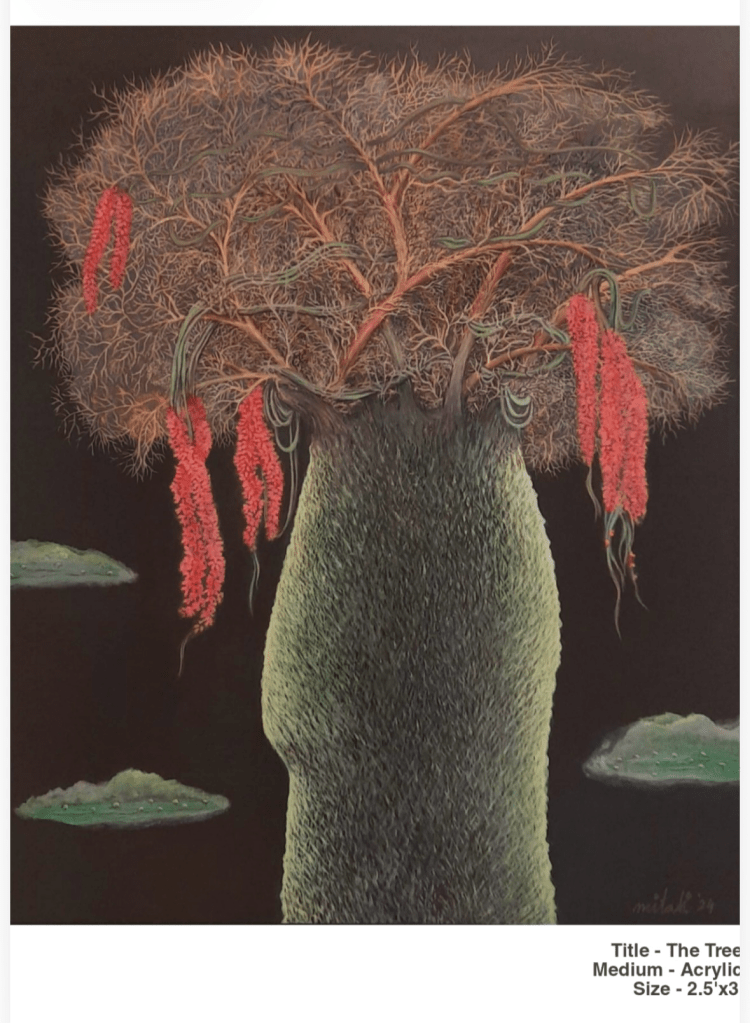
Painting by SilajitArt by Mitali GangopadhyayProvided by Ratnottama Sengupta
Varied. Appealing. Accomplished.
These, to me, are the hallmark of the works of these six artists: Abhijeet Bhattacharya, Maitreyi Nondi, Mitali Gangopadhyay, Shampa Bhattacharya, Silajit Ghosh and Vani Chawla, in alphabetical order. And I am delighted to bring this motley group living and working in diverse geographical points of the Indian map, in this exhibition, befittingly titled C’est la Vie![1]
Let me expand on my response.
Variety, they say, is the spice of life. Why so? Variety, the dictionary would have us believe, is the quality of doing the same thing in different ways. In other words, even if the six artists here were using the same medium – oil perhaps? Or acrylic? May be water colour? Or if they boast the same palette, or the same brand of paintbrush, or canvas of the same thickness — they are not doing the same thing.
And I am not limiting the observation to the broad classification of figurative painting, abstract images, or landscape art. If Mitali is painting landscapes, Abhijit is painting humans in a landscape. If Vani is painting detailed or surrealistic human forms, Shampa’s humans have their contours distorted, for stylisation. Or perhaps to make a certain statement. If Maitreyi’s statement is garbed in the signs of the zodiac, Silajit enunciates his thoughts through the sheer flow of pigments.
What makes for the difference in their visual expression? Their different experiences. If these make life more interesting, can it be any less for art?
The difference in experiences accounts for the changes in life, likewise it accounts for the changes in the forms that come alive on their framed spaces.
*
Maitreyi, a Bachelor of Visual Arts from the Rabindra Bharati University, has been expressing herself through dynamic images of humans and icons, gods and goddesses, and not excluding life embracing animals and symbolic creatures. The Feminine Mystique, the Nirbhaya incident that had jolted the nation, Prakriti and Mahamaya, Ganesh Janani or Durga, the dreams and reflections of women — yes, and of men too. Why not, when she expresses her homage to, say, the Kargil heroes? She finds acceptance then, with the Society of Oriental Arts as with Arts Acre, with Dhoomimal Gallery of Delhi as with the artists group led by Jogen Chowdhury.
Needless to add that the forms and focus of this artist are driven by a consistent striving to empower women. But the war she thus wages is fuelled by the power of storytelling. It is a creative energy that flows through her veins as she claims the lineage of Dakshina Ranjan Mitra Mazumder, the word-smith celebrated across the boundaries of age, or maps, for Thakurmar Jhuli and Thakurda’s Tales[2]. So, her art constantly tries to explore new ways of recounting lived experiences.
*
Abhijit, born in the tea gardens of Assam, and raised in Visual Arts at Agartala, now heads the Government College of Art and Craft of Tripura. His art practice revolves around dreams and memories — but it has also gained its punch from the time he spent working as an illustrator for publications and designer for advertisements.
His art weaves in elements of fantasy to create a surreal atmosphere that takes viewers away from the stresses of ground reality. It is a foliage dotted with orange kadamba flowers against which his Krishna plays a flute — and, in dalliance, his Radha sprawls herself out on a luscious bed of luxurious green.
Elsewhere, a Buddha merges with a tree and a tall tree grows into a halo that surrounds a form of divinity which protects a snowhite dove at the core of its being.
*
Vani is nudged by balmy nature to breathe life into her canvases. Flora and butterflies and birds too flit through her frames then, as do quadrupeds and bipeds. Women in particular are her protagonists: attired in starkly modern clothes, they share their space with elemental forms. But like the English poet who wrote, “God made the country, and man made the town[3],” Vani is irked by the drastic changes humans have wrought to the natural landscape.
This artist, who majored in the stream of Commerce, is saddened by the greed that is overwhelming the planet’s green foliage with brick and mortar, concrete and steel. Her surroundings are criss-crossed by skyscraping structures of high-rise buildings and six-lane flyovers. Is this the region, the soil, the clime we must change for heaven? This fog-filled gloom that is overshadowing the celestial light of blue skies? What happened to the happy coexistence that once marked the harmony of food chains and cycles of life? How can we chant the Biblical hymn of “Peace on earth, goodwill to men?” Or the Shanti Mantra of benevolence towards not merely humanity but every spec under the sun?
*
For Mitali, the bright flowers that change with every season and the silence of undulating hills are not merely decorative art nor purely landscapes. One stands for impermanence; another for stability of aeons. But in the curves and rhythms of these contrasting forces of nature, she finds a reflection of her outer and her inner self. And in the fragility of petals? She sees her own resilience!
Is this a quest for identity, or a desire to belong to the bounteous world of Nature? The latter, methinks. For, nature has endowed women with the blessing of motherhood. That is creativity of the highest form — in the entire universe.
*
When Shampa designed a Durga for the Pujas last autumn, the Third Eye of the Icon took the shape of a pen. “The pen is truly the sword in today’s world,” she believes. Realism clearly is a counter point for mysticism in her art. Naturally the inner radiance of the forms created by this figurative artist — also born in Assam, and shaped by an MA in Philosophy — transcend the external circumstances of their natural existence. Witness the series of darkened women she mounts here: their vibrant smiles spell hope. And resilience. In fact, they symbolise the triumph of inner strength over outward appearance.
This is a philosophical expression of her credo: There’s no absolute sorrow nor pure happiness, just as day and night are a continuum…
*
Silajit’s paintings are envisaged as a space for the cohesive bonding of sharp, vibrant, even strident colours. The colours flow much like the Ganga, from north to south. They zigzag through the canvas but their course does not meander. They are very much like this self-taught artist who does not claim adherence to any art school nor formal initiation through a hoary institution. They are an expression of his deepest mental state, his meditative best. Yet the visuals are heightened by a certain experiential detachment. Silajit seems to be contemplating on the concept of zero — or a state of absolute void. As he puts it, through these paintings he observes himself as a medium of creation, not the creator himself.
*
Nearly 250 years have passed since the English poet William Cowper wrote in ‘The Task’ that “variety gives life all its flavour.” The lines have gone on to become a proverb which underscores that unexpected turns make life more fulfilling. I would then urge all the artists who have gathered under the umbrella of C’est la Vie to try new experiences, venture into untrodden landscapes, and catch a glimpse of new vistas. I will egg them on to be so adventurous as to break the monotony of even ‘vibgyor’ and create new rainbows…
[2] Translation from Bengali. Grandmother’s Bag and Grandfather’s Tales: Folklores and children’s fairytales from Bengal.
[3] A line from ‘The Task’, a poem by William Cowper(1731-1800)
.
Ratnottama Sengupta, formerly Arts Editor of The Times of India, teaches mass communication and film appreciation, curates film festivals and art exhibitions, and translates and writes books. She has been a member of CBFC, served on the National Film Awards jury and has herself won a National Award.
.
PLEASE NOTE: ARTICLES CAN ONLY BE REPRODUCED IN OTHER SITES WITH DUE ACKNOWLEDGEMENT TO BORDERLESS JOURNAL
Five poems by Pravasini Mahakudahave been translated to English from Odia by Snehaprava Das. Click here to read.
A Poet in Exileby Dmitry Blizniuk has been translated from Ukranian by Sergey Gerasimov. Click hereto read.
Kalponik or Imaginedby Tagore has been translated from Bengali by Mitali Chakravarty. Click hereto read.
Pandies Corner
Songs of Freedom: The Seven Mysteries of Sumona’s Life is an autobiographical narrative by Sumona (pseudonym), translated from Hindustani by Grace M Sukanya. These stories highlight the ongoing struggle against debilitating rigid boundaries drawn by societal norms, with the support from organisations like Shaktishalini and Pandies. Click here to read.
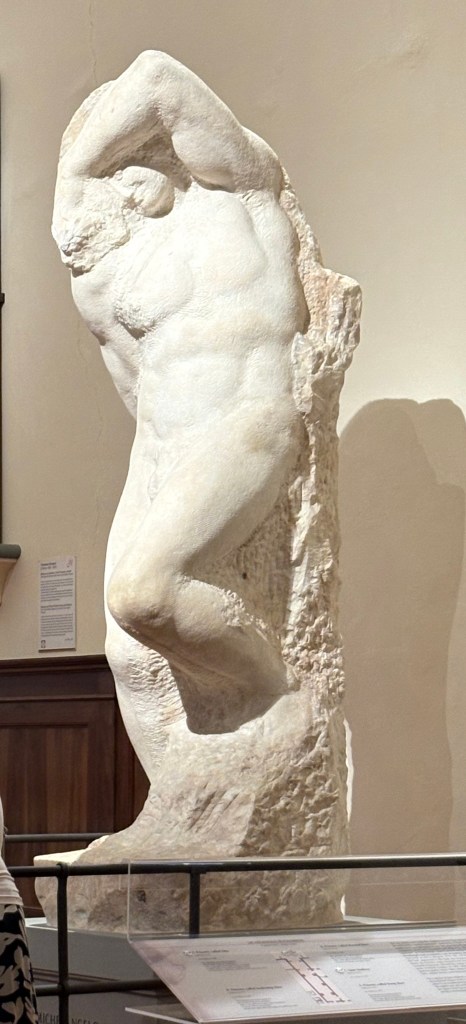
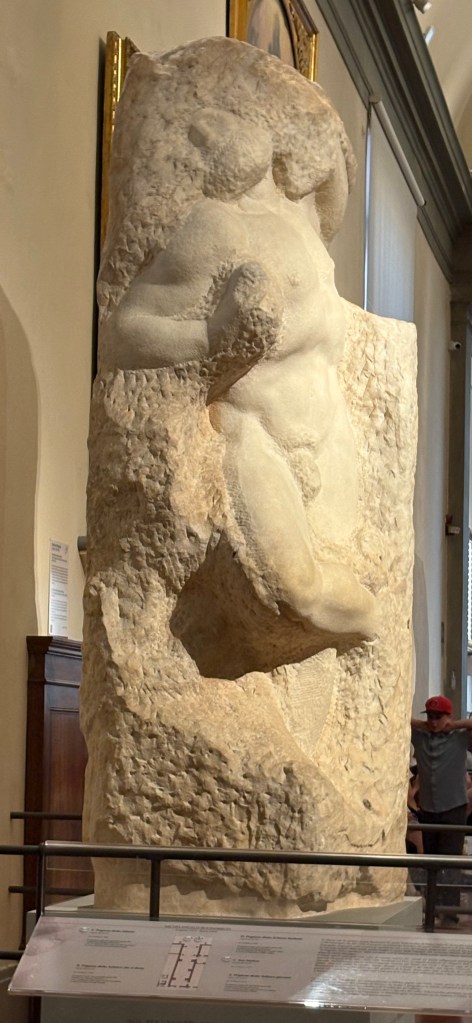
Incomplete statues of Michelangelo in Accademia Gallery, Florence
In the Accademia Gallery, Florence, are housed incomplete statues by Michelangelo that were supposed to accompany his sculpture of Moses on the grand tomb of Pope Julius II. The sculptures despite being unfinished, incomplete and therefore imperfect, evoke a sense of power. They seem to be wresting forcefully with the uncarved marble to free their own forms — much like humanity struggling to lead their own lives. Life now is comparable to atonal notes of modern compositions that refuse to fall in line with more formal, conventional melodies. The new year continues with residues of unending wars, violence, hate and chaos. Yet amidst all this darkness, we still live, laugh and enjoy small successes. The smaller things in our imperfect existence bring us hope, the necessary ingredient that helps us survive under all circumstances.
Imperfections, like Michelangelo’s Non-finito statues in Florence, or modern atonal notes, go on to create vibrant, relatable art. There is also a belief that when suffering is greatest, arts flourish. Beauty and hope are born of pain. Will great art or literature rise out of the chaos we are living in now? One wonders if ancient art too was born of humanity’s struggle to survive in a comparatively younger world where they did not understand natural forces and whose history we try to piece together with objects from posterity. Starting on a journey of bringing ancient art from her part of the world, Ratnottama Sengupta shares a new column with us from this January.
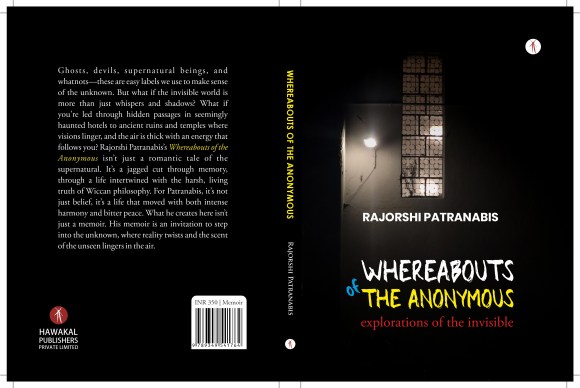
Drenched in struggles of the past is also Showkat Ali’s The Struggle: A Novel, translated from Bengali by V. Ramaswamy and Mohiuddin Jahangir. It has been reviewed by Somdatta Mandal who sees it a socio-economic presentation of the times. We also carry an excerpt from the book as we do for Anuradha Marwah’s The Higher Education of Geetika Mehendiratta. Marwha’s novel has been reviewed by Meenakshi Malhotra who sees it as a bildungsroman and a daring book. Bhaskar Parichha has brought to us a discussion on colonial history about Rakesh Dwivedi’s Colonization Crusade and Freedom of India: A Saga of Monstrous British Barbarianism around the Globe. Udita Banerjee has also delved into history with her exploration of Angshuman Kar’s The Lost Pendant, a collection of poems written by poets who lived through the horrors of Partition and translated from Bengali by multiple poets. One of the translators, Rajorshi Patranabis, has also discussed his own book of supernatural encounters, Whereabouts of the Anonymous: Exploration of the Invisible. A Wiccan by choice, Patranbis claims to have met with residual energies or what we in common parlance call ghosts and spoken to many of them. He not only clicked these ethereal beings — and has kindly shared his photos in this feature — but also has written a whole book about his encounters, including with the malevolent spirits of India’s most haunted monument, the Bhangarh Fort.
Bringing us an essay on a book that had spooky encounters is Farouk Gulsara, showing how Dickens’ A Christmas Carolrevived a festival that might have got written off. We have a narrative revoking the past from Larry Su, who writes of his childhood in the China of the 1970s and beyond. He dwells on resilience — one of the themes we love in Borderless Journal. Karen Beatty also invokes ghosts from her past while sharing her memoir. Rick Bailey brings in a feeling of mortality in his musing while Keith Lyons, writes in quest of his friend who mysteriously went missing in Bali. Let’s hope he finds out more about him.
Charudutta Panigrahi writes a lighthearted piece on barbers of yore, some of whom can still be found plying their trade under trees in India. Randriamamonjisoa Sylvie Valencia dwells on her favourite place which continues to rejuvenate and excite while Prithvijeet Sinha writes about haunts he is passionate about, the ancient monuments of Lucknow. Gulsara has woven contemporary lores into his satirical piece, involving Messi, the footballer. Bringing compassionate humour with his animal interactions is Devraj Singh Kalsi, who is visited daily by not just a bovine visitor, but cats, monkeys, birds and more — and he feeds them all. Suzanne Kamata takes us to Kishi, brought to us by both her narrative and pictures, including one of a feline stationmaster!
We've run away from the simmering house
like milk that is boiling over. Now I'm single again.
The sun hangs behind a ruffled up shed,
like a bloody yolk on a cold frying pan
until the nightfall dumps it in the garbage…

('A Poet in Exile', by Dmitry Blizniuk, translated from Ukranian by Sergey Gerasimov)
In translations, we have Professor Fakrul Alam’s rendition of Nazrul’s mellifluous lyrics from Bengali. Isa Kamari has shared four more of his Malay poems in English bringing us flavours of his culture. Snehaparava Das has similarly given us flavours of Odisha with her translation of Pravasini Mahakuda’s Odia poetry. A taste of Balochistan comes to us from Fazal Baloch’s rendition of Sayad Hashumi’s Balochi quatrains in English. Tagore’s poem ‘Kalponik’ (Imagined) has been rendered in English. This was a poem that was set to music by his niece, Sarala Devi.
After a long hiatus, we are delighted to finally revive Pandies Corner with a story by Sumona translated from Hindustani by Grace M Sukanya. Her story highlights the ongoing struggle against debilitating rigid boundaries drawn by societal norms. Sumana has assumed a pen name as her story is true and could be a security risk for her. She is eager to narrate her story — do pause by and take a look.
In fiction, we have a poignant narrative about befriending a tramp by Ross Salvage, and macabre and dark one by Mary Ellen Campagna, written with a light touch. It almost makes one think of Eugene Ionesco. Jonathan B. Ferrini shares a heartfelt story about used Steinway pianos and growing up in Latino Los Angeles. Rajendra Kumar Roul weaves a narrative around compassion and expectations. Naramsetti Umamaheswararao gives a beautiful fable around roses and bees.
With that, we come to the end of a bumper issue with more than fifty peices. Huge thanks to all our fabulous contributors, some of whom have not just written but shared photographs to illustrate the content. Do pause by our contents page and take a look. My heartfelt thanks to our fabulous team for their output and support, especially Sohana Manzoor who does our cover art. And most of all huge thanks to readers whose numbers keep growing, making it worth our while to offer our fare. Thank you all.
Here’s wishing all of you better prospects for the newborn year and may we move towards peace and sanity in a world that seems to have gone amuck!
A brief discusion of Whereabouts of the Anonymous: Exploration of the Invisible by Rajorshi Patrnabis, Hawakal Publishers, with an exclusive interview with the author on his supernatural leanings
Whereabouts of the Anonymous: Exploration of the Invisible by Rajorshi Patrnabis could have been a regular book of intense ghost stories, with the oldest ‘presences’ dating back to the regime of Sher Shah Suri (1472 – 1545). ‘Presences’ are basically spirits — visible or barely visible — that cause disturbances in the energy field surrounding us, as per the book.
One of the most coherent of these ‘spirits’ was from 1920, confiding her story on Christmas eve — reminds one of Dickens’ A Christmas Carol and Uncle Scrooge — only this spirit was a British woman from the Raj era, a spirit that lost her beloved who was from a Bengali royal family. Her strict father stepped in and stopped the marriage. No one knew what happened to the groom. And she continued to weep and wait while haunting the premises of the popular and populous Park Street where she was supposed to meet her beloved more than a hundred years ago… Then there’s a ghost that takes you back to his funeral pyre… drawing back the curtain between the two dimensions — one in which we exist and one in which they hover…
These, however, are not your regular ghost stories. There is a difference for Patranabis claims to have met these sad spirits in real life.
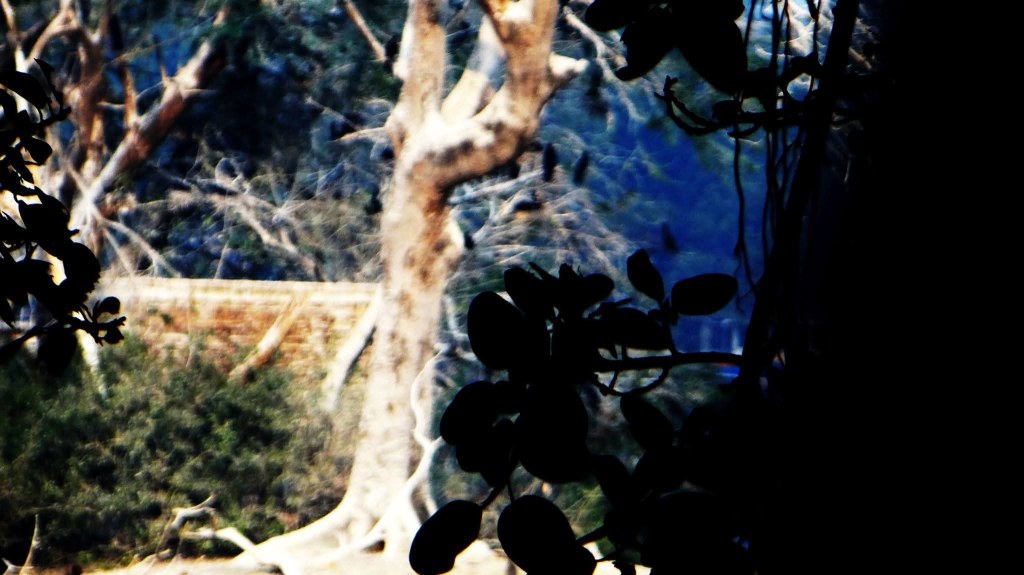
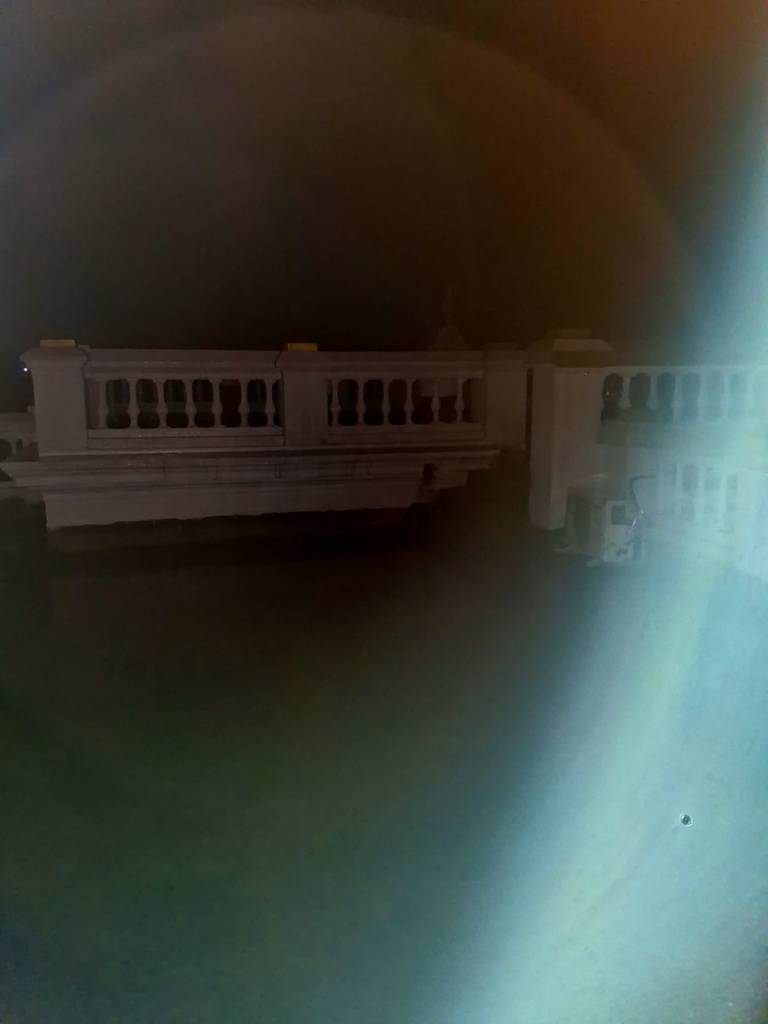
A Wiccan by choice, Patranabis has tried to draw back the curtains to reveal a dimension whose existence is elusive and avoidable for most of us at best and rejected by many. He claims to have a spiritual bent of mind which helps him experience these out-of-the-box scenarios, meet the dearly departed. He has done a number of books of poetry around his beliefs. He has even photographed these spirits!
Photographs of spirits by Rajorshi Patranabis
Though the images are blurry at the first viewing, you have to focus hard to see the ethereal outlines of shadows beyond the realm of the living, I guess.
Whereabouts of the Anonymous is a memoir that spans his interactions with, as the title says — ‘the anonymous’ — or the blurry ‘presences’ and explores the invisible for majority of the spirits are merely depicted as shadowy in his narrative as in his photographs except for a few whose images have not been taken.
Occasionally, the spirits can be malevolent as in the Bhangarh Fort, where a foul-smelling female spirit and some lost souls in the ancient jails wounded Patranabis physically and chased him out. Set in the Aravalli hills of Rajasthan. Bhangarh is the most haunted place in India. There is a story of a princess and her spurned lover associated with it. Evidently, a sage fell in love with the princess and made a special concoction which would make her fall in love with him. When she went to buy a perfume, the smitten lover tried to replace it with his love potion. The princess threw away the bottle of love potion. It fell on a rock, dislodging it. The rock rolled down to kill her admirer, who cursed her with his dying breath!
There is also the narrative about a whole village that accepts and lives in peace with the spirits of their dearly departed, even giving them rickshaw rides and offering them chairs!
Patrnanabis has brought his Wiccan outlook into the discourse. His language flows. The narrative is simple and easy to understand. The descriptions are so graphic that one can almost visualise the disembodied spirits and their interactions. The 150-page book is an enjoyable and easy read and a perfect companion for travel or an evening or two. But the author’s experiences and his interests stretch beyond what the pages can hold. In this interview, we discuss his beliefs and his experiences…and maybe, another book?
How old were you when you had your first supernatural sighting? Were you scared the first time?
When I look back, the first time that I had a feel of the ‘other dimension’ was perhaps at the age of 7 or 8. I remember going to my paternal home at Digboi during our winter vacations. I remember going to my parent’s bedroom at the first floor and my mother used had to send me to her room to fetch something. The room was across a terrace, and I remember running through the terrace from the staircase to the room. But every time, I could feel someone running with me through the terrace. But as and when I would enter the room, it was all perfect. I would run back again again to the stairs. When I would blurt this out to my parents, they would simply ignore me, but somehow, I was never completely convinced. It was much later, sometime around the year 2000 that my father confided with me of a real ‘presence’ there. He told me that there had been many an experience where people had felt the presence of something eerie there. But by then I had had some very deep experience of the supernatural existence.
Rajorshi Patranabis in Wiccan wear
When did you become a Wiccan and why?
The answer to this ‘why’ is a wee bit dicey. I am myself not sure of this. It was just a flow that I couldn’t control. Mind you, I had already gone through some extremely remarkable experiences and my stint at the hill top temple and my encounter with that 97 year old person who taught me numerology was way before I joined Wicca. I would call myself pretty insane in those phases of my life. By the time Wicca happened, I had calmed down considerably and joining my teacher was nothing less than an accident. It so happened that my friend, Subhodip, and I were walking down the Southern Avenue in Kolkata when we spotted another school friend ( a senior Wiccan) standing at the door of an otherwise inconsequential book store. He waved at us and asked us to join in, as it was an open session by my teacher. We joined. Subhodip was skeptical, while I followed it up with an email and I was called for an interview with Ma’am. The journey started. I had mentioned about my experience in ‘Whereabouts…’ This was early 2013.
Did becoming a Wiccan help you align to the supernatural better?
Infact, my Wiccan knowledge taught me the nuances of alignment with the forces of nature. Why just the supernatural? The vibrations that the earth emanates, the animal kingdom throws out, to feel and spot across dimensions etc. The most important thing is perhaps the use of sound like the chatter of a rainfall, the melodies of a singing bowl or even drum beats (like in Voodoo) as means of invocation, that, was passed on to me. More than anything, the pleasures of immersing oneself in ancient knowledges can be very ‘intoxicating’. Our school concentrates most on the Egyptian origins. If you ask me now, I worship Goddess Isis as my altar Goddess along with the 64 yoginis. Yes, Wicca has helped align myself to me, if I say this philosophically.
You have called yourself ‘spiritual’ and also spoken of ‘seers’? Can you explain these two terms?
I wouldn’t get into the linguistic trap of English. But a Wiccan would say spiritual comes from ‘spirit’. A very basic tenet of Wicca is to align your body, mind, soul and spirit. As and when the becomes one with nature does your mind uplift itself to being a soul. A soul that gets through the rigours of lust becomes a spirit. We are in the habit of using the word spirituality very lightly, but a true Wiccan would say that a pure spirit sits on the pinnacle of the pyramid. There are many references in our Sanatan scriptures too about such spirits and the recourse they take to leave the body, as and when they cross over.
A seer is a saint who has won over the realms of the physical nuances. He/she is automatically clairvoyant as all their faculties have attained the higher plains in the atmosphere. Please don’t mistake a seer for only a saint. A scientist or a litterateur who had immersed themselves in the claustrophobic depths of knowledge can be a seer too. Many such examples can be sighted to prove this.
How did/does your family respond to your being a Wiccan or interacting with spirits?
My family doesn’t always subscribe to what I do, but in all honesty they had never been a hindrance to my learnings. There are Wiccan ceremonies that I celebrate or spells that I do from time to time for the well being of people, they had all along been very supportive. They stand as a pillar beside me.
When and why did you turn to writing?
I started writing at a very young age. My first poem, if I can recall was at the age of 13. But as time went on, everything slowed down. My next phase was from 2015 and my first published book was in 2018. By this phase I was well and truly into Wicca.
You have used Japanese techniques in poetry to describe your journey as a Wiccan and to interact with spirits. Why? Do these align better to help you describe your experiences?
Well, I wouldn’t say I use Japanese poetry forms to interact with any spirit. Though I must accept that I’ve had communications with the other dimension which were very poetic at times. In my book, Gossips of our Surrogate story, I had used quite a bit from my Wiccan Book of Shadows and even you had accepted that they were poems alright, good or bad, notwithstanding. But I would also like to harp on the inherent pertinence of this question. Gogyokha or Gogyoshi are short form poetry in just 5 lines and my forays into the other dimension had just had similar experiences — short, crisp and at most times life altering. In my Gogyoshi collection, Checklist Anomaly, all the poems are either true happenings or near life occurings. My writing (poetry) as a whole, until now, had been with deep metaphysical love. Perhaps my thought process is challenged. But Japanese forms had been a huge compliment to this particularly weird handicap of mine.
What made you think of doing this book — your memoir of supernatural interactions so to speak?
To be very honest, all these experiences that I had shared in Whereabouts of the Anonymous would have stayed with me through out this physical life had it not been for a dear brother and publisher, Bitan Chakraborty. It was on his persistent insistence that I decided to put my ‘stories’ on paper. But that was again a very difficult thing. I really had to scoop things from the nook and crannies of my memory to make for a reasonably good compilation. Even Bitan had certain experiences with me or otherwise ( like his camera giving up on a particular shot etc.) and was most interested on such a memoir seeing the light of the day. I have dedicated this book to Bitan. I had to, it was his brainchild and as a Wiccan would say, the Universe made me write it.
You seem to seek out departed spirits or ghosts. Why? Are you not scared?
I find this word ‘ghosts’ very disrespectful. Departed spirits, well, if you ask me no spirits depart. Remember, the law of conservation of energy — the total energy remains constant, it can neither be created nor be destroyed. The energies ( whether spirits or not) have this affinity to get in touch with other souls who can feel them and with a little effort can hear them. The ectoplasmatic fusions that happen inside the cosmos are mostly not registered by ‘so called science minded sceptics’. There are gadgets to measure such vibes. And afraid? No. You would only be afraid if you stay in denial of the other dimension. If I say that the other dimension is omnipresent, no matter what, you won’t be afraid of it. Remember you are afraid of darkness because you don’t see through it, but as soon as you put on a light, it becomes a part of you. Precisely the unknown is magic or mysticism and the known is science.
Do you only sight spirits or auras around people? Are you into Noetics as a subject?
Auras form the atmosphere, it really doesn’t matter whether you have a body or not. There are ascetics who would ask you not to touch anyone’s feet while paying obeisance. The say, the aura or the protonic energy of a person is as long as that person’s height. They say you put your head on the ground, possibly, to absorb a concoction of the Earth’ s magnetism coupled with the aura of that person. By the bliss of this Universe, I do feel a few energies that are devoid of a body. Noetics or the consciousness levels automatically become part of these. But I am personally not into Noetic sciences or research. But ancient knowledges under the umbrella of Wicca does take you through the subconscious to superconscious levels of the mind with twinings of the nature, supernature and the supernatural. There are very thin lines segregating them.
In you memoir, you keep asking people to leave a glass of water to satiate the spirit. Do you see yourself as a person who appeases ghosts? Do you help people – how do they reach out to you if they feel a ‘presence’?
What does a glass of water do? Think of a situation where you stand in front of everyone, yet you’re being ignored by everyone. You would not realise that you’re actually not visible to them. Just think of the insecurity that you would have to realise that persons whom love so dearly are slowly getting ahead with life and that you have become a fading memory. That glass of water just reinstates the faith that he/she still matters to you.As time goes, like all energies, they would also dissipate. But with pleasantness in them.
I don’t appease anyone. As my teacher says, it’s all about alignment. If I may say so, the Universe makes me do certain things that a psychiatric practitioner would do to people with mental illness. These are very small techniques that I had learnt over the years to put a restless soul to a restful state. As far as the last part of your question is concerned, I don’t do anything for any consideration. I have a promise to keep. If the cosmos so wills that I would be of help to someone, I would definitely land up from nowhere.
Do you plan to do something with this ‘gift’ you have? Can you see spirits where others cannot? Will you be doing more books about your supernatural experiences?
Well, after the book went for print, I realised that I could have included many more of the experiences that I had gone through. So, another book is very much in the offing. And as far as doing something with this ‘gift’ is concerned, I am completely in sync with you that this is a ‘gift’ that the cosmos had bestowed upon me and when you have such an invaluable gift, you keep them. You generally don’t use them. Seeing spirits? I feel them and I see them only when the spirit wants to show them off (like the school Master of Bhanjerpukur – one of my most remarkable experiences).
(This review and online interview by email is by Mitali Chakravarty)
PLEASE NOTE: ARTICLES CAN ONLY BE REPRODUCED IN OTHER SITES WITH DUE ACKNOWLEDGEMENT TO BORDERLESS JOURNAL
Kalponik (Imagined) was written by Tagore in 1897 and published in his collection called Kolpona (Imagination) in 1900.
Art by Sohana
IMAGINED

I yearn  only for dreams sown
         In the breeze’s sigh —
That is why in despair I gather
         Wishful thoughts nigh.
The ferry of hope has lost its path
In the shady corners of the Earth.
   Fictitious images lose themselves
             Wafting high.

Nothing  emerges from my scattered
           Desires' streams.
No one  joins me to
     Pursue my distant dreams.
       I play with flames alone
       I sit on my own. At the end
       Of the day, I see my dreams
                 Turn to ashes.
I yearn  only for dreams sown
          In the breeze’s sigh.
The poem was set to music by his niece Sarala Devi. Click here to hear it performed as a song by contemporary artiste, Srabani Sen.
.
This poem has been translated from Bengali by Mitali Chakravarty with editorial input by Sohana Manzoor
.
PLEASE NOTE: ARTICLES CAN ONLY BE REPRODUCED IN OTHER SITES WITH DUE ACKNOWLEDGEMENT TO BORDERLESS JOURNAL
My daughter Lilia and I were in Wakayama Station, on our way to see the cat station master in the small town of Kishi. Because Lilia uses a wheelchair, we had to ask for assistance getting on and off the train.
“What time are you coming back?” a Japan Railways employee asked. They would have to prepare for our return later in the day.
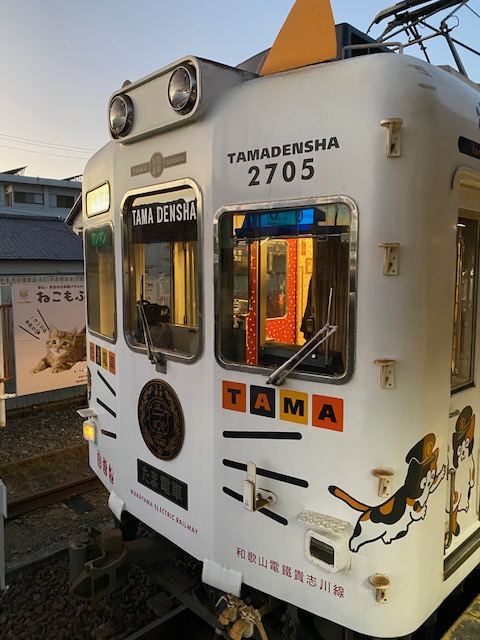
“We want to come back on the Tamaden,” I said, referring to a train with a cat theme. I had taken a photo of the train schedule, and I opened my phone to check the time. It was now about twelve-thirty. Although there were trains every thirty minutes – the Animal Train, the Plum Train, the Cha Train – the Tama Train (aka Tamaden) only ran from Kishi twice a day. The next would be at 2:38, which wouldn’t give us much time to see everything. We didn’t want to rush. The final one would be at five fifteen.
“Five fifteen,” I said.
The man gave me a dubious look. “There isn’t very much to do in Kishi,” he said. “There’s nothing there. Are you sure you want to stay that long?”
What about the café? The museum? The shrine? The cat? We had come all this way, and we would only be there for a couple of hours. If we ran out of things to do, we could go for a walk. It was a lovely day, after all.
“You want to ride on the Tama Train, don’t you?” I asked Lilia.
“Yes,” she replied.
“What if we change our minds and want to come back early?” I asked the JR attendant.
He told me that would be difficult.
“Okay, then. Five fifteen.”
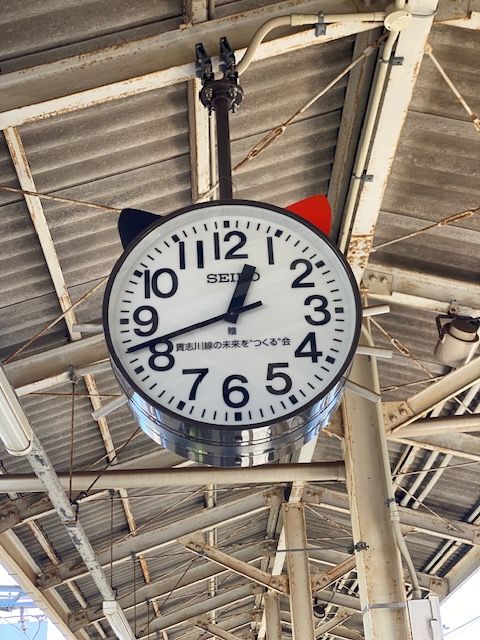
After showing our tickets, we were given Wakayama Electric Railway Kishigawa Line postcards. On the platform, there was a rubber stamp featuring a cartoonish Tama, with Wakayama Castle, and citrus fruits in the background. Little blank books meant for collecting stamps from various places were sold in gift shops. We didn’t have such books, so we stamped our postcards. A clock with cat ears – one black, one brown, like a calico – hung overhead.
I deduced that the train on the tracks, decorated with colored hearts, illustrations of dogs and cats, and the letters JSPCA, was the Animal Train. Other than the banners featuring cats clutching flowers and a white dog holding a bone, the inside of the car was ordinary. Like most Japanese trains, it was clean, with plush benches along each side, and an orange ticket dispenser at the entrance and exit.
Lilia marveled at how empty the train was. Now that she lived in Osaka, she had become a city girl, used to being squished between passengers on her morning and evening commutes. I was pretty sure that most of the people getting on board were tourists on their way to see Tama.
During the thirty-minute ride, the train swayed on the tracks, past rice paddies, and orange orchards.
“Maybe in the future they will make it easier for people in wheelchairs to visit,” I said.
Lilia frowned and made the sign for money. Yes, it might cost a lot to add an elevator in the station, but was it really too much to ask?
At the end of our journey, which was also the end of the line, a young man wearing white gloves laid out the ramp. Again, we conferred about what time we would go back. He gave me a paper schedule, folded into the size of a credit card, and showed me the phone number at the bottom.
“If you change your mind about what time you want to go back, just call this number,” he said.
“Thank you.” I looked around. We were indeed in the middle of nowhere. Yes, there were many houses, but I could already tell that the station itself was quite small, and, as the attendants in Wakayama had said, there weren’t any shops and restaurants around. But there were quite a few people, many from abroad. I saw a young woman in a pink hijab, and a group of Chinese tourists.
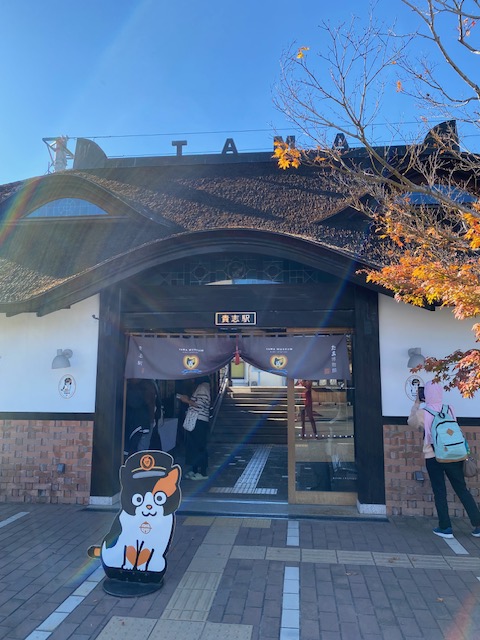
We paused before the shrine to the original cat station master, Tama, on the platform, then went down a ramp, and to the front of the station. By now, we were hungry. But first, the cat.
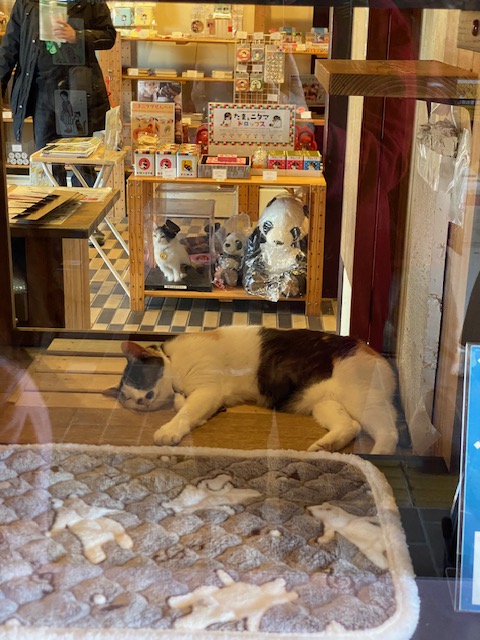
On this day, Yontama, a calico like her predecessor, was in a little room behind glass at the side of the station. She was napping on the wooden floor, next to a soft, plush mat. Many people were taking photos of her, but no one was bothering her. She wasn’t wearing the hat or suit of a stationmaster or doing anything special. She looked – and I say this with love – like an ordinary cat.
To the left of the window stood a fortune dispenser. Lilia dropped a hundred-yen coin into the box and extracted a rolled-up piece of paper. She unfurled it and showed it to me: “Very happy!”
“Great!” I gestured to the café behind us. “Now let’s go eat.”
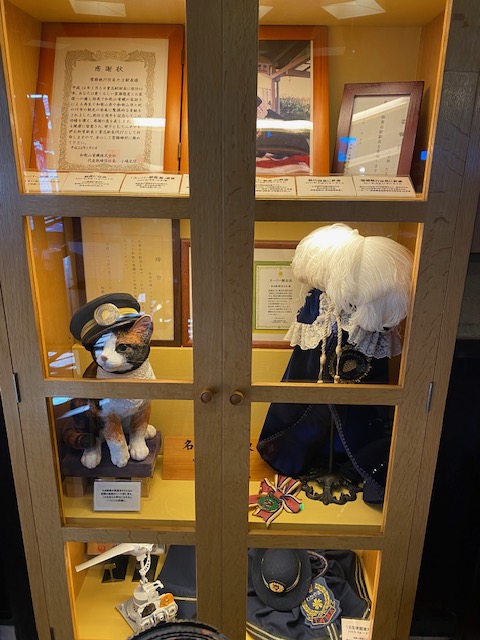
We entered the Tama Café, which also seemed to function as the museum. The original cat station master’s hat, decorated with a strawberry emblem, a lace-trimmed blue velvet cloak worn by Tama, and various framed documents were displayed in a glass-fronted cabinet.
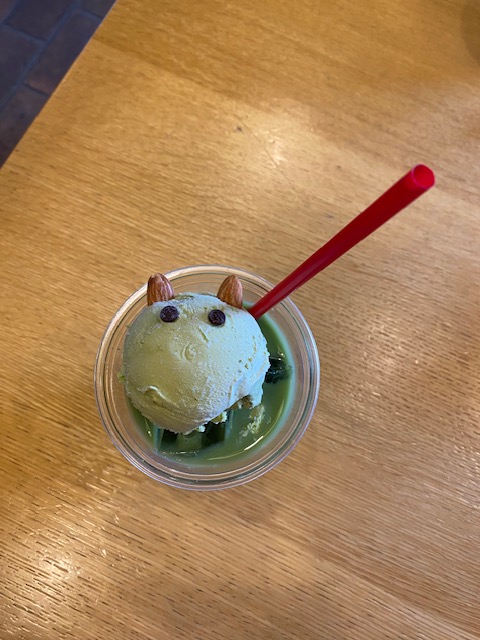
I ordered two Hot Cat Sets for us — fish sausages on hot dog buns, strawberry sodas, and cookie wafers printed with Tama’s image. We topped that off with green tea floats, with a scoop of green tea ice cream with almond ears and chocolate chip eyes.
After we had finished our meal, we visited the gift shop next door. From there, we could see Yontama from a different angle. She was awake but still lolling about. I bought little Yontama towels, which are always used in Japan for blotting your hands dry after washing them in public places. Then I paid for a fortune of my own. “Very happy,” it said. I wondered if all of the fortunes in the box were exactly the same.
Across the street was a tourist information center. Despite the JR employees’ skepticism, the people of Kinokawa City had taken the time to consider ways to occupy and engage the many visitors who would come to see the cats. Brochures in many languages were arranged in a rack. I plucked a few and discovered that a beautiful park dating back to the medieval period was within walking distance. The region also produced a lot of fruit, such as strawberries, figs, and oranges.
“Shall we go for a walk?” I asked Lilia.
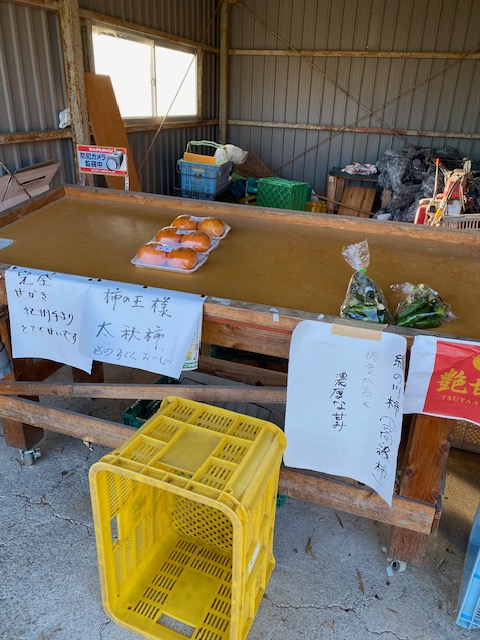
She nodded. Using a map app on my phone, we set out for Hiraike Park Land. Part of the walk was uphill. Although Lilia’s wheelchair was electric-assisted, she still had to turn the wheels. Her arms started to get tired, so I helped her out for some of the way. We passed fields of cabbages, rice paddies, and groves of lemons, oranges, and figs. Unattended farm stands offered clear plastic bags of freshly picked persimmons and citrus fruits at bargain prices, much cheaper that those sold at the supermarket back home.
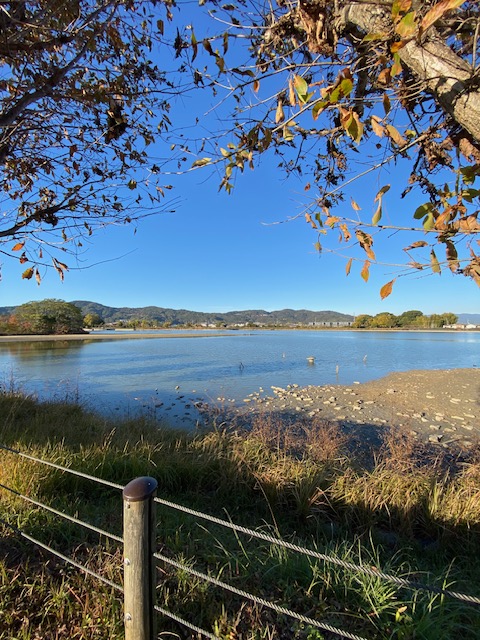
We finally arrived at the park. We stopped to observe the ducks and herons, the placid blue pond. According to the map, some ancient burial mounds, made distinctive by their key-holed shape, were nearby. I thought that we might be in danger of exhausting the wheelchair’s battery, however, so we didn’t go in search of them.
On the way back to the station, I stopped at one of the farm stands, put a couple of coins in the money box, and bought a bag of oranges. I would take it back as a souvenir for my husband and me to enjoy.
At one point, Lilia stopped, threw back her head and looked at the sky. “Ao,” she said in Japanese, drawing her fingers across her cheek in the sign for “blue.” She signed that there were no clouds. Indeed, it was a perfect autumn day.
When we were almost to the station, Lilia spotted a general store. She wanted to go inside, so we did. The lone woman behind the counter did not greet us, as is customary in Japan. I wondered if she was put off at the sight of a couple of foreigners. Of course, my daughter is half-Japanese, and has spent her entire life in Japan, but when she is with me, people assume that she is from abroad.
At the front of the store, school uniforms were displayed on mannequins Further inside, various goods were haphazardly arranged – a rack of flannel shirts, a shelf of liquor bottles, snacks for kids dropping in after school. It looked like the aftermath of a rummage sale. When Lilia started down a narrow aisle in her wheelchair, the woman drew in her breath. I could sense her fretting behind us, but she didn’t say anything. What must it be like for these country people to deal with the many foreigners traipsing through their small town? I was reminded of how people in Tokushima, where I live now, used to literally tremble when they saw my foreign face and thought that they might have to speak English.
Lilia decided to buy a packet of shrimp chips. The woman took her money, thanked her, and we got out of her hair.
Back at the station, we returned to the gift shop. Although Yontama was on the clock until four, and it was past four thirty, she was still relaxing in her little room. She probably didn’t mind. No one was tapping on the glass or otherwise harassing her. She had a good view of tourists buying cat themed T-shirts, cookies, and keychains. Lilia bought an ema, a small wooden plaque on which she would write a wish, and appeal to the cat deity, Tama Daimyojin.
We went onto the platform, and I tied Lilia’s ema onto a wooden board, along with wooden plaques inscribed by people from all over the world: “Wishing happiness and peace to animals all around the world.” “May all the strays and rescues get a good and loving home.” “May Pomelo, Walnut, and I live a long healthy life together.”
Dusk was already falling. The platform began to fill with other visitors, who apparently had the same desire to ride the Tama Train as we did. A young Chinese woman with flowing bleached-blonde hair in Lolita-meets-Little-Bo-Peep fashion – bonnet, and a tiered plaid dress with frills, eyelet, and ribbons — posed while her friends took photos. I wanted to take her picture, too, and post it on my Instagram account. She probably wouldn’t have minded, because she seemed to be some kind of influencer, but my daughter frowned and shook her head when I indicated my intentions.
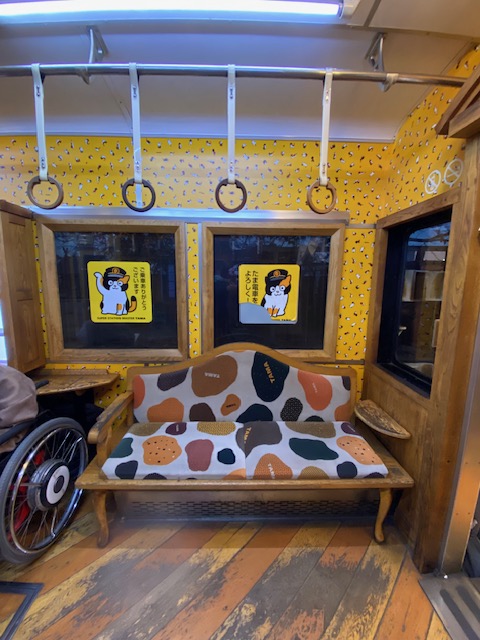
As the train finally approached, everyone tried to get the best spot on the platform for the best shot. The front of the train was painted with a cat’s face. The windows served as eyes, and just below were a nose and whiskers. Cat’s ears were affixed to the top of the car. Pawprints and a cartoon version of Tama in various poses illustrated the sides. Inside, passengers could sit on colorful Tama-themed sofas.
Our friend from earlier showed up with a ramp, and helped us get onto the car with a space for wheelchair users. Lilia was delighted to find a bookshelf stocked with cat-related manga in the car. I handed her a stack of them to read over the duration of the train ride.
Although many of those onboard were obviously tourists, like the young Chinese women continuing their photo shoot, I realised that this train was also used by the residents of the towns on the Kitagawa Line. Observing a man in a business suit who appeared to be among them, I wondered what it was like for him to share his commute with eccentric travelers. I suppose it would be entertaining. At any rate, I couldn’t help but be impressed by this small town’s ability to create a new identity for itself and capitalize on it.
We returned to Wakayama Station tired but satisfied at having completed our mission. When I reached home, my cats were there to meet me, yowling and needy.
.
Suzanne Kamatawas born and raised in Grand Haven, Michigan. She now lives in Japan with her husband and two children. Her short stories, essays, articles and book reviews have appeared in over 100 publications. Her work has been nominated for the Pushcart Prize five times, and received a Special Mention in 2006. She is also a two-time winner of the All Nippon Airways/Wingspan Fiction Contest, winner of the Paris Book Festival, and winner of a SCBWI Magazine Merit Award.
PLEASE NOTE: ARTICLES CAN ONLY BE REPRODUCED IN OTHER SITES WITH DUE ACKNOWLEDGEMENT TO BORDERLESS JOURNAL


 Borderless