Categories
Poetry

If poems heal, poets are healers

By Moinak Dutta

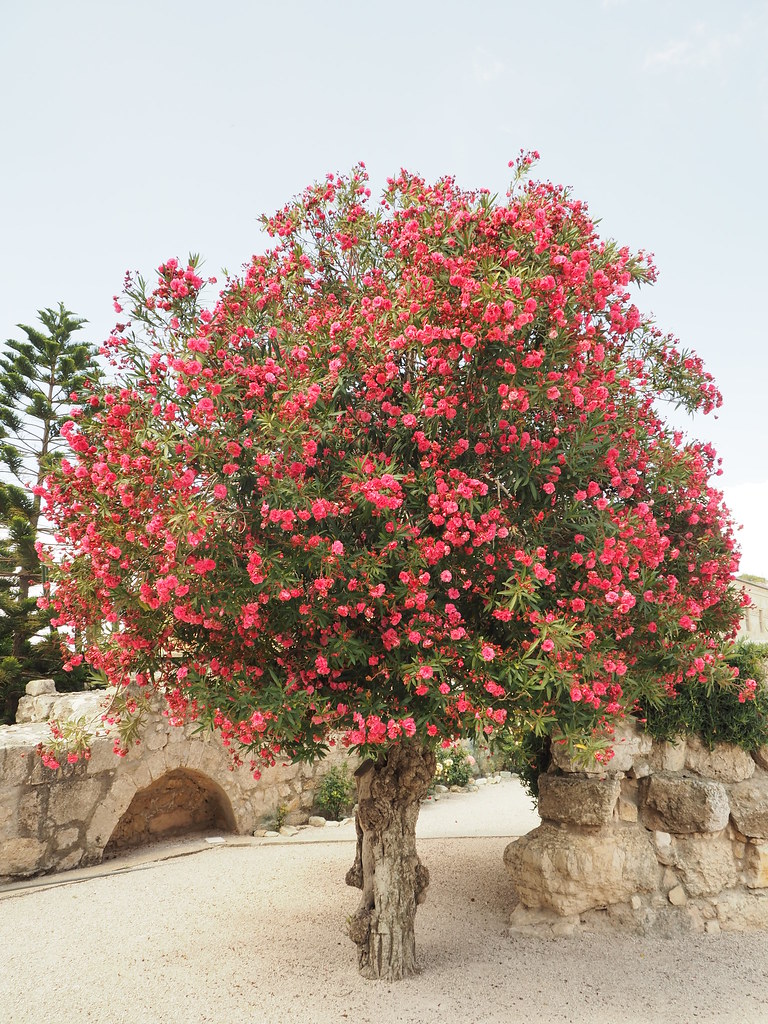
Red Oleander tree

Even if I miss it,

The onset of spring I mean,

That red oleander tree would surely know

At which hour the spring would arrive,

When and how,

.

For she would bloom,

Even before cuckoos would start singing,

And fragrance of gulal would float in the breeze,

.

Even if I miss spring

The red oleander would not,

.

For she would bloom

Despite everything

In every spring.

.

Mother’s touch

Mother’s touch always had that magic of a doctor

Sans that ugly smell of medicines,

Remember once, just before Durga pujo,

Had fever,

Maha shashti it was the day,

The day which always began the festivities,

Ma sat beside my cot,

Putting wet towel over my forehead,

Her bangles made curious sounds every time she touched my head;

.

With end of her saree she would wipe my face, reddened lobes of ears,

And her voice would ring like nursery rhymes,

In my half drowsy state would I hear her singing songs for me,

That way how Mahashashti slipped away to Dashami didn’t notice

Then one fine morning, woke up without temperature, with Ma just beside my cot, holding a box of crayons.

.

Long distance love

Of all affairs had I in my life,

Long distance love

Gave me a curious blend of hope and despair,

Freedom and slavery, yearning and detestation;

.

Lack of communication for more than one month would make me half sage,

It would take at least thirty phone calls to make matters right,

Following which came a sudden rise of yearning, strong and intoxicating, like cheap pegs of whiskey,

.

Then came a slow killing of all restlessness,

Yellow moon, large and low

Would come down climbing that coconut tree

Beside my solitary confinement.

.

The paper wheel seller

In sultry scorching noon of summer

When the lane before our house would wear the most desolate look,

Oft that paper wheel seller would walk by,

A score and half paper wheels stuck at the end of a pole

Would make a stirring noise, whirling in the hot listless air;

.

I would think of the paper wheel seller as the most blessed soul

A magician perhaps, a liberated man,

Ignorant of the heat of Indian summer.

.

Can’t we hibernate?

Can’t we hibernate,

For some months?

Like some other creatures do,

Sleeping through every winter

Or summer,

Making a cave deep into mother earth

Sleeping, sleeping just?

.

When we are fast asleep

The earth becomes so beautiful,

We dream, while the planet reboots itself

Making it greener, purer, happier,

.

When the cars do not honk,

When the factories do not shoot columns of black fumes

Into the sky,

The Earth lives merrily.

.

Can’t we hibernate?

.

Moinak Dutta is a published poet, fiction writer and a teacher. Got two literary and romantic fictions to his credit namely ‘ Online@offline’ and ‘ In search of la radice’. His  third fiction is going to be published soon. He loves to travel and to do nature photography. Interested in creating video poetry or poetry films. His debut video poetry / poetry film ‘ I think I love twilight’ already got accepted in Lift Off film festivals across the globe and got enlisted in some others too. He lives in Kolkata, India with his wife, son and a pet dog.

Email : moinakdutta@yahoo.co.in

Social media : www.facebook.com/moinakdutta

www.instagram.com/moinakdutta

www.twitter.com/moinakdutta

.

PLEASE NOTE: ARTICLES CAN ONLY BE REPRODUCED IN OTHER SITES WITH DUE ACKNOWLEDGEMENT TO BORDERLESS JOURNAL. 
Categories
Slices from Life

How green was our valley!

By Ratnottama Sengupta

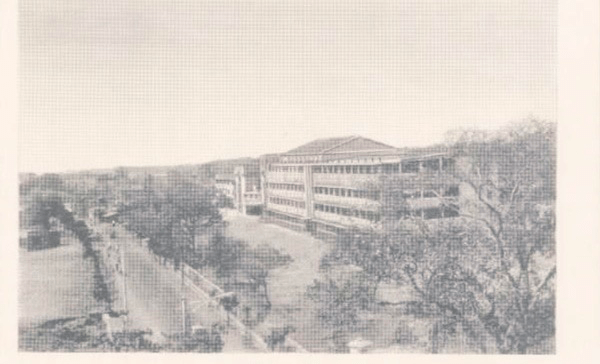
Panoramic view of Fatima Devi High School, around 1960

Dwiref Bhai was Shubhu Da’s friend; Alka was mine. So whenever Alka and I quarrelled — which we still do — I would tell Shubhu to tell Dwiref to give her a sound scolding.

“Hmm!” he’d reply.

What did that mean? I had no doubt that it meant “Sure.”

And sure enough they did no such thing. So next we met, Alka and I were friends again — which we have been for six decades and more, through high water and low, with the entire families of the Mehtas, Ghoshs and then Senguptas too.

Fatima Devi English High School existed in Malad East even before Kanaklata and Nabendu Ghosh* moved in to 2 Pushpa Colony. I was born in 1955 with that address. Rashmikant Mehta and Family moved in to ‘Kshitij Kunj’ some years later. The neighborhood was a cluster of Goan style bungalows that were home to Sequieras and Marchons, to Jenny Aunty and Hubert, to Paul Mahendra, Tarun Bose and Madhup Sharma – actors, all three – to the Chopras, Kashmiris, Khemanis, Bhatias, Mohan, Anthony, George… Together we have consigned to flames so many Auld Lang Syne on New Year Eves. Among so many abiding memories that bind this assortment of Indian lives, the strongest one is of our Holis. The toli or band would start somewhere with the Sharmas and the Chopras carrying gulal*, the Mahendras and Marchons would join in as the group stopped at the Mehtas, wound their way down the tiny colony and finished at 2 Pushpa Colony — gorging on sweets at every pause to smear colours and share joi de vivre. Years down, when we grew up, we would bunch into cars, drive down to Marve or Aksa Beach and dip into the Arabian Sea to add tan to the pink and green gulals on our faces. Jaane kahan gaye woh din… where have those days disappeared!

‘The road to a friend’s house is never too long’ — read the legend on a porcelain vase I had got for Alka from my first visit to UK. That legend captured the essence of our bonding. Both our families flanked Fatima Devi. But, while Dwiref, Kshitij, Alka and Spandana went to that very school — part of which was housed in the Mehta mansion — Subhankar and I went to school in Dadar. This arrangement was to ensure that we would grow up with some knowledge of Bengali, a language that had been enriched with the literary outpouring of Nabendu Ghosh.

So, every day it was almost 6 pm by the time I was back from school — and nearing 7 — when I showed up in the Mehta household. That happened to be their dinner time: the four siblings would sit around the kitchen table for the hot rotis and mouth-watering sabzis, vegetables cooked savoury with spices which  Prafulben Mehta — Aunty — would whisk off the tawa. Quietly she would put another plate on the table and hungrily I would polish off whatever was dished out. And, with a serious face, Dwiref Bhai would adjust his glasses, look meaningfully at the plate and ask, “Uttama, how do you manage to time the clock so perfectly?”

Looking back at that table in my mind’s eye, I now sigh. I wish I could manage to turn the clock back in time too. How I long for those dhoklas and vadas, khandvis and chhoondas, spiced up with the comments baked in camaraderie!

Dwiref and Shubhu did not study in the same school but playmates they were all along. So, rather than exchange homework and classwork, they were always indulging in the give-n-take of comics. That is how I got my first lessons in the intricate history of World War II. That is how I got acquainted with the Phantom, ‘Mr Walker’. That is how Archie and Betty and Veronica also became our ‘friends’.

Dwiref and Kshitij, brothers two, were divergent in their looks and in their style too. If the demeanor of the elder brother took after the Bollywood dancing hero Shammi Kapoor, Kshitij tailored his ways after the dashing heartthrob of 1960s, Shashi Kapoor. This dawned on me when I took to writing on films in 1970s. Shubhu had by then graduated from the Film & Television Institute of India — so Cinema was the constant topic of conversation at 2 Pushpa Colony. I came to realize that Rashmikant Uncle and Anil Kaka also had style models in two earlier matinee idols — Rahman and Guru Dutt!!

While Kshitij took over the mantle of a highly revered Criminal Lawyer from the Senior Mehta brothers, Dwiref Bhai became a doctor — like my own elder sibling Dipankar. I couldn’t, however, benefit from his knowledge of medicine: he travelled to the East Coast of America; I, to the Eastern metropolis of Calcutta. Seldom did we chance to meet even on our holidays in Bombay. But on my first visit to New York, Dwiref’s name was there in my ‘must visit’ list, right next to the Statue of Liberty, Time Square, Lincoln Center, MOMA, WTC, Smithsonian, and Krishna Reddy. Unfortunately, while I could personally catch up with the other names, I had to rest content with a telephonic chat with Dwiref Bhai: the doctor had turned patient and was not fit to travel out of his apartment.

Even then, I did not gauge the severity of his ill health. But, then, did I gauge that for my Dadabhai* either? This calendar year, circa 2020 has snatched away both our elder brothers. Is that fair, Alka? But today we are not quarrelling. Today, in grief, we are enjoined — the Mehtas and the Ghoshs.

*Nabendu Ghosh was a well-known writer and Bollywood script writer and director. Ratnottama Sengupta is his daughter.

*Gulal – dry colours which are smeared on friends during the festival of colours in India, Holi.

*Dadabhai – Elder brother

Ratnottama Sengupta turned director with And They Made Classics, on the unique bonding between screenwriter Nabendu Ghosh and director Bimal Roy. A very senior journalist, she has been writing for newspapers and journals, participating in discussions on the electronic media; teaching mass communication students, writing books on cinema and art, programming film festivals and curating art exhibitions. She has written on Hindi films for the Encyclopaedia Britannica; been a member of CBFC, served on the National Film Awards jury and has herself won a National Award. The former Arts Editor of The Times of India is also a member of the NFDC’s script committee. Author of Krishna’s Cosmos and several other volumes, she has recently edited That Bird Called Happiness (2018/ Speaking Tiger), Me And I (2017/ Hachette India), Kadam Kadam (2016/ Bhashalipi), Chuninda Kahaniyaan: Nabendu Ghosh (2009/ Roshnai Prakashan).

.

PLEASE NOTE: ARTICLES CAN ONLY BE REPRODUCED IN OTHER SITES WITH DUE ACKNOWLEDGEMENT TO BORDERLESS JOURNAL. 

Categories
Poetry

Two Poems

By Sekhar Banerjee

Juxtaposition

The renovated church near the promenade

has a large bell

in wrong metals – it sounds like a sea-coast cannon

and the new washrooms stand side by side

.

like soldiers, anxious

before returning to the garrison

You spin oddness and similarity like a nervous Tibetan

weaver making religious motifs

on a scarlet silk scarf

or a sleepy tailor stitching consecutive wrong

buttonholes in a formal shirt

We take a side and arrange similarity throughout the series, as if,

every uneven number is our special child

.

There is an ice-cream seller with a pair

of maroon shades in the rain

You can’t decipher his eye movement

.

like dissimilar chairs in a perfect table

You come to understand

juxtaposition is rather a choice than a coincidence

.

The Essayist

Nowadays every organ in my body

is an individual. I walk like the French Revolution

and I see the working of my limbs

 like an eighteenth-century staggering power loom

I roam and I count

one by one: this is my hand, this is my head,

this is my perception of my face

And, I know, those are my legs which will not let me fly

and that is my only solace for losing all wars nearby

like an essayist balancing his words

in the second draft 

And I look at my severed legs only in the dark

when the last pomelo flowers of spring

start blooming on them,

as though, they are my French floral brocade shoes

and I float

with my bereaved knees

 like a renaissance painting – white and blue

.

Sekhar Banerjee is a bilingual writer. He has four collections of poems and a monograph on an Indo-Nepal border tribe to his credit. He lives in Kolkata, India.

.

PLEASE NOTE: ARTICLES CAN ONLY BE REPRODUCED IN OTHER SITES WITH DUE ACKNOWLEDGEMENT TO BORDERLESS JOURNAL. 

Categories
Excerpt Poetry

Poems from My Father’s Face by Chandra Gurung

Chandra Gurung’s poetry translated by Mahesh Paudyal

My Father’s Face

Two eyes glitter like the sun and the moon

In that face

A kite of self-confidence keeps flying

Beautiful orchids and rhododendrons bloom

Combating the storms of calamities

.

On that face

A sun rises every morning to carry the burden of a new day

And returns, at the end of the day

Hiding every line of sorrows

Carrying little parcels of joy

Making the house and the patio bright

.

On that face

Narrow are the eyes that read the world

Pug is the nose that looms with raised self-respect

Wrinkled are the cheeks where joys and sorrows glide

Chapped are the lips, where smiles stage a march-past

And the entire Mongol identity has been smouldered by heat.

.

But I am delightful

Happy beyond telling

When everyone says:

“You look exactly like your father.”

.

Trust

Since you are back

Take those roses on the table

And kindly adorn them in the hearts.

Let the fragrance of love waft from it.

.

Bring out on the veranda

A pair of chairs;

Let’s spend some intimate moments.

Also place a bottle of wine, and two glasses

On the table;

We shall spend

Some moments of life, talking.

.

Look!

My weary rags

My books, pen and paper abandoned like an orphan

The stubs of cigarette littered like unclaimed corpses

And the scratched mirror—

All await for a single touch

From you.

.

This dark evening

You showed up at my doorstep all alone.

At this moment

Every nook of my heart

Is filled with love, ripple by ripple.

.

Leave it!

Let that window remain open at least

It reflects my heartfelt belief

That you would certainly turn up.

.

Desert: A Life of Mirage

There is not a single bright line of smile

On the broad canvas of the face

No butterfly of joy flutters on the cheeks

Desolate is this desert

Like a garden where all beauty has wilted.

.

There are dry tufts, devoid of life, everywhere

Dry hands of wind come to caress youth

The eyes accumulate dead excitement

And looms a mound of desolation

.

The youthful sun comes to face, eye-to-eye, all day long

The wind teases again and again

The desert longs to allure a traveler with its youth

Dreams of enchanting someone with its gestures

The desert is like a bride’s dream

Living in anticipation of a loving embrace.

.

Its breasts are decked by green date palms

A youthful cactus is tucked on its ears

And the desert stands in a long caravan of desires

Like a life of mirage

.

All is well

Everything is fine.

Just now,

My children in immaculate uniform

Have been taken to school

By a house-boy their age

.

My parents are happy in an old-age home

I am off from the pack of my siblings

My better half spends time watching TV serials

My home has hosted peace pervasively

From this, we can perceive that

All is well.

.

Since a prayer room in the home accommodates

A bunch of deities

It has been long that praying has been a rare tale

Doesn’t it mean

Everything is fine?

.

Nothing ever tortures my heart

I don’t meddle in others’ affairs

And keep myself away from such trifling hassles

And thus, do not bother myself in vain

It’s true:

Everything is fine.

.

I keep my own ways

Act amiably with all

And keep myself away from problems

For this reason

Everything is fine.

.

I carefully maintain my looks

Dress up myself decently

And follow healthy dietary habits

In fact,

Is everything really fine?

.

All these poems are excerpted from Chandra Gurung’s upcoming book, My Father’s Face, with the author’s permission

.

Chandra Gurung is a Bahrain based Nepali poet.  He has an anthology of poetry to his credit. That was published in 2007. The second anthology of his translated poems titled My Father’s Face will be published from Rubric Publishing, New Delhi.  He has passion for translation as well. He has translated Hindi, English and Arabic poets into Nepali. He has also has translated some of the Nepali poets into Hindi. His works (poems and articles) have found space in many online and print magazines including More of my beautiful Bahrain, Snow Jewel, Collection of Poetry and Prose complied by Robin Barratt (UK), Warscapes.com and many leading Dailies in Nepal.

.

Mahesh Paudyal is a Nepalese writer, translator critic and Assistant Professor of English at Tribhuvan University. His works basically foreground local epistemic traditions and Eastern mythological richness. He has published novels, stories, poems, plays and songs both for adults and children and has extensively written critical works. His major translations include Sheikh Mujiboor Rahman’s Unfinished Memoirs and Prison Notes into Nepali, Silver Cascades, a collection of Nepali short stories and Dancing Soul of Mount Everest, representative modern Nepali poems. He is the Executive Editor of Roopantaran, a translation-based journal of Nepal Academy.

.

PLEASE NOTE: ARTICLES CAN ONLY BE REPRODUCED IN OTHER SITES WITH DUE ACKNOWLEDGEMENT TO BORDERLESS JOURNAL. 

Categories
Poetry

I Am A Lover

By Ravi

.

I love flowers

For they are colourful

I love plants and woods

For they are fruitful

.

I love the sky

That glitters in the night

I love the Earth

That fills our appetite

.

I love the mountains

Covered with ice

I love the deep ocean

With its roaring voice

.

I love the lakes

Blue in color

I love the plains

Those are arch’s lover

.

I love the birds

Singing all day long

I love sweet words

Coming from my mother’s tongue

.

I love my father’s hand

Rising in blessing

I love my mother’s hug

Its like heaven embracing

.

I love Nature

For its beautiful creatures

I love the universe

For its secret features

.

Let’s all love

None should hate

We are humans after all

Only Love is human’s fate, not hate.

.

Bhanu Prakash aka Ravi (Pen-name) is a teacher, poet and writer living in Uttar Pradesh, India. His poems, stories and articles have been published in online journals and in various anthologies like “Rubaroo”, an anthology by Evincepub Publication and “Whisper of Hearts”, an anthology by Oxigle Publication. He is a blogger also and writes regularly on https://www.histolit.com/. Besides writing, he is an avid reader and loves singing a lot. Presently, he is working on his first novel and his collection of stories.

.

PLEASE NOTE: ARTICLES CAN ONLY BE REPRODUCED IN OTHER SITES WITH DUE ACKNOWLEDGEMENT TO BORDERLESS JOURNAL. 
Categories
Poetry

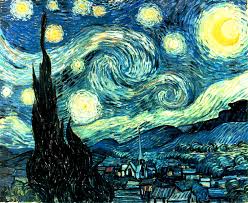
The Starry Night

By Sunil Sharma

The Starry Night

Forced by the power cut,

Suburbanite went up

To his deserted terrace;

Was hit by the immensity

Of the starry night,

Felt overwhelmed by

The primeval beauty

Spread out,

The breath-taking magnificence

Of the swirling night sky

Stretched taut overhead

The eternal space

That glowed with twinkling silver bulbs,

And beckoned the little child gaping

At this rapturous sight, along with his mesmerised dad,

The huge moon and the pale-white light

Washed the blue of the vast sky and produced

Strange lights that streamed down on a French village,

In a different era, when things were more quiet,

The darkness mild and the well-lit sky

Was an enthralling discovery by Vincent van Gogh,

Who had painted and immortalised this ethereal spectacle,

Through his Starry Night over the Rhone and The Starry Night,

The poetic painter, committed to sanatorium,

Suffering from delirium and what not,

Studied the curious effect of darkness and light,

The two paintings still transmit

The same sense of first-time wonder and delight

To the subsequent viewers, living in polluted cities,

Breathing fumes and pure carbon dioxide;

As the cold wind of November buffets the

 Father-son duo that stood silent,

Before gods of yore, now not recognised,

The two felt standing in a pagan shrine,

Found accidentally,

 In the heart of a commercial city,

And

Overawed by this rare divine sight,

Stared at the infinity and felt their own

Small size,

They then understood that

There exists a unique mysterious realm

Beyond the sodium vapour lamps,

For centuries,

That has been trying again

 To communicate

With humankind but in vain,

This rich world that was once deeply understood and captured

By the likes of Gogh and Wordsworth,

Now lost forever for the ever competing,

Rude,

Aggressive,

Utilitarian,

Raider

Called

Homo Economicus.

.

The lofty view from the barred window

May 1889. Saint-Paul Asylum

Through the east-facing iron-barred

Window of the second-floor bedroom,

The familiar sky grew into a revelation

That electrified a young inmate fighting

His own private demons;

The ether got suffused with luminosity

And the stars and the moon orbited

 In swirls very bright;

The other side of a mundane sky!

The vision uplifted the gloomy mood

Of a self-mutilated and starved artist, and,

The scene was painted and preserved as the iconic Starry Night.

That canvas still alive, despite the intervening time

And is part of a marvellous series and it

Forms a luminous summit of

World culture, easily recognized;

The sky was always there for those living

In the Saint-Remy-de-Provence and

Still there stretched out for other mortals in the world,

Yet its mystery, its spiritual dimension could only be

Captured by someone considered nuts

By the rest of the proper and the civilized,

What arbitrary cultural and social categories

To imprison and destroy tender creative minds!

Vincent van Gogh could see vividly the other side of the

Brilliant star-studded sky, and, the

Essence of the grim reality of his time and

Could easily locate its soul pristine in meadows

Sunflowers and the sky.

Asylum walls could not restrain his soaring spirit

And he drew furiously through his inner eye.

 .

Madness was never so lucid

So receptive to the beauty innate

In things ugly/ordinary!

.

Like the famous Don Quixote and the cat in the Wonderland,

Dear Vincent—and rest of us through the Dutch artist—can

See things only the crazy can see

Yes, the other side,

That the sane and practical always dislike!

.

Nightly visions granted to the blessed!

When night suddenly becomes

A brilliant image inspires

An inmate that went by the name

Gogh

And begets brilliant visions

Of heavenly bodies and playful

 Mix of colours— light-n-dark

And restive hands, in creative

Frenzy, caught on an oil canvas

Delighting by now

Millions of lonely hearts

Trapped in hopeless situations

 .

To-night, the same sky

Looks similarly beautiful

As it was for those red eyes

In the year 1889

 .

The dim space, a-wash

Stars redeeming the dark

And the boughs, all lit

Creating patterns divine

On the

Uneven walk.

.

Rare! This Spectacle, seen in another age, as well

…at this precise moment

when the sky is in a flux

 .

drenched in a riot of

dark-blue- grey colours

and a flowering tree, backlit

 .

the composite elements

of the heavenly composition

grab the fleeting attention;

 .

the viewer- concentration

divided between the two metaphysical

entities that uplift

the viewer

reads the live space and writes

lines on such an out-of-world canvas

that firmly echo

refer back, back of mind,

collective consciousness,

to a “mad” painter who goes by the name of Gogh!

.

Sunil Sharma is Mumbai-based senior academic, critic, literary editor and author with 21 published books: Seven collections of poetry; three of short fiction; one novel; a critical study of the novel, and, eight joint anthologies on prose, poetry and criticism, and, one joint poetry collection. He is a recipient of the UK-based Destiny Poets’ inaugural Poet of the Year award—2012. His poems were published in the prestigious UN project: Happiness: The Delight-Tree: An Anthology of Contemporary International Poetry, in the year 2015.

.

PLEASE NOTE: ARTICLES CAN ONLY BE REPRODUCED IN OTHER SITES WITH DUE ACKNOWLEDGEMENT TO BORDERLESS JOURNAL. 
Categories
Essay

This Independence Day, Let’s Celebrate the Apocalypse

By Dustin Pickering

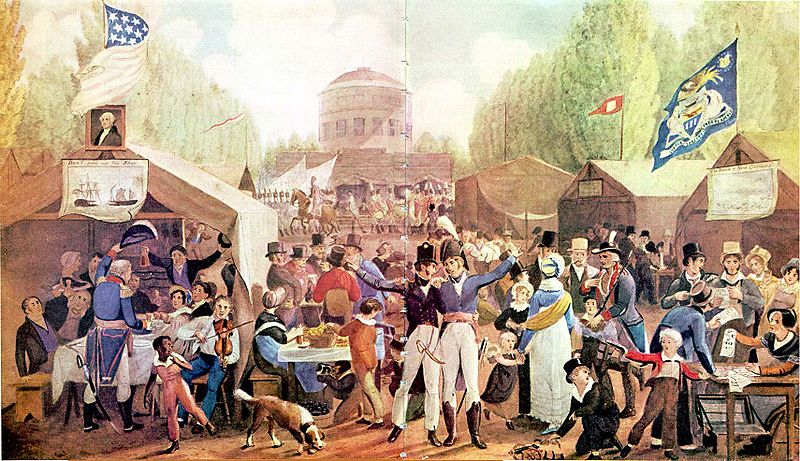
Independence Day Celebration in Centre Square, Philadelphia, by John Lewis Krimmel, 1819

“…rather these question marks arise when the human condition is so improved and ameliorated that the inevitable mosquito bites of body and soul are found to be altogether too gruesome and gory, and in the poverty of their experience of actual pain, people will even take being troubled by ideas to be suffering of the highest order.”

Friedrich Nietzsche, The Joyous Science trans. R. Kevin Hill

This essay is a reflection on the current crises and my own proposed approach to handling them positively. I also attempt to offer some meaning to them while keeping within the tradition of American constitutional liberty. I also invite the reader into my own experiences.

If the reader is adverse to controversial ideas that challenge prevalent assumptions, then I suggest passing on this personal essay. I plan to shake assumptions concerning the direction of the United States and talk about things that matter and how our country and culture are reckoning with them.

Trump emerged as a Black Swan President in 2016, completely shattering liberal hopes of the first female president. Most of his supporters were white, seen as uneducated rednecks and put on display for ridicule. He was the anti-immigrant candidate, the one saying that “bad, bad hombres” were crossing the border. He told us that he could shoot someone on the street and his constituents would still love him, demonstrating a casual arrogance found in every other politician we have come to know. What makes him different? 

President Trump is an arrogant man who has courted authoritarian regimes of various stripes including North Korea, India, and even the Russian government is pleased to have him in power. This could signal a global paradigm shift in power relations altogether. Trump is not the problem, but he is the response. By reflecting the face of Caliban back to our souls, he leads us to think on matters of importance.

After President Obama created the Syrian refugee crisis with the aid of Secretary of State Hillary Clinton, what sort of leadership was needed to counteract the ensuing instability? Bernie Sanders suggested importing thousands of people as climate refugees and writing a blank check to cover expenses of an increasing welfare state. Even the controversial Rep. Alexandria Ocasio-Cortez (who this writer admires) suggests major changes in fiscal policy guided by Modern Monetary Theory. Infrastructure needs dire improvement as it crumbles. What better time to create something entirely new from the old patterns?

Let’s also talk about injustice. How we have treated others historically. How we continue to marginalize people. Why are we only now reckoning with our own hideous reality that we created?

Society needs a culture to help it identify itself. It requires art, both commercial and fine arts. It requires attitudes and stereotypes to fit our lazy thinking habits. It requires political economy, adjustments to government and its relations to industry. A country is a thing much larger than itself.

Nationalism, a word I have often despised, means what a country identifies as should be held at high value by its citizens. Pride in one’s country is not inherently exclusive. Critics of the United States on the left have offered a great number of reasons to reconsider our global supremacy. Post-globalization society will be much different; it will need to be strong and fit to survive, but it will require openness. It will need to be robust, but multicultural. Open criticism helps us adapt to growing cultural pressures.

*

July 4th, Independence Day, is a celebration of the penning of the Declaration of Independence which declared the 13 colonies of America separate from the tyranny of British monarchial rule. Later the founders were to establish a new government after coming short with the Articles of Confederation.

In creating a stronger central power capable of collecting revenue to pay the debts of the Revolutionary War, the United States engaged in a radically new political mode of being in the world. After centuries of European wars over religion, the Enlightenment sought to empower the individual and empirical science.  The ideas of the Enlightenment  from thinkers such as Rousseau, Locke, Voltaire, and others established a new precedent which emboldened culture and science.

The founders were familiar with these ideas. After rational debates concerning the new government, the United States Constitution as we know it was written. The ideals presented of rational discussion, free speech and assembly, not only founded this majestic country, but were the very staples of its founding. Free press was established to help circulate ideas. Common Sense by Thomas Paine was a leading factor in persuading the colonists so free press was also beneficial to the American Revolution.  These ideals are something to make us exceptionally proud.

*

This writer is a left-libertarian when it comes to ideology, but we must look beyond ideas. The metamodernists convey that reality and text are different things, but not mutually exclusive. How we conceive ourselves matters. With Donald Trump in the White House, a man who has shady dealings in the past as everyone does, a political outsider whose rhetoric is extreme but powerfully honest, a reality TV host who admittedly has helped our culture decline into laziness, we have come to firmly reckon with not just our history but our present as well. There has never been more open, honest discussion in the public domain as now. I see people defying the conventions that have long held them down. Ideology is an enemy, a bad conscience. However, it is a necessary component to our being. It contextualizes and celebrates our caveats.

President Trump has put in front of us what so many past presidents have hidden in private. In doing so, he is caused us to think more deeply on our predilections. Broad cultural shifts are taking place that wouldn’t have without such an impetus. The mobilization against Trump is as powerful a catalyst as he is himself. Let’s not be dogged by ragged assumptions.

With this said, I plan to vote for Libertarian Party candidate Jo Jorgensen to make a point that I want to preserve the ideas of liberty, independence, and freedom of thought. I cannot empower the left or the right in my vote with reasoned conscience. Identity politics has triumphed as a reaction to racism, sexism, and the various evil isms setting one’s “identity” as political collateral in a battle against history. This leftist dogma does not suit me, and I cannot empower it by voting to uphold it and its culture.

I respect Trump and admire some of his accomplishments. I have discussed them in writing. However, I cannot vote to uphold Trumpism either. With writers such as Anis Shivani I believe Trump is a man of the people, although his responses to coronavirus and the Black Lives Matter movement are tepid. A recent NPR (National Public Radio) article discussed by FEE (Foundation for Economic Education) suggested that experts have failed to properly address an issue yet again, and making comparisons to the expertise that lead to the Iraq War. Government authority clearly is human, and not divine.

I was an atheist after hearing Bad Religion for the first time at age 13. Raised strict Catholic, I merged my traditional and revolutionary tendencies into Christian humanist anarchism, my own variety of metamodernism.

*

My mother, also an atheist, lost her mother to a drunk driver at age eighteen when I was a toddler. She and my father separated. Courts ordered my father to pay child support for which he never took responsibility. Custody was granted to my grandmother and aunt. Court documents from the Chancery Court of Monticello, Mississippi I dug up a few years ago reveal that my grandmother was given custody because she would raise me in a “Christian atmosphere suitable to the court.” She raised me exceptionally well, but held strong patriotic tendencies and for many years I despised her politics. She read Ann Coulter as she was passing away and I selfishly argued with her. Independence Day was always cause for argument over American Empire.

She had a heart of gold. She had an intellect that the world did not fully glimpse, and I only understood in retrospect. An independent woman can take many forms.

My father hates liberals so I grew into one, naturally. Now I renounce the left as a sworn leftist. I will not stand for attacks on free expression. I will not passively watch our country slide into extremes. I will not, I cannot, let this happen now. I will pray for my own redress. The world needs God. I need God.

It is often said that the founders did not like religion. This is only partially true. Jefferson’s own writings mock the clergy. However, Madison was a devout Anglican. Washington was a Mason. Even the radical democrat Jefferson praised religious tolerance as the means to spread truth, thus the creation of separation of church and state.

Is it time to separate church and hate? Enough of the religious supremacy. It turns people away. Embrace the shifting world. One can be strong in faith and reasonable in heart.

*

It is time that we celebrate independence of thought, free discussion, and individual liberty again. These ideals must be vindicated. The Enlightenment emboldened science, elevating it to a cause of its own. However, it did not leave a strong legacy of criticism of science. Science, however, offers criticism of itself. As it creates its own church with dogmatic expertise in the name of consensus, we sometimes forget that it’s mind is human.

*

I released a poetry collection called Salt and Sorrow several years ago. I even boldly sent a copy to the White House as a gift to the new president, asking him to end the longest federal shutdown in American history. The book’s basic idea was to restore Western values to their Platonic Idealism. After reading an introduction to Plato’s Collected Dialogues that notes how these values have saved Western civilization over centuries when it was at its most crucial moments, I thought to add some Christian humanist Idealism to our culture. The book was well received. The President sent me a thank you card which he signed personally. I have it hanging on my bedroom wall. The book is an easy but thoughtful read and worth discussing.

I announced to the Cosmic Poets Society that I had sent the gift to the president, and the day after the tracking number showed it was received the shutdown ended. Many people suggested I may have persuaded the president, although I humbly doubt it.

*

In the aftermath of Black Lives Matter and the ongoing battle against all forms of bigotry, lightning struck the Washington Monument. The monument stands as one of the world’s tallest structures in memorial to the United States’ first president, General George Washington of the Continental Army.

For years, I prayed justice would come to halt the world. I know God knows what He is doing as He has been doing it for an eternity and will continue to do it. The world stands.

Perhaps the astounding loneliness penetrating my soul and the soul of humanity found a course for its reckoning.

*

Again, all ideas have their faults and we should be willing to critique them. Ideals are important especially in the United States where slaveowners boldly declared independence from tyranny. Words are powerful. Over the course of American history, movements have developed to challenge bigotry and discrimination. When we fail to honor “life, liberty and the pursuit of happiness,” and forget that “all men are created equal” (even the language is a tad sexist, though the idea is powerful), we relinquish our ideals to the dustbin. The founders were imperfect, and they were trapped in world history with all its faults.

We can discuss slavery in 1776, and forget that sex slavery still exists in this country. Children are sold and trafficked across the border. We can continue reckoning with our history, and forget that its spectre still haunts us in myriad shapes. It is important that we shape our identity to suit the growing multicultural globalism before us.

Liberal democracy is a faith. It has proved to help us ascertain the human condition and address it assertively. Ideals are to be cherished; they guide us. Independence is not to be relinquished.

.

Dustin Pickering is the founder of Transcendent Zero Press and editor-in-chief of Harbinger Asylum. He has authored several poetry collections, a short story collection, and a novella. He is a Pushcart nominee and was a finalist in Adelaide Literary Journal’s short story contest in 2018. He is a former contributor to Huffington Post. 

.

Disclaimer: The opinions expressed are solely that of the author.

.

PLEASE NOTE: ARTICLES CAN ONLY BE REPRODUCED IN OTHER SITES WITH DUE ACKNOWLEDGEMENT TO BORDERLESS JOURNAL. 
Categories
Poetry

Giants and more…

By John Grey

Giants

The elephant enclosure

is dotted with heaps of hay.

Three giant gray thirty-somethings

jolt each other softly,

as trunkfuls of feed

are packed into open mouths.

A crowd gathers behind a fence,

watches these gentle behemoths

fills their massive bodies.

.

A sign nailed to a post

gives Latin name,

location in the wild,

color-codes Loxodonta Africana

as threatened.

Herds and habitat are shrinking.

There’s so little that can live

on such a grand scale.

.

The Law-giver

Shorter days panic

the apples into ripening.

Those that don’t fall

are plucked, fill buckets,

are trafficked from orchard

to ramshackle road-side shack

where scrawled sign and cheap scales

make for a fleeting Autumn store.

.

Bright red Washingtons are traded

for crisp green Washingtons.

A plush, juicy Granny Smith

is sold to a bent, age-smudged Granny Smith.

.

A gray-haired woman holds court

from her ancient lawn-chair,

while noisy children chase dogs

in and out of her legs.

.

A guy in a Buick drives up,

checks through a bushel so fresh,

the smell of the tree is still on their skin.

He scowls at the spots, the bruises.

.

The first law of apples is that

the scruffier the look, the tastier the fruit.

The red-cheeked woman in rumpled dress,

is the law-giver.

John Grey is an Australian poet, US resident. Recently published in Sin Fronteras, Dalhousie Review and Qwerty with work upcoming in West Trade Review, Willard and Maple and Connecticut River Review.

.

PLEASE NOTE: ARTICLES CAN ONLY BE REPRODUCED IN OTHER SITES WITH DUE ACKNOWLEDGEMENT TO BORDERLESS JOURNAL.

Categories
Poetry

‘Bloodoholic”

By Sutputra Radheye

Sutputra Radheye is a poet and commentator who delves into the themes affecting the socio-eco-political scenario. His works have been published in prestigious platforms like Frontier, Countercurrents, Janata Weekly, Culture Matters (UK), Livewire , Sunflower Collective, Eleventh Column and many more throughout the years.

.

PLEASE NOTE: ARTICLES CAN ONLY BE REPRODUCED IN OTHER SITES WITH DUE ACKNOWLEDGEMENT TO BORDERLESS JOURNAL. 

Categories
Slices from Life

Baudelaire and Paris

By Sunil Sharma

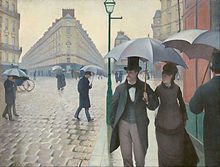
Gustave Caillebotte. Paris Street, Rainy Day, 1877. 

I

Modern Paris was discovered by Baudelaire in his avatar as the flaneur. And Walter Benjamin made this figure intellectually respectful as a field of study.

In a recent visit to Paris, I hovered between two allied states of being a flaneur and a gawking tourist. I had come as a sightseer from Mumbai, India, allured by the tales and well-crafted image of a mythic Paris, drinking in the street flavours on those May days, passively registering the wide monuments and boulevards and palaces and towers in one clean and clear sweep — almost like a wide-angle shot in a Stanley Kubrick film. Spring had set in and the Paris of May 2014 was full of eager tourists from nations as wide apart as China and the USA; Africa and Middle East and Latin America. A bouquet of the ethnicities strung together.

Then, I became a flaneur, making a neat switch, in a single instant.

I became Baudelaire.

Different terms can make you look differently at a similar set of things or a common setting.

Of course, I did not have the urge to write a new millennium version of The Flowers of Evil. At best, you can parody a sacred text but you cannot re-write it, howsoever Borges-like you might be.

I am neither of the two.

Like Mallarme and Verlaine, you can carry forward an idea by expanding it further but cannot imitate with complete fidelity to the original.

So, not in a mood for a cheap replication of a master praised by Proust so profusely, I took on the stance of a flaneur and became a connoisseur of the street-life.

Was it possible?

Assuming the role of a figure long dead or supposed to be dead? Replaced by a tourist? Solo or in a group?

Armed with a camera or a cell phone, in casuals, the modern tourist — guided by brochures and online information and a city map — looks at the urban skyline vicariously familiarized by prior research. Or, could it be at a professional polyglot guide spewing bits and pieces of history like a typical street performer or an amateur actor? A mass tourist consuming the city, architecture, culture, food, arts and clothes — public life — in a predictable way and sequence largely decided by the tourist industry. A few breaks are possible in that routine.

But to resurrect the role and agency of the classic flaneur, you have to take on a different position and way of seeing.

And what was that?

I could not become a dandy—detached, arrogant, inheritor of a small fortune, an idler walking a tortoise on a Paris street of the nineteenth century. Even if I had the means, I could get arrested for an act of animal cruelty!

Those were different times!

So what can be done?

The clues lie in The Flowers of Evil, perhaps.

Will this title be acceptable today? With changing definitions of evil? With life becoming more liberal and open?

Baudelaire was a dandy and a cultivated flaneur—the painter of modern life; a gentleman stroller of the city streets. Part of, yet apart from, the crowds.

But then, not every dandy is a flaneur and every flaneur, a dandy?

Again, dandy is a historical invention, a social-engineering, manufacturing of a social type for a particular age.

Perhaps, a metro-sexual male, now no longer fashionable.

Is he a voyeur?

Perhaps, we all are, given the nature of our society.

Or, a keen participant, an acute observer, a chronicler?

For me, the answer lies in the personality of Charles Baudelaire who in turn was influenced by Edgar Allan Poe. But that would be complicating things further.

Let us stick to our central figure Baudelaire. His genius lies in radicalizing the trope of the French flaneur. A theme that fascinated Walter Benjamin who, in the twentieth century, tried to essay the same role performed so well by Baudelaire in the industrialized Paris of the nineteenth century. The former could not capture the underlying passion of Baudelaire in this unfinished project.

In fact, by the late 1990s and start of the 21st century, author-flaneur proved an impossible figure.

Market forces, on global level, have incorporated author as a producer of kitsch or dystopia. Dissidents were slowly and subtly disenfranchised.

We are all sellers!

Baudelaire resisted this initial process in Paris. Beckett was next. Sartre and Camus too tried.

Then the flow stopped.

The Flowers of Evil mounts a challenge to the order and morality of the Second Republic.

The poems challenge the bourgeois morality and conception of order and beauty and aesthetics in a radical way. The book talks of evil and implies that the source of evil lies in its origins — capitalism.

In that simple gesture of observing, participating, recording of street life, Baudelaire liberates himself from his historical position and becomes a true artist. By talking of prostitutes and vampires, the poet shows the underbelly of capitalism. His creations provide the material basis for highlighting these themes and give credence to outcasts from the system that feed on the blood of the innocent and the gullible.

The Flowers of Evil is the greatest indictment of the French bourgeoisie by a person deeply embedded in it as a bourgeois but a radical one that unveils the brutal face of a system that once talked of revolutionary slogan of liberty, equality, fraternity!

An evil society can produce evil flowers!

Vampires are for real!

II

That Baudelaire had not died in 2014 was proven on a street near the Eiffel Tower on that memorable trip.

A Roma girl, bold and audacious, stole my son’s cell phone from his shirt pocket. She returned it after a cop intervened.

I could smell evil in the air. The disenfranchised and the ethnic Roma are still the threat — like the prostitute and the vampire, the perpetual outsiders.

The Paris of Baudelaire is not safe.

The shoot-out at the Charlie Hebdo proves that.

The vampires are out.

This time round, Baudelaire the flaneur has disappeared. There is no one to warn us of these sinister presences.

.

Sunil Sharma, an academic administrator and author-critic-poet–freelance journalist, is from suburban Mumbai, India. He has published 22 books so far, some solo and some joint, on prose, poetry and criticism. He edits the monthly, bilingual Setu: http://www.setumag.com/p/setu-home.html
For more details of publications, please visit the link below:
http://www.drsunilsharma.blogspot.in/
. This story was first published in Scarlet Leaf Review.

.

PLEASE NOTE: ARTICLES CAN ONLY BE REPRODUCED IN OTHER SITES WITH DUE ACKNOWLEDGEMENT TO BORDERLESS JOURNAL. 
.