Categories
Essay

A Book of One’s Own: The Story of Women’s Writing


By Meenakshi Malhotra

Human beings have always told stories. However, in the course of history, the voices of many groups fell silent, their lives — and their stories-hidden from ‘his’ story. Before the story of women’s writing can be recounted, we have to look at the term itself.

 Why are we still using the term Women’s Writing? Do we use the term  mens’ writing?

Is the conceptual category of  women’s writing a description , a prescription  or a ghettoization?

When we say women’s writing, are we marking out women as a group whose gender identity needs to be  declared  in order to evaluate their writing? Or are we saying that the writing will lead us to a revelation of the gender identity of the writer?

Does it then, or can it then become a reductive activity, an “intellectual measuring of busts and hips”, as feminist and literary critic, Elaine Showalter, writes in one of her essays ?

Or are we making an allowance for them, much in the spirit we view any kind of affirmative action, as a sort of acknowledgement of past wrongs? And reparation of the kind we make towards historically marginalised or oppressed groups?

In a sense, women have always written, albeit in an environment where a large part of their work has been hidden from history, not acknowledged or documented. Another problem is that their writing and its evaluation has not only been framed by, but completely explained away in terms of the gender of the writer, leading to generalisations and gender stereotyping. This is a reductive and circular view where every detail in the text is sought to be explained with reference to the gender of the writer. So the statement that emerges is “she writes like this because she is a woman” or “only a woman can write this or this way” and that too not in a tone of approbation.  

 The  goalpost for the woman writer was set by male critics, often the self-appointed custodians  of  literary traditions where the gatekeepers were all men. In a sense women writers were being pushed towards adopting the honorary status of men, (the incidence of the male pseudonym) or to forget their femininity and become a frump. Another image was also that of the virago or the “hyena in petticoats”, a form of labelling to undermine strong, strident and opinionated women. Here I am  deviating from Showalter’s idea of the ‘feminine’ phase by suggesting that the woman writer of the 18th and 19 th century were actually challenged to forget their femininity.

 It was deemed inappropriate for women writers to write about sex and sexuality, as is evident from the discomfort and disquiet around Radhika Santwanam, described in the Introduction to Women Writing in India: 600 BC to Present (2009), edited by Susie Tharu and  K. Lalita. Interestingly this censorious attitude to women’s  writing was not a historical but a product of relatively recent ideas of gentility and appropriate womanhood enshrined and embedded in Victorian morality, which were appropriated by the newly-emerging middle classes who had received western education.

 Sumanta Banerjee in his The Parlour and the Streets (1989) traces the loss of a vivid colourful idiomatic oral language drawing from the popular culture of the streets. As this vigorous colloquial idiom was  deemed inappropriate and unfit for literary usage, it did not find any place in the new respectable national literatures in the regional languages that were emerging in the 19th century. So the ‘literary’ got marked off from the colloquial where the baby (women’s literature –oral and written) was literally thrown out along with the bathwater.

 Prior to the 19th century, in England , one reads not just Mary Wollstonecraft, but also Aphra Behn, and  other signposts to  alter an otherwise barren landscape of women’s writing. Here as we probably know already, the anxiety of  ‘influence’(pointed out by Harold Bloom) is replaced by the anxiety of authorship, where the woman writer is made to feel orphaned and alienated, a Jane come lately since  she  has no genealogy or tradition to which she belongs. Thus we see the attempts in many instances, where writers claim their mother’s heritage.

Alice Walker’s In Search of Our Mother’s Gardens (1983) is a case in point. While the figure of the mother is very important even for male writers, there is a special poignancy in which this relationship is signified in women’s writing. Thus there is Rashsundari Debi’s autobiography, Amar Jiban ( 1876, one of the first autobiographies in Bengali), Zora Neale Hurston’s autobiography, Dust Tracks on a Road (1942), and Carolyn Steedman’s Landscape for a Good Woman (1986) , all autobiographical texts where the mother’s death becomes a moment of unusual poignancy, helping shape the contours of the writing self.  

Another problematic issue is obviously the seemingly unified and homogeneous category of ‘women’, which is an imposed unity for a  heterogeneous and diverse cross-section of people. So when we refer to ‘women’s  writing’ as a category, we have to think whether we are being just or fair in  clubbing  such a diversity of voices under one rubric or template. What tends to happen is that a diversity of voices tend to get homogenised and flattened out and specific issues are lost or get submerged depending on power dynamics, on factors like access to vectors of power related to race, class, caste, socio-economic status and sexual orientation.

Some of these  issues  were flagged by women of colour or Afro-American feminists and also by ‘third world’ academicians. They felt that the unmarked category of women, while seemingly inclusive, actually excluded them in fundamental ways. They rejected the term ‘feminism’ and instead replaced it with their coinage, ‘womanism’. They also compared women’s  writing to a patchwork quilt, where ever bit is both an individual piece as well as part of a collective and bigger creation and endeavour.

Now what do we see in terms of the situation on the ground of or for the women writer? One is Virginia Woolf’s vignette in ‘Shakespeare’s Sister’( excerpted from A Room of One’s Own, 1929).  Nearer home, we have the narrative of how Rashsundari teaches herself to read and write. I would go so far as to say that one of the themes of women’s writing seems to be a thematising of women’s writing itself, their coming to voice, textuality and affiliation, about the pangs of growing up female and about the process of gendering across societies.

However, while these themes and issues maybe crucial to women’s writing , they may not always be framed as belonging to the category of the ‘literary’, according to the rules put in place  by its custodians. So even though a lot of novels by women circulated in the marketplace, they are missing in the archive.

 Therefore one obvious way of approaching women’s writing is to do so through the non-formal, the informal, the  non-canonical, through modes and forms which slip under the radar of the ‘literary’. Thus the memoir, the diary, letters autobiographies or hagiographies, the poetic fragment  are also aspects and forms that we need to take into account while discussing women’s writing.

There is a fair amount of material on women and the novel, how women were peculiarly suited to the exigencies of novel writing and consumption, and how they are more shadowy figures when it comes to poetry. If we see the poetry section in the  usual courses, we see a handful of poems (in a somewhat tokenistic way), many of them deeply personal, confessional and autobiographical. Some poets like De Souza seem to use irony quite a lot, for example in ‘Marriages are Made’. If we were to isolate stylistic features of women’s poetry as specifically gendered , relatively short verse forms, brevity, tightness of language and syntax, are all evident in women’s  poetry and  one of the most anthologised female poets, Sylvia Plath, eschews the elaborations of an intricate style and sticks to flat statement, staccato rhythms and colloquial tones. As Dickinson frames it, they “shut me up in prose/because they would have me still.” We can only speculate about the ‘they’ in these lines.

Women’s experience on the stage and as playwrights were also dictated by certain social norms. Women’s visibility on the stage and their occupying the public domain represented a kind of transgression, as is evident both in theatre journals and in the autobiographical writings of actresses like Binodini Dasi, known to generations of Bengali theatre goers as Nati Binodini.  The stage raises a question about the ‘proper’ legitimate domain of women, who were viewed as violating the boundaries of morality  and respectable and acceptable behaviour.

The story of women’s writing is still in the process of unfolding. From learning to read and write in secret, as showcased in Rashsundari Debi’s autobiography (since literacy in women, it was believed, was a sure precursor to widowhood) because of the taboo on women’s literacy, many women have emerged as powerful voices-and presences-both in the archive and in the marketplace. The hand that supposedly rocked the cradle can also hopefully rock the world, challenge the existing order of things and write a better world into being.     

   Dr Meenakshi Malhotra is Associate Professor in English at Hansraj College, University of Delhi. She  has edited two books on Women and Lifewriting, Representing the Self and Claiming the I, in addition  to numerous published articles on gender and/in literature and feminist theory. Some of her recent publications include articles on lifewriting as an archive for GWSS, Women and Gender Studies in  India: Crossings (Routledge,2019),on ‘’The Engendering of Hurt’’  in The State of Hurt, (Sage,2016) ,on Kali in Unveiling Desire,(Rutgers University Press,2018) and ‘Ecofeminism and its Discontents’ (Primus,2018). She has been a part of the curriculum framing team for masters programme in Women and gender Studies at Indira Gandhi National Open University(IGNOU) and in Ambedkar University, Delhi and has also been an editorial consultant for ICSE textbooks (Grades1-8) with Pearson publishers. She has recently taught a course as a visiting fellow in Grinnell College, Iowa. She has bylines in Kitaab and Book review.

.

PLEASE NOTE: ARTICLES CAN ONLY BE REPRODUCED IN OTHER SITES WITH DUE ACKNOWLEDGEMENT TO BORDERLESS JOURNAL. 

Categories
Review

A History of Desire in India

Book Review by Bhaskar Parichha

Title: Infinite Variety – A History of Desire in India

Author: Madhavi Menon

Publisher: Speaking Tiger, 2018

Taṇhā in Pali or trishna in Sanskrit roughly means desire, thirst, longing, and greed. Whether physical or mental, taṇhā is an important Buddhist concept found in early texts. Out of the four ‘Noble Truths’, the Buddha identified taṇhā as a principal cause in the arising of dukkha (suffering, pain, dissatisfaction).

Take no notice of what ancient Indian texts said about desire; look at this stupendous book that portrays the notion of desire whilst bringing out its myriad colors. Part of queer theory, it travels across the subcontinent in the hunt for diverse manifestations of desire.

Madhavi Menon’s Infinite Variety – A History of Desire in India is a rebellious account of desire and is full of astonishing analyses and insights. Menon – professor of English at Ashoka University – writes on desire and queer theory with panache. She has authored a number of books resembling the subject: Wanton Words: Rhetoric and Sexuality in English Renaissance Drama; Unhistorical Shakespeare: Queer Theory in Shakespearean Literature and Film; and Indifference to Difference: On Queer Universalism.

Pleasant and edifying, the book, as the blurb says, “reveals not purity but impurity as a way of life. Not one answer, but many. Not a single history, but multiple tales cutting across laws and boundaries.”

In Bhakti poetry, Radha and Krishna disregard marital fidelity, age, time, and gender for erotic love. In Sufi dargahs, pirs (spiritual guides) who were married to women are buried alongside their male disciples, as lovers are. Vatsyayana, the author of the world’s most famous manual of sex, insists that he did not compose it for the sake of passion, and remained celibate through the writing of it. Long hair is widely seen as a symbol of sexuality; and yet, shaved off in a temple, it is a sacred offering. Even as the country has a draconian law to punish homosexuality, heterosexual men share the same bed without comment. Hijras are increasingly marginalized; yet gender has historically been understood as fluid rather than fixed” – the book says it all in splendid details.

Written in an impeccable style, the approach is spanking new and commonsensical. What enhances the beauty of the book is that the author plots a route through centuries, geographies, personal and public histories, schools of philosophy, literary and cinematic works. It meanders through contemporary studies on sexology, dissects Bollywood films based on the subject, depicts symbols, and even juxtaposes the object of desire with yoga, philosophy, and commonplace events.

While Menon examines the numerous faces of desire in the Indian subcontinent, for the most part, we are exposed to amazing tales and factoids dug out from enormous archival material and public spheres. The study ranges from the erotic sculptures of the Khajuraho temple to the shrine of the celibate god Ayyappan; from army barracks to public parks; from Empress Nur Jahan’s paan to home-made kohl; from cross-dressing mystics to asexual gods. It shows us the connections between syntax and sexual characteristics, between mane and warfare, between self-restraint and gratification, between love and death.

Loaded with factoids and figures and with a spiky introduction, the book is neatly divided into twenty long chapters –- desire in education, desire in suicide; law and psychoanalysis, desires among bhabhis (sisters-in laws) to grandparents, desire in celibacy, desire while dating and make-up et al.

The work is phenomenal –- both because of the subject and the approach. That an entire book could be written on ‘desire’ is inspiring. But more important is the way it has been conceived. There is an element of gracefulness, lucidity, and enchantment as one flips through the pages. No one who has a desire can afford to fail to notice this meticulously-researched book.

Together with germane photos to buttress her argument, Menon’s book pivots around   texts, oral traditions, schools of philosophy to exhibit   the sub-continent’s nebulous, many-sided, and rich tradition of desire. Her deft handling of the theme and narrowing it down into a single book is truly commendable.

Infinite Variety: A History of Desire in India is deeply insightful, across-the-board, and stimulating.

.

Bhaskar Parichha is a Bhubaneswar-based  journalist and author. He writes on a broad spectrum of  subjects , but more focused on art ,culture and biographies. His recent book ‘No Strings Attached’ has been published by Dhauli Books. 

.

PLEASE NOTE: ARTICLES CAN ONLY BE REPRODUCED IN OTHER SITES WITH DUE ACKNOWLEDGEMENT TO BORDERLESS JOURNAL. 

 

Categories
Poetry

Colours of an Island & more…

By Jose Varghese

Colours of an Island

Islanders learn to shut their eyes

to the colours others vie to capture

behind self-indulgent faces.

Born to it, seen enough of the kind

that invites the scorn of even

the dreamless, they learn to live

in grey shades on white space.

.

All that drifts ashore are

the ugly remnants of what once

lured life. Longings stuffed

in fantasy aren’t enough to reclaim

the colours lost in aquamarine heaves.

.

The mainland dumps its visions

on them, the blissfully ostracized.

It envies the burly waves

that mock senseless captures.

.

The sea paints the shore in colours

that reek of dead light rays,

bodies in decay still trapped

to a mind that moves, the way

a dead hermit-crab floats, encased

in mad hopes that refuse to break.

.

Scary Silence

A sound implodes

the silence you keep

enclosed in high walls.
.
You raise an eyebrow.

Ears fail to catch even

the noise of your

eyelashes cutting air

in thin brush strokes.
.
I freeze. Your unmoving

lips stretch to a grin.

Your silence creeps on me

as you embrace death.

.

Jose Varghese is a bilingual writer/editor/translator. His first poetry collection was Silver Painted Gandhi and Other Poems (2008). He was a finalist in Beverley Prize 2018 and his works have appeared or are forthcoming in The Best Asian Short Story Anthology, Dreich, Meridian: The Drunken Boat APWT Anthology of New Writing, Unveiled, Unthology 5, Chandrabhaga, Postcolonial Text, Reflex Fiction, Flash Fiction Magazine and so on. He was a runner up in the Salt Flash Fiction Prize 2013 and two Faber QuickFic contests, two Eyewear Fortnight Poetry Prize competitions, and was commended in the Gregory O’Donoghue International Poetry Prize 2014.

.

PLEASE NOTE: ARTICLES CAN ONLY BE REPRODUCED IN OTHER SITES WITH DUE ACKNOWLEDGEMENT TO BORDERLESS JOURNAL. 
Categories
Review

Vignettes of Bengal

Book Review by Gopal Lahiri

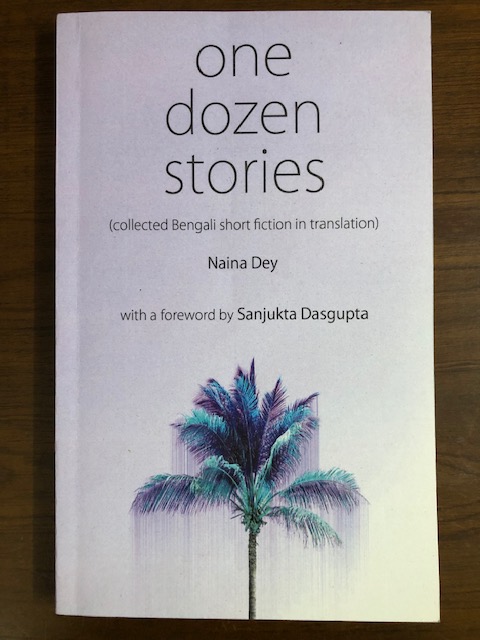
Title : One Dozen of Stories

Author: Naina Dey

George Steiner says, ‘Every language is a world. Without translation, we would inhabit parishes bordering on silence’. In her fascinating book titled One Dozen Stories, Naina Dey captures the shades and tones of Bengali short stories written by well-known storytellers into the folds of English language and gives it her own distinctive stamp. One can not only see Bengal in her words, but also can smell it, feel its very texture.

Sanjukta Dasgupta, the eminent writer and academician, has rightly said, in her Foreword, “The translator of the twelve short stories in this collection has exhibited both sense and sensibility in her selection of the short stories originally written in by some of the best storytellers of Bengali fiction. Naina Dey’s training as a literary critic and translator become obvious as the authors, whose short stories that have been selected for translation cover a wide trajectory.”

Short stories, can also be a welcome diversion from the barrage of images we’re often submitted to in long narratives. The writers feel sometimes it’s worth showing less and hiding more and that is the essence of the short story. Through the power of observation, Naina Dey takes hold of the essence of the stories “each equally griping in intensity” and gives it to the reader with a power that is, paradoxically both strange and familiar. She portrays the influence of images and their seductiveness and their complexities as depicted in the original with expressionist clarity and feelings.

One Dozen Stories includes translation of selected stories by Rabindranath Tagore, Bibhutibhusan Bandyopadhyay, Ashapurna Devi, Narendranath Mitra, Suchitra Bhattacharya, Nabakumar Basu, Anita Agnihotri and Esha Dey.

The twelve stories offer astounding depictions of desire, dream, love, belief and the power of the natural world and the translator tracks the inner monologue of an impoverished world with skill and purpose. There is no dream fog about these stories. There is no slapdash, no satire, no postmodern signs and flashes either.

Naina Dey has mentioned in her ‘Introduction’, “Edgar Allan Poe, considered the father of the short story and its first critical theorist had defined what he called the prose tale as a narrative which can be read at one sitting from half an hour to two hours, and is limited to ‘a certain unique or single effect’ to which every detail is subordinate.”

The stories in this collection are appealing in their richness and variety, in the sharpness of their perceptions and the clarity of even their complicated psychological unpicking and above all in their stylistic forms.

Tagore is a master storyteller and his stories are associated with events of our life that touched. Dey has selected two poignant and powerful short stories of Tagore. In ‘Shesh Puroshkar’ (The Last Reward), Tagore excavates the flaws and examines the truth to heal wounds and reward thereafter. The settings feel fresh because the author refuses to draw on worn-out descripted tropes with a thing of shreds and patches.

 ‘Streer Patra’ (The Wife’s Letter) is a landmark short story in Bengali literature.In the life of poor Bindu, Tagore has infused portrait of several generations of tortured and exploited women in Bengal. The deprivation and the denial are all encompassing. The protagonist, Mrinal, unearths the suppression that women undergo and renounces the injustice meted out to the young girl Bindu. Mrinal leaves her house, as a mark of protest at the atrocities against the women and becomes a free woman at the end.

You had cloaked me in the darkness of your customs. Bindu had come for an instant and caught sight of me through the hole in that veil. With her own death, she had ripped at the end my veil from top to bottom. Today I emerged and saw that there was hardly any place where I could keep my pride. Those eyes that had beheld and loved my neglected beauty, now look at me from the entire sky. Mejobou is dead now.’”(Steer Patra)

For readers looking for a more interesting story with twist at the end, ‘Chor’ (Thief) written by Narendranath Mitra, an accomplished short-story writer, shows the relationship between two enigmatic characters who embark on unusual life path; the husband, a kleptomaniac, compels his innocent wife to steal. The story shows pleasure cannot sustain either itself or any meaning.

Today Renu was truly her husband’s worthy consort. This was what Amulya had been wishing for all these days. Today was his day to rejoice. But Amulya was frozen stiff in his wife’s tender embrace. It was as if every beauty, every charm had disappeared from this earth. And those familiar arms which encircled his neck were not the bangle-laden slender arms of a beautiful young woman- they had become loathsome, defiled.”(Chor)

Bibhutibhusan Bandyopadhyay’s ‘Puimacha’ (The Spinach Vine) is a captivating investigation of the life. The author depicts human fallibility and the tragic ending with the untimely death of Khenti, the eldest daughter of Sahayhari. Families dissolve through vagrant desire and inner disconnection. Relations between mother and son becomes insensitive and fail to cohere at times.

The depiction of a family’s routines, rituals, and idiosyncrasies in the midst of rule is reflected in Ashapurna Devi’s deft and gripping story ‘Chinnamasta’(The Severed Head). The power of apprehension and its scaring presence is a theme of the story. The broken down, disheartened, surging negative energies emanating from the Hindu widows, echo through the story.

“In the women’s circle, the newly widowed wife’s fare held the same interest as the manners of a newly-wed bride… Frequently therefore, one found Kanaklata, the eldest of the Lahiri wives, Monty’s mother, appearing at opportune moments at Jayabati’s house.” (Chinnamasta)

Nabakumar Basu’s ‘Faydaa‘ (Gain) grapples with harsh effect of generation gap where everyone is under suspicion and the artificiality of the modern life especially while staying abroad. Lives are shaped by ordinary neglect: of spouses, of children and of selves.

Esha Dey’s three stories ‘Anya Jagat Anya Nari’ (Another World, Another Woman), ‘Lapis Lazuli’ and ‘Satilakhi‘(A Devoted Wife) centre on the beliefs and variances in life laced with humour and warmth. Her stories are delicate, unfixed and evanescent. These qualities render it an exclusive place among the narratives and reflect on a way to attain a life without boundaries.

Suchitra Bhattacharya’s two stories are all about the power of life sketches, their lightness and complexities as well. In ‘Atmaja’(The Son), the mother and son relationship being at once compulsive and embryonic, and the mental and physical disentanglement is suggested in unsettling details. It is poignant and the ending is tragic. ‘Ashabarna‘ (Discrimination) portrays the hollowness of the middle-class life with dark undertones of class difference.

In ‘Ranabhoomi’ (Battlefield), Anita Agnihotri conjures a natural chemistry from the start with the historical context of the battle of Plassey and the emblematic mango tree and keeps the dramatic tension till the end. The writer is especially good at capturing its longings while the historical, the political, and the personal overlap within society are clearly evident in the story.

“No one remembers, no one remembers anything. Place, history, time…they themselves get entangled in the web of antiquity and remain silent covered with dust.

Abraham will remember. His mother’s anger, his sister’s ill-humour, his wife’s tears and keep them hidden in his breast like the mango tree struck by the cannon-ball!’(Ranabhoomi).

Translation from one language to other always poses a challenge to convey the nuggets of nuances of the original language. The key to the translation is the choice of words and the need of transporting the soul of the culture into another language. Dey finds her vein of expression by attending to the miniscule details and offers new areas that goes beyond the prevailing.

One Dozen Stories is striking, impressive and of significance even now. The readers will feel the desolation and misery and the sweat and tears that run through the stories. The cover page is impressive. This immensely readable book offers us the chance to escape into a world that is worth a revisit.

.

Gopal Lahiri is a Kolkata- based bilingual poet, critic, editor, writer and translator with 21 books published mostly (13) in English and a few (8) in Bengali, including three joint books. His poetry is also published across various anthologies as well as in eminent journals of India and abroad. He has been invited in various poetry festivals including World Congress of Poets recently held in India. He is published in 12 countries and his poems are translated in 10 languages.

.

PLEASE NOTE: ARTICLES CAN ONLY BE REPRODUCED IN OTHER SITES WITH DUE ACKNOWLEDGEMENT TO BORDERLESS JOURNAL. 

Categories
Stories

Ketchup

By Rakhi Pande

The Lucknow Residency

The month of May in 1984. Schools closed, scorching summer heat and best of all, the trip to Lucknow, where the family of five went every summer vacation, without question. Riha, all of seven years old, was ecstatic to have reached her grandparents’ house after the two-day long train journey. The house appeared to be as large as a palace to her. Much bigger than their two-bedroom house in Bombay.

That, however, paled in comparison to this –- the most perfect of all homes to Riha’s young eyes. The aangan* in the centre –- bigger than their private terrace –- with rooms all around, a green garden patch with the open water tank, dank, green water whose depth could not be fathomed by her and which, through an unerring child’s instinct, she kept at a safe distance. The steep, curving staircase with treacherous and oddly angled steps leading up to the roof which secretly scared her; which she was vaguely aware she took much longer to ascend than her cousins who lived here. But once conquered, you were on a long roof with a view of the neighbourhood – and the room on the roof. (This was the best of all houses!) Surely haunted, but only after dark as per her childish logic.

Many years later, when she visited the same house in her mid-twenties, in what was to be her last visit to it – she saw the house just as it was – crumbling and old, destined to be pulled down and replaced by a taller, sleeker rectangular block, having permanently divided the family over its sale proceeds. The staircase which had intimidated her as a child was just ordinary. Mixed feelings and some regret – perhaps she would have preferred those childhood memories to the reality of this crumbling, derelict version.

But this story is about one of the magical days from all the summers spent in that city and of only one of those many mornings. A morning from a riotous summer for Riha along with her two siblings, and five cousins that lived here in the hauntingly enchanted city of Lucknow of the eighties as viewed from the vinyl covered cycle rickshaw seat. The driver laboured over the pedals in a mesmeric rhythm, navigating impossibly narrow streets, cows, street dogs, people, the occasional cars, tempos and handcarts and the noise that was always a part of the city – the shouts, honking, bleating of goats, mingling with the call of the azaan*.

Riha was a happy, confident and an attractive child and though she would vehemently deny it later; citing ‘middle child’ as her defence; perhaps a little pampered by her aunts and uncles here. She woke early with anticipation for the promised outing – utterly excited that they were having an Enid Blyton style morning ‘picnic’, complete with a wicker basket full of buttered buns, the sweet milk bread which she loved and a rajai* and a bedsheet to spread on the grass. They had to go very early, to avoid the dreaded loo* and the heat, which didn’t bother her, but which was just a convenient excuse for her elder cousins and aunts to not play catch or hide and seek with her during the afternoon.

That morning they were approaching the gates of ‘The Residency’, in quite a grand procession of two cycle rickshaws hired in addition to the spotlessly clean and sparkling white Ambassador belonging to her ‘Advocate’ grandfather. Riha was sure they would be the very first visitors here as she had awoken at an impossibly early hour, so she was surprised to see a few people already there –- walking about with dogs on leashes.

They walked quite far from the entrance, on wide green rolling lawns, way past the museum and dungeon, quite close to another set of ruins –- just walls with no roofs bordering unkempt taller grasses. The bedsheet was rolled out, basket deployed and after a while as it got sunnier and sunnier, without quite knowing how, Riha had soon wandered into the semi-walled ruins to explore the ground for unusual stones and wild flowers, her younger brother Aahan trailing behind her as usual.

She smiled at the other girl she saw there, enchanted by her blonde hair – “Hi! Are you here for a picnic too?” she asked, arrested by the lovely crisp white lacy and ruffled “birthday dress” the other girl wore. Only birthday dresses were so beautiful! Riha looked down at her own blue cotton dress, which she had worn a lot many times.

“You’re so lucky your mother let you wear your party dress!” Riha said. The other girl looked down at her dress and that’s when Riha noticed the ketchup patch all down the front of the lovely white dress. Exactly where she had once stained her dress while eating pakodas* with ketchup when her impish younger brother had jolted her arm. She felt immediately concerned and sorry for her –- she knew her mother would be upset and if her mother was anything like hers, there would have been good chances of receiving a stinging slap for messing up her party dress like this.

“Is that your brother?” the girl asked.

Riha nodded. “My brother is here too.” Riha moved closer but could not spot the other boy –- hoping he could be a playmate for her brother. He must’ve wandered off.

“Who’re you talking to?” said Aahan. Riha rolled her eyes knowing her brother was annoying her as usual.

“How rude, Aahan!” She looked at the girl, sharing the – ‘younger brothers!’ look. “Sorry about him… I’m Riha, what’s your name and why don’t you come and play with us?” she invited, frowning at Aahan.

“I’m Mary. Look,” she pointed across the greens, “My mother is calling us –- I have to go.”

Riha could not quite spot which of the women in the far distance Mary was indicating, but she was not happy at the thought of losing a newfound playmate.

“I’ll walk with you till you find your mother and we could ask her permission to play with us – we are a big group here,” she confidently proclaimed.

“Okay, I’ll ask her, maybe we can meet near the museum after some time,” smiled Mary.

“Okay, bye!” shouted Riha, happily.

Riha looked around for Aahan but he must have run off earlier. As she left the ruins, she saw her aunt halfway there, calling her to come quickly away from the dangerous ruins.

“They’re not dangerous at all!” scoffed Riha.

“Who were you talking to?” her mother asked. “Aahan said you were trying to scare him by pretending to talk to someone.”

Riha plonked herself down on the sun-soaked sheet and glared at Aahan. Why were younger brothers such pests? Describing the encounter, she couldn’t resist remarking how the other girl had been allowed to wear such a nice dress to a park. “But didn’t you say she’d spilled ketchup on it?” retorted her mom.

With the elders finding it too hot, it was time to leave but Riha insisted on stopping by the museum to say goodbye to Mary and dragged the whole family there. After waiting for a while it was clear no one was coming there and Riha was reluctantly made to leave, with promises of one more picnic there for sure. 

Now, years later, sitting on the sagging charpai*, under the bright stars that evening in that old house, the moment triggered a memory of the picnic to the Residency. In her teens she had been quite intrigued by the history of the place and read about the slaughter of the British families including women, children and babies there during the siege of 1857. She remembered quite vividly that evening years ago, cuddling on her grandmother’s roomy lap on the same charpai. 

Naniji* had surprised her by asking for a detailed account of the girl she had met. In Riha’s world, that morning was already firmly in the past. Her grandmother was quite interested in the ketchup stain too. Later, she had noticed the elders having a discussion in whispers and looking at her.

Annoyingly, Aahan was allowed to hover around them or perhaps they hadn’t noticed. He had then galloped up to her and shouted in glee, “See, I told you, you met a ghost! That was not ketchup, it was blood!”

.

Glossary:

*Aangan = an inner open courtyard

*Aazan = Islamic call to prayer

*Rajai = block printed comforter/ duvet

*Loo = hot and dry summer wind

*Charpai = traditional Indian woven bed

*Nani – Maternal grandmother, ‘ji’ a respectful suffix

.

Rakhi Pande heads the English department at a British curriculum school in Dubai, UAE. She segued into this profession after quitting her erstwhile post as General Manager in the field of brand management in India. Having spent her formative years in Mumbai she has spent a decade in each profession before exploring greener pastures abroad. An avid reader and award-winning educator, while dabbling with blogging and other creative pursuits, she tries to write whenever time permits. Hopefully, there’s a book in her.

www.linkedin.com/in/rakhi-pande-362a387

.

PLEASE NOTE: ARTICLES CAN ONLY BE REPRODUCED IN OTHER SITES WITH DUE ACKNOWLEDGEMENT TO BORDERLESS JOURNAL. 

Categories
Musings

Lost in the Mists of Time

By Devraj Singh Kalsi

Before I ventured into the choppy waters of publishing and experienced what it means to have a book that sank without a trace, I had a somewhat condescending attitude of ignoring books that failed to acquire readership or impress critics. In the wake of my literary misadventure, I realised I should not feel ashamed of reading or holding an obscure book that nobody in my circle has even heard of.  

Being an unknown author, I have acquired adequate compassion for books languishing in anonymity. Instead of flashing best-sellers, I have overcome the shyness to identify myself with small-time, unknown writers. Now it is comforting to identify with their plight and feel I am also one of their kind.  

This transition happened when I tried something unusual last year. Call it an experiment to shape new thinking, to accommodate divergence, to stir empathy, to reboot my system. I must confess that the entire exercise turned out to be therapeutic in more ways than one.  

Inside a bookstore, I picked up a title lying upside down on the congested shelves, fighting for space to survive in the saturated market. The passport-size colour photograph of the author on the back cover made it look like one of the photographs clicked when he was applying for clerical jobs. As I checked out the year of its publication, it became clear that the title was resting there for more than a year. Some other queries bubbled in my mind. Was this the only copy left unsold? Or was this the only copy in stock? There was no way to know the facts so I had the freedom to imagine what I wished to imagine.   

It must have been a big high for the author when it was formally launched, when it found space on the shelves of the esteemed bookstore. As the failure of finding readers capsized the literary boat, the short-lived euphoria of the gift-wrapped copies stifled his spirits and expectations, pushing him into the morass of darkness, just as quickly as he was brought to public gaze. Left without any choice, he became another suitable candidate for the ever-growing club of authors who exist to launch another struggle to get rid of the stigma of commercial setback after enduring the long struggle of finding a publisher.   

Holding the book without any hesitation was the next step of boldness. An unfamiliar strength coursed through the hands as I began to rummage it. I felt overjoyed with this liberating and cathartic act – unable to recollect having done something noble of this kind before. While other readers around cherry-picked best-sellers and recommended titles, I held this one in my hands and continued reading it with seriousness. I was not conscious of the reality of reading an obscure book. If there was no sense of pride, there was no sense of guilt or shame either.  

After reading a few pages, I understood that readability was not the reason why the author failed or why the book collapsed. Probably the marketing apparatus was responsible for its dismal fate. Such mishaps do happen from time to time – almost forgotten like accidents that do not make any significant difference.

I imagined being a source of pleasure for the author who found no readers or very few readers. If he found me here reading his work, he would be thrilled to spot a live reader right in front of his eyes. I did think of clicking a photograph with the book and mailing it to the publisher who would hopefully forward it to the author. Maybe this small act to cheer him up would stimulate him and make him feel that his book actually created some difference in the life of a reader. Maybe, he will then pick up the pen and bangs out another book. I could be that spark to ignite his passion to write.   

I proceeded to the sales counter and the cashier gave me a strange look while trying to understand my choice. He appeared close to suggesting I should seek the assistance of sales staff. Without looking up, he said this title offered no discount. He billed me and dumped the copy on the desk without offering a carry bag. Before leaving, I asked him whether this author had any other release. He did not check the computer or bother to respond to my query.

I came out flashing the new purchase and planned to give it more visibility. I entered a nearby café and occupied a strategic spot from where it was possible to see the book cover. When nothing worked, I placed it on the table beside my cup of coffee, hoping the young couples seated nearby would cast a fleeting glance, raise a polite query or seek to hold the copy in hand out of curiosity. An hour passed. My best attempt to give exposure to the unknown author failed.

After coming out of the café, I took a bus and sat with the copy on my lap. The same response disappointed me and I returned home with a heavy heart. In the next few days, I read the book in the balcony. Then I displayed it on the tea-table in the living room, hoping that my guests would pick it up to read or at least flip through it. Perhaps the plain cover did not evoke interest. 

A week later, I posted the book cover on my social media handles, highlighting it as my current read. Only a few close friends and relatives pressed the like button without posting any comments. Finally, I donated the book to the public library in my neighbourhood — with the hope it would find some readers here.

Almost a month later, I ventured there and asked the librarian how many people borrowed the title to read. He was unwilling to dampen my spirit and said he had read it and found it nice. His words of fake praise did make me feel better and I thanked him warmly, behaving like the author of the work he had read. Such close identification with an anonymous author transformed my way of thinking, making it more collective in nature. I felt a sense of relief that I had done something good –- even if it was trivial for an unrecognized author completely unknown to me.   

Earlier, I loved to rummage through best-seller or recommendation sections inside bookstores. Now I realise how authors hire marketing and PR agencies to give traction to their books – both offline and online. As a result, I have lost interest in picking up such titles unless a reliable source refers it to me. I am far more comfortable browsing unknown writers from the shelves, looking for an occasional good pick that compels me to read beyond the first page. 

.

Devraj Singh Kalsi works as a senior copywriter in Kolkata. His short stories and essays have been published in Deccan Herald, Tehelka, Kitaab, Earthen Lamp Journal, Assam Tribune, and The Statesman. Pal Motors is his first novel.  

.

PLEASE NOTE: ARTICLES CAN ONLY BE REPRODUCED IN OTHER SITES WITH DUE ACKNOWLEDGEMENT TO BORDERLESS JOURNAL. 


Categories
Poetry

Volcanic Night, Ashen Light

By Dustin Pickering

Dustin Pickering is the founder of Transcendent Zero Press and editor-in-chief of Harbinger Asylum. He has authored several poetry collections, a short story collection, and a novella. He is a Pushcart nominee and was a finalist in Adelaide Literary Journal’s short story contest in 2018. He is a former contributor to Huffington Post. 

.

PLEASE NOTE: ARTICLES CAN ONLY BE REPRODUCED IN OTHER SITES WITH DUE ACKNOWLEDGEMENT TO BORDERLESS JOURNAL. 
Categories
Ghumi Stories

Nostalgia

By Nabanita Sengupta

I

He spends his days painting his beloved Ghumi – a riot of colours bursts upon his canvas, pouring out the passion he has for the place. I admire the way his brush moves, the way a picture takes shape yet I feel sorry for him. For the solitary life that he has chosen for himself, though he is happy in it. His paintings too have attained a maturity that his clients all over the world much appreciate. Also, it is because of this quirk in him that I have got this lucrative job as a caregiver and my future is almost taken care of. Not just that, I enjoy taking care of him too! It gives a purpose to my lonely life.

II

I have to revisit my origin — the place that had nurtured me for the first fifteen years of my life before I plunged into the real world. Yes real world I said. Because Ghumi was not exactly real. It was almost like a simulation for the real thing — like those driving lessons you know you can take on your computer screen before the actual driving? It was like that.

Rough edges of dangers padded off in a very large extended family. That place was my whole world and a place that I had to leave for the real one; because Ghumi did not hold back anyone. It trained you, taught you, helped you with important inputs for sustainability but ultimately let you go. And exactly at sixteen! That age when the world was either pink or black and very rarely white or grey. That age when either you could be wallowing in romance or rattling off revolution or even both, in a mission to change the world. So it was at that volatile age that we were all simply shot out of Ghumi high on ‘we are the world’ motto to various higher educational institutions across country. And we did survive.

Ghumi, I knew had the solution to my problem. A place that I had not visited for almost twenty years! A place where I had painted the first canvas of my life — a hill with many greens. Ghumi had taught me colours in a way no art teacher could. She lovingly made me aware of the nuances of various shades of a single colour. She was the muse for the budding artist within me. In fact, I feel that the artist in me was Ghumi’s gift. Even now that I am successful as an artist, I feel Ghumi’s colours predominate my palette. My canvases carry a madness of mahua, a glimpse of the huge saal, dark green of the jamun and so much more. 

So much has changed since those early days — in the world, in my life. Yet I have not been able to unhinge myself from her. Of late the association with that place has grown so strong that it is becoming difficult for me to ignore. I have begun neglecting my paintings, my studio and even my wife.

There are spans when I would drown in a deep melancholy, stretching even to days. Neither medication, nor counseling helped much. Geeta, my better half, had been quite understanding and patient to my mood swings and neglect. Initially she had tried to talk it out with me but after a few attempts, she left me to myself. So when I told her that I must go to Ghumi to find a solution, she too supported me. In fact the idea had been initially suggested by her.

III

That was a moment so special — the moment when my feet touched Ghumi after such a long time! What happiness! I felt energised. I wished I could be all around the place all at once but of course my emotions needed to be controlled. Geeta did not come, in spite of my repeated requests. Instead she asked my assistant, Rohit to accompany me. I was grateful for Geeta’s motivation behind this entire Ghumi idea, for inspiring me to embark on it. After a long time I passionately made love to her that night after I booked the tickets. It was overwhelming, and when she was almost spent, I could smell in her the mahua, that intoxicating scent which was so much a part of my Ghumi days. Her face was flushed with the colours of flaming Palash. For one last time I inhaled her deeply and fell into one peaceful slumber. That night, I had one of the most restful nights — soundest sleep in my life.  

IV

Ghumi hadn’t changed much. The factory, the school, the pond — they just looked the same. Even trees had an ancient charm. Like the Lotus-Eaters of Homer, they wove their magic spell upon me. I was mesmerized, forgetting almost everything of my city life. My studio, my wife — they remained a faraway reality for me. I relived my childhood with a gusto that was almost unthinkable. I put up at a guesthouse that had come up in the recent years — one of the few changes that marked the face of Ghumi. The other new additions that I saw were a quaint little cafe, a print-out and photocopy shop, a private bank and a few ATMs. 

It was a three-day trip that I started finding inadequate. But of course, there was Geeta and the studio to return to. Caught in the web of a modern lifestyle, how long a holiday could I afford! But what if I stayed back! I was hit hard by this sudden thought — staying back, and why not. But of course, there was Geeta who was waiting for my return. In the soft afternoon of Ghumi, amid the eucalyptus and sal trees, she seemed to belong to another life. 

I pushed back my fanciful thoughts and putting on my track pants and tee, ventured out alone. Though I had Rohit with me, I was planning to do more of self-exploration. What did he know of my love affair with this place! I wanted to visit those new places that had sprouted upon the face of my old Ghumi and see how much change they had wrought upon her character. 

A desire for a steaming mug of coffee took me towards the cafe. ‘Ghumi Tales’ — that’s what it was called. In the low light of the setting sun it looked more mysterious, as if there was a lot hidden within it. I was drawn towards it. Though a new addition, it had somehow blended with the character of Ghumi. 

That night I made a call asking Geeta to cancel my return tickets. I needed to feel the place a bit more. I would perhaps, one day return to her, after I have made peace with myself.

V

I am Geetanjali, Arun’s Geeta. We have been married for the past six years and I could feel this coming gradually. At first it was nostalgia, a general remembrance of the past. But slowly it turned into an obsession. He stopped most of his activities, spoke only of Ghumi and lived in it. I changed my role in his life — from friend to lover to wife to a caregiver. I knew he needed support, I needed help too. There was no one I knew who could help me — psychiatrist visits were out of question — I knew I could not convince him. Rahul appeared as a Godsend.

As a psychologist and a childhood friend, he listened to my problems attentively. It was he who first made me aware of the terms ‘terminal nostalgia’ and ‘restorative nostalgia’ in which a person wants to recreate his past and wants to live in that period. He said Arun’s was a case of such extreme ‘restorative nostalgia’ which was pushing him towards clinical depression.

I looked at him aghast! How could Arun, one of the most successful artists of his times, one whose career graph was showing a steep rise, become like this? I raged and ranted and cursed my luck — all through Rahul held my hand. I loved Arun but was becoming dependent on Rahul.

The last straw in our relationship was when Arun made love to me comparing me to Ghumi! I could not take it anymore. I refused to go to Ghumi with him but made my secret preparations with Rahul to keep an eye on him from here.

Once there, I could feel the calmness in him, the distractions much lesser. The phone call regarding extension of his stay at Ghumi was as anticipated one; hence I had made arrangements with one of the local elderly women to take care of him during his stay there. For a long-term stay, he would need a proper house with a set up for his studio. Reena aunty, the woman I spoke to had assured me that she would take charge of everything, I would just need to pay for the expenses. I am more at peace now. I have understood that Arun does not need me — we would merely be hindrances in the lives we want to lead. He has found the Land of Lotus Eaters. Nothing perhaps can take him back or make him happy if not Ghumi.

Dr. Nabanita Sengupta is an Assistant Professor in English at Sarsuna College Kolkata. She is a creative writer, a research scholar and a translator. Her areas of interest are Translation Studies, Women Studies, Nineteenth century Women’s writings, etc. She has been involved with Translation Projects of Sahitya Akademi and Viswa Bharati. Her creative writings, reviews and features have been variously published art Prachya Review, SETU, Muse India, Coldnoon, Café Dissensus, NewsMinute.in, News18.com and Different Truths. She has presented many research papers in India and abroad.

.

PLEASE NOTE: ARTICLES CAN ONLY BE REPRODUCED IN OTHER SITES WITH DUE ACKNOWLEDGEMENT TO BORDERLESS JOURNAL. 

.

Categories
Poetry

‘Light’ at the end of the tunnel

          By K Sheshu Babu

True!
The Earth is wrapped around
By a huge dark tunnel
Where every life is struggling
To survive —
.
The great extinctions,
Disasters,
Pandemics,
Economic and social depressions,
Wars
Have ravaged for centuries
.
Many lost their lives
.
Many species became extinct
.
But,
Earth moved on and on
.
New forms of flora and fauna
Adorned beautiful nature
.
But, then,
Occasionally,
Dark tunnel of pessimism
Engulfed
Plant and animal life perished
People groped in darkness
Till someone pointed out
Faint light of optimism
Far away at the end of the tunnel
.
Now,
A similar phase is passing
Covid 19 is devastating
Human life
.
But, the darkness of despair
Will pass
And life will move out of the tunnel
And embrace ‘light’ of hope
.
Humanity will learn lessons
And find ways to avert pandemics
… Hopefully…

.

K Sheshu Babu is a writer from everywhere, heavily influenced by Assamese poet Bhupen Hazarika’s ‘ Ami Ek Jajabor’ (I am a wanderer). Some of his publications, including poems, have appeared in  Countercurrents.org, Virasam, counterview.orgcounterview.net, Leaves of Ink, Tuck magazine, Scarlet Leaf Review, poemhunter.com, Dissident Voice and Sabrangindia.

.

PLEASE NOTE: ARTICLES CAN ONLY BE REPRODUCED IN OTHER SITES WITH DUE ACKNOWLEDGEMENT TO BORDERLESS JOURNAL. 


Categories
Stories

Thicker Than Water

By Revathi Ganeshsundaram

From his vantage point just inside the doorway of the international terminal’s arrival area, he observed the children. Full of energy and in high spirits, they were running up and down the waiting section while the grownups chatted. When they neared the coffee shop, however, they halted and looked longingly at the muffins, doughnuts, and other treats that were temptingly displayed behind the glass counter. The boy then whispered something urgently to the little girl, and she obediently ran back to where the four adults stood. Tugging at her mother’s arm, she tried to get her attention, but the women were too engrossed in conversation to pay heed. Besides, such entreaties were routine, and as such were to be routinely ignored!

A helpless glance back at the counter received a glare of such imperative that she turned to one of the men in the group, ostensibly more amenable to requests from her (and therefore, probably the father). He continued to watch with suppressed amusement as the parent was dragged by hand to the shop, where the over-priced sweetmeats were promptly procured with rather too many dollars and an indulgent smile. Duty done, the man sauntered back to his group and was once more lost in conversation.

The children remained near the counter, eyes shining bright with delight as they beamed at each other over the goodies, unwittingly smearing powdered sugar and frosting on chins and cheeks as they feasted. He was rather pleasantly surprised to observe some peaceable and generous sharing of treats too — although, as he told himself in a cynical after-thought, the goodwill might partly have been engendered by a sugar high!

He looked at them more closely. The little girl was chubby and rosy-cheeked, and her hair was neatly done up in two tight braids that were held in shape with predictably bright-pink hair ties. With her beatific smile, she reminded him of a cute angel decoration he had once seen in The Dollar Shop. The boy was taller, probably a few years older, and seemed quiet and serious.

But then, looks could be deceptive, he thought with a rueful smile.

Although the inside of the airport was temperature-controlled, it was winter, and he was glad of the warmth of his jacket. He zipped it up to his throat and began to walk up and down the long and narrow waiting area, momentarily forgetting the children that had so interested him. He had arrived earlier than he had expected to, but it was a Sunday and the roads had been free. The flight had landed on time, and he estimated that passengers would soon be coming out after the usual hour it took to collect baggage and pass through immigration.

A piercing shriek startled him and silenced conversationalists all around. Turning swiftly, he saw the little girl, now in tears, pointing to the boy and sobbing out a complaint to her father, while the culprit scowled and slunk away out of his reach, mightily embarrassed by the scrutiny of everyone in the vicinity. The mother’s attention was also momentarily drawn, and he could hear her call out rather shrilly, “How many times have I told you not to pull your sister’s hair?!”

After the momentary lull, people turned away and picked up where they had left off, and he too resumed his pacing, half-smiling. But his thoughts were far away.

A memory flashed into his mind, painful in its intensity. Of a mother’s sorrow and a father’s anger. Of his own shock and dismay. He had not thought that the smack he gave the child in a moment of fury would cause her to cut her lip such that it bled…

As he paused to turn back, he caught a glimpse of his reflection in the tinted glass window and was taken aback by the look of deep remorse on his face.

But then, he remembered other incidents. Of his mother applying cold cream on his chest and a penitent little girl asking if she could help –- the feel of her small fingers and the cool, soothing effect of the emollient as she gently rubbed it on the raw, semi-circular marks that had been made by her small teeth…

And the time she had pushed all the things off his desk in a rage, no doubt infuriated by something he had said or done. Words had quickly turned to blows and screams, leading their normally gentle and soft-spoken father to separate them with speech and look of such potent disappointment as left them more shaken than if they had been penalised through any form of corporal punishment. 

He found himself grinning then, feeling oddly relieved that in those years now seemingly eons away, things had not been one-sided after all! Like warriors, they had drawn each other’s blood…

As he reached the coffee shop now, he saw that people had begun to come down the arrival ramp and he quickened his steps towards it. Passengers were arriving singly, or in twos and threes, pushing trolleys or wheeling suitcases, and everywhere pairs of eyes were looking for familiar faces. He too craned his neck, trying to look beyond the tall and stout man, the old lady and her husband being wheeled out by airport attendants, and the harassed-looking couple with several small children.

There she was now!

She seemed rather tired as evidenced by the dark circles under her eyes appearing more pronounced than usual. But more than that, it was her haunted look that arrested him. With anxious eyes she was scanning the waiting crowd and when she caught sight of him, her face brightened briefly with the smile he had once known so well. Although her hair was flecked with premature grey and slightly tousled from the journey, it seemed to have been cut it in a different, shorter style that was elegant and suited her. She carried herself with a quiet dignity and he thought she still looked beautiful.

His heart swelled with a mixture of warmth and pride, that was yet tinged with pain.

They hugged briefly and she replied satisfactorily to his query about the comfort of the journey. As he took hold of her trolley and turned to lead the way out, they passed the family he had noticed earlier, still in their place a little way away from the arriving crowd. They were probably waiting for a different flight, maybe one that had been delayed.

The adults were watching the arrivals with superficial interest, but he noted that the siblings were now quietly going through a comic book together in apparent camaraderie. He suspected that sooner or later, one of them would again be shrieking in aggravation, but right now, the sight of their small heads bent close to each other as they pored over the pictures, cheered him greatly.

“Oh, so cute…!” he heard her whisper behind him, evidently equally struck by the scene. “Yeah, ha, ha,” he responded, feeling a peace settle on him that he had not experienced for a decade.

As the car sped along the empty roads, they spoke a little, skimming lightly over the surfaces of mostly impersonal topics. Common acquaintances back in India, certain kinds of air travellers, and a movie she had watched on the long journey were mentioned without much enthusiasm, with both concurring readily on the respective idiosyncrasies of the subjects under discussion. (In-flight meals were a slightly more rousing matter — she thought they were awful, he exclaimed in surprise.)

In between, he pointed out key landmarks like the Harbour Bridge and the Opera House, not much else being view-worthy in the growing dark. She seemed listless, and unspoken emotions hung between them like a heavy curtain that he had not the courage, nor she the words, to draw aside.

But finally, she broke the silence. “I didn’t listen to any of you, did not take you into confidence, and ended up making a mess of my life! And yet, here you are now…” Her voice shook, and she could not go on.

He tried to make light of it. “Well, we only read about extreme cases where women commit suicide because they have nowhere to go — we never read about the scores of families that support their girls in their times of need. They would not make news because that is what families are for — that is what they should do. Families are meant to provide unconditional support!” 

She did not reply, yet something seemed to shift in the atmosphere. And then, just like that, there was no longer any curtain hanging oppressively between them.  

“Do you remember…?” he began and launched into one of his amusing anecdotes just like in the old days, and she was surprised to find that she had it in her to laugh again. And the miles flew by.

“We’re almost there now… this is our street,” he said shortly, as they turned right onto a quiet and dark lane.

She sat up straighter and looked out with interest. They were passing shadowy houses with glowing windows, half-hidden behind dark trees that added to the atmosphere of mystery, and she felt a growing excitement as she gazed at them. The scenes had a magical quality that transported her back to childhood, bringing before her mind’s eye the charming illustrations of fairy tales read and re-read in the happy security of her parents’ home. The memory lit a small lamp in her heart that she had thought was beyond re-kindling.

“And here we are!” he said suddenly, slowing before one of the dark house fronts.

As they turned into the driveway, the porch bulb burned bright, and even while the car was rolling to a stop, she saw the front door open and light from the house spill out. Silhouetted in the doorway stood the familiar figure of a woman, pulling her wrap tightly around herself to ward off the chill. It seemed to her as she watched from the car, that the golden rays dancing about her sister-in-law’s head as she waited to welcome her, were just like a star on a Christmas tree.

Then the light in her own heart flared up, flooding her being with a warmth that had nothing to do with the heater in the car. She felt a decade of tension leave her body as the years rolled off her mind and person like a mantle she had just shrugged off.

She turned to look at him as he switched off the engine and slid the gear into park. It struck her then that her brother’s care-worn face now looked relaxed and cheerful, and surprisingly younger, lit as it was by the warm glow from his house and perhaps from deep within as well.

“You’re home now,” he said simply.

And then they beamed at each other, bright-eyed children in a doughnut shop.

Revathi Ganeshsundaram taught in a Business School in South India for several years until she recently decided to take a break to study Counseling Psychology. A self-professed introvert, she is comfortable in the company of family, books, and herself  — not necessarily in the same order. She finds the written word therapeutic and, hence, loves reading and writing fiction, sometimes dabbling a little in poetry. 

.

PLEASE NOTE: ARTICLES CAN ONLY BE REPRODUCED IN OTHER SITES WITH DUE ACKNOWLEDGEMENT TO BORDERLESS JOURNAL.