Categories
Interview Review

How Jaladhar Sen Travelled to the Himalayas More Than a Hundred Years Ago…

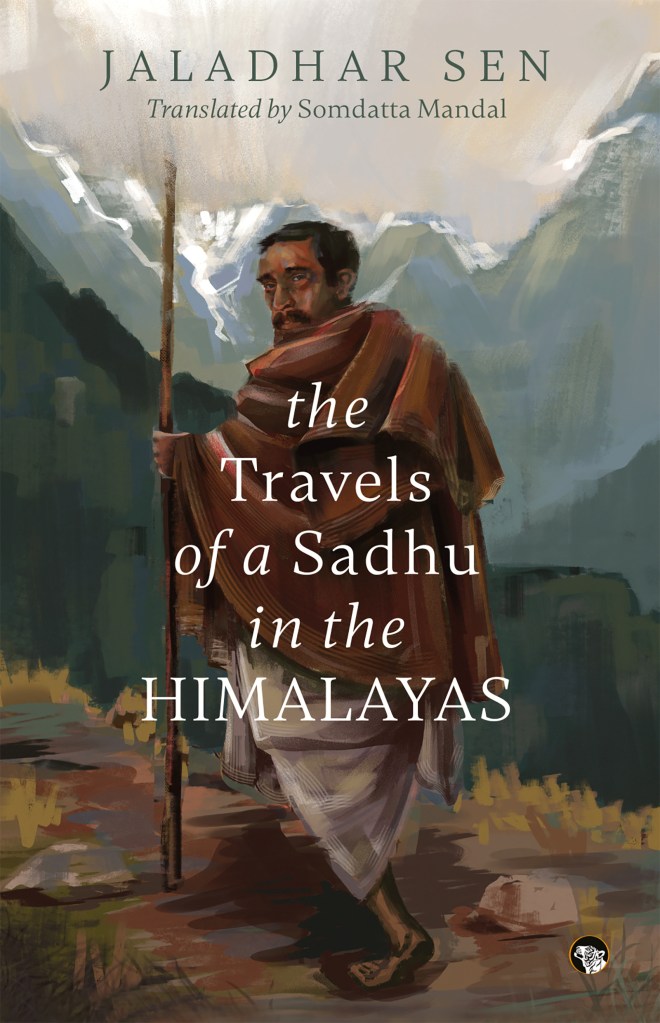
A review of Jaladhar Sen’s The Travels of a Sadhu in the Himalayas, translated from Bengali by Somdatta Mandal, published by Speaking Tiger Books, and a conversation with the translator.
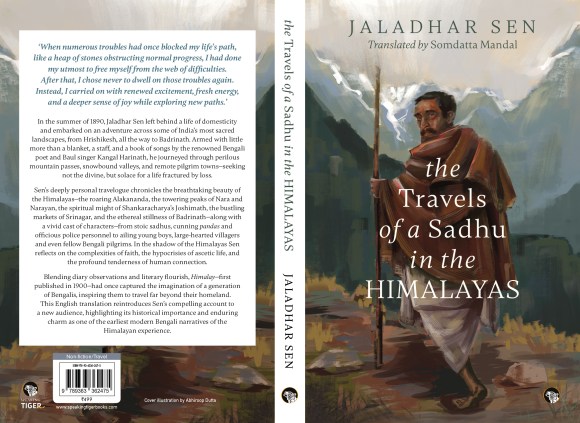
Jaladhar Sen (1860–1939) travelled to the Himalayas on foot with two sadhus[1] in quest of something intangible. His memoir makes us wonder if it was resilience, for after all he lost his daughter, wife and mother — all within a few months. He moved to Dehradun from Bengal for a change of scene after his tragic losses before journeying into the hills.

Written in Bengali and first published as a serial in the Tagore family journal, Bharati, in 1893, the book was brought out in 1900 as Himalay. It has been brought to Anglophone readers by Somdatta Mandal, an eminent translator who has extensively translated much of Tagore’s essays and journals. She is a critic and scholar, a former professor of Santiniketan, an excellent translator to bring Jaladhar Sen’s diary to light. Mandal has given a lucid and informative introduction to Sen, his book and her translation — very readable and without the use of scholastic language or words which would confuse readers. Her commentary adds value to the text by contextualising the people, the times and the circumstances.

Her translation is evocative of the journey, creating vivid visual impact with the play of words. Sen is a Bengali who has picked up Hindi during his brief stay in Dehradun. That he uses multiple vernaculars to move around with two more Bengali migrants who have turned to a religious life and meets locals and pilgrims from a variety of places is well-expressed with a smattering of expressions from various languages and dialects. Mandal has integrated the meanings of these words into the text, making it easy for readers unfamiliar with these phrases to read and enjoy the narrative without breaking the continuity.

Sen is secular and educated — not ritualistic but pragmatic. You can see his attitudes illustrated in an incident at the start of the book: “We quickened our pace, but when we caught up to the two sanyasis, I felt a mix of amusement and irritation. One of them turned out to be my former servant, whom I had dismissed twenty or twenty-five days earlier for theft. His transformation was remarkable—dressed in the elaborate robes of a sanyasi, with tangled hair and constant chants of ‘Har Har Bom Bom’, he was barely recognisable as the thief he once was. It was sheer bad luck on his part that our paths crossed that day.”

At the end of the journey too, Sen concludes from his various amusing and a few alarming experiences: “Many imposters masquerading as holy sanyasis brought disgrace to the very essence of renunciation. Most of these so-called sanyasis were addicted to ganja[2], begged for sustenance, and carried the weight of their sins from one pilgrimage site to another.”

Yet, there is compassion in his heart as the trio, of which Sen was a part, help a sick young youth and others in need. He makes observations which touch ones heart as he journeys on the difficult hilly terrain, often victimised by merciless thunderstorms, heavy downpours and slippery ice. He writes very simply on devotion of another: “I felt happy observing how deep faith and belief illuminated his face.” And also observes with regret: “We have lost that simple faith, and with it, we have also lost peace of mind.” He uses tongue-in-cheek humour to make observations on beliefs that seem illogical. “In such matters, credit must be given to the authors of the Puranas. For instance, Hanuman had to be portrayed as colossal, so the sun was described as being subservient to him. However, with the advancement of science, the estimated size of the sun grew larger, and instead of diminishing Hanuman’s glory, his stature had to be exaggerated even further. Similarly, Kumbhakarna’s nostrils had to be depicted as enormous, so that with each breath, twenty to twenty-five demon monkeys could enter his stomach and exit again.”

Mandal has translated beautiful descriptions of the Himalayas from his narrative with lucid simplicity and elegance. When Sen chances to see the first snow peaks, the wonder of it, is captured with skill: “We were amazed to see a huge mountain of snow, its four large peaks encircling us. The sun was already quite high in the sky, and its bright rays fell upon those mountain peaks, radiating hues that cannot simply be described in words. Even the best painter in the world could not replicate the scene with his brush.” And: “Yet the scenery that unfolded before my eyes was simply magical. Standing in front of this pristine beauty, man’s power and pride were humbled. He could recognise his own triviality and weakness very clearly and, to a certain extent, grasp the greatness of the creator within his heart.”

And of course, there is the typical Bengali witty, sardonic banter creeping in to the narrative: “On certain days, when I felt inclined to indulge in minor luxuries, I would purchase a few pedas. However, such bravado was rarely worth the effort, as one might have needed the assistance of archaeological experts to determine the sweets’ actual date of origin—no one could tell how many generations of worms had made their home inside them!”

The translation has retained the simplicity of the narrative which Sen tells us was essentially his style. He had no intention of publishing what he wrote. He had started out in company of a sadhu with a staff, a blanket and a stock of Baul Kangal Harinath’s songs. He writes at the end: “I didn’t intend to write a diary. I had a songbook with me, and when that book was being bound, I had added a few blank pages with the idea of writing down new songs if I came across them.” He scribbled his notes in those blank pages.

The journey makes a wonderful read with its humorous descriptions of errant sadhus, frightening storms, descriptions of geographies and travel arrangements more than a hundred years ago, where the pilgrims live in shop houses and eat meagre meals, the perseverance, the wonder, the love and friendship one meets along the way. Though there is greed, theft and embarrassment too! Some of his narrative brings to my mind Nazes Afroz’s translation of Syed Mujtaba Ali’s In a Land Far from Home: A Bengali in Afghanistan.

Mandal tells us: “A prolific writer, Sen authored about forty-two books, including novels, travelogues, works with social messages, children’s literature, and biographies.” In real life, she describes Sen as “a writer, poet, editor, philanthropist, traveller, social worker, educationist and littérateur.” That’s a long list to wear. There’s more from Mandal about what the book offers and why she translated this unique travelogue in this exclusive interview.
How did you chance upon this book and why did you decide to translate it? How long did the whole process take?

I have been writing and researching on Indian Travel Writing for almost over two decades now and so was familiar with the sub-genre of travel writing about the Himalayas. In Bangla, there exists a great number of books on travel to holy places as part of a pilgrimage from the mid-19th century onwards. But this book was unique because it was written by a secular person who did not go to the Himalayas as part of a pilgrimage but nevertheless got influenced by the other pilgrims with whom he went along. It was in the summer of 1890 when he actually travelled, and later in 1893, his perilous experience was published serially in the Bengali periodical Bharati which was then edited by Rabindranath Tagore’s niece, Sarala Devi Choudhurani.

During that period, with the proliferation of travel narratives being regularly published in several contemporary Bengali periodicals, Jadadhar Sen’s narration became very popular and after 1900 when it was published in book form, it took the Bengali readers of the time by storm. Its popularity led to it being included as part of the syllabus at Calcutta University. Feeling that pan-Indian readers who could not read the original text in Bangla should get to read this interesting text in English, I was inspired to translate this travelogue for a long time and Speaking Tiger Books readily accepted my proposal a couple of years ago.

The places visited by Sen might not seem unique in the present context, but the period during which he undertook the travel and the culture-specificity of it needed special attention. I was busy editing two volumes of travel narratives to Britain then, and after I finished my project, I took up translating this text in full earnest. It took me about three months to complete the translation, and I send the manuscript to the publishers in January this year. After several editorial interventions, it ultimately saw the light of day in July 2025.

Did you need to input much research while doing the translation? How tough was it to translate the text, especially given that it has multiple language and cultural nuances?

I did have to do some biographical research on Jaladhar Sen as his narrative is absolutely silent about why he moved from Bengal to Dehradun and the actual reason for his setting out on this particular journey. Interestingly, I was also researching about Swami Ramananda Bharati, who was the first Bengali traveller to Tibet and Manas Sarovar, and who wrote the famous book Himaranya (The Forest of Snow) whom Sen knew earlier and with whom he actually undertook the journey. With several cross references I could fill in a lot of biographical gaps in the narrative.

Regarding translation, it must be kept in mind that though something is always lost in translation, one must always attempt to strike the right balance between oversimplification and over-explanation. Translation is also a sort of creativity and the challenges it poses are significant. The intricate navigation between the source language and the translated language shows that there are two major meanings of translation in South Asia – bhashantar, altering the language, and anuvad, retelling the story. Without going into major theoretical analyses that crowd translation studies per se, I feel one should have an equal grasp over both translated and source languages to make a translated piece readable.

What are the tools you have used to retain the flavour of the original narrative? Please elaborate.

Readability of this old text Himalay in the present context is of paramount importance and though it is very difficult to replicate the grandiose writing style of late nineteenth-century Bangla, I have attempted to retain as much of the original flavour of the text as possible. Without using glossary or footnotes, the meaning of certain words becomes evident through paraphrasing the text. Thus, in keeping with Jaladhar Sen’s original work, the names of some words have been retained as they are. For example, the words dharamshala and chati—resting places on the pilgrim’s path—are so culture-specific that they are retained in their original forms. Sen also uses other culture-specific words such as panda (the Brahmin middleman who acts as the intermediary for worshipping the deity), the kamandalu (the water jug carried by sanyasis), lota-kambal (the jug and blanket that emphasise one’s identity as a sadhu), the jhola (the typical cloth bag that hangs from the shoulders), and the mahanta, or the head priest of the temple. Again, different terms such as sadhu, sanyasi, and yogi are used at different points to define ascetics and are often employed interchangeably. The term math, denoting seats of authority and doctrinal learning, has also been retained in its original form. As a Bengali gentleman settled in western India— Dehradun—the author often refers to Bengal as his desh, which literally means ‘country’, but in his parlance refers to the region of Bengal, which is as much a part of India as Dehradun. This definition should not create any confusion in the reader’s mind.

You, like the author, never clearly tell us why Sen starts out on such a perilous journey. Why do you think he went to this journey?

From evidential sources we get to know that like any other domestic person Jaladhar Sen began his career as a teacher in a High School in 1883 in Faridpur in Bengal. He got married in 1885 but however, a few years later he endured a great personal tragedy, losing his family members in quick succession. In 1887, his newborn daughter died on the twelfth day after her birth, and his wife passed away another twelve days later. Within three months, his mother also died. Overwhelmed by grief and seeking solace, he moved to Dehradun at the foothills of the Himalayas, where he worked as a teacher.  

It is known that Sen did not venture into the Himalayas out of wanderlust. Dejected with domestic life, he apparently went to Kumbh Mela in Haridwar, where he chanced upon Swami Ramananda Bharati, an elderly Bengali sadhu whom he had known previously. He decided to accompany him on a trek all the way to Badrinath on foot. This was the background to his Himalayan travels and how he became a paribrajak sadhu or a traveller saint. The year was 1890.

Even though the memoir spans only a month, the author underwent many changes. Would you regard this book as a bildungsroman of sorts, especially as there is a self-realisation that comes to Sen at the end? Please elaborate. 

In his travel account Sen documents his experiences of journeying to various places of religious significance, namely Devaprayag, Rudraprayag, Karnaprayag, Vishnuprayag and Joshimath before reaching the temple town of Badrinath in the upper Himalayas. He undertook this journey as a secular sojourner. But the travel impacted his soul in such a way that at the end of his narrative he admits that he had ventured in the Himalayas with a funeral pyre burning within his heart; and he merely embraced the cool breeze of the mountains with his hands and pressed the hard snow against his chest. He is doubtful whether he had the time or the state of mind to witness the eternal glory of the Lord revealed in the heavenly scenes around him. Could he lift his head and look towards heaven? That sense of wonder was absent within him. But some sort of change had already appeared within him. In this context, I feel the last two sentences of his narrative to be very significant when he states: “If anyone feels inspired to visit the Himalayas after reading this simple travel narrative of mine, then all my writing will have been worthwhile. And if anyone journeys towards the feet of the god of the Himalayas, my life would have been fulfilled.”

What was your favourite part of the book. Did you enjoy translating some things over others? Please elaborate.

There are several sections in the book which I really enjoyed translating. Most of them relate to specific incidents that Sen encountered during his travels and how human nature was the same everywhere. The first one was when they were on their way to Devaprayag and in his diary entry on 11th May, he tells us about the incident when his money pouch along with the Swamiji’s tiger skin was stolen on the way and how with the help of a panda he managed to retrieve it after a lot of effort. Though they were not very much spiritually inclined, they realized that there were crooks on the way to the pilgrimage sites who also dressed up as sadhus and everyone could not be trusted in good faith.

 The second memorable incident is when trekking during extremely inclement weather — rain and thunderstorm– and when stones rushed down from the mountain slopes nearly killed them, how Achyutananda or Vaidantik who was accompanying them managed to protect him by shielding from the natural calamities with his own body as a mother hen does to protect her chicks.

 The third interesting incident that Sen narrates is dated 3rd June when they got stranded at a chati in Pipul Kuthi. The head constable or jamadar sahib arrived there to enquire about a theft and Sen tells us how even in that remote mountainous region, the police had the reputation for rudeness and stern behaviour as the Bengal police had. He writes, “These officers, tasked with restraining wrongdoers and protecting civil society, displayed the same demeanour no matter where they were stationed. It seemed that the police were the same everywhere.”

Another memorable section is when they chance upon a young boy who probably ran away from his house and was trekking with them for some part of the way. The way in which the sick lad was ultimately deposited under the care of a doctor in the local hospital is extremely moving. Several other sections can also be mentioned here but it will turn my reply excessively long.

Why did you feel the need to bring this book to a wider readership? Are you translating more of his books?

I have already mentioned the importance of Sen’s travelogue in charting the long tradition and rich repertoire of Bengali travel narratives on the Himalayas that focus on travel as pilgrimage. As early as 1853, Jadunath Sarbadhikari embarked on a journey from a small village in Bengal to visit the sacred shrines of Kedarnath and Badrinath. Returning in 1857, he chronicled his travels in Tirtha Bhraman (1865). Two lesser-known pilgrimages to the Himalayas were undertaken by monks of the Ramkrishna Mission order – Swami Akhandananda and Swami Apurvananda—in 1887 and 1939, respectively. Their travelogues were published many years later by Udbodhan Karyalaya, the official mouthpiece of the Mission. In both narratives, we find vivid details of the hardships of travelling during that period, marked by limited financial resources and minimal material comforts.

Jaladhar Sen’s narrative also holds a significant position in this chronological trend of writing about travelling in the Himalayas. From the 1960s onwards we find a proliferation of Himalayan travel writing in Bangla by writers such as Prabodh Kumar Sanyal, Shonku Maharaj, Umaprasad Mukhopadhyay and others, and many of these texts need to be translated provided one finds a responsive publisher for them. I am not translating Jaladhar Sen anymore, though as a prolific writer Sen authored about forty-two books, including novels, travelogues, works with social messages, children’s literature, and biographies.

How do you choose which text to translate? You always seem focussed on writers who lived a couple of centuries ago. Why do you not translate modern writers? 

There is no hard and fast rule for selecting which text I want to translate. I have already translated several travel texts by Bengali women beginning from Krishnabhabini Das’s A Bengali Lady in England, 1876, to later ones. But I have not translated any travelogue about the Himalayas before. Here I must be candid about two issues. I pick upon writers usually whose texts are free of copyright as that does not entail a lot of extra work securing permissions etc. The second more practical reason is that I still have a long bucket list of translations I would like to do provided I find an agreeing publisher. But that is very difficult because several of my proposals have been rejected by publishing houses because they feel it will not be marketable in the current scenario.

As for the query about translating modern writers let me narrate a particular incident. As a woman writer and as someone interested in translating travel narratives of all kinds, I had approached Nabanita Dev Sen through a willing publisher to translate her visit to the Kumbh Mela that she wrote about in her book titled Koruna Tomar Kone Poth Diye[3].  After seeking necessary permission and meeting her personally on several occasions to discuss several chapters, I gradually got frustrated because even after three sets of corrections, the translation did not satisfy her.

She consulted several other people, including her own daughter, and ultimately told me that she couldn’t accept my translation because she ‘didn’t find herself in it.’ The colloquial Bangla humour in some places were not sufficiently translated. As far as I got to know from the publisher, she changed editors thrice, and in the end the translated book was published with one of the editors named as the ‘translator’. When I chanced to meet her at my university on a different occasion, Nabaneetadi told me that she had mentioned my name in the acknowledgement section of the book, which of course I didn’t bother to buy or check. From such a bitter experience, I feel staying with writers dead long ago is a safer bet for me.

You are working on a new translation. Will you tell us a bit about your forthcoming book?

As I have already mentioned, I found Swami Ramananda Bharati’s Himaranya (The Forest of Snow) to be a companion piece for translation. Not only is this significant because it was the same Swamiji with whom Jaladhar Sen travelled to the Himalayas, and though his name is not mentioned anywhere by Sen, we get to know a lot about him already through his narrative. As a monk, Bharati travelled to Mount Kailash and Manas Sarovar in Tibet during 1898, the first Bengali to do so. These travels form the basis of Himaranya. It was not entirely ‘spiritual’ or ‘theological’ but rather depended on the traveller’s own temperament. There are presentations of secular interests and considerations, and modern readers can relate to them easily, especially because the route to Kailash and Manas Sarovar has now been opened for Indian pilgrims once again and several groups are going there every other day. The manuscript is already with the publisher and hopefully the book should see the light of day by the end of this year if everything goes well.

 You have translated so many voyages by Tagore, by Sen, do you now want to bring out your own travelogues or memoirs?

I have been translating travel narratives of different kinds for a long time now. I still plan to do a few more if I get a proper publisher for the same. I am an avid traveller myself and have actually trekked to Kedarnath, Badrinath, Gangotri and Yamunotri twice. I have also trekked for fourteen days to visit Muktinath in Nepal way back in the early 1980s, and during the pandemic days when I was confined at home, I managed to key in that experience in Bangla from the diary I kept at that time. That narrative was published in the online journal Parabaas which is published from the United States. But I have never taken writing about my own travelogues or memoirs seriously. Of course, last year and also forthcoming this year, a special Puja Festive number of a Bengali magazine has been publishing my travel articles. But there is nothing serious or academic about it.

Do you have any advice for fledging writers or translators?

 Translating has caught up in a big way over the past five or six years. Now big publishing houses are venturing into publishing from regional bhasha literatures into English and so the possibilities are endless. Now every other day we come across new titles which are translations of regional novels or short stories. My only advice for young writers or translators is that since copyright permissions have become quite rigid and complicated nowadays, it is always advisable to seek permission from the respective authorities before venturing into translating anything. I was quite young and naïve earlier and just translated things I liked without seeking prior approval and as usual those works never saw the light of day. Also, as time went by, I learnt that translating should have as its prime motive current readability and not always rigidly adhering to being very particular about remaining close to each individual line of the source text. The target readership should also be kept in mind and so the choice of words used and glossary should be eliminated or kept to a minimum. The meaning of a foreign word should as far as possible be embedded within the text itself. All these issues would definitely make translating an enjoyable experience.

Thanks for the wonderful translation and your time.

[1] Mendicants. Sadhu and swami also have the same meaning

[2] Marijuana

[3] Translates from Bengali to The Path to Compassion, published in 1978. The translation was published by Supernova Publishers in 2012 as The Holy Trail: A Pilgrims Plight. Soma Das is mentioned as the translator.

(This review and online interview is by Mitali Chakravarty)

Click here to read an excerpt from Somdatta Mandal’s translation of Jaladhar Sen’s Travels

PLEASE NOTE: ARTICLES CAN ONLY BE REPRODUCED IN OTHER SITES WITH DUE ACKNOWLEDGEMENT TO BORDERLESS JOURNAL

Click here to access the Borderless anthology, Monalisa No Longer Smiles

Click here to access Monalisa No Longer Smiles on Kindle Amazon International

Categories
Review

The Bookshop Woman

Book Review by Aditi Yadav

Title: The Bookshop Woman

Author: Nanako Hanada

Translator: Cat Anderson

Publisher: Brazen

There is a unique charm around books that talk of books and bookstores. Nanako Hanada’s The Bookshop Woman is an honest and touching memoir where she recounts and reflects on real life incidents that transpired in the rock-bottom phase of her life. Seamlessly translated from the Japanese by Cat Anderson, the narrative opens on a certain night in January 2013, with a distraught Nanako sitting listless and dejected in a restaurant at 2 a.m. in Yokohama. She had parted ways with her husband, and moved out of their flat. Living out of a suitcase, she moves through cheap hotels and public bathhouses, like a homeless drifter with an uncertain future.

Nanako is a manager at a branch of  Village Vanguard, a bookshop chain. She is depressed with the thought that there’s a lot lacking in her life. However, as we flip through the pages, we see the resilient side of Nanako. She intends to rise above the mess and her depression. She learns to walk with her head held high without feeling sorry for herself. She moves into a cramped apartment near Yokohama station, and also happens to join a new social networking site, the ‘Perfect Strangers’, which provides dating services. She embarks on her ‘Perfect Strangers’ journey with a profile that reads, “I’m the manager of a very unusual bookshop. I have access to huge database of over ten thousand books, and I’ll recommend the one that’s perfect for you.” Although a trivial trend of the modern times, joining this new virtual platform proved a turning point in Nanako’s life.

Through several encounters with random strangers, Nanako discovers a world beyond her broken relationship and self doubt. Meeting new people puts her social skills to test and starts her on a journey of self-discovery. She learns to open up without being over-conscious of herself. In the larger picture, she understands that accepting changes in life is the right way to embrace it. The discussions that Nanako holds with people provide insight into the conditions of the modern day world and human relationships. However, through the eyes of Nanako, Tokyo which “had only felt cold and inhospitable” turns interesting beyond her dreams when she just “tried opening! What freedom there was here!” , and all she wanted to do with this freedom was to introduce more people to new books.

Meanwhile, as the manager of the Village Vanguard, she passionately continues to do her best, innovating with selling strategies and tending to her customers. She gradually learns to “discern what was special about books that perhaps didn’t look so promising at first, and to distil their charm in words”.  She talks of the ‘joy of bookselling’ and gives a first-hand account of the challenges of her business. Nanako introduces readers to a host of books through the recommendations she offers during her Perfect Stranger sessions. There is even an appendix in the book that provides more details about these recommendations.

Experimenting with her ideas, Nanako also holds book jam sessions where people come over at a designated spot at an assigned time and share about their favourite books. These book jam sessions humbled her, as she realises that she had hitherto been ‘slightly condescending’ in recommending new books to people. This realisation transforms her outlook immensely.

Weaving through myriads of book suggestions and social meet-ups, Nanako evolves as a person and finds her footing in the real world. Even in the professional sphere she follows her heart and makes changes that resonate with her personal evolution. Her love for books and devotion to bookselling make her empathetic to the extent that she “would inadvertently get a glimpse of something deep in a person’s heart”.

Within a year of that dreary lonesome night in Yokohama, life comes a full circle for Nanako. As a result of her adventures and experiments, she finds peace within herself. Her divorce gets amicably finalised and she even quits the virtual platform to immerse herself in the natural flow of the delightful world she’d discovered — one full of meaningful human connections, friendships, the warmth of books and bookstores. We see Nanako wondering about the day when someone else would pick her books and recommend it to others, triggering an infinite loop– such is the power of books that turns drifters into trendsetters and dreams into reality. The book is indeed a must read to discover this incredible power and reaffirm one’s faith in resilience of human spirit!

Aditi Yadav is an amateur writer from India. She is also a South Asia Speaks fellow (2023). Her works appear in Rain Taxi Review, EKL Review, Usawa Literary Review, Gulmohur Quarterly, Narrow Road Journal, Borderless Journal and the Remnant Archive.

.

PLEASE NOTE: ARTICLES CAN ONLY BE REPRODUCED IN OTHER SITES WITH DUE ACKNOWLEDGEMENT TO BORDERLESS JOURNAL

Click here to access the Borderless anthology, Monalisa No Longer Smiles

Click here to access Monalisa No Longer Smiles on Kindle Amazon International

Categories
Interview Review

‘Looking to the Future with New Eyes’ with Mineke Schipper

A brief review of Mineke Schipper’s Widows: A Global History (Speaking Tiger Books, 2024) and a conversation with the author

To conquer fear is the beginning of wisdom.
—Bertrand Russell, Unpopular Essays (1950)

This is one of the dedications that precedes the narrative of Mineke Schipper’s non-fiction, Widows: A Global History. Her description of misapprehensions and the darkness around widowhood, as well as the actions that have been taken and suggestions on how more can be done to heal, weave a narrative for a more equitable society.

Starting with mythological treatment of widows, the book plunges into an in-depth discussion, not just with case studies but also with a social critique of the way these women are perceived and treated around the world, their need to heal from grief or a sense of devastation caused by their spouse’s death, concluding with stories that reflect the resilience of some of those who have overcome the odds of being repulsed. It is a book that inspires hope… hope for a world where despite all stories of misogyny covered in media, there are narratives that showcase both the human spirit and humanity where the ostracised are moving towards being integrated as a part of a functional social sphere.

Schipper, best known for her work on comparative literature mythologies and intercultural studies, navigates through multiple cultures over time and geographies to leave a lingering imprint on readers. She writes: “In Book V of his Histories, Herodotus (485-425/420 BCE) described life among the Thracians: Each man has many wives, and at his death there is both great rivalry among his wives and eager contention on their friends’ part to prove which wife was best loved by her husband. She to whom the honour is adjudged is praised by men and women alike and then slain over the tomb by her nearest of kin. After the slaying she is buried with the husband.” And yet she tells us of the dark past of Europe, “A Polish text asserts with great certainty that, after the burning of the body of her husband, ‘every wife allowed herself to be beheaded and went with him into death’.” She tells us stories of wife burning, killing and dark customs of yore across the world that seem like horror stories, including satis in India. The “motivation” is often greed of relatives or customs born of patriarchal insecurities. She contends, “wherever desperate poverty reigns, widows are at an increased risk.”

She argues: “The story is much the same everywhere; widows who are well educated know what rights they have or are able to find the right authorities to approach with their questions, while women with little or no education continue to suffer from malevolent practices.”

She has covered the stories that reflect the need for the welfare of widows, of how early marriages lead to widowhood even in today’s world ( “ Every year around twelve million girls under the age of eighteen get married, one in five of all marriages.”), of social customs like dowry, which can be usurped by a widow’s spouse’s family, of steps that are being taken and changes that need to be instituted for this group of women often regarded in the past and even in some places, in the present, as witches. In fact, she has written of such ‘witch villages’ in Africa, which have been developed to help widows who have been treated badly and turned away from their homes. Such stories, she tells us prevail all over the world, including India, where widows are sent or go to Varanasi.

She asserts that despite these efforts, “there is often still a significant gap between declarations of gender equality and their day-to-day enforcement and application.” She ends with case studies of four women: “Christine de Pisan, Tao Huabi, Laila Soueif and Marta Alicia Benavente examples of widows who dared to fully throw themselves into a new life following the death of their husbands.” And with infinite wisdom adds: “We cannot change history, but we can look to the past with new knowledge and to the future with new eyes.” She concludes with a profound observation: “Time does not heal sorrow, but out of the centuries-old ashes, grief, strict commandments and prohibitions, new prospects can also rise. The fact that every person’s life is finite makes every day unique and precious. The same goes for widows.”

In this interview Mineke Schipper (née Wilhelmina Janneke Josepha de Leeuw), an award-winning writer from Netherlands, tells us what started her on her journey to uncover the stories of this group of people.

What got you interested in widows as a group from around the world? Why would you pick this particular group only for a whole book?

Yes, whence this topic? The widow had been a tiny part of Never Marry a Woman with Big Feet. Women in Proverbs From Around the World (Yale UP 2004), an earlier book I wrote about proverbs referring to women’s lives, from girl babies to brides, wives and co-wives, mothers and mothers-in-law, grandmothers and old women. It was a long and breathtaking study about more than 15,000 proverbs, collected over many years, apparently widely appreciated and translated with two relatively recent editions published in India, in English and in Marathi. For those interested: the complete collected material is accessible and searchable at www.womeninproverbsworldwide.org, including proverbs about widows. That small but striking section about widows had made me curious, but other books, as it goes, pushed ahead, before I came back to them. In January 2020, I had to look up something in that book about proverbs, and the pages about widows looked so weird that I proposed the widow as my new topic to my Dutch publisher who responded enthusiastically.

You have written of so many cultures and in-depth. How long did it take you to collect material for this book and put it together?

All over I found obvious warnings and distrust viz a viz a woman whose husband dies. Interestingly, a widow was associated with death—and a widower was not. Take heed, suitor, when you replace the dead husband in the widow’s conjugal bed! Better not! Was it the fear that she had killed him? Or the creepy thought that the dead man’s hovering ghost was still hanging around? A widow was supposed to mourn intensely over her husband, preferably the rest of her life. In the meantime, proverbial messages openly expressed the widower’s happiness at the news of his wife’s death: ‘Grief for a dead wife lasts to the door’ (all over Europe) or ‘A wife’s death renews the marriage’ (Arabic). I came across well-known names—such as Confucius, Herodotus, Boniface, and Ibn Battuta—and lesser-known names of early travellers, historians, and philosophers with their commentaries on widows, compulsory or non-mandatory prolonged mourning, voluntary or prescribed chastity, and a surprisingly common choice of suicide as the best option for her. Amazingly many widows obediently followed their husbands to death. In all continents, monuments and documents witness how women joined dead men—buried or burnt alive, hanged, strangled or beheaded, drowned, stabbed or shot. A preference for strangling was inspired by the idea that the victim would enter the next world ‘intact’. So, from the narrow diving board of no more than a few dozen proverbs I plunged into the hidden history of widowhood for about three years.

How do women perpetrate the victimisation of widows? Would you say that widows as a group are more victimised against than other groups of women?

Conceptions about women as interchangeable objects were widespread. If a woman was ‘no longer of use’, a man would need to get a new one, much as you would do with a broken watch, rifle, knife or whip. A man cannot or will not do without a wife, but what about when the tables are turned? The need to present women without husbands as inept and dependent must have been great. A widow managing all by herself was rather met with obvious disapproval. Widowhood has traditionally been associated with emptiness. In Sanskrit, the word vidhua means ‘destitute’, and the Latin viduata (‘made destitute, emptied’) is the root of the word for widow in many European languages, including Witwe (German), veuve (French) and weduwe (Dutch).

Nonetheless there have always been plenty of widows who have lived wonderfully independent lives, but this is not the image seared into the public consciousness. The notion that a woman is unable to live her own life after the death of her husband is an amazingly deep-rooted one. The Japanese word for widow (mibōjin) literally means ‘she who has not yet died’, that is, a widow is simply sitting in Death’s waiting room for her own time to come. Interestingly, the status of widower on the other hand was usually so short-lived and temporary that some languages even lack a word for it all together!

What makes widows more vulnerable than others?

Every widow has her own story, but social systems play an important role. In traditions where goods, land and property are inherited through the mother’s family line with matrilocality, a groom comes to live with his bride’s family, although this often ended up working out slightly differently as men were not best pleased with this living arrangement, so in reality there would be negotiation. However, over the centuries patrilineal systems, lineage and inheritance significantly became the dominant system. According to the patrilocal rules, a man had to remain ‘at home’, a system which to this day obliges countless brides to move in with their parents-in-law, an environment foreign to them. They are forced to comply with the demands and expectations of their family-in-law, while the husbands remain comfortable in the familiar surroundings they grew up in, with major consequences for the lives of women who become widows. This patrilocal living situation has often resulted in greater inequality between marital partners and harsh rules for widows, often preventing a wife from any material heritage after her husband’s death. According to the work of evolutionary psychologists, married women who live with or in close contact with their matrilineal family run a significantly lower risk of violence in the form of (physical) abuse, rape and exploitation than those who move in with their husband’s family. This is all the more true for a widow with a distrustful family-in-law who accuse her of killing her husband, a danger that is greatest in areas where poverty reigns.

At a point you have said, “The Aryan period, which preceded later negative social developments, saw a differently structured society in which there was more space for women: to a certain extent women had religious autonomy, they were entitled to education at all levels (with some even becoming celebrated authors), they participated in public life and also held important positions… However, by the year 200 AD, their position had considerably worsened.” Do you have any idea why their condition worsened in India? What were the ‘negative social developments’ you mention?

In matters of religion the woman was increasingly dependent on the services of her husband or of priests, possibly also on her sons or male relatives, to carry out the rituals she required. Simultaneously she became largely excluded from all types of formalised education. This lasting effect can be seen even today in the global difference in the rate of female and male literacy. The negative stance towards women in India dates back to Brahmin commentaries of ancient Vedic texts, which referred to women as lesser humans; widows subsequently occupied an even lower rung on the social ladder and were forced to work hard towards their religious salvation through extreme asceticism. One example: ‘At her pleasure [after the death of her husband], let her emaciate her body by living only on pure flowers, roots of vegetables and fruits. She must not even mention the name of any other men after her husband has died.’ (Manusmriti Kamam 5/160) Patriarchal relations have developed gradually in different parts of the world and at different times, but not everywhere in the same rigorous forms.

In the Abron-Kulango culture in the northeast of his native Côte d’Ivoire, you have told us “[B]oth widows and widowers were required to accompany their spouse to the next world” but eventually due to societal realisations, such practices stopped. Do you think this can happen in other cultures too. Have you seen it happen in other cultures?

As far as I know, such practices do not exist anywhere anymore. The most problematic obstacle for the rights of widow’s in less-well off regions is the unfortunate combination of illiteracy, fear of witchcraft and covetous in-laws, particularly during periods of mourning and grief. The good news is that even in the most unexpected places initiatives are emerging to help inform women in rural areas of their equality before the law. Self-aware widows become inspiring role models; conscious of their rights, they share their knowledge with others so that more of their fellow widows can find the right legal aid when injustice rears its head.

Would you hold as culprit people who enforce the death of widows? Would you address these people too as criminals in today’s context? Please elaborate.

It wouldn’t help much to do this! Marriage is still frequently presented as the utmost peak that a woman can achieve during her life. From this supposed top spot married women often still look at single and widowed women in a new light—with pity, contempt, suspicion or even hostility: they are out to seduce your own husband! When death comes calling, not only men’s but also women’s negative feelings easily bubble up from the morass of fear at the dreaded prospect of becoming a widow. Over the centuries such reactions towards widows have become part of the constrictive hierarchy meant to keep so many women in their place.

Can sati be justified [1](even though they are deemed illegal as is suicide) by saying the widow immolated herself willingly? Please explain.

The social pressure on widows must have been immense, but we are living now and no longer in the past. It is true that in poorer regions far out of the reach of cities, countless numbers of widows still have to traverse a long road towards a humane and dignified existence. However, instead of justifying the willingness to immolate herself as her own choice, it is better to insist on the positive news that, after the loss of their partner, today not only men but also women have the right to stay alive and further explore their own talents and new possibilities.

You have told us dowry started as a European custom. Is it still a custom there as it is in parts of South Asia, even if deemed illegal? Was it brought into Asia by Aryans/colonials or a part of the culture earlier itself?

The dowry is the gift that the bride’s family would contribute to the couple’s new home. Even though colonisation may have reinforced this ancient custom, but in many communities, it was already a custom and still is in many parts of the world. In Europe it stayed on until the late nineteenth century. In cultures where the bride provided a dowry, the death of a wife would bring benefits to a widower, as a new wife with a new dowry would enrich his home with new assets such as silver tableware, jewellery, bed linen and other valuables. For centuries, among Christians, divorce was forbidden, and from the perspective of widowers the prospect of a second chance provoked a sense of euphoria, as expressed in quite some sayings where his sadness does not go beyond the front door. Across Europe such messages confirm a husband’s profit of his wife’s death: ‘Dead wives and live sheep make a man rich.’ (French; UK English). However, most widows were denied such liberating feelings or didn’t experience any profit from the change. Often, they did not even allow themselves to get over her loss and indulge in any new freedom. They usually were subject to the paralysing fear of other people’s gossip.

In many places a widow who remarried would even lose entitlement to her own dowry or other input she had contributed to her marriage. Many women who remarried felt unable to invoke any right they had on the property of their deceased husband. Little wonder, therefore, that widows were heavily discouraged from remarrying, for example in China. The use of far-reaching laws still re-enforced the highly recommended chaste and sexless existence of widows after the death of her husband. Of course, the considerable number of child marriages in sub-Saharan Africa and South Asia easily robbed child widows from the legal rights wherever they had. According to the World Widows Report, the situation for widows with children is still exceptionally alarming in many parts of the world. Daughters, in particular, remain a huge problem in traditions where women have to contribute a dowry when daughters get married. For this reason alone, poorer parents have a preference for sons: they are more likely to inherit from their father’s family, while their widowed mother can expect little.

Has the condition of widows across the world improved over time? Please elaborate.

Over the centuries far too many widows have been convinced that their only future was conditioned by their dead husband. In my book there are examples from different areas of courageous widows who changed their own lives. Looking around in one’s own neighbourhood, there are always exemplary models of independent widows who do not let themselves be deterred by the doom of whatever prejudiced people think or say.

All emancipation starts with the opportunity to acquire knowledge, but if we are to believe what tradition tells us, women had little need for that, based on an assumption that knowledge did nothing to encourage and promote female obedience, and even less for virtue. ‘Knowledge goes before virtue for men, virtue before knowledge for women’ is an old saying in Europe, while a Chinese saying also agrees that a woman without knowledge is already doing very well. The fact that this message has had such a wide-ranging effect can be seen in the vast difference in levels of education and training among boys and girls in global education statistics.

What did a man look out for when it came to finding a wife? In order to facilitate control over women, various warnings have been passed down to men. One such proverb found the world over clearly expresses this sentiment: ‘Never marry a woman with big feet.’ It comes from the Sena language in Malawi and Mozambique. In China, India and other parts of the world, I came across literal iterations of this proverb. In spite of geographic or cultural distances and differences, this saying reflects a widespread consensus: hierarchy in male-female relations seemed to be essential, and someone had to be in charge. Should he become the main breadwinner for the duration of their married life, his wife will be even more dependent on him.

Significantly the big feet metaphor points to male fear of female talents and power. Hardly surprising therefore that becoming a widow was the worst possible catastrophe for women. Worldwide the solidarity between wives and widows is growing and literacy support within local communities as well, while the former unwavering prejudices against widows are shrinking, and more and more widows with big feet do manage. The old anti-widow stronghold of local prejudice is slowly but surely crumbling into ruins. We cannot change history, but widows can look to the past with new knowledge and into the future with new eyes and new hope.

Thank you Mineke for your time and book.

Click here to read an excerpt from Widows

[1] https://theprint.in/ground-reports/sati-economy-still-roars-in-rajasthan-youtube-as-jaipur-court-closes-roop-kanwar-case/2331357/

(This review/interview has been written/ conducted by Mitali Chakravarty.)

PLEASE NOTE: ARTICLES CAN ONLY BE REPRODUCED IN OTHER SITES WITH DUE ACKNOWLEDGEMENT TO BORDERLESS JOURNAL. 

Click here to access the Borderless anthology, Monalisa No Longer Smiles

Click here to access Monalisa No Longer Smiles on Kindle Amazon International
Categories
Review

Short Stories by Nazrul

Book Review by Somdatta Mandal

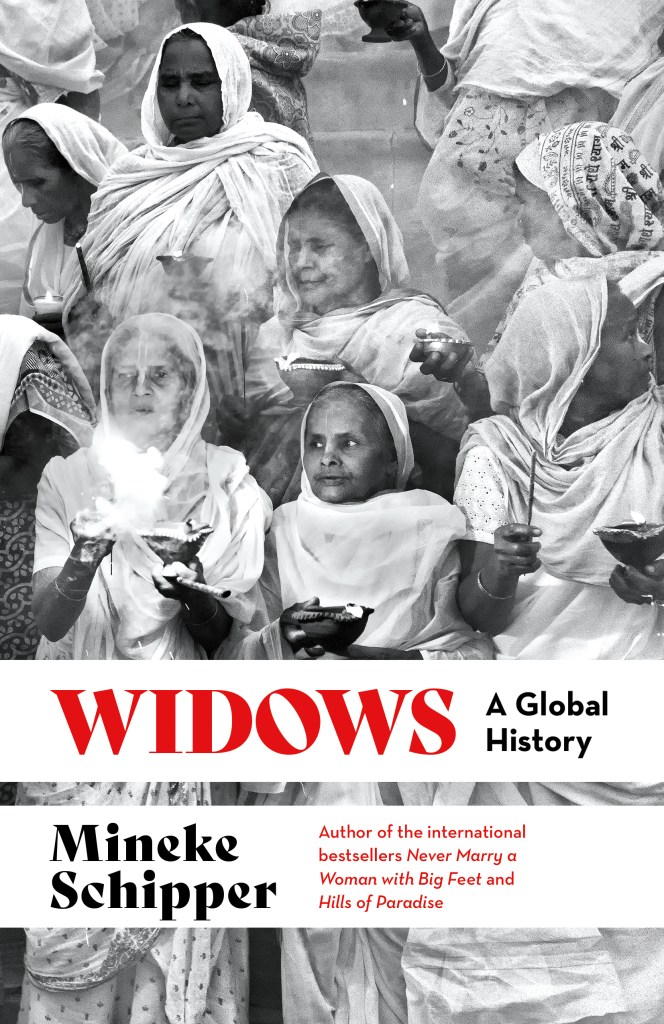
Title: The Collected Short Stories of Kazi Nazrul Islam

Editors: Syed Manzoorul Islam and Kaustav Chakraborty

Publisher: Orient Blackswan

He dons many mantles. Kazi Nazrul Islam (1899 – 1976), the national poet of Bangladesh, was a prolific Bengali poet, revolutionary, essayist, journalist, editor, activist and composer of songs. The very mention of his name conjures up the figure of a fiery iconoclast who fought against the structures of oppression and orthodoxy in society to bring about progress and change. In fact, his self-styled image as the volatile bidrohi or ‘rebel poet’ overshadows his other literary achievements and that is how ordinary people still remember him.

This unique volume presents all twenty of Kazi Nazrul Islam’s short stories for the first time in English translation. Done by different hands, they feature rich imagery, evocative landscapes, references to music, classical poetry, folktales and more. The prominent characteristics of these stories are simplicity, vivacity and emotionality. They have been sourced from different anthologies. The first six stories are from the collection Harvest of Sorrow1.  The opening story of the collection titled “Harvest of Sorrow”, is a collage of tales narrated by the three characters: Dara, Bedoura and Saiful Mulk. Dara, located in Iran’s Golestan, narrates his tale of love, separation and devotion to his motherland through a series of reminiscences. After that, we hear the same set of events narrated from Bedoura’s perspective. Then follows the account narrated by Saiful Mulk, portrayed as a sinner who tempted Bedoura into losing her virginity. Overcome by guilt, he joins the freedom struggle where he encounters Dara. What follows is a tale of redemption loss and transcendence of physical love to a more spiritual kind of love. “Hena”, the second story of the collection, is narrated by Sohrab, and its theme is also love and war – both internal and external battle. “In the Relentless Rain” is basically a story of love between strangers. The author doesn’t provide us the names of the lovers – rather both are addressed as dark-skinned. The next story, “Half Asleep”, is divided into two parts: Azhar’s story and Pari’s story. Azhar’s story is mainly about his sacrifices and why he favours detachment from the sensuousness. His renunciation of carnal pleasures towards attaining greater contentment ends his relationship with Pari, whose marriage he arranges with one of his friends. He ensures that Pari remains confined within the household structure. By making Pari assert that she will not betray her role as a loving wife without pretending to erase the love that she has for her former lover, Nazrul offers a critique of the conventional notion of ‘loyalty’ of wives to serve their husbands. The first-person narrator of “Insatiate Desire” soliloquizes on a saga of disunited love where the narrator falls in love with his childhood friend, feigns disinterest in her when her marriage is arranged to another man, and characterises his own actions as stemming from the most noble impulses. The final piece of the volume, “Letter from a Political Prisoner”, is an epistolary story of a political prisoner who has also been diagnosed with fatal tuberculosis. The story is addressed to the lady of his dreams, Manashi, who does not seem to have reciprocated his love.

 The title story of the next section is from an anthology of the same name, The Agony of the Destitute2. The story centres around the glorification of war but in the process, it also raises questions related to war and gender. In sharp contrast to the narrator-protagonist of this narrative who detaches himself from domesticity to join the war, the protagonist of the very next story, “Autobiography of a Vagabond” suffers a tragic end to his domestic life and thereafter joins the army and eventually dies while fighting in Baghdad. “Meher Negar”, the third story of this section, is another tale of war and conflicts in love. Yusuf Khan, the protagonist, is a Pathan from the mountains of Waziristan who meets Meher Negar (whose actual name is Gulshan) after reaching a distant land to learn music. Later he joins the War of Independence for Afghanistan. Unable to forget her, he visits Meher Negar one last time only to discover that she is no more. As an allegorical piece of writing, “Evening Star” is about a man’s love for a distant beloved that is ultimately futile because of the probable demise of the beloved.

“Rakshasi” is written in the language spoken by the Bagdi community of the Birbhum district in West Bengal in which the speaker Bindi is a woman who complains to her friend about how society has stigmatized her as a demoness because she has killed her husband to save him from abandoning her and getting remarried to a notorious girl.“Salek” is a short moral story where, through a series of events, a dervish (later revealed to be Hafiz) shows an arrogant Kazi the path to salvation; the former becomes the latter’s salek or the one who shows the way. In “The Widow”, Begum, the narrator, speaks of her sorrowful youth, her happy married life and the miseries of her widowhood to her friend Salima. The story challenge multiple stereotypes that are often associated with the women of South Asia. The concluding tale of this volume is titled “The Restless Traveller” which is an impressionistic story centered round the urge towards finding freedom by restless youth.

The four stories that comprise the third volume of Nazrul’s stories and the next section, called The Shiuli Mala3, speak about Nazrul’s ecological sensitivity. The opening story “The Lotus-Cobras” is about Zohra and her human and non-human intimacies. As the editors rightly point out, “In the portrayal of Zohra’s attachment with her serpent sons, Nazrul seems to be very close to the essence of posthumanism where radical posthuman subjectivity is understood on the basis of an intersectional ethics of plurality”. “The King of the Djinns” is a tragicomic story about how Alla-Rakha, the protagonist, resorts to a series of tricks to get married to Chan Bhanu, the woman he desires. “The Volcano” deals with the disaster that is caused by the sudden eruption of repressed anger and egotistic pride in Sabur, the humble, helpful and uncomplaining protagonist of the story. It is a study of the anxiety of manliness. “The Shiuli Mala”, the concluding story of this section, is a testimony to Nazrul’s love for the trope of separated lovers or unrequited love. Set in Shillong, it primarily deals with a platonic and disunited love between Azhar, a well-known chess player, and Shiuli, the daughter of another brilliant chess player, Professor Chowdhury. Structured as a flashback, Azhar narrates the story to his friends who are part of a regular chess adda.

Two unanthologised stories end the collection. “Letter from a Lost Boy” is an epistolary account of a boy who writes to his mother about some incidents in his life that have occurred since he had left her until the time of his return. The story is a critique of child marriage and the consequent early widowhood that brings never-ending misery in the life of a woman. “The Hawk-Cuckoo from the Woods” tells the story of a marital discord between Dushasan Mitra and his wife Romola. Their friction widens after Romola becomes too attached to an injured hawk-cuckoo and her husband feels agitated by her gradual disconnect from their conjugal life.  The story ends with Romola flaying her husband for throwing the bird away, finding and hugging the dying bird to her heart and plunging into the waters of the Padma.

All these twenty stories invite the reader to re-evaluate the ‘rebel poet’ as an empathetic humanitarian who also excelled in human relationships. Nazrul is essentially multilingual – he uses Hindi, Urdu, Arabic and Persian words along with Bangla. This book is the outcome of a project sponsored by the Nazrul Centre for Social and Cultural Studies, Kazi Nazrul University, Asansol, West Bengal. The volume is a transnational, collaborative labour of love bringing together the editors and translators from Bangladesh and India. Most of them are academics and have taken up the challenge to translate the stories, which in their infinite variety, is indeed a difficult task. The stories are accompanied by a timeline of Nazrul’s life and a detailed critical introduction that not only provides foundational context for the stories, but also highlights Nazrul’s attempt to counter majoritarianism and various hegemonies by dismantling hierarchies and celebrating intimate pluralities. In fact, at the end of their introduction, the editors Syed Manzoorul Islam and Kaustav Chakraborty ask two very pertinent questions. “In which category can we place Nazrul? Is there a need to formulate a different category altogether in order to position him?” The answers of course lie with the readers of the translated stories to decide. All said and done, this volume of short stories is strongly recommended for all classes of readers who are keen to discover the multi-faceted genius of Kazi Nazrul Islam and who could not earlier savour their uniqueness because they were only written in Bangla.

  1. Byathar Daan (Harvest of Sorrows) published in March 1922 ↩︎
  2. Rikter Bedon (Agony of the Destitute) published in January 1925 ↩︎
  3. Shiuli Mala (Garland of Jasmines) published in October 1931 ↩︎

Somdatta Mandal, critic, academic and translator, is a former Professor of English at Visva-Bharati University, Santiniketan, India.

PLEASE NOTE: ARTICLES CAN ONLY BE REPRODUCED IN OTHER SITES WITH DUE ACKNOWLEDGEMENT TO BORDERLESS JOURNAL

Click here to access the Borderless anthology, Monalisa No Longer Smiles

Click here to access Monalisa No Longer Smiles on Amazon International

Categories
Nostalgia

A Doctor’s Diary: Life in the High Ranges

By Ravi Shankar

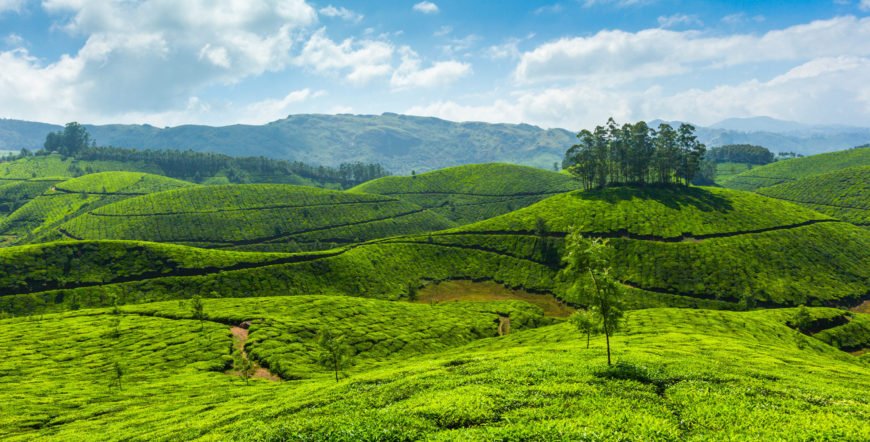
Munnar Hills. From Public Domain

The van suddenly went quiet. Night had fallen and our driver was negotiating the bends and turns in the road carefully. The yellow fog lights cut through the mists lighting up the dense forests on both sides. We were in Idukki district in the western ghats of the southern Indian state of Kerala. This region is called the high ranges. Areas above 600 m in height from the mean sea level in the central Travancore region of Kerala have rich biodiversity and a cooler climate. The weather was beginning to get colder.

We were ill prepared for the cold as we were students from Thrissur in the plains, where it was always hot and sticky. The road continued over the top of a dam. The security officer wanted to talk to us in person before letting us through. We boldly rushed out in our slippers and lungis[1] only to return at double the speed to the warmth of the van. It was freezing outside. The short but intense exposure to the cold may have frozen many vital organs. During winter, the temperatures here can dip to around 4 degrees Celsius once the sun goes down.

We were on a college trip to Idukki while studying for our undergraduate medical (MBBS) course. We had visited Thekkady and Peeramede and planned to spend the night in the hill station of Munnar. The trip was long and tiring as we drove through the mist along winding roads. The night in the hotel was freezing but we managed with the clothes we had, and the blankets provided by the hotel. The steaming tea with cardamom was the highlight of the morning. We hungrily gulped down several cups to chase away the cold.   

I eventually completed my MBBS and got an offer to work at a hospital in the high ranges. The place was Ellakkal at a height of about 1100 to 1200 m. The road diverted from the main highway to Munnar at a place called Pallivasal, the site of one of the earliest hydropower stations in Kerala. The village is also known as the gateway to Munnar. The area had a mix of Malyali and Tamil culture. Many poor families from Travancore had migrated to Idukki in search of land and better prospects. Tamil families had migrated too. The nearest village to Ellakkal was Kunchithanny (little water in Tamil). I had seen a similar system of naming places after water in Nepal. There was Kalopani (black water), Ratopani (red water), Ghorepani (where horses are watered) and Tadapani (far water) among others.

St Xavier’s hospital where I was working was situated up an incline from the main road. The location was spectacular. The hospital was established in the 1960s and was once the only source of medical care for a large region but now several clinics and hospitals had been established in towns and villages. The view across the valley was breathtaking. In the evening the mist slowly moved down the valley eventually reaching the river far below. The thickly forested green hills draped in thick white mist that slowly cleared as the Sun gained in strength was the highlight of my mornings! The hospital was run by the Medical Sisters of St Joseph and owned several acres of land on the hill. They grew coffee and cardamom and other spices. My quarters were a newly constructed annexe to an old house situated halfway up the hill. The view from the veranda was spectacular. I used to spend my afternoons and evenings drinking in the magnificent views and reading my books and magazines. The hospital still exists and provides affordable health care to the people.  

Dr Rodney Sebastian, the other doctor at the hospital had graduated from Kottayam Medical College. He was from the high ranges and a devout Christian. Many evenings there were prayer meetings at the hospital and people from the neighbourhood participated. The convent for the nuns was nearby. There was an old nun who was fond of gardening. Flowers grew well in the rich soil and the cool, moist climate. Multi-coloured roses were the highlight of the garden. There was a priest (Father) who lived on the other side of the hill next to the church. The deep phut-phut of his Enfield Bullet as he rode to the hospital was distinct. This heavy motorbike has a solid presence and is stable to drive on rough roads and undulating terrain. My cousin brother used to also ride one.

In the mid-1990s there was no internet and no mobile phones. The hospital had a landline. We lived more in the moment. Letters were still an important means of communication. My mother used to say that the arrival of a letter was as good as the arrival of a person. I have not posted a letter for a long time now choosing to go with email, voice chat, Skype and WhatsApp. During those days these were, however, all in the future. I never imagined the changes that would happen during the next two decades when I began working at Ellakkal.

We mostly had outpatients though we did admit people. Most of the admissions were for fever. Leptospirosis[2] was common. We also had X-ray facilities, and we sutured many wounds mostly caused by farm injuries. We did not handle surgeries and deliveries. We did not have any intensive care units and our lab investigations were basic.

We used to occasionally drop in to meet a doctor couple, Dr Verghese at Kunchithanny. His clinic was named John’s clinic, and he was called Dr Johnson by the locals. We knew some quacks, that is unqualified self-styled doctors, also practised in this area. The nearest big town was Adimali Adimali had a movie theatre, and a huge rock dominated the town. There were tribal settlements on top of the rock. The tribals were a deprived community. Long distance buses as local transport was something peculiar to the high ranges. The buses started from the town of Ernakulam over a hundred kilometres away and reached the high ranges through Kothamangalam. The buses had glass windows and were comfortable. Ellakkal was on the route to Rajakkad (literally the King’s Forest). There were many places named after rocks (para in Malayalam). Poopara (Flower rock), Santhanpara, Chaturangapara viewpoint were the most prominent.

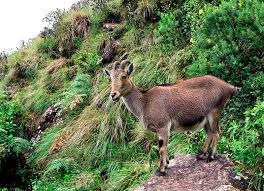
Munnar was famous for heavy, dense white fogs that were almost opaque. The place was covered by a heavy mist most afternoons and evenings. The mist began a few kilometres from the town. Drinking cups of cardamom flavoured tea in the cold mist was a highlight of my visits to the place. The restaurant also served crisp dosas. We went on a trip to the Eravikulam National Park which took a lot of planning as both of us (Rodney and I) would be away from the hospital for over eight hours. Some of our local friends accompanied us. The route was through rolling Kanan Devan hills and expansive tea gardens.

Nilgiri Tahr. From Public Domain

The hills are owned by Tata Tea, and they grow the famous Kanan Devan brand of tea. I used to remember their advertisements starring the megastar, Mohan Lal. The park is famous for the Nilgiri Tahr. I remember it also for the leeches. We were badly set upon by them and the bites bled for over twelve hours. Once I also took a bus ride with my cousin to Maraiyur near the Tamil Nadu border. The route was through spawling tea estates. Maraiyur was an end of the Road Town those days. The place was famous for sandalwood. The security checks were strict to ensure people did not decamp with a few thousands of rupees worth of sandalwood in their pockets.

I visited Ellakkal once more after I left toward the end of the last century. The ensuing three decades must have brought about a lot of change to this spice garden. Tourism has boomed and Idukki district is a prime tourist destination. Internet has made steady advances and cable TV is now common. Several resorts have opened, and the roads have improved. They have opened a hospital called Morningstar. The pace of life has quickened with all the city folks coming to escape from their hectic city lives. Someone once said about Munnar and I quote, “In Munnar, time slows down, allowing us to savour every moment, appreciate the present, and find joy in

[1] A sarong is called a lungi in South Asia

[2] A blood infection caused by contaminated water and soil

.

Dr. P Ravi Shankar is a faculty member at the IMU Centre for Education (ICE), International Medical University, Kuala Lumpur, Malaysia. He enjoys traveling and is a creative writer and photographer.

.

PLEASE NOTE: ARTICLES CAN ONLY BE REPRODUCED IN OTHER SITES WITH DUE ACKNOWLEDGEMENT TO BORDERLESS JOURNAL

Click here to access the Borderless anthology, Monalisa No Longer Smiles

Click here to access Monalisa No Longer Smiles on Kindle Amazon International
Categories
Slices from Life

The Pearl of the Indian Ocean

By Ravi Shankar

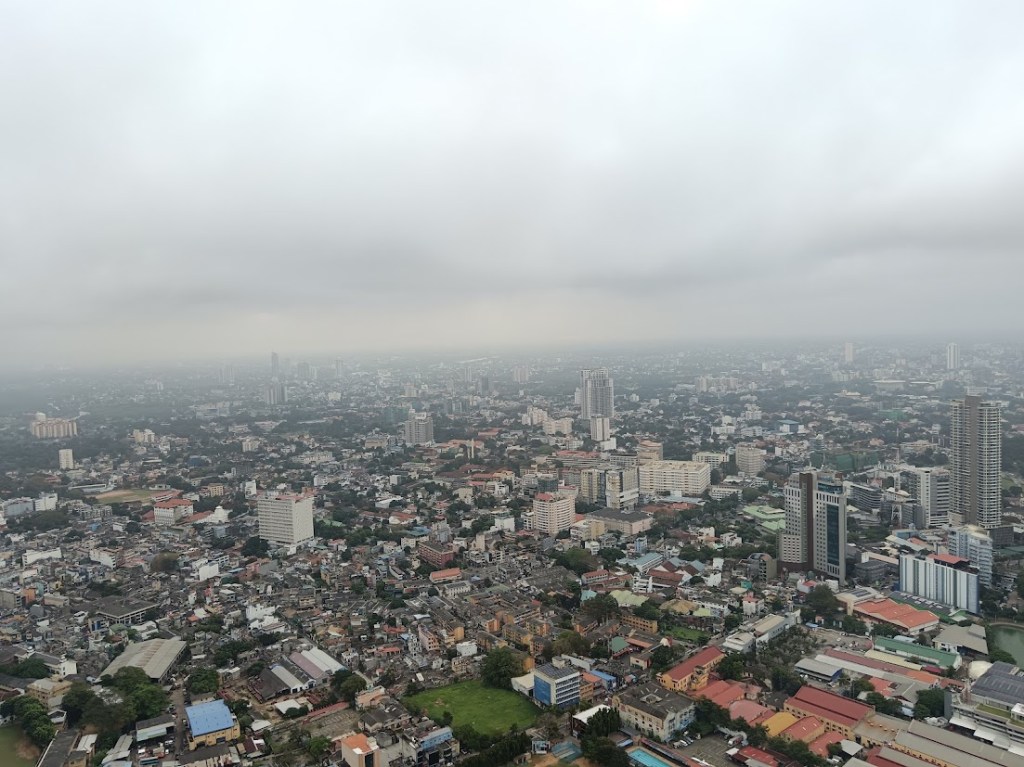
A panoramic view of Colombo. Photo courtesy: Ravi Shankar

My impressions of Colombo and Sri Lanka were positive. I was aware of the high human development indicators of the island nation, progress in access to essential medicines and the civil war. Sri Lanka shares many similarities with the state of Kerala in Indian in terms of topography, culture, food habits, high human development, outmigration, militant trade unions and a passion for egalitarian development. I also remembered the recent violent uprising against the former president and the image of the public frolicking in the pool at the presidential palace.

I was happy to receive an invitation to travel to Colombo in July 2023. I was invited to The Colombo Medical School, which was established by the British in 1870 and is one of the older schools in South Asia. It is the premier medical school of the country, and a new tower block has been constructed. The twenty-story tower is spacious and houses various departments. the humanities. The school was the first to start a Department of Medical Humanities (using art in the education of doctors) in South Asia. The physiology department has created a museum consisting of old instruments and apparatus that are no longer used. This is an excellent idea, and you remain in touch with the history of medicine.

The hotel where I stayed was located on Galle Face Road with the beach and the Galle Face green on the other side of the road. The beach was clean, and the park was originally laid out in 1859 by the British Governor General Sir Henry Ward. The Dutch had placed the cannons facing the ocean as a defence against the Portuguese. Sri Lanka had changed hands multiple times among the different colonial powers.

One of the striking features of Colombo is its cleanliness. The buses may be old and crowded but they are colourful. There are also rickshaws in a variety of colours, mainly green and red though yellow ones were less common. The kittul jaggery harvested from the fishtail palm or the jaggery palm is famous and I loved the gingelly rolls made with this jaggery. My second visit was in early January this year. The apartment where I stayed was attached to an old Sri Lankan house. The location was near to all conveniences but away from the noise and traffic.

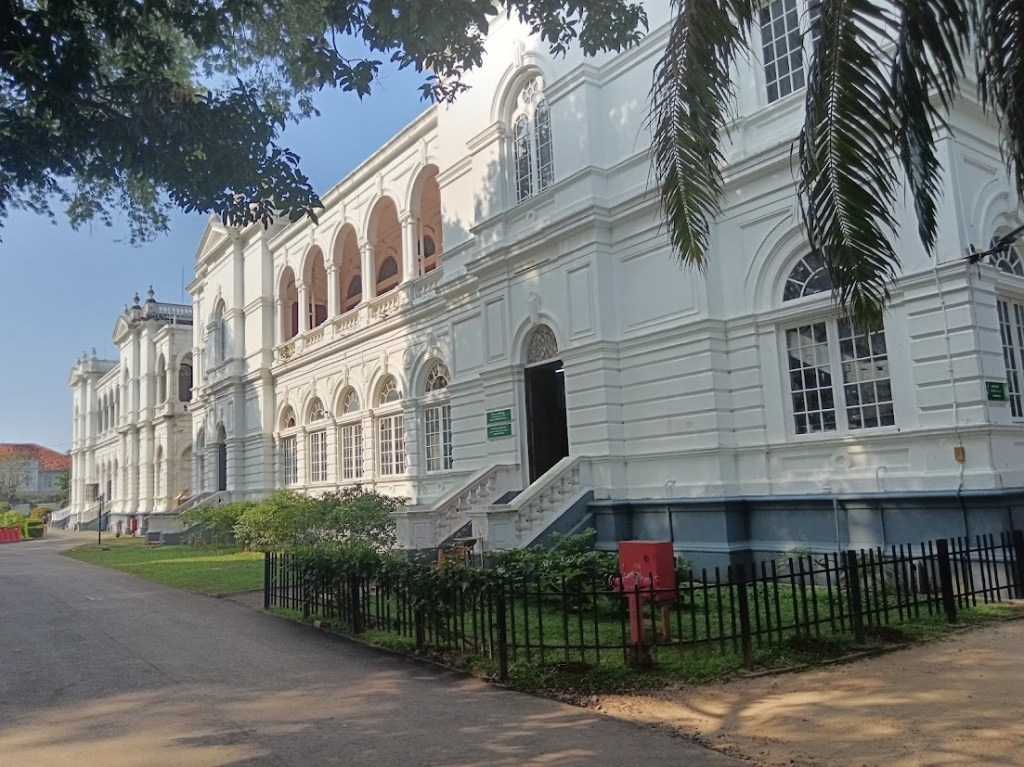
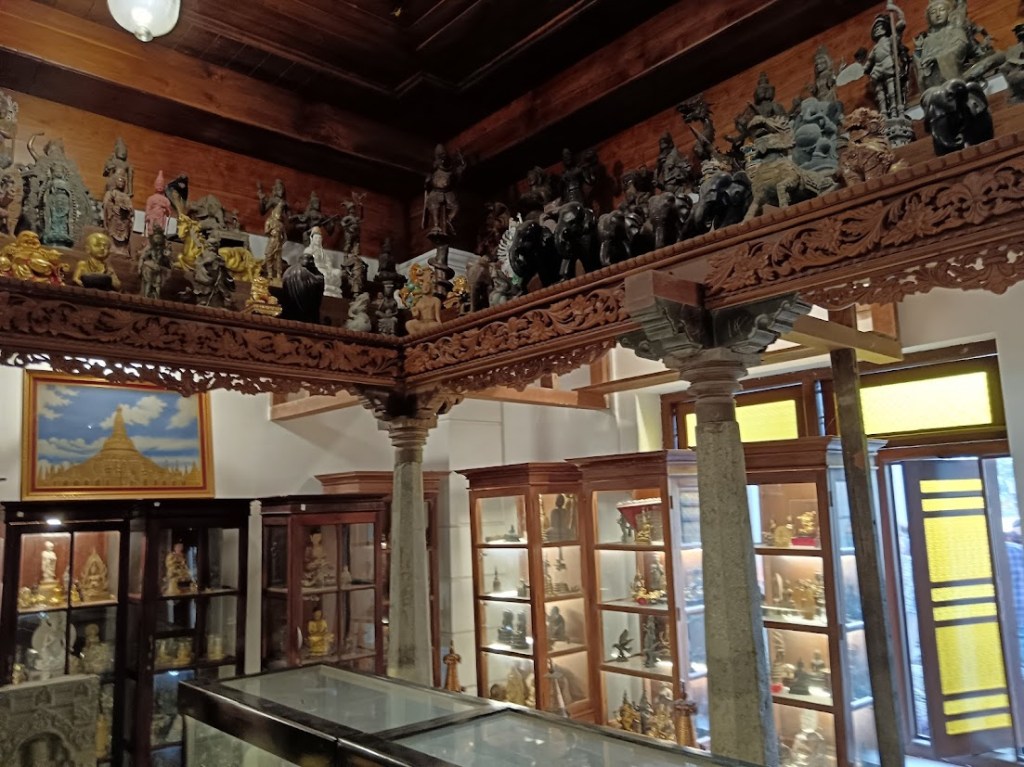
I visited the Sri Lankan national museum, the largest in the country. It was established by Sir Gregory, the British governor of Ceylon (as Sri Lanka was then called) in 1877. The museum is housed in a white, neo-Baroque building and offers a fascinating glimpse into Sri Lanka’s past. The museum is well maintained though it is not air conditioned. The humidity is a constant presence in Colombo. The collection of antiques at the museum is extraordinary.

On my last evening in Colombo, I did some sightseeing. We went to the Gangaramaya temple, the most important one in Colombo. The architecture is a mix of Sri Lankan, Indian, Thai, and Chinese styles. The temple was started by the famous scholar monk Hikkaduwe Sri Sumangala Nayaka Thera in the late 19th Century. The temple has a rich collection of Buddha statues and huge collections of ivory that must be worth millions if not billions. Our next stop was the Lotus tower at 351.5 metres, the largest self-supported structure in South Asia. The lotus is a symbol of purity. view of Colombo city from the observation tower at the top is excellent. I could see the Galle Face Road where I had stayed during my last visit. We could see the Sri Lankan railway depots and stations.

Colombo is a fascinating city. There is plenty to see and do. Recent economic events have hit the island hard. During my subsequent visit I plan to explore other parts of this magical country. Serendip/Serendib was the ancient Persian/Arab name for the country. The name is believed to be derived from the Sanskrit Simhaladwipa (dwelling place of Lion’s Island). The lion occupies a prominent place on the Sri Lankan flag.

The three princes of Serendip in an ancient story had the knack of making unexpected discoveries and is the root of the word serendipity in English. Visit Colombo and Sri Lanka, who knows what serendipitous discoveries await you?

Photo Courtesy: Ravi Shankar

Dr. P Ravi Shankar is a faculty member at the IMU Centre for Education (ICE), International Medical University, Kuala Lumpur, Malaysia. He enjoys traveling and is a creative writer and photographer.

.

PLEASE NOTE: ARTICLES CAN ONLY BE REPRODUCED IN OTHER SITES WITH DUE ACKNOWLEDGEMENT TO BORDERLESS JOURNAL

Click here to access the Borderless anthology, Monalisa No Longer Smiles

Click here to access Monalisa No Longer Smiles on Kindle Amazon International
Categories
Review

Nazrul and His World View

Book Review by Somdatta Mandal

Title: Selected Essays: Kazi Nazrul Islam

Author: Kazi Nazrul Islam

Translator: Radha Chakravarty

Publisher: Penguin Random House

The Bengali poet, Kazi Nazrul Islam (1899-1976), is widely remembered as the fiery iconoclast who fought against the structures of oppression and orthodoxy. The iconic bidrohi or ‘rebel poet’ of Bengal, Nazrul continues to be loved for his songs and poetry that were aimed at arousing the rebellious spirit of both Hindus and Muslims alike. But what of his prose, his journalism, and his politics? Selected Essays reveals to us the extraordinary versatility of Nazrul as a writer, thinker, and activist. Addressing subjects as diverse as social reform, politics, communal harmony, environmental concerns, education, aesthetics, ethics, and philosophy, this rich collection showcases Nazrul’s dynamic vision and unique use of language as an instrument of change. The essays chart his evolving consciousness as a thinker, writer, and activist, offering vivid glimpses of the ethos of his times, his relationships with leading figures such as Tagore and Gandhi, and his active engagement with social, political, and cultural processes.

Of the forty-one essays selected here, (three undated), the first thirteen are all written in different places all in the year 1920. That was the year Nazrul returned to Bengal after serving in Karachi during World War I as a member of the Bengal regiment of the colonial British army. Reacting to the Jallianwallah Bagh massacre he writes, “May the Dyer monument never allow us to forget Dyer’s memory” because on that occasion Hindus and Muslims embraced each other and wept together as brothers. They shared the same agony as children of the same womb. In ‘Strike’, he praises the social awareness that has swept among the ranks of the labouring class and believes that the “protest is not just a rebellion, but the death-bite of the suffering, moribund class”. When some migrants were fired upon after a clash with the armed police at a place called Kanchagarhi, he asked in ‘Who is Responsible for the Killing of Migrants?’, whether anyone can ever tolerate such injustice towards humanity, conscience, self-respect and independence and states that they are no longer going to passively accept such assaults. ‘Awakening Our Neglected Power’ contends that democracy or people’s power cannot be established in our country because of the oppression inflicted by the Bhadra[1] community.

There are several essays in which Nazrul speaks about the state of National Education, he envisages ‘A National University’, and in a very powerful piece that he wrote from Presidency Jail in Kolkata on 7 January 1923, titled ‘Deposition of a Political Prisoner’ he reveals his self-confidence:

“If anything has struck me as unjust, I have described it as injustice, described oppression as oppression, named falsehoods as falsehood. …For that endless mockery, insults, humiliation and assaults have been rained on me, from within my home and beyond. But nothing whatsoever has intimidated me into dishonouring my own truth or my own Lord. No temptation has overpowered me enough to compromise my integrity or to diminish the immense self-satisfaction gleaned through my own endeavours…. I repeat, I have no fear, no sorrow. I am the child of the elixir of immortality.”

Nazrul grew up in a traditional religious environment, yet in his writings he drew upon both Hindu and Islamic sources, and expressed a faith that transcended the limits of any single religion. In several essays, he harps on the problems of Hindu-Muslim amity and enmity and warns us about “this hideous business of purity of touch and untouchability”. He wants only humans to live in India as brothers and wants everyone to be wary of the terrible deceptions created by both the religions.

In the essay ‘Temple and Mosque‘, he states that both parties have the same leader, and his real name is Shaitan, the Devil. Written in response to the communal riots that broke out in Kolkata on 2 April 1926, he feels that those very same places of worship that ought to have been bridges between heaven and earth are instead causing harm to humanity today, and so those temples and mosques should be broken down. In another essay titled ‘Hindu-Muslim’, penned the same year, Nazrul talks about the question of an internal tail in human beings. He says, “There’s no telling what animal excitement lured the human mind to discover a substitute for tails in the beard or tiki[2]!” He further elaborates:

“Both Hindu and Muslim ways of life can be tolerated, but their faith in tikitwa and daritwa, the orthodox ways of tiki and beard, is not to be borne, for both instigate violence and killing. Tikitwa is not Hindutwa, it is perhaps punditwa, the way of the pundit! Likewise, the beard, too, is not Islamic, it is mullatwa, the way of the mullah. These two types of hair tufts, marked with religious dogma, are precisely the reason for all the conflict and hair-splitting we witness today!”

Though it is not possible to discuss all the different editorials, book reviews, and political pieces that are included in this collection, one must mention at least two essays that speak about literary issues as well. In 1932, Nazrul wrote for Patrika (subsequently reprinted in Bulbul the following year), an interesting piece titled ‘World Literature Today’. In it he states that there are two kinds of writers present in the world today and their different tendencies have assumed immense proportions.

“Ranged on both sides are great war heroes, champion charioteers of the battlefield. On one side are the dreamers, such as Noguchi, Yeats and Rabindranath, and on the other, Gorky, Johan Bojer, Bernard Shaw, Benavente and their ilk.”

But Nazrul’s ire in being ostracized comes out clearly in ‘A Great Man’s Love Is a Sandbank’ (1927), where he criticises the high-handedness of Rabindranath Tagore. He begins by telling us how he was a prisoner of state at the Alipore Central Jail when he was informed by the assistant jailor that Tagore had recognised Nazrul’s talent and dedicated his play Basanta to him. The other political prisoners present there had laughed at him not in joy but in incredulity. For him, the blessing turned into a curse. His very close friends and state prisoners also turned away from him. He realised what massive internal damage this outward gain had caused him. Busy with his political agenda, he didn’t have the time to sit and meditate as advised several times by Tagore. So Nazrul writes, “I find that the brighter my countenance shines in this glory, the darker some other famous poets’ faces seem to appear.” He mentions that he had grown accustomed to police torture but when literary personages begin to torment one, their brutality knows no bounds. “Alas, O youthful new literature!” His crime was that young people celebrated his work. He laments further,

“That Kabiguru[3], revered by both parties like the grandsire Bhisma, should assent to this plot of killing Abhimanyu, is the greatest sorrow of our times. …As for me, I have discarded that topi–pyjama—sherwani–beard look[4], only out of fear of being mocked as a ‘Mia Saheb’. But still there is no respite for me…. Now we get the feeling that the Rabindranath of today is not the same Rabindranath we have always known.”

That the trajectories and beliefs of Tagore and Nazrul went in the opposite direction is well- known. In the essay, Nazrul then further continues his complaints against Tagore. He questions whether they have been considered as his enemies, simply because they didn’t go to him frequently. Also, since the goddess of wealth blessed him, Kabiguru did not know what dire poverty the new writers had to struggle against, languishing in conditions of starvation or semi-starvation. So, he humbly requests Kabiguru not to sprinkle salt on their wounds by mocking the impoverishment that is their singular affliction, for that is one form of heartlessness that they cannot tolerate.

Of the last three essays written in 1960, namely, ‘The Science of Life’(where men “are surrounded by all sorts of travails and sufferings, and many of them cannot be alleviated”), ‘A Point to Ponder’(where the nation faces an immense problem regarding the dispute about the instructions and procedure for the worship of the mother, the Bharatmata, our Mother India) and in ‘What We Need Today’, Nazrul speaks of the necessity of a “vast tumult in India”. Making his readers aware of the vast duplicity and trickery in the name of religion, he warns that unless one avoids the baseness of being subjugated by an external power, there is no prospect of heaven for us, only the grotesqueness of hell. He wants the kalboishakhi, the wild summer storm, to “approach in all its fury, rearing his head like a hooded serpent swimming in the unchecked torrents of an ocean of blood” and sweep everything away.

Before concluding one should also make a few comments on the translation. As a veteran translator, Radha Chakravarty, has successfully managed to transcreate some very difficult Bengali idioms, cultural nuances and analogies that Nazrul used in some of his essays. As she admitted in the Introduction, “[T]ranslating Nazrul’s prose proved to be a challenge, as demanding as it was exhilarating. …The endeavour demanded experiment and creativity rather than mechanical lexical ability and involved some difficult choices…Literal translation has been avoided, with greater focus on the sense, emotion, intellectual import, rhetorical features and stylistic particularities of the Bengali source texts.” She further adds that the present translations stemmed from a desire to bring Nazrul’s essays to a contemporary audience in South Asia and the rest of the world, to draw attention to his literary achievement as well as his significance as a writer, thinker, activist, and visionary. Though a lot of research and translation projects on Nazrul has been going on in Bangladesh for quite some time (where he holds the status of National Poet), in India, especially in West Bengal, the response is still rather lukewarm. Hence this volume is strongly recommended as a collector’s item.

[1] Literally decent but here indicates the bourgeoisie.

[2] A tuft of hair at the back of a tonsured head 

[3] Tagore

[4] Cap-pyajama-longcoat – these with a beard were associated with the genteel muslim look – the look of the Mia Saheb

CLICK HERE TO READ THE EXCERPT

Somdatta Mandal, critic and translator, is a former Professor of English at Visva-Bharati, Santiniketan, India.

.

PLEASE NOTE: ARTICLES CAN ONLY BE REPRODUCED IN OTHER SITES WITH DUE ACKNOWLEDGEMENT TO BORDERLESS JOURNAL

Click here to access the Borderless anthology, Monalisa No Longer Smiles

Click here to access Monalisa No Longer Smiles on Kindle Amazon International
Categories
Editorial

Celebrating the Child & Childhood…

‘Victory to Man, the newborn, the ever-living.’
They kneel down, the king and the beggar, the saint and
the sinner,
the wise and the fool, and cry:
‘Victory to Man, the newborn, the ever-living.’

The Child’ by Rabindranath Tagore1, written in English in 1930

This is the month— the last of a conflict-ridden year— when we celebrate the birth of a messiah who spoke of divine love, kindness, forgiveness and values that make for a better world. The child, Jesus, has even been celebrated by Tagore in one of his rarer poems in English. While we all gather amidst our loved ones to celebrate the joy generated by the divine birth, perhaps, we will pause to shed a tear over the children who lost their lives in wars this year. Reportedly, it’s a larger number than ever before. And the wars don’t end. Nor the killing. Children who survive in war-torn zones lose their homes or families or both. For all the countries at war, refugees escape to look for refuge in lands that are often hostile to foreigners. And yet, this is the season of loving and giving, of helping one’s neighbours, of sharing goodwill, love and peace. On Christmas this year, will the wars cease? Will there be a respite from bombardments and annihilation?

We dedicate this bumper year-end issue to children around the world. We start with special tributes to love and peace with an excerpt from Tagore’s long poem, ‘The Child‘, written originally in English in 1930 and a rendition of the life of the philosopher and change-maker, Vivekananda, by none other than well-known historical fiction writer, Aruna Chakravarti. The poem has been excerpted from Indian Christmas: Essays, MemoirsHymns, an anthology edited by Jerry Pinto and Madhulika Liddle, a book that has been reviewed by Somdatta Mandal and praised for its portrayal of the myriad colours and flavours of Christmas in India. Christ suffered for the sins of humankind and then was resurrected, goes the legend. Healing is a part of our humanness. Suffering and healing from trauma has been brought to the fore by Christopher Marks’ perspective on Veronica Eley’s The Blue Dragonfly: healing through poetry. Basudhara Roy has also written about healing in her take of Kuhu Joshi’s My Body Didn’t Come Before Me. Bhaskar Parichha has reviewed a book that talks of healing a larger issue — the crises that humanity is facing now, Permacrisis: A Plan to Fix a Fractured World, by ex-British Prime Minister Gordon Brown, Nobel Laureate Michael Spence, Mohamed El-Erian and Reid Lidow. Parichha tells us that it suggests solutions to resolve the chaos the world is facing — perhaps a book that the world leadership would do well to read. After all, the authors are of their ilk! Our book excerpts from Dr Ratna Magotra’s Whispers of the Heart – Not Just A Surgeon: An Autobiography and Manjima Misra’s The Ocean is Her Title are tinged with healing and growth too, though in a different sense.

The theme of the need for acceptance, love and synchronicity flows into our conversations with Afsar Mohammad, who has recently authored Remaking History: 1948 Police Action and the Muslims of Hyderabad. He shows us that Hyderabadi tehzeeb or culture ascends the narrow bounds set by caged concepts of faith and nationalism, reaffirming his premise with voices of common people through extensive interviews. In search of a better world, Meenakshi Malhotra talks to us about how feminism in its recent manifestation includes masculinities and gender studies while discussing The Gendered Body: Negotiation, Resistance, Struggle, edited by her, Krishna Menon and Rachana Johri. Here too, one sees a trend to blend academia with non-academic writers to bring focus on the commonalities of suffering and healing while transcending national boundaries to cover more of South Asia.

That like Hyderabadi tehzeeb, Bengali culture in the times of Tagore and Nazrul dwelled in commonality of lore is brought to the fore when in response to the Nobel laureate’s futuristic ‘1400 Saal’ (‘The year 1993’), his younger friend responds with a poem that bears not only the same title but acknowledges the older man as an “emperor” among versifiers. Professor Fakrul Alam has not only translated Nazrul’s response, named ‘1400 Saal’ aswell, but also brought to us the voice of another modern poet, Quazi Johirul Islam. We have a self-translation of a poem by Ihlwha Choi from Korean and a short story by S Ramakrishnan in Tamil translated by T Santhanam.

Our short stories travel with migrant lore by Farouk Gulsara to Malaysia, from UK to Thailand with Paul Mirabile while chasing an errant son into the mysterious reaches of wilderness, with Neeman Sobhan to Rome, UK and Bangladesh, reflecting on the Birangonas (rape victims) of the 1971 Bangladesh Liberation war, an issue that has been taken up in Malhotra’s book too. Sobhan’s story is set against the backdrop of a war which was fought against linguistic hegemony and from which we see victims heal. Sohana Manzoor this time has not only given us fabulous artwork but also a fantasy hovering between light and dark, life and death — an imaginative fiction that makes a compelling read and questions the concept of paradise, a construct that perhaps needs to be found on Earth, rather than after death.

The unusual paradigms of life and choices made by all of us is brought into play in an interesting non-fiction by Nitya Amlean, a young Sri Lankan who lives in UK. We travel to Kyoto with Suzanne Kamata, to Beijing with Keith Lyons, to Wayanad with Mohul Bhowmick and to Langkawi with Ravi Shankar. Wendy Jones Nakanishi argues in favour of borders with benevolent leadership. Tongue-in-cheek humour is exuded by Devraj Singh Kalsi as he writes of his attempts at using visiting cards as it is by Rhys Hughes in his exploration of the truth about the origins of the creature called Humpty Dumpty of nursery rhyme fame.

Poetry again has humour from Hughes. A migrant himself, Jee Leong Koh, brings in migrant stories from Singaporeans in US. We have poems of myriad colours from Ryan Quinn Flanagan, Patricia Walsh, John Grey, Kumar Bhatt, Ron Pickett, Prithvijeet Sinha, Sutputra Radheye, George Freek and many more. Papia Sengupta ends her poem with lines that look for laughter among children and a ‘life without borders’ drawn by human constructs in contrast to Jones Nakanishi’s need for walls with sound leadership. The conversation and dialogues continue as we look for a way forward, perhaps with Gordon Brown’s visionary book or with Tagore’s world view of lighting the inner flame in each human. We can hope that a way will be found. Is it that tough to influence the world using words? We can wish — may there be no need for any more Greta Thunbergs to rise in protest for a world fragmented and destroyed by greed and lack of vision. We hope for peace and love that will create a better world for our children.

As usual, we have more content than mentioned here. All our pieces can be accessed on the contents’ page. Do pause by and take a look. This bumper issue would not have been possible without the contribution of all the writers and our fabulous team from Borderless. Huge thanks to them all and to our wonderful readers who continue to encourage us with their comments and input.

Here’s wishing you all wonderful new adventures in the New Year that will be born as this month ends!

Mitali Chakravarty

borderlessjournal.com

  1. Indian Christmas: Essays, MemoirsHymns edited by Jerry Pinto & Madhulika Liddle ↩︎

Click here to access the content’s page for the December 2023 issue

.

READ THE LATEST UPDATES ON THE FIRST BORDERLESS ANTHOLOGY, MONALISA NO LONGER SMILES, BY CLICKING ON THIS LINK.

Categories
Interview Review

The Gendered Body

In conversation with Meenakshi Malhotra and a brief introduction to The Gendered Body: Negotiation, Resistance, Struggle (Scopus Index), edited by Meenakshi Malhotra, Krishna Menon and Rachana Johri, published by Routledge

Why would one half of the world population be seen as evolved from the rib of the first man, soulless or as merely subservient to fulfil the needs of the other half? This is a question that has throbbed for centuries in the hearts of that half that suffers indignities to this date, women. While feminism became a formalised idea only in the 18th-19th century and things started improving for certain groups of women around the world, in some regions, like Afghanistan, the situation has deteriorated in recent years. Their government, recognised by world leadership, has ensured that women do not have schooling, cannot work in senior positions, have to be accompanied by men if they go out and remain covered as the feminine body could tempt bringing shame, strangely, to the female but not to the man who has the right to be tempted and hence to violence and violate her body and her mind.

Given this ambience, any literature voicing protest for patriarchal mindsets that accept situations like in current day Afghanistan passively, should be celebrated as an attempt to shard the silence of suffering by one half of the world population. The Gendered Body: Negotiation, Resistance, Struggle, edited by three academics, Meenakshi Malhotra, Krishna Menon and Rachana Johri, does just that. At the start, we are told: “This book situates the discourse on the gendered body within the rapidly transitioning South Asian socio-economic and cultural landscape.  It critically analyzes gender politics from different disciplinary perspectives…”

Featuring 22 writers, the narratives take up a range of issues faced by women in Pakistan, India, Bangladesh and Srilanka. The Pakistani implementation of Islamic law, under the Hudood ordinances, has been addressed in a powerful essay by Aysha Baqir, subsequently by Anu Aneja, in her discourse on Urdu poetry. It was interesting to read how the ghazal form started as a male-only art form where women were depicted as mysterious houris or pining with sadness. Birangona — a phrase that was given to rape victims of the 1971 Bangladesh Liberation War — has been explored by Sohana Manzoor through a classic, Rizia Rahman’s novel, Rokter Okshor[1](1978), written about such women driven to prostitution. Women’s voices in the Sri Lankan LTTE have been explored by Simran Chaddha. Nayema Nasir has taken up decadent customs in the progressive Bohra community in Mumbai and shown how things are moving towards a change. Colonial and Dalit voices have found a hearing in Malhotra’s essay on Mahasweta Devi’s short story, ‘Draupadi’, set against the Naxalite movement of 1970s.

Dotted with women’s responses to a variety of current issues, including the Anti-CAA-NRC uprisings (Tamanna Basu), Shaheen Bagh (Meenakshi Gopinath, Krishna Menon, Rukmini Sen and Niharika Banerjea), and the pandemic (Krishna Menon, Deepti Sachdev and Rukmini Sen), there is even a case study by Shalini Masih dealing with psychiatric trauma where both the psychiatrist and the patient, who might have evolved into a stalker or a rapist without the therapy, heal. A certain sense of hope echoes through some of these narratives, a hope to heal from wounds that have sweltered over eons.

The flow of words is smooth and the ideas should be able to rise against the tide of erudition to touch our lives with lived realities. There are responses that transcend the heaviness of academic writing for instance the impassioned start made by Giti Chandra in her narrative: “A woman’s body is a story that men tell each other. When it is full-hipped, it is a tale of their healthy children; when it is fair, it speaks of their wealth; when it is narrow, it proclaims their access to gyms; and when it is tanned, it flaunts their ability to vacation on sunny isles. If its feet are not small enough to convey a leisure that does not require walking, they are bound and made smaller and more childishly submissive; if its legs are not long enough befitting its trophy status, bone-crippling heels are added to them. When it is raped it is an assertion of power, a chest-thumping; when it is raped it is an aggression over its owner; when it is raped its womb is stolen from the enemy…” Chandra points out some things that make one think, like quoting Rahila Gupta, she suggests victims is not the word we should use for women, but we should refer to the sufferers as survivors.

This collection of essays questions social norms and niceties to realise what early woman’s rights activist, Elizabeth Cady Stanton, drafted, that “all men and women [had been] created equal” in July 1848. While the struggle continues through centuries and the discourse of these narratives, the last essay by a man, Brijesh Rana, attempts to give a broader and more inclusive outlook to the whole human body. The book comes across as a tryst — of academic and feminist voices — to speak up for mankind to equalise.

To further understand the intent and scope of this book, we have in conversation one of the editors— Meenakshi Malhotra, who teaches gender studies and literature, has to her credit two Charles Wallace fellowships and a number of books. She reflects on the bridge that is being attempted between scholarship and activism.

How and when did you conceive this book? Tell us a bit about your journey from the conception to the publication of the book.

This book was originally conceived due to the positive response my co-editors and I received after presenting a panel at an American Association of Asian studies (AAS) conference back in 2017. We were approached by an international publisher who encouraged us to take forward the work with a focus on South Asia. We were unable to take it forward at that time, however we revived the project a few months into the lockdown in late 2020 when we felt we had a little more time. Also, along the way, we were able to reach out to fellow travellers, working in and on Pakistan, Bangladesh and Sri Lanka.

Three of you have collaborated to compile and edit this book. Collaborations to bring out books are not easy. Tell us about this collaboration.

As we three had presented on the same panel, the collaboration was a natural corollary since we had a sense of being fellow travellers and sister academics/scholars. That worked well for us because each of us were engaged in research and research guidance and wanted to showcase the recent work in this area. Both the co-editors, Krishna working on gender and its intersections with politics and Rachna on gender and psychology are very well-established scholars in the field of gender. I work on gender and literature, had my own network and I must mention that in the course of writing for Borderless Journal, I was able to access the work of others on that platform.

Explain to us the significance of the title of your book.

I think we arrived at the title through two processes-one was the immediate situation of Covid which left us in a state of precarity. However, we felt that even within the context of the contagion, women — and other genders — were endangered in specific ways. Second is the understanding that the body is always already produced by multiple matrices of gender, race, caste etc. The human body is also always a gendered body.

We had initially suggested that we call it ‘The Gendered Body and its Fragments’ to connote the bundling of several discursive strands on gendered bodies, but the idea was vetoed (by the initial reviewer) since “fragments” had   resonances and nuances which we did not have space (or expertise) to go into, at that point.

You have a variety of contributors, some of who are non- academic. What did you look for when you chose your content?

Variety as you point out, is the key term. We were looking for something new, something interesting, flagging the variegated cultures of South Asian societies. The book comprises a mix of experienced researchers and some researchers whose essays are their preliminary forays into publishing.

Your book is divided into different sections ‘Negotiation’, ‘Struggle’, ‘Resistance’, ‘Protest’, ‘Critique’, ‘Representations and New Directions’. Can you tell us the need to compartmentalise the essays into this structural frame?

Just to give it a structure, organisation and coherence. Having said that, there are also frequent overlaps.

Would you call this book feminist? Feminism is as such a human construct. Why would this construct be essential for treating people equally? What is the need for feminism?

It is feminist in its orientation to the research areas as well as its methodologies. The key concept here is collaboration and therefore we have two conversation as an expression of feminist epistemology or knowledge-making.

Feminism, like other modes of affirmative action — like reservations, quotas — are an attempt to create a level playing field for historically disprivileged groups  and oppressed minorities.

Having said that, I/we would like to point out that feminism has become inclusive and an umbrella term that also includes the work on masculinities and trans-identities since the 1990s.

Isn’t feminism the forte of only women?

Not at all and that is why we have the term feminisms. We hope to do more work subsequently on masculinities, on trans bodies in the future.

You have 21 women writers who write of women’s issues. Yet the last is an essay by a man — not on feminist issues— but more to create a sense of inclusivity, if I am not wrong. Why did you feel the need for this essay?

It is not so much about women’s issues as much as about gendered bodies in contemporary South Asia, about identities, subjectivities, bodies in motion gearing up for political action(the conversation and the essay on campus movements are instances).

Also, the last essay which articulates a post-humanist perspective, I felt, would take us beyond the materialities of gendered bodies and flag the way recent research/scholarship has looked at the Anthropocene. It was attempting to give a meta perspective, to bring in a way of seeing, which probably will have an impact on how we understand and conceptualise human bodies.

Your book blurb says: “Topical and comprehensive, this book will be useful for scholars and researchers of gender studies, sociology, political sociology, social anthropology, cultural studies, post-colonial studies and South Asian studies.” Why would you limit the scope of your book when you have some essays that should be read by many and are like eye openers, like the ones on Hudood, Birangonas, Bohras, even your own on ‘Draupadi’ and more?

I think Routledge as an academic publisher, probably does this routinely, to highlight the academic terrain any new book covers.

Having said that, we would definitely want the book to be of general interest. Some of the essays discussed issues which were possibly eye-openers for us as well.

What is the difference between academic writing and non-academic writing? You do both, I know.

Academic writing has often a thesis and an argument underpinning it, which is not to say that non-academic writing — especially the essay — cannot have them.

Also, many of the essays were based on student papers/MPhil and even PhD dissertations. The panel we were a part of was an academic conference on South Asian studies.

Would this book be classified as women’s writing as majority of the writers are women and have written on women’s issues… and yet there is a man? Is it necessary to have such classifications? Would it rule out male readers?

Not at all to every question. It just happens that many of our contributors are women, but I would like to dispel the idea that “gender” is about women only. It is about boxes, stereotypes and role-based expectations, which are to be questioned. 

Thanks for giving us a powerful book and your time.

[1] Words of Blood

(The online interview has been conducted through emails and the review written by Mitali Chakravarty.)

PLEASE NOTE: ARTICLES CAN ONLY BE REPRODUCED IN OTHER SITES WITH DUE ACKNOWLEDGEMENT TO BORDERLESS JOURNAL. 

Click here to access the Borderless anthology, Monalisa No Longer Smiles

Click here to access Monalisa No Longer Smiles on Kindle Amazon International

Categories
Stories

A Troubled Soul

By Mahim Hussain

Amma[1], it . . . it feels like fire is running through my veins!”

These were the words Abir uttered sitting on the rear seat of their car. His mother, a fifty-five-year-old woman, was sitting right beside him. She was trying to help her son any way she could to relieve him of his suffering. With moist eyes, she kept massaging Abir’s hands and neck constantly.

“Everything is going to be all right, abba[2]. Try to relax,” she said to her son.

Leaving other cars behind, the white Toyota sped through the street – piercing the thickness of the night. Their deft driver devoted all his attention to dodging and overtaking other cars on the road. The car had headed to the Labaid Hospital, situated in the Dhanmondi area of the bustling city of Dhaka.

Abir’s older brother, Rafique, was sitting in the front seat next to the driver. He kept turning back frequently to see how his younger brother was doing.

Amma . . . I can’t breathe . . . I can’t breathe amma!” Abir cried out to his mother.

Abir’s mother pleaded with Rafique to lower the wind shield on his side. Without being asked, the driver flicked a switch swiftly, and the windshield came down with a whirring sound. Abir, with the help of his mother, managed to get his head out of the window to breathe fresh air. With his head sticking outside the car, he could see the taillights of the passing cars growing faint in the distance. To the boy, it seemed like red and yellow fairies were flying in the darkness. Soon, Abir slid back on his mom’s lap, as he could no longer bear the weight of his head.

“Don’t worry, amma. We will get their soon,” Rafique tried to console his anxious mother.   

About forty minutes later, the car entered through the lofty gate of the hospital – battling an abysmal traffic jam. They were lucky it was a weekend. On any other night of the week, it would have taken them at least an hour and a half to get there from the Mirpur area. By the time they arrived at the emergency entrance, Abir had already lost his consciousness. He could not move any of his limbs or open his eyes.

A door man and two female nurses came out of the emergency department running. They carefully hauled Abir out of the car. Then, putting him on a stretcher, they hastily took the boy inside the emergency department. Rafique and his mother ran after them, frantically.

Passing a long corridor, they entered a ward. The nurses again lifted Abir gently off the stretcher and laid him on one of the empty beds. At ten-thirty of the night, the whole ward was empty and quiet. The nurses started to commence their usual protocol. One nurse put a clip of a pulse meter on the boy’s index finger of his right hand. It was attached to a screen above the bed with a cord. Another nurse tied the strap of a blood pressure machine, connected to the same screen. While Abir’s family was worried to see him unconscious, one of the nurses tried to calm them down. She told Rafique to accompany her to the information desk and fill out some forms. The other nurse kept her eyes on the screen, monitoring the patient’s vitals.

After observing the patient for about ten minutes, the nurse blurted out: “His pulse is too weak. I am calling the duty doctor.”

“Ha! What happened nurse? What’s wrong with my son?” cried out the mother.

Without responding to her, the nurse ran out of the ward in a hurry. Abir’s mother was in tears. She started rubbing Abir’s chest incessantly, overwhelmed by apprehension.

Before long, the nurse came running with the duty doctor. After glancing at the monitor for a moment, the doctor turned around and said to the nurse: “The pulse and pressure rates are too low. We can’t treat him here.”

By this time, Rafique was back. The female doctor told him that they didn’t have all the equipments in the emergency ward to treat a critical patient like his brother.

While the doctor and Rafique were engaged in a discussion, suddenly, Abir started having convulsion.

“Nurse, call the ICU upstairs. Tell them that we are bringing a patient, quickly!” the doctor passed the order.

As the hospital staff pushed the movable bed and took the boy inside an elevator, Abir’s mother started to lament.

“What’s happened to my little boy, Rafique? Bring my Abir back to me . . .  bring him back!”                     

Rafique took his mother in his arms and held her tightly. He too was on the verge of falling apart. But he bit his lips and managed to keep his poise. Rafique was the eldest son. If he had broken down, who was going to take care of his family? With glistening eyes, Rafique recalled the fateful day when it all started.

Rafique entered their apartment of a three-storied building with a heavy, black briefcase in his hand. Their family doctor walked behind him with brisk steps. Going past the dining room, they walked straight inside Abir’s bedroom.

As soon as they entered, Rafique felt a piece of glass getting crushed under his left shoe. Raising his head, he saw broken pieces of a plate and some food were strewn all over the floor. His mother was cleaning up the mess with a sweep and a scraper. His father, seated on Abir’s bed, stood up seeing the doctor.

“Look, doctor, what he has done to himself this time,” said Abir’s father, pointing at his son in the bed.

The doctor looked at the boy over his reading glasses.

Sixteen-year-old Abir was lying in the bed quietly. But his chest was rising and falling in quick succession. He had his face covered with his forearms. A white bandage was wrapped around his left wrist. On one side of the bandage, blood had seeped through and had left a big stain.

“Some time last night, he tried to cut the veins of his wrist with a blade,” Abir’s father related with a distressed tone. “This morning we found him in the bed with blood all over the bed sheet.”

The doctor kept his gaze fixed on the boy and listened to Abir’s father intently.

 “Moreover, he has not eaten anything in two days. A few minutes ago, his mother brought some food for him. But as soon as she got close to him, he took the plate off her hand and smashed it on the floor. He has been having angry outbursts quite frequently these last few days,” added the father.

The doctor slowly walked to the bed and sat beside the boy warily.

“Well, dear boy. Let uncle see your hand,” saying this, he gently picked up Abir’s wounded hand. The doctor examined his wrist from different angles and tried checking his pulse.

Only a few moments had passed, when suddenly, Abir sat up and pulled his arm out of the doctor’s hand with a savage jerk.

“Let go of my hand, you devil!” screamed the boy.

The doctor jumped off the bed, and Abir’s parents lunged to restrain the boy. Rafique kept the doctor from losing balance, and quickly took him in the dining room.

He sat the doctor at the table and poured him a glass of water.

Glug, glug, glug, ahh . . .

“Rafique, I don’t think Abir was able to cut any of his major veins. If he did, he would have bled out over the night and have been unconscious by now. The bandage on his wrist was done nicely and the bleeding has stopped.” confirmed the doctor. “However, as you have shared with me earlier, Abir has been showing such erratic behavior for several months now. So, his problem is actually psychiatric rather than physical.”

“Yes, doctor. We have taken him to a psychiatrist named Samsul Huq, twice. But during the last session, he suddenly got violent and hurled a glass of water at the doctor. Thankfully no one got hurt. But after that, we could not take him to the doctor again,” shared Rafique.  

“Humn . . . At this moment, he is not in the condition to be taken anywhere. So, I suggest you go back to the psychiatrist and tell him about Abir’s present condition,” concluded the doctor.                                                                     

*

Doctor Huq’s chamber was in a mental health rehabilitation center in the affluent neighbourhood of Gulshan. Rafique had been sitting outside his chamber with other visitors. It was a big lobby under a wooden shed. There were about thirty people outside the chamber, waiting for their turn. A middle-aged man was sitting behind a small table facing the visitors. As patients were coming out of the room, the assistant was calling the next person in serial. Rafique had been waiting there for about two hours now. Feeling bored and exhausted, he was snoozing sitting on his cozy little chair.

“Mr. Rafique Ahmed . . . who is Rafique Ahmed?” inquired the assistant sternly.

When his name was called loudly a second time, Rafique woke with a shudder. In frenetic motion, he got off the chair and almost dashed inside the chamber.

It was a spacious, soundproof room with a gigantic air-cooler hanging above the door. On the far end of the room, there was a big mahogany desk. In the middle of the desk, there was a plastic dummy head with an open brain coming out of it. Beside it, there was a pile of big, thick medical books and journals on one side of the desk. On the other side were two pen holders containing pens of different colors and design. In the front of the desk, there were two cane-made chairs for the visitors to sit on. A few feet from them lay a big, comfortable couch on which a patient could easily lie down. The doctor was sitting on the other side of the desk on a reclining chair the size of a throne.

Professor Huq was an elderly man with long, cotton-like beard and hair. He always wore a fatua[3] and loose pajamas and a big smile on his face. As soon as Rafique entered, the doctor recognised him. It was Rafique who had accompanied Abir to his clinic a week ago. The doctor nodded and made a gestured with his hand, telling him to take a sit.

“How are you doing? Didn’t you bring your brother today?” asked the doctor.

“No, doctor, Abir is not doing too well. He is having mood swings again. Two days ago, he tried to kill himself by slashing his wrist. We don’t understand what is going on with him. Why is he acting like this, doctor?” exclaimed Rafique in a tensed voice.

“Well, Mr. Rafique, I’ve told you on the first day that Abir is showing symptoms of bi-polar disorder. A typical bi-polar person has periods of energetic activities followed by bouts of severe depression. But some of these symptoms may vary from person to person. In your brother’s case, he has moments of angry outbursts followed by long periods of depression. And it’s not uncommon for bi-polars to have suicidal thoughts,” informed the doctor.

“But, doctor, how are we supposed to thwart him from harming himself?” inquired Rafique.

“The condition he is in right now, he needs to take some medications. Here, I am writing down the name of a medicine called Lithosun SR, which contains the chemical lithium. Across the world, lithium has been proven to prevent suicidal thoughts. But there is a catch. Too much of lithium can cause toxicity in the blood, which could be fatal. Therefore, he should take exactly 400 mg per day, and not more than that. In addition, Abir needs to have his blood tested every fortnight to check the level of lithium in his body,” enlightened the doctor.

After that, he tore a page from his pad and handed it to Rafique.

*


At six in the evening on the Friday night, Abir was sitting on his study table. It was a medium sized table with a bookshelf attached on one side. The shelf was laden with books, copies and note papers. A history book was open in front of him. Because of his illness, the boy had not been able to attend his school for two months. His final term exam was in two weeks. After taking the prescribed medication for a month, his thoughts of self-harm started to subside.

It had been an hour. The boy was struggling to focus on the book. But so far, he had not been able to read a single line. He was having difficulty concentrating. All kinds of negative thoughts were churning inside his fragile mind. Soon, fat tears started trickling down his cheeks. Abir could not fathom, why was he unable to control his emotions? Why did he feel so gloomy and miserable all the time?

Unable to bear the frustration anymore, suddenly he stood up with a grunt and tore the book into small pieces. Then, he picked up other books from the bookshelf and started throwing them in the air. This rampage lasted a few minutes. Then, he dashed away from the table, crashed on his bed and started to sob burying his face in the pillow.

After lying there motionless for a while, the boy raised his head for a moment. Incidentally, his eyes fell on the side table attached to his bed. He saw the container of his medication lying on the table, beside his bottle of water.

If I took some extra pills, it should help me get rid of the melancholic thoughts.

Slowly, he clambered on the side of the bed and picked up the container. Popping it open in a fit of impulse, her started pushing several pills down his throat at once and drank a lot of water. Afterward, he lay in the bed, still struggling to harness his emotions.

Around 08:00 p.m., Abir’s mother knocked on his door.

Baba[4] Abir? Come out, son. Dinner has been served.”

Not getting any response for a while, she opened the door which was unlocked from inside. Walking in, she was flabbergasted to find torn books and papers scattered on the floor. Facing the other way, her son was lying in the bed and seemed to be asleep.

The mother walked to the bed and sat next to him.

“Abir? What’s wrong, abba?”                        

There was no response. His mother got little concerned. She held his shoulder and turned his torso toward her.

“Wake up, sweetheart. The dinner is getting cold.”

After calling him several times, the boy lifted his heavy eyelids gradually.

Amma . . . I am not feeling so well. My . . . my head is throbbing in pain.”

Saying these words, the boy closed his eyes again. His mother nudged his shoulder several times, trying to keep him awake. But the boy slowly succumbed deeper and deeper to the side effect of the medicine.

“Mr. Rafque . . . Mr. Rafique!”

The voice of the duty doctor brought the man back to present time.

“What’s going on, doctor? How is my little brother doing,” asked Rafique agitatedly.

“Your brother has been shifted to the ICU. The overdose of the medicine has rendered him unconscious. We are trying to separate the toxic substance in his blood with some medicines and saline. But his pulse rate is still low. Nothing can be said until few hours pass,” reported the doctor and walked away.

Hearing this news, Abir’s mother started wailing and was at the brink of losing her senses. Rafique laid his mother on a bed and tried to pacify her.

Meanwhile, Abir lay in one corner of the ICU with all kinds of tubes and electric wires attached to his body – battling with death.

.

[1] Mother

[2] Father

[3] A short, kameez-like collarless shirt worn by people of South Asia

[4] Father

Mahim Hussain is a 38-year-old man and lives in Dhaka, Bangladesh. He couldn’t finish high school diploma. However, that did not deter him from reading and learning on his own.

PLEASE NOTE: ARTICLES CAN ONLY BE REPRODUCED IN OTHER SITES WITH DUE ACKNOWLEDGEMENT TO BORDERLESS JOURNAL

Click here to access the Borderless anthology, Monalisa No Longer Smiles

Click here to access Monalisa No Longer Smiles on Kindle Amazon International