Categories
Humour & Horror

Spooky, Chooky, Gooky

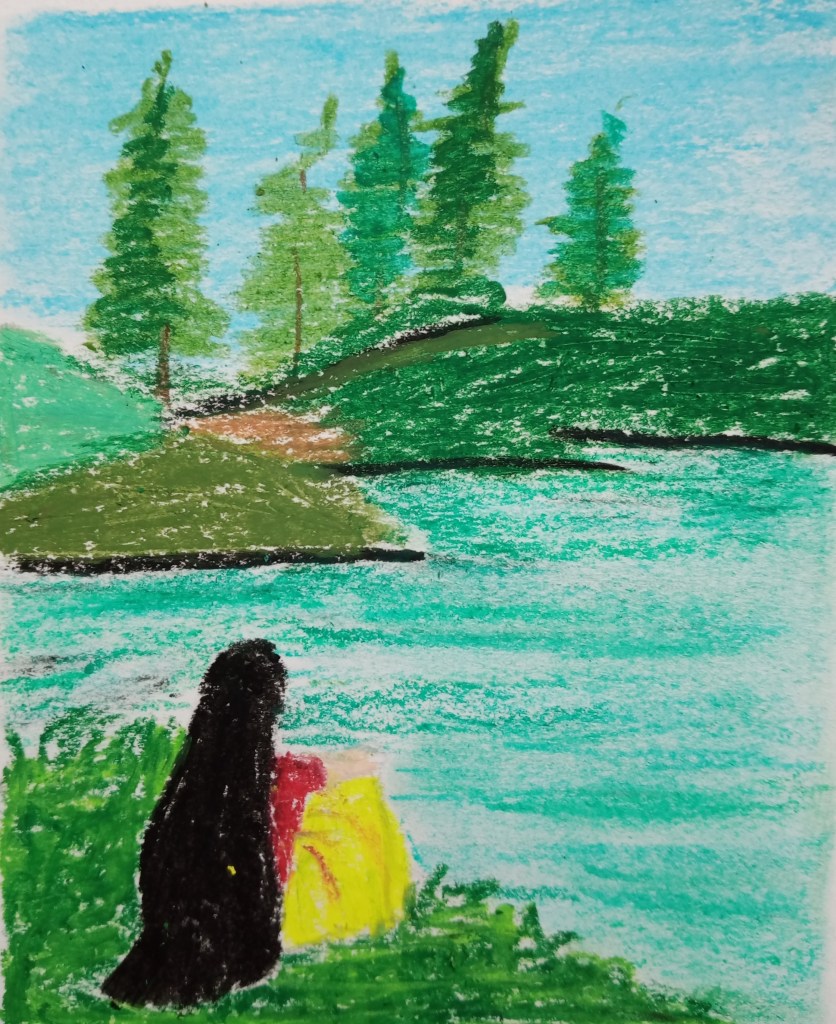
Art by Sohana Manzoor

It’s again that time of the year when we have fun spooking each other with stories of ghosts and haunting. While festivals of light1 and darkness vie with each other for a spot on the same date, observances to pay our respects to our forefathers follow at their heels, some before and some after.

In this selection, we bring to you narratives that could be dark, strange or funny or all of these … a selection of poetry, fiction and non-fiction from around the world. Enjoy the reads!

Poetry

Of Singing Mice, Biscuit Tins & Gym Bikes… by Rhys Hughes. Click here to read.

Human by Manzur Bismil has been translated from Balochi by Fazal Baloch. Click here to read.

In Another Galaxy by Masud Khan has been translated from Bengali by Professor Fakrul Alam. Click here to read.

The Waiting by Stuart MacFarlane. Click here to read.

Walking Gretchums by Saptarshi Bhattacharya. Click here to read.

Bonfire by Ihlwha Choi has been translated from Korean by the poet himself. Click here to read.

Exaltation in D. Minor (I’ll Be Around) by Ryan Quinn Flangan. Click here to read.

It’s Halloween! by Michael Burch. Click here to read.

Prose

From Diana to ‘Dayaan’ : Rajorshi Patronobis talks of Wiccan lore. Click here to read.

The Ghosts of Hogshead: Paul Mirabile wanders into the realm of the supernatural dating back to the Potato Famine of Ireland in the 1800s. Click here to read.

My Christmas Eve “Alone”: Erwin Coomb has a strange encounter at night. Is it real? Click here to read. 

Orang Minyak or The Ghost: A Jessie Michael explores ‘ghosts’ in a Malay village. Click here to read.

The Browless DollsS.Ramakrishnan‘s spooky story, has been translated from Tamil by B Chandramouli. Click hereto read.

 Witches and Crafts: A Spook’s TaleDevraj Singh Kalsi finds a ghostly witch in his library. Click here to read.

In The Chopsy Moggy: Rhys Hughes gives us a strange feline adventure. Click here to read. 

Ghosts, Witches and My New Homeland: Tulip Chowdhury muses on ghosts and spooks in Bangladesh and US. Click here to read.

Nagmati: Prafulla Roy’s long story based on strange folk beliefs has been translated from Bengali as Snake Maiden by Aruna Chakravarti. Click here to read.

From Public Domain

.

  1. Deepavali or festival of lights is on October 31st this year along with Kali Puja and Halloween. October 30th is Bhooth Chaturdashi, or Indian Festival of Ghosts while All Saints’ Day and all Souls’ Day are observed at the start of November. Early October hosted Pitri Paksha, observances for apeasing forefathers in India. ↩︎

Categories
Greetings from Borderless

We wish You a Happy New Year

The year 2023 seemed to have been hard on all of us. Wars in the post-pandemic world, weapons and armies that destroy innocent civilian lives have taken the centre stage, vying with climate disasters, refugees, senseless shootings and unrest.  Amidst this gloom and doom, we need hope — a gleam of light to help us find solutions towards a peaceful world. Let us give the newborn 2024 a fair chance towards its own wellbeing with cheer and laughter. Let’s laugh away our troubles and find the inner strength to move forward towards a better future where people live in harmony… perhaps to hum and recall Paul Mc Cartney’s wise words in ‘Ebony and Ivory'(1982)…

We all know that people are the same wherever you go 
There is good and bad in ev'ryone
We learn to live, when we learn to give
Each other what we need to survive, together alive

A solution to find that hidden strength within us is given to us by a bard who we cherish, Rabindranath Tagore. He suggests a panacea in his poem, Tomar Kachhe Shanti Chabo Na (I Will Not Pray to You for Peace):

....
Amidst this wave of conflict,
In the haze of the games you script,
I will swing towards my own dream.

Let the breeze blow off the lamplight,
Let storms thunder in the sky —
Every moment in my heart,
I can sense your footfall.
In darkness, I strive to find my stream.

In that spirit, we look inward not just to find our dreams and materialise them, but also into the treasure chests of Borderless Journal to find writings that bring a smile to our lips. Tagore, translated by Fakrul Alam and Somdatta Mandal, leads the way as we start with humour and wonder in poetry and meander into a few prose pieces that evoke laughter, at times upending our current stream of thoughts or values. We move on to our three columnists, Rhys Hughes, Devraj Singh Kalsi and Suzanne Kamata, who bring laughter and uncover the nuances of the world around us on a monthly basis. Included also are the pieces by our travelling granny, Sybil Pretious, whose spirited travels prove that age is just a number. Capturing the spirit of diversity with a tinge of laughter, let us usher in the new year to a more hopeful and sturdy start.  

Poetry

Giraffe’s Dad by Tagore: Giraffer Baba (Giraffe’s Dad), a short humorous poem by Tagore, has been translated from Bengali by Professor Fakrul Alam. Click here to read.

Dangermouse by Ryan Quinn Flanagan. Click here to read. 

A Poem About Mysore by Rhys Hughes. Click here to read.

Voice of the Webb by Ron Pickett.  Click here to read.

The Writer on the Hill by Kisholoy Roy.  Click here to read.

Philosophical Fragments by Don Webb. Click here to read.

A Blob of Goo? by Wilda Morris. Click here to read.

Dino Poems by Richard Stevenson.   Click here to read.

Rani Pink by Carol D’Souza. Click here to read.

Walking Gretchums by Saptarshi Bhattacharya. Click here to read.

The Decliner by Santosh Bakaya. Click here to read.

Prose

Travels & Holidays: Humour from Rabindranath: Translated from the original Bengali by Somdatta Mandal, these are Tagore’s essays and letters laced with humour. Click here to read.

Humbled by a Pig: Farouk Gulsara meets a wild pig while out one early morning and muses on the ‘meeting’. Click here to read. 

Leo Messi’s Magic Realism: Sports fan Saurabh Nagpal explores the magic realism in famous footballer Messi’s play with a soupçon of humour. Click here to read.

I am a Jalebi: Arjan Batth tells us why he identifies with an Indian sweetmeat. Click here to read why.

A Day at Katabon Pet Shop , a short story set amidst the crowded streets of Dhaka, by Sohana Manzoor. Click here to read.

Columns

Poets, Poetry & Rhys Hughes… Click here to read.

Musings of a Copywriter by Devraj Singh Kalsi … Click here to read.

Adventures of a Backpacking Granny by Sybil Pretious… Click here to read.

Notes from Japan by Suzanne Kamata … Click here to read.

Categories
World Poetry Day

We have a Dream…

Come make merry and let's dance.
The world is now in a prance.
Winds of change
Swirl and rage
Let's dream of a new world in a trance...
Courtesy: Creative Commons

Let’s dream of a new world with laughter and move towards a vision we treasure — of a world that we can build together with poetry, peopled with strange imaginary creatures who bring a smile to our lips or perhaps evoke laughter…

Kissing Frogs by Rhys Hughes. Click here to read.

Carnival of Animals by Rhys Hughes. Click here to read.

Walking Gretchums by Saptarshi Bhattacharya. Click here to read.

Limericks by Michael R Burch Click here to read.

Animal Limericks by Michael R Burch. Click here to read.

The Recliner by Santosh Bakaya. Click here to read.

The Decliner by Santosh Bakaya. Click here to read.

Katsaridaphobia/Gospel According to Cockroaches by Aditya Shankar. Click here to read.

Pirate Poems by Jay Nicholls. Click here to read.

Categories
A Wonderful World

Can Laughter be Weaponised?

"Against the assault of Laughter, nothing can stand." -- Mark Twain, The Mysterious Stranger 


A sketch by Edward Lear: Courtesy: Creative Commons

Imagine… if there were a world where laughter could help collapse the human construct of war! If only leaders of opposing factions could meet in a match of laughter and resolve their differences with guffaws instead of weapons that kill, maim destroy… 

Imagine… if each cannon chortled with hilarity, shooting absurd images to evoke fun instead of destroying buildings, nature and fauna, the concept of war could be annihilated. To build a new world based on love and harmony, old harmful constructs need to be erased — and battles, weapons and war are exactly that. Hundred years ago, Nazrul wrote about destroying walls and differences in his famous poem ‘Rebel or Bidrohi’ to create new civilisation based on love and acceptance.

For a world we dream of building with love, peace and hope, here is a deluge of laughter from our treasure chests to help heal gloom, doom and hate, often the tools of warlords. Let us step into the realm of the fantastic where with a dash of humour the pen creates Pirate Blacktarn who sails the Lemon seas to meet strange creatures, mermaids and Gods and battles pollution with catfish! Let us laugh while we battle Gretchums, go on pony rides or drives and pay a tribute to the great Lear who created limericks. On April 1st, 2022, let us with a pinch of humour and lot of laughter thaw warmongers and wall builders by making them snigger away their grouches with the aid of the tickle imp so that battles collapse into peaceful resolutions. Let us cheer war victims and recreate a beautiful imaginary world. To that end, we have the humorous writing of Tagore to start us out on our cheerful voyage towards a beautiful world…

Prose

 Humour from Rabindranath: Translated from the original Bengali by Somdatta Mandal, these are Tagore’s essays and letters laced with humour. Click here to read.

Surviving to Tell a Pony-tale: Devraj Singh Kalsi journeys up a hill on a pony and gives a sedately hilarious account. Click here to read.

Driving with Murad: Sohana Manzoor unfolds her experiences while learning to drive with a dash of humour. Click here to read.

Lear And Far: Rhys Hughes on Edward Lear who wrote fabulous humorous verses to laugh away our fears and founded the popular genre of limericks. Click here to read.

Poetry

Pirate Blacktarn poems … Wander into the fantastical world of Pirate Blacktarn, terror of the Lemon seas with twelve story poems by Jay Nicholls. Click here to read.

Walking GretchumsSaptarshi Bhattacharya takes us into a land of the fantastical… Do such creatures exist and can we battle them? Click here to read.

Animal LimericksMichael Burch introduces the absurd in the format created by Lear. Click here to read.

The Tickle ImpRhys Hughes introduces us to an imp who tickles… a most powerful weapon. Click here to read.

A LAUGHING LIMERICK 
(With Due Apologies to the Maker of Prufock)

Let us go there you and I...
Where laughter etches out against the sky
To a fun-tastical world of the absurd —
Fun-loving creatures, animals and birds.
Let us replace gloom with laughter. Let us do, you and I...

-- Mitali Chakravarty
Categories
Contents

Borderless February 2022

Winter in Africa. Painting by Sybil Pretious.

Editorial

What’s Love Got to Do with it’ … Click here to read.

Interviews

Sriniketan: Tagore’s “Life Work”: In Conversation with Professor Uma Das Gupta, Tagore scholar, author of A History of Sriniketan, where can be glimpsed what Tagore considered his ‘life’s work’ as an NGO smoothening divides between villagers and the educated. Click here to read.

Akbar: The Man who was King: In conversation with eminent journalist and author, Shazi Zaman, author of Akbar, A Novel of History. Click here to read.

Translations

One Day in the Fog, written by Jibananda Das and translated from Bengali by Professor Fakrul Alam. Click here to read.

Mahnu, a poem by Atta Shad, translated from Balochi by Fazal Baloch. Click here to read.

A Superpower in the Pandemic, written and translated from Korean by Ihlwha Choi. Click here to read.

Eyes of the Python, a short story by S.Ramakrishnan, translated from Tamil by Dr.B.Chandramouli. Click here to read.

Raatri Eshe Jethay Meshe by Tagore has been translated from Bengali as Where the Night comes to Mingle by Mitali Chakravarty. Click here to read.

Pandies’ Corner

These stories are written by youngsters from the Nithari village who transcended childhood trauma and deprivation. The column starts with a story, Stranger than Fiction from Sharad Kumar in Hindustani, translated to English by Grace M Sukanya. Click here to read.

Poetry

Click on the names to read

Rhys Hughes, A Jessie Michael, Jay Nicholls, Moonmoon Chowdhury, Mike Smith, David Francis, Ananya Sarkar, Matthew James Friday, Ashok Suri, John Grey, Saptarshi Bhattacharya, Candice Louisa Daquin, Emalisa Rose, Ryan Quinn Flanagan

Nature’s Musings

Penny Wilkes explores dewdrops and sunrise in A Dewdrop World. Click here to read.

Poets, Poetry & Rhys Hughes

Rhys Hughes explores the paranormal with his usual wit in Three Ghosts in a Boat. Promise not to laugh or smile as you shiver… Click here to read.

Musings/ Slices from Life

Requiem for the Melody Queen

Ratnottama Sengupta sings her own paean in which a chorus of voices across the world join her to pay a tribute to a legend called Lata Mangeshkar. Click here to read.

Forsaking Distant Hemispheres for the Immediate Locale

Meredith Stephens introduces us to the varied fauna found in South Australia with vivid photographs clicked by her. Click here to read.

Breaking the fast

P Ravi Shankar takes us through a breakfast feast around the world. Click here to read.

Musings of a Copywriter

In Life without a Pet, Devraj Singh Kalsi gives a humorous take on why he does not keep a pet. Click here to read.

Notes from Japan

In Bridging Cultures through Music, author Suzanne Kamata introduces us to Masaki Nakagawa, a YouTuber who loves Lativia and has made it big, playing for the President of Lativia at the Japanese coronation. Click here to read.

Essays

Farewell Keri Hulme

A tribute by Keith Lyons to the first New Zealand Booker Prize winner, Keri Hulme, recalling his non-literary encounters with the sequestered author. Click here to read.

Satyajit Ray’s Cinematic Universe: Can Isolation Lead to a New World?

Rebanta Gupta explores two films of Satyajit Ray, Kanchenjunga & Charulata to see what a sense of isolation can do for humans? Click here to read.

‘What remains is darkness and facing me – Banalata Sen!’

Rakibul Hasan Khan explores death and darkness in Fakrul Alam’s translation of Jibanananda Das’s poetry. Click here to read.

Dhaka Book Fair: A Mansion and a Movement

Ratnottama Sengupta writes of a time a palace called Bardhaman House became the centre of a unique tryst against cultural hegemony. The Language Movement of 1952 that started in Dhaka led to the birth of Bangladesh in 1971. In 1999, UNESCO recognised February 21 as the Mother Language Day. Click here to read.

The Observant Immigrant

 In To Be or Not to Be, Candice Louisa Daquin takes a close look at death and suicide. Click here to read.

Stories

Navigational Error

Luke P.G. Draper explores the impact of pollution with a short compelling narrative. Click here to read.

The Art of Sleeping

Atreyo Chowdhury spins an absurd tale or could it be true? Click here to read.

Dear Dr Chilli…

Maliha Iqbal writes of life as a young girl in a competitive world. Click here to read.

The Literary Fictionist

In MissingSunil Sharma gives us a long literary yarn. Click here to read.

Book Excerpts

Two Banalata Sen poems excerpted from Jibanananda Das: Selected Poems with an Introduction, Chronology and Glossary, translated from Bengali by Fakrul Alam. Click here to read.

An excerpt from Mahasweta Devi, Our Santiniketan. Translated from the Bengali by Radha Chakravarty. Click here to read.

Book Reviews

Indrashish Banerjee reviews The Best of Travel Writing of Dom Moraes: Under Something of a Cloud. Click here to read.

Gracy Samjetsabam reviews Masala and Murder by Patrick Lyons. Click here to read.

Rakhi Dalal reviews Kavery Nambisan’s A Luxury called Health. Click here to read.

Bhaskar Parichha reviews Growing up Jewish in India: Synagogues, Customs, and Communities from the Bene Israel to the Art of Siona Benjamin, edited by Ori Z. Soltes. Click here to read.

Special Issues

Cry, Our Beloved… Click here to read (For Peace)

Born to be Wild …Click here to read (World Wild Life Day)

Categories
Editorial

‘What’s Love Got to Do with It’

Art by Sohana Manzoor
‘Why does education in love not feature in today’s curriculum?’
— Mahasweta Devi, Our Santiniketan (Translated by Radha Chakravarty, 2022, Seagull Books)

As the world celebrates Valentine’s Day, one pauses to think how far commercialisation has seeped in over time that the very concept of a tender emotion was questioned by Tina Turner in a song called, “What’s love got to do with it” nearly four decades ago. 

This was written even before Mahasweta Devi (1926-2016) published a nostalgic memoir of 1930’s Santiniketan in Bengali in 2001. She raised her pen to ask the very pertinent question that is quoted above. Why is education in love not a part of our curriculum anymore? She was reminiscing about her days in Santiniketan where children were brought up with rigorous academics while discipline was coloured with love and affection. They nurtured a love for nature in students too. This has become a rarity for many and perhaps needs to be revived as the Earth struggles to continue habitable for humankind. In the process of educating students to love and give, Santiniketan threw up many greats like the writer herself. We are delighted to host an excerpt from the start of Our Santiniketan translated beautifully by Radha Chakravarty.

Santiniketan was only the very visible part of a huge project taken on by Tagore (1861-1941). The other part now united with Santiniketan under the banner of Visva Bharati University is Sriniketan, a group of villages where Tagore experimented with raising consciousness and standards of villagers to integrate them into a larger world. He brought in new techniques in agriculture and crafts into the villages under this programme involving many prominent scientists, artists and humanists. And the project has blossomed. Did you know Tagore thought of himself as an NGO and his ‘life work’ he felt was developing villages (Sriniketan) and educating young minds to build a world where borders of knowledge, poverty and ignorance could be smoothened?

He wrote: “I alone cannot take responsibility for the whole of India. But even if two or three villages can be freed from the shackles of helplessness and ignorance, an ideal for the whole of India would be established.

“Fulfill this ideal in a few villages only, and I will say that these few villages are my India. And only if that is done, will India be truly ours.”

All this can be found in a book called A History of Sriniketan (Niyogi Books), written by Uma Das Gupta, a major authority on Tagore who moved from Oxford to Santiniketan and made Tagore’s work in these two institutions her own life’s work. We have featured her and her book in our interview/review section.

Raised out of such ashes of poverty that Tagore sought to dispel, are youngsters from the village of Nithari, where ceaseless efforts by volunteers of organisations like Saksham and pandies’ has given a new lease for life to those who have been exposed to violations, violence, divides, poverty and deprivation. One of them, Sharad Kumar, now studying to be an engineer, kicks off our new section called Pandies’ Corner with his story in Hindustani translated by a volunteer, Grace M Sukanya. His story learns from history and shows rather than tells.

A similar approach to view the present through lenses focussed on the past at a much grander scale has been taken by Shazi Zaman, an author and journalist, who has stepped into the Anglophone world with the transcreation of his own novel from Hindi to English, Akbar, A Novel of History (Speaking Tiger Books). He has brought to the fore how in days when sectarian violence based on religions killed, Akbar (1542-1605) tried to create a new path that would lead to peace so that he could rule over an empire united by administration and not broken by contentious religious animosities which often led to wars. In his interview, he tells us of the relevance of the Great Mughal in a period of history that was torn by divides, divisions so deep that they continue to smoulder to this day and date. That history repeats itself is evident though our living standards seem to improve over time. Bhaskar Parichha’s review of Growing up Jewish in India: Synagogues, Customs, and Communities from the Bene Israel to the Art of Siona Benjamin, edited by Ori Z. Soltes, also reinforces these divides and amalgamations in the modern context. The other books that have been reviewed include The Best of Travel Writing of Dom Moraes: Under Something of a Cloud by Indrashish Banerjee, and Gracy Samjetsabam has introduced us to an intriguing murder mystery in Masala and Murder by Patrick Lyons.

Translations have thrown up interesting colours this time with a Tamil story by a Sahitya Akademi winning writer, S Ramakrishnan, translated on our pages by B Chandramouli, one from Korean by Ihlwha Choi and of course a transcreation of Tagore’s songs where he sings of the meeting of horizons. A beautiful poem by eminent Balochi poet Atta Shad (1939-1997) has been translated by Fazal Baloch. We are again privileged to host an original translation of Jibananda Das(1899-1954) by Professor Fakrul Alam. We also managed to get permission to share some of Professor Alam’s fabulous translations of Jibananada Das from UPL (United Press Limited) and are starting it out by excerpting two of his poems on Banalata Sen, which were till now restricted to readership who only had access to the hardcopy. Rakibul Hasan Khan has given us an essay on these translations. An interesting essay on Satyajit Ray (1921-1992) by Rebanata Gupta and personalised tribute to the first Booker Prize winner from New Zealand, Keri Hulme (1947-2021), by Keith Lyons, who had many non-literary encounters with the sequestered author, add to the richness of our oeuvre.

Ratnottama Sengupta has also paid a moving tribute to the music legend, Lata Mangeshkar, who died at the age of 92 on 6th February, 2022. The choral symphony of multiple voices that hums through the paean recreating the larger than life presence of Lata reinforces that her lilting voice will stay embedded in many hearts and lives forever. Her perfect honing of musical skills delivered with the right emotions make her an epitome of human excellence. She gave the best of herself to the world.

Brooding on death and suicide is Candice Louisa Daquin essay. This is a topic under discussion as Switzerland might start a resort for abetting suicides. It is rather frightening that while people value life and as technology and humans work in consonance to preserve it, the rich can think of squandering away this unique process that has till now not been replicated. The other strange long literary yarn that is dark in colours is woven by Sunil Sharma as he explores the futility and self-pity experienced by retirees in their existentialist quest to find a meaning to live. It has bits of poetry too. Penny Wilkes has also introduced verses into her photographic tour of dewdrops. Candice’s vibrant poetry this time has joined that of Ryan Quinn Flanagan, Mike Smith, A Jessie Michael, Ananya Sarkar, Jay Nicholls, Saptarshi Bhattacharya, Rhys Hughes and many more I leave you to unfold. Rhys Hughes has also given us a spooky piece which says ghosts might be genies — check it out. Do you agree or is he just being bizarre and funny?

Wrapped in more dry humour is Devraj Singh Kalsi narrative on why he does not want pets. Meredith Stephens, on the contrary loves pets and sails the seas of West Australia with her camera, words, seals and dolphins. Luke PG Draper also speaks for animals — for the intrusion of pollutants that harm creatures like whales in his short story. Hop all over the world with Ravi Shankar breaking nightly fasts with food from different cultures. More colour is brought in by Suzanne Kamata who starts a new column, Notes from Japan — introducing us to Japanese sensation, Masaki Nakagawa, who has sung his way to hearts with Lativian songs that he loves, so much so that he got to perform at the Japanese coronation and has pictures with the Latvian President.

The time has come to let you discover the mysterious pieces that have not been mentioned here in the February edition — and there are many.  

Before I wind up till the next month, I would like to thank our fabulous team who make this journal possible. Keith Lyons has now become part of that team and has graciously joined our editorial board. Sohana Manzoor and Sybil Pretious deserve a special kudos for their fabulous artwork. Our grateful, heartfelt thanks to all our wonderful contributors and readers who keep the journal alive.

Wish you all a lovely month.

Best wishes,

Mitali Chakravarty

Borderless Journal

Categories
Poetry

Walking Gretchums

By Saptarshi Bhattacharya

WALKING GRETCHUMS

Ever seen a walking gretchum?
'The Scourge of a Good Night's Sleep' they are called.
Exactly when you are tired of the day's din and bustle,
Of trying to crawl up the ladders of your world,
And all you want to do is lie down and start the new day afresh,
Or when you are full and getting ready for your afternoon nap,
They will climb your bed and whisper into your ears,
All that which would have been better if you had not heard.
 
To semi-suicidal teens, they sing songs to overcome acrophobia.
To nine-to-five workers, they sing hymns of living the high life.
To the eligible jobless, they play the clarion call to defiantly create their own worlds.
To the old and wise, they sigh about counter culture blues,
Saying, there's still time to be obscene if you haven't tried that in your youth.
 
Whether they are good or bad is still up for debate though.
However, that is mostly because they sealed the mouths of opposers with craft glue.
Maybe that's why people call them crafty.

Finally, a word of advice for all those who sleep with their ears open,
If you see little horned creatures, with a little microphone and speaker in hand, trying to get inside your mosquito net, don't ignore them.
The worst thing you can do is to leave them
For they feed on human ignorance.
The best thing to do is to call someone else to stare,
Because the walking gretchums have one glaring weakness,
They set themselves on fire when more than one pair of eyes simultaneously look at them.

Saptarshi Bhattacharya is a student at St. Xavier’s College, Kolkata, India. He is an amateur writer and a die-hard Bob Dylan fan.

.

PLEASE NOTE: ARTICLES CAN ONLY BE REPRODUCED IN OTHER SITES WITH DUE ACKNOWLEDGEMENT TO BORDERLESS JOURNAL