The nomenclature ‘historical fiction’ is sometimes quite confusing for the reader who keeps on wondering how much of the novel is real history and how much of it is the figment of the author’s imagination. Beginning in 1686, and set in the later part of Aurangzeb’s reign, this work of historical fiction named Job Charnock and the Potter’s Boy charts the turbulent history of an insignificant hutment in the inhospitable swamps of Sutanati in Bengal that becomes one man’s unyielding obsession. This man is no other than Job Charnock whom we all claim to be the original founder of the city of Calcutta.
Bengal during that period was the richest subah of the Mughal Empire and the centre of trade. The English were granted a toehold in Hugli when Shah Jahan ousted the Portuguese in 1632 and made it a royal port. Since then, they had been worrying Shaista Khan, the current nawab at Dhaka, to give them permission to erect a fort at the mouth of the river but the wily old nawab did not agree and dismissed their petitions repeatedly. This was a period of extreme flux when the European powers like the Dutch, the Danes, the French and the English were all playing out age-old rivalries in new battlefields, aided and abetted by individual interests and local conflicts. This is when Sir Joshua Child was at the helm of East India Company’s affairs in London throughout the 1680s and his plans were brought to fruition in faraway Bengal by William Hedges and then Job Charnock.
Of the earliest champions of the British Empire, none was as fanatic or single-minded as Job Charnock. He evinced no wish for private trade or personal gain, and unlike many of his contemporaries who returned to England as wealthy ‘nabobs’, he lived and died here as a man of modest means. His life’s work was only to identify the most strategic location on the river and secure it for his masters.
Sutanati, with its natural defences and proximity to the sea, appealed to his native shrewdness and he applied himself in relentless pursuit. The story of this novel begins in Hugli in 1686, on the first day of the monsoon, when a poor potter, Gobardhan, and his wife, Indu, find it difficult to make ends meet and their life is centred around their young son Jadu. In the guise of Gobardhan relating bedtime stories to his son, the novelist very tactfully gives us the earlier historical background of the place. He tells us how during his great-great-grandfather’s time, two hundred years ago, Saptagram was the greatest city in the country, the greatest port in the Mughal Empire where ships and boats came from all over the world. Later the Portuguese bought land and built a fort at Golghat, but the Mughals grew jealous of them and finally attacked Hugli and ousted them from there.
Coming down to the present time, Jadu is twelve years old when his parents are burnt to death in front of his eyes as they were innocent bystanders in the struggle for power between the East India Company and the Nawab of Bengal. By a quirk of fate, Jadu is rescued by his father’s Mussalman friend, Ilyas, who is really protective of the boy and acts as a substitute father figure. But soon Ilyas leaves for Dhaka on a diplomatic mission and thrusts the young boy in the hands of a trusted Portuguese sailor and captain called D’ Mello. Since then, Jadu is drawn into the whirlwind of events that follow. He spends a lot of time on the river, and from December 1686 to February 1687, stays at Sutanati. Then, he moves from Sutanati to Hijli, and back to Sutanati up to March 1689, till at last he stands face to face with the architect of his misfortune — Job Charnock himself.
The rest of the tale hovers around how Jadu becomes one of his most trusted aides and though Charnock’s grand dreams did not come to fruition during his lifetime. When he died in 1693, the place was still a clutch of mud and timber dwellings still awaiting the nawab’s parwana[1] to build and fortify the new settlement. The English finally managed to acquire the zamindari rights to Sutanati, Kolkata and Gobindopur in November 1698, when the area had become quite lucrative by then.
In exploring the how, but more importantly the reason for this coming into being, the story then speaks of the motivations of the great and good and the helplessness of the not so great, all of whom in their own way contributed little nuggets of history to the city’s birth. The novel is also filled with common folk, both local natives as well as foreigners, who watch unheeded while destinies are shaped by the whims of rulers. Interwoven with verifiable historical events and many notable characters from history, the novel therefore is above all primarily the story of an innocent boy Jadu who navigates the different circumstances he is thrust in and emerges victorious and hopeful in the end. As the narrative continues, he also moves from innocence to maturity. Through his eyes we are given to read about a wide range of characters who form the general backdrop of the story.
In the ‘Author’s Note’ at the end of the novel, Madhurima Vidyarthi categorically states that this is not a history book, but she has strung together imaginary events over a skeleton of fact, based on the sum of information available. She states, “While trying to adhere to accepted chronology, the temptation to exercise creative license is often too great to be overcome”. The most significant character in this perspective is Job Charnock’s wife, who has been the subject of much research and her treatment in the Company records is typical of the time. But though a lot of information is available about Charnock’s daughters repeatedly in letters, Company documents, baptismal registers, and headstones, their mother is conspicuous by her absence. This is where the author applies her ‘creative license’ and makes Mrs. Charnock’s interactions with Jadu reveal his coming of age, and with her death, he symbolically reaches manhood. Vidyarthi also clarifies that several characters in the novel like Jadu, his parents, Ilyas, Manuel, Madhu kaka and Thomas Woods are also imaginary, and they represent the nameless, faceless masses during that period and therefore provide a ‘slice of life’ that make up history. All in all, this deft mingling of fact and fiction makes this almost 400-page novel a page-turner, ready to be devoured as fast as possible.
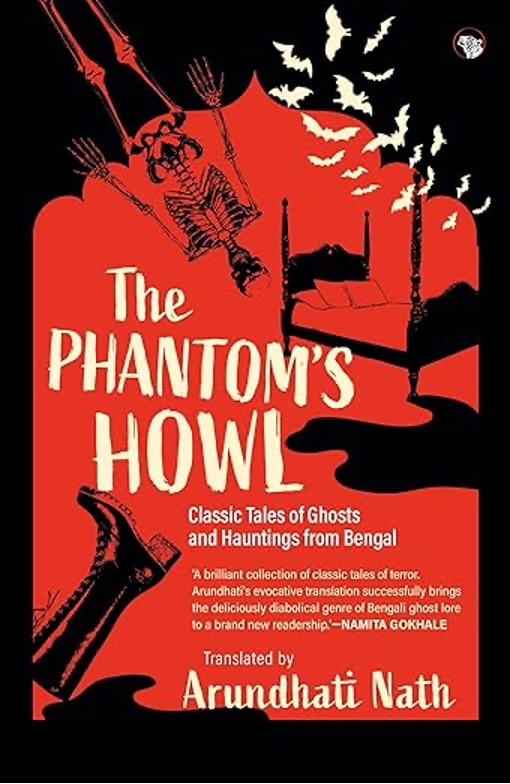
Title: The Phantom’s Howl: Classic Tales of Ghosts and Hauntings from Bengal
Translator: Arundhati Nath
Publisher: Speaking Tiger Books
Bengalis have always had a curious relationship with the supernatural and so stories of ghosts or bhoots are omnipresent in Bengali literature through generations. The Phantom’s Howl: Classic Tales of Ghosts and Hauntings from Bengal brings us a new collection to savour this genre once again. Written for adults and children by some of the best writers in the language, these stories have entertained generations of readers since they first appeared. Comprising eleven stories in all, from legendary authors such as Rabindranath Tagore, Bibhutibhushan Bandyopadhyay and Hemendra Kumar Roy (who contribute two stories each) to lesser-known writers like Jogeshchandra Bandyopadhyay, Niradchandra Majumdar and Amarendranath Munshi, the stories elucidate the supernatural elements in different forms. Manik Bandyopadhyay and Pramatha Chaudhuri, though well-known for writing in other genres, have also contributed their share in creating spooky tales.
Rabindranath Tagore’s immeasurable talent as a storyteller is well-known. In both Konkal (The Skeleton) where a vainglorious skeleton reminisces about her past beauty, and Kshudito Pasan (The Famished Stone), the supernatural element takes over in a slow burn and our understanding of the other-worldly is a cerebral exercise that is an interplay between emotion and intellect. Bibhutibhusan Bandyopadhyay’s repertoire of ghost stories is well-known. Two of his short stories about hauntings included in this anthology are Bhoutik Palonko (The Spectral Bed) and Paitrik Bhita (Paternal Legacy), and both have an enticing and intangible everyday quality in them. In the first story we are told of a mysterious cursed bed of a Chinese man whose dissatisfied soul still lurks every night and disturbs anyone who sleeps on that bed. In the other story, the generations-owned massive homestead of Radhamohan is inhabited by the ghost of a young girl Lokkhi, who happened to be their youngest paternal aunt who died at the age of twelve and she slips in and out of his conscious memory.
Hemendra Kumar Roy is known for adapting many Western writings of his time and creating his own brand of short stories. In his Bari Buro Bhoot (The House, the Old Man, the Hunting Boots), the ghost has ‘sahebi’ chops and in Bhooter Raja (The King of Ghosts), Mr. J. Taylor is a typical British Raj prop who being posted as the Police Superintendent of Santhal Pargana, had access to encountering the bizarre after spending the night in a hunting lodge in the jungle.
Manik Bandyopadhyay’s horror stories explore the psychological underpinnings of supposed ghost sightings and examine what the mind can do to the perception of a lived experience – something that stands out in Pora Chhaya (The Singed Shadow). In a totally different vein, Pramatha Chaudhuri in First Class Bhoot (The First-Class Ghost) tells the story of a proud English ghost who creates trouble on a train from Kolkata to Kashi and it is steeped in humour.
As the translator mentions, she discovered the three lesser-known writers from the pages of the Bengali magazine Shuktara with its special collection of 101 ghost stories. In Bon Kolmir Bile (Inside the Water Spinach Forest Marsh), Amarendranath Munshi creates a ghostly ambience where the lonely spirit of a young girl forever rows its boat in the marshes. In Sanket (The Signal), we are told of two friends who land up in a remote corner of Aara district and take up residence in an old, rambling, dilapidated house and are narrowly saved after they come across an innocuous black cloth that spells danger for all who wave it. In Preter Kanna (The Phantom’s Howl), Jogeshchandra Bandyopadhyay tells us how the protagonist Debkumar was trapped motionless in a maze of indescribable fear and horror only to discover how the skeleton of a dead lady’s dissatisfied soul left her secret hideaway and then whatever happens is probably a re-enactment of reality.
Though most of the eleven stories that have been included in this collection are well-known to Bengali readers who grew up during the forties and fifties decades of the 20th century, The Phantom’s Howl is a quintessential representation of Bengal and its fascination with its many ghosts and stories of haunted houses. Basically, Arundhati Nath’s translations bring these household favourites to a new generation of readers. Most of the selected stories have undergone translation several times and even non-Bengali readers might already be familiar with some of them and therefore, for many readers they would seem like warmed up fare. In the translator’s note at the beginning of the text, Nath mentions her personal choices as she began listening to ghost and horror stories from her grandmother and reading some of them in Bangla from the books her parents bought for her as she grew up outside Bengal. So, the selection was ‘tinged with the wistfulness of memory.’ But unlike the stories of Dracula, we really do not find these stories ‘as thrilling and sometimes as spine-chilling’ as she claims them to be. At best they give us a lucid picture of the different kinds of ‘bhoots’ and some spooky tales prevalent in Bangla literature.
.
Somdatta Mandal, critic and translator, is a former Professor of English at Visva-Bharati, Santiniketan, India.
.
PLEASE NOTE: ARTICLES CAN ONLY BE REPRODUCED IN OTHER SITES WITH DUE ACKNOWLEDGEMENT TO BORDERLESS JOURNAL
Rabindranath Tagore (1861-1941) in the role of the blind singer in his play, Falguni (published in 1917). Art by Abanindranath Tagore. From Public Domain
On May 7th 1861, or Pochishe Boisakh of the Bengali year 1268, Rabindranth Tagore was born in Jorsanko, Calcutta. That time, there was one subcontinent. Borders were fluid though the concept of countries had already started making inroads with the onset of colonials more than a couple of centuries ago. Rabindranath Tagore — a man who rejected the academia and earned no degrees — set the world aflame with his words and ideals. Many of his works hope to inspire people out of miseries by getting them in touch with their own strength. He created Santiniketan and Sriniketan to train young minds, to close social and economic gaps, to override the stigma of walls that continue to box and divide humanity to this date. Subsequently, his works, especially his writings, have become subjects of much academic discourse as well as part of popular cultural lore.
Tagore celebrated his own birthdays with poetry on Pochishe Boishakh. Pochishe Boisakh falls between 7-9 May on the Gregorian calendar. We start our celebrations with translations of his birthday songs and poems. The song translated by Aruna Chakravarti was the last he wrote, and based on a long poem he had written in 1922, also featured here. We also have the first birthday song he composed in 1899. In prose, we bring to you works that showcase his call for change and reform. Fakrul Alam has translated a powerful play by him, Red Oleanders, which strongly seems to reflect the machinations of the current world and ends on a note of hope. We can only carry an excerpt from this long play but it will be a powerful read when published in full. Somdatta Mandal shares a translations of an essay in which Tagore airs his views on the need for change in social norms — the strange thing is it would still seem relevant today. And Himadri Lahiri rendered an essay from Bengali to English on his views about the British Raj. We also have a story about a woman who changed social norms and her religion, translated by Chakravarti.
Birthday Poems & Lyrics
Hey Nutan or Oh ever new has been translated by Aruna Chakravarti inDaughters of Jorasanko. This was the last birthday song he wrote in 1941, a few months before he died. It was based on the long birthday poem he had written in 1922. Click here to read.
Pochishe Boisakh Cholechhe(The twenty fifth of Boisakh draws close…), a birthday poem written in 1935, seems to be a sad reminder of mortality and dreams left unfinished. Click hereto read.
Pochishe Boisakh(25th of Baisakh) is a birthday poem Tagore wrote in 1922 and the poem from which he derived the lyrics of his last birthday song written in 1941. Click here to read.
Jonmodiner Gaan or Birthday Song by Tagore was written in 1899 and later sung as Bhoye Hote Tobo Abhayemajhe ( Amidst Fears, May Fearlessness). Click hereto read the translation.
Prose
An excerpt from Tagore’s long play, Roktokorobi or Red Oleanders, has been translated by Professor Fakrul Alam. Click here to read.
This essay was first published in Tattwabodhini Patrika, Ashwin issue, 1319 B.S.(September-October, 1912) and reprinted in Pather Sanchoy (Gleanings of the Road). It has been translated from Bengali by Somdatta Mandal.
Tagore at Paris, 1921. From Public Domain
When we travel to Vilayet[1], then it is not simply going from one country to another; for us it is like entering a new household. The external differences of lifestyle are not that important. It is expected that there will be a difference between us and the foreigners in our dress, ornaments, eating and pleasure habits and so that doesn’t bother us too much. But not only in lifestyle, there is a deeper dissimilarity in our evaluation of life and to find a sense of direction there suddenly becomes a very difficult task.
We start feeling this from the moment we board the ship. We understand that we will have to abide by the rules of another different household. This sudden change is not to the liking of man. This is why we do not try to understand it very clearly; we somehow try to follow it or feel disgusted and then utter to ourselves—their manner and behaviour is too artificial.
The truth is that what is important is the difference we have with them regarding our social position. Our society has come and stopped within the limits of our family and village. Within those limits we have evolved certain fixed rules about how to behave with one another. Keeping those limits in mind it has been decided what we should do and what we should not. Some of those rules are superficial whereas others are quite normal.
But the society which is the target of these rules being framed is not very big in size and it is a society of relatives. So, our habits are quite domesticated. You cannot smoke tobacco in front of your father, you are supposed to pay obeisance to the guru and pay him some money, the sister- in- law must cover up her face in the presence of the elder brother-in-law and close proximity to your uncle- in- law is totally prohibited. Those rules that are outside the family or village society are based on caste(varna) differences.
It can be said that the thread of caste difference has tied our village society and families like a chain or necklace. We have reached a conclusion. India has resolved its societal problems once and for all and she feels that if this system can be permanently retained then there is nothing to worry about. That is why modern India is trying to strengthen in all manner this family and social bonding laws woven through the thread of varnashram[2].
It has to be admitted that India had been able to find a solution to the problems it was facing at one point of time. She has somehow reconciled the differences between diverse castes, she has pacified the struggle between diverse classes; by classifying professions she has managed to contain competition and disputes and has staved off the vanity created by differences of wealth and capacity through the fence of caste differences. Though, on the one hand, India has maintained through all means the independence of Brahmins who are at the helm of society to the people belonging to other castes, at the same time, she has also spread out small and big processes through which all facilities and education could be disseminated among the others. This is why what the rich person enjoys in India is also partly distributed among the ordinary people on various pretexts and in this way, by giving shelter to the ordinary and appeasing them, the powerful retains his power. In our country, there is no reason to go into a major clash between the rich and the poor and the necessity has not arisen by which the incapable person has to be protected by legal means.
The Western society is not family oriented; it is an open and large society which is much more widespread than ours. It is more on the outside than on the inside. The concept of family that is there in our country is absent in Europe and that is why the people of Europe are spread everywhere.
The nature of this spread-out society is such that on the one hand it is loosely assimilated and on the other it is more diverse and stronger. It is like composing a prose piece. Poetry is restricted within its rhymes and that is why its binding is simpler. But the prose spreads out. That is why on the one hand it is independent and on the other its steps are bound through logic and reason, through diverse rules on ideas about the development of the mind in a greater way.
Because the English society is so spread out and because all its activities are externally motivated, it must be always prepared for different social rituals. It hardly has time to wear casual domestic clothes. It must remain dressed up because its social area is not that of relatives. Relatives pardon you, tolerate you, but you cannot expect such tolerance on the part of outsiders. Everyone must do each and every work in due time, otherwise one will encroach upon another. If the rail line is in my area or is under the control of a few of my friends and relatives, then we can run the train as we wish and can even halt each other’s train as and when we desire. But if we try to detain a train for five minutes in the ordinary train route where lots of trains move up and down, then there will be lots of problems and that will be difficult to tolerate. Because our society is extremely domesticated or maybe because we are habituated with domestic practices, we behave with each other very loosely—we spread ourselves as much as possible, waste time and criticise formal behaviour as lacking in fraternal feelings. This is the first thing that prevents us from feeling at home in English society—there one cannot act in a carefree manner and then expect that people will pardon us. They have created different rules that will on an average benefit the maximum number of people. They have set up fixed rules for meeting each other, for invitation formalities, for dressing up, for entertaining guests. If we try and impose the laxity that we display with relatives in a place that is not actually a society of relatives, then everything turns out to be horrible and life becomes impossible.
Till now this wide European society has not come up with any solutions. It has made an effort through certain rules and regulations in external rituals and behaviour to retain self-restraint and gracefulness but is unable to make arrangements by which the internal strife at a personal level can be resolved. Europe is only going through experimentation, change and revolution. There is a constant rivalry cropping up between men and women, between religious society and professional society, between the power of the ruler and the ruled, between businessmen and worker groups. It has not pacified itself like the halo round the moon. Even now it is ready like a volcano waiting to erupt.
But how can we say that we have solved all our problems, have finalised our social structure, and are resting as peacefully as dead bodies? Even though time has elapsed, we can retain the system for some time, but we cannot keep the situation in chains. We are facing the entire world, now we cannot do with our domesticated society; these people are not merely our fathers, grandfathers or uncles, they are outsiders. They belong to different countries and so we should be extremely alert while interacting with them. If we are absent-minded and behave in a loose manner, then one day we will be totally unfit to act.
We are proud of our tradition, but it is not at all true that the society of India has not evolved through history. In different situations even India had to go through newer revolutions—there is no doubt about that—and history is replete with instances. But I don’t want to even utter that it is the end of all treading for her and from now on till eternity she will just be there and hold on to her traditionality. Society gets fatigued after each large revolution; during that time, it shuts its doors, switches off all lights and prepares to go to sleep. After the Buddhist revolution India had gone off to sleep latching her doors and windows with the hook of strict laws. She was sleepy. But to boast about this as eternal sleep will become a laughable though pitiable thing. Sleep is good only during the night, when there are no crowds of people outside, and when all the big shops and markets are shut down. But in the morning when everyone is awake and there is activity all around, if you go on quietly lying down and close all the old doors and windows, then you will be the loser.
The rules of the night are very simple. Its arrangements are sparse, and its requirements are very little. That is why we can complete all our tasks and go to sleep in an unperturbed manner. Then things go on lying where they were kept because there is no one to move them. The arrangements during the day are not so simple and completing the job once and for all in the early morning does not mean that one can relax and smoke tobacco the rest of the day. Work keeps pouring down our necks. We must keep attempting new things and if we cannot adjust ourselves to the flow of the outside world, then everything else falls out of place.
For some time, India has spent her nights in a system of strict and fixed set of rules. That does not mean that that situation will permanently remain very comfortable. Getting a beating is most painful and difficult, especially when it falls upon a sleeping body. Daytime is the period to receive such blows. That is why it is most comfortable to remain awake during the daytime.
It is time for us to wake up whether we wish it or not, whether we are full of laziness or not. We are constantly being hurt both internally and externally in society and so we are sad. We are suffering from poverty and famine. The society is breaking down; the joint family system is being split into bits and pieces. And the role of the Brahmins in society has become so demeaning that with the aid of ‘Brahmin societies’ and such other things, they keep on shouting loudly to prove their existence and thus only attest to their weakness. The panchayat[3] system worn in the neck by the government’s chaprasi[4] has committed suicide and its ghost is dominating the village. The food in the country is incapable of satiating the small village schools. Due to famine, they are now relying on the charity of government dole. The rich people of the country have doused the light in their birthplaces and are roaming around in Calcutta in motor cars, and people of noble descent are ready to sacrifice their entire wealth and their daughters at the feet of a graduate groom. There is no point in blaming the Kaliyuga[5], or the foreign king or the native English-speaking people for this misfortune. The truth is that our lord has sent his assistant during the daytime, and he will not stop till such time he can drag us out of our traditional bedrooms. So, we cannot forcibly close our eyes and try to create the night at odd hours. The world that has come to our threshold has to be welcomed inside our house. If we don’t give it a cordial welcome, then it will break open our doors and gain entry. Hasn’t the door not yet been broken now?
So once again, we must think about resolving our problems. It cannot be done by imitating Europe, but we must learn from her. Learning and imitating are not the same thing. Actually, if we learn in the correct way, we will be relieved from the art of imitating. If we cannot know the other truly, then we cannot understand the truth ourselves.
But I was saying that we cannot adjust ourselves in the European society with our loose domestic habits. We can never prepare ourselves in any way. It seems that everyone is pushing us aside, no one is waiting for us for a moment. We are pampered human beings; we feel out of place without our relatives in society. After coming here, I have noticed that since our students are not used to entering other people’s houses, most of them come here and learn things by heart but they do not keep any contact with the society here. The society here is large and so it has more responsibilities. Only if we undertake those responsibilities, can we find a sort of connection with the people of this society. If we cannot connect then we shall be deprived of the greatest learning prevalent here. This is because society is the greatest truth here. The greatest strength, the greatest sublimity is in the society here and not in the battlefield. Sacrifice and self-respect suitable for a broad-minded society are being expressed at every step. They are nurtured here and are preparing themselves in different ways to sacrifice their lives for the welfare of man. In modern India, the educated class of people still consider school education to be the true education. They are deprived of the education of greater society. Even after coming here and entering the school factory, if they come out simply as mechanical things and do not enter the birthplace of humanity visible here then they will be deprived even after coming to a foreign country.
[5] The current age in Hindu mythology which ends when the Kalki avatar comes to rescue humanity from darkness.
Somdatta Mandal is a critic and translator and a former Professor of English at Visva-Bharati, Santiniketan, India.An earlier version of this essay was published in Gleanings of the Road (Niyogi Books, pg 20).
.
PLEASE NOTE: ARTICLES CAN ONLY BE REPRODUCED IN OTHER SITES WITH DUE ACKNOWLEDGEMENT TO BORDERLESS JOURNAL
India is perhaps the one country where the Jews have maintained their identity without ever being exposed to antisemitism at the hands of their host. Although representing a microscopic segment of the Indian population, the Bene Israel is one of the largest and oldest of the three major Jewish communities of India, the other two being the Cochin Jews of the Malabar Coast and the Baghdadi Jews of Bombay and Calcutta. The Bene Israels arrived at the Konkan coast, shipwrecked, and have lived in India for more than 2,000 years and claim descent from the ten lost tribes of Israel. After they had settled down permanently in the Konkan villages of Western Maharashtra, the Bene Israels were called ‘Shaniwar Telis’ or Saturday oil pressers – a relatively low-caste designation – by the local population because they refrained from working on Saturday, the Jewish Sabbath. Later, they also farmed their land, peddled produce, and took up petty jobs, with the majority working as clerks in government offices and private firms. With time, they adopted Hindu names similar to their Biblical names and took up Marathi surnames such as Rohekar, Penkar, Palkar, and Ashtamkar by adding the suffix ‘-kar’ to the villages and town they came from. They adopted Marathi, the local language, as their mother tongue, and to outsiders, became physically indistinguishable from the local population. But within the village society, the Bene Israels were clearly differentiated from others because they adhered to Judaism. Initially overtones of a caste system coloured the Bene Israelis but they changed with time. Intermarriages between other Jewish communities became common.
With the formation of the nation-state of Israel in 1948, the exodus of the Jews of India took place on a very large scale, and only a few hundred members were left in Gujarat. Initially the integration of the Bene Israels into Israeli society was not easy and many of them returned to India but re-emigrated to Israel later after 1964 when their religious status was finally accepted.
Miss Samuel: A Jewish Indian Saga is written by Sheela Rohekar, a Bene Israel Jew, who is probably the sole-living Jewish Hindi author, and she managed to recreate the distinct identity of her own community. Bearing across life histories of her ancestors, she seeks answers to those questions that troubled her in the novel. Originally written in Hindi, it is aptly translated into English for the first time by Madhu Singh, a professor of English teaching at the University of Lucknow. The novel is narrated by Miss Seema Samuel, an almost 70-year-old Bene Israel living at an old age home called Parisar on the outskirts of Pune, and it portrays her unsuccessful struggle to fit into a majoritarian Hindu society along with the plight of being an unmarried woman in India. She tells the story of her community, of their trials and tribulations, love and loss, and their longing for ‘Aliyah’ — the return to the Promised Land of Israel. Shifting from the Konkani shores to the bustling streets of Ahmedabad (called Amdavad in the local parlance), and finally to the tranquility of an old-age home, each generation of Seema’s family grapples with the tension between their Jewish faith and Indian identity, struggling with their fear of persecution on the one hand and a yearning for acceptance on the other.
In the novel, apart from giving a macrocosmic view of the Bene Israel community which makes its members victims of isolation and alienation from mainstream Indians, and depicting their ancient history and present status, Sheela Rohekar also very deftly presents the microcosmic view of the extended family of her community along with the problems of cross-cultural liaisons and the problems each individual member of her family faces. She states: “But some images embed themselves in the mind, not in the eyes, and chase you – all your life. The role of time in fusing images is not much but the trick of a fading memory. They light up in a flash!”
Since her narration spans six generations and moves deftly backwards and forwards in time, in some places it becomes difficult for the readers to keep track of who’s who in the narrative and occasionally one must go back to the family tree chart at the beginning to place the characters in their proper perspective.
Miss Seema tells the story of Isaji Eloji, who, having married a Hindu woman named Narayani, is believed to have ‘blackened’ the Jewish name. Two generations later, burdened by his grandfather’s transgression, David Reuben stops at nothing to keep his Jewish identity pure, even poisoning his daughter Lily for loving a non-Jewish man.
Again, years later, his son Samuel David (Miss Seema’s father) finds that his Jewish identity makes him an outsider in his own country; and his grandson, Bobby, faces persecution of the worst kind – when he is murdered by a mob in Ahmedabad. It is through reading the loose notes and a long essay that Bobby had left behind that Seema manages to tell us the background history of their community. With his collection of yellow, crumbling newspaper cuttings about the Jews, old coins, badges, awards, certificates, degrees, and moth-eaten black and white photographs that were around 150 years old, Bobby tried to illuminate the path taken by the fellow members of his community – the Bene Israel, the pardesi, the foreigners – whom the people of Amdavad did not know in the twentieth century and believed to be Maharashtrians or converted Christians. The story of how his brother, David, and his Hindu wife. Jyotsna Prajapati, managed to throw Seema out of their apartment in Gitanjali Society also reminds us about such machinations that prevail in our Indian society in general. Through the different tales, the narrator remains a constant, and her memories commingling the past with the present are deftly handled by the novelist.
Further, Miss Samuel becomes a key novel to understand not only for its Indian-Jewish identity but also its multicultural Indian identity and its challenges in the present time. The old age home, Parisar, is not at all a closed space and it opens to new forms of solidarity among elderly abandoned women who, though belonging to different faiths and identities, abandon their frustration with the twists of patriarchal society to discover the meaning of friendship, love and solidarity.
Seema writes: “The campus where I live is surrounded by hills. There is silence, always. I can see residents of my age, some even older, shuffle from one room to another. Constructed at a distance of two hours from Pune, all stories seem to end up here, in this building.” Parisar is thus a model of a tolerant society that not only accepts differences but even respects, maintains and transcends them at the same time. The translation is lucid, and the translator labels her endeavour as ‘interpretive performance’ and a journey beyond imaginary borders. A good read indeed.
.
Somdatta Mandal, critic and translator, is a former Professor of English at Visva-Bharati, Santiniketan, India.
.
PLEASE NOTE: ARTICLES CAN ONLY BE REPRODUCED IN OTHER SITES WITH DUE ACKNOWLEDGEMENT TO BORDERLESS JOURNAL
Story by Bitan Chakraborty, translated from Bengali by Kiriti Sengupta
Bitan Chakraborty. Photo Courtesy: Kiriti Sengupta
The black smoke rises in a straight line. It will fade into the air as it reaches a certain altitude in the sky. The wind feels still today, causing a grey layer to form. Not long ago, Lali experienced recurrent bouts of excruciating pain, but now it refuses to subside. She tries to relax, her spine loosely resting against the wall of the leather factory. Lali shrinks again as her little baby stretches its limbs inside her womb. In the distance, her husband, Fatik, is tending to their domestic belongings in the dilapidated house. He is vigilant, working hard to safeguard their utility items. He won’t let anyone take away their hard-earned household goods. Fatik does not know what will be put into the fire. A few government-appointed people collect the crushed bamboo walls from the ghetto and add them to the flames. The more they burn, the more smoke rises. At a safe distance, a curious crowd observes the unfolding events.
Fatik packs goods in small quantities and takes them to Lali, who is resting under the shade. He quips, “I could have packed up sooner if I had someone to help. You’re in pain, huh? Hold on for a bit; we will board the train shortly.”
“Hey scoundrels, that’s mine. Keep it there, I’m telling you! Otherwise, I’ll put y’all in that fire.” Fatik rushes to their ruined house. It’s not a house anymore! An empty stretch reveals the impressions of bricks laid down for years. Fatik’s shanty looks the same — a square piece of land with torn plastic sheets and scattered, fragmented earthen roof tiles.
Lali continues to endure pain. Fatik appears exhausted; he is busy organising goods. There’s no point in disturbing him further with another complaint of discomfort. Lali remains silent and attempts to sketch the new place they will inhabit for the next few months or possibly years. No one will be a stranger there; they cannot afford the luxury of exploring exotic living. Fatik once told her, “Shashthida has affirmed that we can come back here once the air cools down.”
It’s easy to earn a living in the city, but finding a job is difficult in the countryside, where opportunities are scarce. Once the flyover is built, Fatik plans to return and set up a small eatery for the evenings. In a tone filled with love and care, Fatik tells Lali, “No one can resist the mutton curry you cook. All visitors will become regular customers at our shop.” Lali adds a touch of sass to her response, “I won’t. I’d rather teach you the recipe. You can then cook and feed them.” Gazing at the ceiling with wide eyes, Fatik remains lying in bed.
Lali does not believe in Fatik’s words that they will be able to come back here again. A few minutes ago, Hema came to see her, “My bad luck; I won’t get a chance to see your child. But you never know if I will meet you again somewhere else.”
“Won’t you come back here?” Lali asks.
“They will not allow us here again,” Hema replies. “The officials informed us that they were planning to build a marketplace below the flyover after its construction.”
Mum’s the word when Lali relays the news to Fatik. He murmurs, “But then Shashthida[1] has assured…”
“You can pursue a small shop in the proposed market,” Lali advises.
“I can’t say; they might ask for a cash lump sum as advance payment.” Fatik appears worried.
The pain shoots once again. Lali flings her legs aimlessly. The dusty floor reflects her movements. She remains silent. On the other side, Fatik gets into trouble with Dulu and his family. Dulu’s mother seems to have taken Lali’s rice pot. Lali raises her voice, “The pot is mine!” Unfortunately, her words go unheard.
2
Fatik knocks Lali with his bag, “Come on, the Hasnabad local is at platform eight. Walk along the straight direction.”
Lali has heard of the Sealdah railway station, but she has never been there. It is a large station with several platforms, numerous trains, and huge crowds. Passengers jostle against one another. With great caution, Fatik quickly walks across the platform to board the train and get into a compartment by any means necessary. There are likely a few travelling ticket examiners around, but during this time, they usually don’t enter the coach. Lali is unable to keep pace with Fatik and remains far behind him, but she compensates for the distance by tightly gripping one side of the gamcha[2] draped around his neck. Fatik collides with the commuters approaching from the other end, and a few passengers express their annoyance with a word or two of irritation. Fatik does not respond at all. Lali pulls her saree to cover her breast. She has no control over the saree girded around her head, which has now slipped onto her back.
The train will start in ten minutes. All coaches are full; not a single seat is vacant. Fatik quickly decides on a favourable compartment and boards the train with his wife. Lali cannot stand any longer, so she sits on the floor beside the door, her hands resting on her belly. Fatik arranges their bags around Lali. An elderly gentleman asks, “Where will you get off?”
“Barasat,” Fatik answers.
“What the hell are you doing here? Get inside the coach. Have you lost your mind or what? How can a sensible man board the train in such conditions?”
Fatik turns to his wife and whispers, “There aren’t any vacant seats. Do you still want to go inside?”
Lali refuses to move. The spasm has taken over her body and mind. She cannot stand up. She wants to stretch her legs to give her baby more space. However, the situation does not allow for that privilege. With each passing minute, more passengers crowd the coach, and the draft is cut off. In a dry voice, Lali calls out to her husband, “I cannot breathe. I need some air.”
“Wait a moment. The crowd should thin out after we pass two stations,” Fatik says.
As soon as the train departs, more than a handful of late passengers hurriedly board the coach. They will travel a long distance and want to get inside. The bags and goods piled around Lali create an obstacle to their movement. One of them raises his voice, “Is this a place to sit?” Another man from the crowd yells at Lali, “Stand up, I said!” Someone empathetically informs, “Try to understand; she is carrying.”
“Oh! This is horrible. Hey brother, you aren’t pregnant, are you? Better you stand up. More passengers will enter the coach at Bidhan Nagar and Dum Dum. They will smash you to death.”
Fatik gets anxious and follows the instructions. Lali shrinks in fear, feeling breathless. In her womb, she carries their only child, who waits to see the world — as if the baby complains, “I cannot stay in this small dark space anymore, Ma!” The passengers become frightened as Lali lets out a low moan of pain.
“Are you okay?”
Fatik bends toward Lali as much as possible to ask, “I’m sure it’s terrible to bear any longer.”
“No air; it’s suffocating!” Lali sounds fragile.
“It won’t be long; I’ll take you to the hospital as soon as we reach there. Shashthida has shared the address.”
Lali’s facial muscles contort in extreme agony. Fatik isn’t sure whether she has heard him. Intoxicated, Fatik had seen her suffer from pain before; during those times, he did not feel her distress. Lali wept profusely. Fatik never intended to hurt her but lost control as he downed liquor. The very next day, Fatik committed to his wife, saying, “I won’t trouble you anymore. All I want is a son!”
With a hint of dejection in her eyes, Lali poked, “Right! So, he can run a liquor shop you longed for.”
“Shut up! I’ll make him a real gentleman,” Fatik readily addressed her concern.
3
Several travellers board the train as soon as it stops at the next stations. Lali, who somehow remains seated on the floor, gets pressed painfully against the legs. She feels worse than ever. Fatik seems restless and cautiously peeks out from behind the crowd to read the station names. At times, he turns to look at the goods around him. A few passengers become irritated, saying, “What’s wrong with you? Why don’t you stand still?”
“Be careful, dada! Take care of your pocket. You never know…Dasbabu lost three hundred bucks yesterday only.” Someone from the crowd airs the words of caution.
Fatik understands the meaning of such lines. He does not utter a word, for he knows if he begins an argument, they will forcibly push him out of the coach at the next station and beat him like hell. He requests the passenger beside him, “Dada, please let me know as we reach Barasat.”
“We are currently at Cantonment. Please be patient; it will take another thirty minutes or so to reach Barasat.”
4
Lali wants to scream. She feels thirsty. Amid the numerous legs visible to her, she cannot identify Fatik’s. Even when Lali looks up to see the faces, she is unable to locate her husband. The child in her womb revolts; it will not tolerate the torture to which the mother is subjected. The baby twirls, rapidly changing positions. Lali realises that her child is responding to the world — specifically, the passengers in the coach. The tiny tot wishes to emerge from confinement to greet them. Lali is afraid — will they treat the child as lovingly as their family?
Fatik bends down and says, “We will get off at the next station. Several others will disembark. I’ll first grab the bags, and then I’ll help you off the coach. Be careful.”
Lali gathers her courage and prepares for the exit. She moves her palm over her belly, saying, “A little more waiting, Baba[3]!”
The train halts at Barasat. Passengers disembark from the train like a vigorous flow of water. Fatik feels puzzled as the bags scatter. A few passengers are still getting off. Meanwhile, many commuters waiting to board the train begin to enter. Ignoring the chaos, Lali tries to stand but fails. Fatik quickly gathers their bags and helps them to ensure a swift exit. The passengers ready to disembark push him out of the coach. Fatik cannot withstand the force and is shoved away from the train. The coach has room for more passengers and fills up quickly. Lali crouches toward the gate and cries, “Help! I’ll get off; stop the train.” People leaning out of the coach warn her.
No one can hear Lali. Fatik rushes to the coach to grip the gate’s rod, but he fails every time he stretches his hand to grasp it. A guy leaning out of the coach holds it in such a way that Fatik cannot access the rod. He refuses to give up and keeps running alongside the train. The thick crowd challenges his swift movement. Amid several passengers inside the coach, Fatik sees his wife’s hands and the two pairs of bangles she wears. He reaches the far end of the platform.
Fatik breathes rapidly. He is exhausted and sweating profusely. He shivers while keeping his head lowered. A drop of sweat rolls down his forehead and falls onto the tip of his nose. Fatik can see the passengers hanging out of the coach, trying their best to get inside. Amid their relentless efforts, Lali’s hands disappear.
[1] Dada/Da: In Bengali, the elder/older brother is calledDada(Dain short).Dada or Daissuffixed to the first or last name when addressing an acquaintance, relative, or stranger during a conversation. Bengalis also suffix Babu to a name (first or last) to show respect.
[2] A traditional, thin cotton cloth (generally, a handloom product) of varyinglengths used in Bengali households to dry the body after bathing or wiping sweat. It is also used in several Hindu rituals.
[3] Baba is father. But parents often use this word affectionately to address their sons.
(Translated from the original Bengali by Kiriti Sengupta. First published in the EKL Review in December 2021)
Bitan Chakraborty is essentially a storyteller. He has authored seven books of fiction and prose, translated two collections of poems, and edited a volume of essays. Bitan has received much critical acclaim in India and overseas. Bougainvillea and Other Stories, The Mark, Redundant and The Blight and Seven Short Stories are four full-length collections of his fiction that have been translated into English. He is considered one of the flag-bearers of Indian poetry in English, being the founder of Hawakal Publishers. When Bitan isn’t writing or editing, he is photographing around Rishikesh, Varanasi, Santiniketan, among other places. He has successfully participated in the 3-day-long Master Class on Photography led by the legendary Raghu Rai. Chakraborty lives in New Delhi with Jahan, a pet Beagle. More at www.bitanchakraborty.com.
Kiriti Sengupta, awarded the 2018 Rabindranath Tagore Literary Prize and the 2024 Nilim Kumar National Honour, has had his poetry featured in various publications, including The Common, The Florida Review Online, Headway Quarterly, The Lake, Amethyst Review, Dreich, Otoliths, Outlook, and Madras Courier. He has authored fourteen books of poetry and prose, published two translation volumes, and edited nine anthologies. Sengupta serves as the chief editor of Ethos Literary Journal and leads the English division at Hawakal Publishers Private Limited, one of the top independent presses established by Bitan Chakraborty. He resides in New Delhi. Further information is available at www.kiritisengupta.com.
.
PLEASE NOTE: ARTICLES CAN ONLY BE REPRODUCED IN OTHER SITES WITH DUE ACKNOWLEDGEMENT TO BORDERLESS JOURNAL
For 50 years now Ratnottama Sengupta has seen Haren Thakur adroitly create art from the humdrum of tribal life. And his stylised abstract of the dark-toned humans still makes her sit up and take note.
Haren Thakur with his painting. Photo provided by Ratnottama Sengupta
A dark, stick-like outline encompasses a human of the male species. A triangle, an oblong, a rectangle. A white patch in the midst of a sepia-green landscape. A drummer. A mother with a child holding aloft a balloon. Two women bathing in a primitive pond. A quizzical duck. A wriggling worm. Trees hills fish pigs cows fox… And, yes! A train zigzagging its way through a vast expanse of meadows. As we view the watercolours of Haren Thakur from Ranchi, you might think of the rice-white art of the Warli tribals characterised by geometric shapes that depict the rituals of everyday life. I might be inclined to revisit the painted layers on the 100,000-year laterite at the prehistoric rock shelters of Bhimbetka in the foothills of the Vindhyas in Madhya Pradesh. Another viewer might think of the ancient Sauras and the adornment of their walls in their adobe huts in Odisha. The artist himself might have recollections of the animated Santhal pats he saw being created during his student years in Tagore’s Santiniketan. However, none of Haren’s figures are simplistic. They are all stylised. And so adroitly that you are bound to sit up and take note of them no matter how many times you have come across the theme.
Art by Haren Thakur. Photos provided by Ratnottama Sengupta
Form and content come seamlessly together in the paintings that Haren Thakur will exhibit in Delhi’s Habitat Centre from April 15. The artist who mastered Art at Santiniketan — home to Santhals, the native dwellers of Bengal and Odisha — then made his living in Jharkhand, which is home to 32 tribes… Indeed, from his very beginning, the beauty in the dark skin-tone of the men and women going about their chores was the most natural rhythm of life in the bazaars and streets of Bankura Bishnupur, where his family hailed from, or in Purulia, where his father made his home.
Beyond doubt, Rabindranath’s deep affection for the Santhals and the Bauls reinforced this love. Much like Gurudev, Haren finds poetry in their tilling of the earth. In their mono-toned songs and the repetitive steps of their dance. In the fulfilment they find in the primeval life and archetypal love. And when, following in the footsteps of the Universal Poet, Haren finds beauty in a grain of sand, the everyday life ceases to be an essay in deprivation and rises to the level of art.
*
And his colour palette? That too came off the walls of his hostel in Santiniketan, from the frescoes and murals by Binode Behari Mukherjee. From the brick-toned ‘canvas’ that is the prehistoric rock painting of Bhimbetka. The pigment on Haren’s brush and tubes is never loud then, never grating. It is always muted, always mellow. And the impact is heightened by Haren’s utilisation of rice paper, and Chinese ink, on watercolour.
The Nepali rice paper became his signature in 1974. Prior to that he would work the rice paper in the tempera process that was ‘Master Moshai’ Nandalal Bose’s gharana, school – or Indian shaili, style. But in that process of painting layer by layer, the rice paper would lose its original character and serve merely as a background surface.
Then, in his fourth year, for a scholarship test of the Visva Bharati University, Haren experimented by soaking the rice paper in water. It became so pliant that he could spread it out like a piece of cloth. “And its texture!” It won him the scholarship — and immense appreciation from his teachers, Dinkar Kaushik and Somnath Hore. “They said, ‘Go ahead and explore this medium and this process further. It adds a dimension that has immense possibility.”
Art by Haren Thakur. Photos provided by Ratnottama Sengupta
Fifty years have gone by since, but Haren has not given it up. Sometimes, when painting on canvas, he does apply acrylic directly on its surface. But at times, even here, he pastes rice paper on the canvas, primes it with watercolour, then inks in the forms. However he adds, “when I paint on rice paper mounted on board, I do not – cannot – use acrylic. It simply doesn’t have the capacity to be absorbed by the rice paper the way watercolour gets absorbed.” So, in such cases Haren uses transparent watercolour.
Clearly the chemistry between rice paper and watercolour is amazing. Unique.
*
Circling back to the content: Haren’s understated pitch was reinforced by the Zen worldview of a teacher like Somnath Hore. The master minimalist’s use of the white, barely scratched by the red of a wound, spoke volumes — and it made Haren introspect. Once, while exhibiting the Wound series, Somnath Da had said, “I discovered such depth of emotion in the reticence of tones!” This soliloquy got deeply etched in Haren’s unconscious. And eventually it came to express itself in the rusty red of the iron oxide rich Birbhum soil; the roasted brown of Purulia’s rocky earth; the weathered green of the Bauls; the soothing blue of the open sky high above the woolly white of floating clouds.
Art by Haren Thakur. Photos provided by Ratnottama Sengupta
Flattened figures. Non-realistic features. Do you see a hint of Husain – or perhaps Paul Klee – in the abstraction of the human world? I notice a reflection of the figures encountered on Egyptian papyrus. Or the African world. Haren, on his part, reiterates his original inclination: the attraction towards the lack of artifice in Adivasi life. How else would the tribals go about their daily humdrum with a baby knotted to their back? Or float in an open pool under the sun-kissed sky? To the city-bred mind, this would be unthinkable — until Haren captions it ‘Nature’s Bathtub’!
But, notwithstanding my references, the art traditions of the indigenous people over the world have never influenced Haren. “Their art tradition is so rooted in their environment – be it of Jharkhand or of any other.” Even their pigments, brush, and surface are integral to their life. But he certainly derives inspiration from the lifestyle of the original inhabitants, he affirms.
“I have always admired their direct application, the spontaneity of their form,” Haren further explains. “But I am influenced rather by the uncomplicated lives they lead. Since I was in Santiniketan I have admired the way they connect with nature in everything they do. Their intimacy with animals is incredible – they seem to be in dialogue with the animals they domesticate! This became a part of my visual world, especially when I came to live in Ranchi. The same reality imbues the lives of the natives – Oraon, Munda, Ho, Sabar, Bedia, Lohar… They rest under the tree unconcerned about how the ‘civilised’ world looks at them. They speak with the hills, with clouds in the sky, with cattle and kids, trees and waters, rivers and streams!”
Art by Haren Thakur. Photos provided by Ratnottama Sengupta
This they do with no inhibition. Because this routine is a reality they have inherited from their ancients. “That is why I believe there is nothing more ‘Contemporary’ than this,” Haren asserts. This innate natural life, and the Santiniketan grooming, combined to forge his vocabulary, his visual language.
So, in the exhibits, you encounter an abundance of water bodies. Pools and ponds. Rivers and waterfalls. Lotus and lily. Big fish. Many small fish in its tummy. Ducks and kingfishers. Hyacinth and hayfield. All this is a natural part of the countryside that has made Haren theirs.
Interestingly there is also this play with size. In one of the frames an elephant walks down the road – and at every footfall he is greeted by a number of… ants?! Look closely and you will decipher that they are dogs!
Haren is giving you a worm’s eye view. And, in addition to the proportion, he is picturing the Hindi proverb Haathi chaley bazar, kutta bhaukey hazaar/ when an elephant walks to the market, a thousand dogs will bark! Political comment? You said it!
Stay tuned to the song of the Adivasi earth, Haren.
.
Ratnottama Sengupta, formerly Arts Editor of The Times of India, teaches mass communication and film appreciation, curates film festivals and art exhibitions, and translates and writes books. She has been a member of CBFC, served on the National Film Awards jury and has herself won a National Award.
.
PLEASE NOTE: ARTICLES CAN ONLY BE REPRODUCED IN OTHER SITES WITH DUE ACKNOWLEDGEMENT TO BORDERLESS JOURNAL
Borderless Journal started on March, 14, 2020. When the mayhem of the pandemic had just set in, we started as a daily with half-a-dozen posts. Having built a small core of writings by July, 2020, we swung to become a monthly. And we still continue to waft and grow…
Art by Sohana Manzoor
We like to imagine ourselves as floating on clouds and therefore of the whole universe. Our team members are from multiple geographies and we request not to be tied down to a single, confined, bordered land. We would welcome aliens if they submitted to us from another galaxy…
On our Fifth Anniversary, we have collected celebratory greetings from writers and readers stretched across the world who share their experience of the journal with you and offer suggestions for the future. We conclude with words from some of the team, including my own observations on being part of this journey.
Aruna Chakravarti
Heartiest congratulations to Borderless on the occasion of its fifth anniversary! Borderless, an international journal, has the distinction of carrying contributions from many eminent writers from around the world. From its initiation in 2020, it has moved from strength to strength under the sensitive and skillful steering of its team. Today it is considered one of the finest journals of its kind. I feel privileged to have been associated with Borderless from its very inception and have contributed substantially to it. I wish to thank the team for including my work in their distinguished journal. May Borderless move meaningfully towards the future and rise to greater and greater heights! I wish it every success.
Professor Fakrul Alam
Five years ago, when Borderless set out on its literary voyage, who would have imagined the length and breadth of its imaginative crossings in this span of time? The evidence, however, is digitally there for any reader who has seen at least some of its issues. Creative writing spanning all genres, vivid illustrations, instant links giving resolute readers the option to track a contributor’s creative voyaging—here is boundless space always opening up for those seeking writing of considerable variety as well as originality. The best part here is that unlike name-brand journals, which will entice readers with limited access and then restrict their spaces unless you subscribe to them, all of Borderless is still accessible for us even though it has attracted a wide readership in five years. I certainly hope it will stay that way.
And what lies ahead for Borderless? Surely, more opportunities for the creative to articulate their deepest thoughts and feelings in virtual and seemingly infinite space, and innumerable avenues for readers to access easily. And let us hope, in the years to come Borderless will extend itself to newer frontiers of writing and will continue to keep giving space to new as well as emerging writers from our parts of the world.
May the team of Borderless, continue to live up to their claim that “there are no boundaries to human imagination and thought!”
Radha Chakravarty
Since its inception, Borderless Journal has remained true to its name, offering a vital literary space for writers, artists and scholars from around the world to engage in creative dialogue about their shared vision of a world without borders. Congratulations Borderless, and may your dream of global harmony continue to inspire.
Somdatta Mandal
According to the famous Chicana academic and theorist Gloria Anzaldua, the Borderlands are physically present wherever two or more cultures edge each other, where peopIe of different races occupy the same territory, where under, lower, middle and upper classes touch, where the space between two individuals shrinks with intimacy. Hatred, anger and exploitation are the prominent features of this landscape. There, at the juncture of cultures, languages cross-pollinate and are revitalized; they die and are born. Borders are set up to define the places that are safe and unsafe, to distinguish us from them. A border is a dividing line, a narrow strip along a steep edge. A borderland is a vague and undetermined place created by the emotional residue of an unnatural boundary. It is in a constant state of transition. The prohibited and forbidden are its inhabitants.
About five years ago, when a new online journal aptly called Borderless Journal was launched, these ideas which we had been teaching for so long were simply no longer applicable. Doing away with differences, with limits, it became a suitable platform where disparate cultures met, where people from all disciplines could express their views through different genres, be it poetry, translation, reviews, scholarly articles, creative writing and so on. Many new writers from different parts of the world became regular contributors to this unique experimentation with ‘borderlessness’ and its immense possibilities are very apt in this present global context where social media has already changed many earlier notions of scholarship, journalism, and creativity.
Jared Carter
In its first five years Borderless has become an important witness for international peace and understanding. It has encouraged submissions from writers in English based in many different countries, and has offered significant works translated from a wide range of national literatures. Its pages have featured writers based in India, Pakistan, China, Taiwan, Japan, South Korea, Australia, the UK, and the US. In the future, given the current level of world turmoil, Borderless might well consider looking more closely toward Africa and the Middle East. As the magazine continues to promote writing focused on international peace and freedom, new horizons beckon.
Teresa Rehman
The best part of this journal is that it is seamless and knows no margins or fringes. It is truly global as it has cut across geographical borders and has sculpted a novel literary genre called the ‘borderless’. It has climbed the mountains of Nepal, composed songs on the Brahmaputra in Assam, explored the hidden kingdom of Bhutan, walked on the streets of Dhaka, explored the wreckage of cyclones in Odisha, been on a cycling adventure from Malaysia to Kashmir, explored a scenic village in the Indo-China border, taken readers on a journey of making a Japanese-Malayalam dictionary, gave a first-hand account of the war in Bosnia-Herzegovina and described the syncretic culture of Bengal through its folk music and oral traditions. I hope it continues telling the untold and unchartered stories across mountains, oceans and forests.
Kirpal Singh
In a world increasingly tending towards misunderstandings across borders, this wholesome journal provides a healthy space both for diverse as well as unifying visions of our humanity. As we celebrate five distinguished years of Borderless Journal, we also look forward to another five years of such to ensure the underlying vision remains viable and visible as well as authentic and accurate.
My heartfelt Congratulations to all associated with this delightful and impressive enterprise!
Asad Latif
The proliferation of ethnic geographies of identity — Muslim/Arab, Hindu/Indian, Christian/Western, and so on — represents a threat to anything that might be called universal history. The separation and parcelling out of identities, as if they are pre-ordained, goes against the very idea (proclaimed by Edward Said) that, just as men and women create their own history, they can recreate it. Borders within the mind reflect borders outside it. Both borders resist the recreation of history. While physical borders are necessary, mental borders are not. This journal does an admirable job in erasing borders of the mind. Long may it continue to do so.
Anuradha Kumar
I have been one of Borderless’ many readers ever since its first issue appeared five years ago. Like many others, I look forward with great anticipation to every issue, complete with stories, , reviews, poems, translations, complemented with interesting artwork.
Borderless has truly lived up to its name. Within its portal, people, regardless of borders, but bound by common love for literature, and the world’s heritage, come together. I would wish for Borderless to scale even greater heights in the future. As a reader, I would very much like to read more writers from the ‘Global South’, especially in translation. Africa, Asia and Australasia are host to diverse languages, many in danger of getting lost. Perhaps Borderless could take a lead in showcasing writers from these languages to the world. That would be such an invaluable service to readers, and the world too.
Ryan Quinn Flanagan
To me, Borderless Journal is a completely free and open space. Topics and styles are never limiting, and the various writers explore everything from personal travelogues to the limp of a helpful druggist. Writers from all corners of the globe contribute, offering a plethora of unique voices from countless circumstances and walks of life. Because of this openness, Borderless Journal can, and likely will continue to grow and expand in many directions simultaneously. Curating and including many new voices along the way. Happy 5th Birthday to a truly original and wonderfully eclectic journal!
George Freek
I feel the Borderless Journal fills a special spot in the publishing world. Unlike many journals, which profess to be open-minded and have no preference for any particular style of poetry, Borderless actually strives to be eclectic. Naturally, it has its own tastes, and yet truly tries to represent the broad spectrum which is contemporary poetry. I have no advice as to where it should go. I can only say keep up the good work, and stooping to a cliche, if it’s not broken, why try to fix it?
Farouk Gulsara
They say time flies when one is having fun. It sure does when a publication we love regularly churns out its issues, month after month, for five years now.
In the post-truth world, where everybody wants to exert their exclusivity and try to find ways to be different from the person standing next to them, Borderless gives a breath of fresh air. At a time when neighboring countries are telling the world they do not share a common history, Borderless tries to show their shared heritage. We may have different mothers and fathers but are all but “ONE”!
We show the same fear found in the thunderous sounds of a growling tiger. We spill the exact hue of blood with the same pain when our skin is breached. Yet we say, “My pain is more intense than yours, and my blood is more precious.” Somehow, we find solace in playing victimhood. We have lost that mindfulness. One should appreciate freedom just as much as we realise it is fragile. Terrorism and fighting for freedom could just be opposing sides of the same coin.
There is no such thing as a just war or the mother of all wars to end all wars as it has been sold to us. One form of aggression is the beginning of many never-ending clashes. Collateral damage cannot be justified. There can be no excuse to destroy generations of human discoveries and turn back the clock to the Stone Age.
All our hands are tainted with guilt. Nevertheless, each day is another new day to make that change. We can all sing to the tune of the official 2014 World Cup song, ‘Ola Ola,’ which means ‘We are One.’ This is like how we all get together for a whole month to immerse ourselves in the world’s favourite sport. We could also reminisce about when the world got together to feed starving kids in Africa via ‘Band-Aid’ and ‘We Are the World’. Borderless is paving the way. Happy Anniversary!
Ihlwha Choi
I sincerely congratulate Borderless Journal on its 5th anniversary. I am always delighted and grateful for the precious opportunity to publish my poetry in English through this journal. I would like to extend my special thanks for this.
Through this journal, I can read a variety of literary works—including poetry, essays, and prose—from writers around the world. As someone for whom English is a foreign language, it has also been a valuable resource for improving my English skills. I especially enjoy the frequent features on Rabindranath Tagore’s poetry, which I read with great joy. Tagore is one of my favourite poets.
I have had the privilege of visiting Santiniketan three times to trace his legacy and honor his contributions to literature and education. However, one aspect I find a little disappointing is that, despite having published over 30 poems, I have yet to receive any feedback from readers or fellow writers. It would be wonderful to have such an opportunity for engagement.
Additionally, last October, a Korean woman received the Nobel Prize in Literature—the first time an author from South Korea has been awarded this honor by the Swedish Academy. She is not only an outstanding novelist but also a poet. I searched for articles about her in Borderless Journal but was unable to find any. Of course, I understand that this is not strictly a literary newspaper, but I would have been delighted to see a feature on her.
I also feel honoured that one of my poems was included in the anthology Monalisa No Longer Smiles: An Anthology of Writings from across the World. I hope such anthologies will continue to be published. In fact, I wonder if it would be possible to compile and publish collections featuring several poems from contributing poets. If these were made available on Amazon, it would be a fulfilling experience for poets to reach a broader audience.
Moving forward, I hope Borderless Journal will continue to reach readers worldwide, beyond Asia, and contribute to fostering love and peace. Thank you.
Prithvijeet Sinha
The journey of authorship, self-expression and cultural exchange that I personally associate with Borderless Journal’s always diverse archives has remained a touchstone ever since this doorway opened itself to the world in 2020. Going against the ramshackle moods of the 2020s as an era defined by scepticism and distances, The journal has upheld a principled literary worldview close to the its pages and made sure that voices of every hue gets representation. It’s also an enterprise that consistently delivers in terms of goodwill and innocence, two rare traits which are in plenteous supply in the poems, travelogues, essays and musings presented here.
The journey with Borderless has united this writer with many fascinating, strikingly original auteurs, buoyed by a love for words and expression. It is only destined for greatness ahead. Happy Birthday Borderless! Here’s to 50 more epochs.
From Our Team
Bhaskar Parichha
As Borderless Journal celebrates its fifth anniversary, it is inspiring to see its evolution into a distinguished platform for discourse and exploration. Over the years, it has carved a unique niche in contemporary journalism, consistently delivering enlightening and engaging content. The journal features a variety of sections, including in-depth articles, insightful essays, and thought-provoking interviews, reflecting a commitment to quality and fostering dialogue on pressing global issues. The diverse contributions enrich readers’ understanding of complex topics, with a particular focus on climate change, which is especially relevant today. By prioritising this critical issue, Borderless informs and encourages engagement with urgent realities. Having been involved since its inception, I am continually impressed by the journal’s passion and adaptability in a changing media landscape. As we celebrate this milestone, I wish Borderless continued success as a beacon of knowledge and thoughtful discourse, inspiring readers and contributors alike.
Devraj Singh Kalsi
Borderless Journal has a sharp focus on good writing in multiple genres and offers readable prose. The platform is inclusive and does not carry any slant, offering space to divergent opinions and celebrating free expression. By choosing not to restrict to any kind of ism, the literary platform has built a strong foundation in just five years since inception. New, emerging voices – driven by the passion to write fearlessly – find it the ideal home. In a world where writing often gets commercialised and compromised, Borderless Journal is gaining strength, credibility, and wide readership. It is making a global impact by giving shape to the dreams of legendary poets who believed the world is one.
Rakhi Dalal
My heartiest congratulations to Borderless and the entire team on the fifth Anniversary of its inception. The journal which began with the idea of letting writing and ideas transcend borders, has notably been acting as a bridge to make this world a more interconnected place. It offers a space to share human experiences across cultures, to create a sense of connection and hence compassion, which people of this world, now more distraught than ever, are sorely in need of. I am delighted to have been a part of this journey. My best wishes. May it continue to sail through time, navigating languages, literature and rising above barriers!
Keith Lyons
Is it really five years since Borderless Journal started? It seems hard to believe.
My index finger scrolls through Messenger chats with the editor — till they end in 2022. On the website, I find 123 results under my name. Still no luck. Eventually, in my ‘Sent’ box I find my first submission, emailed with high hopes (and low expectations) in March 2020. ‘Countdown to Lockdown’ was about my early 2020 journey from India through Thailand, Malaysia, Indonesia, and Australia to New Zealand as COVID-19 spread.
Just like that long, insightful trip, my involvement with Borderless Journal has been a journey. Three unique characteristics stand out for me.
The first is its openness and inclusiveness. It features writers from all over the globe, with various contributions across a wide range of topics, treatments and formats.
The second feature of the journal is its phenomenal growth, both in readers and writers, and in its reach. Borderless really does ‘walk the talk’ on breaking down barriers. It is no longer just a humble literary journal — it is so much bigger than that.
The third unique aspect of Borderless is the devotion endowed in nurturing the journal and its contributors. I love the way each and every issue is conceived, curated, and crafted together, making tangible the aspiration ‘of uniting diverse voices and cultures, and finding commonality in the process.’
So where can we go from here? One constant in this world is change. I’d like to think that having survived a global pandemic, economic recession, and troubling times, that the core values of Borderless Journal will continue to see it grow and evolve. For never has there been a greater need to hear the voices of others to discover that we are all deeply connected.
Rhys Hughes
I have two different sets of feelings about Borderless Journal. I think the journal does an excellent job of showcasing work from many different countries and cultures. I want to say it’s an oasis of pleasing words and images in a troubled sea of chaos, but that would be mixing my metaphors improperly. Not a troubled sea of chaos but a desert of seemingly shifting values. And here is the oasis, Borderless Journal, where one can find secure ideals of liberty, tolerance, peace and internationalism. I appreciate this very much. As for my other set of feelings, I am always happy to be published in the journal, and in fact I probably would have given up writing poetry two years ago if it wasn’t for the encouragement provided to me by regular publication in the journal. I have written many poems especially for Borderless. They wouldn’t exist if Borderless didn’t exist. Therefore I am grateful on a personal level, as a writer as well as a reader.
Where can Borderless Journal go from here? This is a much harder question to answer. I feel that traditional reading culture is fading away year after year. Poets write poetry but few people buy poetry books. They can read poems at Borderless for free and that is a great advantage. I would like to see more short stories, maybe including elements of fantasy and speculative fiction. But I have no strategic vision for the future of the journal. However, one project I would like to try one day is some sort of collaborative work, maybe a big poem with lots of contributors following specific rules. It’s an idea anyway!
Meenakshi Malhotra
Borderless started with a vision of transcending the shadow lines and has over time, evolved into a platform where good writing from many parts of the world finds a space , where as “imagination bodies forth/ The forms of things unknown, the poet’s pen/Turns them to shapes and gives to airy nothing/A local habitation and a name.”
It has been a privilege to be a part of Borderless’s journey over the last few years. It was a journey based on an idea and a vision. That dream of creating solidarity, of transcending and soaring over borders and boundaries, is evident in almost every page and article in the journal.
Mitali Chakravarty
Looking at all these responses, thinking on what everyone has said, I am left feeling overwhelmed.
Borderless started as a whimsical figment of the imagination… an attempt to bring together humanity with the commonality of felt emotions, to redefine literary norms which had assumed a darker hue in the post Bloomsbury, post existentialist world. The journal tried to invoke humour to brings smiles, joys to create a sense of camaraderie propelling people out of depression towards a more inclusive world, where laughter brings resilience and courage. It hoped to weave an awareness that all humans have the same needs, dreams and feelings despite the multiple borders drawn by history, geographies, academia and many other systems imagined by humans strewn over time.
Going forward, I would like to take up what Harari suggests in Homo Deus — that ideas need to generate a change in the actions of humankind to make an impact. Borderless should hope to be one of the crucibles containing ideas to impact the move towards a more wholesome world, perhaps by redefining some of the current accepted norms. Some might find such an idea absurd, but without the guts to act on impractical dreams, visions and ideas, we might have gone extinct in a post-dino Earth.
I thank the fabulous team, the wonderful writers and readers whose participation in the journal, or in engaging with it, enhances the hope of ringing in a new world for the future of our progeny.
How can a 470-page long book turn into a page-turner when it is neither a historical novel nor a whodunit thriller that compels the reader to go on reading as quickly as he/she can? That too when it is a motley collection of twenty-six essays written on different occasions and on different topics for the last twenty-five years. The answer is of course Amitav Ghosh who can literally mesmerise his readers with his multi-faceted interests and subjects ranging from literature and language, climate change and the environment, human lives, travels, and discoveries. Divided into six broad sections, Ghosh clearly mentions in the Introduction that the pieces in this collection are about a wide variety of subjects, yet there is one thread that runs through most of them: of bearing witness to a rupture in time, of chronicling the passing of an era that began 300 years ago, in the eighteenth century. It was a time when the West tightened its grip over most of the world, culminating ultimately in the emergence of the US as the planet’s sole superpower and the profound shocks that began in 2001.
A subject very close to his heart and that is reflected in all the books that he has been writing over the last decade or more, the six essays of the first section are on “Climate Change and Environment.” Ghosh writes about different aspects of migration (both in the sub-continent and in Europe), about the storm in the Bay of Bengal, cyclones, the tsunami affecting the Andaman and Nicobar Islands, and about Ternate, the spice island in Indonesia. According to him, by knowing about anthropogenic greenhouse emissions and their role in intensifying climate disasters, it is no longer possible to cling to the fiction of there being a strict division between the natural and the political. Climate change and migration are, in fact, two cognate aspects of the same thing, in that both are effects of the ever-increasing growth and acceleration of processes of production, consumption and circulation.
According to Ghosh, each of the six essays in the second section entitled “Witnesses” grew out of the research he undertook for his four historical novels, The Glass Palace, and the Ibis Trilogy. All the essays in it “are attempts to account, in one way or another, for the recurrent absences and silences that are so marked a feature of India’s colonial history”. While looking for accounts written by Indian military personnel during the First World War, Ghosh came across two truly amazing books, both written in Bengali, on which three pieces in this section are based. The first of these books is Mokshada Devi’s Kalyan-Pradeep (‘Kalyan’s Lamp’; 1928), an extended commentary on the letters of her grandson, Captain Kalyan Mukherji, who was a doctor in the Indian Medical Service. The second, Abhi Le Baghdad (‘On to Baghdad’), is by Sisir Sarbadhikari, who was a member of the Bengal Ambulance Corps, and is based on his wartime journal. Both Mukherji and Sarbadhikari served in the Mesopotamian campaign of 1915-16; they were both taken captive when the British forces surrendered to the Turkish Army in 1916 after enduring a five-month siege in the town of Kut-al-Amara – the greatest battlefield defeat suffered by the British empire in more than a century. He also writes about how these two prisoners of war witnessed the Armenian genocide.
Regarding the exodus from Burma, Ghosh narrates the plight of one Bengali doctor, Dr. Shanti Brata Ghosh from whose diary (written in English) we are given incidents of events that are a striking contrast to British accounts of the Long March. What the doctor remembered most clearly were his conflicts with his white colleagues and his diary represents a personal assertion of the freedom that his nation’s hard-won independence had bestowed upon him.
Section Four entitled “Narratives” consists of three essays. Speaking about the etymology of the word ‘banyan’, and a short personal anecdote about 11 September 2001, we come to the essay from which the title of this collection – Wild Fictions – is taken. It shows us how the policies and administrative actions have divided landscapes between the ‘natural’ and the ‘social.’ Discussing several environmental issues related to the manner in which over many decades there has been a kind of ethnic cleansing of India’s forests and how the costs of protecting nature have been thrust upon some of the poorest people in the country, while the rewards have been reaped by certain segments of the urban middle class, Ghosh warns us why the exclusivist approach to conservation must be rethought. Before environmental catastrophe happens, we have to find some middle way, one in which the people of the forest are regarded not as enemies but as partners. The idea of an ‘untouched’ forest is none other than a wild fiction.
As mentioned in the beginning, Ghosh’s intellectual curiosity ranges from exploring themes of history, culture, colonialism, climate change and the interconnectedness of human and natural worlds and the readers will get a sample of these different topics in this rich collection. Over the years, we had read some of the essays in journals like Outlook, The New Yorker, The New York Times, The Hindu, The Economic and Political Weekly, The Massachusetts Review, Conde NastTraveller and so on, and some of the articles have been the product of his detailed research before he commenced writing a novel. The five essays in the penultimate section titled “Conversations” begins with a long correspondence that Ghosh had with Dipesh Chakraborty via email after Provincilaizing Europe was published in 2000. The two never met personally as Chakraborty was in Australia at that time, but the exchanges between these two scholars on such wide-ranging issues is surely a reader’s delight. The pieces on Shashi Tharoor’s An Era of Darkness and Priya Satia’s Time’s Monster which were written as reviews also form parts of ongoing dialogue. As Ghosh states, Sattia’s work “has given me new ways of understanding the role that ideas like ‘progress’ have played in the gestation of this time of monsters”. In ‘Storytelling and the Spectrum of the Past’, we are told about the historians versus the novelists view of seeing and documenting themes.
The final and sixth section comprises of three pieces that were originally conceived as blogposts or presentations, accompanied by a succession of images – “the texts that accompany my presentations are scripts for performances rather than essays as such”. In the first one, Ghosh gives us new insights from his diary notes (the Geniza documents) about how he chose to study social anthropology and how In an Antique Land was made—about the Muslim predominance in the Arab village where he stayed and how he evaded the attempt at conversion. In a lecture he delivered at Indian Institute of Technology, Kharagpur, Ghosh asks us to think back for a moment to the intellectual and historical context that led to the foundation of such institutions as the IITs, the IIMs and the outstanding medical institutions of contemporary India. He tells us how we cannot depend on machines alone to provide the solution to our social problems and talks about mercenaries, prisons, the hegemony of the Anglo-American power and how the empires kept close control over rights to knowledge. One of the great regrets of Ghosh’s life was that he never met A.K.Ramanujan and in the concluding essay of this section, he tells us how he considered Ramanujan to be “one of the foremost writers and intellectuals of the twentieth century and how one of the most important aspects of his work is the context from which it emerged.
In the introduction to this collection Ghosh wrote that we were now in a time between the ending of one epoch and the birth of another – ‘a time of monsters’, in the words of Antonio Gramsci. In the Afterword he mentions how the strange thing about this interstitial era is that it could also be described as a ‘time of benedictions’ in that it has suddenly become possible to contemplate, and even embrace, potentialities that were denied or rejected during the age of high modernity. He reiterates that it is the elevation of humans above all other species, indeed above the Earth itself, that is largely responsible for our current planetary crisis. “The discrediting of modernity’s anthropocentricism is itself a part of the ongoing collapse that we are now witnessing.” The only domains of human culture where doubt is held in suspension are poetry and fiction. Though it is not possible to discuss all other aspects that Ghosh deals with in this anthology as the purview of the review is rather limited, I would like to conclude it by quoting the last couple of sentences written by Ghosh himself when he categorically states: “High modernity taught us that the Earth was inert and existed to be exploited by human beings for their own purposes. In this time of angels, we are slowly beginning to understand that in order to hear the Earth, we must first learn to love it.”
.
Somdatta Mandal is a critic and translator and a former Professor of English at Visva-Bharati, Santiniketan, India.
.
PLEASE NOTE: ARTICLES CAN ONLY BE REPRODUCED IN OTHER SITES WITH DUE ACKNOWLEDGEMENT TO BORDERLESS JOURNAL.
Translated from Original Bengali by Hiranmoy Lahiri
Publisher: Hawakal Publishers
Bibhutibhusan Bandyopadhyay (1894 – 1950) is one of the best-known Bengali writers of the twentieth century and therefore needs no introduction. Though most of his works are largely set in rural Bengal, he didn’t receive much critical attention until 1928. Author of famous novels like Pather Panchali (1929), Aparajito (both of which inspired the famous film director Satyajit Ray make his films based on them), Chander Pahar and Aryanak, he is the also the author of several short story collections like Meghmallar (1931), Jonmo O Mrityu (1937), Kinnardal (1938), Talnabami (1944), Upolkhondo (1945), Kshanavangur (1945), and Asadharon (1946). The multifaceted nature of his short stories has invited translators to explore the different facets of this genre and till date, we find several new translated volumes of his short stories see the light of the day quite frequently.
An interesting feature of the short story is that down the centuries the genre’s changing variety made it difficult to be classified under any fixed notion. Whatever may be the subject matter, structure, or style, a short story tells a ‘story’; otherwise, readers would not read it. Whether events in their stages of development or sequential movements and logical relationships are enough for it to be considered a story have been debated so often that it is not necessary to repeat them here. We just need to remember that as far as the short story is concerned, readers have opted for it because of the beauty that lies within its compact structure, a beauty that thrills the reader when the story ends.
Now to come to this collection of Bibhutibhusan’s short stories selected and translated by Hironmoy Lahiri, a young translator and a freelance writer. Apart from the semi-autobiographical piece “How I began writing,” with which it begins, there are fifteen stories ranging from the sentimental, bizarre, thrilling, meditating, and occult where different other kinds of emotions are also expressed. Except for a couple of already translated pieces by other hands, most of the stories selected here by the debut translator have not been translated earlier and all of them are unique for their theme, style and narrative method. The stories have not been chosen on the criterion of chronology of their appearance in print or a particular theme which is usually resorted to by other translators; instead, the focus has been on the diverse nature of the author’s creative world. The volume thus includes ‘slices of life’ stories, unusual stories such as those of smugglers and dacoits, fictions of remote places and unusual personalities, and even supernatural narratives. They really provide a comprehensive view of Bibhutibhusan’s genius, and the phrase ‘kaleidoscope of life’ mentioned in the title definitely justifies this collection.
The very first story in this collection titled Upekshita, ‘The Disregarded’, is significant because it happens to be Bibhutibhusan’s first published story that appeared in the leading Bengali magazine Prabasi in 1921 and narrates the writer’s special relationship that he had developed with a village lady who took on the responsibility of taking care of his meals and looking after him. Drawn upon his personal experiences, especially during his stint as a teacher at a suburban school in Harinavi, when the myopic residents of the area misrepresented the author’s innocent nature of the relationship with the lady as a scandalous incident, it led to such misunderstanding that Bibhutibhusan eventually resigned from his school and moved to Calcutta.
‘Archaeology’ talks about a statue that mysteriously comes to life and establishes Bibhutibhusan’s interest in ghosts, the mystic and occult that is revealed in several other stories as well. Some of them are simplistic, like the story ‘Motion Picture’ that narrates the vision of seeing a lady djinn swinging outside an old house, or the sighting of the ghost of an opium seller in ‘Gangadhar’s Peril’. But there are also much more complicated ones like the very popular long story of ‘Taranath, the Tantrik’ where the protagonist is a mystic figure and practitioner of occult. With a growing fascination for tantra and tantric practices and philosophy in real life, it is said that the author had interactions with a commanding female ascetic who was a devoted follower of the Hindu goddess Kali, and she offered him words of wisdom about tantra and afterlife. The popularity of this fictional character created by Bibhutibhusan was later continued by his son Taradas Bandyopadhyay and even graphic stories continue to be created on him.
Bibhutibhusan’s penchant for exotic locations in his fiction like Chander Pahar (The Mountain of the Moon, 1937) and Moroner Donka Baje (The Death Knell, 1921) comes out clearly in the story ‘Chyalaram’s Adventure’ where a driver is recruited to help the King and his family escape from Kabul by crossing inhospitable terrain and reach India. The narrative is packed with action and thrilling escapades and Bibhutibhusan portrays Chyalaram’s brave actions and unorthodox approach to life in a positive light. As in the novels mentioned above, it expresses the author’s impressive ability to vividly and accurately describe exotic places he had never visited but write about them imaginatively, totally resting upon ‘the wings of poesy.’
In several stories, we find a delicate twist at the end of the tale, be it ‘Grandpa’s Tale’ narrating how he was forced to marry a dacoit’s daughter with a subtle touch of humour seamlessly integrated into the narrative, or ‘Not a Story’ that focuses on the danger posed by dacoits in rural Bengal at that time, where a traveller narrates the tale about a person called Satish Bagdi; or the sweet romantic ending of ‘The Suitcase Wrap’ that was inspired by an actual event when the author’s sister-in-law’s suitcase was accidentally switched on a train. This story captured the attention of readers and was eventually made into a very popular Bengali feature film called Baksho Bodol. ‘Jawharlal and God’ is a satirical tale born out of the author’s anguish and sorrow caused by the Partition of India and the tumultuous aftermath of World War II. The story was written to depict the loss of human values and how man had lost compassion and wonder for the natural world and distanced himself from God. Each of the remaining stories in this collection is unique and once again the translator needs to be congratulated for such an eclectic selection.
Providing a suitable glossary at the end, Hironmoy Lahiri has tried to stick to the original as far as possible, as well as to keep inconsistencies at bay. He has also taken particular care to maintain the essential Bengali linguistic and cultural nuances in the stories. The book will provide non-Bengali readers a good example of the quintessential Bibhutibhusan Bandyopadhyay, who is definitely a difficult writer to translate. The stories explore several universal themes that transcend cultural boundaries and will prove to be popular with readers from different cultural backgrounds.
.
Somdatta Mandal is a critic and translator and a Former Professor of English, Visva-Bharati, Santiniketan.
.
PLEASE NOTE: ARTICLES CAN ONLY BE REPRODUCED IN OTHER SITES WITH DUE ACKNOWLEDGEMENT TO BORDERLESS JOURNAL.