We share the planet with creatures great and small. To commemorate the World Wild Life Day, we present to you a selection of non-fiction, stories and poems around the fauna and its conservation
Rabindranath Tagore’s Ekti Khudro Puraton Golpo (One Small Ancient Tale) from his collection Golpo Guchcho (literally, a bunch of stories) has been translated by Nishat Atiya. The story centres around birds in wilderness. Click hereto read.
Meredith Stephens introduces us to the varied fauna (ranging from seals to monitors) found in South Australia with vivid photographs. Click here to read.
Sriniketan: Tagore’s “Life Work”: In Conversation with Professor Uma Das Gupta, Tagore scholar, author of A History of Sriniketan, where can be glimpsed what Tagore considered his ‘life’s work’ as an NGO smoothening divides between villagers and the educated. Click here to read.
Akbar: The Man who was King: In conversation with eminent journalist and author, Shazi Zaman, author of Akbar, A Novel of History. Click here to read.
Translations
One Day in the Fog, written by Jibananda Das and translated from Bengali by Professor Fakrul Alam. Click here to read.
Mahnu, a poem by Atta Shad, translated from Balochi by Fazal Baloch. Click hereto read.
Eyes of the Python, a short story by S.Ramakrishnan, translated from Tamil by Dr.B.Chandramouli. Click here to read.
Raatri Eshe Jethay Meshe by Tagore has been translated from Bengali as Where the Night comes to Mingleby Mitali Chakravarty. Click hereto read.
Pandies’ Corner
These stories are written by youngsters from the Nithari village who transcended childhood trauma and deprivation. The column starts with a story, Stranger than Fiction from Sharad Kumar in Hindustani, translated to English by Grace M Sukanya. Click here to read.
Ratnottama Sengupta sings her own paean in which a chorus of voices across the world join her to pay a tribute to a legend called LataMangeshkar. Click here to read.
P Ravi Shankar takes us through a breakfast feast around the world. Click here to read.
Musings of a Copywriter
In Life without a Pet, Devraj Singh Kalsi gives a humorous take on why he does not keep a pet. Clickhere to read.
Notes from Japan
In Bridging Cultures through Music, author Suzanne Kamata introduces us to Masaki Nakagawa, a YouTuber who loves Lativia and has made it big, playing for the President of Lativia at the Japanese coronation. Click here to read.
A tribute by Keith Lyons to the first New Zealand Booker Prize winner, Keri Hulme, recalling his non-literary encounters with the sequestered author. Click here to read.
Ratnottama Sengupta writes of a time a palace called Bardhaman House became the centre of a unique tryst against cultural hegemony. The Language Movement of 1952 that started in Dhaka led to the birth of Bangladesh in 1971. In 1999, UNESCO recognised February 21 as the Mother Language Day. Click here to read.
The Observant Immigrant
In To Be or Not to Be, Candice Louisa Daquin takes a close look at death and suicide. Click here to read.
‘Why does education in love not feature in today’s curriculum?’
— Mahasweta Devi, Our Santiniketan(Translated by Radha Chakravarty, 2022, Seagull Books)
As the world celebrates Valentine’s Day, one pauses to think how far commercialisation has seeped in over time that the very concept of a tender emotion was questioned by Tina Turner in a song called, “What’s love got to do with it” nearly four decades ago.
This was written even before Mahasweta Devi (1926-2016) published a nostalgic memoir of 1930’s Santiniketan in Bengali in 2001. She raised her pen to ask the very pertinent question that is quoted above. Why is education in love not a part of our curriculum anymore? She was reminiscing about her days in Santiniketan where children were brought up with rigorous academics while discipline was coloured with love and affection. They nurtured a love for nature in students too. This has become a rarity for many and perhaps needs to be revived as the Earth struggles to continue habitable for humankind. In the process of educating students to love and give, Santiniketan threw up many greats like the writer herself. We are delighted to host an excerpt from the start of Our Santiniketan translated beautifully by Radha Chakravarty.
Santiniketan was only the very visible part of a huge project taken on by Tagore (1861-1941). The other part now united with Santiniketan under the banner of Visva Bharati University is Sriniketan, a group of villages where Tagore experimented with raising consciousness and standards of villagers to integrate them into a larger world. He brought in new techniques in agriculture and crafts into the villages under this programme involving many prominent scientists, artists and humanists. And the project has blossomed. Did you know Tagore thought of himself as an NGO and his ‘life work’ he felt was developing villages (Sriniketan) and educating young minds to build a world where borders of knowledge, poverty and ignorance could be smoothened?
He wrote: “I alone cannot take responsibility for the whole of India. But even if two or three villages can be freed from the shackles of helplessness and ignorance, an ideal for the whole of India would be established.
“Fulfill this ideal in a few villages only, and I will say that these few villages are my India. And only if that is done, will India be truly ours.”
All this can be found in a book called A History of Sriniketan (Niyogi Books), written by Uma Das Gupta, a major authority on Tagore who moved from Oxford to Santiniketan and made Tagore’s work in these two institutions her own life’s work. We have featured her and her book in our interview/review section.
Raised out of such ashes of poverty that Tagore sought to dispel, are youngsters from the village of Nithari, where ceaseless efforts by volunteers of organisations like Saksham and pandies’ has given a new lease for life to those who have been exposed to violations, violence, divides, poverty and deprivation. One of them, Sharad Kumar, now studying to be an engineer, kicks off our new section called Pandies’ Corner with his story in Hindustani translated by a volunteer, Grace M Sukanya. His story learns from history and shows rather than tells.
A similar approach to view the present through lenses focussed on the past at a much grander scale has been taken by Shazi Zaman, an author and journalist, who has stepped into the Anglophone world with the transcreation of his own novel from Hindi to English, Akbar, A Novel of History (Speaking Tiger Books). He has brought to the fore how in days when sectarian violence based on religions killed, Akbar (1542-1605) tried to create a new path that would lead to peace so that he could rule over an empire united by administration and not broken by contentious religious animosities which often led to wars. In his interview, he tells us of the relevance of the Great Mughal in a period of history that was torn by divides, divisions so deep that they continue to smoulder to this day and date. That history repeats itself is evident though our living standards seem to improve over time. Bhaskar Parichha’s review of Growing up Jewish in India: Synagogues, Customs, and Communities from the Bene Israel to the Art of Siona Benjamin, edited by Ori Z. Soltes, also reinforces these divides and amalgamations in the modern context. The other books that have been reviewed include The Best of Travel Writing of Dom Moraes: Under Something of a Cloudby Indrashish Banerjee, and Gracy Samjetsabam has introduced us to an intriguing murder mystery in Masala and Murder by Patrick Lyons.
Translations have thrown up interesting colours this time with a Tamil story by a Sahitya Akademi winning writer, S Ramakrishnan, translated on our pages by B Chandramouli, one from Korean by Ihlwha Choi and of course a transcreation of Tagore’s songs where he sings of the meeting of horizons. A beautiful poem by eminent Balochi poet Atta Shad (1939-1997) has been translated by Fazal Baloch. We are again privileged to host an original translation of Jibananda Das(1899-1954) by Professor Fakrul Alam. We also managed to get permission to share some of Professor Alam’s fabulous translations of Jibananada Das from UPL (United Press Limited) and are starting it out by excerpting two of his poems on Banalata Sen, which were till now restricted to readership who only had access to the hardcopy. Rakibul Hasan Khan has given us an essay on these translations. An interesting essay on Satyajit Ray (1921-1992) by Rebanata Gupta and personalised tribute to the first Booker Prize winner from New Zealand, Keri Hulme (1947-2021), by Keith Lyons, who had many non-literary encounters with the sequestered author, add to the richness of our oeuvre.
Ratnottama Sengupta has also paid a moving tribute to the music legend, Lata Mangeshkar, who died at the age of 92 on 6th February, 2022. The choral symphony of multiple voices that hums through the paean recreating the larger than life presence of Lata reinforces that her lilting voice will stay embedded in many hearts and lives forever. Her perfect honing of musical skills delivered with the right emotions make her an epitome of human excellence. She gave the best of herself to the world.
Wrapped in more dry humour is Devraj Singh Kalsinarrative on why he does not want pets. Meredith Stephens, on the contrary loves pets and sails the seas of West Australia with her camera, words, seals and dolphins. Luke PG Draper also speaks for animals — for the intrusion of pollutants that harm creatures like whales in his short story. Hop all over the world with Ravi Shankar breaking nightly fasts with food from different cultures. More colour is brought in by Suzanne Kamata who starts a new column, Notes from Japan — introducing us to Japanese sensation, Masaki Nakagawa, who has sung his way to hearts with Lativian songs that he loves, so much so that he got to perform at the Japanese coronation and has pictures with the Latvian President.
The time has come to let you discover the mysterious pieces that have not been mentioned here in the February edition — and there are many.
Before I wind up till the next month, I would like to thank our fabulous team who make this journal possible. Keith Lyons has now become part of that team and has graciously joined our editorial board. Sohana Manzoor and Sybil Pretious deserve a special kudos for their fabulous artwork. Our grateful, heartfelt thanks to all our wonderful contributors and readers who keep the journal alive.
I once had a friend who told me a strange story about what happened to her father in their garden in Tehran. He saw a face peeping at him from among the flowers, a strange yellow face much larger than that of a person. He wasn’t sure if the face was itself a type of gigantic flower. Then it laughed at him silently and rolled its eyes and the father felt chills spread all over him. He retreated to the inside of the house, and it was a long time before he ventured into that garden again. We had been talking about ghosts, so I asked my friend if the peculiar face among the flowers might also be a ghost.
“There are no such things as ghosts!” she said with great emphasis. Then in response to my puzzled frown she added, “There are only genies who pretend to be ghosts,” and she went on to explain that genies are a class of beings unrelated to angels or humans, faster and stronger than people and that few of them are left now. What the one in the Tehran garden wanted can’t be ascertained. Maybe it just wanted to create some mischief. For my friend, it was very important to differentiate it from a ghost.
A ghost is the disembodied soul of a once living man or woman. But in the mind of my friend there was simply no room on the Earth for such spirits. Therefore, if someone sees a ghost, or if you see one yourself, it can’t be a ghost but something else. It must be an entity that only seems to be a ghost. If it looks, walks and talks like a duck then it’s a duck, but this rule doesn’t apply to ghosts. It is a problem for sceptics who don’t believe that the souls of human beings are able to survive death, or who don’t believe that souls exist at all, that they are illogical. Ghosts continue to be seen. So alternative explanations must be found as to what they are. Hallucinations, mirages, electromagnetism, autosuggestion or misinterpretation of something real. Or genies in disguise.
I don’t believe in ghosts and yet I once had a ghostly encounter. I was in a hotel bar with some friends. We had attended the wedding of a student we had been to university with. There were four of us. Apart from the barman, we were the only customers in the place. Suddenly a table in the middle of the room, at least three metres from where we were standing, flipped itself over so that its legs were pointing at the ceiling like those of a frozen dead horse. The barman remarked very casually, “The ghost is early tonight,” and we all just nodded as if this was perfectly fine, as if his explanation made utter sense. It didn’t feel odd, neither the event itself nor the barman’s observation. It just felt normal.
Later when we left the hotel, the four of us stopped and looked at each other. “Did that really happen?” The incident was already acquiring a dreamy aspect, as if it was something remembered from childhood rather than a very recent event. And now the barman’s words hit us with delayed force and became in hindsight as fantastical as one would have expected them to have been inside the hotel bar. This remains my most profound ghostly encounter despite its simplicity. Often, I have discussed it with those who are interested in such things. I developed a theory that I always knew was contrived and whimsical but which I offered as a serious idea anyway, just to gauge the reactions of others who had endured similar cases.
Perhaps there are other universes, an almost infinite number of them, all in parallel, with the most adjacent ones being most similar to ours, differing perhaps in only one detail or so. This is not an original concept by any means, but I wondered if somehow the bar of that hotel was a place where two almost identical universes overlapped. While we believed we were in a bar in our familiar universe, we were actually in a bar in the universe next door, a universe absolutely the same as ours with one difference, namely that ghosts existed there, were normal and nothing to elicit surprise, which is why we had accepted everything so calmly, almost disinterestedly. The moment we left the hotel we were back in our own universe, where ghosts don’t exist, and that’s why we were now surprised.
This idea resonated with people and the unsettling feeling that maybe it was true began to grip me. I was intrigued to discover that many people who’d also had ghostly experiences felt the same way at the time, blasé, aloof, very accepting of the manifestation. They were calm too until after the incident was over. Only then did they question the veracity of the phenomenon and their reaction to it, as we had done that day.
Of course, others offered jocular solutions to the occurrence. We had come from a wedding and were standing at a bar. Clearly, we were drunk! Or were we exaggerating for effect? Not in this instance, no we weren’t. Might I have dreamed the whole thing but thought it was real? Yes, that’s plausible, but that doesn’t change the fact that so many people I spoke to also had a feeling of ‘normality’ when they experienced the supernatural even if the events weren’t really paranormal.
But questions remain. If ghosts are not the spirits of dead people, then they are phenomena of psychology or physics that remain untested. They are a problem that hasn’t been solved, yet the probability is that one day they will be understood. Then sceptics will be able to rest more easily. They already force themselves to rest more easily by dismissing ghosts as an irrelevance in the modern world, but the solving of this problem scientifically will be a blessing. It will remove their need for coercing themselves to disbelieve. All of us are human beings, emotional beasts, including sceptics, and when a ghost appears we jump in fright and our hair stands on end. Even if we don’t believe in ghosts, our goose pimples do. Our rational minds don’t really have sufficient strength to enable us to act in tandem with our sceptical claims.
The incident in the hotel bar was my most remarkable ghostly experience but not the only one. The others were all sensations rather than sights, a feeling that something wasn’t right about the places I was in. Those places were always remote and always locations I encountered on hiking trips. Perhaps tiredness had something to do with my extra sensitivity or maybe it merely muddled my mind a little. Sometimes the unsettling experience happened in the daytime and sometimes at night. I might be looking for a spot to camp and after finding one would settle down. Then minutes later, or an hour later, or many hours later, I would be compelled to pack up again and move on, in a state of near panic.
Near the rather isolated Pwlldu Beach in Gower, South Wales, I heard what sounded like a bell tolling under the sea. I later learned that I was camping in a place called Grave’s End where on November 26th in the year 1760 a ship named The Caesar was wrecked on the rocks with the loss of ninety press-ganged men locked in the hold. The corpses of those unfortunates were buried in a gully that was filled with soil and a ring of limestone rocks was placed on top to mark the site. Unwittingly this is where I had chosen to bivouac. I had to leave and blunder my way through a wood that was pitch dark. Anything was preferable to remaining in that unwelcoming spot. That wood also has a reputation for ghosts and my panic compelled me to keep going until I reached the next beach along, where I slept soundly and happily.
It really does appear that some geographical locations come with a good feeling, some with a bad one. This is indisputable. But surely there are a host of rational explanations for this? I have felt a malevolent presence in a number of areas during these hiking trips and now I avoid those places at night. I regard myself as a sceptical man, yet my actions appear to indicate otherwise.
If we consider the matter closely, it will become plain that the malevolent quality of the atmosphere of those haunted places is an argument against the idea that ghosts are the spirits of dead people. In the unforgettable words of the most famous of all ghost story writers, M.R. James (1862-1936), ghosts are “the angry dead” and yet how can anger be associated with any entity that lacks a body? Anger is an emotion and absolutely requires a physicality in which to exist. It is not that the body is a vessel for anger but that anger itself is a function of a body.
Without a heart to beat faster, without lungs to breathe deeper, without blood to increase its pressure, without the glands to secrete adrenaline, how is anger practical? It simply isn’t. The most that a disembodied soul can feel in this regard is a cold and indistinct intellectual disdain. There are no opportunities for anger in the souls of dead people. And is true malevolence possible without the input of at least some anger?
I suppose that ghosts exist in ways that are tangential to our usual ideas of what they are and where they might be found. I believe they reside not in old castles but on the shelves of our own homes. A friend was talking about ghost stories and why the Victorians were so good at them. It occurred to me that whether or not they were good at them back then is irrelevant, because they are certainly good at them now. What I mean by this is that every story of any kind told by any Victorian has become a ghost story because all Victorians are dead.
Even a light comedy such asThree Men in a Boat (1889)is a ghost story in the present age because when we read it, we are reading the words of a dead man. It may well have been a story told by a living man once, but now it’s a dead man’s tale. A ghost story. In other words, the content of the story might not be a ghost story, but the form of it is. And yet we laugh when we read it. It appears that a story featuring ghosts written by a living person can be spookier than a story featuring men written by a ghost. How strange!
If a dead man whispered words in your ear while you were lying in bed, you would be scared. But when you read a book in bed by an author who is no longer alive, you are reading the words of a dead man, and if the book is a comedy you aren’t scared. Yet in both instances a dead man is communicating with you. In both instances the words of a dead man are going into your mind. It’s the same thing! So don’t laugh when reading Three Men in a Boat. Be scared instead! That book is a direct communication from a dead man to you! When we consider the matter objectively, Three Men in a Boat must be scary. Logic demands this.
So, let’s take logic seriously and always be scared by such books from now on. Because a dead man is communicating with us through it. That’s the very definition of a supernatural experience! When funny incidents happen in the book, tremble with fright. That’s the correct reaction. Shiver with dread. Because a GHOST is TELLING JOKES!
Rhys Hughes has lived in many countries. He graduated as an engineer but currently works as a tutor of mathematics. Since his first book was published in 1995 he has had fifty other books published and his work has been translated into ten languages.
.
PLEASE NOTE: ARTICLES CAN ONLY BE REPRODUCED IN OTHER SITES WITH DUE ACKNOWLEDGEMENT TO BORDERLESS JOURNAL
PIRATE BLACKTARN AND THE MERMAID


Pirate Blacktarn was sailing on a quest.
Each day he woke, feeling full of joy and zest.
“I’m going to find a mermaid, swimming in the sea
And then when I find one, I’ll ask her to marry me.”

The crew all sighed, “Blacktarn’s full of daft ideas,
We can see this adventure is going to end in tears.
Who’d marry Blacktarn when he doesn’t wash his hair?
And he’s got holes in his socks that let in all the air.
He’s lost his sword and the sheath is full of sweets
And he’s useless at cards ’cos he always cheats.”

“If he thinks a mermaid is going to marry him,
He’s soft in the head,” agreed Parrot Tim.
“Poor old Captain,” said Stowaway Fay,
“But we won’t find mermaids anyway.
They’re magic and mysterious and secret and strange
And they live in hidden places, far out of range.”

But then one evening, after a long day’s sail
They saw a mermaid on a rock, swishing her tail.
“A mermaid, a mermaid,” Blacktarn cried with delight.
“Come Crew, come and see this special sight.”

“Mermaid, mermaid, mermaid ahoy!
I’ve come to marry you,” cried Blacktarn with joy.
But the mermaid just laughed and jumped from the rocks.
“I can’t marry a man with big holes in his socks.”

Poor Pirate Blacktarn was dreadfully upset
But he found Bosun Mick, mending a fishing net.
And he asked if he’d help him mend his holy socks.
“You do it,” said Mick, “here’s the sewing box.”
So as the red sun set and the silver moon rose,
Poor Pirate Blacktarn sat darning his hose.

Then the very next day, all tidy and neat
He went to the mermaid, who sat looking sweet
And he showed her his socks and his very clean feet.
“Now you can marry me, oh mermaid my dear.”
“Oh no,” she said, “you’d better disappear.
You haven’t washed your hair for at least a year.
And your beard is tangled and matted and rough
I can’t marry you, you’re not smart enough.”

Poor Pirate Blacktarn shed a very sad tear
Then he whispered to Rakesh, hardly loud enough to hear
“Please will you lend me your comb and your shampoo.”
Rakesh was astonished but he didn’t dare to argue.
All night long, Blacktarn washed and brushed his hair
And curled and combed his beard with the utmost care.
And then in the morning, all shiny and tangle free,
He went to the mermaid and asked, “Will you marry me?”

But the cruel mermaid only shook her head
“No, for you haven’t got a sword,” she said.
“And even worse, you keep sweets in the sheath.”
And laughing she dived into the waves beneath.

Poor Pirate Blacktarn went grumpily away
“Looks like I’ll have to go searching today.”
“Will you help me find my sword?” he asked Big Bob the cook.
“No,” answered Bob, “you’ll have to look.”
All day and night, Blacktarn rummaged through his junk
And found his rusty sword, hidden by his bunk.
He cleaned and polished till it gleamed and flashed
Then put it in his sheath and to the mermaid dashed.
“Now you must marry me, please dearest mermaid.”

“Oh no Pirate Blacktarn, I can’t I’m afraid.”
“Oh dear,” groaned Blacktarn, “now what must I do?”
“Nothing, because I’m married to a merman, fine and true.”

“What!” Blacktarn jumped up and down with rage,
Then burst into tears and started to rampage.

“But never mind Pirate, I’ve bought you a gift
For I can see your spirits are in need of a lift.”
And she held out a shell, all curved and curly,
A beautiful thing, all whorled and pearly.
This magical shell you must put to your ear
And the music of Mer is the melody you’ll hear,
The sound of their singing will make you happy again
And you’ll forget all your anger and sadness and pain,
So all your hard work hasn’t been in vain.”
And down she dived into the green sea’s domain.

“Farewell Pirate”

Blacktarn held the shell and listened amazed,
For a wonderful music made him joyous and dazed.
“You know,” he said merrily to his startled crew
“I’m glad I didn’t marry, it really wouldn’t do.
That mermaid now, might have made a nice wife
But would she have suited our sea faring life?”

“Well come on crew, now we’re single and free
We must get sailing across the Lemon Sea.”
Note: The ‘Pirate Blacktarn’ poems were written in the early 1990s but were never submitted anywhere or shown to anyone. By lucky chance they were recently rescued from a floppy disc that had lain in the bottom of a box for almost thirty years. There are twelve poems in the series but no indication as to what order they were written in and the author no longer remembers. However, they seem to work well when read in any order. They all feature the same cast of characters, the eponymous pirate and his crew, including a stowaway and an intelligent parrot. The stories told by the poems are set on a fictional body of water named the Lemon Sea. (Dug up by Rhys Hughes from the bottom of an abandoned treasure chest).
Jay Nicholls was born in England and graduated with a degree in English Literature. She has worked in academia for many years in various student support roles, including counselling and careers. She has written poetry most of her life but has rarely submitted it for publication.
HUSKY DOG

I knew
a husky dog
      long ago.

     In the day
           he pulled
     sledges over snow.

                 But in the evenings
            he was a singer
                       in a jazz club.


WHAT WE CALL

I sometimes wonder
what we call a sea
in which a brave dog
swims desperately
through tempestuous
and perilous waves?

      Rough! Rough!


SHEEP MAY SAFELY GRAZE THEIR KNEES

Sheep may safely graze their knees
when skating in the dark.
Although the park is closed at night
and trees in the breeze are sepulchral
the half-pipe is still accessible
to those who have the keys
and this bold woolly flock do, it’s true.

The rams and lambs are showing off,
pulling wheelies and flipping spins,
while the ewes prefer to slalom
around tall bollards wet with dew.

But no matter what tricks they play
they are safe until the break of day,
for this is a town that loves their kind,
a place where animals can lark around
and sheep may safely graze their knees.
Rhys Hughes has lived in many countries. He graduated as an engineer but currently works as a tutor of mathematics. Since his first book was published in 1995 he has had fifty other books published and his work has been translated into ten languages.
.
PLEASE NOTE: ARTICLES CAN ONLY BE REPRODUCED IN OTHER SITES WITH DUE ACKNOWLEDGEMENT TO BORDERLESS JOURNAL
Keith Lyons introduces us to Kenny Peavy, an author, adventurer, educator and wilderness first-aider who has travelled far and wide and wishes everyone could connect with the natural world right outside their door. Click here to read.
In Rhys Hughes Unbounded, Hughes, an author and adventurer, tells us about his inclination for comedies. Click here to read
Translations
Professor Fakrul Alam translates If Life were Eternal by Jibananada Das from Bengali. Click here to read.
Ratnottama Sengupta translates Bengali poet Michael Madhusudan Dutt’sBijoya Doushami. Click here to read.
Give Me A Rag, Please:A short story by Nabendu Ghosh, translated by Ratnottama Sengupta, set in the 1943 Bengal Famine, which reflects on man’s basic needs. Click here to read.
On This Auspicious Day is a translation of a Tagore’s song, Aaji Shubhodine Pitaar Bhabone, from Bengali by Mitali Chakravarty. Click here to read.
Munaj Gul writes of how volunteers are engaged in wooing children from poverty stricken backgrounds to school in Turbat, Balochistan. Click here to read.
Camellia Biswas, a visitor to Sunderbans during the cyclone Alia, turns environmentalist and writes about the potable water issue faced by locals. Click here to read.
In Fakir Mohan: A Tribute, Bhaskar Parichha introduces us to Fakir Mohan Senapati, the writer he considers the greatest in Odia literature. Click here to read.
Sohana Manzoor tells a story around the awakening of a young woman. Click here to read.
Among Our People: Devraj Singh Kalsi gives a fictitious account of a common man’s quest for security in a country that is one of the world’s largest democracy. Click here to read.
Book Excerpts
An excerpt from Shazi Zaman’sAkbar: A Novel of Historydetailing his interactions with Surdas and Braj. Click here to read.
Ideally, I would love to start the New Year with laughter and happiness! Then perhaps, the whole year would be dotted with humour …
Laughter clubs often practice laughing for health benefits. I know the pandemic makes both guffawing outdoors or in a group hard but think of the funniest possible thing and, perhaps, you will start laughing. For me what works other than children’s and monkeys’ antics, are my trips to the dentist, especially the trip where I wondered on the fringe benefits of ‘laughing gas’ (as given in the PG Wodehouse novel of the same name), only to be informed that it was used exclusively for young children. For me, an adult, there was only — you have guessed it — the jab that numbs your lip function to lubber. I discovered if I could make light of a dentist drilling by learning from Harry Potter (the spell to get rid of the terrifying boggart, who took the shape of the thing you feared most, was to imagine the funniest thing, focus on the humour in it, and shout ‘Riddikulus’ with a wand pointed at the creature in the form of your worst nightmare), then I could pretty much get rid of most fears.
The other thing I have been wondering for sometime is can one write an editorial that is humorous when the content is serious? I would have wanted to ask that question to many, including Ruskin Bond, who continues as one of my idols. I would love to touch hearts with the humour and the sensitivity that flavours his writing. It is tough to convey a complex thought with the simplicity and elegance of a writer who can be read and understood easily. I think we have a few of them around and I interviewed one. You all probably know him well— Rhys Hughes. I have given the reasons for the interview in lieu of Mr Bond, who continues a distant star beyond the horizon of online interviews. We discussed humour and its role in literature, leaving out completely in the cold, the fictional Mr Bond who answers to the names of James and 007 and has made entertaining films, which can be seen as serious or non-serious.
Hughes has of course, given some writerly advice not just in the interview but in ‘Making Something of Nothing’ – pretty much the advice that God had probably been given when he asked an unspecified friend on how to create the universe and multiple realities. Hughes has also added to our galaxy of poets where Michael Burch, Ryan Quinn Flanagan, Anasuya Bhar, Vernon Daim, William Miller, Pramod Rastogi, Mike Smith, Jay Nicholls and many more continue to sparkle. Taking up the theme of God’s creations, Devraj Singh Kalsi has added to more humour with a dream of divine intervention to make the ‘New Normal’ in 2022 – a plan for this year. Will it ever be real?
Another major issue in this world currently is climate change. In keeping with the need for acceptance of this reality, Keith Lyons introduced us to a nature lover, author and adventurer Kenny Peavy, who loved the fictional adventurer called Indiana Jones and has been working towards living in harmony with nature. He moved to Indonesia from America and is trying to raise awareness. You can find much, though not elephants, in the interview that encompasses the story of a man who cycled across a continent on a bike made of bamboo. However, you can find some writing on a king who acquired the skill to ride and tame elephants in our book excerpt from Shazi Zaman’sAkbar: A Novel of History. The excerpt does not showcase his elephant taming skills as did the Bollywood blockbuster Jodha Akbar but is focussed on bringing out the syncretism in the Mughal monarch’s outlook which made him seek out exponents of other religions. Sangita Swechcha’s and Andrée Roby’s anthology, A Glimpse Into My Country, with excerpts of short stories from Nepal and Zimbabwe, like Kenny Peavy, cycle across multiple borders as does our fiction. We feature stories from within and without the continent with Fazal Baloch recombining a couple of folklores from Balochistan to a single tale. Fiction from young writers highlight compassion and a varied perspective. Steve Ogah has a story from Nigeria which almost rings with overtones of Alex Haley’s Roots. Sohana Manzoor has given us a poignant narrative with an inspiring twist at the end, an absolute antithesis of the humorous one she rolled out for us last month. Candice Louisa Daquin has also given us an exceptional short fiction along with her column where she discusses the changing face of families in the current context.
While Daquin’s focus is mainly towards the West, we have an essay from Sanjay Kumar on families that live in the greyer zones of big cities, children from an outcropping called Nithari in Delhi, where they or theirs suffered neglect, abuse, carnage and cannibalism in their formative years. Introducing the impacted children, Kumar explains how they transcended the wounds that lacerated their lives. This piece is a precursor to a column called ‘Children of Nithari’. Starting February, the abuse victims will give us a story a month which will be translated by young volunteers from pandies’, an activist theatre group founded by Kumar, and published in Borderless. Another article from Balochistan reflects on the lack of literacy and efforts to bring children into the folds of schooling. Pakistan ranked 99th out of 132 countries on the literacy survey in 2021. We are privileged to be the voice of the unheard.
Two essays that ring of concerns raised in the Kenny Peavy interview are to do with climate crisis in the Sunderbans and waste disposal in Delhi. Both of these are written by researchers who are working on these issues.
We have travel pieces from Australia – one is a sailing adventure by Meredith Stephens and the other is about a trip to the Sand Dunes of Western Australia by Shernaz Wadia. Ravi Shankar has also taken us through winters from the Everest to New York with his globe-trotting non-fiction. Penny Wilkes takes us on a flight of creativity with beautiful photography.
We have a stellar layout of translations. Professor Fakrul Alam translated another poem by Jibananada Das and Borderless is honoured to publish it to the world for the first time. We have a translation from Korea and another of a Brahmo hymn, Aji Shubho Dine, by Tagore, which is sung often during festivals. The icing in our Tagore section in this issue is Ratnottama Sengupta’s translation of the Kobiguru’s ‘Two Birds’ (Khanchar Pakhi Chhilo) along with a musing which reflects on the perspectives of the two contemporaries, Tagore and Saratchandra. She has also translated a well-known Bengali poet, Michael Madhusudan Dutt. Dutt wrote just before the advent of Tagore and had an interesting past which has been vividly depicted by Sunil Gangopadhyay in Those Days (Sei Somoy in Bengali), a novel that has been translated by Aruna Chakravarti. Bhaskar Parichha has given us a tribute on the occasion of the birth anniversary of Fakir Mohan Senapati, who, he claims, has the same standing in Odia literature as Tagore in Bengali or Premchand in Hindi.
Parichha has also reviewed Amit Ranjan’sJohn Lang; Wanderer of Hindoostan; Slanderer in Hindoostanee; Lawyer for the Ranee. It looks like an interesting read where an immigrant Australian came supported Rani of Jhansi in India. Rakhi Dalal has reviewed Selma Carvalho’s Sisterhood of Swans, again a story of migrants and their lives. The theme seems to echo among the books that have been reviewed this time, including Gracy Samjetsabam’s take on Anuradha Kumar’s The Hottest Summer in Years, a story about a German immigrant to India in the twentieth century. Meenakshi Malhotra’s review of Somdatta Mandal’s translation of A Bengali Lady in England by Krishnabhabini Das (1885) highlights the views of a traveller rather than an immigrant as the lady did return home after a ten-year sojourn in Britain. As Meenakshi contends, “The process of travel offers opportunities for emancipation where exposure to other cultures offers her a way of viewing and of gaining a perspective on her own experiences and that of her sisters in India. Krishnabhabini constantly refers to her Indian sisters and bemoans their sorry state and ignorance when she sees how active British women were in their families and societies…”
I was supposed to try my hand at a humorous editorial, but I realise that is tough when the ground is small. For humour, we need rolling acres where we can etch out each detail till it cannot be milked further for laughter. But I promise you I will keep trying to please the readers till one evolves to write like Ruskin Bond.
I would like to thank my fabulous team who even if not actively contributing to content are always at hand to advise and help. I would especially want to thank both Sohana Manzoor and Sybil for their fantastic artwork, which is as wonderful as their writings. I would like to give heartfelt thanks to all the contributors who have made this journal possible and each reader who comes back to our journal for more every month. Some of the pieces remain unmentioned adding to the mystery of the content, just like, Christmas gifts which need to be unwrapped and continue a reality even in January in some parts of the world – the Russians celebrate on January 7th and the Spaniards extend their festivities to January 6th.
Do take a look at this month’s edition for not just the stories mentioned here but for more.
I wish you all a wonderful New Year filled with laughter.
I have always wanted to interview Ruskin Bond who lives in Landour, near the hill-station of Mussoorie in India. Bond, now 87, grew up in Dehradun, tried a stint in England and returned to the country that had nurtured him to write stories that make us laugh and yet bring out the flavours of love and kindness in the Himalayas. Sadly, no one seems to be able to get me an online interview with him. So, I did the next best thing…
I interviewed Rhys Hughes.
Rhys Hughes in Srilanka
You have to see it from my perspective, here was a humourist migrating from UK to India, just like Bond. Both their names begin with R — Ruskin wrote of monkeys conducting a fashion parade in colourful pyjamas borrowed from him, perhaps permanently and Rhys wants to interview a monkey who took a bottle of coconut oil from his current home. Only, Hughes’ monkey happens to be in Sri Lanka and Bond’s monkeys were in India. In fact, I told Hughes he could be the next Bond and could perhaps get into an apprenticeship. He has the basic compassion and humour in his writing that endears Bond to so many hearts. However, Hughes has not made it across to India as yet. He waits on the lush shores of Sri Lanka to make a landfall on the Coromandel Coast or … maybe the Himalayas… as the pandemic continues to upheave in tsunami-like waves. Maybe, Rhys Hughes will become the Ruskin Bond of Sri Lanka! Let us tread into the world of Hughes to check out what he thinks.
Tell us since when have you been writing? What gets your muse going?
I began writing when I was six years old or so. My earliest stories were inspired by films and comics I enjoyed and mostly were about monsters, adventures, space travel, robots, dinosaurs and ghosts. I doubt if any of them made much sense.
The first short story I wrote with a plot I remember was about a man who jumps off a cliff so that he will turn into a ghost and can create mischief in his village, which he does, but the twist is that he survives the fall and only thinks he is a ghost. The enraged villagers chase him back over the same cliff, and he isn’t frightened because he believes he can float on air, but he can’t and this time he doesn’t survive. I was about ten years old when I wrote that. But I didn’t begin writing short stories in earnest until I was fourteen. That was the real beginning of my writing career. I have been writing regularly ever since. I don’t require prompting to write these days. It has become a habit, a reflex, something I just do. I still write about the same old things as always, monsters, adventures, space travel, etc, but I have added a few more themes since I was a young child and my style has improved considerably. At least I hope it has!
That story you wrote as a ten-year-old definitely has potential! And we enjoy your writing as we read it now. Now tell us why do you write?
Ideas come unbidden into my mind and they won’t leave me alone unless I put them into stories. The moment I embody these ideas in a work of fiction they stop bothering me. I get ideas all the time, especially when I am walking or travelling somewhere, but also in the middle of the night. I try to make notes so I can use them later but sometimes I neglect to note them down and I forget them. Then the ideas go away temporarily but return days, weeks, months or years later and bother me again. Only when I pin them down into a narrative of some kind will they go away forever. So writing is a compulsion for me as well as a voluntary activity. It wasn’t always like this.
In the beginning I found it difficult to come up with original ideas. I had to work hard at it. I would say that most of my ideas back then were fairly ordinary ones and only occasionally truly original. But I persisted and exercised my mind, and just like muscles do, the parts of my mind responsible for the invention of original ideas got bigger and stronger, and now the ideas come without effort. As it happens, not all these ideas turn out to be as original as I like to think they are. Sometimes I get excited that I have come up with a totally new concept only to later discover that some other author beat me to it years ago. But I do believe that originality is possible.
The oft-repeated maxim that there are no new ideas simply isn’t true. If originality is impossible, how were any ideas generated in the first place? I don’t mean to say that originality is the ultimate objective of writing, of course not, there are a great many other reasons to write, but I am talking about it from my own particular point of view. And all I am really saying here is that practice is the most important thing, the only essential thing. I write a lot and the very act of writing regularly seems to make writing in the future easier and smoother.
What is your favourite genre for writing and for reading?
The genre question is a difficult one to answer but I am going to say that if I had to choose only one genre to describe my own writing I would answer “comedy”. This doesn’t mean that everything I write is comedic, but a large percentage of it certainly is. And I don’t necessarily mean laugh-out-loud comedy but other types of comedy too, whether subtle irony, philosophical farce, absurdist and surrealist works. There are many grades of comedy, from wit to parody, and I enjoy most of them. When it comes to reading, I still have a focus on comedy, I suppose, but I will read very sober and serious works too. If I made a list of my favourite works of fiction, comedic works would be at the top of the list.
Broadly speaking there are two types of humorous literature, one in which incidents are funny and one in which it is the telling that is comic. Writers who combine both types tend to win my deepest admiration. Yet quite a few of my favourite books have no comedy in them at all, neither in subject nor in style, for example The Adventures and Misadventures of Maqrollby Alvaro Mutis ( 1993, translated by Edith Grossman, 2002) which is a sequence of tropical and troubling narratives, often sombre in tone, that nonetheless remains an enthralling and uplifting read.
Which writers have influenced your work? Are you influenced by other art forms?
I wanted to become a professional writer because of Robert Louis Stevenson. It was Treasure Island (1883) that opened the gates into the entire world of literature for me. I still admire him hugely but I have had much bigger influences since then. Delving deeper into the novels and short stories that were available to me, I was lucky enough to find authors who resonated with some deep part of my being and made me not only want to continue trying to be a writer, but to be a writer who wrote as they did. Of course, it’s better to develop one’s own style, but I suspect that ‘distinctive’ styles are really the result of amalgams of influences, a blend of prior styles. Italo Calvino (1923-1985) has been my favourite writer for more than thirty years, with Donald Barthelme (193i-1989), Boris Vian (1920-1959), Flann O’Brien (1911-1966) and Stanislaw Lem (1921-2006) not far behind. At the moment I am a keen reader of the work of Mia Couto (1955-2013). Alasdair Gray (1934-2019) is another favourite.
To answer the second part of your question, I have definitely been influenced by art forms other than writing, in particular music and visual art. I might even say that the paradoxical imagery in the artwork of M.C. Escher (1898-1972) has been at least as big an influence on me as the prose of any author. I was astounded and captivated when I first saw his graphic designs and have loved them ever since.
You have travelled to many places. How many countries have you visited? Has travel impacted your writing? How?
I have lost count of the number of countries I have visited. I used to keep a map and colour in the countries that I had been to, but I lost the map years ago. The truth is that probably the total isn’t as high as I think it is. Most of my travelling has been done in Africa and Europe, and I have only really dipped my toes into the vastness of Asia, and I haven’t even been to the Americas at all. No one is so well-travelled that they really know the world.
Travel has certainly impacted my writing, though. I can state that with confidence. I am often inspired to write stories set in the places I have visited and I guess I probably wouldn’t do so if I hadn’t been there. Having said that, I do occasionally set a story in a location I have never visited. Such stories can work well but there is nearly always a vital element missing, some immediacy that a certain level of familiarity gives to a work of prose. It’s far easier to create a convincing atmosphere when you are writing from experience rather than from research. Little details will give some solidity to the evocation of scenes, details that can’t be easily imagined without first-hand experience. This doesn’t mean that I think travelling is necessary for the creation of good fiction. Good fiction can be centred in nowhere, almost in no space or time if the author is talented enough. And there’s a paradox in the nature of travel, which is that even though the particulars of your surroundings might change, the essentials remain the same. We can put a lot of effort into the act of travelling only to discover that people are people everywhere. And would we have it any other way?
Tell us a bit about the world you grew up in — we have an interesting piece by you called ‘Dinosaurs in France’ — which claims you grew up in a world of different value systems. Would you see those as better or the present as better?
The past is another country. That’s one of the pithiest and truest maxims anyone has devised. In only half a century I have seen many changes, but in fact most of these changes came so gradually I didn’t notice that things were changing at the time. Only now, looking back, do I see the vast gulf between the present and my past. I was youthful in a world where information was much more difficult to obtain. There were rumours and suppositions and often no way of confirming or refuting them. People believed strange things and adjusted their attitudes to match these odd beliefs. People still do the same now, of course, but it somehow feels different. One can more easily check assertions now than before and learn much more quickly if they are true or false. The world I grew up in was one in which you had no choice but to take another person’s word at face value. So if a supposedly responsible adult, like the postman, told you with a straight face that he lived in a house made entirely from marshmallows, there was no easy way of disproving the claim. You had to take his word for it. I can’t say it was a better world and I don’t want to suggest it was a worse one. It was simply different, a world lacking ready access to information.
You have written a lot of humour. Not too many people do that nowadays. Could you tell us why your funny bone is tickled to create humour as it does? Do you think humour is a good way to address major issues?
Humorous writing has gone out of fashion to a certain extent in the anglophone world, yes, but it’s still there, in the background. There was a great tradition of British humorous writing that lasted about a century or so, and I was fortunate enough to grow up at the end of that phase. I am talking about a particular type of humour, dryly ironic but also theatrical, a sort of blend of surrealism and the old musical hall routines. J.B. Morton (1873-1979) was one of the masters of the form, and he was an influence on many of my favourite comedic writers, such as Spike Milligan (1918-2002), Maurice Richardson (1907-1978) and W.E. Bowman (1911-1985). These humorists also took the language and played with it a little, transforming it into something new, though I feel ultimately that such comedy derives more from the rhythms than the melodies of wordplay.
The entire range of comedic devices might be used but new ones invented as well. There can be over reaction to minor incidents and under reaction to major ones, constant misunderstandings, amplification of repetition, parody of existing forms. W.E. Bowman’s The Ascent of Rum Doodle is my favourite humorous novel, and its sequel, The Cruise of the Talking Fish, is also high on my list of best comedic literature. Bowman apparently wrote a third volume in the series that remains unpublished and is in the safe keeping of his son. If this is true, I hope it will appear one day.
Are you influenced by any specific humourist? If so, who?
Flann O’Brien is probably my biggest influence in terms of comedic prose. His work is quirky, inventive, curiously erudite, absurdist and often metafictional. I am staggered by the wealth of invention in his novels, the supremely silly but also highly ingenious conceits and concepts, and the bone-dry irony contrasted with farcical exuberance, the light touch and the dark tone. W.E. Bowman and Maurice Richardson are another two favourites. That is prose but when it comes to poetry I love Don Marquis (1878-1937), Ogden Nash (1902-1971) and Ivor Cutler (1923-2006) best, all of them with radically different approaches to comedy. Marquis in particular pushed humour in his free verse to a point where it often became profound, serious and socially critical. You asked if humour can be used to address major issues. Yes, sometimes it can, even with great force, but it doesn’t have to.
Tell us the extent of your work. How many books have you written?
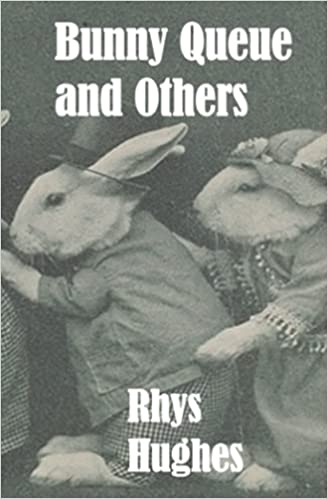
I have published many books. The question is how do I count them. I tend not to count the self-published books. It seems to me that self-publishing is too easy. On the other hand, traditional publishing is maybe too difficult. I have forty or so traditionally published books and twenty self-published books out there, so I am going to give forty as my answer. Most of my books are collections of short stories. I have only written a few novels. My poetry collections so far have been self-published with the exception of one single volume called Bunny Queue.
It is one of my goals to have all the short stories I have ever written appear in my books. At the moment there are many of my short stories that exist in magazines and anthologies that have never been collected. And there are many unpublished short stories in my files too. My plan is to write exactly a thousand short stories and consider them as part of one big story-cycle. This project is almost done. In a few more months, with luck, I will finish writing my thousandth story. Thirty years in total it has taken. When that last story is finished I will devote myself entirely to novels, plays, poetry and articles. No more short stories! So, in reply to your question, I can say that I have written a great deal of work, maybe too much, but as I said earlier, writing has been something of a compulsion for me.
What are your future plans?
I plan to finish my big story-cycle of one thousand stories. Then I will write a few novels that I have been planning for a long time. One of these novels will be called The Hippy Quixote and will be about a young, deluded fellow who in his mind is living in the 1960s. He takes a guidebook written in that decade and follows the old hippy trail to India, blissfully unaware that so many things have changed in terms of societal attitudes and geopolitics. This idea seems to me to be a fruitful one for the creation of comic scenes.
I also have to finish a novel I began a long time ago, The Clown of the New Eternities, sections of which have already been published. It’s long overdue for completion. This novel is about a highwayman who has accidentally outlived his own age and is forced to adjust to the modern world. Another variant of Quixote, I suppose. I think that many or most of my longer narratives are a blend of the Quixote and Candide models with a bit of Gulliver thrown in. We can talk about our future plans all day, of course, but whether we are lucky enough to have a chance to make them real is another question altogether. I intend to do my best, as I have always done, but nothing is certain in this world of ours.
Thanks Rhys Hughes for your time and lovely answers.
I dislike giving advice almost as much as I dislike receiving it, but as a friend recently asked me if I knew of any easy techniques to generate ‘inspiration’ when creating an outline for a story or script. I replied to her request. Somewhat pompously and just a little ponderously, I’d now like to share the answer I gave to her with everyone, even with you out there. This is what I said:
(a) Don’t sit around waiting for inspiration.
(b) Don’t chase it too hard.
Some people appear to assume that ideas are difficult to come by, and if we mean very good ideas, then that’s true. But if we concentrate on workable ideas, the fact is that they can be manufactured easily. Strange useful juxtaposition is one reliable and simple way to create new ideas. Think of the elements hydrogen and oxygen. Pretty neat on their own? Yes, but a bit overdone.
Put them together and what do you get? Water! The first time water was created I am sure that its originality was astounding, far more astounding than might have been anticipated. After all, water is a fusion of hydrogen and oxygen but not just that. It is also something entirely itself, with all its own qualities and properties, most of which hydrogen and oxygen don’t have. Indeed it would be virtually impossible to anticipate the properties of water by examining the behaviours of the elements that constitute it, no matter how minutely detailed the analysis.
Water is a new thing. You can’t pre-empt thingness. It can’t be modelled before it exists. Only with hindsight can we have understanding. We may work backwards as a consequence and then model it as the necessary outcome of a combination of the two elements that constitute it, but this doesn’t change the fact that water is not obviously contained in embryonic form in hydrogen and oxygen. The empirical truth came first, the chemical formula followed, and only later did we nod at each other with the false wisdom of experience disguised as physics.
I repeat, there is nothing in the attributes of the atoms of elements to give us specific clues about the attributes of the compounds they would generate when they are clashed together. The same may be true for ideas, if we regard archetypes or clichés as the atoms of story elements and decide to combine them unusually. This method is one I might use when I want to come up with an outline for a story from scratch. I’ll take two things that aren’t connected and put them together to see what will happen. The less naturally connected those things already are, the better the process and the nicer the outcome, because you can have more fun trying to connect them, and more surprising ideas will be generated as a result.
These original ideas will come with very little effort, because they have no other choice. The simple act of colliding and fusing a pair of unrelated items will mean that such ideas naturally come into being, the same way that water comes into being when we bash hydrogen and oxygen atoms into each other. And one way of finding pairs of things that aren’t naturally connected is to flip open a dictionary at random and jab a finger down onto the page. The finger chooses a word, the first word, then repeats the process for the second word, and the two consequent words are the magnetic poles of the story. They run right through it just as the magnetic poles of our planet spear our globe like a blue pumpkin on a skewer.
I tried the method recently and here are my combinations:
Caffeine addiction and macramé.
Frogs and tangerines.
The fashion world and tropical diseases.
Astronomy and crossbows.
Economic downturn and pickled gherkins.
Liver salts and scarves.
Tinted windows and army trousers.
Bananas and canoes.
Howler monkeys and world peace.
Bellybuttons and cacti.
Castigation and dirigible accidents.
Zoetropes and cheese.
Almost any two unconnected things will work. Maybe pairing together ‘modulus’ and ‘reciprocal’ would cause difficulties. ‘Oneness’ and ‘duplicity’ too. ‘Contradiction’ and ‘congruence’. I am sure there are many others, and that you can devise pairs that defy my technique. But generally speaking the method is sound. And perhaps a very clever person could work perfectly well with all combinations, even those that cancel themselves out, especially with those, one suspects. It ought to be remembered that if two words are picked that the picker doesn’t especially like, the random page flipping can be done again. The method is a tool, not an order. ‘Tool’ and ‘order’ are two words that can surely be combined productively.
Recently I learned that the old British comedy show, The Goodies (1970-1982), used the same technique at the script stage. Perhaps that was where I learned it, for I was a devoted follower of the show when I was very little, but it must have happened by a process of mental osmosis, for I never consciously understood that this was how the writers Graeme Garden, Bill Oddie and Tim Brooke-Taylor generated their initial scenarios. In one episode, a satire on apartheid, the piano in the South African embassy had the white notes grouped at one end of the keyboard and all the black notes at the other. I am wandering off the point, of course, but the joke still seems especially poignant in its absurdity. Back to the day’s business!
There is absolutely no need to stop with only two unusually juxtaposed elements. More may be used according to taste. For example, three parameters may be selected for the structure of the story: (a) location, (b) activity, (c) participant. I open an atlas at random for the location, which turns out to be Rangoon. Now I need an activity. I turn on the radio, which is broadcasting a cricket match. Very well. Now a participant must be found. I look out the window and see a rabbi walking past. So the story must be set in Burma and involve a religious scholar who is a wicket keeper. The basics of the work are already in existence. But what happens next? Another application of the method will bring forth something for this fellow to do. He won’t sit around waiting for inspiration. Nor will he chase it too hard.
A lot of hydrogen and oxygen has combined in his vicinity. Rangoon is flooded. A canoe is provided for him and a bunch of bananas for sustenance. He paddles down the watery streets seeking his only friend, a tailor who has succumbed to malaria. The search is fruitless, so he moors his canoe next to a stall in the market and buys some tangerines while frogs hop all about him. Yes, he has already eaten the bananas. The day is over, night comes and the stars twinkle above him. He is surprised to observe a constellation previously unknown to him.
The twang of a discharged crossbow alarms him. A soldier on a roof is aiming at the new pattern of stars in the shape of a howler monkey. How might world peace be achieved with people like this about? Suddenly the stars vanish. Has the soldier killed them? No, it is merely an unlit dirigible looming from out of the sky. Let’s shout at it for doing so! There is no need for me to continue. The point has been made. The man in the tale has a fictional fate mapped out. This doesn’t mean that his adventures will be any good. That isn’t up to me, but you.
Rhys Hughes has lived in many countries. He graduated as an engineer but currently works as a tutor of mathematics. Since his first book was published in 1995 he has had fifty other books published and his work has been translated into ten languages.
.
PLEASE NOTE: ARTICLES CAN ONLY BE REPRODUCED IN OTHER SITES WITH DUE ACKNOWLEDGEMENT TO BORDERLESS JOURNAL







 Borderless