The Not-So-Glum Panjandrum
likes to play the drums
on every day of the month of May
and in the night-time too.
If you happen to be his guest
when his fingers are twitching
and his drums are itching
to be played, you will surely find
it most bewitching
while he sits in the kitchen
to listen to his rhythms. They go:
        tikky tak tok, boom blam bash,
        takky tok tik, blam boom bong!

And often when the owls hoot
in the garden where the suits
are flapping on the washing line,
he adds a cymbal to his kit,
hits it with a thimble on the end of a stick,
keeps the rhythm steady.
It must be a symbol
of something profound,
and the total result, at least I have found,
sounds somewhat, if not a lot,
like this… Are you ready?
        tikky tak tok, boom blam ting,
        takky tok tik, ping ding bling!

He often smiles while drumming
and his eyes are running
with tears of joy. His drums are toys
that must be played with
in order to make a compelling noise
and if you aren’t careful
he’ll expect you to sing along
in the music room
while his fingers rapidly tap
a pulsating jazzy racket
after he removes his jacket:
        boom shack, a whack and clack,
        ching bing bong, shack a boom!


Sing along? you cry in alarm
for you know that your voice
can do great harm
to innocent bystanders
but the Not-So-Glum Panjandrum
refuses to accept excuses.
And so, abandoned by the Muses,
you open your mouth
while he beats out his rhythm,
like a mathematical lumberjack
chopping up logarithms,
and this is what you croon:
       yowdle curdle, furdle durdle,
       screechy vichy, bongo blighty,
       bangy wangy, shrieky speaky,
       warble burble, yubble wubble!


And now the month of May is over
and silence reigns
yet again.
Rhys Hughes has lived in many countries. He graduated as an engineer but currently works as a tutor of mathematics. Since his first book was published in 1995 he has had fifty other books published and his work has been translated into ten languages.
.
PLEASE NOTE: ARTICLES CAN ONLY BE REPRODUCED IN OTHER SITES WITH DUE ACKNOWLEDGEMENT TO BORDERLESS JOURNAL
On 26 th January, 1950, India was declared a republic, an independent entity with the complete withdrawal of colonial support of any kind. The country adopted an independent constitution. The Republic Day celebrations conclude on 29th January with ‘Beating the Retreat’,where more than seven decades ago the British withdrew all armed support from India.
In this edition, we will explore how the idea of an independent India has evolved over the decades. We have poetry by Asad Latif that celebrates the Indianess across borders. On the other hand, Beni S Yanthan from Nagaland explores the republic in the shadow of displacement, which makes one wonder if cultural hegemony can help make a country? Ukraine is faced with a war over it.
Tagore’s poem builds empathy around human suffering as does Premchand’s story, translated by C Christine Fair — these are texts written at the start of the turn of the last century. Have we come out of that suffering? Perhaps, the answer can be found in Bhaskar Parichha’s review about a book that spans almost the whole of twentieth century in India. He tells us the author, “MA Sreenivasan (1897-1998) lived through almost the entire 20th century and was among the very few people who witnessed at close quarters the enormous changes that took place in India during this period.” This has been recorded in his book and its review. Rhys Hughes’ humour winds up this edition where he recounts the differences in the cultural ethos of India and a region of the country that despite losing an empire where the sun never set, still retains its sense of humour!
In Conversation with Abhay K, a poet turned diplomat, translator and a polyglot, converses of how beauty inspired him to turn poet and translating Kalidasa and other poets taught him technique. Click here to read.
Between 1990 and 2017 one in seven people in India suffered from mental illness. However, the depiction of this in cinema has been poor and sensationalist contends Shantanu Ray Chaudhuri. Click hereto read.
The Observant Immigrant
In The Immigrant’s Dilemma, Candice Louisa Daquin explores immigrants and the great American Dream. Click hereto read.
Book display at Om BookstoreBook display at Midlands
The first month of 2023 has been one of the most exciting! Our first book, Monalisa No Longer Smiles: An Anthology of Writings from across the World, is now in multiple bookstores in India (including Midlands and Om Bookstores). It has also had multiple launches in Delhi and been part of a festival.
Delhi University panellists from left to right: Shantanu Ray Chaudhuri, Meenakshi Malhotra, Debraj MookerjeePanellists at Om Bookstore launch: Aruna Chakravarti, Mitali Chakravarty, Radha Chakravarty
We, Meenakshi Malhotra and I, were privileged to be together at the physical book events. We met the editor in chief of Om Books International, Shantanu Ray Chaudhuri, the editor of our anthology, Jyotsna Mehta, along with two translators and writers I most admire, Aruna Chakravarti and Radha Chakravarty, who also graced a panel discussion on the anthology during our physical book launch. The earlier e-book launch had been in November 2022. My heartfelt thanks to the two eminent translators and Chaudhuri for being part of the discussions at both these launches. Chaudhuri was also in the panel along with Debraj Mookerjee at a launch organised by Malhotra and the English Literary Society steered by Nabaneeta Choudhury at Hans Raj College, Delhi University. An energising, interactive session with students and faculty where we discussed traditional and online publishing, we are immensely grateful to Malhotra for actively organising the event and to the Pandies’ founder, Sanjay Kumar, for joining us for the discussion. It was wonderful to interact with young minds. On the same day, an online discussion on the poetry in Monalisa No Longer Smiles was released by the Pragati Vichar Literary Festival (PVLF) in Delhi.
At the PVLF session, I met an interesting contemporary diplomat cum poet, Abhay K. He has translated Kalidasa’s Meghaduta and the Ritusamhara from Sanskrit and then written a long poem based on these, called Monsoon. We are hosting a conversation with him and are carrying book excerpts from Monsoon, a poem that is part of the curriculum in Harvard. The other book excerpt is from Sanjay Kumar’s Performing, Teaching and Writing Theatre: Exploring Play, a book that has just been published by the Cambridge University Press.
Perhaps because it is nearing the Republic Day of India, we seem to have a flurry of book reviews that reflect the Sub-continental struggle for Independence from the colonials. Somdatta Mandal has reviewed Priya Hajela’s Ladies Tailor: A novel, a book that takes us back to the trauma of the Partition that killed nearly 200,000 to 2 million people – the counts are uncertain. Bhaskar Parichha has discussed MA Sreenivasan’s Of the Raj, Maharajas and Me, a biography of a long serving official in the Raj era — two different perspectives of the same period. Rakhi Dalal has shared her views on Shrinivas Vaidya’s A Handful of Sesame, translated from Kannada by Maithreyi Karnoor, a book that dwells on an immigrant to the Southern part of India in the same time period. The legendary film writer K.A. Abbas’s Sone Chandi Ke Buth: Writings on Cinema, translated and edited by Syeda Hameed and Sukhpreet Kahlon, has been praised by Gracy Samjetsabam.
We have a piece on mental health in cinema by Chaudhuri, an excellent essay written after interviewing specialists in the field. Ratnottama Sengupta has given us a vibrant piece on Suhas Roy, an artist who overrides the bounds of East and West to create art that touches the heart. Candice Louisa Daquin has written on border controls and migrants in America. High profile immigrants have also been the subject of Farouk Gulsara’s ‘What do Freddy Mercury, Rishi Sunak & Mississipi Masala have in Common?’ Sengupta also writes of her immigrant family, including her father, eminent writer, Nabendu Ghosh, who moved from Bengal during the Partition. There are a number of travel pieces across the world by Ravi Shankar, Meredith Stephens and Mike Smith — each written in distinctively different styles and exploring different areas on our beautiful Earth. Sarpreet Kaur has revisited the devastation of the 2004 tsunami and wonders if it is a backlash from nature. Could it be really that?
The flavours of cultures is enhanced by the translation of Nazrul’s inspirational poetry by Professor Fakrul Alam, Korean poetry written and translated by Ihlwha Choi and a transcreation of Tagore’s poem Banshi (or flute) which explores the theme of inspiration and the muse. We have a story by S Ramakrishnan translated from Tamil by R Sathish. The short stories featured at the start of this year startle with their content. Salini Vineeth writes a story set in the future and Paul Mirabile tells the gripping poignant tale of a strange child.
With these and more, we welcome you to savour the January 2023 edition of Borderless, which has been delayed a bit as we were busy with the book events for our first anthology. I am truly grateful to all those who arranged the discussions and hosted us, especially Ruchika Khanna, Om Books International, the English Literary Society of Hans Raj College and to the attendees of the event. My heartfelt thanks to the indefatigable team and our wonderful writers, artists and readers, without who this journey would have remained incomplete. Special thanks to Sohana Manzoor for her artwork. Many thanks to the readers of Borderless Journal and Monalisa No Longer Smiles. I hope you will find the book to your liking. We have made a special page for all comments and reviews.
I wish you a wonderful 2023. Let us make a New Year’s wish —
May all wars and conflicts end so that our iconic Monalisa can start smiling again!
Left to right: Mitali Chakravarty, Sanjay Kumar, Shantanu Ray Chaudhuri, Meenakshi Malhotra and Debraj Mookerjee After the event with a few students and teachersAt Delhi University
.
Left to right: Radha Chakravarty, Mitali Chakravarty, Aruna Chakravarti, Shantanu Ray ChaudhuriLeft to right: Shantanu Ray Chaudhuri, Aruna Chakravarti, Mitali Chakravarty, Radha Chakravarty, Jyotsna MehtaAt Om Bookstore, Ambiance Mall, GurgaonWith book reviewer Rakhi Dalal
Insta Link to an excerpt of the launch at Om Bookstore. Click here to view.
E-Launch of the first anthology of Borderless Journal, November 14th 2022. Click here to view.
ACRONYMS OF AFFECTION AND OPPOSITION

(i)
Significant
Other
Unique
Lover

     Makes
     A cup of
     Tea
     Every morning.

(ii)
Boundless
Energy for playing
Scrabble and
Travelling to the beach

      For fabulous frolics
      Relentless
      In the
      Endless
      Nocturnal
      Delightful surf

(iii)
Anachronistic
Ruffian
Chews
His grudges

      Eternally
      Never
      Expecting to
      Make friends again with
      You (but they do)


NO ACCOUNTING FOR TASTE

There’s no accounting for taste
and in my haste
to attempt to complete
a sweet and savoury tax return
I made a mistake
and ruined my chances of a rebate.
In future I will employ
a taste accountant
who will check the receipts
of everything I eat
in any gastronomic year.
Rhys Hughes has lived in many countries. He graduated as an engineer but currently works as a tutor of mathematics. Since his first book was published in 1995 he has had fifty other books published and his work has been translated into ten languages.
.
PLEASE NOTE: ARTICLES CAN ONLY BE REPRODUCED IN OTHER SITES WITH DUE ACKNOWLEDGEMENT TO BORDERLESS JOURNAL
I went to Kerala for Christmas, travelling from Bangalore on the night bus. It wasn’t the first time I had taken a night bus in India. The first time was when I went to Madikeri, high in the hills of Coorg. That bus was one with berths that one can lie completely flat on. In fact, you have no choice but to lie flat because there are no seats. It should be more comfortable than sitting upright all night, and I am sure many passengers find it so, but the vibrations of the engine made my body vibrate in sympathy and every bend in the road made me slide around the berth uncontrollably and when the bus climbed a slope all the blood rushed to my head, which was oriented towards the rear of the vehicle. I decided never to use this restful method of travel again.
This is why I chose a more old-fashioned style of bus in order to journey to Kerala. I understand seats. Your head is always up and your feet always down, and if this happens not to be the case then it quickly becomes obvious that some disaster has happened. Head up, feet down, seems to me the natural order of the universe when travelling a great distance. It was a twelve-hour journey. In India that might not be so remarkable, but I come from a small country where twelve hours on a bus is sufficient time to drive right across the land and a fair way out to sea. “Captain, there seems to be a bus overtaking us!” “Have you been at the rum again, bosun?” The immensity of India is something I doubt I will ever get used to. It is big even in terms of bigness.
Not that the bus with seats was completely free of problems. The seats had a lever by the side of them, and if this lever was pulled, the seats reclined. I was expecting something of this nature, but I was completely taken by surprise at the extreme angle they adopted. They reclined to an excessive degree. All was fine for the first fifty kilometres or so, then the young lady in the seat in front of me decided it was bedtime. She reclined the seat so precipitously that it whacked on my knees, and I was given no choice but to stare directly at the top of her head which was almost touching my chin. The only solution was to recline my own seat. I did so and heard a yowl from behind. I had taken my turn to crush some other innocent knees. And so I lay in this absurd position, sandwiched between two sleepers as the hours slowly passed.
The bus was soon filled with snorers and all of them were out of time with each other. I am a jazz aficionado, I love music with complex rhythms, and I also love polyrhythms, but the point of such intricate music is that there is resolution at some point along the melody lines. The contrasting rhythms ought to come together at least sometimes, in order to provide structure, but the snoring was far too avant garde for that. It was atonal and without time signatures. A man in a forest of lumberjack gnomes probably feels the same way I did, as the sawing takes place and the trees topple with a crash. There was no crash for me during that night, thank goodness, but plenty of jolting as the bus ran over potholes in the highway or swerved around unseen obstacles or accelerated to overtake rival night buses also full of snoring passengers.
Well, all this is a nuisance but one that is necessary for travellers to endure. I reached my destination safely and that’s what really counts. It was morning in Kerala and the heat was already intense. Bangalore is at altitude and altitude is a restrainer of temperature. The landscape shimmered and the port city of Kochi pulsated under the sun. No matter! Time to find my hotel and rest for a while in order to catch up on all the sleep I had missed on the night bus, whose motto is ‘sleep like a baby’, which turned out to be accurate, for I slept not at all and felt like wailing for hours. I went to the correct address and found that the hotel had been closed for the past two years. Ah well!
We are always advised to expect the unexpected, and we do this well, but I don’t think we are ever prepared for the types of unexpectedness we encounter. I was ready for the bus to break down, or for me to lose my way in the narrow entangled city streets, or for crows to swoop and peck my head. I wasn’t ready for a hotel to not exist. I soon found another and it was a better establishment with two ceiling fans instead of one, a balcony, even a fridge that was on the verge of working. That fridge later held two bottles of beer and cooled them from hot to lukewarm, and I drank them one evening and regretted it because I have no stomach for beer. Because of that warm beery incident, I missed out on sampling the palm wine that Kerala is so famous for.
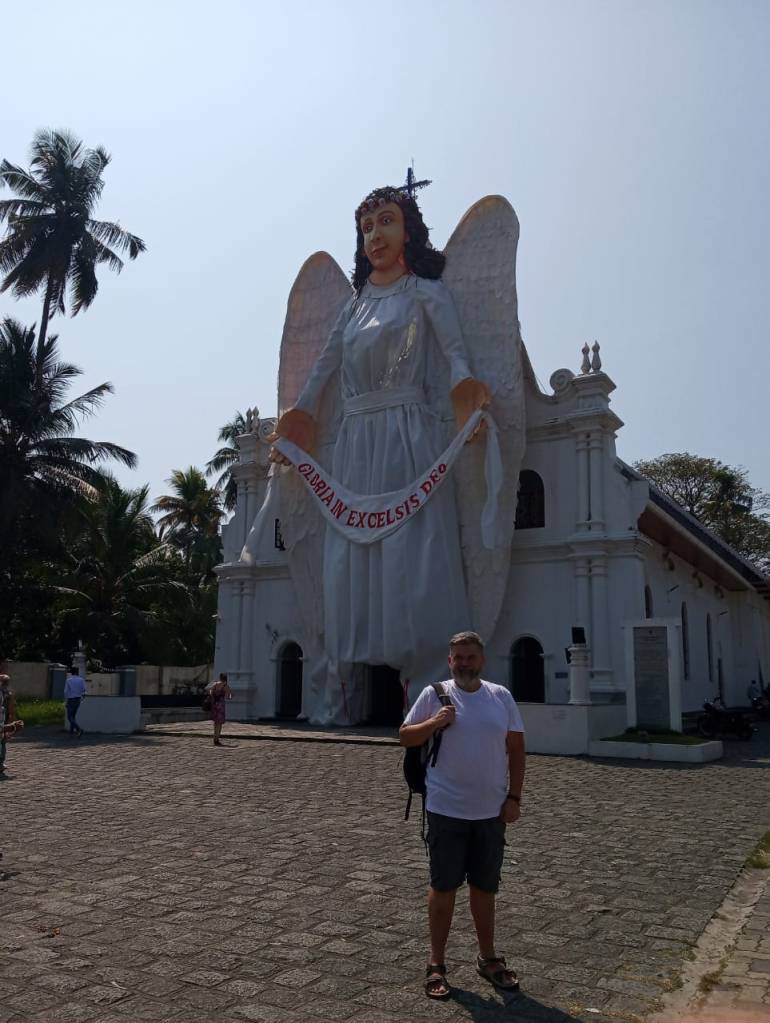
The old part of Kochi is picturesque and labyrinthine. I wandered where I would and ended up somewhere, but I’m still not sure where. Christmas lights were strung between the buildings, large glowing stars had been erected on the summits of walls, on roofs, or dangled from gables. One church I passed had a façade in the form of a gigantic angel. This was really quite surreal. We tend to think of angels as radiant beings with a human form, perfect men and women, but if you read the Bible you will soon see that most angels have an appearance that is not human at all. The highest rank of angels, the Ophanim, resemble sets of interlocking gold wheels with each wheel’s rim covered with eyes. They float through the air without needing wings. A church façade based on one of these angels would be an example of experimental architecture. But the church in the shape of a personable angel was endearing.
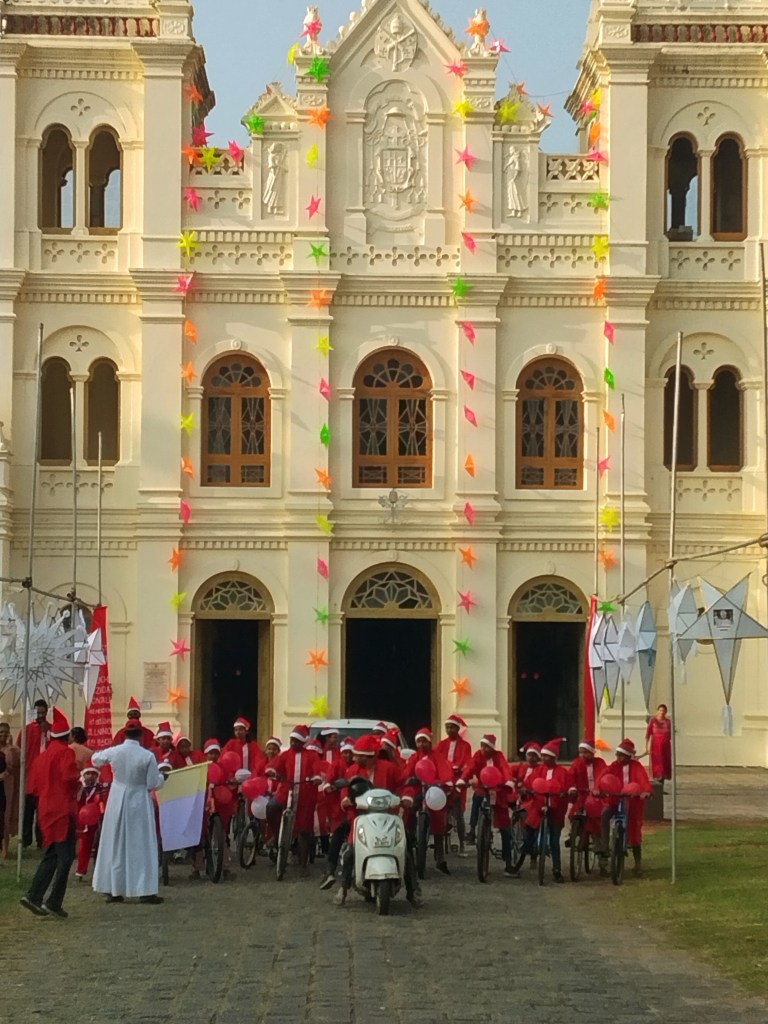
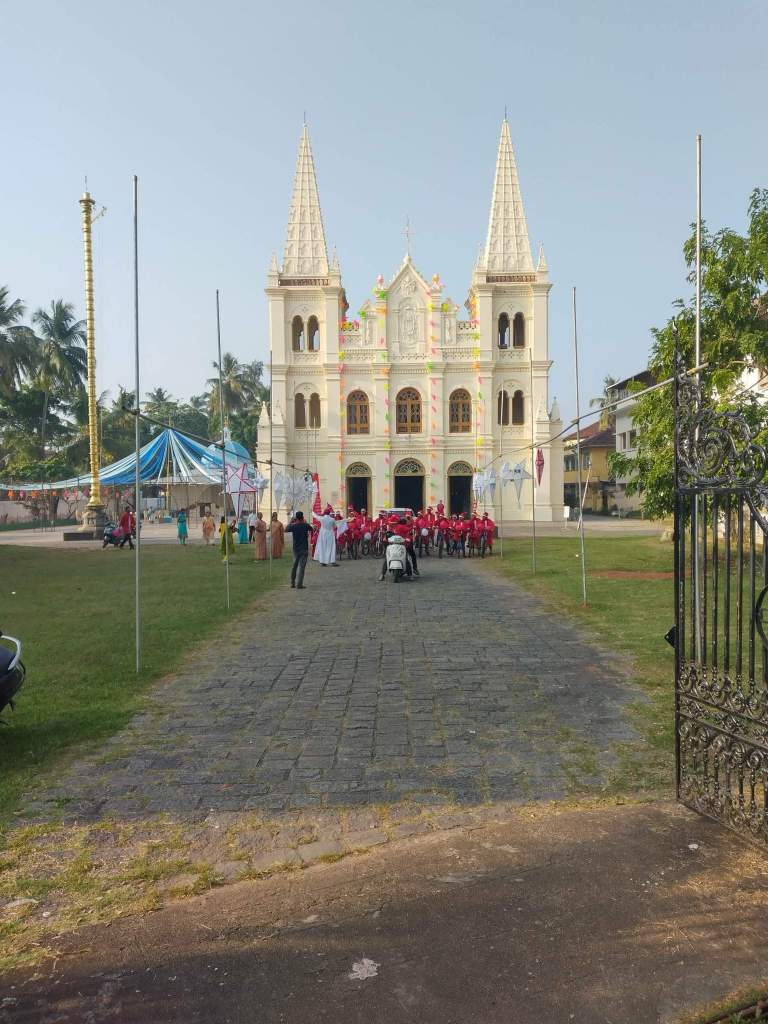
I walked past another church and saw a fleet of Santa Clauses mounted on bicycles about to set off. Is ‘Clauses’ the plural of ‘Claus’? I have no idea, for it has never occurred to me that there might be more than one of them. This fleet consisted of children in costume and I have no notion of where they were going or what they would do when they arrived. I strolled onwards and they rode past me, guided by two men on a scooter, one steering and the other holding in his arms a loudspeaker and facing backwards, like a Pied Piper who has entered the Electronic Age. One by the one, the Santa Clauses pedalled past, laughing, waving, generally enjoying themselves.
Photos provided by Rhys Hughes
This was Christmas at its most gentle, innocent and benevolent, a far cry from the Christmas ritual I witnessed exactly thirty years ago in Prague, where the tradition involves a saint, an angel and a devil chained together who stalk pedestrians in order to give them lumps of coal that represent the sins of the year. Prague was freezing, Kochi was broiling, and I know which I prefer, but the beer in Prague is certainly better. I reached the waterfront and sat under a tree and wondered if the mass migration of Santa Clauses I had seen was truly a fleet. Maybe it was an armada instead, or a division? Is there a collective noun for Father Christmas? A Splurge of Santas?
Kochi is riddled with waterways, and it feels like an excellent location for a port, which it is. No wonder it was established at that spot. I felt a small connection to the ancient mariners who had sailed here from the West long ago, from Europe and around the tip of Africa and across the Indian Ocean. One day I will travel from this very place to the islands of Lakshadweep. This has been a dream of mine for a long time, since I was eight or nine years old. I had entered a competition run by the Twinings tea company and I won. A map of the Indian Ocean was given with the names of islands removed and the entrants had to fill in those missing names. I consulted an atlas to do this, as I imagine every other entrant did, but I had an unknown advantage.
My atlas was very old, a green battered thing, and the Lakshadweep islands were marked by that very name. In other atlases the island chain was apparently named as the Laccadives. The administrators were looking for Lakshadweep and that is how I won a year’s supply of tea. It came regularly via the postman in an endless series of little tubs, Earl Grey, Lapsang Souchong, Peach Oolong. But in the end, this endless series finally ended, and my tea luck turned out only to feel inexhaustible rather than to be so. I have never won a competition since or even come close. But I have had a fondness for tea and Lakshadweep ever since, so it is imperative that I sail to those islands one day.
During my time in Kochi, I travelled on a boat only once, from Fort Kochi to Vypin Island. A battered rusty ferry crammed with foot passengers, cars and motorcycles. Cost of ticket? The equivalent of three British pennies. This is far cheaper than the cost of any ferry I have ever been on, with the exception of the occasional free ferries that I have encountered around the world, such as the one that takes passengers across the Suez Canal from one side of Port Said to the other, or the ferry that travels back and forth between Mombasa, which is on an island, and the African mainland. Sea travel is something special and I have done too little of it in my life. If I could have sailed back to Bangalore, I would have. As it happens, I went back on another night bus, but this time the person in the seat in front of me only reclined their seat to a reasonable angle. My knees were not crushed, and in return I did not crush the knees of the person behind me. I like and admire reasonable angles. They make geometry sweet.
.
Rhys Hughes has lived in many countries. He graduated as an engineer but currently works as a tutor of mathematics. Since his first book was published in 1995 he has had fifty other books published and his work has been translated into ten languages.
.
PLEASE NOTE: ARTICLES CAN ONLY BE REPRODUCED IN OTHER SITES WITH DUE ACKNOWLEDGEMENT TO BORDERLESS JOURNAL.
As the old year winds up, we wait for the new year in anticipation… We wait to see how the new born blossoms as each year takes a unique form. This year, while we strengthened the population with vaccines, other kind of politics set in, which finally found fruition in a war that has perhaps been one of the saddest events of human history — people made homeless, towns erased, lives lost, nature polluted with gunpowder and shreds of machinery along with the ultimate threat of nuclear weapons erupting every now and then. What could possibly give hope amidst the darkness of the receding year with price hikes, the threat of looming hunger, joblessness, more conflicts and fear?
The fact that we have survived for more than 200,000 years in our current form is heartening. That we have lived through wars, plagues and disasters without being erased out of existence only highlights the resilience of our species to adapt to all kinds of contingencies. Perhaps, with the current crises, we will move towards new world orders…perhaps, we will find hope in creating and evolving new ways of living in consonance with nature and more by our need than greed.
With that hope in heart, we wish you a wonderful start to the New Year with a few interesting pieces from our journal, including a highly entertaining piece by Suzanne Kamata on how the Japanese traditionally, literally make a clean start each New Year and Michael Burch’s fun poems and a translation of Tagore’s adaptation of the traditional year-end Auld Lang Syne. We have sprinkled more humour in poetry by Rhys Hughes and Santosh Bakaya and, in prose, by Tagore, translated by Somdatta Mandal, Ruskin Bond and Devraj Singh Kalsi. Laughter at the this juncture will hopefully give us a year with more shades of happiness.
Shantanu Ray Chaudhari converses with writer Gajra Kottary, a well-known writer of Indian TV series, novels and stories. Clickhereto read.
A discussion on Samaresh Bose’s In Search of the Pitcher of Nectar, a book that takes us to the heart of the Kumbh Mela, a festival recognised by the UNESCO as an Intangible Cultural Heritage, with the translator, Nirmal Kanti Bhattacharjee. Clickhere to read.
Translations
Nazrul’s Why Provide Thorns has been translated by Professor Fakrul Alam. Clickhere to read.
Mercy, a story be P. F. Mathews, has been translated from Malayalam by Ram Anantharaman. Clickhere to read.
Songs of Freedom: Vikalangta or Disability is an autobiographical narrative by Kajal, translated from Hindustani by Janees. These narrations highlight the ongoing struggle against debilitating rigid boundaries drawn by societal norms, with the support from organisations like Shaktishalini and Pandies. Clickhere to read.
Paul Mirabile explores James Joyce’s Stephen Dedalus and his passion for words keeping in mind the hundred year old Ulysees & the even older, A Portrait of the Artists as a Young Man. Clickhere to read.
Book Excerpts
An excerpt from Radha Chakravarty’s translation of Tagore’s Farewell Song. Clickhere to read.
An excerpt or two short narratives from Rhys Hughes’ Yule Do Nicley. Clickhere to read.
The next year will do the same – we will all celebrate with Auld Lang Syneand look forward to a resolution of conflicts that reared a frightening face in 2022 and 2021. Perhaps, this time, if we have learnt from history, there will not be any annihilation but only a movement towards resolution. We have more or less tackled the pandemic and are regaining health despite the setbacks and disputes. There could be more outbreaks but unlike in the past, this time we are geared for it. That a third World War did not break out despite provocation and varied opinions, makes me feel we have really learnt from history.
That sounds almost like the voice of hope. This year was a landmark for Borderless Journal. As an online journal, we found a footing in the hardcopy world with our own anthology, Monalisa No Longer Smiles: Writings from Across the World, which had a wonderful e-launch hosted by our very well-established and supportive publisher, Om Books International. And now, it is in Om Book Shops across all of India. It will soon be on Amazon International. We also look forward to more anthologies that will create a dialogue on our values through different themes and maybe, just maybe, some more will agree with the need for a world that unites in clouds of ideas to take us forward to a future filled with love, hope and tolerance.
One of the themes of our journal has been reaching out for voices that speak for people. The eminent film critic and editor, Shantanu Ray Chaudhuri , has shared a conversation with such a person, the famed Gajra Kottary, a well-known writer of Indian TV series, novels and stories. The other conversation is with Nirmal Kanti Bhattajarchee, the translator of Samaresh Bose’s In Search of a Pitcher of Nectar, a book describing the Kumbh-mela, that in 2017 was declared to be an Intangible Cultural Heritage of Humanity by UNESCO. Bhattacharjee tells us how the festival has grown and improved in organisation from the time the author described a stampede that concluded the festivities. Life only gets better moving forward in time, despite events that terrorise with darkness. Facing fear and overcoming it does give a great sense of achievement.
In keeping with the festive season is our book excerpt from Rhys Hughes’ funny stories in his Christmas collection, Yule Do Nicely. Radha Chakravarty who brings many greats from Bengal to Anglophone readers shared an excerpt – a discussion on love — from her translation of Tagore’s novel,Farewell Song.
Love for words becomes the subject of Paul Mirabile’s essay on James Joyce’s Stephen Dedalus, where he touches on both A Portrait of the Artist as a young Man and Ulysees, a novel that completed a century this year. Love for animals, especially orangutans, colours Christina Yin’s essay on conservation efforts in Borneo while Keith Lyons finds peace and an overwhelming sense of well-being during a hike in New Zealand. Ravi Shankar takes us to the historical town of Taiping in Malaysia as Meredith Stephens shares more sailing adventures in the Southern hemisphere, where it is summer. Saeed Ibrahim instils the seasonal goodwill with native Indian lores from Canada and Suzanne Kamata tells us how the Japanese usher in the New Year with a semi-humorous undertone.
Also touching and yet almost embracing the school of Absurd is PF Mathew’s story, ‘Mercy‘, translated from Malayalam by Ram Anantharaman. Fazal Baloch has brought us a Balochi folktale and Ihlwha Choi has translated his own poem from Korean to English. One of Tagore’s last poems, Prothom Diner Shurjo, translated as ‘The Sun on the First Day’ is short but philosophical and gives us a glimpse into his inner world. Professor Fakrul Alam shares with us the lyrics of a Nazrul song which is deeply spiritual by translating it into English from Bengali.
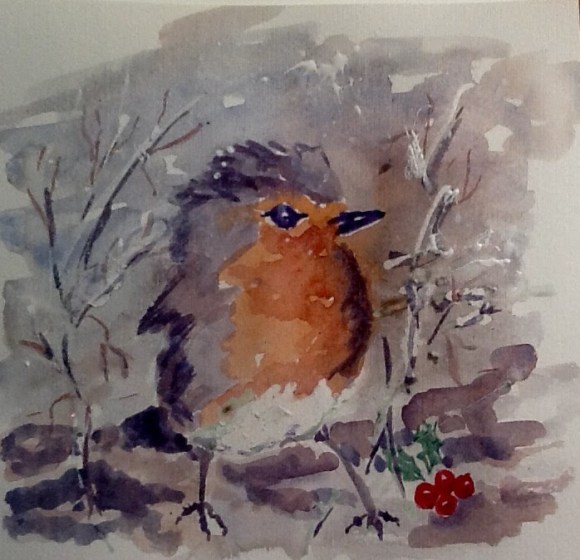
A huge thanks to all our contributors and readers, to the fabulous Borderless team without who the journal would be lost. Sohana Manzoor’s wonderful artwork continues to capture the mood of the season. Thanks to Sybil Pretious for her lovely painting. Please pause by our contents’ page to find what has not been covered in this note.
We wish you all a wonderful festive season.
Season’s Greetings from all of us at Borderless Journal.
I am from Wales but now I live in India. I am therefore in a very good position to note any differences between life in the two different countries. The first of these differences concerns food. Indian food is the main kind of food in public eating places in both locations. But the food itself isn’t quite the same. Indian food in India is Indian by default. In Wales no one knows whose fault it is. I fell into a curry in Wales once. I slipped on discarded laddoo peel (we peel laddoos over there because we think they grow on trees) and into the pot I went. It was a good curry and might be considered authentic. After I fell into it, ‘in authentic’ was the correct term for it. I wiped myself clean with a large naan bread. Later I wore the naan bread as a cloak. Waste not, want not.
So much for food. I am writing this short essay at the end of November. India is especially different from Wales at this time of year. Here I am playing badminton in shorts and a t-shirt. Back in Wales it is so cold that the sunbeams have frozen solid and I would be hanging my washing on one of the horizontal rays. In the afternoon, here in India, I will probably read a book of poetry under a banyan tree while drinking mosambi juice and listening to sitar music. But in Wales, I would be snapping off that frozen sunbeam and using it as a long lance while riding my yeti[1] over the misty mountains.
Traffic is another difference. In India the roads are choked with cars, autos, tuk-tuks (yes, I know that autos and tuk-tuks are the same thing but I need more wordage in this essay), trucks, buses, bicycles, wheelbarrows and cows. Wales doesn’t really have roads and the only traffic consists of crows. A crow perched on the back of a cow would make a perfect official emblem for a Welsh-Indian Friendship Association. If there are no roads in Wales, how do we get about? It is a pertinent question. We jump, is the answer. This not only enables us to reach our destinations but keeps us warm in winter.
In India there are monsoons but in Wales they are never soon, they are here already. The only time it stops raining in Wales is when the clouds go on strike for more pay. Lightning also goes on strike. There are puddles everywhere, even on the surfaces of lakes and ponds. Because we jump everywhere, there is a lot of splashing in Wales. This splashing puts most of the moisture back into the air where it forms clouds and perpetuates the cycle. I once perpetuated a cycle. It was a bicycle originally but I sent it away to get an education and it came back as a unicycle. I connected it to a motor powered by a rainfall gauge. Off it went on an endless journey around Wales. I would never attempt something like that in India. So there’s another big difference.
India is actually a very advanced country in terms of technology. Based in Bangalore, I am able to order anything I like with an app on my mobile phone. If I want food or drink or a bicycle, I just have to tap a few keys and a delivery guy will turn up with the ordered stuff. I once ordered a delivery guy using one of these apps and a different delivery guy turned up carrying the first delivery guy over his shoulder. But then I decided I didn’t really need a delivery guy so I sent him back and obtained a full refund.
It’s not like that in Wales. We only acquired mobile phones very recently in history and they are of a decidedly primitive sort. We started with parrots that one keeps in a pocket and speaks the messages to before releasing them to land on the shoulders of the recipients, where they recite the messages. This meant the pockets of our trousers had to be enlarged but we felt it was worth the cost. The parrots didn’t like flying through the endless rain and the messages usually went astray. So we progressed to a more advanced model, which consisted of riders on bicycles holding tin cans connected by string. You can’t order food on our mobile phones or even new trousers.
Wales is behind the times in other ways too, in fact in all ways. Wales is so belated in every respect that when the end of the world finally takes place, the country will continue for a few more years as if nothing has happened. I suspect that very slow processes, such as continental drift, evolved in Wales. I suppose that even evolution evolved in Wales, considering how slow it is and how long it takes a dinosaur to change into a chicken. I can change into a chicken with a great deal more efficiency, but I prefer pretending to be a gorilla or a chimp. It’s a very relaxing thing to do. Why not try?
Also in India you have holy men, but in Wales we only have holy socks. A holy man can open himself to the secrets of the universe. A holy sock is open to the weather, which is generally wet, and not much else. Holy men can levitate if they are sufficiently pure in spirit, or so I have been told. I once saw a flying sock, but it had been lobbed at me by a neighbour and wasn’t pure at all. That’s not the only thing I have seen rushing through the atmosphere in Wales. Parrots with sad expressions, of course, but also gloves. Why this should be so was a mystery for ages but recently the enigma was solved by an enigma machine and the answer is that “glove is in the air, everywhere I look around”. Or perhaps it is just the wind. Yes, I think it’s the wind.
The Enigma machine was used in the early- to mid-20th century, especially in WWII, for commercial, diplomatic, and military communications. Courtesy: Creative Commons
An enigma machine, incidentally, is a device invented in Wales that looks like an abacus, but it has small onions on wires instead of beads. Crows perch on the wires and peck the onions and move them into different positions, which gives the answer to any question. But the answer is cryptic and must be studied by a druid, who will interpret it. Druids are common in Wales. They aren’t holy men, strictly speaking, but are highly respected because they wear intact socks. They also wear cloaks made from naan breads but if you ask them, they insist they are made from wool and cobwebs.
You are probably beginning to ask yourself, is this a serious essay? And at this point you might be harbouring doubts that it is. There are many harbours in Wales, which has a convoluted coastline, but not many in the interior of India. That’s another difference. I have already mentioned laddoos and the fact that we peel them (and I mentioned it in brackets) but we also peel bells. I don’t think bells are ever peeled in India. They are rung instead. The peel of Welsh bells is used to make the tall hats that old women wear, conventionally on their heads, that you might have seen in vintage photographs. Bell peel is more enduring than satin or any other kind of fabric. It means that every old woman always knows what the time is when their hat bongs.
India is full of palaces. Not long ago, I visited Mysore Palace and found it truly impressive. In Wales we have nothing quite like that, but I often mention Mysore Feet after all the jumping I have to do to get anywhere. And now one final difference before I go. In India, the essays that writers write are generally detailed, comprehensive and lengthy. In Wales they often end abruptly in the middle with three dots, as if the writer was eaten by a yeti unexpectedly… but not this one. No yeti. Not yet anyway.
[1] The Welsh yeti, Abominablis Boyo, is only distantly related to the Himalayan species.
.
Rhys Hughes has lived in many countries. He graduated as an engineer but currently works as a tutor of mathematics. Since his first book was published in 1995 he has had fifty other books published and his work has been translated into ten languages.
.
PLEASE NOTE: ARTICLES CAN ONLY BE REPRODUCED IN OTHER SITES WITH DUE ACKNOWLEDGEMENT TO BORDERLESS JOURNAL







 Borderless