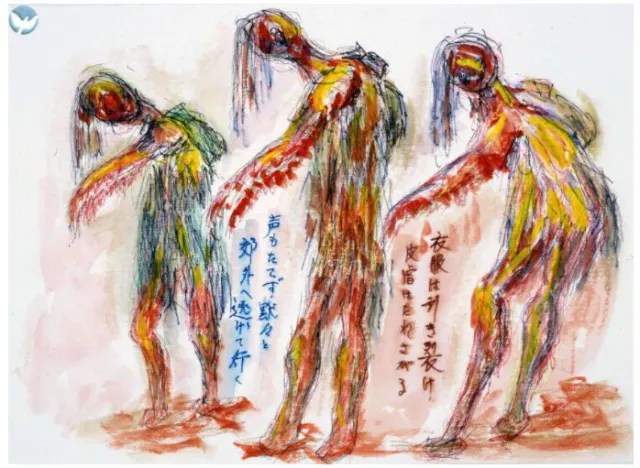
This painting/drawing is from artist Kichisuke Yoshimura, who said of it, “Their clothes ripped to shreds, their skin hanging down. On the riverbank I saw figures that seemed to be from another world. Ghost-like, their hair falling over their faces, their clothes ripped to shreds, their skin hanging. A cluster of these injured persons was moving wordlessly toward the outskirts.” Courtesy: Public domain
Almost eight decades after the Atomic Holocaust in Hiroshima and in Nagasaki, we still are looking for peace. These blasts destroyed humanity and the tenor of human lives. While nuclear treatise are still holding up, many parts of the world are warring over different issues… for borders we ourselves have drawn, for ideologies and pedagogies we ourselves have created. It has become difficult now to keep track of the terrors and horrors unleashed on unsuspecting citizens and innocents. There was a point of time, where kings settles their conflicts by fighting outside the cities with rules of war. But despite all the treatise and the deals, children are still dying in bomb blasts. Innocents are still being killed by missiles. One would have thought, humanity would have learnt from the past… But have we?
Showcasing the need for peace, we bring to you, recent poetry about the ensuing conflicts and some poems on the blast that killed innocents and maimed generations to come. We have an essay on an age-long conflict which does not seem to get resolved and the interview of a second generation Hibakusha who still suffers from the impact of the blast that had destroyed her mother’s world and left its imprints on the later generations.
Ratnottama Sengupta,comments on the current situation in Ukraine while dwelling on her memorable meeting with folk legend Pete Seeger, a pacifist, who wrote ‘Where have all the Flowers gone’, based on a folk song from Ukraine. Click here to read.
Ratnottama Sengupta muses on acts of terror and translates a Bengali poem by Tarik Sujat which had come as a reaction to an act of terror. Click here to read.
Renee Melchert Thorpe recounts her mother’s migration story, hopping multiple countries, starting with colonial Calcutta and Darjeeling. Click here to read.
Paul Mirabile wanders into the realm of the supernatural dating back to the Potato Famine of Ireland in the 1800s. Clickhere to read.
Conversations
In conversation with eminent Singaporean poet and academic, Kirpal Singh, about how his family migrated to Malaya and subsequently Singapore more than 120 years ago. Click hereto read.
There was a time when humans walked the Earth crossing unnamed landmasses to find homes in newer terrains. They migrated without restrictions. Over a period of time, kingdoms evolved, and travellers like Marco Polo talked of needing permissions to cross borders in certain parts of the world. The need for a permit to travel was first mentioned in the Bible, around 450BCE. A safe conduct permit appeared in England in 1414CE. Around the twentieth century, passports and visas came into full force. And yet, humanity had existed hundreds of thousand years ago… Some put the date at 300,000!
While climate contingencies, wars and violence are geared to add to migrants called ‘refugees’, there is always that bit of humanity which regards them as a burden. They forget that at some point, their ancestors too would have migrated from where they evolved. In South Africa, close to Johannesburg is Maropeng with its ‘Cradle of Humanity’, an intense network of caves where our ancestors paved the way to our evolution. The guide welcomes visitors by saying — “Welcome home!” It fills one’s heart to see the acceptance that drips through the whole experience. Does this mean our ancestors all stepped out of Africa many eons ago and that we all belonged originally to the same land?
And yet there are many restrictions that have come upon us creating boxes which do not allow intermingling easily, even if we travel. Overriding these barriers is a discussion with Jessica Mudditt about Once Around the Sun: From Cambodia to Tibet, her book about her backpacking through Asia. Documenting a migration more than a hundred years ago from Jullundur to Malaya, when borders were different and more mobile, we have a conversation with eminent scholar and writer from Singapore, Kirpal Singh. Telling the story of another eminent migrant, a Persian who became a queen in the Mughal Court is a lyric by Nazrul, Nur Jahan, translated by Professor Fakrul Alam from Bangla. Ihlwha Choi has self-translated his own poem from Korean, a poem bridging divides with love. Fazal Baloch has brought to us some exquisite Balochi poems by Munir Momin. Tagore’s poem, Okale or Out of Sync, has been translated from Bengali to reflect the strange uniqueness of each human action which despite departing from the norm, continue to be part of the flow.
We have a tongue in cheek piece from Devraj Singh Kalsi on traveling in a train with a politician. Uday Deshwal writes with a soupçon of humour as he talks of applying for jobs. Snigdha Agrawal brings to us flavours of Bengal from her past while Ratnottama Sengupta muses on the ongoing wars and violence as acts of terror in the same region and looks back at such an incident in the past which resulted in a powerful Bengali poem by Tarik Sujat. Kiriti Sengupta has written of a well-known artist, Jatin Das, a strange encounter where the artist asks them to empty fully even a glass of water! Ravi Shankar weaves in his love for books into our non-fiction section. Recounting her mother’s migration story which leads us to perceive the whole world as home is a narrative by Renee Melchert Thorpe. Urmi Chakravorty takes us to the last Indian village on the borders of Tibet. Taking us to a Dinosaur Museum in Japan is our migrant columnist, Suzanne Kamata. Her latest multicultural novel, Cinnamon Beach, has found its way to our book excerpts as has Flanagan’s poetry collection, These Many Cold Winters of the Heart.
In reviews, Somdatta Mandal has written about an anthology, Maya Nagari: Bombay-Mumbai A City in Storiesedited by Shanta Gokhale and Jerry Pinto. Rakhi Dalal has discussed a translation from Konkani by Jerry Pinto of award-winning writer Damodar Mauzo’sBoy, Unloved. Basudhara Roy has reviewed Trailokyanath Mukhopadhyay’s Tales of Early Magic Realism in Bengali, translated by Sucheta Dasgupta. Bhaskar Parichha has introduced us toThe Dilemma of an Indian Liberal by Gurcharan Das, a book that is truly relevant in the current times in context of the whole world for what he states is a truth: “In the current polarised climate, the liberal perspective is often marginalised or dismissed as being indecisive or weak.” And it is the truth for the whole world now.
Our short stories reflect the colours of the world. A fantasy set in America but crossing borders of time and place byRonald V. Micci, a story critiquing social norms that hurt by Swatee Miittal and Paul Mirabile’s ghost story shuttling from the Irish potato famine (1845-52) to the present day – all address different themes across borders, reflecting the vibrancy of thoughts and cultures. That we all exist in the same place and have the commonality of ideas and felt emotions is reflected in each of these narratives.
We have more which adds to the lustre of the content. So, do pause by our content’s page and enjoy the reads!
I would like to thank all our team without who this journal would be incomplete, especially, Sohana Manzoor, for her fabulous artwork. Huge thanks to all our contributors who bring vibrancy to our pages and our wonderful readers, without who the journal would remain just part of an electronic cloud… We welcome you all to enjoy our June issue.
Ratnottama Sengupta muses on the ongoing wars and violence as acts of terror and gazes back to an incident in the past which resulted in a powerful Bengali poem by Tarik Sujat that she has translated here
The world is in the grip of violence, Rabindranath Tagore wrote on March 5, 1927, sitting in the abode of peace – Santiniketan. Full 97 years later, the world is still in the grip of violence?
It’s Gaza today. Ukraine yesterday. Afghanistan some days ago. Sri Lanka not so long ago. Sometimes it is Bosnia. At other times, it’s Vietnam. Lands far flung and near adorn themselves with blood-red mark of hatred. Religion. Self-seeking dictators. Communism. Global lust for power. No matter what is at stake, the pawn is an innocent life. Always. A woman. An elder. An unborn child…
Tagore wrote Hingshay unmatto prithibi[1]– “The world is in the grip of violence as a prayer to the Almighty. The delirium is leading to conflicts, cruel and ceaseless… Crooked is the world today, tangled its philosophy. No bond is sacred.” And the anguish of such a state of affairs? It led even the Eternal Bard of Bengal to pray for a new birth of ‘Him of Boundless Life.’ “Save them,” Tagore had prayed to the Serene, “raise your eternal voice of hope” so that “Love’s lotus, with its inexhaustible store of nectar” may open its petals in His light. In His immeasurable mercy. To wipe away all dark stains from the heart of the continents.
In vain he prayed.
“Forgive them!” Jesus said, for “They know not what they do!” And what did the soldiers do? They gambled for his clothes by throwing dice! (Luke 23:34)
Forgive them? “Have you forgiven those who vitiated the atmosphere and snuffed out light for innocent lives?” Tagore asked the Almighty, in ‘Proshno (Question)‘. Have you forgiven those who deal hate in the secret hours of night? Have you embraced with love those who murder the helpless in broad daylight under the cover of ideology? Don’t you wince when a pregnant Bilkis[2] is gang-raped? Why do you shed silent tears when elected rulers choke people’s voice with furtive use of power?
And like his Prayer, Tagore’s ‘Question’ too has remained unanswered. And dumb sit the messiahs when men with mistaken notion of mission kill, maim, mutilate hostages who become mere numbers in newspaper headlines – until a new dateline wipes it off our collective memory. Thus, once again, the world was shaken by brutalities carried out in the name of God, in Dhaka’s elite neighbourhood, Gulshan.
On July 1, 2016, before the Cinderella hour struck, five militants entered the Holey Artisan Bakery with bombs, machetes, pistols, and opened fire on men and women, from Italy, Japan, India, Bangladesh. Sunrise. Sunset.. Sunrise… unsuccessfully the police tried to secure the hostages. An elite force of the Bangla Army had to raid to put an end to what BBC News described as “the deadliest Islamist attack in Bangladesh”. Meanwhile? The toll had risen to 29 lives, totaling 17 foreigners, three locals, two policemen, five gunmen, and two bakery staff who were trying to earn their daily bread!
Since Gulshan is home to many embassies and high commissions in the capital of the secular nation, the news stirred up the world in no time. And prayers poured in – over cellphones, on Facebook, television and newspapers too. Prayers of wives for their husbands. Prayers of mothers for their sons. Prayers of a niece for her aunt. Prayers of American friends for their Indian batch mate. But once again, prayers went unanswered…
Among those who did not survive to tell the story was Simona Monti of Italy who worked in textiles. Then 33 years of age, Simona was soon to go to her home an hour away from Rome, to deliver the child she had nursed in her womb for five months. But Michelangelo too did not live to breathe in the world vitiated by hatred. When the news reached her brother, he prayed his Simona’s bloodshed would make this “a more just and brotherly world.”
His prayer, too, remains unanswered.
But poets and other men of conscience did not remain silent. Within days of the incident Tarik Sujat wrote Janmer aagei aami mrityu ke korechhi alingan (Even before my birth I embraced death, July 6, 2016). No diatribe in his words, but the muted cry of an unborn being jolts us. That cry left me with a tear in one eye and fire in the other…
On my very first reading I was touched, I was moved, I fell silent. The pensive mood of the embryonic life turned me reflective. Anger, rage, fury was not the answer to hostility, loathing, abhorrence, I realised. So will you, as you go through the poem that was handed out in Magliano Sabino when Simona’s hometown prayed for her eternal rest.
I Embraced Death Before Birth

Even before my birth I embraced death.
I have no nation, no speech,
No stock of my own.
No distinction between Holy-Unholy,
Sin and Virtue, Sacred or Cursed.
Having seen the ghastly face of life
I've swallowed my last drop of tear...
My first breath did not pollute
The environs of your earth.
My last breath was the first gift
Of this planet to me!

Maa!
You were my only playhouse,
My school, and my coffin.
I had yet to open my eyes -
And still I saw
The sharp nails of executioner
Ripping apart my naval cord.
My ears were yet to hear sound,
Still I could catch bells
That summon lads to schools...
The obscure sound echoed
Through churches, temples,
And minarets of masjids
Until, slowly, it fell silent...

My first bed was my last.
My mother's womb was
My only home
In the unseen world.
On that nook too, darkness descended.
Floating down the river of blood
I groped for my umbilical cord
To keep me afloat...
My tiny fingers, my soft palm
Could find nothing to clutch.

In that Dance of Death
My unseeing eyes witnessed
Koran, Bible, Gita, Tripitak
Bobbing in receding blood.
In the achromatic gloom
Of my chamber
I got no chance to learn
A single mark of piety!

Still...
I embraced death before I was born.
My mother's womb is my
Grave, my coffin, my pyre.
The world of humans
Is enveloped in fire -
A few droplets of my meagre body
Does not quench its thirst!

(Translated from Tarik Sujat’s Bengali poem by Ratnottama Sengupta)
Why has this portrayal of a tormented soul found voice in French, German, Swedish, Italian, English…? Why has it been translated into 17 languages? In the answer blowing in the wind lies hope for mankind. For, the answer is: Not every man is created in the image of Lucifer. That is why, when Giulia Benedetti learnt that she will never again see her aunt Nadia Benedetti, that “she will not talk, will not comment on fashion, will not sing together again…” she wrote on Facebook: “Do not forget. Do not lose her memory. Do not let crazy people massacre. Do not let them win…”
And I immerse my voice in the Bard’s to say: “Let life come to the souls that are dead…” And I pray, bring harmony, bring rhythm, bring melody in our lives, O Serene! Wipe away every dark cloud from the world yet to dawn!
Ratnottama Sengupta, formerly Arts Editor of The Times of India, teaches mass communication and film appreciation, curates film festivals and art exhibitions, and translates and write books. She has been a member of CBFC, served on the National Film Awards jury and has herself won a National Award.
.
PLEASE NOTE: ARTICLES CAN ONLY BE REPRODUCED IN OTHER SITES WITH DUE ACKNOWLEDGEMENT TO BORDERLESS JOURNAL
Perhaps when Dylan Thomas wrote these lines, he did not know how relevant they would sound in context of the world as it is with so many young dying in wars, more than seven decades after he passed on. No poet does. Neither did he. As the world observes Dylan Thomas Day today — the day his play, Under the Milkwood, was read on stage in New York a few months before he died in 1953 — we have a part humorous poem as tribute to the poet and his play by Stuart McFarlane and a tribute from our own Welsh poet, Rhys Hughes, describing a fey incident around Thomas in prose leading up to a poem.
May seems to be a month when we celebrate birthdays of many writers, Tagore, Nazrul and Ruskin Bond. Tagore’s birthday was in the early part of May in 1861 and we celebrated with a special edition on him. Bond, who turns a grand ninety this year, continues to dazzle his readers with fantastic writings from the hills, narratives which reflect the joie de vivre of existence, of compassion and of love for humanity and most importantly his own world view. His books have the rare quality of being infused with an incredible sense of humour and his unique ability to make fun of himself and laugh with all of us.
Nazrul, on the other hand, dreamt, hoped and wrote for an ideal world in the last century. The commonality among all these writers, seemingly so diverse in their outlooks and styles, is the affection they express for humanity. Celebrating the writings of Nazrul, we have one of his fiery speeches translated from Bengali by Radha Chakravarty and a review of her Selected Essays: Kazi Nazrul Islam by Somdatta Mandal. An essay from Niaz Zaman dwells on the feminist side of Nazrul while bringing in Begum Roquiah. Zaman has also shared translations of his poetry. Professor Fakrul Alam, who had earlier translated Nazrul’s iconic ‘Bidrohi or Rebel‘, has given us a beautiful rendition of his song ‘Projapoti or Butterfly’ in English. Also in translation, is a poem by Tagore on the process of writing poetry. Balochi poetry by Manzur Bismil on human nature has been rendered into English by Fazal Baloch and yet another poem from Korean to English by Ilwha Choi.
Ratnottama Sengupta this month converses with a dancer who tries to build bridges with the tinkling of her bells, Sohini Roychowdhury. Gita Viswanthan travels to Khiva in Uzbekistan, historically located on the Silk Route, with words and camera. An essay on Akbar Barakzai by Hazran Rahim Dad and another looking into literature around maladies by Satyarth Pandita add zest to our non-fiction section. Though these seem to be a heterogeneous collection of themes, they are all tied together with the underlying idea of creating links to build towards a better future.
In focus this time is a writer whose prose is almost akin to poetry, Rajat Chaudhuri. A proponent of solarpunk, his novel, Spellcasters, takes us to fictitious cities modelled on Delhi and Kolkata. In his interview, Chaudhuri tells us: “The path to utopia is not necessarily through dystopia. We can start hoping and acting today before things get really bad. Which is the locus of the whole solarpunk movement with which I am closely associated as an editor and creator…”
On that note, I would like to end with a couple of lines from Nazrul, who reiterates how the old gives way to new in Proloyullash (The Frenzy of Destruction, translated by Alam): “Why fear destruction? / It’s the gateway to creation!” Will destruction be the turning point for creation of a new world? And should the destruction be of human constructs that hurt humanity (like wars and weapons) or of humanity and the planet Earth? As the solarpunk movement emphasises, we need to act to move towards a better world. And how would one act? Perhaps, by getting in touch with the best in themselves and using it to act for the betterment of humankind? These are all points to ponder… if you have any ideas that need a forum on such themes, do share with us.
We have more content which has not been woven into this piece for the sheer variety of themes they encompass. Do pause by our content’s page and browse on all our pieces.
With warm thanks to our wonderful team at Borderless — especially Sohana Manzoor for her fabulous art — I would like to express gratitude to all our contributors, without who we could not create this journal. We would also like to thank our readers for making it worth our while to write — for all of our words look to be read, savoured and mulled, and maybe, some will evolve into treasured wines.
Ratnottama Sengupta in conversation with Sohini Roychowdhury, who uses dancing to build bridges across cultures
“Meet my daughter Sohini,” Uma Di was introducing the dancer who then lived in Madrid. And my first response was, “Why isn’t she in the movies?!”
Sohini Roy Chowdhury. Courtesy: Sohini Roy Chowdhury
Tall, fair, lissome, agile, Sohini Roychowdhury is the stuff beauty queens and show stoppers are made of. That wasn’t surprising: after all, Uma Roychowdhury herself is the picture of perfection in aesthetics.
It didn’t take me long to realise that, much like the well regarded sculptor’s bronzes, her daughter too was made of enduring stuff. One day she was teaching Bharatanatyam to French, Spanish, and Italian enthusiasts. The next day she was lecturing on mythology in New York. One day she was dancing to ‘Jai Ho![1]’ for the director of the Oscar winning Hollywood movie[2]. Another day she was delineating Durga in an Anthropology Museum…
None of these saw her run out of breath. Nor does she, ever, run out of time. When she’s not holding her fingers in a dance mudra, she is holding a metaphoric pen. This month she unveiled her second book, Dance of Goddess Kali. Yes, she has rings on her fingers and bells on her toes — and wherever she goes, there’s dance on the cards!
Here is what she had to say when I spoke to her:
The Dance of Kali follows Dancing with the Gods. How are the two books different?
Dancing With the Gods and The Dance of Kali are two distinct works, each focusing on different aspects of my artistic and spiritual journey.
Conceived by Monideepa Mukherjee and Sutapa Sengupta, featuring photos from Sohinimoksha
Dancing With the Godsis a pictorial, coffee-table book stemming from my journey as a classical Indian dancer with a multinational dance troupe. Its vivid visuals showcase my onstage performances and behind-the-scenes moments. These are highlights of my career as a dancer, both solo and with Sohinimoksha World Dance and Communications[3].
This visually captivating book focuses on imagery and aesthetics. It offers glimpses into my artistic expression through dance, celebrates my journey around the world, and highlights my life-mantra of connecting civilisations through my craft. This tracing of Sohinimoksha’s journey is for a broader audience: Indian dance enthusiasts, art lovers, and individuals interested in my achievements. The aim is to inspire through visually compelling storytelling.
In contrast, The Dance of Kali is a treatise on the ethos of Goddess Kali and Shaktism. It delves into the deeper spiritual and philosophical aspects associated with the goddess, exploring Kali’s symbolism, mythology, and significance within the context of Shaktism, a Hindu tradition of worshiping the divine feminine energy. The tone of this work is contemplative, as it delves into the profound symbolism and the spiritual aspects associated with the Goddess. It incorporates scholarly research, analysis, and interpretations from various perspectives. Hopefully it offers readers a deeper understanding of Kali’s significance in Hindu spirituality.
May I point out here that The Dance of Kali is not a religious book. It is for readers with a specific interest in Hindu mythology, spirituality, or the myths and legends around the resident Goddess of Kolkata. Those seeking a deeper understanding of Kali’s symbolism and philosophical underpinnings within the context of Shaktism, will find this book dispels disrespectful misrepresentations and unfounded Western misconceptions surrounding the images of Kali as a demonic goddess.
To sum up: both the books reflect different facets of my artistic and spiritual journey. However, they differ significantly in their subject matter, focus, tone, and intended audience. One celebrates my achievements as a dancer through captivating visuals. The other is an academic tome exploring the profound symbolism and spirituality associated with Goddess Kali.
What prompted you, an international dancer, to pick such a rooted in mythology subject?
I have always had a personal affinity with or inclination towards Goddess Kali. Many artistes draw inspiration from their own beliefs, experiences, and cultural backgrounds when choosing subjects for their work. I am no different. For me the depiction of the Goddess is an opportunity for artistic exploration. Kali, with her complex symbolism and multifaceted persona, offers rich material for creative interpretation through the arts, be it dance, literature or visual arts.
This book also celebrates India’s rich mythological heritage and the way it connects to other ancient cultures, in Mesopotamia, Egypt, Spain and France. Kali, with her global soul sisters Ishtar or Sara La Kali, holds significant cultural and religious importance, not just in Hinduism, but other cultures as well, particularly within the contexts of worshipping Mother Goddesses. I delve into Kali’s mythology and symbolism to honour this aspect of Indian life, and its universal resonance.
Yes, Goddess Kali is rooted in Indian mythology. But the themes she embodies — feminine power, transformation, and liberation —transcend cultural boundaries. I hope this book will serve to explore universal themes of empowerment and spirituality. It also aims to provide a deeper understanding of Hindu mythology, and the symbolism associated with the Dark Goddess. Effectively I seek to promote intercultural dialogue and foster greater appreciation for diverse religious traditions. Most significantly, I hope to dispel the uneducated interpretations of Kali as a horrific, savage, demonic goddess. How often she is typecast as a symbol of evil — in popular Western films, books and even as Halloween costumes for disrespectful celebrities like Heidi Klum!
I have witnessed your performance as Durga in an anthropology museum in Madrid. I have noted your commitment to meaningful, even profound themes in your endeavours. What has been your grooming in dance?
I started dancing at a young age under renowned Bharatanatyam Guru, Thankamany Kutty. Later I learnt from Kalamandalam Venkitt in Kolkata. I received rigorous training in Bharatanatyam, the dance that originated in the temples of Tamil Nadu. My dedication to classical art led me to delve deep into its nuances. I mastered intricate footwork, expressions, and storytelling techniques. Over the years, I refined my technique and expression through consistent practice and performance and came to embody the essence of Bharatanatyam.
Your father was a renowned sitarist living in Germany. Your mother is a reputed sculptor of Kolkata. Why did you, an only child, not take to any of these streams of creative expression?
Indeed I was born into a family of accomplished artists. My father, Pandit Subroto Roychowdhury was a renowned sitarist, and my mother, Uma Roychowdhury, is a reputed sculptor. But I chose a different path for myself.
As an only child, I was exposed to various forms of creative expression. But my passion for dance was ignited after watching a riveting performance by Yamini Krishnamurthy when I was about four years old. While I deeply respect my family’s artistic legacy, I followed my own calling and embarked on a journey to carve my niche in the world of dance.
What are the values you have imbibed from them individually?
My father’s sitar schools in Germany have produced hundreds of students — including distinguished sitar players. From him I imbibed a profound appreciation for music and rhythm. I learned discipline, dedication, and the importance of perseverance in mastering an art form. From my sculptor mother I inherited a keen love for aesthetics and eye for details. I learned the importance of expressing emotions and stories through visual and performing arts.
Together these values have steered me towards excellence and innovation in my journey as a dancer and communicator.
Mixed genre performance by Sohini Roychowdhury. Courtesy: Sohini Roy Chowdhury
You have lived in Moscow and Madrid. You are guest professor in far-flung Universities, in America and Columbia. You have danced Bharatanatyam and you have danced to Jai ho! at the premiere of Slumdog Millionaire. What have you gained through your international exposure?
My international exposure has enriched me both personally and professionally. Living in cultural environments as diverse as Moscow and Madrid have broadened my perspectives and deepened my understanding of global arts and communication.
More than 2000 students have ‘graduated’ through my two dance schools in Spain — Casa Asia and Sohinimoksha Artes de la India. In Moscow, more than 80 Russian students performed with me on stage at the Embassy of India and Nehru Centre at the end of their course. As a guest professor in universities across Europe, USA and Latin America, teaching dance, Natyashastra [theory of dance] and Indology, I have not only shared my expertise — I have learnt from students, artistes and scholars from different backgrounds.
Through my performances of Bharatanatyam, and collaborations with international artists, have bridged cultural divides. My dancing to Jai Ho! at the European premiere of Slumdog Millionaire showcased the universal appeal of Indian dance and music. It highlighted its ability to connect with people across borders. Today I can confidently claim to have promoted cross-cultural exchange globally.
Coming from an aristocratic, old Calcutta background, what merit do you see in Bollywood dancing?
Despite coming from an aristocratic background rooted in old Calcutta, I recognise the merit in Bollywood dancing which has become a global phenomenon. Not surprising. For, characterised by vibrant energy, expressive movements, and fusion of multiple dance styles — from Salsa to Tango, Twist to ChaChaCha – Bollywood dancing holds mass appeal. It serves as a platform for artists to showcase their talents to diverse audiences and has contributed to the popularization of Indian culture worldwide. It is rooted in traditional Indian dance forms, yet embraces modern influences. And it reflects the evolving tastes of contemporary audiences.
Since the 1960s, Bollywood has drawn inspiration from various musical traditions across the world. This imparted its films a rich tapestry of global influences. This fusion of world music and dance enriched the aesthetic of Bollywood — and in turn contributed to its cultural significance and global appeal.
In the 1960s, Indian cinema underwent a transformation with the emergence of filmmakers like Guru Dutt and Raj Kapoor, who infused their films with elements of Western music and dance. The most iconic example of this is seen in the song Mera joota hai Japani [my shoes are Japanese] from Shree 420 (1955): here Raj Kapoor’s character sings about wearing Japanese shoes, English pantaloons, and Russian caps — all of which symbolised the growing influence of the West in post-colonial India. And yet, as the song stresses, at core these films are Hindustani — Indian.
Throughout the ’60s, ’70s and ’80s, the industry witnessed the rise of dance and music directors who played a pivotal role in incorporating world music and dance forms into Hindi cinema. Composers like OP Nayyar, Shankar Jaikishan, SD Burman, C Ramachandran, Kalyanji Anandji, RD Burman, Laxmikant-Pyarelal, and Bappi Lahiri experimented with disparate musical styles. These ranged from rock-n-roll, rumba, flamenco to disco, reggae and jazz. This infused their compositions with international flavours.
Similarly, choreographers Sohanlal, PL Raj, Herman Benjamin, Suresh Bhatt, Saroj Khan, Chinni and Rekha Prakash, Shiamak Davar, Farah Khan, Remo D’Souza, Terence Lewis, Vaibhavi Merchant, and Prabhu Deva have blended Indian classical dance with Western styles. This has created the unique dance style that is now identified as Bollywood dancing. It has homogenised movements from hip-hop to salsa and contemporary dance.
Soon stars like Shammi Kapoor, Helen, Asha Parekh, Hema Malini, Rishi Kapoor, Mithun Chakraborty, Jeetendra, Govinda, Hrithik Roshan, Madhuri Dixit, and Sridevi became synonymous with Bollywood’s larger-than-life dance numbers. For, it showcased their versatility and flair for different dance steps. Embracing the twist and turn era of the ’60s to the disco craze of ’70s and the hip-hop-inspired moves of the 2000s, Bollywood stars captivated audiences with their energy and charisma.
Along with Western influences, Bollywood also drew from traditional Indian dances. Its choreography incorporated elements of Bharatanatyam, Kathak, and Odissi. Dance sequences like Dola Re Dola from Devdas (2002) and Pinga from Bajirao Mastani (2015) exemplify the fusion of classical and contemporary dances, blending intricate footwork with dynamic movements and expressions.
In recent years, Bollywood has continued to evolve, reflecting the changing tastes and preferences of global audiences. Directors, like Sanjay Leela Bhansali and Farah Khan, have pushed the boundaries of traditional filmmaking, creating visually stunning spectacles that showcase the diversity of world music and dance. Stars like Priyanka Chopra, Deepika Padukone, and Ranveer Singh have embraced this eclectic mix of styles, bringing their own unique interpretations to the screen.
Spanish, Bulgarian and other European dancers from my own troupe, Sohinimoksha World Dance, have performed specially choreographed fusion dance items set to popular Bollywood tracks. Kristina Veselinova danced toMere Dholnafrom Bhool Bhulaiya; Violeta Perez and Lola Martin to Senorita! from Zindagi Na Milegi Dobara and Maria Sanz on Padmavat’s Ghoomer on stages across India and the world. So I readily acknowledge the significance of Bollywood dance in preserving India’s cultural heritage while adapting to changing times.
Would you say our films are taking our dance traditions to votaries abroad? Just as Indian musicians of the 1960s had taken our ragas to the West?
In the 1960s, Ravi Shankar, Ali Akbar Khan and other maestros played a crucial role in initiating the West in the rich notes of Indian classical music — and that had enriched the global cultural landscape. My own father, Pandit Subroto Roychowdhury, spent more than 40 years in Germany and other European countries, spreading and popularising Indian classical music through concerts and classes. Today Indian films, particularly Bollywood, are carrying forward this legacy. They are showcasing the wealth that is Indian dance — often fused with world dance influences. Just as our musicians shared the wealth of ragas with the West, Bollywood films are spreading the infectious exuberance of Indian dance to enthusiasts around the globe. This is fostering cultural exchange on an international scale. Small wonder that Bollywood is now acknowledged as India’s most potent soft power.
What, in your opinion, is needed to make GenNext learn from our past traditions?
If we want GenNext to learn from our past traditions, we must provide them with comprehensive exposure to our rich cultural heritage. For this, we must integrate our arts and cultural practices into educational curricula. We must foster appreciation through interactive experiences — workshops, performances, cultural events. Additionally we must leverage modern technologies and platforms to disseminate information. Let’s make traditional arts more accessible and engaging for the young. Let’s cultivate mentorship programs and intergenerational exchanges. For, we must bridge the gap between past traditions and contemporary lifestyles, to ensure their relevance and continuity for the generations to come.
Sohini I have seen you at close quarters, as a mother, wife, daughter, and daughter-in-law even as you criss-cross the world for your dance. How do you still find time to write, which is such a demanding, reflective expression?
I am fortunate to be able to balance my roles as a mother, wife, daughter, daughter-in-law, and a performing artiste. My experience as much as my dedication to my craft honed my time-management skills. Despite crisscrossing the world for performances, lecture tours, and other professional commitments, I carve out time to write, for I recognise its significance as a reflective form of expression.
To effectively manage my time, I set priorities, create schedules, and maximize productivity during the available windows of time. I designate specific periods for writing, be it early mornings, late evenings, or during travel downtime. I try to integrate writing into my daily routine, seizing moments of inspiration and reflection to jot down ideas or draft passages.
My passion for writing is a driving force — it motivates me to make time for it amidst my busy schedule. Writing provides a creative outlet for introspection, and intellectual exploration. It complements my artistic endeavours and enriches my personal and professional growth.
I am grateful for the support I receive from the network of my family, friends, and collaborators. They play a crucial role in facilitating my writing pursuits. My latest book, The Dance of Kali, was co-written with my son Rishi Dasgupta, an Economics MSc from the University of St Andrews, UK.
However, at the end of the day, that I find time to write amidst my multifaceted life, reflects my passion for engaging in reflective expression. Because? It contributes to my holistic development as an artist and an individual.
[1] A song from the 2008 Bollywood movie, Slumdog Millionaire
[3] A dance troop started by Sohini Roychowdhury with presence in Madrid, Berlin and Kolkata
.
Ratnottama Sengupta, formerly Arts Editor of The Times of India, teaches mass communication and film appreciation, curates film festivals and art exhibitions, and translates and write books. She has been a member of CBFC, served on the National Film Awards jury and has herself won a National Award.
.
PLEASE NOTE: ARTICLES CAN ONLY BE REPRODUCED IN OTHER SITES WITH DUE ACKNOWLEDGEMENT TO BORDERLESS JOURNAL
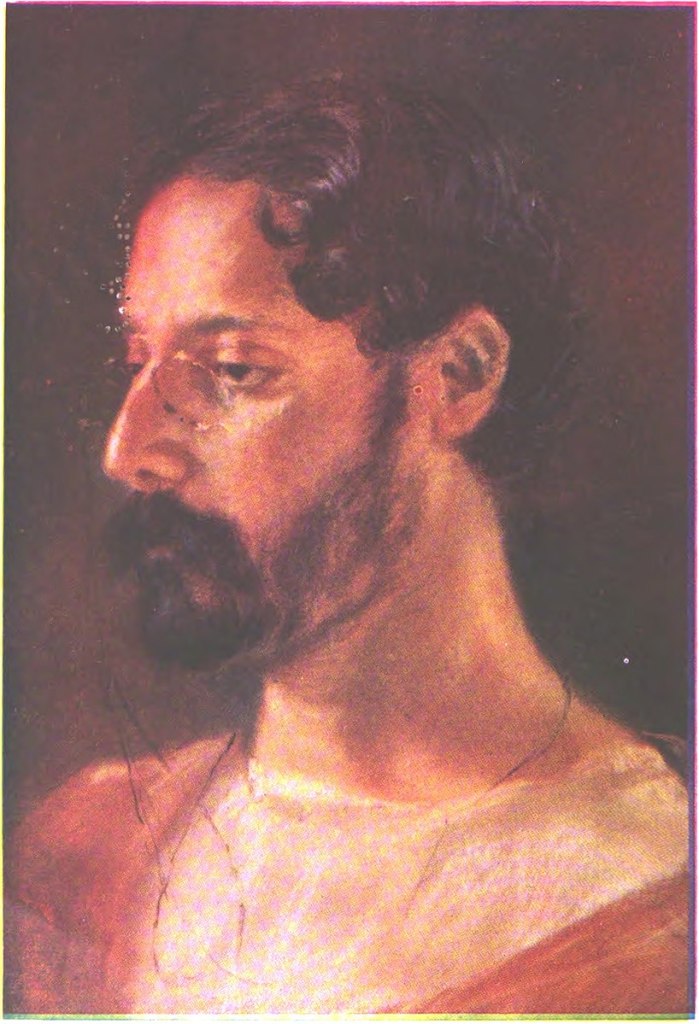
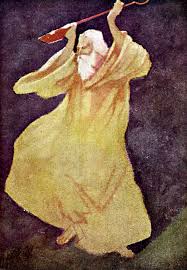
Portraits of Tagore by his nephew, Abanindranath Tagore (1871-1951)
Rabindranath Tagore (1861-1941) has a unique place in many lives. His works continue to impact us. His songs continue to feel relevant. It is not easy to grasp him in totality, to comprehend how he towered over divisive constructs created by humans with his work at Sriniketan and Santiniketan, funded eventually by his Nobel Prize money that poured in with his writings. We all unite not just under the umbrella of his writings and wisdom, but also seek solutions from his life and times — a period of dynamic changes, a renaissance. Can we find these answers? Is it to be found in the breeze that wafts across boundaries at war… or in an eternity where he continues to touch hearts…
For many of us who have not grown up listening to Tagore songs and know of him as a distant figure, here is an attempt to bring his life to you starting with the naming of the infant Rabindranath — reimagined by Aruna Chakravarti, to his first trip out of his cloistered home in Jorsanko and his first experience of snow as he went to study in England — both translated from his writings by Somdatta Mandal. We have a transcreation of a poem he wrote celebrating his birthday on pochishhe boisakh where he shares the joy of his birth with all of us. We wind up translations with Ratnottama Sengupta’s rendition of a song where he offers his lyrics to all those who are willing to listen.
Showcasing the current relevance of Tagore is a brief musing from Sengupta. To relate the wonder of Tagore’s lyrics, we have writings from professor Fakrul Alam and Asad Latif, who contend how Tagore continues evergreen…
Birth
The Naming of Rabindranath: Aruna Chakravarti shares how he chanced upon the name Rabindranath in this excerpt from Jorasanko. Click here to read.
Joys of Living
Himalaya Jatra ( A trip to Himalayas) by Tagore, has been translated from his Jibon Smriti (1911, Reminiscenses) by Somdatta Mandal from Bengali. This records his first trip out of Jorasanko as a teenager. Click here to read.
Baraf Pora (Snowfall) by Rabindranath Tagore, gives a glimpse of his first experience of snowfall in Brighton and published in the Tagore family journal, Balak (Children), has been translated from Bengali by Somdatta Mandal. Clickhereto read.
Pochishe Boisakh (25th of Baisakh), a birthday poem by Tagore(1922), has been translated from Bengali by Mitali Chakravarty. Click here to read.
Bhumika (Introduction) by Tagore has been translated from Bengali by Ratnottama Sengupta. Click here to read.
Professor Fakrul Alam muses on the impact of Tagore in his life. Click here to read.
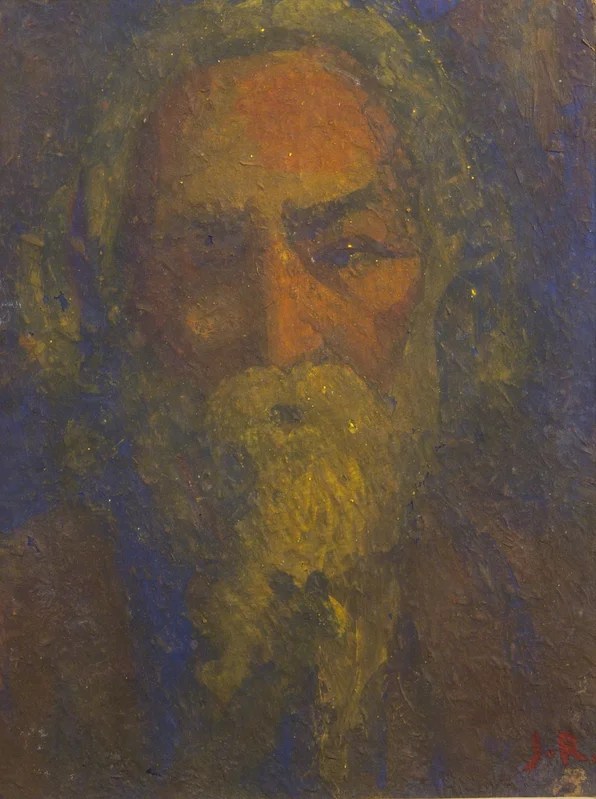
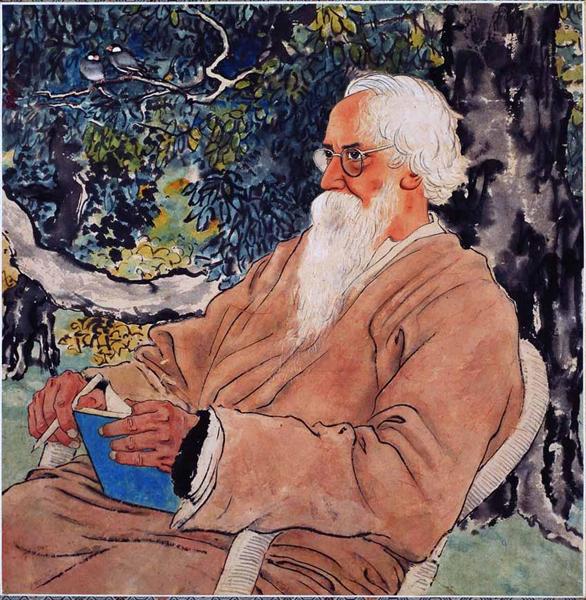
Portrait of Tagore by Jamini Roy (Indian Artist, 1887-1972)Portrait of Tagore by Xu Beihong ( Chinese Artist, 1895-1953)
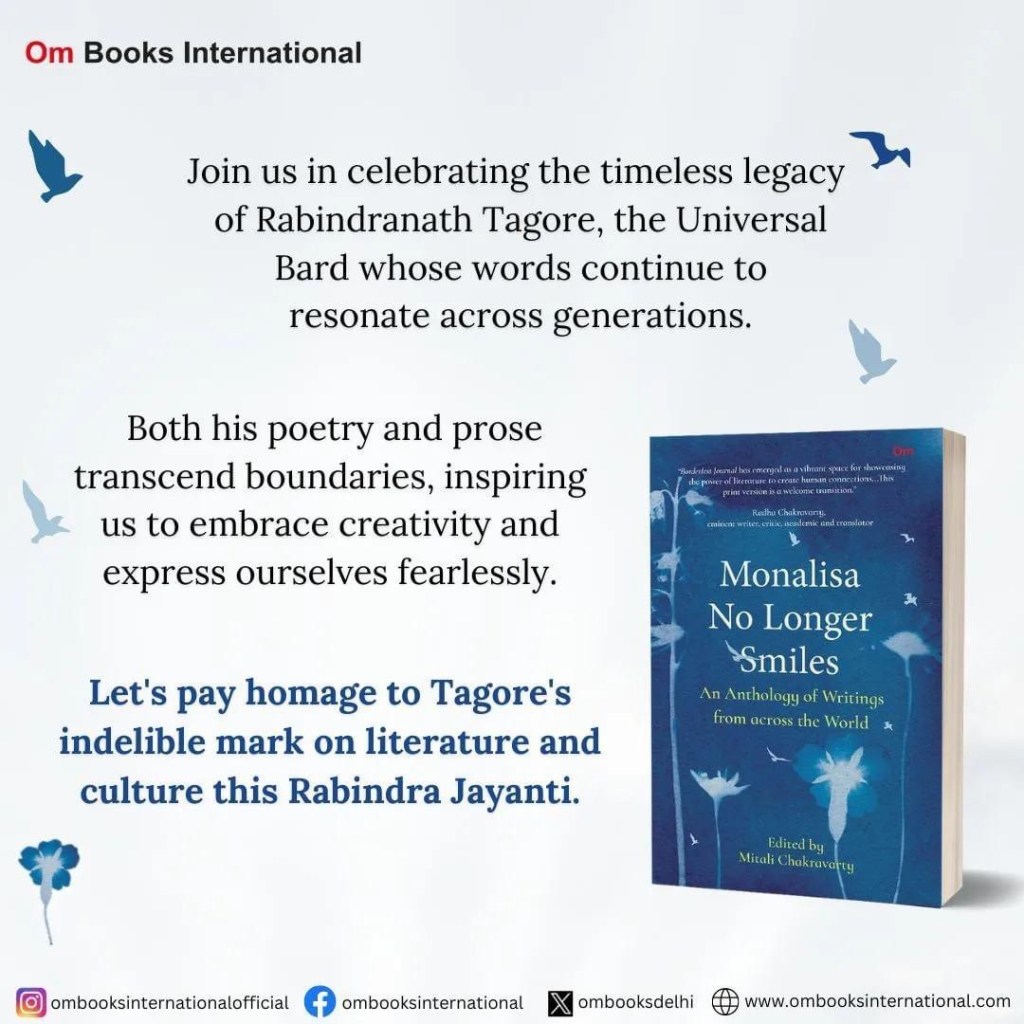
Celebrate Tagore’s legacy not only with translations but with a unique discussion on Tagore between Aruna Chakravarty and the late Sunil Gangopadhyay (1934-2012). The discussion took place under the auspices of Sahitya Akademi during the celebration of 150 years of Tagore. The book is available online on Amazon, in Om and more bookstores in India and in Bookworm, Bangladesh.
Once more, Ratnottama Sengupta explores the contemporariness of Tagore ….
In empathy with Kolkata’s heatwave in April 2024
The continuing heatwave in Kolkata that has defied the geographical reality of Kaal Baisakhi — the norwester that brings relief to sun-scorched beings — prompted me to continuously hum this Tagore song in Brindavani Sarang Raag, written in 1922.
Darun Agni Baaney Re...
(Shafts of Fire)

Shafts of fire pour thirst on us --
Sleepless nights, long scorching days,
No respite in sight!
On withered branches,
A listless dove wails
Droopy doleful notes...
No fear, no scare,
My gaze is fixed on the sky,
For you will come in the
Form of a storm,
And shower rain on scorched souls.
And as I kept singing the song first penned in Santiniketan, I marvelled at the creativity of the giant whose words are true to this very day, more than 100 years later!
Kaal Baisakhi, the nor’wester known in Assam as bordoisila, is a localised rainfall and thunderstorm event which occurs in the Indian states of West Bengal, Bihar, Jharkhand, Odisha, Tripura, and Assam as well as in Bangladesh during the summer month of Baisakh (April 15-May 14). This first month of the Bengali calendar also saw the birth of Rabindranath Tagore. These storms generally occur in the afternoon or just before sunset, when thick dark black clouds appear over the sky and then bring gale-speed wind with torrential rain, often with hail, but spanning only a short period of time.
Kalbaisakhi
Tagore’s love for Nature had compelled him to set up in Santiniketan open air classrooms, where students would learn sitting on the ground in the bower, under trees where birds would chirp and gentle breeze would caress their tired brows.
And, his involvement also expressed itself in the 293 songs he wrote in the segment titled Prakriti (nature) Parjaay. There are songs about nature in general. But he himself further classified the songs under subsections — Upa parjaay — that focus on the six seasons: grishma (summer), barsha (Monsoon), sharat( early autumn), hemanta (late autumn or early winter), sheet (winter), basanta (spring).
Tagore clearly was taken up by the wild beauty of monsoon with its dark clouds and thunderous showers. For, he wrote 150 songs on the drops of nectar from the heavens, while summer elicited a tenth of this number! If this is half the number celebrating sharat, the festive season of Durga Puja, it is thrice the number dedicated to hemanta, the confluence of autumn and winter.
I take heart in the fact that Grishma subsection includes Chokkhe aamar trishna, Ogo trishna aamar bakkho jurey… [1]
Thirst fills my eyes, Dear,
Thirsty is my heart too...
I'm a rain-starved day of Baisakh
Burnt by the sun, heat stroked.
There's a storm brewing
In the ovenated air..
It sweeps my mind into the distance.
It rips me of my veil.
The blossom that lit up the garden
Has withered and fallen.
Who has reined in the stream
Imprisoned in heartless stone
At the peak of suffering?
And then, when it rained? The torrents poured balm on the angry burns. The fleet-footed lightning seared the heart of the cloud-covered darkness and extracted the nectar-like flow…
It assured us that no hardship lasts forever. It reiterated faith in the eternal words, “This too shall pass!” And, for me? It confirmed Tagore’s words that “You will come in the form of a storm and shower rain on scorched souls…”
Tagore lives on, 163 years after he came. In his words. In his imagery. In his empathy with every human situation…
[1] Thirst fills my eyes, Dear, /Thirsty is my heart too…
Ratnottama Sengupta, formerly Arts Editor of The Times of India, teaches mass communication and film appreciation, curates film festivals and art exhibitions, and translates and write books. She has been a member of CBFC, served on the National Film Awards jury and has herself won a National Award.
.
PLEASE NOTE: ARTICLES CAN ONLY BE REPRODUCED IN OTHER SITES WITH DUE ACKNOWLEDGEMENT TO BORDERLESS JOURNAL
Baraf Pora (Snowfall) by Rabindranath Tagore,gives a glimpse of his first experience of snowfall in Brighton and published in the Tagore family journal, Balak (Children), has been translated from Bengali by Somdatta Mandal. Clickhere to read.
Himalaya Jatra( A trip to Himalayas) by Tagore, has been translated from his Jibon Smriti (1911, Reminiscenses) by Somdatta Mandal from Bengali. Click here to read.
Bhumika (Introduction) by Tagore has been translated from Bengali by Ratnottama Sengupta. Click here to read.
The Fire-grinding Quern by Manzur Bismil has been translated from Balochi by Fazal Baloch. Clickhere to read.
The Tobacco Lover by Ihlwha Choi has been translated from Korean by the poet himself. Clickhere to read.
Pochishe Boisakh(25th of Baisakh) by Tagore(1922), has been translated from Bengali by Mitali Chakravarty. Click here to read.
Pandies Corner
Songs of Freedom: Dear Me… is an autobiographical narrative by Ilma Khan, translated from Hindustani by Janees. These narrations highlight the ongoing struggle against debilitating rigid boundaries drawn by societal norms, with the support from organisations like Shaktishalini and pandies’. Click here to read.
Paul Mirabile gives a gripping tale about a young pyromaniac. Click hereto read.
Conversation
Ratnottama Sengupta in conversation about Kitareba, a contemporary dance performance on immigrants, with Sudarshan Chakravorty, a choreographer, and founder of the Sapphire Dance Company. Click here to read.
Centuries ago, April was associated with spring induced travel… just as pilgrims set out on a journey in Chaucer’s Canterbury Tales. Some of the journeys, like to Mecca, become a part of religious lore. And some just add to the joie de vivre of festivities during different festivals that punctuate much of Asia during this time — Pohela Boisakh (Bengali), Songkran (Thai), Navavarsha (Nepali), Ugadi (Indian), Vaisakhi (Indian), Aluth Avurudda (Sri Lankan) and many more.
A hundred years ago, in April 1924, Tagore had also set out to journey across the oceans to China — a trip which, perhaps, led to the setting up of Cheena Bhavan in Vishwa Bharati. Recently, Professor Uma Dasgupta in a presentation stated that Tagore’s Nobel prize winning Gitanjali, and also a collection called The Crescent Moon (1913), had been translated to Chinese in 1923 itself… He was renowned within China even before he ventured there. His work had been critically acclaimed in literary journals within the country. That arts connect in an attempt to override divides drawn by politics is well embodied in Tagore’s work as an NGO and as a writer. He drew from all cultures, Western and Eastern, to try and get the best together to serve humankind, closing gaps borne of human constructs. This spirit throbbed in his work and his words. Both towered beyond politics or any divisive constructs and wept with the pain of human suffering.
This issue features translations of Tagore’s writings from his childhood — both done by professor Somdatta Mandal — his first trip with his father to the Himalayas and his first experience of snow in Brighton. We have a transcreation of some of his lyrics by Ratnottama Sengupta. The translation of his birthday poem to himself — Pochishe Boisakh(his date of birth in the Bengali calendar) along with more renditions in English of Korean poetry by Ihlwha Choi and Manzur Bismil’s powerful poetry from Balochi by Fazal Baloch, add richness to our oeuvre. Bismil’s poetry is an ode to the people — a paean to their struggle. It would seem from all the translations that if poets and writers had their way, the world would be filled with love and kindness.
Yet, the world still thunders with wars, with divides — perhaps, there will come a time when soldiers will down their weapons and embrace with love for, they do not fight for themselves but for causes borne of artificial human divides. It is difficult to greet people on any festival or new year, knowing there are parts of the world where people cannot celebrate for they have no food, no water, no electricity, no homes and no lives… for many have died for a cause that has been created not by them as individuals but by those who are guided solely by their hankering for power and money, which are again human constructs. Beyond these constructs there is a reality that grows out of acceptance and love, the power that creates humanity, the Earth and the skies…
Humour is brought into non-fiction by Devraj Singh Kalsi’s narrative about being haunted by an ancient British ghost in Kolkata! Suzanne Kamata adds to the lightness while dwelling on modelling for photographs in the Japanese way. Ravi Shankar plunges into the history of photography while musing on black and white photographs from the past.
Tagore again seeps into non-fiction with Professor Fakrul Alam and Asad Latif telling us what the visionary means to the Bengali psyche. Starting with precursors of Tagore, like Michael Madhusudan Dutt, and post-him, Sarojini Naidu, Mandal has shared an essay on Bengaliness in contemporary poetry written by those born to the culture. Jared Carter has given discussed ‘the lyric temper’ in poetry — a wonderful empathetic recap of what it takes to write poetry. Exploring perspectives of multiple greats, like Yeats, Keats, George Santyana, Fitzgerald, Carter states, “Genuine lyricism comes only after the self has been quieted.”
Sengupta has conversed with a dance choreographer, Sudershan Chakravorty, who has been composing to create an awareness about the dilemmas faced by migrants. An autobiographical narrative in Hindustani from Ilma Khan, translated by Janees, shows the resilience of the human spirit against oppressive social norms. Our fiction has stories from Lakshmi Kannan and Shevlin Sebastian urging us to take a relook at social norms that install biases and hatred, while Paul Mirabile journeys into the realm of fantasy with his strange story about a boy obsessed with pyromania.
“It is an ironical reflection on our times that a prolific and much awarded Indian writer– perhaps deserving of the Nobel prize — should be excised from the university syllabus of a central university. This move has, perhaps paradoxically, elicited even more interest in Mahasweta Devi’s work and has also consolidated her reputation as a mascot, a symbol of resistance to state violence. A timely intervention, this volume proves yet again that a great writer, in responding to local, regional, environmental ethical concerns sensitively, transcends his/her immediate context to acquire global and universal significance.”
There is more content than I mention here. Do pause by our current issue to take a look.
I would hugely like to thank the Borderless team for their unceasing support, and especially Sohana Manzoor, also for her fantastic art. Heartfelt thanks to all our wonderful writers and our readers. We exist because you all are — ubuntu.
Hope you have a wonderful month. Here’s wishing you all wonderful new years and festivals in March-April — Easter, Eid and the new years that stretch across Asian cultures.
Looking forward and hoping for peace and goodwill.





 Borderless