Ratnottama Sengupta muses on her encounter with the writings of eminent artist and writer, Dhruba Esh, and translates one his many stories, Amiyashankar Go Back Home from Bengali. Click here to read.
The air at Patenga Sea Beach hung thick with salt and memory, a living weight that clung to Karim’s skin and settled in the grooves of his thoughts. He stood motionless, his feet half-buried in the damp embrace of sand, facing the heaving expanse of the Bay of Bengal. Each wave broke with a rhythm once known to him, a lullaby of youth and simplicity. Now, it rolled like an echo chamber of loss.
He didn’t just see the sea—he saw the absence it bore. Azimpur Union, a coastal village once nestled like a secret in the arms of Sandwip, no longer existed. The Meghna River had devoured it, inch by insatiable inch, until it was reduced to memory. His family, like countless others, had fled inland, displaced not by war or persecution but by the creeping violence of climate change. Halishahar became their reluctant refuge. Karim, now a climate scientist, carried the wound like a relic—not healed but honed.
Beside him, Anika traced idle circles in the sand with her bare toe, drawing galaxies destined to be washed away. Her short hair fluttered in the breeze, framing a face defined by quiet determination and dark, searching eyes. As a student of Environmental Sciences at the Asian University for Women, she viewed the beach not just as a source of beauty, but as a battleground.
“It’s getting worse, isn’t it?” she asked, not breaking her gaze from the horizon, where cargo ships floated like steel ghosts. Karim nodded. “It’s not just the sea creeping in. It’s the salt in our fields, the poison in our wells. My grandfather spoke of golden paddy fields in Azimpur. Now it’s all water. Still. Empty. Unforgiving.” A voice, crisp and clear, cut through the air. “That’s why your work matters, Bhaijaan[1].”
Hafsa had arrived, stepping into the wind like it obeyed her. Younger than Karim by a decade, she wore her uniform from Feni Girls Cadet College like a blade sheathed in pride. Her eyes, sharp and unwavering, carried a fire that scorched complacency.
“Understanding the science is our first defence,” she said. “You’re giving us a fighting chance.” Karim smiled—not the performative curve of lips, but the rare, involuntary kind that cracked through layers of grief. “That’s why I studied Oceanography. Not for grades. To learn the language of the sea. To understand the force that took everything from us.”
They drifted to the quieter banks of the Chittagong Boat Club, where boats bobbed like dreams tethered to fragile ropes. Here, the water lapped gently, less a threat, more a whisper.
“Sandwip’s shoreline is disappearing,” Karim said, leaning on the railing. “Sometimes by metres each month. It’s a perfect storm: rising seas, broken river systems, displaced sediments. The Bay of Bengal funnels it all into disaster. It’s not just nature. It’s a mirror of our neglect.” Anika picked up the thread like a weaver. “It’s a slow massacre. Salt invades the soil. Crops wither. Freshwater turns brackish. The mangroves—our final fortress—are dying. The Sundarbans are gasping.”
“And with them,” Hafsa added, “everything unravels. People flee inland. Cities like Halishahar swell and groan. Agriculture collapses. Food security frays. And without mangroves, every cyclone cuts deeper. Everything is connected.”
Karim nodded, the weight of data behind every word. “The models I build are no longer predictive. They’re prescriptive. They warn of what is already unravelling. Sea levels, salinity, erosion—they all spike. The IPCC[2] confirms it. But the tide doesn’t wait for consensus.”
At Foy’s Lake, serenity shimmered over the water like an illusion. But their thoughts grew darker.
“Bangladesh knows storms,” Anika said, her voice soft. “Bhola, 1970. Chittagong, 1991. Cyclones that rewrote our history in wind and water.”
“Those storms taught us resilience,” Karim said. “Shelters. Warnings. Community drills. However, the storms are now stronger. Hotter oceans feed them. And higher seas mean bigger surges—even from weaker storms.”
Hafsa’s voice quivered at the edges. “But how much more can we endure? Our grandparents rebuilt after every storm. But if this continues, is it resilience, or a kind of slow exile?” Anika nodded. “Traditional adaptation isn’t enough anymore. We need foresight. Long-term planning. Even planned migration. And that’s not just about moving people. It’s about moving lives, cultures, entire identities.”
They sat for a while, sharing silence, watching birds slice the air like omens. In that stillness, Anika said, “You know what hurts most? It’s not the loss of land. It’s the loss of certainty. The knowledge that what raised you, fed you, and shaped your memories is vanishing. And there’s no going back.”
Silence followed them to the War Cemetery, where white stones bore witness to another kind of war. One with bullets and borders. Karim saw it differently now: this, too, was a battlefield. But here, the enemy was time, water, and indifference. Later, among the blooms of DC Park and the Sitakunda Botanical Garden and Eco Park, their talk turned to life beneath the waves.
“Most people think of fish,” Karim said, gesturing to a flowering hibiscus. “But the ocean’s true wealth lies in biodiversity. Coral reefs, like those near St. Martin’s Island, are the lungs and nurseries of the sea.”
“And they’re dying,” Anika said. “Warming waters bleach them. Carbon dioxide makes the ocean acidic. Reefs dissolve before our eyes. It’s extinction, hidden by depth.”
Karim’s voice dropped like an anchor. “The blue economy—fishing, tourism, aquaculture—depends on healthy oceans. Without reefs, fish vanish. Livelihoods collapse. The sea becomes a graveyard.”
“So it’s not just conservation,” Hafsa said. “It’s survival. But how do we grow our economy without destroying what sustains it?” Karim didn’t hesitate. “Balance. Policy grounded in science. Marine protected areas. Sustainable fishing quotas. Eco-tourism. Stewardship over extraction.”
They spent hours walking through the botanical paths, discussing seagrass, kelp forests, and the future of ocean farming. Anika shared her dreams of working with community-led marine conservation, and Hafsa spoke of pushing climate policy debates in every youth parliament session she attended. High in the Chandranath Hill, where the wind carried the scent of leaves and legacy, their voices softened.
“There’s more to the sea than science,” Karim said, his voice almost reverent. “There’s a myth. Memory. Identity. That’s what the blue humanities teaches us. When Azimpur disappeared, it wasn’t just land. It was language. It was lullabies.” Anika blinked; her eyes were glassy. “I see it in displaced communities. They lose more than their homes. They lose stories. The names of trees, the tastes of festivals.” Hafsa, ever the compass, brought it home. “So blue humanities means recognising the ocean not just as a resource but as part of us. A mirror. What we take from it, we take from ourselves.” Karim looked at them and felt a surge rise in his chest, not of sorrow this time, but something like hope. “You’re right. This fight isn’t just scientific. Or economic. It’s human. And we can only win it together.”
As the sun dipped behind the Chandranath Hill, setting the sky ablaze in golds and blood-reds, they walked in a hush, not of despair, but of reverence. They were young, yes. But in their hearts, they carried the future—and it was heavy.
Then Anika asked, “What gives you hope?” Karim looked at her, then at Hafsa, and smiled. “You do. The fact that we’re talking like this. That we care. That we haven’t given up.” And Hafsa, eyes firm as stone, said, “We won’t. We’re the generation that listens to the tide before it screams.”
They turned from the sea, toward the uncertain shore of tomorrow. The water behind them was not done. But neither were they.
Sandwip beach. From Public Domain
[1] A respectful way of addressing a man, translates to brother
ProfessorFakrul Alam brings to us Tagore songs in translation and in discussion on the season that follows the scorching heat of summer months. Clickhereto read.
“May is pretty, May is mild,
Dances like a happy child…”

Annette Wynne (Early twentieth century)
Each month is expressed in a different form by nature in various parts of the world. In the tropics, May is sweltering and hot — peak summer. In the Southern hemisphere, it is cold. However, with climate change setting in, the patterns are changing, and the temperatures are swinging to extremes. Sometimes, one wonders if this is a reflection of human minds, which seem to swing like pendulums to create dissensions and conflicts in the current world. Nothing seems constant and the winds of change have taken on a menacing appearance. If we go by Nazrul’s outlook, destruction is a part of creating a new way of life as he contends in his poem, ‘Ring Bells of Victory’ — “Why fear destruction? It’s the gateway to creation!” Is this how we will move towards ‘dancing like a happy child’?
Mitra Phukan addresses this need for change in her novel, What Will People Say — not with intensity of Nazrul nor in poetry but with a light feathery wand, more in the tradition of Jane Austen. Her narrative reflects on change at various levels to explore the destruction of old customs giving way to new that are more accepting and kinder to inclusivity, addressing issues like widow remarriage in conservative Hindu frameworks, female fellowship and ageing as Phukan tells us in her interview. Upcoming voice, Prerna Gill, lauded by names like Arundhathi Subramaniam and Chitra Divakaruni, has also been in conversation with Shantanu Ray Choudhuri on her book of verses, Meanwhile. She has refreshing perspectives on life and literature.
Devraj Singh Kalsi has written a nostalgic piece that hovers between irony and perhaps, a reformatory urge… I am not quite sure, but it is as enjoyable and compelling as Meredith Stephen’s narrative on her conservation efforts in Kangaroo Island in the Southern hemisphere and fantastic animals she meets, livened further by her photography. Ravi Shankar talks of his night hikes in the Northern hemisphere, more accurately, in the Himalayas. While trekking at night seems a risky task, trying to recreate dishes from the past is no less daunting, as Suzanne Kamata tells us in her Notes from Japan.
May hosts the birthday of a number of greats, including Tagore and Satyajit Ray. Ratnottama Sengupta’s piece on Ray’s birth anniversary celebrations with actress Jaya Bachchan recounting her experience while working for Ray in Mahanagar(Big City), a film that has been restored and was part of celebrations for the filmmaker’s 102nd Birth anniversary captures the nostalgia of a famous actress on the greatest filmmakers of our times. She has also given us an essay on Tagore and cinema in memory of the great soul, who was just sixty years older to Ray and impacted the filmmaker too. Ray had a year-long sojourn in Santiniketan during his youth.
Eulogising Rabindrasangeet and its lyrics is an essay by Professor Fakrul Alam on Tagore. Professor Alam has translated number of his songs for the essay as he has, a powerful poem from Bengali by Masud Khan. A transcreation of Tagore’s first birthday poem , a wonderful translation of Balochi poetry by Fazal Baloch of Munir Momin’s verses, another one from Korean by Ihlwha Choi rounds up the translated poetry in this edition. Stories that reach out with their poignant telling include Nadir Ali’s narrative, translated from Punjabi by his daughter, Amna Ali, and Aruna Chakravarti’s translation of a short story by Tagore. We have more stories from around the world with Julian Gallo exploring addiction, Abdullah Rayhan with a poignant narrative from Bangladesh, Sreelekha Chatterjee with a short funny tale and Paul Mirabile exploring the supernatural and horror, a sequel to ‘The Book Hunter‘, published in the April issue.
All the genres we host seem to be topped with a sprinkling of pieces on Tagore as this is his birth month. A book excerpt from Chakravarti’s Daughters of Jorasankonarrates her well-researched version of Tagore’s last birthday celebration and carries her translation of the last birthday song by the giant of Bengali literature. The other book excerpt is from Bhubaneswar@75 – Perspectives, edited by Bhaskar Parichha/ Charudutta Panigrahi. Parichha has also reviewed Journey After Midnight – A Punjabi Life: From India to Canadaby Ujjal Dosanjh, a book that starts in pre-independent India and travels with the writer to Canada via UK. Again to commemorate the maestro’s birth anniversary, Meenakshi Malhotra has revisited Radha Chakravarty’s translation of Tagore’s Farewell Song. Somdatta Mandal has critiqued KR Meera’sJezebel, translated from Malayalam by Abhirami Girija Sriram and K. S. Bijukuma. Lakshmi Kannan has introduced to us Jaydeep Sarangi’s collection of poems, letters in lower case.
There are pieces that still reach out to be mentioned. Do visit our content page for May. I would like to thank Sohana Manzoor for her fantastic artwork and continued editorial support for the Tagore translations and the whole team for helping me put together this issue. Thank you. A huge thanks to our loyal readers and contributors who continue to bring in vibrant content, photography and artwork. Without you all, we would not be where we are today.
addendum

if you look at my journey, from your point of view,
you will find, i have been grateful to people
who nurture me, encourage me, and criticise me to be better,
to make me a thoughtful and considerate human
in times of crises, in the era of finance.
how can i forget those moments?
i don’t ask you to be on my side
rather i want my own space, my territory.
if you don’t know what’s happening inside and around the world,
how can you be updated? how can you be on par?
you may not know what a bird thinks, and how a fish smiles in our region.
checking me is a violation, i am not a weapon of chess.
and it matters when you don’t make any assumptions
about the issues. you are not heard of. do you know
what i am doing now apart from typing verses
with my hands and looking at the device’s screen?
while you care about these, i am on top of the hour of hope.
i look outside my windows on a spring afternoon,
to see how leaves fall from the trees, and to enjoy the breeze.
pause. no endnote. no final full-stop. a continual task…
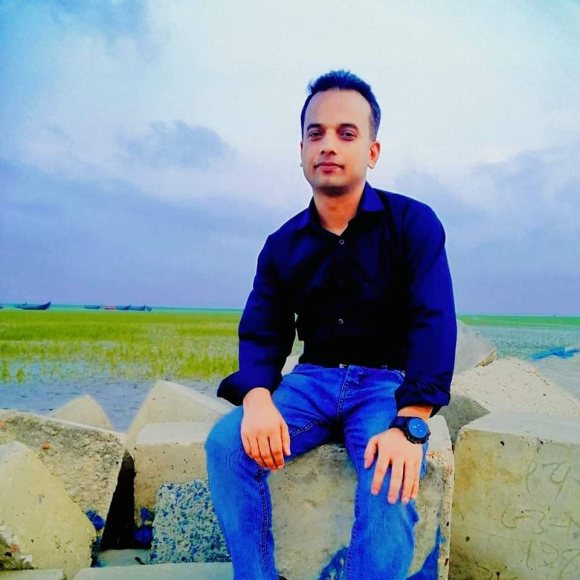
Md Mujib Ullah from Sandwip, Chittagong, Bangladesh, is a researcher, writer, and translator. His poems have appeared in Journal of Poetry Therapy, Text, Asiatic, Capitalism Nature Socialism, and Postcolonial Text.
PLEASE NOTE: ARTICLES CAN ONLY BE REPRODUCED IN OTHER SITES WITH DUE ACKNOWLEDGEMENT TO BORDERLESS JOURNAL



 Borderless