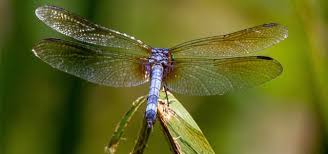
The dragonfly, it seems, wishes to be my companion.
Even when October comes, it still hovers close by my side.
On a late autumn morning, cloaked in white frost,
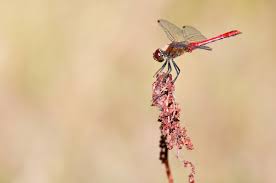
clinging to a withered blade of grass until its life is spent,
the dragonfly loves the fields, loves the sunlight.

As swallows line up in long ranks,
packing their final bundles for a faraway journey,
news may come from the city of someone’s suicide,
yet the dragonfly listens half-heartedly, caring little.
Beside the fisherman, beside the farmer gathering beans,
following the way of life of distant ancestors,
the dragonfly flits about, plays with innocence.
And then, from a withered blade of grass,
it departs the world as lightly as taking flight—
on a morning when leaves and blossoms alike have faded.
From Public Domain
Ihlwha Choi is a South Korean poet. He has published multiple poetry collections, such as Until the Time When Our Love will Flourish, The Color of Time, His Song and The Last Rehearsal.
.
PLEASE NOTE: ARTICLES CAN ONLY BE REPRODUCED IN OTHER SITES WITH DUE ACKNOWLEDGEMENT TO BORDERLESS JOURNAL.
“This is just like Midsomer Murders without the murders!” I quipped to Alex.
Midsomer Murders was one of my favourite British crime shows. In particular, I loved the depiction of English village life, where villagers gossiped on the village green. The only problem was when the happy village life was interrupted by a gruesome and unexpected murder. Then I had to place my hands before my eyes to block out the scene of the murder in case the camera lingered there too long.
Alex, Verity and I were visiting the Mypunga Markets in the South Australian countryside. The first vendor was selling a wide selection of eye-wateringly delectable Greek cakes. To our right was an Italian wine-grower selling his wines, such as Pinot Grigio, from a nearby vineyard. A Korean stall holder was selling kimchi[1]. Perhaps the offerings were a tad more multicultural that those depicted on the village green in Midsomer Murders. Farmers sold organic vegetables and local dairies sold cheeses. We stopped to soak in the sounds of a group of elderly ukulele players. Shoppers were wearing home-spun hand-knitted jumpers, scarves and beanies, carrying shopping bags made of cheesecloth. I revelled at being on the set of the South Australian equivalent of the village green in Midsomer.
Our purpose for driving into the countryside was twofold. After the market, we went to the shed at Alex’s hobby farm to collect some firewood. Alex unlocked the gates at the roadside entrance, and we drove through the spotted eucalypts, wound up and down the hill through the gorge to eventually arrive at the shed. The roller door was wide open. This was the first time we had been greeted by an open roller door. We parked and peeked inside.
“Don’t go in, Dad!” screamed Verity.
Plastic tubs had their lids off. Children’s toys were scattered. Furniture was tipped over. The new off-grid battery modules, in the process of being installed, had been ripped out and strewn on the floor. We could not turn on the lights because they were powered by the batteries.
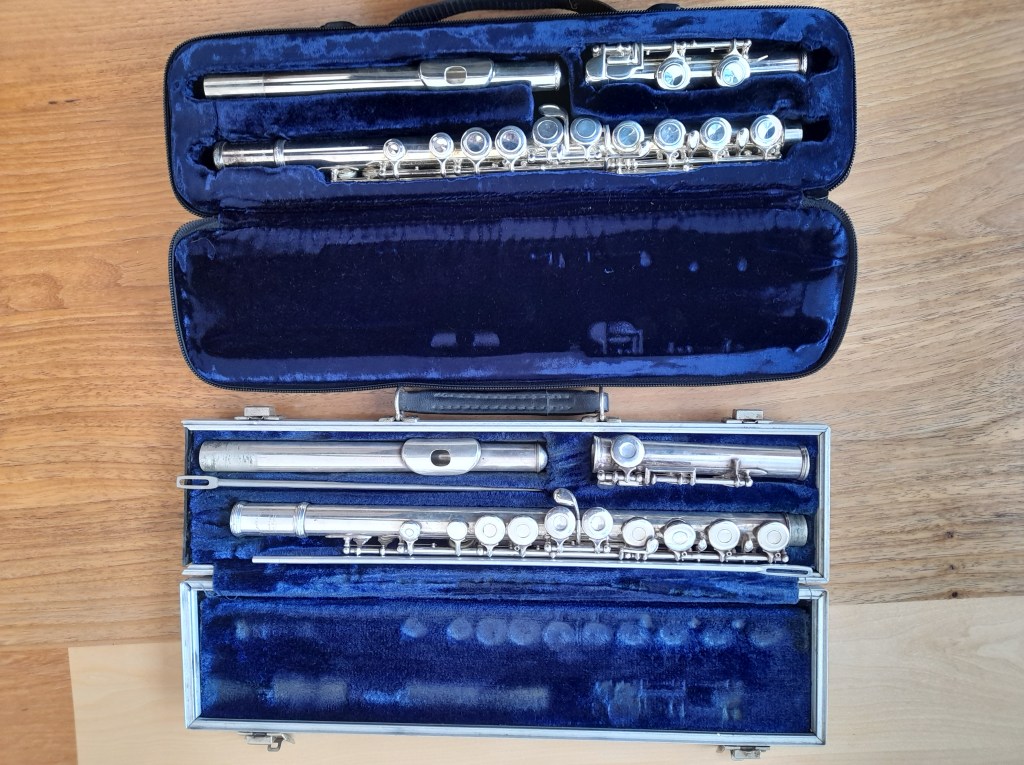
We carefully continued our entry into the huge dark shed lest we surprise the burglars and become a victim ourselves. No-one was there. I looked in the ancient sideboard I had inherited from my grandmother and opened the top drawers. My forty-year-old flutes were missing. Were the burglars flautists?
We righted the upturned furniture, returned the toys to the plastic tubs, affixed the lids and stacked them neatly. Then Alex got on the phone to his young employee, Troy.
“Would you mind getting hold of a battery-powered camera and placing it up high in the gum tree facing the shed door?” he asked. “We need surveillance.”
It was Saturday and Troy’s day off, but he was willing to assist Alex, and by 9 pm that evening he had purchased a camera and placed it where requested. He used the drop-down menu to ensure that notifications of camera images would come to his phone.
We returned home with the firewood. At least the burglars hadn’t stolen that. We lit a fire in the fireplace and luxuriated in front of it, savouring the delights we had purchased at the Mypunga markets. Now we had a camera installed, surely, we would be safe.
At 5 am the next morning the telephone rang. It was Troy. Alex’ phone had been on bedtime mode, and he could not have received calls any earlier.
“They’ve broken in again,” said Troy. “At 2.38 am. This time with a car. The footage came to my phone.”
“Are you there now?” asked Alex.
“Yes. I came straight here when I got the notification.”
“OK. We’ll head over there this morning. Have you called the police?”
“Yes. They’re coming shortly.”
Usually, I savour sleeping in on the weekend, or in fact on any day, but suddenly I had no desire to continue nestling between the brushed cotton sheets. I had been jolted awake.
“Are we going now?” I asked Alex.
“Soon. I have to wait for the hardware store to open. I want to buy some metal reinforcements to secure the shed door. Because we have no power, I’ll have to buy an inverter to power my tools.”
We drove towards Mypunga, first stopping at the hardware store en route to buy the bolts and then at an electronic’s store to buy the inverter. When we arrived at the farm we stopped at the gates to check the locks. The chain had been cut with bolt cutters. Then came a phone call from Troy.
“Are the police here?” asked Alex.
“Yes. They have collected fingerprints and DNA samples. They are coming out now to talk to you.”
Soon we were joined at the gates by four detectives and Troy. It was 11 am. Troy had been on the site for at least six hours, not to mention having been there at 9 pm the night before to install the cameras. He excused himself and the detectives explained to Alex the evidence they had found. The visit from the previous day had been a stake-out on foot. Once they had discovered the batteries, they had resolved to return with a car. The batteries were too heavy to have been carried out on foot. But not the flutes. They were much lighter than the batteries.
The police promised to examine the footage carefully. It captured the arrival of the car, and three men with torches circling the shed. One of the men had spied the camera, seized it, and thrown it down the hill. After that the images from the camera were of the surrounding grass. The detectives left and Alex and I drove up and down the winding track to the shed. The roller door was wide open. We entered, and the carefully stacked boxes again were opened and the lids strewn around the shed. Toys and hats were scattered. The drawer from which my flutes had been removed was now firmly wedged against the sideboard. They had clearly opened and shut it again, even after having removed the flutes the day before.
Unlike in Midsomer, no-one had been murdered, but there was a strong sense of violation. Burglars had staked out Alex’s shed, upturned the contents, and left with the roller door still open. Returning the very next day after having staked out the property was brazen. There was a dark underside in this countryside location despite the peaceful scene we had observed the previous day in Mypunga, with shoppers in their home-spun hand-knitted jumpers carrying their organic produce in cheesecloth bags. Most likely the thieves were from elsewhere and had followed the battery installer’s vehicle emblazoned “Remote Power Australia”.
A few days later Alex received a call from the detectives requesting a DNA sample, in order to rule him out. Some tools in the shed had been used to remove the batteries, and they had produced a DNA sample from these. Alex agreed, and a constable arrived at the house the next day to take a swab.
“Have you made any progress on the case?” asked Alex.
“We’ve identified the car the burglars used from the footage. It’s a Ford Maverick. That narrows it down quite a bit.”
Meanwhile Alex and Troy restored the camera to the eucalyptus tree, and bought another one which they affixed it to another tree one hundred and fifty feet away. At the detective’s suggestion, the second camera was aimed at the first one. If a burglar took down the first camera they would be filmed by the second camera. Since the batteries had been stolen and there was no power in the shed, the cameras were operated by solar panels. Alex could regularly check for notifications on his phone.
Two months later Alex received a phone call from a constable with a strong northern English accent that transported you to a distant time and place. It was the kind of English you would hear on a British detective show, although not the southeastern English accent of the fictional Midsomer.
“This is Senior Constable Jane Michaels. We have found two flutes. They may be yours. Can you identify them from the photo? I took it with my bodycam.”
Alex showed me his phone. I couldn’t identify them from the photo. However, they had to be mine. Flute theft must be a much rarer crime than battery theft. More people are in need of batteries than a flute.
“If you prefer to identify them in person, I can make myself available next week,” explained the Senior Constable. “The burglars were not what you would call a musical family,” she quipped.
“I’ll give you my partner’s number so that you can contact her directly,” offered Alex.
The next Wednesday a call came from an unknown number. I let it ring out because I never answer unless I know who is calling. Then I listened to the recorded message the caller had left behind.
“It’s Senior Constable Jane Michaels from the Camden Police Station. I’m hoping you can identify those flutes. Please call me back.”
Hearing this English accent made me feel like I was on the set of Midsomer Murders. A frisson of excitement tingled up my spine. It was a warm, old-world and unpretentious accent that I associated with the north of England. (When you hear an English accent by a worker in South Australia, you may feel like you are on the set of a detective show like me, or you may assume they are in the health or policing professions because of the recruitment drives in Britain in these professions.)
“Can you come to Camden Station to identify them? We’ll be there in half an hour.”
I drove to the address she provided, entered through the imposing gates, and parked outside a giant warehouse. I entered the building and pressed a button marked ‘Property recovery’. A constable greeted me from behind a glass partition.
“What have you come to collect?” he asked.
“Two flutes.”
He looked at me quizzically. Flute theft is probably an uncommon crime.
“What?” he asked again.
“Flutes,” I repeated.
He disappeared to the room behind, and Senior Constable Jane Michaels appeared bearing the flutes in their cases. Despite her old-world accent on the phone, she was surprisingly young.
“Are these in fact yours?”
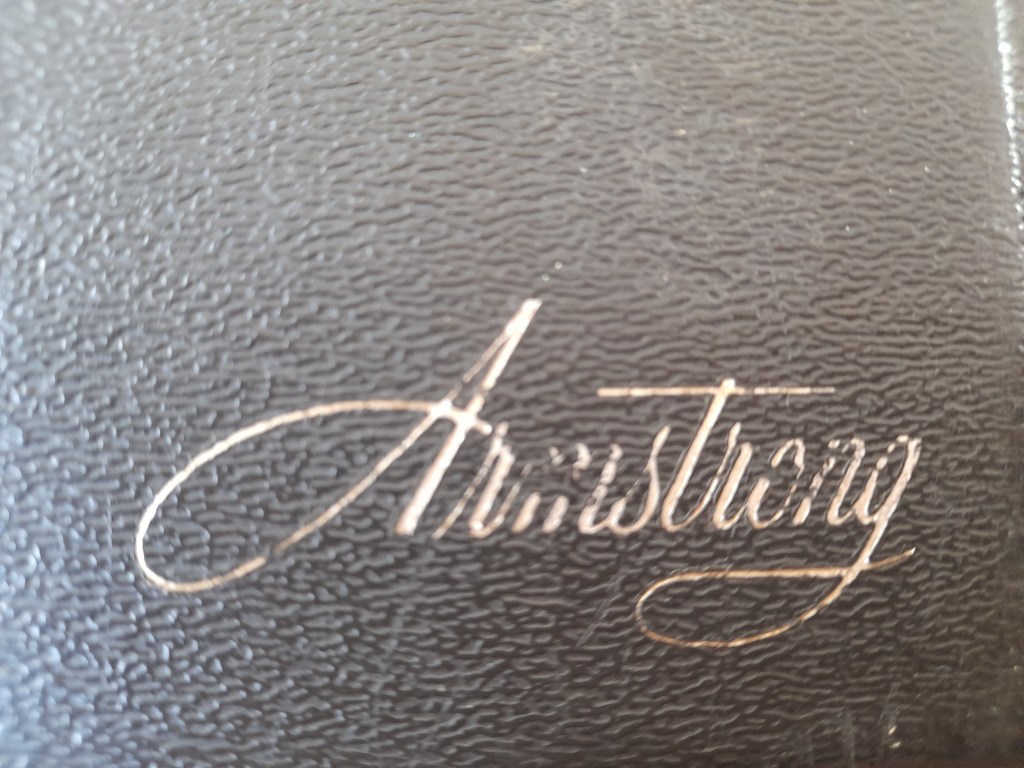
I looked at the cover of the box for the brand, and sure enough, ‘Armstrong’ was written in faded silver letters. This was the flute I had owned since my teenage years.
“How about the batteries? Are you likely to find them?” I asked hopefully.
“We didn’t find them at the property, but it’s an ongoing investigation,” she explained. I could tell from her apologetic tone that she thought we would be unlikely to retrieve them.
I thanked her and left. I returned to my car, the sole one in the enormous car park. As I drove off two constables headed to close the enormous gates behind me, smiling and waving, happy that I had been reunited with my stolen flutes.
I have to hope for Alex’ sake that the batteries will be found. Meanwhile, I haven’t played my Armstrong flute in over forty years, but now that it has been stolen and recovered in a raid, I feel compelled to take it up again. What’s more, who knows whether the recovered flutes will be instrumental in solving the crime of the stolen batteries?
Meredith Stephens is an applied linguist from South Australia. Her recent work has appeared in Syncopation Literary Journal, Continue the Voice, Micking Owl Roost blog, The Font – A Literary Journal for Language Teachers, and Mind, Brain & Education Think Tank. In 2024, her story Safari was chosen as the Editor’s Choice for the June edition of All Your Stories.
PLEASE NOTE: ARTICLES CAN ONLY BE REPRODUCED IN OTHER SITES WITH DUE ACKNOWLEDGEMENT TO BORDERLESS JOURNAL
Nazrul’s Jonomo, Jonomo Gelo(Generations passed) has been translated from Bengali by Professor Fakrul Alam. Click here to read and listen to a rendition by the famed Feroza Begum.
Ajit Cour‘s short story, Nandu, has been translated from Punjabi by C Christine Fair. Click here to read.
The Scarecrowby Anwar Sahib Khan has been translated from Balochi by Fazal Baloch. Click here to read.
Naramsetti Umamaheswararao moulds children’s perspectives. Click here to read.
Notes from Japan
In American Wife,Suzanne Kamata gives a short story set set in the Obon festival in Japan. Click here to read.
Conversation
Neeman Sobhan, author of Abiding City: Ruminations from Rome, discusses shuttling between multiple cultures and finding her identity in words. Click here to road.
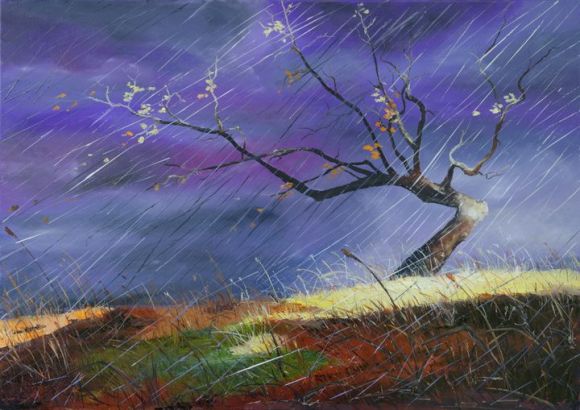
Storm in purple by Arina Tcherem. From Public Domain
If we take a look at our civilisation, there are multiple kinds of storms that threaten to annihilate our way of life and our own existence as we know it. The Earth and the human world face twin threats presented by climate change and wars. While on screen, we watch Gaza and Ukraine being sharded out of life by human-made conflicts over constructs made by our own ‘civilisations’, we also see many of the cities and humankind ravaged by floods, fires, rising sea levels and global warming. Along with that come divides created by economics and technology. Many of these themes reverberate in this month’s issue.
From South Australia, Meredith Stephens writes of marine life dying due to algal growth caused by rising water temperatures in the oceans — impact of global warming. She has even seen a dead dolphin and a variety of fishes swept up on the beach, victims of the toxins that make the ocean unfriendly for current marine life. One wonders how much we will be impacted by such changes! And then there is technology and the chatbot taking over normal human interactions as described by Farouk Gulsara. Is that good for us? If we perhaps stop letting technology take over lives as Gulsara and Jun A. Alindogan have contended, it might help us interact to find indigenous solutions, which could impact the larger framework of our planet. Alindogan has also pointed out the technological divide in Philippines, where some areas get intermittent or no electricity. And that is a truth worldwide — lack of basic resources and this technological divide.
On the affluent side of such divides are moving to a new planet, discussions on immortality — Amortals[1] by Harari’s definition, life and death by euthanasia. Ratnottama Sengupta brings to us a discussion on death by choice — a privilege of the wealthy who pay to die painlessly. The discussion on whether people can afford to live or die by choice lies on the side of the divide where basic needs are not an issue, where homes have not been destroyed by bombs and where starvation is a myth, where climate change is not wrecking villages with cloudbursts. In Kashmir, we can find a world where many issues exist and violences are a way of life. In the midst of such darkness, a bit of kindness and more human interactions as described by Gower Bhat in ‘The Man from Pulwama’ goes some way in alleviating suffering. Perhaps, we can take a page of the life of such a man. In the middle of all the raging storms, Devraj Singh Kalsi brings in a bit of humour or rather irony with his strange piece on his penchant for syrups, a little island removed from conflicts which seem to rage through this edition though it does raise concerns that affect our well-being.
Parichha has also reviewed a book by another contemporary Odia woman author, Snehaprava Das. The collection of short stories is called Keep it Secret. Madhuri Kankipati has discussed O Jungio’s The Kite of Farewells: Stories from Nagaland and Somdatta Mandal has written about Chhimi Tenduf-La’s A Hiding to Nothing, a novel by a global Tibetan living in Sri Lanka with the narrative between various countries. We have an interview with a global nomad too, Neeman Sobhan, who finds words help her override borders. In her musing on Ostia Antica, a historic seaside outside Rome, Sobhan mentions how the town was abandoned because of the onset of anopheles mosquitos. Will our cities also get impacted in similar ways because of the onset of global ravages induced by climate change? This musing can be found as a book excerpt from Abiding City: Ruminations from Rome, her book on her life as a global nomad. The other book excerpt is by a well-known writer who has also lived far from where he was born, MA Aldrich. His book,From Rasa to Lhasa: The Sacred Center of the Mandala is said to be “A sweeping, magnificent biography—which combines historical research, travel-writing and discussion of religion and everyday culture—Old Lhasa is the most comprehensive account of the fabled city ever written in English.”
With that, we come to our fiction section. This time we truly have stories from around the globe with Suzanne Kamata sending a story set in the Bon festival that’s being celebrated in Japan this week for her column. From there, we move to Taiwan with C. J. Anderson-Wu’s narrative reflecting disappearances during the White Terror (1947-1987), a frightening period for people stretched across almost four decades. Gigi Gosnell writes of the horrific abuse faced by a young Filipino girl as the mother works as a domestic helper in Dubai. Paul Mirabile gives us a cross-cultural narrative about a British who opts to become a dervish. While Hema R touches on women’s issues from within India, Sahitya Akademi Award Winner, Naramsetti Umamaheshwararao, writes a story about children.
With such hope growing out of a neolithic burial chamber, maybe there is hope for life to survive despite all the bleakness we see around us. Maybe, with a touch of magic and a sprinkle of realism – our sense of hope, faith and our ability to adapt to changes, we will survive for yet another millennia.
We wind up our content for the August issue with the eternal bait for our species — hope. Huge thanks to the fantastic team at Borderless and to all our wonderful writers. Truly grateful to Sohana Manzoor for her artwork and many thanks to all our wonderful readers for their time…
In those far-off, flower-like days,
before a flickering oil lamp,
I wrote, then erased, then wrote again—
Running only toward you, always toward you,
like the tender heart of first love,
I bloom at last into a single, radiant flower.
This longing, both aching and earnest,
must be a precious gift for me by the Creator.
Ah, dear companion,
will this yearning, burning beneath the scorching sky,
one day fade— as the breeze drifts softly through the autumn fields,
leaving me standing alone in the empty plain,
shivering and weeping in the cold wind?
Today, under the blazing heat of the noonday sun,
my life burns hot with passion.
Even I can no longer contain my heart,
beneath the shining sun,
as all living things sway in the hymn of life,
I, too, offer my heart
like a great lantern of petals turned solely toward you.
In this long, hot summer field,
all day long, I am consumed by this fiery devotion.
Ihlwha Choi is a South Korean poet. He has published multiple poetry collections, such as Until the Time When Our Love will Flourish, The Color of Time, His Song and The Last Rehearsal.
.
PLEASE NOTE: ARTICLES CAN ONLY BE REPRODUCED IN OTHER SITES WITH DUE ACKNOWLEDGEMENT TO BORDERLESS JOURNAL.
Ratnottama Sengupta muses on her encounter with the writings of eminent artist and writer, Dhruba Esh, and translates one his many stories, Amiyashankar Go Back Home from Bengali. Click here to read.
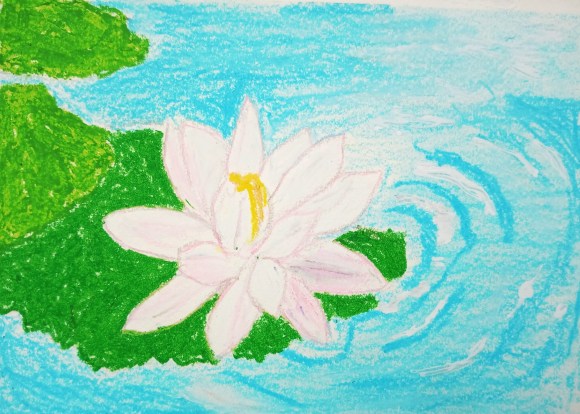
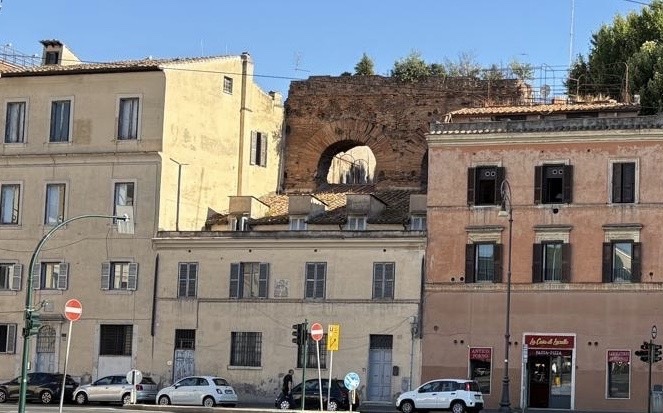
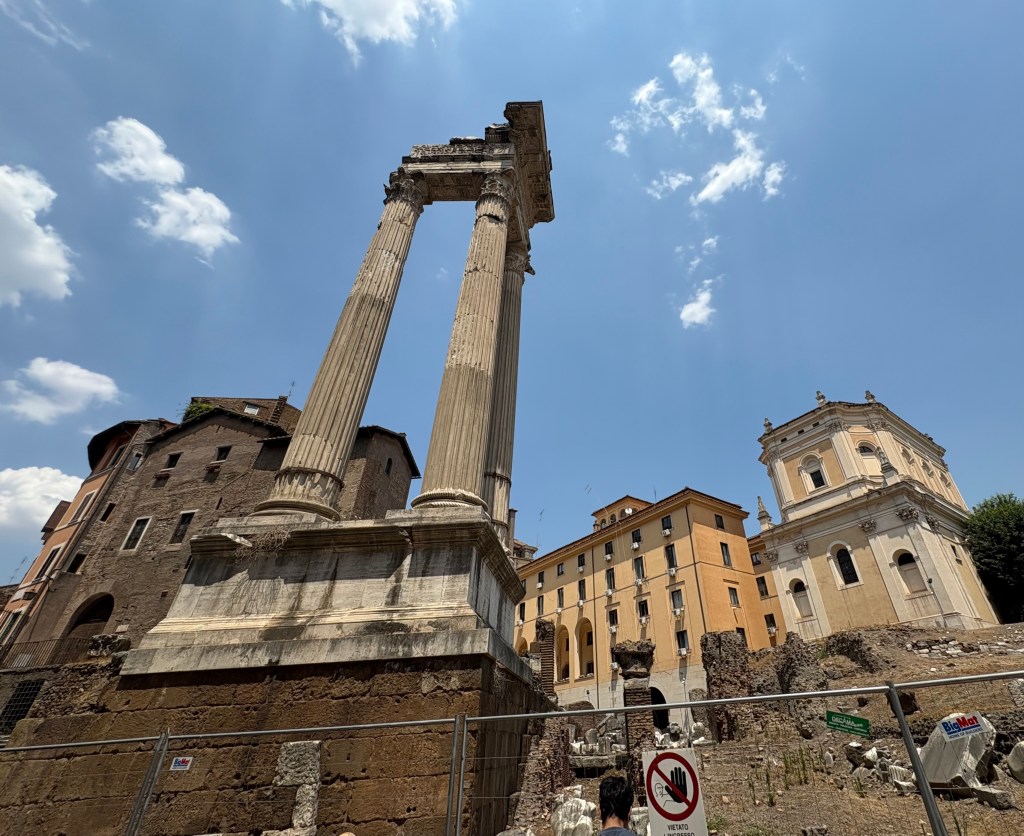
All around us, we hear of disasters. Often, we try to write of these as Tagore seems to do in the above lines. However, these lines follow after he says he draws solace and inspiration from a ‘serene lotus’, pristine and shining with vibrancy. He gazes at it while looking for that still point which helps him create an impact with words. That is perhaps what we can hope to do too — wait for a morning where clarity will show us the path to express not just what we see, but to find a way to heal and help. Finding parallels in great writings of yore to our own attempts at recreating the present makes us realise that perhaps history is cyclical. In Rome, new structures rear up against thousand-year walls, reflecting how the past congeals into the present.
Congealing the past into our present in this July’s issue are stories of American migrants — like Tom Alter’s family who made India their home — by Anuradha Kumar in her new non-fiction Wanderers, Adventurers, Missionaries: Early Americans in India. We feature this book with a review and an interview with the author where she tells us how and why she chose to write on these people. We have more people writing of their own wanderings. Mohul Bhowmick wanders into Cambodia and makes friends over a local sport while Prithvijeet Sinha strolls by the banks of the River Gomti in Lucknow. Meredith Stephens not only takes us to the Prime Meridien in Greenwich but also to Carnarvon which houses a science and technology centre in Australia. Devraj Singh Kalsi wanders with humour to discover gastronomical inspiration and hopes for sweeter recompense.
Taking up the theme of cli-fi, Rajat Chaudhuri’s Wonder Tales for a Warming Planetseems to bring hope by suggesting adapting to changing climes. Rakhi Dalal tells us in her review: “It dares to approach the climate crisis through the lens of empathy and imagination rather than panic or guilt. In doing so, Rajat Chaudhuri gives us what many adult climate narratives fail to deliver—a reason to believe that another world is not only possible but already being imagined by the young. All we need to do is listen.” Bhaskar Parichha has discussed the autobiography of a meteorologist and Distinguished University Professor at George Mason University, Jagadish Shukla. In A Billion Butterflies: A Life in Climate and Chaos Theory, he claims Shukla has “revolutionised monsoon forecasting.” Somdatta Mandal has written about Dilip K Das’s Epidemic Narratives: The Cultural Construction of Infectious Disease Outbreaks in India. And Gower Bhat reviews Neha Bansal’s best-selling poetry collection, Six of Cups.
With that, we wind up the contents of this month’s issue. Do pause by our content’s page to check it out in more details.
This month’s edition would not have been possible without all our contributors, our fabulous team and especially Sohana Manzoor’s artwork. Huge thanks to all of them and to our wonderful readers who make it worthwhile for us to write and publish. Do write in to us if you have any feedback. Five years ago, we chose to become a monthly from a daily… We have come a long way from then and grown to host writers from more than forty countries and readers from almost all over the world. For this, we owe you all – for being with us and encouraging us to find fresh pastures.
Every time I write to you a letter,
I pray it won’t be the last.
Why is my love so unstable?

If I look away for just a moment,
it feels as if you might fly far away.
I hope this letter isn’t the last.

But if the seasons change,
and I hear nothing back from you,
this could become the last letter.

That word — last — brings sorrow.

If I receive no reply from you,
and this letter is
the final one I ever send,
then winter will come,
and I’ll watch the snow fall alone.
Spring will come again,
and I’ll walk the blooming fields by myself.
Ihlwha Choi is a South Korean poet. He has published multiple poetry collections, such as Until the Time When Our Love will Flourish, The Color of Time, His Song and The Last Rehearsal.
.
PLEASE NOTE: ARTICLES CAN ONLY BE REPRODUCED IN OTHER SITES WITH DUE ACKNOWLEDGEMENT TO BORDERLESS JOURNAL.
The story of Hawakal Publishers, based on a face-to-face tête-à-tête, and an online conversation with founder Bitan Chakrabortywith his responses in Bengali translated by Kiriti Sengupta. Clickhere to read.
The Great War is over
And yet there is left its vast gloom.
Our skies, light and society’s soul have been overcast…

'The Great War is Over' by Jibanananda Das (1899-1954), translated from Bengali by Professor Fakrul Alam.
Jibanananda Das wrote the above lines in the last century and yet great wars rage even now. As the world struggles to breathe looking for a beam of hope to drag itself out of the darkness induced by natural calamities, accidents, terror attacks and wars that seem to rage endlessly, are we moving towards the dystopian scenario created by George Orwell in 1984, which would be around the same time as Jibanananda Das’s ‘The Great War is Over’?
Describing such a scenario, Ahmed Rayees writes a moving piece from the Kashmiri village of Sheeri, the last refuge of the displaced refugees who were bombarded after peace was declared in their refuge during the clash across Indo-Pak borders. He contends: “People walked back not to homes, but to ruins. Entire communities had been reduced to ash and rubble. Crops were destroyed, livestock gone, schools turned into shelters or craters. How do you rebuild a life when all that remains is dust?”
People could be asking the same questions without finding answers in Gaza or Ukraine, where the cities are reduced to rubble. While we look for a ray of sunshine, amidst the rubble, Farouk Gulsara muses on hope that has its roots in eternity. Vela Noble wanders on nostalgic beaches in Adelaide. And Meredith Stephens travels to the Australian outback. Devraj Singh Kalsi brings in lighter notes writing of driving lessons while Suzanne Kamata creeps back to darker recesses musing on likely ‘criminals’ and crimes in her neighbourhood.
Lopamudra Nayak writes on social media and its impact while Bhaskar Parichha writes of trends that could be brought into Odia literature. What he writes could apply well to all regional literature, where they lose their individual colouring to paint dystopian realities of the present world. Does modernising make us lose our ethnic identity and how important is that? These are questions that sprung to the mind reading his essay. As if in an attempt to hold on to the past ethos, Prithvijeet Sinha wafts around old ruins in Lucknow and sees a cemetery for colonial soldiers and concludes: “Everybody has formidable stakes, and the dead don’t preach the gospel of victory or sombre defeat.”
We have mainly poetry in translation this time. Snehaprava Das has brought to us Soubhagyabanta Maharana’s poems from Odia and Ihlwha Choi has translated his own poem from Korean. Sangita Swechcha’s poem in Nepali has been rendered to English by Saudamini Chalise. From Bengali, other that Jibanananda Das’s poems translated by Professor Fakrul Alam, we have Tagore’s pensive and beautiful poem, Sonar Tori (the golden boat). Yet another Bengali poet, one who died young and yet left his mark, Sukanta Bhattacharya (1926-1947), has been translated by Kiriti Sengupta. Sengupta has also translated the responses of Bitan Chakravarty in a candid conversation about his dream child — the Hawakal Publishers. We also have a feature on this based on a face-to-face conversation, giving the story of how this publishing house grew out of an idea. Now, they publish poetry traditionally, without costs to the poet. Their range of authors are spread across continents.
Our fiction again returns to the darkness of war. Young Leishilembi Terem has given a story set in conflict-ridden Manipur from where she has emerged safely — a story that reiterates the senselessness of violence and politics. While Jeena R. Papaadi writes of modern human relationships that end without commitment, Naramsetti Umamaheswararao relates a value-based story in a small hamlet of southern India.
We have more content. Do pause by our contents page and take a look.
Huge thanks to all our contributors without who this issue would not have materialised. Heartfelt thanks to the team at Borderless for their support, especially Sohana Manzoor for her iconic artwork that has almost become a signature statement for Borderless.
Let’s hope that next month brings better news for the whole world.




 Borderless