Categories
Editorial

Whispers of Stones

When the mountains and grass
had life, stones whispered
how the world came to be…

'Stonehenge', Daily Star

And as the world came to be, there was war — war that seems to rage in some part of the world or other. The British Museum has an exhibit which states the first battle was staged 13,000 years ago… in what is now Sudan, long before the advent of written history. This was even before the advent of people who built the ancient Stonehenge which was constructed around 3000-2000 BCE. And battles still continue to rage. The Jebel Sahaba casualties in Sudan 13000 years ago were less than 100. But the current conflicts claim in terms of tens of thousands which prolonged could stretch to millions. The last world war (1939-1945) which lasted for six years had a total of  75-80 million persons who perished. Ukraine-Russia conflict has within five months had a casualty count of more than 14000. And yet weapons and nuclear arms continue to proliferate decimating humanity, nature and towns, destroying homes, erasing ruthlessly and creating more refugees. The only need for such battles seem to be to satiate the hunger of the warlords secure in their impenetrable fortresses while tens of thousands are annihilated and natural or nurtured landscapes lie emaciated, mutilated and polluted.

What would be a good way of ending such wars?

Tagore sought the development of better instincts in humankind as an antidote. He wrote in the last century: “Any teaching concerning man must have human nature for its chief element. How far it will harmonise with human nature is a matter of time.”

With wars getting deadlier and more horrific, we can only try to awaken, as Tagore suggests, the better nature in man to move towards a peaceful world. What would be a more effective way of doing it than writing with the hope of a kinder and accepting future?

For that let us start with translations of the maestro Tagore himself. We have a song about the season — monsoon, ‘Monomor Megher Songi (My Friends, the Clouds)’, translated by Professor Fakrul Alam, a painting by Sohana Manzoor interpreting the lyrics and a transcreation of Nababarsha or New Rains’ was shrunken into a popular Rabindra Sangeet and reduced to twenty lines in English by Tagore himself. The connect with nature is an important aspect that enables humans to transcend petty concerns leading to dissensions of different kinds as evidenced in the maestro’s humorous feline skit, translated by Somdatta Mandal. A translation of Dalip Kaur Tiwana’s ‘The Bus Conductor’ from Punjabi by C. Christine Fair adds zest to this section. Fazal Baloch has translated a folktale from Balochistan involving the supernatural and Ihlwha Choi has taken on the cry for peace on behalf of Ukraine while translating his own poem in Korean. The Nithari column has a story by Jishan in Hindustani, translated to English by Grace M Sukanya, showcasing the struggle of a youngster during the pandemic – rather a sad narrative, which though fictitious has its roots in reality. 

Our poetry section touches upon the timelessness of dissensions and darkness with Michael R Burch’s poem on Stonehenge and Supatra Sen’s poem on Ukraine. This has been allayed by love poetry by Maid Corbic from Bosnia. George Freek’s poem ruffles with its reflective lines. And in the midst of it all, is poetry by Ryan Quinn Flanagan reflecting on the seven stages of man. Will the process of aging or human nature ever change? I wonder if Rhys Hughes can find an answer for that in humorous verses as he has shared in this issue. In his column, Hughes has written about an imagined anthology of short stories.

Our short story section has echoes of humour around felines by Manzoor, somewhat in tune with the mind frame seen in Tagore’s skit on this issue. Humour rings tinged with an apparition in Erwin Coombs’s narrative – should one call it dark humour or is it just his style? Paul Mirabile goes for gothic darkness in his meanderings around Italy.

Strangely, we seem to have a focus on short stories this time. Keith Lyons has interviewed Steve Carr, a journalist, a publisher and writer of 500 short stories who is questing to create a ‘perfect short story’. Reading out excerpts from her short story at a literary festival in Simla, Bollywood celebrity, Deepti Naval, was in conversation with eminent film journalist, Ratnottama Sengupta. She spoke of her literary aspirations while unveiling her autobiography in verse, A Country Called Childhood. This conversation has been shared by Sengupta with Borderless. It is interesting to see how Naval’s reactions to social malaise contrasts with that of the film director, cinematographer and actor, Goutam Ghose, who was present during the unveiling of her book. He had responded to communal violence by making a film on Lalan Fakir extolling virtues of love and kindness, called Moner Manush (2010) and then made a book on the film called, The Quest (2013) which has beautiful translations of Lalan Fakir’s lyrics by Sankar Sen.  

Our non-fiction sections seem to be hosting multiple travel stories across UK by Mike Smith, along the Australian coastline by Meredith Stephens, on the Himalayas with Ravi Shankar and an unusual visit by Hema Ravi to a farm in US where animals that had been used in Disney films in the past are homed. Our environmental columnist, Kenny Peavy, actually wrote about his cycling trip from Thailand to Indonesia on a bamboo cycle made by a Singaporean! And from Japan, Suzanne Kamata explored a museum in the neighbouring town of Mure. The museum on a hill hosts the art of American Japanese Artists, Isamu Noguchi.

We do have non-fiction that moves away from travel: noir humour by Devraj Singh Kalsi and an essay by Candice Louisa Daquin on a very interesting subject – ‘Is it Okay to be Ordinary?’ Is it?  Dan Meloche has written a literary essay on Canadian novelist Andre Alexis’s award-winning novel, Fifteen Dogs: An Apologue (2015). While Meloche spoke of how the novel departed from Orwell’s Animal Farm, his narrative brought to my mind a novel closer to our times set in England by Jasper Fforde called Constant Rabbit (2020) – this a science fiction while Alexis’s was an apologue or an animal fable. Fforde did use the rabbits rather well to highlight the current times.

We have book excerpts of two recent books that I would call really outstanding. One of them is Aruna Chakravarti’s The Mendicant Prince, which is being released this week, and is based on the evergreen contentious case of the prince of Bhawal that has even been explored even in cinema. The other, Dadamoni: The Life and Times of Ashok Kumar by Nabendu Ghosh, has been published posthumously and is not a translation from Bengali but written in English originally by this trilingual writer.  

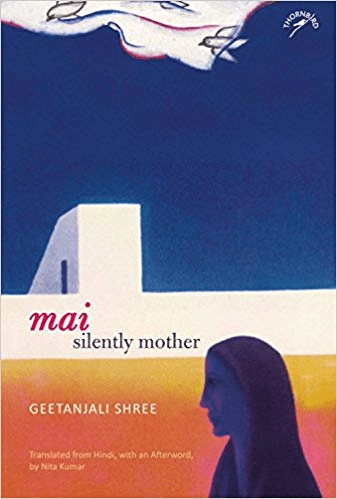
Called ‘Dadamoni’ affectionately, iconic actor Ashok Kumar is regarded as “the one personality who symbolises Indian cinema’s journey from Bombay Talkies to Bollywood”.  This book has been reviewed by Indrashish Banerjee, who calls it ‘a reflection on the Hindi film industry’ as well as a biography. Rakhi Dalal has reviewed Booker winner Geetanjali Shree’s Mai, Silently Mother, a Sahitya Akademi winning translation of her Hindi novel by Nita Kumar, reiterating the dialogue that had been kindled on motherhood last month by Rinki Roy Bhattacharya and Maithili Rao’s The Oldest Love Story (2022). Bhaskar Parichha has reviewed Prosanta Chakrabarty’s Explaining Life Through Evolution plotting how life evolved on earth. Parichha tells us: “Meaningful, wide-ranging and argumentative, this is a must-read book. It will propel us to imagine and reimagine life around us.” Another book that sounds like a must-read has been reviewed by Meenakshi Malhotra, Tagore’s Gleanings of the Road, translated by Mandal. She tells us: “ ‘Gleanings’ represents the quintessential Tagore…Ably introduced and translated by Somdatta Mandal, a renowned Tagore scholar, the translation captures the iridescent and luminous quality of Tagore’s prose and its chiaroscuro effects.”

There is more to tempt. Please stop by on our contents page and take a look.

We would like to hugely thank all our contributors and readers for being with us and helping us grow. I would like to thank my team, who despite hurdles they face, always lend a helping hand and wonderful words from their pens or computers to get Borderless on its feet. I apologise for the delay and thank you all for your patience. Special thanks to Sohana Manzoor for her fabulous artwork.

I wish you all a wonderful July and peace in a war-torn world. We are all affected by the ongoing conflicts. Let us hope for peaceful and just resolutions.

Thanks.

Mitali Chakravarty

borderlessjournal.com

Categories
Tagore Translations

Poetry on Rain by Rabindranath

Tagore’s Nobobarsha (or ‘New Showers’) celebrates the onset of rains. The poem was written in 1900 and brought out that year itself as part of Kshanika (Momentary).  It can also be found in Sanchayita (An Anthology of Selected Works), his poetry collection brought out by Visva Bharati, in 1931.

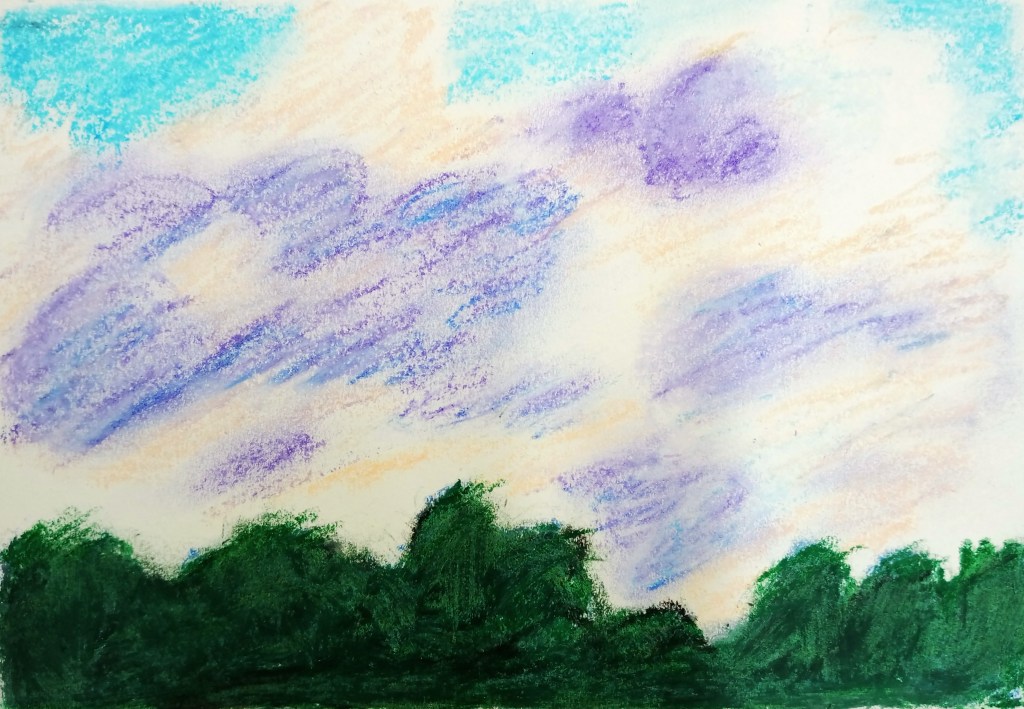
Clouds . Art by Sohana Manzoor
New Rains

My heart dances today — dances like a peacock.
Like the shimmer of its plumes,
My heart glistens with rapturous colours.
When I see the sky, my longing loses itself in euphoria.
My heart dances today — dances like a peacock.

The clouds rumble, rumble high up in the heavens.
The rain rushes in.
The new stalks of rice quiver.
Doves shiver silently in their nests, frogs croak in flooded fields,
The clouds rumble, rumble in the heavens.

I see the clouds’ tear-filled eyes lined, lined with blue kohl.
Ecstasy innervates
The grass and deep shady woods.
The floral bowers bloom with a new zest.
I see the clouds’ tear-filled eyes are lined with blue kohl.

Oh, who has untied her hair in gay abandon, in abandon on the palace's roof?
Who has covered her bosom
In blue, who has come
Back to play with slivers of lightning?
Oh, who has untied her hair in abandon on the palace's roof?

Oh, by the riverbank lined with grass, who sits in dark raiment dripping purity?
The young malati flowers wonder distractedly
As they gaze at the distant skies, where
Does the vessel float as it leaves the ghats?
Oh, by the riverbank lined with grass, who sits in dark raiment?

Oh, who swings today on the lonely swaying bakul branch, swings and sways?
The bakul flutters and falls.
An aanchal* soars to the the sky with yearning,
A lock of hair flies to cover the eyes, the karabi flower drops.
Oh, who swings today on the lonely swaying bakul branch?

In this chaos, who has moored his boat, his new boat by the riverside?
Clumps of cotton-like moss
Fill the watery banks.
The clouds sing soulful songs with tear-filled eyes.
In this chaos, who has moored his new boat by the riverside?

My heart dances today —
Dances like a peacock.
A heavy downpour falls on the new leaves,
The garden quivers with the chirrup of crickets.
The river has crossed the bank and approaches the village.
My heart dances today — dances like a peacock.

*Loose end of a Saree

(This poem has been translated by Mitali Chakravarty)

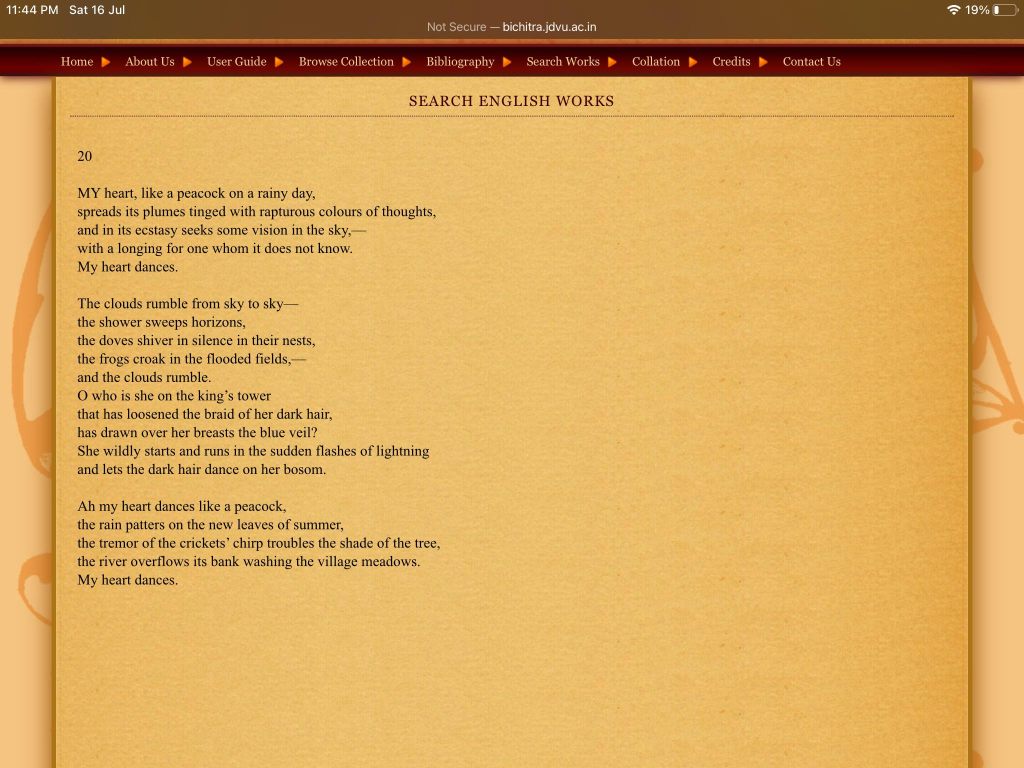
There is also an English translation [1]of the poem by Tagore. The translation is shorter and of twenty lines only as opposed to the 41 lines of the full-length poem. The poet’s translation is a part of Tagore’s Poems edited by Krishna Kripalani, Amiya Chakravarty, Nirmalchandra Chattopadhyay and Pulinbehari Sen ( Calcutta: Visva Bharati, 1942).

Screenshot of Tagore’s own translation from Bichitra Varorium by Anasuya Bhar

 The poet’s own translation is sung in the original language it was written in, Bengali. Here we present the song sung by a reputed singer, Srikanto Acharya.

Thanks to Bichitra Varorium, to Anasuya Bhar for her research and editorial advise, Sohana Manzoor for her art and editorial comments. Tagore’s short translation has also been used as a resource for improving the translation of the full-length poem. The translation is by Mitali Chakravarty.


[1] Bichitra Varorium, researched by Anasuya Bhar

.

PLEASE NOTE: ARTICLES CAN ONLY BE REPRODUCED IN OTHER SITES WITH DUE ACKNOWLEDGEMENT TO BORDERLESS JOURNAL

Categories
Tagore Translations

A Monsoon Song by Tagore Translated by Fakrul Alam

Tagore’s Mono Mor Megher Shongi translated as ‘My Friends, the Clouds’ was first published in the spring of 1939 and is now a part of Gitabitan. It has been translated by Professor Fakrul Alam for us.

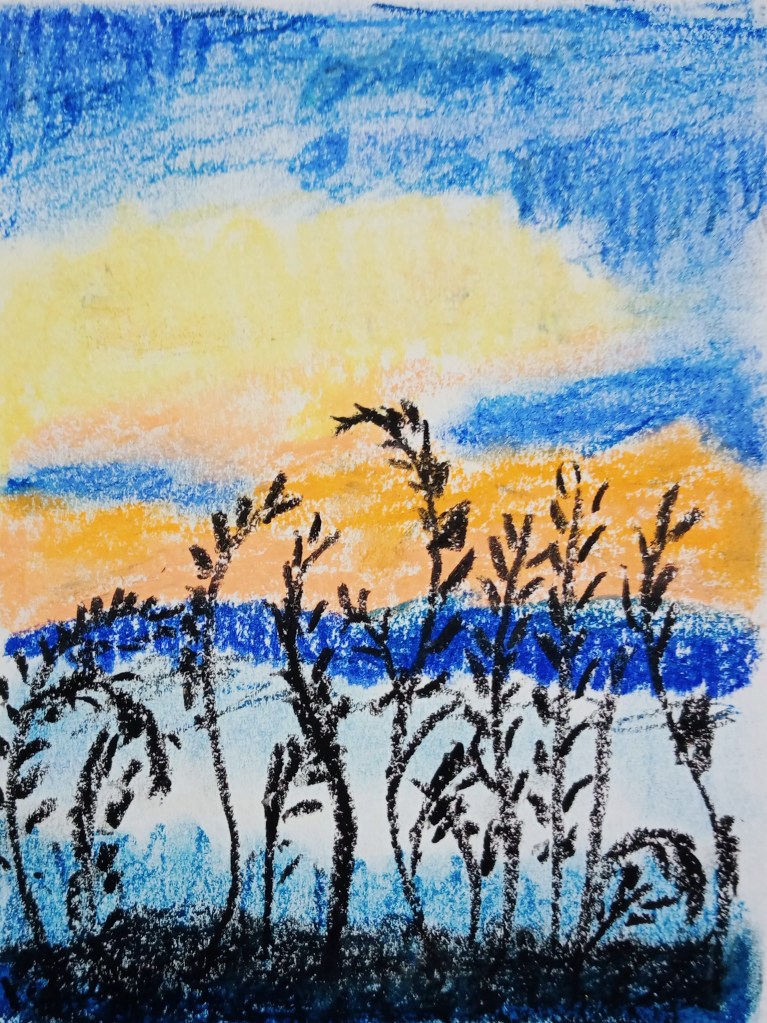
Megher Songi or Cloud Companions, Art by Sohana Manzoor
MY FRIENDS, THE CLOUDS

My mind keeps company with clouds
And soars with them in all directions.
To the pitter patter pitter patter of sravan showers,
My mind swerves towards infinite space.
Flying on the wings of swans and cranes,
In startling, dazzling flashes
Accompanied by ringing, clanging sounds of fiery delight,
In murmurings, rumblings and then incessant downpours,
Clouds usher in cataclysmic sounds and sights.
The wind blows from the eastern sea
Making the river water sparkle, surge and ripple.
My mind flows forward overwhelmed with joy,
Past palm trees, groves and forests,
All astir, keyed up, excited!

Here we have the song presented in Bengali by a legendary singer, Hemanta Mukherjee (1920-1989)

Fakrul Alam is an academic, translator and writer from Bangladesh. He has translated works of Jibanananda Das and Rabindranath Tagore into English and is the recipient of Bangla Academy Literary Award (2012) for translation and SAARC Literary Award (2012).

.

PLEASE NOTE: ARTICLES CAN ONLY BE REPRODUCED IN OTHER SITES WITH DUE ACKNOWLEDGEMENT TO BORDERLESS JOURNAL

Categories
Review

Tagore’s Cartography of the Imagination

Book review by Meenakshi Malhotra

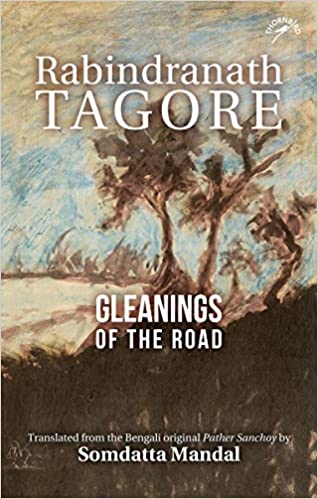
Title: Gleanings of the Road

Author: Rabindranath Tagore Translator: Somdatta Mandal

Publisher: Niyogi Books

Travels formed an integral part of the personae and creative artist that was Rabindranath Tagore. During his travels to England and the America (1912-13 and 1920) Tagore wrote essays for publication in various Bengali journals. Rabindranath Tagore was an inveterate traveller who travelled to the furthest corners of the globe. Detailing his travels in the  colloquial everyday language (also referred to as ‘chalit’ bhasha or language)  during his tour of England and USA in 1912-13, he used to publish regularly in journals like Prabasi, Bharati and Tattwabodhini Patrika. As the translator-editor Somdatta Mandal  informs us, Vishwa Bharati Publication Department in 1946 decided to discard Rabindranath’s own selection. They went back to the earlier formal register and included writings of the 1912 tour, irrespective of whether they were related to his travel.  

 The book blurb says: “In 1939, Tagore selected fourteen of these essays and an appendix containing seven letters he had written to some of the teachers in the Santiniketan ashram while he was on these trips, for publication as a volume. It was at this point that he rewrote the original essays then using the colloquial instead of the formal language; he also revised the texts substantially. Later editions altered the number of essays, sometimes digressing from Tagore’s own selection, sometimes going back to Tagore’s original formal language.”

The travelogue, if it can be called that, provides an insight into Tagore’s perception of the different facets of western life and the diverse philosophical issues that cross his mind as he journeys from one continent to another. Thus perhaps it is more appropriate that the collection is named “gleanings’’ rather than a travel account or narrative. They are philosophical ruminations where Tagore holds forth on various aspects of civilizations and cultures.

In the very first segment, Tagore’s critical observations about Indian society comes to the fore. Thus he comments on what he sees as  cultural differences and civilizational clashes, in “Prelude to the Journey”: “We always comfort ourselves by saying that we are a religious and spiritual race”. He sees this as a compensatory move by Indians to cover up our own sense of inadequacy, about our “weakness”  in the external world.(Tagore was acutely conscious of India’s status as a colonised country). “Many of us boast that poverty is our asset”, dwelling perhaps in a haze of pseudo-spiritualism which balks at admitting that this attitude is merely a kind of bravado.

Tagore’s essay here unpacks the notion of the binary that the West is materialistic while the East is spiritual by lauding certain aspects of Western and European culture. Thus he writes that “if we go to Europe with the aim of a pilgrimage, our journey will not be in vain”. He further explains that  this is not only because of the material developments achieved by Western culture, but their spirit and attitude.

Power, according to Tagore, is more than an external manifestation; rather, it has to do with a sense of real inner strength. He goes on to cite the instance of the Titanic and people’s altruism and self-sacrifice that was in evidence at that time, to interrogate the view, held by many Indians, that the average European is self-centred and self-serving. On the other hand, Tagore also gives plenty of instances where the spiritual poverty of Indians was in evidence. Thus he writes, “I know there has been a clash between our welfare and that of Europe and because of that we are suffering deep anguish and pain. We do not trust their religion and we criticise their culture as being too materialistic.” However, he continues that there are aspects of European culture which are worthy of emulation, which we would do well to follow, without feeling that it threatens our culture. He strongly commends that the path to seek the truth is a pilgrimage on which we should proceed without being blinded by ego, prejudice and false pride.

Coupled with this contrast of cultures, are observations about people and places. Thus he talks about the women of Bombay who are visible on the beaches of Bombay and contrasts it with the city of Calcutta, which according to him, is bereft of women in public places. Tagore also muses on the vast and limitless ocean which to him offers a cornucopia of literal and symbolic meanings. The sea and the ocean signify  vastness, depth, boundlessness and infinitude, as well as the lure of the unknown. In contrast, he bemoans  the loss of man’s ties with nature signified to him by the colonial appropriation of the river. He reflects that the river “Ganges was once one of Calcutta’s ties with nature…It was the one window of the city from where you could look out and realize that the world was not confined to this settlement.” He bemoans the fact that the once natural strength of the Ganga had been dissipated, “it has been dressed up in such tight clothes on both its banks and its waist band has been tightened so that the Ganges seems to be the image of a liveried footman of the city”. In contrast, the “special glory of the sea is that it serves man but does so without wearing the yoke of slavery on its neck.” His evocative description brings to life the various aspects of the landscape in full measure.

Tagore’s ‘travel’ writing is not just a mapping of people and places, but shows him as the supreme cartographer of the imagination. Witness his contrast of the earth and the ocean. The earth is compared to an excessively doting mother who binds her children to her and does not allow them to venture far away; the ocean by contrast “constantly allures him to venture towards the unattainable”. He adds, “Those who responded to that call and moved out are the ones who conquered the world.” Moreover, “that race of people on this earth who have specially welcomed this ocean have also found the unceasing effort of the ocean in their character.” Travelling on the Arabian sea, glimpsing distant shores, he stresses that the union of the two — the land and the ocean — signifying stability and movement are vital to an understanding of the truth.

The urge to travel, to move forward continuously, is forever present in man. In a philosophical vein , the poet muses that the soul “always wants to travel” and that it dies if it does not do so.In a series of similes and metaphors drawn from nature, he reflects: “Let us keep moving on, like the waterfall, the waves of the ocean, the birds at dawn, the light at sunrise.” He even transcends to the next plane when he says that “even the call of death is nothing but just a call to change the dwelling place”. In almost the same breath, he compares himself to a fairy princess who is fast asleep and who cannot be woken from her slumber, except with a golden wand.

Part anthropological study– at one point, the poet reflects that the vastness of the surrounding sea would have elicited devotion among many Indians, unlike the European traveller who is intent on enjoying the comforts and varieties of entertainment on the ship-part philosophic meditation, “Gleanings” represents the quintessential Tagore. His interrogation of Indian claims to spirituality is made in the tone of a concerned father warning his children not to fall prey to false pride and vanity. Deeply patriotic as well as an internationalist, he straddled two contrasting worlds of materiality and spirituality, without succumbing to limiting binaries and stereotypes.

Ably introduced and translated by Somdatta Mandal, a renowned Tagore scholar, the translation captures the iridescent and luminous quality of Tagore’s prose and its chiaroscuro effects.  

CLICK HERE TO READ THE BOOK EXCERPT

  Dr Meenakshi Malhotra is Associate Professor of English Literature at Hansraj College, University of Delhi, and has been involved in teaching and curriculum development in several universities. She has edited two books on Women and Lifewriting, Representing the Self and Claiming the I, in addition  to numerous published articles on gender, literature and feminist theory.       

.

PLEASE NOTE: ARTICLES CAN ONLY BE REPRODUCED IN OTHER SITES WITH DUE ACKNOWLEDGEMENT TO BORDERLESS JOURNAL

Categories
Excerpt

Aruna Chakravarti’s The Mendicant Prince

Title: The Prince Mendicant

Author: Aruna Chakravarti

Publisher: Picador India

January 1921

1

The Sannyasi

It was a raw, blustery morning in late January. A small knot of people could be seen standing near the Buckland Bund, an embankment on the Buriganga river. The river, which swirled and foamed along the edges of the city of Dhaka, was especially turbulent this winter.

All eyes were fixed on a man, a stranger to these parts. He had been sitting cross-legged on the Bund, gazing into the distance day and night, for the past three months, impervious to the cold gusts of wind and spray that rose from the agitated waters below. There was something odd about his appearance. He could be a Bengali, the locals surmised, judging by the shape of his face with its somewhat square jawline, wide nose and high cheekbones. His body was covered with ash but the patches that were visible were as fair as a European’s and his eyes, hooded by dark, heavy lids, a greenish brown. Masses of tawny hair fell in dreadlocks down his sturdy back and shoulders and a matted beard almost touched his navel. A tattoo—a word in some strange language—could be seen on his right arm. He was naked except for the strip of coarse orange cloth that covered his genitals. The men standing around stared at him with unabashed curiosity and exchanged glances. Once in a while someone would fling a question at him. They had been doing so from the first day they saw him sitting on the Bund.

‘Who are you? Why are you here?’ A middle-aged man in a silk lungi and woollen vest asked in a stern voice.

‘Main Bangla nahin jaanta.’ [1]The stranger’s lower lip twisted to the right as he answered in Hindi.

A barrage of questions followed in a Hindi thickly accented with Bengali.

‘Where have you come from?’ ‘Bahut door se.[2]

‘What are you doing here?’ ‘Nothing. Just sitting.’

‘That we can see. But why here?’

‘No reason. I just … just came here …’

‘Are you a sannyasi?’

‘Yes. I’m a roaming sadhu.’

‘You look quite young. Must be in your mid-thirties. Am I right?’ The stranger shrugged his heavy shoulders and turned his eyes northwards on a massive structure looming in the distance. It was the zamindar’s mansion locally known as the Rajbari. The zamindars of Bhawal were rich and powerful beyond ordinary landowners and had been dignified by the title of Raja. Their sons were addressed as Kumar, each according to his position in the hierarchy.

The man in the lungi moved aside. Another, an elderly gentleman in a dhuti[3] and shawl, took his place.

‘You are too young to abandon the world. When did you become a sannyasi?’ The old man leaned forward and examined the stranger’s face and head closely. There was a puzzled look in his eyes.

‘I ran away from home in my youth and joined a group of holy men.’

‘How long ago was that?’

‘I don’t remember.’

 ‘Where did they take you?’

‘To the mountains. I spent many years there.’

The old man nodded. But the answer didn’t seem to satisfy him.

The crowd ebbed, melted and swelled once more. Others took up the interrogation.

‘Do you have parents?’

‘No.’

‘Are you married?’

The man, calm and unruffled all this while, stiffened at this question. As though alerted to some hidden hostility. He had a prominent Adam’s apple which jumped up and down his throat.

‘Um …’ he hesitated, ‘yes … n-no. Yes. I had a wife … once.’

‘You left her too?

‘Yes.’

‘Why do you keep looking at the Rajbari?’

‘No reason.’ The answer came pat as though he had prepared for the question. ‘There’s nothing else to see …’

The men walked away and stood a little apart. They exchanged meaningful looks and nudged and whispered. Snatches of their conversation came floating through the air.

‘Exactly like the mejo kumar[4]. The same height and build. The same small hands and feet. Even the tiny wart on the lower lid of the right eye. What do you think, Taufique?’ The elderly gentleman turned to the man in the lungi.

‘Yes, indeed, Kashi kaka. I never did believe the story.’

‘You think anyone does?’

‘I don’t know about the family. The subjects certainly don’t. Not one.’

‘The man seems to be about thirty-five or thirty-six. Exactly the age the mejo kumar would have been today. Have you noticed the way he sits? Hunched forward like a bull.’

‘And his complexion! What man other than a royal could be that fair? His body is covered with ashes but I noticed his hands and feet. Particularly the feet. Rough and scaly but shell pink. Like new milk with a drop of vermilion mixed in it.’

‘The colour of his eyes? And the tiny angles sticking out from the tops of his ears? The resemblance is uncanny. The mejo kumar too had …’

‘There are marks on his back and legs. And tiny patches on the scalp in between the dreadlocks. I looked at them closely …’

‘Yes, I noticed them too. The mejo kumar’s body was ridden with syphilis when he was sent to Darjeeling. These must be the scars.’

‘He seemed a bit rattled when I asked if he was married.’

‘He did indeed. He couldn’t decide what to say.’

‘He is the mejo kumar,’ a chorus of voices joined in. ‘The story we have been told is bunkum.’

‘Concocted by the mejo rani[5] and her brother.’

‘Without a doubt. Without a doubt.’

‘Why do you think they did it?’

‘Who knows? They must have had their reasons.’

‘Mark my words, brothers,’ an old man wearing a skull cap observed darkly, ‘this man is pretending to be a sadhu, when he is in fact the mejo kumar – the second prince of the royal family. Now that both his brothers are dead, he is the sole heir of the estate. The real ruler. If I’m proved wrong, I’ll never venture another opinion as long as I live.’ He moved his head solemnly from side to side.

About the Book:

In the winter of 1909, Ramendranarayan Roy, the ailing second prince of the Bhawal zamindari, proceeds to Darjeeling with his wife Bibhavati, brother-in- law Satyendranath and a retinue of officials and servants, after being advised a change of air by his physicians. Three weeks later, a telegram from Satyendranath arrives at the Bhawal estate, carrying news of the prince’s demise and subsequent cremation.

Soon peculiar rumours start circulating around Bhawal and the surrounding town. Some say that the prince was poisoned, while others suspect that his body was taken to the burning ghat but not actually cremated. There are also whispers about an incestuous relationship between Bibhavati and her brother. The story takes a bewildering turn when, twelve years later, a mendicant comes to Bhawal, claiming to be the long-lost prince and the heir to the estate.

With no resolution in sight, matters reach the court, where the so-called prince and some family members face off against Bibhavati and her brother, aided by the British Court of Wards who are keen on maintaining ownership of the zamindari. The breathless legal drama that ensues will culminate in an incredible series of events, permanently altering the course of the estate’s history.

Inspired by the legendary Bhawal sannyasi case and evocative in its recreation of pre-Partition Bengal, The Mendicant Prince is an intriguing tale of dual identity and the inexplicable quirks of fate.

About the Author:

Aruna Chakravarti has been Principal of a prestigious women’s college of Delhi University for ten years. She is also a well-known academic, creative writer and translator with fifteen published books to her name. Her novels, The Inheritors, Jorasanko, Daughters of Jorasanko and Suralakhsmi Villa, have sold widely and received rave reviews. She is the recipient of the Vaitalik Award, the Sahitya Akademi Award and the Sarat Puraskar.


[1] I do not know Bengali – translated from Hindi

[2] From very far – translated from Hindi

[3] A cloth wrap that is a substitute for trousers

[4] The second prince

[5] The second queen or the prince’s wife

Amazon pre-order link: https://amzn.to/3uZgjCy

.

PLEASE NOTE: ARTICLES CAN ONLY BE REPRODUCED IN OTHER SITES WITH DUE ACKNOWLEDGEMENT TO BORDERLESS JOURNAL

Categories
Stories

Hasan Sol: A Balochi Folktale

Translated by Fazal Baloch[1]

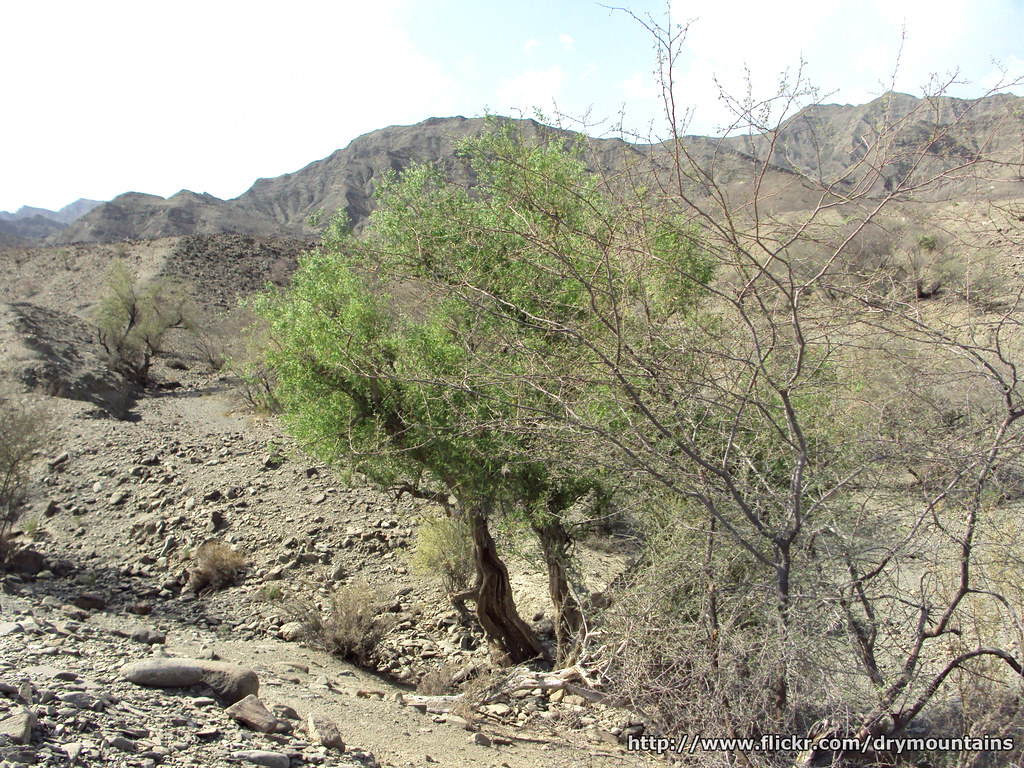
Balochistan. Courtesy: Creative Commons

Once there lived a poor man. Despite all his efforts, he could not beget any offspring. The grief of being childless had almost emaciated him. Most of the time he remained grief-stricken.

One day he left his home and took the route to the jungle where he reclined against a giant jujube tree. He decided not to move unless he was blessed with a child. A couple of days later a voice in the tree addressed him: “Man! Why don’t you leave me alone? I’ve named this tree after my own name. It is my dwelling. I have left the entire world for humankind and spared this tree for myself. Here I worship my Creator. Please leave me alone.”

The poor man said: “O, holy fakir! I am an unlucky man. I have no child. I have decided not to leave the tree unless I am blessed with a child. No matter if I die of thirst or hunger, I’m not going away”.

The fakir said: “Go home you will be blessed with a child, If it happens to be a boy, it is all yours but if it turns out to be a girl, you are bound to marry her with me. I will be your son-in-law”. The fakir continued, “If he’s a boy, his name will be Hasan sol, and in case of a girl, her name will be Nokmadina”.

The poor man replied, “Master! I am a Baloch. I will honour my promise”.

Nine months later he was blessed with a girl. As advised by the fakir, he named her Nokmadina. Time passed by and Nokmadina grew up. One day, along with other girls and womenfolk of the hamlet, she went to the jungle and walked over to the giant jujube tree to pluck its ripened fruits. The moment she stretched her hand, she felt her scarf had entangled with a branch of the tree. Despite all her efforts, she could not free it. She heard a voice addressed her: “Nokmadina! Ask your father to honour his promise”.

She immediately left for home but forgot to convey the message to her father. The next day when she went to the jungle, the same voice echoed again but Nokmadina couldn’t remember either. On the third day, when the jujube branch held her dress, Nokmadina apologised to it that she couldn’t remember his message.

The voice emanating from the tree said, “If you put your hand in the jar to pick up a dry date, a wasp will sting your finger and remind you of my words.”

She freed the hem of her scarf and quickly rushed towards home. Unmindful of the fakir’s words, the moment she ran her hand into the jar, the wasp stung her, and she broke out crying. Her father rushed to her and asked her what had happed to her. She recalled and told her father what the fakir had been telling for the past three days.

Her father did remember his promise. Though he did not want to marry his daughter with the fakir, he still wanted to fulfil his promise. His wife said, “May the Holy Quran cripple the old fakir! Do you have the heart to abandon your grown-up daughter in a jungle at the mercy of wild beasts? I am not going to allow you”.

The poor man said: “I’ve to honour my words. Let’s settle with whatever our fate has for us. First, we didn’t have any child. When we were blessed with one, it turned out to be a girl. And I have to marry it with the tree”.

Then he turned to his daughter and told her to be ready for he was going to leave her in the custody of the jujube tree the next morning. Everyone in the house including the girl and her mother cried inconsolably.

The next day he held Nokmadina’s hand and walked down to the jujube tree. Hasan Sol descended from the tree and they solemnised the marriage accordingly. Nokmadina’s father took the road back home.

Hasan Sol had already two ghoul-wives whom he visited every Friday in Mount Qaf and stayed with them for three days. He asked an old crone to stay with Nokmadina during his absence. Feeling envious of her, the old woman put Nokmadina in an underground den nearby and placed a huge rock on its opening so that she could not come out. When Hasan Sol returned, she produced her daughter before him and said, “Your wife has grown prettier than ever.”  On the other hand, she secretly fed Nokmadina with just a few morsels.

On a Friday morning, when Hasan Sol was about to leave, a dove perched on the tree. He shot at the bird and put it in the oven to roast it. Suddenly, the birds said: “The old woman has put Nokmadina in the den and brought her daughter in her place”. The bird repeated it over and again.

Hasan Sol thoroughly scanned her wife to determine the truth. He concluded that the bird was right.  Hence, he held her hand, spun it in the air and hurled it off like a stone in the sling. She landed beyond seven mountains. Nobody found any trace of her. Then he called out the old woman. He seized hold of her legs and thrusted them beneath the ground. Then he went to the nearby mountains to look for Nokmadina. He searched in each cave and cavern but could not find any trace of her. On his way back, he heard someone’s groan coming out of a jackal-den. He removed the rock from its opening and helped Nokmadina out and carried her home. When she fully regained her senses, Hasan Sol told her that he was going to Mount Qaf to visit her ghoul-wives. He warned her thus, “Never follow me. The road to Mount Qaf is long and tedious. You will wear out seven pairs of shoes made of steel, till you reach there. The ghouls will kill you there.”

When Hasan Sol flew off, Nokmadina made it to an ironsmith and ordered seven pairs of shoes made of steel and set out for Mount Qaf. After a long and tedious journey, having worn out all seven pairs of shoes, she finally reached the Mount Qaf.

A few children were playing at the door of a garden. She asked them if they knew anything about Hasan Sol. One of the children said that the very garden belonged to Hasan Sol and he would come there for his ablutions. She put her ring in the earthen jar, which he used to store water for cleaning himself, and hid behind a tree.

A little later, Hasan arrived there. When he noticed the ring in the bottom of the jar, he overturned and spilled the water on the ground to retrieve the ring. He assumed Nokmadina had disobeyed him and made it there. He asked the children if they had seen someone around.

The children told him about Nokmadina who was hiding behind a tree.

Hasan Sol walked over to her and asked her why she came there. He advised her to be careful otherwise the ghouls would eat her flesh. Hasan Sol transformed her into a knife and slipped it into his pocket and went home. The moment he got there, his ghoul-wives blurted loudly, “Human Smell! Human Smell.”

Hasan Sol said, “Where is the human? There’s no human but me. Are you want to eat my flesh?” He picked up spear and with great effort, he managed to silence them. He took his meal and strolled towards the garden where he transformed Nokmadina back into a human and together with her, he ate his meal. Then Hasan Sol transformed her into a pomegranate and tucked in a tree and told his ghoul-wives, “This pomegranate is meant for a sick man. Whosoever lays her hand on it, I will gouge out her eyes”.

When Hasan Sol left, the wives suspected it was a human. Thus, they cut a small piece and shared it together. When Hasan Sol returned, he asked them who spoiled the pomegranate in his absence. But they feigned ignorance. In the very instant, Hasan Sol transformed her back into a human and found out her that the ring on her little finger was missing. Infuriated, he shouted at them and said, “I swear by my sanctity, next time if you even touch her, I will tie you with chains and throw you before the dogs.”

One day when Hasan Sol had gone on an errand, one of the ghouls called Nokmadina and said, “You damn good-for-nothing human! Go to our mother’s house and bring us hair oil, comb and mud-soap.” They also gave her a letter as well. She complied and left. Midway through, she saw Hasan Sol who asked her where she was heading.

“I am going to deliver the letter to your mother-in-law,” she replied.

Hasan Sol asked her to show him the letter.

It read, “The moment this daughter of human delivers you the letter, kill her.” Hasan Sol changed the letter and wrote instead: “She is your granddaughter from your youngest daughter.” He further advised her thus, “Down the road you will see a dog with some grass before it and a goat with a piece of bone before it. Place the grass before the goat and the bone before the dog. Some distance further, you will find a mosque, replace its old mats with new ones. Then you will come across a dry pond. Unblock the watercourse and fill it with water.”

Nokmadina did exactly what Hasan Sol had advised her. When she delivered the letter, the ghoul woman hugged her and showered her with boundless love and affection. Nokmadina noticed a cage with four doves in the house. She asked her about them. The woman said: “One is my spirit; second one is your mother’s; third one is your stepmother’s and the fourth one is their grandmother’s”.

She took the cage and trampled the dove that was her co-wife’s sprit and ran off. The woman chased her. When she reached near the pond, she called the pond to stop her but the pond told her that she filled it with water a while ago so it would not stop her. When she drew close to the mosque, the woman asked the mosque to not let her go, but the mosque said that a while ago she replaced its mats, so it let her go. Then she asked the goat and the dog for the same, but they too refused as she fed them a while ago. At last, she reached Hasan Sol’s garden. When he saw the cage in her hand, he said, “Lo! You brought the cage along”.

“Why shouldn’t I? They don’t let me live. So now I’m not going to spare them either”, remarked Nokmadina.

“Alright. Kill all of them,” said Hasan Sol.

So, the story ended. And they headed home.


[1] This folktale is translated with permission from Geedi Kessah-4(Folktales Vol: 4) compiled and retold by Gulzar Khan Mari in Balochi, published by the Balochi Academy Quetta in 1971.

Fazal Baloch is a Balochi writer and translator. He has translated many Balochi poems and short stories into English. His translations have been featured in Pakistani Literature published by Pakistan Academy of Letters and in the form of books and anthologies.

.

PLEASE NOTE: ARTICLES CAN ONLY BE REPRODUCED IN OTHER SITES WITH DUE ACKNOWLEDGEMENT TO BORDERLESS JOURNAL

Categories
Essay

Discovering Books and Places: The Voyage from Eden

Meredith Stephens sails the Australian coastline, recording her experiences with words and her camera.

Maybe because I am an applied linguist, one of the pleasures of travel is the novelty of learning unfamiliar place names. Sailing north from Eden in southern New South Wales towards Wollongong, south of Sydney, provided ample opportunity to indulge this pastime.

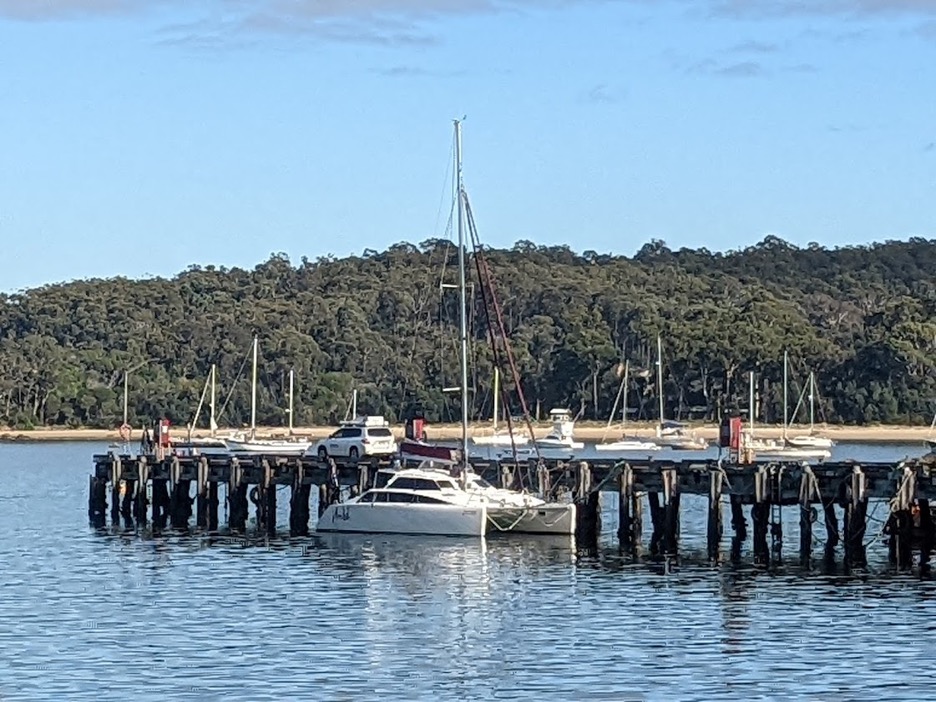
We were relieved to arrive at the township of Eden after the long crossing of Bass Strait from Tasmania to the mainland. Too tired to disembark, we spent the evening recovering on the boat after availing ourselves of a public mooring. The next morning, we rose afresh and resolved to explore Eden. We made our way to the wharf but found that it was formidably higher than our vessel. As much as I was looking forward to Eden, I suddenly realised that climbing onto the wharf looked impossible.

“I can’t do it!” I complained, as I often did, to my sailing companions Alex, Katie and Verity. They were all taller than me and leapt up to the wharf.

“I don’t mind staying here and reading a book. You all go off and enjoy the town,” I urged, as I looked down at the green water in between the boat and the wharf. It wasn’t the first time. Whether climbing a mountain, or hiking, I just couldn’t keep up with the others. Rather than holding everyone up I would prefer to stay back and read.

“No, you have to come with us,” Alex insisted, as always.

I lifted my left foot onto the tyre and my right onto the beam, grabbed hold of the side of the wharf and somehow made it to safety, as the others encouraged me on.

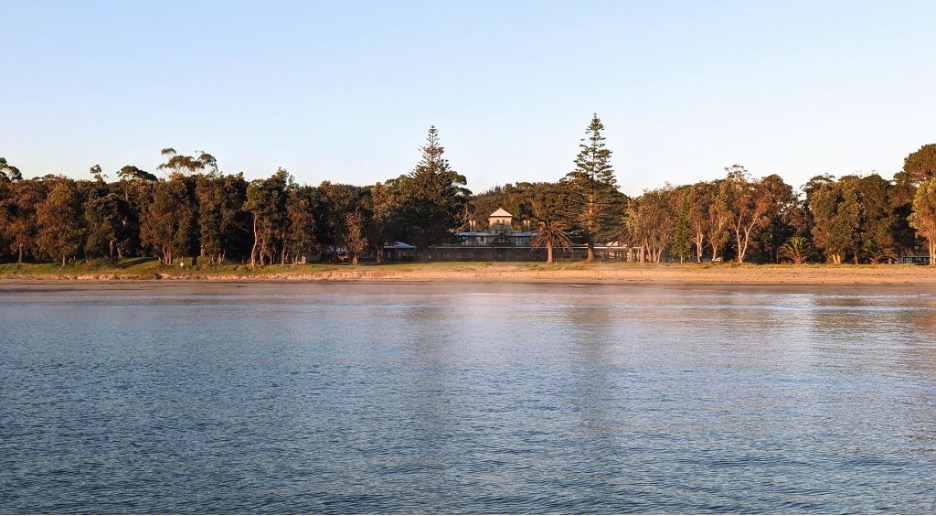
We climbed up the hill and walked along the coastal road to the centre of Eden, taking in shops and the Eden Killer Whale Museum. Then we wound our way downhill back to the boat, ready to sail across the bay to the Sea Horse Inn, where we planned to dine later.

After anchoring Alex decided to attend to boat maintenance before heading across the water to the inn. Alex always attended to business before pleasure, but I was hungry and couldn’t wait for the inn to open at 6 pm. I had to be patient because Alex wanted to fix his anchor light. He climbed into his bosun’s chair. Katie and I winched him up the mast with the electronic winch. Katie released the rope steadily. We had to watch carefully because he would give a hand signal when he wanted to pause. As he moved higher and higher up the mast it became harder to crank our necks backwards to keep him in view. The only way we could keep our eyes on him without bending over backwards was to lie on the deck facing upwards. It might appear that we were lounging around but in fact we were doing our best to keep him in sight. Alex repaired the anchor light and then Katie and I slowly and carefully winched him back to the deck.

Having performed the essential maintenance, we were ready to hop into the dinghy and motor to shore.

After disembarking we dragged the dinghy as far onto the sand as we could and secured it to a branch with a rope. We walked up to the restaurant and wiped the sand off our bare feet before putting on our shoes. We were greeted by a smiling Maitre d’. His expressions changed to concern when he saw Verity.

“I need to see your ID. You can only come into the bar if you are over 18.”

We tried to suppress our giggles. Verity was 28.

“Don’t worry, She’s an adult,” I reassured him.

“We have to check. Until we don’t. Some people get upset when we stop asking them,” he quipped.

After presenting her ID we sat outside and basked in the sunset sitting on the outdoor furniture facing the bay. Then we made our way into the dining room. Although our first choice on the menu had been sold out, my second choice of smoked salmon proved to be the most delicious of the trip. Alex was just as impressed by his serving of sole.

Our destination was Shellharbour, near Wollongong and we were due to sail north along the New South Wales Coast. After having sailed through the fierce Southern Ocean to circumnavigate Tasmania, and the notorious Bass Strait, I was relieved that land would be in sight for the rest of the voyage.

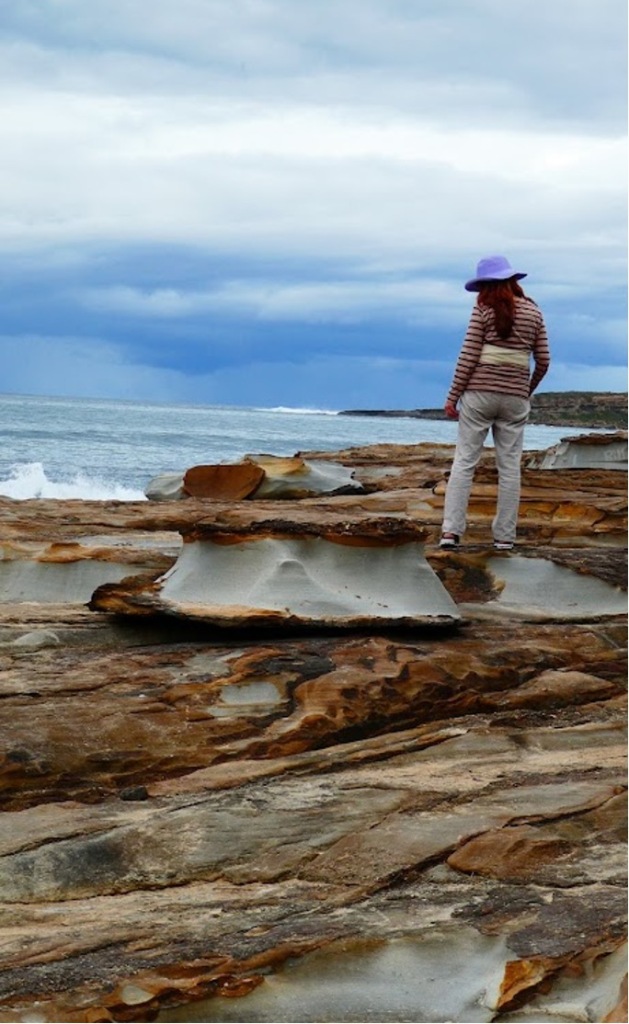
The most memorable stop was South Durras, because as soon as we arrived on the shore we were greeted by a kangaroo grazing and scratching her belly with her forearm.  We walked through the caravan park to a rainforest lined with ferns underfoot which led to the shore. We circled back to the shore, treading over rock pools on our way to the beach leading back to the boat.

The next stop had an enchanting name – Ulladulla. If somewhere was named Ulladulla, I simply had to stop there. I kept practising the pronunciation as we sailed into the bay. We anchored, and as usual, took the dinghy to a wharf. As we approached the wharf, we noticed barnacles. The sharp barnacles could easily cause a puncture and it was too late to turn it around.

“Push back as hard as you can!” urged Alex.

We pushed the dinghy away from the barnacles. Then we motored to the wharf on the other side of the bay and disembarked. We walked up the hill into Ulladulla, and unexpectedly Alex announced, “Let’s visit the secondhand bookstore. There’s a sign over there.”

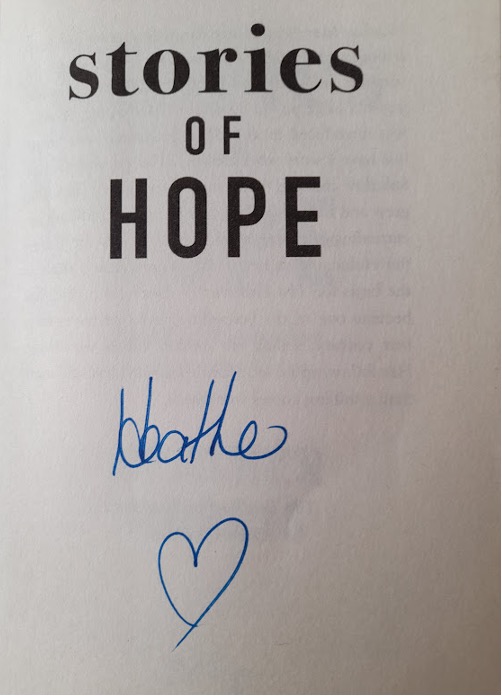
We followed a narrow arcade to the end and spotted the bookstore. My attention was immediately drawn to a signed copy by Heather Morris, a bestselling author.

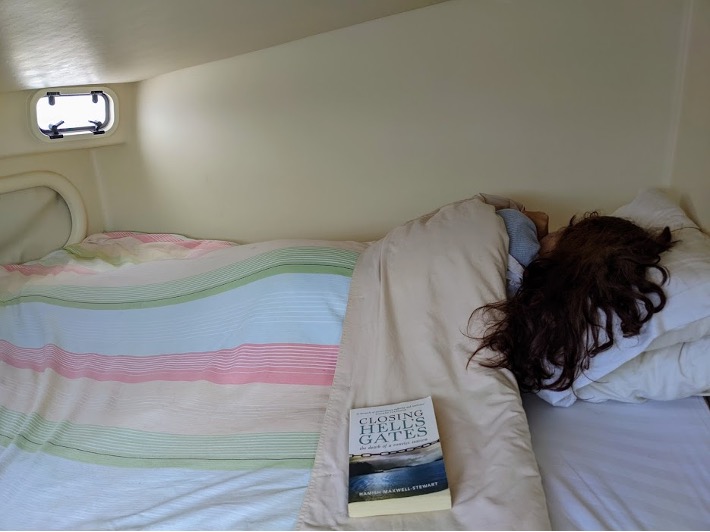
Sailing often entails many hours of crossing vast distances at the slow rate of 6 knots. When the seas are rough there is nothing for me to do but take an anti-seasickness pill and sleep in the cabin while Alex, who doesn’t suffer from seasickness, takes the helm.

But when the seas are calm there is ample time for reading, if you have enough crew to take turns at the helm. Thankfully Alex’s boat library takes pride of place. Even so, the addition of Heather Morris’ book was welcome and the long hours at sea passed quickly as I read this.

The seas were calm as we headed to Shellharbour, a new marina south of Wollongong, another city with a mellifluous name. We sailed through the many empty berths to the heart of the marina and located our assigned berth. Katie put out the fenders, and then we leapt onto the dock to tie the boat to the cleats. Relieved to have made this long sail to Wollongong, Alex cracked open some of our sparkling Tasmanian wine, with which we celebrate the completion of each leg.

Next, we had to clean up the boat before our flight back to Adelaide. We still had plenty of unopened food in the fridge, so Alex went to offer it to our friendly French Canadian boat neighbours, Gerard and Heloise. They happily received it. Then we asked them the easiest way to get to Sydney airport, after which they offered to drive us to Wollongong station. It was our first time to see Wollongong, and we were astounded to see the lush vegetation so unlike our home state of South Australia. We caught the train from Wollongong to the airport, passing all too quickly through the temperate rainforest. We then flew back to Adelaide to unlimited hot water and clean sheets, as we slowly discarded our sea legs. Not least, I was proud to have learnt beautiful place names such as Ulladulla and Shellharbour, although I still couldn’t manage to spell Wollongong without a spellchecker.

* All the photographs are courtesy Meredith Stephens.

Meredith Stephens is an applied linguist from South Australia. Her work has appeared in Transnational Literature, The Muse, The Font – A Literary Journal for Language Teachers, The Journal of Literature in Language Teaching, The Writers’ and Readers’ Magazine, Reading in a Foreign Language, and in chapters in anthologies published by Demeter Press, Canada.

PLEASE NOTE: ARTICLES CAN ONLY BE REPRODUCED IN OTHER SITES WITH DUE ACKNOWLEDGEMENT TO BORDERLESS JOURNAL

Categories
Stories

Murder at the ‘Pozzo di San Patrizo’

Paul Mirabile travels to 1970s Italy to a crime inside a sixteenth century well

A visit to Italy would certainly do me wonders; I hoped my migraines and other aches and pains would disappear, and my academic life regain its habitual vitality and éclat. Yet, in spite of my joyous resolution, I couldn’t see myself going alone to a country so different from my own. I thus decided to bring along a girlfriend of mine, a colleague from the university who had been working with me on various projects both at the university and at my summer home. She would be an excellent companion for such an excursion; the long distances by bus and train would be spent in ardent conversation, the sites and experiences could be discussed with a sympathetic companion. Also, if my health would fail at any given moment, she could surely offer her fine qualities as a physical and spiritual healer.

We left at the end of June, taking a night train through sunny France then directly to Rome. After spending a stimulating week there, bathing in the glory and debauchery of the Roman Empire, exalting the works of the great Renaissance artists, strolling through the still present Pasolinian streets of proletarian squalor, we took a bus to Orvieto, a mediaeval town located in the lush green hills of Umbria, noted especially for its white wine. I like a good white wine, and I was sure this ancient Etruscan town would revive and rejuvenate my spirits. Rome had plunged me in a numbing, cultural lethargy ; it was much too theatrical for my tastes, too saturated in enormous works of art for me to assimilate. I needed a stimulus less exacting, less pompous, more submissive. Orvieto was just that submissiveness …

The cathedral drew me towards her like a lascivious hussy. The queenly black and white columns and the lightly faded frescoes depicting scenes from the ‘Apocalypse’ painted at both ends of the transept[1] heightened my appetite for the imaginative and the unknown. The ceiling towered ever so high above me. At times the long and lofty naves appeared like soaring prehistoric animals, zebra-coloured, ready to devour their squealing prey below. At these awesome moments, I forgot that my colleague was close at hand, a hand so tender, fresh. Her presence became unreal, fading away beyond the muslin ramparts of my intimate sanctuary.

When I returned to the real world, I took my girlfriend by the hand and pressed it firmly. She appreciated those penetrating instances, although I will confess they were few and far between.

After our visit to the Duomo, we stopped for lunch, and had some lovely Orvieto wine. I ate and drank like I never had before, gobbling down plates of pasta that I never dared touch at home. I felt like I was in a reverie, drinking, eating, laughing … even joking ! I had never joked in my life: Was I possessed by some spirit, or simply by the trellis of polychromatic vines creeping up the trattoria[2]walls that emitted the most sensuous perfumes?

We stopped off at our hotel to change after lunch. I threw around my neck my favourite silk scarf stained a violent red. As to my companion, she too dressed very smartly for the occasion, draped in a long, milky white muslin skirt, a resplendent black satin blouse and sporting a large hat with crape rose. Yes, it would to be a most rewarding plunge into the underworld, I thought cheerfully.

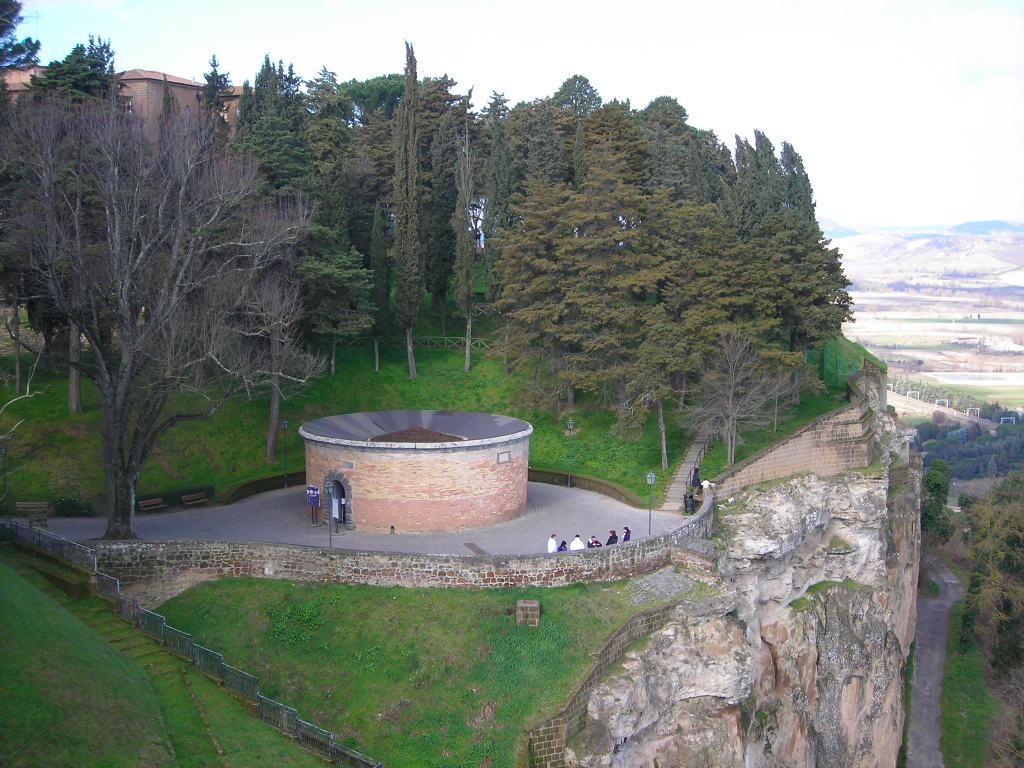
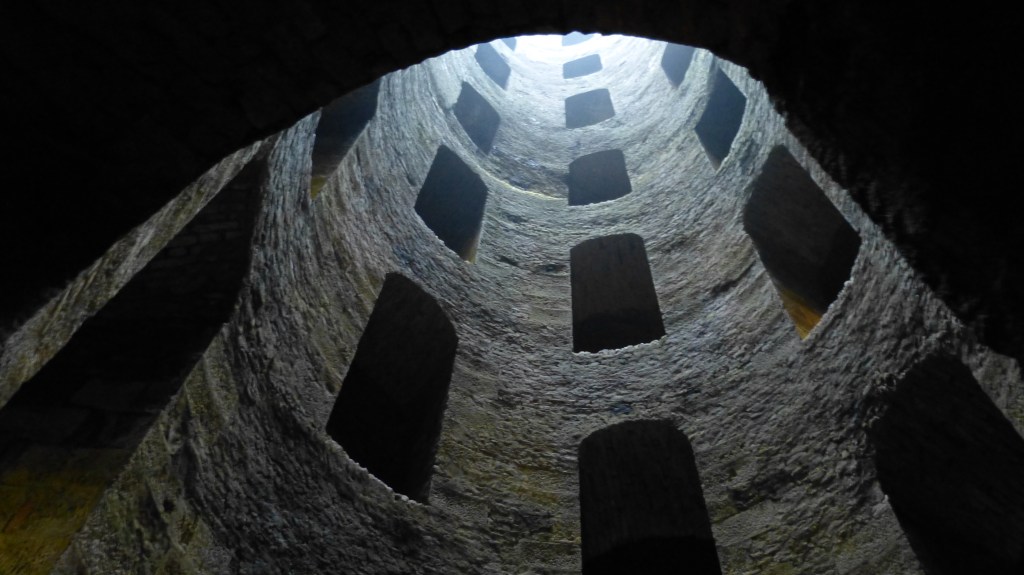
We left the hotel. Arm in arm we strolled like two young lovers towards the famous Pozzo di San Patrizio, a curiosity that attracted me for its absolute banality: a well dug out of volcanic tuft, hellishly profound, spiralling down and down into the bowels of the earth, where the coolness of its universe preserves and petrifies all that stumble into and within its dark, dank apertures. Are all wells similar ?

We descended the cool, glistening, humid steps, smoothed over by moss. Oddly enough, we were the only visitors. My colleague, startled by our chilly surroundings, grasped my arm tightly in an almost man-like grip. She slipped, nearly sliding over the low stone wall that separated the steps from the brackish waters far below. I peered down into them ; a diminutive bridge connected the two spiralling stairways on each side of the darkened waters. The bridge seemed so far away, so distant from our weary lives spent on the surface of the earth, working like slaves to earn a meagre living. I had been toiling so much, trying to gather new ideas for a book or short-story. But nothing emerged, no matter how deep I sounded ; only a spittle of words drooled on paper without meaning, and oftentimes, without form.

My mind wandered nervously from the moist walls to the lightless, stagnant waters … A story would surely form out of those dank elements, a murder committed on the spur of the moment as the killer descended ever deeper into the bowels of Hell … Yes, Saint Theresa’s Hell as she so vividly depicted it in her autobiographical writings; a depiction that I had memorised to comfort me during long sleepless nights, twisting and turning in moist, smelly sheets :

 “…Whilst she knelt in prayer, she suddenly found herself amongst demons in a place which appeared to her like the entrance of a long, narrow small street, a sort of low furnace, obscure and anguishing. The floor seemed to be of a very foul-smelling muddy water, swarming with terrible vermin or worms. At the end of this road appeared a cavity with a sort of closet, cabinet or store-room where the saintly nun felt cramped. Here she felt as if she were imprisoned. Hence, I reiterate that the descent into Hell was one of the greatest boons that the Lord granted me because I gained greatly from it, losing thus my fears of the trials and contradictions of this life, so as to strengthen myself to endure them ; and I thank the Lord who delivered me from what appears to me to be such terrible and perpetual evils …” 

How comforting did those words ring in my tortured ears under the weighty silence of starless nights. A murder, yes a murder … without premeditation, without vindictiveness … without meaning ! A murder pure in act, taintless of any scrupulous criminality to which mankind has been accustomed. A murder to be executed in this very well, in its unholy, hellish, malodorous enveloping coil. Its slimy aureole would indeed produce a horror-filled effect.

 As I turned to my colleague to expound my budding thoughts, a hard, clanking noise disturbed us from above. It sounded like a rotating, iron machine, grinding, pounding, droning … droning like a million wasps or hornets. A torturing engine, perhaps, twisting and tearing the limbs of its hysterical victims. The weird cranking sounds made my head spin. I felt a pang of involuntary emotion for its victims, his or her sorrows and misfortunes, trials and tribulations. My girlfriend stared at me out of empty orbits. Above the cranking din, the droning wasps and hornets, now receded now grew louder. I poured out my soul to her about the imagined murder. My animation caused her to laugh meekly, albeit I sensed in her voice an anguish that if magnified would have echoed off the well walls. She noted my need to expurgate this relevant project, the desire to couch it on paper, the need to fulfil its account. She realised this tale could only be discussed in whispers, here in the bowels of Hell. Yet, how delighted, how encouraged, how spellbound even was I to enlist her sympathy.

Our footfalls were endless. The sun’s rays had long since left us to grope our way along the smooth, rounded walls. The clanking and droning had ceased for an instant, but again took up its place amongst the horrors of my imagination, in rhythm with the melodious words of Saint Theresa, still drumming inside my temples. And my tale thickened with obsolete details amongst those uncanny rhythms. The cranking lent it beauty and balance, the drake-like light, ruddy and rutilant, form and volume. But the tiny bridge still appeared so remote, so aloof, far below us. Would we ever reach the damn thing ? Its razor-sharp crossing? The descent … the razor-sharp bridge : “ ..it was the bridge over cold water … it was strong and stiff like a sword … and it had the length of two lances..…” murmured creepily into my ear a fey voice from some remote, unearthly Time and Space; one that I could not fathom for the life of me. I shook my head, ridding it of that vexing nuisance …

The story that poured out from my entrails would surely please my future readers. But did it have to occur at the bridge ? Could it not, for example, happen elsewhere, along the slimy passage downwards, high above the stinking waters ? Could the killer, anxious to carry out his crime, impatient of the countless steps, not throw his victim to a watery death from the smooth, slimy, low, protecting, stone wall ?

I submitted these new image-filled details to my colleague who merrily agreed to the novel developments. She deemed it amusing, and even cautioned a detail or two, apropos the way in which the murder was to be effected. Was the victim to be strangled or merely thrown over the stone wall ? I shook my head fiercely, no violence would be condoned, a simple push over the side. The killer would observe the frightened face of his defenceless prey as she plunged over the stone wall. Yes ! It had to be a woman ! One who was easily terrified, especially of well deaths ! I laughed so loud that its echo clanged above the clanging, iron clamour … the droning hordes of wasps and hornets. My girlfriend stepped back against the low wall, noticing that the laugh resounded far greater than the gyrating engines. She turned a ghastly white, her eyes frozen in their sockets. Her sudden soft smile eased my inner tensions, soothed my painful need to perform a physical achievement. Yet, I had to do something to alleviate the mounting tension in my chest and temples : that spiralling Theresian plummet into Hell …

I touched her arm, absorbed by the intensity of her presence. She suddenly slapped me away as if the torturous pounding had been impounded in the palm of my hand. Her face transformed into a mutilated horror, her lips stretched bloodlessly across her already livid, pallid face. Those lips curled into a snarl and sneered at me. Those hollow eyes tunnelled out two fiery rays in the inky darkness. Her slow and steady transformation, along with the droning machines drove me back a few steps. The well seemed so much deeper ; and where was that bridge ? The iron clanking and wasp-like droning came to a sudden halt … The silence grew unworldly, and as it did, all the terrors of the subterranean world began to jump at me in tainted colours. Indeed, the Luciferian world would soon gain on my own. I wanted to run back up those long steps, back to light and hope.

She caught my shoulder. I lashed out to protect myself. Who’s side would she be on ? There would be no turning back now, my mind was running amok. My story was not evolving any further, and there I was trapped within the entrails of Hell in company not with Saint Theresa but with a witch-like demon. A strong impulse grew terribly painful and seized my heart, a killer’s impulse that shot adrenalin through my arm as it involuntarily stretched out to grasp the witch’s leathery neck … to wring it to death. But ever so gently, as not to leave any ungainly marks on that creamy, pasty, ashen skin. Those marks never attracted me in the least ; they were done in the most barbaric fashion, passionately and without reflexion.

We are not savages, are we not ? We are children of mild words and sober acts. And here I was forced to perform such undistinguished rituals … I deemed it repugnant to prostrate before these base and besmirching deeds. Her lips touched mine. They were dry, wilting like the dying petals of a black tulip, no longer tempting, but welcoming infectious lust. My strength, however, did not yield, and lifting up this mindless, mirthless creature, I threw it over the wall, its screams in perfect harmony with the churning machines, the droning hornets. The screams vanished with a distant thud … and splash … I peered over the low stone wall : the body floated listlessly upon the calm, clammy waters. Suddenly it disappeared, and only the large hat with crape rose lay stiff on the oily surface waters like some dead gelatinous marine creature …

I continued to peer into those waters, so still, so tranquil, like my nerves, still and tranquil. A decomposing odour soon filled the air. Already ? It made me think of a slaughter-house on the edge of a polluted river-bank. Perhaps even of a burial vault. I searched for my colleague but she was nowhere to be found. Had she returned to the surface? She did seem so distraught at the stillness and profoundness of that Hell-hole. Someone did caution me about her oftentimes awkward, even odd, unpredictable behaviour.

Apparently she was capable of standing you up at any time for any given reason. I now believed it. She had left me to wane alone in Saint Theresa’s realm. But I was undaunted, unafraid of what others would say if they should find me amongst the dead. Their words could never pierce my brazen heart. I had been there before and knew how to handle poisonous platitudes. And besides, I could at last write my story… my beloved story that would earn me a grand reputation amongst my so called peers, they who, to tell the truth, were no more than the lackeys of market-targeting editors and courtiers of government officials. Perhaps they would all laugh at my naivety, at my indefatigable efforts. But I feared not their calloused mockery. I would not lock myself up like some raving maniac and let them tear me to pieces. Let them come ! The dark walls of Hell had welcomed Saint Theresa … They shall welcome me ! They shall be my lichened ramparts, my spiralling stairway to fame and fortune ! Hell will transform the cranking machine and droning nests of wasps and hornets into a deadly weapon of defence … cranking and droning my enemies to atoning tears. Had the goodly saint not whispered to me the bitter but bountiful benefits of Lucifer’s diabolical gardens ?

There on the diminutive bridge, razor-sharp (I finally gained the bridge), I waited for them, my indistinguishable peers, cranking my neck high up to the creamy waxing rays of a lunar light ; waited at that precipitous bridge for the great Crossing. Ô Theresa ! Ô Theresa ! Will my story rise to the dawn of rosy day, expurgated of its entombed overweening bondage ?


[1] Either of the two sides of a cross-shaped church that are at a perpendicular angle to the main part

[2] Italian eatery

Paul Mirabile is a retired professor of philology now living in France. He has published mostly academic works centred on philology, history, pedagogy and religion. He has also published stories of his travels throughout Asia, where he spent thirty years.

.

PLEASE NOTE: ARTICLES CAN ONLY BE REPRODUCED IN OTHER SITES WITH DUE ACKNOWLEDGEMENT TO BORDERLESS JOURNAL

Categories
Essay

Trekking to Tilicho Lake

Photographs & Narrative by Ravi Shankar

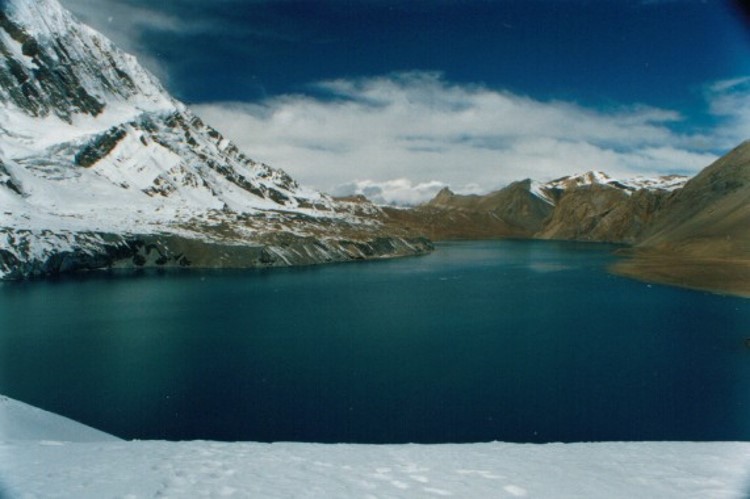
Tilicho Lake

I ran through the dark narrow corridor into the cold night air. I had been having a pounding headache since my arrival and lacked the appetite for my evening meal of spaghetti and eggs. My stomach churned violently, and the bile rose in my throat ejecting the contents into the frozen ground surrounding the lodge. Vomiting always makes me uneasy and brings back unpleasant memories of my early childhood when vomiting accompanied most maladies. Luckily this was the only serious episode of altitude sickness that I had during my high-altitude travels.  

We had broken most rules of acclimatising to the altitude during this trip. We had flown to the Humde/Hongde airport at Manang from the lakeside town of Pokhara, a day before. Pokhara is at around 800 m above sea level while Humde is at around 3400 m. Most flights to Manang are from Kathmandu and many Manangis are rich and sophisticated traders. The pilot did a visual inspection tour walking around the twin otter aircraft. He seemed satisfied and we were soon skyborne. The view of the Annapurna Himal (snow mountain in Nepali) in the morning sunshine was breath taking. We had lunch at the Airport Hotel in Humde and then hiked up to Khangsar at 3800m. We spent a night at a lodge run by a relative of our Humde didi [1] and started walking to the Tilicho Tal[2] after a substantial breakfast of buckwheat bread, late in the morning.

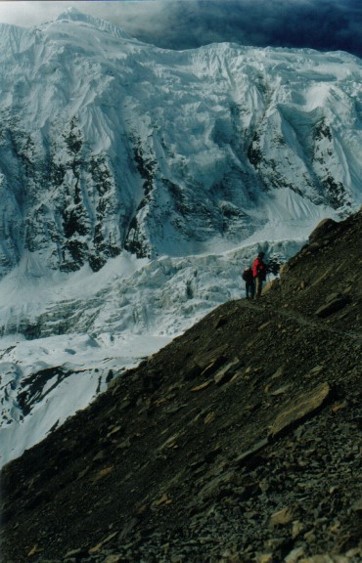
A cold wind was blowing, and the trail wound through scree[3] slopes. The hike was becoming treacherous, and we did some of the worst sections on our hands and knees. The mountain views were becoming spectacular as the Himals closed in on the valley. Our heavy backpacks threatened to unbalance us and push us over the edge to the Khangsar Khola and Marsyangadi river far below. Thorny bushes grew in the arid landscape and snagged our down jackets. We were worried about the condition of these jackets that we had rented in Pokhara. The shop owner was a patient of my fellow trekker, Dr Praveen Partha.    

We could see the Tilicho base camp lodge far below. The descent was along sheer scree slopes. The soil was loose, and the ground could vanish at your feet! Running descents down 45-degree slopes were battering to the knees. Time seemed to stop as we negotiated the vertigo-inducing slopes. Eventually, we reached the valley below and the final stretch was a short level walk. The lodge was dusty and cold. There was some problem with the solar lights and only the dining room was lit.

The next morning dawned cloudy and grey. It had snowed the previous night and I was still feeling nauseous and light-headed. The lodge owner told us about an ultra-marathon race being held that day and that we might meet the runners on our way up. It was a long climb to the lake. The trail initially wound through scree slopes and then climbed more slowly through snowfields. A freezing wind was blowing, and we wore sunglasses with side blinders to protect our eyes from the reflected sunlight and avoid snow blindness. My nose was becoming numb due to the cold. We were struggling at the high altitude (above 4500 m) and in my weakened state, I was finding the going difficult.

The runners were racing through the landscape. Their fitness was astounding. The ones we had met during the early stages of our hike were now returning from the lake. We saw the trail to Yak Kharka[4] and Thorung La[5] in the distance. Our plan was to cross the pass and descend to the holy site of Muktinath and the city of Jomson on the other side.

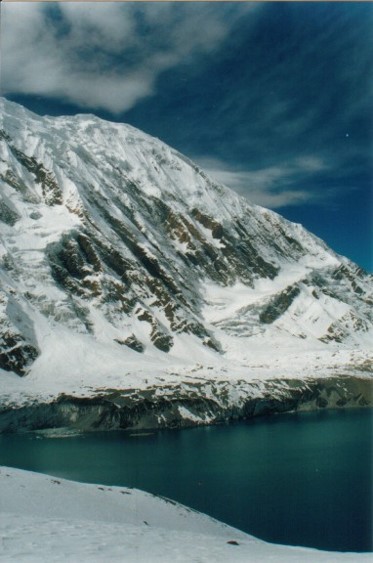
The mountains provided a stark contrast. The north-facing slopes were cloaked in the snow while the south-facing ones were bare. The power of our star, the Sun even at 152 million kilometres was awe-inspiring. We continued climbing. A steep climb along a snow-covered slope and the dark blue waters of the lake could be seen in the distance. The race organizers had set up stations for the runners and race flags and posters were seen on both sides of the trail. The wind was bitterly cold. The snow-cloaked landscape was breathtakingly beautiful. The lake is located at an altitude of 4940 m.  No aquatic organisms have been recorded in the lake.

Snowfields

Tilicho lake is believed by Hindus to be the ancient Kak Bhasundi lake mentioned in the Ramayana. The sage Kak Bhasundi told the epic to Garuda, the king of birds near this lake. The lake was also the location of the highest scuba dive by a Russian team in 2000. A trekking route skirting the lake and reaching Thini Gaon in the Kali Gandaki valley is becoming popular.

This route requires at least a night of camping as there are no lodges (tea houses) after Tilicho Base Camp till you reach Thini Gaon[6]. I have never camped during my travels in the Himalayas. Camping gives you more options but may be more challenging in terms of logistics. Many lodges also have well-maintained camping places.

The trekking lodges in Nepal started as converted tea houses. They were places to have tea, exchange gossip, and eat food. They had been around in the hills for a long time. People hiked the trails for different reasons ranging from trade, visiting family and friends, and pilgrimage. As trekking became more popular many of these started offering travellers a place to sleep. They used to charge only for the food. Later the rooms became more elaborate and private accommodations were created. In big towns and popular locations, some have become hotels.

The cold soon drove us down from the lake and the descent was easier on the lungs. Runners were still running up the slopes. The weather was becoming cloudy, and the sun was soon cloaked by clouds. Light snow started falling. In the mountains, it often snows around noon. I was beginning to feel better but was still weak. It was around four in the afternoon when Dr Partha and I reached the base camp lodge. My appetite was slowly returning.

Climbing to the village of Khangsar

The next morning, we started mid-morning to the settlement of Khangsar and eventually continued to Manang village. The village has some excellent hotels and spectacular views of the Gangapurna glacier. Manang is at 3500 m and the plan was for me to rest here and see how I felt the next morning and then decide whether to continue to do the circuit trek through the pass or return down to the road head of base town of Besishahar.  My bout with altitude sickness had sapped my confidence and we decided discretion was better and slowly headed down. I felt bad for Praveen who was keen to do the circuit before heading off to the greener pastures of the United Kingdom.

The Thorung pass still remains on my bucket list. Hopefully one day I will be able to do it. The Annapurna circuit trek has steadily contracted over the decades as roads have made deeper inroads into the mountains. The trek used to start from Dumre on the Kathmandu-Pokhara highway, then the trailhead shifted to Besishahar, and with the construction of the new road to the district headquarters of Chame. On the other side, there are regular buses from Pokhara and Kathmandu to Muktinath.

Tim Cahill, a travel writer from Montana, wrote, “A journey is best measured in friends rather than miles.” Praveen was perfect company. We gelled well together, we were adaptable and took the rough with the smooth. We did some interesting treks together and I am sure he must be continuing his walks in the cold English air as he thinks about medicine, health, love, happiness, and eternity! 


[1] Elder sister in Nepali

[2] Lake in Nepali

[3] Mountain slopes littered with loose pebbles and rocks

[4] Alpine pasture in Nepali

[5] La is pass in Tibetan

[6] Village in Nepali

Dr. P Ravi Shankar is a faculty member at the IMU Centre for Education (ICE), International Medical University, Kuala Lumpur, Malaysia. He enjoys traveling and is a creative writer and photographer.

.

PLEASE NOTE: ARTICLES CAN ONLY BE REPRODUCED IN OTHER SITES WITH DUE ACKNOWLEDGEMENT TO BORDERLESS JOURNAL

Categories
Review

Geetanjali Shree’s Mai

Rakhi Dalal reviews Geetanjali Shree’s Mai, Silently Mother, a Sahitya Akademi winning translation of the Hindi novel by Nita Kumar

Title: Mai, Silently Mother

Author: Geetanjali Shree, Translator: Nita Kumar

Publisher: Niyogi Books

To live in a South Asian country means to grow up with an absolute idea of a mother. A mother is always giving, nurturing, sacrificing and working. Her day begins and ends with looking after the household. In context with India, this notion also seems to be defined by the structures of caste and class. Although an opinion of her position, based upon the ideas imbedded in conscience, takes on different interpretations when seen broadly from the lenses of patriarchy or feminism. With the former, it is more of a responsibility or duty that is taken for granted and in many cases not even given a second thought. In the case of latter, it might be considered as oppression in some situations, where the mothers are deliberately subjugated into drudgery of family grind by the patriarchal structure.

Mai by Geentajali Shree presents to us the complexities brought about by the conflict between both of these ideas in a domestic realm. However more than that it compels us to think when we talk of a mother, exactly whose opinions are being discussed and whether we also explore it from the point of view of the mother herself.

It is the debut Hindi novel of the author and is centred on the world of a mother as observed by her daughter. The English translation of Mai by Nita Kumar had won Sahitya Academy Award in 2002 and was shortlisted for the Crossword Book Award in 2001. Ret Samadhi by Geetanjali Shree, whose English translation Tomb of Sand by Daisy Rockwell won International Booker this year, also has at its centre a mother.

Shree writes stories and novels in Hindi. Her much acclaimed novels Tirohit and Khali Jagah have also been translated into English. She has written a biography of Premchand in English and is also associated with theatre. Nita Kumar, the translator of Mai, is a Brown Family Professor of South Asian History at Claremont McKenna College, Claremont, California. She has also authored several books and is engaged in innovative education in Varanasi since 1990.

The household in Mai is a typical middle class in a small North-Indian town where the patriarch set the diktats rolling for a joint family. Governed by the binaries of outside and inside, the roles of each member are clearly defined. ‘Outside’ is a world to be conquered by the men whereas the confines within the house are to be looked after and cared for by the women. Three generations of a family living under the same roof offer resonance with confirmations and contradictions inherent to the structure they are bound by.

With this backdrop, the author successfully pulls strings to present an image closer to the familiar realities of such a household. Silently mother, the subtitle of Mai, is the identifier which Sunaina, the third generation daughter, associates with her mother. From her early childhood, she has watched her mother attending to the call of her family silently. Always bent, always working, from behind her purda, the mother seemed weak. Slowly however, and with much subtlety, Shree offers the reader certain glimpses into the character of silent Mai. Instances which, as Kumar suggests, mean that her silence does not equate with being speechless. At the most crucial points, we witness the mother speaking up for her children, even if it is only a single word or sentence is being uttered. She never questions their choices or decisions, thereby giving them freedom to get on with their own lives, something which makes them closer to her than to their father or grandparents.

The reader also finds that mother does have her own moments of joy when she retires at night to the bedroom she shares with her children, lets go off her veil and laughs at their jokes, when she appears in the forbidden courtyard humming a song or when she takes on the responsibility of entire house after her husband meets a tragic accident.  

For Sunaina and her brother Subodh however, her silence equates with oppression. They are obsessed with the idea of rescuing her from the fetters which they believe are afflicted upon her. So much so that it becomes the sole purpose of their lives. With passage of time, their mission nevertheless remains unaccomplished as they realise in frustration that their mother doesn’t need to be saved. It is only towards the end that they realise her strength and contribution in building their lives.

In the afterword, Kumar says, “We do not know ‘what’ mothers are, we do not know if a given mother is ‘fulfilled’ in what she does, or what else she ‘wants’. But we could progressively know whether to ask certain questions, how to ask some others, what any of them might imply, how to refrain from asking and retrack, how to pause and begin to comprehend little glimpses better. We could start evaluating silence differently from what we do in our dichotomous, rationalist world, like Subodh and Sunaina’s tells us to. We could question agency, strength and weakness anew.” 

With an impressive 50 page critique of Mai, the afterword is an added treat to the reader. Kumar writes on the matter of mother and looks at it from the point of history and anthropology. She discusses the challenges associated with the task of translation and her discourse engages the reader, bringing focus on her work which is done exceptionally well. 

This splendid novel by Geetanjali Shree, with its nuanced portrayal of sensibilities across class, gender and age, invites the reader to look closely into the preconceived as well as acquired notions around ‘mother’. It stresses profoundly that the mothers are not only made invisible by the veil which patriarchy forces upon them but also by the partial and opinionated understanding of their desires. Maybe if we try to catch the little glimpses better, we may start seeing her coming out of shadows.

.

Rakhi Dalal is an educator by profession. When not working, she can usually be found reading books or writing about reading them. She writes at https://rakhidalal.blogspot.com/ .

.

PLEASE NOTE: ARTICLES CAN ONLY BE REPRODUCED IN OTHER SITES WITH DUE ACKNOWLEDGEMENT TO BORDERLESS JOURNAL.