In Conversation withRinki Roy(daughter of legendary director Bimal Roy) about The Oldest Love Story, an anthology on motherhood, edited and curated byjournalist and authors, Rinki Roy and Maithili Rao. Click here to read.
Achingliu Kamei in conversation with Veio Pou, author of Waiting for the Dust to Settle, a novel based on the ongoing conflicts in North-east India. Clickhereto read.
Translations
The Funeral, a satirical skit by Tagore, translated by Somdatta Mandal. Click here to read.
Pie in the Sky is a poem written and translated from Korean by Ihlwha Choi. Click here to read.
Taal Gaachh or The Palmyra Tree, a lilting light poem by Tagore, has been translated from Bengali by Mitali Chakravarty. Click here to read.
Pandies’ Corner
This narrative is written by a youngster from the Nithari village who transcended childhood trauma and deprivation. Dhaani has been written in Hindi and translated to English by Kiran Mishra. Click here to read.
Keith Lyons discovers the import and export of desires in Varanasi, one of the oldest cities in the world, beside one of the most revered rivers. Click here to read.
Notes from Japan
In Marathon Blues, Suzanne Kamata talks of pandemic outcomes in Japan in a lighter tone. Click here to read.
Musings of a Copywriter
In Journey of an Ant, Devraj Singh Kalsi explores life from an insect’s perspective. Click here to read.
Mission Earth
In Tuning in to Nature, Kenny Peavy tells us how to interact with nature. Click here to read.
Yes! It is vacation time, and we are all able to travel at last. Though the pandemic which had closed borders for us seems to be evolving as an endemic, another huge human crisis, a war which cannot be justified in any way, stares us in the face. Loss of lives, homes, towns, cities and threats of global recession follow in the footsteps of refugees wandering into our lives. Lesya Bakun, the Ukrainian refugee whose story we have been following, told me four of her relatives’ homes in Mariupol have been erased out of existence and her extended family has scattered where they found safety as her cousin continues a prisoner of war, captured while defending the iron and steel factory at Azovstal. While majority of the world expresses solidarity with the Ukrainians, another set of refugees remain in shadows. They have completely lost their country in which they had lived from ancient times. I am referring to the Rohingya of Arakan. CNN world states:
“The Rohingya are a stateless Muslim minority in Myanmar’s Rakhine State, thought to number about 1 million people.
“Myanmar does not recognize them as citizens or one of the 135 recognized ethnic groups in the country.”
We are privileged to host a powerful poignant translation by Arifa Ghani Rahman of Shaheen Akhtar’s short story about such a voiceless Rohingya child in a refugee camp. Though this is a fiction inspired by Akhtar’s visits to such shelters, we hope at some point these children will be able to build new lives to create a world free of violence, intolerance, hatred and greed.
One of the questions that springs to one’s mind, watching such atrocities destroy innocent lives is that should one accept bullies and give in to their pressure tactics? Bullies can be found among world leaders as well as perpetrators of decadent societal norms which are often critiqued by satires. Somdatta Mandal has translated one such satirical playlet where social conventions are targeted in a lighter vein by Tagore. In the same spirit, the maestro’s iconic poem about a palmyra tree called Taal Gaachh has been transcreated to bring the joy of innocent wanderings back into the narrative, creating an island of healing thoughts. We continue with our translations of Jibananada Das by Professor Fakrul Alam, a Korean poem by Ihlwha Choi and a magical Balochi folktale by Fazal Baloch. Let us read such translations to connect with varied cultures so that compassion and acceptance of diverse perspectives end horrors like wars, starvation and hunger.
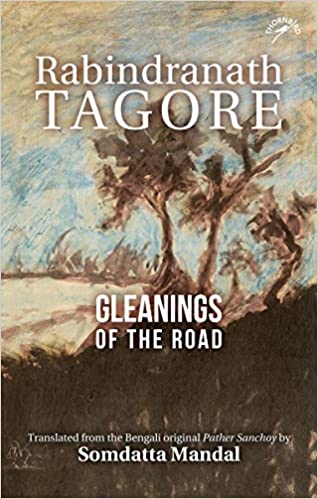
Tagore’s writings translated to English by Mandal in Gleanings of the Road, a collection covering the maestro’s travel to the West, is part one of our book excerpts and highlights Rabindranath’s perspectives on the need to connect with the larger world. The other book excerpt, from Waiting, poetry by Suzanne Kamata, takes up the theme of victimisation, crime and murder. Dwelling on no less horrific narratives, though justified as non-criminal, is a review by Meenakshi Malhotra of Harsh Mander’s Locking down the Poor: The Pandemic and India’s Moral Centre. Gracy Samjetsabam’s assessment of Half-Blood by Pronoti Datta informs about the greyer areas of a whole community in Mumbai. Indrashish Banerjee reviewed Keki Daruwalla’s stories on human relationships anthologised in a collection called Going: Stories of Kinship while Bhaskar Parichha has acquainted us with Deepti Priya Mehrotra’s Her Stories –Indian Women Down the Ages — Thinkers, Workers, Rebels, Queens, a non-fiction that visits inspiring women.
Inspiration can also be drawn from Rinki Roy Bhattacharya’s and Maithili Rao’sThe Oldest Love Story, featuring a medley of men and women writing on the theme of motherhood along with some narratives about their mothers or on the experience of being one. The medley includes well-known names from films and literature like Shabana Azmi, Saeed Mirza, Shashi Deshpande, Nabanita Dev Sen and more. We interviewed Roy Bhattacharya to find out more about this impactful book. Achingliu Kamei, an academic and writer, has conversed with Naga writer, Veio Pou, whose award-winning book, Waiting for the Dust to Settle, was reviewed earlier — a book that gives a glimpse of conflicts in the Northeast of India.
Taking on the theme of conflicts at a personal level, Atreyo Chowdhury’s and Banerjee’s stories create a sense of disquiet as Paul Mirabile’s explores crime, madness and its impact on humans. G Thomas takes a relook at heroism and bravery as a concept. His story set in Kerala shakes our complacency, upending traditional concepts of heroism and bravery just as Candice Louisa Daquin has upended the cult of positivity in her essay. Notes of discord and accord seem to ring through this edition and the undertones of greys spread out towards an exploration of life and death. We have multiple ghost stories this time, even from the Nithari column written by Kiran Mishra, a youngster who got over the trauma of violence in the community and discovered her place as a bilingual writer and educator.
Keith Lyons has got the bug of tongue-in-cheek too as he gives us a piece on his travels in Varanasi that well captures the dichotomies we find in India. Dwelling on social dichotomies also is Ratnottama Sengupta’s powerful tribute to Swatilekha Sengupta, a film and theatre doyenne who brought to life Tagore’s novel, Ghare Baire (Home and the World, 1985). An essay by Mozid Mahmud exploring both the syncretic elements in Tagore’s and Kabir’s works, the medieval poet’s impact on the Nobel laureate and a dispute over Rabindranath’s own translation blends with the tone of greys in this edition.
Travel narratives and photographs by Meredith Stephens sailing the seas in Tasmania and Ravi Shankar trekking on the slopes of the Himalayas to get a view of Mt Everest make for perfect holiday adventures. From Japan, Kamata has given us a narrative set in the pandemic. And environmentalist Kenny Peavy dwells on reconnecting with nature in Mission Earth.
We have a fair deal from across the globe in the June issue. But, as usual, some of the treats in the content have not been mentioned though they are wonderful pieces of writing too. We look forward to your continued support as you delve into our treasure trove of gems from across the oceans. A huge thanks to our fabulous team, to the contributors and readers. I especially want to thank Sohana Manzoor for sharing her lovely artwork and wish you all a wonderful read!
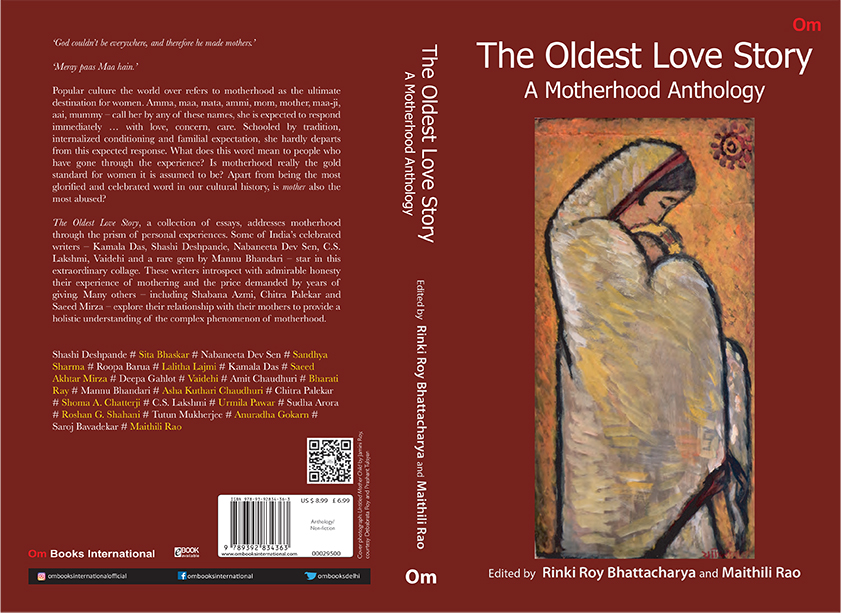
The Oldest Love Story, edited and curated by Rinki Roy and Maithili Rao published by Om Books International, 2022, carries multiple voices across cultures on a most ancient bond and nurtures pertinent questions and observation, which hope to redefine the role.
‘Antara 1’

Antara rising from primordial waters
As the first sun, forever new, forever old,
You made me the universe.
History and prehistory filed through me hand in hand
In gradual evolution.
Antara, because of you
I have earned the right to enter
The tenfold halls of my foremothers.
Clutching your baby hands in my fist,
I have made the future a debtor to me
Antara, in an instant you have filled all time
By your grace I am coeval with the Earth today.

-- Nabanita Dev Sen, The Oldest Love Story(2022)
The Oldest Love Story, curated by two eminent authors and journalists, Rinki Roy Bhattacharya and Maithili Rao, is an anthology that not only describes a human’s first love, their mother, and their lives, but also explores the social and psychological outcomes and ramifications of motherhood with powerful narratives from multiple writers. They range from eminent names like the late Nabanita Dev Sen, Shashi Deshpande, Kamala Das to Bollywood personalities like Shabana Azmi and Saeed Mirza and contemporary names like Amit Chaudhuri or Maithili Rao herself.
The anthology has narratives clubbed into three sections: ‘Being a Mother: Rewards and Regrets’, ‘Outliers’, ‘Our Mothers: Love, Empathy and Ambivalence’. The headings are descriptive of the content of each section. These real-life narratives, some of which include translations by editors Roy and Rao among others, make for interesting and fresh perspectives of the age-old story that is as natural as water or air. More than two dozen diverse voices as well as Roy’s powerful “Preface” and Rao’s exhaustive “Introduction” paint motherhood in new colours, giving it an iridescence that glitters with varied shades. Stories of what mothers faced — bringing up a child with Down’s syndrome, a child who drove his roommate to suicide and yet another daughter who marries a man old enough to be her father — bring us close to issues we face in today’s world.
One of the most interesting and unusual aspects of this book is at the end of each essay is a takeaway from the narrative where the writers write about themselves. This is not a biography but a description of the writers’ perception about their mother or what they learnt from their experience of motherhood. The most interesting takeaway is given by Shabana Azmi, who wrote of her dynamic mother Shaukat Kaifi (1926-2019).
“I am cut from the same cloth as her. But who am I?
“I would say I’m a woman, an Indian, a wife, an actress, a Muslim, an activist, etc. My being Muslim is only one aspect of my identity but today it seems as though a concerted effort is being made to compress identity into the narrow confines of the religion one was born into, at the absence of all other aspects. This is not the truth about India. India’s greatest truth is her composite culture.
“The Kashmiri Hindu and the Kashmiri Muslim have much more in common with each other because of their ‘Kashmiriyat’ than a Kashmiri Muslim and a Muslim from Tamil Nadu in spite of them sharing a common religion. To me, my cultural identity is much stronger than my religious identity.”
And she concludes: “My mother taught me that identity must not be a melting pot in which individual identities are submerged. It should be a beautiful mosaic in which each part contributes to a larger whole.”
Major social issues are taken up in multiple narratives. Mirza used the epistolary technique to describe how his mother discarded her burqa forever in Pre-Partition India.
“You were emerging from the hall of the Eros theatre and were about to wear your burqa in the foyer when Baba popped the question to you.
“‘Begum, do you really want to wear it?’
“You told me you paused for a moment, and then you shook your head. And that was that. The rest, as they say, is history.
“I am trying to imagine that moment. The year was 1938 and you had been wearing a burqa ever since you were thirteen years old.”
Mannu Bhandari’s spine-chilling narrative of her mother, a child bride around the time when Mirza’s mother shed her burqa, shows a young girl punished and abused for accidentally tearing her sari. It showcases a conservative, abusive culture where women turn on women. An extreme contrast to the bold maternal outlook described by Mirza or Azmi, the narrative highlights the reason why women need to protest against accepting familial abuse bordering on criminality. That these three mothers lived around the same time period in different cultures and regions of India only goes to enhance the large diaspora of beliefs, customs and cultures within one country.
Dalit writer, Urmila Pawar’s reasserts her mother’s belief, “A woman is a wife for only a while/ She is a mother all her life.” “Screams Buried in the Walls” by Sudha Arora dwells on the abuse borne by women to pander to societal norms. Narratives of abuse of women who could not stand up to social malpractices seem to have turned into lessons on what not to do for daughters who condemn patriarchal norms for the suffering their mothers faced.
On the other hand, Shashi Deshpande tells us: “Motherhood becomes a monster that devours both her and her young; or, when the children go away, there is an emptiness which is filled with frustration and despair. I have been saved from this because of my work. My children no longer need me, but my life does not seem empty.” While Shashi Deshpande found her catharsis by writing her stories, Deepa Gahlot, justifies her stance of remaining unmarried and childless by espousing a voice against motherhood. She contends that the only reason to perceive motherhood as a viable alternative would be propagation of the species. But concludes with an interesting PS: “Does it even make sense to bring a child into such an ugly, nasty, brutal world?” As one hears of senseless violence, wars and mass shootings in the news, Gahlot’s words strike a chord. She has actually researched into the subject to draw her conclusions. But one would wonder how would humankind propagate then — out of test tubes in a bleak scenario like Aldous Huxley’s Brave New World (1932)? Would humans really want such an inhuman existence?
I would rather go with Dev Sen’s outlook. While she emoted on motherhood in her poems on her daughter Antara, she has given a powerful prose narrative elucidating her own perspective. Antara, the daughter to who these poems are addressed, has given a beautiful takeaway on her mother at the end of Dev Sen’s narrative. Despite being abandoned by her husband, Amartya Sen, who later became a Nobel laureate, Dev Sen not only fulfilled herself as a woman and a mother but threw out an inspiring statement that well sums up motherhood for some: “[C]ould I do anything to make this planet worthy for my kids?”
Rinki Roy Bhattacharya, one of the editors of this sparkling collection and author of a number of books, especially on the legendary film maker, her father, Bimal Roy (1909-1966), had published an earlier collection on a similar theme called, Janani (Mother, 2006). She agreed to tell us more about the making of this meaty and gripping anthology, The Oldest Love Story.
Editor Rinki Roy Bhattacharya at the book launch in Mumbai. Photo sourced by Rinki Roy
Motherhood as a concept that is ancient, natural, and yet, not fully understood nor explored. What made you think of coming up with this collection that highlights not only stories of mothers and how it influenced women but also discusses the process of being a mother?
The present collection, titled “The Oldest love Story” goes back several decades. This is mentioned in my preface. It began when I woke up to the fact that I was redundant as a mother. By the time the children had grown up one-by-one and left home. I began to explore the situation with other women to understand, why we give so much importance to motherhood? Foolishly, I felt. Motherhood as a concept is indeed natural but taken for granted. I have a problem with that. My maid, Laxmi, is a classic example of a mother who is exploited to the hilt by her children. She is blind to their exploitation and refuses any change that will help her live with comfort or dignity. As if women are just mothers and nothing else?
Was it a personal need or one that you felt had to be explored given the current trend towards the issue where women are protesting the fact that looking after children saps them of individuality? Can you please explain?
I answered this issue as have others in this book. The deep resentment that follows after raising kids who then go away to find greener pastures, is an extremely common, and collective experience for most parents. Particularly in the Indian context. Parents cannot let go. The main reason, I think is, the parent’s fear. The fear of who will light the funeral pyre if not the son? In the event of not having a son, a close male relative takes over. Do you see the gender bias, the patriarchal assumption? Daughters are not considered legitimate enough to light the pyre?! Yet it is daughters who care for elderly parents in most cases.
This is not the case in Europe, nor the West, where children are expected to become independent very early. In fact, European teenagers seize their independence at the earliest opportunity. It is the expected thing, and no one resents that inevitable shift.
You had an earlier collection called Janani (Mother). Did that have an impact on this book?
I am glad you referred to Janani, published by Sage books in 2006. That collection is the cornerstone of our new book. In this collection, we have included eight extraordinary essays from Janani. We have retained, for example, Kamala Das and Shashi Deshpande to name two. And guess what we discovered out of the blue? In the oldest love story, we have several Sahitya Akademi winners amongst our writers, including these stalwarts. This raises our book to a huge literary stature.
How was it to work jointly on a book with Maithili Rao? Did you both have the same vision for the book?
Working with Maithili was fantastic, and it was great fun. She is the most generous of people and shares without fuss. Ours was a good partnership. I could not have produced this book without Maithili. She has been and continues to be a rock.
You have done many translations for the book. Why is it we did not find an essay from you as we did from Maithili Rao?
Yes, I did. I helped fine-tune Mannu Bhandari’s story It ranks as one of my personal favourites. Her narrative is beautifully visual. I find it cinematic. I also translated Sudha Arora’s poignant essay. Sudha is a noted Hindi writer. It was, however, difficult for me to write my personal story. But the hope is, our next reprint will carry a story I wrote on my son Aditya’s birthday in 2021. In this I have given graphic details of how childbirth robs women of their dignity in the so-called natural process of birthing children. My essay is entertaining and somewhat satirical in style.
You have written a beautiful preface to the book, reflecting your own experience with your children. Were you, like the other writers, impacted by your mother?
I take that as a compliment. Yes, I wrote a heartfelt preface. My relationship with my mother, admittedly, was a strained one. Our age difference was just eighteen years…whatever the reason, I have not been able to fathom or pinpoint it. So, I thought it was best to refrain from the troubled territory.
Would you say that Bollywood had some bearing on the book as a number of writers are from within the industry? Also, your father, the eminent Bimal Roy, made a movie called Maa in 1952. If so how. Please explain.
I do not see any bearing from Bollywood. The fact we have eminent personalities from the world of cinema, for example, Shabana Azmi, Saeed Mirza, and Lalita Lazmi do not make it a Bollywood-driven work. My father, Bimal Roy’s Bombay debut was with a film called Maa. Apparently, Maa was inspired by a Hollywood film titled Over the Hills. The main protagonist was an elderly mother of two sons. Maa bared a socially relevant issue, elder abuse, that has been globally recognised and is prevalent. My father’s empathy for the elderly is well documented in this fictional account. In day-to-day life, my father supported the elderly. His widowed aunt in Benaras was maintained by him. His brothers were educated and helped by his generosity. Compassion was his second nature. From him, I learned that a silent, discreet way to support others is the best way to reach out.
There are so many women in the anthology who reiterated the huge impact their mothers had on them, and they were quite critical of their ‘patriarchal’ fathers. Do you think this is true for all women? At a personal level, did your father or mother have a similar impact on you?
I am glad to hear that these woman are critical of their patriarchal fathers…while most women tend to overlook the patriarchal aspect. In general, women tend to ignore or even neglect, their mothers. In my case, it was distinct. My cultural upbringing was instilled by my father’s secular and inclusive vision and social values. These played a decisive part. Much more than my mother, who was a gifted photographer. My parents, by the way, were a made for each other couple. Rarest of rare in the movie industry. My father is my mentor. If you contemplate his well-loved films, let us take Sujata[1959], for one. I have yet to see another film that speaks so eloquently of social boycott. It is not just the caste issue of Sujata, which doubtless is the main thrust. It is the combined forces of class, caste, and gender that play havoc with human relationships as portrayed compassionately in this work.
Yes, Sujata is indeed a beautiful film and your book has taken up many of the issues shown in the movie through the voice of mothers, whether it is caste or religion. Was this intentional or was it something that just happened?
The voices of our contributors in the book are of individuals who write with exemplary honesty and spontaneously. Nothing is contrived in their writings. We did not brief our writers to take up any specific issue. They wrote from the heart.
One of the trends that emerged from my reading of the book was that educated and affluent mothers through the ages had it easier than child brides and less educated mothers, whose children also reacted with more vehemence, looking for a better world for themselves. Do you feel my observation has some credence? Please comment on it.
I do not agree entirely. Bearing children, and raising them in our complex, the confusing socio-economic culture is a challenging matter for all mothers. For all parents in fact. Child brides are subjected to it more intensely than others. There are no shortcuts, nor ready-made answers.
There is an essay against motherhood in this anthology. Do you agree with the author that it is a redundant institution and can be replaced by test-tube babies? Do you not think that could lead to a re-enactment of what Aldous Huxley depicted in Brave New World?
I think, you mean Deepa Gahlot’s essay. This was from the earlier collection. Deepa is entitled to her views. As are others. I think many younger women would agree with Deepa. Balancing motherhood with one’s professional life is a knotty business. I know women who have opted for one or the other to do full justice to it.
Yes, it was Deepa Gahlot’s essay. As you have rightly pointed out in your preface, motherhood can be interpreted variously. What do you see as the future of motherhood in India, and in the world?
Motherhood, remains subjective. Interpreted differently in each case. Every childbirth is a different experience. It may be life-threatening. A case to note is my dear friend Smita Patil’s. She died giving birth. But, I doubt women will stop being mothers, or abandon stereotypical mothering options that live up to that Deewar [Wall, 1975] dialogue: “Mere paas maa hain [I do not have a mother]”. There is a change, a shift, nonetheless, it is slow. Women are afraid to rock this entrenched image of motherhood. At least in India. I know successful women filled with guilt that they failed to be good mothers.
Well, that is certainly a perspective that needs thought.What books and music impact your work?
I read both Bangla and English. After leaving Calcutta where I read the children’s Ramayana, Raj Kahini, or stories by Tagore and Sukumar Ray. But there was an interruption when I got into an English medium school. Culturally I moved out of Bengal. During that phase, my mother introduced me to Agatha Christie. I was 12 years perhaps…I devoured her works. And I still do. Christie fascinates me.
I fell in love with the piano and began to learn it. As a result, Chopin, Mozart, and Liszt were my musical inspirations. I also learned Rabindra sangeet and Manipuri dance in Calcutta…. there was no dearth of cultural grooming. We are especially fortunate that our parents enjoyed the best in performing arts. Pandit Sivakumar Sharma, the great santoor maestro who just passed away, played at home. Sitara Devi danced for private programs. We were wrapped in a rich tapestry of culture.
What is your next project? Are you writing/ curating something new?
I am a compulsive writer, always itching to write. I believe that writers do not age…they mature and get better. Currently, I am compiling non-fiction episodes about some of the most celebrated artists from Indian cinema who I was privileged to meet…the collection may be titled, Brief Encounters. Writing keeps me creatively busy. Before I sign off, we have to thank our editor Shantanuray Chaudhuri for his unconditional support to make this book a reality. He has been marvellous.
Thank you for taking our work seriously.
Thank you for giving us your time and answering the questions
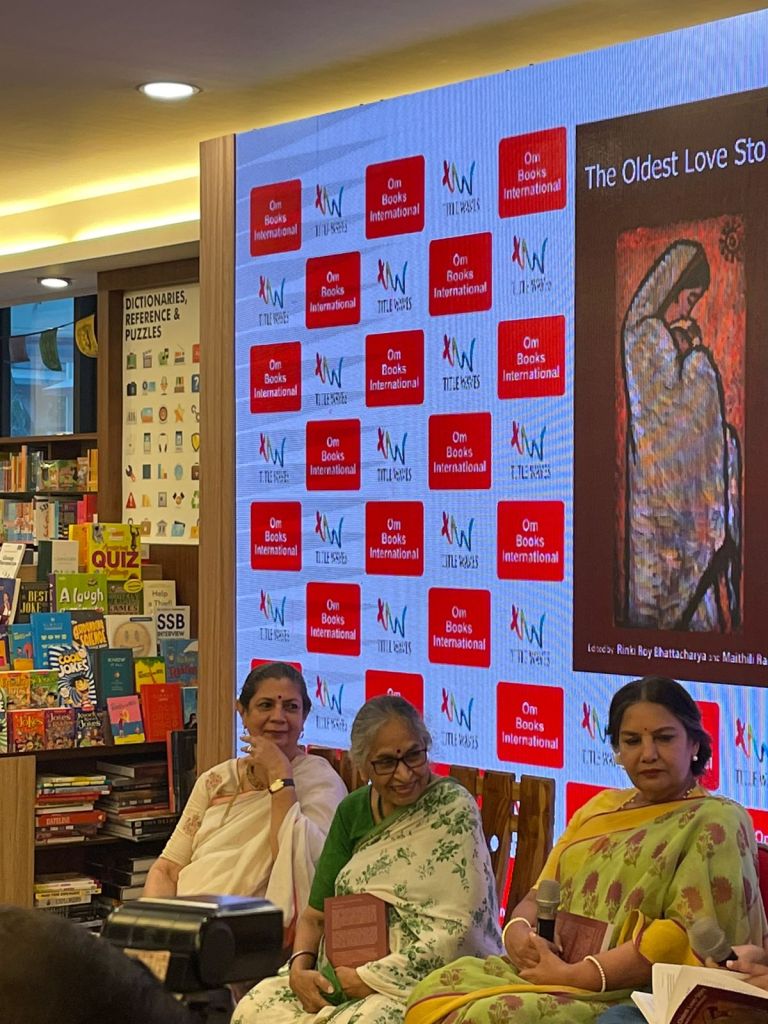
From Left to Right: Rinki Roy, Maithili Rao and Shabana Azmi at the Mumbai book Launch in June 2022. Photo sourced by Rinki Roy
(This is an online interview conducted by Mitali Chakravarty.)
PLEASE NOTE: ARTICLES CAN ONLY BE REPRODUCED IN OTHER SITES WITH DUE ACKNOWLEDGEMENT TO BORDERLESS JOURNAL
Taal Gaach or The Palmyra Tree was published as part of Shishu Bholanath (Child Bholanath) brought out in 1922. The poem has an inbuilt cadence and rhythm that flows like the sway of palmyra (commonly referred to as taal ) leaves in the breeze.
Taal Gaach, painting by Sohana Manzoor
THE PALMYRA TREE

The palmyra towers over all trees
Standing on one foot, it peeps
Into the sky.
It yearns to fly,
Piercing through dark clouds nigh
But where will it find wings?
That is why, it thinks —
Leaves circling its crown
Are wings to float around.
To soar unhindered, free,
Leaving its home, it flees.
The whole day, the foliage rustles,
Murmurs, susurrates and bustles.
The tree imagines its flight,
Drifting past stars in the sky,
Towards a destination up high.
Then the breeze stalls.
The swish of leaves halts.
When it regards the loam
As its mother, its hearth.
It loves again its home,
The nook on Earth.
(This poem has been translated for Borderless Journal by Mitali Chakravarty with editorial comments from Sohana Manzoor and Anasuya Bhar.)
.
PLEASE NOTE: ARTICLES CAN ONLY BE REPRODUCED IN OTHER SITES WITH DUE ACKNOWLEDGEMENT TO BORDERLESS JOURNAL
Ray Krishnakishore Bahadur is lying on his deathbed. His three sons Chandrakishore, Nandakishore and Indrakishore are busy consulting each other. A doctor is present. The women are close to tears.
Chandra: Who are the people we should write to?
Indra: Write to Sir Reynolds.
Krishna: (With great difficulty) What will you write, son?
Nanda: The news of your death.
Krishna: But I am not yet dead, son.
Indra: You might not die right now, but we have to fix a time for the event and write that down…
Chandra: We should collect the condolence letters from all the Englishmen here and get them published in newspapers. No point in publishing them when all the excitement is gone!
Krishna: Patience boys; let me die first.
Nanda: We can’t wait, father. Let’s make a list of the letters to be sent to the people in Shimla and Darjeeling. Come on, let’s get all the names down.
Chandra: The Governor, Sir Ilbert, Sir Wilson, Beresford, Macaulay, Peacock –
Krishna: Boys, what names are you chanting so close to my ears? Chant God’s name instead. When the time comes, He is the only one who can save us! Hari –
Indra: Yes, good thing that you reminded us, we forgot to include Sir Harrison.
Krishna: My sons, say Ram, Ram –
Nanda: Really, I had forgotten about Sir Ramsey.
Krishna: Narayan, Narayan!
Chandra: Nanda, write down the name of Sir Noran also.
Enter Skandakishore.
Skanda: So, you people seem so relaxed! You still haven’t done the real thing!
Chandra: And what is that?
Skanda: We have to inform in advance all the people who will be part of the procession going to the funeral ghat.
Krishna: Sons, which one do you consider the real thing? First, I’ll have to die, only then –-
Chandra: No worries on that account. Doctor!
Doctor: Yes sir!
Chandra: How much time is left for father to go? When do the public have to be here?
Doctor: Perhaps–
The women start wailing.
Skanda: (Disgusted) Ma, will you stop it? You’re creating quite a scene! It’s better to sort out everything in advance. When doctor?
Doctor: Most likely this night at—
The women start wailing again.
Nanda: This is a huge problem! You shouldn’t disturb us during work. What do you think your crying will accomplish? We are planning to publish condolence letters sent by important Englishmen in newspapers.
The women are sent out.
Skanda: Doctor, what do you think?
Doctor: From what I can see I think he will expire around four a.m.
Chandra: Then there is no time – Nanda, go quickly, get the slips printed at once right in front of your eyes.
Doctor: But first mustn’t the medicine—
Skanda: Look here! Your medicine shop will not run away. On the other hand, we’ll be in trouble if the print ring shop shuts down.
Doctor: Sir, the patient might not —
Chandra: That is why you must hurry. For who knows what might happen if the slips are printed before the patient —
Nanda: Here I go.
Skanda: Write down that the procession will begin at eight tomorrow.
Scene Two
Skanda: What, doctor? It’s already seven now instead of four.
Doctor: (Apologetically) Yes, yes, amazing the pulse is still strong.
Chandra: You are a fine one doctor to have got us into this mess!
Nanda: Everything went wrong when I was late in bringing the medicine. In fact, dad began to recover as soon as the doctor’s medicine was stopped.
Krishna: All this time you were so very cheerful, why is everyone looking so glum all of a sudden? I am feeling fine now.
Skanda: We aren’t feeling that great. We had already finalized all preparations to go to the funeral pyre.
Krishna: Is that so? I guess I should have died.
Doctor: (Feeling irritated) Do one thing and that will solve all problems.
Indra: What?
Skanda: What?
Chandra: What?
Nanda: What?
Doctor: Instead of him why don’t one of you die when the time is ripe.
Scene Three
A lot of people have assembled in the outer house.
Kanai: Hello, It’s already eight thirty. Why are you all late?
Chandra: Please sit down. Have some tobacco.
Kanai: I’ve been [chewing] tobacco from the morning!
Bolai: Where is everybody? I can’t see signs of any arrangements being made.
Chandra: Everything is ready – it’s not our fault – now only—
Ramtaran: Hey, Chandra, we shouldn’t waste any more time.
Chandra: Don’t I understand that – but—
Harihar: What is causing the delay? We’ll be late for office, what’s the matter?
Indrakishore enters.
Indra: Don’t be impatient. We are almost ready. In the meantime, why don’t you read the condolence letters?
He distributes them.
This is from Lambert, this from Harrison, this is Sir James’s—
Skandakishore enters.
Skanda: Here take them. In the meantime, read the obituary notices on father in the newspapers. Here is The Statesman, here TheEnglishman.
Madhusudan: (To Yadav) Isn’t this typical? Bengalis won’t ever learn what punctuality is all about.
Indra: You’re absolutely right. They will die and yet never learn to be punctual.
The guests shed tears reading the newspapers and the condolence messages.
Radhamohan: (in tears) Oh God, the poor man’s friend!
Nayanchand: Alas! To think that even such a good man has his share of troubles.
Nabadwipchandra: (in a deep breath) Lord! Everything is your will!
Rasik:‘The lotus that blooms in the heart’ – I’m forgetting what comes after that –
‘The lotus that blooms in the heart
Has been plucked untimely
The lotus heart sinks in the sea of sorrow!’
This is exactly the case here. The lotus heart in the sea of sorrow. How sad! Add esquire. Otempora! O mores[2]!
Tarkabagish[3]:Challchittang challadbittang, challajiwan – The mind is inconsistent, wealth is transitory and one’s life is perishable. Oh how sad!
Nyayabagish[4]:Yadupathe kri gata mathurapuri, raghupate – Where is the city of Mathura that belonged to the Lord of the Yadavas (i.e. Krishna), to the Lord of the Raghus (i.e. Rama Chandra)? (chokes)
Dukhiram: Oh Krishnakishore Bahadur, where have you gone?
A faint voice can be heard from within: I am here. Please, don’t shout.
[1] [Translated from “Antyashti-Satkar” in the Hasyakoutuk series Bhadra 1293 B.S. by Somdatta Mandal].
[2] “Oh the times! Oh the customs!” – Latin phrase, first recorded to have been spoken by Cicero
Somdatta Mandalis a former Professor of English and ex-Chairperson, Department of English, Visva-Bharati, Santiniketan, India. A recipient of several prestigious fellowships like the Fulbright Research and Teaching Fellowships, British Council Charles Wallace Trust Fellowship, Rockefeller Residency at Bellagio, Italy, Salzburg Seminar and Shastri Indo-Canadian Faculty Enrichment Fellowship, she has been published widely both nationally and internationally. She has also an award from Sahitya Akademi for the All India Indian Literature Golden Jubilee (1957-2007) Literary Translation Competition in the Fiction category for translating short stories series ‘Lalu’ by Sarat Chandra Chattopadhyaya.
.
PLEASE NOTE: ARTICLES CAN ONLY BE REPRODUCED IN OTHER SITES WITH DUE ACKNOWLEDGEMENT TO BORDERLESS JOURNAL
Our ashrama school is situated in the midst of a meadow, a place where both the old and the young, students and teachers all reside in the same room. We also have other playmates; we do not have a concealed relationship with the blue sky, the light and the breeze. Here the early morning rays of the sun fall directly upon our eyelids, the evening stars in the sky directly stare at our faces. When the storm comes, its dusty stole warns us from a very long distance. The arrival of a new season is first heralded through the new leaves on our trees. It is as if Nature does not have to wait for a moment outside our doors. Our desire is to share this kind of a relationship with the people of the world as well. The desire of our heart is to see clearly all the seasons that come and go in the history of mankind, the rising and setting of the sun or the tumult that storm and rain create. This is possible for us because we stay far away from human habitation. Here all the information of the world is not received in a particular cookie-cutter mould; if we want we can receive them in an unadulterated form.
In order to make the relationship of our institution to the rest of the human world an open one, I feel it necessary to explore the world. We have received the invitation of that larger world. As it is not possible for all the 200 students of this school to accompany me in this grand tour, so I have decided that I shall alone attend the invitation on your behalf. Through me I shall complete all of yours travel. When I will again return to your ashrama I will be able to capture a lot of the external world in my life and bring it for you. Once I come back I will share my experiences at leisure, but now, before departing, I want to clearly explain some of my thoughts to you. Many people ask me why are you going for an Europe travel? I cannot find an answer to this question. If I give a simple answer that I am going because I simply want to travel, then people will think that I am dismissing the fact lightheartedly. Man is not at peace until a result is declared and an assessment made of the profit and loss involved. Why should man venture out of home without any need is a question that can be raised in our country only. We are oblivious of the fact that the wish to venture outside is a natural instinct in man. Home has bound us up in such a manner that we are tied by many superstitions and tears once we decide to set our feet across the threshold. Thus the outside is totally beyond us while its connection with home has been completely severed. Our friends and relatives enmesh us so closely that outsiders are outsiders in the true sense of the word.
ABOUT THE BOOK
Travels formed an integral part of the personae and creative artist that was Rabindranath Tagore. During his travels to England and the USA (1912-13 and 1920) Tagore wrote essays for publication in various Bengali journals. In 1939, Tagore selected fourteen of these essays and an appendix containing seven letters he had written to some of the teachers in the Shantiniketan ashram while he was on these trips, for publication as a volume. Tagore rewrote the original essays then using the colloquial instead of the formal language; he also revised the texts substantially. Later editions altered the number of essays, sometimes digressing from Tagore’s own selection, sometimes going back to Tagore’s original formal language. The travelogue provides an insight into Tagore’s perception of the different facets of western life and the diverse philosophical issues that cross his mind as he journeys from one continent to another. Translated from Bengali for the first time, Pather Sanchoy would be of interest to all those who enjoy exploring unknown territories geographically and psychologically.
ABOUT THE AUTHOR
Rabindranath Tagore, sobriquet Gurudev, was a Bengali polymath who reshaped Bengali literature and music, as well as Indian art with Contextual Modernism in the late 19th and early 20th centuries. Author of Gitanjali and its “profoundly sensitive, fresh and beautiful verse”, he became the first non-European to win the Nobel Prize in Literature in 1913.He is sometimes referred to as “The Bard of Bengal”.
ABOUT THE TRANSLATOR
Somdatta Mandalis a former Professor of English and ex-Chairperson, Department of English, Visva-Bharati, Santiniketan, India. A recipient of several prestigious fellowships like the Fulbright Research and Teaching Fellowships, British Council Charles Wallace Trust Fellowship, Rockefeller Residency at Bellagio, Italy, Salzburg Seminar and Shastri Indo-Canadian Faculty Enrichment Fellowship, she has been published widely both nationally and internationally. She has also an award from Sahitya Akademi for the All India Indian Literature Golden Jubilee (1957-2007) Literary Translation Competition in the Fiction category for translating short stories series ‘Lalu’ by Sarat Chandra Chattopadhyaya.
TO A PAINED ONE

Now late at night you have a bed,
A quiet and dark room,
Placidity and silence.
Think of nothing more.
Listen to no one speaking,
Just wipe your bloodied heart clean
And tucked like the tuberose,
Go to sleep.

CITIES

My heart, you’ve seen many big cities
Cities whose bricks and stones
Accents, affairs, hopes, frustrations and terrifying deprivations
Have turned into ashes in the cauldron of my mind.
Nevertheless, I’ve seen the sun amidst thick clouds in a corner of a city
I’ve seen the sun on the other side of the river of a port city
Like a love-struck farmer, he bears his burden in the tangerine-cloud coloured fields of the sky;
Over the city’s gaslights and tall minarets, I’ve also seen—stars—
Like flocks of wild geese heading towards some southern city.

DAYS AND NIGHTS

The whole day went purposelessly.
The whole night will pass miserably.
Full of frustrations and failures,
Day in, day out, life is drudgery
To be wasted away.
And yet the phanimansha’s thorns we see
Daubing the dew delightfully; not one bird in the sky
All knowingly guilty birds in their nests now lie.
(These translations are from Jibanananda Das: Selected Poems with an Introduction, Chronology and Glossary, translated by Fakrul Alam, published by The University Press Limited, Dhaka, 1999. Republished with permission from the original publisher.)
Jibananada Das (1899-1954) was a Bengali writer, who now is named as one of the greats. During his life he wrote beautiful poetry, novels, essays and more. He believed: “Poetry and life are two different outpouring of the same thing; life as we usually conceive it contains what we normally accept as reality, but the spectacle of this incoherent and disorderly life can satisfy neither the poet’s talent nor the reader’s imagination … poetry does not contain a complete reconstruction of what we call reality; we have entered a new world.”
Jibananda Das’s All Afternoon Long, translated from Bengali by Fakrul Alam. Click here to read.
The Colour of Time, Korean poetry composed and translated by Ihlwha Choi. Click here to read.
The Ordeal of Fame, a humorous skit by Rabindranath, translated by Somdatta Mandal. Click here to read.
Fazal Baloch translates a retold folktale from Balochi, The Precious Pearl. Click here to read.
Tagores’ Lukochurihas been translated from Bengali as Hide and Seek by Mitali Chakravarty. Click here to read.
Pandies’ Corner
These narratives are written by youngsters from the Nithari village who transcended childhood trauma and deprivation. The Story of Rajesh has been written by Yogesh Uniyal in a mix of English and Hindi, and translated fully to Hindi by Nirbhay Bhogal. Clickhere to read.
Rhys Hughes shares why he put together an anthology of humorous poetry with seventeen writers, Wuxing Lyrical. Is his logic funny or sane? Click here to find out.
In An Encounter with the Monet on Naoshima, Suzanne Kamata writes of snacking on Claude Monet’s hundred year old recipes while savouring his art and that of the famed artist who makes bold art with polka-dots, Yayoi Kusama. Click here to read.
An excerpt from Upamanyu Chatterjee’s Villainy. Click here to read.
An excerpt from Ramy Al-Asheq’sEver Since I Did Not Die, translated from Arabic by Isis Nusair, edited by Levi Thompson. The author was born in a refugee camp. Click here to read.
Book Reviews
Rakhi Dalal revisits Tagore’s The Post Office, translated from Bengali in 1912 by Devabrata Mukherjee. Click here to read.
Indrashish Banerjee reviews Upamanyu Chatterjee’s Villainy. Click here to read.
For when your troubles starting multiplying
And they just might
It's easy to forget them without trying
With just a pocketful of starlight

Catch a falling star and put it in your pocket
Never let it fade away (never let it fade away)
Catch a falling star and put it in your pocket
Save it for a rainy day

'Catch a Falling Star' by Paul Vance and Lee Pockriss
Perhaps, it is time to find that fallen star popularised by pop singer Perry Como is 1957. Optimism glimmers faintly, sometimes even conceals itself, in a world passing through a dark phase in history. For instance, few of us would know that we might find more answers to tackle climate change as dinosaur fossils (from the time an asteroid hit the planet) have been unearthed recently. That sounds like solutions can be had to what was perceived as inevitable doom.
Another bit of news that perhaps will cheer some is the first anthology of Borderless Journal will soon be available in market. It has been accepted by a publisher, an old, trusted and reputed name from India, Om Books International. They have bookshops splattered all over — should make it easy for buyers to access the book. Hopefully, you can target the anthology for your Diwali or Christmas gift hampers. Om Books has one of the most iconic editors-in chief, Shantanu Ray Chaudhuri. A multiple award-winning editor, he has worked in Penguin and Harper Collins and is currently churning out wonderful books from Om with a fabulous production team, working with whom has been a pleasure. Ray Chaudhuri is an outstanding film writer and poet. He is part of a group that is creating a film archive online. To know more about him or his views on publishing, you can read our online conversation with him.
The energy one gets from optimism like starlight from a fallen star, lightens the darker shadows that create gloom with the war leading to rise in prices and threats of recession in a post pandemic scenario. Lesya Bakun, the refugee from Ukraine whose story we carried last month, finds her starlight by sharing updates of her story. She added to her narrative with the news that her cousin has been taken as a prisoner of war by Russia from the besieged factory in Ukraine. Though sharing does not alleviate suffering, Bakun’s ability to cling to hope and imagine a future where she gets her dream highlights the strength of her convictions. The other thing that is revealed by her narrative and media coverage is exclusivity and boxes of ideology split humankind, erase families, cities, countries, lives and sanity. The war can appease only the lust of warlords. Against this desolation caused by the devastation, what could be the starlight that would lead to a happier future?
Laughter. Unleashing the ability to laugh at oneself is as potent as laughter that generates relief and lightens our mood, so that we can view differences as whimsical, treat them with tolerance and compassion and not destroy the diversities that add colours to the world. Perhaps, that is why Tagore took to humour too. Somdatta Mandal has translated a series of humorous skits by Tagore. We are featuring one of these called the ‘Ordeal of Fame’. Yet another translation or transcreation of a poem called ‘Lukochuri’ or ‘Hide and Seek’ reflects the playful in Tagore’s oeuvre. These, along with Rhys Hughes humour on the pandemic in poetry and prose, bring good cheer into our journal. Hughes has also used his column to tell us why he curated a new humorous anthology of verses by seventeen poets called Wuxing Lyrical. I wonder if he is serious or joking!
As we trot around the globe, Suzanne Kamata tells us about a Monet museum in Japan where she ate madeleines made with the artist’s recipe! Meredith Stephens sails to Tasmania with her camera and gives us a glimpse of nature’s plenty. Ravi Shankar relates his trekking adventures among the Himalayas in Nepal, with awesome photographs of these mountains, while Kenny Peavy who lives in Indonesia dwells on the value of falling down and getting up in a light humorous vein against the backdrop of nature – though metaphorically perhaps the world needs to do that. We have G Venkatesh’s story about his stay in Johannesburg where he discovers that skin tones do not matter.
Ratnottama Sengupta makes the whole world look like a home with the story of a legendary screenwriter, Jean Claude Carriere, who wrote the script of Mahabharata for Peter Brook’s play (1985) of the same name and the subsequent film (1989) — with characters drawn from all over the world. Candice gives us an overview of the pandemic, with more focus on US where she lives.
Mike Smith travels back to another time when an ailment called World War II raged and has revived a writer from the past, HE Bates (1905-1974). We have another essay by Dan Meloche on a legendary book which turned 100 this year — Herman Hesse’s Siddhartha. Rakhi Dalal revisits more than a century old translation by Devabrata Mukherjee of Tagore’s The Post Office which bears relevance to the present day as it shows how the human spirit endures over even the darkness of death.
Bhaskar Parichha has reviewed Radhika Gupta’s Limitless: The Power of Unlocking Your True Potential, by his assessment a book that inspires youngsters to take charge of their future. On the other hand, there are books that explore the darkest in humans. Basudhara Roy has reviewed a collection short stories by Sunil Sharma called Burn the Library & Other Fiction. Indrashish Banerjee reviews Upamanyu Chatterjee’s latest novel based on modern day crimes, Villainy, from which we are carrying a book excerpt too. The other excerpt is from a narrative written from a refugee’s perspective, Ramy Al-Asheq’s Ever Since I Did Not Die, translated by Isis Nusair from Arabic. Born in a refugee camp in Damascus, this Syrian-Palestinian poet defies all genres to touch hearts with brutal honesty. No less sincere is Michael Burch’s poetry on summer that ushers in the season as much as Sohana’s beautiful painting that we are using as our cover photo. We have poetry from not just Shantanu Ray Chaudhuri but also by George Freek, S. Srinivas, Tohm Bakelas, Abin Chakraborty, Marianne Tefft and many more. As usual, I have not mentioned all the treats in store for you. Delve into our contents page and browse to find out more.
Before winding up, I would want to extend my thanks not only to our team and contributors, but also to our publisher who is willing to republish our content with some tweaking. Thanks to our readers who, I hope, will be excited to have selected content between their palms as a hardcopy anthology with 49 of our most iconic pieces. We have more than a thousand published works. This anthology will be an iconic sample that you can carry anywhere with you even if there is no internet – that would include Mars and Moon!
I wish you happy reading, happy dreaming and hope… plenty of it.
A humorous skit[1] by Rabindranath Tagore, translated by Somdatta Mandal
Hasyakoutuk(1914) or Humour by Tagore, the collection in which this skit was published.
Scene One
The lawyer Dukori Dutta is sitting on a chair.Kangalicharan enters nervously, ledgers in hand.
Dukori: What do you want?
Kangali: Sir, you are a well-wisher of the nation –
Dukori: Everyone knows that. But what do you actually want?
Kangali: You have devoted your life for the welfare of the ordinary man –
Dukori: And I do so while I am carrying on my legal business but what is your point?
Kangali: Sir, actually I don’t have much to say.
Dukori: Then why don’t you finish soon.
Kangali: Think for a while and you’ll have to admit “ganat paratrang nahi”, that is to say, nothing is better than music —
Dukori: Look here, man. Before I admit anything, I need to know the meaning of what you just said. Say it in Bangla.
Kangali: Sir, I don’t know the exact Bangla meaning. But the main idea is that one loves to listen to songs a lot.
Dukori: Everyone doesn’t like them.
Kangali: Anyone who doesn’t like songs must be —
Dukori: Lawyer Dukori Dutta.
Kangali: Sir, don’t say such things.
Dukori: Then should I lie?
Kangali: The sage Bharata is the first Aryan to have…
Dukori: If you have any lawsuits to file against the Sage Bharata then tell me. Otherwise stop giving a speech on him.
Kangali: I had a lot of things to say.
Dukori: But I don’t have the time to listen to a lot of things.
Kangali: Then let me state the case in brief. In this city we’ve established a society called “Gannonati Bidhyaini” – The Society for the Betterment of Music. Sir, we want you —
Dukori: To deliver a lecture?
Kangali: No, Sir.
Dukori: To be the chairman?
Kangali: No, Sir.
Dukori: Then tell me what it is that I have to do. Let me tell you before hand, singing songs and listening to songs – I have done neither previously and will not do either of these things in future.
Kangali: Sir, you won’t have to do either. (Advancing a receipt book) Just some donation–
Dukori: (Startled, gets up) Donation! Good grief! You aren’t an easy man to please. When you came in you appeared to be a good-natured man and came in with an embarrassed face – I thought then that you were in legal trouble. Take your donation booklet immediately or I will file a police case against you for trespassing.
Kangali: Wanted a donation but got a beating! (To himself). But I I’ll teach you a lesson.
Scene Two
Dukori Babu with newspapers in his hand.
Dukori: This is great fun. Someone called Kangali Charan has informed all English and Bengali newspapers that I have donated five thousand rupees to their “Gannonati Bidhayini Society”. What donation, the only thing I didn’t do is throw him out by the collar. In the meantime, I’ve gained a reputation that will be very good for my business. They will also benefit from this. People will think that since they have got five thousand rupees as donation, it will turn out to be a huge meeting. No doubt they will get greater donations from elsewhere. Nevertheless, fortune will surely favour me.
The clerk enters.
Clerk: Sir, have you donated five thousand rupees to “Gannonati Sabha?”
Dukori: (scratching his head and smiling) Well, it is just a story some one has made up. Why do you listen to it? Who told you that I have donated? Suppose I did, so what? Why make a fuss about it?
Clerk: Oh, what humility! Paying five thousand rupees in cash and then trying to conceal the deed is no feat for an ordinary man.
Enter servant.
Servant: Plenty of people have assembled downstairs.
Dukori: (To self) See! In one day, my income has increased. (Gladly) Bring them upstairs one by one – and bring paan leaves and betel nut as well as some tobacco.
The first supplicant enters.
Dukori: (Shifting a seat) Come – be seated. Sir, have some tobacco. Who is there? Hey—could we have some paan.
First Supplicant:(to himself) Really, what an amiable person! If he doesn’t fulfil one’s desires desires, who will?
Dukori: And what could have brought you here?
First Supplicant: Your generosity is famous all over the country.
Dukori: Why listen to such gossip?
First Supplicant: What humility! I had heard about you earlier, but today the difference between sight and sound has been eliminated.
Dukori: (To self) I hope he will come to the point now. Plenty of men are waiting downstairs. (Openly) So, what do you need?
First Supplicant: For the development of the nation, from the heart —
Dukori: Yes, it is good of you to mention the heart.
First Supplicant: That’s right. Great honourable persons like you are India’s —
Dukori: I am agreeing to all that you are saying so why don’t you concede this part to me? And so —
First Supplicant: It’s the habit of people who are full of humility that when it comes to their own virtues –
Dukori: Spare me sir. Come to the point!
First Supplicant: You know, the fact is that day by day our country is regressing —
Dukori: That is because people don’t know how to say things concisely.
First Supplicant: Our once rich and glorious motherland is now mired in poverty.
Dukori: (Like a long-suffering person, covering his head with his hand) Go on.
First Supplicant: Day by day sinking in the well of poverty –
Dukori: (In a pleading tone) Sir, what is the point?
First Supplicant: Then let me tell you the real thing –
Dukori: (Enthusiastically) That’s better.
First Supplicant: The English have been looting us.
Dukori: This is something worth pursuing. Collect proof and I will appeal to the magistrate’s court.
First Supplicant: The magistrates too are sharing the spoils.
Dukori: Then I will lodge an appeal in the court of the District Judge.
First Supplicant: The District Judge is a dacoit.
Dukori: (Surprised) I can’t figure you out.
First Supplicant: Let me tell you, all the money from the country is being sent abroad.
Dukori: That is terrible!
First Supplicant: So, a meeting –
Dukori:(Alarmed) A meeting?
First Supplicant:Yes, see this is the booklet.
Dukori: (Wide-eyed) Booklet?
First Supplicant: Some donation would be –
Dukori: (Jumping up from the bench) Donation! Get out — out — out!
Quickly the table is turned, ink spilled, the first supplicant tries to exit hurriedly, falls down, gets up, chaos ensues.
The Second Supplicant enters.
Dukori: What do you want?
Second Supplicant: Your country-wide munificence —
Dukori: I’ve gone through it all once before. Tell me if you have anything new to say.
Second Supplicant: Your patriotism –
Dukori: Good lord! He seems to be saying exactly the same things!
Second Supplicant: Your virtuous acts for the motherland –
Dukori: This is too much! Come straight to the point!
Second Supplicant: A meeting.
Dukori: What? Another meeting?
Second Supplicant: Here, see this booklet.
Dukori: Booklet? What booklet?
Second Supplicant: To collect donations.
Dukori: Donations! (Pulls his hand) Get up, get out, out – if you love your life —
The man leaves without saying anything else
Enter third supplicant.
Dukori: Look, here. Appeals to my patriotism, generosity, politeness – all these have been exhausted. Try something else.
Third Supplicant: Your openness, philanthropy, and liberal views –
Dukori: That’s somewhat better. At least he’s saying something new. But sir, leave all those things and start our discourse.
Third Supplicant: We have a library –
Dukori: Library? Not a society?
Third Supplicant: No sir, no society.
Dukori: Oh! I’m relieved. Library! Excellent. Go on.
Third Supplicant: Here, see the prospectus.
Dukori: Sure this isn’t a subscription booklet?
Third Supplicant: No sir, not at all. Merely printed leaflets.
Dukori: Oh! What next?
Third Supplicant: Some donation.
Dukori: (Jumping up) Donation! Who’s there? There’s a dacoit in my house today. Policeman! Policeman!
The third supplicant escapes as fast he can. Enter Harashankar Babu.
Dukori: Come in, come in, Harashankar. I remember our college days. But we haven’t met since then. You don’t know how happy I am feeling after seeing you.
Harashankar: I too have a lot of pleasant and unpleasant things to share with you. But I will do those things later. First let us finish a piece of business.
Dukori: (Excited) I haven’t heard anyone talk to me about business for a while now, brother. Tell me, tell me so that I can fill my ears with business talk. (Harashankar takes out a booklet from under his shawl). Oh, what is that? I see a booklet coming out!
Harashankar: The boys in my locality have decided to hold a meeting –
Dukori: (Startled) Meeting?
Harashankar: Yes, sort of. So, for some donation –
Dukori: Donation! See I have loved you for a long time now but if you utter that word in my presence, we will become enemies for ever.
Harashankar: Is that so! You can donate five thousand rupees to some “Gannonnati Sabha” of Khargachia but cannot sign a cheque of five rupees at the request of your friend? One must be a heartless person to step in here to seek your company!
Exits with great speed. A man enters, notebook in hand.
Dukori: Notebook? Bringing a notebook to me yet again? Get lost, will you?
The Man: (Scared) I’ve come from Nandalal Babu —
Dukori: I don’t care for Nandalal or anyone else. Leave immediately.
The Man: Sir, what about giving some money—
Dukori: I won’t pay you any money. Get lost.
The man runs away
Clerk: Sir, what have you done? He was trying to return the money Nandalal Babu owed you. We need to get the money back today. We can’t do without it.
Dukori: Good grief! Go and call him back.
The clerk goes out and comes back a little later
Clerk: He’s gone. I couldn’t find him anywhere.
Dukori: This is a problem indeed.
A man enters with a mandolin in hand.
Dukori: What do you want?
The man: We need connoisseurs of music like you. What haven’t you done for the advancement of music! I will sing a song for you.
He starts playing his mandolin immediately and sings a song set to the tune of Raga Iman Kalyan.
Glory be to Dukori Dutta
In the world his munificence saw…etc etc.
Dukori: What nonsense! Stop, stop.
Enter a second man with a mandolin in hand.
Second man: Sir, what does he know of music? Listen to my song:
Dukori Dutta you’re a blessed man
Whoever knows your greatness can…
First man: Glory – g—l—o—r—y
Second man: D—u—u—u—u—kori—i—i
First man: Duk—o—o—o—
Dukori:(With fingers in his ears) Oh my god! I can’t take it anymore!
A man enters, tabla in hand.
Player: Sir, a song without a musical accompaniment? How can that be?
He begins playing. A second player enters.
2nd player: What does he know of accompaniment? He cannot even hold the tabla correctly.
1st singer: Stop.
2nd singer: Why don’t you stop!
1st singer: What do you know about singing?
2nd singer: What do you know?
The two start arguing about the scales and rhythm of music. Then they fight with their mandolins.
The two players start bandying the beats used in tablas such as “dhekete didhey ghene gedhe ghene.” The contest climaxes with a tabla fight.
Enter a group of singers and some more men with donation booklets in hand.
1st person: Sir, song –
2nd person: Sir, donation –
3rd person: Sir, meeting –
4th person: Your benevolence –
5th person: A khayal in Raga Iman Kalyan –
6th person: For the welfare of the country –
7th person: A tappa song by Sari Miyan—
8th person: Shut up, shut up!
9th person: Please stop, brother. Let me finish my words.
Everyone starts pulling Dukori’s shawl and shouts of “Sir, listen to me, Sir, listen to my words” can be heard etc.
Dukori: (ina voice admitting defeat) I am going to my uncle’s place. I will stay there for a while. Don’t give my address to anybody.
Exit.
The brawl between the singers and the musicians continues in the house for the whole day. In the evening the clerk tries to stop the quarrel, gets injured, and collapses.
[1] [Translated by Somdatta Mandal from “Kshatir Birambana” B.S. Magh 1292].
Somdatta Mandalis a former Professor of English and ex-Chairperson, Department of English, Visva-Bharati, Santiniketan, India. A recipient of several prestigious fellowships like the Fulbright Research and Teaching Fellowships, British Council Charles Wallace Trust Fellowship, Rockefeller Residency at Bellagio, Italy, Salzburg Seminar and Shastri Indo-Canadian Faculty Enrichment Fellowship, she has been published widely both nationally and internationally. She has also an award from Sahitya Akademi for the All India Indian Literature Golden Jubilee (1957-2007) Literary Translation Competition in the Fiction category for translating short stories series ‘Lalu’ by Sarat Chandra Chattopadhyaya.
.
PLEASE NOTE: ARTICLES CAN ONLY BE REPRODUCED IN OTHER SITES WITH DUE ACKNOWLEDGEMENT TO BORDERLESS JOURNAL









 Borderless