The Traveller in Time: An interview with Sybil Pretious who has lived through history in six countries and travelled to forty — she has participated in the first democratic elections in an apartheid-worn South Africa and is from a time when Rhodesia was the name for Zimbabwe. Click here to read.
A poem reflecting the state of Gandhi’s ideology written in Manipuri by Thangjam Ibopishak and translated from the Manipuri by Robin S Ngangom. Click here to read.
Written by Tagore in 1908,Amaar Nayano Bhulano Eledescribes early autumn when the festival of Durga Puja is celebrated. It has been translated from Bengali by Mitali Chakravarty. Click here to read.
Sameer Arshad Khatlani dwells on the tradition of education among Muslim women from early twentieth century, naming notables like Ismat Chughtai and Rashid Jahan. Click here to read.
John Herlihy takes us through more of Myanmar with his companion, Peter, in the third part of his travelogue through this land of mystic pagodas. Click here to read.
Ratnottama Sengupta, who has edited an encyclopaedia on culture and is a renowned arts journalist, gives us the role ‘kanthas’ (hand-embroidered mats, made of old rags) played in India’s freedom struggle. Click here to read.
“Beauty is truth, truth beauty — that is all
                Ye know on earth, and all ye need to know.”

John Keats (1795-1821), Ode to a Grecian Urn
‘Beauty is Truth’ : The Potato Eaters(1885) by Vincent van Gogh (1853-1890). Courtesy: Creative Commons
What makes for great literature? To me, great literature states the truth — the truth that touches your heart with its poignancy, preciseness, sadness, gentleness, vibrancy, or humour. If Khayyam, Rumi, Keats, Tagore, Frost or Whitman had no truths to state, their poetry would have failed to mesmerise time and woo readers across ages. Their truths – which can be seen as eternal ones — touch all human hearts with empathetic beauty. Lalon Fakir rose from an uneducated illiterate mendicant to a poet because he had the courage to sing the truth about mankind — to put social norms and barriers aside and versify his truth, which was ours and still is. This can be applied to all genres. Short stories by Saki, O’ Henry or plays and essays by Bernard Shaw — what typifies them? The truth they speak with perhaps a sprinkle of humour. Alan Paton spoke the truth about violence and its arbitrariness while writing of South Africa — made the characters so empathetic that Cry, My Beloved Country(1948) is to me one of the best fictions describing divides in the world, and the same divides persist today. The truth is eternal as in George Orwell’s 1984 (1949) or Suskind’s Perfume(1985). We love laughter from Gerald Durrell or PG Wodehouse too because they reflect larger truths that touch mankind as does the sentimentality of Dickens or the poignancy of Hardy or the societal questioning of the Bronte sisters, George Eliot, and Jane Austen. The list of greats in this tradition would be a very long one.
Our focus this time is on a fearless essayist in a similar tradition, one who unveiled truths rising above the mundane, lacing them with humour to make them easily digestible for laymen – a writer and a polyglot who knew fourteen languages by the name of Syed Mujtaba Ali (1904-1974). He was Tagore’s student, a Humboldt scholar who lived across six countries, including Afghanistan and spoke of the things he saw around him. Cherished as a celebrated writer among Bengali readers, he wrote for journals and published more than two dozen books that remained untranslated because his witticisms were so entrenched by cultural traditions that no translator dared pick up their pen. Many decades down the line, while in Afghanistan, a BBC editor for South and Central Asia, Nazes Afroz, translated bits of Mujtaba Ali’s non-fiction for his curious friends till he had completed the whole of the travelogue.
The translation named In a Land Far from Home: A Bengali in Afghanistan was published and nominated for the Crossword Awards. This month, we not only run an excerpt from the translated essays but also have an interview with the former BBC journalist, Afroz, who tells us not only about the book but also of the current situation in ravaged Afghanistan based on his own first-hand experiences. Nazes himself has travelled to forty countries, much like our other interviewee, Sybil Pretious, who has travelled to forty and lived in six. She had been writing for us till she left to complete her memoirs — which would cover much of history from currently non-existent country Rhodesia to apartheid and the first democratic election in South Africa. These would be valuable records shared with the world from a personal account of a pacifist who loves humanity.
We have more on travel — an essay by Tagore describing with wry humour vacations in company of his niece and nephew and letters written by the maestro during his trips, some laced with hilarity and the more serious ones excerpted from Kobi and Rani, all translated by Somdatta Mandal. We have also indulged our taste for Tagore’s poetry by translating a song heralding the start of the Durga Puja season. Durga Puja is an autumnal festival celebrated in India. An essay by Meenakshi Malhotra explains the songs of homecoming during this festival. It is interesting that the songs express the mother’s views as highlighted by Malhotra, but one notices, never that of the Goddess, who, mythology has it, gave up her life when the husband of her own choosing, Shiva, was perceived by her family as ‘uncouth’ and was insulted in her parent’s home.
In spirit of this festival highlighting women power and on the other hand her role in society, we have a review by Somdatta of T. Janakiraman’s Wooden Cow, translated from Tamil by Lakshmi Kannan, where the protagonist upends all traditional values ascribed to women. Another book which is flavourful with food and would be a real fit on every festive occasion is Mohana Kanjilal’s A Taste of Time: A Food History of Calcutta. Bhaskar Parichha tells us in his review, “In the thriving universe of Indian food books, this clearly stands out.”
Aruna Chakravarti’s review of Shazia Omar’s Golden Bangladesh at Fifty also stands out embracing the colours of Bengal. It traces the title back to history and their national anthem — a Tagore song called ‘Amaar Sonar Bangla – My Golden Bengal’. Gracy Samjetsabam’s review of Suzanne Kamata’sThe Baseball Widow, a cross cultural novel with an unusual ending that shuttles between America and Japan, winds up our review section this time.
As Kamata’s book travels across two continents in a pre-covid world, Sunil Sharma in reality moved home from one continent to another crossing multiple national borders during the pandemic. He has written an eye-opening account of his move along with his amazing short story on Gandhi. Another unusual story creating a new legend with wonderful photographs and the narrative woven around them can be relished in Nature’s Musings by Penny Wilkes. This time we have fiction from India, Malaysia, Bangladesh and America. Steve Davidson has given a story based partly on Tibetan lore and has said much in a light-hearted fashion, especially as the Llama resumes his travels at the end of the story. Keeping in step with light humour and travel is Devraj Singh Kalsi’s account of a pony ride up a hill, except it made me laugh more.
The tone of Rhys Hughes cogitations about the identity of two poets across borders in ‘Pessoa and Cavafy: What’s in a Name?’ reminds me of Puck or Narada! Of course, he has given humour in verses with a funny story poem which again — I am not quite sure — has a Welsh king who resisted Roman invasion or is it someone else? Michael Burch has limericks on animals, along with his moving poem on Martin Luther King Junior. We have much poetry crossing borders, including a translation of Akbar Barakzai’s fabulous Balochi poetry by Fazal Baloch and Sahitya Akademi winning Manipuri poet, Thangjam Ibopishak, translated by Robin S Ngangom. A Nazrul song which quests for a spiritual home has been translated from Bengali by no less than Professor Fakrul Alam, a winner of both the SAARC award and Bangla Academy Literary Award.
Former Arts Editor of Times of India, Ratnottama Sengupta, has shared an essay on how kantha (hand embroidered rug) became a tool to pass on information during the struggle against colonial occupation. The piece reminded me of the narrative of passing messages through mooncakes among Chinese. During the fourteenth century, the filling was of messages to organise a rebellion which replaced the Yuan dynasty (1271-1368) with the Ming (1368-1644). Now the filling is delicious lotus paste, chocolates or other edible delicacies. Women were heavily involved in all these movements. Sameer Arshad Khatlani has highlighted how women writers of the early twentieth century writing in Urdu, like Ismat Chughtai, created revolutionary literature and inspired even legendary writers, like Simone de Beauvoir. There is much more in our content — not all of which has been discussed here for again this time we have spilled over to near fifty pieces.
We have another delightful surprise for our readers – a cover photo of a painting by Sohana Manzoor depicting the season titled ‘Ode to Autumn’. Do pause by and take a look at this month’s issue. We thank our writers and readers for their continued support. And I would personally like to give a huge thanks to the team which makes it possible for me to put these delectable offerings before the world. Thank you all.
Sybil Pretious in Morocco. Photograph provided by Sybil Pretious
She paints. She writes. And she has lived through history. She was born in a country that no longer exists. The borders changed with movements of history. In South Africa in the late 80’s, early 90’s she ran a Nursery School attached to the local Primary School for whites. She lived through Nelson Mandela’s movement. As laws changed she admitted the first black child into the school in 1993. She writes of celebrating the first democratic elections in South Africa: “I felt ecstatic. I realised that it was not only the Africans who had been freed to be equal citizens, but I felt free too. I had been released from the enormous guilt and helplessness that had been part of daily living during apartheid.” She lived through it all and soared out to explore more…
Sybil Pretious is a woman who has travelled through life with an élan for assimilating the best in all cultures she has lived in, and she has lived in many. She has lived in six countries and travelled to forty. I met her in China, where she was teaching in an international school. She was like a beam of sunshine. She retired and left. Then we met virtually in a world devoid of borders. While she wrote of her travels from China, the part of her life where she lived through incidents we only read of in history remained silent. That is what we set out to explore in this interview. At an age where others retire and complain of aches and pains, she is writing a biography of her mother and looks forward to traveling, painting, and writing more. Now, this traveller in time, with a heart full of compassion, calls herself a South African, lives in United Kingdom and unfolds for us the story of her life.
Tell us about your childhood in South Africa.
My childhood was never spent in South Africa. The first 23 years of my life were spent in Southern Rhodesia/ Rhodesia. Rhodesia joined Northern Rhodesia and Nyasaland as the Federation – 1953-1963). Rhodesia declared UDI (Unilateral Declaration of Independence) from Britain in 1965. This lasted for 13 years and in 1980 after much conflict Rhodesia became Zimbabwe.
Only now, when I look back do I realise how much of an influence my childhood had on my passage through life.
Rhodesia, part of the British empire, a land-locked country almost in the centre of Africa, was first colonised by the BSA Company (British South Africa Company) lead by Cecil Rhodes in 1890 when mineral rights were granted by the chief, Lobengula. The country was named after Rhodes. It had a perfect climate and was known as ‘The Breadbasket of Africa’ for the high-quality food crops the farmers produced. Sadly, now, there are many people who do not have enough to eat in the country.
My parents met and married in in 1934. My dad was born in Rhodesia in 1901. His father had been one of the early pioneers in the 1890’s. My mother travelled from Kimberley in South Africa where she was born, to Rhodesia in 1926.
My dad refused to go to university because his father would not allow him to study Mine Engineering. My mother had little education because she was so involved with helping her mother with her six siblings.
I was born in 1942. Fortunately, my father was too old to enlist for World War II. I arrived six years after my elder brother and sister and my arrival was greeted with joy. I was the centre of attention and loved it, generally revelling in the light shining on me and responding to it. From then on, I tried to please everyone. I was not enamoured when two-and-a-half years after my birth my younger sister made an appearance followed a year after that by my younger brother. Of necessity they became the focus of attention, and I became more of a loner and learnt to enjoy my own company.
My father had a great love of the outdoors, prospecting, and mining for gold. Mum grew to love the peace of the veld in his company. During my parents’ first few years of marriage, they moved often as gold reefs ran out. They also farmed during this period. Eventually when they settled in the capital, Salisbury, and made their money by purchasing land, building a house, living in it for a short while before selling it and moving on to the next project.
This made for a rather interrupted childhood where we changed homes and schools often. I attended four different schools in the first four years of my schooling. When I finally had some settled years in a Primary School, I did well. I was the star of the family, but it put a lot of pressure on me to perform.
As children we found it difficult to make and keep friends, but this constant change equipped us for adapting to many different situations. My elder sister insisted on going to Boarding School just so that she could make friends and I think get away from her three younger siblings.
With the wonderful climate in Rhodesia, I spent much of my free time during childhood out of doors. We had one-acre gardens that were generally virgin veld. They provided many opportunities to explore, invent games, problem solve, and use our imaginations.
I loved going to the library in Salisbury and taking out many books, especially adventure stories and visualised myself in the roles of the characters. I created imaginary people and used the natural world to feature in my make-believe stories. Although we were always moving, there was no lack of childhood company as our cousins lived close by. But of course, they were not the same as friends.
Our holidays were spent mainly in Rhodesia, camping in the Eastern Highlands. I loved camping and still do even at my age. On occasion we travelled to Natal in South Africa or Beira in Mozambique for seaside holidays. In our teens we went in friend’s cars on wonderful picnics to dams where we swam and water-skied. We visited the beautiful outdoor places with names like ‘Mermaid’s Pool’ and Sinoia Caves with its mysterious bottomless pool. We scrambled over rocks and climbed hills and had parties on friends’ farms. It was generally a carefree existence in the open air.
My contact with Africans was mainly when we lived on farms. I enjoyed sitting in the dust with a few of the children and pretending to ‘teach’ them. I had a small blackboard, and I would write a word and say it and they had to repeat it and copy in the sand. I used fingers to indicate numbers and showed them how to count (though I am sure they could do that in their own language). They did not attend our schools and we rarely saw the children or mothers in towns. The African men worked as servants in our homes.
Did you often visit other countries during your childhood?
The only other countries I visited during childhood were South Africa and Mozambique for holidays. I loved reading about other countries and was always fascinated the by different peoples, climates, and lifestyles.
Can you recall a memorable event?
The most memorable day in the whole of my time in Africa must be the day of the first democratic elections in South Africa on 27th April 1994.
On that day I remember rising early, stowing a water bottle, some sandwiches and fruit in my backpack. The closest polling station was not far from where I lived so I walked. It was a beautiful day. Clear sky, warm sun (though that proved to be hot after many hours of standing). My husband had decided to go later. I was astonished at the long queues that had formed – some literally miles long. I approached and found myself standing behind two Africans and Indian lady. We all greeted each other warmly clasping two hands together and greeting in our own languages. Later as the time wore on in the heat I shared my water, fruit and sandwiches. Our discussions were general – the weather, our families, where we had come from and how glad we were to be there at this historic time. They had all travelled further than I had but there was no grumbling as we stood patiently.
There was an air of calm euphoria.
I felt ecstatic. I realised that it was not only the Africans who had been freed to be equal citizens, but I felt free too. I had been released from the enormous guilt and helplessness that had been part of daily living during apartheid. We could only treat the people in our employ with sympathy and fairness, but the rules of apartheid shackled our relationships. It was a day of hope for everyone chatting, showing kindness, laughter and waiting patiently to vote.
There was not one adverse incident throughout the country and foreign journalists were disappointed that violence had not broken out. This day was the greatest example of forgiveness and acceptance that I have ever witnessed. I feel privileged and blessed to have been there.
You are writing your mother’s memoirs tell us about it.
My mother was born in 1904 and lived until 2001. At sixteen, she was the eldest of seven siblings in Kimberly, South Africa, when her mother was tragically killed in a shooting accident which involved her brother. When her father remarried, she felt rejected and left to stay with a friend. With little knowledge except of cooking and shopping for her mother she took on the job of manageress of a bakery and improved her education by reading the newspaper to her friend’s blind father and writing letters for him.
Eventually she decided to relocate to the newly annexed colony of Southern Rhodesia. The story records her many personal challenges in this pioneering country – some sad, some hair raising, some very amusing and others poignant. When she married my father, their resourcefulness was tested to the limit with five children to raise. She is an example of courage, inventiveness, creativity, love and sheer grit in pioneering times. It encompasses family life in a fledgling country.
I want my children and grandchildren to know about their roots so that they may be as fearless and resourceful as my mother was in very testing circumstances.
Why did you write about your mother specifically?
I wrote about my mother because the first sixteen years of her life were very demanding as she helped her mother with her six siblings at home while missing school. The death of her mother left her without a purpose in life as the family was dispersed.
She is a shining example of getting on with life no matter the circumstances. Subsequently with her marriage the story includes my father. They have both been inspirational in different ways. My mother for her love, steely determination and creative thinking, my father for his quiet, never-ceasing support of her and us.
My mother, despite her poor schooling manged a bakery, worked in a department store, designed the houses they built, helped build them and was there for her children. She never hired any help to look after us. She was thrifty, made all our clothes and was a tower of strength in our family as well as being adored by her siblings.
She remains the most positive person I have ever known despite having no help with getting over the death of her mother. Her influence on my outlook in life is tremendous and while the story is mainly hers, it honours both of my parents.
How many countries have you lived in? Tell us a bit aboutwhy you moved.
I have lived in six countries but travelled to about forty. My home country is of course Rhodesia, now Zimbabwe.
I travelled to UK age 23 and lived here for a year working and travelling.
When I married in 1967 my husband was from Swaziland, so we lived this beautiful mountainous country for three years. Our first precious daughter was born there.
We moved to South Africa in 1971 and lived mainly in Durban and Johannesburg in the next 30 years. Our precious two younger daughters were born in Durban. This was during the apartheid years. In 1988, we bought a trading store in the rural cane farming area out of Durban and with no experience plunged into that way of life. Our customers were mainly Zulu farm workers. During that time, I started a Pre-School and admitted the first African child. These were the years leading up to the first democratic election and there were many tumultuous incidents during that time. Our venture failed and we returned to Johannesburg to recoup our losses.
While I was teaching, I studied for my BA by correspondence, and did a Remedial Teaching qualification.
In 2003, I obtained a teaching post at an International School in Maputo, Mozambique, commuting back to Durban during the holidays. After two years, I realised that I needed to be on my own and in 2005 our divorce went through.
In 2006, I secured a teaching post at an international school in Suzhou, China. I spent the next six years in this fascinating country. This was a really special time in my teaching career and life and fuelled my passion for travel. Precious people in a spectacular country, they will always remain dear to me. In 2012, I had no choice but to retire at age 70.
I have not taught since moving to the UK but have enjoyed the history, walking in gentle countryside, painting, singing in a choir, Circle Dancing and of course writing. This has been a beautiful retirement.
Which country has been the most memorable and why?
Many people ask me which is the best country I have ever been to or lived in. My answer is simple:
“The best country in the world is wherever I am.”
Of course, no one is satisfied with that answer even though it is perfectly true. I look for the best in each country I go to and tell the people I meet.
I generally find that it is then very easy to settle into a new place.
If I was forced to choose a country, my home country would be the one – wonderful people, perfect climate and terrain and a relaxed lifestyle.
What has been your learning from all your travels?
I have learnt that there is no substitute for my own very special daughters. While on my travels they and their families were so often in my thoughts, and I have learnt that sacrifices are made when you are away from your family.
I have learnt to welcome differences instead of looking for similarities in cultures.
I have learnt that you need not speak a language to communicate. Communication comes in many forms.
I have learnt to go with the unexpected as wonderful surprises often ensue.
I have learnt that the way in which you approach people is usually what will be returned to you.
I have learnt that this world of ours is infinitely beautiful in so many different ways.
I have learnt that we need to take better care of our precious planet.
I have learnt to take risks and not to fear the unknown.
And I have learnt to appreciate and understand differences and similarities in countries and peoples.
How did you get impacted by the pandemic? How did you tackle it?
I did not weather the pandemic very well during the first lockdown in 2020. In 2019, I had just moved into a new complex, gone through winter, then spent a month in South Africa with my family so had little time to meet people and settle in. I returned to UK the day that lockdown started. My youngest daughter and family lived fairly close, but I was unable to see much of them.
I am usually positive in most situations, but my mind appeared to lockdown during this time.
I gave up painting, playing the ukulele and at times writing during those months. I cleared out a lot of stuff that I didn’t really need so that was good, but it was a very frustrating time for me as I was considered too old to volunteer for anything. I didn’t consider myself vulnerable and resented being told what was supposedly ‘good for me’. By the time the second lock down came in 2021, I had inherited my granddaughter’s little dachshund called Hope. She has indeed brought hope and joy to my life. And now that we are almost back to normal, I seem to be re-igniting my creativity.
Do you see any commonality among people across different cultures and in different places?
People are people throughout the world. Unfortunately, borders are created by governments. Wherever I have travelled my reception has always been generous and helpful. People are curious and show exceptional interest in the differences between our cultures. Laughter often follows explanations. I have been asked to give a speech at a Chinese wedding and had toasts in my honour. I have slept on beds with bamboo pillows and climbed mountains with local people. I feel blessed for the acceptance I have experienced.
Travelling without expecting other cultures to mimic your own; expecting and experiencing exciting and interesting differences is the most gratifying point of travel. I have been privileged to be accepted into the homes of local people in many countries which is why I like to travel on my own or perhaps with one other. The real joy of travel and culture is to be found in local places with local people, not in hotels and on organised tours.
In conversation with an American poet,Jared Carter, who has received multiple encomiums like the Walt Whitman Award, the Poets’ Prize, a Guggenheim fellowship and much more. He tells us of his life and how he writes a poem. Click here to read.
In conversation with eminent academic and translator, RadhaChakravarty. Click here to read.
Translations
Two songs by Tagore written originally in Brajabuli, a literary language developed essentially for poetry, has been translated by Radha Chakravarty. Click here to read.
Korean Poetry written and translated to English by Ihlwha Choi. Click here to read.
Poetry in Bosnian from Bosnia & Herzegovina, written and translated by Maid Corbic. Click here to read.
Translation of ‘Dushomoy’ by Tagore, from Bengali to English by Mitali Chakravarty on behalf of Borderless Journal. Click here to read and listen to Tagore’s voice recite his poem in Bengali.
Penny Wilkes takes us Down the Path of Nostalgia with a mix of old and new photography and prose and poetry on how a decade after the end of the Second World War, she started her love affair with photography and nature. Clickhere to read
Marjuque-ul-Haque explores Mughal Lalbagh fort left unfinished in Dhaka, a fort where armies were said to disappear during the Sepoy Mutiny of 1857. Clickhere to read.
Nishi Pulugurtha journeys with her camera on the famed grounds near Fort William, a major historic site in Kolkata. Click hereto read.
Musings of a Copywriter
In Managing Bookshelves, Devraj Singh Kalsi cogitates with wry humour while arranging his book shelves. Click here to read.
Adventures of the Backpacking Granny
Sybil Pretious concludes her adventures this round with a fabulous trip to Generous Indonesia, a country with kind people, islands and ancient volcanoes. Click here to read.
A poignant real life story by Jeanie Kortum on adopting a child. Click here to read
The Literary Fictionist
In Scarecrow, Sunil Sharma explores urban paranoia. Click here to read.
Book Excerpt
The Parrot’s Tale, excerpted from Rabindranth Tagore. The Land of Cards: Stories, Poems and Plays for Children, translated by Radha Chakravarty, with a foreword from Mahasweta Devi. Clickhere to read.
In a tribute to Bollywood legend Dileep Kumar, Ratnottama Sengupta, one of India’s most iconic arts journalists, recollects the days the great actor sprinted about on the sets of Bombay’s studios …spiced up with fragments from the autobiography of Sengupta’s father, Nabendu Ghosh. Click here to read.
“Nothing can be unconditional: consequently, nothing can be free.”


“Liberty means responsibility. That is why most men dread it.”

-- George Bernard Shaw,  Maxims for Revolutionists, Man & Superman (1903)
George Bernard Shaw (1856-1950), a great writer and playwright, used these epigrammatic lines to bring focus on what people thought was liberty or freedom from oppression, from regimes that were dictatorial. While discussing concepts of freedom, one does wonder if political freedom solves all humane issues, occasions we celebrate with great aplomb, like the birth of a nation.
This month started with the observance of July 4th, the date of the American Revolution in 1776 and the publication date of Whitman’s Leaves of Grass in 1855. In between these two years, in 1789, ten days down the line, on July 14th, another significant occurrence has been handed down by history to be celebrated as the Bastille Day— the day prisoners were freed from Bastille, a major event that led to the overthrow of the insensitive monarchy in France, a symbolic resurgence of the common, exploited man that has often been seen as an inspiration for later uprisings to reinforce the concept of democracy or liberté, égalité, fraternité.
As we move forward in time, towards August, one wonders if liberty attained by these means was good for all fellow humans? France was part of the Allied Forces that with America taking the lead dropped not one but two atom bombs on Hiroshima and Nagasaki on August 6th and 9th, 1945, to end the Second World War. Did the ends justify the means? Reflecting the cry and suffering of these victims, we have poetry from Suzanne Kamata, a well-known writer from Japan. Michael Burch on the other hand has shared poetry with us which shows how the nuclear programme continued unrepentant despite the devastation it caused. One must give kudos to the descendants of the victims of the nuclear blast that they have forgiven the perpetrators, admitted their own hand in the Second World War and moved ahead. In that spirit, we have an essay on peace by Candice Louisa Daquin, who joins the Borderless team as a writer-in-residence.
We have much happening in poetry this time with an interview of American poet Jared Carter, a recipient of number of awards and fellowships, including the Walt Whitman Award and the Guggenheim fellowship. He walks us through how he created the poem ‘Yeti’ (first published in the May edition of Borderless) and talks of the impact of artifacts from China and India on his own thought processes, the impact of Du Fu (712-770) and much more. We have a poem in Du Fu’s style this time by George Freek and an interesting poem with a Chinese title by Carter, a title that can have multiple connotations and yet each seems to fit the poem perfectly.
Rhys Hughes has brought humour into our pages with both his poetry and essay on William Mcgonagall, who bore the sobriquet of the worst writer in the world through his life and had things thrown at him when he read his poetry in Dundee. Yet, his work survived the beatings, and he lives on known as the ‘Scottish Homer’.
More poetry by Singaporean poet Marc Nair gives us a glimpse of the little island as viewed by someone who has grown up on it. Poetry is always multi-hued, and we have Lorraine Caputo transport us to a Garífuna village in Honduras. Penny Wilkes takes us ‘Down the Path of Nostalgia’ with a mix of old and new photography, prose and poetry on how almost a decade after the end of the Second World War, she started her love affair with photography and nature. It hovers between poetry and musings, and this time we have a rare musing by Jared Carter too. Devraj Singh Kalsi continues cogitating with wry humour while arranging bookshelves. We also have the backpacking granny visitingIndonesia. Post sharing this trip, our granny — Sybil Pretious — plans a little break from publishing to complete her memoirs.
A riveting flash fiction by Kaiyi Tan celebrates the spirit of conquest in these dark times, weaving into the pandemic lore the quest for personal freedom. Stories this time carry a real life one by Jean Kortum on adoption — her own struggle. But then, stories can be real or unreal – draw a bit from both to reflect bigger truths or create alternates that sink into the human mind as a perceived reality and leave an imprint deep inside the heart, like that of Niles Reddick. My conviction is that some lived experiences of writers seep into each story, whether it is from Bangladesh or India or by our literary fictionist, Sunil Sharma. His narrative continues infused by suspense.
We have a complete translated story of Tagore by Radha Chakravarty as our book excerpt this time. ‘The Parrot’s Tale’, ostensibly part of a children’s collection, reflects Tagore’s response to conventional schooling — a reason for him to start Shanti Niketan perhaps. She has also shared two of her translations of Rabindranath’s songs from Bhanusingher Padabali (1884, Bhanusingh’s verses). Chakravarty generously consented to an interview and has given us a glimpse of her journey as a translator and critic. We also have translated a long poem by Tagore on our pages, a poem that inspires hope, though it was named Dushomoy (1897, Bad Times) finally. The original name had been Swarga Patthe (On the Path to Heaven) as can be seen from a page in his diary. We have been fortunate in finding a recording of his voice reciting the poem in Bengali and the print of a sample page of the manuscript bearing his signature.
We continue with Akbar Barakzai’s poetry translated by Fazal Baloch from Balochi – this time addressed to his daughter reminding for some reason of Nehru’s Letters from a Father to his Daughter — a book I read as a child. In addition, we have translations from Korea and Bosnia & Herzegovina, from where the young poet, Maid Corbic, has taken up the concept of freedom of the self and of the nation, both together.
Keith Lyons from New Zealand in his very brief essay has quoted American novelist William Faulkner, “We must be free not because we claim freedom, but because we practice it.” And perhaps we need to remember this if for no other reason, then, just to maintain our own sanity in these strange, almost unreal times as we attempt to unite as humankind to free ourselves from an unknown and unfathomable virus.
In a more sombre note, last week, untroubled by the virus, a victim of cancer, Bollywood legend Dileep Kumar, aged 98, breathed his last. Ratnottama Sengupta adds an unusual colour to the Borderless Journal with her tribute to this hugely acclaimed actor. In the process, she unfolds for us a brief history of the Indian cinema, and a glimpse of a world that transcends all man made constructs in quest of perfection.
We have an interesting set of reviews this July. Rakhi Dalal has reviewed Anuradha Kumar’s riveting short story collection, A Sense of Time. A murder mystery for young readers, Murder at Daisy Apartments by Shabnam Minwalla, has been reviewed by Gracy Samjetsabam. The Third Eye of Governance–Rise of Populism, Decline in Social Research by Dr N Bhaskara Rao, reviewed by Bhaskar Parichha, seems to be a non-fiction that looks forward to bridging gaps between academia and the real world, a truly felt need. Parichha has also given us an essay on a man who inspired Ian Fleming, the creator of James Bond, to make him a part of his lore, a journalist who moved around all of Asia with equal aplomb and a sense of humour – a truly global citizen called Richard Hughes.
I want to thank all our wonderful contributors for making this edition a reality. And readers, we leave you to explore the unknown… like that place we call outer space. A huge thank you again to not only all our wonderful contributors, our faithful readers but also to the fabulous Borderless team scattered across the world.
Before I wind up, a little bird trills a song of hope in my ear. Business tycoons have started stepping into the mysterious void of space to eventually – let us hope — create affordable travel for common man, though it has started off as an expensive proposition. Will this be an industry that will generate more jobs on and off Earth and find new places for man to inhabit? After all, when George Bernard Shaw wrote his plays and essays, we had yet to cross the frontiers beyond Earth, had never even thought of flying across the world in budget airlines or mining moons!
Will we have a new world, a new outlook and a new set of hopes and aspirations as we stretch the frontiers of our home planet?
Wish you all a wonderful month of reading and thinking.
Sybil Pretious concludes her adventures this round with a fabulous trip to a country with islands and ancient volcanoes
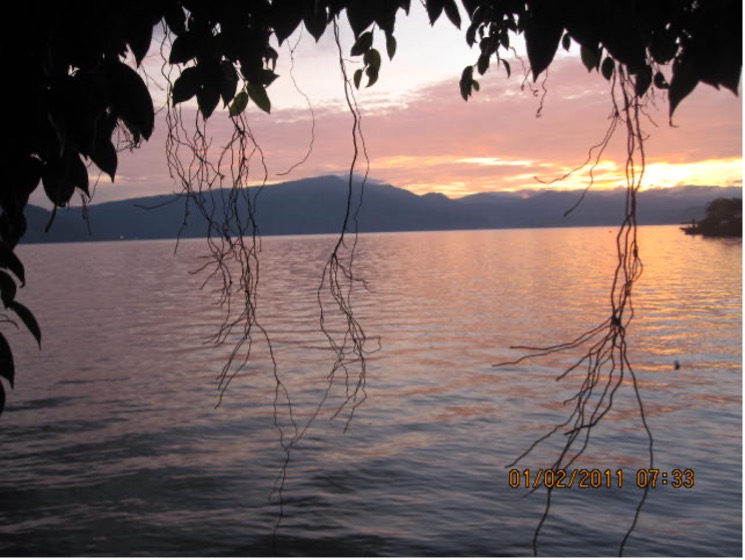
Volcanic Lake Toba. Photo Courtesy: Sybil Pretious
A good traveller has no fixed plans and is not intent on arriving. The way to do, is to BE.
~Lao Tzu
In 2011 (aged 69), I decided to challenge myself and travel alone to Indonesia. I also looked at alternative accommodation to backpacking so I joined Couch surfers. CouchSurfing is an organisation that connects people who wish to find accommodation in other countries while offering to host travellers in their own country. You offer just a couch where you live and can ‘surf’ to find a ‘couch’ with a resident of the country you want to visit. You do not pay for the ‘couch’ and you must supply your own meals and transport. The big advantage of this accommodation apart from no cost is that you get information from a person who is local and loves where they live plus it’s a base to travel from.
Indonesia is a country that spans the equator and consists of at least 17,000 islands. I would only touch on this extended land by visiting Java and Sumatra and yes, I was interested in the people, volcanoes, dance, puppets and woven fabric that I had heard so much about. My Couchsurfing host was Arianne who had written a couple of travel books about Indonesia – perfect.
I flew into Jakarta in the evening and wondered about how I would get to Arianne’s as I didn’t have her address. As so often happens when I leave events to unfold without trying too hard, they do so in a much better way than if I had been more diligent. Without informing me my lovely hostess had sent a chauffeur driven car with refreshments. Her welcome and the help and caring throughout my stay were definitely not included in the description of CouchSurfing hosts.
Her home had wide open spaces with pillars and floors of red concrete so that air flow was optimal in this hot, steamy climate. My ‘couch’ turned out to be an ornate four-poster bed in a bedroom with my own ‘en suite’. The toilet was typically Asian with a bucket of water for flushing. The ‘bathroom’ held a large concrete cube open on top and filled with cold water. A very large scoop was provided. To ‘bath’ I stood naked on the concrete floor, soaped myself and scooped out the water, throwing it in the general direction of my body. It was a bit hit and miss but I did feel cool and refreshed for a short while. There was no hot water. It just wasn’t needed. Every morning, I was woken with the long loud call to prayer.
I mentioned to Arianne as we chatted that I wanted to make a trip to Sumatra and was busy looking for flights and that I wanted to stay on the island of Samosir in the centre of the volcanic lake Toba. The island and lake are the result of a super volcano eruption 75,000 years ago.
“Let me book the flights for you. I do this often and will get the best prices and I can also arrange for someone to meet you.”
I couldn’t refuse her kind offer so it seemed once more that I had a guardian angel at my side. She efficiently took over and booked flights, arranged for people to meet me and take me wherever I needed to go. I would explore Jakarta and possibly go to Bali when I returned.
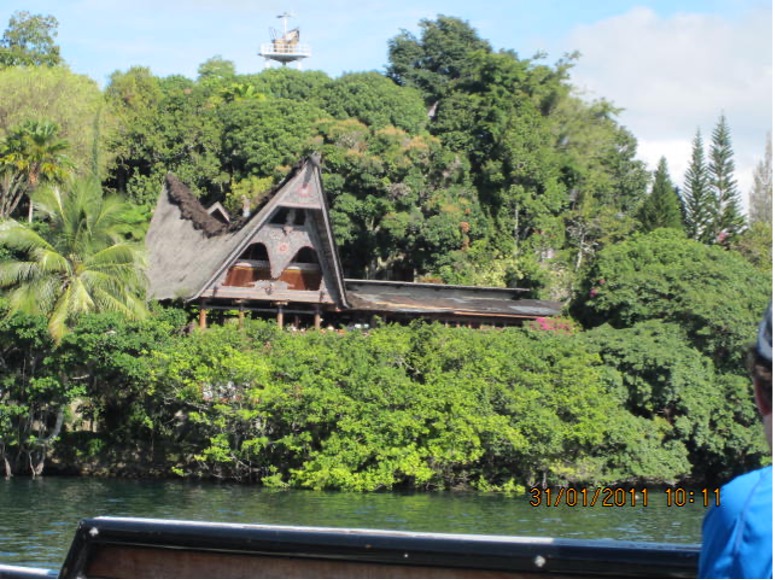
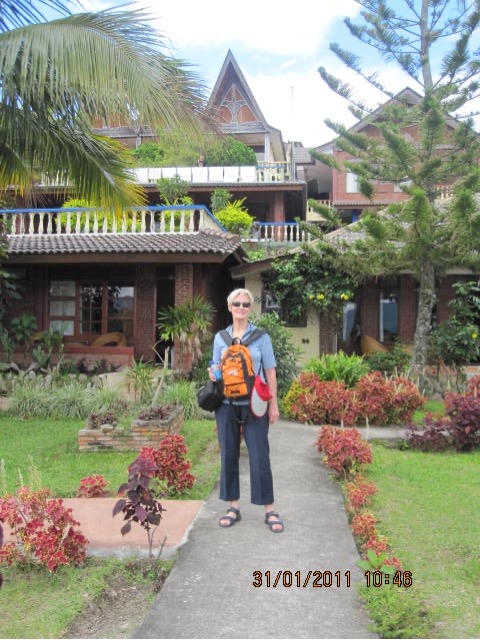
On arrival in Medan, I was met by Argys, a young Indonesian man who had brought his friends along. They were so attentive and concerned that I wouldn’t like the accommodation they had arranged for that night in Parapat before we took the ferry from a small village called Tuk Tuk across to Samosir Island where we stayed at Samosir Cottages.
It was hard to believe that an angry volcano had created this stunningly tranquil Lake. I got up early for the sunrise, a perfect place to meditate and feel grateful. I was ready for the day ahead.
Samosir Cottages. Photo Courtesy: Sybil Pretious
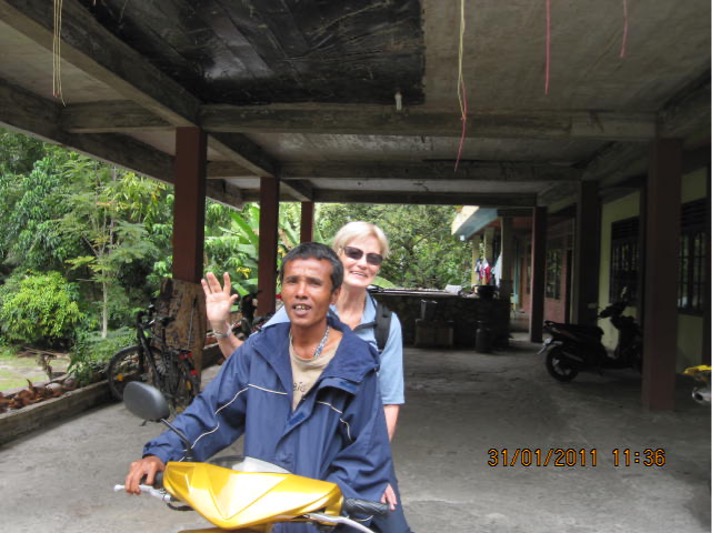
I wanted to see more of the island and was offered a motor bike tour by a local entrepreneur, Banyu. I didn’t give it a second thought, but Argys wasn’t too sure about this and gave Banyu a lecture before we set off. I promised him half the fee at the beginning of our ride and the other half when we returned and after a wonderful trip. He finally got more than he had asked for. It was a good feeling to be supporting local people rather than large touring companies. I have found that trust and acceptance is a must if you are to experience life through the local people’s eyes. Lack of knowledge of the local language is not necessarily a disadvantage.
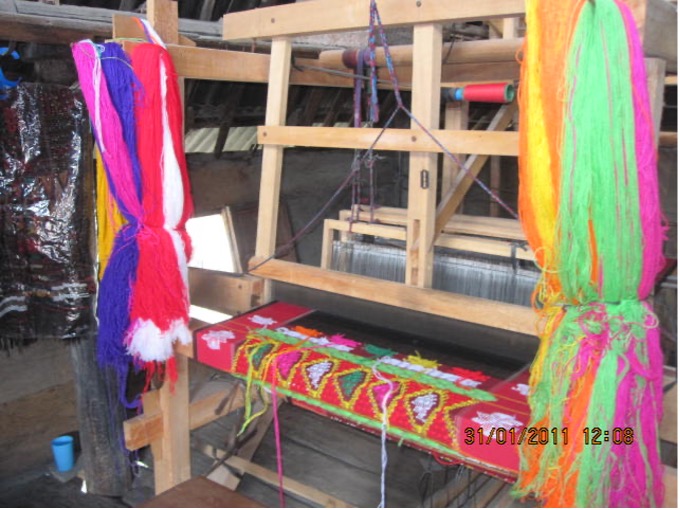
Travelling by motorbike gives an uninterrupted view of the lush vegetation and local scenery. My guide stopped at regular intervals delighting in showing off the wonderful textiles and weaving that local people were demonstrating. I couldn’t resist buying some of the colourful pieces after a demonstration by the weaver who looked delighted at the sale.
Photo Courtesy: Sybil Pretious
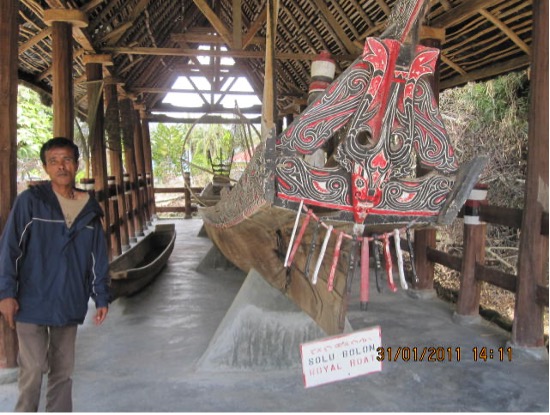
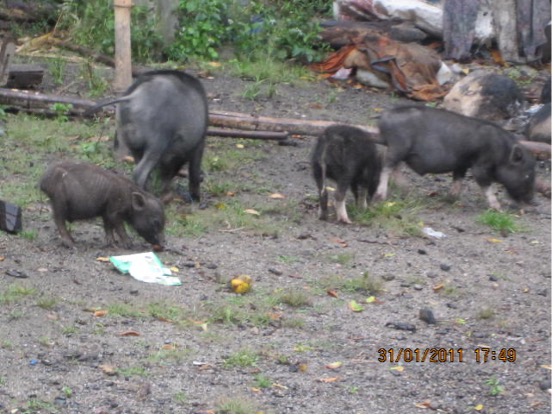
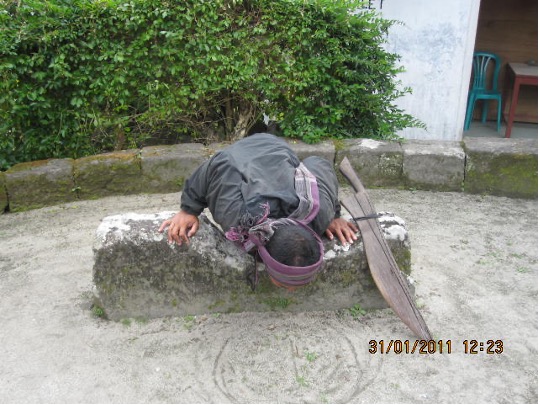
A museum displayed wonderful crafting on a ship, using minimum tools while creating intricate, colourful decoration. We laughed at black pigs foraging and then went to talk to a man who was looking after a ‘castle’. He was happy to demonstrate just how a prisoner would be beheaded. Many hand signals flew between us until he figured I had not understood and finally looking resigned, laid himself down on a specially shaped stone, leaning the massive sword towards his head and laughing when I got agitated.
Demonstrating beheading
Photo Courtesy: Sybil Pretious
Banyu was ever attentive but refused to share the fruit and water I had taken with me. He had not eaten during the tour. At the end I thanked him profusely. I slept well that night dreaming of battling to get through a gate. I woke feeling vaguely disturbed.
The following day was the one I enjoyed the most.
“We want to take you to the Sipiso Piso Waterfall.”
“That sounds wonderful. I could do with some cool water in this heat.”
Argys looked a little worried.
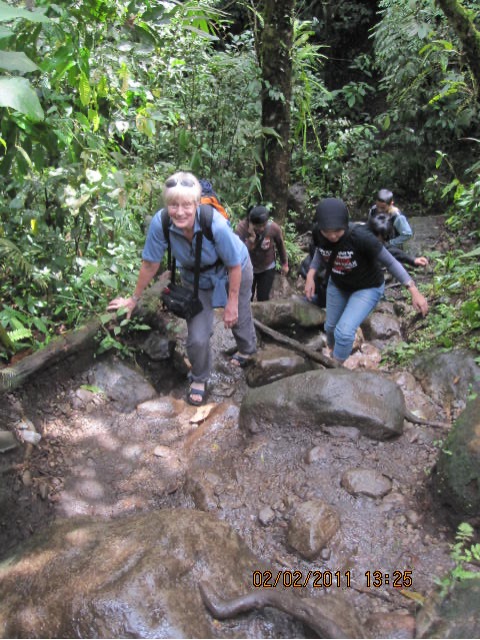
“It’s really high up. It is a waterfall that comes from very high in the side of the lake. We have to go over rivers and rocks and climb through a very muddy forest to get there.”
“I will be okay. I haven’t had the chance to climb any mountains here so this will be good.”
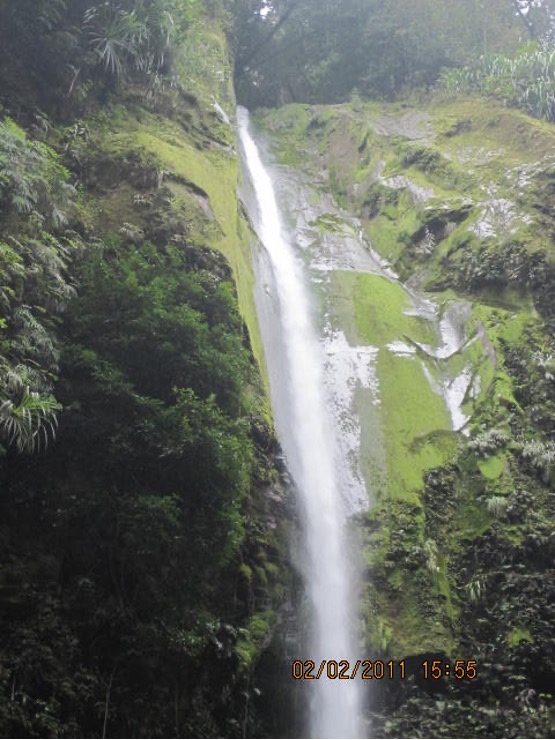
I later found out that the waterfall fell from a height of 120metres above the lake gushing from a cave in the Lake Toba caldera.
I packed the usual things in my small backpack – water, fruit, biscuits, a first aid pack and an extra blouse as I knew how hot and sweaty I got when climbing. I wore open sandals and the loose top and light slacks I had worn on Kilimanjaro. I was glad I didn’t have to cover my head as the two girls in our little party did. It looked very uncomfortable in that humid heat, but they assured me it wasn’t. The guy’s clothes looked cooler.
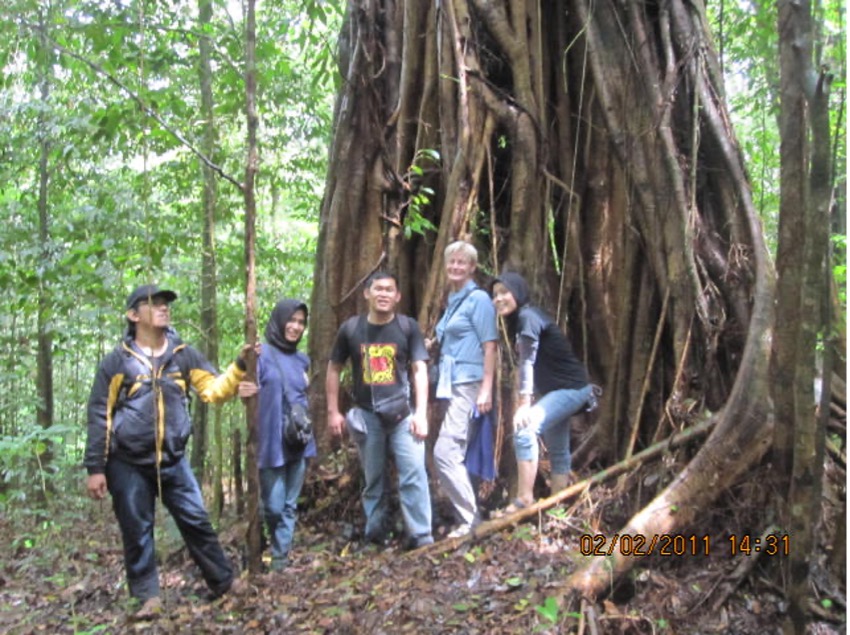
The way up was through a forest of giant trees with lush foliage, taking us over a river, rocks and through thick, slippery mud. Bright orchids flowers graced some trees, and a musty smell pervaded the air. Leaning against one of the trees when we stopped for a short while, I felt very small, so tiny. I closed my eyes and gave thanks for the beauty and gifts that trees give us. My back against the thick trunk felt supported and strong, so I harnessed the strength to continue. The going was steep, and I found myself slipping and slowing down. Argys had offered to take my camera so that I would have many pictures without having to stop so often. He literally leapt around snapping photos from every angle — yet another thoughtful gesture.
Photo Courtesy: Sybil Pretious
Finally, we could hear voices amid the sound of rushing water. As we broke through the trees I was awestruck. A bright slither of water plunged in a narrow silver-white ribbon down the steep, rocky side of the caldera splashing into a shallow rocky pool below. The pool was filled with people, laughing and joyful as they cooled themselves in this beauty.
Cool! Photo Courtesy: Sybil Pretious
I was soon soaked and feeling thoroughly refreshed. Several local people came to ask Argys and the girls what I was doing there. I told them that I was living my life to the full and loving Indonesia and its peoples.
In the morning I downloaded all my photos onto my outside hard drive (no tiny memory sticks then) and promptly left it in the hotel computer. It was only at the airport that I remembered. I was devastated – my life was on that piece of equipment. True to form, Argys said he would go back for it and send it to Arianne’s. I was overcome with his selflessness.
I arrived back in Jakarta mid-morning and Arianne, knowing I would need it, after my exertions at the waterfall with the young people on Sumatra, had thoughtfully arranged a day of luxury and beauty. I could not have afforded that if I had been staying in paid accommodation. I languished with a scrub, massage and green tea soak, feeling thoroughly refreshed and pampered.
Arianne had arranged for a guide in Bali, and I was shepherded by Dewa. I explained my interest was not the beaches, but the culture and he obliged.
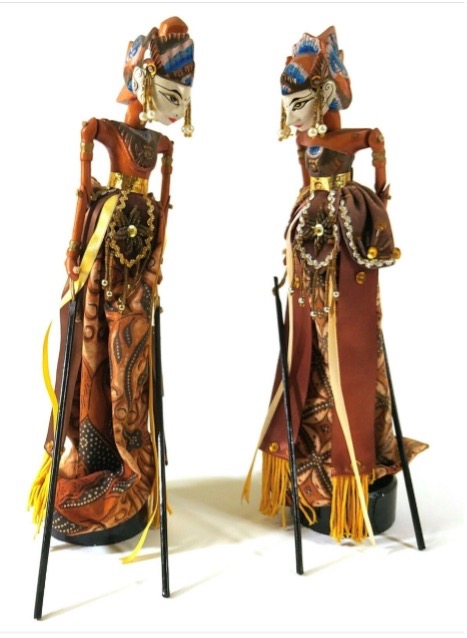
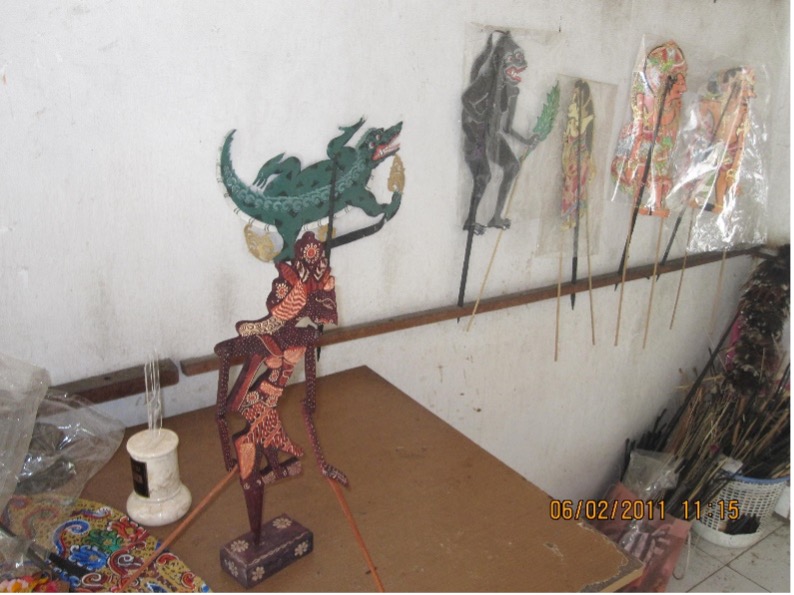
I was entranced with the story telling by dance and puppetry. I have used puppets so often in my teaching especially with young, shy children and children learning a new language. They might not want to respond to me, but they will willingly interact with the puppets. In that way, I gleaned many insights into feelings and thinking. I was determined to buy a Wayang Golek rod puppet. They were so beautifully made with spectacular clothing. At that time I had not known the story behind these puppets. They are always sold in pairs. I fell in love with a pair but felt I couldn’t afford two. The vendor did not want to sell one.
Dewar interpreted for me.
Wayang Golek puppets
Shadow puppets
Photo Courtesy: Sybil Pretious
“They belong together. They cannot be parted.”
But I stupidly insisted and eventually I bought a female one. A strange thing happened when I was at the airport. I accidently left the puppet and a painting on the seat as I rushed to catch the plane. Sitting on the plane I felt sad and knew that the puppet had not wanted to leave her partner and I had not listened to local lore and story telling. I hope she found him again and I hope that I will listen to those that know the ancient stories of their culture, more closely in future.
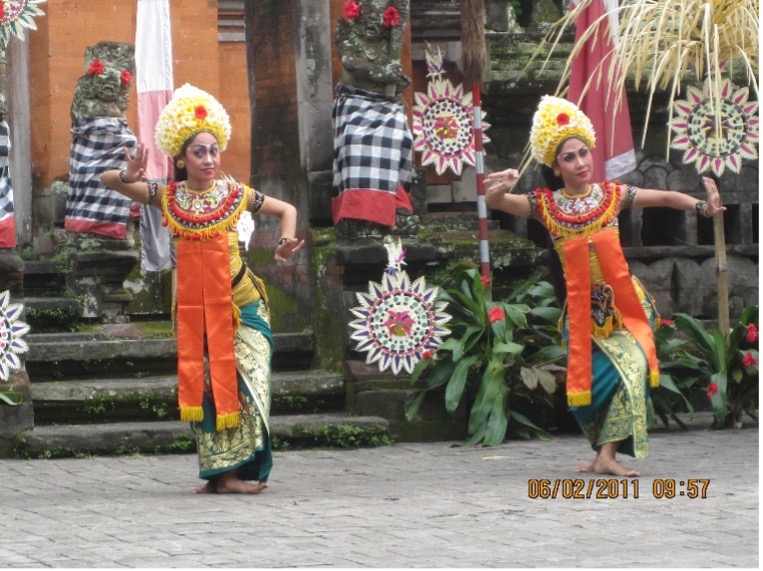
My encounter with Barong and The Kris Dance was enthralling. The dancers in vibrant costumes seemed in a trance as the story unfolded and the dance became more hypnotic. I was drawn in as the Kris, a formidable sword was wielded. Precision and drama could not have been more pronounced.
Barong dance
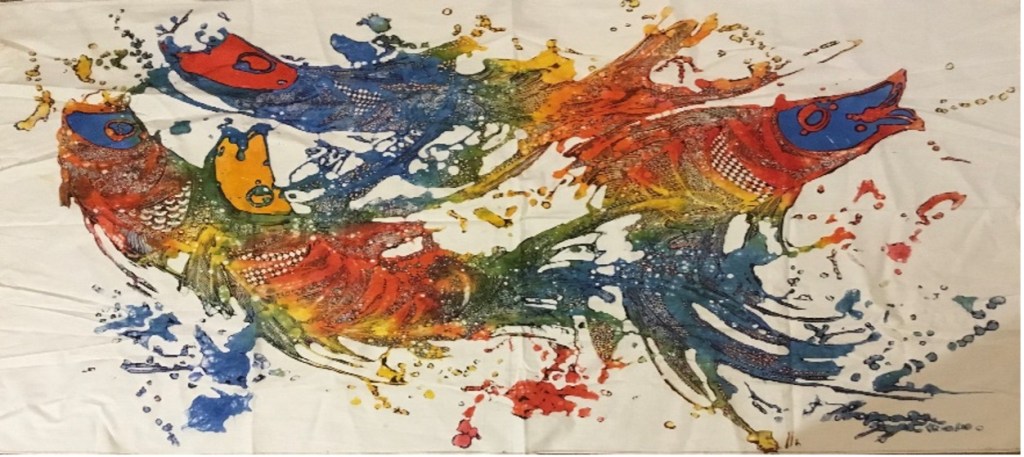
Batik
Photo Courtesy: Sybil Pretious
Dewar couldn’t resist taking me to view some paintings and batik. I fell in love with a batik featuring fish swimming. It was extraordinarily intricate.
After a long day and feeling completely saturated with culture Dewar asked if I would like to meet his family the next day. I told him it would be my privilege and his face burst into a big grin.
His mother and three of his brother’s wives met me. How privileged I felt. They had been at their sewing machines making traditional ceremonial garments, an industry that his mother had started in 1976. There were four houses round a central place for worship and a small temple. Dewar’s parents lived with him and his wife as he is the eldest. There were 20 people living in this family complex. That family is so important was so evident here.
Dewar’s mother and wife
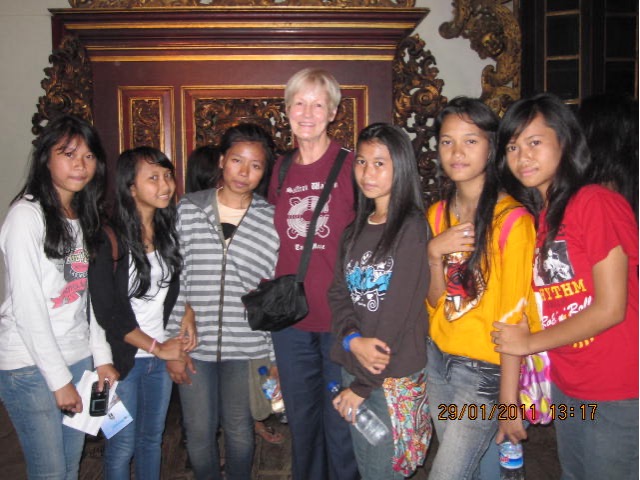
Students interviewing me
Photo Courtesy: Sybil Pretious
Having flown back to Jakarta Arianne arranged for me to stay with a writer friend of hers who also lives in a traditional home. Tita, like Arianne was a very busy lady. At forty two, she had written four books and ran an advertising agency and had a one year old daughter. The surroundings were tranquil, only the faint sound of insects floating on a zephyr breeze.
That afternoon I went out on my own to explore. The bus stops are lovely – there are at least two people manning each one to help with selling tickets and advice. On the bus the conductor helps passengers off at the correct stop ticking them off his list as they alight!
Just wandering down the streets was special. I got to eat street food – Nasi Goreng which was quite delicious – rice, meat, and curry flavours. A group of young students asked if they could interview me, and I obliged. Tita knew of my interest in puppets and arranged for me to buy a pair of the Wayang Golek. This time I knew I had to buy the pair and very beautiful they were. They didn’t fit in my backpack, so I carried them under my arm all the way on the plane back to Suzhou.
Finally, back with Arianne and getting ready to leave she said she had arranged for me to wait in the Emerald Sky Lounge at the airport. I felt very self-conscious sitting on luxury chairs and able to select from a variety of delicious food and drink all for free.
My solo journey turned out to be a travel experience of trust and delight in Indonesia. I felt blessed to have encountered many Indonesian people and places at a local level. Most importantly I had been able to support ground level community in my travel experiences instead of relying on tourist companies.
Travel is not about the sights you see but the people you meet.
.
Sybil Pretious writes mainly memoir pieces reflecting her varied life in many countries. Lessons in life are woven into her writing encouraging risk-taking and an appreciation of different cultures.
.
PLEASE NOTE: ARTICLES CAN ONLY BE REPRODUCED IN OTHER SITES WITH DUE ACKNOWLEDGEMENT TO BORDERLESS JOURNAL
In conversation with Fakrul Alam, an eminent translator, critic and academic from Bangladesh who has lived through the inception of Bangladesh from East Bengal, translated not just the three greats of Bengal (Tagore, Nazrul, Jibanananda) but also multiple political leaders. Click here to read.
In conversation with Arindam Roy, the Founder and Editor-in-cheif of Different Truths, an online portal for social journalism with forty years of experience in media and major Indian newspapers. Click here to read
Akbar Barakzai’s poem, The Law of Nature, translated by Fazal Baloch. Click here to read.
Kazi Nazrul Islam’s poem, Shammobadi(The Equaliser) translated by Shahriyer Hossain Shetu. Click here to read.
Tagore’sAmar Shonar Horin Chai(I want the Golden Deer) translated by Mitali Chakravarty, edited and interpreted in pastel by Sohana Manzoor. Click here to read.
To mark the birth centenary of Satyajit Ray, Ratnottama Sengupta translates fromNabendu Ghosh’s autobiography experience of Pather Panchali ( Song of the Road) — between covers and on screen. Click here to read.
Wendy Jones Nakanishi, an academic who started her life in a small town called Rolling Prairie in midwestern US, talks of her journey as a globe trotter — through Europe and Asia — and her response to Covid while living in UK. Click here to read.
‘Did life change or did I change from the events of the last year,’ ponders New Zealander Keith Lyons who was in the southern state of Kerala when the first cases of Covid-19 were detected in India last January. Click here to read.
An excerpt from Enter Stage Right by Feisal Alkazi with a visual of young Alkazi dancing in one of the earliest discos of New Delhi. Click here to read.
As we stand on the threshold of a new normal that will eternally rewrite the history of social interactions, of movements across the globe, of new world orders that will have to be more inclusive and more transparent to world view, we will, perhaps, feel the need to redefine business laws so that even countries with lesser wealth are able to access vaccinations and peace. We are now looking up to leaderships which seem to be in crises themselves. Sitting securely on a tiny island that is well governed, an island where affluence and well-being set it adrift from the turmoils of countries around it, I wonder thirty years from now, what will mankind be like… Will we be forever marred by the current events of the world? Globalisation has ensured that none of us can be secure on any secret island. There can be no land of lotus eaters hidden from the rest of mankind and accessed by only a few anymore. Even if one region is affected by the virus in any corner of the world, can the rest of the world be pandemic free? Perhaps, a question that those who peddle in vaccines and human well-being can address.
These issues have not only been highlighted by the news media but have also found echoes in some of our content this time. Keith Lyons’s essay talks of his last stay in India, when a tourist carried the the pandemic unwittingly into Kerala in February 2020 and subsequent repercussions. More stories and poems that dwell on the spread of the virus this year cry out for compassion. One hopes young poet Ruchi Acharya’s verses are born true.
One day the roses of hope will grow
Meeting the horizon,
Roses that, even plucked, will not die
But will bloom and bloom
Every single day that passes by.
We have young writers on the virulence of the virus and mature pens like that of globe-trotting academic Wendy Jones Nakanishi, who maps the pandemic from UK. Perhaps, we will find a new direction eventually.
There have been calls for uniting above divides as a single unit called mankind earlier too, from greats like Tagore and Nazrul. This time we carry translations of both — Nazrul’s translated poem calls for uniting against artificial divides drawn by man-made constructs and Tagore’s translation talks of redefining through self-reflection. An essay on Tagore by academic Parineet Jaggi talks of the impact of the teachings of Guru Nanak, the founder of Sikhism, on Tagore.
We have essays on writers and icons from around the globe. A photo-essay on the bald eagle, heralding the American Independence Day on the 4th of July, gives a humorous anecdote on how the eagle was chosen above the turkey. We have more variety by Candice Louisa Daquin, an immigrant in US, who shows how important human movement across man-made borders is to the development of a country. Michael Burch has given us beautiful poetry reflecting the history of America and American dreams, one of them with the voice of the legendary Mohammed Ali. These verses add substance to the concerns raised by Daquin. Jared Carter brings to us the colours of life with his poetry.
We have humour in verses from Rhys Hughes and even from a young poet, Sutputra Radheye. Limericks from Michael Burch and Penny Wilkes photo-poetry on ‘Changing Seasons’ puts us in a more cheerful mood. More poetry from multiple writers across the world, including Nepal, Macedonia and Korea, have found their way into our journal.
Hughes has also given us a comprehensive and interesting essay on a twentieth century poet called Ivor Cutler, who said much as he sang his poetry and was encouraged by Paul McCartney of the Beatles. The brilliant poetry of Akbar Barakzai continues translated on our pages by Fazal Baloch and one must give many thanks to the translator for his indefatigable energy and for bringing us wonderful fare from Balochistan. An excerpt translated by eminent journalist Ratnottama Sengupta from Nabendu Ghosh’s autobiography ends with Satyajit Ray’s starting his famed career with Apu’s triology (based on Pather Panchali, a novel by Bibhuti Bhushan Bandopadhyay). These three films have become iconic in cinema history.
We were fortunate to have Professor Fakrul Alam agree to an interview. An eminent translator, critic and academic who has lived through the inception of Bangladesh from East Bengal, Alam has translated not just the three greats of Bengal (Tagore, Nazrul, Jibanananda) but also multiple political leaders like Mujibur Rahman. In this exclusive, he has taken us through the annals of history, reflecting on less-known perspectives of the Partition. Also, in conversation with Borderless, is Arindam Roy, a journalist with forty years’ experience and the founder of Different Truths who started his writing career, much in the tradition of Cyrano de Bergerac on a humorous note.
This time our backpacking granny, Sybil Pretious, gives us a glimpse of her wisdom, wit and compassion while visiting Philippines and talks of an ancient death ritual, volcanoes and strange mud baths. Devraj Singh Kalsi explores young romance in his tongue-in-cheek fashion. We also have more semi-humorous musings from young writers across borders. While Sunil Sharma has explored facets of the impact of terrorism, the other stories are told in a lighter vein.
Our book excerpt from Feisal Alkazi’s Enter Stage Right has a picture of the young artiste in a discotheque dancing in abandon — check it out. It made me smile. Rakhi Dalal has reviewed Jnanpith Award winner Shrilal Shukla’s Fragments of Happiness translated by Niyati Bafna. The book review by Meenakshi Malhotra of Neelima Dalmia Adhar’sThe Secret Diary of Kasturba brings out an interesting facet on Gandhi and women in the Independence movement. It makes one notice the contrasts in the perspectives of Gandhi and Tagore, who created women like he saw around him in fiction. Kasturba’s life also contrasts with the independence found in the life of the avant-garde artist, Amrita Sher-Gil, who lived around the same time. In an essay, Bhaskar Parichha has shown how Sher-Gil lived out her dreams, blending the best of the East and West, while Malhotra writes, that though “Gandhi called women to join the national movement … he was not seeking to emancipate, but more to call forth their capacity for self-abnegation and self-sacrifice.”
Parichha has also introduced us to the need for changes in the banking sector in India while reviewing Transformational Leadership in Banking edited by Anil K. Khandelwal. Perhaps these will be part of the changes that will ultimately lead to a revision of old systems and the start of new ones. Changes, though not always welcomed or convenient, hopefully will lead to progress that can mould our future into a happier one. Restless stirrings transformed mankind from cave dwellers to an intelligent race that can assimilate nature and technology to survive and dream of a future, living among stars.
As Borderless reaches out to unite mankind transcending artificial constructs, its attempts can bear fruit only with support from each and every one of you. I would like to thank all our editorial team for their wonderful support, contributors for being the backbone of our content, and all our readers for continuing to patronise us.
Do take a look at our current issue for the writers who remain unmentioned here but create phenomenal bridges towards a borderless world.
“The beauty of the world is the diversity of its peoples.”
During the Chinese New Year holiday in 2010 (I turned 68 that year), I resolved to visit the Philippines. It was a last-minute thought, so preparations were minimal. Barry, in Australia, like me, made an instant decision and would land in Manila the day after I did, both of us just toting our backpacks as luggage.
The Philippines is made up of 7,640 islands and is situated in South-East Asia. The local language is Tagalog. Its position in the Pacific ‘Ring of Fire’ makes it susceptible to earthquakes and typhoons and volcanic activity. I was interested in visiting the Taal Volcano which erupted in January 2020 and had had some of the country’s deadliest eruptions. Mount Pinatubo which last erupted in 1991 (the biggest eruption of the century). The islands are known for their stunning beaches and azure waters, but I was focused on the mountains.
Nine days was hardly time to take in this astounding country, so we limited our wanderings to Luzon. Even that was ridiculous, and it was one of the lessons I learnt on that trip – less travel and more getting to know local people should be my mantra.
There was another fascinating fact – the presence of the fire mummies, 2000-year-old bodies preserved in pinewood coffins, in the Kabayan area. This proved to be an inward as well as an outward journey of significance in my life.
Travelling in the Philippines offers a colourful variety of vehicles and we had great fun contorting ourselves into side cars, covered motorcycles, three wheeled vehicles, buses and the very distinctive Jeepney.
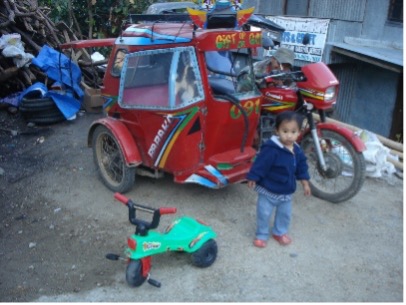
I arrived the day before Barry, so I travelled into Manila to see the old Spanish walled city — The Intramuros. I caught a ‘tricycle’ which is a motorbike with covered sidecar. It was rather hair-raising, squealing round corners and going over bumps. Chatting to the driver when we stopped, I discovered that he had had to work for many years to obtain enough money for a license, but he was very proud of his vehicle. Subsequently friends of mine had sponsored one of these drivers which I thought was a wonderful thing to do. I then caught a vehicle that I have never seen in any other country – a colourful jeepney. A big jeep-like engine in front and then the covered back has seats on either side and held about 20 people. This is the main form of transport and there are regular ‘jeepney jams’.
We took normal buses to get to Capas and Pinatubo Spa Town and up to the Volcano next day. At the Spa town I couldn’t resist a volcanic mud bath hoping that it might help my awful itchy skin. It wasn’t quite what I expected – I had to change into baggy shorts and top provided and then two young girls slimed the mud over me till I looked like someone from the coon carnival. I then sat around uncomfortably, in full view of everyone, till it dried and then showered it off. My skin was still awful but luckily my face was a whole lot better. Maybe I needed a few more treatments.
A rather an extreme way to treat itchy skin
The trip in a jeep through rivers, volcanic ash, sand, mud took us to the Pinatabo volcano. The eerie, moonlike mud scenery showed devastated river courses and vegetation. A ferried boat trip across the turquoise blue lake to the volcanic island with some small ‘craters’ still bubbling beside the lake. It felt unreal, not of this world.
Pintabo Volcano
Our guest house was a double story wooden structure that felt unstable, but the people were charming. Off again in the morning on a bus driven by a manic driver through a very scary mountain ‘highway’ veering dangerously close to the crumbling edges on a single lane with very sparse passing places where we had to back up for other vehicles.
Crumbling roads
Waiting for the bus
Crumbling roads
We stopped for food and a toilet break. I approached the toilet building and looked inside. It was enough to make me gag. There was a long ditch down the middle of the room. Somehow you got your feet on either side and did what you had to do. Not only that but it was used by men and women at the same time! No time for niceties on this journey.
An elder sister in charge of her three siblings.
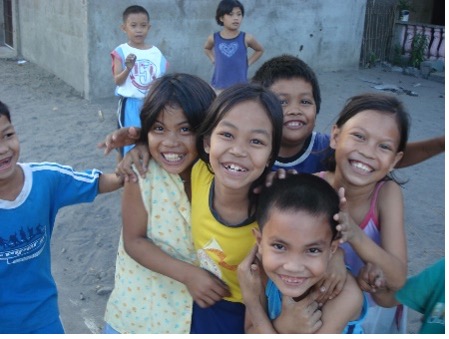
Always along the way were smiling children happy in their circumstances. I was thinking the many privileged children I had taught, who hardly ever seemed happy with what they had. They would benefit from living in areas like these just for a few months.
Kabayan was the one place I really wanted to be during this adventure. The Timbac caves hold the ‘fire mummies’. We set out with three French people, to climb up to the caves, a climb we were told would take four hours. It took me six hours. At the start Barry and I did not have much water and asked the guide if we could get some. He indicated a village on the way, but there was no bottled water, only cold drinks, which we discovered were not hydrating.
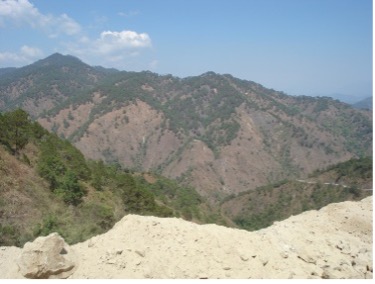
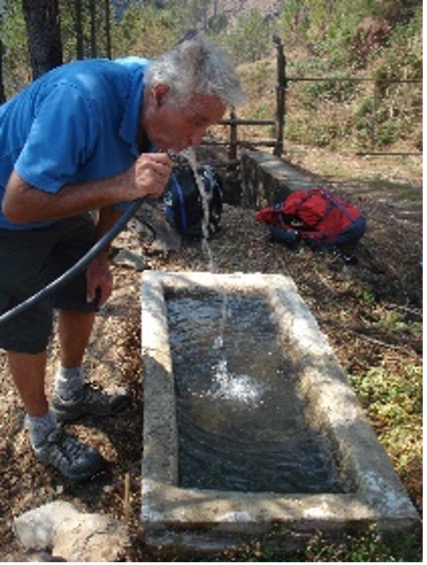
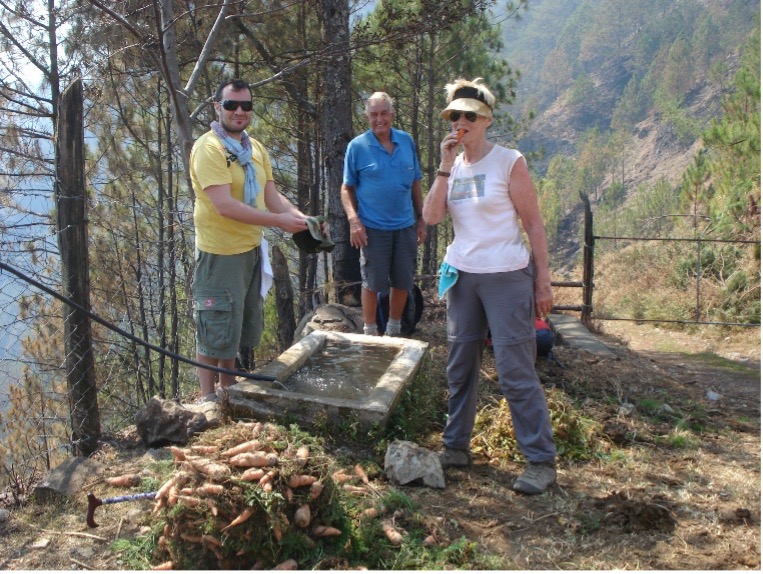
I climbed wearily up grassy hills, pulling on my trusty stick, feeling that this was the last thing I wanted to do. I just unable summon any energy. We arrived at a ‘farmhouse’ where there was an open tank and running water from a spring and also a pile of carrots.
Barry drinking from the hose pipe
Me eating a carrot
I tipped my head back and drank and drank, then filled my bottles and ate a couple of carrots. I can’t describe what that water did but it was as though every cell in my body had woken up after a long painful sleep. I was anew woman and resumed the walk. Barry said he would see us on the way down — I thought he was joking.
I set off, energy high and kept a steady pace enjoying the scenery as I got higher. I was walking on my own because the French couple had gone on ahead and the other one had cramp and was trailing behind. Eventually the guide caught up to me and said that he had been all the way back for Barry, who said again that he was not coming and then the guide went on ahead to check the French couple were on the right track before returning to me. He had done a lot of extra mileage for his clients. Another lesson in service from these lovely people.
I caught up with the others before making the final steep climb to the caves. I was so glad that I had made it.
The guide took me on my own to the caves.
There, in small rocky caves, scattered around, some agape, some closed were the tiniest coffins. Surely these were for children? But no they were adults who had been placed in that sitting position. I had read about this mummification process which is no longer used in the Philippines.
Wikipedia has it that the unique mummification process was said to actually begin before death, with an individual participating in the initial steps. As death approached, the individual would drink a beverage with a very high concentration of salt. Drinking saltwater is known to dehydrate the body, so this initial step was used to start the drying process prior to death. After the individual passed away, the rest of the mummification process would take place. It is estimated that this process took anywhere from several weeks, to several months to complete.
The body was thoroughly washed, and then placed above a heat source in a seated position. The body was not exposed to actual fire or flames but remained suspended above the smouldering kindling. Rather than burning the body, the heat and smoke would slowly and completely dehydrate the entire body. The internal drying process was ritually furthered along by blowing tobacco smoke into the deceased’s mouth. This was thought to help remove the fluids from internal organs.
Many of the caves had been looted but the one I visited had a rusty iron grid in front of the opening with an ancient padlock attached. The guide produced a key and opened the gate for me.
Cave opening with flimsy grid
The closed coffins
A fire mummy
I sat down to look inside. A feeling of sadness pervaded my senses. I went in to take a closer look and to say a prayer of thanksgiving for allowing me this privilege. When I came out, I turned and kneeling with hands together I said, “I’m so sorry. Forgive me.”
The guide simply said, “Thank you. You understand. Not many people do.”
The Visitors’ Book
We made our way back to the Guide’s Hut to wait for the Jeepney that was to collect us. I wrote in the visitors’ book while I waited:
“A wonderful, tiring walk with amazing scenery, friendly people and a very energetic, caring guide. Maybe tell the climbers to take more water. AND THEN The Mummies – what a privilege to see them. Please guard them with more security.”
The jeepney never came and as the light was fading my guide said we should make our way down. He knew a shorter way.
The road and path were not easy because of loose stones and I fell twice slightly pulling a muscle on my left side and knocking my head and bum. Good thing both are soft. We took three hours going down and the last hour was particularly difficult because it was dark and we had to use a torch. I stumbled several times wanting to give up and just sit on the road till morning. My guide steadied me and encouraged me.
Finally, back at the lodgings, I stumbled in ready to collapse onto my top bunk. Barry, looking fresh as a daisy made some stupid remark about my appearance that had the others laughing at me. I said nothing and went to our room but wondered why I had this effect on men when I had achieved something that they hadn’t.
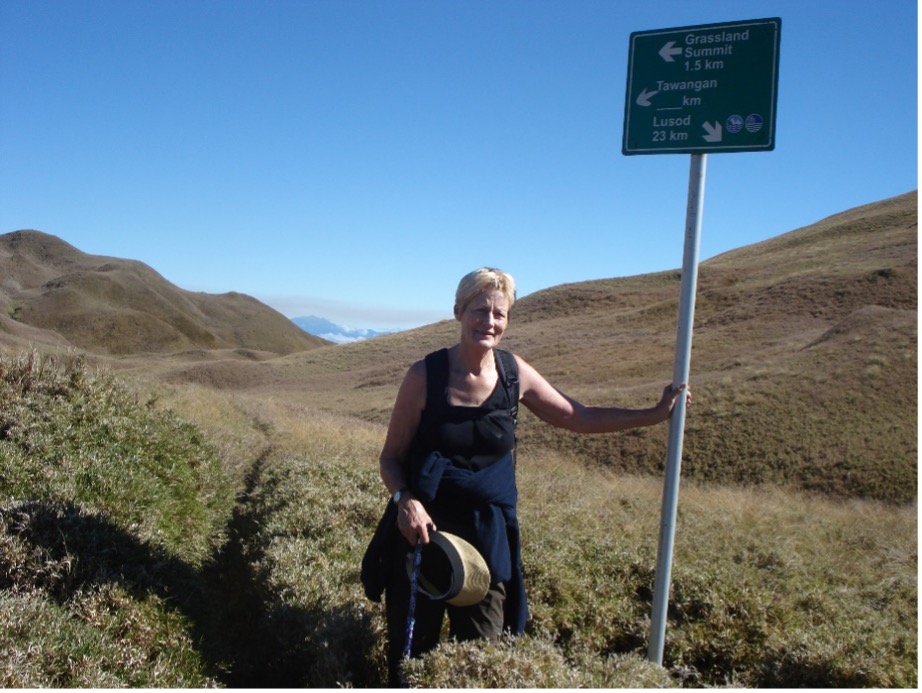
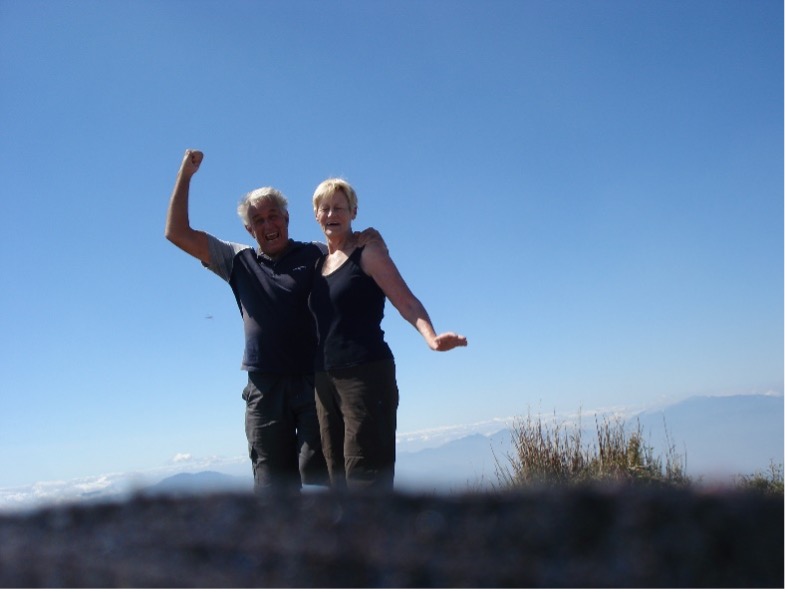
The following day we left on another tortuous mountain road journey to Abangeg to climb Mt Pulag. We met up with six young Belgian doctors who were doing their internship in a hospital in Banguio. They walked right from the base of the mountain whereas us oldies took a jeepney to the Rangers Station and stayed the night there before attempting the summit climb of three hours. I did not find it easy — too much climbing in too short a time. We had to leave our guide half-way because she had tummy trouble. Barry seemed confident that he knew the way. The top of the mountain is not marked but we presumed we had made it as there were no higher peaks around. It was just covered in plain old grass!
“Grassland summit 1.5 Km”
Grassland summit, Mt Pulag
Enough!
We were lucky to get a lift back with the doctors in a 4×4 driven by Father Eugene who had been in the Philippines for 42 yrs. Lucky did I say? He drove like a Formula 1 driver over precarious mountain roads and sometimes I just closed my eyes and prayed — seemed appropriate seeing he was a priest!
After a very long day traveling in many vehicles, we got back to our hostel, The Green Mango Inn, and on the following day took a trip to Taal Volcanic Lake and the smallest active volcano in the world. Yes, no rest days in between! We travelled from the town by tricycle. A boat that looked like a gondola with bamboo stays on either side took us across the water to travel to the Taal Volcanic Lake.
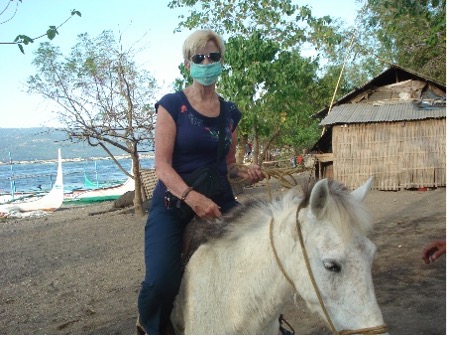
We were to ride on mules for the final part of the journey. I am not a rider having come off rather badly a couple of times but their minder assured us they were docile. Looking like bandits we had to wear masks because the fine black volcanic dust was not good to breathe in.
To my shame I never thought about the mules right then. They did not have masks on and would have been breathing in that fine dust every time they valiantly took tourists to see the lake. Another lesson in being less self-centered.
The masked bandit
On the boat
Taal Lake and beautiful caldera
The lake was calm, but I was not calm. There seemed to be a ‘presence’ and I was not comfortable especially as there was still the ride back on the poor mules. Maybe I was just over-tired. I slept fitfully that night and went over all that I had experienced while in the Philippines. It was a jumble of thoughts and I realized for the first time during my backpacking adventures, I had done too much sightseeing and found out too little about the important parts of travel — the people and their lives.
I arrived back in Suzhou feeling very tired and older than my years but perhaps a little wiser about what travel should really be about.
“More is less.”
.
Sybil Pretious writes mainly memoir pieces reflecting her varied life in many countries. Lessons in life are woven into her writing encouraging risk-taking and an appreciation of different cultures.
.
PLEASE NOTE: ARTICLES CAN ONLY BE REPRODUCED IN OTHER SITES WITH DUE ACKNOWLEDGEMENT TO BORDERLESS JOURNAL
As a tribute to the 209th anniversary of Edward Lear, Rhys Hughes writes of his famous poem, ‘Owl and the Pussycat’, and writes a funny ending for it rooted in the modern day. Click here to read.
A compelling flash fiction by Suyasha Singh hovering around food and a mother’s love. Click here to read.
The Literary Fictionist
In A Lunch Hour Crisis, Sunil Sharma raises humanitarian concerns that though raised in a pandemic-free world, have become more relevant and concerning given our current predicament. Click here to read.
Anasuya Bhar explores the various lives given to a publication through the different edited versions, translations and films, using Tagore as a case study and the work done to provide these online. Click here to read.
Prithvijeet Sinha uses Gaman (Departure), a Hindi movie around the pain of migrant workers, as a case study to highlight his contention that lyrics and songs convey much in Indian films. Click here to read.
Bhaskar’s Corner
In Manoj Das – The Master Storyteller, Bhaskar Parichha pays a tribute to one of the greatest storytellers from the state of Odisha, India, Manoj Das( 1934-2021). Click here to read.
Bhaskar Parichha reviews Raising a Humanist by Manisha Pathak-Shelat‘s and Kiran Vinod Bhatia. Click here to read.
Interviews
Communication scholars and authors, Manisha Pathak-Shelat and Kiran Vinod Bhatia, discuss how to bring up children in these troubled times, based on their book, Raising a Humanist, which has just been released. Click here to read.
Sonya J Nair of Samyukta Poetry talks about the Samyukta Research Foundation and its affiliates and its festival, Anantha. Click here to read.



















 Borderless