Painting by Claud Monet (1840-1926). From Public Domain
Acknowledging our past achievements sends a message of hope and responsibility, encouraging us to make even greater efforts in the future. Given our twentieth-century accomplishments, if people continue to suffer from famine, plague and war, we cannot blame it on nature or on God.
–Homo Deus (2015),Yuval Noah Harari
Another year drumrolls its way to a war-torn end. Yes, we have found a way to deal with Covid by the looks of it, but famine, hunger… have these drawn to a close? In another world, in 2019, Abhijit Banerjee had won a Nobel Prize for “a new approach to obtaining reliable answers about the best ways to fight global poverty”. Even before that in 2015, Yuval Noah Harari had discussed a world beyond conflicts where Homo Sapien would evolve to become Homo Deus, that is man would evolve to deus or god. As Harari contends at the start of Homo Deus, some of the world at least hoped to move towards immortality and eternal happiness. But, given the current events, is that even a remote possibility for the common man?
Harari points out in the sentence quoted above, acknowledging our past achievements gives hope… a hope born of the long journey humankind has made from caves to skyscrapers. If wars destroy those skyscrapers, what happens then? Our December issue highlights not only the world as we knew it but also the world as we know it.
In our essay section, Farouk Gulsara contextualises and discusses William Dalrymple’s latest book, The Golden Road with a focus on past glories while Professor Fakrul Alam dwells on a road in Dhaka , a road rife with history of the past and of toppling the hegemony and pointless atrocities against citizens. Yet, common people continue to weep for the citizens who have lost their homes, happiness and lives in Gaza and Ukraine, innocent victims of political machinations leading to war.
Just as politics divides and destroys, arts build bridges across the world. Ratnottama Sengupta has written of how artists over time have tried their hands at different mediums to bring to us vignettes of common people’s lives, like legendary artist M F Husain went on to make films, with his first black and white film screened in Berlin Film Festival in 1967 winning the coveted Golden Bear, he captured vignettes of Rajasthan and the local people through images and music. And there are many more instances like his…
It's always the common people who pay first. They don’t write the speeches or sign the orders. But when the dust rises, they’re the ones buried under...
Echoing the theme of the state of the common people is a powerful poem by Manish Ghatak translated from Bengali by Indrayudh Sinha, a poem that echoes how some flirt with danger on a daily basis for ‘Fire is their life’. Professor Alam has brought to us a Bengali poem by Jibanananda Das that reflects the issues we are all facing in today’s world, a poem that remains relevant even in the next century, Andhar Dekhecche, Tobu Ache (I have seen the dark and yet there is another). Fazal Baloch has translated contemporary poet Manzur Bismil’s poem from Balochi on the suffering caused by decisions made by those in power. Ihlwha Choi on the other hand has shared his own lines in English from his Korean poem about his journey back from Santiniketan, in which he claims to pack “all my lingering regrets carefully into my backpack”. And yet from the founder of Santiniketan, we have a translated poem that is not only relevant but also disturbing in its description of the current reality: “…Conflicts are born of self-interest./ Wars are fought to satiate greed…”. Tagore’s Shotabdir Surjo (The Century’s Sun, 1901) recounts the horrors of history…The poem brings to mind Edvard Munch’s disturbing painting of “The Scream” (1893). Does what was true more than hundred years ago, still hold?
Reflecting on eternal human foibles, Naramsetti Umamaheswararao creates a contemporary fable in fiction while Snigdha Agrawal reflects on attitudes towards aging. Paul Mirabile weaves an interesting story around guilt and crime. Sengupta takes us back to her theme of artistes moving away from the genre, when she interviews award winning actress, Divya Dutta, for not her acting but her literary endeavours — two memoirs — Me and Ma and Stars in the Sky. The other interviewee Lara Gelya from Ukraine, also discusses her memoir, Camels from Kyzylkum, a book that traces her journey from the desert of Kyzylkum to USA through various countries. In our book excerpts, we have one that resonates with immigrant lores as writer VS Naipual’s sister, Savi Naipaul Akal, discusses how their family emigrated to Trinidad in The Naipauls of Nepaul Street. The other excerpt from Thomas Bell’s Human Nature: A Walking History of the Himalayan Landscape seeks “to understand the relationship between communities and their environment.” He moves through the landscapes of Nepal to connect readers to people in Himalayan villages.
The reviews in this issue travel through cultures and time with Somdatta Mandal’s discussion of Kusum Khemani’s Lavanyadevi, translated from Hindi by Banibrata Mahanta. Aditi Yadav travels to Japan with Nanako Hanada’s The Bookshop Woman, translated from Japanese by Cat Anderson. Jagari Mukherjee writes on the poems of Kiriti Sengupta in Onenessand Bhaskar Parichha reviews a book steeped in history and the life of a brave and daring woman, a memoir by Noor Jahan Bose, Daughter of The Agunmukha: A Bangla Life, translated from Bengali by Rebecca Whittington.
We have more content than mentioned here. Please do pause by our content’s page to savour our December Issue. We are eternally grateful to you, dear readers, for making our journey worthwhile.
Huge thanks to all our contributors for making this issue come alive with their vibrant work. Huge thanks to the team at Borderless for their unflinching support and to Sohana Manzoor for sharing her iconic paintings that give our journal a distinctive flavour.
With the hope of healing with love and compassion, let us dream of a world in peace.
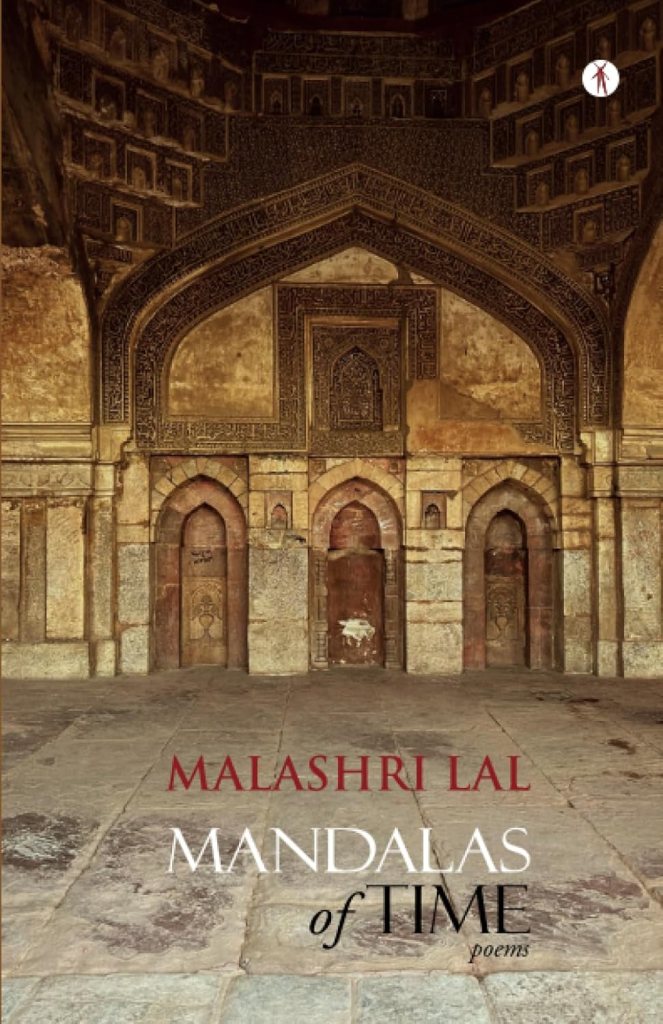
In Conversation with Malashri Lal, about her debut poetry collection, Mandalas of Time, Hawakal Publishers
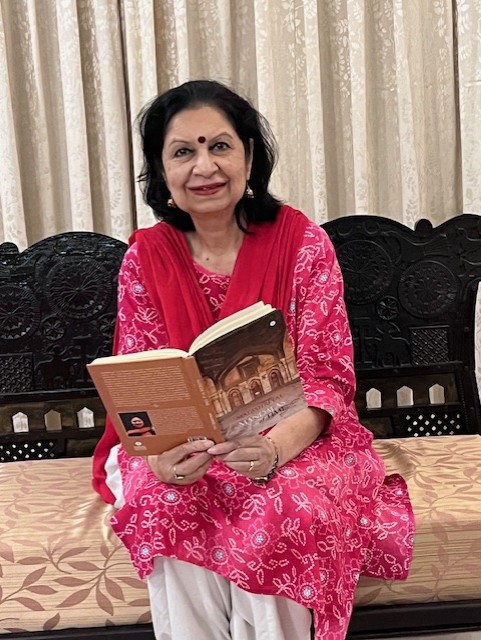
Professor Malashree Lal
Time present and time past Are both perhaps present in time future, And time future contained in time past. If all time is eternally present All time is unredeemable.
‘Mandalas’ means circle in Sanskrit, the root, or at last the influencer, of most of the Indian languages in the subcontinent. Sanskrit belongs to the Indo-Germanic family, which homes Latin and Greek among other languages. Malashri Lal, a former professor in Delhi University, has called her poetry collection Mandalas of Time.
Her poetry reiterates the cyclical nature of the title, loaning from the past to blend the ideas with the present and stretching to assimilate the varied colours of cultures around the world.
Embracing an array of subjects from her heritage to her family — with beautiful touching poems for her grandchild — to migrants and subtle ones on climate change too, the words journey through a plethora of ideas. Nature plays an important role in concretising and conveying her thoughts. In one of the poems there is a fleeting reference to wars — entwined with the Pilkhan (fig) tree:
The Pilkhan tree thinks of its many years Of shedding leaves, bearing inedible fruit, of losing limbs But smiles at his troubles being far less Than of unfortunate humans Who kill each other in word and deed But gather around the tree each Christmas With fulsome gifts and vacant smiles To bring in another New Year.
--Another New Year
Amaltas (Indian Laburnum) or Bougainvillea bind her love for nature to real world issues:
Only the Amaltas roots, meshed underground Thrust their tendrils into the earth’s sinews below. Sucking moisture from the granular sand, desperately. The golden flowers pendent in the sun, mock the traveller Plump, succulent, beacon-like, they tease with The promise of water Where there is none.
--Amaltas in Summer
And…
The Bougainvillea is a migrant tree, blossom and thorn That took root in our land And spread its deception Of beauty.
--Bougainvillea
Her most impactful poems are women centric.
Words crushed into silence Lips sealed against utterance Eyes hooded guardedly Body cringing into wrinkled tightness Is this what elders called ‘Maidenly virtue?’
--Crushed
There is one about a homeless woman giving birth at Ratlam station during the pandemic chaos, based on a real-life incident:
Leave the slum or pay the rent Who cares if she is pregnant, Get out — go anywhere. … Ratlam station; steady hands lead her to the platform. Screened by women surrounding her A kind lady doctor takes control. Pooja sees a puckered face squinting into the first light. "This is home," she mutters wanly, "Among strangers who cut the cord and feed my newborn,”
-- Ladies Special
In another, she writes of Shakuntala — a real-world migrant who gave birth during the covid exodus. She birthed a child and within the hour was on her way to her home again — walking. It reminds one of Pearl S Buck’s description of the peasant woman in Good Earth (1931) who pauses to give birth and then continues to labour in the field.
Most interesting is her use of mythology — especially Radha and Sita — two iconic characters out of Indian lore. In one poem, she finds a parallel to “Sita’s exile” in Italy, at Belisama’s shrine. In another, she finds the divine beloved Radha, who was older to Krishna and married to another, pining after the divinity when he leaves to pursue his life as an adult. And yet, she questions modern stances through poems on more historical women who self-immolated themselves when their husbands lost in battle!
Malashri Lal has turned her faculties post-retirement to literary pursuits. One of her co- authored books around the life of the poet Michael Madhusudan Dutt, received the Kalinga award for fiction. She currently serves on the English advisory board of Sahitya Akademi. In this conversation, Lal discusses her poetry, her journey and unique perceptions of two iconic mythological women who figure in her poetry.
When did you start writing poetry?
Possibly my earliest poetry was written when I was about twelve, struggling with the confusing emotions of an adolescent. I would send off my writing to The Illustrated Weekly which used to have pages for young people, and occasionally I got published. After that, I didn’t write poetry till I was almost in my middle age when the personal crisis of losing my parents together in a road accident brought me to the outpourings and healing that poetry allows.
What gets your muse going?
Emotional turmoil, either my own or what I observe within the paradigms of social change. With my interest in women’s issues, my attention is arrested immediately when I hear or read about injustice, violence, exploitation or negligence of women or girl children. It doesn’t have to be a dramatic or extreme event but even the simple occurrences of decision making by a husband without consulting his wife has me concerned about the dignity and agency of a woman. Some poems like “Escape”, hint at such inequality that society takes for granted. On the other hand, my poems about migrant women giving birth on the long march to a hypothetical village “home” during the pandemic, are vivid transferences from newspaper stories. “Ladies Special” is about Pooja Devi giving birth at Ratlam station; “The Woman Migrant Worker” is based on a report about Shakuntala who stopped by the roadside to give birth to a baby and a few hours later, joined the walking crowd again.
Why did you name your poetry book Mandalas of Time?
To me ‘Mandalas’ denote centres of energy. Each node, though distinct in itself, coheres with the others that are contiguous, thus resulting in a corporeal body of interrelatedness. My poems are short bursts of such energy, concentrated on a subject. They are indicative of a situation but not prescriptive in offering solutions. Hence the spiritual energy of ‘Mandalas’, a term used in many traditions, seemed best suited to my offering of poems written during periods of heightened consciousness and introspection. The poems are also multilayered, hence in constant flux, to be interpreted through the reader’s response. Many of them end in questions, as I do not have answers. The reader is implicitly invited to peruse the subject some more . It’s not about closure but openness. See for instance: “Crushed”, or “Shyamoli”.
Today, I rebel and tug at a Divided loyalty — The feudal heritage of my childhood Fights off the reformist Bengali lineage, My troubled feminism struggling Between Poshak and Purdah White Thaan and patriotism Can one push these ghosts aside?
--Shyamoli *Poshak: Rajasthani dress *Thaan: White saree worn by the Bengali widow
You have written briefly of your mixed heritage, also reflected in your poem dedicated to Tagore, in whose verses it seems you find resolution. Can you tell us of this internal clash of cultures? What exactly evolved out of it?
My bloodline is purely Bengali but my parents nor I ever lived in Bengal. My father was in the IAS in the Rajasthan cadre and my mother, raised in Dehradun, did a lot of social work. In the 1950s and 1960s, Rajasthan was economically and socially confined to a feudal heritage and a strictly hierarchical structure. Rama Mehta’s novel Inside the Haveli (1979), describes this social construction with great sensitivity. Elite homes had separate areas for men and women, and, within that, a layout of rooms and courtyards that were defined for specific use by specified individuals according to their seniority or significance. Such hierarchies existed in Bengal too — the ‘antarmahal[1]’ references bear this out — but the multiple layers in Rajasthan seemed more restrictive.
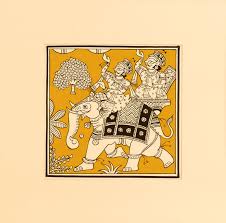
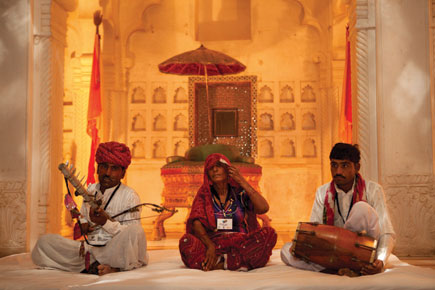
In my “mixed heritage” of being born of Bengali parents but raised in Rajasthan, I started noting the contrasts as well as the similarities. I recall that when my father went on tours by jeep into the interior villages along rutted roads, I would simply clamber on. At one time I lived in a tent, with my parents, during the entire camel fair at Pushkar. I would listen to the Bhopa singers of the Phad painting tradition late into the evening. So my understanding and experience of Rajasthan is deep into its roots.
Phad paintingBhopa singersFrom Public Domain
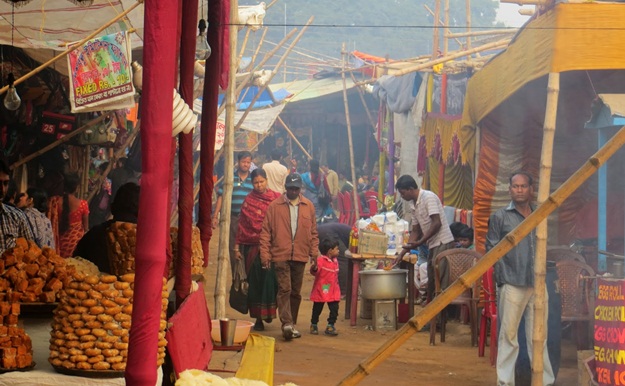
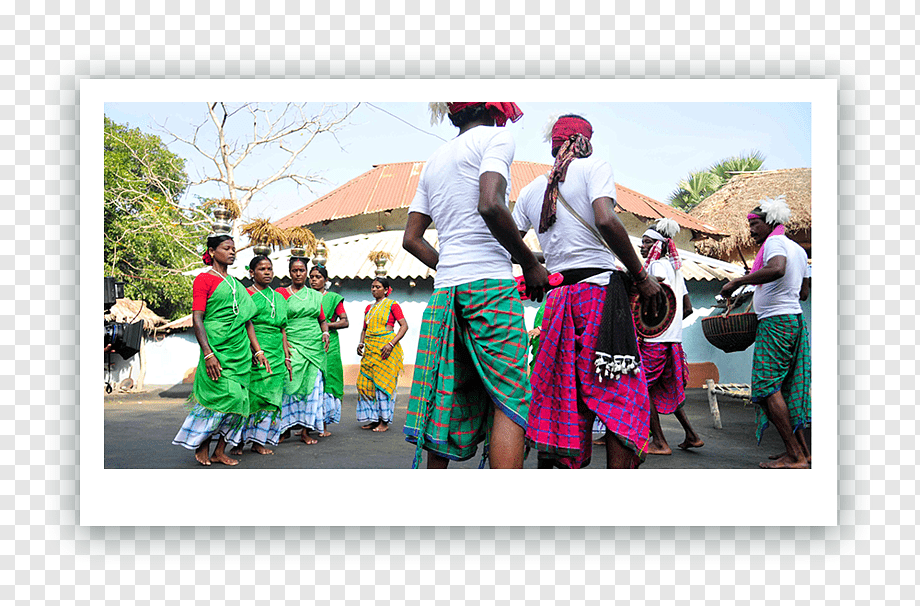
Bengal– that is only Calcutta and Santiniketan–I know through my visits to grandparents, aunts and uncles. My cousins and I continue to be very close. I saw a fairly elite side of Calcutta—the Clubs, the Race Course, the restaurants on Park Street, the shopping at New Market, and sarees displays at Rashbehari Avenue. Santiniketan though was different. I was drawn to the stories of the Santhal communities, visited their villages, attended the Poush Mela[2] regularly and knew several people in the university. After Delhi, the wide-open spaces, the ranga maati (red soil), the Mayurakhi River, and the tribal stories were fascinating. I am fluent in Bengali and because of my relatives in Calcutta as well as Santiniketan, I never felt an outsider. My father’s side of the family has been at Viswa Bharati since the time of Rabindranath Tagore. So, I felt comfortable in that environment. And through an NGO called Women’s Interlink Foundation, established by Mrs Aloka Mitra, I had easy access to Santhal villages such as Bonerpukur Danga.
Poush Mela, started by the Tagore Family in 1894Santhali Performance at Poush Mela
However, in summary, though I lived with both the strains of Bengal and Rajasthan, the daily interaction in Jaipur where I received all my education till PhD, was more deeply my world. The fragmented identity that some poems convey is a genuine expression of figuring out a cultural belonging. Poems such as “To Rabindranath Tagore” helped me to understand that one can have multiple exposures and affiliations and be enriched by it.
Do you feel — as I felt in your poetry — that there is a difference in the cultural heritage of Bengal and Rajasthan that leads you to be more perceptive of the treatment of women in the latter state? Please elaborate.
Indeed, you are right. Bengal has a reformist history, and my family are Brahmo Samaj followers. Education for women, choice in marriage partner, ability to take up a career were thought to be possible. My paternal grandmother, Jyotirmoyi Mukerji, was one of the early graduates from Calcutta University; she worked as an Inspectress of Schools, often travelling by bullock carts, and she married a school teacher who was a little younger than her. They together chose to live in Rangoon in undivided India, heading a school there. These were radical steps for women in the late 19th century. My father grew up in Rangoon and came to Rajasthan as a refugee during the Second World War. My grandmother, who lived with us, was a tremendous influence denoting women’s empowerment. But what we saw around us in Jaipur was the feudal system and purdah for women in Rajasthan.
Fortunately, Maharani Gayatri Devi had set up a school in 1943 in Jaipur to bring modern thinking in the women, and I was fortunate to study there till I went to university. Let’s recall that Maharani Gayatri Devi was from Coochbehar (Bengal) and had studied at Santiniketan. She brought Bengal’s progressive ideas to the privileged classes of Rajasthan. My classmates were mostly princesses. I visited their homes and families and delved deeply into their history of feudalism. Without being judgmental, I must say that Rajasthan’s heritage is very complex and one must understand the reasons behind many practices and not condemn them.
You have brought in very popular mythological characters in your poems — Sita and Radha — both seen from a perspective that is unusual. Can you explain the similarity between Sita’s exile and Belisama’s shrine (in Italy)? Also why did you choose to deal with Radha in a post-Krishna world?
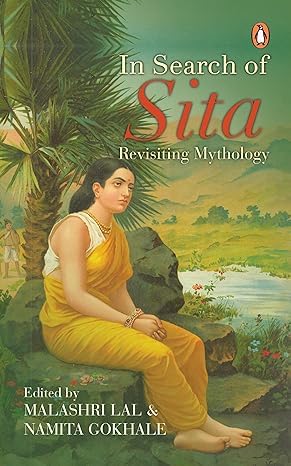
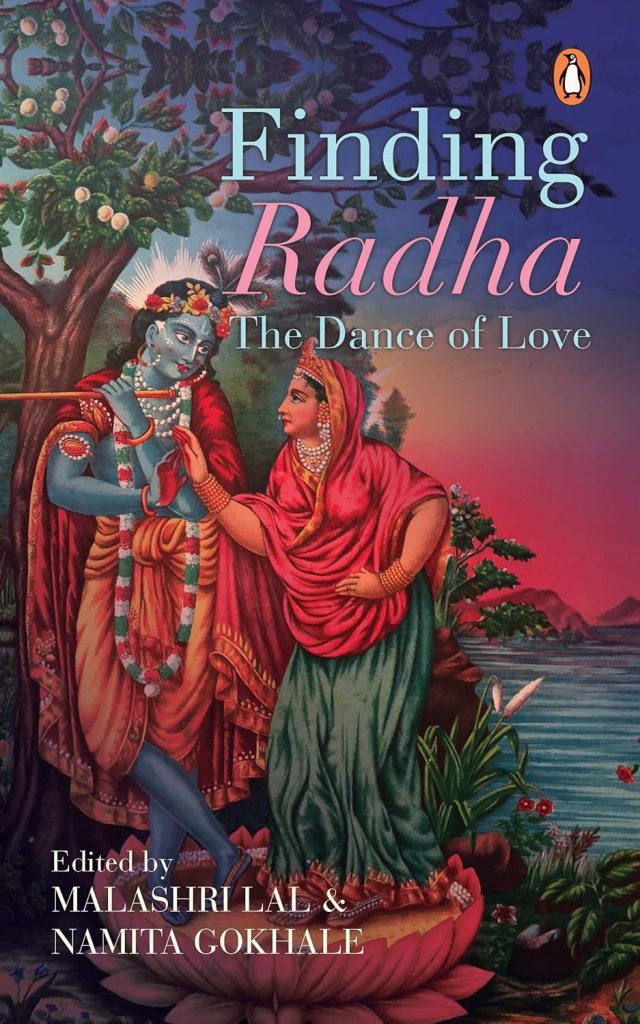
Namita Gokhale and I have completed what is popularly known as the “Goddess Trilogy”. After In Search of Sita and Finding Radha, the latest book, Treasures of Lakshmi: The Goddess Who Gives, was launched in February 2024 at the Jaipur Literature Festival, and the Delhi launch was on 8th October 2024 to invoke the festive season.
Version 1.0.0
In answering your question let me say that myth is storytelling, an indirect way of contending with issues that are beyond ordinary logic or understanding. Sita and Belisama coming together is an illustration of what I mean. The backstory is that Namita Gokhale and I had a joint residency at Villa Serbelloni in Bellagio (Italy) and we were revising the final manuscript of our book In Search of Sita. The thrust of that book is to recall the strength of Sita in decision making, in being supportive of other women, in emerging as an independent minded person. Our research had unearthed a lot of new material including oral history and folklore. In Bellagio, we started enquiring about local mythical stories and chanced upon Belisama,[3] a Celtic goddess known for her radiant fire and light, and in the village we chanced upon an old grotto like structure. Unlike in India, where we have a living mythology of commonly told and retold tales, in Italy the ancient legends were not remembered. The poem “Bellagio, Italy” took shape in my imagination bringing Sita and Belisama, two extraordinary women, together.
As to my poems on Radha, I cannot think of a “post-Krishna” world since Vrindavan and Mathura keep alive the practices that are ancient and continuous. Radha is the symbol of a seeker and Krishna is the elusive but ever watchful divine. They are body and soul, inseparable. The stories about “Radha’s Flute” or “Radha’s Dilemma” in poems by those names have an oral quality about them. The craft of writing is important, and for me, the theme decides the form.
Interesting, as both the poems you mention made me think of Radha after Krishna left her for Rukmini, for his role in an adult world. You have a poem on Padmini. Again, your stance is unusual. Can you explain what exactly you mean — can self-immolation be justified in any way?
This is a poem embedded in the larger query about comparative cultural studies. Rani Padmini’s story was written by Jayasi[4] in 1540, and it described a ‘heroic’ decision by Padmini that she and her handmaidens should commit Jauhar (mass self-immolation) rather than be taken prisoners and face humiliation and violent abuse by the men captors. You will note that my poem ends on a question mark: “I ask you if you can rewrite /values the past held strong?” Self-immolation has to be seen in the context of social practices at the time of Padmini (13-14th queen in Mewar, Rajasthan). The jauhar performed by Rani Padmini of Chittor is narrated even now through ballads and tales extolling the act if one goes into oral culture. But there is counter thinking too, as was evident in the controversy over Sanjay Leela Bhansali’s film Padmavat (2018) which stirred discussions on historicity, customary practice and oral traditions. Sati and Jauhar are now punishable offences under Indian law, but in recording oral history can one change the storyline? It’s not just self-immolation that comes under such a category of questioning the past — polygamy, polyandry, child marriage, prohibitions on widows and many other practices are to be critiqued in modern discourse, but one cannot rewrite what has already been inscribed in an old literary text.
This is a question that draws from what I felt your poems led to, especially, the one on Padmini. Do you think by changing text in books, history can be changed?
“History” is a matter of perspective combined with the factual record of events and episodes. Who writes the “history” and in what circumstances is necessary to ask. The narration or interpretation of history can be changed, and sometimes ought to be. To take an obvious case why is the “Sepoy Mutiny” of 1857 now referred to as the “First War of Independence”? In current discussions on Rana Pratap[5] in Rajasthan’s history, there are documents in local languages that reinterpret the Haldighati battle of 1576 not as the Rana’s defeat but his retreat into the forests and setting up his new kingdom in Chavand where he died in 1597. The colonial writers of history—at least in Rajasthan– were dependent on local informers and had little understanding of the vast oral repertoire of the state. Even Col. James Tod’s Annals and Antiquities of Rajasthan (1829) about the history, culture, and geography of some areas in Rajasthan, is often reproducing what he has heard from the bards and balladeers which are colourful and hyperbolic renderings as was the custom then. In Bengal, the impact of Tod is seen in Abanindranath Tagore’s[6]Rajkahini (1946), which is storytelling rather than verified facts. I feel history cannot be objective, it is author dependent.
Nature, especially certain trees and plants seem to evoke poetry in you. It was interesting to see you pick a fig tree for commenting on conflicts. Why a Pilkhan tree?
The Pilkhan is an enormous, bearded old fig tree that lives in our garden and is a witness to our periodic poetic gatherings. Mandalas of Time is dedicated to “The Poets under the Pilkhan Tree” because my book emerged from the camaraderie and the encouragement of this group. I see the tree as an observer and thinker about social change—it notes intergenerational conflict in “Another New Year”, it offers consolation against the terrors of the pandemic in the poem “Krishna’s Flute”. It’s my green oasis in an urban, concrete-dominated Delhi. In the evening the birds chirp so loudly that we cannot hear ourselves speak. Squirrels have built nests into the Pilkhan’s wide girth. It’s not a glamorous tree but ordinary and ample—just as life is. By now, my poet friends recognise the joy of sharing their work sitting in the shadow of this ancient giant. There are no hierarchies of age or reputation here. We are the chirping birds—equal and loquacious!
You have successfully dabbled in both poetry and fiction, what genre do you prefer and why?
Mandalas of Time is my first book of poems and it comprises of material written unselfconsciously over decades. During the pandemic years, I decided to put the manuscript together, urged by friends. Meanwhile my poems started appearing in several journals.
As to fiction, I’ve published a few short stories and I tend to write ghostly tales set in the mountains of Shimla. Its possibly the old and the new that collides there that holds my attention. I’ve been urged to write a few more and publish a book—but that may take a while.
Should we be expecting something new from your pen?
Mandalas of Time has met with an amazing response in terms of reviews, interviews, speaking assignments, and online presentations. The translation in Hindi by 13 well known poets is going into print very soon. Permission has been sought for a Punjabi translation. I’m overwhelmed by this wide empathy and it is making me consider putting together another book of poems.
If you thought time travel was only a captivating concept in science fiction or theoretical physics, try experiencing it in Khiva! Located in the heart of the Kyzylkum Desert in Uzbekistan is the ancient city of Khiva, declared a UNESCO World Heritage Site in 1990. With its immaculately preserved city walls and stunning monuments, Khiva transports visitors back in time to the days of the Silk Route and the prosperous empires of Central Asia. When five of us planned a trip to Uzbekistan, we knew we would encounter history in every nook and corner of this utterly enchanting country. However, to see it all preserved with so much care and thought was another experience all together. The credit for this goes to Uzbekistan’s first President, Islam Karimov, who took up the task of restoring monuments and returning to the Uzbeki people, their rich and layered history and multiculturalism after years of Soviet rule.
Our guide, Murat led us through this treasure trove of history and architectural marvels with a quiet, thoroughly knowledgeable air. We set out after a hearty breakfast at Zarafshon Boutique Hotel, conveniently located within the walls of the Itchan Kala (Inner City), to walk for the next four hours through its mesmerizing, labyrinthine streets that reverberate with the sounds of a folklore ensemble’s traditional music, tourists’ chatter, guides’ narrations, and shopkeepers’ entreaties to buy their wares.
A city that goes back over two millennia, Khiva was one of the oases along the Silk Route. The Silk Route, an ancient network of trade routes connecting the East and West, spanning thousands of miles across Asia, resulted in the exchange of goods, ideas, faiths and convictions that ultimately transformed and defined history in a way that has an impact to this day. Ever since, Khiva thrived as a centre of trade, commerce, and cultural exchange. It became an important city in the region, famous for its wealth, power, and architectural splendor.
The skyline of Khiva is defined by its walls, reminiscent of Jaisalmer in Rajasthan. Itchan Kala, enclosed inside magnificent mud-brick walls, packed with straw, dates back to the 10th century. Within these walls lie architectural marvels, including the Kalta Minor Minaret, Toshhovli Palace, the Muhammad Amin Khan Madrassah, and the Juma Mosque.
Kalta Minor minaret
The incomplete Kalta Minor, with its arresting turquoise minaret towers over us at 45 meters. Soon, the colour turquoise became so omnipresent in our photo gallery that we needed to use Google Lens to distinguish one from another! Muhammad Amin Bahadur Khan, the Khan of the Khiva Khanate intended the minaret to be the largest and tallest in the Muslim world at 80 meters, exceeding the height of the 73-meter Qutb Minar in Delhi. According to the historian, Mulla Olim Maxdum Hoji, the Khan could not have his way due to his untimely death in a battle near Sarakhs in 1855. Twelve of the sixteen verses inscribed on the minaret are those of Muhammad Riza Ogahi, a poet from Khiva, who was witness to its construction. The writings were pulled down during the Soviet regime, only to be restored after Uzbekistan’s independence. There is a belief that criminals were dragged up to the top of the minaret and thrown down, although there is no historical evidence to support this. It remains a tale told by the guides to tourists who go, “Oh nooooo!”
Tosholvi Palace
Moving on to the Toshhovli Palace, which means ‘Stone House’, we were captivated by the decoration comprising ceramic tiles, carved stone and wood. Built by Alla Khuli Bahadur Khan between 1832 and 1841, it has more than 150 rooms with nine courtyards. The high ceilings of the rooms are designed to keep the place cool in the summer months of this desert region.
Known for his impatience, Allah Khuli insisted that the royal architect, Usto Nur Mohammed Tajikhan, build the palace in three years. When the architect nervously said that it would not be possible, he was impaled and Kalender Khivaki took over along with the famous tile decorator, Abdullah Jin. It took eight years and the labour of nearly a thousand slaves to complete this structure that we, today as tourists, gape at in complete awe. The unfading colours of the glazed tiles owe their lasting quality to a technique called “ishkor,” mastered by the craftsmen of another era.
Embedded within the intricate tile work of the Toshhovli Palace is the hilarious story of how Allah Khuli picked a woman from his harem for each night. The region is known for its large pomegranates, with juicy seeds as red as rubies and Khuli is supposed to have flung one fruit into the quarters of the woman he desired. The fall of a pomegranate through the window, then, alerted the woman! Murat and the five of us had a hearty laugh and one of us even wondered aloud, ‘what if he didn’t have good aim,’ or ‘what if the window was closed!’ Murat shrugged his shoulders, a tad embarrassed.
Juma Mosque
The austere and monastic, yet splendid wood carved pillars and roof of the Juma Mosque stands as a contrast to the rich colour palettes of the other monuments. According to the Arabian geographer Al-Mukaddasy, the Juma Mosque was constructed in the tenth century. This one-storey brick building with a flat roof was rebuilt over the ruins in 1788 with 25 of its 212 pillars, made of black elm wood, recovered from the original structure. The roof has small openings to let in the light.
Beyond its architectural majesty, Khiva resounds as a living testament to the cultural heritage and traditions of Uzbekistan. In its stark brown desert landscape, the colours of Khiva’s monuments, ceramics and hats stand out in a sharp and endearing contrast. To this day, the bazaars of Khiva are filled with artisans who continue to practice traditional crafts such as carpet weaving, pottery, and silk embroidery, preserving age-old techniques and skills passed down through generations. The great artistic legacy lives on in the silent monuments staring down at you as well as in the bustling bazaars with warm, hospitable people who are especially partial to Indian tourists given their adoration of Bollywood films. In fact, fans of Hindi films, of which there are aplenty in Uzbekistan, rattle off names of stars ranging from Raj Kapoor to Shah Rukh Khan! Parts of the Hindi action film, Yeh Mohabbat Hai (This is love, 2002), directed by Umesh Mehra were shot in Khiva!
The rumble in the belly with all the walking we did brought us back rudely into the moment and we headed straight to a restaurant recommended by Murat. Food is such an integral part of travel and we did full justice to the spread that consisted of fresh salads, bread called non, straight out of the wood-fired ovens, and the ubiquitous lamb. As Khiva continues to enthrall travellers, it remains a guiding light of history, culture, and heritage in the heart of the Uzbekistan desert. It remains a mute witness to a borderless world of yore.
Gita Viswanath is the author of two novels – Twice it Happened (2019) and A Journey GoneWrong (2022), , a non-fiction book, The‘Nation’ in War: A Study of Military Literature and Hindi War Cinema (2014), and a children’s book, Chidiya (Bird, 2018). Her short films: “Family Across the Atlantic” and “Safezonerz” are available on YouTube.
PLEASE NOTE: ARTICLES CAN ONLY BE REPRODUCED IN OTHER SITES WITH DUE ACKNOWLEDGEMENT TO BORDERLESS JOURNAL
Mahashweta Devi (1916-2016) was a renowned and much awarded writer-activist-translator who was reputed for her close observation and documentation of tribal life and its marginalisation and willed forgetting by dominant power systems. Among the many awards received by her were the Padma Vibhushan, the Ramon Magsaysay, the Jnanpith and the Sahitya Akademi Award. The stated aim of the present volume — in keeping with the overall objectives of the Writer in Context Series — is to present a more rounded, multidimensional image of Mahasweta Devi. This has been admirably accomplished by Prof Radha Chakravarty who is an eminent translator and academic herself.
In the ‘Introduction’, she unpacks the partial truths that underlie the stereotypical image of Mahasweta Devi as an activist. Highlighting the fact that Mahashweta’s representations of different forms of marginality bring together “the aesthetic and the political in ways that demand a more nuanced reading”, she reinforces the need to read Devi’s oeuvre as literature, and not only as “forms of social documentation or ‘witnessing’”. She interrogates the stereotype of the activist-writer and opens up the possibility of re-reading Mahasweta Devi’s life and work in “newer, more unsettling ways”. Further, Chakravarty highlights how her (Devi’s) creative writings in particular emerge as “ambivalent texts, simultaneously imbued with radical potential and a continued reliance on traditional forms of signification”.
Mahasweta Devi’s writings often demonstrate a tenuous divide between fiction and non-fiction. As a matter of fact, she emphasises on “the historical basis for her creative writings”, which is evident in many of her novels like Mother of 1084 (Hazaar Churashir Maa, 1974), and stories like ‘Draupadi’ and many others, which are based on the Naxalite movement. Simultaneously however, her literary works display a measure of social realism which, Chakravarty contends, is “offset by a visionary quality that enables the imagining of transformative possibilities.” The contents of this volume testify to the varied, diverse and sometimes “contradictory dimensions of her multifaceted genius”.
The book under consideration aims to set the record straight for readers outside Bengal whose views are based on the “tiny fraction of her Mahashweta Devi’s work available in English translation”. She was an extraordinarily prolific and versatile writer who wrote in multiple genres, including fiction, biography, drama, children’s literature, memoirs, travel writing, and literary criticism. She also occasionally translated her own work into English.
Chakravarty’s introduction and compilations in this volume foregrounds the aspect of Mahashweta’s political activism and how her writing itself becomes a form of resistance. Her early induction into Marxism was also partially attributable to her family background. Her family included Ritwik Ghatak (her father’s brother was a famed film maker) on her father’s side and on her mother’s, Sankha Choudhuri and Sachin Choudhuri, one a well-known sculptor and the other, the founder/editor of India’s foremost social science journal, Economic and Political Weekly, respectively.
Her early contact with Tagore and education at Santiniketan sensitised her to values of “inclusiveness, self-reliance, freedom of thought and expression, social responsibility, and environmental issues”. There, she also imbibed some of the spirit of the freedom struggle. Through her marriage to Bijon Bhattacharya, she grew familiar with IPTA[1] and the left ideologies. Later, she was associated with different radical movements in Bengal, Manipur, Jharkhand, Bihar, and Rajasthan, which find expression in many of her writings (Mother of 1084, ‘Draupadi’).
Her political commitment to these movements is evident in her use of language. Local vocabularies become central to the style and subject of Mahasweta’s writings. She wrote in 1983: “Since I remain immersed in indigenous myths, oral legends, local beliefs and religious convictions, I find purely indigenous words very potent and expressive.”
She was critical of writers in the Bangla literary establishment whose experiments with modernist aesthetics led to disengagement with the socio-political context. All the same, her writings evince special “linguistic, textual, and aesthetic strategies that can be compared to the practices of other writers who were experimenting with new approaches”, using non-linear time. Oral traditions fascinated her and she worked closely with Prof G.N.Devy in her later years, to campaign for the recognition of tribal languages.
She also translated and edited volumes on Indian folklore. In her own writings, she includes elements from the oral traditions, as in the snatches of local lore in Jhansir Rani (The Queen of Jhansi) or the lines from an untranslated Santhal song in ‘Draupadi’. As Chakravarty points out, “Heteroglossia, the use of language as an indicator of social hierarchies in multivocal, polyphonic texts, functions as a potent literary feature in her writings.” Alongside, many of her texts incorporate multilingual elements, as if to indicate the heterogeneities in South Asian societies and cultures.
The book is an comprehensive introduction to and reappraisal of Mahasweta Devi’s life and work. It is imaginatively conceptualised and organised into different sections, each highlighting diverse aspects of her work and the criticism thereon. Section 1 of the book called ‘Spectrum: The Writer’s Oeuvre’, offers the reader in English an overview of the full range of her oeuvre through brief samples of her literary writings across diverse genres to highlight her versatility. These include Jhansir Rani (1956), a fictionalised biography of Rani Lakshmibai, Queen of Jhansi, which amalgamates historical sources, folklore, and creative characterisation, to show up the contradictions in different versions of the Rani’s life and Hajar Churashir Ma (The Mother of 1084), her powerful novel about the political awakening of a mother after her son is killed by the police during the Naxalite movement of the 1970s, altered the trajectory of the Bengali novel. The extract from the final pages captures, in a style resembling stream-of-consciousness, the dramatic political power struggles in the outer world and the inner drama of the mother’s psyche.
The short story ‘Giribala’ narrates the plight of a girl married off at 14 to a man who sells their own daughters into the flesh trade to pay for the construction of his dream house. The play Bayen uses modern experimental techniques to present the story of a woman from the caste of Doms (cremation attendants), who becomes the victim of collective superstition and scapegoating and yet, in a final act of heroic self-sacrifice, saves the very community that has ostracised her. In a complete change of tone and style,’Nyadosh the Incredible Cow’, a delightful piece of writing for children, offers a witty anecdotal account of the devastating exploits of a cow in the author’s home. The extract from Tarasankar Bandyopadhyay, Mahasweta Devi’s English monograph on the iconic Bengali writer, reveals her incisiveness as a literary historian and critic and also provides a window to her own literary values.
As Chakravarty clarifies, given the vast body of critical readings on Mahasweta’s writings, a comprehensive compilation is beyond the scope of this book. Instead, the selected essays in Section 2 (‘Kaleidoscope: Critical Reception’) offer the reader (in translation) a sense of the paradigm shifts that mark Devi’s critical reception in Bengal, the rest of India, and in the international domain. Tensions, debates, and contradictions are highlighted, and overview of her critical reception over four decades –1957 to 1997 in Bengal is discussed by Arup Kumar Das. An essay by Dipendu Chakrabarti analyses the debates and controversies around her work. Dilip K. Basu’s account of Hajar Churashir Ma views itas a pathbreaking text that transformed the course of the Bengali novel in the 1970s.
The essays in English by other Indian critics include Sujit Mukherjee’s classic piece on Mahasweta and Spivak, Jaidev’s account of national allegory in Douloti, Arunabh Konwar’s comparative analysis of the creative use of fictionalised biography by Mahasweta and Indira Goswami, Shreya Chakravorty’s study of the politics of translation in the work of Spivak and Samik Bandyopadhyay, Anjum Katyal’s account of Mahasweta as a dramatist, and Benil Biswas’ reading of the transmutations of Mahasweta’s texts via stage and screen adaptations.
International contributions include an important new essay on Pterodactyl by Gayatri Chakravorty Spivak, who interprets the rhetorical pointers in the text to speak of it as an activist mediation for the reader to learn about earning the right to intervene. Shreerekha Subramanian’s essay offers a comparative study of the discourse on motherhood in novels by three women writers across different languages, locations, and literary traditions: Mahasweta Devi, Toni Morrison, and Amrita Pritam.
Section 3 (‘Ablaze With Rage: The Writer as Activist’) includes some of Mahasweta’s activist writings, such as ‘Tribal Language and Literature: The Need for Recognition’, a passionate demand for the inclusion of tribal languages in official discourse; ‘Palamau is a Mirror of India’, where she critiques what she perceives the failures of the state to address the plight of the oppressed people in post-Independence India; and ‘Eucalyptus: Why?’, a scathing critique of the nexus between local powers and global market forces that have led to the replacement of natural forests in Bengal with eucalyptus plantations that have destroyed the local ecology that sustained human and animal life there. Alongside, in ‘The Adivasi Mahasweta’, Ganesh N. Devy reminiscences about his first encounter with Mahasweta Devi and their subsequent collaborations in activist campaigns and projects. ‘Haunted Landscapes: Mahasweta Devi and the Anthropocene’, by Mary Louisa Cappelli, connects Mahasweta’s activist writings and fiction on the subject of the Anthropocene to indicate the need to take a composite view of her writing and activism as twin manifestations of the same vision.
Section 4, ‘Personal Glimpses: A Life in Words’, includes extracts from Mahasweta’s memoir Our Santiniketan (2022), along with interviews (with Naveen Kishore and Radha Chakravarty) and reminiscences by her family members (Nabarun Bhattacharya, Soma Mukhopadhyay, Sari Lahiri, Ina Puri), friends (writers ‘Anand’ and Anita Agnihotri), and associates (Ranjit Kumar Das ‘Lodha’, Dakxin Bajrange), which highlight different facets of Mahasweta’s life and personality, bringing to life the woman behind the public image.
The book offers a comprehensive overview of Mahashweta Devi’s writing and will be of immense use to students, researchers and to general readers. As Chakravarty reiterates , “New trends in Mahasweta studies continue to evolve, including emphasis on her environmental concerns, ethics, planetarity and the Anthropocene, intersectionality, the use of incommensurate realities and registers of writing, comparative readings, and an emerging focus on her life”.
This is an ambitious attempt to give us an idea of the immense range of her work. While a full biography and a full bibliography of Mahasweta’s oeuvre is yet to be published, (encompassing the entire corpus of her work, including letters and other unpublished material) this volume is a vital step in that direction. In her excellent Introduction, Chakravarty charts the long-term impact of Devi’s work which continues to resonate in contemporary forms of activism and theatre. Through the actions of the many groups of people she inspired – the women of Manipur whose public protest imitated her fiction, to the performances of the Budhan theatre, and the rise to fame of the Dalit Bengali writer, Manoranjan Byapari— “Mahasweta’s impact and influence can be felt in many ways. She survives through the people she struggled to support all her life,”
It is an ironical reflection on our times that a prolific and much awarded Indian writer-perhaps deserving of the Nobel prize, should be excised from the university syllabus of a central university. This move has, perhaps paradoxically, elicited even more interest in Mahasweta Devi’s work and has also consolidated her reputation as a mascot, a symbol of resistance to state violence. A timely intervention, this volume proves yet again that a great writer, in responding to local , regional, environmental ethical concerns sensitively, transcends his/her immediate context to acquire global and universal significance.
[1] Indian People’s Theatre Association founded in 1943
.
Dr Meenakshi Malhotra is Associate Professor of English Literature at Hansraj College, University of Delhi, and has been involved in teaching and curriculum development in several universities. She has edited books on Women and Lifewriting, Representing the Self and Claiming the I, in addition to numerous published articles on gender, literature and feminist theory. Recently, she co-edited The Gendered Body: Negotiation, Resistance, Struggle.
.
PLEASE NOTE: ARTICLES CAN ONLY BE REPRODUCED IN OTHER SITES WITH DUE ACKNOWLEDGEMENT TO BORDERLESS JOURNAL
Title: Camel Karma: Twenty Years Among India’s Camel Nomads
Author: Ilse Kohler-Rollefson
Publisher: Speaking Tiger Books
Whenever we read about travel narratives by foreigners in India, especially Westerners, we assume it to be primarily superficial, skin-deep, and without much contact with ground reality. This non-fiction book, that can also be read as a sort of travelogue, busts that myth. It begins with a German veterinarian, Ilse Kohler-Rollefson’s arrival in Rajasthan in 1991 and almost twenty-five years of association with the same. On a field trip to Jordan in 1979, she first became fascinated by the relationship between pastoral peoples and the camels they shared their lives with. After a brief stint of camel field research in Sudan’s eastern desert, her choice to continue her research on camel husbandry led her naturally to India, the country with the third-largest camel population in the world, and she arrived at the National Research Centre on Camel (NRCC) in Bikaner, Rajasthan. Wanting to know more about the practical aspects of camel-keeping or its cultural foundation, she encountered the Rebaris, also called Raikas in Marwar, who are proper breeders of camels and whose whole lifestyle centred around it. She writes, “To me it seemed that the Raikas’ relationship with their animals was equally worthy of conservation as a uniquely human heritage.”
Historically, the Raika of Rajasthan have had a unique and enduring relationship with camels. They offer a compassionate alternative by keeping farm animals as part of nature, allowing them to move and do so in herds. Farm animals can thus extend their potential as humanity’s greatest asset. Their entire existence revolves around looking after the needs of these animals which, in turn, provide them with sustenance, wealth and companionship. Ilse is immediately enthralled by Raika’s intimate relationship with their animals, but she is also confronted with their existential problems.
For her, her research among them gave her not just a glimpse of the history and culture of Rajasthan, but also a way forward in her personal journey. Denying all kinds of creature comforts, the hope of saving both the camel and the Raika way of life took her and her spirited ally, Hanwant Singh Rathore, from vet labs in the city, to Raika settlements in the remotest corners of the Thar Desert, and everywhere in between. The intractable dilemmas— both bureaucratic and cultural—they were often confronted with required creative solutions. As they adapted to their circumstances, they found their orthodox Raika friends adapting with them. Kohler-Rollefson’s is a journey that is often exasperating, sometimes funny, but keeps revealing unexpected layers of rural Rajasthani mores and diverse cultures that make it such a fascinating place.
Spending her own research grants on a shoe-string budget, Kohler-Rollefson set up a base office in Sadri, close to the Kumbhalgarh Wildlife Sanctuary at the foothills of the Aravalli mountains, where she employs several Indians as research assistants (none of whom stay for long), veterinarians who help in administering the teeka, the vaccines to eradicate common camel diseases. With her trusted driver cum translator, her ally, she interacts with several nomadic tribes who rear camels, but whose caste and culture are radically different from one another as chalk and cheese. The narrative also gives details about her interactions with the local people — some of whom had earlier eyed her with suspicion of being an outsider, but later accepted her whole-heartedly.
She describes the sign-language with which she interacts with the womenfolk in the Raika households, her regular visits to the annual animal fair at Puskar, where she even bought a young female camel and named her Mira, leaving her to grow up and breed with the other camels of the Raika. Kohler-Rollefson learned that the Raika did not sell camel milk or eat camel meat. They used other camel by-products, but clearly the economic returns from a camel did not seem optimal. Mostly, they bred female camels to give birth to male camels that could be sold to other caste for work. She was surprised to find that “these camels resembled family members and were treated almost as intimately; nobody was afraid of them.”
Despite repeated setbacks, both from government apathy as well as social taboos, Kohler-Rollefson’s dedication to the cause was so sincere that she was able to found many organisations like the Lokhit Pashu-Palak Sansthan (LPPS), including the Camel Husbandry Improvement Project (CHIP), promote the study and documentation of ethno-veterinarian practices (the melding of traditional and modern approaches to treating camel diseases), highlighting the Raika’s grazing needs at the World Parks Conference (2003), and along with Rathore and a Raika team, even embarking on an arduous 800 km long yatra on camelback throughout Rajasthan to raise awareness and draw attention to the dwindling camel numbers.
She successfully organised a meeting where apart from the traditional Raika constituency, she could include members from a range of castes spanning the whole social spectrum of Rajasthan – Rajputs from Jaisalmer, Bishnois from Barmer, Jats from Bikaner, Gujjars from Nagaur and Sindhi Muslims from deep in the Thar. She even escorted a group of Raika, including a colourful Bhopa (a wandering minstrel who sings and narrates the story of various episodes of the mythical Pabuji’s life through unfolding of cloth scrolls) to Germany and then to Interlaken, Switzerland for an FAO (Food and Agriculture Organisation of the United Nations) conference. She set up the League for Pastoral Peoples and Endogeneous Livestock Development (LPP) in Germany. In other words, Kohler-Rollefson has been successful in drawing attention to the problems of camels rearing at an international level.
The first edition of this book came out in 2014. Since then, they have had a daunting roller-coaster ride, shuttling back and forth between the depths of despair where they thought all was lost to exhilarating heights from which they fleetingly espied camel nirvana: a scenario where camels, people, and the environment live together in harmony and mutually support each other. Interestingly, the second revised edition of Camel Karma was published in 2023 and the other good news is that 2024 has been declared the International Year of Camelids by the United Nations General Assembly, with the stated goal of raising awareness of the contribution of camelids to livelihoods, food security and nutrition. It also aims at encouraging all stakeholders, including national governments, to work towards recognising and valuing the economic, social, and cultural importance of camelids in the lives of communities, especially those that are highly vulnerable to extreme poverty.
In combination with the India government’s recent discovery and appreciation of the country’s pastoralist cultures, this may be just the constellation that successfully revives India’s camel sector. In a scenario where companies and countries are competing for shares in the globalised market, the unique selling point of Rajasthan’s camel milk is the Raika’s heritage of producing milk humanely and with compassion. The biodiverse diet of the state’s camels is composed of ayurvedic plants that add another unique quality.
Thus, it seems appropriate that we all read Camel Karma now and let the world know about the unique Raika heritage and to serve as a baseline to look back on ten or twenty years from now. Despite the rapid technological development in all spheres of life, the author sees a future, and even an urgent need, for both the camel and for the Raika and other nomadic livestock keepers. She is optimistic for several reasons as everything in India is cyclical. The camel is a versatile and multipurpose animal that can fulfil many basic needs of humans. Its role as transport and farm animal is certainly on the retreat, so long as oil is available and affordable. Yet its potential as a dairy animal remains huge. Apart from that, there is a range of other eco-friendly products that can be made from happy living camels and that may just satisfy that budding urge of urbanites – in India and abroad – to re-connect with nature.
Apart from wholeheartedly praising the endeavour of Kohler-Rollefson in spending twenty years of her life among India’s camel nomads, in sacrificing her personal and family life for the welfare of the camels, and in drawing the attention to their problems in various fora in the international context, Camel Karma is a must read for everyone who is interested in learning about the socio-economic lifestyle of several castes and tribes of rural people in Rajasthan. We are looking forward to reading the sequel to this book which the author is planning to write, and which she tentatively calls “Camel Dharma” – a book about finding the right way of living with camels!
.
Somdatta Mandal, critic, and translator, is former Professor of English at Visva-Bharati, Santiniketan, India
.
PLEASE NOTE: ARTICLES CAN ONLY BE REPRODUCED IN OTHER SITES WITH DUE ACKNOWLEDGEMENT TO BORDERLESS JOURNAL
Our Tanda
Our tanda is a bird’s nest
our homes: broken refuges
and our lives are feathers
swirling in the air.
The moon and the sun
hatch time so long as they wish
and flee, leaving folds,
on the lips of time.
Mirrors raise our hopes
showing ourselves
break our knuckles quietly
shatter into fragments and prick hearts.
Goats, cows, buffaloes, sheep and hearts,
all dig out rivers of forests with desires
as kids draw winged horses on the black of night
with fingers
dreaming of sugary peppermints or custard blobs.
Mothers sing lullabies,
oil-lamps
embellishing the night
to sleep.
Fathers guard homes
one eye on the house
the other eye on the field
with their heads out of their windows
they turn into flaming torches.
The ippa flowers grieve
releasing inebriety
listening to the story of our tanda.
Chakmak
I
There were a few chakmak
at the window, ants and insects wandered
among them.
Whenever I visit the window,
I licked the chakmak,
no sweetness touched my heart,
nor did smell hit my nostril,
though they look like candy jellies.
I picked them
and threw them out of the window.
Daada picked them up,
took them again into the house
and placed them at the sill.
I thought of doing the same again.
He taunted our hen indirectly —
I could understand that the hen was me.
I thought the mysterious relationship
of our folk remains untold,
hid in the skulls
about chakmak.
II
One day when daadi was busy
in stitching her tukri
she kept the chakmak beside her
sharpening the needle on a chakmak.
I sat beside her staring at the chakmak —
darkness and light played about,
I was astonished by the sharp light
emitting from them.
The beads were placed in front of daadi
on a piece of cloth for stitching them on her tukri,
they stopped singing and rolling,
were trying to peep into daadi's honey eyes.
The needle writing the joy of tukri on the chakmak,
white stains swelled out from the black chakmak
when accidentally her sweat fell on it.
She saw me and asked me to sit beside her,
started narrating the tales of chakmak,
as I continued staring at them.
III
Birth after the water broke —
you crept out of your mother's womb
with stains of the eternal world
giving her womb to rest from the eternal sea.
This black stone gave you the world,
cut your umbilical cord
but it suffered by your birth,
fevered, it one day burnt our hut.
At the age of two
when the moon was peeping into the rice
squeezed in my hand with milk,
my hand filled with moonlit serpents crawling down
that trembled in my blood tunnels.
Your daada sang a song —
the red stones brought joy to earth,
consoling the hard skin of daada's hand,
illuminating his loneliness
Then you got an invitation to the wonderland,
and there you slept in the bed of the red stone's reflection.
At the age of five,
we were summoned by the monsoon and started migrating.
We were stuck in the forest
you weeping of darkness and hunger,
in the fierce night.
Flesh-coloured stones devoured the darkness,
sprinkled its hunger on your fear
and roasted a few onions for you.
At the age of eight,
you were anxious about seeing the lunar eclipse —
the milk stone dragged the sky in its reflection.
She kept on stitching her tukri.
I was plunged into gazing at the chakmak,
my heart sensed something strange strange is about to happen.
IV
I picked the chakmak into my palm.
The curves in the palms and lines on the chakmak
are trying to mate, and the curiosity in me reached my neck.
A cleft appeared in the chakmak.
I checked others for any more.
After a few minutes,
a butterfly soars from stone,
a man falls from its wing.
I take him in my hand,
he turns into a flute
made of animal bone.
I train my ear to hear him.
A voice from the bone flute starts talking
from the rusted past,
how we vanished from our identities,
how we were sheltered in the tortoise shells
and hung on horns of deers.
The world is trying to heap the chakmak together,
ransack our tribe for stones
and change the tanda into a haat
of banjara tribes.
The chakmak in the haat were ready to burst
with chronicles untold.
You gather the people.
The flute disappears.
I try fabricating the remaining tale.
Courtesy: Chakmak, art by Ramavath Sreenivas Nayak
Canvassing the Lives of Banjaras
By Surya Dhananjay
Banjara is an indigenous ethnic tribe of India. Banjara were historically nomads and later established settlements called tanda. Generally known as Gor-Banjara, they are also called Lambadis in Telangana, or Banjaras collectively across India. However, they are known by different names in various parts of the country, including Banjara, Gor, Gorya, Tanda, Laman, Lambadi, Sugali, Labhan, Labhana, Baladiya, Ladniya, Adavi, Banjari, Gypsy, Kora and Gormati, among others. The other names also indicate synonyms and signify the principal nature — wandering of Banjaras in various parts of the country.
Banjaras generally suffix Nayak with their names, along with other surnames such as Jadhav, Rathod and Pawar. Nayak was a title given by the local kings, Britishers and Mughals, as the Banjaras were warrior transporters, who transported essential commodities, such as salt, food grains (as well as weapons) on ladenis, bullock caravans for their armies. The titles were bestowed in appreciation of their honesty and hard work. Over time, the title has become the traditional name of many of the Banjaras.
The word Banjara is derived from the Sanskrit word Vana Chara — wanderer of the jungle. The word Lambani or Lamani, by which our community is also known, is derived from the Sanskrit word lavana (salt), which was the principal product the community transported across the country. Their moving assemblage on a pack of oxen was named tanda by the European traveller Peter Mundy in 1632 AD.
Historically, they were the original inhabitants of Rajputana, Rajasthan, and professional cattle breeders and transported these essentials to different parts of the region, using crucial transport routes. They are known to have invented Laman Margass1.
They then migrated to North India, East Asia and Europe in the ancient periods and to Central India and South India in the medieval periods along with the armies of Mughals from thirteenth to eighteenth century.
Banjaras lost their livelihood during British rule when the railways and roadways were constructed and they became the victims of predatory capitalism. Banjaras who were uprooted by the British government from their transportation profession were forced to indulge in petty crimes for their livelihood, which invited the wrath of the British and brought them under the ambit of the Criminal Tribes Act of 1871. Later, abandoning their traditional Ladeni profession, they settled wherever their Ladenis had halted in the colonial period and established their tandas, dwellings.
Traditionally, Banjaras depended on the pack of bullocks and bullock carts, called balder bandi in their Gorboli, for carrying out their ladenis and the cattle and oxen only were their properties for the ages, on which they built their livelihood through centuries. Many generations of Banjaras have taken birth on the balder bandi and have used it as shelter too.
Their language is called Gorboli, an Indo-Aryan language in addition to their own culture and traditions.
Gorboli has no script, it is either written in Devanagari script or the script of the local language, such as Hindi, Marathi, Telugu and Kannada, etc.
Most of their populations are concentrated in Maharashtra, Karnataka, Telangana, Andhra Pradesh, Bihar, Madhya Pradesh, Gujarat, Tamil Nadu, Himachal Pradesh, Orissa and West Bengal.
As such the local languages have much impact on their language, the words of which have found their way into Gorboli.
Owing to the fact that it is a dialect, the Banjaras do not have much written literature either. However, they keep their songs, lyrics, and literature alive orally. As there is no written literature available to the outer society about Banjaras, the chances of knowing their history, sentiments, culture and traditions are meagre.
Banjaras show a unique lifestyle, holding steadfast to their ancient dress code, perhaps the most colourful and elaborate of any tribal group in India.
The versatile and colourful Banjaras are found to be interspersed amidst tribal and non-tribal populations and yet tenaciously maintain their cultural and ethnic identity. Their dress and decoration and social practices have remained almost unchanged through the ages despite the habitation shift from northwest India to across India. Banjaras are a strong and virile race with tall stature and fair complexion.
The Banjara women’s dress and jewellery are auspicious and the whole outfit consists of elaborately embroidered and studded phetya or ghagro (skirt), kaacnhli or kaali (blouse), tukri and ghunghto (veil stitched in patches of cloth of various colours along with mirrors of different shapes, cowries and beads).
Women also wear baliya, bangles made of ivory to save their lives from wild animals. They wear many ornaments like topli, hanslo, rapiyar haar, wankdi, kasse, ghughara and phula pawla, which weigh nearly 20 kgs or more.
Banjara men (maati mankya) wear turban on their heads, a few wear babli (earrings) on the top of the right ear, kameez (white shirt) and dhoti, kolda (silver fat ring wrapped to wrist) in turban they hide chutta (cigar), tobacco, beedi leaves, cotton and chakmak (flint stone), etc.
Tattoos on their body parts define philosophies and memories of childhood. The main intention of tattoos is to sell them and buy food after death in heaven or hell. They make sacrifices to the earth and stones because they believe that God is in nature.
Banjaras have their own culture and traditions that reflect their life and beauty. Banjaras celebrate the festival of Goddess Seethla Matha (starting at the time of the rainy season to save us and our cattle from seasonal disease and for good yield) at the end of the rainy season.
They celebrate Teej Festival, a celebration of wheatgrass grown for nine days in bamboo baskets by maiden girls to get married to a good groom in the presence of Goddess Jagdamba,
Baar Nikler/ Baarand khayer is a feast in the forest, exposing the love towards nature that protects them.
Historically they had a big struggle to settle down since they led a nomadic life for centuries. During difficult times, they ate grass and clay. Their regular diet consists of grass poppies, leafy boiled dough-made baatis (chapattis), bran, maize, jowar, deer, pigeon, rabbit, fish, hen, turkey, peacock, tortoise, turtle, porcupine, goat, sheep, radish, raw onions, wild onions, green chilli, roasted potatoes, red clay, black clay, tamarind sprouts, rela pulu (golden shower flower as used to make curry) and monitor lizard.
Few folks sell their children, lands, traditional dress, ornaments and even wombs and many girls and women are known to have faced human trafficking. Many people have slaved as daily labours, women were sexually exploited, many of their tandas were wiped out and they have been killed.
Though The Constitution of India had provided many rights to the tribes, the provisions are unknown to these people who lead their lives as daily labourers, selling firewood and children for food, becoming street vendors, roadside chapati-makers and the like. People who do not know this stare at them. A small percentage of people use the reservation benefits, and most of them are subject to discrimination and exploitation.
As such, not much is spoken about in media channels and newspapers about the atrocities of land evictions and exploitations of Banjaras. This still happens throughout the country.
Only a few scholars have written books and presented papers on their lives. Few non-fiction collections have been published in Telugu, Kannada and Hindi languages. But no creative literature has been produced from the community.
This effort of bringing out the poetic illustration of the life of Banjaras is made by Ramesh Karthik Nayak, a young member of the Banjara community.
He hails from the small, remote village of VV Nagar Tanda of Jakranpally Mandal of Nizamabad District. He has published a poetry book, Balder Bandi (Ox Cart) and a short story collection, Dhaavlo (Mourning Song), canvassing the life of Banjaras in Telugu.
Both books have been received well by the literary world and have since opened the doors to Banjara literature. Within a short span, he has been able to bring before us this wonderful poetic format, which shows his interest in bringing out the historical, cultural, traditional and contemporary issues of Banjaras before the world.
I believe that he is like a popular flower called kesula (moduga puvvu in Telugu), which is seen brightly among all the trees in a jungle.
According to my knowledge, this is the first poetry collection written on the lives of Banjaras in the English language which brings out the rawness of Banjara’s lives and the poems are brilliantly written. It is a rare drop of honey from a kesula flower, in which the lives of Banjaras are carved transparently.
I believe that each poem of this collection is a chakmak, flint stone, which ignites many endless thoughts in the reader. I hope that this poetic creation of Ramesh Karthik Nayak will also definitely be received in a big way by all the literary minds. I hope this introduction about Banjara tribes will help you understand the tribal communities a little.
Finally, without going into the depth of his poems, I would like to quote a few lines from his poem ‘Tanda’:
Our tanda is a bird’s nest
our homes: broken refuges
and our lives are feathers
swirling in the air.
In this poem Ramesh has carved the picture of the status of the lives of Banjara tribes in the present-day context and earlier days. Banjara lives are indeed shattering day by day.
Courtesy: Chakmak, art by Ramavath Sreenivas Nayak
About the Book
Ramesh Karthik Nayak’s poems are marked by rich imagery, poignant stanzas, and moving stories about his people. I enjoyed reading his poems. — Hansda Sowvendra Shekhar
Ramesh Karthik Nayak distills all the pains and fears of his tribe to create a poetry of intense suffering and profound communion with nature. There is something primal, elemental, about his poetry that helps the reader distinguish it from the dominantly urban Indian English poetry. The poet brings a fresh voice, a new tone, and timbre seldom seen in traditional English poetry in the country, without making his poetry less sophisticated. — K Satchidanandan
Through his poems, Ramesh Karthik Nayak presents the celebratory life of the Banjara people; at the same time, he questions his existence. The questions he poses to us are both poignant and plausible. The poet expresses the truth with spontaneity and ferocity that if we are untouchables then, from nature to your vitality to your body, everything in this world has been touched by us. — Sukirtharani
Ramesh Karthik Nayak’s poems represent the dimensionalisation of Indian poetry in English. It’s appalling to think that a mature collection of poetry from a tribal/nomadic tribe poet had to wait for so long after Maucauley’s initiatives. Anchored in his cultural inheritance, Nayak documents with elan his dreams for the future. — Chandramohan S
About the Author
Ramesh Karthik Nayak is a Banjara (nomadic aboriginal community in South Asia) bilingual poet and short story writer from India. He Writes in Telugu and English. He is one of the first writers to depict the lifestyle of the Banjara tribe in literature. His writings have appeared in Poetry at Sangam, Indian Periodical, Live Wire, Outlook India, Nether Quarterly, and Borderless Journal and his story, “The Story of Birth was published in Exchanges: Journal of Literary Translation, University of IOWA. He was thrice shortlisted for the Sahitya Akademi Yuva Puraskar in Telugu.
Chakmak is his first collection of poems in English.
The poet can be reached at rameshkarthik225@gmail.com
Title: Digesting India: A Travel Writer’s Sub-Continental Adventures with the Tummy (A Memoir À La Carte)
Author: Zac O’Yeah
Publisher: Speaking Tiger Books
Digesting India: A Travel Writer’s Sub-Continental Adventures with the Tummy (A Memoir À La Carte)is a culmination of thirty years of experience with the three things Zac O’Yeah loves most about life — eating, drinking and travelling — that put together a delightful travel-cum-food book. A detective novelist, O’Yeah is the creator of the Majestic Trilogy. He freelanced for the Swedish radio for 25 years before moving to India in 2000. Subsequently, he has written several bestsellers, both fiction and nonfiction. His writings have been part of Hindu Business Line and National Geographic Traveler.
The Scandinavian-Indian novelist takes us on an entertaining and informative journey through the country in this book. We learn about dishes we may not have heard of before, and food habits we may not have known about. The author takes the reader through the pleasures of drinking beer in Bengaluru, drinking toddy in Kerala, and eating boiled vegetables and masala-less curries in Sevagram, Maharashtra, to prepare himself for Rajasthan’s rich red flavours. During his travels, he discovers Goa’s literati culture while sipping cashew fenny. He finds two of his favourite foods, mushrooms and cheese, in Bhutan, and finds out what astronauts eat and drink in space.
The book is an intriguing and profound story of an avid traveler’s untiring quest for evolving cultural and culinary experiences. It is a fast-paced, exciting book. In a nutshell, it is a very substantial, coconut-sized shell that captures all of India within its dimensions. It is the right place to learn about dishes we might not have heard of before, and food habits we may never have known existed. It is similar to what we experience when accompanying O’Yeah on a ‘spare parts’ tour. This starts in Shivajinagar, Bengaluru’s slaughterhouse area, where the exploration begins.
As he winds his way through India, he shows us the pleasures of drinking beer in Bengaluru (a slang for ‘beer galore’), drinking toddy in Kerala, and eating boiled vegetables and masala-less curries in Sevagram, the Mahatma’s ashram in Maharashtra, to prepare him for the rich red ‘lal maas’ [deer meet] in Rajasthan. During his visit to Goa, he discovers the literati culture of the state while sipping cashew fenny alongside Nobel laureates Orhan Pahmuk and Amitav Ghosh. In a delightful digression, he explores two of his favourite mushrooms and cheese in the Bhutanese dish, shamudatsi, and learns — while still on earth — what astronauts eat, and more importantly, what they consume, in outer space while still on earth.
It takes O’Yeah more than three hundred pages to guide us through India’s diverse food culture, which he explores in a fascinating way over the course of the book. The author combines history, anecdotes, and travel effortlessly. It is a mesmerising narrative that captures the reader’s attention.
He tells us Indian food traditions are no exception to the diversity of cultures in the country. The cuisine is incredibly diverse, with influences from many cultures. He explains how customs and religion are reflected in food. Food culture is incredibly varied, ranging from the spicy, vegetarian dishes of the south to the rich, meaty curries of the north. Many dishes are cooked with a variety of spices, from mild to extremely hot. Rice is a staple in many parts of the country, and chapati, a flatbread, is common.
Indian cuisine is also known for its wide variety of desserts. Sweets are usually made with milk and sugar, and often feature nuts and dried fruit. One of the most popular sweets is non-diary, jalebi, a deep-fried, syrupy dessert. The cuisine also features many savoury dishes. Another favourite is dal, a stew made with lentils or beans, and spices. Samosas are also a favourite snack, usually filled with vegetables and served with chutney.
He contends through his narrative how the country’s culture can also be observed in the process by which people prepare and consume their food. Meals are often served on large plates and eaten with their hands. “Eating off the floor” is a tradition in India that reflects the country’s diversity and history. India has something for everyone, including vegan curries and rich desserts. Whether you’re looking for something spicy or sweet, he concludes, India has a dish to suit every taste.
A thoroughly enjoyable and informative tour through Indian culinary art, Digesting India is the perfect introduction to Indian cuisine. As O’Yeah explores it, he can stomach anything and everything that grows or walks on earth. A delightful romp based on thirty years of understanding India through its food culture.
The book is an engrossing read — it’s like having a multi-course meal full of wonderful discoveries at every turn. There are thousands of interesting, unanticipated facts about local foods and the many places they come from in this book. A virtual adventure awaits you in the book.
.
Bhaskar Parichha is a journalist and author of Unbiased, No Strings Attached: Writings on Odisha and Biju Patnaik – A Political Biography. He lives in Bhubaneswar and writes bilingually. Besides writing for newspapers, he also reviews books on various media platforms.
.
PLEASE NOTE: ARTICLES CAN ONLY BE REPRODUCED IN OTHER SITES WITH DUE ACKNOWLEDGEMENT TO BORDERLESS JOURNAL
Ratnottama Senguptaexplores the poetry in lyrics of Bollywood songs and scans the title song of the Hindi film, Guide, to conclude that a film song can be more than a lyric, a screenplay…
“If you want to be famous, do not write screenplays,” Jean Claude Carriere once told film students in a workshop. The legendary screen writer could have just as well said, ‘Do not write for films!’ For, it is the same story for lyricists as well. The better a film and performance of the actors, the less people remember the writer. Similarly, the better the rendition of a song, listeners remember it by the voice that rendered it — the singer; the man who scored the music, the actors who embodied the persona; or the film for which it was written. Seldom do people remember or even know who had penned the ditty that has got woven into the warp and weft of not only the script but, over time, of our life!
Festival of Letters 2023. Photo: Ratnottama Sengupta
So where’s the question of according them the literary status of a poet? Yet, speaking in Sahityotsav 2023 – the Festival of Letters hosted March 11-16 by Sahitya Akademi, India’s national council for literature, Tamil lyricist Vairamuthu refuted that there is no literary value in writing for cinema. “Yes, in a commercial art like cinema, everything cannot be literature, but surely literature is not utterly absent!” The seven times National Film Award winner admits that all movie songs are not poetry but he is ready to tussle with those who demean songs by saying they do not have the charm or aesthetic of poetry.
Kavithaigal Vairamuthu at Sahityotsav. Photo: Ratnottama SenguptaRatnottama Sengupta chairing the session on Cinema and Literature. Photo provided by the author
The role of songs in cinema is different, and therefore the aesthetics is different from that of poetry, the celebrated song-writer elaborates. “Lyrics are written to fit into a script; a character; and a social clime. So a lyricist has to bow to politics, humanities and sociology. And still a film song becomes a feast for the tastes of common people, because it contains in its folds the seeds of nuanced literature.” When a poet becomes a lyricist, he does not have the same freedom: his imagination is bound by the barriers of melody. He has the added responsibility of creating poetry by overcoming the constraints of the situation and the tune scored to heighten the emotion of the moment. When the lyrics of a song transcends these constraints it attains the heights of aesthetics, not necessarily of poetry but of its own particular identity. “Why must banana be described as poor man’s apple?” Vairamuthu poses.
*
I can recall countless songs that fit the bill of poetry. But, as I prepared to speak to Film Appreciation students of the Film and Television Institute of India on Literature in Cinema, it struck me that some songs track a different course and go on to presage the yet-to-unfold narrative, or even the final resolution of the film. And, in doing so, they sometimes equate the screenplay. Here I can readily mention two songs, both penned by Shailendra for two films released in 1966. One is the Mahua Ghatwarin song from Teesri Kasam (The Third Vow). In it Hiraman, a bullock-cart driver, recounts the story of Mahua who is sold off for money by her own family to Hirabai, the Nautanki dancer, who eventually defies that fate. The second is the title song of Guide, directed by Vijay Anand with Dev Anand and Waheeda Rehman leading the cast, which I will scan today.
Published in 1958, won the Sahitya Akademi Award in 1960
… A book brought out by film scholars and admirers of the film
R K Narayanan’s masterpiece was a rather unusual story for a Hindi film made so many years ago. The fact is that it started as a Hollywood venture. Pearl S Buck, the first woman to win the Pulitzer award with The Good Earth, was the screen writer for the English version. Unfortunately, that reached neither here nor there. The Hindi version, on the other hand, turned out to be a cult film – particularly for its unmatched songs and dances that were shorn off for the Hollywood version. Just goes to show how integral song and dance are to Indian life.
Genius, they say, always evokes admiration and provokes curiosity. My attention to this song was drawn when a handful of cine lovers got together to understand why its unconventional profiling of adultery succeed in tradition-bound India when it failed miserably in the ‘advanced’ society that is Hollywood? Both the versions had the same plot, nearly the same cast and crew, and yet the difference was stunning. Their urge to analyse its extraordinariness led Blue Pencil to publish Guide The Film: Perspectives. And, while answering interviewer Antara Nanda Mandal, I realised how Wahan kaun hai tera is unique in the way it knits the past with the future of the character, grafting a seamless flow of flashbacks and offering a glimpse of the narrative as it will unravel on its way to the finale…
The story goes that Dev Anand and his brother Vijay Anand had approached Shailendra when the film was almost ready. Not being in a particularly obligatory mood, he demanded a fortune– Rs 1 lakh. Nearly 60 years ago, this was indeed a king’s ransom but without batting an eyelid, the producer-director duo of Navketan Films agreed – after all, they needed a mounting fit for the epic that was at once radical and traditional. And, set to music by Sachin Dev Burman, what a memorable number it turned out to be!
A brief synopsis of the film based on a 1958 novel: Freelance guide Raju meets Rosie, the daughter of a nautch girl married to Marko, a wealthy archaeologist who is a philanderer. But dancing in public was not only infra dig back then, it was an absolute no-no. Dancers were regarded as social outcasts, little better than prostitutes. One day, after a showdown with her womanising husband, Rosie seeks relief in a burst of Kalbelia, the dance of Rajasthan’s snake charmers, in the marketplace. As Raju watches her hypnotic passion, he is convinced that dance is Rosie’s calling, and he convinces her to leave Marko and move in with him. The repercussions? His mother leaves home, he is ostracised in the small town, he starts losing customers. But acting as her manager, Raju establishes Rosie as a star on the dance stage. However, without the bonding of marriage to hold them together they start to drift apart. Raju feels insecure because of her fame and fortune, and is jealous when Marko sends a cheque for her. To keep him away, he forges Rosie’s signature and is forced to go to jail.
Thus far is a ‘flashback’ – the film opens on the day of his release. Both Rosie and his mother arrive only to learn that he was released six months before his term. Narayanan’s multi-layered narrative now follows Raju who, disillusioned by Rosie’s reluctance to protect him, had set off by himself on an uncharted course towards a bleak future. Along the way he joins an itinerant group of sadhus and travels till he reaches a small village that spent many monsoons facing drought. There he finds shelter in a derelict temple, and the unshaven wanderer is mistaken for an ascetic. The simple villagers flock around him to unburden their woes as he offers them the wisdom rising out of his churnings. That becomes their solace, and soon they believe he’s a Sadhu sent for their deliverance. This takes the form of an announcement: the Saint will starve himself until the skies relent and relieve the villagers from the scourge of drought!
Will Raju, an outcast with a criminal past, now act like a mere mortal and devour the offerings for the gods? Or will he live up to their faith and find redemption by making possible the impossible? Let’s study how the title song prepares the viewers for this mature narrative to unspool.
The song opens with one single string of sitar that goes on playing almost discordant notes. So you are not lured in by a melodious tune or tarana until the signature voice of Sachin Dev Burman breaks in, forcing you to follow the words. They don’t necessarily match the action on the screen which has a man coming out of a jail, pausing at a crossroad that points to the city, then walking in the opposite direction that gradually leads him into an unknown terrain of wilderness and desolation.
As the protagonist keeps walking and the titles appear, the song goes into its successive paras, and you realise that it is a song that could not have belonged to any other film. Nor was it an add-on number that you could take out if you so wished, without impacting the film negatively. For, the song is a planned part of the script and serves as an index to the narrative that will unfold in the next couple of hours.
It strings together glimpses of the past, the present and perhaps the future, in a way that resembles joining a musafir, a traveller, on the highway, to keep pace with him, strike up a conversation, and before long, you have plunged into his life. Your curiosity is aroused and you want to know why he was jailed and what will befall now when a criminal is mistaken to be a Swami, a sage, who must prove himself to be a saint, no less, so as not to destroy the faith of the trusting villagers. In doing so, the song becomes an index for the actions that will make the characters.
What is a more, it prepares the viewer for an unconventional structuring of the narrative which opens with the Epilogue, where the convicted becomes Conscience keeper; resorts to the flashback technique and reverts to the prologue, where a frustrated Rosie repeatedly attempts suicide; and then arrives at the main drama between the Guide and the Dancer. He, who helped her come out of her failed marriage and ride the crest of success in her dream career; She, who fails to plumb the depth of emotion in the man who loved her so much that he commits a crime rather than risk losing her to her legal husband.
Anyone waiting for you out there?!
Oh wanderer
Which way are you headed?
Come, rest a while here,
This bower's a shelter of greens
You will find nowhere...
Days untold have passed.
Those fleeting moments, those
Boundless nights of love,
They're but a dream
They've forgotten...
Why not you??
Those encounters, trysts of love!
Pitch dark, as far as your eyes go...
Where are you headed, wayfarer?
Not a soul's watching out for you.
No eye's on the winding road
Waiting for a sight of you.
No one squirmed when
You were in pain,
Not an eye shed tears...
So who is your dear,
Drifter? Where to...??
You guided them on their way.
Now you, Guide,
Have lost your way?!
You eased the knots in their lives,
Now you are twined in threads!
Why, oh why??
Why swings the charmer,
Not the serpent,
To the music of the Been?
Words of wisdom from the ancients:
This world's but a writing
On the face of a stream!
Watch 'em all, know it all but
No, don't belong to One...
Bonding is not for you, nor for me
Ambler... Where are you off to?
(Transliteration by Ratnottama Sengupta of the original lyrics by Shailendra that can be found below)
Wahan kaun hai tera, Musafir, jayega kahaan?
Dum le le, dum le le ghari bhar, Yeh chhaiyya payega kahan...
Beet gaye din pyar ke palchhin, Sapna bani woh ratein...
Bhool gaye woh, tu bhi bhoola de, Pyar ki woh mulaqatein!
Sab door andhera, Musafir, jayega kahaan?
Koi bhi teri raah na dekhe, Nain bichhaye na koi,
Dard se tere koi na tarpa, Aankh kisi ki na roi...
Kahe kisko tu mera, Musafir, jaayega kahaan?
Tuney toh sabko raah bataayi, Tu apni manzil kyoon bhoola?
Suljha ke raja, auron ki uljhan, Kyoon kachhe dhaagon mein bhoola?
Kyoon naache sapera, Musafir, jaayega kahaan!
Kehte hain gyaani, duniya hai paani, Paani pe likhi likhaai,
Hai sab ki dekhi, hai sab ki jaani, Haath kisi ke na aayi...
Kuchh tera na mera, Musafir jaayega kahaan?
Here, I must stress that Guide would not be the evergreen film it is sans the songs and dances. In particular, this opening number places the story in its context. Everytime it plays.
Sapna bani woh raatein… the dizzy heights of love, fame, riches that did not last, alas! Night is what Rosie will celebrate when she sings, Raat ko jab chaand chamke, jal uthe tan mera… And Raju will lament, Din dhal jaaye haay, raat na jaaye…
Koi bhi teri raah na dekhe, bhool gaye woh tu bhi bhoola de… endless roads, journeys on bus, on tonga, on foot, over hills, dales, and forests… matching his state of mind.
Dard se tera koi na tarpa, aankh kisi ki na roi… One word of denial from Rosie and he would not have been convicted of forgery, but she simply watches him being taken into custody! Later, this would be echoed in the divergent perspectives of the twin numbers – Kya se kya ho gaya bewafa tere pyaar mein, Oh what have I not undergone by falling in love with a loveless woman, he sings while she dances to Mosey chhal kiye jaay, haay re haay! Saiyaan beimaan, Oh how he fakes love, my faithless lover!
Tuney toh sabko raah dikhaayi, tu apni manzil kyoon bhoola … Raju guide, how could you – who took others to their destination – forget your own and get waylaid?! For plain love?
And then the remarkable twist: Kyoon naache sapera! The snake swings to the tune of the snake-charmer; how come your tale is reversed? It could be the voice of destiny commenting on what has transpired in the life of the guide. This imagery in particular is so unique that celebrated lyricist Javed Akhtar is reported to have said, “The day I pen a line like this, I will become a poet!”
Then, look at the layers within these three words. Both naach and sapera will be seen to be crucial motifs in the film. Rosie, born to a dancer, sought respectability through marriage but is stifled because it takes dance out of her life. The guide realises her passion when she dances the snake dance in the market; Raju establishes Rosie as a star performing artiste and not a mere homemaker, his ghar ki rani...
For me, the ultimate irony lies in the words, Kehte hain gyaani, duniya hai paani, paani mein likhi likhaayi.. The temporal world is ephemeral, much like words written on water. So, belong not, to anyone! And yet, it is the want of this very element — water — that will put his will to test, and ultimately claim his life. For, Swami must expiate for Raju Guide’s lapses, and when his followers are praying Allah megh de, paani de/ Send us the clouds, the rains, the droplets of water O Lord, he must fight the temptation to devour even a morsel, and be rewarded for it by a downpour in the parched land.
How remarkably does philosophy dovetail into poetry!
.
Ratnottama Sengupta, formerly Arts Editor of The Times of India, teaches mass communication and film appreciation, curates film festivals and art exhibitions, and translates and write books. She has been a member of CBFC, served on the National Film Awards jury and has herself won a National Award.
.
PLEASE NOTE: ARTICLES CAN ONLY BE REPRODUCED IN OTHER SITES WITH DUE ACKNOWLEDGEMENT TO BORDERLESS JOURNAL
Written in Hindustani and translated to English by Kiran Mishra
Kiran Mishra is 22 years old. She was just 7 when she started coming for pandies’ workshops immediately after the Nithari pogrom. A fabulous performer in all senses of the word she has been in all Saksham productions with pandies’, including a lead role in the performance at The American Center, Delhi. She has done her MA in political science. Aspiring to be a teacher, she is currently doing her B.Ed. She also has a senior diploma in Bharatnatyam dance. Central to the teaching programme at Saksham, she started teaching there after high school and currently she is both a teacher and the Co-ordinator at Saksham. She says, “I love to teach these kids specially those who want to get educated but are unable to because of different reasons. I think when we teach one kid, we teach one whole generation.”
Dhaani
I had come to Kota, Rajasthan for some company work but suddenly I had to leave for Delhi for an urgent meeting in office. Train tickets were not available and so I decided to take the inter-state bus to Delhi.
A small box like ticket house had been constructed at the bus stand from where I bought the ticket and boarded the bus to Delhi. The bus was full, people had left their belongings on the seats and not even one seat was without something on it. The next bus was at 4 am, too late. So, I knew there was no choice but to take this one, the last one that night. I entered the driver’s cabin thinking I will ask him where the earliest seat would get vacant. I was surprised that the seat next to the conductor was empty, nobody had noticed it. I quickly occupied that seat.
Settling I realised that the condition of the bus was bad, really bad. But well, I had no choice. Soon the driver started blowing the horn to indicate the bus was ready to leave. Hearing that people rushed to occupy their seats. The bus started moving. It sounded like a bronchitis patient. A girl aged 24-25 came and stood beside me. I started to ignore her, thinking I might be asked to give my seat to her as she was a woman. And as a man, it was only courteous to offer my seat. Without looking at her I could feel her staring at me, she kept doing that for a while and slowly she said, “This seat is mine.” I finally turned to her and raised my head and saw that her face was covered with a dupatta. She repeated, “This seat is mine.”
The bus was moving at a hesitant speed. I kept looking at her, the dupatta slipped a bit and half her face became visible. I could see she was beautiful. Though only her nose and lips were visible, I could estimate her beauty. I was still staring trying to estimate her face when she repeated that that was her seat.
“Now I can’t see how it is your seat when I am sitting in it”? I retorted finally. She continued in a very polite and sweet voice, “Yes this seat is mine since I kept a handkerchief on it and went to the washroom.”
I looked carefully at the seat, and yes there was a hanky, a white hanky, lurking in the corner. Irritated but conceding her point, I took a long breath and stood up to give her the seat. It felt like she grabbed my arm and then she said, “Hey, why are you getting up? Just shift a little and we can both sit together, any way there is no vacant seat in the bus.” And with that, she sat down next to me. I felt slightly embarrassed at the closeness, but she was seated quite comfortably.
The bus was moving slowly, as if protecting itself from the big potholes on the road.
It was November, and the chilly wind was blowing through the broken glass window. But the touch of her body started to thrill me to the core of my being. We sat on the single seat, clinging together lest we fall off the seat. I felt we were merging together. Her dupatta was raised more now, and I could see her whole face. This is what they call an “apsara[1]”. She was unbelievably beautiful, her nose, her eyes and her lips were like rose petals and the teeth like pearls between. Travel with such a beautiful girl was double fun and there I had been cursing the ride and the bus.
Every road bump would propel us in the air and then we would land almost on top of each other. A couple of times we almost fell off but in a second, she would be sitting, fully composed as if nothing had happened. Looking at me, she enquired, “Are you uncomfortable? Are you experiencing any trouble?”
“No, no, not at all,” I said reassuring. She started looking straight into my eyes and asked: “I think you have not recognised me”.
Now it was my turn to be surprised. I looked at her carefully. Her face clicked somewhere. And I was wondering where I had seen this face. She said in a very soft tone, “You have forgotten me.”
She said this in a way that I felt heartbroken and kept staring at her and thinking for some time but could not remember her. Avoiding her, I looked at my wristwatch. It was 10 pm, an hour since we started. She had turned the other way. Angry and upset at my not giving an answer? She was looking outside, and my mind was all in a mess.
Suddenly a word jumped into my mind: “Dhaani.”
I suddenly blurted out: “Dhaani?”
As soon as I said that the glow returned to her face, her eyes were happy, and a beautiful smile floated on her lips. “Too late,” she said, “But at least you have recognised me.”
“Hey, how are you here Dhaani?” I asked.
“Just understand,” she said, “I have come here to this bus only to meet you.”
“So, you have learnt how to joke too,” I remarked. “I still remember how you would get irritated over small things.” She looked at me with imploring eyes. Her eyes were raising questions and the four years she was in my life came across me.
This is about the time I was staying in Delhi to study. I needed money. So, along with studying, I wanted to give tuitions. A friend, who did tuitions, gave me her address and asked me to go to her home. I met Dhaani the first time there. I was giving tuitions to her younger brother in the 8th grade. Both her parents were working and she had done her graduation and was preparing to study further. There was a servant, but he was usually missing. Three of us would be in the house and Dhaani would give me tea and sometimes some breakfast. We became friends and I advised her with her preparations too. I did not realise when Dhaani fell in love with me. Dhaani was not her real name but she wanted me to call her that. Things were going fine but then something happened, and we could not meet again.
Dhaani was from a Rajasthani family. And one day, her maternal uncle arranged a marriage proposal for her and I too reached at the same time. Her family members were talking among themselves, so I went to another room and started teaching her brother. After a while, I was feeling thirsty. As usual I called out to Dhaani by name, and asked her for a glass of water. This created the trouble. Dhaani’s uncle came and glared at me. I could not understand. He roared, “Who did you call Dhaani?”
I pointed at her.
“Do you know the meaning?” he asked.
“No”, I said, “Maybe a nickname.”
Realising I was innocent, her uncle backed off, and the elders explained to me that the word meant “wife” and is used as an intimate address for one’s spouse. I could only stare at Dhaani who had tears in her eyes. Her father told me firmly that my services were not required anymore.
Four years later, I had never thought I would ever meet Dhaani in this rickety old bus in the middle of the dark night. Dhaani was shaking my shoulders, “Where are you lost?”
I blurted a series of questions: “Just remembering the old times. You got married, didn’t you? What does your husband do? Why are you travelling alone?”
She asked me “Did you get married?”
“No,”I answered.
“Why? You should have,” she responded.
We had left the town behind. We were in the jungle. Trees and sand. It was dark, the lights of the bus were weak and the visibility was poor. People were asleep in the bus. Maybe to keep awake, the driver started singing aloud a film song. His voice broke the silence.
I asked her again, “Why are you travelling alone?”
She said with a heavy heart, “I am on a journey that never ends, just one wish to see you and meet you once.”
“What nonsense!” I said, “Please answer my question.”
“You want to know where is my husband? Husband is one a girl like me falls in love with once, I am his Dhaani and never again will anyone settle in my heart. But you will not understand these things.” She took my hand in both her hands, “Swear to me that you will get married and have a family and a home.” With that she got up to leave.
I said, “Where are you going to go in this forest?”
“It’s a forest for you,”she said in a low voice, “For us it is our new home, we’ll never meet again but keep your promise.”
Saying this she got off the moving bus. I was stunned and stopped the driver, “A girl just got off the moving bus and you did not stop for her?”
The driver looked amused, a bit irritated, “Which girl?” he asked.
“The one sitting next to me, the one who I was talking to,” I was almost shouting.
He chuckled, “Near you. You were sitting all by yourself and yes you have been talking loudly to yourself but we get people like you, it doesn’t bother me.”
I craned my neck out of the bus and saw a smiling Dhaani waving to me. I was sweating despite the chill. “Dhaani, why did you do this?” I looked at the handkerchief in the corner, picked it, it had Dhaani written in the corner. Squeezing it tight, I cried. The bumpy potholes could not measure up to the pits in my heart.