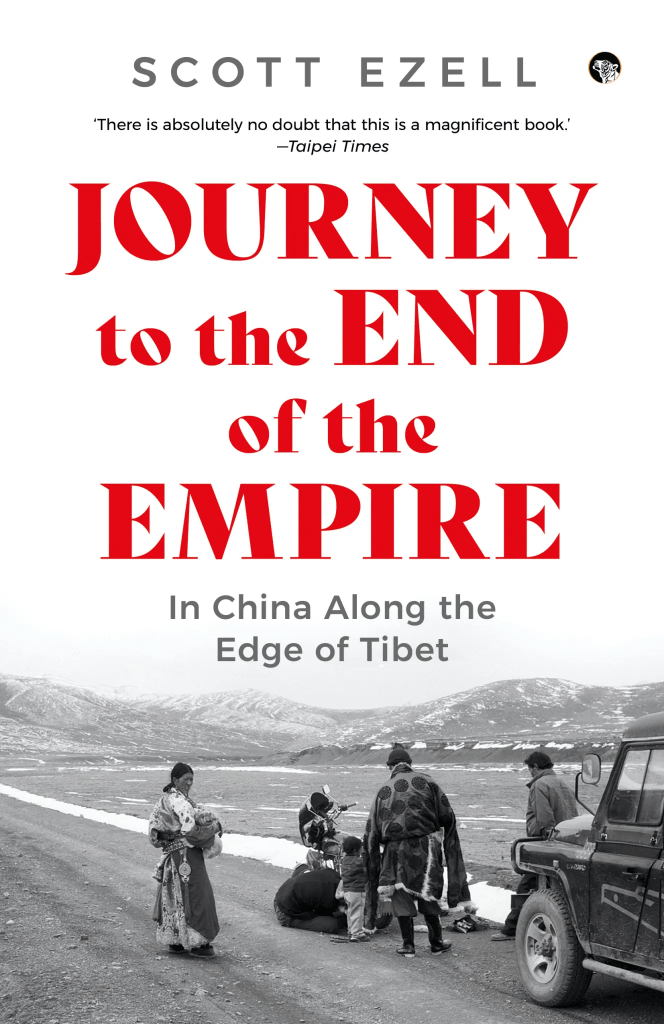
Title: Journey to the End of the Empire: In China Along the Edge of Tibet
Author: Scott Ezell
Publisher: Speaking Tiger Books
A young Tibetan woman in a gold tunic came riding down the street on a horse. Her body was straight and her chin lifted high, her cheeks flushed red, and she smiled like she was the center of the world despite being dwarfed by the towers. Up ahead I saw snipers on roofs behind sandbags, wearing mirrored shades. Silver bracelets jangled on the woman’s wrists and her hair was braided with turquoise. Her horse trotted up and over a pile of rocks and earth heaped in front of an army bunker — this was an anti-insurgency tactic, so there could not be a quick rush of crowds in an uprising.
I followed her down the street, walking around the mounds of rubble. As we approached the old town, with its buildings of ancient blackened wood, she blew kisses to the snipers and to the soldiers in roadside bunkers. Aside from the army trucks, the street was half-full with oxcarts, motorcycles, pedestrians in fur-lined robes, pilgrims on their way to the central temple, and a few beggars mumbling mantras and ringing bells for alms. At a crossroad the woman pulled the reins so her horse reared up and turned circles beneath her, then set off at a trot toward the outskirts of town and the open horizon beyond. I headed the other way, to the center of town, where the market and temple square converged.
Zhongdian was an administrative outpost at the edge of the wilderness, an interface between the engulfing yawn of the Tibetan Plateau and the authority of the empire. From here, there was nothing north and west for a thousand miles but the earth tilting higher and higher, human culture becoming funkier and more rarified as the landscape lifted its bones up toward the sky. Zhongdian is a transliteration of the Tibetan place-name Gyalthang, but the local government had secured a regional trademark to call it Shangri-la. This place may have been the inspiration for the original Shangri-la in the novel Lost Horizon by James Hilton. If so, the mythic valley of paradise was located in the Meilixue Mountains to the west, at the base of Kawaboge peak, a twenty-two-thousand-foot pyramid of ice and snow. Additional inspiration would have come from farther west, on the other side of the range, in a valley along the upper Mekong, where in the nineteenth century a French priest built a Catholic church. Tibetan families still brewed wine from the grapes the priest planted there over a hundred years ago. The vineyards lined the valley wall above the upper Mekong where it ran bronze and copper between walls of talus and dust on its long descent from the Tibetan Plateau to the plains of Southeast Asia, finally reaching the South China Sea.
The ministry towers were gridded and mirrored, and drew my vision to the sky like tracer bullets. They sucked in and concentrated the light of this landscape where everything was infused with light, even the barley fields beyond the edge of town seemed composed of light lifting up from earth in golden germs and stalks and leaves, light reaching up to light. Sections of the towers were still under construction and covered with scaffolding, revealing girder structures. I had to look straight up to read the titles in formal script high on the façades, as if they were declaring, not to the people on the ground but to the far mountains and horizons, that they were the Regional Authority of Financial Interests in Tibet, the Ministry of Civilizing Minorities, the Ministry of Mineral Extraction, the Ministry of Love — each one was a glittering obelisk, a cosmococcic, cosmodemonic eye turning and revolving, a panopticon of surveillance.
The wind beat me like a club, the sun flashed and blinded me. A few dented taxis drove around aimlessly. Along the street, huge cuts of yak meat hung from steel hooks in butcher shops, and a yak skull with broad arcing horns was propped by the doorway of a restaurant. A tattered, greasy beggar who looked about sixteen came walking down the middle of the street. He was shirtless despite the cold, his skin nearly black from filth. The boy had scabs on his face; he was half-starved and half-mad and mumbled gibberish interspersed with om mani padme hum, as he cackled and stared hungrily at the sides of yak and goat hung from steel hooks for sale, the ribs curved like rows of triggers beneath their curtains of meat. When he saw me he shouted out, “Oh ho, oh no!” He aimed his finger at me with a squinted eye, then swivelled and turned it up, up, up to the tower above us and the calligraphy sign that labeled it the Ministry of Sanity and Sanitation, reflecting the sun from a thousand mirrored panels. He staggered down the street calling out, “Cock-towers, scratching up the sky … om mani padme hum…. They weren’t here first, but those cock-towers tell you you’re not first no more. Claim the land, they’re going to stake a claim with their cock towers, claim the land … om mani padme hum….”
A cluster of wrinkled Tibetan women shuffled toward me wearing sky-blue tunics fringed with silk. They had baskets of gnarled radishes and potatoes on their backs and tump lines around their foreheads. They called out to me, laughing and pointing like I was a painted clown, but with such good humor that I laughed right along. When I greeted them in Mandarin they just laughed louder and placed their palms together in benediction and greeting, Tashi delek.
Along the row of market stalls, announcements crackled over loudspeakers, and Hong Kong soap operas blared weeping and imprecations from TVs.
ABOUT THE BOOK
On foot, by rattling truck and local bus, by jeep and motorcycle, American poet and musician Scott Ezell explores the Tibetan borderlands in the twenty-first-century Chinese empire. The journey starts in Dali, in the foothills of the Himalaya in southwestern China, and extends north a thousand miles through towns and villages along the edge of Tibet, finally arriving at Kekexili, the highest plateau in the world, and crossing the Kunlun Mountains. Ezell takes us through landscapes of blond and gold barley fields, alpine meadows ablaze with wildflowers, silver-blue rivers beneath “clouds like burning aluminium,” and snow peaks “cracking and shattering into jagged resplendence against the sky.”
Balancing the epic is the intimate. Fluent in Mandarin, Ezell chats with farmers, shopkeepers, lamas, nomads, and police along way. There is also outrage in Ezell’s account, as, over the course of many years and numerous trips, he witnesses the rise of militarization, surveillance, destructive resource extraction and the killing of entire river ecosystems by massive dams.
The work of an exceptionally talented writer at the height of his craft, Journey to the End of the Empire is both a love song for the earth, and a cry of dissent against environmental destruction, centralized national narratives, and the marginalization of minority peoples.
ABOUT THE AUTHOR
Scott Ezell is an American musician and poet with a background in Asia and Indigenous peoples. He was based in Taiwan from 1992 to 2004, and travelled widely in China, India and Japan. Since 2009 he has worked on a project documenting the effects of centralized state power, civil conflict and destructive resource extraction on marginalized communities in the China– Southeast Asia border zone. He is the author of A Far Corner, an account of three years he lived and worked with an Indigenous artist community in Taiwan.
PLEASE NOTE: ARTICLES CAN ONLY BE REPRODUCED IN OTHER SITES WITH DUE ACKNOWLEDGEMENT TO BORDERLESS JOURNAL

 Borderless