Some books speak in metaphors. Some shout their brilliance. Some want to be dissected, reviewed, analysed like puzzles. But Six of Cups isn’t that kind of book. It doesn’t ask you to do much. It just wants you to sit with it.
Neha Bansal’s poems don’t pretend. They don’t try to be clever. They don’t need you to clap. What they ask for is something quieter — your stillness, maybe. Your memory. They speak softly. Almost like they’re afraid of waking something in you. And maybe that’s exactly what they do.
This is a collection of fifty poems. Simple on the surface. But like most simple things, they carry weight. Not the kind that crushes. The kind you forgot you were holding until you’re reminded.
Reading Six of Cups is like finding an old sweater at the back of your closet. You didn’t even know you were missing it. But the moment you hold it, you’re somewhere else. In another time. Another house. Another life.
The title itself comes from the tarot — a card about childhood, nostalgia, kindness, innocence. The poems live in that space. They revisit things that aren’t just personal, but also collective such as homemade meals, festivals, sibling fights, old TV serials, chalk-smeared hands, and monsoon evenings. There’s a familiarity here that doesn’t feel manufactured. You don’t get the sense that Neha Bansal is trying to be nostalgic. She just is.
There’s a poem about Doordarshan[1]. It doesn’t try to explain the significance. It just takes you there — back to the old wooden cabinet TV, the warm static before the signal settled, the family crowding around the screen. It doesn’t say much and yet it says everything.
‘Sibling Squabbles’ is a small miracle. It captures that strange love we carry for the ones who shared our roof, our food, our secrets. The kind of love that includes shouting, pushing, sulking. But also defending each other, silently. Even now.
‘Paper Boat’ and ‘Mint Chutney’ — two more standouts don’t indulge in poetic imagery. Instead, they lean into the senses. The tartness of raw mango on your tongue. The wet smell of monsoon earth. The steam of evening tea. You read them and you’re not just reading. You’re smelling things. Tasting them. Hearing the old kitchen door creak open.
Neha Bansal is an Indian Administrative Services officer. It’s an unexpected background for a poet, maybe. Bureaucracy is about order. Poetry, one imagines, is about chaos. But in these poems, there’s order in the chaos. There’s discipline, but not rigidity. Every word is chosen carefully. Nothing feels excessive. Nothing is wasted. She writes like someone who listens closely to the world, to people, to memory. Maybe that’s what makes her poetry so honest. Her poems for people who’ve lived. People who remember the smell of their mother’s shawl. People who know the comfort of routine — boiling milk, folding bedsheets, watching Ramlila in the open field. They’re for the ones who’ve carried small hurts for years and never said a word.
There’s a kind of sacred quiet in this collection. That might be its most remarkable trait. In a time when poetry is often loud, performative, and built for clicks, these poems resist the noise. They’re not dramatic. They don’t climax. They settle in. They let silence speak.
In one of the most moving pieces, Neha Bansal writes about an old family tradition — Janmashtami, the celebration of Lord Krishna’s birth. But it’s not about religion. It’s about her grandmother drawing tiny footprints with rice flour. The quiet anticipation of the festival. The waiting. The softness of belief, not its spectacle. It’s in those tiny footprints that the poem finds its magic. You can almost see them fading slowly on the tiled floor.
These poems understand that memory is not a highlighted reel. It’s a soft murmur. A drawer that squeaks when you open it. A spoon stirring something warm. A phrase you haven’t heard in years but still know by heart. Neha Bansal knows that nostalgia isn’t about grandeur. It’s about the details we almost miss.
Her form is mostly free verse. But that doesn’t mean it’s careless. She knows how to pause — where to breathe. The white space around her lines isn’t empty. It holds meaning. A kind of emotional residue. You finish a poem, and it doesn’t end. It lingers. Like the scent of someone who just left the room.
There’s no poetic ambition here and that’s its strength. These poems don’t ask to be poetry. They just are. And that’s why they work. You trust them. You feel at home in them.
I thought of my own home while reading these pages. Kashmir. The long winters. My grandmother in her worn pheran, roasting cornflakes and walnuts on an old iron tawa, her hands, cracked and slow. The hush of mornings. No urgency. Just living.
That’s what Six of Cups reminded me of — the art of simply being. And how much that art is vanishing now.
Some poems mention festivals like Lohri, Janmashtami, Diwali. They present them as they are — domestic, lived-in, full of ordinary magic. For those unfamiliar, there’s a glossary at the end. But the real understanding happens not through translation, but emotion. Neha Bansal doesn’t lean on metaphor much. And when she does, it’s light. A passing breeze, not a storm. She doesn’t build complex imagery. But she does ask you to notice. In a world of scrolling, skimming, glancing — she’s saying, “Stop. Look. Listen.”
Even the titles of her poems have that simplicity: ‘Old Shawls’, ‘Grandmother’s Halwa’, and ‘First Rain’. They sound like diary entries. And in a way, they are. Only they’re not just her diary — they become ours too.
The brilliance of Six of Cups is that it democratises poetry. It makes it accessible again. You don’t need a theory. You need memory. You need feeling. That’s it. If you’ve ever missed someone or some place or even some version of yourself — you’ll get this.
And maybe that’s the beauty of it. It doesn’t want to be studied. It wants to be remembered. Like an old friend. Like a childhood street. Like a scent you can’t name but know in your bones.
The last poem in the collection doesn’t try to wrap everything up. There’s no neat ending. It just… fades out. The way light fades at dusk. Slowly. Gently. Without warning.
You close the book and feel something that isn’t quite sadness. It’s quieter than that. Maybe it’s the feeling of being seen. Or the feeling of remembering something small that meant something big. You sit with it for a while. You let it settle.
Six of Cups is not a loud voice. It’s a warm room. A soft light. A hand reaching back, not to pull you into the past, but to remind you it’s still with you. That you are made of it.
And maybe that’s what poetry should be sometimes — not a performance but a presence.
Gowher Bhat is a published author, columnist, freelance journalist, and educator from Kashmir. He writes about memory, place, and the quiet weight of things we carry. His work often explores themes of longing and belonging, silence and expression. He believes the smallest moments hold the deepest truths.
PLEASE NOTE: ARTICLES CAN ONLY BE REPRODUCED IN OTHER SITES WITH DUE ACKNOWLEDGEMENT TO BORDERLESS JOURNAL
This monsoon: that darkened Now dresses my windows in the glory of her wetted pearls
This monsoon: that (g)rumbled Now sings an opera; sometimes whispers a Hallelujah
This monsoon: that quieted Now visits the sonnets huddled upon the mantle of her mind
This monsoon: that scattered Now draws us to the hearth, immersing us in the infinite unsaid
This monsoon: that shadowed Is now a Hail Mary, that our Mother may bring forth Her flower and fruit
This monsoon: a monster unclothed Now purrs like a kitten, that I may tickle her chin
This monsoon: an adversary Now walks arm in arm. Innocent. Whistling a tune
This monsoon: pick-pocketer of hope Now lends us a full breath of abundance divine
This monsoon: once a marshland Washes away longing and regret, that we may flourish to be
Another Garden of Eden
Nia Joseph is a part-time poet with a published children’s book. She is of the belief that poetry says what no picture or thousand words can. She draws inspiration from nature, relationships and her three young children.
PLEASE NOTE: ARTICLES CAN ONLY BE REPRODUCED IN OTHER SITES WITH DUE ACKNOWLEDGEMENT TO BORDERLESS JOURNAL
In Cherry Blossom Forecast, Suzanne Kamata brings the Japanese ritual of cherry blossom viewing to our pages with her camera and words. Clickhere to read.
There was a time when monsoon was known to be either parsimonious to Chennai or simply indifferent.
In the sixties and seventies, water scarcity was a byword in every household. The city evolved from independent houses to matchbox apartments extending its periphery to suburbs and beyond in the name of burgeoning real estate, but water scarcity continued a mole on the elbow.
Like in all commercial activity where promises mean more than performance, real estate developers too promised enough water supply to ensure bookings and until the housing was handed over. Few years after the handing over, the old complaints returned and the problem revolved around deepening or digging more bore wells manipulating the cross currents of water flow…….in the process digging their own grave.
In due course bore wells became economical with water, not costs.
They were not to be blamed strictly either because it was in the nature of demand and supply. Essentially it meant, rather sounded the missive, that planning was all fine on paper but when it came to reality, commercial exigencies and lobbies took over. It became then a case of passing the buck.
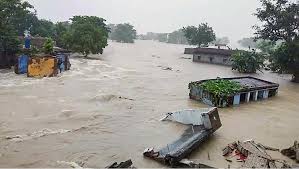
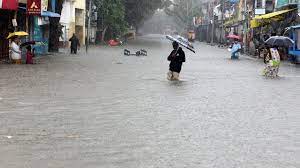
The city had long since graduated from the parsimony of monsoon. Now it was regular, buoyant and often uncomfortably bounteous. So much so that parked cars in the stilt space of apartments went for a swim in roaring waters that stretched to a height of 5 to 10 ft in some places.
One of the inmates from her window of the first-floor apartment saw her car transported to God knows where and screamed knowing full well she was helpless……could not get down into the vast sheet of water that left no sign of anything — let alone the road. And she hoped to find her car when the water level receded.
Just the night before, Ganesan, a young software engineer holding a senior position in a prestigious IT firm, had boarded the train to Srivaikuntam, a holy town close to Tirunelveli where Lord Vishnu held court. A devout believer and practitioner of sacraments that drilled into him the belief that men could succeed and achieve on the merits of brain and diligence but there was always a pervading force that guided him, he had prayed before boarding the train to Tiruchendur.
Four days back, the forecast of a formidable downpour had unnerved him but he wanted to see his parents after a gap of two years. They looked forward to it as much as he did. He was loath to cancel or put off the trip on the prevarications of nature. It could be sunny if the low depression changed its course at the last minute and veered away…not that he wished ill for his brethren in the neighbourhood.
So he took a chance, went ahead with the trip and saw the Tiruchendur Express chug slowly out of Chennai Egmore.
The weather was murky, stubbornly ominous. He shrugged his shoulders, smiled.
“It’s all in the game. Let us leave it to the on High!”
*
On the way the starless sky got darker still. Dark clouds raged viciously to pour with the chilling owl-like howl of the wind. It was December and the cold wind hitting the windowpane of the train chugging in a monotony of extreme caution, made Ganesan’s arms shudder. He could see nothing in the dark and barely could imagine the procession of dense vegetation and fields obviously drenched in the downpour.
He put on his sweater, but it proved to be no protective cloak and so he had to put on more. “God! It’s frightening… hope I reach my place in one piece.” His thoughts were as intimidating as the weather outside.
Thankfully the lights were on. All the shutters were down in the coach except his, where the glass pane was tightly secured. The biting cold penetrated the inside of the coach though there was balancing warmth due to radiation of body heat.
An elderly man, in his early sixties, was travelling with his wife. There were several families busy chatting about their kin or the functions to attend in Tiruchendur, including the celebrated Murugan temple, though inwardly their minds were filled with queasy churnings.
“Where are you bound, sir?” asked the elderly man with hesitation. Ganesan smiled though he could smell the palpable concern in his voice.
“Vaikuntam sir….to be with parents. I am visiting them after two years.”
The old man returned the smile. “I am a resident of Tiruchendur, have got land and a rice mill there. My daughter is in Chennai. We came on a holiday to be with our granddaughter.”
There were two families in front in the three tier AC[1] coach. Both the families had taken their dinner early in the evening as they were too wary of railway catering. The elderly man, who introduced himself as Muthuraman, was not finicky enough to insist on home made food and shun rail service and had, therefore, ordered. So did Ganesan.
As they dug into the dinner, Muthuraman broke the silence, aware that the inclement weather could make anyone off colour. Silence made it worse, of course.
“Sir! You must be in touch with parents. They would be worried. The cyclone had hit close to the Chennai coast a few weeks back but now it is pure monsoon fury. The earlier one affected Chennai badly and a lot of them are yet to come out of the trauma. I am worried about the open drains, small dams and culverts and lakes in southern part of the state which are all vulnerable.”
Ganesan, listening to him in rapt attention, said, “I know. A place like Vaikuntam cannot face up to persistent rain for a few hours, let alone the whole day or days. We own land very close to our home and the paddy will be submerged. My father told me just now he is bracing up to some severe loss of crop and money this year. We have been facing it regularly. A curse in what is otherwise a holy and fertile belt….”
Muthuraman’s wife nodded with lines of worry in her face. “What else could we do other than pray to Perumal?”
Muthuraman spat out in disillusionment. “In cities, they lay roads which cannot stand a day’s rain, metro rail and residential skyscrapers where a guy in the balcony is no proof against a bust of breeze. I know of a lady who lived on the 14th floor and wanted to enjoy the scene. She opened the door and stood close to it when the gust of wind, slammed the door on her face knocking her over. She fell into coma and died soon after. I mean…a city is unable to cope with the pressures of money and commercial lobbies which have their way. So, the less said about a rural town the better.”
“God! It is horrible to hear. Such occurrences are hard to believe,” said Ganesan. “Migration in search of a job across the country is inevitable and it adds to the pressure. You need to have a footing somewhere and if all things go well settle down there. You need to build a roof unless you are lucky enough to get back to where you belong.”
Just then, the train had halted at Villupuram for more than 45 minutes before easing into motion. The passengers were blissfully unaware of it, having been preoccupied in their own uncertain world.
“We didn’t even know we were tagged here for this long,” said an exasperated Muthuraman. Ganesan, who was equally chagrined, didn’t reply.
*
Most of the stations en route wore a deserted look except for the idle tea stalls, The passengers too, especially senior citizens, didn’t venture out even for a hot sip of tea apprehending wet and possibly slippery platforms. Inevitably the train ran late by an hour considering possible presence of water or even flooding of the track. Thankfully, signals were in place though the menacing purr of the dark outside continued with the trundle of the train.
“Are we closer to Kumbakonam?” enquired Muthuraman.
“We are, possibly will reach in a few minutes,” said Ganesan. “But the persisting rain worries me, sir. In some places ahead of us the track would be flooded, and it could delay us longer.”
“If the train drops us at our destinations, I will be more than happy, in fact thank God for it. It will be a blessing,” said one of the members of a family in front.
None of them however had any assurance that they would be blessed in some way.
*
Ganesan slept fitfully as he was accustomed to during train travel at night. “Cool, undisturbed sleep is a luxury,” he thought. Most of the passengers in the coach appeared to have slept well perhaps as a relief from the ordeal of the weather.
He looked at his watch and saw it as 6.30 a.m. He pulled up the shutters to see how the weather was and it was dull, wet and pouring. The train had stopped and he had no way of knowing the duration of the halt. He knew the train should have reached Srivaikundam by now but the stretching flooded farm fields on either side with sparse houses indicated that it was off schedule. There was no evidence of roads or pathways — had there been any.
“Srivaikundam is just a km away sir,” said a passenger who was bound for Tiruchendur. “The train got an alert and has halted. Seems the ballasts are off. I hope it will start moving again.”
Ganesan gave a sigh of near relief though he was not sure whether the train would move. He could see a sheet of water submerging the fields though the track appeared to be navigable. He could not help blurting out his concern though.
“The scene is scary sir. We can neither get down nor remain in the train.”
Muthuraman, who had got up, was slightly sullen, looking clearly unwell. “Mr. Ganesan, I am glad you are close to your destination….we are still 30 km away.” His wife looked crestfallen, at the end of her tether.
“He is a heart patient. I am only concerned about him.” To Ganesan’s relief the train creaked, began to move. It trundled at a snail’s pace and reached Srivaikundam.
But his relief was only palpable and short lived as the message came through that any further movement was risk bound and foolhardy. One of the railway staffers came to the coach to inform them that the train might remain there for some time before the weather eased or the flooded tracks were restored to usable.
The train had already been delayed by more than 90 minutes. Ganesan was embraced by his father who had managed to come to the railway station in his car driving through flooded roads in the town in meditative hermitlike composure and caution.
Ganesan found someone tugging at his shirt and turned back to find Muthuraman”s wife apprehensive and scared.
“Son! He seems to have symptoms of cardiac attack. I don’t know what to do….”
Ganesan’s father rushed into the coach while Ganesan ran into the railway staff room to look for instant health care.
A stretcher was brought to take Muthuraman and rush him to the nearest hospital. Thankfully Ganesan knew of a specialist hospital close to the station and took him there, having forgotten to even speak to his fretful mother about what had held him and his father back. He knew his mother would continue to worry but there was no time to even ring her up.
“We must know first this man is all right or is recovering,” he muttered. His father took care to let his mother know that an emergency (not related to their family) had occurred and it had held them up at the station.
Ganesan also came to know that the train would not proceed further and that the passengers were holed up there.
A crisis had come home to roost.
*
All the passengers shackled to Srivaikuntam for no fault of their own put it to a matter of a few hours but it seemed to stretch before the shadows of the night crept in. There was no let up in the rain and the southern belt was not equipped to handle nature’s unmitigated fury.
Thankfully the cafeteria run by a local rose to their needs and gave them breakfast but the railway catering service was not prepared for this eventuality. About 500 odd passengers, including the geriatric, needed round the clock vigil and sustenance though some were near breakdown amid symptoms of vomiting and diarrhea.
Ganesan and his father were faced with a task not of their own choosing and of the magnitude of a mountain to climb. They could not let it go either. The roads in the town were clogged with knee-deep or waist level sheet of water, hindering their drive to do their best.
“It is a test of our nerve, my boy! We have not spent all our lives to creep back into our shell and watch them suffer, possibly die. It was your good fortune you reached along with others but the rest of them are braving it out. We have to show we are not heartless, nor do we rely on external agencies for help. There is no time for it. Rather we help ourselves.”
Ganesan, who had learnt forbearance in his stint in IT firm and not given to wasteful emotions, nodded and raised his thumb to his father.
His father used his decades old connections in the town, comprising hoteliers, vegetable and fruit vendors, nursing staff to help the distraught.
The message from the railways was distressful and alarmingly ominous. “Sorry ladies and gentlemen. It will take a day or two. The track restoration is on in full blast and the signal system is in place. Please, please bear with us.”
*
The railway station was abuzz for the next prolonged hours with supplies of food, medicines and equipment being rushed to the respective coaches where the need was greater. It pertained to those who had symptoms of sudden dehydration, stomach disturbance, diarrhea and fatigue and stress related syndromes.
Ganesan and his father were on their feet all the time coordinating whatever they could with local connections of suppliers who rose to the occassion. Commerce took the back seat relatively to an extent.
Muthuraman showed signs of recovery a few hours later in the evening having gone through a CPR and defibrillation by the railway staff as was done in the event of unforeseen emergencies. His wife spoke to her daughter in Chennai who was almost ill with perplexity and worry since they left the city.
The news that the train had halted at Srivaikuntam and might not leave for a couple of days was less painful than one of father’s cardiac arrest which left the family in tatters. She could only hope her worst fears would not come true.
Muthuraman opened his eyes, took note of his wife’s presence before locking his hands in gratitude with Ganesan.
“No sir…this is no time for thanking me and my father. You must thank all the locals who rose as an army to support and bring relief to so many who are stranded in the train still because they are unable to move out. We have arranged a big hall where most of them could be fed in turns. I am amazed sir… unable to believe it. But I have learnt a world of things from this experience. That alone matters sir.”
His father laid a reassuring hand on Muthuraman’s shoulder. “They are still at work. Possibly the train may leave tomorrow morning. I hear the track has been restored. If you wish you can return in the train itself or you can have somebody from Tiruchendur to take you in a car.”
Muthuraman’s wife said “It will take three days as per medical opinion to discharge him. We will ask our cousin to take us home in a car.”
“We will take care of you till you leave for home,” smiled Ganesan.
He took leave of the couple as one of the hotelier’s employees came up to him. “Sir! We have the next consignment of water cans ready for the station. Care to join us?”
“Of course,” said Ganesan and hopped into the front seat of the van.
A cool breeze blew across the vast fields from a distance. The weather had improved beyond expectation two days after the train came to a halt at the station, looking sunny, soothingly warm and reassuring after the terrible onslaught of the monsoon the day they left Chennai.
Suddenly, nature seemed to have recovered from its surge of fury and had become benign and benevolent. But anything could have happened in the passing hours when the fury was in full swing and the aftermath would have been horrible to imagine, much less experience.
But what gave him succor and regeneration was the unstinted display of human kindness and concern in times of adversity. The whole village worked as an army to guard, nurse and redeem the afflicted from the depths of despondency.
“There is always a light in the tunnel” thought Ganesan with a smile. “If I had any cynicism about the milk of human kindness it is gone.”
K.S.Subramanian, a retired Senior Asst. Editor from The Hindu, has published two volumes of poetry titled Ragpickers and Treading on Gnarled Sand through the Writers Workshop, Kolkata, India. His poem “Dreams” won the cash award in Asian Age, a daily published from New Delhi. His essays and blogs can be found under his name in http://www.boloji.com.
.
PLEASE NOTE: ARTICLES CAN ONLY BE REPRODUCED IN OTHER SITES WITH DUE ACKNOWLEDGEMENT TO BORDERLESS JOURNAL
Book display at Om BookstoreBook display at Midlands
The first month of 2023 has been one of the most exciting! Our first book, Monalisa No Longer Smiles: An Anthology of Writings from across the World, is now in multiple bookstores in India (including Midlands and Om Bookstores). It has also had multiple launches in Delhi and been part of a festival.
Delhi University panellists from left to right: Shantanu Ray Chaudhuri, Meenakshi Malhotra, Debraj MookerjeePanellists at Om Bookstore launch: Aruna Chakravarti, Mitali Chakravarty, Radha Chakravarty
We, Meenakshi Malhotra and I, were privileged to be together at the physical book events. We met the editor in chief of Om Books International, Shantanu Ray Chaudhuri, the editor of our anthology, Jyotsna Mehta, along with two translators and writers I most admire, Aruna Chakravarti and Radha Chakravarty, who also graced a panel discussion on the anthology during our physical book launch. The earlier e-book launch had been in November 2022. My heartfelt thanks to the two eminent translators and Chaudhuri for being part of the discussions at both these launches. Chaudhuri was also in the panel along with Debraj Mookerjee at a launch organised by Malhotra and the English Literary Society steered by Nabaneeta Choudhury at Hans Raj College, Delhi University. An energising, interactive session with students and faculty where we discussed traditional and online publishing, we are immensely grateful to Malhotra for actively organising the event and to the Pandies’ founder, Sanjay Kumar, for joining us for the discussion. It was wonderful to interact with young minds. On the same day, an online discussion on the poetry in Monalisa No Longer Smiles was released by the Pragati Vichar Literary Festival (PVLF) in Delhi.
At the PVLF session, I met an interesting contemporary diplomat cum poet, Abhay K. He has translated Kalidasa’s Meghaduta and the Ritusamhara from Sanskrit and then written a long poem based on these, called Monsoon. We are hosting a conversation with him and are carrying book excerpts from Monsoon, a poem that is part of the curriculum in Harvard. The other book excerpt is from Sanjay Kumar’s Performing, Teaching and Writing Theatre: Exploring Play, a book that has just been published by the Cambridge University Press.
Perhaps because it is nearing the Republic Day of India, we seem to have a flurry of book reviews that reflect the Sub-continental struggle for Independence from the colonials. Somdatta Mandal has reviewed Priya Hajela’s Ladies Tailor: A novel, a book that takes us back to the trauma of the Partition that killed nearly 200,000 to 2 million people – the counts are uncertain. Bhaskar Parichha has discussed MA Sreenivasan’s Of the Raj, Maharajas and Me, a biography of a long serving official in the Raj era — two different perspectives of the same period. Rakhi Dalal has shared her views on Shrinivas Vaidya’s A Handful of Sesame, translated from Kannada by Maithreyi Karnoor, a book that dwells on an immigrant to the Southern part of India in the same time period. The legendary film writer K.A. Abbas’s Sone Chandi Ke Buth: Writings on Cinema, translated and edited by Syeda Hameed and Sukhpreet Kahlon, has been praised by Gracy Samjetsabam.
We have a piece on mental health in cinema by Chaudhuri, an excellent essay written after interviewing specialists in the field. Ratnottama Sengupta has given us a vibrant piece on Suhas Roy, an artist who overrides the bounds of East and West to create art that touches the heart. Candice Louisa Daquin has written on border controls and migrants in America. High profile immigrants have also been the subject of Farouk Gulsara’s ‘What do Freddy Mercury, Rishi Sunak & Mississipi Masala have in Common?’ Sengupta also writes of her immigrant family, including her father, eminent writer, Nabendu Ghosh, who moved from Bengal during the Partition. There are a number of travel pieces across the world by Ravi Shankar, Meredith Stephens and Mike Smith — each written in distinctively different styles and exploring different areas on our beautiful Earth. Sarpreet Kaur has revisited the devastation of the 2004 tsunami and wonders if it is a backlash from nature. Could it be really that?
The flavours of cultures is enhanced by the translation of Nazrul’s inspirational poetry by Professor Fakrul Alam, Korean poetry written and translated by Ihlwha Choi and a transcreation of Tagore’s poem Banshi (or flute) which explores the theme of inspiration and the muse. We have a story by S Ramakrishnan translated from Tamil by R Sathish. The short stories featured at the start of this year startle with their content. Salini Vineeth writes a story set in the future and Paul Mirabile tells the gripping poignant tale of a strange child.
With these and more, we welcome you to savour the January 2023 edition of Borderless, which has been delayed a bit as we were busy with the book events for our first anthology. I am truly grateful to all those who arranged the discussions and hosted us, especially Ruchika Khanna, Om Books International, the English Literary Society of Hans Raj College and to the attendees of the event. My heartfelt thanks to the indefatigable team and our wonderful writers, artists and readers, without who this journey would have remained incomplete. Special thanks to Sohana Manzoor for her artwork. Many thanks to the readers of Borderless Journal and Monalisa No Longer Smiles. I hope you will find the book to your liking. We have made a special page for all comments and reviews.
I wish you a wonderful 2023. Let us make a New Year’s wish —
May all wars and conflicts end so that our iconic Monalisa can start smiling again!
Left to right: Mitali Chakravarty, Sanjay Kumar, Shantanu Ray Chaudhuri, Meenakshi Malhotra and Debraj Mookerjee After the event with a few students and teachersAt Delhi University
.
Left to right: Radha Chakravarty, Mitali Chakravarty, Aruna Chakravarti, Shantanu Ray ChaudhuriLeft to right: Shantanu Ray Chaudhuri, Aruna Chakravarti, Mitali Chakravarty, Radha Chakravarty, Jyotsna MehtaAt Om Bookstore, Ambiance Mall, GurgaonWith book reviewer Rakhi Dalal
Insta Link to an excerpt of the launch at Om Bookstore. Click here to view.
E-Launch of the first anthology of Borderless Journal, November 14th 2022. Click here to view.
Monsoon is a poem of love and longing that follows the path of monsoon which originates near Madagascar and traverses the Indian Ocean to reach the Himalavas and back to Madagascar. As monsoon travels, the rich sights and sounds, languages and traditions, costumes and cuisine, flora and fauna, festivals and monuments, and the beauty and splendour of the Indian Ocean islands and the Western Ghats, East and North India, Bhutan, Nepal and Tibet are invoked. The poem weaves the Indian Ocean Islands and the Indian Subcontinent into one poetic thread connected by monsoon, offering an umparalleled sensuous experience through strikingly fresh verses which have the immense power to transport the readers to a magical world.
About the Author
Abhay K is the author of nine postry colfections including The Magic of Madagascar (1’Harmattan Paris, 202 I), The Alphabets of Latin America (Bloomsbury India, 2020), and the editor of The Book of Bihari Literature (Harper Collins, 2022), The Bloomsbury Anthology of Great Indian Poems, CAPITALS, New Brazilian Rems and The Bloomsbury Book of Great Indian Love Poems. His poems have appeared in over 100 literary journals. His “Earth Anthem” has been translated into over 150 languages. He received SAARC Literary Award 2013 and was invited to record his poems at the Library of Congress, Washington, D.C. in 2018. His translations of Kalidasa’s Meghaduta (Bloomsbury India, 2021) and Ritusamhara (Bloomsbury India, 2021) from Sanskrit have won KLF Poetry Book of the Year Award 2020-21.





 Borderless