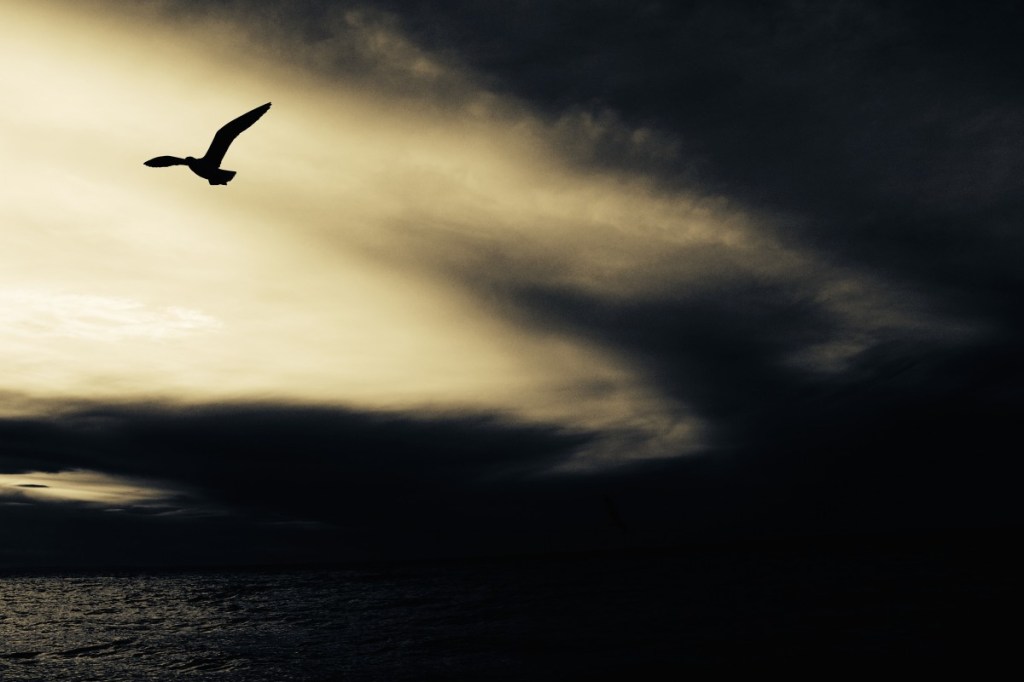
A translation of Dushomoy (bad times), written originally by the poet as Swarga Patthe (On the path to Heaven) in the Bengali month of Boisakh 1304, roughly April 1897 of the Gregorian Calendar.
A Journey of Hope


Though dusk sets in slowly,
    The songs of the spheres have been silenced.
Though you fly companionless in the endless sky,
     Though exhaustion seeps into your body,
A terrifying dread prays in mute chants,
    All horizons across the orb are covered by a veil --
Yet bird, o lone bird of mine,
     Despite the blinding darkness, do not stop beating your wings.

This is not the murmur of woods,
     This is the python-like ocean swelling.
This is not a bower of flowers,
      This is the undulating hood swaying to the music of waves.
Where is that shore full of blossoms and foliage,
     Where is the nest, where is the branch to rest?
Yet bird, o lone bird of mine,
     Despite the blinding darkness, do not stop beating your wings.

The long night stretches ahead,
     The sun sleeps stilled after sunset.
The universe is breathless under restraint.
     In this stunned stance, time meanders.
Swimming across the shades of the limitless night,
     A crescent moon appears in the distant skyline.
Yet bird, o lone bird of mine,
     Despite the blinding darkness, do not stop beating your wings.

High up in the skies, the stars point their fingers
     Towards your path while gazing at you.
Deep below lies restless death in rising crests
      Of hundreds of waves that beckon.
In distant shores, some call out with an offering,
    “Come, come,” they entreat, they plead.
Yet bird, o lone bird of mine,
    Despite the blinding darkness, do not stop beating your wings.

There is no fear, no tie of affection, no attraction,
      There is no expectation, expectation is only a mirage.
There is no language, no futile weeping,
      There is no home, no floral bed to rest on.
There are only these wings, there is the celestial quadrangle,
     The dawn is led astray by the drawing of the sequestered night —
Yet bird, o lone bird of mine,
    Despite the blinding darkness, do not stop beating your wings.
(Translated by Mitali Chakravarty, edited by Sohana Manzoor on behalf of Borderless Journal. Thanks to Dr Aruna Chakravarti for the discussion and feedback which helped improve the translation.)
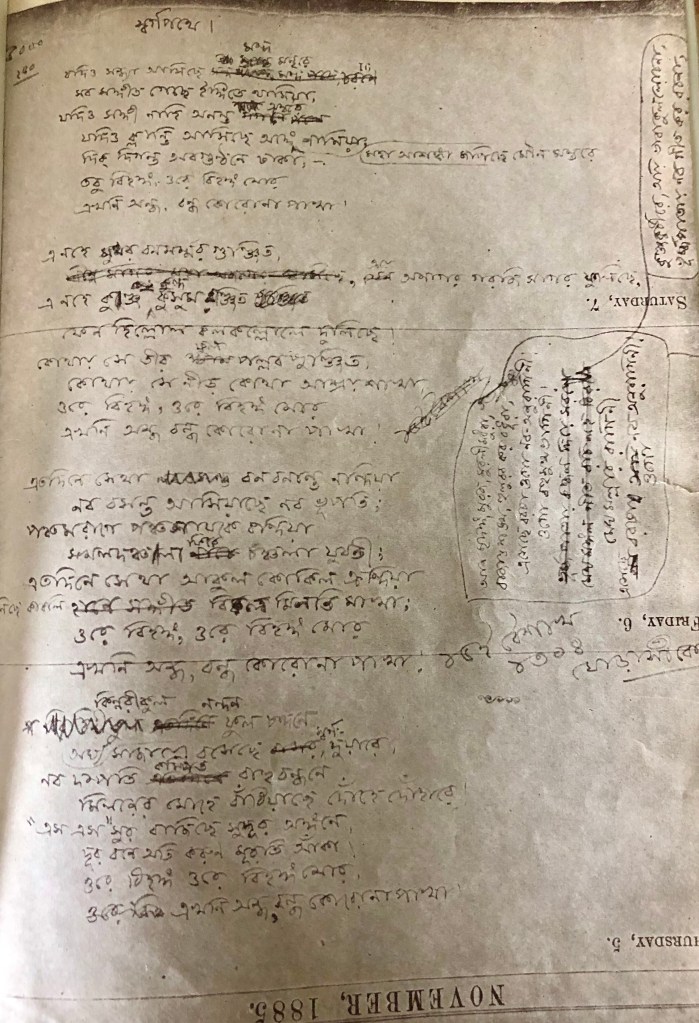
Tagore’s draft of the poem, ‘Swarga Patthe’, with the signature and date. This is the poem that has come down to us as ‘Dushomoy’, now translated as ‘Journey of Hope’.
Click here to listen to Tagore recite the poem about a lone bird in his own voice in Bengali.
.
PLEASE NOTE: ARTICLES CAN ONLY BE REPRODUCED IN OTHER SITES WITH DUE ACKNOWLEDGEMENT TO BORDERLESS JOURNAL
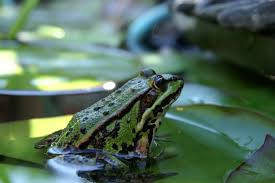
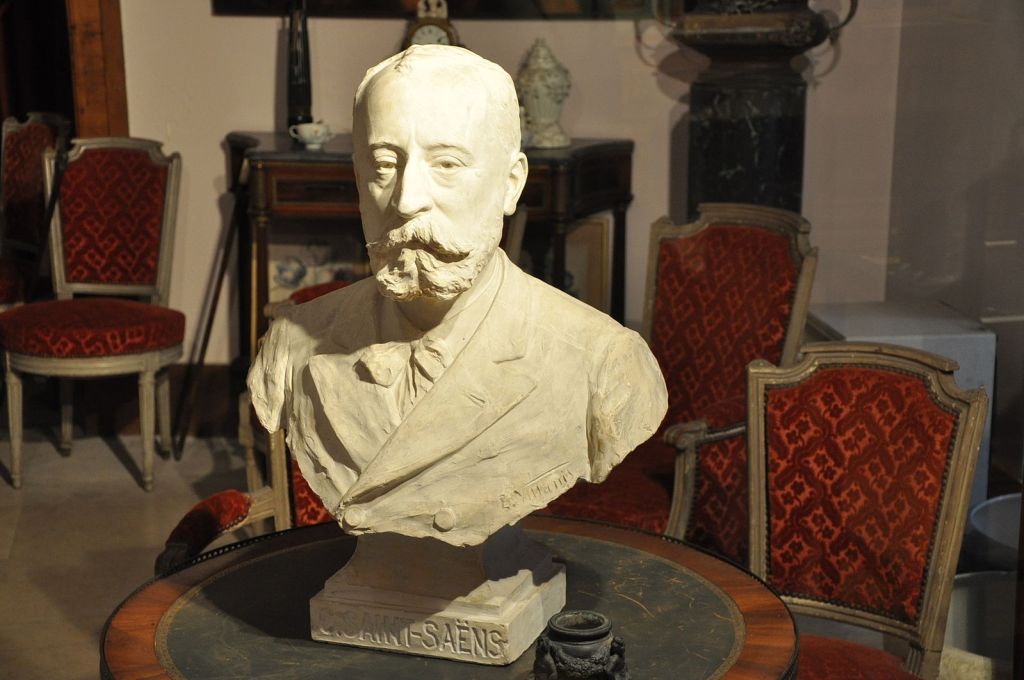
Carnival of animals other than being reminiscent of a circus, brings to the mind a humorous piece of music composed in 1886 by Camille Saint-Saëns. In the short composition of less than half-an-hour, the range of animals start with lions and capers on to kangaroos, elephants, donkeys, fishes, swans and even fossils! Peeking into our treasure trove, we found gems frolicking with animal-based humour from creatures addressed in the composition of Saint Saëns to frogs, pandas and even cockroaches. So, we decided to do a special dedicated to Carnival of Animals on the Animal’s Rights Awareness Week, June 20-25. May we live in harmony with all animals and see ourselves as part of the same kingdom!
We conclude our poetry ensemble by dedicating a few lines to the most learned and privileged of animals — the human — and his other friends.
PhD thesisBy Mitali Chakravarty
The elephant with its pink nose,
Flung up his trunk and with outstretched toes,
Danced a little stutitu
In a violet pink tutu.
The lion stood on its tail
And did a jig on the rail.
The giraffe twirled its forked tongue
And sang a song with a guitar strummed
By an Orangutan in purple pyjamas
With a gold tooth from Bahamas.
The music pranced.
The animals danced.
The future PhD stood entranced
And did a thesis on the hippo's glance.
The lissome 'potamus batted its lid
And solved problems by Euclid.
The future PhD stood entranced
And did a thesis on the hippo's glance.
Prose
Our next movement is prose. We have much starting with humorous retellings of cats — I wonder why these felines were left out of the musical composition of Saint Saëns! Our stories make up for it with multiple humorous telling of cats.
A Day at Katabon Pet Shop , a short story set amidst the crowded streets of Dhaka, by Sohana Manzoor. Click here to read.
Peregrine, a flash fiction about a cat who is named after a bird by Brindley Hallam Dennis. Click here to read.
Bugs of Life, a slice of life by Sohana Manzoor, highlighting her ‘affection’ or the lack of it for bugs. Click here to read.
As we come to the end of our ensemble, listen to the grand finale of the Carnival of Animals and tell us if you could trace resonances of the frolicsome spirit of the composition of Saint Saëns in this selection.
In conversation with Fakrul Alam, an eminent translator, critic and academic from Bangladesh who has lived through the inception of Bangladesh from East Bengal, translated not just the three greats of Bengal (Tagore, Nazrul, Jibanananda) but also multiple political leaders. Click here to read.
In conversation with Arindam Roy, the Founder and Editor-in-cheif of Different Truths, an online portal for social journalism with forty years of experience in media and major Indian newspapers. Click here to read
Akbar Barakzai’s poem, The Law of Nature, translated by Fazal Baloch. Click here to read.
Kazi Nazrul Islam’s poem, Shammobadi(The Equaliser) translated by Shahriyer Hossain Shetu. Click here to read.
Tagore’sAmar Shonar Horin Chai(I want the Golden Deer) translated by Mitali Chakravarty, edited and interpreted in pastel by Sohana Manzoor. Click here to read.
To mark the birth centenary of Satyajit Ray, Ratnottama Sengupta translates fromNabendu Ghosh’s autobiography experience of Pather Panchali ( Song of the Road) — between covers and on screen. Click here to read.
Wendy Jones Nakanishi, an academic who started her life in a small town called Rolling Prairie in midwestern US, talks of her journey as a globe trotter — through Europe and Asia — and her response to Covid while living in UK. Click here to read.
‘Did life change or did I change from the events of the last year,’ ponders New Zealander Keith Lyons who was in the southern state of Kerala when the first cases of Covid-19 were detected in India last January. Click here to read.
An excerpt from Enter Stage Right by Feisal Alkazi with a visual of young Alkazi dancing in one of the earliest discos of New Delhi. Click here to read.
As we stand on the threshold of a new normal that will eternally rewrite the history of social interactions, of movements across the globe, of new world orders that will have to be more inclusive and more transparent to world view, we will, perhaps, feel the need to redefine business laws so that even countries with lesser wealth are able to access vaccinations and peace. We are now looking up to leaderships which seem to be in crises themselves. Sitting securely on a tiny island that is well governed, an island where affluence and well-being set it adrift from the turmoils of countries around it, I wonder thirty years from now, what will mankind be like… Will we be forever marred by the current events of the world? Globalisation has ensured that none of us can be secure on any secret island. There can be no land of lotus eaters hidden from the rest of mankind and accessed by only a few anymore. Even if one region is affected by the virus in any corner of the world, can the rest of the world be pandemic free? Perhaps, a question that those who peddle in vaccines and human well-being can address.
These issues have not only been highlighted by the news media but have also found echoes in some of our content this time. Keith Lyons’s essay talks of his last stay in India, when a tourist carried the the pandemic unwittingly into Kerala in February 2020 and subsequent repercussions. More stories and poems that dwell on the spread of the virus this year cry out for compassion. One hopes young poet Ruchi Acharya’s verses are born true.
One day the roses of hope will grow
Meeting the horizon,
Roses that, even plucked, will not die
But will bloom and bloom
Every single day that passes by.
We have young writers on the virulence of the virus and mature pens like that of globe-trotting academic Wendy Jones Nakanishi, who maps the pandemic from UK. Perhaps, we will find a new direction eventually.
There have been calls for uniting above divides as a single unit called mankind earlier too, from greats like Tagore and Nazrul. This time we carry translations of both — Nazrul’s translated poem calls for uniting against artificial divides drawn by man-made constructs and Tagore’s translation talks of redefining through self-reflection. An essay on Tagore by academic Parineet Jaggi talks of the impact of the teachings of Guru Nanak, the founder of Sikhism, on Tagore.
We have essays on writers and icons from around the globe. A photo-essay on the bald eagle, heralding the American Independence Day on the 4th of July, gives a humorous anecdote on how the eagle was chosen above the turkey. We have more variety by Candice Louisa Daquin, an immigrant in US, who shows how important human movement across man-made borders is to the development of a country. Michael Burch has given us beautiful poetry reflecting the history of America and American dreams, one of them with the voice of the legendary Mohammed Ali. These verses add substance to the concerns raised by Daquin. Jared Carter brings to us the colours of life with his poetry.
We have humour in verses from Rhys Hughes and even from a young poet, Sutputra Radheye. Limericks from Michael Burch and Penny Wilkes photo-poetry on ‘Changing Seasons’ puts us in a more cheerful mood. More poetry from multiple writers across the world, including Nepal, Macedonia and Korea, have found their way into our journal.
Hughes has also given us a comprehensive and interesting essay on a twentieth century poet called Ivor Cutler, who said much as he sang his poetry and was encouraged by Paul McCartney of the Beatles. The brilliant poetry of Akbar Barakzai continues translated on our pages by Fazal Baloch and one must give many thanks to the translator for his indefatigable energy and for bringing us wonderful fare from Balochistan. An excerpt translated by eminent journalist Ratnottama Sengupta from Nabendu Ghosh’s autobiography ends with Satyajit Ray’s starting his famed career with Apu’s triology (based on Pather Panchali, a novel by Bibhuti Bhushan Bandopadhyay). These three films have become iconic in cinema history.
We were fortunate to have Professor Fakrul Alam agree to an interview. An eminent translator, critic and academic who has lived through the inception of Bangladesh from East Bengal, Alam has translated not just the three greats of Bengal (Tagore, Nazrul, Jibanananda) but also multiple political leaders like Mujibur Rahman. In this exclusive, he has taken us through the annals of history, reflecting on less-known perspectives of the Partition. Also, in conversation with Borderless, is Arindam Roy, a journalist with forty years’ experience and the founder of Different Truths who started his writing career, much in the tradition of Cyrano de Bergerac on a humorous note.
This time our backpacking granny, Sybil Pretious, gives us a glimpse of her wisdom, wit and compassion while visiting Philippines and talks of an ancient death ritual, volcanoes and strange mud baths. Devraj Singh Kalsi explores young romance in his tongue-in-cheek fashion. We also have more semi-humorous musings from young writers across borders. While Sunil Sharma has explored facets of the impact of terrorism, the other stories are told in a lighter vein.
Our book excerpt from Feisal Alkazi’s Enter Stage Right has a picture of the young artiste in a discotheque dancing in abandon — check it out. It made me smile. Rakhi Dalal has reviewed Jnanpith Award winner Shrilal Shukla’s Fragments of Happiness translated by Niyati Bafna. The book review by Meenakshi Malhotra of Neelima Dalmia Adhar’sThe Secret Diary of Kasturba brings out an interesting facet on Gandhi and women in the Independence movement. It makes one notice the contrasts in the perspectives of Gandhi and Tagore, who created women like he saw around him in fiction. Kasturba’s life also contrasts with the independence found in the life of the avant-garde artist, Amrita Sher-Gil, who lived around the same time. In an essay, Bhaskar Parichha has shown how Sher-Gil lived out her dreams, blending the best of the East and West, while Malhotra writes, that though “Gandhi called women to join the national movement … he was not seeking to emancipate, but more to call forth their capacity for self-abnegation and self-sacrifice.”
Parichha has also introduced us to the need for changes in the banking sector in India while reviewing Transformational Leadership in Banking edited by Anil K. Khandelwal. Perhaps these will be part of the changes that will ultimately lead to a revision of old systems and the start of new ones. Changes, though not always welcomed or convenient, hopefully will lead to progress that can mould our future into a happier one. Restless stirrings transformed mankind from cave dwellers to an intelligent race that can assimilate nature and technology to survive and dream of a future, living among stars.
As Borderless reaches out to unite mankind transcending artificial constructs, its attempts can bear fruit only with support from each and every one of you. I would like to thank all our editorial team for their wonderful support, contributors for being the backbone of our content, and all our readers for continuing to patronise us.
Do take a look at our current issue for the writers who remain unmentioned here but create phenomenal bridges towards a borderless world.
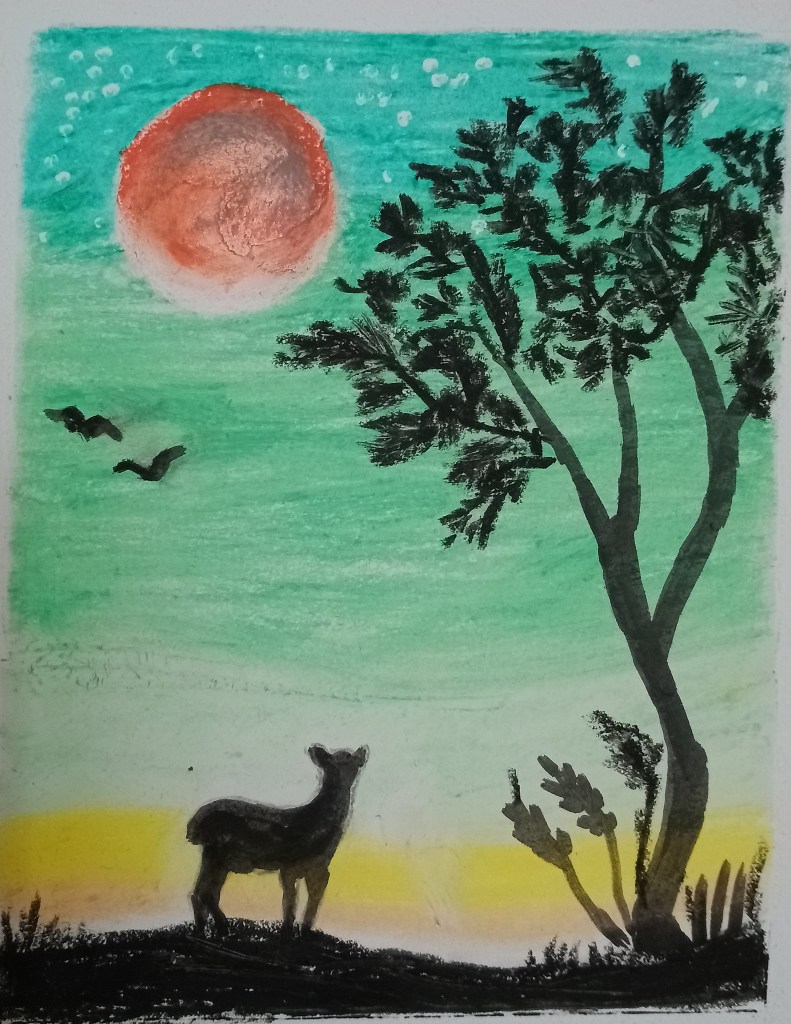
Written in 1910, Amar Sonar Horin Chai ( I want the Golden Deer) is a popular Rabindra Sangeet that is often performed on stage. Seemingly simple, it explores the poet’s yearning for the intangible and ends with the sense of euphoria generated by his quest for the impalpable.
Sohana Manzoor’s interpretation in pastel & ink of ‘Amar Sonar Horin Chai’
The Golden Deer

Regardless of what you say,I want the golden deer.
Enchanting,nimble footed,I want that golden deer.
He runs startled,eludes our gaze,and cannot be tied.
If he comes within our reach,he escapes puzzling our vision.
Chasing the elusive one who continues to evade capture
Through fields and forests,I lose myself.
Things that you can buy in bazaars are stored in homes.
Why do I look for that which cannot be bought?
I lost what I had while yearning for the intangible.
Do you think I am grieving for my lost treasures?
I am content to live with a smile devoid of sorrow,
Disappearing in my mind amidst meadows and woods.
As a tribute to the 209th anniversary of Edward Lear, Rhys Hughes writes of his famous poem, ‘Owl and the Pussycat’, and writes a funny ending for it rooted in the modern day. Click here to read.
A compelling flash fiction by Suyasha Singh hovering around food and a mother’s love. Click here to read.
The Literary Fictionist
In A Lunch Hour Crisis, Sunil Sharma raises humanitarian concerns that though raised in a pandemic-free world, have become more relevant and concerning given our current predicament. Click here to read.
Anasuya Bhar explores the various lives given to a publication through the different edited versions, translations and films, using Tagore as a case study and the work done to provide these online. Click here to read.
Prithvijeet Sinha uses Gaman (Departure), a Hindi movie around the pain of migrant workers, as a case study to highlight his contention that lyrics and songs convey much in Indian films. Click here to read.
Bhaskar’s Corner
In Manoj Das – The Master Storyteller, Bhaskar Parichha pays a tribute to one of the greatest storytellers from the state of Odisha, India, Manoj Das( 1934-2021). Click here to read.
Bhaskar Parichha reviews Raising a Humanist by Manisha Pathak-Shelat‘s and Kiran Vinod Bhatia. Click here to read.
Interviews
Communication scholars and authors, Manisha Pathak-Shelat and Kiran Vinod Bhatia, discuss how to bring up children in these troubled times, based on their book, Raising a Humanist, which has just been released. Click here to read.
Sonya J Nair of Samyukta Poetry talks about the Samyukta Research Foundation and its affiliates and its festival, Anantha. Click here to read.
April and May have been strange months — celebrations withered to anxieties. As the pandemic took on demonic proportions in its second wave, devastating millions with death and darkness, paralysing with the fear of losing friends and relatives or ones’ own life, festivities gave way to mourning. April this time truly seemed like the cruellest month as expressed by TS Eliot in the start of the Wasteland, turning our joyous thoughts on healing to a devastating reality of swirling smoke of pyres and graves that continue to throng certain parts of the world. However, mankind needs hope like the Earth needs rain, hope to survive. Great literature and writing inspire to give just that.
This month is also the birth month of three greats who were able to generate that kind of hope with their work: Rabindranath Tagore, Edward Lear and Kazi Nazrul Islam. We launched our new Tagore section on May 7th with Aruna Chakravarti’s translations of the maestro, Songs of Tagore. Do visit us at Tagore & Us to read them and more. We plan to keep adding to this section on a regular basis. This time we have Bengal Academy Award winner Fakrul Alam’s translations of six seasonal songs of Tagore, a translation from Borderless of a poem by the maestro that is not quite accepted as Rabindra Sangeet as the tune was given by the eminent musician Pankaj Mullick. An essay by Dr Anasuya Bhar highlights different lives given to Tagore’s writing by his own rewrites, translations, and films – an interesting perspective. We also carry tributes to Tagore in verse from Ilwha Choi of Korea, Mike Smith of UK, Himadri Lahiri and Sunil Sharma from the poet’s own homeland.
We celebrated Edward Lear’s birthday with some limericks and Rhys Hughes essay placing the two century old writer’s poetry in the present context and a hilarious conclusion to the sequel of Lear’s famous ‘The Owl and the Pussycat’. Upcoming is the birth anniversary of the rebel poet from Bengal, Nazrul. Sohana Manzoor translated a powerful essay and Shahriyer Hossain Shetu, a poem by this legendary writer who believed in syncretic lore and married a Hindu woman. Now the national poet of Bangladesh, Nazrul even wrote of Hindu Gods in many of his songs and essays – a lore that yearns for revival in the current day where politicians have fragmented the world by building more walls, using the names of religion, race, economics, caste and culture.
We have a poem from Pakistan by eminent poet Akbar Barakzai translated by Fazal Baloch using the lore of Samuel Becket’s Godot and yet another translation from Malayalam by Aditya Shankar of Sujith Kumar’s poem. Our poetry section is exciting with an exquisite poem from Jared Carter on a yeti, resting on the ephemerality of its presence; a funny one from Rhys Hughes and a diversity of poets from many countries, including Bangladesh. We also started a new column called Nature’s Musings which will combine poetry or prose with photographs by award-winning photographer Michael Wilkes and Penny Wilkes, who joins us now as a writer-in-residence.
In stories, we carry a COVID narrative by a real doctor, Shobha Nandavar, based in Bangalore and interestingly another about a doctor, the first women to adopt the medical profession in Bengal. Sunil Sharma in his narrative has highlighted a crisis in humanism. There are many more stories which would make for an interesting read. In musings, other than Devraj Singh Kalsi’s witty take on countries without Nobel Laureates, we have a Canadian writer’s perception of death rituals in Japan. Sybil Pretious has shared with us her strange adventures within China this time. Don’t miss the backpacking granny!
The May issue has a wide range of essays and musings ranging from Candice Louisa Daquin’s write up on the need to trust instincts to Keith Lyon’s residency in the Antarctica with interesting photographs. He writes that you could wear shorts in summers! Bhaskar’s Corner pays a tribute to the Padmashree Odia writer who passed away last month of old age, Manoj Das.
Our interviews this time are more on practical issues than literary – with the two authors of Raising a Humanist and with someone who supported our Tagore section by inviting us to talk on it in an online festival called Anantha, Sonya Nair. A friend and an academic with decidedly avant garde outlook, she is part of the twenty-year-old peer-reviewed Samyukta Journal that homes many academics. Pause by and have a read to see how they serve.
I would want to give heartfelt thanks to Nidhi Mishra and Archana Mohan for hosting Ms Sara’s Selections from Bookosmia this time as they help many battle the pandemic with hope, especially young children growing up in a world inhibited with masks and social distancing. I would also like to thank all the writers and my whole team for rising above the darkness by helping us get together this issue for our readers who I hope do find solace in our pages. And thank you readers for being with us through our journey.
There is a lot more in our pages than I have written. Do take a peek at this month’s issue and enjoy.
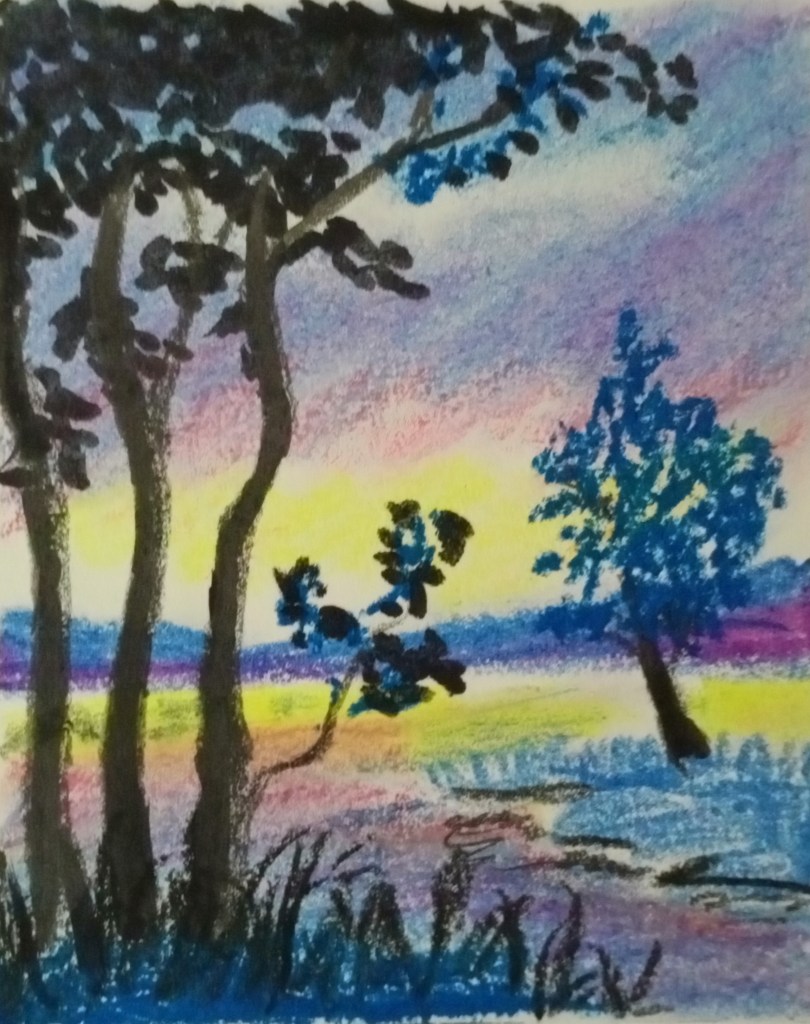
Originally written as a poem by Tagore called ‘Shesh Kheya‘ in 1907 and then set to music in 1922 by Pankaj Mullick, ‘Diner Sheshe Ghoomer Deshe‘( At the Close of the Day in the Land of Sleep) is a solemn song, which seems to cry out with an unfathomable yearning for an unknown fate.
Sohana Manzoor’s pastel that was inspired by Tagore’s Diner Sheshe Ghoomer Deshe
The Last Boat

At the close of the day, in the land of sleep, a veiled shadow
Makes me forget, forget my life.
On the other bank, a golden shore edges the gloaming,
Which like an enchantress disrupts my work.
The wayfarers who head back after completing their task,
Do not look back at the trail they leave behind.
Like a receding tide, intoxicated, I am drawn away from home.
The dusk sets in as the day leaves.
Please come, o ferryman, one
Who can row me across on the last
Ferry at the end of the day.
In the dusk, a few ferries ebb with the tide
To the other side.
How will I recognise the ferryman among the other ones
Waiting at the arrival to take me to my destination?
Downhill, by the thick vegetation at the bank,
The shade moves like a shadow.
Where is the ferryman who is willing to halt
When I call out?
O come,
The one who will row me
At the close of the day in the last ferry.
Those who were returning home have gone back.
Those who headed for the riverside have reached the banks.
The dusk calls out to one
Who is neither at home nor at the riverbank, but stuck mid-way.
Flowers do not bloom for those whose crops did not yield harvest —
When I try to shed tears, it turns into sorrowful mirth —
He who has turned off the daylight, did not light up the dusk.
He is the one who sits by the riverbank.
Please come,
O ferryman who will row me across
At the close of the day in the last ferry...
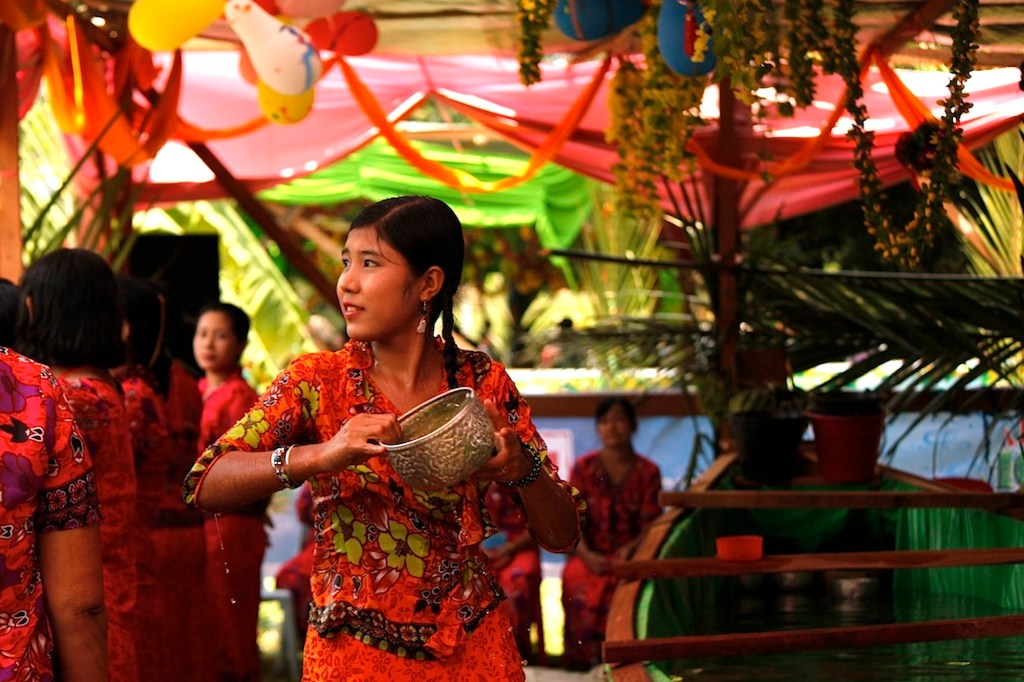
We wish all our readers and writers fabulous varieties of new year celebrations across Asia! We also complete one year and waft towards a new beginning. We have had some alterations as you know over the last few months — new faces on our board and writers in residence. Now, in addition to hosting writers from across all borders and ages, we have decided to also become an online forum for translated Tagore songs and writings. This will be launched on Tagore’s Birth Anniversary — 7th May. We hope that the transcreations in this section will take the treasures of the great writer and philosopher closer to the non-Bengali speaking populations from all over the world. We will try to retain the spirit of his poetry and attempt to recreate the impact of the Bengali verses for everyone who can read in English. We have already started with transcreations of about half-a-dozen of his songs. Do take a look and tell us what you think.
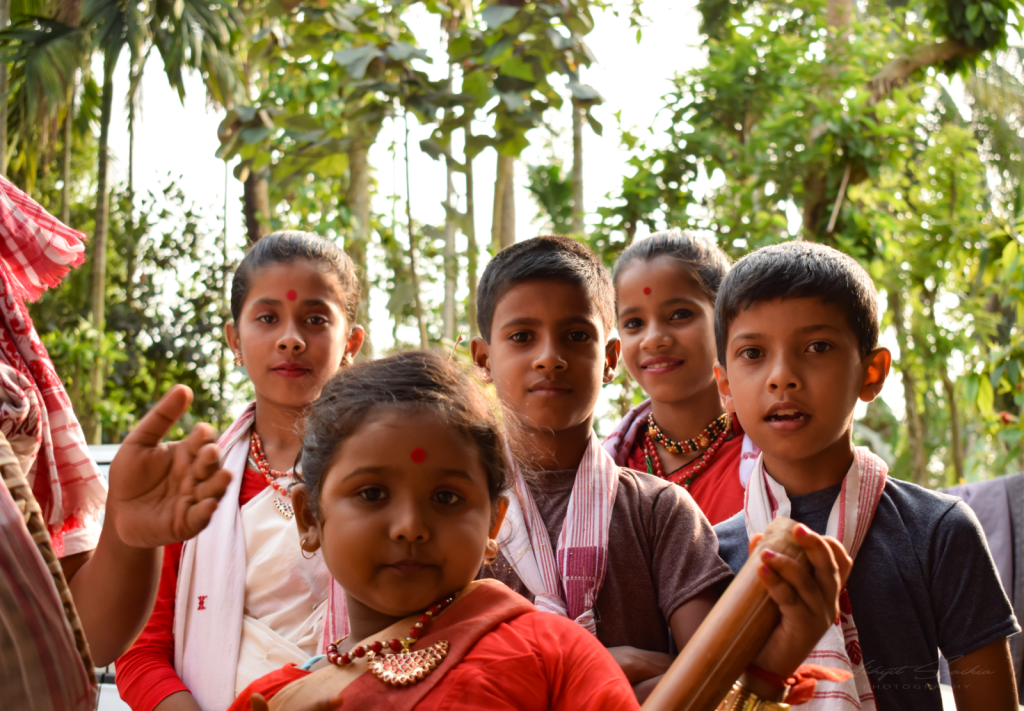
To celebrate our diverse new years, we have a musing by Sohana Manzoor. Did you know that Pohela Baishakh or the Bengali New Year is a national holiday in Bangladesh and is observed on the 14th of April each year?
A new year bodes a new beginning, a new sunrise and a new day — a new bunch of experiences. That is why our theme this time was new beginnings. What did we have in the beginning? Dylan Thomas tells us —
In the beginning was the word, the word
That from the solid bases of the light
Abstracted all the letters of the void;
And from the cloudy bases of the breath
The word flowed up, translating to the heart
First characters of birth and death.
On that theme of words, we have a fabulous poem by Balochi writer, Akbar Barakzai, who created a furore by turning down an award from the Pakistan Academy of Letters last year. His poem has been translated by Fazal Baloch. That is just one of the treasures. This time to celebrate this bouquet of new years across Asia, we have a bumper issue which includes, interviews with the 2020 Sahitya Akademi winner, Arundhathi Subramaniam, and academic-cum-writer Sumana Roy. Both poets have been kind enough to share a poem each with us. Arundhathi’s poem is inspiring and Sumana’s is a moving one about a tree, a tree that made history. We have powerful poetry from a number of other writers, Pushcart winner Jared Carter, Michael Burch, Sekhar Banerjee, Vatsala Radhakeesoon, Ihlwa Choi and of course our inimitable Rhys Hughes. Rhys has also started a column for us in which he will talk of poets, poetry and whatever else he chooses (within the confines of our magazine’s needs, of course). Our focus this year will shift even more towards quality of content.
In translations, other than Tagore songs and Baloch’s translations, we have Aditya Shankar’s translation of Malayalam writer, Shylan. A short story by Tagore from his famous collection Golpo Guchcho has been translated by Nishat Atya. To celebrate Tagore’s anniversary, we have essays by Meenakshi Malhotra and Sohana Manzoor too. Interestingly Sohana Manzoor’s essay has Tagore’s vision of Buddha — and Sumana Roy gave us a poem on the Bodhi tree, a tree under which the Buddha meditated his way to salvation! Looking at the sad situation in Myanmar, we definitely have a need for reviving Buddhism, a theme that has been touched on by well-known film critic, journalist and translator Ratnottama Sengupta, in her ponderings on the Silk Route. Branching off from the journey across Asia towards Europe and moving up north to Siberia is a narrative from our spunky back packing granny, Sybil Pretious. She writes of her travels all the way to Lake Baikal!
Devraj Singh Kalsi suffered personal loss and has given us a poignant in memoriam on his mother. Mike Smith takes us on a memorable nostalgic journey with postcards from the past with stories that want to make you weep. There is more on memorabilia with a photo-essay by Nishi Pulugurtha and a photo-poem by Penny Wilkes (have you ever adventured with one of these?). Sunil Sharma tried out a playlet! The other exciting and new thing is Bhaskar Parichha has started a witty column with us. We are calling it Bhaskar’s Corner! I won’t tell you what about but do take a peek!
Books reviewed are Paro Anand’s Nomad’s Land by Nivedita Sen — a book on migrants, a theme which is there in the piece on silk route too; Rudolf C Heredia’s Reconciling Differenceby Bhaskar Parichha and Candice Louisa Daquin has reviewed a book on cancer, The First Cellby Azra Raza. Our book excerpt is from a book on parenting,Raising a Humanist: Conscious Parenting in an Increasingly Fragmented World by Manisha Pathak-Shelat and Kiran Vinod Bhatia. An interesting read in a world of changing values. Our young person’s section run by Bookosmia owe a huge thanks to the untiring efforts of Nidhi Mishra and Archana Mohan. Thank you both. Thanks to the whole team for your immense support.
I have as usual not covered all the content in my note. I leave you to unfold the surprises! Much thanks to all our writers and readers for continuing to be with us!
Does she need an introduction? Arundhathi Subramaniam who has taken the world by storm with her poetry, reinforcing God, using English as a medium of writing over what we call a mother tongue, and voicing her stand on her own concept of national identity, and yet she has won the Sahitya Akademi award for 2020 for her collection, When God is a Traveller. She has broken rules that defined the modern literary world and moved towards creating her own individual brand of writing. Her writing is full of vivacity and makes the reader emote. She writes from the core of her being — that is clearly evident in the flow of her poems. Clarity, preciseness and perfection in linguistic usage enhance her ideas and grasp the reader in their fulcrum to lever their thoughts and emotions into her world. In this exclusive with Borderless Journal, read about Arundhathi’s journey.
Tell us about your journey as a writer and a poet. When and why did you start writing?
I’ve been excited by poetry for as long as I can remember, Mitali — the swing, the rhythm, the velocity, the precariousness of it. Thankfully, none of my early efforts at writing it have endured! But I composed many bits of doggerel as a child. In my adolescence and early adulthood, poetry was catharsis and emotional self-expression, as it is for so many. I think it was in my late twenties and thirties that I began to come into my own as a poet.
My first book, On Cleaning Bookshelves, happened in 2001. I felt I’d been waiting a long time to be published. But in hindsight, it was a good thing. It took me time to find the timbre of my voice, to allow it to embody a mix of assurance and doubt. At least I now began to know the poetry I aspired to. It is what I still aspire to — a kind of textured clarity, a poised uncertainty.
What gets your muse going?
I’m still finding out! I know some measure of quiet helps. Long days, devoid of agenda, help. And yet, so much writing also happens on flights, in cab rides, in coffee shops, waiting for a friend to arrive. Poems happen when I’m able to strike a certain creative tension between urgency and unhurriedness.
When you were a child, what were your aspirations? What did you want to become?
There was a fleeting aspiration at age five to join the army. But I think I realized pretty soon that the path to field marshaldom was an arduous one. It was always poetry after that!
In 1997 you had a life changing experience. What was it and has it impacted your writing?
It was a naked-wire experience of emptiness, if you will. A brush with life without form, without any graspable meaning. There was terror in it, but later, also a kind of freedom. I’m never quite sure what brought it on. But the experience faded in a week, leaving in its wake a strong, unwavering awareness that I needed to live my life differently, to commit myself to making my peace with this vacancy. That turned me into a seeker, first and foremost. All the writing – both prose and poetry – that came afterwards probably reflected this shift in some way.
What have been the influences that impacted your writing?
The literary influences have been as varied as all the poets whose work I’ve ever loved: TS Eliot, Basho, Wallace Stevens, Donne, Neruda, Rilke, Anne Sexton, Denise Levertov, Arun Kolatkar, AK Ramanujan, John Burnside, and so, so many more. But as my spiritual journey took on a certain momentum, I also rediscovered the Bhakti poets for myself, and realized they were an integral part of my literary lineage. They are my ancestral guides and companions, in a sense: Nammalvar, Annamacharya, Tukaram, Akka Mahadevi, among others. And there are so many other mystic poets I’d add to that list: Issa, Buson, Ryokan, Ikkyu, Dogen, St John of the Cross, Hafiz, Rumi, among them.
But we aren’t shaped only by what we read, are we? My life experiences have also impacted my writing. I’ve met some extraordinary people, had some fascinating conversations, travelled to some unforgettable places, had some deeply life-altering (and not always easy) experiences, and I’m sure all of those have contributed to who I am and how I write.
You have done a book on Sadhguru and another with him. What was it like working with him?
Sadhguru can be funny, profound, provocative, compassionate, a friend, a remote spiritual master — sometimes all in the course of a single interaction. So, I learnt to go into every book session, prepared to be startled. It’s been interesting — the way I have felt provoked, unsettled, singed, during many of our meetings, and still emerged, feeling oddly energized, invigorated, alive. As the writer of his biography, I was struck by the freedom he allowed me, his refusal to micro-manage the writing.
You have written books on Buddha and Sadhguru. Why did you opt to write on men associated with religion?
Well, I’ve also edited an anthology of Bhakti poetry, Eating God, and have a forthcoming book on four contemporary little-known women who walk the spiritual path in their own deeply individual ways, called Women Who Wear Only Themselves. So, my fascination is with the realm of the sacred – and not just with men who commit themselves to it, but with women too.
I am emphatically not fascinated with the exoteric aspects of religion. But I am interested in the nascent experiential insights around which faiths are often built. So, the Buddha has long interested me as the fearless amateur questor, the compassionate guide who showed us a direct path back to ourselves – one that allows us to bypass all the institutional middlemen who ‘sell water by the river’, as it were. Sadhguru fascinates me for similar reasons, as a contemporary mystic – irreverent, flamboyant, and deeply human all at once.
You have got God back into poetry. Eating God, a recent book of yours, even says it in the title. What made you opt for bringing God back in where the modern trend is to shun the spiritual? What is your perception of God?
Eating God is an anthology of sacred verse – of devotional poetry. So, it was difficult not to have god on the menu. The bhaktas wouldn’t have forgiven me for it!
My own book of poems, When God is a Traveller, also uses the word ‘god’. But the god of this book is not a deity in a temple, but a heroic adventurer who, like so many others in world myth, takes off on a journey around the world and returns to find the answers lie within him. So, the god, Muruga, is a kind of alter ego in this case; a pilgrim/ traveller/ vagabond archetype who mirrors us back to ourselves.
My perception of the divine? It’s still unfolding and is best implicated in poetry. So, let me simply share my poem, ‘Goddess – II’, with you. It’s from my most recent book, Love Without a Story.
Goddess II
(after Linga Bhairavi)

In her burning rainforest
silence is so alive
you can hear

listening.
Have you ever written in any other language other than English? Why?
No, I haven’t. English is my first language, and it is an Indian language. It may be ours due to unfortunate historical circumstances. But it is no longer a foreign import. It is as much ours today as democracy, or cricket, or chai, or the chili, or tamarind, or okra, or the nose ring! I have translated poems from Tamil and Gujarati into the English, however, working with fellow-translators for whom those are their first languages.
In your poem, To the Welsh Critic, you have said: “This business about language, / how much of it is mine, /how much yours”. By saying this, in a way you critique the commonly held belief that writers should write in their mother tongue to express themselves. Can you explain your views on this?
Well, I often say that my mother speaks many tongues. She is a Tamilian, raised in Burma and Delhi, married in Mumbai, and has chosen now to live in Chennai. Consequently, she speaks Tamil, English and Hindi fluently, and is now studying Spanish online! Like most Indians, she has bequeathed to me a multilingual inheritance. I grew up in Mumbai where I heard Bambaiyya Hindi, Marathi, Gujarati, Tamil and English around me. English, however, was the language I formally studied, and the language I heard plentifully at home, so it is my first language. It is the language I dream in, express rage and grief in. It is the language closest to my skin; it is the language I need, therefore, to write poetry in.
Rather than impose some doomed project of cultural jingoism upon ourselves, rather than try to aspire to some mythic state of cultural purity, it would make our lives infinitely richer and more exciting if we embraced our pasts. My ‘Welsh Critic’ poem is addressed to all those – in our country and elsewhere — who offer us absolutist formulae for belonging, who would have us believe there is only one way to be ourselves. As I say in the poem, ‘I stammer through my Tamil,/ and I long for a nirvana that is hermetic,/ odour-free, bottled in Switzerland’. My cultural identity is polyglottal, happily hybrid, and for those very reasons and other indefinable ones, I believe I am as Indian as they come.
How do you think language should be perceived? Should it be bound to the umbilical bonds? Or should a writer, like an artist, be free to choose his medium of expression — for language is merely his tool, his colour or paintbrush?
Language is and must always be about freedom of choice. Only when we choose freely can we express freely. Rather than chop and hack at a diverse cultural legacy, it makes sense to enjoy its abundance and savour its many flavours. This is why so many Indian poets I know are translators as well. We enjoy the challenges of bringing the textures and insights of one literature into another, opening up new worlds of aesthetic experience. I have worked for years as editor of the India domain of the Poetry International Web, a small but significant online archive of contemporary Indian poetry. It entailed working with poets working in over twenty Indian languages. The work on this website, as well as all my book of Bhakti poetry, has been about translation – allowing literatures to roam freely from one linguistic context to another.
It is time to talk unapologetically about the language of poetry. Poets everywhere recognize each other because of this kinship. It has nothing to do with jaded arguments around language politics. Those belong to politicians, not poets.
Some of your poems talk of establishing an identity as a woman and express a fierce desire for an independent existence. “I erupt from pillars, / half-lion half-woman.” Do you think this need is gender related? Or is it the call of poetry?
Well, yes, some of my poems do consciously assert a female identity. It is one of the many identities I own – alongside being Anglophone, Indian, contemporary, among other things. In ‘Confession’, the poem you mention, the entity that erupts from pillars, ‘half lion-half woman’, is clearly an allusion to the Narasimha avatar of Vishnu – and yes, I’m definitely presenting a female version of that archetype here. I remember the surge of freedom and joy when crafting that metaphor.
There is an early poem, ‘5.46, Andheri Local’, in which I speak of a women’s compartment in a peak-hour Mumbai local train being transformed into ‘a thousand-limbed, million-tongued, multi-spoused Kali on wheels’. And in my most recent book, I have a song for ‘catabolic women’ – women who are happily ‘unbuilding, unperpetuating, unfortifying, disintegrating’. These are some of the poems in which the female identity is asserted strongly, emphatically.
‘Catabolic Woman’ is a poem that binds you to both your identity as a woman and an Indian. Do you see nationalism as a necessary part of a writer’s identity?
Well, there’s a playful paradox in one phrase — ‘proudly Indian, anti-national’ — but other than that, the poem doesn’t really dwell on national identity. It’s more about growing into oneself as a woman (something that happens usually in one’s forties and fifties, or at least, did for me), a woman who’s no longer fooled by self-serving rhetoric, vested interests, hidden agendas. As I said of the poem, ‘To the Welsh Critic’, I see myself as deeply Indian. But I’m uncomfortable with dogmatic definitions of what it means to belong to a particular country, a particular faith, or even a particular gender. There are many ways of being not just Indian, but woman, as well. I would like to believe that my work reflects that complex sense of identity.
Tagore, perhaps the most acclaimed poet from India, wrote in the start of his essay on Nationalism, “Our real problem in India is not political. It is social.” Would you agree with that?
Well, I know that there are ways of belonging that lie beyond a glib cosmopolitanism and what I think Tagore called ‘the fierce idolatry of nation-worship’. Belonging anywhere is not about passivity. It is always an act of negotiation. It takes time to see plurality as a possibility, rather than a liability. As richness, rather than confusion. Countries everywhere are grappling with this in their own way – how to celebrate diversity, but without hierarchy, a diversity rooted in justice, in equality. That is our challenge too.
What is your perception of the role of a poet or writer in the world? Is it only aesthetics or something further?
We sometimes tend to polarize the morality-aesthetics debate. Being morally attentive doesn’t mean turning heavy-handed or perennially indignant, and valuing aesthetics doesn’t mean turning ethically laissez-faire or politically indifferent. The role of a poet, as I see it, is to be true to the way she sees the world and to use language with precision and thoughtfulness. A mix of authenticity and artistry, integrity and craft – both are essential to poetry.
Poetry alters human beings in very deep and enduring ways. But those changes aren’t accomplished by turning self-conscious, but by growing more conscious – aiming for greater exactitude and greater nuance, but without losing intensity, without losing the fire that burns, and must always burn, at the core of this art.
Thank you Arundhathi for giving us your time.
Photo Credit: Meetesh Taneja
This interview was conducted online by Mitali Chakravarty on behalf of Borderless Journal.








 Borderless