Categories
Notes from Japan

One Thousand Year Story in the Middle of Shikoku

Photographs and Narrative by Suzanne Kamata

I’d wanted to go on the Shikoku Mannaka Sennen Monogatari (One Thousand Year Story in the Middle of Shikoku) train trip ever since I saw it advertised on a poster in the window of Tokushima Station. When I investigated, however, I discovered one couldn’t begin the journey in Tokushima, where I live. Although it starts (or ends, depending on which way you’re coming from; it’s a one-way trip) deep in the mountains of Tokushima, I would have to change trains a few times before boarding the special sightseeing train. It would take hours to get there. A better way would be to board in Tadotsu, which is in the neighboring prefecture Kagawa. I could drive there in a little over an hour, take the fancy train to Oboke, and return by express train.

I decided to take a ride on the spur of the moment. The train was pretty much booked for the rest of the season, at least on the days when I didn’t have other plans, like my job. I did find one last seat on a train in mid-November. It might have been more fun to go with someone else, but I didn’t have time to coordinate with friends. I immediately booked the seat, reserving my lunch as well.

The morning of my train trip was chilly, but sunny. I donned a thin tunic and a long cardigan, wondering if it would be cold in the mountains. Maybe I should bring my down jacket? I rolled up a windbreaker and stuffed it into my backpack. I entered my destination – Tadotsu Station – into my phone’s navigation app, selected a podcast for the drive, and set off.

Tadotsu turned out to be a sleepy little town, which makes sense. These are the kinds of places that need something special to attract visitors and their money. If the whole purpose of these sightseeing trains is to rejuvenate dying towns, then Tadotsu seemed like a good choice. I could see that some construction was in progress, perhaps to accommodate the hordes of new visitors brought by the train. Porta potties temporarily served as bathrooms.

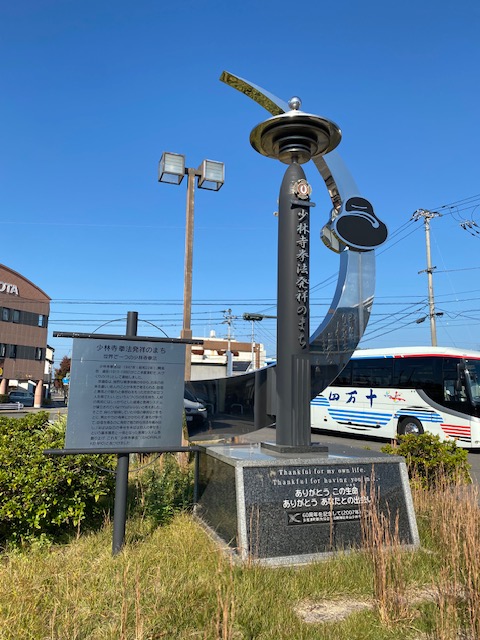
In front of the station, an intriguing sculpture attracted my attention. To me, it looked like a tall armless man wearing a hat, backed by a sickle. There was an emblem like a coat of arms where the neck of the man would be. At the base of the sculpture was a plaque with the words: “Thankful for my own life. Thankful for having you in it.”

Later, I discovered that it was meant to commemorate Doshin So, nee Michiomi Nakano, a former military intelligence agent who spent many years in China. After returning to Japan, he was stationed in Tadotsu, where he established a cram school to teach Buddhist philosophy and martial arts.

In 1947, he founded Shorinji Kenpo, a Japanese martial art with a holistic system. The training methods are divided into self-defense training, mental training, and health training. According to his philosophy, spirit and body are as one, and they must be trained together as such. His teachings emanated from this small town of about 20,000 people to the rest of the world. The emblem, as it turned out, was the symbol for Shorinji Kenpo.

I took a photo of the monument and proceeded to the train platform, where I was met with heavy equipment surrounded by a chain link fence. A sign apologised for this inconvenience, and explained that construction was underway to make the station barrier-free.

I was twenty minutes early, but my fellow passengers – Japanese, as far as I could tell – were already milling about, taking selfies and photos of each other in advance of their train trip. The group was mostly female, middle-aged, and older. Many people were wearing masks.

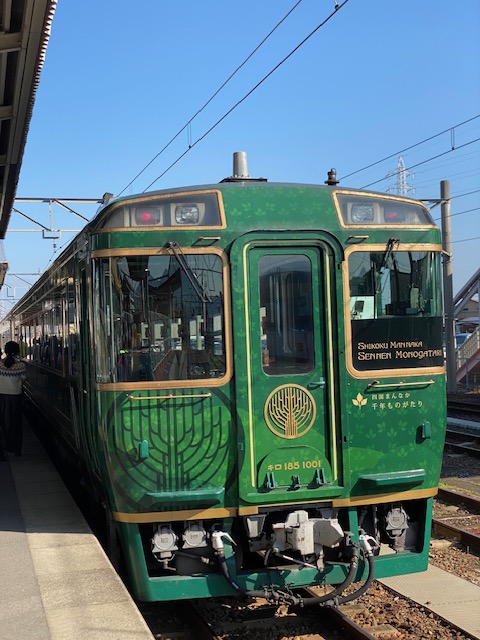
A cinematic melody heralded the approach of the train, accompanied by another rush for selfies and photos. The three cars, all different colors, were named after spring, summer, and fall. What happened to winter? A small doormat with the train’s motif, which resembled a stylized tree, was positioned on the platform at the entrance to the train. I boarded the green “spring” car, Haru Akari, and found my seat, a fuzzy green upholstered chair at a table against the wall, facing the window. The two seats next to me were unoccupied.

Most people wore casual clothes. I rarely saw folks from Tokushima get dressed up, unless it was for a wedding, say, or a graduation ceremony. One woman at the four-top on the other side of me was striking in a sumptuous Chinese-style jacket and gold barrettes. I wondered for a moment if she might be some kind of celebrity. I tried not to stare.

I examined the orange cloth placemat, again with the tree motif. Already my mouth was watering. Disposable chopsticks and a wet napkin were aligned at the bottom, while a spoon rested on a rectangle of granite. Paper napkins, toothpicks, and creamers were tucked into a small basket made of vines. Brochures detailing the train’s route, souvenirs for purchase, and additional menu items were laid out.

You could use your phone to scan a QR code and order keychains, sweet potato cakes, or a yusan-bako, a traditional lunch box which originated in Tokushima. This one was made of Japanese cypress adorned with Kagawa lacquerware. It had three drawers for various delicacies, which fit into a box with a handle, perfect for toting to a picnic in a meadow somewhere. You could also buy a CD with the train’s theme song.

I had already ordered my lunch, but I glanced at the menu anyway. Fish cutlets, another specialty of Tokushima were available, along with bamboo shoots, and ice cream made with sake lees. The sweet potato crumble, with a dollop of whipped cream, was also tempting, but I summoned my willpower.

One of the uniformed attendants pointed out the wooden box under my car for storing my backpack and purse. I got those items out of the way. She also handed me a coupon for soup and water to be redeemed at our first stop. And then finally, the train began to move. A whistle blew. Japan Railway employees and others lined up with flags and round paper fans and began waving at us. We all waved back.

After that enthusiastic send-off, the train began to trundle along the tracks, picking up speed as we zipped past backyards of houses, apartment buildings with laundry hanging on balconies, convenience stores, crows alighting on power lines, an empty playground. We passed rice paddies, some surrounding family gravestones; a construction site with bright blue, green, and yellow earth moving machines.

As we neared Kotohira Station, our first stop, a young woman chirped that Kotohira’s brass band had been declared second best in the country. She reminded us to redeem our coupons in the welcome center. After the train had stopped, I followed everyone into a small room adjacent to the station where we lined up at a counter. I handed over my little piece of paper and received a bottle of water and a small China cup of kabocha 1potage. I perched on the padded bench to drink it, while gazing around at the proud display of photos of the award-winning high school band. A white-gloved attendant came around with a tray to collect my empty cup, and I got back on the train.

A young Chinese family – a couple and their plump baby – were now occupying the seats beside me. The train moved on. The view outside my window was now more expansive – terraced fields, occasional houses with tiled roofs and walled gardens, tufts of pampas grass, a patch of pink and magenta cosmos.

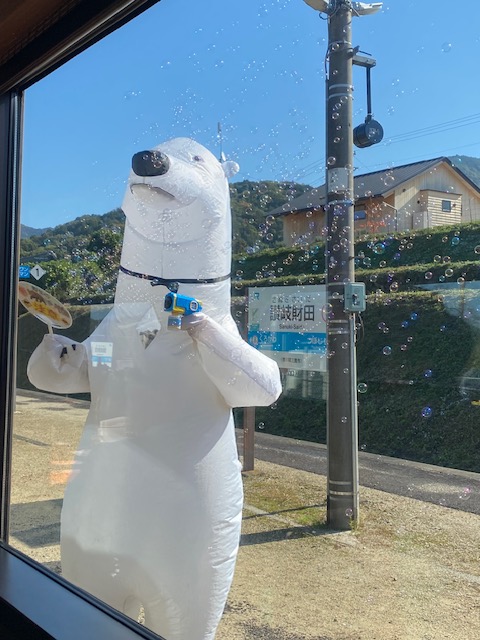
The voice announced that we were nearing Sanuki Saida Station, which boasts a 700-year-old tabunoki tree, said to be a “power spot.” Apparently if you stand under the tree, you can absorb some of its spirit and energy. The tree has also been designated a Kagawa Prefectural Protected Tree. The train came to a stop again, but this time we didn’t get off. Instead, we all whipped out our smartphones to take photos of the person dressed in a polar bear costume shooting soap bubbles from a bubble gun. The baby was delighted.

Once we were again underway, the attendant distributed large square bento boxes with gold-rimmed lids. I opened mine to find an array of chilled meat dishes – the first course. I unsheathed my disposable chopsticks and broke them apart. “Itadakimasu!2

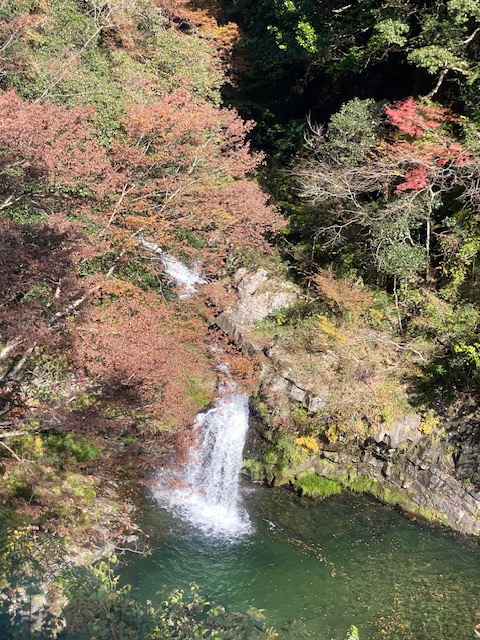
Out the window, farmland had given way to gnarly brush. `Although the foliage wasn’t quite at its peak, swatches of scarlet and gold popped against the greenery. I wondered about the wildlife in the mountains. I knew that there were monkeys, boars, and deer. The latter two appeared on menus deep in the interior of Shikoku. You could get a burger made with game meat, or “peony hot pot,” in which thin slices of pink boar meat curled up like flower petals after being cooked in miso broth.

Next to me, the young parents passed their good-natured baby back and forth. When I caught his eye, I smiled at him, and he showed his dimples, smiling back. I remembered how, when I had first come to Japan, whenever I had tried to engage with a stranger’s baby on the train, the baby’s face had crumpled up in terror. Apparently, big-nosed foreigners were scary even for infants. At least back then. It was nice to be able to engage with a small child without causing tears.

We made a brief stop at Tsubojiri Station, a small, unmanned station accessible only by switchback, surrounded by trees. “You can get off the train and smoke,” the voice announced. We all scampered off the train, but I didn’t see anyone light up a cigarette. Instead, passengers posed in front of the station’s sign and the weathered wooden building.

Back on the train, the next course was served – buttered rice and pork, arranged on a gold-rimmed China plate. The narration continued. “Please look to the right. You will be able to see Mount Hashikura. You can take a ropeway to Hashikura Temple, which was established by the famous Buddhist monk Kukai, also known as Kobo Daishi.”

Kobo Daishi is known as the father of Shikoku’s 88-Temple Pilgrimage. Hashikura Temple is not one of the 88, but is considered to be an associated temple. According to the Tourism Shikoku website, the name “Hashikuraji” contains the character for “hashi,” or chopsticks, “an everyday unifying ubiquitous tool of daily life for all Japanese. In 828 [CE], Konpira Daigongen revealed himself to the priest Kukai and promised to save all who use chopsticks, a pledge of salvation for all.”

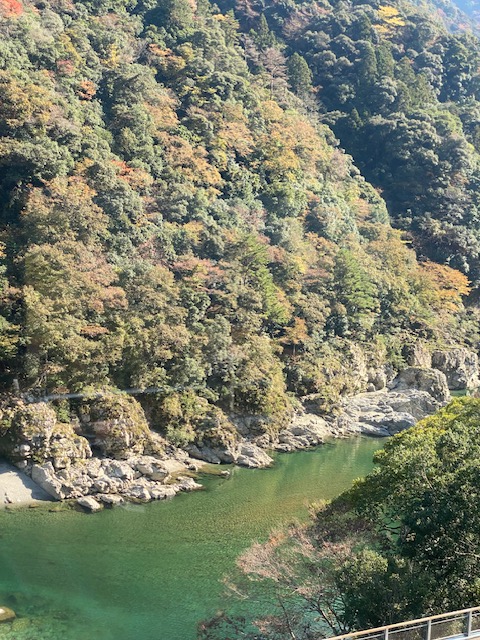
According to an announcement, we would soon have a good view of the Yoshino River, the majestic “wild” river which runs west to east across Shikoku. Its rushing waters carved out the Oboke Gorge over millennia. This river flows 121 miles, past Tokushima City, and the house where I live, and into the Kii Channel. At one time, it flooded repeatedly. The “Tora-no-Mizu” (“Tiger’s Water”) flood of 1886 (Year of the Tiger), one of the worst floods in Japanese history, led to the deaths of an estimated 30,000 people. Now, however, strong levees keep the waters in check, though heavy rains can still shut down the roads nearest the river. These days, the Yoshino River is more known as a place where visitors can enjoy various forms of recreation including swimming, fishing, and white-water rafting.

As I gazed out at the glassy emerald waters, which reflected the rocky banks, the voice announced that we were approaching Awa-Ikeda. High school baseball, I thought. Sure enough, the voice told us that we would soon have a view of baseball players practicing at Ikeda High School’s diamond, and that they had once won the National High School Baseball Tournament at Koshien.

The train chugged on. We passed another station, Awa Kawaguchi, where another person in a polar bear suit filled the air with soap bubbles. A sign on the platform declared that this was a town where tanuki (an indigenous animal that is often called raccoon-dog, and is a notorious trickster in Japanese folklore) and people live together.

After traversing another tunnel, coffee was served with a petite madeleine. Outside the window, I could see the water rushing through the gorge, frothing over rocks. We were almost at the end of our thousand-year journey. It had lasted a little over two hours.

The train pulled into Oboke Station, in the town of Miyoshi, and we got off. We were greeted by a man wearing a woven peaked hat and happi coat, banging on a drum affixed with characters from the animated series Anpanman. Although my fellow travelers had been mostly Japanese, quite a few European and American tourists were milling around the station, perhaps waiting for transportation.

At the time I first visited, over thirty years ago, I recall no restaurants or hotels, but now there was a large roadside station with souvenir shops, food vendors, and a Yokai House. There was even yokai3-themed food. Some traditional houses have been refurbished as high-end inns.

I took a short walk around the area and then attempted to buy a return ticket on an express train. Although the station was now geared for tourists with English signage and souvenir shops, it was still old-fashioned in many ways. I realised it wasn’t equipped to deal with phone apps or credit cards. I hadn’t brought a lot of cash, but I had just enough to buy a ticket back to my starting point.

  1. A variety of winter squash ↩︎
  2. I humbly receive (feel grateful for the food) ↩︎
  3. A spirit having supernatural powers ↩︎

Suzanne Kamata was born and raised in Grand Haven, Michigan. She now lives in Japan with her husband and two children. Her short stories, essays, articles and book reviews have appeared in over 100 publications. Her work has been nominated for the Pushcart Prize five times, and received a Special Mention in 2006. She is also a two-time winner of the All Nippon Airways/Wingspan Fiction Contest, winner of the Paris Book Festival, and winner of a SCBWI Magazine Merit Award.

PLEASE NOTE: ARTICLES CAN ONLY BE REPRODUCED IN OTHER SITES WITH DUE ACKNOWLEDGEMENT TO BORDERLESS JOURNAL

Click here to access the Borderless anthology, Monalisa No Longer Smiles

Click here to access Monalisa No Longer Smiles on Amazon International
Categories
Slices from Life

Honeymoon Homecoming

By Meredith Stephens

“Please show me your international driver’s licence.”

“Certainly!”

Alex produced the licence.

“This is out of date! I’m sorry but we can’t hand over the car.”

“No! It’s current! It’s valid for five years.”

We scrutinized the licence. The start date was prominently displayed, but not the expiration date. As we squinted to decipher the fine print on page three, we discovered that it had expired three years ago. Alex had thought it would be valid for five years, but it was only valid for one. We attributed it to his light-heartedly referred to “OCD Deficit Disorder”. And that is how a one-week road trip suddenly became a public transport and taxi trip.

This was my first visit back to Japan after having left at the beginning of the pandemic. Alex and I had been deliberating where to spend our honeymoon, and we agreed that the island of Shikoku in western Japan where I had spent over twenty years would be our first choice.

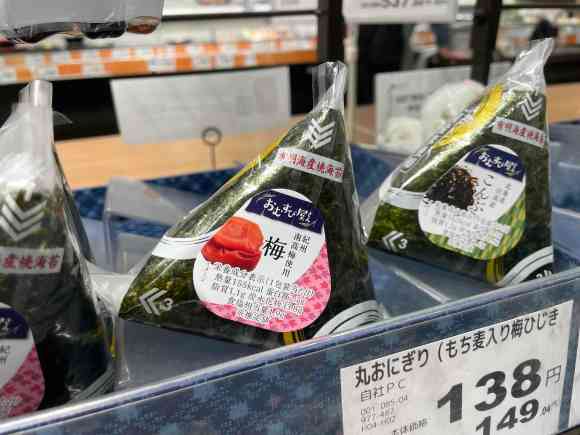
Onigiri. Photo courtesy:
Mariko Hisamatsu

There were so many things to look forward to. The first thing I did, before even leaving Kansai Airport, was rush into the convenience store and buy an onigiri flavoured with an umeboshi pickled plum. An onigiri is a triangle of rice, with a choice of flavours in the centre such as fish, seaweed, or the aforementioned umeboshi. It is wrapped in a crisp sheet of seaweed. Before eating it you gently pull away a thin layer of wrapping which protects the outer seaweed from absorbing the moisture of the rice. As you bite into it you can enjoy the three distinct textures and flavours – the piquant centre, the contrasting bland rice, and the crisp outer layer of seaweed. Next, I purchased a mugwort daifuku. This is a Japanese sweet, consisting of a layer of pounded mugwort-flavoured rice around a centre of sweet azuki bean paste. All of this was washed down with a bottle of green tea.

From the above account, it might sound like I was returning to Japan to indulge in simple culinary delights from a convenience store, and maybe this is a possibility I am unwilling to admit to myself. Of course, the main purpose was to reconnect with old friends, the second to reconnect with old pleasures, such as the aforementioned onigiri and daifuku, and the third, to stay in a traditional Japanese house.

After having been refused permission to drive our hire car, we headed back towards the terminal and searched for the railway station. We caught trains out to the UNESCO heritage listed site of Koyasan to enjoy the autumn leaves, and then seven trains and two buses later, to Wakayama station. Finally, we caught a taxi to our accommodation, which turned out to be a house that was over two hundred years ago, dating from the end of the Edo Period.

The door slid open to reveal an earthen floor. We walked down the hall to the kitchen, left our shoes in the sunken area, and donned the provided slippers. The kitchen opened onto two traditional tatami rooms, with fusuma sliding cupboards, and latticed paper shoji screens leading onto the garden. Beyond the shoji was a narrow hall known as an engawa, with a small wooden table and chair where you could enjoy sipping a drink while looking out over the garden. This was the kind of room I had been longing for during my five years away from Japan.

But we hadn’t had dinner yet and I was longing to ride to a local supermarket to purchase a ready meal.

‘“Do you have any bicycles?” I asked the host.

“Certainly. We have mountain bikes too!”

“You don’t want to go cycling in the dark?” queried Alex. “Not after a long-distance flight, seven trains, two buses, and a taxi ride? Surely not!”

I insisted, and Alex gave up persuading me otherwise. Rather than a mountain bike I chose the mamachari, a vintage bike replete with a shopping basket attached to the front handlebars.

We cycled to the supermarket, as I had done almost daily during my twenty years of living in Shikoku. There we bought sushi and sashimi ready meals, and cycled home, scanning to avoid roadside ditches with sheer drops and no guard rails. Once safely home, we indulged in the much longed for sushi and sashimi, enjoyed the traditional deep Japanese bath, spread out the futons on the tatami, and luxuriated in a deep sleep.

The next morning, we woke to a gentle light streaming through the latticed paper shoji screens. We cycled to Wakayama castle, Alex on the mountain bike and me on the mamachari. We strolled around the traditional garden before entering the castle and then completed it with a visit to the adjacent tearoom, where we enjoyed green tea and a sweet bean paste confectionery.

The following day, we bid farewell to our Edo Period home, and our kind host drove us to the ferry terminal. As soon as I saw the sign in Japanese for Tokushima, I could feel the colour rising to my cheeks. This had been my home in Japan for fifteen of my twenty years in Shikoku, until the day I departed for a routine visit to Australia, just before the international borders were closed due to COVID. Little did I know that the pandemic would prevent me from returning to Japan. I boarded the ferry as I had so many other times after returning from various work trips, but this time I was visiting on my honeymoon. The two-hour crossing readied me for the arrival in my old stomping ground and was heralded by the sentimental music played to signal a homecoming. Alex and I exited the ferry to be met by my old friend and writing mentor, Suzanne. Overcome with emotion, I covered my face with my hands to spare her the sight of my crumpled features and then gave her a hug. Then I went back to covering my swollen eyes and gave her another hug.

Platter of Sushi at Sally’s home. Photo courtesy: Alan Noble

Suzanne drove us to the home of the son of another old friend, Sally, who had kindly offered us a couple of nights’ accommodation. That evening a subset of old friends dropped in to see us and eat sushi. I braced myself for the entry of each friend into the house, trying to compose my features, after an unanticipated five-year interval. My eyes, however, betrayed me. I caught the expressions of those who returned by gaze, and they could sense my relief and excitement of meeting them again. Over five years people’s appearances were a little different. Those who had long hair now wore it shorter. Those with shorter hair had grown it. Those who were curvaceous were now svelte, and those who were svelte were now curvaceous. A child had now become a lanky teenager. I’m sure I must have looked different to them too. What had not changed was people’s smiles, conversation and sense of humour. People who I would normally see a few times over a month were now all present in the same room in the space of a few hours.

A few days later, we took the bus across Shikoku to Matsuyama, where another happy reunion took place of eight friends from six different countries. I was freshly aware of the joys of the expat life, where you can make friends from a greater range of countries, and a greater range of ages, than you would at home.

Ranma Carvings in a traditional room. Photo Courtesy: Alan Noble

I had been craving another stay in a traditional house, and we savoured a room with ranma carvings suspended from the ceiling, letting in light and air flow from the adjacent room. We sat at the kotatsu low heated table on the tatami, and slept on futon, in a room featuring shoji paper screens facing outside and fusuma cupboards where futons were stored. Features which had once seemed so ordinary were now infused with nostalgia.

Family obligations called us back to Australia after only one week of our Japanese honeymoon. A taxi was followed by a bus which took us on the long trek back across Shikoku, driving through impossibly long tunnels, crossing elegant bridges, with views of the sea and mountains. Once we crossed the final bridge onto the largest main island of Honshu, the landscape was transformed into high rise apartments, and dense traffic. We alighted from the bus at Kobe’s Sannomiya Station.

There we asked directions to the airport limousine bus and made a final purchase of onigiri. My favourite umeboshi pickled plum one was not on sale, so I had to make do with a tuna mayonnaise one and a pickled seaweed one. We ran to the bus stop, purchased tickets, and skipped into the bus holding our luggage. There was no time to store the luggage in the hold. Once the bus pulled into the traffic, we knew we could relax after our long and complicated journey. I gently pulled away the wrapping separating the layers of the tuna mayonnaise onigiri and savoured the contrasting flavours and textures. Our fleeting trip to Japan was punctuated by savouring onigiri on both arrival and departure. We bade farewell to this land of delectable tastes, exquisite arts, historic houses, hair-raising bicycle rides, and precious friends.

.

Meredith Stephens is an applied linguist from South Australia. Her recent work has appeared in Syncopation Literary Journal, Continue the Voice, Micking Owl Roost blog, The Font – A Literary Journal for Language Teachers, and Mind, Brain & Education Think Tank. In 2024, her story Safari was chosen as the Editor’s Choice for the June edition of All Your Stories.

PLEASE NOTE: ARTICLES CAN ONLY BE REPRODUCED IN OTHER SITES WITH DUE ACKNOWLEDGEMENT TO BORDERLESS JOURNAL

Click here to access the Borderless anthology, Monalisa No Longer Smiles

Click here to access Monalisa No Longer Smiles on Amazon International
Categories
Poets, Poetry & Rhys Hughes

Nomads of the Bone

A Poem Of Unsuccessful Excess

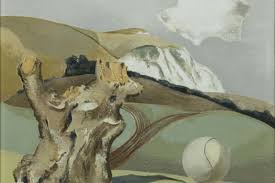
Art by Paul Nash (1889-1946)
Ogden Nash is the finest.
The snobs who dismiss his work
are knobs and jerks
whose heads should be examined
and given an F minus.
Of his talent they have not a tenth.
I mean, flipping heck!
Lacking depth is his strength.

And
now for some
HAIRY QUESTIONS…
Werewolf?
Whywolf? Howwolf?
Whenwolf? Whatwolf? Whowolf?

Questions like those never can
be answered
because the facts are tactless
and the fangs
will leave you gutless on nights
of a full moon.
The lycanthropic topic is one
best avoided
and thus I will always avoid it.

I made myself a sandwich.
I made it for my health.
I am a self-made man
despite my lack of wealth.

I made myself a promise
I would be a bitter gourd
cut into fancy segments
by an even fancier sword.

Unlike okra I’m not slimy.
If you ever dare to try me
I’m a vegetable Cockney,
I must say, “gourd blimey.”

Is that all?
No, it certainly isn’t.


Lady Rickshaw claims
we are all ghost ships
on the streets of cities,
drifting here and there.

That’s modern civilisation
for you: please join the queue
for the time machine.

But in more barbaric times
in chillier climes…

Our cavemen noses
glow in the cold.
They never grow
when we are old
but snowmen’s noses
linger for longer
and their nostrils
resemble craters.

The comet made from ice,
interstellar, vast,
oblivious, very fast,
will strike that fellah dead
when it hits his head.

And now
let’s take a trip to
ANCIENT GREECE

A gorgon’s internal organs
must be clever forgeries.
She turns heroes to stone,
in pairs or if they’re alone,
and when destiny calls
and Greece finally falls
those statues will be taken
to Rome, their new home.

But the gorgon’s heart
will never beat a rhythm
you can dance to.
It won’t thump like
a man-bull’s hoof-shaped
shoes, that’s true.
No swirling sonic brews
amuse our motley crews.

I’ve had better days
lost in this maze:
one time I almost
found my way out,
said the Minotaur…

Fenugreek Mythology
featuring Hercules
and Coriander leaves,
Turmeric and Ulysses,
Centaurs and Bottle Gourds
on a bed of saffron rice
is nicer to devour than plain
old Greek mythology.

Tell me honestly:
have you ever seen
A GHOST?

Death’s anniversary,
is a ghost’s birthday:
blowing out cake candles
with supernatural breezes
he teases the ectoplasm,
a professional phantasm.

Are spooks international?

I am turning Japanese
after a sneeze
because some wasabi
went up my nose.
Kimonos are my clothes.

Also, I play shogi
with my toes. (Shogi is a
kind of chess: I’m glad to
get this off my chest).

Now let’s have a
SELF-REFERENTIAL HAIKU

Counting syllables
when confronted with haiku
ruins the effect.

That’s done.
Where else can we find our fun?


Do you know the tale of
Patriarchy and Mehitabel?
Do you know the tail that
twitches on the windowsill?

The proof is in the pudding,
or so they say,
but I think I know a better way:
the waterproof
is in the puddling duck.

A vestige of a visage?
My face is the place
where my luck never runs out.
It may lack grace,
a waste of features
belonging to other creatures,
but each to their own.

The philosopher doesn’t like
my tone: he tells me
to ponder harder
but not to think about
swamp imps named Marsha.
Easily done: I don’t
know anyone with that name.

Harsher, he calls me timid,
says I am a coward.
Coward? But how?
I don’t know the meaning
of that word
but I can work it out
and applied to me it’s quite absurd.
It means to move
in the direction of a cow,
or many cows, a herd.

Have mercy if you’re thirsty.
Be ruthless if you’re toothless.

Do farm girls
grow on you over time,
seasonally?


A question I can’t answer
because I am a scarecrow.
No one planted me,
I do not grow. I do not know
a single thing.

But I can take a guess
about the mess
made by guests at dinnertime.
Billabong Monkeys
dunk their feet in the soup
in groups much larger
than gorillas are long.

Is that a SONG?
Somehow, I don’t think so.


And now
let’s have some
Soliloquies for Stringless Guitars.


Kiss her through the mask.
Miss her through the cask.

Foxglove Alley.
Weasel Stockings.
Garter Snakes, real and fake.
Rotten Shed and Rusty Rake.
I venture down
the Cul-de-Sac of Frogs.
I lost my way in the fogs.

That isn’t fog: it’s sand.
That’s no frog: it’s a panda.
Are you an understander?
There is no great demand
for sand disguised as mist
and so we insist you redo
the list of things you wish
to purchase in the sopping
shops that underwater lie.

Swinging on a garden gate,
it’s far too late
to palpitate at sunset
but the day’s still too early
to fly away and so you may
barbaric be,
barbaric bee, barbaric beer.

Beer comes in at the mouth.
Jokes come in at the ear.
Foam comes out of the nose.
POOR ATTILA lost his clothes
during a drunken stupor.
It’s not ideal but he is super.

Attila was very short.
Only one metre tall
and nocked with battle scars
at one centimetre intervals.
No wonder he was such
an effective ruler!

He wanted his wife
to call him ‘Darling’
in the marriage bed
but she insisted on
calling him ‘Hun’ instead.

Oh dear!
Have no fear:
King Lear has shed a tear
that splashes
on the lashes of the whip
that thickens cream
in dreams.

When I was younger
I had a narrow mind
and only thought of
narrow things:
tight corridors,
blocked canals,
mountain ledges,
malnourished gulls,
ladders designed
for stick insects,
crevices into which no
man could fall.

But now I am older
and think only of
wide things like
canyons and gulfs,
the open mouths that
shout bravo at gigs,
the taste in literature
of well-read people,
the square bases of
the mighty steeples
perched on churches
in historical towns,
the flapping gowns
of aristocratic vamps,
the pipe bowl of my
eccentric gramps and
the prehistoric snouts
of pigs snuffling for
unripe but fallen figs.

Listen closely, my dear…

My love for you
might sound hyperbolic
to hyperactive alcoholics.
But it will sound
perfectly fine to
good romantic folks.

Now here’s a thing:
sea roofs on the inside
are called sea lings.

Freshwater otters in Goa.
Salty authors in the shower.
Both are so clean
but only the latter dare dream
of rivers of cash.
The former dream only of fish.

FOR A FLUTE?

Love
for a flute
is holy love
because a flute without holes
is a stick
and love for sticks
makes me sick
but flutes have holes
thus my stomach will settle
at the base of the kettle
and I will laugh:
tea-hee cough-hee.

The frozen lion
thaws before he roars.


A thaw in the old ball bearings
and the machinery of his desire
began working again.

The machine marks time
like a strict examiner
puffing out his metal cheeks
in the weeks
before the summer holidays.

Do machines
really play the drums?


As a rule of thumb, yes!
Keeping the beat with steel feet.
How neat. What a treat.
The soul of the dance
is deep in the soles.
The heels heal the heart.

We have
our whole lifetimes
A HEAD of us
in which to try out
new hairstyles, she said.
She knew what
she was talking about.
The barber’s wife.

Mourning becomes Electra.
Evening becomes etcetera.

The gentle love drizzle
puzzles the riddler.
The lion is sizzling
in the meri jaan frying pan
over the fire
of our heartfelt desire.

And that’s
the end of the line
for the wandering rhymes
and the Nomads
of the Bone will soon end
up back home.

*meri jaan is an endearment in Hindi meaning my life

Rhys Hughes has lived in many countries. He graduated as an engineer but currently works as a tutor of mathematics. Since his first book was published in 1995 he has had fifty other books published and his work has been translated into ten languages.

.

PLEASE NOTE: ARTICLES CAN ONLY BE REPRODUCED IN OTHER SITES WITH DUE ACKNOWLEDGEMENT TO BORDERLESS JOURNAL

Click here to access the Borderless anthology, Monalisa No Longer Smiles

Click here to access Monalisa No Longer Smiles on Kindle Amazon International

Categories
Essay

From Madagascar to Japan: An Adventure or a Dream?

By Randriamamonjisoa Sylvie Valencia

For as long as I can remember, I have been an introvert — this is who I am and will always be. Yet, few believe it. I come from Madagascar, a distant island where the people are called the Malagasy — a community bound by culture, tradition, and a shared sense of identity. Malagasy people are known for their warmth and generosity, often revealing a talkative side as they delight in conversation, and playful exchanges.  In contrast, I am reserved — a shy person who expresses myself freely only when comfortable and among those I trust.

As a child, I was the most talkative among my siblings, recounting every detail of my school day to my parents. I delighted in describing the funny expressions my primary school teacher made while explaining lessons, or the mischievous boys who always stuck their chewing gum on the pupils’ desks and all the tasks I had accomplished. I wanted my parents to know I was doing well, that the teacher praised me, and that I helped classmates who struggled.

Both my parents are very talkative, especially my father, from whom I inherited the gift of words. Speaking in front of my family comes naturally, yet in front of others, my words often falter — a fear that has always troubled me. I speak freely only with those I know well— my family and a few close friends.

Facing a large audience has always been daunting. My father encouraged me to confront this fear, to be confident, and to meet the audience’s gaze. I tried many times: presenting in group projects, speaking as a class representative, even addressing an audience at a classmate’s parent’s funeral.

As I grew older, my determination to overcome this fear grew. I devoured books and videos on public speaking, eager to communicate with confidence. My first real test came in 2018, when I delivered a speech in a Japanese language contest. I had loved Japanese language since childhood, captivated by its culture, and dreamed of becoming fluent. Entering the contest was a dream — an opportunity to speak publicly and a chance to win a trip to Japan.

I was guided by two close friends who practiced with me daily. They corrected my mistakes, offered feedback, and most importantly, encouraged me. Having known me for years, they understood how terrifying standing on stage could be, yet they supported me out of love, friendship, and belief in my potential.

During rehearsals, I gave my utmost effort, memorising the script when necessary. Still, doubts lingered about meeting expectations, conquering fears, and not disappointing those who believed in me. The days of practice passed quickly, and soon, the big day arrived. Nervous at first, I gradually became more at ease while speaking. I managed to control my anxiety but knew my performance was imperfect. I focused on each word, yet my mind occasionally went blank, struggling with the judges’ questions. Embarrassment washed over me; I feared I had let my friends and family down.

In the end, I did not win the first prize, but my closest friends congratulated me. They reminded me that the true milestone was stepping onto the stage, speaking in front of an audience, and maintaining composure. Their encouragement helped me realise that courage and effort mattered more than the outcome itself.

As an introvert, talking to strangers is challenging, let alone addressing a crowd. Hearing the words “public speaking” makes my stomach tighten, palms sweat, and heart race. Stage fright, fear of facing many people and sharing my thoughts has always been real. Each time my name is called, I shake, my mind blanks, heart pounds, mouth dries, and confidence seems to vanish before I start. Yet, I have never lost hope. Deep down, I knew a strength within me would help rise above fear and grow into a better version of myself.

One year later, I stood again in the same contest. This annual competition was a goal I refused to let go of. As before, my friends encouraged, pushed, and trained with me every day until the D-day. Their support gave me the strength to continue. I prepared even more fiercely — joining language clubs and volunteering in storytelling activities. But it was not easy. I never felt comfortable speaking or working with strangers. I was told teamwork required discussion, sharing, and collaboration — a nightmare for an introvert.

Solitude had been my ally, yet suddenly, I was surrounded by people of all ages and personalities. Cooperation was no longer optional. However, through this challenge, I discovered an important truth: whether introverted or extroverted, whether silent or talkative, we must learn to connect with others. Survival and growth depend on collaboration and support.

The big day of the speech contest arrived in May, a season of transition between summer and winter. I arrived at the hall just in time, accompanied by a close friend. A staff member guided me to my seat, only a few meters from the judges. I felt cheerful, and calm, even giving a fist bump to nearby contestants. For the first time, I felt truly ready to give a speech — optimistic, and at peace. Perhaps it was the preparation or my friends’ wholehearted support, or maybe I had begun to trust myself.

There were four contestants in the advanced level, and I was the last to speak. Each of us hoped to win the grand prize — a trip to Japan. I did not worry about the others. I believed in my success and was determined to win first place. Just days before, I even dreamed of visiting Japan, so nothing could stand in my way.

Finally, it was my turn. I adjusted the microphone, greeted in Japanese, and bowed to the judges and audience. I spoke for about five minutes on how Malagasy parents raise children. Three judges asked each two questions. Thanks to countless practice hours and mock questions and answers sessions with my best friends, I answered every tricky question. For the first time, right after my speech, I felt like a winner.

The event lasted about three hours, and the final verdict came. The Master of Ceremonies announced winners, starting with the beginner level, then the advanced. Among the four in my category, only two remained. The Master of Ceremonies paused dramatically before announcing the first-place winner… and pronounced my name. I whispered a silent thanks to God. This result — the goal I had worked so hard for — had become reality. The trip to Japan was the reward, and even more importantly, I had overcome stage fright. I spoke naturally and confidently in front of the audience — another milestone achieved.

Later that year, in 2019, I visited Japan for the first time. The experience was magical. I met wonderful people, explored my favorite country, and fulfilled a long-cherished dream.

Six years later, I returned to the Land of the Rising Sun—this time as an international student. I now live in Tokushima prefecture, which is in southeastern Japan, far from the bustling cities, in a quiet countryside where few tourists venture. Yet, the city and its neighbourhoods are simply wonderful. It is peaceful, surrounded by greenery, and while the locals may seem reserved, they are incredibly welcoming. Even with some grasp of the local language, adapting to a new country as a foreigner is challenging. Still, thanks to the support of my seniors and friends who have lived here for years, I managed to navigate my first six months successfully.

The city where I live hosts an annual Japanese speech contest open to foreigners who have been residing here for some time. I was encouraged to participate, partly because I could speak some Japanese, and partly because it was a great chance to gain experience. I thought, why not? After all, I gradually grew more comfortable speaking in front of others.

This time, participants could choose their own topics, though it was suggested to focus on their experience in Japan or explore cultural connections between their home country and Japan. I was eager to participate, but selecting a topic was harder than I expected. Inspiration felt scarce, and I had no clear direction. Still, I knew that finding my own perspective was key to making the speech meaningful.

Overwhelmed by my studies, I barely noticed the passage of time. Before I knew it, the deadline had arrived. I had not written a single word, though ideas swirled in my mind. I opened my laptop, took a deep breath, and began writing everything that came to my mind. Reflecting on my experiences in Japan, I realised that people often struggled to pronounce my name correctly. That inspired me to talk about the hidden culture behind Japanese and Malagasy names.

With my theme set, I focused on making my speech coherent and captivating. I tend to draw inspiration at the last minute. I wrote, rewrote, and proofread repeatedly, staying up all night without noticing morning approaching.

Finally, I finished my manuscript and emailed it to one of my Japanese teachers to check for grammatical errors. She responded immediately, and her quick proofreading allowed me to submit my speech on the deadline. I felt relieved, yet strangely nervous, a sensation I could not quite describe.

Six years have passed since I last spoke in front of an audience. Preparing another speech made me feel nostalgic, bringing back memories of long rehearsals, the advice of my best friends, and countless sleepless nights.

A month after submitting my manuscript, I received an email from the event organizer announcing my selection. I was among the fourteen candidates chosen to compete. I whispered a quiet “wow,” but doubts immediately surfaced. I had two months to prepare. To understand what awaited me, I watched recordings of previous competitions, while my seniors and Japanese teacher helped me refine my speech.

Four students were selected from my university. The other three were Asian students with extensive experience in Japanese language and culture. They read Kanji (Japanese characters)effortlessly and conversed naturally. And then, there was me. Though I had been exposed to Japanese language and culture since childhood, memorising every character reading and grasping dialects was never easy. Back in my country, despite growing interest in Japanese language and culture, opportunities to use it in daily life remain limited. Once again, I faced a new challenge—this time in the Land of the Rising Sun.

Time flew, and soon the two months of preparation had passed. Finally, the big day arrived. Early that morning, a kind university staff member greeted us with a bright smile. As I descended from my dormitory, I saw her waiting by her car near the main gate, bowing politely. Her excitement was palpable. Three of us rode in her car; she asked about our preparations and told jokes, perhaps to ease our nerves, which were all visible.

After twenty minutes, we arrived at a large building and walked up to the fifth floor through corridors decorated in traditional style. Japanese architecture and design have always fascinated me, and I was struck by their beauty once again. The event hall was medium-sized, with a small table at the entrance holding our name tags.

One by one, the other candidates arrived. We were then led to a smaller room for a preparatory meeting. While waiting, we chatted briefly to get to know one another. The competition began in the early afternoon. We were instructed to enter the hall one by one, greeted with warm applause. Observing the other candidates, I could tell they were ready. Fourteen contestants competed in total. Thirteen were Asians from countries including China, Vietnam, India, Indonesia, the Philippines, Taiwan, Sri Lanka, and Thailand. I was the only African, from a distant country few people knew. Before each speech, the Master of Ceremonies shared a brief anecdote about the candidate’s country, offering the audience a glimpse into its culture. Each contestant then delivered a five-minute speech.

There were two types of awards: the Golden Prize for first and second place, followed by four Silver Prizes. I had hoped to place among the top five while preparing my speech.

As I listened to the first three candidates, I was deeply impressed. Their speeches were powerful, emotional, and delivered with near-native fluency. I was surprised by how advanced and impressive their speaking skills were. I was the sixth speaker. Perhaps it had been so long since I last addressed an audience, or perhaps it was the absence of my closest friends but standing alone in a foreign country in front of strangers was overwhelming. My hands trembled. When my name was announced, I feared I might not endure those five minutes on stage.

Still, I stood before hundreds of people. I bowed, held the microphone firmly, and began. My heart raced and sweat ran down my face and back. Gradually, the pressure eased. When I shared the example of the longest name in the world—from my country, the audience reacted with surprise and amusement. I realised how attentive they were and regained inner calm. Although I forgot one line, I finished my speech smoothly and expressively.

The remaining eight candidates were equally impressive. Their eloquence was such that, with eyes closed, one might mistake them for native speakers. It was the highest-level contest I had ever participated in. Each theme and presentation were unique, and every contestant spoke with confidence. I doubted whether I would receive a prize, but reassured myself that even without one, the experience was worthwhile. Most participants had lived in Japan for over three years, and the Chinese and Taiwanese contestants were especially strong in oral expression. Yet, standing among such talented competitors was an honor.

After a break that was supposed to last twenty minutes but stretched to fifty, results were announced. They began with six Encouragement Prizes. I thought I might be among them, but my name was not called. Two more awards followed, still not mine. A friend nudged me, whispering, “Congratulations!” I replied, “Stop joking. Congratulations to you instead!”

Finally, the Silver Prizes were announced. They first called my country, then my name. The applause and cheers overwhelmed me, and tears welled in my eyes. I had not expected to win a Silver Prize, given the competition’s level. One friend from my university won the Golden Prize, and the second Golden Prize went to a Vietnamese contestant.

Participating in such a high-level competition was a tremendous challenge. Every step—from manuscript preparation to standing on stage—pushed me beyond my comfort zone. Yet, when it was over, I felt immense pride. I had once again delivered a speech before a large audience, this time in the country whose language I had cherished for years.

Though I had been nervous, the audience remained unaware. Their attentive expressions and warm applause carried me through. Afterwards, my Japanese teachers praised my performance, saying I had done exceptionally well. In that moment, I realised every hour of preparation, every doubt, and every fear had been worthwhile. I had faced a formidable challenge, stood my ground, and expressed myself fully, a reminder that courage, practice, and determination can transform daunting experiences into triumphs. It is a memory I will treasure forever.

.

Randriamamonjisoa Sylvie Valencia is from Madagascar and is currently studying in Japan as a trainee student. She enjoys reading, writing, listening to music, and traveling to explore new cultures.

PLEASE NOTE: ARTICLES CAN ONLY BE REPRODUCED IN OTHER SITES WITH DUE ACKNOWLEDGEMENT TO BORDERLESS JOURNAL

Click here to access the Borderless anthology, Monalisa No Longer Smiles

Click here to access Monalisa No Longer Smiles on Kindle Amazon International

Categories
Editorial

Seasons Out of Time

Today, as I gaze in this autumnal light,
I feel I am viewing life anew.

— Tagore's Aaj Shororter Aloy (Today, in the Autumnal Light)
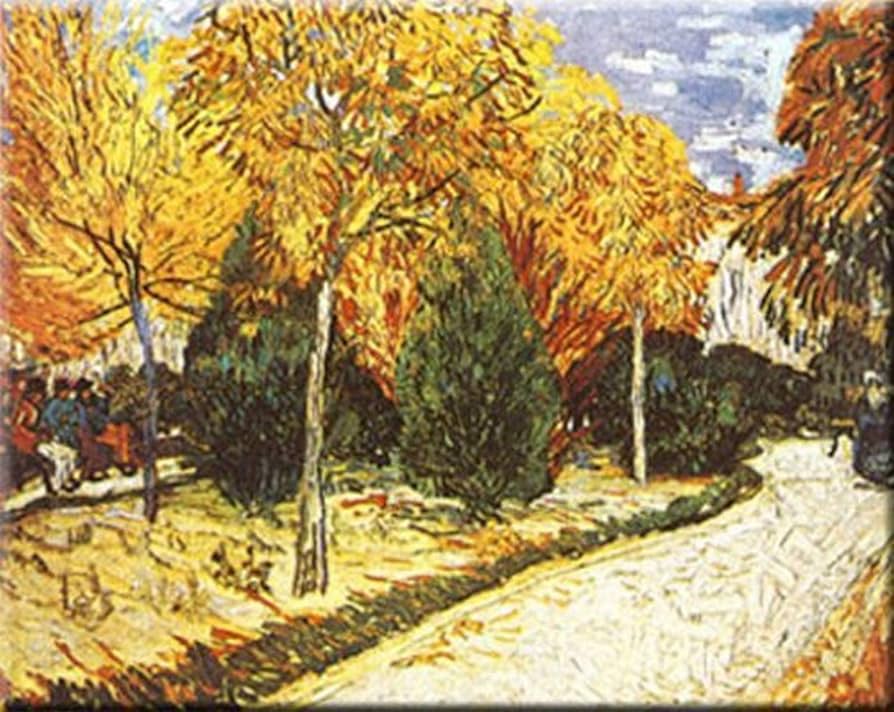
Autumn Garden by Vincent Van Gogh (1853-1890). From Public Domain

September heralds the start of year-end festivities around the world. It’s autumn in one part and spring in another – both seasons that herald change. While our planet celebrates changes, dichotomies, opposites and inclusively gazes with wonder at the endless universe in all its splendour, do we? Festivals are times of good cheer and fun with our loved ones. And yet, a large part of the world seems to be in disarray with manmade disasters wrought by our own species on its own home planet. Despite the sufferings experienced by victims of climate and war-related calamities, the majority will continue to observe rituals out of habit while subscribing to exclusivity and shun change in any form. Occasionally, there are those who break all rules to create a new norm.

One such group of people are the bauls or mendicants from Bengal. Aruna Chakravarti has shared an essay about these people who have created a syncretic lore with music and nature, defying the borders that divide humanity into exclusive groups. As if to complement this syncretic flow, we have Professor Fakrul Alam’s piece on a human construct, literary clubs spanning different cultures spread over centuries – no less an area in which we find norms redefined for, the literary, often, are the harbingers of change.

Weaving in stories from around the world, our non-fiction section offers parenting tips ( or are these really nerdy meanderings?) from Farouk Gulsara who looks inclusively at all life forms — big and small, including humans. Meredith Stephens brings us a sobering narrative with a light touch from the Southern Hemisphere. Prithvijeet Sinha takes us to explore an ancient monument of Lucknow and Jun A. Alindogan tells us “what’s in a name” in Philippines — it’s quite complex really  — it reads almost as complicated as a Japanese addresses explained in her column by Suzanne Kamata. In this issue, she takes us through the complexities of history in South Carolina, while Devraj Singh Kalsi analyses literary awards with a dollop of irony!

Humour is brought into poetry by Rhys Hughes, though his column houses more serious poems. Joseph C.Obgonna has an interesting take on his hat — if you please. We have poetry on climate by Onkar Sharma. Verses as usual mean variety on our pages. In this issue, we have a poem (an ekphrastic, if we were given to labelling) by Ryan Quinn Flanagan on a painting, by Ron Pickett on aging and on a variety of issues by Arshi, Joseph K Wells, Shamim Akhtar, Stephen House, Mian Ali, John Grey, Jim Murdoch, Juliet F Lalzarzoliani, Jim Bellamy, Soumyadwip Chakraborty, Richard Stimac and Sanzida Alam. We have translations of poetry. Ihlwha Choi has self-translated his poem on a dragonfly from Korean. Snehprava Das has brought to us another Odia poet, Ashwini Mishra. Tagore’s Aaj Shororter Aloy (Today, in the Autumnal Light) has been translated from Bengali. Though the poem starts lightly with the poet bathed in autumnal light, it dwells on ‘eternal truths’ while Nazrul’s Karar Oi Louho Kopat (Those Iron Shackles of Prison), transcreated by Professor Alam, reiterates breaking gates that exclude and highlight differences. In the same spirit as that of the bauls, Nazrul’s works ask for inclusivity as do those of Tagore.

We have more poetry in book excerpts with Sinha’s debut collection of poems, A Verdant Heart, and in reviews with veteran poet Kiriti Sengupta’s Selected Poems, reviewed by academic Pradip Mondal. Rakhi Dalal has written on Mohua Chinappa’s Thorns in my Quilt: Letters from a father to a Daughter. while Bhaskar Parichha has discussed Kalyani Ramnath’s Boats in a Storm: Law, Migration, and Decolonization in South and Southeast Asia, 1942–1962, a book that explores beyond the boundaries that politicians draw for humanity. The pièce de résistance in this section is Somdatta Mandal’s exploration of Aruna Chakravarti’s selected and translated, Rising from the Dust: Dalit Stories from Bengal. The book stands out not just for the translation but also with the selection which showcases an attempt to create bridges that transcend linguistic and cultural barriers.

Mandal, herself, has a brilliant translation featured in this issue. We have a review of her book, an interview with her, and an excerpt from the translation of Jaladhar Sen’s The Travels of a Sadhu in the Himalayas. Written and first published in the Tagore family journal, Bharati, the narrative is an outstanding cultural bridge which even translates Bengali humour for an Anglophone readership. That Sen had a strictly secular perspective in the nineteenth century when blind devotion was often a norm is showcased in Mandal’s translation as well as the stupendous descriptions of the Himalayas that haunt with elegant simplicity. 

Our fiction this month seems largely focussed on women’s stories from around the world. While Fiona Sinclair and Erin Jamieson reflect on mother-daughter relationships, Anandita Dey looks into a woman’s dilemma as she tries to adjust to the accepted norm of an ‘arranged’ marriage. Rashida Murphy explores deep rooted social biases that create issues faced by a woman with a light touch. Naramsetti Umamaheswararao brings in variety with a fable – a story that reflects human traits transcending gender disparity.

The September issue would not have been possible without contributions of words and photographs by many of you. Huge thanks to all of you, to the fabulous team and to Sohana Manzoor, whose art has become synonymous with our journal. And our heartfelt thanks to our wonderful readers, without who the effort of putting together this journal would be pointless. Thank you all.

Looking forward to happier times.

Mitali Chakravarty

borderlessjournal.com

.

CLICK HERE TO ACCESS THE CONTENTS FOR THE SEPTEMBER 2025 ISSUE

.

READ THE LATEST UPDATES ON THE FIRST BORDERLESS ANTHOLOGY, MONALISA NO LONGER SMILES, BY CLICKING ON THIS LINK.

Categories
Musings

A Journey through Pages


By Odbayar Dorj

Before I ever stepped into a classroom, I had already learned to read and write. Over twenty years ago in Mongolia, children typically started school at the age of eight. But I began a year earlier—at seven—already recognising the letters and words on the page.

I don’t remember exactly how I learned, but I do recall asking my mother, who worked at a school dormitory, to bring me a copy of the Tsagaan Tolgoi (Alphabet Book) from the school library. With the help of my grandparents, I memorized all 35 letters and began reading. Because my mother worked at a school, we often visited the homes of her coworkers. On one such visit, we stopped by the home of the school librarian, Mr. Bayaraa. I remember flipping through one of the literature books for older students and seeing a drawing of a giant with one eye standing before frightened people in a cave. Later, I realised it must have been The Odyssey. From that moment on, I was fascinated. I longed to read every book I could find—especially those with pictures and stories.

When I finally started school, I couldn’t wait to dive into books. But the first-grade routine quickly wore me down: we spent most of our time copying words neatly into our notebooks. Then our family moved from the countryside to the city, and I transferred to a new school. By fourth grade, I was enrolled in a class called Reading and Writing, which would later become Literature. It was my favorite subject. Our teacher encouraged us to borrow books from the school library and read outside of class. That was, without a doubt, the most exciting homework I’d ever been given.

Still, getting into the school library wasn’t easy. Our school operated in two shifts, and my classes were in the morning—from 8:00 to 11:00. I lived nearby and could be home in under five minutes. My grandmother always had lunch ready, usually a warm bowl of bantan. Those were some of my happiest moments.

In the afternoons, I would walk back to school and try to visit the library. But the teacher on duty at the entrance always interrogated me: “Where are you going? Who are you meeting?” I explained that I just wanted to visit the library. Even after getting permission, I often found a sign on the door that read: “Closed for internal work.” Many times, I left disappointed. The librarian never opened the door.

Everything changed when I entered junior high school and gained the independence to ride buses. I started visiting the National Public Library named after D. Natsagdorj. It took about thirty minutes by bus, and I could only afford to go once or twice a week. The library was mostly empty, except for a few elderly men reading newspapers. It used the old Soviet-era catalog system, which was difficult to navigate. Instead, I approached the librarian directly and told her the kinds of books I liked. She always picked something out for me, and even though I never knew what it would be, the anticipation became one of my favorite parts of the week. I spent many summer days in the tiny reading room, lost in stories. When the fall semester began and university students returned, seats became scarce. They, too, relied on public libraries for study space.

By the time I entered high school, our school librarian had changed. Finally, we were allowed to use the library after classes. It had a wide range of books—both Mongolian and international literature. It felt like a dream come true.

Years later, in 2020, my daughter started school. In Mongolia, we celebrate the moment children finish learning their 35 letters with a Tsagaan Tolgoi celebration—a joyful milestone that marks the beginning of reading and writing. Sadly, due to COVID, my daughter never got to experience that celebration. More than that, she never even had a chance to experience a library. Unlike my school, hers didn’t even have a library corner. Due to overcrowding, the library space had been converted into a classroom. After textbooks were distributed during the first few weeks of the school year, the “library” served no other purpose.

As a mother and a former student, I couldn’t help but feel heartbroken by this quiet loss.

Now, as I study in Japan, I’ve started volunteering as an English teacher for first- to fourth-grade students at a local elementary school. It was my first time being at a Japanese school not as a visitor, but as a teacher. Two retired female teachers welcomed me warmly and introduced me to the principal. I would start teaching on May 1st. Even though my Japanese was limited, I felt their kindness beyond words.

We visited the classroom—a spacious room, half of it open for movement and activities. I was shown the storage room where they kept teaching materials, including flashcards. I was given two weeks to prepare. I was thrilled—not just to be working, but to finally be using my professional skills.

I reviewed every flashcard, thinking carefully about how to incorporate them into my lessons. I created a 12-week lesson plan and excitedly prepared for my first class.

But the first class didn’t go as I imagined. Sixteen students joined the English club, and as soon as I started speaking in English, some children looked surprised. Because I am Mongolian and physically resemble Japanese people, many often assume I am Japanese. The students seemed confused—some even asked if I was pretending or acting, wondering why a “Japanese-looking” person was speaking to them in English. I had prepared fun activities like Simon Says and The Alphabet Song, hoping to create a lively atmosphere, but without help from the two retired teachers, it was hard to hold their attention. Somehow, I made it through the class, but I left feeling defeated.

Thankfully, the teachers encouraged me: “Don’t be discouraged,” they said. “Especially with first graders—it’s only been a month since they started school.”

I spent the following week stressed and unsure. How could I communicate with children from another culture? How could I teach kids of different ages and learning levels?

There’s a Mongolian saying: “If God doesn’t know, ask a book.” I realised books were my only hope.

Just like the times I hesitated to enter unfamiliar spaces in Japan, I found myself nervous about entering the university’s children’s library. But I gathered courage, walked in, and soon found myself surrounded by picture books in English.

There were so many beautiful titles—more than I had ever imagined. I felt I was more excited than the children. Since then, finding the right book for my students has become my favourite part of lesson planning. I spend hours reading reviews, flipping through pages, and selecting stories that are both accessible and engaging.

At the same time, I couldn’t help but reflect on how lucky Japanese children are. Back in Mongolia, many children grow up without ever experiencing a library. And here I am, surrounded by cozy furniture and shelves filled with books, just a few steps away from the classroom.

Every week, I arrive an hour early to prepare for class. Right next to my classroom is the school’s library—bright, welcoming, and full of choices. Sometimes I see the first graders visiting with their teacher, eagerly choosing books and settling into child-sized chairs to read. And I think of my daughter. I feel sad—not only because I miss her, but because I know she doesn’t have access to a space like this. At her school in Mongolia, there is no library—not even a reading corner. Watching these children enjoy books so freely makes me wish my daughter could experience the same joy and comfort that comes from being surrounded by stories.

I remember my childhood dream: to one day have a small children’s library of my own. A place where I could read aloud to children, draw with them, fold origami, and spend quality time. That dream has only grown stronger.

In Mongolia, there are very few children’s book authors. Most publishers produce simplified versions of Disney movies or classic tales, often filled with too much text to engage young readers. Finding the right book for my daughter has always been a challenge. That’s when I began to dream—not just of reading books, but of writing one myself. After all, books hold countless lives, stories, and dreams. They are entire worlds we can live in.

I miss my daughter very much. I often make a list of things we could do together—places I want to show her if she ever comes here, places I want to go with her. I especially dream of going to the library with her, choosing and reading books together. I want to read aloud to her the book I think is the most beautiful, and then watch what she imagines, what she draws, and what she creates after reading it.

Sitting here in my university’s children’s library, I felt like I became a child again, and I found myself wishing that children everywhere in the world could have access to a library like this—one that sparks their imagination. That’s when I began writing this essay.

Because libraries are not just buildings filled with books—they are spaces where children begin to dream. I hope that one day, more schools in Mongolia will make room for those dreams. And until then, I’ll keep turning pages, teaching stories, and imagining that little library I still dream of—for my daughter, and for so many others like her.

Odbayar Dorj is an international student from Mongolia currently studying in Japan. Her writing reflects on cultural identity, personal memory, and the power of connection across borders and generations.

.

PLEASE NOTE: ARTICLES CAN ONLY BE REPRODUCED IN OTHER SITES WITH DUE ACKNOWLEDGEMENT TO BORDERLESS JOURNAL

Click here to access the Borderless anthology, Monalisa No Longer Smiles

Click here to access Monalisa No Longer Smiles on Amazon International
Categories
Editorial

“Imagine all the people/Living life in peace”

God of War by Paul Klee (1879-1940)
The sky weeps blood, the earth cannot contain
The sorrow of the young ones we've slain.
How now do dead kids laugh while stricken by red rain?

— from Stricken by Red Rain: Poems by Jim Bellamy

When there is war
And peace is gone
Where is their home?
Where do they belong?

— from Poems on Migrants by Kajoli Krishnan

Poetry, prose — all art forms — gather our emotions into concentrates that distil perhaps the finest in human emotions. They touch hearts across borders and gather us all with the commonality of feelings. We no longer care for borders drawn by divisive human constructs but find ourselves connecting despite distances. Strangers or enemies can feel the same emotions. Enemies are mostly created to guard walls made by those who want to keep us in boxes, making it easier to manage the masses. It is from these mass of civilians that soldiers are drawn, and from the same crowds, we can find the victims who die in bomb blasts. And yet, we — the masses — fight. For whom, for what and why? A hundred or more years ago, we had poets writing against wars and violence…they still do. Have we learnt nothing from the past, nothing from history — except to repeat ourselves in cycles? By now, war should have become redundant and deadly weapons out of date artefacts instead of threats that are still used to annihilate cities, humans, homes and ravage the Earth. Our major concerns should have evolved to working on social equity, peace, human welfare and climate change.

One of the people who had expressed deep concern for social equity and peace through his films and writings was Satyajit Ray. This issue has an essay that reflects how he used art to concretise his ideas by Dolly Narang, a gallery owner who brought Ray’s handiworks to limelight. The essay includes the maestro’s note in which he admits he considered himself a filmmaker and a writer but never an artist. But Ray had even invented typefaces! Artist Paritosh Sen’s introduction to Ray’s art has been included to add to the impact of Narang’s essay. Another person who consolidates photography and films to do pathbreaking work and tell stories on compelling issues like climate change and helping the differently-abled is Vijay S Jodha. Ratnottama Sengupta has interviewed this upcoming artiste.

Reflecting the themes of welfare and conflict, Prithvijeet Sinha’s essay takes us to a monument in Lucknow that had been built for love but fell victim to war. Some conflicts are personal like the ones of Odbayar Dorj who finds acceptance not in her hometown in Mongolia but in the city, she calls home now. Jun A. Alindogan from Manila explores social media in action whereas Eshana Sarah Singh takes us to her home in Jakarta to celebrate the Chinese New Year! Farouk Gulsara looks into the likely impact of genetic engineering in a world already ripped by violence and Devraj Singh Kalsi muses on his source of inspiration, his writing desk. Meredith Stephens tells the touching story of a mother’s concern for her child in Australia and Suzanne Kamata exhibits the same concern as she travels to Happy Village in Japan to meet her differently-abled daughter and her friends.

As these real-life narratives weave commonalities of human emotions, so do fictive stories. Some reflect the need for change. Fiona Sinclair writes a layered story set in London on how lived experiences define differences in human perspectives while Parnika Shirwaikar explores the need to learn to accept changes set in her part of the universe. Spandan Upadhyay explores the spirit of the city of Kolkata as a migrant with a focus on social equity. Both Paul Mirabile and Naramsetti Umamaheswararao write stories around childhood, one set in Europe and the other in Asia.

As prose weaves humanity together, so does poetry. We have poems from Jim Bellamy and Kajoli Krishnan both reflecting the impact of war and senseless violence on common humanity. Ryan Quinn Flanagan introduces us to Canadian bears in his poetry while Snigdha Agrawal makes us laugh with her lines about dogs and hatching Easter eggs! We have a wide range of poems from Snehprava Das, George Freek, Niranjan Aditya, Christine Belandres, Ajeeti S, Ron Pickett, Stuart McFarlane, Arthur Neong and Elizabeth Anne Pereira. Rhys Hughes concludes his series of photo poems with the one in this issue — especially showcasing how far a vivid imagination can twist reality with a British postman ‘carrying’ sweets from India! His column, laced with humour too, showcases in verse Lafcadio Hearn, a bridge between the East and West from more than a hundred years ago, a man who was born in Greece, worked in America and moved to Japan to even adopt a Japanese name.

Just as Hearn bridged cultures, translations help us discover how similarly all of us think despite distances in time and space. Radha Chakravarty’s translation of Kazi Nazrul Islam’s concerns about climate change and melting icecaps does just that! Professor Fakrul Alam’s translation of Nazrul’s lyrics from Bengali on women and on the commonality of human faith also make us wonder if ideas froze despite time moving on. Tagore’s poem titled Asha (hope) tends to make us introspect on the very idea of hope – just as we do now. At a more personal level, a contemporary poem reflecting on the concept of identity by Munir Momin has been translated from Balochi by Fazal Baloch. From Korean, Ihlwah Choi translates his own poem about losing the self in a crowd. We start a new column on translated Odia poetry from this month. The first one features the exquisite poetry of Bipin Nayak translated by Snehprava Das. Huge thanks to Bhaskar Parichha for bringing this whole project to fruition.

Parichha has also drawn bridges in reviews by bringing to us the memoirs of a man of mixed heritage, A Stranger in Three Worlds: The Memoirs of Aubrey Menen. Andreas Giesbert from Germany has reviewed Rhys Hughes’ The Devil’s Halo and Somdatta Mandal has discussed Arundhathi Nath’s translation, The Phantom’s Howl: Classic Tales of Ghosts and Hauntings from Bengal. Our book excerpts this time feature Devabrata Das’s One More Story About Climbing a Hill: Stories from Assam, translated by multiple translators from Assamese and Ryan Quinn Flangan’s new book, Ghosting My Way into the Afterlife, definitely poems worth mulling over with a toss of humour.

Do pause by our contents page for this issue and enjoy the reads. We are ever grateful to our ever-growing evergreen readership some of whom have started sharing their fabulous narratives with us. Thanks to all our readers and contributors. Huge thanks to our wonderful team without whose efforts we could not have curated such valuable content and thanks specially to Sohana Manzoor for her art. Thank you all for making a whiff of an idea a reality!

Let’s hope for peace, love and sanity!

Best wishes,

Mitali Chakravarty

borderlessjournal.com

Click here to access the contents page for the May 2025 Issue

READ THE LATEST UPDATES ON THE FIRST BORDERLESS ANTHOLOGY, MONALISA NO LONGER SMILES, BY CLICKING ON THIS LINK.

Categories
Poets, Poetry & Rhys Hughes

Did He Ever?

Lafcadio Hearn (1850-1904) was a British-Japanese national of Irish-Greek descent. Also known as Koizumi Yakumo, he was a writer, translator, and teacher who introduced Japanese culture to the West. From Public Domain.
Did Lafcadio Hearn
ever write about a worm
that went to
university in Tokyo?
I don’t think so.

Did he write about a fright
that coughed all night
in the loft of
a barn in Uzbekistan?
No, he didn’t.

Did he ever tell a tale
about a purple whale
who drank tea
with Yukio Mishima?
Of course not.

Did he dance
in France with a pig
named Nancy
in a fancy club in Nantes
while wearing a wig?
Even if he did,
I care not a fig.

Did he fancy Albert Camus
and take him
to a fair where he gambled
his underpants
for the chance to win a pear?
How should I know!

Did he surf with a flea
or row with a gnat
on tempestuous seas
while thunders boomed
and blunders
loomed in a volatile sky
that resembled a curtain?
Impossible
to be absolutely certain.

Did he acutely applaud
a cute fruit bat
that loved to sing songs
and bash gongs with twigs
in twilight hours
while the sleepy flowers
shut their petals
like silky eyelids? Beats me!

So what did he do?
What about him isn’t untrue
but genuinely odd?
Did he cavort with a frog or
plot with a toad
to overthrow the lords
of chaos and dismay?

Did he rummage his way
through the remains
of the day,
barking like a dog
balanced on a log
that is floating down a river?
I suspect not.

That’s the most curious thing
to learn about
Lafcadio Hearn: no one ever
finds anything
definite to say
about his strange experiences.

I don’t even know
if he ever kissed a ghost
on the lips
or played billiards
with a host who turned out
to be a vampire
or ate toast burned to a crisp
by dragon breath
and thereby ruined the health
of his breakfast.

Confirmation is hard to find.
Sometimes I think
that all these events are just
in my mind.

Rhys Hughes has lived in many countries. He graduated as an engineer but currently works as a tutor of mathematics. Since his first book was published in 1995 he has had fifty other books published and his work has been translated into ten languages.

.

PLEASE NOTE: ARTICLES CAN ONLY BE REPRODUCED IN OTHER SITES WITH DUE ACKNOWLEDGEMENT TO BORDERLESS JOURNAL

Click here to access the Borderless anthology, Monalisa No Longer Smiles

Click here to access Monalisa No Longer Smiles on Kindle Amazon International

Categories
Interview

Folklore, Fiction, Ghosts and Grammar

Storytelling is central to the life and work of Malaysian author, editor and teacher, Daphne Lee. Keith Lyons finds out what keeps her up at night.

When I1 first met Daphne Lee in person, in a Chinese Buddhist cafe in Christchurch, New Zealand, on a summery day. I was struck by her curiosity. And I came away impressed, not just by how she delights in hearing ghost stories, myths, supernatural tales, and folklore but how she makes connections to the universality of storytelling, and what lies beneath.

Daphne Lee

As well as being a collector and curator of stories, she’s a writer, a creative writing teacher, and an editor—since 2009 she’s been consulting editor at Scholastic Asia.  She’s been active in supporting the work of writers and illustrators of children’s and young adult literature with Asian content. Daphne curated and edited Malaysian Tales: Retold & Remixed (ZI Publications) in 2011 and Remang: An Anthology of Ghostly Tales (Terrer Books) in 2018, while Bright Landscapes, Daphne’s first collection of short stories, was published in 2019. She’s working on a new short story collection, and her first novel, which she is currently revising while in New Zealand on a writing retreat, far from the streets of Kuala Lumpur and her Roman Catholic school upbringing.You can find out more about the multi-talented Daphne at her website https://daphnelee.org/.

Interview with Keith Lyons

What inspired you to create Remang: An Anthology of Ghostly Tales?

Malaysians love ghost stories. We would rather any misfortune or unusual occurrence be caused by a spirit or other supernatural phenomena than try to figure out a logical reason. Having said that, I don’t believe in ghosts, but I do enjoy ghost stories. I thought it would be fun to edit a collection of these, but I was wrong …  

How do you approach writing and curating ghost stories? What elements do you feel make a truly eerie and memorable tale?

I prefer a story to suggest a mood and to be atmospherically or suggestively spooky than to be full of gory and blood-curdling details. I like the sort of ghost stories that are frightening only if you read between the lines or that seem unremarkable at first, but months later, you suddenly realise what it all means.

Your work often draws from Asian folklore and supernatural beliefs. Are there any particular myths or legends that have influenced your storytelling?

Nothing in particular, but I have heard the same stories all my life and with surprisingly few variations and differences. I enjoy retelling the old tales or building on elements in them. Hopefully, I make a completely new story, but with recognisable features because I like reading stories in which there are some familiar details.  

Do you have a personal ghost story or supernatural experience that shaped your interest in this genre?

My family lived in a haunted house in my hometown (Segamat in Johor, the peninsula’s southern-most state) and we experienced things like lights going on and off, footsteps, odd, unexplained sounds, and so on. I can’t remember much, but I don’t think any of us ever felt threatened during the eight years we lived there. If there were spirits, they were not malevolent. My interest in the supernatural was probably more shaped by the films I watched as a child, including The Exorcist and the Hammer House of Horror — Dracula films starring Christopher Lee.

As an editor, what do you look for in a compelling ghost story?

The problem with the ghost stories we tell one another is that they are usually just anecdotal fragments. I look for fully-formed stories with well-developed characters—the ghostly element might even seem merely incidental to the plot yet be significant enough to make an impression. It should haunt you a long time after you’ve stopped reading.

How do you balance creative freedom with maintaining a strong thematic or narrative structure in an anthology?

I’ve curated two anthologies—one of ghost stories and the other of retellings of folktales, myths and legends. For both the brief was quite open and I welcomed a variety of styles and voices.

What are some of the challenges you face when working with authors, particularly in speculative fiction and folklore-based stories?

I find that when it’s an open call, it can be challenging to gather enough suitable stories for an anthology. Once you’ve made the selection, the editing process is usually long and laborious, with more back and forth than the deadline allows. It’s a much more straightforward process when experienced authors are invited to contribute to an anthology. With the authors published by my day-job (at Scholastic Asia), the major challenge is when the author is too precious about what they’ve created and is adamant about retaining something that doesn’t work or refuses to/is unable to develop a half-formed idea. Fortunately, that has rarely been the case. It’s imperative that authors trust their editors and, thankfully, I’ve had a good relationship with most of the writers with whom I’ve worked.

Youve been deeply involved in the Malaysian publishing scene. How has the landscape for local horror and supernatural fiction evolved over the years?

I’m not directly involved in the scene as most of my work as an editor is with an American publishing house, albeit its Asian imprint. However, I am a reader of locally published books and do read some supernatural fiction written in the Malay language. When I was a teenager, I was a fan of a series of books with the series title Bercakap Dengan Jin (Talking with a Jinn)—they were dark tales that featured a witch doctor, set in rural Malaysia, with lurid covers and badly designed interior pages. The production value of horror fiction has improved, but the stories that are most popular are still the ones we are familiar with, especially about the ghosts that haunt every school and hospital in the country. They are hastily written and barely edited, with high print runs—horror sells, second only to romance novels.

How important is it for Malaysian and Asian supernatural stories to be represented in the broader literary world?

The world needs to realise that there is more to Asia than just what the West is showing it. Right now, a handful of houses controls what most of us are exposed to and end up reading. Even if Asian fiction is getting on the shelves, it’s only what these publishing houses have decided is worthy. In Asia, especially those countries that were colonised, readers are still stuck with the idea that books out of the UK and the US are better than those published locally. In Malaysia, we have some authors who have ‘made it’ in the West—people like Tan Twan Eng, Tash Aw, Preeta Samarasan and Zen Cho. They are excellent writers, but I don’t know if many Malaysians would pay attention to their work if they were published by Malaysian houses. Unfortunately, we don’t appear to be very discerning readers. Penguin Random House SEA, which runs out of Singapore and is riding on the Penguin brand, fails to offer sufficient editorial support to its authors and seems to be prioritising marketability and quantity over quality. Readers buy the books because Penguin is supposed to equal quality. Writers sign contracts with the house because they recognise PRH as a popular brand with a great reputation. They complain about the poor editing but choose to stay with the company. This is a kind of horror story too!

Do you think traditional ghost stories still resonate with modern readers? How do you adapt them to contemporary audiences?

I think so. I think part of the attraction of ghost stories is that people like to be scared as long as they can also feel safe while feeling terrified. Traditional ghost stories are the perfect comfort reads. They are thrilling yet familiar. You know what’s coming—all the scary bits, but there’s usually a happy ending too, when the ghosts are put to rest and the humans go back to their boring lives.

Many Western readers are familiar with ghosts like the vengeful spirit or the haunted house trope. What uniquely Malaysian or Asian ghostly elements do you wish more people knew about?

The Asian ghosts most familiar to Western readers are probably the Japanese yokai. Once again, there is a degree of gatekeeping going on. A Malaysian author I know was looking for a lit agent and was told that although her writing was good, her stories were ‘too South-east Asian’. What does that even mean? Western publishers and agents underestimate the ability of readers to relate to subjects unfamiliar, especially when they originate in South-east Asia. Often you hear that a publisher or agent already has a South-east Asian on their list and does not have room for more. Yet, there are officially eleven countries that make up the region. They are not interchangeable, and do not share a common language, history or culture. Malaysia has many types of ghosts and they each reflect the various beliefs and attitudes Malaysians have towards life and all its big and petty questions. To know these spirits is to know the fears and anxieties of the common Malaysian.

Youre planning an online archive of Malaysian folktales. Could you share more about this project and why its important to preserve these stories?

I was recently on a panel about folktales with two other Malaysian authors who write books that draw on folktales for inspiration and one of them said that the folktales that stick around are the ones that mean something to the community. This may have been true in the past when folktales were shared orally. These days, the ones that survive are those that get included in collections or are retold and reimagined into films etc. The same ones get recycled time and time again, probably because they are the most dramatic or sentimental. Collecting as many folktales as possible and storing them online gives them all a fair chance of surviving. What may be insignificant to one generation, may resonate for another. The main thing is to let each generation decide, and for the stories to be available and accessible.

Bright Landscapes was your first personal collection of short stories. How did that experience differ from curating Remang?

For Bright Landscapes I had only myself with whom to argue and disagree. My editor and I were, fortunately, on the same wavelength, but she really helped me improve on the quality of the stories. I wouldn’t undertake another project like Remang unless more time and more resources were available.

Can you share any details about your upcoming novel? What themes or ideas are you exploring?

During the pandemic I completed a novel but on reading it, I realised how rubbish it was. It’s very close to my heart, but I think it’s not quite the right time for a rewrite. It needs to ‘cook’ more, in my subconscious. That novel is set in a world where gods and humans live side-by-side, during a time of religious reform. The protagonists are a priest and a deity, and the story deals with questions of friendship, integrity, religious belief, and faith. I have a second novel that I am currently working on—a coming-of-age story set in a convent school in a small Malaysian town in the 1980s. It also explores questions of friendship and faith. I attended two Convent schools from age five to seventeen, and I was raised Roman Catholic. I did think of becoming a nun when I was in my early teens, like the protagonist of my novel, but I have been an atheist since my early twenties, although I am now probably more agnostic than anything. Religious belief and faith are subjects fascinating to me.

As a creative writing teacher, what advice would you give to aspiring writers interested in supernatural fiction?

The same advice I would give any aspiring writer: Read widely and voraciously. And write every day, about anything and everything.

If you could collaborate with any author—living or deceased—on a ghost story, who would it be and why?

I don’t want to collaborate with anyone, but I would like to have a conversation with Elizabeth Bowen about the handful of ghost stories she published. They are my favourites—quiet, mysterious, melancholy, sardonic. I have questions about them that still keep me up at night, decades after I first read them.

  1. Keith Lyons ↩︎

Keith Lyons (keithlyons.net) is an award-winning writer and creative writing mentor originally from New Zealand who has spent a quarter of his existence living and working in Asia including southwest China, Myanmar and Bali. His Venn diagram of happiness features the aroma of freshly-roasted coffee, the negative ions of the natural world including moving water, and connecting with others in meaningful ways. A Contributing Editor on Borderless Journal’s Editorial Board, his work has appeared in Borderless since its early days, and his writing featured in the anthology Monalisa No Longer Smiles.

.

PLEASE NOTE: ARTICLES CAN ONLY BE REPRODUCED IN OTHER SITES WITH DUE ACKNOWLEDGEMENT TO BORDERLESS JOURNAL. 

Click here to access the Borderless anthology, Monalisa No Longer Smiles

Click here to access Monalisa No Longer Smiles on Kindle Amazon International

Categories
Greetings

Happy Birthday Borderless

Borderless Journal started on March, 14, 2020. When the mayhem of the pandemic had just set in, we started as a daily with half-a-dozen posts. Having built a small core of writings by July, 2020, we swung to become a monthly. And we still continue to waft and grow…

Art by Sohana Manzoor

We like to imagine ourselves as floating on clouds and therefore of the whole universe. Our team members are from multiple geographies and we request not to be tied down to a single, confined, bordered land. We would welcome aliens if they submitted to us from another galaxy…

On our Fifth Anniversary, we have collected celebratory greetings from writers and readers stretched across the world who share their experience of the journal with you and offer suggestions for the future. We conclude with words from some of the team, including my own observations on being part of this journey.

Aruna Chakravarti

Heartiest congratulations to Borderless on the occasion of its fifth anniversary! Borderless, an international journal, has the distinction of carrying contributions from many eminent writers from around the world. From its initiation in 2020, it has moved from strength to strength under the sensitive and skillful steering of its team. Today it is considered one of the finest journals of its kind. I feel privileged to have been associated with Borderless from its very inception and have contributed substantially to it. I wish to thank the team for including my work in their distinguished journal. May Borderless move meaningfully towards the future and rise to greater and greater heights! I wish it every success.
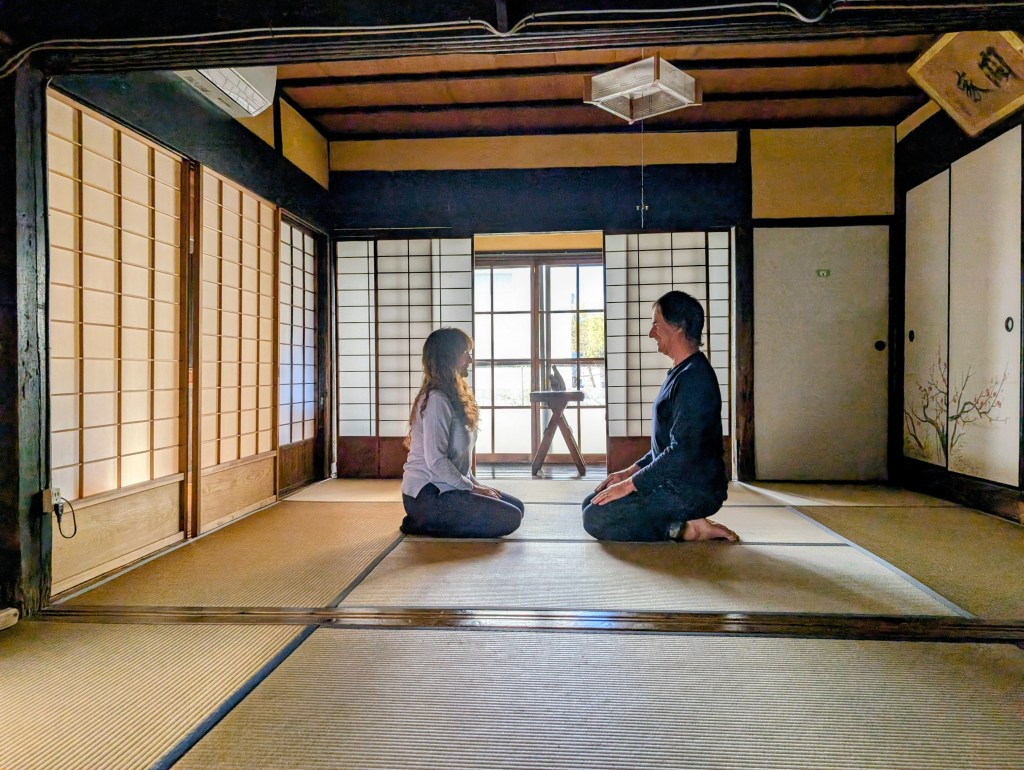
Professor Fakrul Alam

Five years ago, when Borderless set out on its literary voyage, who would have imagined the length and breadth of its imaginative crossings in this span of time? The evidence, however, is digitally there for any reader who has seen at least some of its issues. Creative writing spanning all genres, vivid illustrations, instant links giving resolute readers the option to track a contributor’s creative voyaging—here is boundless space always opening up for those seeking writing of considerable variety as well as originality. The best part here is that unlike name-brand journals, which will entice readers with limited access and then restrict their spaces unless you subscribe to them, all of Borderless is still accessible for us even though it has attracted a wide readership in five years. I certainly hope it will stay that way.

And what lies ahead for Borderless? Surely, more opportunities for the creative to articulate their deepest thoughts and feelings in virtual and seemingly infinite space, and innumerable avenues for readers to access easily. And let us hope, in the years to come Borderless will extend itself to newer frontiers of writing and will continue to keep giving space to new as well as emerging writers from our parts of the world.

May the team of Borderless, continue to live up to their claim that “there are no boundaries to human imagination and thought!”

Radha Chakravarty

Since its inception, Borderless Journal has remained true to its name, offering a vital literary space for writers, artists and scholars from around the world to engage in creative dialogue about their shared vision of a world without borders. Congratulations Borderless, and may your dream of global harmony continue to inspire.

Somdatta Mandal

According to the famous Chicana academic and theorist Gloria Anzaldua, the Borderlands are physically present wherever two or more cultures edge each other, where peopIe of different races occupy the same territory, where under, lower, middle and upper classes touch, where the space between two individuals shrinks with intimacy. Hatred, anger and exploitation are the prominent features of this landscape. There, at the juncture of cultures, languages cross-pollinate and are revitalized; they die and are born. Borders are set up to define the places that are safe and unsafe, to distinguish us from them. A border is a dividing line, a narrow strip along a steep edge. A borderland is a vague and undetermined place created by the emotional residue of an unnatural boundary. It is in a constant state of transition. The prohibited and forbidden are its inhabitants.

About five years ago, when a new online journal aptly called Borderless Journal was launched, these ideas which we had been teaching for so long were simply no longer applicable. Doing away with differences, with limits, it became a suitable platform where disparate cultures met, where people from all disciplines could express their views through different genres, be it poetry, translation, reviews, scholarly articles, creative writing and so on. Many new writers from different parts of the world became regular contributors to this unique experimentation with ‘borderlessness’ and its immense possibilities are very apt in this present global context where social media has already changed many earlier notions of scholarship, journalism, and creativity.

Jared Carter

In its first five years Borderless has become an important witness for international peace and understanding. It has encouraged submissions from writers in English based in many different countries, and has offered significant works translated from a wide range of national literatures. Its pages have featured writers based in India, Pakistan, China, Taiwan, Japan, South Korea, Australia, the UK, and the US. In the future, given the current level of world turmoil, Borderless might well consider looking more closely toward Africa and the Middle East. As the magazine continues to promote writing focused on international peace and freedom, new horizons beckon.
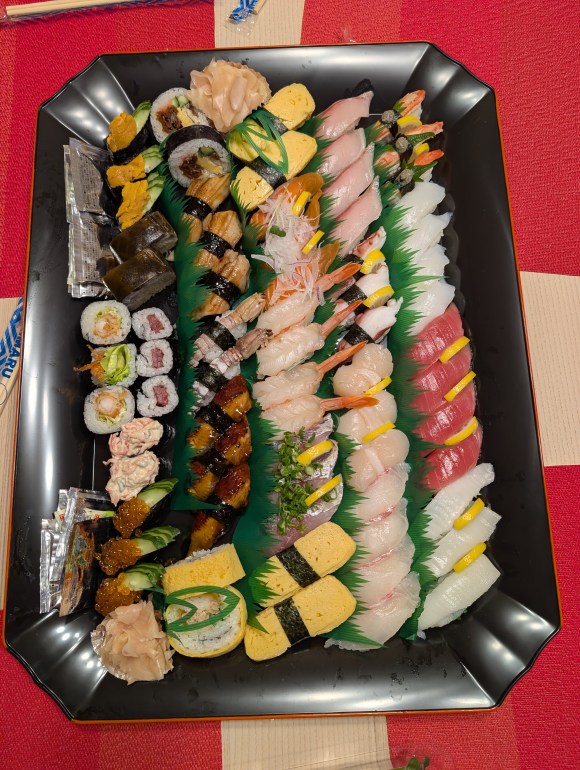
Teresa Rehman

The best part of this journal is that it is seamless and knows no margins or fringes. It is truly global as it has cut across geographical borders and has sculpted a novel literary genre called the ‘borderless’. It has climbed the mountains of Nepal, composed songs on the Brahmaputra in Assam, explored the hidden kingdom of Bhutan, walked on the streets of Dhaka, explored the wreckage of cyclones in Odisha, been on a cycling adventure from Malaysia to Kashmir, explored a scenic village in the Indo-China border, taken readers on a journey of making a Japanese-Malayalam dictionary, gave a first-hand account of the war in Bosnia-Herzegovina and described the syncretic culture of Bengal through its folk music and oral traditions. I hope it continues telling the untold and unchartered stories across mountains, oceans and forests.

Kirpal Singh

In a world increasingly tending towards misunderstandings across borders, this wholesome journal provides a healthy space both for diverse as well as unifying visions of our humanity. As we celebrate five distinguished years of Borderless Journal, we also look forward to another five years of such to ensure the underlying vision remains viable and visible as well as authentic and accurate.

My heartfelt Congratulations to all associated with this delightful and impressive enterprise!

Asad Latif

The proliferation of ethnic geographies of identity — Muslim/Arab, Hindu/Indian, Christian/Western, and so on — represents a threat to anything that might be called universal history. The separation and parcelling out of identities, as if they are pre-ordained, goes against the very idea (proclaimed by Edward Said) that, just as men and women create their own history, they can recreate it. Borders within the mind reflect borders outside it. Both borders resist the recreation of history. While physical borders are necessary, mental borders are not. This journal does an admirable job in erasing borders of the mind. Long may it continue to do so.  

Anuradha Kumar

I have been one of Borderless’ many readers ever since its first issue appeared five years ago. Like many others, I look forward with great anticipation to every issue, complete with stories, , reviews, poems, translations, complemented with interesting artwork. 

Borderless has truly lived up to its name. Within its portal, people, regardless of borders, but bound by common love for literature, and the world’s heritage, come together. I would wish for Borderless to scale even greater heights in the future. As a reader, I would very much like to read more writers from the ‘Global South’, especially in translation. Africa, Asia and Australasia are host to diverse languages, many in danger of getting lost. Perhaps Borderless could take a lead in showcasing writers from these languages to the world. That would be such an invaluable service to readers, and the world too.   

Ryan Quinn Flanagan

To me, Borderless Journal is a completely free and open space.  Topics and styles are never limiting, and the various writers explore everything from personal travelogues to the limp of a helpful druggist.  Writers from all corners of the globe contribute, offering a plethora of unique voices from countless circumstances and walks of life. Because of this openness, Borderless Journal can, and likely will continue to grow and expand in many directions simultaneously.  Curating and including many new voices along the way.  Happy 5th Birthday to a truly original and wonderfully eclectic journal!

George Freek

I feel the Borderless Journal fills a special spot in the publishing world. Unlike many journals, which profess to be open-minded and have no preference for any particular style of poetry, Borderless actually strives to be eclectic. Naturally, it has its own tastes, and yet truly tries to represent the broad spectrum which is contemporary poetry. I have no advice as to where it should go. I can only say keep up the good work, and stooping to a cliche, if it’s not broken, why try to fix it?

Farouk Gulsara

They say time flies when one is having fun. It sure does when a publication we love regularly churns out its issues, month after month, for five years now.

In the post-truth world, where everybody wants to exert their exclusivity and try to find ways to be different from the person standing next to them, Borderless gives a breath of fresh air. At a time when neighboring countries are telling the world they do not share a common history, Borderless tries to show their shared heritage. We may have different mothers and fathers but are all but “ONE”! 

We show the same fear found in the thunderous sounds of a growling tiger. We spill the exact hue of blood with the same pain when our skin is breached. Yet we say, “My pain is more intense than yours, and my blood is more precious.” Somehow, we find solace in playing victimhood. We have lost that mindfulness. One should appreciate freedom just as much as we realise it is fragile. Terrorism and fighting for freedom could just be opposing sides of the same coin.

There is no such thing as a just war or the mother of all wars to end all wars as it has been sold to us. One form of aggression is the beginning of many never-ending clashes. Collateral damage cannot be justified. There can be no excuse to destroy generations of human discoveries and turn back the clock to the Stone Age. 

All our hands are tainted with guilt. Nevertheless, each day is another new day to make that change. We can all sing to the tune of the official 2014 World Cup song, ‘Ola Ola,’ which means ‘We are One.’ This is like how we all get together for a whole month to immerse ourselves in the world’s favourite sport. We could also reminisce about when the world got together to feed starving kids in Africa via ‘Band-Aid’ and ‘We Are the World’. Borderless is paving the way. Happy Anniversary!

Ihlwha Choi

I sincerely congratulate Borderless Journal on its 5th anniversary. I am always delighted and grateful for the precious opportunity to publish my poetry in English through this journal. I would like to extend my special thanks for this.

Through this journal, I can read a variety of literary works—including poetry, essays, and prose—from writers around the world. As someone for whom English is a foreign language, it has also been a valuable resource for improving my English skills. I especially enjoy the frequent features on Rabindranath Tagore’s poetry, which I read with great joy. Tagore is one of my favourite poets.

I have had the privilege of visiting Santiniketan three times to trace his legacy and honor his contributions to literature and education. However, one aspect I find a little disappointing is that, despite having published over 30 poems, I have yet to receive any feedback from readers or fellow writers. It would be wonderful to have such an opportunity for engagement.

Additionally, last October, a Korean woman received the Nobel Prize in Literature—the first time an author from South Korea has been awarded this honor by the Swedish Academy. She is not only an outstanding novelist but also a poet. I searched for articles about her in Borderless Journal but was unable to find any. Of course, I understand that this is not strictly a literary newspaper, but I would have been delighted to see a feature on her.

I also feel honoured that one of my poems was included in the anthology Monalisa No Longer Smiles: An Anthology of Writings from across the World. I hope such anthologies will continue to be published. In fact, I wonder if it would be possible to compile and publish collections featuring several poems from contributing poets. If these were made available on Amazon, it would be a fulfilling experience for poets to reach a broader audience.

Moving forward, I hope Borderless Journal will continue to reach readers worldwide, beyond Asia, and contribute to fostering love and peace. Thank you.

Prithvijeet Sinha

The journey of authorship, self-expression and cultural exchange that I personally associate with Borderless Journal’s always diverse archives has remained a touchstone ever since this doorway opened itself to the world in 2020. Going against the ramshackle moods of the 2020s as an era defined by scepticism and distances, The journal has upheld a principled literary worldview close to the its pages and made sure that voices of every hue gets representation. It’s also an enterprise that consistently delivers in terms of goodwill and innocence, two rare traits which are in plenteous supply in the poems, travelogues, essays and musings presented here.

The journey with Borderless has united this writer with many fascinating, strikingly original auteurs, buoyed by a love for words and expression. It is only destined for greatness ahead. Happy Birthday Borderless! Here’s to 50 more epochs.

From Our Team

Bhaskar Parichha

As Borderless Journal celebrates its fifth anniversary, it is inspiring to see its evolution into a distinguished platform for discourse and exploration. Over the years, it has carved a unique niche in contemporary journalism, consistently delivering enlightening and engaging content. The journal features a variety of sections, including in-depth articles, insightful essays, and thought-provoking interviews, reflecting a commitment to quality and fostering dialogue on pressing global issues.
The diverse contributions enrich readers’ understanding of complex topics, with a particular focus on climate change, which is especially relevant today. By prioritising this critical issue, Borderless informs and encourages engagement with urgent realities.
Having been involved since its inception, I am continually impressed by the journal’s passion and adaptability in a changing media landscape. As we celebrate this milestone, I wish Borderless continued success as a beacon of knowledge and thoughtful discourse, inspiring readers and contributors alike.

Devraj Singh Kalsi

Borderless Journal has a sharp focus on good writing in multiple genres and offers readable prose. The platform is inclusive and does not carry any slant, offering space to divergent opinions and celebrating free expression. By choosing not to restrict to any kind of ism, the literary platform has built a strong foundation in just five years since inception. New, emerging voices – driven by the passion to write fearlessly – find it the ideal home. In a world where writing often gets commercialised and compromised, Borderless Journal is gaining strength, credibility, and wide readership. It is making a global impact by giving shape to the dreams of legendary poets who believed the world is one.  

Rakhi Dalal

My heartiest congratulations to Borderless and the entire team on the fifth Anniversary of its inception. The journal which began with the idea of letting writing and ideas transcend borders, has notably been acting as a bridge to make this world a more interconnected place. It offers a space to share human experiences across cultures, to create a sense of connection and hence compassion, which people of this world, now more distraught than ever, are sorely in need of. I am delighted to have been a part of this journey. My best wishes. May it continue to sail through time, navigating languages, literature and rising above barriers!

 Keith Lyons

Is it really five years since Borderless Journal started? It seems hard to believe. 

My index finger scrolls through Messenger chats with the editor — till they end in 2022. On the website, I find 123 results under my name. Still no luck. Eventually, in my ‘Sent’ box I find my first submission, emailed with high hopes (and low expectations) in March 2020. ‘Countdown to Lockdown’ was about my early 2020 journey from India through Thailand, Malaysia, Indonesia, and Australia to New Zealand as COVID-19 spread.

Just like that long, insightful trip, my involvement with Borderless Journal has been a journey. Three unique characteristics stand out for me. 

The first is its openness and inclusiveness. It features writers from all over the globe, with various contributions across a wide range of topics, treatments and formats. 

The second feature of the journal is its phenomenal growth, both in readers and writers, and in its reach. Borderless really does ‘walk the talk’ on breaking down barriers. It is no longer just a humble literary journal — it is so much bigger than that. 

The third unique aspect of Borderless is the devotion endowed in nurturing the journal and its contributors. I love the way each and every issue is conceived, curated, and crafted together, making tangible the aspiration ‘of uniting diverse voices and cultures, and finding commonality in the process.’

So where can we go from here? One constant in this world is change. I’d like to think that having survived a global pandemic, economic recession, and troubling times, that the core values of Borderless Journal will continue to see it grow and evolve. For never has there been a greater need to hear the voices of others to discover that we are all deeply connected.

Rhys Hughes

I have two different sets of feelings about Borderless Journal. I think the journal does an excellent job of showcasing work from many different countries and cultures. I want to say it’s an oasis of pleasing words and images in a troubled sea of chaos, but that would be mixing my metaphors improperly. Not a troubled sea of chaos but a desert of seemingly shifting values. And here is the oasis, Borderless Journal, where one can find secure ideals of liberty, tolerance, peace and internationalism. I appreciate this very much. As for my other set of feelings, I am always happy to be published in the journal, and in fact I probably would have given up writing poetry two years ago if it wasn’t for the encouragement provided to me by regular publication in the journal. I have written many poems especially for Borderless. They wouldn’t exist if Borderless didn’t exist. Therefore I am grateful on a personal level, as a writer as well as a reader.

Where can Borderless Journal go from here? This is a much harder question to answer. I feel that traditional reading culture is fading away year after year. Poets write poetry but few people buy poetry books. They can read poems at Borderless for free and that is a great advantage. I would like to see more short stories, maybe including elements of fantasy and speculative fiction. But I have no strategic vision for the future of the journal. However, one project I would like to try one day is some sort of collaborative work, maybe a big poem with lots of contributors following specific rules. It’s an idea anyway!

Meenakshi Malhotra

Borderless started with a vision of transcending the shadow lines and has over time, evolved into a platform where good writing from many parts of the world finds  a space , where as “imagination bodies forth/ The forms of things unknown, the poet’s pen/Turns them to shapes and gives to airy nothing/A local habitation and a name.”

It has been a privilege to be a part of Borderless’s journey over the last few years. It was a journey based on an idea and a vision. That dream of creating solidarity, of transcending and soaring over borders and boundaries, is evident in almost every page and article in the journal.

Mitali Chakravarty

Looking at all these responses, thinking on what everyone has said, I am left feeling overwhelmed.

Borderless started as a whimsical figment of the imagination… an attempt to bring together humanity with the commonality of felt emotions, to redefine literary norms which had assumed a darker hue in the post Bloomsbury, post existentialist world. The journal tried to invoke humour to brings smiles, joys to create a sense of camaraderie propelling people out of depression towards a more inclusive world, where laughter brings resilience and courage. It hoped to weave an awareness that all humans have the same needs, dreams and feelings despite the multiple borders drawn by history, geographies, academia and many other systems imagined by humans strewn over time.  

Going forward, I would like to take up what Harari suggests in Homo Deus — that ideas need to generate a change in the actions of humankind to make an impact. Borderless should hope to be one of the crucibles containing ideas to impact the move towards a more wholesome world, perhaps by redefining some of the current accepted norms. Some might find such an idea absurd,  but without the guts to act on impractical dreams, visions and ideas, we might have gone extinct in a post-dino Earth.

I thank the fabulous team, the wonderful writers and readers whose participation in the journal, or in engaging with it, enhances the hope of ringing in a new world for the future of our progeny.