Interviewing Bulbul: Remembering Mrinal Sen… Ratnottama Sengupta introduces Bulbul Sharma to converse with her on Mrinal Sen, the legendary filmmaker, reflecting on Bulbul Sharma’s experience as an actress in his film, Interview. Click here to read.
In conversation with Gajra Kottary, eminent screenplay writer, and a brief introduction to her recent book of short stories, Autumn Blossoms. Click hereto read.
Translations
Nazrul’s poem, Samya or Equality, has been translated from Bengali by Niaz Zaman. Click here to read.
Masud Khan’s Fire Engine has been translated from Bengali by Fakrul Alam. Click here to read.
A conversation with Gajra Kottary, focusing on her new short-story collection, Autumn Blossoms, published by Om Books International.
Gajra Kottary is an eminent screenplay writer on Indian television. She has had many awards and accolades for teleplays that ran into a few thousand episodes, including the very popular Astitva Ek Prem Kahani (Existence: A Love Story, 2002-2006). Trained as a journalist, she turned into a screenplay writer, and now, she opts to go back to writing books.
Her collection of fifty stories in Autumn Blossoms bloom through five hundred pages with an epigraphic verse at the start of each story summing up the intent of the narrative. The focus group of the content is mainly upper middle-class women in India—people who have studied in privileged schools and colleges, though there is a story about a tribal woman who “evolves” to be a leader. The language flows capturing the nuances of her characters, replete with their values, biases, and attitudes. The stories, like her tele series, bring to light not only societal issues but also the interactions between different economic and social strata within the country. They give a glimpse of the world she inhabits.
Forwarded by Anupam Kher, a well-known actor, director and producer, the narratives despite being women-centric are not feminist in intent. There is a story about a girl who while opposing the patriarchy of her married home, runs away to that of her guru only to discover he lives by even more stringent rules and has an extremely gifted wife who practically gave up her life to look after the needs and career of her husband. The turn of events is such that the protagonist returns home, changed in her outlook. The story in a way upends the current norms towards concepts like patriarchy and yet, it dwells on the strength that can be found among common women, women who are housewives and ostensibly live in the shadows of men. The character of the guru’s wife brings to mind Scarlett O Hara’s mother in Margaret Mitchell’s original novel, Gone with the Wind (1936).
The plots of the stories are involved. And each story takes you through a different world. It’s like you have lived the lives of umpteen women within the social constructs of India. You live through murders, weddings, divorces, parties, terrorist kidnappings and even revolutions! In the centre of it all, are the stories of all humanity with their varied moods and flavours, their loves, compassion, happiness, grief, disappointments, and achievements.
In her ‘Afterthought’ — what in common parlance would be afterword — Kottary tells us the name, Autumn Blossoms, is the “generic descriptions of the stories” in the collection. She contends she is “a firm believer in the fact that women, and for that matter men too, bloom and discover strength in the autumn of their lives. As do many protagonists in these stories, where autumn stands as much for the vagaries of age as for what they are experiencing in life which gives them a new perspective.”
There is a story behind the book told in the afterword… how all the stories were curated into this collection. Some of the stories from her earlier collections were redone by the writer to suite her current needs. As there were many stories, she tells us the editor, Shantanu Ray Chaudhuri, “suggested that we categorise them into three sections”. She further elucidates: “The first would be the section about women’s relationships with men. The second section would be women’s relationships with other women. The third would be about women’s relationships with themselves, by far the most complex of them all. Of course, there are bound to be overlaps – these categories have permeable boundaries, so that it is possible for one story in one category to resonate in another. That too provides a sort of unity to the entire collection – apart from the overarching commonality of women being at the centre of each narrative.”
We invite you here to read what the queen of screenplay has to share with us about her journey as a writer and also on her current book, Autumn Blossoms.
Since when have you been writing? Tell us about your writerly journey.
I have been writing ever since I learned to write – quite literally. Ironically as a kid, like many silly things kids do, it was about trying to connect thoughts and make them rhyme in poems. I went to a convent school but more than my English poetry, it was my Hindi writing that got noted. I edited the Hindi section of our school magazine and I always knew I would end up with some sort of career in writing. Then in college, I tried my hand at writing middles and short journalistic pieces for The Times of India, Hindustan Times and some evening papers and women’s magazines. I was emboldened when they got published. So I did the next best thing for those times. I enrolled for a journalism diploma at the Indian Institute of Mass Communications. The course was great, but when I got down to brass tacks, I didn’t enjoy myself at all – reporting and subbing were not my scene at all. I did it for a while, but then took a motherhood break since I had married by then. My break and the quietude it brought helped me to analyse where I was going, helped me find my true calling within writing … which was fiction.
Short stories, published in 2003Novel , published in 2014
Starting with two short-story collections, I soon moved to writing for film and television and it consumed me completely for more than a decade. Until I realised that I also needed to write purely for myself too. I wrote my first novel in 2011 and have written three more after that, simultaneously with my TV work. The former has no deadlines beyond the self-imposed, while TV is all about deadlines so it’s a great mix.
What gets your muse going?
Random thoughts triggered by happenings around … whether it’s in the news or through people’s conversations around. Basically the ‘what ifs’ part of any incident or happening is what triggers the chain of a story in my mind. There is a lovely term in Hindi called ‘udhed-boon’. By now my mind is attuned to churning the thoughts around the ‘what ifs’ to design it into a tale. One has learnt to also decide to design the idea around as a story for a TV show or a short story or a novel. For most of the time, the idea itself speaks in a manner that can be easily identified or slotted. For example, when I read about the phenomena of bride buying in Haryana, I knew I could write a whole TV show around it – so Molkkiwas born. Similarly the concept of age difference in marriages … it’s thematic and therefore lends itself to exploration of its myriad aspects and nuances through a long-format series like Astitva and Na Umr Ki Seema Hodid. Similarly, most of the short stories in Autumn Blossoms are short tales that can’t be stretched very long, or else they would lose their punch.
A soap that focussed on the hunt for a woman’s identity (2002-2006)A TV series centred around exploring Molkki, an Indian tradition that involves marrying off poor girls to a wealthy man in exchange for money (2020-2022)
Tell us briefly what made you opt towards moving back towards books when you are a well-known screenplay writer?
That’s my favourite question to answer. When you write for the screen you train to be collaborative. To cooperate, convince and compromise. Since the ownership of the final product is going to be shared, democracy is the need of the medium.
Published in 2011
But it is important for a writer to be in touch with their solo voice to know what it sounds like, apart from coping with the cacophony of many voices involved in screenwriting. In fact I don’t really understand why more scriptwriters don’t feel this urge to have their individual voices heard and write for print too. It is a most empowering and self-affirming thing to do, but maybe scriptwriting is so tiring that inertia creeps in.
As far as I am concerned, I desperately needed to hear my own voice after more than a decade of collaborative writing, although I started writing short fiction way before scriptwriting. So, I finally wrote my first novel in 2011. I really loved the process though it was an edgy and confusing one all through. Once I had written Broken Melodies and gauged for myself what it added to my skill set, I made a habit of periodically hearing my own voice, along with participating in the chorus of the songs of scriptwriting.
How is writing a book different from writing a screenplay?
I am not a ‘go with the flow’ writer and need to have my goal or destination in sight before I embark on writing a new story. In that sense the process is the same for me in both kinds of writing. But after having done that basic planning for structure, while writing a book, spontaneity takes over. While writing a screenplay one has to be so much more conscious of the craft and style, the judicious part of what ideas to keep and what to discard. In a book one looks at editing much later. Although every good story should have the three-act structure working quietly in the head of the writer, I find that a book or writing for television has most of its texture in the mid portion. The first and third acts are the bookends, the former is a diving board and the latter is a climb to the crescendo. If one can get the middle right, one is sorted. Writing a book is like taking a walk in the park or the open … there’s unpredictability, adventure, mystery, open skies, fresh air to breathe and sights to savour on the way. Scriptwriting is much like walking on a treadmill – you get the required exercise and benefit but it’s not like an entire life experience.
By what I gathered from your ‘Afterthought’, these are stories that have been written over a period of time. How old is the first story and how recent the latest story? What made you think of bringing them out as a collection now?
Yes, these are virtually all the stories in the category of short fiction that I have ever written, including audiobooks. My last published collection of short stories came out in 1996, which is therefore nearly thirty years ago. The audiobooks are fairly recent. Many were written more than a decade ago when I was in between full-time writing for TV. And the last two were written a few weeks before the book went to press, so that we could reach the magical number of 50!
About the reason of bringing them out as a collection. Well it’s every writer’s dream to have a lifetime collection out, I wasn’t actively working towards it.
This book has happened solely because of its editor Shantanu Ray Chaudhuri. He is also a columnist and was writing a piece on my writing journey. As part of his research I shared with him my published, slim volumes of short stories. After he had read them – at record speed at that – he asked if I had written any more that were as yet unpublished. One thing led to another and now we have this door stopper of a volume titled Autumn Blossoms. Both Shantanu and I believe in short fiction, which frankly is challenging to sell. But the challenge is what has driven us both to bring an entire compendium out. Frankly, logically there is no real reason why short fiction shouldn’t be selling even more than novels, in these days of shorter attention span.
Why did you feel the need to have epigraphic verses at the beginning of each story? Are these epigraphs your first attempt at writing poetry … you mention in your ‘Afterthought’ they got you in touch with the ‘closet poet’ in yourself?
The idea to have epigraphic verses at the beginning of the stories was again an innovative suggestion that came from Shantanu after he read some lyrics that I had written in Hindi, and a few in English. They had all been commissioned lyrics, for music albums and the odd theme song for my own shows on TV. Shantanu is quite a poet, having published his poetry too. For me, it was like going back to my early days as a writer who had tried out all genres before I settled for quintessential storytelling. Writing these quatrains was some work and a lot of fun too and discovering the closet poet in myself gave me something to look forward to doing as an option for the coming years. A retirement activity when I perhaps won’t get story ideas anymore. It also gave me a kind of perspective of the essence of each story that I might not have made the effort to analyse otherwise.
Is your writing impacted by any writer, art or music?
My father was a classical musician, though I never pursued music. I love to listen to his music, as well as soulful Hindi film music, and for me the lyrics are as important as the melody. I love Hrishikesh Mukherjee’s films and their music and my regret over the last few years is that I have not been reading as much as I should or would have liked to. I used to love Roald Dahl, Manto, Jane Austen, and most of all Tagore. In recent times I was bowled over by Elif Shafaq’s Forty Rules of Love. I suppose when one admires an art form or artiste, influences do seep in, in terms of both style and content, so all these people’s works have impacted my writing. And also, the aspiration to be as impactful as they have been, since they have been influential across art forms.
You are writing a novel too. Tell us a bit about the novel. Would they too have something to do with these short stories?
Published in 2017
I am almost ready with two novels. Both have male protagonists at the centre which is unusual for me. They are both very different stories from each other. One is a slice-of-life story that is light-hearted in its telling – quite a challenge for me actually – and is tentatively titled Sibling Revelry. The other is a thriller, also a social commentary. It’s tentatively titled Bonds and Bondage. Both the stories, like my earlier novel Girls Don’t Cry have their roots in stories from Autumn Blossoms, that tugged away at me to develop them more, which I eventually did. My forthcoming novels are broader versions of the stories titled ‘Hello, Goodbye’ and ‘Sugar and Spice and All Things…’ respectively.
I don’t know whether this happens with other writers, but this crossover writing does happen with me at times, as I write across media and genre. By now I have come to enjoy the process of finding more and more layers to my own story as I develop some of them from one medium to another.
There are yet some more stories in Autumn Blossoms that I didn’t see as possible novels when I wrote them. But in the process of revisiting them for the collection, I feel they merit a longer format … ‘Friends Indeed’ is a case in point.
What is your favourite genre as a writer?
Honestly, there is no favourite genre. They are all flavours of the season, and I don’t mean that in a disparaging way. Currently it is the short-fiction genre, but I know that it will be my new TV show next and when that hopefully settles, my novels will draw me to them. I guess this makes my imagination more agile, though when there is an unplanned overlap of projects, I get very tired and these days, I get anxious too as energy levels are not as high as they were a few years ago.
What can we expect from you in the near future – more books or serials or both?
God willing, there should be both, but I need to calibrate my involvement in both spheres. I am going to distance myself from the very tiring process of everyday series writing. Though of course, I will still be involved as I am experienced and can bring some wisdom to the table. I dream of writing books at a more leisurely pace; quite literally blossoming in the autumn of my life.
Thank you for the wonderful answers and your writings across the screen and in books
(The online interview has been conducted through emails and the review written by Mitali Chakravarty.)
PLEASE NOTE: ARTICLES CAN ONLY BE REPRODUCED IN OTHER SITES WITH DUE ACKNOWLEDGEMENT TO BORDERLESS JOURNAL.
In Conversation with Advait Kottary about his debut historical fiction, Siddhartha: The Boy Who Became the Buddha, published by Hachette, May 2023.
At a time, when the world looks for compassion, acceptance, love, kindness, relief from wars, economic downturns, divides drawn by multiple human-made constructs, what kind of a book could provide entertainment, solace and also suggest solutions to human crises?
Perhaps, Advait Kottary’s Siddhartha: The Boy Who Became the Buddha, comes closest to the kind of book that would encompass all these demands. Many people have written about Buddha and Buddhism, but few have attempted to recreate vividly the life of a prince who rebelled against social norms to uncover a path that more than 2,500 years later continues to be seen as a refuge from violence and hatred. For those who misconstrue Buddhism in the modern political ambience, this book could well be a reminder of what Buddhism is all about.
The writer, Advait Kottary, is an engineer turned actor. Perhaps that is why the visual vividness of the narrative is almost cinematic. The story flows like a stream taking the reader back in time to a period we know very less about. What is amazing is the way in which the author has unfolded the story beginning with Siddhartha’s enlightenment and his journey back through his life in that state. This unique situation gives the Buddha the advantage of not just revisiting scenes but also to visit those aspects of his life and that of others which he could not possibly have witnessed in reality. The Enlightened One witnesses his own birth, his mother’s demise, many battles and courts that he had never ventured into. At a point in his journey, Buddha brings to readers Prince Siddhartha’s dejection despite winning a war. Kottary narrates: “Siddhartha burst into tears. The man was right and all his anger was for the war itself, not directed towards the soldier in front of him… They had won the war, but at what cost?” These are pertinent questions that perhaps, if world leaders asked themselves, we would not have had Bakhmut (Ukraine) or the World Wars.
As Siddhartha finds his peace leaving his palatial home, he realises that he is fortunate to have a family that gives him the freedom to complete his quest (though initially with reluctance). He reflects on why he needs to go on this journey, upending the lives of his family, traditions and even his kingdom. He tells his first teacher, Alara Kalama, “At the root of all the customs and the things we consider to be tradition, I could find no answers, other than the ones that said we live in one way, simply because that is what we are accustomed to; whether it is by virtue of following the habits of one’s parents, or the habits of those in the world around us.”
While raising pertinent issues that need to be brought to the fore in the present context through Buddha’s journey, the detailed research that Kottary has put in is evident. People get drunk on Tongba, a pre-historic recipe for an alcoholic brew of millet which is still in use. Authenticity is enhanced by an interplay of historic incidents, including acceptance of Buddha’s beliefs by one of the bloodiest kings of Indian history, Ajaatshatru, who killed his own father, Bimbisara, drove his mother to death, fell in love with his father’s concubine and razed a city down to find her. Reading of the change wrought by Buddhism in such a ruthless man, one can find hope in the darkest of times. Maybe, like Ajaatshatru, mindless, warmongering political overlords will have a change of heart at some point.
The book is racy despite the factual content. It reads like a well-written fiction. Perhaps it is a bit of that for after all, could we really know what Buddha said to his wife? But what we do know is his wife supported him and became a bhikshuni at the end. The narrative flows — sometimes, calm and reflective while Buddha talks, and sometimes, moving through turbulence, war, intrigue and violence providing a counterfoil to Buddha’s own quest. At the end of every episode, there is that moment of stillness induced by the enlightened one’s comment as he moves towards a new scene from his past.
Each scene brings us closer to the resolution of how the personal and the larger-than-life quest combine to create a sense of harmony at the end. The narrative has the ageless innocence, elegance and wisdom of Oscar Wilde’s stories like “The Happy Prince”. Kottary, a debuting author with the ability to create a compelling tale, explains what went into the making of this remarkable book in this interview.
Buddha is a subject much written about. And yet, you have given this book a unique twist. What made you select the life of Buddha as your debut venture into the arena of historical fiction?
I think I’ve always been fascinated with history and stories from the past, wondering how much of it happened the way we imagine it, and constantly imagining what life was like in any age of the past.
The story of Siddhartha, or the Buddha, came to me at a very interesting time in my life. I had just quit my engineering job, and though I vaguely knew I wanted to act and write, I had no real clue what lay ahead. It was at this time that I found a copy of Old Path, White Clouds by the revered Buddhist monk, Thich Nhat Hath, at home. At the time, Mom (Gajra Kottary) was reading it for research for a television show she was scripting, and I began to read it, often just opening up to a different random page every time and reading about a fascinating story from Siddhartha’s life. Over the years, I began to read more and more about the life of Siddhartha, beyond the basic facts I had learned in school, and found it so striking that a lot of questions that Siddhartha had from his life and his world, were the same questions that we have from life today. At a stage I was trying to find my feet in life, something resonated within me, and I found so many facets of his life that barely anyone knew about… I felt compelled to tell the story, and it seemed only natural to tell it through his eyes.
What kind of research went into your book? How many years did it take you to create the final product?
If I’m honest I can’t really quantify the amount of research that went into it, I can just sum it up and say, A LOT! Through each and every draft of the book, I’d read more and more about the subject, and there were so many beautiful tales that couldn’t make it to the final manuscript too! But it took more than five years of writing, rewriting, and rethinking. Several drafts were involved. Of course, there were other things I was doing, but putting the book aside for a few months, and revisiting it made me come back with a fresh perspective too, which really helped the process.
How much is fact and how much fiction? Tell us about the journey of the book.
History is certainly the greatest storyteller, and most of what you read in the book is fact. The places, the people, and most of the incidents are all part of recorded history. I had to imagine a lot of the interpersonal relationships involved in the story while weaving the narrative, especially since I was telling the tale from Siddhartha’s point of view. It was therefore critical to understand where he was in his spiritual journey at the time those things happened.
And to be honest that is what fascinated me the most, the lesser-known parts surrounding the known facts and bullet points of history. I couldn’t find Siddhartha’s angst really being dissected before, or his pain being talked about, because history often makes us think of him as a sea of calm, a stoic man. As I went through the drafts, I understood that in this layer of emotions lay something that perhaps we hadn’t thought of before. And of course, we know now that Siddhartha found the answers he was looking for, but back when he left the palace and renounced his life, he had no idea if he would ever find what he was looking for. Can you imagine the turmoil of someone who can surrender the rest of their time to finding an answer they may never actually find? There was a great human tale there, and I wanted to delve into the things in his life that built up to that journey, while learning more about it myself.
You have unfolded the Eightfold Path through Buddha’s personal journey, bringing in his own life experiences into play. Is that something you found in the course of your research or was it your own conclusion? Please elaborate.
A lot of it was down to research, and documented incidents in the life of Siddhartha, but I feel like especially when telling the story of Siddhartha’s life from his own point of view, it was essential to bring his own life experiences into play. Siddhartha’s learnings were often through practice and self-experimentation, a theme that is echoed throughout the book.
There are many personalised details which recreate a distant time period that is unknown to us. What went into giving authenticity to these unknown persons, their thoughts, conversations and tying them up to give us a picture of the times? How did you create characters from the past that could touch on contemporary issues and hearts?
I think it’s easy to think of characters of the past as unidimensional beings. Often that is how history is academically taught to us; good person – bad person, winner – loser etc. But when telling a story, it would be a huge injustice on my part if I did the same. As an actor, the biggest strength one can have is empathy, and every character I’ve played, I’ve always had to personalise the motivations, the desires, the fears and the joys of them all. I tried to think of all the characters in Siddhartha in the same manner. For example, it would have been easy for us to think about Siddhartha’s father, King Shuddhodana, as wrong for sheltering him from the realities of life, like pain, suffering and death. But that would be such a myopic view of what happened, and not taking into account the prophecies that had been told to him, and the fact that Siddhartha had been born after years and years of wanting a child; the stakes were incredibly high!
All it took was a little curiosity and deep thinking into why these characters did what they did; they were simply following their convictions in that moment… Most of it seemed logical, given we knew what each of these characters wanted at different points in time, but of course there was a fair bit of imagination when it came to their conversations. I was always fascinated by how each character would be at their most vulnerable, because that is a part of history that is never touched upon, and I’ve tried to do that in Siddhartha.
You have touched on many contemporary concerns in your book— war, the need to question traditions. You have even said something very deep when you had Buddha say: “Acceptance can only happen when there is no ego.” Was all this done intentionally, or did it just happen in the flow of events? Please elucidate.
When I first began to think about the story of Siddhartha, what struck me was always the contemporary relevance of the questions Siddhartha asked, more than 2500 years ago… Siddhartha always questioned everyone around him, but it was with a view to understand the universe and the world that he was born into. If he didn’t understand, he asked, and with every answer he got from people or the world around him, came new understanding and new questions too. A lot of it happened in the flow of events; but what was challenging was understanding the internal journey of Siddhartha through these events, his emotions and learnings as he grew up, and that had to be intentional in journey and design.
You have been living in London. Did you visit the parts of the Indian subcontinent you have written about?
Yes! It was a surreal experience for me, I had the good fortune of being able to visit Sarnath and Bodh Gaya from Varanasi. I can tell you that photos do not do the Dhamekh Stupa justice, it’s a beautiful and tranquil place, almost like you’ve stepped into a different world.
Did any films, writers or books impact your choices and the way you executed the book? What writers, artistes impact you as a writer?
Growing up as the son of a journalist and a scriptwriter, I’d be lying if I said my parents Sailesh and Gajra Kottary hadn’t strongly influenced my writing. I’ve also been inspired by Antione de Saint Exupery’s The Little Prince and the way it spoke of such beautiful thoughts in such a simple manner, a principle I tried to keep in mind while writing Siddhartha. Some of my favourite films are Dr. Strangelove, the Batman Trilogy, and the television series, Succession. I’m quite fond of storytelling in general as an actor and creator, and I have this weird habit of trying to piece together the narrative in everything I see, maybe even an advertisement in a magazine, deconstructing it and analysing the choices made by the creators.
Your novel is very cinematic. Are there plans afoot to make it into a film, considering the choices you have made, choosing acting over engineering and cars? Did your mother, Gajra Kottary, a major screenplay writer in India, have an impact on the choices you made and your journey as a writer?
Thank you! I’m a very visual thinker, so when I read or write about something, I watch it unfold like a movie in my mind, perhaps that is reflected to some extent in my writing. I have had interest expressed in the book from a couple of wonderful filmmakers, and hopefully I’ll have some amazing news to share soon!
My mother has been the greatest writing influence in my life, and I have to give her credit in that she has only guided and taught me and never tried to influence my decisions in the kind of work or projects that I take up.
So, what are your plans for the future? Any more books coming our way?
Yes, most certainly! I’ve got two drafts screaming at me for attention. One is about the life of another historical figure, closer to modern times, who lead an unbelievable life. The other one is pure fiction and more in the genre of dark humour; a dystopian take on modern civilisation, but again centred around a clear protagonist.
I’m living in London now and continue to act and perform in theatre as well, so there’s always something exciting happening on that front. I’ve also had some interest in Siddhartha from some wonderful film makers, so fingers crossed something visually beautiful can be born from this. So the hunt for great stories continues!
Thank you so much for your time and your lovely book.
(The review & online interview conducted through emails are by Mitali Chakravarty)
Shantanu Ray Chaudhari converses with writer Gajra Kottary, a well-known writer of Indian TV series, novels and stories. Clickhereto read.
A discussion on Samaresh Bose’s In Search of the Pitcher of Nectar, a book that takes us to the heart of the Kumbh Mela, a festival recognised by the UNESCO as an Intangible Cultural Heritage, with the translator, Nirmal Kanti Bhattacharjee. Clickhere to read.
Translations
Nazrul’s Why Provide Thorns has been translated by Professor Fakrul Alam. Clickhere to read.
Mercy, a story be P. F. Mathews, has been translated from Malayalam by Ram Anantharaman. Clickhere to read.
Songs of Freedom: Vikalangta or Disability is an autobiographical narrative by Kajal, translated from Hindustani by Janees. These narrations highlight the ongoing struggle against debilitating rigid boundaries drawn by societal norms, with the support from organisations like Shaktishalini and Pandies. Clickhere to read.
Paul Mirabile explores James Joyce’s Stephen Dedalus and his passion for words keeping in mind the hundred year old Ulysees & the even older, A Portrait of the Artists as a Young Man. Clickhere to read.
Book Excerpts
An excerpt from Radha Chakravarty’s translation of Tagore’s Farewell Song. Clickhere to read.
An excerpt or two short narratives from Rhys Hughes’ Yule Do Nicley. Clickhere to read.
The next year will do the same – we will all celebrate with Auld Lang Syneand look forward to a resolution of conflicts that reared a frightening face in 2022 and 2021. Perhaps, this time, if we have learnt from history, there will not be any annihilation but only a movement towards resolution. We have more or less tackled the pandemic and are regaining health despite the setbacks and disputes. There could be more outbreaks but unlike in the past, this time we are geared for it. That a third World War did not break out despite provocation and varied opinions, makes me feel we have really learnt from history.
That sounds almost like the voice of hope. This year was a landmark for Borderless Journal. As an online journal, we found a footing in the hardcopy world with our own anthology, Monalisa No Longer Smiles: Writings from Across the World, which had a wonderful e-launch hosted by our very well-established and supportive publisher, Om Books International. And now, it is in Om Book Shops across all of India. It will soon be on Amazon International. We also look forward to more anthologies that will create a dialogue on our values through different themes and maybe, just maybe, some more will agree with the need for a world that unites in clouds of ideas to take us forward to a future filled with love, hope and tolerance.
One of the themes of our journal has been reaching out for voices that speak for people. The eminent film critic and editor, Shantanu Ray Chaudhuri , has shared a conversation with such a person, the famed Gajra Kottary, a well-known writer of Indian TV series, novels and stories. The other conversation is with Nirmal Kanti Bhattajarchee, the translator of Samaresh Bose’s In Search of a Pitcher of Nectar, a book describing the Kumbh-mela, that in 2017 was declared to be an Intangible Cultural Heritage of Humanity by UNESCO. Bhattacharjee tells us how the festival has grown and improved in organisation from the time the author described a stampede that concluded the festivities. Life only gets better moving forward in time, despite events that terrorise with darkness. Facing fear and overcoming it does give a great sense of achievement.
In keeping with the festive season is our book excerpt from Rhys Hughes’ funny stories in his Christmas collection, Yule Do Nicely. Radha Chakravarty who brings many greats from Bengal to Anglophone readers shared an excerpt – a discussion on love — from her translation of Tagore’s novel,Farewell Song.
Love for words becomes the subject of Paul Mirabile’s essay on James Joyce’s Stephen Dedalus, where he touches on both A Portrait of the Artist as a young Man and Ulysees, a novel that completed a century this year. Love for animals, especially orangutans, colours Christina Yin’s essay on conservation efforts in Borneo while Keith Lyons finds peace and an overwhelming sense of well-being during a hike in New Zealand. Ravi Shankar takes us to the historical town of Taiping in Malaysia as Meredith Stephens shares more sailing adventures in the Southern hemisphere, where it is summer. Saeed Ibrahim instils the seasonal goodwill with native Indian lores from Canada and Suzanne Kamata tells us how the Japanese usher in the New Year with a semi-humorous undertone.
Also touching and yet almost embracing the school of Absurd is PF Mathew’s story, ‘Mercy‘, translated from Malayalam by Ram Anantharaman. Fazal Baloch has brought us a Balochi folktale and Ihlwha Choi has translated his own poem from Korean to English. One of Tagore’s last poems, Prothom Diner Shurjo, translated as ‘The Sun on the First Day’ is short but philosophical and gives us a glimpse into his inner world. Professor Fakrul Alam shares with us the lyrics of a Nazrul song which is deeply spiritual by translating it into English from Bengali.
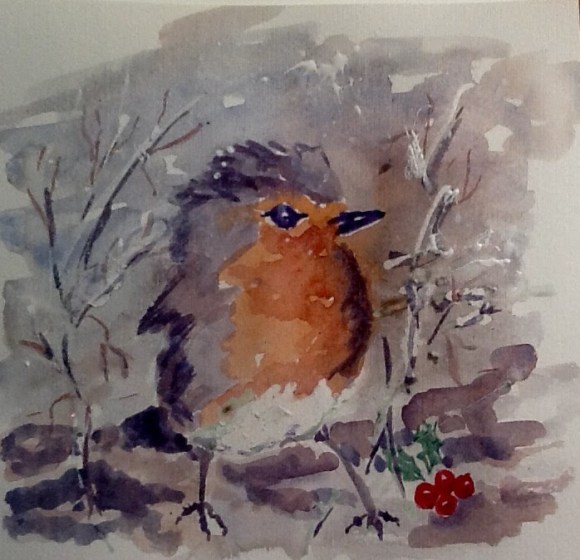
A huge thanks to all our contributors and readers, to the fabulous Borderless team without who the journal would be lost. Sohana Manzoor’s wonderful artwork continues to capture the mood of the season. Thanks to Sybil Pretious for her lovely painting. Please pause by our contents’ page to find what has not been covered in this note.
We wish you all a wonderful festive season.
Season’s Greetings from all of us at Borderless Journal.
In a medium that is known for its regressive content, Gajra Kottary, novelist and short-story writer, has time and again gone against the tide and broken taboos. Shantanu Ray Chaudhuri looks at five shows she has written that went against the grain and emerged triumphant…
Growing up in the 1980s, one of the many pleasures of a less cluttered and leisurely time was the birth of the TV series. Many people I know would swear by the fact that the first of these represented the best of Indian television. Even close to forty years later, I can still rattle off the days on which each was telecast: Karamchand on Mondays; Hum Log[1]and then Buniyaad[2] on Tuesdays and Saturdays; Khandan[3] on Wednesdays; Ados Pados[4]on Thursdays; Yeh Jo Hain Zindagi[5]on Fridays. You had stalwarts like Satyajit Ray, Mrinal Sen, Shyam Benegal and Basu Chatterjee make fine works for the television.
Sometime by the end of the decade kitsch entered in the shape of Ramayan and Mahabharat. I moved on and lost touch. A resurgence of sorts happened with the coming of cable television, and we had path-breaking shows like Shanti and Tara. And then it became increasingly difficult to keep track of TV shows. The shows changed beyond recognition. Led by the likes of Kyunki Saas Bhi Kabhi Bahu Thi,[6] they became more and more ridiculous in the worlds they represented. One word came to be bandied about regularly with respect to soap operas: regressive.
However, like all generalised judgements, a blanket application of the word is unfair to a number of serials that tried to, and often succeeded in breaking taboos, while operating within the limitations dictated by the medium and the grammar of its narrative. And the one writer who has time and again bucked the trend, gone against the tide, is Gajra Kottary, the creator of historic shows like Astitva: Ek Prem Kahani[7]and Balika Vadhu.[8]
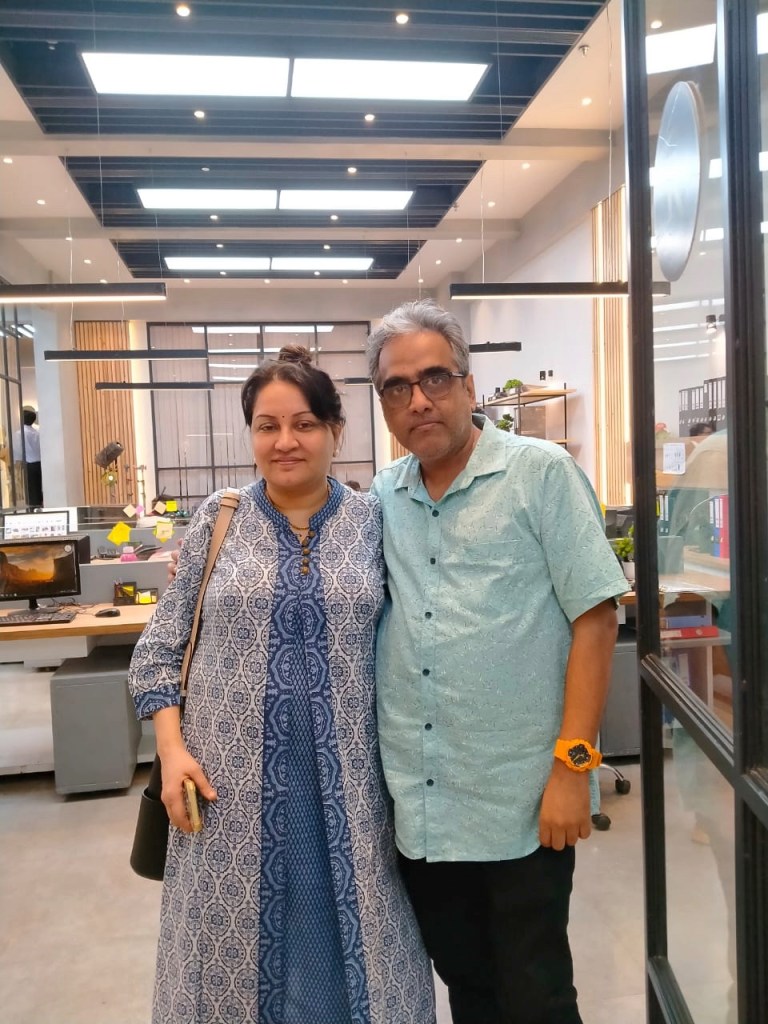
Gajra Kottary with Shantanu Ray Chaudhuri. Photo provided by Shantanu Ray Chaudhuri
Journalism and Fiction Writing
One of the reasons Gajra manages to break new ground in her television narratives might have something to do with her training as a journalist. “IIMC [Indian Institute of Mass Communication] was a tough course to get into and we had a few fresh graduates like me, and a whole lot of older and established professional journalists from other non-aligned countries studying with us, a great mix,” she says. It provided her with a grounding in fact-based narratives while polishing her skills as a writer, of which she had provided glimpses in college, when two stories she wrote got published in Eve’s Weekly, along with two fiction-style middles in TheTimes of India. “The IIMC stint helped because as I have observed over the years, I have more respect for the sanctity of facts even while taking my flights of fancy than others in the business. I take fewer creative liberties than others. I have done more realistic shows on television which helped forge a distinct identity for my writing.” But it also left her confused since political and economic writing held no interest for her and Delhi offered avenues only for those.
Destiny intervened in the form of Cupid. Falling in love with Sailesh Kottary, a “hotshot and hardcore journalist”, she moved to Bombay. It was here, as a “stay-at-home mom”, that she gave wings to her imagination and honed her writing skills. Watching serials like Saans[9] and The Bold and the Beautiful might also have helped imbibe certain aspects of writing for a visual medium. Her first work of fiction, Fragile Victories, a collection of stories, led to her first assignment in television. She had sent a copy of the book to Mahesh Bhatt, who passed it on to Soni Razdan. Impressed by the collection, the latter signed Gajra up for the story and screenplay of her first TV production, Hamare Tumhare[10](2000), which marked her TV debut, before Astitva made everyone sit up and take notice.
If IIMC shaped her in some ways, another skill-set that has held her in good stead probably came from her experiments in writing fiction. Fragile Victories was followed by another collection of stories, The Last Laugh, and the novels Broken Melodies, Once Upon a Star, Girls Don’t Cry and Not Woman Enough. These helped her to keep to a discipline that could go missing in the never-ending juggernaut that is the TV soap opera. They also are testimony to her willingness to push the envelope when it comes to narratives and characters. Not many know that much before Indian writers, particularly women, began addressing issues of sexual identity and same-sex relationships, Gajra had written about these in her fiction. As she puts it, these themes “continued to ‘consume’ me”. Not Woman Enough may have been published as an e-book only recently, but it evolved from a story that she had published way back in 2003. “I felt that I hadn’t done justice to the theme in the short format, so I wrote a full-length novel titled Not Woman Enough and felt finally relieved of my obsession.” Another story, ‘Two Gold Guineas’, evolved to her third novel Girls Don’t Cry, a pun on the expression ‘boys don’t cry’ and “an ode to the bravery of women and the friendship between a grandmother, mother and daughter”.
What is startling about these works of fiction is her ability to address taboos. Not Woman Enough not only deals with a same-sex relationship, but Gajra has the audacity to set it in rural Rajasthan as opposed to an urban setting, where it would have probably been just another story. She has the perspicacity to understand that the stakes are so much higher for first-generation characters experiencing the forces of social liberation while battling age-old customs. It is the same acuity that she brings to bear upon her iconic TV shows, which have time and again shown what is possible in a medium that allows little leeway for out-of-the-box thinking.
Astitva: Ek Prem Kahani (2002-2006, Zee TV)
Running 668 episodes, over a period of three-and-a-half years, this is the series that launched Gajra into the big league. Today, twenty years after the first episode was aired, an older woman-younger man relationship might appear staid. But back then it was bold, and Indian television had not seen anything like it. It made an icon of its lead, Niki Taneja, who plays a doctor who falls in love with a man ten years younger. What stood out is the maturity with which the series unfolds, largely devoid of the excesses that came to mark television in later years. “The first TV show maker I decided to call upon was Ajai Sinha, who had directed shows like Hasratein[11]and Justajoo[12]. He had been planning a show called Astitva with a bold theme and my timing was bang-on. It spoilt me enough to believe that television too was conducive to the kind of work I felt happy doing.” That this show managed to hold its own against a raging Kyonki[13], speaks volumes of the writer.
Balika Vadhu (2008-2016, Colors TV)
2167 episodes! Yes, you read that right. One of the longest-running shows on Indian television, this cemented Gajra’s reputation as a writer. Here again, Gajra was going out on a limb addressing a much-abused tradition prevalent in large parts of India. And sure enough, the press wasn’t flattering. It is one show that divided opinion like few others. “Yes, we received some negative press, because Anandi was this irrepressible kid, a happy child who kept bouncing back despite dealing with the dark consequences of child marriages of the past playing out in the present. It was a calculated approach as child marriage is a dark and gloomy issue. It was a conscious decision here as we needed to keep the cheer, but critics felt that we were glorifying child marriage. I think they were missing the woods for the trees.”
One possibly needs to understand the medium and its viewership to get a sense of what Gajra means. Unless the packaging is glossy enough – colourful clothes and jewellery – audiences might have been put off entirely by what is a repulsive subject. “And that would mean we would not be able to get across the underlying message of the show. These tactics are important due to the challenge of the medium of television, and the terror of the remote control. It was a classic case of the sugarcoated pill doing its work.”
Apart from the writing, the series was also recognised for its iconic performances and comments on several social issues that ail Indian society, which were woven in organically without being preachy. It also had an authentically rustic feel thanks to Purnendu Shekhar, whose concept it was. Those decrying the glossy packaging forget that the issues the series addressed included girl child education; peer, sibling and parental pressure to do the best; child labour; the begging racket; forced prostitution behind a legal façade; quacks and medical malpractices; date rape; adoption; alcoholism; divorcee and widow remarriage; trafficking in women; surrogacy; juvenile delinquency and teenage crimes, among others. From the comfort of our air-conditioned condos and offices, far removed from these realities, it was easy for the elitist press to criticise the series.
One standout episode dealt with the protagonist’s first experience of menstruation. This is a subject still, despite Padman and the increased conversation around it, spoken of in hushed tones. It is fascinating to hear Gajra’s take on this: “I remember how we involved Avika’s [the child actor who played Anandi] mother to explain to the child privately about menstruation before we shot the scene showing a young girl’s trauma when it happens to her as a bahu in a conservative household. Lots of people wrote to us about delaying the marriages of their girl children after watching Balika Vadhu. There was a girl who was emboldened enough to annul her marriage that had happened as a child when she turned eighteen. We received mails even from parents of city girls who were now reversing their decisions to get their girls married by the time they were sixteen.”
There was of course the flipside of popularity, when the writer received a death threat on Twitter if she dared to kill off the character of Shiv (played by Siddharth Shukla). “Those were the early days of social media, so real people started to write in with their reactions which were usually very intense and sometimes downright ridiculous.”
This series, spanning 55 one-hour episodes, was a huge challenge, involving as it did a historical figure, and one of the most important religious figures of the world. But trust Gajra to approach the subject from a refreshing point a view: as she points out, in school textbooks we go straight from the story of Gautama leaving home to being under the Bodhi tree and achieving enlightenment. But his experiments to arrive at the truth had many stages to it. As she says, “What it did was to dispel my own myths about the Buddha’s life. I had always felt disturbed about his abandonment of his wife and child for his own spiritual search.”
It helped that the show came to her at a point in life when the strong opinions and idealism of youth, both professionally and personally, had given way to the realisation that nothing is or can be ‘perfect’. By the time the show was done she too had evolved to accept that the Buddha had to be true to his heart’s calling. “I understood the ‘larger purpose’ of his life. I came to terms with the ‘abandonment’, though my heart still bleeds for Yashodhara and Rahul. What also helped was learning about Yashodhara’s evolution, albeit painfully, to want to join his sangha voluntarily, and him helping her find her ‘larger purpose’.” The series focuses on aspects of his life after the Enlightenment that many are not aware of. It is this larger view that shapes the series, making it a departure from the dime-a-dozen ‘mythological/religious’ shows with ‘special effects’ that blight our senses.
Extramarital affairs are the oxygen to the beast that is the TV serial. Offhand, I can think of not one serial that does not have a million and more permutations and combinations of the theme. So, it takes a really perceptive writer to give this tired trope a new perspective, and Gajra manages that in Silsila, upending the traditional way that extramarital affairs are portrayed. “Is the ‘other’ woman necessarily a femme fatale, a super-cool career woman, and the wife a boring domestic goddess or could it be the other way round also?” she asks.
The series provides further proof of her ability to give a new spin to a theme that’s been done to death. As she says, “I am emotional about this show as it was inspired by what happened with some close friends and associates. I needed a relief from all the social stuff in Balika Vadhu. Also, I believe that an author’s voice in terms of standing for the right thing can and should reflect in any kind of story, even if it’s not apparently one on a social issue. The classic extramarital affair with the eternal conundrum is a fascinating aspect of human relationship … does a third person enter the picture because a marriage is already collapsing or does the entry of a third person lead to the collapse of a marriage. Is it the cause or effect?”
Molkki (2020-2022, Colors TV)
After Silsila, it was back to a classic social issue for Gajra. At the heart of this show is the tradition of bride-buying in Haryana, which in turn has its roots in the scarcity of brides due to female feticide/infanticide. As Gajra says, “Molkki was a Covid baby, my second project with Ekta Kapoor and it was made keeping in mind all commercial considerations.”
Female infanticide is a recurrent theme in several of her stories. She writes about it in her novel, Girls Don’t Cry, while Not Woman Enough, published as an e-book by Juggernaut, has this as a strong strand, being part of the protagonist’s backstory impacting her psyche. Again, what needs to be noted here is the writer’s willingness to explore issues that contemporary television is not known for, even if the execution falters given the demands of the medium.
Addressing the Regressive Nature of Television
But Gajra does agree that on the whole, television is regressive. Though it is described as a writer’s medium, there’s only so much that writers can do in terms of trying to infuse new ideas and nuanced storytelling in the face of TRPs[16] and other market considerations and entrenched beliefs that ‘bas yahi chalta hai’[17]. So, writers take the easy way out, churning out what the studio executives want. “For the handful of people prepared to take the risk and at least try to do things differently, there are scores of others who would like to use every gimmick in their book and keep regurgitating bad content.”
In terms of audience profiling too, what’s happening with television is that most of the intelligentsia has shifted to web shows. The television viewership class has gone lower down in the social scale. So when content is being made and consumed by a non-thinking class, it also starts reflecting in the TRP studies. The classic chicken-and-egg syndrome.
Looking Ahead
Gajra is currently basking in the success of her latest show, Na Umr Ki Seema Ho,[18] which recently celebrated its hundredth episode. The show is being hailed as ‘different’ by many. As she says, “The most heartening comment that I often get to hear is that ‘it’s the first TV show I have started watching after many years’, from people who had switched full time to watching web shows.”
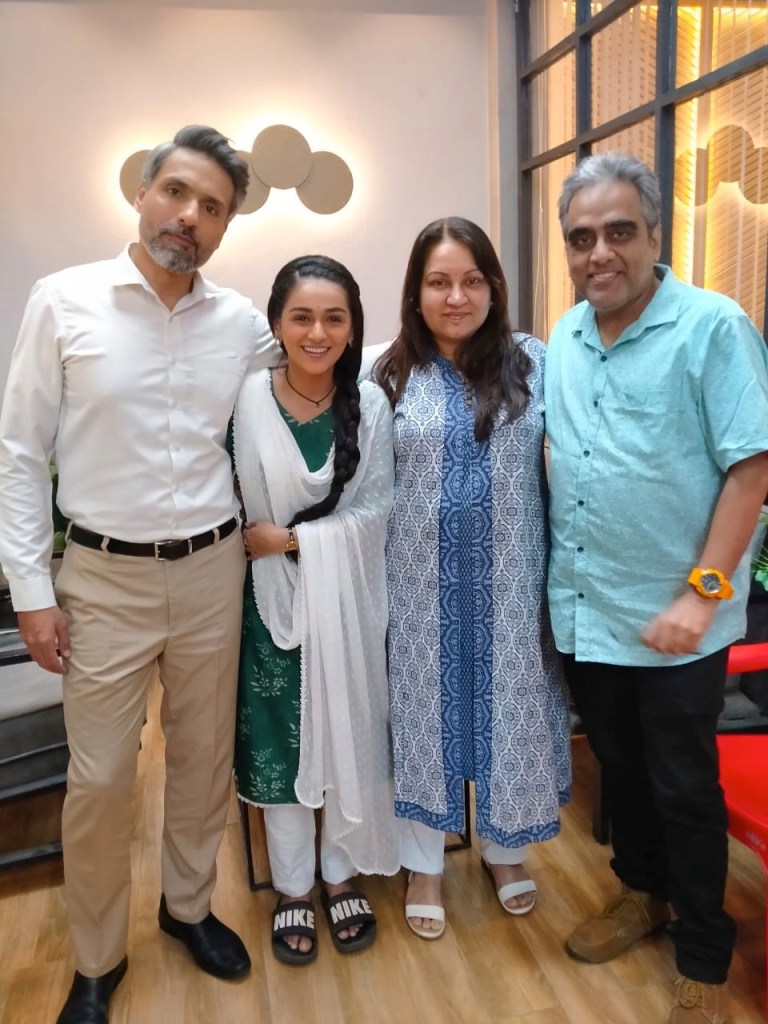
Shantanu and Gajra with the lead actors of Na Umr Ki Seema Ho. Photo provided by Shantanu Ray Chaudhuri
Any grand obsession, a show she would like to write? “As far as TV goes, I have always dreamed of doing a version of one of my all-time favourite films, Abhimaan[19], with or without the music background. The subject becomes more and more relevant every decade. Frankly, no channel wants to touch it. Though the people one speaks to share my admiration for the story, the ‘system’, they say, is not conducive to making it. I also want to adapt my first novel, Broken Melodies, as a web show or film. It’s the story of a girl growing up in the seventies, torn between the values and stifling world that her classical musician father [an autobiographical element given that Gajra is the daughter of the classical maestro Pandit Amarnath] represents and the liberation that the English education sponsored by her mother affords her.”
One can only say, more power to writers like her, and the breaking of glass ceilings and taboos.
(Originally published in The Telegraph, Kolkata)
Addendum
Shantanu: You grew up in Delhi in the 1980s. That was the birth of the TV era with Hum Log, Buniyad, and all those glorious serials. Did any of these influence you?
Gajra: You’re so right, Shantanu, they hugely did, except that there was no plan that I had then, to actually use that impact to write something similar. I loved both these shows purely as a viewer. HumLog did tackle social issues, for example, dowry, but why I liked it was that it showed the clash of values within a family with different generations, and through that, it entertained and made one feel and think – the sensitization process as its termed. Later, I learned that Hum Log was inspired by the Sabido method (originating in Mexico) where TV is used as a medium to bring about positive social change by making viewers ‘feel and think’ rather than preaching to them.
I loved Buniyaad for a purely sentimental reason. My parents were from Lahore and Multan respectively and had come as refugees to Delhi, so we had grown up hearing stories of Partition and here was a show that brought that era alive for me in an extremely moving and entertaining way. So maybe subconsciously both these shows did impact my psyche – as in it was possible to talk emotions that were universal, even while having a responsible author’s voice.
Shantanu: What do you attribute the change in the style and content in TV soaps, first with Tara and Shanti, and then Kyunki Saas Bhi…
Gajra: Tara and Shanti were the first movers, coming in like a breath of fresh air after the DD days which were associated with somewhat stodgy storytelling, Buniyaad etc., being the shining exceptions. Tara and Shanti were great in terms of revolving around thinking and evolved women, but perhaps were ahead of their times…they still are, given where TV storytelling has gone.
By the time Kyunki Saas came to TV screens, middle- and lower-middle-class homes could afford a TV set, so there was a genuine need for TV to go more middle class in its appeal. So, we had a plethora of shows with joint families and generations under one roof, which truly was the reality of such homes, and which therefore connected with the masses easily. Ekta Kapoor also upped the drama quotient hugely, so there was no way it wasn’t going to work with the masses.
Unfortunately, however, everyone went about copying the formula and there was the overdose factor. So, TV honchos were afraid of trying different subjects and worlds and that for a very long time became the bane of TV writers.
Shantanu: On Buddha: ‘dispel your own myths, you say …’ What apart from his abandonment of his wife and child haunted you. Do you reconcile with the abandonment once you had done the writing for this? Did it make sense now?
Gajra:Buddha, the show, came to me at a point in life when the strong opinions and idealism of youth – both in professional and family life – had given way to some acceptance and the realisation that actually nothing is or can be ‘perfect’. And certainly not any decisions of life that we might make. So, we might as well make the decision, and accept and live with the consequences as positively as one can. I know that that’s so ‘anti’ the way today’s youngsters think!
So yes, from his wife and family’s point of view his decision seemed ‘selfish’ but he had to be true to his heart’s calling and that so-called ‘selfishness’ of his is what made him give so much to the world to make it a better one. I understood the ‘larger purpose’ part of the Buddha’s life after I started researching more and more while writing the story for the show. I came to terms with the ‘abandonment’, though my heart still bleeds for Yashodhara and Rahul, when I think about them. What also helped was me learning the historical truths about how Yashodhara evolved, albeit painfully, to want to join his sangha voluntarily at some point, and him helping her find her ‘larger purpose’.
Also, what I realised is that in school textbooks we go straight from the story of Buddha leaving home to being under the Bodhi tree and achieving enlightenment and uplifting the world. This had been my myth too. But, in reality, the Buddha’s many experiments to arrive at the truth had many stages to it. He went through extreme deprivation, abnegation, self-loathing and much else, before he arrived at the eight-fold path – the most practical and fair way to lead life in any time and space.
And he certainly did not advocate renunciation for all or even the perception of Buddhism as a religion. His was the ultimate live-and-let- live approach to life – just that his methods helped his followers lead a life of peace and equanimity within their chosen path. Through writing the show I realised that there could be no other way of life that was so compatible with the modern way of thinking and doing. So I am not a ‘Buddhist’ but I still try to recall the eight-fold path at various difficult points in my life and it really helps me.
Shantanu Ray Chaudhuriis a film buff, editor, publisher, film critic and writer. Books commissioned and edited by him have won the National Award for Best Book on Cinema twice and the inaugural MAMI (Mumbai Academy of Moving Images) Award for Best Writing on Cinema. In 2017, he was named Editor of the Year by the apex publishing body, Publishing Next. He has contributed to a number of magazines and websites like The Daily Eye, Cinemaazi, Film Companion, The Wire, Outlook, The Taj, and others. He is the author of two books: Whims – A Book of Poems(published by Writers Workshop) and Icons from Bollywood (published by Penguin/Puffin).


 Borderless