Categories
Essay

The Story of a Land at War with Itself

If religion has bound people of different lands, religion has also crafted gulfs between people who shared the birthplace and spoke the same language. If religious hatred led to the holocaust, religion became the cornerstone of India’s Partition. The crimes against humanity in Bosnia also were rooted in religious intolerance, as Ratnottama Sengupta retraced when her brother, Dr Dipankar Ghosh wrote to her from Bosnia-Herzegovina, as part of the peace-keeping forces in 1996.
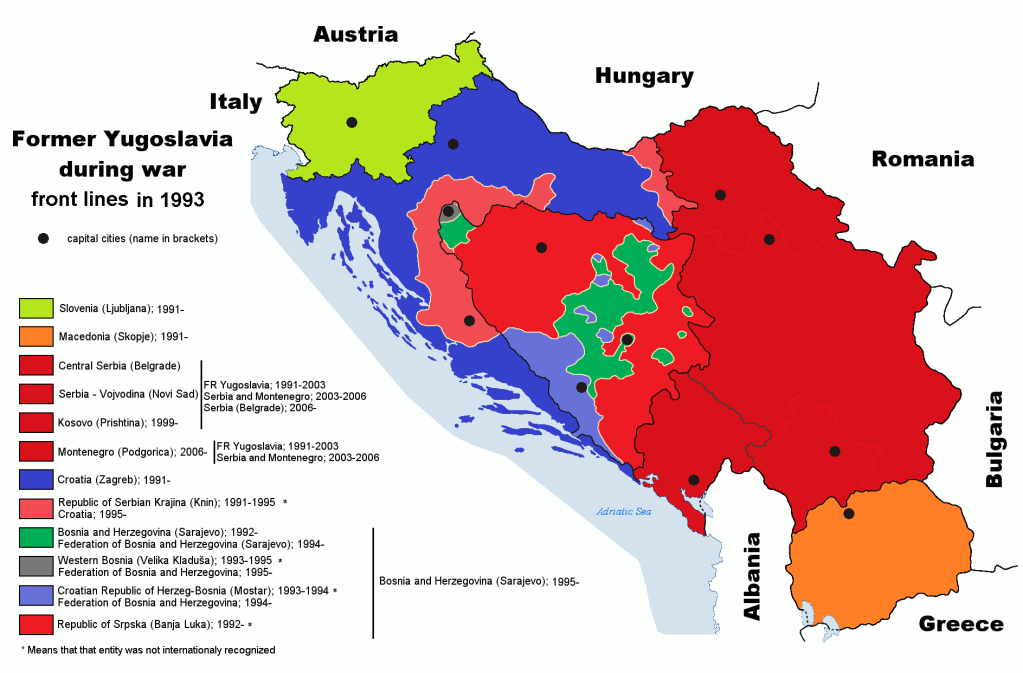
Map of former Yugoslavia in 1993. Courtesy: Creative Commons

The Bosnian War (1992-1995) was an immediate fallout of the break-up of the Socialist Federal Republic of Yugoslavia. It began to disintegrate when Slovenia and Croatia seceded in 1991. Serbia, the largest constituent in the Republic of Yugoslavia, did not want Croatia’s independence as a large Serb minority lived in Croatia. But the rest of the state declared national sovereignty in October 1991 (two years after the fall of the Berlin Wall) and held a referendum for independence on 29 Feb 1992.

Bosnia, the largest nationality, was home to Muslim Bosniaks – they wanted Bosnia to be a unitary multi-ethnic state. The Serbs wanted to be independent if not to unite with Serbia. Likewise, the Croats wanted significant autonomy for their majority areas or secession to Croatia.

The referendum favoured independence, but the Bosnian Serbs opposed this, as they aimed at creating a new state – Republika Srpska (RS) that would include Bosniak majority areas. So, their political representatives boycotted it. And a day before the outcome of the referendum, on 28 February 1992, the Assembly of the Serb People in Bosnia and Herzegovina adopted the Constitution of the Serbian Republic of Bosnia and Herzegovina.

Eventually, the European Union formally recognised the newly constituted Republic, as did the UN. It was inhabited mainly by Muslim Bosniaks, Orthodox Serbs, and Catholic Croats. As this Republic gained international recognition, the earlier Cutiliero Plan proposing a division of Bosnia into ethnic cantons collapsed.

Now the Bosnian Serbs, led by Radovan Karadzic and supported by the Serbian regime of Slobodan Milosevic and the Yugoslav People’s Army (JNA), mobilised their forces inside Bosnia and Herzegovina in order to secure ethnic Serb territory. Soon war spread across the Balkan land, accompanied by ethnic cleansing.

Siege of Sarajevo (1992-1996): The Bosnian Serbs who would settle for nothing less than a new state, Republika Srpska (RS), now encircled Sarajevo, the capital of Bosnia-Herzegovina. With a siege force of 13,000 stationed in the surrounding hills, they assaulted the city with artillery, tanks, and small arms. The army of RS, which had transformed from the Yugoslav Army units in Bosnia, fought the army of the Republic of Bosnia and Herzegovina (ARBiH).

Inside the city ARBiH, which was the Bosnian government’s defence force composed of Bosniaks and Croat forces in the Croatin Defence Council (HVO), was poorly equipped. It could not break the siege and for six months, the population of Sarajevo lived without gas, electricity or water. It is estimated that of the 13,952 killed during the siege, 5434 were civilians.

Within a year increased tension between the Bosniaks and the Croats led to escalation of the Bosnian war, in 1993. Here on, the war was characterised by bitter fighting, indiscriminate shelling of cities and towns, ethnic abuse, forcible transfer and systematic mass rape of Bosniak Muslim women – perpetrated mainly by Serbs and, to a lesser extent, by Croat and Bosniak forces. Events such as Markale massacre and Srebrenica genocide, perpetrated to raze the Bosniak’s morale and willingness to fight, became iconic of the conflict.

Markale Massacre: In February 1994, the open-air market in the historic core of Sarajevo. Mortars were shelled. This act of targeting civilians in the marketplace was carried out, it was later confirmed, by the Army of Republika Sprska (VRS).

Initially the Serbs were militarily superior due to the weapons and resources from the JNA. Eventually they lost momentum as the Bosniaks and Croats allied against RS following the creation of the Federation of Bosnia and Herzegovina in 1994.

The repeat shelling of the Markale Market in August 1995 prompted the NATO airstrikes against Bosnian Serb forces and eventually led to the Dayton Peace Accord. The peace negotiations were held in Dayton, Ohio and signed on 21 November 1995.

Srebrenica Genocide: In July 1995, more than 8000 Bosniak Muslim men and boys in and around the town in eastern Bosnia were killed by the Bosnian Serb Army of Republika Srpska (VRS) under the command of Ratko Mladic. Prior to the massacre UN had declared the besieged enclave of Srebrenica a “safe” area but had failed to demilitarise the area or break the siege of Sarajevo.  By 2012, close to 7,000 genocide victims were identified by DNA analysis of the recovered body parts.

Some Serb accounts say that the massacre was in retaliation of civilian conflicts on Serbs by Bosniak soldiers from Srebrenica. This claim has been rejected by the UN and ICTY as “bad faith attempt to justify the crime against humanity”.

US Inaction: The United States took no action till 1995 against the smuggling of arms that had become rampant. It was widely believed that the CIA funded, trained and supplied the Bosnian Army. EU intelligence sources maintained that the US organised arms shipment to Bosnia through its Muslim allies. Pakistan, for one, ignored the UN ban that declared it illegal for other Muslim countries to supply arms in the war. It not only supplied arms and ammunition to Bosnian Muslims, it also airlifted anti-tank missiles.

Serbia did not fight but supported RS with money, arms and volunteers. Croatia too did the same for Croats.

The war ended with the signing of the General Framework Agreement for Peace in Bosnia and Herzegovina in Paris on 14 December 1995. British soldiers were first deployed in 1992 to protect aid convoys in Bosnia during the vicious civil war. They stayed on for peacekeeping duty.

War Crimes: Radovan Kradzic, the first President of Sprska during the Bosnian war, was a trained psychiatrist who was also known for his poetry. But the co-founder of the Serbs Democratic Party was declared a War Criminal. He was hunted down after 12 years as a fugitive in Belgrade and Austria, and extradited to the Netherlands which was then heading EU. There the International Crimes Tribunal for Yugoslavia (ICTY) convicted him on 11 counts of crimes against Bosniak and Croat civilians. Found guilty of the genocide in Srebrenica, he was sentenced to 40 years imprisonment.

Reportedly hundreds of people had demonstrated in his support. Others pleaded that Bosnia and Serbia could not move ahead economically as long as he was at large.

By 2008 ICTY had convicted 45 Serbs, 12 Croats, and 4 Bosniaks of War Crimes against Humanity. Estimates suggest that around 12,000-50,000 – mostly Bosniak – were raped, mainly by Serb forces. About 1 million people were killed and 2.2 million were displaced. This makes the Bosnian war the most devastating conflict in Europe since the end of World War II.

Net Outcome: The Bosniaks accomplished their goal of independent Bosnia. But the Serbs preserved their territorial gains a change in the demographic and self-rule in Republika Sprska. Also, the ethnic cleansing led to changes in the demographic composition of the Bosnian region – with the Serbs gaining the most.

History of the Conflict: The roots of the Bosnian War lies in the history that dates back to the 6th and 7th century when the region came to be inhabited by Slavic tribes. Bosnia was conquered in 1463 by the Ottoman Turks. Under their rule, large sections of the population converted to Islam while the rest remained either Orthodox Christians or Catholics. The Christian Orthodoxy came to be associated with Serbian nationality and Catholicism with Croat nationality. It is interesting to note that all these people spoke the same Slavic language.

Ethnic violence has been endemic in Bosnia and Herzegovina that had been under Austrian rule (1878-1918) before becoming a part of Yugoslavia. Violence engulfed it during WW2 when it was under Croatia, a puppet of Nazi Germany. In 1943-44, most of Bosnia was conquered by Serb-dominated Communists. Consequently, when WW2 ended, Bosnia became a constituent of the Socialist Federal Republic of Yugoslavia. It was led by Josip Broz Tito (1892-1980), an ethnic Croat who tried  to create a common Yugoslav identity based on adherence to Communist ideology. When that glue wore off, the nationalist separatist forces surfaced again.

*

Dipankar Ghosh, since he went to Pune’s Shivaji Preparatory Military School as a teenager, was mentally equipped to face the tribulations a war brings in its wake. His graduation from Kolkata’s Neel Ratan Sircar Medical College armed him to care for the ailing. And, being the firstborn of celebrated writer Nabendu Ghosh, he had a flair for writing.

All three qualities surfaced whenever the doctor, who retired as a Colonel in Britain’s Royal Army Medical Corp, put pen to paper. And he did that whenever he felt the urge to touch base with his parents in Bombay. From wherever he was camping — Belize, Belsen, Brunei, Cyprus, or in the Gulf War…

In the process, he breathed life into the now lost art of writing letters — which often became travelogues… like this letter to his father:

*
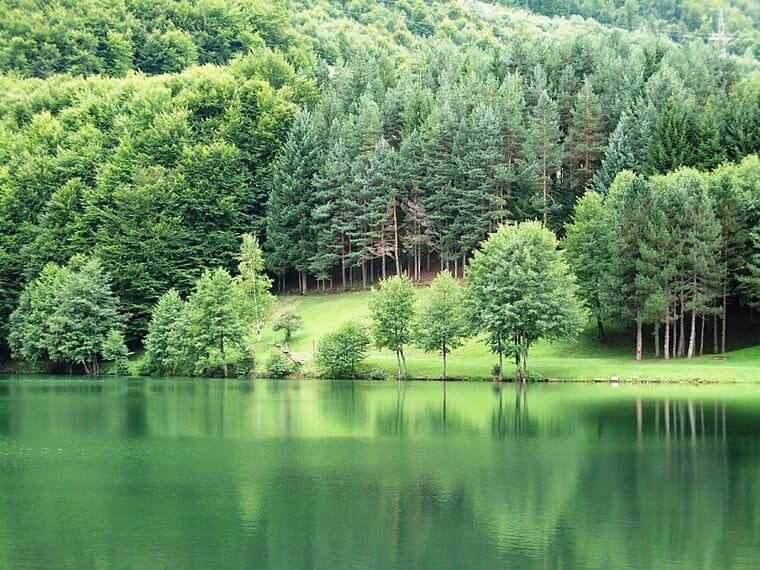
Mrkonic Grad. Photo provided by Ratnottama Sengupta

Lt Col D Ghosh, RAMC

RMO, 1 WFR

SHOE Factory, Mrkonic Grad

BFPO 551.U.K.

5th July 1996

Dear Baba,

I have just received your last letter from Bombay. I was worried about your health, which is why I rang you last night. Sorry it was so late. There was quite a queue for the phone, so I had to wait for my turn, Lt Col notwithstanding! I am reassured that you are okay.  

I am sorry the line was so poor, but it is a satellite line, which travels from Bosnia to the USA then is beamed on to India — hence all the static. Mind you, it is full of static when I speak to Lesley and Children in the UK too. Sadly, it is only an outgoing line, which takes call out, but no incoming calls. If you need to get in touch with me urgently, the best thing would be for you to ring Lesley and she can get in touch with me via the Ministry of Defence. 

We have been out in Bosnia for just over three months now, and the problems here seem to be in a state of very uneasy peace, now that Dr Radovan Karadzic has finally handed over the reins of power (Oh Yes!?). We are somewhat concerned that the proposed elections in September might bring about fresh unease and disturbance, even without Dr Karadzic at the hustings, and we might be, willy-nilly, dragged into a situation of tension to try to maintain peace.  Nonetheless, the Bosnians are making some efforts to keep the peace, albeit because we are waving a big stick whilst holding out a carrot.  

The position is especially delicately balanced for us at the moment, due to the ICFWCB’s (International Commission for War Crimes in Bosnia) declaration of the good Dr Karadzic and his General, Ratko Mladic as ‘War Criminals’ for genocide against the Muslims of Bosnia. There’s little doubt, this is due to pressure from the countries with more than a few spare billions of petrodollar in western banks. We are hoping that we will not need to confront the Bosnian Serbs by having to arrest these two persons (since this was not a part of the Dayton agreement that has laid the framework last year for ending the war ravaging Bosnia for more than three years). These two still hold considerable political sway, and have a significant following in this country. 

It seems likely that we (British Army as well as the Americans, much as they might dislike it) will have to stay on in Bosnia for quite a while longer than we’d initially made allowance for. If the yanks want out, I hope we shall pull out as well. The Serbs seem to prefer having us around, to maintain the peace, than any other European nation, as they feel the British army of IFOR has, so far, been fair and reasonable in their dealings with them. (IFOR, you do know, is the NATO-led multinational peace enforcement force here under a one-year mandate). 

This was not the feeling they had about us last year though!

The biggest single problem at the moment, which might cause a major flare up for us, is Mostar. The people of this divided town straddling the river Neretva in south-east Bosnia have selected a Muslim majority council: this, the minority Croatian population are unwilling to accept, and have been boycotting. So far the town, which is known for its mediaeval arched bridge Stari Most, has been run by a peace committee from the European community with the help of IFOR, but they have threatened to hand over the council and resign from running it. 

This would effectively ring the death knell for the first election in Bosnia. Which would mean that the results of all the country-wide elections, due in September, may be an exercise in futility. 

The sad news this morning is that the iconic bridge, which connected the two parts of the city, was blown up by ‘unknown miscreants’ – very likely to have been Croats. Thankfully, Mostar is in the French sector of IFOR overall, so let’s hope and pray.

*

Now to give you some idea of all the other things that I’ve been up to, here in Bosnia. In May we started what we call a G5 project, a ‘Hearts and Minds’ operation to try and persuade the people at the grassroots about the benefits of Peace. This is in a small village called Podrasnica, with medical logistic support — essentially, medicines — from Medicine Sans Frontier (MSF), an international humanitarian organisation that provides medical assistance to people affected by wars, epidemics or other disasters.

Podrasnica is a village of some 950 people and is, like most places in the Balkans, nestled in a valley, about ten miles from our location in Mrkonic Grad. 

The people are mostly poor agrarians, eking out a living on small land holdings, or are involved in the logging industry. I run a Primary Health Care Clinic here, twice a week. The locals and also some people from the surrounding villages (though they never let on they are from another village!) are very grateful to have this facility, as they are very poor and many of them are unable to afford the price of medicine, or have transport to travel to Mrkonic Grad, and certainly not to their only surviving big hospital at Banja Luka. We do the basic medical care and also provide them with medicines which are given to us by MSF. 

Most of my patients are elderly people and small children, as the majority of young healthy men and women go to other places, bigger cities or towns, to earn a living  as best as they can. I’ve never come across so many people, in such a small community, with so much Hypertension amongst them. How much of that is the result of the stresses of war and how much of it due to the Turkish coffee they drink, would be interesting to investigate.

The majority of people are by and large sick of the war, and this is the first time, in five years, some of them will be able to harvest their own crops. The vast quantity of what they grew in the last few years was either commandeered by their own Army or looted by the opposition (Muslims and/or Croats). 

The clinic is now quite popular, but it is time consuming as we have to use an interpreter, and I am lucky if I can get through more than 15-20 patients per clinic.  

I have a special admirer called Milija (Serbian version of our dear Emily!) who brings us Turkish coffee. She was one of my first patients. She is sixty-two years old, and is a real darling. She doesn’t believe I’m fifty, which is wonderful for my morale! 

Later this month, possibly on the 16th, we will ‘hand over’ the clinic to the local Serbs, to continue the clinic with ongoing Medical support from MSF and support from us, if they want it. If they do take over the clinic completely, I shall miss seeing the patients. I’m hoping that they will be happy to allow me to continue the clinic, at least once a week. 

The clinic work sustains me through the boredom and the non-events (in real life terms) of the remainder of the week. So far I have had one bottle of ten-year-old Brandy, and a bottle of the local firewater called Sliivo — a fruit brandy they make out of plums). I’ve found out the hard way that it is safer to keep a hand over the little glasses they offer the slivovitz in, otherwise it gets automatically topped up! Even better, so that I don’t drink whilst on duty. 

The vegetables are coming on a treat in Milija’s garden, and the palm trees are loaded with fruits, as are the apple trees next to the clinic. Milija thinks they will have a decent harvest, if the peace holds, and she’s trying hard to dissuade her oldest son from drinking too much — otherwise, she says, she will force him to come and see me! 

The men who do not have regular employment, and there’s a lot of them about, have become apathetic. So alcoholism is rife, and hence, I think, Hypertension and Peptic disease. All my boys have now developed a taste for Milija’s Turkish coffee, but I try to dissuade Milija, as I am fairly certain that the coffee beans must cost quite a bit. 

We always have an interpreter for the clinic, who are generally Bosnian girls, or fellers. They are generally chary (maybe even contemptuous) of the local yorkels, as is normal in all developing nations, and certainly in India. But the vast majority of them seem to have developed a special protective shell, to help them cope with the business of dealing with the needs of their poorer country folks, as the vast majority of them (the interpreters) get paid some DM 1000–12,00/ a month. This is eight to ten times what the ordinary folks in the country earn.  

There are some really bright students amongst these interpreters, who have given up career courses in order to take up jobs with IFOR, so that they can look after their families. One of the girls we have with us in Mrkonic  Grad was a second year medical student when the war broke out. Another girl, the daughter of a Chemistry Professor (her mother), is a graduate Electronic Engineer. She is trying to get funds organised so she can do a Master degree, and then probably a PhD. What will happen to all these blighted lives eventually, who knows?

I am constantly amazed how well these girls cope with living amongst all of our sex-starved, often foul mouthed soldiers. Some, of course, cope better than others, the youngest being just over 16 years old! IFOR has arranged a free scholarship for her, to study in the UK after she’s done her stint with the Army.  

It is hard to be surrounded by so much tragedy and not be repulsed by war and the people who lead nations into them. But draw the experiences of N Ireland into the reckoning and you realise that humankind has still some way to go before being called truly civilised. Amongst all this, when one has to cope with the petty point scoring of the self-seeking people, and self-aggrandizement of personalities around you, then it can get somewhat wearying. 

So far I am managing to cope with the changes that have occurred in my life, and find it comforting to accept that “This too shall pass”. Your letter was a solace.

I hope that my dear mother is keeping well. Please convey my pronam and love to Maa. Hope you are both well when this gets to you. I’ve rambled on too long for now. 

With pronam and love, 

Yours, as ever, Khoka
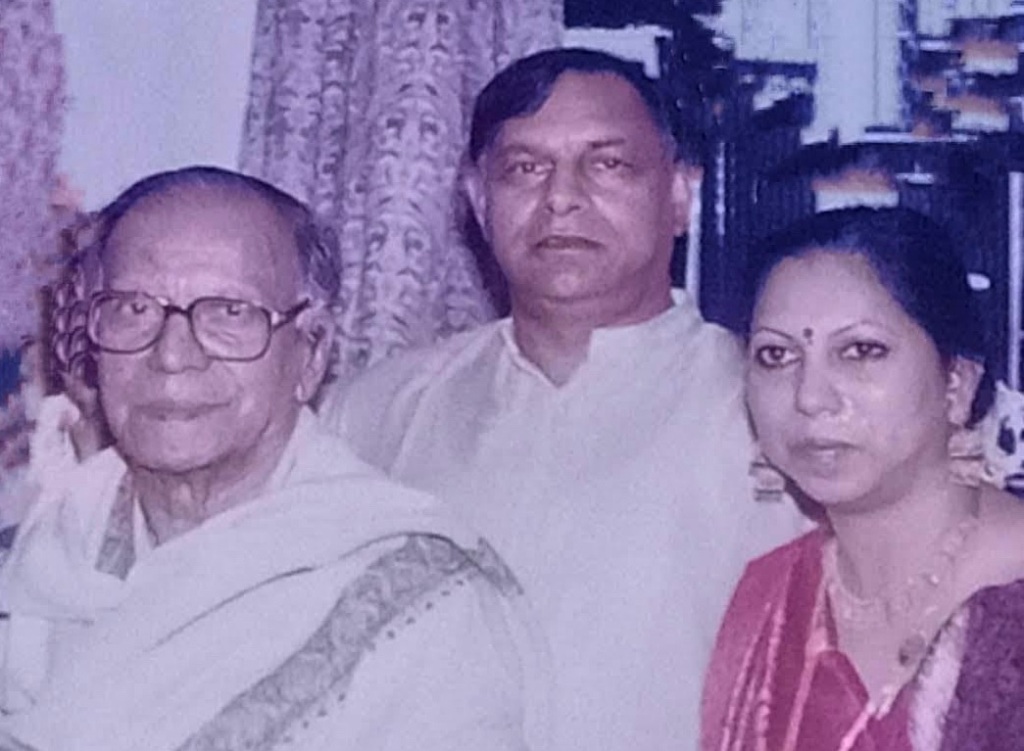
From left to right: Nabendu Ghosh, Dipankar Ghosh and Ratnottama Sengupta. Photo provided by Ratnottama Sengupta.

Ratnottama Sengupta, formerly Arts Editor of The Times of India, teaches mass communication and film appreciation, curates film festivals and art exhibitions, and translates and write books. She has been a member of CBFC, served on the National Film Awards jury and has herself won a National Award. 

.

PLEASE NOTE: ARTICLES CAN ONLY BE REPRODUCED IN OTHER SITES WITH DUE ACKNOWLEDGEMENT TO BORDERLESS JOURNAL

Click here to access the Borderless anthology, Monalisa No Longer Smiles

Click here to access Monalisa No Longer Smiles on Kindle Amazon International

Categories
Contents

Borderless, March 2023

Art by Sohana Manzoor

Editorial

Imagine… Click here to read.

Translations

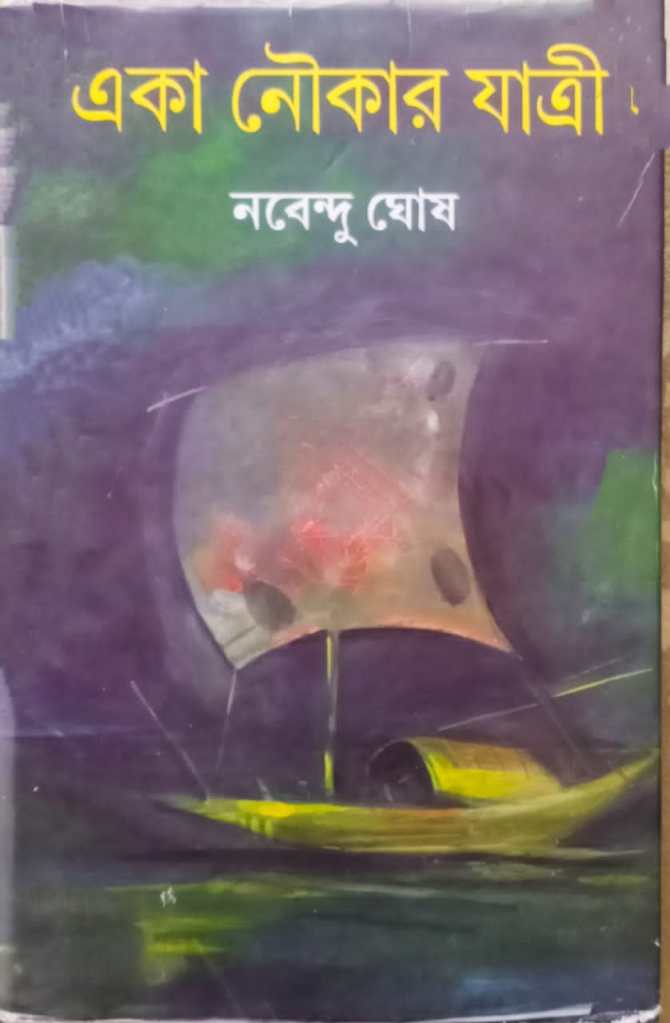
A translation from Nabendu Ghosh’s autobiography, Eka Naukar Jatri (Journey of a Lonesome Boat), translated by Dipankar Ghosh, from Bengali post scripted by Ratnottama Sengupta. Click here to read.

Uehara by Kamaleswar Barua has been translated from Assamese and introduced by Bikash K. Bhattacharya. Click here to read.

Kurigram by Masud Khan has been translated by Professor Fakrul Alam from Bangla. Click here to read.

Bonfire by Ihlwha Choi has been translated from Korean by the poet himself. Click here to read.

Tagore’s Borondala (Basket of Offerings) has been translated by Mitali Chakravarty from Bengali. Click here to read.

Poetry

Click on the names to read the poems

Michael R Burch, Kirpal Singh, Luis Cuauhtémoc Berriozábal, Amit Parmessur, Carl Scharwath, Isha Sharma, Gale Acuff, Anannya Dasgupta, Vaishnavi Saritha, Ryan Quinn Flanagan, Pragya Bajpai, George Freek, Sanket Mhatre, Ron Pickett, Asad Latif, Rhys Hughes

Poets, Poetry and Rhys Hughes

In Indian Pale Ale, Rhys Hughes experiments with words and brews. Click here to read.

Conversation

Being fascinated with the human condition and being vulnerable on the page are the two key elements in the writing of fiction, author and poet Heidi North tells Keith Lyons in a candid conversation. Click here to read.

Musings/Slices from Life

Mother Teresa & MF Hussian: Touching Lives

Prithvijeet Sinha muses on how Mother Teresa’s painting by MF Hussain impacted his life. Click here to read.

The Night Shift to Nouméa

Meredith Stephens writes of her sailing adventures to Nouméa. Click here to read.

Musings of a Copywriter

In Simian Surprises, Devraj Singh Kalsi describes monkey antics. Click here to read.

Notes from Japan

In Multicultural Curry, Suzanne Kamata reflects on mingling of various cultures in her home in Japan and the acceptance it finds in young hearts. Click here to read.

Essays

Which way, wanderer? Lyric or screenplay…

Ratnottama Sengupta explores the poetry in lyrics of Bollywood songs, discussing the Sahityotsav (Literary Festival) hosted by the Sahitya Akademi. Click here to read.

One Happy Island

Ravi Shankar takes us to Aruba, a Dutch colony, with photographs and text. Click here to read.

Cadences in A Portrait of the Artist as a Young Man

Paul Mirabile explores the stylistic nuances in this classic by James Joyce. Click here to read.

Stories

Heafed

Brindley Hallam Dennis plays with mindsets. Click here to read.

Busun

A Jessie Michael narrates a moving saga of displacement and reservations. Click here to read.

A Wooden Smile

Shubhangi gives us poignant story about a young girl forced to step into the adult world. Click here to read.

The Infallible Business

Sangeetha G tells a story set in a post-pandemic scenario. Click here to read.

Book Excerpts

An excerpt from Robin S. Ngangom’s My Invented Land: New and Selected Poems. Click here to read.

An excerpt from Vikas Prakash Joshi’s My Name is Cinnamon. Click here to read.

Book Reviews

Aruna Chakravarti reviews Bornali Datta’s In A Better Place: A Doctor’s Journey. Click here to read.

Somdatta Mandal reviews Baba Padmanji’s Yamuna’s Journey, translated from Marathi by Deepra Dandekar. Click here to read.

Basudhara Roy reviews Robin Ngangom’s My Invented Land: New and Selected Poems. Click here to read.

Bhaskar Parichha reviews S.Irfan Habib’s Maulana Azad – A Life. Click here to read.

.

Click here to access the Borderless anthology, Monalisa No Longer Smiles

Click here to access Monalisa No Longer Smiles on Kindle Amazon International

Categories
Editorial

Imagine…

Art by Pragya Bajpai

Imagine a world without wars, without divisions, where art forms flow into each other and we live by the African concept of Ubuntu — I am because you are’ — sounds idyllic. But this is the month of March, of poetry, of getting in touch with the Dionysian elements in ourselves. And as we have said earlier in the introduction of Monalisa No Longer Smiles: An Anthology of Writings from across the World, what could be a better spot to let loose this insanity of utopian dreams than Borderless Journal!

Having completed three years of our Earthly existence on the 14th of March, we celebrate this month with poetry and writing that crosses boundaries — about films, literature and more. This month in the Festival of Letters or Sahityaotsav 2023, organised by the Sahitya Akademi, films were discussed in conjunction with literature. Ratnottama Sengupta, who attended and participated in a number of these sessions, has given us an essay to show how deep run the lyrics of Bollywood films, where her father, Nabendu Ghosh, scripted legends. It is Ghosh’s birth month too and we carry a translation from his Bengali autobiography which reflects how businessmen drew borders on what sells… After reading the excerpt from Nabendu’s narrative translated by Dipankar Ghosh and post-scripted by Sengupta, one wonders if such lines should ever have been drawn?

Questioning borders of a different kind, we have another piece of a real-life narrative on a Japanese Soldier, Uehara. Written by an Assamese writer called Kamaleswar Barua, it has been translated and introduced by Bikash K. Bhattacharya. The story focusses on a soldier’s narrative at his death bed in an alien land. We are left wondering how his need for love and a home is any different from that of any one of ours? Who are the enemies — the soldiers who die away from their homes? What are wars about? Can people live in peace? They seemed to do so in Kurigram, a land that has faded as suggests the poem by Masud Khan, brought to us in translation from Bangla by Professor Fakrul Alam, though in reality, the area exists. Perhaps, it has changed… as does wood exposed to a bonfire, which has been the subject of a self-translated Korean poem by Ihlwha Choi. Tagore’s poem, Borondala translated as ‘Basket of Offerings’, has the last say: “Just as the stars glimmer / With light in the dark night, / A spark awakens within/ My body. / This luminosity illuminates / All my work.” And perhaps, it is this luminosity that will also help us find our ideal world and move towards it, at least with words.

This is the poetry month, and we celebrate poetry in different ways. We have an interview with poet Heidi North by Keith Lyons.  She has shared a poem that as Bijan Najdi said makes one “feel a burning sensation in …[the]… fingertips without touching the fire”. It flows with some home truths put forward with poignancy. We have poetry by Michael R Burch, Kirpal Singh, Luis Cuauhtémoc Berriozábal, Amit Parmessur, Ryan Quinn Flanagan, George Freek, Sanket Mhatre, Asad Latif and Rhys Hughes. While Burch celebrates spring in his poetry, Parmessur explores history and Hughes evokes laughter as usual which spills into his column on Indian Pale Ale. Devraj Singh Kalsi has written of simian surprises he has had — and, sadly for him, our reaction is to laugh at his woes. Meredith Stephens takes us on a sailing adventure to Nouméa and Ravi Shankar explores Aruba with photographs and words. Suzanne Kamata shows how Japanese curry can actually be a multicultural binder. Prithvijeet Sinha links the legends of artist MF Hussain and Mother Teresa while Paul Mirabile explores the stylistic marvels of James Joyce in his A Portrait of the Artist as a Young Man, a very literary piece.

We have a book review by Aruna Chakravarti of Bornali Datta’s In A Better Place: A Doctor’s Journey, a book that is set amidst immigrants and takes up certain social issues. Baba Padmanji’s Yamuna’s Journey, translated from Marathi by Deepra Dandekar, one of the oldest Indian novels has been discussed by Somdatta Mandal.  Bhaskar Parichha has told us about S.Irfan Habib’s Maulana Azad – A Life. Basudhara Roy has brought out the simplicity and elegance of Robin Ngangom’s My Invented Land: New and Selected Poems. He writes in the title poem that his home “has no boundaries. / At cockcrow one day it found itself/ inside a country to its west,/ (on rainy days it dreams looking east/ when its seditionists fight to liberate it from truth.)”. We also carry an excerpt from his book. Stories by Jessie Michael, Brindley Hallam Dennis, Sangeetha G and Shubhangi bring flavours of diversity in this issue.

Our journey has been a short one — three years is a short span. But, with goodwill from all our readers and contributors, we are starting to crawl towards adulthood. I thank you all as caregivers of Borderless Journal as I do my fabulous team and the artists who leave me astounded at their ability to paint and write — Sohana Manzoor, Gita Vishwanath and Pragya Bajpai.

Thank you all.

Looking forward to the next year, I invite you to savour Borderless Journal, March 2023, where more than the treasures mentioned here lie concealed.

Mitali Chakravarty

borderlessjournal.com

Click here to access the Borderless anthology, Monalisa No Longer Smiles

Click here to access Monalisa No Longer Smiles on Kindle Amazon International
Categories
Tribute

Five Spices of Screen-writing

From Nabendu Ghosh’s autobiography, Eka Naukar Jatri / Journey of a Lonesome Boat, translated by Dipankar Ghosh, post scripted by Ratnottama Sengupta

By now it had become common knowledge in the Bombay film community that Bimal Roy had brought along a “writer” with his group, and apparently he was quite a decent writer. Just as, at one time, Urdu writer Sadat Hasan Manto had come to Bombay Talkies, and Urdu writer Krishan Chander too had come on the scene. There was a feeling that there might be a chance of acquiring a decent storyline from Nabendu Ghosh. Naturally, for a while quite a few producers and film directors contacted me. Story sessions were held at Van Vihar, or at the offices of the producers concerned. but there seemed to be a lack of appreciation from these people to stories that came from the mind of an alumni of the Progressive Writers Association. They were all of the opinion, “The idea is great Ghosh Babu, but it is too idealistic. Dada we want to make movies with Dev Anand and Geeta Bali, accompanied by Johnny Walker and Yakub (comedians of the time). Please tell us stories where we can incorporate them, rather than literary stories.”

Realisation soon dawned on me that the Hindi ‘filmy kahani’ was a different genre of stories. What kind of stories? In short, stories that would be appreciated by 90 percent of viewers from different states, with different tastes, all over India. Hence even a highly educated producer like S Mukherji heard the story of Baap Beti and said: “It’s a nice story but I won’t make it – I’m a businessman”! In other words the businessman had a different slant on dramatic arts: they might well say that “Bicycle Thieves is a great film but an undoable story, I’m a businessman.”

Later, on one occasion I had asked Mr Mukherjee, “You said ‘No’ to Baap Beti, yet you wanted to film the literary story, Mrit Pradip. Why was that?” Mr Mukherjee laughed. “If there is an indication of high literary merit in a story then it might well be conducive to our business, and might turn a ‘hit’ picture into a superhit.” I asked, “Does that mean a ‘hit’ is quantifiable?” 

“Of course it is!” he replied. “Just as any tasty dish needs some specific spices to make it tasty.” 

“But what about the healthiness of the dish? Isn’t that a consideration?” 

“Nabendu Babu, I am not into the medical business.” 

“Does it follow that you will cater to the mass’s addiction for entertainment without upholding the essential ideals of life?”

“I do that Nabendu Babu but in very low doses,” said S.Mukherjee. “I follow the principles of dramatic arts as laid down in Natya Shastra but I don’t profess to be a saintly sadhu. I am a very ordinary person in pursuit of happiness.”

He guffawed loudly for a bit. Then he said, “The spices I need for my ‘cinema-dish’ are these. First, the story: usually should be about love. Second: five or six memorable ‘love scenes’ or warm situations, full of fun, lovers tiffs, misunderstanding, separation and reunion. Third: obstacles to love, by a person, family or enemy. That contributes to tension or anxiety. Fourth: four to five moments of suspense: some conspiracy, someone chasing the lovers, trying to kill them. Fifth: comic moments, not mildly humorous but uproariously funny so that people roll around in bouts of laughter. Sixth: moments of tear-jerking sadness. Seventh: Fight scenes, each being individual in itself. Eighth: five to six melodious songs, of  which two or three should be such that even persons with no music sense can sing them. Ninth: appropriate selection of actors and actresses. Tenth: a good director and a good music director. Finally: the right planetary configuration for audience’s applause.” Mr Mukherjee laughed out loud.

His words got entrenched in my mind. The successful ‘formula’ for a Hindi film! In other words it was the formula of a Hindi village Nautanki, no different from the Jatra formula of rural Bengal. Of a hundred films made by that formula, even if two managed to enlighten the mind or uplift the spirit, that would be an icing on the golden cake – “sone pe suhaga”. And if there was no icing, the gold that clinked in would be good enough gain, and two and a half hours will pass away in laughter and tears, in suspense and romance, with joyous humming of a few bars of melody as viewers return home to deep slumber, dreaming of the handsome features of a hero or heroine that will tickle their fancy and prove the worth of the newly invented form of art – cinema. In particular, the magic of Hindi movies.

Therefore, I decided to write or adapt stories and ideas to comply with the mandates of the Formula. Whatever good ideas came along, whether in five pages or five hundred, I would fit into two and a half hours, either by extending or shortening in a fast flowing format that would leave the viewer wondering what’s next at every turn. In other words, I would write screenplays of a different kind.

And since I was unable to uphold the higher ideals of literature on the silver screen, I would compensate for it by writing for literature. I would thereby absolve myself of my sense of guilt.

Photo provided by Ratnottama Sengupta

Ratnottama Sengupta’s post-script:

In 1952, when Nabendu Ghosh was narrating his story, Baap Beti, Sashadhar Mukherjee (1909-1990) was a highly successful producer who had set up Filmistan Studios in 1943 along with his brother-in-law, the legendary actor Ashok Kumar; Rai Bahadur Chunilal, father of music director Madan Mohan; and Gyan Mukherjee, director of the superhit Kismet. These personalities had broken away from Bombay Talkies after the death of its founder, Himanshu Rai. 

Later in the 1950s, S Mukherjee independently started Filmalaya, noted for films like Dil Deke Dekho (1959), Love in Simla (1960), Ek Musafir Ek Hasina (1962) and Leader (1964). He is also recognised as the patriarch of the distinguished Mukherjee clan of Bollywood that boasts actors like Joy Mukherjee, Deb Mukherjee, Tanuja, Kajol, and Rani Mukherjee.

And Baap Beti? It got made into a film produced by another highly successful producer of the times, S H Munshi. Directed by celluloid master Bimal Roy, it had brought a host of child artistes who went on to become big names of the Hindi screen: Tabassum (1944-2022), who passed away in November; Asha Parekh (2 October 1942), who was bestowed with the Dadasaheb Phalke Award last year, and Naaz (1944-1995),  besides Ranjan (1918-1983), the swashbuckling actor from the South.

As he writes in his autobiography, after this conversation Nabendu Ghosh took a conscious decision to write his own realisations as literature, and to adapt stories by other writers for the screen. That is why we find that less than 10 per cent of the films he scripted are from his own stories. But some major directors did draw upon his stories – as Bimal Roy did for Baap Beti; Gyan Mukherjee for Shatranj (1956), Satyen Bose for Jyot Jale (1973), Mohan Sehgal for Raja Jani (1972) and Ajoy Kar for Kayahiner Kahini (1973). Only one classic that used his story but did not credit it to Nabendu Ghosh was Guru Dutt’s Kaagaz Ke Phool (1959).

Nabendu Ghosh with his son, Dipankar Ghosh, & daughter, Ratnottama Sengupta

Nabendu Ghosh’s (1917-2007) oeuvre of work includes thirty novels and fifteen collections of short stories. He was a renowned scriptwriter and director. He penned cinematic classics such as Devdas, Bandini, Sujata, Parineeta, Majhli Didi and Abhimaan. And, as part of a team of iconic film directors and actors, he was instrumental in shaping an entire age of Indian cinema. He was the recipient of numerous literary and film awards, including the Bankim Puraskar, the Bibhuti Bhushan Sahitya Arghya, the Filmfare Best Screenplay Award and the National Film Award for Best First Film of a Director.

Dipankar Ghosh (1944-2020) qualified as a physician from Kolkata in 1969 and worked as a surgical specialist after he emigrated to the UK in 1971.  But perhaps being the son of Nabendu Ghosh, he had always nursed his literary side and, post retirement, he took to pursuing his interest in translation.

.

PLEASE NOTE: ARTICLES CAN ONLY BE REPRODUCED IN OTHER SITES WITH DUE ACKNOWLEDGEMENT TO BORDERLESS JOURNAL

Click here to access the Borderless anthology, Monalisa No Longer Smiles

Categories
Tribute

Classics in Translations

Translations bridge borders — borders drawn by languages. We have showcased translations in multiple languages. Paying a tribute to all the greats, we invite you to savour a small selection of our translations.

Tagore Translations

Translations from Tagore & Us

Click here to check out our collection of Tagore’s writings translated to English. With translations by Aruna Chakravarty, Fakrul Alam, Radha Chakravarty, Somdatta Mandal and many more.

Nazrul Translations

Temples and Mosques

Kazi Nazrul Islam’s fiery essay translated by Sohana Manzoor. Click here to read.

Purify My Life

Kazi Nazrul Islam’s poem, Purify my Life, translated by Shahriyer Hossain Shetu. Click here to read.

Shammobadi

Kazi Nazrul Islam’s poem translated by Shahriyer Hossain Shetu. Click here to read.

Sarat Chandra

Abhagi’s Heaven

A poignant story by Saratchandra Chattopadhyaytranslated by Sahitya Akademi winner, Aruna Chakravarti. Click here to read.

Bijan Najdi

Our Children

A poem by well-known Iranian poet, Bijan Najdi. Translated from Persian by Davood Jalili. Click hereto read.

Persian Perspectives: The Third Perception of Man

This essay by Bijan Najdi, translated from Persian to English by  Davood Jalili, talks of Najdi’s concept of poetry. Click here to read.

Tarashankar

The Witch

The witch is Aruna Chakravarti’s translation of a short story by renowned writer, Tarasankar Bandopadhyay . The original story titled, Daini, was first published in 1940 in Probashi magazine in Bengali. Click here to read.

Akbar Barakzai

Songs of Freedom

Poems translated from Balochi by Fazal Baloch. Click here to read.

Syad Zahoor Hashmi

The Lost Coin

A story by Syad Zahoor Shah Hashmi, translated from Balochi by Fazal Baloch. Click here to read.

Nabendu Ghosh

The Saviour

A translation from Bengali to English by Dipankar Ghosh of Nabendu Ghosh’s Traankarta, a story set during the Partition riots. Click here to read.

Nadir Ali

Bundu, Consoler of the Rich 

A story based on memories of Partition by Nadir Ali, translated from Punjabi by Amna Ali. Click here to read.

Louis Couperous

Of Days and Seasons

A parable by the eminent Dutch writer, Louis Couperus (1863-1923), translated by Chaitali Sengupta. Click here to read.

Categories
Stories

The Saviour

  A translation from Bengali to English by Dipankar Ghosh of Nabendu Ghosh’s Traankarta, a story set during the Partition riots

Nabendu Ghosh

The bad news reached here too, the news of the rioting. The roads looked tense and empty. Even the pariah dogs that usually roamed the streets had disappeared. Only a few brash teenagers were bunched up in a group at the head of the lane, swaggering around with cigarettes hanging from their lips.

On the other side of the city, fires were raging, severed heads rolling on the blood-bathed streets; teenaged girls had their breasts cut off and little babies had been thrown head down into concrete floors. Tonight they were paying homage to Satan in the stygian darkness, on the other side of the city. The news wafted in the gentle breeze, and the horrifying tales of the day’s events spread through the grapevine to every household.

Gloom descended on everyone. They felt benumbed, paralysed, by a tidal wave of fear.  Fear, unspoken fear.  Fear that made the heart palpitate madly in the breast. Fear that made you seek the company of a crowd. Awful fear. The kind of fear that deprived one of the will to live.

The ladies proceed silently with their chores. Not too many items on the menu for tonight. Rice and boiled vegetables. The children don’t understand much, occasionally they were bursting out into giggles, running noisily up and down the stairs, squabbling amongst themselves.  But, now and then, an older person would burst out like a sentry, “Silent! Or I’ll behead you with a smack!”

But they could think of very little that they could be done to save their own heads from the approaching holocaust. Everyone was discussing behind barred doors, what to do. Not just bad news, but terrible news that the people from the other side intend to attack them tonight. A cold wave of fear ran down their spines when they got the news. What to do, what on earth should they do?

The house of Mr Bose, a barrister who was the local leader, was brightly lit up. Arun was planning to quietly slip out, how long could one possibly stay cooped? But Mr Bose had his searchlight eyes on every possible exit, making it impossible for anyone to either enter or leave his fortress of Lanka without his knowledge.

“Where do you think you are going?” he asked in his deepest voice.

 “Just out – for a dekko.”

 “Just out! Forget it. Are you not aware of what’s going on in the heart of this city?! Go, get back and stay put in your room.”

Arun returned to his room.

His daughter Ruby came out. There were dark circles of anxiety under her large almond eyes. Her curly black tresses were floating in an unruly fashion, her usually healthy pink glow was replaced by sallow pallor. She was depressed, and fear had put its mark on her. Movies, parties, and picnics were suddenly out of question, the desire to fly around the flowers and taste their honey at will had suddenly flown out of the honey bee. Ruby was lost.

“Daddy –”

“Yes?”

“Will you take us to uncle’s house?”

Meaning Bhawanipore. Meaning a predominantly Hindu area, where perhaps she could put on her crepe silk sari and wander around at will, shaking her long coil of hair.

Mr Bose shook his head in frustration, “Uncle’s house? Now? Impossible! The roads are barren, not a man or a car about, we will have to cross many localities, driving through corpses and rivulets of blood, and more importantly, sudden unprovoked attacks! That important thing called life that we are trying to save, could very easily be ended en route! Stop making silly suggestions, go up to your room and stay there Ruby –”

But how on earth could Ruby sit calmly in her room! She felt frightened out of her mind. Occasionally the sound of shouting was floating in from afar. Awful noises. Last night she had seen the sky flare up in the east. She had heard all the beastly tales. It had all left a fearful imprint on her mind and every now and then, a spark of fear would set off a burst of anxiety in her mind. The nervous pulsating of the vessels under that pink alabaster skin of hers bore witness to her angry, frightened state of mind.

Now, it was one thing browbeating Arun and Ruby, but Mrs Bose?  Perpetually conscious and tense about her obese abundance, she was an entirely different proposition. No doubt the dreadful news of the riots would put her in a fairly explosive state of mind — of that Mr Bose was certain. Therefore, when the substantial lady made her appearance Mr Bose felt a bit intimated, fairly aware that if he tried to browbeat her, the result could be counter-productive.   

“Listen, I can’t go on like this — this suspense, this danger, it is unbearable.”

“But what — tell me what am I to do dear?” Mr Bose protested weakly.

“Do something, for Heaven’s sake! Don’t just sit still, quietly—”

“I am not sitting still. I am trying to think. Besides, we have two rifles, five hundred rounds of ammunition, we have a sentry, a bearer, a man servant and also a chauffeur, so what are you worried about?”

Mrs Bose collapsed on the sofa, there was a glint of fire in her bluish eyes, sharply she said, “Spare me a list of your rationale, please — your little group would disappear in front of a massive crowd. I’d like to see you stop them with those five hundred rounds. You don’t consider that an unending supply, do you? No, I’m sorry that is not enough to reassure me — I’ll faint any moment under the strain!”

Knock, knock. Somebody at the door.

“Sir,” the sentry’s voice outside the door.

“What is it Tiwari?”

“Some people of the community want to meet you Sir.”

“Offer them seats,” he spoke aloud, then continued to assure Mrs Bose, “Now listen, don’t get overexcited. Let’s wait and watch. We are due to have a meeting of the local defence committee. It is such a large community I am sure they are all willing to fight to protect us all. Don’t be nervous dear. If the situation deteriorates then of course we will have to take a risk — but the car will be ready to leave at a moment’s notice.”

*

In the margins of the so-called civilised society, at the end well-to-do side of the neighbourhood, separating them from the Others on the opposite side, lived a group of people who considered themselves a part of the same community. They were the untouchable Doms. Living in pigeon hole sized tiny hovels, they just about carried on living. They swept the roads, carried water for folks, washed their drains and lavatories. They collected night soil, got into manholes and extracted rubbish from them, they cleaned refuse bins and manned the garbage carts of the municipality. Their hovels were plastered with mud, and they ate from chromed metal plates of their dirt mixed rice. They sat in the light of little kerosene lamps and got boisterously drunk in the evening. And although they considered themselves to be part of the community, to the more genteel and affluent part of the community they were always a bit of an embarrassment. 

These people in the no man’s land between the two communities numbered some two hundred. And the only man who had the absolute obedience of these two hundred odd bods was called Jhagru. Such was his hold over them that, if he chose to call daylight as night his men would do so without batting an eyelid. He was their unopposed and unanimous chief, their sardar.

Jhagru’s men had come to him. They had seen bits of what had happened on the other side, heard most of all the atrocities that had taken place, they had even helped the frightened people who had managed to flee from the fortress-like bounds of the place, and taken them to safety. But the question was, what would they do today? If what they had heard on the grapevine was proven true, then how were they to react?

Having binged on some onion bhajis (fritters) and the potent rice-wine of Tari, Jhagru was feeling content. The capillaries of his eyes were bloodshot, and in the cool evening breeze his large figure deemed ready to take off like a well inflated balloon. He eyed his wife’s, Suratiya’s, generous proportions as he was preparing himself for some decent basic entertainment for the evening, his men all descended on him with the bad news, and spoilt his mood.

 “Bugger off !” he said crossly in Hindi. “What will be, will be. So what if they attack?”

Ranglal said, “But surely we must do something -”

“You buggers have ruined my drinking,” Jhagru barked at them.

Waving a hand, he demanded, “What the hell is there to worry about? If they attack, we will fight. What else? The main thing is, be prepared with your weapons, when the gong is rung, jump on them — end of story –”

“But sardar–”

“No buts, you all run off. Sitting here with my toddy, let me enjoy my drink — you blighters get back to your homes.”

They all left.

Munching his onion bhaji, he sipped from his earthen cup. Slowly but surely the warmth off the stinging spirit made his ears ring, his breathing got heavier, his eyelids drooped, his sight got hazy. Jhagru was drunk. In that state he was pleasantly surprised to notice that Suratiya had turned into an exceptional beauty, like an unattainable princess of a fairy tale.

“Suratiya dear –”

“What?”

“Come on, over here –”

“Unh-hun –”

“Have a bit of tari?”

“NNo – I won’t –”

In his stupor Jhagru was suddenly enraged by this rejection, and got headstrong.

“You coming here or not — you bitch!”

“No I won’t — I’ve enough work still to finish –”

“Then suffer the consequences –”

Jhagru got up. Walking with unsteady gait like a child, he reached Suratiya, caught hold of her and lifted her in his arms.

“You’ll kill me,” Suratiya screeched, “you’ll break every bone in my body!”

Pulling his wife close to him Jhagru guffawed loudly, “You frightened? Don’t be, woman. Go on, sit in my lap.”

Jhagru was drunk like a lord. No way could he hold on to a strong woman like Suratiya in his drunken state, let alone have his way with her. Giggling loudly, Suratiya ran away.

Ten or eleven o’clock in the morning. If it were an ordinary day, Jhagru would be up to his neck in work. But since the rioting was a good excuse not to be at work, why not have some fun. 

 “Ran away,” Jhagru laughed. “Bloody woman.” Got to do something, he thought to himself.  The tari was finished, he was drunk, and Suratiya was gone. So he needed to do something. But what?

Suddenly in a dusty corner he noticed his forgotten dhol (drum). He pulled it out and started to beat it enthusiastically. He would sing. Never mind, if it scared the daylight out of people, Jhagru could not desist. He was in the mood for some singing, and sing he would.

Vigorously beating the drum, Jhagru started to sing widely. Amongst the incoherent lyric the audience could have deciphered only one line, which he kept repeating in a refrain:

Chhappar par kauwa naache, Bug bugoola/ Hanh hanh bug bugoola…

(The crow dances on the rooftop, bug bugoola)

 Ya, Ya, bug bugoola

What wonderful tune! What incredible control of voice! What melody and feeling in rendition! The entire slum of untouchables woke up to fact that Jhagru was drunk and was singing.

Respectfully they whispered, “Sardar is singing, by jove he is singing.”

*

The Defence committee meeting was on at Mr. Bose’s house. He himself was the chairman.

Almost all the important folks of the locality were gathered there. Venerable teacher Nibaran Mukherji, solicitor Haridas Mitra, Dr. Santosh Dutta (MBE, RCS), and iron merchant Sukumar Roy.  There were also the young representatives of the Saraswati Orchestra Group, Youth Body-Culture Samiti, and the Evergreen Dramatic Club. A large blanket had been laid on the floor of Mr Bose’s inner courtyard. Seated on it, all the members were earnestly discussing the situation.

In a room across the corner Ruby had drawn the curtain aside to watch the proceedings. Sheer curiosity. Unable to get out of the house, the lack of parties, movies and picnics was getting unbearable. The meeting was an interesting diversion. If nothing else, she would see a wide spectrum of people. Ruby did not watch them passively, she tried to instinctively assess them. It pleased her to do so.

Mr Bose started in a deep, appropriately grave presidential voice. “You are all aware of the reprehensible events that have started in our city yesterday. Some of you may have witnessed the carnage. This is not the time, and I’m not the person, for long drawn speeches. Suffice it to say that we, especially us Bengalis, are witnessing the beginning of an evil period. Today we must bind together against this medieval barbarism. We have to fight it and stop it — meaning, we have to stop this aberration. We must forget the differences of our castes, our classes, high or low, who is untouchable and who isn’t– remembering only one thing– that we are Hindus and nothing else.”  

Mr Bose stopped for a moment, took a hanky out of his pocket, wiped the tension-induced sweat off his forehead. Opening his cigarette case, he offered the expensive ‘Black and White’ cigarette to the assembled elders and lit one for himself. There was a murmur of appreciation in the gathering for his opening speech, Ruby was flushed with pride.

The iron merchant said, “Absolutely, there’s great merit in what you have just said. The time for squabbling about class, caste et cetera is gone — from now on we are all equal, we are all Hindus.”

Mr Bose said, “Now let us determine how we should go about it.”

“Right, right,” they said in unison, and leaned forward.

The venerable teacher said, “Let’s divide the neighbourhood into four parts, each one keeping guard in their side of the four directions.”

The solicitor said, “Let’s use a siren or conch shells to signal danger to others.”

The doctor said, “A group of youths should stand guard, by rota, and blow on a conch three times at the first sign of danger. The siren should go off then. There should be red beacons in the last row of houses in the four main directions, and if danger approaches, the beacons should be lit up to let the others know which direction the danger is approaching from.”

The industrialist said, “The women, children, and the elderly should remain in the top floor or in the terrace armed with bricks and stones. The men should stay on the ground floor, armed with sticks and other weapons.”

All the suggestions were passed. The defence committee meeting was progressing nicely, but suddenly, a young lad called Jatin, created a problem. He wore clothes of hand woven khadi, which meant he was a nationalist, he had short cropped hair, and he was rough-spoken.

He said, “You have arranged everything. But if they really do attack us, then who is going to engage in a hand to hand fight?”

It seemed like a bomb had been set off. Everything felt hazy and nebulous like smoke. Not for a moment had they considered this! Really worth thinking.

The industrialists said, “Why, won’t we all fight them? Let all of us get to grips with them.”

The teacher shook his head in dissension, “That does not sound reasonable. It would mean that a group of people would always have to be outside to fight the enemy. In other words, they would have to be prepared to sacrifice their lives. Can all the able-bodied men do that, or be willing to do that?”

Another explosion. Really, who should fight on ground, if there were a fight?  If their worst fears materialised and thousands of people attacked them suddenly, then would people in individual houses, like disparate little islands, battling the enemy with bricks and sticks be able to save themselves?

Jatin said, “So, in spite of our well-organised meeting, and all our arrangements, we will not be able to save ourselves. So consider what ought to be done–”

Mr Bose was an intelligent man, having passed his bar at Law in the distant land across the seas had sharpened his instincts even more. He realised that since Jatin had raised this insoluble problem, it was fairly certain that he had pondered on the answer to it. And truly it was a serious point. He said, “I really have no solution to the problem Jatin has set before us, so I must request Jatin himself to show us a way out of this dilemma.”

Jatin smiled. “Fine,” he said, “I will resolve the problem. Have you any idea knowledge of the poor people who live between ‘Them’ and ‘Us’?”

“The Doms?”

“Yes. They don’t belong to the other community, they consider themselves part of us Hindus. And, although they cannot enter the Shiva temple at the other end of our colony, they worship the idol in that temple. Meaning, they are Hindus –”

Mr Bose smiled appreciatively at him, “The idea.”

 Jatin continued, “They might earn little and eat less but they are hardy and strong. The instinct that we have lost, which is presently making us timid despite our numbers, is fully active in them. So if you really want to perform as a defence committee, and live on, then you better bring them into this meeting. And raise a fund-immediately!”

The mention of money made the industrialist take note, “Fund for what?”

“It is best to give some salted yeast to the cow when it’s in milk,”Jatin smiled.

“Meaning what? Cough a bit freely, son –” the industrialist said, testily.

“The meaning is self-evident. We must give them weapons, good food, and a decent flow of liquor.”

“That is true. Those who are going to put their lives on line must be well tended,“ Mr Bose agreed with Jatin.

“Don’t waste time in thinking,” Jatin stressed. “Atrocity has to be stoutly countered with ferocity, so we must be prepared. And let there be no doubt in your minds that they will attack us tonight.”

There was a rustle of notes and coins changing hands. Then and there a collection of fifty rupees was raised, more funds would be forthcoming later. Who could object to a bit of wise investment when one’s life was at stake? Nothing is quite as deep as one’s life — so let the blighters have good food and potent country liquor. Not a lot to pay for the bargain. They might attack this very night. If the cruel pack of animals descend in the dark of the night, then these men will pour out their life blood for our protection. Wasn’t this the least one could do for them? Surely they would serve them. It would be a good deed. Not just the joy of being alive but also the gratification of doing a good deed, by giving the money. So let them eat, let them get drunk.

*

Jhagru suddenly tired of the drum and put it down. He kicked it to a corner, swearing, “Hell, I think I’m sober –”

No work today. How long can a person enjoy staying within the house? It would be fine if there was toddy around. That was gone. A bit of monkey business with Suratiya might have been fun, but she, wretched girl, had scampered. Maybe she really had work to do. Even bonking wasn’t much fun any more, but what he did enjoy was good liquor. This approaching sobriety, clearness of vision, reality creeping into the drowsy stupor of alcoholic haze was most disagreeable to Jhagru. What was termed as normal life was totally abnormal as far as Jhagru was concerned. To him normalcy was epitomised by gallons of drinks followed by drunken fisticuffs, singing and dancing bare-assed, puking the guts out and lying down inebriated.

This was rotten. Must get some more toddy. Must get back into the mood.

“Suratiya –O Suratiya–”

“What do you want?”

“Give us a couple of annas, dear.”

“Don’t have any.”

Jhagru jumped up and roared, “You going to give me the money without hassle, Suratiya?”

Suratiya answered back in the same pitch, “No hassle, no tassle — simple fact, I don’t have the money.”

Suddenly, Jhagru lunged at Suratiya — pulling her by her short pigtail he thumped a few hefty blows on her back, “You ungrateful slut–”

 “Oh my Ma — he’s killing me!” Suratiya wailed out loud. There was no need for the wailing, but Suratiya had talent for dramatic exaggeration.

“Are you gonna gimme the money or not, you wretched witch?”

The people of the hovels took note, and respectfully whispered amongst themselves, “Sardar is giving his wife a thrashing, a good hiding.”

It was at that moment they heard two or three voices call out, “Jhagru? Is Jhagru in?”

The voices were barely audible above Suratiya’s caterwauling. Again the voices were heard, this time a notch higher, “Jhagru? Jhagru sardar— are you in? Jhagru–”

Suratiya stopped her yowling, looked out and said, “Some people looking for you –”

“Me?”

“Yes, some gentlemen.”

“Gentlemen?!”

Caught unawares, Jhagru tried to collect his thoughts as he came out to meet the three ‘gentlemen’. Jatin was one of them.

“Are you Jhagru?”

“That’s me.”

“You have been sent for.”

“Who has sent for me?” Jhagru was a bit puzzled.

 “Bose Saheb, the barrister– don’t you know of him?”

 Jhagru’s pupils dilated anxiously, shaking his head vigorously he said, “Sure I know him sir, of course, yes.”

“He has sent for you — now–”

“Me? Oh my lord, what would he want with Jhagru Dom?”

“He needs you. Won’t you come?”

“Yes, yes, certainly I will come, sir. Barrister Saheb has sent for me, goodness–”

Salaam squire, salaam babus–”

Jhagru stood in front of the defence committee. He was still rather drunk, he swayed a bit on his feet as he waited. They all gazed at him. There was a fine sheen of sweat on his hairline pate, and the pupils of his small eyes flickered a bit anxiously. He was wearing a dirty torn loincloth and a thick loose shirt, an angry boil on his left cheek. That was Jhagru.

Ruby stood close behind the curtain. Her nose in the air, she muttered to herself, “How ugly and dirty!”

All the inspecting keen eyes seemed to pierce Jhagru like needles.

He smiled a bit uncomfortably, blurting out, “Forgive me sirs, I am a bit drunk on rice wine–”

Mr Bose leaned forward to ask, “So you are Jhagru?”

“Yes sir, Jhagru Dom.”

“And you are drunk?”

“Yes sir.”

“You enjoy your booze?”

Hanging his head, Jhagru said, amused, “Certainly do sir.”

A bit more forcefully, Mr Bose asked, “Are you the leader of the Doms?”

“Yes sir.”

 “Well then, listen Jhagru. We will let you, and your comrades, have as much drink as you want. And not just drinks, we will give money for food too.”

Jhagru wondered if he was dreaming. He looked all round, somewhat warily. No, everything looks quite real. He wondered if he was he awfully drunk. Never, he had barely wet his snout. It wasn’t false, it was all true, real.

“You are very kind sir, but –”

Mr Bose interrupted, “I’ll tell you. You have heard about the disturbances, haven’t you Jhagru?” 

Jhagru nodded, yes.

“Tonight they might attack us here.”

 “Yes sir.”

“We are Hindus, and you all are also Hindus.”

“Sir.”                  

“If Hindus don’t save Hindus then who will save them?”

“Certainly sir, absolutely right.”

“If they attack us, you will all fight? We — we shall certainly join you, we will fight together.”

 Suddenly, Mr Bose noticed that amidst the seated gathering Jhagru was the only one standing up. In  an excited voice he said, “What’s this Jhagru, why are you still without a seat? Come take a seat, sit.”

Jhagru’s was stunned. The sudden, unexpected cordiality overwhelmed him, he uneasily said, “But –”

“No buts, no formalities, don’t be shy, take a seat.”

 “I am an untouchable Dom, sir.”

 “Dom?” Mr.Bose lifted his eyes to heaven, his voice quivering with feeling he said, “Dom so what? Untouchable?! You are a human being just like us. A Hindu just like us. Sit down, brother.”

Suddenly, to emphasise that he meant what he had uttered, Mr.Bose walked up to Jhagru, took the astounded man’s arm and sat him down on a chair.

Jhagru tried to say something but his chocked vocal cords would not cooperate. The man who could talk nonstop even when he was completely inebriated, was struck dumb through a combination of amazement, gratefulness, and a feeling of unprecedented happiness.

The soft crackling of notes being counted could be heard.

Moments later Jhagru came out of the house.

On his way back home, as he passed by the temple of Lord Shiva, Jhagru stopped short. He went up to the temple, moved his calloused hands over its mossy wall, and chuckled, “Lord Shiva, you are so kind, so good.”

*

All at once an air of festivity engulfed them all in the slums. Ramprasad Singh’s distillery of illicit liquor was drained within the hour. Banwari’s Confectionery shop had empty shelves, so had Tiwari’s eatery.

Occasionally the sound of a clash in the distance would float in. The battle-crazed sound of destruction, “Allah-Ho-Akbar!” It sounded like the sea from a distance, like waves the sound overpowered the senses.

Every now and then, a dog or two would respond to the danger of the distant noise. In the deepening silence of the dark night, the leader of the slum-dwelling Doms sat awake and alert. His eyes pierced the unknown before him, his ears pricked, attuned to every sound and echo.

At about one o’clock in the morning They declared war.

Allah-ho-Akbar–”

Pakistan zindabad–”

Jhagru started to beat his drums. Doom-doom-doom-doom. Every slum-dweller was awake. Without a word, they all ran out to the meeting point.

They came playing a band, with torch flares alight. A feeling of hellish surreality descended with them. Like a mass of primitive malevolent spirits, some blood-thirsty phantoms seemed to have taken possession of their dark souls.

The main assault was aimed at the Shiva temple, the purpose being its destruction and after that,  the colony beyond.

The entire neighbourhood was overcome with fear. Sirens were blaring, the blood-red lights at the top of the buildings sent out a morse flicker of fright, children could be heard crying as windows banged and doors rapidly closed.  The sound of fleeing feet was challenged by the conches.

The whole colony in fear roared, “Vande Mataram* –”The battle cry that was used to liberate the country from foreign rule was the very one they now used to strike at their own countrymen.

Jhagru had stopped beating his drum by then. Quietly they waited.

“Make no noise brothers– let them get close–” Jhagru directed them.

Allah-ho-Akbar–”

Suddenly they descended like floodwater. In the bright light of the torches their knives and swords gleamed wickedly.

Jhagru was swaying to the beat of the band music, now he shouted, “Go strike now brothers– let’s clear this rubbish–”

The slum-dwellers let out a roar.

The Shiva temple whose walls had never granted them entry, the deity whose blessings they sought merely by touching its moss-covered walls, whom they prayed to and sought solace by beating their head in despair, the unresponsive stony God who never objected to the poverty and deprivation of His people, in His name, Jhagru joined the battle today.

Har har Mahadev– Jai Shivji ki jai—” Glory to the God of Gods–victory to Lord Shiva.

Then, it seemed as if two mountains had clashed. Not soft mud-hills of earth but two primordial masses of rocks.

Blood flowed in streams. Arms, legs, and decapitated heads fell and floundered on the soil. Shattered skulls poured out their contents like an outpouring of ghee. The sharpened knives pierced a chest or belly and emerged victorious, dripping blood.

Overhead, in the dark blue of the eternal sky the stars flickered weakly. Scraps of cloud floated noiselessly. Somewhere in the sooty night surely flowers were opening their petals, some child was peacefully sleeping, a lover was holding his beloved to his chest motionlessly. Somewhere, surely people were dreaming, someone was singing, making love. And yet…

*

The rioting stopped. They accepted defeat and retreated. Jhagru’s band had cooled their ardour for battle. The Shiv temple stands untouched.

But many had lost their lives. On both sides. On this side, only the Doms. All the genteel folks were watching the rear end of the battlefield, but the battle did not extend that far. If it had done, of course they would have pitched in, sacrificed their lives.

In the deserted battlefield only the corpses remained. The stench of spilt blood and decomposing bodies was stifling the breeze.

Outside Mr Bose’s house the car stood with its engine idling in the semi-dark of early dawn. Next to it stood an army truck, with four armed soldiers.

“Are you all ready, Ruby?”  Mr Bose urgently called out. “Hurry up, the military escort will not hang about much longer.”

 Ruby nodded in assent, “Yes, we are ready, let’s go. You know Daddy, Maa is still in a shock.” They all came out.

“Quite natural,” Mr Bose said, “Do you think I am my own self? The good Lord saved us so we are alive to talk about it. Now hurry up.”

 Mr Bose got into the car. It sped off. They were going to the safety of Bhowanipur.

Arun said, “Jhagru was our saviour, dad! The man put up some fight.”

Mr Bose lit up a cigarette, until now he did not have the state of mind to do so. Letting off a mouthful of smoke, he said, “Hunh — it was their kind of work. Do you think you all could have done that? Certainly not. Anyway, we did not fail to compensate with money, he was well paid.”

Ruby heaved a sigh of relief, what a close call. Thankfully picnics, parties, and movies would not go out of her life, the butterfly had not come to the end of her days.

The car disappeared into the distance.

In the slums of the untouchable community, the women mourned their dead.

Numerous women had lost their fathers, brothers, husbands and sons. Their cries of mourning rose like a flame into the morning sky.

Suratiya wept. Jhagru was dead.

Yes, Jhagru is dead, but then people like him are born to die so that may save the Mr Bose of this world. Without five sacrificial deaths in the highly combustible lac house of Jatugriha, the five Pandav princes of Mahabharat could not have been saved.

.

*Vande Mataram — A song by Bankim Chandra written for his novel Ananda Math in the nineteenth century and used during the Indian independence movement widely.

(Published with permission of the translator’s and writer’s families.)

Nabendu Ghosh‘s (1917-2007) oeuvre of work includes thirty novels and fifteen collections of short stories. He was a renowned scriptwriter and director. He penned cinematic classics such as Devdas, Bandini, Sujata, Parineeta, Majhli Didi and Abhimaan. And, as part of a team of iconic film directors and actors, he was instrumental in shaping an entire age of Indian cinema. He was the recipient of numerous literary and film awards, including the Bankim Puraskar, the Bibhuti Bhushan Sahitya Arghya, the Filmfare Best Screenplay Award and the National Film Award for Best First Film of a Director.

Dipankar Ghosh (1944-2020) qualified as a physician from Kolkata in 1969 and worked as a surgical specialist after he emigrated to the UK in 1971.  But perhaps being the son of Nabendu Ghosh, he had always nursed his literary side and, post retirement, he took to pursuing his interest in translation.

.

PLEASE NOTE: ARTICLES CAN ONLY BE REPRODUCED IN OTHER SITES WITH DUE ACKNOWLEDGEMENT TO BORDERLESS JOURNAL