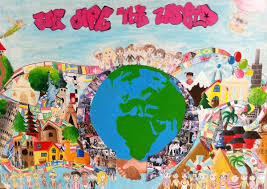
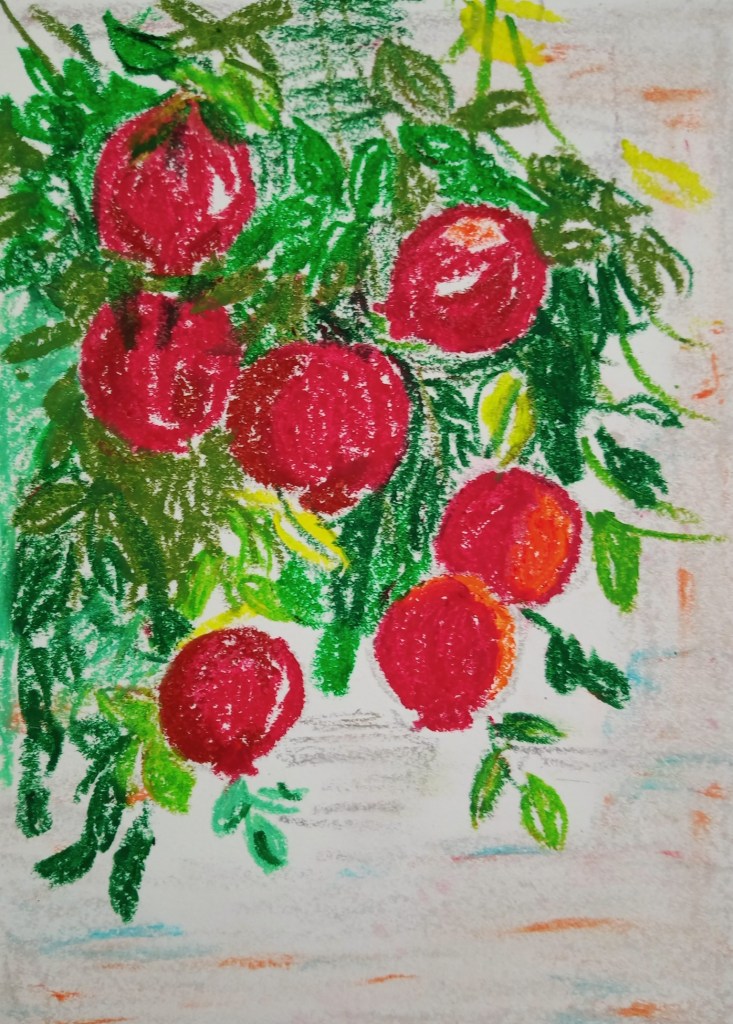
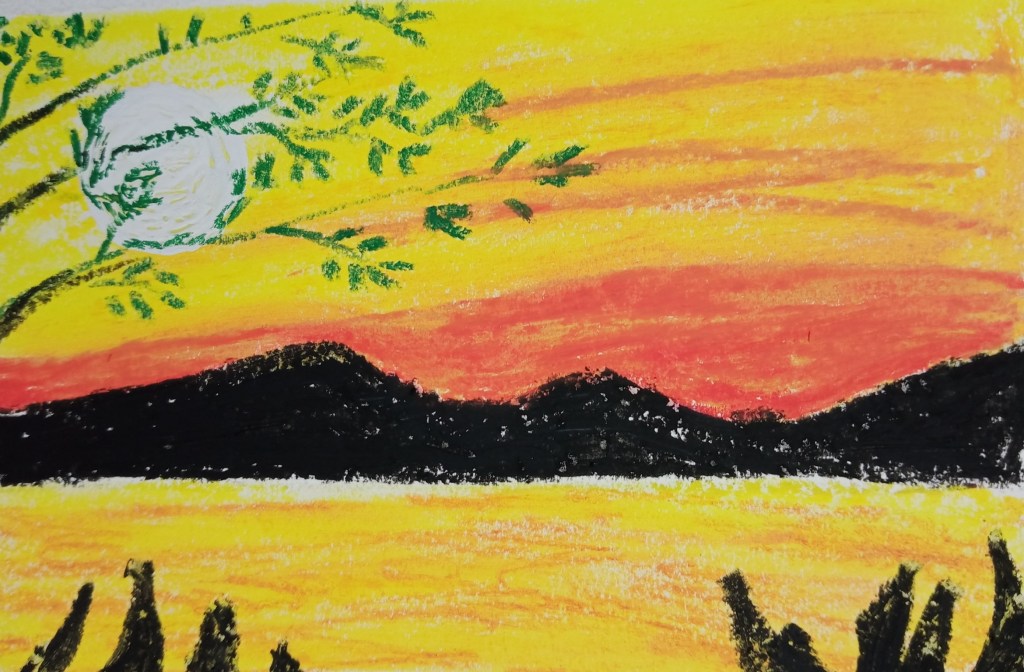
Art by Sophia P, CypressArt by Hugo A, Quezon CityFrom Public Domain
In 1985, famous artistes, many of whom are no longer with us, collaborated on the song, We are the World, to raise funds to feed children during the Ethiopian famine (1983-85). The song was performed together by Michael Jackson, Willie Nelson, Bob Dylan, Ray Charles, Diana Ross, Stevie Wonder, Smokey Robinson, Paul Simon, Tina Turner, Dionne Warwick, Lionel Richie, Billy Joel and Bruce Springsteen. The producer, Julia Nottingham, said: “It’s a celebration of the power of creativity and the power of collective humanity.” The famine was attributed to ‘war and drought’.
Over the last few years, we have multiple wars creating hunger and drought caused by disruptions. Yet, the world watches and the atrocities continue to hurt common people, the majority who just want to live and let live, accept and act believing in the stories created by centuries of civilisation. As Yuval Noah Harari points out in a book written long before the current maladies set in, Homo Deus (2015), “…the stories are just tools. They should not become our goals or our yardsticks. When we forget that they are mere fiction, we lose touch with reality. Then we begin entire wars ‘to make a lot of money for the corporation’ or ‘to protect the national interest’. Corporations, money and nations exist only in our imagination. We invented them to serve us; why do we find ourselves sacrificing our lives in their service?”
What Harari says had been said almost ninety years ago by a voice from another region, by a man who suffered but wrote beautiful poetry, Jibanananda Das… and here are his verses —
“The stories stored in my soul will eventually fade. New ones— New festivals—will replace the old — in life’s honey-tinged slight.”
We carry the poem in this issue translated by Professor Fakrul Alam, lines that makes one dream of a better future. These ideas resonate in modern Balochi poet Ali Jan Dad’s ‘Roll Up Not the Mat’ brought to us in English by Fazal Baloch. Korean poet Ihlwha Choi’s translation takes us to longing filled with nostalgic hope while Tagore’s ‘Probhat’ (Dawn) gives a glimpse of a younger multi-faceted visionary dwell on the wonders of a perfect morning imbibing a sense of harmony with nature.
“I feel blessed for this sky, so luminous. I feel blessed to be in love with the world.”
Starting a new year on notes of hope, of finding new dreams seems to be a way forward for humanity does need to evolve out of self-imposed boundaries and darknesses and move towards a new future with narratives and stories that should outlive the present, outlive the devastating impact of climate change and wars by swapping our old narratives for ones that will help us harmonise with the wonders we see around us… wonders created by non-human hands or nature.
We start this year with questions raised on the current world by many of our contributors. Professor Alam in his essay makes us wonder about the present as he cogitates during his morning walks. Niaz Zaman writes to us about a change maker who questioned and altered her part of the world almost a century ago, Begum Roquiah. Can we still make such changes in mindsets as did Roquiah? And yet again, Ratnottama Sengupta pays homage to a great artiste, filmmaker Shyam Benegal, who left us in December 2024 just after he touched 90. Other non-fictions include musings by Nusrat Jan Esa on human nature contextualising it with Milton’s Paradise Lost (1667); Farouk Gulsara’s account of a fire in Sri Lanka where he was visiting and Suzanne Kamata’s column from Japan on the latest Japanese Literary Festival in the Fukushimaya prefecture, the place where there was a nuclear blast in 2011. What is amazing is the way they have restored the prefecture in such a short time. Their capacity to bounce back is exemplary! Devraj Singh Kalsi shares a tongue-in-cheek musing about the compatibility of banks and writers.
Exploring more of life around us are stories by Sohana Manzoor set in an expat gathering; by Priyatham Swamy about a migrant woman from Nepal and by Naramsetti Umamaheswararao set against rural Andhra Pradesh. While Ahmad Rayees gives a poignant, touching story set in a Kashmiri orphanage, Paul Mirabile reflects on the resilience of a child in a distant Greek island. Mirabile’s stories are often a throwback to earlier times.
In this issue, our book excerpts explore a writer of yore too, one that lived almost a hundred years ago, S. Eardley-Wilmot (1852-1929), a conservationist and one who captures the majesty of nature, the awe and the wonder like Tagore or Jibanananda with his book, The Life of an Elephant. The other book takes us to contemporary Urdu writers but in Kolkata —Contemporary Urdu Stories from Kolkata, translated by Shams Afif Siddiqi and edited by Shams Afif Siddiqi and Fuzail Asar Siddiqi. A set of translated stories of the well-known Bengali writer, Bibhutibhushan Bandopadhyay by Hiranmoy Lahiri, brought out in a book called Kaleidoscope of Life: Select Short Stories has been reviewed by Somdatta Mandal. Malashri Lal has discussed Basudhara Roy’s A Blur of a Woman. Roy herself has explored Afsar Mohammad’s Fasting Hymns. Bhaskar Parichha has taken us to Sri Lanka with a discussion on a book on Sri Lanka, Return to Sri Lanka: Travels in a Paradoxical Islandby an academic located in Singapore, Razeen Sally.
Bringing together varied voices from across the world and ages, one notices recurring themes raising concerns for human welfare and for the need to conserve our planet. To gain agency, it is necessary to have many voices rise in a paean to humanity and the natural world as they have in this start of the year issue.
I would like to thank all those who made this issue possible, our team and the contributors. Thank you all from the bottom of my heart. I cannot stop feeling grateful to Sohana Manzoor for her fabulous artwork too, art that blends in hope into the pages of Borderless Journal. As all our content has not been mentioned here, I invite you to pause by our content’s page to explore more of our exciting fare. Huge thanks to all readers for you make our journey worthwhile.
I would hope we can look forward to this year as being one that will have changes for the better for all humanity and the Earth… so that we still have our home a hundred years from now, even if it looks different.
Opening a bank account is a simple procedure that takes a complex turn for writers once they reveal their profession. The bank executive eyeing a rich customer loses interest in serving a writer who is expected to struggle with the maintenance of minimum balance in his savings account. Almost on the verge of suggesting he should opt for a piggy bank instead, the executive dumps his papers, making him wait for longer than expected even though there is no serpentine queue inside the bank. The writer collects his original documents and proceeds to the sitting area, hoping that the executive will be merciful and serve him without further delay. He tries to establish contact, but the executive rolls his eyes and looks at the computer screen, pretending to be busy with some urgent online task despite the server failure notice tagged above his terminal.
The sitting area has other customers facing a similar fate. The writer finds it a blessing to be surrounded by other clients. He takes keen interest in observing their mannerisms and speech. He overhears their conversations and tries to remember the important bits and pieces that he can later use as dialogues in his forthcoming novel. One interesting line or a phrase that catches his imagination gets noted in his diary.
He begins to love his waiting time and feels comfortable with such inordinate delays so long as he gets fodder for his prose. He gets richer during the waiting period though the bank has no idea how this happens. When he is finally summoned to the counter to deposit his earnings, he looks happy instead of showing signs of irritation. The executive sports a fake apologetic smile and proceeds to make the entry while he chalks out the plan for another visit to the bank branch – even if the task is just updating his passbook. He needs an excuse to enter the bank where he finds so many clients discussing financial and personal matters. His greed to enrich himself with varied, interesting human insights makes him a regular customer who continues to be warmly greeted by the security guard irrespective of his financial position.
The next visit to the bank is slated in the same week. He comes in with a request for partial withdrawal of the deposited amount, making the teller wonder why he has to waste a cheque for this instead of swiping his debit card. He stands in the queue, flanked by other customers, and he strikes conversation with a fellow customer who smells fragrant and suddenly fishes out a bundle of currency notes to deposit. Seeing such a hefty amount of money that exceeds his annual income, the writer becomes aware of his own impoverished state and collapses in his mind. He tries to look the other way as he does inside a public lavatory and keeps a safe distance from the customer who loses interest in carrying on with the silly chat on weather and politics as he inches closer to the cash counter.
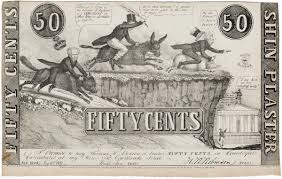
Perhaps the writer deserves this assault on his financial status to return to the materialistically insane world. He makes a quick promise to himself, closing his eyes and pledging to churn out a best-seller that would give him royalty of a much bigger amount. The special visit makes him strongly motivated and inspired. He is determined to mint money through writing even though most of the writers the world over have failed to do so for centuries. He aims to become part of the minority of globally successful authors with royalty earnings ensuring a royal lifestyle. If a writer can create the best life for a character, he is also entitled to dream of a similar fortune for himself. The writer who topples characters from cliffs or offers them a lifeline gives himself some space to hang on, bounce back, and break the silence of critics. He knows it takes no time for the naysayers to start crowning an emerging author as the bravest, newest, and shiniest literary star who breaks norms to push the boundaries of creativity churning out a best-seller that keeps selling like hot cakes the world over.
When the bank refuses to serve him with interest but charges interest on any dues, there is not much he can do to show how aggrieved he feels as an ordinary customer. He goes home and creates a wily character with shady features of the presiding banker. He has no fear of getting caught as he knows the banker is not likely to trace or read the story published in a faraway land. He goes ahead with adding villainous shades to the character created with borrowed inputs resembling the banker. The way he fobs off pesky customers – and his scrunched-up forehead with flawed skin – finds space in fiction.
The next time the writer walks in for another trivial chore, he has no idea of what is in store for him. He is pleasantly surprised to find a new woman executive who is courteous, polite, and dignified in her professional conduct. As he walks in early in the morning, the lady offers him a seat in front of her desk and proceeds to address his concerns and carry out the tedious job of printing the passbook even though there is just one entry on the last page. He reads the updated book and then reads her face that still looks eager to offer assistance. He submits the requisition for another cheque book even though there are many leaves unused in his current one.
Such hospitable treatment makes the writer an admirer of the woman executive, and he opts to glorify her grace in his next story by making her a strong character trying her best to change the world of banking. He makes her wield ample strength and positions her as a saviour even though she herself has no idea of being so headstrong. Keeping a writer happy delivers a lot as the lady executive soon understands. He ensures that the story reaches her. He forwards her the published link. He does not gather the courage to ask whether she has read it or not. It would appear he seeks attention from his contacts. But he keeps appearing in front of her in case she remembers she has to offer feedback on the link forwarded to her number. The brief fascination – and interaction – with her comes to a sudden end as she is transferred to another department behind a cubicle far away from the customer service zone.
The sound of note counting machine begins to irritate the writer. He is reminded of the typewriter days. Just to hear the sound of counting notes he buys the machine and keeps counting the same cash again and again. Inside the bank, the same process is repeated only when the machine stops reading at ninety-nine instead of reaching one hundred. He thinks the domestic machine lacks adequate practice and hides errors in the counting process. It becomes his duty to check multiple times and ensure error-free counting even though his writing tends to carry errors he cannot detect. The cacophony has to hit him hard so that he remembers it while writing. It should hammer him all the time, making him determined to write that elusive best-seller at the earliest.
The solitary bundle of his few thousand rupees is dumped carelessly by the teller who has no idea of how much hard work has been put in to ensure this money flows into the writer’s account. Bored of the simple job of deposits and withdrawals, the writer turns ambitious as he approaches the investment counter, deciding to make a systematic investment plan. When he opts for the package with the minimum amount, the fund manager looks with bulging eyes, almost a scornful glance that seems to suggest he is wasting his valuable time.
The writer seems determined to begin his financial journey as an investor – and he firmly states his decision to proceed with it. This gives a little boost to his waning confidence as he signs a cheque for investment after several years. He chooses banking with a leading private sector bank to get better banking services, oblivious that the customer profile matters more in this regard. Those struggling to maintain the threshold limit of minimum balance should not show the temerity to enter the bank meant for the privileged few. Deep inside, the writer is convinced that he will have a reversal of fortune. He knows the bank that is least interested to have him as a customer would felicitate him some day as the most valuable customer who they feel proud and honoured to serve. They will turn loyal readers of his novels and seek his autograph and photograph.
He visualises a turnaround in his financial fortunes through writing even though he is aware that only a few novelists the world over ever make the cut. He remembers the discriminatory scene inside the bank where a rich customer is offered coffee, juice, and cookies while no such warm gesture comes his way – not even a glass of water. He pursues with the dream of turning the tables, reposing full faith in the eternal truth that fortune always favours the brave. The transactional relationship with the bank serves a reminder of how the world operates along the lines of profit and loss even if it is deeply regrettable. He hopes that his repeated debits and credits would make him eligible for a free credit card at least – in case the crunch becomes too hard to bear. In case his dream remains a pipe dream.
The series of snubs steel the writer’s resolve to earn plaudits. He sits at the desk and whenever he feels low and dispirited, he goes straight to the bank to seek a booster dose. The cold welcome is the perfect shot that works like magic. The sight of rich customers and their privileged treatment sets his imagination wild. He keeps adding zeroes in the slip and tears it apart before tears well up. He hopes to create phenomenal income through writing and plans to launch his book inside the same bank or have it as a key sponsor. With such an intense relationship brewing in his mind, he is convinced that his manifestation is sure to translate into reality. He walks in with his book and hopes the staff would recognise him as a learned person. But they ignore him as they are more interested in the cheque book or passbook. At this juncture, he is left with no option but to withdraw all his money and close his account to embalm his bruised ego.
Months and years pass and yet there is no boost in royalty – or loyalty to a bank. He writes well but does not sell well. The best seller remains a distant dream. He switches to another domain, hoping some producer would buy his flop stories and turn them into a web of hit series. Changing the banking partner does not change his fortune. The same plight ensures his flight from another bank – despite the trench coat and dark shades. The wide inequality between his balance and appearance is read by the cashier. Another dream of opening his account with an MNC[1] bank once he becomes a globally read author takes root.
The fact that he slogs despite his previous output comprising four novels and five collections of stories means the writer is alive and forever hopeful that his next tome would rewrite his financial standing. Even though nothing of that sort happens, he is glad to have produced such an enormous body of work that has found few takers. If he is still banking on hope and visiting some bank to feel charged to write, he is following the right track. Rejection works as a stimulant for the writer who faces the maximum number of rejections in life has nothing more to lose. All he needs is a bank as a companion where he makes regular trips to get insulted, to uplift his sagging morale, to mingle with the rich and tell their refreshing tales of deceit, crookedness, and betrayal with a sensitive pen.
Devraj Singh Kalsiworks as a senior copywriter in Kolkata. His short stories and essays have been published in Deccan Herald, Tehelka, Kitaab, Earthen Lamp Journal, Assam Tribune, and The Statesman. Pal Motors is his first novel.
PLEASE NOTE: ARTICLES CAN ONLY BE REPRODUCED IN OTHER SITES WITH DUE ACKNOWLEDGEMENT TO BORDERLESS JOURNAL
Art by Sohana ManzoorCourtesy: Suzanne Kamata Some of our visuals in 2024
As we wait for the new year to unfold, we glance back at the year that just swept past us. Here, gathered together are glimpses of the writings we found on our pages in 2024 that herald a world of compassion and kindness…writings filled with hope and, dare I say, even goodwill…and sometimes filled with the tears of poetic souls who hope for a world in peace and harmony. Disasters caused by humans starting with the January 2024 in Japan, nature and climate change, essays that invite you to recall the past with a hope to learn from it, non-fiction that is just fun or a tribute to ideas, both past and present — it’s all there. Innovative genres started by writers to meet the needs of the times — be it solar punk or weird western — give a sense of movement towards the new. What we do see in these writings is resilience which healed us out of multiple issues and will continue to help us move towards a better future.
A hundred years ago, we did not have the technology to share our views and writings, to connect and make friends with the like-minded across continents. I wonder what surprises hundred years later will hold for us…Maybe, war will have been outlawed by then, as have been malpractices and violences against individuals in the current world. The laws that rule a single man will hopefully apply to larger groups too…
Courtesy: Ratnottama Sengupta Courtesy: Farouk GulsaraSome of our visuals in 2024
Amalkantiby Nirendranath Chakraborty has been translated from Bengali by Debali Mookerjea-Leonard. Click hereto read.
The Mirror by Mubarak Qazi has been translated from Balochi by Fazal Baloch. Click hereto read.
Homecoming, a poem by Ihlwha Choi on his return from Santiniketan, has been translated from Korean by the poet himself. Click here to read.
Pochishe Boisakh(25th of Baisakh) by Tagore (1922), has been translated from Bengali by Mitali Chakravarty. Click here to read.
Nazrul’sGhumaite Dao Shranto Robi Re(Let Robi Sleep in Peace) has been translated from Bengali by Professor Fakrul Alam. Click hereto read.
Jibananada Das’sAndhar Dekhecche, Tobu Ache (I have seen the dark and yet there is another) has been translated from Bengali by Professor Fakrul Alam. Click here to read.
Tagore’sShotabdir Surjo Aji( The Century’s Sun today) has been translated from Bengali by Mitali Chakravarty. Clickhereto read.
A narrative by Rabindranath Tagore thatgives a glimpse of his first experience of snowfall in Brighton and published in the Tagore family journal, Balak (Children), has been translated from Bengali by Somdatta Mandal. Clickhere to read.
Suzanne Kamata discusses the peace initiatives following the terrors of the 1994 Rwandan Genocide while traveling within the country with her university colleague and students. Click here to read.
A story by Sharaf Shad, has been translated from Balochi by Fazal Baloch. Click here to read.
Conversations
Ratnottama Sengupta talks to Ruchira Gupta, activist for global fight against human trafficking, about her work and introduces her novel, I Kick and I Fly. Click here to read.
A conversation with eminent Singaporean poet and academic, Kirpal Singh, about how his family migrated to Malaya and subsequently Singapore more than 120 years ago. Click hereto read.
Jibananada Das’sAndhar Dekhecche, Tobu Ache (I have seen the dark and yet there is another) has been translated from Bengali by Professor Fakrul Alam. Click here to read.
Manish Ghatak’sAagun taader Praan (Fire is their Life) has been translated from Bengali by Indrayudh Sinha. Click hereto read.
Manzur Bismil’s poem,Stories, has been translated from Balochi by Fazal Baloch. Click here to read.
Homecoming, a poem by Ihlwha Choi on his return from Santiniketan, has been translated from Korean by the poet himself. Click here to read.
Tagore’sShotabdir Surjo Aji( The Century’s Sun today) has been translated from Bengali by Mitali Chakravarty. Clickhereto read.
Paul Mirabile wraps his telling like a psychological thriller. Clickhere to read.
Conversations
Ratnottama Sengupta converses with Divya Dutta, an award-winning actress, who has authored two books recently, Stars in my SkyandMe and Ma. Clickhere to read.
Painting by Claud Monet (1840-1926). From Public Domain
Acknowledging our past achievements sends a message of hope and responsibility, encouraging us to make even greater efforts in the future. Given our twentieth-century accomplishments, if people continue to suffer from famine, plague and war, we cannot blame it on nature or on God.
–Homo Deus (2015),Yuval Noah Harari
Another year drumrolls its way to a war-torn end. Yes, we have found a way to deal with Covid by the looks of it, but famine, hunger… have these drawn to a close? In another world, in 2019, Abhijit Banerjee had won a Nobel Prize for “a new approach to obtaining reliable answers about the best ways to fight global poverty”. Even before that in 2015, Yuval Noah Harari had discussed a world beyond conflicts where Homo Sapien would evolve to become Homo Deus, that is man would evolve to deus or god. As Harari contends at the start of Homo Deus, some of the world at least hoped to move towards immortality and eternal happiness. But, given the current events, is that even a remote possibility for the common man?
Harari points out in the sentence quoted above, acknowledging our past achievements gives hope… a hope born of the long journey humankind has made from caves to skyscrapers. If wars destroy those skyscrapers, what happens then? Our December issue highlights not only the world as we knew it but also the world as we know it.
In our essay section, Farouk Gulsara contextualises and discusses William Dalrymple’s latest book, The Golden Road with a focus on past glories while Professor Fakrul Alam dwells on a road in Dhaka , a road rife with history of the past and of toppling the hegemony and pointless atrocities against citizens. Yet, common people continue to weep for the citizens who have lost their homes, happiness and lives in Gaza and Ukraine, innocent victims of political machinations leading to war.
Just as politics divides and destroys, arts build bridges across the world. Ratnottama Sengupta has written of how artists over time have tried their hands at different mediums to bring to us vignettes of common people’s lives, like legendary artist M F Husain went on to make films, with his first black and white film screened in Berlin Film Festival in 1967 winning the coveted Golden Bear, he captured vignettes of Rajasthan and the local people through images and music. And there are many more instances like his…
It's always the common people who pay first. They don’t write the speeches or sign the orders. But when the dust rises, they’re the ones buried under...
Echoing the theme of the state of the common people is a powerful poem by Manish Ghatak translated from Bengali by Indrayudh Sinha, a poem that echoes how some flirt with danger on a daily basis for ‘Fire is their life’. Professor Alam has brought to us a Bengali poem by Jibanananda Das that reflects the issues we are all facing in today’s world, a poem that remains relevant even in the next century, Andhar Dekhecche, Tobu Ache (I have seen the dark and yet there is another). Fazal Baloch has translated contemporary poet Manzur Bismil’s poem from Balochi on the suffering caused by decisions made by those in power. Ihlwha Choi on the other hand has shared his own lines in English from his Korean poem about his journey back from Santiniketan, in which he claims to pack “all my lingering regrets carefully into my backpack”. And yet from the founder of Santiniketan, we have a translated poem that is not only relevant but also disturbing in its description of the current reality: “…Conflicts are born of self-interest./ Wars are fought to satiate greed…”. Tagore’s Shotabdir Surjo (The Century’s Sun, 1901) recounts the horrors of history…The poem brings to mind Edvard Munch’s disturbing painting of “The Scream” (1893). Does what was true more than hundred years ago, still hold?
Reflecting on eternal human foibles, Naramsetti Umamaheswararao creates a contemporary fable in fiction while Snigdha Agrawal reflects on attitudes towards aging. Paul Mirabile weaves an interesting story around guilt and crime. Sengupta takes us back to her theme of artistes moving away from the genre, when she interviews award winning actress, Divya Dutta, for not her acting but her literary endeavours — two memoirs — Me and Ma and Stars in the Sky. The other interviewee Lara Gelya from Ukraine, also discusses her memoir, Camels from Kyzylkum, a book that traces her journey from the desert of Kyzylkum to USA through various countries. In our book excerpts, we have one that resonates with immigrant lores as writer VS Naipual’s sister, Savi Naipaul Akal, discusses how their family emigrated to Trinidad in The Naipauls of Nepaul Street. The other excerpt from Thomas Bell’s Human Nature: A Walking History of the Himalayan Landscape seeks “to understand the relationship between communities and their environment.” He moves through the landscapes of Nepal to connect readers to people in Himalayan villages.
The reviews in this issue travel through cultures and time with Somdatta Mandal’s discussion of Kusum Khemani’s Lavanyadevi, translated from Hindi by Banibrata Mahanta. Aditi Yadav travels to Japan with Nanako Hanada’s The Bookshop Woman, translated from Japanese by Cat Anderson. Jagari Mukherjee writes on the poems of Kiriti Sengupta in Onenessand Bhaskar Parichha reviews a book steeped in history and the life of a brave and daring woman, a memoir by Noor Jahan Bose, Daughter of The Agunmukha: A Bangla Life, translated from Bengali by Rebecca Whittington.
We have more content than mentioned here. Please do pause by our content’s page to savour our December Issue. We are eternally grateful to you, dear readers, for making our journey worthwhile.
Huge thanks to all our contributors for making this issue come alive with their vibrant work. Huge thanks to the team at Borderless for their unflinching support and to Sohana Manzoor for sharing her iconic paintings that give our journal a distinctive flavour.
With the hope of healing with love and compassion, let us dream of a world in peace.
Newspapers with audited accounts of circulation and readership surveys gave the opportunity to claim that your piece was read by millions of readers. Even though the metrics did not suggest how the individual piece performed in terms of garnering readership, the millions of people who bought the newspaper were assumed to have read what you wrote. Unlike the digital space where the complete picture of reads, likes, and shares is accessible, the traditional media platforms provided a cover to indulge in tall claims of popularity and the collective statistics delivered a high to those who dabbled in writing to see their name in print. Even if the truth was that your piece was the least read one, there was no way to establish that in the editorial room where the high-brow editors cherry-picked on the basis of quality of writing and the relevance of the topic.
Bouquets and brickbats in the form of letters to the editor was the only reliable way to assess the merit or demerit of the piece, but these letters were dashed off as reactions to columns by leading commentators in the belief that the editor would grant space for the feedback on what the heavyweight columnists churned out. Readers were apprehensive that their letters would end up in the slush pile if they focused on newcomers. This fear was not unfounded as the interactive engagement often appeared limited to luminaries and experts on the edit pages.
Being published next to a syndicated column meant the equivalent of placing your debut novel on the same bookshelf where the works of a bestselling novelist were displayed. As neighbours, you had the liberty to brag about enjoying the same status even though your readership was negligible. You rushed to the newspaper vendor to buy additional copies of the same edition and keep it archived in your portfolio of published works. Printing xerox copies for circulation in your group of friends and relatives was the next big activity but the target group pricked your ego by saying that they do not read the newspaper that carried your piece. It was a polite way of saying that your breakthrough was no big achievement as they did not consider that newspaper suitable for reading.
The desire to see your name in print again and again was a good motivator in the initial stage. Since you never knew you would get the same space twice in a month, it was a struggle to try another kind piece to ensure you were carried on some other supplement page in the next week. You wanted readers of all age groups to notice your name in the newspaper, to register it in the list of frequent contributors. The easiest way to do so was to keep writing on a diverse range of topics. The byline fever gripped you and a week without a piece in the same newspaper or its competitor felt like a long gap of staying away from the limelight. Writing in a hurry also involved the risk of getting your piece rejected. Maintaining the same quality of writing and factual accuracy through proper research work was important because the team of editors should not get disappointed with any of your submission. As a precautionary move, bombing them with low quality pieces for the sake of byline was ruled out. But the obsession to become a regular contributor with a dedicated space led to several attempts across multiple genres to find your strengths. Even though you were able to find out what worked better in terms of flow and engagement, it was not possible to share the same observations with editors who drew their own inferences.
To keep struggling to write with no reward meant sustenance despite all odds. In such a situation, the byline was a big attraction to continue writing. If journalistic writing led to occasional disappointments, you had the freedom to turn to middles and infuse a dose of humour. There was further scope to write short stories and create a new world of awe, with the illustrator adding visual attraction to the theme of your fiction. This was a great opportunity to find your creative bent and, in case, it clicked, you could submit more elsewhere before getting a solo book of short stories published. Writing for some years in this fashion gave you adequate exposure and you turned confident enough to switch from regional publications to national dailies. Listing these achievements in the resume managed to draw the attention of an employer who himself was keen to get published in the same newspaper without releasing advertisements.
There was anxiety and depression every weekend as the expected publication of your piece was delayed due to editorial discretion. You went to browse at the nearby bookstall to know if you were inside the pages. The joy of seeing your name in print lit up your eyes and you picked up extra copies of the same publication without explaining to the vendor what made you do so. If you were lucky to find space for some weeks at a stretch, you chose to subscribe to it. But when you fell out of favour due to changes in the editorial policy or on account of a new editor storming in with his loyal team of freelancers, you felt like cancelling the subscription plan and never writing again. This temporary phase was soon over – when you found another piece of yours getting picked up by a rival publication. You felt buoyed again, determined to get your byline pieces carried to various homes. Your family was glad you were getting published so they did not discourage you. But they were aware you were getting close to the space where politicians dominated. They were convinced you had a future in writing even if it was an unstable one.
Although the honorarium was a modest amount, the thrill of getting paid for the piece was intense. You felt encouraged to write more to get those cheques and line up for encashment in MNC banks. The recovery of courier and stationery expenses from the published works removed the guilt of suffering losses in case of rejections. The newspaper stayed the whole day on your desk and additional copies were displayed in the lobby or the entrance, to let the guests or visitors catch a glimpse of the edition becoming special with your piece. The frisson of delight petered out as the frequency of publication gathered pace. Many readers, including friends and relatives, wrote to the editor in praise of your piece even though you never got to read those flattering comments in print.
When a delighted reader approached the newspaper office to gather your postal address and mailed a long epistle in appreciation of the style, it was an out of the world experience in the pre-digital era. When the elderly reader requested you to meet him at his residence, you did not feel shy to reach out to a stranger. Despite the wide age-gap, the conversation flowed well on writing issues as he was curious to find out whether it was a flirtatious relationship with writing or something more serious and everlasting would flower. Without confirming anything, you let it remain open-ended and interpretative. Despite your best efforts, the elderly reader inferred it was going to be an enduring relationship. When he confessed he was a writer with a book out of print, it was a humbling experience as you sat in front of a published author whereas you had no such credit. He got up and offered a signed copy and sought candid feedback on his work. You felt being the chosen one who could revive his interest in writing and motivate the septuagenarian.
You were also reminded of similar moments of frustration and encouragement from multiple sources. In his case, the story was different as he was battling health issues and yet seeking out advice pertaining to whether he should pursue writing or quit the domain. You felt like saying the magic of creativity should be kept alive even if there is nothing rewarding in the pursuit. You did not need to read the book to deliver this piece of advice. Whether he took it seriously or brushed it aside as a generic observation could not be ascertained. Later attempts to communicate proved futile. Perhaps he was gone, from the city or left the world, or maybe, the landline phone was dead. Searching for his byline in the newspapers and tomes in the bookstores produced no result. You did not feel like trudging up to the same apartment to uncover a bitter truth.
Your friends in the varsity were the most critical readers who always found something lacking in your piece but were also generous to appreciate the attempt. Some were jealous and competitive – driven by the urge to appear on the same page – and they went to the same editor with their submissions. Unable to bear rejection, they spread the word that the editor sought freebies to publish opinion pieces and it was the surest way to get a byline. Despite getting featured in multiple publications, the child-like curiosity to see your name again and again retained its flavour. Writing became a habit as a result, and the desire to be published generated the desire to write. Sustaining the urge to write was immense and, once it became a regular habit, everything else ceased to matter. You were confident of facing the blank page despite flak and rejections. Even if you wrote five pieces in a month and four of them were spiked, you had the satisfaction of seeing one in print. This was good enough to keep the pen flowing. You became more risk-bearing and tried out other avenues and other forms of writing at the same time. As the digital world opened up more options, you began exploring the writing opportunities on a global scale.
Years of honing your craft offered a better understanding of the writing world and the real world. When a young person read your piece against dowry and went to the newspaper office to collect your address and visit your residence and offer you a proposal to marry his sister, it was a moment of realisation how writing shapes perspectives and the immense responsibility it carries. It was an episode to remind you that good writing is read and the writer must pen his words with social responsibility. Such early encounters made you understand the value of writing beyond the power of bylines.
The writer must be prepared to reach a mature stage when the byline fever subsides. Whether you acquired a thousand bylines becomes immaterial after a certain stage, but the role of byline in offering you anchorage and encouragement cannot be sidelined in the formative years of your writing career.
Devraj Singh Kalsiworks as a senior copywriter in Kolkata. His short stories and essays have been published in Deccan Herald, Tehelka, Kitaab, Earthen Lamp Journal, Assam Tribune, and The Statesman. Pal Motors is his first novel.
PLEASE NOTE: ARTICLES CAN ONLY BE REPRODUCED IN OTHER SITES WITH DUE ACKNOWLEDGEMENT TO BORDERLESS JOURNAL
Nazrul’s Tumi Shundor Tai Cheye Thaki(Because you are so beautiful, I keep looking at you) has been translated from Bengali by Professor Fakrul Alam. Click here to read.
Hotel Acapulco, has been composed and translated from Italian by Ivan Pozzoni. Click hereto read.
Farouk Gulsara pays a tribute to a doctor and a friend. Click hereto read.
Musings of a Copywriter
InBecoming a ‘Plain’ Writer, Devraj Singh Kalsi explores the world of writer’s retreats on hills with a touch of irony. Clickhere to read.
Notes from Japan
In Educating for Peace in Rwanda, Suzanne Kamata discusses the peace initiatives following the terrors of the 1994 Rwandan Genocide while traveling within the country with her university colleague and students. Click here to read.
Bijoy K Mishra writes of cyclones in Odisha, while discussing Bhaskar Parichha’s Cyclones in Odisha – Landfall, Wreckage and Resilience. Clickhereto read.
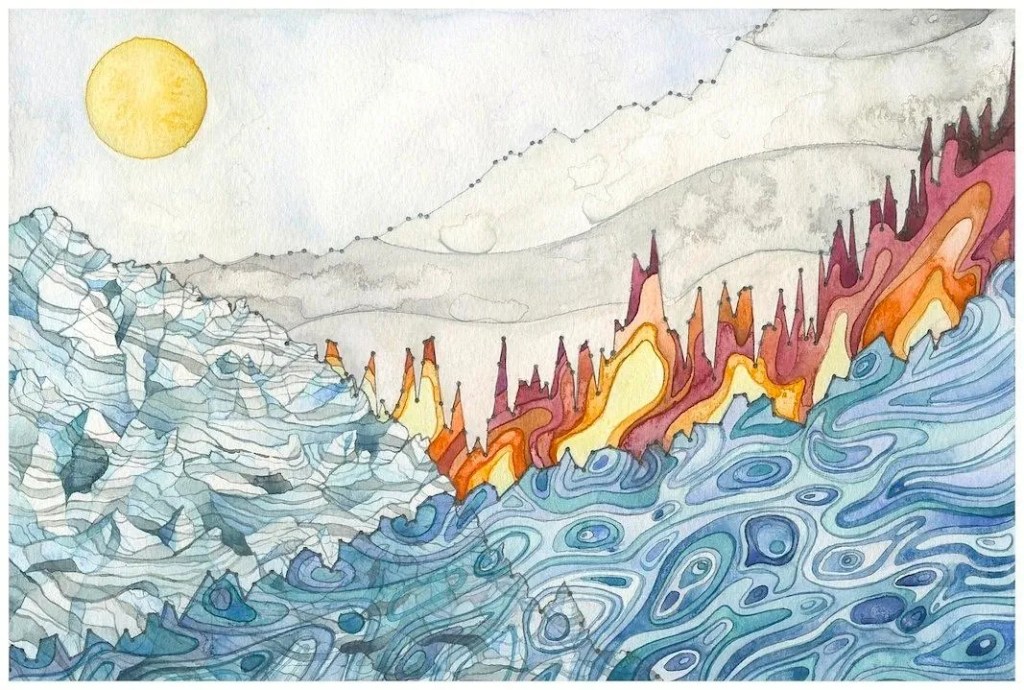
Landscape of Change by Jill Pelto, Smithsonian. From Public Domain
Hope is the mantra for all human existence. We hope for a better future, for love, for peace, for good weather, for abundance. When that abundance is an abundance of harsh weather or violence wrought by wars, we hope for calm and peace.
This is the season for cyclones — Dana, Trami, Yixing, Hurricanes Milton and Helene — to name a few that left their imprint with the destruction of both property and human lives as did the floods in Spain while wars continue to annihilate more lives and constructs. That we need peace to work out how to adapt to climate change is an issue that warmongers seem to have overlooked. We have to figure out how we can work around losing landmasses and lives to intermittent floods caused by tidal waves, landslides like the one in Wayanad and rising temperatures due to the loss of ice cover. The loss of the white cover of ice leads to more absorption of heat as the melting water is deeper in colour. Such phenomena could affect the availability of potable water and food, impacted by the changes in flora and fauna as a result of altered temperatures and weather patterns. An influx of climate refugees too is likely in places that continue habitable. Do we need to find ways of accommodating these people? Do we need to redefine our constructs to face the crises?
Echoing concerns for action to adapt to climate change and hoping for peace, our current issue shimmers with vibrancy of shades while weaving in personal narratives of life, living and the process of changing to adapt.
An essay on Bhaskar Parichha’s recent book on climate change highlights the action that is needed in the area where Dana made landfall recently. In terms of preparedness things have improved, as Bijoy K Mishra contends in his essay. But more action is needed. Denying climate change or thinking of going back to pre-climate change era is not an option for humanity anymore. While politics often ignores the need to acknowledge this crises and divides destroying with wars, riots and angst, a narrative for peace is woven by some countries like Japan and Rwanda.
Suzanne Kamata recently visited Rwanda. She writes about how she found by educating people about the genocide of 1994, the locals have found a way to live in peace with people who they addressed as their enemies before… as have the future generations of Japan by remembering the atomic holocausts of 1945.
In translations, we have poetry from varied countries. Ihlwha Choi has self-translated his poem from Korean. Ivan Pozzoni has done the same from Italian. One of Tagore’s lesser-known verses, perhaps influenced by the findings of sensitivity in plants by his contemporary, Jagadish Chandra Bose (1858-1937) to who he dedicated the collection which homed this poem, Phool Photano(making flowers bloom), has been translated from Bengali. Professor Alam has translated Nazrul’s popular song, Tumi Shundor Tai Cheye Thaki (Because you are so beautiful, I keep gazing at you).
Stories travel around the world with Paul Mirabile’s narrative giving a flavour of bohemian Paris in 1974. Anna Moon’s fiction set in Philippines gives a darker perspective of life. Lakshmi Kannan’s narrative hovers around the 2008 bombing in Mumbai, an event that evoked much anger, violence and created hatred in hearts. In contrast, Naramsetti Umamaheswararao brings a sense of warmth into our lives with a story about a child and his love for a dog. Sreelekha Chatterjee weaves a tale of change, showcasing adapting to climate crisis from a penguin’s perspective.
Trying something new, being out of the box is what helped humans move out from caves, invent wheels and create civilisations. Hopefully, this is what will help us move into the next phase of human development where wars and weapons will become redundant, and we will be able to adapt to changing climes and move towards a kinder, more compassionate existence.
Thank you all for pitching in with your fabulous pieces. There are ones that have not been covered here. Do pause by our content’s page to see all our content. Huge thanks to the fantastic Borderless team and to Sohana Manzoor, for her art too.
When a friend of mine glorified living in the hills and suggested I should live close to nature in order to nurture my creative side, I disagreed without showing displeasure as it would have appealed to me a decade ago. Instead of shifting to the mountains to forge a deep connection with nature, now I prefer to increase my interactions with nature and its elements in the nearby surroundings every day. Even if these exchanges are small and trivial, these are spread throughthe day and keep happening with amazing frequency.
Finding ample time to feel the presence of nature all around leaves me with negligible desire to relocate to the hillside where I would have the privilege to spread myself on a roadside bench and gaze and wave at newly married couples clasping their hands and walking down the road with melting ice-cream cones. I do not wish to turn into another such old man with a toothless grin, who never shies away from showing his naughty side whenever an opportunity arises.
Not considering such indulgences as effective remedies to stay young at heart during old age, the all-pervasive burst of energy actually comes from the bout of inspiration to produce a new creative work. The hills or the muse are just two known – and popular – sources while the fact is that there are infinite sources to explore. It depends on the individual embarking on this journey to awaken the creative self.
Hills are romanticised and considered to be the abode of purity with the power to trigger creativity like no other place. My recent visits to the hills did not prod me to write. While such a visit could be inspiring for many people who prefer the serenity of the hills to produce a masterpiece, I would consider myself an exception or a part of the small group holding a divergent opinion. Those who say you do not face writer’s block on the hillside are not telling the entire truth. Without contesting their belief, I am quick to retort by saying that I do not stare at the blank page and do not face any shortage of ideas here. I am happy to live in the plains and remain a plain writer without any complaints.
Those who live in the hills and write profusely get to write about nature and the people they observe closely during their long walks. The hill towns also have a vast population of ghosts to write about since they prefer to live and breathe clean, fresh air and enjoy the mist and fog of the mountains. This category of dead folks brings so many stories to life. With deadpan humour, the writers relate engaging stories but if there is an abundance of paranormal tales from writers in the hills, it does not mean that the writers from the small towns across the country do not have spooky encounters to narrate. There is no dearth of ghosts to explore in the haunted, dilapidated buildings, cemeteries and treetops. If the emerging and established writers take a keen interest to spin bewitching tales, there can be a potpourri of ghostly delights to feast upon. Instead of trekking to the hills in search of lively characters where the human population is not dense, it is better to seek variety in the plains where the population is teeming with saints and sinners of varying degrees, climbing the heights of divine glory and plumbing the lows of depravity.
Abandon the idea of finding a goldmine of ideas in the hills and choose to focus on the world you live in. Relocating to get inspired involves disconnecting in the greed of enrichment. The ability to source the hidden treasures from the town or the locality comes to those who respect it unconditionally, just as we value the love we get unconditionally. There are many who leave for the hills to become fantastic storytellers, but their output fails to impress and loses consistency. Only when they come down and hit the mean streets, travel in crowded buses and trains, enter flea markets and dingy, narrow lanes do they become an integral part of the creative madness and their output shows that solitude is not the sole stimulant: a chaotic environment can also work its magic to stir creativity in wandering souls.
In case you have garnered a modicum of success and wish to experiment, you can try the hills or the beaches to measure the impact on your creative output. But in case you realise you can write well without changing your pin code, and all you need is a house with big windows providing a wide view of the verdant garden lined with trees and plants, offering a clear vision of quietness, then you can deliver a good creative work by sourcing material from the life lived, from the things you can imagine.
Taking a short break to tour the hills has left me disappointed once again. A depressed state of mind and boredom gripped me more than the lush green vistas. I missed the traffic, the mad rush for trains, and the tearing hurry to cross bridges, the restlessness to leave others behind. The sense of satisfaction found in the hill people seemed to infect me. With limited sources of entertainment, preferring to hit the sleep mode was the best thing to do. The idyllic scenery relaxed me for a few days and then the craving for frenzy took over. Depriving myself of it further would make me sick. So, I returned earlier than I had planned to, with the realisation that writing in the hills would be a challenging job for me. It could force me to quit writing forever. I could well be one of those seasonal types who retreat there to recharge their batteries and come back super charged to face the daily hectic grind of the real world.
How long would an ambulance take to reach me during a medical emergency in the hills also loomed large as a growing concern. Negotiating a sharp bend and thinking about such situations made me feel low. As I grow older, I refuse to be enchanted by apples and apple-picking. The childhood fancy of farm-picking sessions, of plucking litchis, berries, and cherries and apples and eating them in the orchards can be skipped or realised within a week. This charming activity cannot make a strong case to become a resident of the hills. Besides, the local market in the neighbourhood has good supplies throughout the year.
Dozens of markets, malls, bargain stores, eating joints, beauty parlours, and multiplexes are likely to be missed in the hills where consumerism is still not rampant. Aside from natural produce, other staple items are more expensive in the hills. Maintaining budgets would be an uphill task for an aspiring writer. Farmer markets would tempt me exploit those, but I do not want to join the list of discredited experts who exploit and then write about exploitation, thereby showcasing their hypocrisy to the world. Locating an advertising agency in a hill station would be another challenge as the clients think creative honchos from the ad world and film world live in the big cities. Agreed, having a second home in the hills for vacation purpose or weekend breaks is a good option. But writers cannot have this luxury unless they churn out bestsellers to finance a second home.
You could be a writer who is read not just in the hills but also read by those from the plains and beyond. Make your location immaterial for writing. Junk the idea that a masterpiece with a universal appeal can come from a serene place alone. Writing thrives with speed, pace, and action. And the plains are remarkably good at offering this advantage, not just the slow-moving life and stillness in the hills that makes the mind race faster when the body is in a state of relaxation.
Devraj Singh Kalsiworks as a senior copywriter in Kolkata. His short stories and essays have been published in Deccan Herald, Tehelka, Kitaab, Earthen Lamp Journal, Assam Tribune, and The Statesman. Pal Motors is his first novel.
PLEASE NOTE: ARTICLES CAN ONLY BE REPRODUCED IN OTHER SITES WITH DUE ACKNOWLEDGEMENT TO BORDERLESS JOURNAL








 Borderless