Categories
Interview Review

Aruna Chakravarti Converses about her Ghost Stories

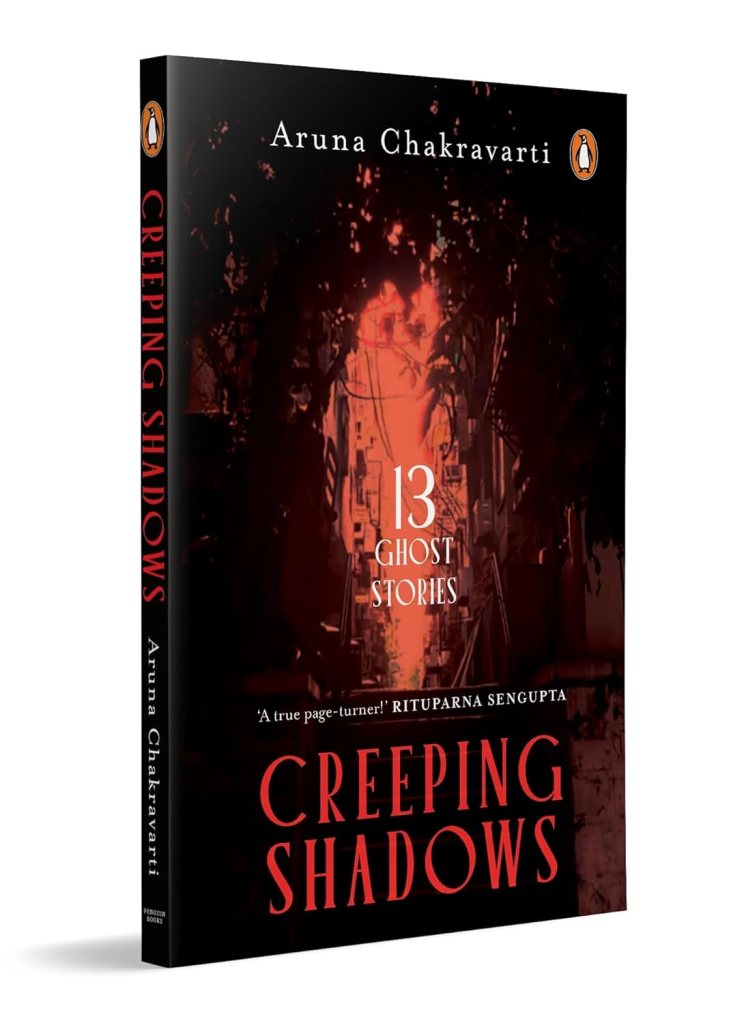
An introduction to Aruna Chakravarti’s Creeping Shadows: 13 Ghost Stories, published by Penguin India, along with a discussion with the author.

Ghosts are evocative of a past… of history one could say. Then who could be a better storyteller of the past than an author steeped in colours of historical fiction — Aruna Chakravarti! In the past she not only translated novels set in colonial India but evoked the Bengal Renaissance to perfection in her two Jorasanko novels and details of a court hearing in her retelling of the Bhawal prince! This time the diva of historical fiction brings to us a book of spine chilling, ghost stories, Creeping Shadows: 13 Ghost Stories.  It is her third collection of short stories.

The narratives are so vivid and visual that they could be worthy of being made into films. They are distinctive in that she has mostly created her own very horrific ghouls – not the traditional ones. They pop up and frighten the reader with their bizarreness and terrifying presences which linger even when you try to sleep at night! She has given us thirteen stories — a spooky number in itself — spread across multiple communities in Asia.

Some of the narratives evoke the past, starting from the 1800s. ‘The House of Flowers’ is set in China partly and partly in Kolkata, where there is now a thriving Chinatown known as “Tangra” and a Kali temple that serves ‘noodles’ as its prasad or offering. The story has echoes of Pearl S Buck’s China interestingly. What was a surprise was the fluency with which she wove in the influences that impact a community of migrants!  

Chakravarti has used her skills as a writer of historical fiction in some of the stories like, ‘The Road to Karimganj’, in which a spook takes us back to undivided Bengal, when passports were not needed as in the story of the migrant Chinese. Hovering around history are more narratives like ‘Possessed’, where a courtesan who performs with the legendary Girish Ghosh1 of the nineteenth century Kolkata undergoes, along with the audience, a strange spooky experience!

Traveling down the century, closer to our times, is the story that is perhaps one of the most bizarre and yet most relatable, ‘The Necklace’. Set in the Anglo-Indian community and the glamour of Park Street — where Wiccan writer, Rajorshi Patranabis, claimed to have met a colonial ghost awaiting her lover — Chakravarti’s narrative is of black magic and betrayal. The fiction is far more impactful and frightening than the factual narrative, which too was spine chilling! You realise what makes fiction so much more gripping than facts — anything can happen in fiction. Chakravarti is imaginative enough to make it as creepy and shadowy as any regular horror writer!

Holding on to that thought, the author holds the key to our experiences as she skillfully outlines two demons grown out of poverty in ‘A Winter Night’. The conclusion has a sense of irony and tragedy. ‘Truth is stranger than Fiction’ weaves in more of the diversity in the historic annals of Bengal. The story that starts the book, ‘The Caregivers of Gazipur’, has an unresolved ending, like some of her other narratives. Though there is a frightful resolution in ‘They Come Out After Dark’. The ghosts play spine chilling havoc with fears of the living while recalling the senseless violence of 1947. ‘There are More Things in Heaven and Earth’…takes us back to the atrocities committed during the Sikh riots of 1984 in Delhi. The mingling of fact and fiction to create weird a fantastical narrative is addressed during a conversation on the supernatural. And there is an exploration of the lines from Shakespeare’s Hamlet, which probably is a touch of the academic as Chakravarti had a long tenure as the principal of a girl’s college in Delhi. It also defines the authorial stance in this story:

‘Don’t forget what Hamlet said to Horatio? There are more things in heaven and earth, Horatio, than are dreamt of in your philosophy.’

What is unusual about these stories is the way she has created fictitious geographies and personas, evoking historic realities. They seem perfectly authentic to the reader, including the one set in China. There is a vast mingling of facts and fiction in these stories all to lead to spine-chilling ends with strange twists. 

‘Grandmother’s Bundle’ stands out in its rendition as the ghosts given out are part of the mythical lore of Bengal — stories that were related to most Bengali kids of the twentieth century. They have a touch of humour and dry wit, perhaps introducing a sense of comic relief among very dark and horrific stories that transport us into different worlds.

‘The Motorcycle Rider’, set in modern times, takes us into a university campus to shock us with horrific spooks born out of tragic deaths, while ‘Twenty-nine Years, Seven Months and Eleven Days’, merges a modern outlook with an unfathomable past, touching upon strange tantric yearnings. ‘Vendetta’ twirls nature and supernatural to give a frightening narrative of how nature takes its revenge… a theme that reiterates in writings addressing our current concerns with climate change.

The ease and fluidity with which she has switched from history and realism to horror and fantasy is amazing. Let’s find out more from her about this new persona that inhabits her writerly self…                                                           

Till now we have had translations, numerous novels—many of which can be called historical fiction—and realistic short stories with their base in history or contemporary life. What made you think of writing ghost stories?

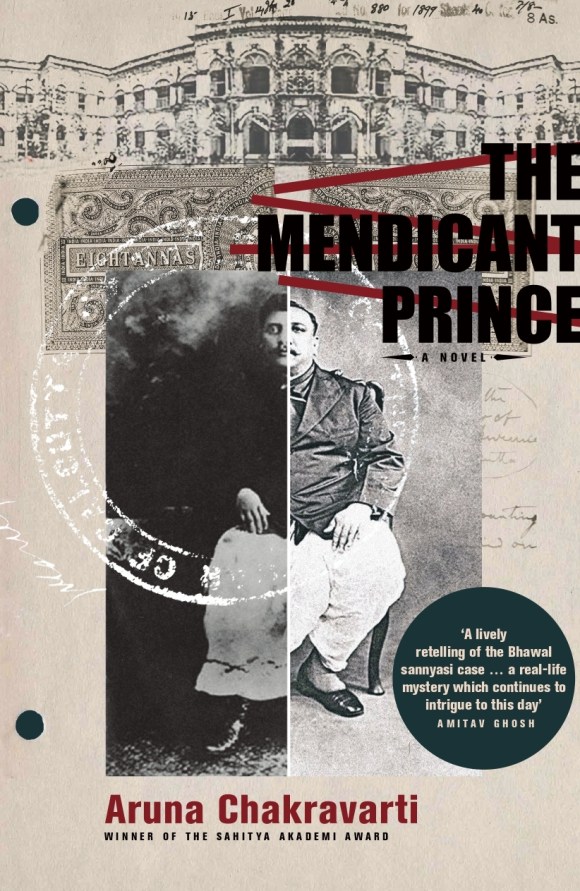
After writing The Mendicant Prince which involved extensive research into the life and times of Prince Ramendranarayan Roy of Bhawal, I didn’t feel up to writing a historical novel again. The work had demanded delving into sociological texts, court records, letters, insurance papers and medical reports. Apart from research, historical fiction also demands a certain amount of field work.
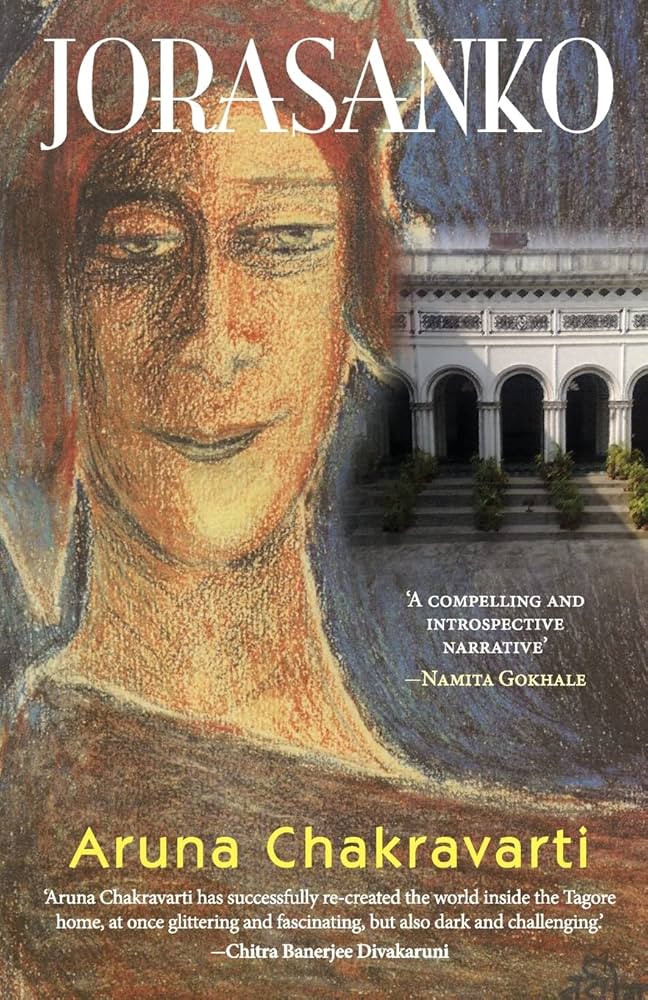
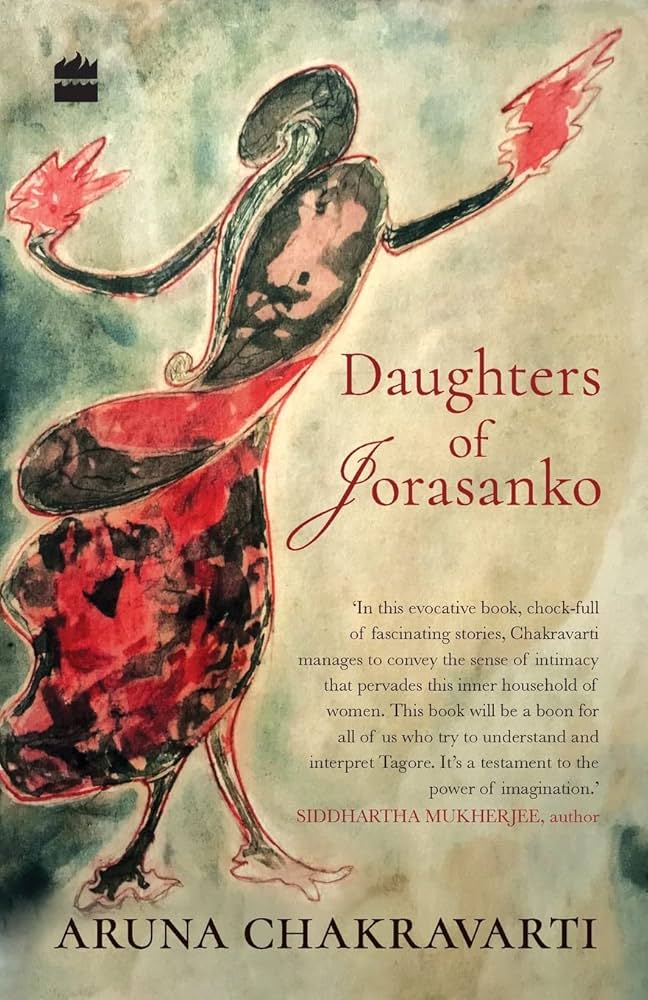
Before writing the Jorasanko novels I visited the Tagore mansion thrice and while writing The Mendicant Prince, I went to Bangladesh to see the royal palace in Bhawal, renamed Gazipur. Though it has been totally neglected, with shopkeepers and squatters having overtaken most of the area, I was able to get some idea of the topography of the palace and its grounds. I saw the lake and the temple (which was locked) and was able to visualise where the halls and galleries and the apartments of the queens and princesses would have stood. All this work was exhausting. So, for a change, I decided to try my hand at short stories which emerge straight from the imagination. And while at it, I decided to break out of the mould of “historical fiction” writer in which I had trapped myself and try a completely new genre.
Published in 2022

I wrote the first one on an impulse and found myself quite enjoying the process. I didn’t even think of publishing at that time. The first story led to another and another. When eleven stories had been written I sent the manuscript to three publishers and was surprised when all three accepted it. It was then that I found out that ghost stories were the in-thing. That they were selling well and that publishers were looking out for them. I signed up with Penguin as you know. At one point my editor Moutushi Mukherjee suggested I write another two. Thirteen stories will make it even more spooky, she said.  So, I wrote another two.

Would you list these stories as fantasies or fantastical? Or are they stories of personal experience? Please elaborate.

No. They are not born out personal experience. I must confess that I have never seen a ghost in my life. I believe in sixth sense. As a matter of fact, I have acted on my sixth sense on occasions. I have had sudden impulses to do certain things and realised later that if I hadn’t yielded to the impulses, I would have regretted it. But I have had no brush with the supernatural. These stories were sparked off by sudden memories. Something I had read somewhere. Something somebody had told me years ago. A face I had seen in childhood which had stuck in my mind though whose I don’t remember. A conversation overheard which made no sense at the time but which, as an adult, seemed ridden with sinister nuances. A phrase from a book whose title and author’s name I had forgotten. In fact, I didn’t even remember the context from where the phrase had come.

Sudden flashes such as these triggered off the stories. But in the writing, they took on a life and soul of their own. I even feel, sometimes, that the pen took over and they were written by an invisible hand.

Your stories are set, sometimes in real landscapes and sometimes in fictional ones. What kind of research went into creating them? How do you make them so vivid and real?

There wasn’t any immediate research.  I needed to look up a few facts, now and then, mostly to be sure of their authenticity. But nothing truly back breaking. The landscapes, both physical and of the mind, were culled from my travels and my reading of both English and Bengali writers over the eight decades of my life. Much of it stayed with me tucked away in some unconscious part of the mind. Although I write in English, you will notice that almost all the stories are about Bengalis. Bengalis living in Delhi, Kolkata, Bihar and the small towns and villages of Bengal. There are Anglo-Indians, Punjabis and Chinese, too among my characters. But having lived in Bengal for generations, they have adopted Bengali customs and a quasi-Bengali way of living.  Many of the locales in which, they appear are fictional…gathered from my reading and observation of people from different strands of Bengali life.

You have a story set in China which also has the Chinatown of Kolkata in it. Have you been to China? What was the reason for the choice? Were you influenced by any Chinese writers? How did you visualise the Chinese migrants in Kolkata?

Yes, I have been to China. I visited the cities of Guangzhou, Shanghai and Beijing in 2004. Naturally, I have no personal experience of life as it was lived in the late 18th century which is the period covered in the story ‘The House of Flowers’. For this I had to rely totally on my reading of English authors writing about China like Pearl Buck and Amy Tan. Pearl Buck was a great influence on me while writing this story. It was from her books that I was able to catch the ambience of tea houses and brothels of the period. In depicting the Chinese family who lived in Calcutta in the early 20th century I had to rely on childhood experience, I knew some Chinese girls who had lived for several generations in Calcutta. And my imagination went into full play, of course.

In ‘Grandmother’s Bundle’ you have written about spooks from Bengal. It departs from your other stories in as much as it does not really introduce the supernatural except as a source of folklore. Do you feel it blends with the other narratives in your collection?

Well. It is different from my other stories in certain ways. Firstly, it is three stories rolled into one. Secondly, unlike the others, they are children’s stories. Thirdly, it is the only one that deals with ghosts and other supernatural beings with humour. Lastly, they have been drawn from folklore. I agree that it doesn’t quite blend with the others in this collection. But it is also true that each story in this collection is different from another. There are different time spans. Different locales. Different themes. Characters from different levels of society. That being the case, I think that this story lends variety and another flavour to the collection.

Your stories aren’t like the usual ghost stories one reads. The structure and content seem different. Your comments.

You are right. These stories do not belong to the gothic/horror genre. They are not about vampires, blood sucking bats, severed heads or violence heaped on violence. They are essentially human-interest stories with a supernatural twist at the end. I have taken my cue, you may say, from Coleridge’s demand for a willing suspension of disbelief  before reading his poetry. These stories have innocuous beginnings. Two friends sharing an apartment, a boy walking from his village to an unseen destination, a dinner party in an exclusive area of the capital, a marital spat or a telephone call at dawn. Then, a few paragraphs later a subtle hint is dropped startling  the reader into a realisation that it is not a simple story of human relationships. That it is headed in another, more sinister direction. Another hint is dropped and another. Then in the final sentence the bomb bursts. The last line is the most important line of the story. 

Which is your favourite story? And why?

Just as a mother loves all her children, I love all my stories. But mothers also have favourites and so do I. “The House of Flowers,” “Vendetta,” “Possessed” and “The Necklace” are my favourites. That’s because their themes are unusual and posed a greater challenge. And, perhaps, because I had to work harder on them than on the others.

Are you planning any new books? Exploring any new genres? Any new book we can expect soon?

I always think of a new book even when I am writing the current one. Yes, I am planning to explore yet another genre of writing. But my ideas are nebulous at the moment. Still in a fluid state That being the case I cannot share them with you. All I can say is that the work will be a challenging one and I’m not even sure I’ll be able to see it through. So, we must both wait for some more time

  1. Girish Ghosh (1844-1912) Actor and Director from Bengal ↩︎

 (This review and online interview by email is by Mitali Chakravarty)

.

Click here to read an excerpt from Creeping Shadows.

PLEASE NOTE: ARTICLES CAN ONLY BE REPRODUCED IN OTHER SITES WITH DUE ACKNOWLEDGEMENT TO BORDERLESS JOURNAL

Click here to access the Borderless anthology, Monalisa No Longer Smiles

Click here to access Monalisa No Longer Smiles on Kindle Amazon International

Categories
Editorial

When Autumn Leaves Start to Fall…

                     “Where are the songs of Spring? Ay, where are they?
                      Think not of them, thou hast thy music too…”

                                 — John Keats (1795-1851), To Autumn
Art by Sybil Pretious

For long writers have associated autumn with “mellow wistfulness”. That loss of spring, or loss of youth is not bleak or regretful has been captured not just by Keats but also been borne out by historical facts. Anthropocene existence only get better as the human race evolves … If we view our world as moving towards an autumn, we perhaps, as Keats suggests, need to find the new “music” for it. A music that is ripe and matures with the passage of time to the point that it moves more towards perfection. Though sometimes lives fade away after autumn gives way to winter as did those of  Queen Elizabeth II (April 21st 1926 – September 8th 2022) after a reign of seventy historic years and Mikhail Gorbachev (2nd March 1931 – 30thAugust 2022) with his admirable efforts to bridge divides. Both of them have left footprints that could be eternalised if voices echo in harmony. Thoughts which create bonds never die – they live on in your hearts and mine.

Imagine… ten thousand years ago, were we better off? Recorded history shows that the first war had already been fought 13,000 years ago. And they have continued to rage – but, at least, unlike the indomitable Gauls in Asterix[1] comics – not all jumped into the fray. They did during the last World Wars — which also led to attempts towards institutionalising humanitarian concerns and non-alignment. Yes, we have not had a perfect world as yet but as we age, the earth matures and we will, hopefully, move towards better times as we evolve. Climate change had happened earlier too. At a point, Sahara was green. Continental shifts split Pangaea  into seven continents – that was even earlier. That might have driven the dinosaurs to extinction. But I am sure mankind will find a way out of the terror of climate change and wars over a period of time, as long as we believe in deciphering the sounds of autumn as did Keats in his poem.

Tagore had also sung of the joys of autumn which happens to be a time for festivities. Professor Fakrul Alam has translated three such songs, reflecting the  joie de vivre of the season, The translation of a small poem, Eshecche Sarat[2], brings the beauty of the season in Bengal to the fore. We have a celebration of youth and romance in a Balochi folksong, an anti-thesis to autumn and aging, translated for us by Fazal Baloch and also, poetic prose in quest of God and justice by Haneef Sharif, translated from Balochi by Mashreen Hameed. Lost romance recapitulated makes interesting poetry is borne out by Ihlwha Choi’s translation of his own poem from Korean. But the topping in our translation section is a story called ‘Nagmati[3]’ by eminent Bengali writer, Prafulla Roy, translated by no less than a Sahitya Akademi winning translator – Aruna Chakravarti. This story illustrates how terrifying youthful follies can lead to the end of many young lives, a powerful narrative about the snake worshipping community of Bedeynis that highlights destruction due to youthful lusts and an inability to accept diverse cultures.  

When this cultural acceptance becomes a part of our being, it creates bonds which transcend manmade borders as did the films of Satyajit Ray. His mingling was so effective that his work made it to the zenith of an international cinematic scenario so much so that Audrey Hepburn, while receiving the Oscar on his behalf, said: “Dear Satyajit Ray. I am proud and privileged to have been allowed to represent our industry in paying tribute to you as an artist and as a man. For everything you represent I send you my gratitude and love.”

This and more has been revealed to us in a book, Satyajit Ray: The Man Who Knew Too Much, authored by a protagonist from Ray’s film, Barun Chanda. This book brought out by Om Books International reflects not just Ray as a person but also how he knitted the world together with his films and took the Indian film industry to an international level. Barun Chanda has been interviewed with a focus on Satyajit Ray. Keith Lyons has also interviewed a man who has defied all norms and, in the autumn of his life, continues his journey while weaving together cultures across, China, India and Thailand by his ethnographic studies on tribes, Jim Goodman. Goodman says he left America when speaking for a war-free world became a cause for censorship. This makes one wonder if war is a game played for supporting a small minority of people who rule the roost?  Or are these ramblings of a Coleridge writing ‘Kubla Khan’ under the influence of narcotics?

Poetry also brings the season into our pages with an autumnal interpretation of life from Michael Burch. More poetry from Sunil Sharma, Ryan Quinn Flanagan, Gayatri Majumdar, George Freek, Ron Pickett, Sutputra Radheye, Marianne Tefft brings a wide range of concerns to our pages – from climate to the vagaries of human nature. Poetry by an Albanian writer, Irma Kurti, and photographs by her Italian spouse, Biagio Fortini, blend together the colours of humanity. Rhys Hughes as usual, makes it to the realm of absurd – perhaps voicing much in his poetry, especially about the environment and human nature, though he talks of woodpeckers on Noah’s ark (were there any?) and of cows, yetis, monkeys and cakes… He has also given us a hilarious cat narrative for his column. Can that be called magic realism too? Or are the edges too abstract?

A book excerpt from Hughes’ Comfy Rascals Short Fiction and a review of it by Rakhi Dalal makes us wonder with the reviewer if he is a fan of Kafka or Baudelaire and is his creation a tongue-in-cheek comment on conventions? A book review by Hema Ravi of Mrutyunjay Sarangi’s A Train to Kolkata and Other Stories and another by Bhaskar Parichha of Netaji Subhash Chandra Bose’s Life, Struggle and Politics, authored by Netaji’s nephew’s wife, Krishna Bose, translated and edited by her son, Sumantra Bose, unveils the narratives around his life and death.

A leader who quested for freedom and roamed the world after being passed over by the Congress in favour of Nehru, Netaji raised an army of women who were trained in Singapore – not a small feat in the first half of the twentieth century anywhere in the world. His death in an air crash remained an unsolved mystery — another one of those controversies which raged through the century like the Bhawal case. In his review, Parichha spells out: “Aiming to bring an end to the controversies and conspiracy theories surrounding the freedom fighter, the over 300-page book gives a detailed and evidence-based account of his death in one of its chapters.”

Our book excerpts in this edition both feature writers of humour with the other being the inimitable Ruskin Bond. We have an excerpt of Bond’s nostalgia from Between Heaven and Earth: Writings on the Indian Hillsedited by Ruskin Bond and Bulbul Sharma.

Our non-fiction also hosts humour from Devraj Singh Kalsi about his interactions with birds and, on the other hand, a very poignant poetic-prose by Mike Smith reflecting on the vagaries of autumn. From Japan, Suzanne Kamata takes us to the Rabbit Island – and murmurings of war and weapons. We have the strangest story about a set of people who are happy to be ruled by foreign settlers – we would term them colonials – from Meredith Stephens. G Venkatesh delights with a story of love and discovery in Korea, where he had gone in pre-pandemic times. Paul Mirabile travels to Turkey to rediscover a writer, Sait Faik Abasiyanik (1906-1954). And Ravi Shankar gives us an emotional story about his trek in the Himalayas in Nepal with a friend who has passed on. Candice Louisa Daquin has written of the possibilities towards integrating those who are seen as minorities and marginalised into the mainstream.

The edition this time is like Autumn – multi-coloured. Though I am not able to do justice to all our contributors by mentioning them here, my heartfelt thanks to each as every piece only enriches our journal. I urge you to take a look at the September edition.

I would like to give huge thanks to our readers and our team too, especially Sohana Manzoor and Sybil Pretious for their artwork. We could not have come this far without support from all of you.

Thank you.

Happy Reading!

Mitali Chakravarty

borderlessjournal.com


[1] The men in the indomitable Gaulish village (which the Romans failed to conquer) in times of Julius Caesar loved to jump into a fight for no reason…Asterix was the protagonist of the comics along with his fat friend Obelix

[2] Arrival of Autumn

[3] Snake Maiden

Categories
Poets, Poetry & Rhys Hughes

My Favourite Poem

I am not sure it is wise to choose a favourite poem out of the millions that exist. It would seem to exclude all the others from the imaginary summit of a fictional pillar. The circumference of that pillar means that there is only room for one poem up there and it might be better not to erect the pillar in the first place and leave the literary landscape unobstructed.

But it is too late for me. I have already chosen a favourite poem. In fact, I have chosen a favourite several times. The first poet I read in any depth, Edgar Allan Poe, provided me with my first favourite, not ‘The Raven’ but a slightly less famous work called ‘The Bells’. How I loved the tinkle, jangle and crash of the cadences in the stanzas of that piece!

I read it again recently and found that it retains great musical power and it is still a poem I regard with intense fondness, but it is no longer my favourite of all. That is hardly surprising considering I was reading Poe when I was 15 years old. Our youthful tastes change not only according to our experiences but also as a result of all the other literature we consume. There is surely a tendency to prefer narrative poems when we are small and a diminishing reliance on actual stories as we grow older. Yet it was the music of ‘The Bells’ that fascinated me rather than the febrile images it contains.

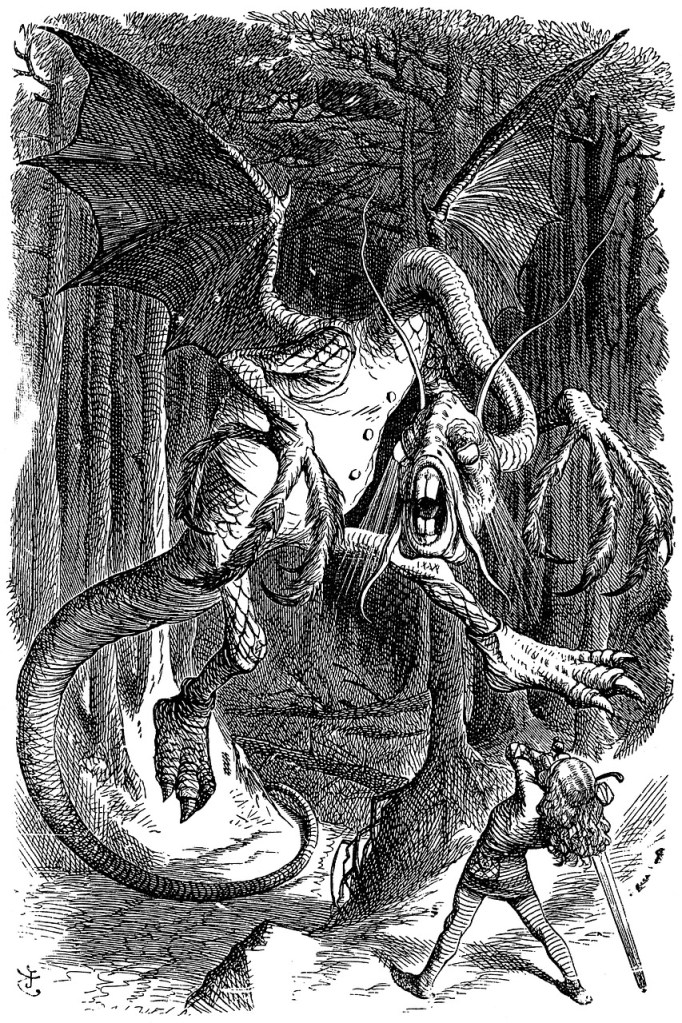
Jabberwocky. Courtesy: Creative Commons

I think my love of euphony has always meant that I relish the way a poem sounds more than I appreciate any meanings it might convey. This is why it was easy for a nonsense poem to become my new favourite and to gently push aside the Poe piece. Lewis Carroll’s ‘Jabberwocky’ became for me the supreme poem and I learned it by heart. It is a poem that makes contextual sense despite all the meaningless neologisms with which it is sprinkled. Somehow, we understand the new words coined by Carroll and there is no need to have them explained. It is a poem that we absorb through osmosis rather than through the normal process of everyday communication. A masterpiece!

When I was 18 years old, I began reading Byron, Shelley, Coleridge and a few other English Romantics, and I discovered ‘Ozymandias’. Now this seemed to me to be a perfect poem. It had music, imagery and a moral, and furthermore it was ironic, an archaic episode with timeless relevance. Again, I learned it by heart, and I found myself in the not uncommon position of reciting it to myself whenever I happened to be confronted with an ancient ruin, whether the blocks of a tumbled castle or shattered torso of a fallen statue. It is a poem that turns a reader into an actor, an introvert into a declaimer. It became my new favourite but only for a short while. The poem that caused it to fall in my estimation was another in the same anthology I was reading.

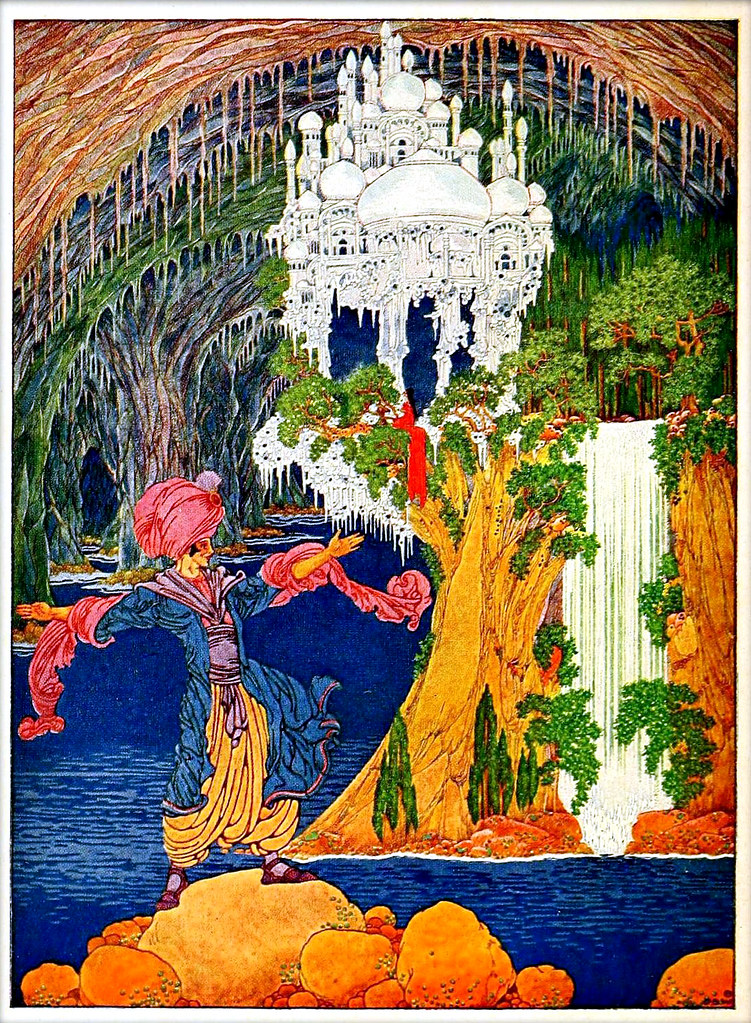
An Illustration from Kubla Khan. Courtesy: Creative commons

Kubla Khan’ struck me as especially appealing because it has a wildness about it that balances out its sense of control. I am not sure why Coleridge affected me to a greater extent than Shelley (and Byron affected me hardly at all) but I was enthralled by the imprecise exoticism and the intimations of doom among paradise in this poem, which is as menacing as it is delightful, as frantic as it is magical. Coleridge himself regarded it as a work in progress, a frustrated potential, unfinished, a burst dream bubble. I wonder if a continuation might have diminished it? The fragmentary nature of the piece adds to its allure by increasing its strangeness. There is atonality here as well as smoothness, like troubling chords inserted in a serene nocturne.

A few years passed and I discovered a new favourite and had to topple poor old ‘Kubla Khan’ from the apex of that idealised pillar and replace it with The Rubáiyát of Omar Khayyám in the first Edward Fitzgerald translation, but whether this series of seventy-five quatrains can be regarded as just one poem is open to debate. Personally, I regard the quatrains as linked inextricably by mood, metaphors as well as theme, and there is a mini-sequence within the whole that gains significant momentum by being treated as a single creation. My ambition once again was to learn the work by heart and recite it at moments that were appropriate but despite my efforts I failed in the endeavour. There was simply too much wordage for me to succeed.

I tried reading more modern poetry, serious and mature work that I failed to understand at first and had to consider very carefully before I could tease out any meaning. I read Akhmatova, Rilke, Pound, Eliot. I tried (but was generally defeated by) Ginsberg, Olsen, William Carlos Williams. This was all well and good but my candidate for new favourite turned out to be something light, an insignificant ditty dashed off by a poet who wrote it as a gift for a friend, and once again it was the music that won me over, the jangling, tinkling, tingling, clipping, clopping, jingly rhythms. ‘Tarantella’ by Hilaire Belloc imitates the sound of a guitar and clapping hands, it clatters along merrily, nostalgically, a tribute to an ephemeral occasion in a mountain tavern that can never be lived again, and the words and their phrasing evoke much of the atmosphere of that night with an appreciable impetus. A candidate for new favourite, yes, but it ultimately failed to displace the Rubáiyát.

That was in my early twenties and soon after I lost interest in poetry, I have no idea why, and rarely read any. Occasionally I would browse an anthology and discover something interesting, but only a few poems made any impression at all on me, and none became my favourite. The Rubáiyát of Omar Khayyám remained at the summit of my appreciation by default. My return to poetry was slow and uneven. The work of Federico García Lorca caught my attention and I chose ‘Canción de Jinete’ to learn by heart, which I did, probably poorly (my Spanish was never fluent). A little later I discovered the precocious genius of Arthur Rimbaud and taught myself ‘Le Coeur Supplicié’ because its torrent of fantastical words appealed to my inner ear.

Unfortunately, what I believed poetry had to offer was something I had no great use for. I misunderstood what it had to offer. That is no great crime, but I did miss out on its delights for a long time. Not until my mid-thirties did I start to return to the pleasures of poetry, and it was the humourist Don Marquis who ushered me back into the heaven I had forsaken, yet it is too much to claim that any of his poems became my favourite. I adore his cycle of poems about the cockroach Archy and the cat Mehitabel, but they must be taken as a whole in an evolving mythos. No individual poem of the cycle is worthy of special attention at the expense of the others. All are good, but together they are brilliant and thus they disqualify themselves from the game.

Now that I was reconciled with poetry, my tastes widened, and I read from a broader set of cultures and times than before. Sappho, Ovid, Catullus, Tagore, Basho, Tu Fu, Housman, Holub, Mandelstam, Eliot, Yeats, Edward Thomas, Dorothy Parker, Ai Ogawa, Ogden Nash, Derek Walcott. I was very enthusiastic about the novels and short stories of Richard Brautigan, so I read his poetry too and found a poem called ‘All Watched Over by Machines of Loving Grace’ that neatly summed up my own hopes for the future of the world. Did it become my new favourite? Not quite. I continued reading. Pessoa enthralled me, Cendrars and Queneau dazzled me. Complicated poetry dealing with the human condition and experimental verse based on mathematics made me nod my head sagely in a close approximation of a deep appreciation.

The City’ by C.P. Cavafy became my new favourite. I had heard his name often mentioned but felt no great desire to explore further. Then by chance I saw this particular poem. What a terrific piece! Hard, bleak even, wrenchingly bitter, but it does not depress the spirits of the reader despite its melancholy message. On the contrary it seems to inspire the reader to action. The poem is quietly and relentlessly insistent that you will never change your life for the better, that you can never escape the circumstances that have trapped you. It issues a challenge to the reader. Prove me wrong, the poem seems to say! I immersed myself in as much of Cavafy’s poetry as I could find. I went out of my way to visit his house in the city of Alexandria in Egypt, so wonderful did I now regard his work. Was this the final destination on my poetic voyage?

Not quite. There was another poem by another poet sunk deep beneath the surface of my awareness and it had been there for a long time. I can say that it had probably been my secret favourite from the beginning. I must have read it in an idle moment and forgotten about it, or thought I had forgotten about it, but it remained on the seabed of my subconscious, and ultimately it wrecked all the poetical vessels that followed, for I was never fully satisfied with any of those I called my favourites. I rediscovered it one unexpected day and it returned with unstoppable force into my affections. It was written by a poet who went to sea and saw the world, who travelled rather aimlessly for a number of years before the urge to write poetry took hold of him.

‘Cargoes’ by John Masefield is evocative and beautiful. It is heady and a little regretful at the same time. It contrasts the supposed splendours of the past with the drab present, and yet ironically in our own age we perceive romance even in the grime and smoke of Masefield’s ‘present’. Three ages are given to us for contemplation, a pre-classical time, the golden age of the Spanish Main, and the very start of the 20th Century, and three ships loaded with merchandise to represent those ages. The ships of Assyria and Spain are loaded with exotic and tropical treasures. They are floating envoys of a pair of widely spaced but equally fabulous cultures. The British ship is grimy and ugly and it wallows through a drab sea on a blustery day, carrying cargo that is practically an insult to the taste of the aesthete. The language employed is perfect for Masefield’s purpose. I know of no poem I like better.

Quinquireme of Nineveh from distant Ophir,
Rowing home to haven in sunny Palestine,
With a cargo of ivory,
And apes and peacocks,
Sandalwood, cedarwood, and sweet white wine…

Cargoes (1903), John Masefield (1878-1967) 

Rhys Hughes has lived in many countries. He graduated as an engineer but currently works as a tutor of mathematics. Since his first book was published in 1995 he has had fifty other books published and his work has been translated into ten languages.

.

PLEASE NOTE: ARTICLES CAN ONLY BE REPRODUCED IN OTHER SITES WITH DUE ACKNOWLEDGEMENT TO BORDERLESS JOURNAL

Categories
Poetry

Lake Poets & Ryan

Poetry by Ryan Quinn Flanagann

A view of the Lake District which nurtured poets like Wordsworth, Coleridge & Southey and writers like the controversial Charles and Mary Lamb. Courtesy: Creative Commons
In the Kawarthas Thinking of the Lake Poets Strung Out on Opium, Words and the View

Sure, Coleridge was a Wordsworth fanboy, but I always thought him the better scribe.  
Taking that albatross of opium dreams as far as bad teeth were willing to chatter.  And Southey sliding into third although Bryon claimed him thrown out by establishment leanings.  Both Lambs lead to slaughter and De Quincey’s Confessions of an English Opium Eater which must have made Samuel Taylor want to race Kubla Khan straight to the bottom of the laudanum bottle.  Addiction in popular literature and not just for it.  And here I am beside wifey’s warm jam jams.  In the Kawarthas, thinking of the Lake Poets strung out on opium, words and the view.  How the Edinburgh Review coined the term trying to slander a little drummer boy out of his only percussion.  But the name stuck, as such things often do and who remembers anything about the critic now?  That’s what I adore about this guttural bullfrog of a cosmos.  How the hodge of the podge never clamps down on salty bitters.  Beside this fire reinvented, on the water and off the clock.  Heavy gangplank eyes uncorking another bottle.  Leaning back in twin Adirondacks wishing the loon out of every asylum.  The howl of distant wolves across this long unanswered wilderness.

Ryan Quinn Flanagan is a Canadian-born author residing in Elliot Lake, Ontario, Canada with his wife and many bears that rifle through his garbage.  His work can be found both in print and online in such places as: Evergreen Review, The New York Quarterly, Borderless Journal, GloMag, Red Fez, and The Oklahoma Review

.

PLEASE NOTE: ARTICLES CAN ONLY BE REPRODUCED IN OTHER SITES WITH DUE ACKNOWLEDGEMENT TO BORDERLESS JOURNAL