The holiday market buzzed with life, bathed in the golden glow of string lights that twisted like ribbons between the stalls. Vendors hawked hot cider, the air thick with the scent of cinnamon and cloves. Children, bundled in puffy coats, raced around, their fingers clutching candy canes, their laughter mingling with the low hum of holiday songs. The warmth of the season wrapped the world in a festive embrace.
Shafi clutched her coffee tightly, the warmth of the cup unable to quell the cold gnawing at her insides. The heat of the liquid contrasted sharply with the chill that had settled deep within her…. a coldness that not even the bright lights or holiday cheer could dispel. She scanned the lively scene, but her focus was elsewhere, far from the twinkling stalls and cheerful music.
“You’re too quiet again,” Amir said, nudging her elbow gently. “You okay?”
Shafi tried to smile, but it didn’t reach her eyes. “Just thinking.”
Amir frowned. “It’s Christmas. You’re supposed to feel warm and fuzzy, not… whatever this is. What’s going on?”
“I don’t know,” she whispered. “It just feels… off.”
Amir gave a small laugh. “Paranoia. Classic Shafi.”
But Shafi couldn’t shake the weight pressing down on her chest. The world felt too loud and too quiet at the same time. The joy around her seemed distant, muffled by a creeping unease. She wanted to feel the warmth of the season, to laugh and enjoy the festivities like everyone else, but all she could think about was the shadow of her past, looming just out of reach.
As they walked toward her apartment, the streets emptied, and the festive energy of the market gave way to the solitude of falling snow. The sky had turned a deep shade of indigo, and the streetlights cast long shadows across the quiet pavement. The snow, falling gently at first, began to collect, blanketing the city in soft, white layers. Each flake seemed to carry its own quiet story, falling in silence but adding to the growing weight of the world.
When they reached her door, Shafi stopped dead in her tracks.
“Wait,” she whispered.
Amir followed her gaze, his expression shifting from concern to confusion. The door to her apartment was slightly ajar. Her heart skipped a beat.
“Stay back,” he said firmly. “We don’t know what’s inside.”
Shafi grabbed his arm, urgency flashing in her eyes. “No. I’m going in.”
They stepped inside together. The apartment was eerily quiet. The usual hum of the fridge, the faint rustling of curtains in the breeze, was absent. Everything seemed untouched—except for a single set of dusty footprints leading from the door to the table.
Amir moved cautiously toward the table, his eyes scanning the room for danger. On the table lay a folded piece of paper. It seemed ordinary, yet in the context of the silence and the unusual circumstances, it felt like a warning.
“Shafi,” he said softly. “You need to see this.”
Her name was scrawled on the front in jagged handwriting, the ink slightly smeared. The paper felt heavy in her hands as she took it, her fingers trembling.
“Shafi,” Amir read aloud, his voice steady but concerned. “The snow may bury, but the truth always thaws. You can’t hide forever.”
Shafi staggered back as though the words themselves had struck her, each letter cutting deep. A cold shiver ran down her spine. The past rushed at her with the force of an avalanche.
“What does it mean?” Amir asked, his voice tense.
Shafi didn’t respond. Her mind raced, the weight of her past crashing down like a flood. The words weren’t just a threat—they were a reminder of the life she had tried to leave behind, of the man she had betrayed, and the secrets she had buried.
“Shafi,” Amir said gently, insistent. “Talk to me. Who sent this?”
She clenched her fists, struggling to speak. The truth felt like a lump in her throat, burning to get out, but fear kept her silent. She had buried this secret for so long, hoping it would stay hidden. Now, it was all coming to the surface.
“It’s not that simple,” she whispered, trembling.
“Make it simple,” Amir said softly, kneeling beside her. “Please.”
She looked at him, eyes glistening with unshed tears. She had carried this burden alone for years, but now, in Amir’s unwavering presence, the walls she had built began to crumble.
“There was a man,” she began, voice breaking. “Rafiq. Years ago, I…” She paused, breath hitching. “I betrayed him.”
Amir’s brow furrowed. “Betrayed how?”
“I lied,” she admitted, voice heavy with guilt. “I framed him for something he didn’t do. It was him or me, and I chose myself.”
Amir stared silently. His quiet presence asked no questions; he simply waited.
“Why?” he asked softly.
“Because I was scared,” she whispered. “I thought it was the only way out. It worked—he went to prison, and I walked free. But now he’s out, and I think he’s come for me.”
Silence hung between them, suffocating. Shafi could barely breathe, the weight of her confession pressing down.
Finally, Amir spoke. “And this note… it’s from him?”
Shafi nodded, throat tight. “It has to be.”
Amir knelt, taking her hands gently. His touch grounded her. “Listen. Whatever you did, whatever he’s planning, we’ll handle it. Together.”
Tears streamed down her face. “You don’t understand. He has every right to hate me. I ruined his life.”
“And hiding will only make it worse,” Amir said firmly. “You need to face this. We need to face this.”
Shafi looked into his eyes, searching for doubt, for hesitation, and found none. Only resolve. Only support.
“What if he wants revenge?” she asked, barely audible.
“Then we’ll stop him. But first, we need to talk to him. No more running, Shafi.”
She nodded slowly. For the first time in years, the weight of her guilt began to lift not because the past had changed, but because she wasn’t facing it alone.
Outside, the snow continued to fall, blanketing the world in quiet beauty. Inside the apartment, something new took root: hope.
.
Gowher Bhat writes fiction and non-fiction. He’s a a columnist, freelance journalist, and educator from Kashmir. His writing explores memory, place, and the quiet weight of the things we carry, delving into themes of longing, belonging, silence, and expression. A senior columnist for several local newspapers across the Kashmir Valley, he is also an avid reader and book reviewer. He believes that books and writing can capture the subtleties of human experience.
PLEASE NOTE: ARTICLES CAN ONLY BE REPRODUCED IN OTHER SITES WITH DUE ACKNOWLEDGEMENT TO BORDERLESS JOURNAL
The December breeze had turned nippy in Bengaluru, carrying with it the aroma of roasted peanuts and freshly fried banana chips from roadside stalls. Fairy lights blinked across MG Road, and plastic Santas dangled from shopfronts. Ravi watched the sparkle through his rear-view mirror as he waited for his regular passenger, Ananya, to emerge from the Barton Centre, where she worked at a real estate firm.
“Sorry, Ravi bhaiya,” she said, sliding into the back seat. “The office party ran late. You know how these Christmas celebrations are: too much food, too little meaning.” She sighed, glancing at her half-open goody bag stuffed with unopened chips and chocolates.
Ravi smiled politely. He liked Ananya. Always punctual, always courteous, never haggling over the fare. But her words lingered. Too much food, too little meaning.
That night, after parking his autorickshaw near his rented room in Ejipura, Ravi noticed a group of slum children huddled under a flickering streetlight. They were watching a television through the open window of a well-to-do home. A Christmas carol drifted out, and the children sang along, slightly off-key.
“Santa will come!” one of the younger ones shouted.
“Arrey, fool,” another replied, “Santa only goes to rich houses.”
Their laughter carried a quiet truth. Ravi walked past them slowly, his chest tightening. What if Santa came here—just once?
The thought stayed with him.
The next morning, Ravi tied a cardboard sign inside his auto:
CHRISTMAS DONATION BOX – HELP BRING A SMILE TO CHILDREN LIVING IN SLUMS
An old plastic box sat beneath it. Some passengers glanced at it and looked away. Others smiled. A few dropped in coins or notes.
“What’s this for?” many asked.
“I want to buy small gifts for the children near my place,” Ravi explained. “Like Santa.”
An elderly woman patted his shoulder before slipping in a hundred-rupee note. “Good man. May God bless you.”
Within days, the box filled faster than Ravi had imagined. One evening, he counted the money: over three thousand rupees. More than a week’s earnings. His hands trembled slightly as he folded the notes.
At the market, he bought candy packets, crayons, and small notebooks. In a second-hand shop near Shivajinagar, he found a faded red Santa coat, a cotton beard, and a cap. It wasn’t perfect, but it would do.
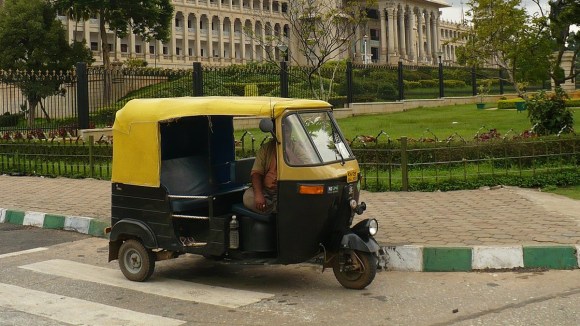
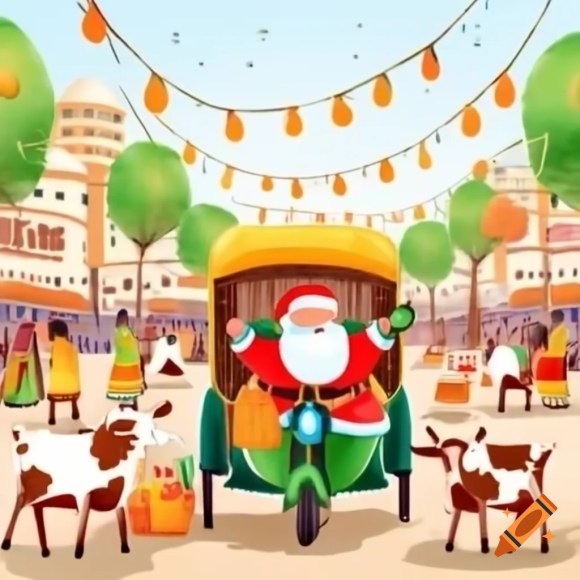
On Christmas Eve, Ravi transformed his green-and-yellow auto. Fairy lights ran along the roof. Paper stars swayed gently. A hand-painted ‘Merry Christmas’ sign was fixed to the back.
His neighbours laughed. “Ravi, have you gone mad? You’re a Hindu. Why Christmas?”
Ravi grinned. “Santa doesn’t ask who you are before giving gifts, right?”
By evening, the narrow lanes were alive with whispers and giggles. When Ravi stepped out dressed as Santa, a cheer erupted.
“Santa has come! Real Santa!”
He handed out candies, crayons, and notebooks. Laughter echoed between the tin roofs, mingling with jingling auto coins and distant church bells.
A barefoot little girl with bright eyes tugged at his sleeve. “Santa uncle, will you come next year also?”
Ravi bent down, his beard slipping sideways. “Only if you promise to study well and share your chocolates.”
She nodded gravely. “Done.”
Ravi laughed, blinking back, gripped by a sudden ache in his throat.
Later that night, he removed the Santa costume and counted the remaining money. Rs 1,800 still lay in the box. Someone had quietly slipped in two Rs 500 notes during the evening crowd. Ravi sat silently for a long moment, overwhelmed.
The next morning, he went to the Hanuman temple, where he prayed every Tuesday. He placed the leftover money before the priest as a thanksgiving.
The priest, an elderly man with cataract-clouded eyes, listened patiently as Ravi explained: the happiness he had brought to the slum children with the donation box, the costume, the Christmas star.
“I know it’s not our festival, Swamiji,” Ravi said apologetically. “But I wanted to do something good.”
The priest smiled. “Tell me, Ravi, did you ask those children their religion before giving them sweets?”
“No, Swamiji.”
“And did they ask yours?”
Ravi shook his head.
“Then where is the difference?” the priest said gently. “Whether one calls Him Krishna, Allah, or Christ, God smiles when His children care for one another. This is the true spirit of dharma[1].”
He placed his hand on Ravi’s head. “May your auto always carry light, not just passengers.”
That evening, Ravi drove through Bengaluru once more. Some fairy lights on his auto had dimmed, but a few still twinkled. The donation box remained inside. Though Christmas had passed, coins continued to clink into it.
For the first time, Ravi understood that Christmas wasn’t about religion, decorations, or abundance. It was about sharing warmth in a world that often forgets to care.
The road stretched ahead, glowing with city lights that shimmered like stars. And in the soft hum of his modest auto, Ravi felt as though he carried a small piece of swarg[2] through the streets of Bengaluru.
Snigdha Agrawal (née Banerjee) is the author of five books, a lifelong lover of words, and the writer of the memoir Fragments of Time, available on Amazon worldwide. She lives in Bangalore (India).
.
PLEASE NOTE: ARTICLES CAN ONLY BE REPRODUCED IN OTHER SITES WITH DUE ACKNOWLEDGEMENT TO BORDERLESS JOURNAL
Narrative by Meredith Stephens: Photographs by Alan Noble
Sydney Skyline
We are not champagne sailors. The only time Alex and I drink champagne aboard a boat is to celebrate the end of a voyage of hundreds of nautical miles. Our sailing expeditions are characterised by breakages, deprivations and isolation. Sometimes the seas are so rough that I cannot move around the boat, let alone change clothes. I can only bathe once a week, and that consists of a dip in the ocean at anchor.
Our meals often consist of fish we have caught and cooked, unless we consume them immediately as sashimi. A single fish might last us days, served in various guises. Other meals are prepared from lentils or canned foods. In contrast to land trips, I usually lose a kilogram or two when at sea. I prefer not to use the term ‘yacht’, because people imagine us sunning ourselves on the deck while sipping champagne. Instead, I use the term ‘sailboat’. I do confess to a tad of reverse snobbery in the deprivations I endure and look down on those I describe as ‘champagne sailors’. But was that about to change?
We had been invited aboard the luxury observer vessel known as The Jackson to watch the start of the annual Sydney to Hobart Yacht Race on Boxing Day. After Christmas lunch, we headed to Adelaide Airport to catch our ninety-minute flight to Sydney. Upon arrival at our hotel, we caught the lift to our room. The lift doors opened on the third floor to let two brothers in, aged around 10 and 12. They met our gaze.
“Would you like us to sing you a Christmas carol?” the younger one asked.
The older one looked a bit embarrassed, but I thought asking strangers to join in singing a carol in a lift on Christmas Day was a nice, if not brave gesture, so I nodded enthusiastically. The younger one started singing ‘We wish you a merry Christmas’, and facing us, moved his hands in the manner of a choir conductor. I joined in. Then the boys noticed that they had arrived at their floor and stopped singing.
“See ya!” said the older one, as they exited.
We continued to the seventh floor and deposited our bags. The light was fading, so we decided to head back outside to take a stroll around the harbour. We returned to the lift. Once we reached the fifth floor the doors opened and the two boys entered again. Three other guests were standing behind us.
“More carols?” asked Alex.
They nodded and smiled. “Yes!”
They launched into another familiar carol, and again I joined in. The tall guest behind me gave a kindly chuckle. Then they reached the third floor, bade us farewell, and exited. We continued to the ground floor and made a tour of Darling Harbour in the remaining light. It had been a wonderful Christmas Day, and what better way to end it than the act of goodwill in being serenaded by children in a hotel lift.
The next day was the yacht race, which has been held annually since 1945 and is one of the world’s great ocean races. The sailors would be competing in a gruelling and treacherous race of 128 boats covering 628 nautical miles (1,200 km), south down the Tasman Sea, across Bass Strait, to Hobart in the south of Tasmania. This race is one of the highlights of Boxing Day and a television staple.
Start of Sydney to Hobart race
We walked to the appointed wharf and noticed a long queue waiting to board. Upon being noticed by our hosts, we were directed to a shorter queue and were ushered up the stairs to the top deck, limited to fewer than sixty people. A ribbon with ‘The Jackson’ written on it was affixed to our wrists. We were greeted by a waiter holding a tray proffering a range of drinks. Alex picked up two glasses of champagne and handed one to me. Was this the beginning of my new career as a champagne sailor?
The Jackson soon departed and we headed out to the deck to view the boats lining up for the race. Even though it was summer the cold penetrated my body and my hands shook. I was determined to brave the cold in order to hold my place to view the start of the race. The lady next to me made some commentary.
“That’s the start line,” she said, pointing to two yellow buoys. The start lines are staggered depending on the the size of the boats to help prevent collisions. It’s a southerly, so that should help.”
I nodded, feigning comprehension. I was not yet a competent enough sailor to pick up the wind direction so quickly. The cannon sounded on the deck below, and a plume of smoke rose. The yachts set off. Soon they had overtaken our observation vessel and most of the guests moved back inside the boat to watch the race on a large screen. Alex and I and a few other hardy souls remained on the outside deck to savour the unique setting of Sydney Harbour. Waiters braved the cold regularly to top up our champagne and offer us canapes. We accepted each time, although I eventually slowed down and shared a glass of champagne with Alex. Had we become the dreaded champagne sailors?
The yachts sailed through the heads until most of them disappeared from view. The Jackson turned around and headed back to King Street Wharf. We remained outside on the deck in the cold, making the most of every minute because Sydney Harbour is so far from home, and we may never have this opportunity again.
I stubbornly refuse to accept the title of champagne sailor though. We are temporarily boatless (which is another story) but once we resume sailing again later this year, we hope to return to the days of self-reliance on the boat and sourcing our meals from the ocean. Maybe not too much deprivation though, because we will continue to uncork a bottle of champagne, as is our tradition, after completing a major ocean passage of several hundred nautical miles.
Sydney to Hobart race
.
Meredith Stephens is an applied linguist from South Australia. Her recent work has appeared in Syncopation Literary Journal, Continue the Voice, Micking Owl Roost blog, The Font – A Literary Journal for Language Teachers, and Mind, Brain & Education Think Tank. In 2024, her story Safari was chosen as the Editor’s Choice for the June edition of All Your Stories.
PLEASE NOTE: ARTICLES CAN ONLY BE REPRODUCED IN OTHER SITES WITH DUE ACKNOWLEDGEMENT TO BORDERLESS JOURNAL
Five poems by Pravasini Mahakudahave been translated to English from Odia by Snehaprava Das. Click here to read.
A Poet in Exileby Dmitry Blizniuk has been translated from Ukranian by Sergey Gerasimov. Click hereto read.
Kalponik or Imaginedby Tagore has been translated from Bengali by Mitali Chakravarty. Click hereto read.
Pandies Corner
Songs of Freedom: The Seven Mysteries of Sumona’s Life is an autobiographical narrative by Sumona (pseudonym), translated from Hindustani by Grace M Sukanya. These stories highlight the ongoing struggle against debilitating rigid boundaries drawn by societal norms, with the support from organisations like Shaktishalini and Pandies. Click here to read.
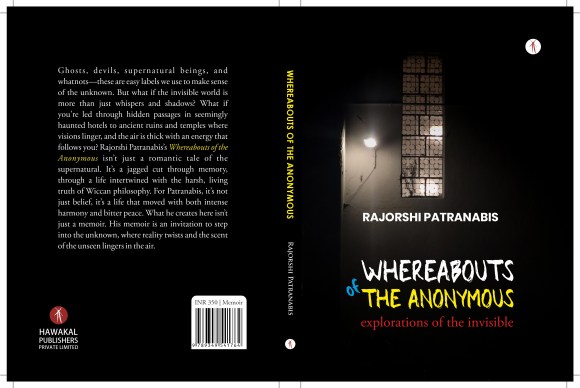
A brief discusion of Whereabouts of the Anonymous: Exploration of the Invisible by Rajorshi Patrnabis, Hawakal Publishers, with an exclusive interview with the author on his supernatural leanings
Whereabouts of the Anonymous: Exploration of the Invisible by Rajorshi Patrnabis could have been a regular book of intense ghost stories, with the oldest ‘presences’ dating back to the regime of Sher Shah Suri (1472 – 1545). ‘Presences’ are basically spirits — visible or barely visible — that cause disturbances in the energy field surrounding us, as per the book.
One of the most coherent of these ‘spirits’ was from 1920, confiding her story on Christmas eve — reminds one of Dickens’ A Christmas Carol and Uncle Scrooge — only this spirit was a British woman from the Raj era, a spirit that lost her beloved who was from a Bengali royal family. Her strict father stepped in and stopped the marriage. No one knew what happened to the groom. And she continued to weep and wait while haunting the premises of the popular and populous Park Street where she was supposed to meet her beloved more than a hundred years ago… Then there’s a ghost that takes you back to his funeral pyre… drawing back the curtain between the two dimensions — one in which we exist and one in which they hover…
These, however, are not your regular ghost stories. There is a difference for Patranabis claims to have met these sad spirits in real life.
A Wiccan by choice, Patranabis has tried to draw back the curtains to reveal a dimension whose existence is elusive and avoidable for most of us at best and rejected by many. He claims to have a spiritual bent of mind which helps him experience these out-of-the-box scenarios, meet the dearly departed. He has done a number of books of poetry around his beliefs. He has even photographed these spirits!
Photographs of spirits by Rajorshi Patranabis
Though the images are blurry at the first viewing, you have to focus hard to see the ethereal outlines of shadows beyond the realm of the living, I guess.
Whereabouts of the Anonymous is a memoir that spans his interactions with, as the title says — ‘the anonymous’ — or the blurry ‘presences’ and explores the invisible for majority of the spirits are merely depicted as shadowy in his narrative as in his photographs except for a few whose images have not been taken.
Occasionally, the spirits can be malevolent as in the Bhangarh Fort, where a foul-smelling female spirit and some lost souls in the ancient jails wounded Patranabis physically and chased him out. Set in the Aravalli hills of Rajasthan. Bhangarh is the most haunted place in India. There is a story of a princess and her spurned lover associated with it. Evidently, a sage fell in love with the princess and made a special concoction which would make her fall in love with him. When she went to buy a perfume, the smitten lover tried to replace it with his love potion. The princess threw away the bottle of love potion. It fell on a rock, dislodging it. The rock rolled down to kill her admirer, who cursed her with his dying breath!
There is also the narrative about a whole village that accepts and lives in peace with the spirits of their dearly departed, even giving them rickshaw rides and offering them chairs!
Patrnanabis has brought his Wiccan outlook into the discourse. His language flows. The narrative is simple and easy to understand. The descriptions are so graphic that one can almost visualise the disembodied spirits and their interactions. The 150-page book is an enjoyable and easy read and a perfect companion for travel or an evening or two. But the author’s experiences and his interests stretch beyond what the pages can hold. In this interview, we discuss his beliefs and his experiences…and maybe, another book?
How old were you when you had your first supernatural sighting? Were you scared the first time?
When I look back, the first time that I had a feel of the ‘other dimension’ was perhaps at the age of 7 or 8. I remember going to my paternal home at Digboi during our winter vacations. I remember going to my parent’s bedroom at the first floor and my mother used had to send me to her room to fetch something. The room was across a terrace, and I remember running through the terrace from the staircase to the room. But every time, I could feel someone running with me through the terrace. But as and when I would enter the room, it was all perfect. I would run back again again to the stairs. When I would blurt this out to my parents, they would simply ignore me, but somehow, I was never completely convinced. It was much later, sometime around the year 2000 that my father confided with me of a real ‘presence’ there. He told me that there had been many an experience where people had felt the presence of something eerie there. But by then I had had some very deep experience of the supernatural existence.
Rajorshi Patranabis in Wiccan wear
When did you become a Wiccan and why?
The answer to this ‘why’ is a wee bit dicey. I am myself not sure of this. It was just a flow that I couldn’t control. Mind you, I had already gone through some extremely remarkable experiences and my stint at the hill top temple and my encounter with that 97 year old person who taught me numerology was way before I joined Wicca. I would call myself pretty insane in those phases of my life. By the time Wicca happened, I had calmed down considerably and joining my teacher was nothing less than an accident. It so happened that my friend, Subhodip, and I were walking down the Southern Avenue in Kolkata when we spotted another school friend ( a senior Wiccan) standing at the door of an otherwise inconsequential book store. He waved at us and asked us to join in, as it was an open session by my teacher. We joined. Subhodip was skeptical, while I followed it up with an email and I was called for an interview with Ma’am. The journey started. I had mentioned about my experience in ‘Whereabouts…’ This was early 2013.
Did becoming a Wiccan help you align to the supernatural better?
Infact, my Wiccan knowledge taught me the nuances of alignment with the forces of nature. Why just the supernatural? The vibrations that the earth emanates, the animal kingdom throws out, to feel and spot across dimensions etc. The most important thing is perhaps the use of sound like the chatter of a rainfall, the melodies of a singing bowl or even drum beats (like in Voodoo) as means of invocation, that, was passed on to me. More than anything, the pleasures of immersing oneself in ancient knowledges can be very ‘intoxicating’. Our school concentrates most on the Egyptian origins. If you ask me now, I worship Goddess Isis as my altar Goddess along with the 64 yoginis. Yes, Wicca has helped align myself to me, if I say this philosophically.
You have called yourself ‘spiritual’ and also spoken of ‘seers’? Can you explain these two terms?
I wouldn’t get into the linguistic trap of English. But a Wiccan would say spiritual comes from ‘spirit’. A very basic tenet of Wicca is to align your body, mind, soul and spirit. As and when the becomes one with nature does your mind uplift itself to being a soul. A soul that gets through the rigours of lust becomes a spirit. We are in the habit of using the word spirituality very lightly, but a true Wiccan would say that a pure spirit sits on the pinnacle of the pyramid. There are many references in our Sanatan scriptures too about such spirits and the recourse they take to leave the body, as and when they cross over.
A seer is a saint who has won over the realms of the physical nuances. He/she is automatically clairvoyant as all their faculties have attained the higher plains in the atmosphere. Please don’t mistake a seer for only a saint. A scientist or a litterateur who had immersed themselves in the claustrophobic depths of knowledge can be a seer too. Many such examples can be sighted to prove this.
How did/does your family respond to your being a Wiccan or interacting with spirits?
My family doesn’t always subscribe to what I do, but in all honesty they had never been a hindrance to my learnings. There are Wiccan ceremonies that I celebrate or spells that I do from time to time for the well being of people, they had all along been very supportive. They stand as a pillar beside me.
When and why did you turn to writing?
I started writing at a very young age. My first poem, if I can recall was at the age of 13. But as time went on, everything slowed down. My next phase was from 2015 and my first published book was in 2018. By this phase I was well and truly into Wicca.
You have used Japanese techniques in poetry to describe your journey as a Wiccan and to interact with spirits. Why? Do these align better to help you describe your experiences?
Well, I wouldn’t say I use Japanese poetry forms to interact with any spirit. Though I must accept that I’ve had communications with the other dimension which were very poetic at times. In my book, Gossips of our Surrogate story, I had used quite a bit from my Wiccan Book of Shadows and even you had accepted that they were poems alright, good or bad, notwithstanding. But I would also like to harp on the inherent pertinence of this question. Gogyokha or Gogyoshi are short form poetry in just 5 lines and my forays into the other dimension had just had similar experiences — short, crisp and at most times life altering. In my Gogyoshi collection, Checklist Anomaly, all the poems are either true happenings or near life occurings. My writing (poetry) as a whole, until now, had been with deep metaphysical love. Perhaps my thought process is challenged. But Japanese forms had been a huge compliment to this particularly weird handicap of mine.
What made you think of doing this book — your memoir of supernatural interactions so to speak?
To be very honest, all these experiences that I had shared in Whereabouts of the Anonymous would have stayed with me through out this physical life had it not been for a dear brother and publisher, Bitan Chakraborty. It was on his persistent insistence that I decided to put my ‘stories’ on paper. But that was again a very difficult thing. I really had to scoop things from the nook and crannies of my memory to make for a reasonably good compilation. Even Bitan had certain experiences with me or otherwise ( like his camera giving up on a particular shot etc.) and was most interested on such a memoir seeing the light of the day. I have dedicated this book to Bitan. I had to, it was his brainchild and as a Wiccan would say, the Universe made me write it.
You seem to seek out departed spirits or ghosts. Why? Are you not scared?
I find this word ‘ghosts’ very disrespectful. Departed spirits, well, if you ask me no spirits depart. Remember, the law of conservation of energy — the total energy remains constant, it can neither be created nor be destroyed. The energies ( whether spirits or not) have this affinity to get in touch with other souls who can feel them and with a little effort can hear them. The ectoplasmatic fusions that happen inside the cosmos are mostly not registered by ‘so called science minded sceptics’. There are gadgets to measure such vibes. And afraid? No. You would only be afraid if you stay in denial of the other dimension. If I say that the other dimension is omnipresent, no matter what, you won’t be afraid of it. Remember you are afraid of darkness because you don’t see through it, but as soon as you put on a light, it becomes a part of you. Precisely the unknown is magic or mysticism and the known is science.
Do you only sight spirits or auras around people? Are you into Noetics as a subject?
Auras form the atmosphere, it really doesn’t matter whether you have a body or not. There are ascetics who would ask you not to touch anyone’s feet while paying obeisance. The say, the aura or the protonic energy of a person is as long as that person’s height. They say you put your head on the ground, possibly, to absorb a concoction of the Earth’ s magnetism coupled with the aura of that person. By the bliss of this Universe, I do feel a few energies that are devoid of a body. Noetics or the consciousness levels automatically become part of these. But I am personally not into Noetic sciences or research. But ancient knowledges under the umbrella of Wicca does take you through the subconscious to superconscious levels of the mind with twinings of the nature, supernature and the supernatural. There are very thin lines segregating them.
In you memoir, you keep asking people to leave a glass of water to satiate the spirit. Do you see yourself as a person who appeases ghosts? Do you help people – how do they reach out to you if they feel a ‘presence’?
What does a glass of water do? Think of a situation where you stand in front of everyone, yet you’re being ignored by everyone. You would not realise that you’re actually not visible to them. Just think of the insecurity that you would have to realise that persons whom love so dearly are slowly getting ahead with life and that you have become a fading memory. That glass of water just reinstates the faith that he/she still matters to you.As time goes, like all energies, they would also dissipate. But with pleasantness in them.
I don’t appease anyone. As my teacher says, it’s all about alignment. If I may say so, the Universe makes me do certain things that a psychiatric practitioner would do to people with mental illness. These are very small techniques that I had learnt over the years to put a restless soul to a restful state. As far as the last part of your question is concerned, I don’t do anything for any consideration. I have a promise to keep. If the cosmos so wills that I would be of help to someone, I would definitely land up from nowhere.
Do you plan to do something with this ‘gift’ you have? Can you see spirits where others cannot? Will you be doing more books about your supernatural experiences?
Well, after the book went for print, I realised that I could have included many more of the experiences that I had gone through. So, another book is very much in the offing. And as far as doing something with this ‘gift’ is concerned, I am completely in sync with you that this is a ‘gift’ that the cosmos had bestowed upon me and when you have such an invaluable gift, you keep them. You generally don’t use them. Seeing spirits? I feel them and I see them only when the spirit wants to show them off (like the school Master of Bhanjerpukur – one of my most remarkable experiences).
(This review and online interview by email is by Mitali Chakravarty)
PLEASE NOTE: ARTICLES CAN ONLY BE REPRODUCED IN OTHER SITES WITH DUE ACKNOWLEDGEMENT TO BORDERLESS JOURNAL
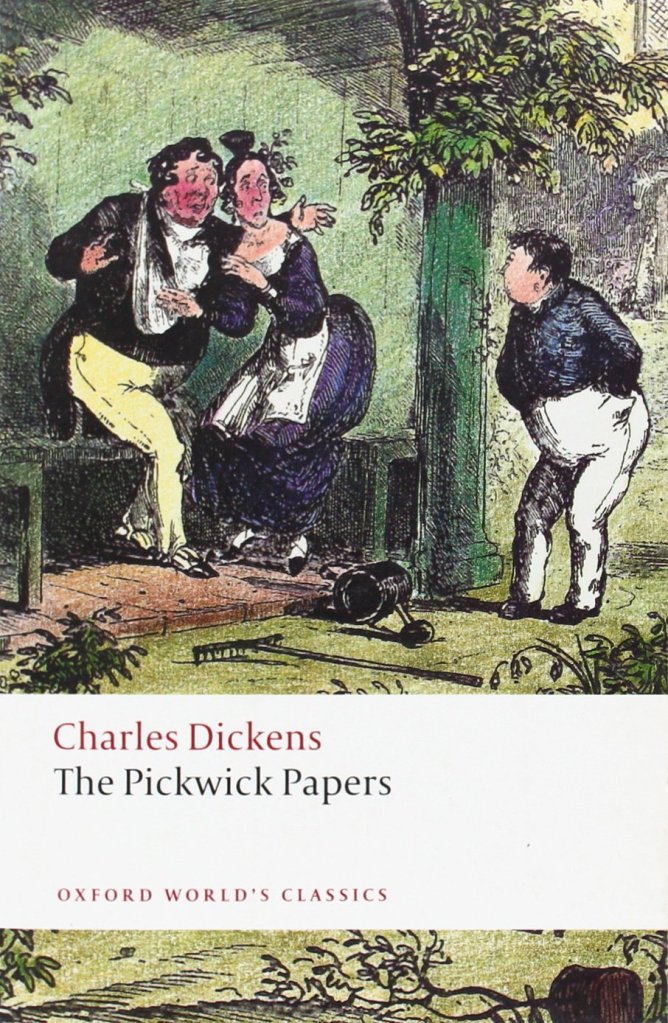
Charles Dickens was flying high by 1842. His books, Pickwick Papers and Oliver Twist, and periodicals were selling like hot cakes on both sides of the Atlantic. With so many fans over in America, he decided to pay them a visit. What he saw in the second-largest fan base upset him for two reasons. Firstly, there was the issue of royalty. Publishers in America were printing his work left, right and centre. He received none of the returns due to him. Secondly, he was upset with the level of racism and their cavalier attitude towards slavery, even amongst the northern states.
Dickens could not stomach the dehumanisation of the black Americans. The vocal and expressive writer, who drew his readers to his craft in the first place, wrote in one of his later articles about his trip to America. He did not twist his words when he wrote verbatim in his American travelogues of slaveowners’ advertisements about their runaway slaves. In one of these advertisements, it read, “Ran away, a negro woman and two children; a few days before she went off, I burnt her with a hot iron, on the left side of her face. I tried to make the letter M.”
A few years earlier, Britain had outlawed slavery, so the British felt a bit of moral superiority over the Americans.
The Americans did not take to this kindly. Dickens’ following few publications fared poorly.
Meanwhile, Britain was also changing.
It was industrialising as its Empire ventured far and wide to exotic lands. With that came the increasing gap between the poor and the rich. The poor remained short of money and short of education opportunities. With the development of science, religious belief took a back seat. Catholicism lost its favour. The Puritans were disillusioned with the material world.
The idea of Christmas and family togetherness was losing out. Work took up most of the time. There were no documented Christmas holidays. The ancient midwinter culture of Europeans had lost its lustre. Many of the Christmas iconographies were viewed as pagan in the UK and the US. The Puritans viewed life as hard, and having joy and fun was scorned. A small proportion of people still wanted to revive the spirit of Christmas.
Against this background, Dickens returned home. His following two books received a poor reception from readers. He resumed his social work, helping the marginalised. At that time, the prevailing view in the UK was that poverty was self-inflicted. The society felt that providing aid to the poor was counterproductive; it made them lazy. People deserved to go hungry for producing so many children, and the Malthusian theory that food demand would outstrip supply seemed to be coming true. The 1840s were known as the “hungry 40s.” Famine was looming.
Yet another layer of population, the reformists, took it upon themselves to help the downtrodden. Dickens was one of those souls. In Manchester, after giving an emotional lecture at a fundraiser to feed and educate poor children, he went for one of his famous long walks.
As he walked the streets, an idea struck him. He visualised a man who had lost all his compassion and had to be jolted back into a complete sense of his humanity. The story helped rebuild Christmas and the compassion that had been lost over the years. The rest, as they say, is history. A Christmas Carol reformed Victorian Britain.
Photo provided by Farouk Gulsara
Reference:
From Journey Through Time: 59. A Christmas Carol: The Book That Brought Back Christmas (Ep 1), 25 Dec 2025. Podcast
Farouk Gulsara is a daytime healer and a writer by night. After developing his left side of his brain almost half his lifetime, this johnny-come-lately decided to stimulate the non-dominant part of his remaining half. An author of two non-fiction books, Inside the twisted mind of Rifle Range Boy and Real Lessons from Reel Life, he writes regularly in his blog, Rifle Range Boy.
PLEASE NOTE: ARTICLES CAN ONLY BE REPRODUCED IN OTHER SITES WITH DUE ACKNOWLEDGEMENT TO BORDERLESS JOURNAL
Mr. Foley’s sister, Gin Thompson, was somewhat taken aback when the mail person arrived on the Wednesday after New Year’s with a suspicious looking package; suspicious because it was both heavy and oblong; a dimension heretofore not observed by her, at least not pertaining to a package.
“Mercy!” she yelled upon twisting the last bit of brown paper away from its contents.
Mr. Thompson stood beside his wife as she read the note addressed to her from St. Paul, Minnesota. They lived in Sioux City, Iowa.
“This is obviously from your brother Jack,” Harold Thompson said, grinning due to the curiosity aroused because Jack had been out of touch for years.
His wife didn’t find her husband’s big grin amusing. She usually knew what he was thinking. Yet, he was right. Jack hadn’t contacted Gin, his only sibling, in coming on fifteen years.
“It’s not FROM Jack!” Gin screamed. “It IS Jack!”
“What the hell?” was all Harold could find to say. To ask. Whatever.
Gin plopped down in Harold’s usual chair holding the ominous quart jar in both hands. “Gee whiz,” was all she could muster, and then a quieter, “Damn.”
“I had so many things I wanted to ask him,” she said.
“I wanted to pick his brain a little too,” Harold said, trying not to smile. “I guess that opens up a can of worms now,” he continued, still pretending a serious demeanor.
“Shut up, Harold!” Gin insisted.
Still, the couple agreed that what Jack Foley did, sending himself to his sister in such an unadulterated, absurd and impossible form with only a brief note was, in itself, unthinkable, untenable, and even morose.
They didn’t use those exact words, but that’s what they thought and Gin did say: “He’s made a mockery of my life.”
After all, Jack Foley had known that ever since his older sister turned sixteen, she’d adored canning. He was present in the Foley home attending grade school when Gin enthusiastically learned to can and pickle cucumbers, beets, zucchini, radishes, and okra. There were also jars of tomatoes and a host of other vegetables.
This very day in the Thompson basement assorted canned veggies were lined up with care on grease papered shelves.
But what should I do with this jar of mortal remains? Gin wondered.
She suffered, perhaps more than was necessary, over the prospect of Jack’s ashes getting mixed up with the onions which were the same color, though of a coarser texture, of course; dear nostalgic memories mixing with fatigued, cooked vegetables in a pickled sauce.
“What do you make of it?” Harold asked with a ruddy faced naivete that deserved scolding, but she didn’t have the stamina for it at that moment.
His question seemed as rottenly absurd as the jar full of what had been her brother for over 59 years. She pondered over how she was to remember him now. The phrase: Jack the vagabond’s last stop occurred to her but was quickly abandoned.
Jack was once an itinerant deli worker. A pill popper of barbiturates; yet he’d probably saved the life of a little girl named Betsy Sears by taking her to Hobby ’N Crafts every Friday so she could buy supplies and paint her way past the abuse she was dealing with at home until she was old enough to go out on her own. Ten years of going to the craft market, reading the ads while Betsy shopped.
He’d desperately wanted to donate one of his corneas to the Eye Bank but they’d insisted on a pair; something he couldn’t bring himself to sacrifice. Still, it was a sweet thought, their mother always said.
“And what would Mama think of Jack passing this way?” Gin asked, conjuring a gnawing question that Harold certainly couldn’t answer.
“What way?” Harold asked. “We know nothing of how the fellow actually died; if he were ill for a long time or hit by a bus. We just don’t know.”
“I guess I mean, what would she think of him passing himself to me like this?”
Gin confessed that she should have called her brother more often, not understanding the true nature of her failure; yet, realising deep down that there must have been a time when she dropped the ball, when she might have kept it surging in the air until Jack could have caught it, might have returned it, and kept the momentum going. She’d never been one to send birthday cards, or even Christmas cards. She thought of that too.
“You did all you could,” Harold soothed.
Everyone who says that phase knows it’s a lie. Still, as Harold saw it, soothing was a husband’s duty in such a situation, and he was merely doing his duty. He certainly felt no guilt in regard to the strange demise of his brother-in-law — no guilt or remorse whatsoever.
His only hidden concern was that Gin would somehow grow less fond of canning. This might affect his daily menu as it was presently full of pickled relish and mango chutney, condiments he favored almost as much as he loved a good cut of beef.
And Harold was right to worry, for it did take Gin a few weeks to bounce back, but canning was in her nature. Her mother had always told her that, and it was true.
She would store Jack on the bottom shelf, far to the left of the vegetables, and that would be that.
.
Mary Ellen Campagna taught Creative Writing and Essay at Virginia Western Community College after receiving her Master’s in Liberal Arts from Hollins University in Virginia. She now writes full-time from Upstate New York. She was recently published in Wild Sound Festival/Experimental Stories, Half and One Literary Magazine, and the Hudson Valley Writers’ Guild.
.
PLEASE NOTE: ARTICLES CAN ONLY BE REPRODUCED IN OTHER SITES WITH DUE ACKNOWLEDGEMENT TO BORDERLESS JOURNAL
Gower Bhat discusses the advent of coaching schools in Kashmir for competitive exams for University exams, which seem to be replacing real schools. Clickhere to read.
In winters, birds migrate. They face no barriers. The sun also shines across fences without any hindrance. Long ago, the late Nirendranath Chakraborty (1924-2018) wrote about a boy, Amalkanti, who wanted to be sunshine. The real world held him back and he became a worker in a dark printing press. Dreams sometimes can come to nought for humanity has enough walls to keep out those who they feel do not ‘belong’ to their way of life or thought. Some even war, kill and violate to secure an exclusive existence. Despite the perpetuation of these fences, people are now forced to emigrate not only to find shelter from the violences of wars but also to find a refuge from climate disasters. These people — the refuge seekers— are referred to as refugees[1]. And yet, there are a few who find it in themselves to waft to new worlds, create with their ideas and redefine norms… for no reason except that they feel a sense of belonging to a culture to which they were not born. These people are often referred to as migrants.
At the close of this year, Keith Lyons brings us one such persona who has found a firm footing in New Zealand. Setting new trends and inspiring others is a writer called Harry Ricketts[2]. He has even shared a poem from his latest collection, Bonfires on the Ice. Ricketts’ poem moves from the personal to the universal as does the poetry of another migrant, Luis Cuauhtémoc Berriozábal, aspiring to a new, more accepting world. While Tulip Chowdhury — who also moved across oceans — prays for peace in a war torn, weather-worn world:
I plant new seeds of dreams for a peaceful world of tomorrow.
Fiction in this issue reverberates across the world with Marc Rosenberg bringing us a poignant telling centred around childhood, innocence and abuse. Sayan Sarkar gives a witty, captivating, climate-friendly narrative centred around trees. Naramsetti Umamaheswararao weaves a fable set in Southern India.
A story by Nasir Rahim Sohrabi from the dusty landscapes of Balochistan has found its way into our translations too with Fazal Baloch rendering it into English from Balochi. Isa Kamari translates his own Malay poems which echo themes of his powerful novels, A Song of the Wind (2007) and Tweet(2017), both centred around the making of Singapore. Snehaprava Das introduces Odia poems by Satrughna Pandab in English. While Professor Fakrul Alam renders one of Nazrul’s best-loved songs from Bengali to English, Tagore’s translated poem Jatri (Passenger) welcomes prospectives onboard a boat —almost an anti-thesis of his earlier poem ‘Sonar Tori’ (The Golden Boat) where the ferry woman rows off robbing her client.
We have plenty of non-fiction this time starting with a tribute to Jane Austen (1775-1817) by Meenakshi Malhotra. Austen turns 250 this year and continues relevant with remakes in not only films but also reimagined with books around her novels — especially Pride and Prejudice (which has even a zombie version). Bhaskar Parichha pays a tribute to writer Bibhuti Patnaik. Ravi Varmman K Kanniappan explores ancient Sangam Literature from Tamil Nadu and Ratnottama Sengupta revisits an art exhibition that draws bridges across time… an exploration she herself curated.
Farouk Gulsara — with his dry humour — critiques the growing dependence on artificial intelligence (or the lack of it). Devraj Singh Kalsi again shares a spooky adventure in a funny vein.
We have a spray of colours from across almost all the continents in our pages this time. A bumper issue again — for which all of the contributors have our heartfelt thanks. Huge thanks to our fabulous team who pitch in to make a vibrant issue for all of us. A special thanks to Sohana Manzoor for the fabulous artwork. And as our readers continue to grow in numbers by leap and bounds, I would want to thank you all for visiting our content! Introduce your friends too if you like what you find and do remember to pause by this issue’s contents page.
Wish all of you happy reading through the holiday season!
“Everyone should believe in ghosts at Christmas. It’s a tradition. Just think of A Christmas Carol, for instance.”
“I don’t care. I still don’t believe in them.”
“So you don’t believe in yourself?”
“Don’t be silly,” said the phantom, “a spook isn’t the same thing as a ghost. Not the same thing at all…”
“I was a ghost once,” sighed the vampire.
“What happened?” cried the ghoul.
“Well, it was like this…” began the vampire, and he proceeded to tell a garbled account of how he was once a poor traveller in an earlier century who was attacked by bandits in the forest, then his spirit rose out of his body and proceeded to haunt the bandit chieftain, making the rogue’s life a misery by possessing him and forcing him to act against his will.
The skeleton rapidly tapped an impatient foot.
“Shh!” hissed the ghoul, “you sound like a xylophone, and I am trying to listen to the vampire’s narrative.”
“Yes, but he’s drawing it out a bit, isn’t he?”
“That’s his privilege, of course.”
“How come he gets your respect and I don’t?”
“He’s a Count, but what are you? Without a shred of flesh on you, I’d say you were merely a subtraction.”
“That’s a really bad play on words,” sniffed the skeleton.
“So what? It’s a good insult…”
“Stop bickering!” growled the werewolf.
The vampire was oblivious to all this fuss. He was explaining how his ghost possessed the bandit chieftain by entering into his brain through his nose, then he would force the miscreant to dance and sing in a very silly manner and do all sorts of humiliating things. The other bandits soon abandoned their leader in dismay and went elsewhere.
“Unfortunately,” continued the vampire, his fangs gleaming in the pale moonlight, “I got trapped inside his brain. I lost my way among the tangle of synapses and couldn’t get back out!”
“That sounds scary!” remarked the phantom.
The vampire nodded and his cape swished in the night breeze. “It was absolutely terrifying, I can assure you. I rushed hither and thither, trying to escape my prison, but I was stuck for good. So, I decided to accept my fate and things got easier. I settled in and was gradually absorbed by the host body, until I became the bandit. Once this happened, I ventured forth and returned to my old ways, robbing travellers in the forest. I was satisfied. But one dark night I chanced on the wrong victim.”
“Who was it?” asked the spook.
“A werewolf! And he attacked and bit me!”
The werewolf looked sheepish. “Don’t swivel your heads at me, I had nothing to do with it, honestly.”
“No, it wasn’t you,” said the vampire.
“Maybe one of my cousins?”
“I have no idea who it was, but I only just managed to escape his teeth and claws before he devoured me, yet I was now infected, and so I turned into a werewolf myself every full moon. I guess it was fun, in a way, but finally I was tracked down by a monster hunter.”
“Did he shoot you with a silver bullet?”
The vampire nodded. “Yes, he did. But when a werewolf dies it turns into a vampire, a fact that humans keep forgetting, and I soon got revenge on him! And that’s who you see before you now: a vampire who was once a werewolf who was once a bandit chief who was once a ghost who was once a poor traveller…”
There was a long pause. The spook cleared his throat.
“So, you believe in ghosts then?”
The vampire clucked his tongue. “Of course!”
“I still don’t,” said the spook.
“You don’t believe what happens to be true?”
“No, I don’t. Why should I?”
The spook and vampire glared at each other. Before they started to bicker seriously, the phantom laughed to lighten the mood and said, “I knew a man who was the opposite of that.”
“The opposite of what?” prompted the ghoul.
The phantom adjusted his ectoplasm.
“Opposite in attitude, I mean. He had no evidence about the existence of ghosts, but he was a firm believer in them. His friends were sceptics and mocked him and so he needed to obtain proof to silence them. But in fact, he required that proof for himself even more. His name was Mr Gaston Gullible, and he did everything possible to meet a ghost. He slept in old churchyards, went for midnight walks in lonely forests, used Ouija boards in the hope of contacting the departed.”
“All without success?” asked the werewolf.
The phantom rolled his insubstantial eyes in his wispy sockets, nodded and sighed. “Nothing ever worked.”
“That’s a shame,” remarked the skeleton.
“One night, it was Christmas Eve in fact, he was sleeping in his bed when the curtains began swishing. The window wasn’t open, there was no breath of wind in his room. The rustling woke him and he sat up and blinked in the gloom and when his eyes had adjusted he saw that the curtains had bunched themselves into the shape of a person, the shape of a woman, and she raised a fabric arm and pointed directly at him.”
“What did he do?” cried the werewolf.
“He died of fright and slumped back onto the bed. Then the ghostly woman approached him and said, ‘I have waited centuries to meet the right man. You will be my husband in the next world,’ and his ghost rose from his body. She was ready to embrace him, but he shook his head and brushed past her. ‘Sorry,’ he said, ‘but I have stopped believing in ghosts. I believed in them all my life without evidence and I’ve finally come to the conclusion that I was wasting my time. I am now a sceptic, and I don’t believe in you,’ and he passed through the wall and was never seen again.”
“That story had a twist ending,” said the ghoul.
“Yes, it did,” agreed the phantom.
The spook said, “I’ve got a twist ending too.”
“I don’t understand—”
“Would you all like to see it?”
The vampire, werewolf, ghoul, phantom and skeleton exchanged glances. Then they said together, “Why not? Go ahead.”
The spook took a deep breath, extended his thin multi-jointed arms and started spinning. He spun faster and faster, became a blur, a spiral of force, a miniature tornado. Then he whirled away through the trees, laughing and crackling with blue thunderbolts.
“Merry Christmas!” he cried as he vanished.
The others shook their heads. The skeleton shook his head so vigorously that it fell off and he had to bend down to pick it up.
“I didn’t anticipate that,” admitted the phantom.
Rhys Hughes has lived in many countries. He graduated as an engineer but currently works as a tutor of mathematics. Since his first book was published in 1995 he has had fifty other books published and his work has been translated into ten languages.
.
PLEASE NOTE: ARTICLES CAN ONLY BE REPRODUCED IN OTHER SITES WITH DUE ACKNOWLEDGEMENT TO BORDERLESS JOURNAL








 Borderless