Categories
Contents

Borderless, July 2024

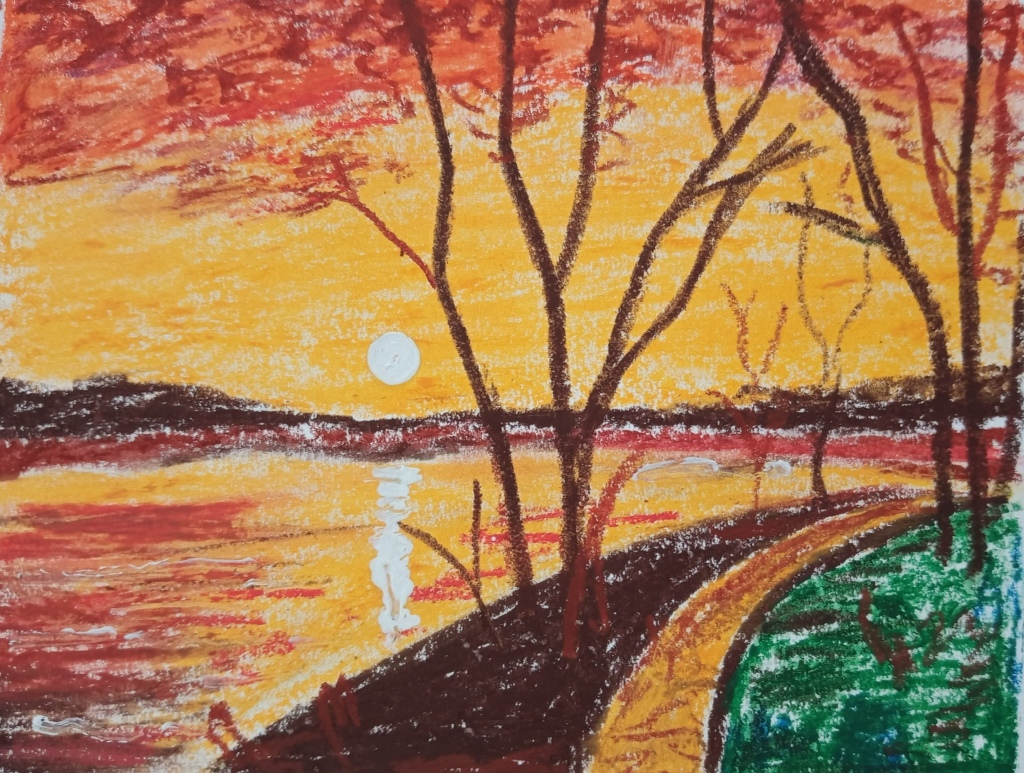
Art by Sohana Manzoor

Editorial

Seasons out of TimeClick here to read.

Conversation

A brief introduction to Suzanne Kamata’s Cinnamon Beach and a conversation with the author about her latest novel. Click here to read.

Translations

Tagore’s Achhe Dukhu, Achhe Mrityu, (Sorrow Exists, Death Exists) has been translated from Bengali by Fakrul Alam. Click here to read.

Nazrul’s Ghumaite Dao Shranto Robi Re (Let Robi Sleep in Peace) has been translated from Bengali by Professor Fakrul Alam. Click here to read.

Amalkanti by Nirendranath Chakraborty has been translated from Bengali by Debali Mookerjea-Leonard. Click here to read.

Speech Matters, a story by Naramsetti Umamaheswararao, has been translated from Telugu by Johnny Takkedasila. Click here to read.

Every Day by Hafeez Rauf has been translated from Balochi by Fazal Baloch. Click here to read.

The Long Journey by Ihlwha Choi has been translated from Korean by the poet himself. Click here to read.

Mrityu or Death by Tagore has been translated from Bengali by Mitali Chakravarty. Click here to read.

Poetry

Click on the names to read the poems

Jared Carter, Michael Burch, Kirpal Singh, Rakhi Dalal, Stuart MacFarlane, Averi Saha, John Grey, Surbhi Sharma, David Francis, Pramod Rastogi, David Mellor, Saranyan BV, Jim Bellamy, Tasneem Hossain, Thompson Emate, George Freek, Mitra Samal, Lizzie Packer, Shamik Banerjee, Ryan Quinn Flanagan, Rhys Hughes

Musings/ Slices from Life

Stop, Look, Think!

Farouk Gulsara muses with a slice irony at a traffic junction. Click here to read.

Norman Rockwell: Out of the Closet

Wayne F. Burke gives a vignette of the life of the legendary illustrator. Click here to read.

Unveiling the Magic of Mystical Mangroves

Sai Abhinay Penna travels to the second largest mangrove forest in the world. Click here to read.

Glimpses of an Indian Summer

Madhuri Bhattacharya nostalgically captures the nuances of a hot summer. Click here to read.

The Pearl of the Indian Ocean

Ravi Shankar travels to Colombo. Click here to read.

Essays

The Myriad Hues of Tagore by Aruna Chakravarti

Aruna Chakravarti writes on times and the various facets of Tagore. Click here to read.

Picked Clean

Snigdha Agrawal writes of the impact from the loss of green cover in Bangalore. Click here to read.

Fast Food for a Month

Keith Lyons gives an in memoriam about the late documentarian, Morgan Spurlock. Click here to read.

Stories

In the Shadows…

Paul Mirabile gives us a story steeped in art and mental health. Click here to read.

The Last Hyderabadi

Mohul Bhowmick talks of the passage of an era. Click here to read.

Alvin and the Curious Case of Spoilt Milk

Anagha Narasimha gives a light hearted piece about the impact of demonetisation. Click here to read.

Book Excerpts

An excerpt from The Poisoner of Bengal/The Prince and the Poisoner by Dan Morrison. Click here to read.

An excerpt from The Sunset Suite by Rhys Hughes. Click here to read.

Book Reviews

Somdatta Mandal reviews Knife:  Meditations After an Attempted Murder by Salman Rushdie. Click here to read.

Basudhara Roy reviews Wild Women: Seekers, Protagonists and Goddesses in Sacred Indian Poetry by Arundhathi Subramaniam. Click here to read.

Navleen Multani reviews Mapping the Mind, Minding the Map, edited by Basudhara Roy and Jaydeep Sarangi. Click here to read.

Bhaskar Parichha reviews Derek Waller’s The Pundits: British Exploration of Tibet and Central Asia. Click here to read.

.

Click here to access the Borderless anthology, Monalisa No Longer Smiles

Click here to access Monalisa No Longer Smiles on Amazon International

Categories
Poetry

Every Day

Poetry by Hafeez Rauf, translated by Fazal Baloch

Hafeez Rauf

Hafeez Rauf belongs to the generation of the poets who emerged on the literary landscape in the early 2000s. Homelessness, exile, uprootedness and related agony are the recurrent themes of his poetry.

How far will the last 
sigh of the smoke stretch,
Rising from the tires
Burning in the distance?

The road lies closed --
No longer offers a passage.
Women and children,
Youths and elders --
All surrounded by an
ever-rising wall of helplessness.

How far can their hands,
their voices reach?

Meanwhile,
A crumbling wall,
In the wall, a decayed door,
And the door gazes at the occasional passerby,
Stretching its sight as far as it can see.

It watches the deserted roads
With the frantic eyes of a man
Who, after losing something,
searches his pockets in despair.

Where will this caravan of smoke lead?
The door just gazes.
From Public Domain

Fazal Baloch is a Balochi writer and translator. He has translated many Balochi poems and short stories into English. His translations have been featured in Pakistani Literature published by Pakistan Academy of Letters and in the form of books and anthologies. Fazal Baloch has the translation rights.

PLEASE NOTE: ARTICLES CAN ONLY BE REPRODUCED IN OTHER SITES WITH DUE ACKNOWLEDGEMENT TO BORDERLESS JOURNAL

Click here to access the Borderless anthology, Monalisa No Longer Smiles

Click here to access Monalisa No Longer Smiles on Amazon International

Categories
Contents

Borderless, June 2024

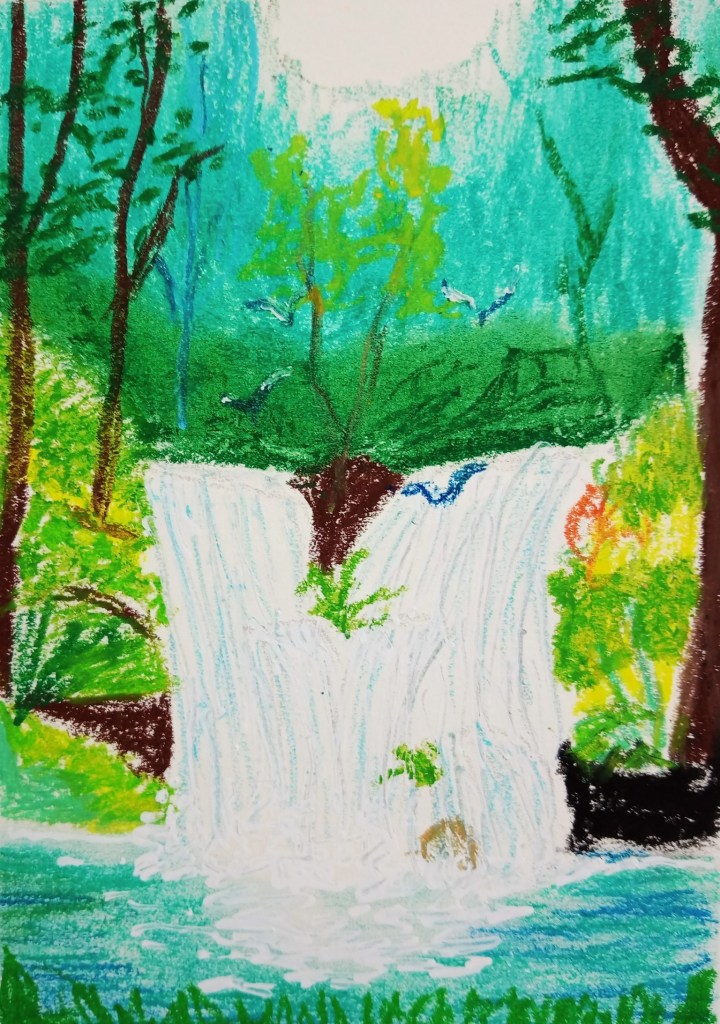
Art by Sohana Manzoor

Editorial

Fly High…Like Birds in the Sky… Click here to read.

Translations

Nazrul’s Nur Jahan, the Mughal empress, has been translated from Bengali to English by Professor Fakrul Alam. Click here to read.

Eight Short Poems by Munir Momin have been translated from Balochi by Fazal Baloch. Click here to read.

An Age-old Struggle by Ihlwha Choi has been translated from Korean by the poet himself. Click here to read.

Okale or Out of Sync by Tagore has been translated from Bengali by Mitali Chakravarty. Click here to read.

Poetry

Click on the names to read the poems

Michael Burch, Ryan Quinn Flanagan, Kumar Sawan, LaVern Spencer McCarthy, Shamik Banerjee, Prithvijeet Sinha, Gregg Norman, Rinku Dutta, Alex S. Johnson, Anushka Chaudhury, Wayne Russell, Nusrat Jahan Esa, Ahmad Rayees, Ivan Ling, Swetarani Tripathy, R.L.Peterson, Ayesha Binte Islam, Rhys Hughes

Musings/ Slices from Life

In the Grip of Violence

Ratnottama Sengupta muses on acts of terror and translates a Bengali poem by Tarik Sujat which had come as a reaction to an act of terror. Click here to read.

Meeting the Artists

Kiriti Sengupta talks of his encounter with Jatin Das, a legendary artist from Bengal. Click here to read.

A Musical Soiree

Snigdha Agrawal recalls how their family celebrated Tagore’s birth anniversary. Click here to read.

A Cover Letter

Uday Deshwal muses on writing a cover letter for employment. Click here to read.

Musings of a Copywriter

In Berth of a Politician, Devraj Singh Kalsi muses on an encounter with a politician. Click here to read.

Notes from Japan

In A Day with Dinosaurs, Suzanne Kamata visits the ancient dino bones found in Fukui Prefecture. Click here to read.

Essays

From Place to Place

Renee Melchert Thorpe recounts her mother’s migration story, hopping multiple countries, starting with colonial Calcutta and Darjeeling. Click here to read.

My Love Affair with (Printed) Books

Ravi Shankar writes of his passion for print media. Click here to read.

A Story Carved in Wood, Snow and Stone  

Urmi Chakravorty travels with her camera and narrative to a scenic village in the Indo China border. Click here to read.

Stories

Spunky Dory and the Wheel of Fortune

Ronald V. Micci takes the readers on a fantastical adventure. Click here to read.

Rani Pink

Swatee Miittal sheds light on societal attitudes. Click here to read.

The Ghosts of Hogshead

Paul Mirabile wanders into the realm of the supernatural dating back to the Potato Famine of Ireland in the 1800s. Click here to read.

Conversations

In conversation with eminent Singaporean poet and academic, Kirpal Singh, about how his family migrated to Malaya and subsequently Singapore more than 120 years ago. Click here to read.

In conversation with Jessica Muddit, author of Once Around the Sun: From Cambodia to Tibet, and a review of her book. Click here to read.

Book Excerpts

An excerpt from Suzanne Kamata’s Cinnamon Beach. Click here to read.

An excerpt from Ryan Quinn Flanagann’s These Many Cold Winters of the Heart. Click here to read.

Book Reviews

Somdatta Mandal reviews Maya Nagari: Bombay-Mumbai A City in Stories, edited by Shanta Gokhale and Jerry Pinto. Click here to read.

Basudhara Roy reviews Trailokyanath Mukhopadhyay’s Tales of Early Magic Realism in Bengali, translated by Sucheta Dasgupta. Click here to read.

Rakhi Dalal reviews Damodar Mauzo’s Boy, Unloved, translated from Konkani by Jerry Pinto. Click here to read.

Bhaskar Parichha reviews The Dilemma of an Indian Liberal by Gurcharan Das. Click here to read.

.

Click here to access the Borderless anthology, Monalisa No Longer Smiles

Click here to access Monalisa No Longer Smiles on Amazon International
Categories
Editorial

Fly High… Like Birds in the Sky…

He sees a barrier where soldiers stand
with rifles drawn, encroachers kept at bay.
A migrant child who holds his mother's hand


— LaVern Spencer McCarthy, Are We There Yet?

There was a time when humans walked the Earth crossing unnamed landmasses to find homes in newer terrains. They migrated without restrictions.  Over a period of time, kingdoms evolved, and travellers like Marco Polo talked of needing permissions to cross borders in certain parts of the world. The need for a permit to travel was first mentioned in the Bible, around 450BCE. A safe conduct permit appeared in England in 1414CE. Around the twentieth century, passports and visas came into full force. And yet, humanity had existed hundreds of thousand years ago… Some put the date at 300,000!

While climate contingencies, wars and violence are geared to add to migrants called ‘refugees’, there is always that bit of humanity which regards them as a burden. They forget that at some point, their ancestors too would have migrated from where they evolved. In South Africa, close to Johannesburg is Maropeng with its ‘Cradle of Humanity’, an intense network of caves where our ancestors paved the way to our evolution. The guide welcomes visitors by saying — “Welcome home!” It fills one’s heart to see the acceptance that drips through the whole experience.  Does this mean our ancestors all stepped out of Africa many eons ago and that we all belonged originally to the same land?

And yet there are many restrictions that have come upon us creating boxes which do not allow intermingling easily, even if we travel. Overriding these barriers is a discussion with Jessica Mudditt about Once Around the Sun: From Cambodia to Tibet, her book about her backpacking through Asia. Documenting a migration more than a hundred years ago from Jullundur to Malaya, when borders were different and more mobile, we have a conversation with eminent scholar and writer from Singapore, Kirpal Singh. Telling the story of another eminent migrant, a Persian who became a queen in the Mughal Court is a lyric by Nazrul, Nur Jahan, translated by Professor Fakrul Alam from Bangla. Ihlwha Choi has self-translated his own poem from Korean, a poem bridging divides with love. Fazal Baloch has brought to us some exquisite Balochi poems by Munir Momin. Tagore’s poem, Okale or Out of Sync, has been translated from Bengali to reflect the strange uniqueness of each human action which despite departing from the norm, continue to be part of the flow.

Among our untranslated poetry is housed LaVern Spencer McCarthy’s voice on the plight of migrants of the current times. Michael Burch gives us poems for Dylan Thomas. We have a plethora of issues covered in poetry ranging from love to women’s issues, even an affectionate description of his father by Shamik Banerjee. Ryan Quinn Flanagan, Kumar Sawan, Prithvijeet Sinha, Gregg Norman, Anushka Chaudhary, Wayne Russell, Ahmad Rayees, Ivan Ling, Ayesha Binte Islam and many more add verve with their varied themes. Rhys Hughes has shared a poem on a funny sign he photographed himself.

We have a tongue in cheek piece from Devraj Singh Kalsi on traveling in a train with a politician. Uday Deshwal writes with a soupçon of humour as he talks of applying for jobs. Snigdha Agrawal brings to us flavours of Bengal from her past while Ratnottama Sengupta muses on the ongoing wars and violence as acts of terror in the same region and looks back at such an incident in the past which resulted in a powerful Bengali poem by Tarik Sujat. Kiriti Sengupta has written of a well-known artist, Jatin Das, a strange encounter where the artist asks them to empty fully even a glass of water! Ravi Shankar weaves in his love for books into our non-fiction section. Recounting her mother’s migration story which leads us to perceive the whole world as home is a narrative by Renee Melchert Thorpe. Urmi Chakravorty takes us to the last Indian village on the borders of Tibet. Taking us to a Dinosaur Museum in Japan is our migrant columnist, Suzanne Kamata. Her latest multicultural novel, Cinnamon Beach, has found its way to our book excerpts as has Flanagan’s poetry collection, These Many Cold Winters of the Heart.

In reviews, Somdatta Mandal has written about an anthology, Maya Nagari: Bombay-Mumbai A City in Stories edited by Shanta Gokhale and Jerry Pinto. Rakhi Dalal has discussed a translation from Konkani by Jerry Pinto of award-winning writer Damodar Mauzo’s Boy, Unloved. Basudhara Roy has reviewed Trailokyanath Mukhopadhyay’s Tales of Early Magic Realism in Bengali, translated by Sucheta Dasgupta. Bhaskar Parichha has introduced us to The Dilemma of an Indian Liberal by Gurcharan Das, a book that is truly relevant in the current times in context of the whole world for what he states is a truth:In the current polarised climate, the liberal perspective is often marginalised or dismissed as being indecisive or weak.” And it is the truth for the whole world now.

Our short stories reflect the colours of the world. A fantasy set in America but crossing borders of time and place by Ronald V. Micci, a story critiquing social norms that hurt by Swatee Miittal and Paul Mirabile’s ghost story shuttling from the Irish potato famine (1845-52) to the present day – all address different themes across borders, reflecting the vibrancy of thoughts and cultures. That we all exist in the same place and have the commonality of ideas and felt emotions is reflected in each of these narratives.

We have more which adds to the lustre of the content. So, do pause by our content’s page and enjoy the reads!

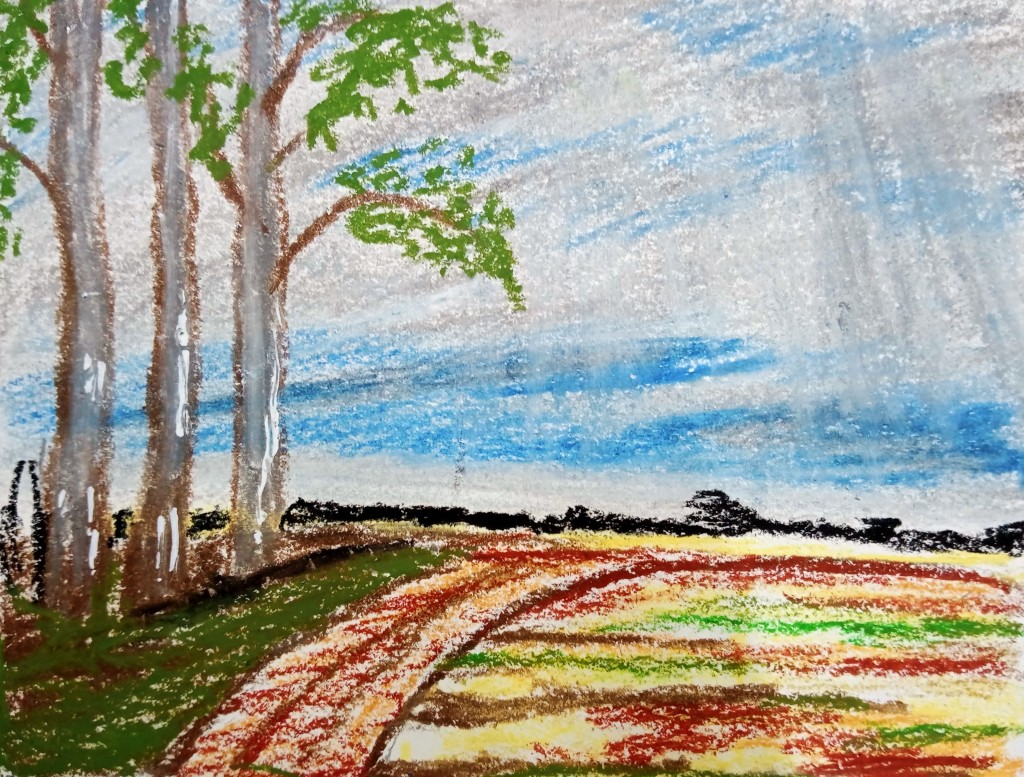
I would like to thank all our team without who this journal would be incomplete, especially, Sohana Manzoor, for her fabulous artwork. Huge thanks to all our contributors who bring vibrancy to our pages and our wonderful readers, without who the journal would remain just part of an electronic cloud… We welcome you all to enjoy our June issue.

Wish you happiness and good weather!

Thank you all.

Mitali Chakravarty

borderlessjournal.com

Click here to access the content’s page for the June 2024 Issue.

.

READ THE LATEST UPDATES ON THE FIRST BORDERLESS ANTHOLOGY, MONALISA NO LONGER SMILES, BY CLICKING ON THIS LINK.

Categories
Poetry

Eight Short Poems by Munir Momin

Translated from Balochi by Fazal Baloch

                   A POEM
Like a mat, we laid out the night,
And birds adorned the jungle around their feet,
Heart —- an ocean, and within the ocean,
Each tide wore shackles around their feet.


A POEM

Everyday,
Time slips through my hands,
Like millet grains.
Would that you were a bird,
You'd be my guest!

A SCENE

Crystalline shards
Of shattered smiles,
Once they pierce the eyes,
The world, like a teardrop,
Seeks an escape
Towards the lap.


A POEM

Just an evening,
From the seasons of your eyes,
Let my heart
Soar for a moment,
With the birds of silence.


STARS
If one night,
Suddenly,
Stars scatter across my eyes,
I’ll cast my eyes at your lap,
And spread the sky,
Upon the earth.


WAITING

With the same pace and rhythm,
They sail ahead --
Yet the moon reaches the shore,
Long before the boats.

MELODIES AT DAWN

“Is there someone, each night who comes,
Sprinkling on the city's somnolent birds,
The colourful melodies of her words?”

“What secrets do I hold? What sights I’ve seen?
In the ambiance, a beauty sifted through,
Casting a strange, enchanting sheen,
Painting hues on voices, wings and silence.”


WORLD

In a bottle,
Carved from your beauty
I’ve preserved for me
A lush green moment of spring --
A nest,
In the nest,
A sweet birdsong.
A window,
Every morning it opens
To a melodious overture of sea-waves
And a cold, bright moment of solitude --
Like a tear drop,
The size of a tiny pearl,
Sustaining you, me and my God.

Munir Momin is a contemporary Balochi poet widely cherished for his sublime art of poetry. Meticulously crafted images, linguistic finesse and profound aesthetic sense have earned him a distinguished place in Balochi literature. His poetry speaks through images, more than words. Momin’s poetry flows far beyond the reach of any ideology or socio-political movement. Nevertheless, he is not ignorant of the stark realities of life. The immenseness of his imagination and his mastery over the language rescues his poetry from becoming the part of any mundane narrative. So far Munir has published seven collections of his poetry and an anthology of short stories. His poetry has been translated into Urdu, English and Persian.  He also edits a literary journal called Gidár.

Fazal Baloch is a Balochi writer and translator. He has translated many Balochi poems and short stories into English. His translations have been featured in Pakistani Literature published by Pakistan Academy of Letters and in the form of books and anthologies.

.

PLEASE NOTE: ARTICLES CAN ONLY BE REPRODUCED IN OTHER SITES WITH DUE ACKNOWLEDGEMENT TO BORDERLESS JOURNAL

Click here to access the Borderless anthology, Monalisa No Longer Smiles

Click here to access Monalisa No Longer Smiles on Kindle Amazon International

Categories
Contents

Borderless, May 2024

Painting by Sohana Manzoor

Editorial

Though I Sang in my Chains like the Sea… Click here to read

Translations

Three poems by Nazrul have been translated by Niaz Zaman from Bengali. Click here to read.

Projapoti (Butterfly) by Nazrul has been translated by Fakrul Alam from Bengali. Click here to read.

Human by Manzur Bismil has been translated by Fazal Baloch from Balochi. Click here to read.

Now, What I Can Do by Ihlwha Choi has been translated from Korean by the poet himself. Click here to read.

Chhora or Rhymes by Tagore has been translated from Bengali by Mitali Chakravarty. Click here to read.

Poetry

Click on the names to read the poems

Michael Burch, Kirpal Singh, Ryan Quinn Flanagan, Shamik Banerjee, Stuart McFarlane, Mary Tina Shamli Pillay, George Freek, Radhika Soni, Craig Kirchner, Tapas Sarkar, Stephen Philip Druce, Anjali Chauhan, Michael Lee Johnson, Milan Mondal, Rhys Hughes

Poets, Poetry & Rhys Hughes

In Dylan on Worm’s Head, Rhys Hughes describes a misadventure that the Welsh poet had while hiking as a tribute to him on Dylan Thomas Day. Click here to read.

Musings/Slices from Life

Hooked for Life and Beyond…

Ravi Shankar looks at the computer revolution in a light vein. Click here to read.

Sundays are Only for Some…

Snigdha Agrawal introduces us to the perspectives of a child of parents who iron clothes for the middle class in India. Click here to read.

Eternalising the Beauty of Balochistan

Munaj Gul gives an in memoriam for a photographer from Balochistan. Click here to read.

Musings of a Copywriter

In Is this a Dagger I See…?, Devraj Singh Kalsi gives a tongue-in-cheek account of a writer’s dilemma. Click here to read.

Notes from Japan

In A Golden Memory of Green Day in Japan, Suzanne Kamata tells us of a festival where she planted a tree in the presence of the Japanese royalty. Click here to read.

Essays

When the Feminist and the Revolutionary Met

Niaz Zaman writes of the feminist leanings of Nazrul’s poetry in context of Madam Roquiah, a contemporary of the poet. Click here to read.

Metaphorical Maladies

Satyarth Pandita looks into literature around maladies. Click here to read.

The Storied Past of Khiva

Gita Viswanath takes us to the heritage city in Uzbekistan. Click here to read.

Akbar Barakzai: A Timeless Poet

Hazaran Rahim Dad explores the universal poetry of Akbar Barakzai. Click here to read.

Stories

Don Quixote’s Paradise

Farouk Gulsara takes us through a dystopian adventure. Click here to read.

The Buyback

Devraj Singh Kalsi gives a tale of reconnecting with the past. Click here to read.

Pier Paolo’s Idyll

Paul Mirabile traces a story of a young boy in the outskirts of Rome. Click here to read.

Conversations

Ratnottama Sengupta in conversation with Sohini Roychowdhury, who tries to bridge cultures with dance. Click here to read.

A brief overview of Rajat Chaudhuri’s Spellcasters and a discussion with the author on his book. Click here to read.

Book Excerpts

An excerpt from Selected Essays: Kazi Nazrul Islam, translated by Radha Chakravarty from Bengali. Click here to read.

An excerpt from Aruna Chakravarti’s Jorsanko. Click here to read.

Book Reviews

Somdatta Mandal reviews Radha Chakravarty’s translation of Selected Essays: Kazi Nazrul Islam. Click here to read.

Malashri Lal reviews Lakshmi Kannan’s Nadistuti: Poems. Click here to read.

Ajanta Paul reviews Bitan Chakraborty’s The Blight and Seven Short Stories. Click here to read.

Bhaskar Parichha reviews Will Cockrell’s Everest, Inc. The Renegades and Rogues who Built an Industry at the Top of the World. Click here to read.

.

Click here to access the Borderless anthology, Monalisa No Longer Smiles

Click here to access Monalisa No Longer Smiles on Amazon International

Categories
Editorial

Though I Sang in my Chains like the Sea…

      Time held me green and dying
Though I sang in my chains like the sea.

Fern Hill by Dylan Thomas (1914-1953)

Perhaps when Dylan Thomas wrote these lines, he did not know how relevant they would sound in context of the world as it is with so many young dying in wars, more than seven decades after he passed on. No poet does. Neither did he. As the world observes Dylan Thomas Day today — the day his play, Under the Milkwood, was read on stage in New York a few months before he died in 1953 — we have a part humorous poem as tribute to the poet and his play by Stuart McFarlane and a tribute from our own Welsh poet, Rhys Hughes, describing a fey incident around Thomas in prose leading up to a poem.

May seems to be a month when we celebrate birthdays of many writers, Tagore, Nazrul and Ruskin Bond. Tagore’s birthday was in the early part of May in 1861 and we celebrated with a special edition on him. Bond, who turns a grand ninety this year, continues to dazzle his readers with fantastic writings from the hills, narratives which reflect the joie de vivre of existence, of compassion and of love for humanity and most importantly his own world view. His books have the rare quality of being infused with an incredible sense of humour and his unique ability to make fun of himself and laugh with all of us. 

Nazrul, on the other hand, dreamt, hoped and wrote for an ideal world in the last century. The commonality among all these writers, seemingly so diverse in their outlooks and styles, is the affection they express for humanity. Celebrating the writings of Nazrul, we have one of his fiery speeches translated from Bengali by Radha Chakravarty and a review of her Selected Essays: Kazi Nazrul Islam by Somdatta Mandal. An essay from Niaz Zaman dwells on the feminist side of Nazrul while bringing in Begum Roquiah. Zaman has also shared translations of his poetry. Professor Fakrul Alam, who had earlier translated Nazrul’s iconic ‘Bidrohi or Rebel‘, has given us a beautiful rendition of his song ‘Projapoti or Butterfly’ in English.  Also in translation, is a poem by Tagore on the process of writing poetry. Balochi poetry by Manzur Bismil on human nature has been rendered into English by Fazal Baloch and yet another poem from Korean to English by Ilwha Choi.

Reflecting on the concept of a paradise is poetry from Michael Burch. Issues like climate, women, humanity, mourning, aging and more have been addressed in poetry by Shamik Banerjee, Ryan Quinn Flanagan, Milan Mondal, Kirpal Singh, Craig Kirchner, George Freek, Michael Lee Johnson and many more. Hughes brings in a dollop of humour with his response to a signpost in verse. Irony is woven into our non-fiction section by Devraj Singh Kalsi’s musing on writers and assailants. Ravi Shankar explores his passion for computers in a light vein. Snigdha Agrawal gives us a poignant story about a young child from the less privileged classes in India. Suzanne Kamata writes to tell us about the environment friendly Green Day in Japan.

Ratnottama Sengupta this month converses with a dancer who tries to build bridges with the tinkling of her bells, Sohini Roychowdhury. Gita Viswanthan travels to Khiva in Uzbekistan, historically located on the Silk Route, with words and camera.  An essay on Akbar Barakzai by Hazran Rahim Dad and another looking into literature around maladies by Satyarth Pandita add zest to our non-fiction section. Though these seem to be a heterogeneous collection of themes, they are all tied together with the underlying idea of creating links to build towards a better future.

Our stories travel from Malaysia to France and India. Farouk Gulsara sets his in futuristic Malaysia, again exploring the theme of utopia as did his earlier musing. Paul Mirabile creates a story where a child tries to create his own idyllic paradise while Kalsi writes of fiction centring around a property tussle. The book reviews feature a couple of non-fiction. Other than Kazi Nazrul Islam’s essays, Bhaskar Parichha reviews Will Cockrell’s Everest, Inc. The Renegades and Rogues Who Built an Industry at the Top of the World. Ajanta Paul discusses Bitan Chakraborty’s The Blight and Seven Short Stories, translated from Bengali by Malati Mukherjee. Malashri Lal has written on Lakshmi Kannan’s Nadistuti: Poems, poems dedicated to Jayanta Mahapatra who the poet reflects lives on with his verses. And that is so true, considering this issue is full of poets who continue in our lives eternally because of their words. That is why perhaps, we recreate their lives as has Aruna Chakravarti in Jorasanko.

In focus this time is a writer whose prose is almost akin to poetry, Rajat Chaudhuri. A proponent of solarpunk, his novel, Spellcasters, takes us to fictitious cities modelled on Delhi and Kolkata. In his interview, Chaudhuri tells us: “The path to utopia is not necessarily through dystopia. We can start hoping and acting today before things get really bad. Which is the locus of the whole solarpunk movement with which I am closely associated as an editor and creator…”

On that note, I would like to end with a couple of lines from Nazrul, who reiterates how the old gives way to new in Proloyullash (The Frenzy of Destruction, translated by Alam): “Why fear destruction? / It’s the gateway to creation!” Will destruction be the turning point for creation of a new world? And should the destruction be of human constructs that hurt humanity (like wars and weapons) or of humanity and the planet Earth? As the solarpunk movement emphasises, we need to act to move towards a better world. And how would one act? Perhaps, by getting in touch with the best in themselves and using it to act for the betterment of humankind? These are all points to ponder… if you have any ideas that need a forum on such themes, do share with us.

We have more content which has not been woven into this piece for the sheer variety of themes they encompass. Do pause by our content’s page and browse on all our pieces.

With warm thanks to our wonderful team at Borderless — especially Sohana Manzoor for her fabulous art — I would like to express gratitude to all our contributors, without who we could not create this journal. We would also like to thank our readers for making it worth our while to write — for all of our words look to be read, savoured and mulled, and maybe, some will evolve into treasured wines.

Thank you all.

Mitali Chakravarty

borderlessjournal.com

Click here to access the content’s page for the May, 2024 Issue

.

READ THE LATEST UPDATES ON THE FIRST BORDERLESS ANTHOLOGY, MONALISA NO LONGER SMILES, BY CLICKING ON THIS LINK.

Categories
Essay

Akbar Barakzai: A Timeless Poet

By Hazaran Rahim Dad

Akbar Barakzai (1939-2022) was born in Shikarpur Sindh, Pakistan. He received his early Education from Karachi and later he graduated from University of Karachi. Barakzai  is considered as one of the most defiant progressive voices in modern Balochi literature. His poetry reflects the objective realities of life and ambitions of his people. Boundless love for masses, profound desire for peace and prosperity, and unwavering resolve to resist and defy the tyranny are some of the commonplace themes of his poetry.

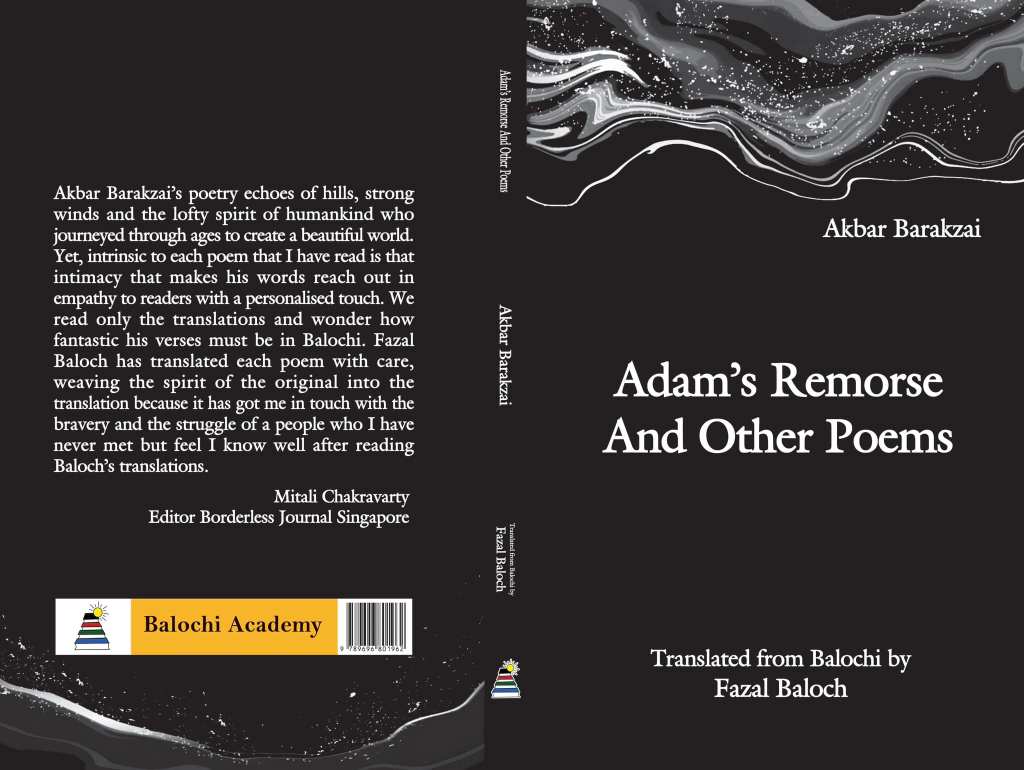
 “Akbar Barakzai belongs to the generation of the poets that witnessed the political and literary activism of Muhammad Hussain Unqa, Sher Mohammad Mari, Mir Gul Khan Naseer and Azat Jamaldini”, writes Fazal Baloch, a renowned translator who most recently brought out the anthology of Barakzai’s translated poems under the title Adam’s Remorse and Other Poems, published by Balochi Academy Quetta in 2023.

In his literary career, which spans over a half century, Barakzai has managed to bring out only two of his anthologies. Some selected poems by Barakzai have been translated from Balochi to English by Fazal Baloch, a college professor in Turbat, and a prominent literary translator.

Akbar Barakzai was an honest and dedicated political and social activist whose aim was progress of Baloch people. He as poet could not only express the human sentiments but could also express their aspirations for their life of Freedom and Dignity. “He served … his people admirably and deserves our respect and love,” says Meer Mohammad Ali Talpur, a Baloch intellectual.

Barakzai’s poems are rich in linguistic and literary expressions. His language is both simple and philosophical. In his poetry, he celebrates resistance, challenges oppression, and expresses a belief in a better future without losing hope. He emphasises resilience to overcome suffering. He writes:

I am the tree of immortality,
O, you tyrant brute!
The more you hew me down,
the more I sprout

The imagery of the tree symbolises the strength and the life cycle of a tree which remains steadfast midst harsh weathers.

In another poem, titled ‘Not Forever’, Barakzai continues to convey themes of resistance and defiance. As he says:

The rule of chains and fetters
Will last only for today, not forever.
The age of tyranny and oppression
Will last only for today, not forever.

He inscribes that the current state of being oppressed or controlled (“rule of chains and fetters,” “tyranny and oppression”) is temporary. Barakzai implies hope for a future where such oppression will end, indicating a belief in the eventual triumph of freedom and justice.

Barakzai sought to reshape the prevailing socio-political views and wrote for freedom and liberty, peace and prosperity and dignity of mankind. His love for human dignity transcends all geographical and cultural frontiers and becomes universal, added Fazal Baloch.

Indeed, Barakzai’s poetry transcends borders and speaks to universal themes. In his poem ‘Who Can Snuff Out the Sun?’ written in response to Che Guevara’s execution, he celebrates Che Guevara’s heroism and the universal struggle for justice and freedom. By acknowledging Che Guevara’s courage and sacrifice, Barakzai connects with a broader global struggle for human rights and liberation.

"Who can snuff out the sun? 
Who can suppress the light?"

And in the last lines of the poem, he notes,

I'm Ernesto Che Guevara
I'm Immortal
Everywhere in the world

“This is not only Barakzai’s most quoted poem, but it is also one of the most remarkable Balochi poems touching the theme of resistance and defiance,” contends Fazal Baloch.

Similarly, in his another poem like ‘I’m Viet Cong’, he expresses solidarity with the people of Vietnam, few lines are written as such:

I'm the spirit of freedom and liberty 
Who can enslave me?
Who can kill me?
After all
I'm Viet Cong I'm Viet Cong.

He might have shown solidarity with Afghanistan in his poem ‘April 1978’. His lines read:

Let's sing for the Saur
Let’s extol the groom
A garden in our heart has bloomed
Doves chant and herald the news
Revolution has arrived
Arrived what we desired

One of the ways in which Barakzai weaves the West and the East into his poetry. He has a poem called ‘Waiting for Godot’. Samuel Beckett’s Godot is emblematic of an ideal that we keep waiting for. Barakzai has captured the essence of the whole play in his poem with his refrain —

Arise! O friends from this deep slumber 
Godot will not, will never show up

In one of his most powerful poems, ‘Word’, Barakzai conveys the power of speaking up for one’s rights and the importance of not remaining silent in the face of oppression. He believes that by voicing one’s grievances and advocating for justice, freedom, and salvation can be achieved, ultimately leading to the end of oppression as these lines indicate:

Don’t ever bury the word
In the depth of your chest
Rather express the word
Yes, speak it out.
The word brings forth
Freedom and providence
Of course, freedom and providence.

In ‘How Long’, Barakzai starts by portraying a bleak situation where life is filled with distress and young people are dying tragically. He inscribes,

For how long
Life will remain in utter distress
Handsome youths keep falling to bullets
And mirror like hearts
Continue to shatter into shards?

Then, he shifts the tone to one of hope and optimism, and writes,

Light-- the very essence of freedom 
Will not forever remain in prison
Life will not suffer distress
The serpent of tyranny
Will vanish evermore
The sapling of envy and hatred
Will wither away.

He suggests that despite the current darkness, better days are ahead. He expresses confidence that “light”, symbolic of freedom, will not remain imprisoned forever. He predicts an end to the suffering and the disappearance of tyranny. The imagery of the “serpent of tyranny” vanishing and the “sapling of envy and hatred” withering away conveys the idea of a brighter future where oppression and negativity are eradicated.

Barakzai’s poetry is a ray of hope in the midst of suffering from atrocities and hatred and envy. His poetry reflects his love for humanity resonating with the voices of the oppressed and for them.

Hazaran Rahim Dad is a poet and writer. She writes on sociopolitical issues focusing on the right of fishermen. Currently she is pursuing her MPhil degree in English literature from Karachi.

PLEASE NOTE: ARTICLES CAN ONLY BE REPRODUCED IN OTHER SITES WITH DUE ACKNOWLEDGEMENT TO BORDERLESS JOURNAL

Click here to access the Borderless anthology, Monalisa No Longer Smiles

Click here to access Monalisa No Longer Smiles on Kindle Amazon International

Categories
Poetry

Human by Manzur Bismil

Translated from Balochi by Fazal Baloch

In the city,
Those who know me,
Look at me through two different perspectives:

"You're peerless,
So pure,
We need souls like yours
To grace our world,
May your shadow endure forever."

"If more souls like yours,
Doomed and dark,
Taint our land,
Our trees will wither,
You're a stain, a blight
On the fabric of our world,
May you end up in shadows unseen."

Yet as I weigh my deeds
And ponder deeply,
A voice echoes deep within me,
Unfurling the truth:
“I am a human,
A fragment of my heart is housed by God
And the devil seeks to take over the rest.”

In this city,
Those who know me
Look at me through two different perspectives.
For if I am truly a human,
How can I be stripped of my share
From either?

Manzur Bismil is a prominent Balochi poet. He emerged on the literary scene in the early 1990s and soon rose to fame, creating a niche for himself in the pantheon of the Balochi poets. He is widely known for his neo-classic style, especially in his verses. So far he has published eight anthologies of his poetry. This poem is taken from the second edition of “Hoshken Kaaneeg” published in 2017.

Fazal Baloch is a Balochi writer and translator. He has translated many Balochi poems and short stories into English. His translations have been featured in Pakistani Literature published by Pakistan Academy of Letters and in the form of books and anthologies. Fazal Baloch has the translation rights of of this poem from the poet. 

PLEASE NOTE: ARTICLES CAN ONLY BE REPRODUCED IN OTHER SITES WITH DUE ACKNOWLEDGEMENT TO BORDERLESS JOURNAL

Click here to access the Borderless anthology, Monalisa No Longer Smiles

Click here to access Monalisa No Longer Smiles on Amazon International

Categories
Contents

Borderless April, 2024

Art by Sohana Manzoor

Editorial

April Showers… Click here to read.

Translations

Baraf Pora (Snowfall) by Rabindranath Tagore, gives a glimpse of his first experience of snowfall in Brighton and published in the Tagore family journal, Balak (Children), has been translated from Bengali by Somdatta Mandal. Click here to read.

Himalaya Jatra ( A trip to Himalayas) by Tagore, has been translated from his Jibon Smriti (1911, Reminiscenses) by Somdatta Mandal from Bengali. Click here to read.

Bhumika (Introduction) by Tagore has been translated from Bengali by Ratnottama Sengupta. Click here to read.

The Fire-grinding Quern by Manzur Bismil has been translated from Balochi by Fazal Baloch. Click here to read.

The Tobacco Lover by Ihlwha Choi has been translated from Korean by the poet himself. Click here to read.

Pochishe Boisakh (25th of Baisakh) by Tagore(1922), has been translated from Bengali by Mitali Chakravarty. Click here to read.

Pandies Corner

Songs of Freedom: Dear Me… is an autobiographical narrative by Ilma Khan, translated from Hindustani by Janees. These narrations highlight the ongoing struggle against debilitating rigid boundaries drawn by societal norms, with the support from organisations like Shaktishalini and pandies’. Click here to read.

Poetry

Click on the names to read the poems

Michael Burch, Kirpal Singh, Scott Thomas Outlar, Nusrat Jahan Esa, George Freek, Snigdha Agrawal, Phil Wood, Pramod Rastogi, Stuart McFarlane, Ahmad Al-Khatat, Shamik Banerjee, Ryan Quinn Flanagan, Lisa Sultani, Jenny Middleton, Kumar Bhatt, Rhys Hughes

Poets, Poetry & Rhys Hughes

In The Desk, Rhys Hughes writes of his writerly needs with a speck of humour. Click here to read.

Musings/Slices from Life

Heatwave & Tagore

Ratnottama Sengupta relates songs of Tagore to the recent heatwave scorching Kolkata. Click here to read.

The Older I get, the More Youthful Feels Tagore

Asad Latif gives a paean in prose to the evergreen lyrics of Tagore. Click here to read.

No Film? No Problem

Ravi Shankar takes us through a journey of cameras and photography, starting with black and white films. Click here to read.

Musings of a Copywriter

In Witches and Crafts: A Spook’s Tale, Devraj Singh Kalsi finds a ghostly witch in his library. Click here to read.

Notes from Japan

In Of Peace and Cheese, Suzanne Kamata gives us a tongue in cheek glimpse of photo-modelling mores. Click here to read.

Essays

Discovering Rabindranath and My Own Self

Professor Fakrul Alam muses on the impact of Tagore in his life. Click here to read.

The Lyric Temper

Jared Carter explores the creative soul of poets through varied times and cultures. Click here to read.

Bengaliness and Recent Trends in Indian English Poetry: Some Random Thoughts

Somdatta Mandal browses over multiple Bengali poets who write in English. Click here to read.

Stories

Hope is the Waking Dream of a Man

Shevlin Sebastian gives a vignette of life of an artist in Mumbai. Click here to read.

Viceregal Lodge

Lakshmi Kannan explores patriarchal mindsets. Click here to read.

The Thirteen-Year Old Pyromaniac

Paul Mirabile gives a gripping tale about a young pyromaniac. Click here to read.

Conversation

Ratnottama Sengupta in conversation about Kitareba, a contemporary dance performance on immigrants, with Sudarshan Chakravorty, a choreographer, and founder of the Sapphire Dance Company. Click here to read.

Book Excerpts

An excerpt from Jessica Mudditt’s Once Around the Sun – From Cambodia to Tibet. Click here to read.

An excerpt from Bhaskar Parichha’s Biju Patnaik: The Rainmaker of Opposition Politics. Click here to read.

Book Reviews

Meenakshi Malhotra reviews Mahasweta Devi: Writer, Activist, Visionary, edited by Radha Chakravarty. Click here to read.

Basudhara Roy reviews Out of Sri Lanka: Tamil, Sinhala and English Poetry from Sri Lanka and its Diasporas, edited by Vidyan Ravinthiran, Seni Seneviratne, Shash Trevett. Click here to read.

Swagata Chatterjee reviews Sanjukta Dasgupta’s Ekalavya Speaks. Click here to read.

Bhaskar Parichha reviews Bhang Journeys: Stories, Histories, Trips and Travels by Akshaya Bahibala. Click here to read.

.

Click here to access the Borderless anthology, Monalisa No Longer Smiles

Click here to access Monalisa No Longer Smiles on Amazon International