Categories
Essay

To Be or Not to Be or the Benefits of Borders

By Wendy Jones Nakanishi

Art by Sohana Manzoor

It may seem perverse to submit an article advocating the benefits of borders to a journal entitled Borderless. I hasten to explain that I agree with the guiding principle of this publication – that the human spirit should be encouraged to soar, transcending cultural limitations and national boundaries. But I’m also reminded of the observation made by the American poet Robert Frost that high fences make good neighbours.

Borders! It’s one of those words that has developed an almost completely negative connotation in recent years, having taken on the emotive sense of exclusion and unfairness. A second example of this phenomenon is the term patriotism, which now is denigrated for similar reasons. Borders and patriotism refer to values and beliefs valorized in the past that are currently under vigorous attack. Their stock has plunged dramatically in this modern globalised society.

It’s no wonder. We inhabit the age of EDI – equality, diversity, and inclusion. Few voices are raised to question its tenets. Most people seem, for example, unreservedly to believe in multiculturalism as an undisputed good, and love of one’s own country has become a questionable – often dismissed as a deplorable – sentiment.

The present disdain for borders and patriotism is unsurprising. We are witnessing the mass migration of people from one part of the world to others on a scale unseen since the post-1945 refugee crisis, when an estimated 175 million people were on the move, in part because of the defeat of the Axis powers but also because of new civil wars. Nowadays, the US, the UK and Europe are proving particularly attractive destinations for individuals fleeing countries troubled by violence, corruption, poverty, religious persecution, and social discrimination. I would like here to explain why I believe in the benefits of borders while acknowledging their potential demerits.

I think the propensity to erect borders is an essentially human trait, coexistent with human existence. The world’s first walls originated with its first cities – places like Jericho in the Bible, constructed twelve thousand years ago – where Joshua waged his famous battle to bring them down. The ancient cities had walls for defensive purposes. Walls intended to divide countries came much later, with the first instance originating in Mesopotamia in 2000 BC.

David Frye observes in his book Walls: A History of Civilization in Blood and Brick that the idea of constructing barriers to keep people out is as ancient as human civilisation. It is only the people excluded that has changed. In the past, it was invading hordes of armed warriors. Now barriers are erected to control immigration, to keep out terrorists, and to halt the flow of illegal drugs.

In Frye’s opinion, borders originated as a means of creating a safe space where civilization could develop and flourish. Walls gave people the security to sit and think.  Frye links the building of the Great Wall of China in the late third century B.C. with the creation of the ancient Chinese state. In Britain, Hadrian’s Wall was constructed around 112 A.D. by the Romans to keep out the ‘barbaric’ tribes in the north while they ‘civilized’ the inhabitants further south.

Borders seem to be coming back into vogue. Donald Trump’s vow to expand and reinforce the Mexico-United States barrier was a crucial component of his successful 2016 presidential campaign platform. But in January 2021, the newly elected president Joe Biden halted construction of what had become known as ‘Trump’s Wall’. Since that date, the southern border of the States has been swamped with illegal migrants, and in July 2022 Biden backtracked, announcing a plan to fill in four gaps in the barrier in Arizona that had seen some of the busiest illegal crossings. Some might argue it’s too little too late. In July 2022, there were reports of four thousand Mexican family encounters at the border; a year later, that number had quadrupled. And that’s only Mexican immigrants. Economic and political turmoil in such countries as Venezuela, Haiti, Ecuador, and Columbia has seen large numbers of people trying to escape to the States: their near neighbor where they seek not only safety but a place where they can aspire and thrive.  

Similarly, the EU is in the process of having to reconsider what it once identified as one of its guiding principles: the unrestricted movement of people (in particular, workers) within its twenty-eight EU member states. Countries such as Austria and Denmark have significant percentages of their populations who are opposed to this policy. It has been argued that citizens in richer member states are more likely to have negative views. Until the 2000s, only one percent of EU citizens lived in a country other than the country of their birth. That situation has changed dramatically in recent years with the EU’s enlargement to central and eastern Europe. Now intra-EU migration involves millions of EU nationals who are, in general, their countries’ best and brightest – their most highly educated or highly skilled workers – moving from poorer to richer EU member states. What some EU nationals see as an opportunity, others regard as a threat.

Borders not only keep people out but also keep people in. That is one of their least attractive features. The barbed wire that was the first manifestation of the structure that came to be known as the Berlin Wall appeared almost overnight in August 1961. But this wall had an unusual purpose. It was erected to prevent immigration from East Germany to West Germany when the economy of the former was on the verge of collapse because of the many people fleeing to the west. The Berlin Wall staunched that flow of emigration, leading President Kennedy to observe that ‘A wall is a hell of a lot better than a war’.

Arguably the Korean Demilitarized Zone constructed after 1953, which is 250 kilometers long and five kilometers wide, separating the north and south of what was once a single country, has similarly acted as a deterrent to armed conflict. It has been described as a ‘comfortable wall’ that ensures an ‘uncomfortable peace’. For the North Korean government, it acts as a barrier to invasion from the far more prosperous and less repressive government of South Korea. But it has also trapped millions of people in a state that increasingly resembles a huge prison camp. North Koreans are among the poorest people in the world as well as the least economically free. It is estimated that a tenth of the population died during a famine that lasted from 1995 to 1998. While a thousand escape the country every year, many are imprisoned, tortured, and even killed while making the attempt. But they are willing to brave the danger, reluctant to remain in a country where they are systematically denied any civil, religious, or political rights.

Borders are not limited to the demarcation of cities and countries. Physical structures indicating property limits are a fact of everyday life for people throughout the world. In my native America, fences are a prominent feature, indicating boundaries for houses and fields. In Japan, where I lived for many years, the traditional family compound – including farmhouse and storehouse and courtyard – is enclosed within clay walls. In the corner of northwest England where I am currently residing, the countryside of rolling green hills is crisscrossed by dry stone walls and hedges. Hedges in Britain have their origins in the Bronze Age (2500-700 BC), when they were used to manage cattle and to keep them separate from crops. There is speculation that some hedges of sufficient age, density and size may even have once served as military defenses. But while their first function was to act as barriers, they now serve an important role in the environment, as the preserve of insects and wildlife, including sixty species of nesting birds.

A house itself represents a kind of delimitation: a declaration of private space as opposed even to the yard or garden, which are semi-public. Americans tend to be house-proud, their dwellings often boasting large picture windows that afford a view to passers-by of the carefully decorated front room. Japanese, on the other hand, are sometimes ashamed of inhabiting a cramped small house sometimes separated only by a matter of inches from their neighbours’ homes on either side, and they tend to use opaque rather than clear windows to preserve their privacy. Even the big traditional Japanese farmhouse is somehow secretive – bearded in heavy shrubbery, stooping under the weight of a heavy tiled roof. Of course, there are many types of houses in Britain, but I happen to live in one of the most common – a terraced house with a tiny garden out front and a cement yard at the back. My bay window looking out onto the street has its lower half shrouded in a thin net curtain. When I stand nearby, I can look out at my domain – my little plot of earth densely planted with bushes, flowers, and shrubs.

Living in the UK, I’m often reminded of the saying ‘An Englishman’s house is his castle’. The typical British home has an emphasis on the cozy and comfortable, and while few still have coal fires, many retain the old fireplaces as a decorative feature. Alas, nowadays, many British people pave over their little front gardens to use the space for parking. But traveling by train affords wonderful views of long strips of narrow gardens backing on to the tracks, and I sometimes think their owners are like public benefactors, entertaining us with the sight of their patios and pergolas, their beds of flowers and rose trellises as we speed to our destinations.

The observant reader may have noticed that I have begun this short essay on borders by examining those surrounding countries and cities, and then continuing with an ever-narrowing perspective. I would like to conclude by looking at the barriers we put up between ourselves and others.

As I noted at the beginning of this piece, the American poet Robert Frost wrote a poem eulogising high fences for ensuring good relations with our neighbors. Because the States is a relatively new country – and one of considerable size – many Americans can enjoy the luxury of living in houses surrounded by a good deal of land. Driving through any suburb you can see large expanses of grassy lawn separating the house, often a ranch-style dwelling, from the road. In that sense, Frost’s high fences aren’t needed. Unlike the Japanese, crammed into close quarters with each other, or Europeans, fond of renting flats, Americans are used to having their own space. The pioneer spirit lingers on with a focus on rugged individualism.

This can be a curse as well as a blessing. There have been shocking instances in recent years of abducted American women and children spending years as captives in houses so remote or so barricaded against the outside world that their kidnappers could act with near impunity.

Such a situation is unimaginable in Japan. Many Japanese, and especially those in Japan’s cities, live in what they call ‘mansions’ – huge buildings with apartments the inhabitants own rather than rent. Few secrets can be kept in such an environment. In towns and rural areas, the strong emphasis on community activities means that there is constant interaction between households.

While many Americans like to preserve a physical distance from others, the Japanese have developed ways to preserve their privacy in public places as a sort of psychic skill. During my long residence in Japan, I often marveled at how the Japanese can make a virtue of necessity, and this is a case in point. On packed trains, the Japanese self-isolate by reading or dozing or using their phones. In dense crowds in cities, they manage to retain personal space by skillfully skirting each other, scarcely touching, as they walk. Whenever I find myself in one of the huge subway stations in Tokyo or Osaka, I occasionally pause to marvel at what looks like a carefully choreographed dance. Throngs of well-dressed people silently rush past me. They are dignified, intent on their own business, and no confusion or chaos is perceptible. Despite the closest proximity imaginable to each other, they somehow manage to preserve their own personal borders.  

The situation in the UK is between those two extremes. Despite inhabiting one of the most densely populated countries in Europe, the British can enjoy incomparable scenery preserved as so-called ‘green belt’ areas around cities as well as landscapes protected by their designation as national parks or as areas of outstanding natural beauty. Unsurprisingly, the British are great walkers. As an American, I’ve had to learn that when a friend suggests a stroll, it can easily mean a four or five-mile hike. The British can escape to the great outdoors when they feel a need to be alone.

There are those who dismiss national stereotypes as nonsense, but I’m inclined to credit them with at least a grain of truth. I think, for example, there are affinities between the Japanese and the British that are perhaps attributable to their both inhabiting island nations and being, as a result, insular. They are bad at learning other languages. They are traditionally characterised by a certain reserve – lacking, for example, the American fondness for confessing details of their private lives to complete strangers.

Borders. Patriotism. The two are connected. It is often said that those who do not learn from the mistakes of the past are doomed to repeat them. The lesson we might be tempted to draw from the bloody history of the twentieth century is that nationalism is reprehensible and that borders can lead to wars.

But I prefer to draw another moral. It can be argued that the world was plunged into two world wars because evil, opportunistic leaders like Hitler chose not to respect national borders while also twisting patriotism felt by Germans and Austrians into a perverted version of what is a normal human impulse to love one’s own country. As I write this piece, I can’t help but think of how topical it is, with the tragedy unfolding in the Middle East which concerns borders and contested land. I pray a just settlement can be reached and peace achieved as soon as possible.    

Finally, I believe we all resort to a variety of measures to define ourselves. We are individuals; we are residents of a certain neighborhood; we are citizens of a particular country. I believe that it is by respecting each other’s borders – personal and public – that we can achieve the ideal of living together on this crowded globe in harmony. Public borders – such as the political boundaries of our own country – can inspire altruism by leading us to identify with an entity greater than ourselves. Private borders – those parameters for conduct and behavior we draw for ourselves, in our daily lives – can confer peace and a sense of individual self.

Wendy Jones Nakanishi has published widely on English and Japanese literature and, under her pen name of Lea O’Harra, has written four crime fiction novels available on Amazon.

PLEASE NOTE: ARTICLES CAN ONLY BE REPRODUCED IN OTHER SITES WITH DUE ACKNOWLEDGEMENT TO BORDERLESS JOURNAL

Click here to access the Borderless anthology, Monalisa No Longer Smiles

Click here to access Monalisa No Longer Smiles on Amazon International

Categories
Poetry

Poetry by John Grey

Groundhog. Groundhog Day is celebrated on February 2nd. If the groundhogs leave the den where they hibernated, the weather is supposed to move towards spring. This observance has its roots in ancient Celtic culture.
GROUNDHOG DAY

It’s Groundhog Day.
The groundhog is somewhere
burrowed deep in the ground.
Either the groundhog 
doesn’t know what day it is
or he doesn’t care.
But, then again, 
Christ doesn’t show up
on Christmas either.
Just your father
and his new wife
with some toys.
It’s the one time of the year,
you see his shadow.


TWILIGHT

day flies off
like cardinals
and gold-finches

night
settles
on the branches
like crows

mice
scamper nervously
across the forest floor

all the birds
are owls


WORKING MY WAY THROUGH THE DICTIONARY, 
	I AM NOW AT Q

Some words 
have tens, 
if not hundreds, 
of synonyms.
Others,
hardly any at all.
That is why I’ve never 
written a poem about a quark.
That word, 
for want of an alternative,
would appear on every second line.
Even this poem 
has to repeat the word quark
just to get its point across.
So let this be my quark poem
and leave it at that.

John Grey is an Australian poet, US resident, recently published in New World Writing, Santa Fe Literary Review, and Lost Pilots. His latest books, Between Two Fires, Covert and Memory Outside The Head are available through Amazon. He has upcoming poetry in the Seventh Quarry, La Presa and California Quarterly.

.

.

PLEASE NOTE: ARTICLES CAN ONLY BE REPRODUCED IN OTHER SITES WITH DUE ACKNOWLEDGEMENT TO BORDERLESS JOURNAL

Click here to access the Borderless anthology, Monalisa No Longer Smiles

Click here to access Monalisa No Longer Smiles on Amazon International

Categories
Poetry

Tosses of Imagination

Poetry by John Grey

Madonna And Child by Raphael (1483-1520)
CONTRAST

Three in the morning,
and I’m wide awake,
in a room silent
everywhere but in my head.

My thoughts won’t lie down.
My imagination tosses and turns.

Beside me,
my wife is so deep in sleep,
the contrast between us
never more stark.

So it’s not just 
her rom-com movies
versus my horror flicks.

Our nights
could never be more different.

So her “meet cute” 
wakes up refreshed.
My “demon encounter”
still has hell to pay.


VACATION TIME

I wish you wouldn’t stroll
around this particular lake
while I am seated on the porch
of this cabin in New Hampshire
sipping my morning coffee.

Living in the city,
I don’t wake up 
to such a glistening blue
stretch of water
surrounded by lush greenery
with the possibility 
of a loon sighting
somewhere in the quiet ripple.
And I see attractive women
every day.

But my eyes are drawn
to the wind in your long blonde hair,
your shapely figure,
a face a modern-day Raphael
would set aside his Madonna and Child
to paint.

I’m here to get away from it all.
And, thankfully, it’s all here. 

THE METHOD ACTOR

He took acting class at school
and the teacher said, “You are a tree:”
So he stood still
with head high, legs together
and arms spread wide.
When the class was dismissed,
he still didn’t move.
The teacher said, “It’s okay, 
you’re no longer a tree.
You’re a boy again.”
But trees don’t understand
human language.

It’s years later
The new kids in acting class
have to work around him.

John Grey is an Australian poet, US resident, recently published in New World Writing, Santa Fe Literary Review, and Lost Pilots. His latest books, Between Two Fires, Covert and Memory Outside The Head are available through Amazon. He has upcoming poetry in the Seventh Quarry, La Presa and California Quarterly.

.

.

PLEASE NOTE: ARTICLES CAN ONLY BE REPRODUCED IN OTHER SITES WITH DUE ACKNOWLEDGEMENT TO BORDERLESS JOURNAL

Click here to access the Borderless anthology, Monalisa No Longer Smiles

Click here to access Monalisa No Longer Smiles on Kindle Amazon International

Categories
Essay

Cinema, Cinema, Cinema!

By Gayatri Devi

Is it appropriate to speak of transnational glee as a legitimate audience response to a film? If so, that might be a fitting label for the global spectator reaction to the blockbuster Indian film, Jailer, released worldwide on August 10, 2023.  The film whose OTT rights were purchased by Amazon Prime is streaming online while simultaneously playing to packed theatres in India, Sri Lanka, Malaysia, China, the Middle East, Australia, Canada, the US, the UK, France, and other countries. In its first month of theatrical release, Jailer brought in an impressive 300 crores in India alone with over 600 crores and counting (just shy of 22 million US dollars) as its worldwide earnings. Many Indian blockbuster films have had a worldwide high-performance index recently with the likes of Ponniyin Selvan, Pathaan, Bahubali etc. thriving on an exoticised glamour of an India of kings and queens and palaces and freedom fighters and medieval breakdance routines, a sort of mystified enchanting India of the travel brochure version for viewers both inside and outside India. Even a mediocre film like RRR had a localised transnational success in the United States during the academy award season as well.

Unlike these historical and revisionist costume dramas, Jailer is a full-on pop culture phenomenon, a movie of the moment, a tale of its time; it is as au courant as cellphones and police corruption. It is full of attitude, and packed chockful of allusions and homages to both Indian and western movies in what is essentially a fun romp. Shot mostly in sumptuous wide shots and rhythmic cuts, it establishes an onscreen India, dry and dusty, with industrial warehouses running forgery, guns and knives, roadside ice cream vendors, fly-by beheadings, and struggling gardens along with elementary school YouTube influencers.  Its real distinction is that people all over the world get it. But it is as Indian, specifically, it is as Tamil as a Tamil can be, and it puts a smile on the face of anyone anywhere who watches it. The international blockbuster with no pretensions to anything other than cinematic entertainment is back, thanks to Jailer and its vibrant young director Nelson Dilipkumar.

Jailer tells the story of two men, a hero and a villain, a retired police officer Tiger Muthuvel Pandian, the eponymous jailer, and a criminal mastermind Varman who runs an art forgery ring. They make counterfeit Indian statuary and sells them in the international market. Their encounter becomes complicated when the jailor’s son, a corrupt police officer, starts working for the villain, the male melodrama of father-son conflict being a favorite trope in Tamil cinema from older films like Thangappathakkam (The Golden Badge, 1974) that starred an earlier era’s superstar Shivaji Ganesan. Jailer belongs to the same pedigree of male melodramatic films. The hero is played by the Tamil superstar Rajnikanth and the villain, the psychopathic leader of the forgers by Vinayakan from the nearby Malayalam film industry in Kerala.

Both Rajnikanth and Vinayakan belong to the highly successful world of mainstream, commercial Indian cinema with strong populist reception while also maintaining a certain level of middle-class entertainment sophistication. When compared to Rajnikanth, Vinayakan is relatively a newcomer, but one who has very quickly claimed his own space in Mollywood, Kerala’s film industry that produces Malayalam language-based films.

Vinayakan’s breakout performance as an underworld operative, an executioner and strongman, a complex character who is right, wrong and everything in between in Kammatti Padam[1] (2016) earned him a Kerala State Film Award for Best Actor.  Jailer sees him as a criminal psychopath with unpredictable ticks like instructing his lackeys to dance for him, drowning his enemies in big vats of sulphuric acid, delivering his Tamil-Malayalam pidgin with menacing comic timing etc.  The overall excesses of his character have the potential to turn him into a stereotypical villain, especially since the sulphuric acid dunking trope has a colourful cinematic legacy in Indian popular culture. (The “sulphuric acid joke” is an instantly recognisable film joke in Indian pop culture attributed to the persona of an outlandish villain played by the erstwhile Bollywood star Ajit who is credited with asking his henchman Raabert (Hindi pronunciation of Robert) the following purely apocryphal lines: “Raabert, is haraami ko liquid oxygen mein dal do; liquid ise jeene nahin dega, oxygen ise marna nahin dega”  (Robert, drown him in Liquid Oxygen; the Liquid won’t let him live, and the Oxygen won’t let him die!”). Jailer abounds in many such recognisable “quotation marks” throughout the film, including an ear-slicing scene, an evident homage to Quentin Tarantino’s Reservoir Dogs(1992), and “Stuck in the Middle with You”. These artfully placed allusions create an enjoyable self-reflexive layer in the film where Jailer talks to film materials that have provided evident inspiration. The self-conscious scripting and direction, and the sheer enjoyment and abandonment with which Vinayakan embraces the deranged psyche of Varman makes him a bonafide villain and not a caricature.

Rajnikanth who plays the title role of the jailer is the 72-year-old veteran superstar of Tamil cinema known to his massive adoring fan base as thalaivar (“Leader/Chief” in Tamil). Rajanikanth started his film career with the 1975 romantic drama Apoorva Ragangal (Rare Melodies), a far cry from the action crime thriller genre which would soon become synonymous with his name in the industry. With his trademark moustache, lopsided pursed lips, thick mop of straight black hair swiped across the forehead, lean frame, and long lanky legs, Rajnikanth from the 80s onwards played the righteous underdog on both sides of the law who took on the snobbish elite as well as the violent underworld players and won. He played orphans, rickshaw drivers, underworld consigliere, police officer, milkman, engineer, writer, grandfather, father, son, brother, husband, lover – he played the full spectrum of masculine roles in mainstream Indian cinema.

There is an underacknowledged colour line in Indian films where the relatively whiter-complexioned actors and actresses are considered stardom material. Rajnikanth with his dark-complexion and Midas touch at the box office demolished this industry practice and became the mirror for the ordinary darker Dravidian face on the Indian silver screen.  Jailer sees him aged but fuller and lighter than his earlier years, though what has not changed are his instantly recognisable dance moves; underworld or the penthouse, underdog or the aggressor, Rajnikanth’s dance moves set the tone in his films. The standing jogs, the high kicks, the hip shake, the robotic arm movements and hand props like dark glasses and hand towels showed a new definition of “cool” to his fans.  His tentative dance performance in Jailer is reminiscent of another accomplished dancer who exhibits a pretend stage fright; John Travolta in Pulp Fiction dancing with Uma Thurman to Chuck Berry’s “You Never Can Tell.”

Other significant performances include Vasanth Ravi as the jailor’s corrupt and clueless son, Ramya Krishnan as the jailer’s visibly irritated wife, along with hilarious cameos by Malayalam superstar, Mohanlal, Bollywood star, Jackie Shroff, and Kannada star, Shiva Rajkumar — all of them act as outlaws who help the jailer in his fight against Varman. An equally hilarious subplot involves a love triangle between the dancing beauty Kamna, her lecherous costar “Blast” Mohan, and her lover, the timid film director.

The film clocks an impressive two hours and fifty minutes on the strength of these men and their vivacious performances, smart, sharp, and funny dialogue, over-the-top violence, and a sizzling cameo dance sequence, popularly known in Indian film lingo as an “item number” by the alluring Bollywood actress Tamannah. The single “Kaavaala[2] composed by the music director, Anirudh, is a proper earworm turned worldwide viral hit with the young and the old alike shaking their hips to its mood altering percussive rhythm, the latest being a Japanese version of the song. Perhaps as a testament to the song’s instant infectious popularity, the original dance features dancers of multiple ethnicities, a global potpourri as it were, with a set reminiscent of the production design of Raiders of the Lost Ark[3] (1981) as well as a flute intro that calls out to Andean musicians. If any song can bring the world together, “Kaavaala” can.

Indeed, the multiple references to Quentin Tarantino, Reservoir Dogs and Pulp Fiction are unavoidable while watching Jailer. As with Tarantino, director Nelson (as he is popularly known) too operates inside a similar vision of cinematic storytelling.

The proper subject of Jailer is cinema, cinemas of India, cinemas of the world. Tamil melodramas of the 1970s, the middle class Tamil comedies of the eighties and the nineties, Bollywood action flicks, Hollywood adventure films, the black  crime comedies of Quentin Tarantino, the epic blood splatter of Robert Rodriguez, the bumbling and menacing sociopathic capers of Guy Ritchie films  – Jailer tips its hat to all of these crime-as-entertainment influences through its multilayered dense scripting, the large cast of characters, and the no holds barred display of gory violence. It is a refreshingly confident film without any false notes though some of the repeated explosion scenes could be tightened.

Jailer tells an old story familiar to the Tamil audience, a story as old as Shivaji Ganesan in Thangappathakkam(1974)—the upright police officer father and the fallen corrupt son. The film chugs through its dense thicket of plot and counterplot towards an inevitable moral resolution to this impasse. This is where the power of the star system in Indian cinema, a status equal to that of gods, plays its trump card. With Rajnikanth playing the jailer father there can be only one moral resolution, son, or no son. It is a formula that never fails, and speaks of a justice perhaps unique to cinema.

.

[1]  Kammatti Paadam — is the name of a slum in Kochi, Kerala. It is a place name. Kammatti is a proper noun without any traceable etymology.  Paadam means “field” in Malayalam. “The Slum Fields” of “The Slum” could be an appropriate translation.

[2] Kaavaalaya — A Telugu phrase, “I Want You, Man”

[3] Set in 1936

.

Gayatri Devi is a teacher, translator and writer living and working in Savannah, Georgia.

.

PLEASE NOTE: ARTICLES CAN ONLY BE REPRODUCED IN OTHER SITES WITH DUE ACKNOWLEDGEMENT TO BORDERLESS JOURNAL

Click here to access the Borderless anthology, Monalisa No Longer Smiles

Click here to access Monalisa No Longer Smiles on Kindle Amazon International

Categories
Essay

Peeking at Beijing: The Wall

How can anybody comprehend one of the largest and most ancient cities in the world? Keith Lyons goes up high, underground, underwater and down some dead-end alleyways as he tries to understand in just three days what took 3,000 years of history to create.

Day One*

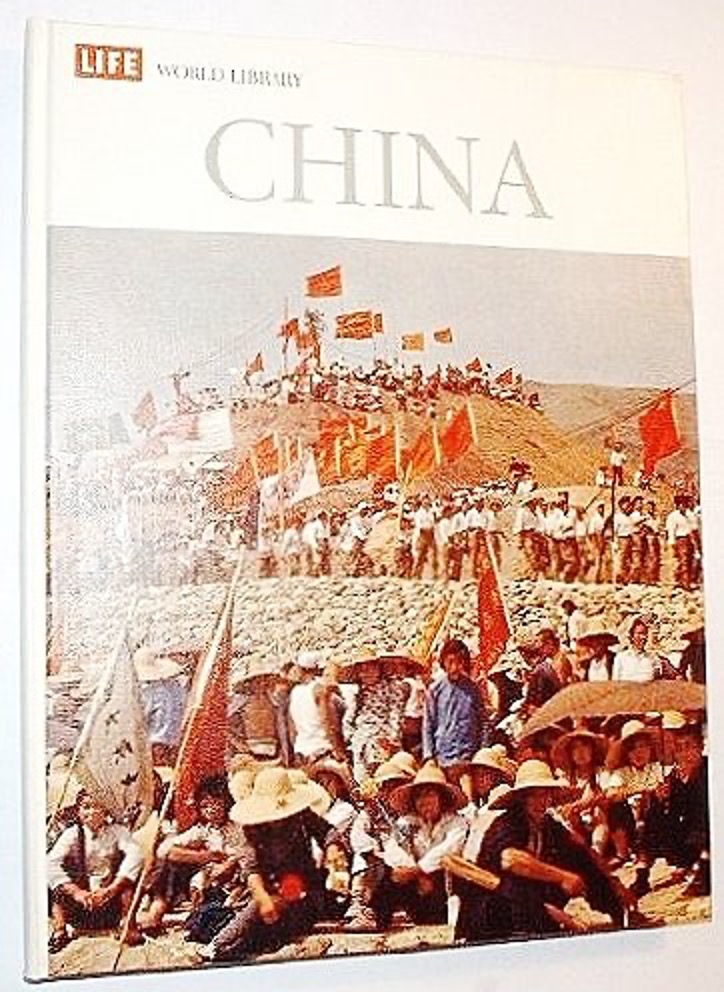
My fascination with China started at an early age. I remember as a child leaving through the Time-Life World Library series volume for China (1965); its photographs grainy black and white, and tinted colour, only serving to increase the mystique about the nation then isolated behind the Bamboo Curtain at the height of Mao’s Cultural Revolution. Back then, to be able to stand on the Great Wall of China, or to see the vastness Tiananmen Square seemed as probable as going on a school trip to the Moon.

I was in my late 20s when I first visited the Middle Kingdom, and through a series of events, choices, and decisions, later found myself living and working in the ethnic borderlands of southwest China for more than a dozen years from the mid-2000s. During that time in-country, as well as before and after during my various travels throughout China, how many times do you think I visited the capital, Beijing? Half-a-dozen times? Or at least 10 times? Sorry. I have to confess, even though I ‘knew’ Beijing through books and documentaries — and creating travel itineraries for tour groups — I never once visited in person the Chinese capital. 

Yes, that’s right. I crafted detailed, tailor-made itineraries for first-time visitors to Beijing, to give them an insider’s experience of the capital, without getting within a thousand kilometres of the great city. My excuses include:

1 – China is vast, and almost the same size as Europe;

2 – It would take 3 days by train from my courtyard house in Yunnan’s Lijiang to the Forbidden City, and I wasn’t up for such a long journey

3 – To be honest, I wasn’t as enthralled about Beijing after hearing mixed reports from other travellers, so I decided I could live (and/or die) without casting my eyes upon the sights and wonders of Beijing. 

A small window of opportunity opened to me recently when the stars aligned between jobs and other responsibilities. I had turned down the invitation to speak at a national tourism conference about the future of China’s tourism development post-pandemic, but I got to visit China for the first time since 2019, making an extended stopover in the capital. A visa-exemption initiative recently re-instated to encourage tourism without the need for pre-approved visas meant I could theoretically apply for a 144-hour transit stamp. 

So, I touched down at Beijing’s Capital International Airport (IATA code PEK) early one morning after an overnight flight from the southern hemisphere. This being my first time without a pre-approved (and expensive) visa I was a little nervous, and my fears were not allayed when no one was staffing the 144-hour visa desk. Was this the first great wall I had to overcome? I got sent from one immigration queue to another, a couple of times having to go against the flow of newly-arriving passengers and slip upstream through security. When eventually an official arrived to process the paperwork and issue the transit stamp, I had to show all my flight and accommodation bookings; not an easy task when you can’t connect to the airport wi-fi. 

I was sweating, not just because of the late summer heat, but also because I had booked a bus tour to the Great Wall that was leaving at 8 a.m. from central Beijing, a train and subway ride away. “Dear Sir, our assembly point is at Exit C of Dengshikou Subway Station on Line 5,” read my instructions. “You can see the guide wearing a blue vest. Please arrived at the assembly point 10 minutes early.”

Having a Chinese bank card, a map preloaded onto my phone, and some decent residual Mandarin skills, along with no reservations about queue-jumping as payback for being delayed, I found an ATM, and headed to the exit of the massive airport. There were only a few seconds to admire the impressive roof arching over Terminal 3, designed by Sir Norman Foster for the 2008 Beijing Olympics as I marched across the marble floors towards the Capital Airport Express. It was just after 7 a.m. but already I could see how Beijing Capital Airport is — or was — the second busiest airport in the world. 

Transferring from the airport line train downtown to the metro, the time on my phone was counting down towards the departure time. I worried that if I missed my bus, my whole trip would be ruined; and that such an inauspicious start to my Beijing exploration would cause a chain reaction of delays, missed opportunities and regret. Maybe I’d never make it to the Wall. Then I thought: take it easy, it’s not the destination, it’s the journey. I studied the Chinese characters for Dengshikou, recognising the first Sinogram as meaning light or lantern.

Arriving at the subway station, I quickened my pace up the stairs and escalators to emerge into sunlight at Exit C. It was 7:59. Fortunately, a blue-vested person was standing in the middle of the carpark. “Do I have time to grab something to eat or drink?” I asked the ZANbus guide in my slightly rusty Mandarin. “No. We’re leaving right now,” she said, ushering me onto the bus.

“But we have bottles of water on sale onboard.”

My online booked tour, a bare basics budget-friendly US$25 including admission ticket, offered three advantages: visiting a less-visited section of the Great Wall a mere 70km from Beijing, arriving before the ‘other tourists’, and being a strictly ‘no shopping’ experience (many tours visit several stores where guides and drivers make huge commissions). As the only non-Chinese person on the coach, the guide (who was supposed to speak some English) gave me a special briefing (in Mandarin), explaining the options for going up and coming down from the Mutianyu section of the wall, as we sped out of the metropolis heading towards the green rolling hills in the hazy distance. 

As we passed orchards, with growers selling freshly-picked fruits and nuts, I secretly wished we could stop for some shopping, not just to support the locals, but to ease my rumbling empty stomach. A nearby passenger, a man in his 20s visiting from a central province, whom I later dubbed ‘Running Man’, live-streamed the succession of farmer’s markets we zoomed past, in between video-chatting to his girlfriend. “There’s apples, pears, apricots, plums, grapes, persimmon, walnuts and huge peaches,” I heard him say. Since the bus driver didn’t once slow down, I justified to myself that, even though probably quite delicious, that produce would probably be exorbitantly over-priced for day-tripping Great Wallers like myself. 

By 9.30am I was striding along an arcade of mainly unopened shops past the visitor centre, stopping to buy more water, and some snacks. “How about an ice cream?”one vendor asked me after I looked into his glass-top freezer. “Later, OK?” A cafe offered a latte coffee, but the US$8.25 price tag reminded me that China gives too much status to the beverage, which is sometimes just instant coffee and creamer. A Chinese family, long-resident in the UK, gave me a fuller rundown on the logistics for sightseeing, where to meet the guide for the trip back to Beijing (the waiting hall just near Burger King), and most importantly, when the bus driver would be leaving (4pm sharp). “Also, if you tell them you are with this bus company, there’s a discount at Subway,” the teenage son chimed in as we boarded an electric vehicle for a short ride to the base station for the ascent of the crestline high above us. Looking along the line of the hills, I could just make out the crenellated up-and-down patterns of the walls, stretching off into the far distance. 

Now you’ve probably heard it many times, but let’s dispel the myth: the Great Wall of China is not visible from space. It is not visible from the Moon. It isn’t even visible to the naked eye from the low-orbit International Space Station. The popular myth goes back centuries, and more recently has been part of the propaganda of modern China to state that the wall was the only human-made structure that could be seen from space. The myth was challenged when Apollo 12 lunar module pilot Alan Bean said, “The only thing you can see from the Moon is a beautiful sphere, mostly white, some blue and patches of yellow, and every once in a while, some green vegetation. . . No man-made object is visible at this scale.”

Some artificial structures such as cities, highways and dams are visible from space, but the Great Wall is only visible from low Earth orbit with magnification or high-powered camera lenses. This was confirmed by China’s own first astronaut who went around planet Earth 14 times in 2003 on Shenzhou 5. “The Earth looked very beautiful from space, but I did not see our Great Wall.”

Photographs provided by Keith Lyons

To get personal and up-close with the Great Wall, other passengers decided to get a chairlift up and traipse further along between watchtowers and then take a toboggan (“speed slide”) down for 5 minutes of excitement. Rather than hike up (crazy in the heat), I opted to take the same cable car up and down (less than US$20 return).

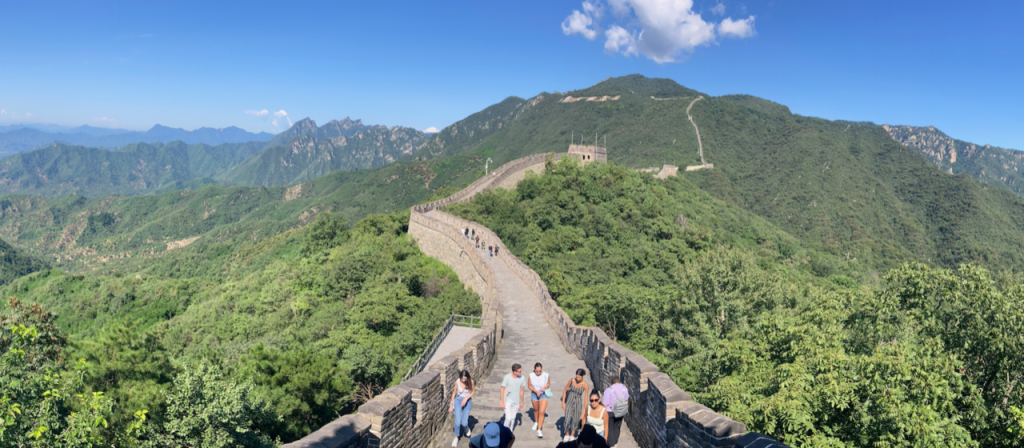
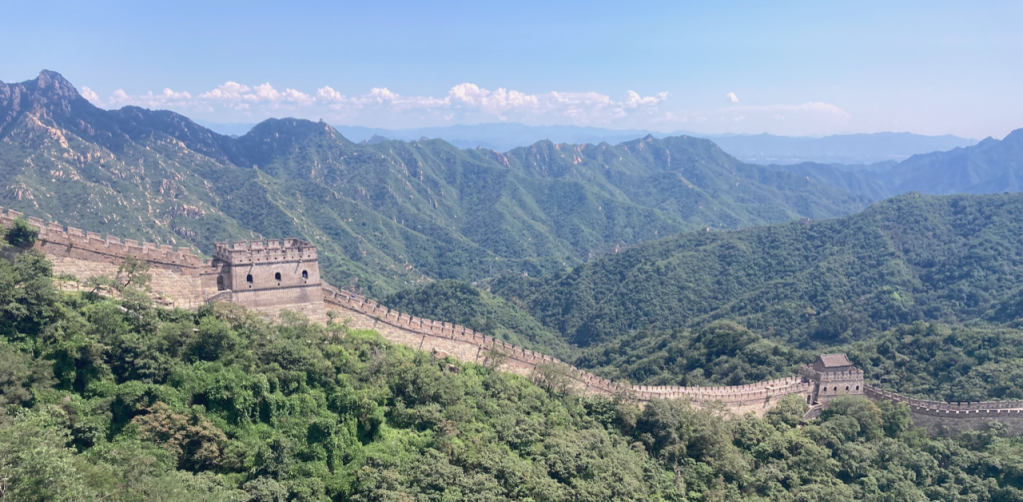
Within minutes we could look down on the graceful, curved line of each section of the wall as it gently arched from one watchtower to the next. Wow! As the cable car reached its terminus near watchtower 14, the extent of the Great Wall to the north was revealed, fading to the horizon as vegetation and battlement became indistinguishable. 

The Mutianyu section extends some 5.4km, and though work began in the 6th century, much of it was rebuilt or renovated in the 15th and 16th centuries. In the 1980s about 2.3 km of that section was restored, so over the last three decades, more and more people have been able to visit the less crowded and commercialised alternative to the more famous, most-restored, scenically magnificent Badaling section. 

At Mutianyu, constructed of granite blocks, the wall has been made pedestrian-friendly and smooth, though there were steps, some steep in parts as they climb to the series of watchtowers. My fellow passenger Running Man darted around taking selfies and videos, as if he had only 24-hours left to live. Couples set off to the best spots to take photos, while a group of three university students set their sights on the highest watchtower, No.20, which could take one or two hours return depending on speed, stops and stamina. The path climbs from the low of watchtower 17, with the steepest leg between 19 and 20. 

Being something of a mountain goat myself, you might expect me to join them purposefully climbing towards the much-talked-about ’20’, but this goat was tired, jet-lagged, and hungry. Instead, I wandered along to the next abutments and decided to just sit in the shade admiring the view. This is just what I had envisioned, I wrote in my journal. And it was. Just like in the photos. Actually, I had expected the Great Wall might be more crowded with jostling visitors, but less than half those getting off the cable car ventured beyond watchtower 16 — and it wasn’t a weekend or holiday. 

At watchtower 17, it was so quiet and still that I could hear cicadas in the pine and chestnut trees flanking the wall. A pair of sparrows darted around, a plane flew overhead, and I watched the slow progress of a centipede across the path from the inner parapet to the invader-facing crenelation, a distance of four or five metres. Surely, the centipede hadn’t climbed all the way up the seven or eight metres of the Wall’s walls, five times the height of an adult? During its construction, which went until the mid-1600s, parts of the wall were made with bricks, held together by a durable glutinous rice mortar — arsenic was used to prevent insects from eroding away the wall. 

An old man, who has been sitting nearby in the shade while his adult son and grandchildren went on further, finishes drinking from a plastic water bottle and discards it over the side. I feel like saying something, but stop myself, realising that some attitudes and behaviours are slow to change. He probably thinks the Great Wall was visible from space, I confide to myself. 

The Wall’s modest width, no bigger than a road, was probably why it couldn’t be easily spotted from above. However, it did provide a fast means of travel and transportation for troops. Officially, the Great Wall was some 21,198 km long – that’s equivalent to half the equator – but up to a third of the structure has disappeared over time. It’s not just one continuous wall either, with sidewalls, parallel walls, enclosing walls, and even sections where there are no walls, just high mountain ridges, rivers, ditches or moats as the barriers. The Wall can lay claim to being the longest man-made structure as well as the largest building construction project ever undertaken. On a blank page I start a rough sketch of the section in front of me, trying to get my head around how this is just a tiny fraction of the longer, greater wall.

As well as being for border defence, the Great Wall also served to transmit messages, using watchtowers and beacon towers. From the next watchtower, the grandson of the bottle-litter-man waves but failing to catch the attention of the old man, he runs back along the wall path yelling, “Yéye – Granddad! Did you see me waving to you at the next castle?”

There is a certain irony about this extensive bulwark constructed across northern China and southern Mongolia up to two millennia ago to keep out invaders which now every day is climbed over by tourists from Mongolia, Russia, Eurasia and beyond. This is supposed to keep us out. But here we are, on the top of the wall and fortifications, having invaded, not from beyond, but from the downtown of the capital of the nation. So much for the upright projections, resembling teeth bared at the enemies. 

Other travel experts and expats living in Beijing tell me if I visited Mutianyu a month later, I would see the surrounding maple, oak and chestnut trees in their autumn splendour. In winter, snow transforms the scene. But on this day, I am just happy to be present, to take on the literal meaning of Mutianyu — Admire Fields Valley — as I take the cable car down to the bountiful valley, snack on a corn cob sprinkled with chilli, and some fresh walnuts. As the clouds turn to a sudden rainstorm, in the comfort of the waiting hall, after savouring an ice cream, I let the day catch up on me.

Photo provided by Keith Lyons

Back on the bus at 4pm, Running Man is sunburnt red and sweaty — but still grinning as he sorts through his photos and videos. The mother hen guide gives us all a small memento of the day, a fridge magnet of the Great Wall, as a reward for all making it back on time. 

The next thing I recall is being woken by the guide. I must have drifted off to sleep. “We’ve arrived,” she says, pointing towards an entrance to the Beijing metro which seems different from the starting point. For a moment, I wonder if I have been dreaming it all: the Great Wall, the perfect day, how everything worked out in the end. Then I realised it was all true: I’ve just seen and been on the Great Wall. And I have the fridge magnet in my pocket to prove it. I turn to say goodbye to Running Man, but he’s already exited the bus, and is making for the escalator down.

*Read the Day two of Keith Lyon’s China trip by clicking here

Keith Lyons (keithlyons.net) is an award-winning writer and creative writing mentor originally from New Zealand who has spent a quarter of his existence living and working in Asia including southwest China, Myanmar and Bali. His Venn diagram of happiness features the aroma of freshly-roasted coffee, the negative ions of the natural world including moving water, and connecting with others in meaningful ways. A Contributing Editor on Borderless journal’s Editorial Board, his work has appeared in Borderless since its early days, and his writing featured in the anthology Monalisa No Longer Smiles.

.

PLEASE NOTE: ARTICLES CAN ONLY BE REPRODUCED IN OTHER SITES WITH DUE ACKNOWLEDGEMENT TO BORDERLESS JOURNAL. 

Click here to access the Borderless anthology, Monalisa No Longer Smiles

Click here to access Monalisa No Longer Smiles on Kindle Amazon International

Categories
The Halloween Spookbook

Witches, Ghosts and Pirates?

Can horror be fun?

While the horror generated by wars deeply saddens with its ultimate disregard for all kinds of flora and fauna, including humans, the horrific as we savour in festivals can cease to be terrifying. It can even be cathartic in the midst of the terror of destruction and violence. Halloween is a festival that brings to mind a time when kids go trick or treating as houses and gardens assume a ‘haunted look’. This year, in the spirit of fun, we bring to you a collection of the spooky and the gooky — poems and prose — from across multiple countries and cultures. These hope to provide a moment of respite and unalloyed fun for all of you, despite their darker notes. Perhaps, as an afterthought, these will also unite with the commonality of human needs to connect… even if it’s with a plethora of spooks from across all kinds of human borders…

Poetry

Poems for Halloween by Michael Burch. Click here to read.

Pirate Poems: Jay Nicholls brings us fun-filled ‘spooky-gooky’ adventures across the Lemon Sea. Click here to read.

Prose

Ghosts, Witches and My New Homeland : Tulip Chowdhury muses on ghosts and spooks in Bangladesh and US. Click here to read.

Three Ghosts in a Boat: Rhys Hughes explores the paranormal. Promise not to laugh or smile as you shiver… Click here to read.

Red Moss at the Abbey of Saint Pons: Paul Mirabile takes us to St Pons Abbey in France in the fifteenth century. Click here to read.

The Browless DollsS.Ramakrishnan’s story about two supernatural dolls, has been translated from Tamil by B. Chandramouli. Click here to read.

Categories
Contents

Borderless, October 2023

Artwork by Sohana Manzoor

Editorial

We had Joy, We had Fun … Click here to read

Conversations

A conversation with Nazes Afroz, former BBC editor, along with a brief introduction to his new translations of Syed Mujtaba Ali’s Tales of a Voyager (Jolay Dangay). Click here to read.

Keith Lyons converses with globe trotter Tomaž Serafi, who lives in Ljubljana. Click here to read.

Translations

Barnes and Nobles by Quazi Johirul Islam has been translated from Bengali by Professor Fakrul Alam. Click here to read.

Cast Away the Gun by Mubarak Qazi has been translated from Balochi by Fazal Baloch. Click here to read.

One Jujube has been written and translated from Korean by Ihlwha Choi. Click here to read.

A Hymn to an Autumnal Goddess by Rabindranath Tagore,  Amra Beddhechhi Kaasher Guchho ( We have Tied Bunches of Kaash), has been translated by Mitali Chakravarty. Click here to read.

Poetry

Click on the names to read the poems

Michael Burch, Gopal Lahiri, Ryan Quinn Flanagan, Hawla Riza, Reeti Jamil, Rex Tan, Santosh Bakaya, Tohm Bakelas, Pramod Rastogi, George Freek, Avantika Vijay Singh, John Zedolik, Debanga Das, Rhys Hughes

Poets, Poetry, and Rhys Hughes

In Do It Yourself Nonsense Poem, Rhys Hughes lays some ground rules for indulging in this comedic genre. Click here to read.

Musings/Slices from Life

Onsen and Hot Springs

Meredith Stephens explores Japanese and Californian hot springs with her camera and narrative. Click here to read.

Kardang Monastery: A Traveller’s High in Lahaul

Sayani De travels up the Himalayas to a Tibetan monastery. Click here to read.

Ghosts, Witches and My New Homeland

Tulip Chowdhury muses on ghosts and spooks in Bangladesh and US. Click here to read.

Musings of a Copywriter

In Red Carpet Welcome, Devraj Singh Kalsi re-examines social norms with a scoop of humour. Click here to read.

Notes from Japan

In Baseball and Robots, Suzanne Kamata shares how both these have shaped life in modern Japan. Click here to read.

Stories

The Wave of Exile

Paul Mirabile tells a strange tale started off by a arrant Tsunami. Click here to read.

Glimpses of Light

Neera Kashyap gives a poignant story around mental health. Click here to read.

The Woman Next Door

Jahanavi Bandaru writes a strange, haunting tale. Click here to read.

The Call

Nirmala Pillai explores different worlds in Mumbai. Click here to read.

Essays

The Oral Traditions of Bengal: Story and Song

Aruna Chakravarti describes the syncretic culture of Bengal through its folk music and oral traditions. Click here to read.

Belongingness and the Space In-Between

Disha Dahiya draws from a slice of her life to discuss migrant issues. Click here to read.

A City for Kings

Ravi Shankar takes us to Lima, Peru with his narrative and camera. Click here to read.

The Saga of a Dictionary: Japanese-Malayalam Affinities

Dr. KPP Nambiar takes us through his journey of making a Japanese-Malyalam dictionary, which started nearly fifty years ago, while linking ties between the cultures dating back to the sixteenth century. Click here to read.

Book Excerpts

An excerpt from Kailash Satyarthi’s Why Didn’t You Come Sooner?: Compassion In Action—Stories of Children Rescued From Slavery. Click here to read.

An excerpt from Rhys Hughes’ The Coffee Rubaiyat. Click here to read.

Book Reviews

Somdatta Mandal reviews Usha Priyamvada’s Won’t You Stay, Radhika?, translated from Hindi by Daisy Rockwell. Click here to read.

Aditi Yadav reviews Makoto Shinkai’s and Naruki Nagakawa’s She and Her Cat, translated from Japanese by Ginny Tapley Takemori. Click here to read.

Gemini Wahaaj reviews South to South: Writing South Asia in the American South edited by Khem K. Aryal. Click here to read.

Bhaskar Parichha reviews One Among You: The Autobiography of M.K. Stalin, translated from Tamil by A S Panneerselvan. Click here to read.

.

Click here to access the Borderless anthology, Monalisa No Longer Smiles

Click here to access Monalisa No Longer Smiles on Kindle Amazon International
Categories
Poetry

Nature Poems by Jared Carter

Morels. Courtesy: Creative Commons
              MORELS

(In temperate regions of the northern hemisphere,
over seventy species of the highly prized
mushroom, Morchella, may be found)


This is the way, through apple trees
          gone wild – on past
The ruined church, where branches seize
          and catch – at last

An opening in the fence. We
          come every spring
Along a path that gradually
          bends ’round, to bring

Us back to what, still hidden here,
          not far below,       
Occasionally will reappear
          in the patched snow.

             SHORELINE

Then in late winter, after rain
          has swept the sea,
And neither presence can explain
          the mystery

Of sand unblemished, or of waves
          that wander there,
Though nothing follows, nothing saves
          those margins where

Half circles fade. As from a dream,
          a ragged frond
Of seaweed surfaces, and gleams,
          and then is gone.
Courtesy: Creative Commons

Jared Carter’s most recent collection, The Land Itself, is from Monongahela Books in West Virginia. His Darkened Rooms of Summer: New and Selected Poems, with an introduction by Ted Kooser, was published by the University of Nebraska Press in 2014. A recipient of several literary awards and fellowships, Carter is from the state of Indiana in the U.S.

.

PLEASE NOTE: ARTICLES CAN ONLY BE REPRODUCED IN OTHER SITES WITH DUE ACKNOWLEDGEMENT TO BORDERLESS JOURNAL

Click here to access the Borderless anthology, Monalisa No Longer Smiles

Click here to access Monalisa No Longer Smiles on Kindle Amazon International

Categories
Conversation

Better Roses for a Warming World and Other Garden Adventures

Shantanu Ray Chaudhuri in conversation with M.S. Viraraghavan and Girija Viraraghavan

In their new book Roses in the Fire of Spring: Better Roses for a Warming World and Other Garden Adventures (Running Head, 2023), world-renowned rose hybridisers, M.S. Viraraghavan and Girija Viraraghavan, record their journey of over fifty years, creating more than a hundred new rose varieties, in a range of colours, shapes and types. The authors spoke to Shantanu Ray Chaudhuri on their lifelong passion for the rose.

The passion for roses goes back a long way – can you recall the first moments when you realised that this was a ‘calling’ you had to follow? Any epiphanic moment that leaps to the mind?

From quite a young age, Viraraghavan was fascinated with roses, but the epiphanic moment was really when his family spent summer vacations in Coonoor, staying at the government guesthouse within Sim’s Park, which overlooked a rose garden. Every morning, he would wander about this garden which was a blaze of colour of the new roses created from the golden rose of Persia, R. foetida by Pernet Ducher, a great French rose breeder. The brilliant, never-before-seen colours of these roses amazed him – from bright gold and apricot to dazzling oranges and reds. In particular, one of the golden roses took his breath away – ‘Julien Potin’, aptly named for a jeweller – its vivid colour was quite overwhelming for the boy of thirteen, already thrilled with roses. From this came the intoxicating thought: ‘If Pernet Ducher could do it, why not I?’

There’s a delightful little bit about Viraraghavan sir’s viva-voce for the IAS and how his knowledge of roses played an important part in him getting through that. Would you like to share that with our readers?

A difficult part of the IAS examination is the viva-voce, where a panel of senior administrators question the aspirant about various aspects of his or her life and ambitions. Viraraghavan was in the middle of this interview when the Chairman, by chance a learned rose grower, asked him what his hobbies were. ‘Growing roses,’ was the response. The next question was meant to be a googly to confuse a nervous candidate. ‘What roses can you grow in Madras City?’ But Viraraghavan had read the Complete Gardening in India by K.S. Gopalaswamiengar, well-known horticulturist of Bangalore, many times, so my answer was nearly verbatim from the chapter on various kinds of roses which do well in low-to-medium elevations, i.e., warm climates, so he reeled off the different rose classifications: Teas, Noisettes, Bourbons, Chinas, Hybrid Teas, Hybrid Perpetuals. The interview committee then decided it was prudent to go on to other questions rather than get a lecture from a young and seemingly unflurried candidate! But his capacity to master detailed information on various subjects had been noted, and he came through with flying colours (pun intended).

You mention making your presence on the world stage as late as 2000. Please give us a brief account of your work on roses before and after – a potted highlights package, if one can call it.

From the start, our rose breeding focused on creating better roses for warm climates based on the dictum of India’s pioneer rose breeder, B.S. Bhatcharji of Bengal and Bihar, who had stressed the need for a separate breeding line for warm climates as distinct from the Western focus on creating cold-hardy roses suitable for them. Thus, in the early years, our work was with those roses which, though Western, performed well in hot climates, and we had bred many which did well in Hyderabad where we lived. Then, after perusal of many books on roses, we realised the potential in two Indian rose species Rosa gigantea (from northeast India) and Rosa clinophylla (perhaps the world’s only tropical rose species). After getting them with great effort, we began to work with them. At every annual national rose convention in India we would present updates of our work. In 1999, at what happened to be a World Regional Rose Convention, in Jaipur, Viraraghavan’s talk, as always, focused on the breeding with the two rose species mentioned. After the talk, the World Federation of Rose Societies President, Helga Brichet, and Vice-President (South America), Mercedes Villar, came up to him and said they had never before heard of this kind of rose work or of these rose species and invited him to be a speaker at the next World Rose Convention to be held in May 2000 in Houston, Texas.

That was the start of a further phase of rose breeding with the realisation that other than India, several warm parts of the world were also looking for roses that would do well there. These two rose species had been personally collected by us from their native habitat. At Houston, and in other places, people were fascinated by this aspect, which no earlier breeder had undertaken, that is, personally collecting rose species in the wild, at great risk, growing them and using them in creating new roses; starting from scratch as it were. It made sense to them when Viraraghavan explained the dictum of that great German breeder Wilhelm Kordes I who said –‘The soup ladle will only bring out what is already in the tureen’, meaning that fresh genetic input was required if new and different roses are to be created. The enthusiastic response to his ideas strengthened his determination to go ahead with this new rose breeding line. There is nothing as intoxicating as the realisation that the rose world is watching our work with great interest.

One of the most fascinating sections of the book is the one titled ‘The Ones Who Came Before’. Please provide readers with a short account of these legendary influences.

Karrie’s Rose. Photo courtesy: M.S. Viraraghavan and Girija Viraraghavan

We had noticed that invariably roses were named for famous people with often no connection to the world of roses. This made us think: why not name our roses for the intrepid plant-hunters who had discovered roses in the wild, on mountains and in forests, and botanists who had contributed to the knowledge on plants.

One wild Indian rose is R. gigantea, from our north-east, and Myanmar. Three great plant hunters were responsible for collecting this species in the wild – Sir George Watt, General Sir Henry Collett and Frank Kingdon Ward. We decided to name our rose hybrids for all three. Sir George was a medical doctor with an interest in botany, and worked as a surveyor with the British India government. During the course of his work, in the 1880s, he found Rosa gigantea growing on the slopes of Mt Sirohi, now in Manipur, and collected specimens. Almost simultaneously, so did Sir Henry Collett, except in the Shan Hills in what is now Myanmar. Both specimens were identified as being the same and named by the great Belgian taxonomist of the time, François Crepin. Climbing Mt Sirohi in 1990, we came across and collected plants from perhaps the precise location that Sir George had found Rosa gigantea. We named our first hybrid, a creamy yellow climbing rose, for him. We then felt it should be planted near his ancestral home in Scotland. With the help of the Royal Botanic Garden, Edinburgh, we managed to get this new rose planted in the Logan Botanic Garden, very near Sir George’s birthplace. Some years later we embarked on a sentimental journey, along with his descendants and his associates’ descendants, visiting his grave and the hospital he had worked in after retiring from India, to see the rose blooming in Logan.

We named a second seedling we had bred from R. gigantea for General Sir Henry Collett, a rose with big creamy white blooms that has been planted in suitable areas in Britain as well, and, gratifyingly, being grown by some of his descendants. A third rose, a climber with blooms of yellow-suffused pink, was named for Frank Kingdon Ward, the legendary and intrepid plant hunter who collected innumerable new and wild Himalayan plants despite his surprising acrophobia! We then came across a piece by the then BBC 4 gardening anchor, Matthew Biggs, who had visited Kingdon Ward’s grave in Grantchester near Cambridge. He wrote about the neglected condition of the grave of one of the world’s greatest plant explorers. So we decided to make amends by planting ‘Frank Kingdon Ward’ by the wall nearest his grave in the churchyard in a moving ceremony organised by Matthew Biggs, and attended by a number of well-known British horticulturists, as also the family. An urn with the ashes of Sheila Macklin, Kingdon Ward’s wife, for whom he had named a Himalayan lily, and who had died just the previous year, was interred near his grave, and close to where the rose was planted.

We have also named a rose for Leschenault de la Tour, the great French plant explorer who found a beautiful new rose species, called Rosa leschenaultiana after him, in the Western Ghats in the early 1800s; our rose named for him is a climber with pure white blooms.

And of course we have a rose to celebrate the remarkable life and career of the great Indian botanist and cytogeneticist, E.K. Janaki Ammal, who co-wrote the Chromosome Atlas of All Cultivated Plants in 1945. She studied botany at Michigan State University in the 1920s on a full scholarship, later receiving a PhD and DSc honoris causa. Back in India, she played a vital role in creating the ‘Noble’ strain of sugarcane – an extraordinary hybrid of sugarcane and bamboo leading to varieties thick as a man’s arm in contrast to the pencil-thin traditional varieties. But credit was stolen by seniors at the research station, and so she went off to Britain. There she worked at famous institutes, including John Innes, Kew and the Royal Horticultural Society. Later, she met the then Prime Minister Jawaharlal Nehru on a plane, and he put her in charge of reforming the Botanical Survey of India in Calcutta. But sadly she was a forgotten figure by the time of her death in 1984. Our rose named for her has the same colour hues as the saris she wore – orange yellow and saffron. A plant of this rose was planted in 2020 at the World Regional Rose Conference Kolkata, at the Botanical Survey of India garden. The rose has also been planted in the John Innes Institute, in Kew and the Royal Horticultural Society’s garden in Wisley in the UK.          

If one were to ask you of one moment each – one particular achievement in the journey and one abiding regret – what would these be and why?

There can be no doubt that the moment which was special in our rose breeding career was the moment described above, when Helga Brichet and Mercedes Villar came up to us in Jaipur in 1999, and said they had never heard such a new approach to breeding roses, pioneered by us, of using two Indian rose species to create a new line of warm-climate roses. It was their invitation to speak in Texas launched us on to the world stage of roses.

As for an abiding regret, that’s all too easy to answer. It’s the systematic neglect of Indian-bred roses by the rose-growing public of India, who remain fascinated by roses raised in Europe and the U.S. though they are utterly unsuited for Indian climates. This unreasonable preference for foreign rose varieties is part of the general craze for all things foreign. Fortunately, more recently, there has been a change, and young rose breeders and growers are realising that Indian bred roses do better in the heat and are slowly beginning to grow these.

Give us an insight into the challenges and pitfalls of growing and creating roses in India, as informed by your journey. Interesting story that highlighted these.

The main challenge was getting Indian roses accepted by the Indian rose growing public, as highlighted above. Indeed, now our roses are being grown in India, perhaps because they are being grown around the world! Another thing is one must learn patience. It takes us about eight to nine years to name and release a new rose. It is a long process, of the actual crossing of two roses, waiting for the fruit to ripen, then harvesting the fruit (rose hips), collecting the seeds, stratifying them in the refrigerator (if one lives on the hot plains), sowing the seed, waiting for the seedlings to sprout, growing the plant for a number of years to test its potential, and suitability, and only then finding a name and releasing it, by sending to a rose nursery to make more plants.

Our long career in rose breeding and our connected travels around the world has provided us with many interesting, even hilarious experiences. We were in Japan, at the Sakura Rose Garden. With us was a group of people including our friend, the well-known Japanese plant scientist, Dr Yuki Mikanagi. We were looking at a rose plant, with dark pinkish-red blooms with white on the reverse, bred by us and as yet unnamed. Yuki said she liked this rose very much. We immediately told her that we would name it for her. She said: ‘But this rose is red and white, whereas my name means “snow” in Japanese. Viru’s instant response was, ‘Then we will it name it Blushing Yuki,’ much to the delight of Yuki and everyone.

In his government service days, when we lived in Hyderabad, Viru would tend to his roses, watering and spraying them with fertilizers before leaving for office. There would be a number of telephone calls for him about some official matter. Girija would answer the phone (landline in those days), and when she told the callers he was busy spraying, they would hear it as ‘praying’ and immediately apologise: ‘Please do not disturb him when he is at his prayers’.

Both of us were hands-on gardeners, doing most of the work ourselves and you cannot garden without muddy hands and clothes. Very often visitors would mistake us for the garden help and request us to take them to the master or the mistress of the house. The looks on their faces when they realised who we were would make us laugh.

On one occasion, we were in California to receive the ‘Great Rosarians of the World’ Award. At the ceremony, we both first gave a talk on ‘Roses in India, Past Present and Future’. At the end of the ceremony, an earnest old lady came up to us and asked, in all seriousness, ‘Do roses grow in India?’

For most of us, roses are red and a Valentine’s Day Gift. Appendix 1 of your roses runs to 50 pages! Tell us briefly of some of the interesting ones, in particular the very evocative names you have, for example, Kindly Light, Meghamala/Wine-dark Sea, Twilight Secret. What goes into giving a name to a rose?

Apart from the roses we have named for friends, for other roses we like to give evocative names.

  • KINDLY LIGHT: we named this lovely white shading to soft pink rose after the hymn ‘Lead, Kindly Light’, a favourite of Mahatma Gandhi’s. We have the practice of giving two names to some of our roses, one better understood in India, if it is a Sanskrit word, and one for the West. This rose is named ‘Swami Vinayananda’ in India, for a monk of the Ramakrishna Mission order. He was great plantsman, his book on dahlias is a definitive work on all aspects of dahlia growing and he was very good rose grower.
  • MEGHAMALA/WINE-DARK SEA: One more example of two names for a rose. Meghamala translates as ‘garland of clouds’. The name for our rose was inspired by the purple garland-like pattern, reminiscent of clouds, on the petals of this rose, which otherwise are dark orange-red  in colour. ‘Meghamala’ is from a line by Devulapalli Krishna Sastri, beloved modern poet of the Telugu language, to whom the rose is a tribute. ‘Wine-Dark Sea’ derives from Homer’s epithet, in both the Iliad and Odyssey, of the purple shadows of approaching night on the orange-red waters reflecting the rays of a setting sun on the Aegean Sea.
  • ALLEGORY OF SPRING: We named a very special light-pink rose with intriguing pointed petals after the famous Botticelli painting La Primavera, also called ‘Allegory of Spring’.
  • INCENSE INDIGO: An indigo purple rose with an enticing fragrance was the inspiration for this name.
  • TWILIGHT SECRET and TWILIGHT TRYST: Two purple-hued roses that remind one of the late evening, shadowy light, romantic secrets and trysts.
  • AHIMSA: We gave this name to a golden yellow rose borne on a plant without any thorns (prickles), thinking of the Mahatma’s philosophy of non-violence.
  • KUSABUE’S GUARDIAN ANGELS: Kusabue is the name of a rose garden in Sakura City, Japan, entirely looked after by volunteers, all very senior citizens. This is our tribute to them.

Click here to read the excerpt

Shantanu Ray Chaudhuri is a film buff, editor, publisher, film critic and writer. Books commissioned and edited by him have won the National Award for Best Book on Cinema twice and the inaugural MAMI (Mumbai Academy of Moving Images) Award for Best Writing on Cinema. In 2017, he was named Editor of the Year by the apex publishing body, Publishing Next. He has contributed to a number of magazines and websites like The Daily Eye, Cinemaazi, Film Companion, The Wire, Outlook, The Taj, and others. He is the author of two books: Whims – A Book of Poems(published by Writers Workshop) and Icons from Bollywood (published by Penguin/Puffin).

.

PLEASE NOTE: ARTICLES CAN ONLY BE REPRODUCED IN OTHER SITES WITH DUE ACKNOWLEDGEMENT TO BORDERLESS JOURNAL

Click here to access the Borderless anthology, Monalisa No Longer Smiles

Click here to access Monalisa No Longer Smiles on Kindle Amazon International
Categories
Excerpt

Journey After Midnight

Title: Journey After Midnight: A Punjabi Life from Canada to India

Author: Ujjal Dosanjh

Publisher: Speaking Tiger Books

50

A variation on the common Indian expression “Mullan de daur maseet taeen,” which roughly translates as “An imam’s ultimate refuge is the mosque,” sums up my relationship with the world: India is my maseet. I have lived as a global citizen, but India has been my mandir, my masjid, and my girja: my temple, my mosque, and my church. It has been, too, my gurdwara, my synagogue, and my pagoda. Canada has helped shape me; India is in my soul. Canada has been my abode, providing me with physical comforts and the arena for being an active citizen. India has been my spiritual refuge and my sanctuary. Physically, and in the incessant wanderings of the mind, I have returned to it time and again.

Most immigrants do not admit to living this divided experience. Our lack of candour about our schizophrenic souls is rooted in our fear of being branded disloyal to our adopted lands. I believe Canada, however, is mature enough to withstand the acknowledgement of the duality of immigrant lives. It can only make for a healthier democracy.

Several decades ago, I adopted Gandhi’s creed of achieving change through non-violence as my own. As I ponder the journey ahead, far from India’s partition and the midnight of my birth, there is no avoiding that the world is full of violence. In many parts of the globe, people are being butchered in the name of religion, nationalism and ethnic differences. Whole populations are migrating to Europe for economic reasons or to save themselves from being shot, beheaded or raped in the numerous conflicts in the Middle East and Africa. The reception in Europe for those fleeing mayhem and murder is at times ugly, as is the brutal discrimination faced by the world’s Roma populations. The U.S. faces a similar crisis with migrants from Mexico and other parts of South America fleeing poverty and violence, in some cases that of the drug cartels. Parents and children take the huge risk of being killed en route to their dreamed destinations because they know the deathly dangers of staying. Building walls around rich and peaceful countries won’t keep desperate people away. The only lasting solution is to build a peaceful world.

Human beings are naturally protective of the peace and prosperity within their own countries. A very small number of immigrants and refugees, or their sons and daughters, sometimes threaten the peace of their “host” societies. But regardless of whether the affluent societies of western Europe, Australia, New Zealand and North America like it or not, the pressure to accept the millions of people on the move will only mount as the bloody conflicts continue. Refugees will rightly argue that if the West becomes involved to the extent of bombing groups like ISIS, it must also do much more on the humanitarian front by helping to resettle those forced to flee, be they poverty-driven or refugees under the Geneva Convention. With the pressures of population, poverty and violence compounded by looming environmental catastrophes, the traditional borders of nation states are bound to crumble. If humanity isn’t going to drown in the chaos of its own creation, the leading nations of the world will have to create a new world order, which may involve fewer international boundaries.

In my birthplace, the land of the Mahatma, the forces of the religious right are ascendant, wreaking havoc on the foundational secularism of India’s independence movement. I have never professed religion to be my business except when it invades secular spaces established for the benefit of all. Extremists the world over—the enemies of freedom—would like to erase both the modern and the secular from our lives. Born and bred in secular India, and having lived in secular Britain and Canada, I cherish everyone’s freedom to be what they want to be and to believe what they choose to believe.

I have always been concerned about the ubiquitous financial, moral and ethical corruption in India, and my concern has often landed me in trouble with the rulers there. Corruption’s almost complete stranglehold threatens the future of the country while the ruling elite remain in deep slumber, pretending that the trickle of economic development that escapes corruption’s clutches will make the country great. It will not.

Just as more education in India has not meant less corruption, more economic development won’t result in greater honesty and integrity unless India experiences a cultural revolution of values and ethics. The inequalities of caste, poverty and gender also continue to bedevil India. Two books published in 1990, V.S. Naipaul’s India: A Million Mutinies Now and Arthur Bonner’s Averting the Apocalypse, sum up the ongoing turmoil. A million mutinies, both noble and evil, are boiling in India’s bosom. Unless corruption is confronted, evil tamed, and the yearning for good liberated, an apocalypse will be impossible to avert. It will destroy India and its soul.

On the international level, the world today is missing big aspirational pushes and inspiring leaders. Perhaps I have been spoiled. During my childhood, I witnessed giants like Dr. Saifuddin Kitchlew of the Indian freedom movement take their place in history and even met some of them. As a teenager, I was mesmerized by the likes of Nehru and John F. Kennedy. I closely followed Martin Luther King and Robert Kennedy as they wrestled with difficult issues and transformative ideas. I landed in Canada during the time of Pierre Trudeau, one of our great prime ministers. Great leaders with great ideas are now sadly absent from the world stage.

The last few years have allowed me time for reflection. Writing this autobiography has served as a bridge between the life gone by and what lies ahead. Now that the often mundane demands of elected life no longer claim my energies, I am free to follow my heart. And in my continuing ambition that equality and social justice be realized, it is toward India, the land of my ancestors, that my heart leads me.

Extracted from the revised paperback edition of Journey After Midnight: A Punjabi Life from Canada to India by Ujjal Dosanjh. Published by Speaking Tiger Books, 2023.

About the Book: Born in rural Punjab just months before Indian independence, Ujjal Dosanjh emigrated to the UK, alone, when he was eighteen and spent four years making crayons and shunting trains while he attended night school. Four years later, he moved to Canada, where he worked in a sawmill, eventually earning a law degree, and committed himself to justice for immigrant women and men, farm workers and religious and racial minorities. In 2000, he became the first person of Indian origin to lead a government in the western world when he was elected Premier of British Columbia. Later, he was elected to the Canadian parliament.

Journey After Midnight is the compelling story of a life of rich and varied experience and rare conviction. With fascinating insight, Ujjal Dosanjh writes about life in rural Punjab in the 1950s and early ’60s; the Indian immigrant experience—from the late 19th century to the present day—in the UK and Canada; post-Independence politics in Punjab and the Punjabi diaspora— including the period of Sikh militancy—and the inner workings of the democratic process in Canada, one of the world’s more egalitarian nations.

He also writes with unusual candour about his dual identity as a first-generation immigrant. And he describes how he has felt compelled to campaign against discriminatory policies of his adopted country, even as he has opposed regressive and extremist tendencies within the Punjabi community. His outspoken views against the Khalistan movement in the 1980s led to death threats and a vicious physical assault, and he narrowly escaped becoming a victim of the bombing of Air India Flight 182 in 1985. Yet he has remained steadfast in his defence of democracy, human rights and good governance in the two countries that he calls home—Canada and India. His autobiography is an inspiring book for our times.

About the Author: Ujjal Dosanjh was born in the Jalandhar district of Punjab in 1946. He emigrated to the UK in 1964 and from there to Canada in 1968. He was Premier of British Columbia from 2000 to 2001 and a Liberal Party of Canada Member of Parliament from 2004 to 2011. In 2003 he was awarded the Pravasi Bharatiya Samman, the highest honour conferred by the Government of India on overseas Indians. 

Click here to read the interview with Ujjal Dosanjh

.

PLEASE NOTE: ARTICLES CAN ONLY BE REPRODUCED IN OTHER SITES WITH DUE ACKNOWLEDGEMENT TO BORDERLESS JOURNAL.