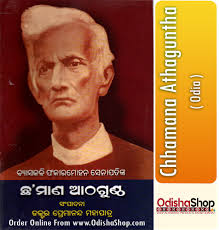
Odia literature is characterised by a profound tradition of classic narratives, with notable examples such as Fakir Mohan Senapati’s timeless Chha Mana Atha Guntha[1]. This literary corpus is further enhanced by an array of mythological and folk narratives that hold significant importance in the cultural legacy of Odisha.
These narratives persist through time because they reflect universal human experiences, encompassing themes such as land, power, family, and morality, all while being intricately linked to the historical context and cultural identity of the region. They serve not only as stories but also as reflections of society, having been shaped and refined over the years.
Readers are consistently attracted to these literary works for reasons similar to those that draw us to the writings of Shakespeare or the epic narrative of the Mahabharata: their themes are enduring, and the insights they provide remain pertinent. Similarly, publishers and curators, even at the national level, often revisit these classic tales, a trend that is entirely justifiable.
However, it is the transition to contemporary matters that strikes a significant chord. Odia literature has been progressing, albeit perhaps not as prominently or visibly as certain other Indian literary landscapes. Modern voices are addressing current issues—urban isolation, the influence of technology, caste relations, and environmental deterioration. The change is evident, yet it remains less pronounced than it has the potential to be.
What accounts for this? There may be multiple reasons.
The literary tradition of Odisha is profoundly embedded in its heritage. Classic literature is not only revered and taught but frequently eclipses modern works. Both publishers and readers exhibit a conservative inclination, preferring established texts. This trend is not unique to Odia literature; for example, Tolstoy remains a central figure in Russian literary discourse. As a result, this inclination obstructs the acknowledgment of new authors.
Modern Odia literature faces considerable challenges in its distribution. In contrast to Bengali or Tamil literature, which benefits from larger urban readerships and established translation networks, Odia books often struggle to reach broader audiences.
While digital platforms are making significant strides in this domain, the overall development is still sluggish. Without a strong market, numerous authors may opt to concentrate on more conventional themes that are viewed as more commercially viable.
The demographic composition of Odisha is primarily rural, where numerous readers find a stronger connection with stories that delve into village life or ethical dilemmas, as opposed to genres like cyberpunk or themes focused on existential angst. Although there are urban Odia authors, their readership is frequently limited in range. As a result, contemporary themes may seem alien to those who maintain a deep bond with traditional cultural settings.
The literary language of Odia typically possesses a formal tone, significantly influenced by its classical roots. This can lead to a conflict with modern terminology and global themes, posing challenges for writers who wish to innovate without jeopardising their connection to the audience. In contrast, languages such as Hindi and Malayalam readily incorporate colloquial expressions, which thrive in contemporary literature.
Nonetheless, modern Odia literature is dynamic and progressing. Short story writers are exploring a variety of topics including religion, science fiction, feminism, leftist ideologies, and climate change. Prominent authors such as Sarojini Sahu, Satya Mishra, Rabi Swain, Sadananda Tripathy, Jyoti Nanda, Bhima Prusty, Janaki Ballabh Mohapatra, Ajaya Swain, Biraja Mohapatra, Sujata Mohapatra and young writers like Debabrata Das are actively investigating these contemporary themes. Publications like Kadambini, Rebati, and Katha are offering platforms for these creative narratives.
Despite this, the main obstacle remains the need to improve visibility. Social media and over-the-top (OTT) platforms have the potential to revolutionise this landscape—just picture an Odia adaptation of Black Mirror[2]!
There is an immediate need for greater investment in Odia storytelling to effectively bridge the gap between traditional and modern narratives.
.
[1] Six acres and a Third, a novel by Fakir Mohan Senapati(1843-1918) published in 1902
[2]Black Mirror is a British dystopian science fiction television anthology series that started in 2011 and is still on the run.
.
Bhaskar Parichha is a journalist and author of Cyclones in Odisha: Landfall, Wreckage and Resilience, Unbiased, No Strings Attached: Writings on Odisha and Biju Patnaik – A Political Biography. He lives in Bhubaneswar and writes bilingually. Besides writing for newspapers, he also reviews books on various media platforms.
.
PLEASE NOTE: ARTICLES CAN ONLY BE REPRODUCED IN OTHER SITES WITH DUE ACKNOWLEDGEMENT TO BORDERLESS JOURNAL
Just the other day, a visitor to my home made a remark. She observed that my cat, Felix, was staring into the horizon while sitting by the glass window. Felix seemed unfazed by the activities within the house, instead focusing his gaze on the neighbour’s gate. In front of the neighbour’s compound stood a few stray cats, returning his stare. It resembled a kind of staring competition.
The visitor remarked that Felix might be looking at all his stray friends on the other side of the fence, envying their lifestyles. They could roam freely whenever they wished, accompanied by their pack of friends. Wherever they rested their heads was their home. Moreover, they did not have to endure his fortnightly baths or grooming. Oh, how Felix loathed those cold showers and the bare feeling afterwards when there was not enough fur on his Persian body to lick, beautify, and flaunt. As for the food… throughout his life, the only sustenance he consumed was in pellet form. The occasional lizards and insects he hunted down with the remnants of what his dormant DNA offered were swiftly intercepted by his owners. This is why Felix the Cat was often seen engaged in forlorn glances, brooding over his seemingly helpless situation.
In response, I told the visitor that Felix’s feline friends on the other side of the fence would likely feel the same way. They would be gazing at him with eyes brimming with envy. If only they grasped a bit of philosophy, they would be yelling, “life is not fair!” Here sits Felix in the comfort of the house, in an aesthetically pleasing environment shielded from the harsh forces of weather and nature, with love overflowing all around, soothing tactile stimuli to caress and rub against him, protected from noxious ailments, and safeguarded against prancing predators and cruel individuals discontented with their presence or their annoying mating calls.
They would probably pray to swap places with a house cat in their next life. Felix, were he to believe in rebirth, would likely yearn to roam free without being tethered—symbolically, of course, as cats are not leashed, a privilege they possess over their fellow domesticated ‘friends’, the dogs!
That is life, is it not? No one is truly satisfied with their existence. Everyone believes the grass is greener on the other side of the fence. What they may fail to grasp is that it appears greener because the soil is fertilised with manure. One must endure the stench of excrement to appreciate the outcome. The poor man looks at his wealthy neighbour and assumes that once he secures that coveted high-paying job and some money, everything will be splendid. Meanwhile, the rich man gazes at the poor, reminiscing about his long-lost days of poverty when life was simple and sleep was undisturbed.
Poet Kannadasan[1], in one of his many wisdom-filled compositions, envisioned a situation: the snake, a natural prey of the eagle, residing upon Lord Shiva’s neck, haughtily sneering at Garuda[2] and inquiring if he was well. The snake, securely nestled in the protection of the Lord, knows that Garuda cannot harm him. Garuda responds that everyone would be just fine if they were in the place they are meant to be. Kannadasan then quotes the Tamil poet Avvaiyar[3],who asserted that the world respects you when you hold a prominent position. When you stumble, even your shadow will defy you. I believe the essence of the message is to accept and appreciate what one possesses in life. Unrealistic expectations lead only to disappointment, whilst acceptance fosters contentment.
.
[1] Kannadasan (1927-81), also known as Kaviarasu (King of Poets) is considered one of the greatest Tamil poets.
[2] A legendary divine eagle-like bird who is the mount of Vishnu.
[3] A Tamil woman poet (supposed to have lived in the first century BCE) from the Sangam period (300BCE – 300 CE).
Farouk Gulsara is a daytime healer and a writer by night. After developing his left side of his brain almost half his lifetime, this johnny-come-lately decided to stimulate the non-dominant part of his remaining half. An author of two non-fiction books, Inside the twisted mind of Rifle Range Boy and Real Lessons from Reel Life, he writes regularly in his blog, Rifle Range Boy.
.
PLEASE NOTE: ARTICLES CAN ONLY BE REPRODUCED IN OTHER SITES WITH DUE ACKNOWLEDGEMENT TO BORDERLESS JOURNAL
Ratnottama Sengupta tracks the journey of Leslie Carvalho over a quarter century
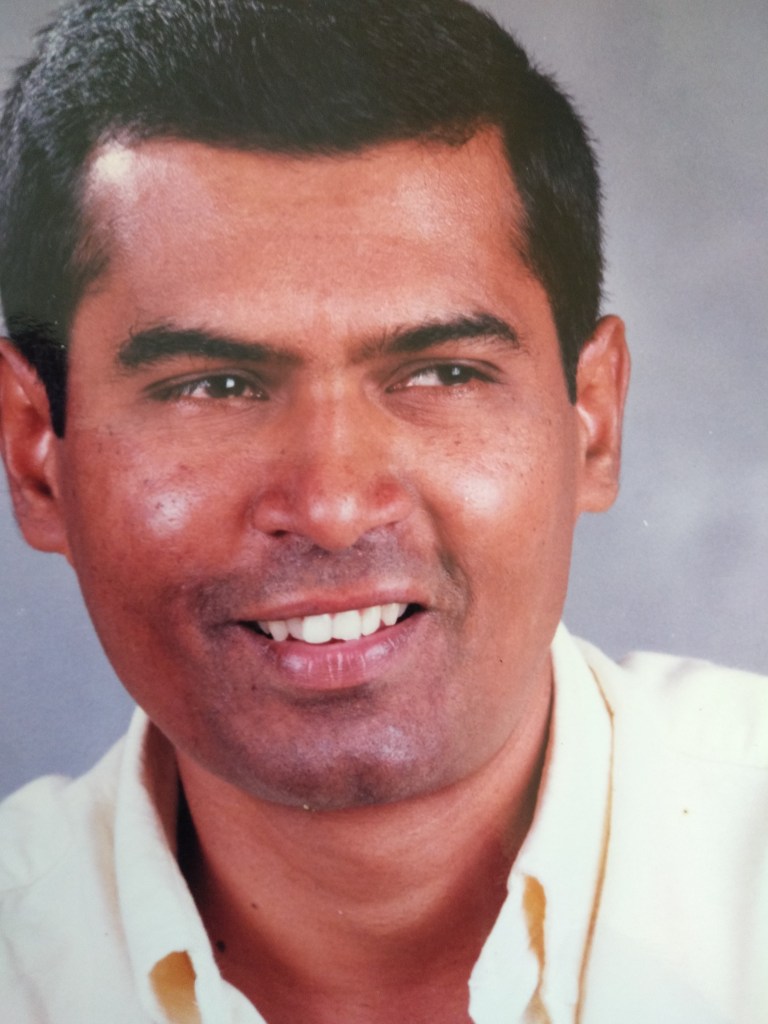
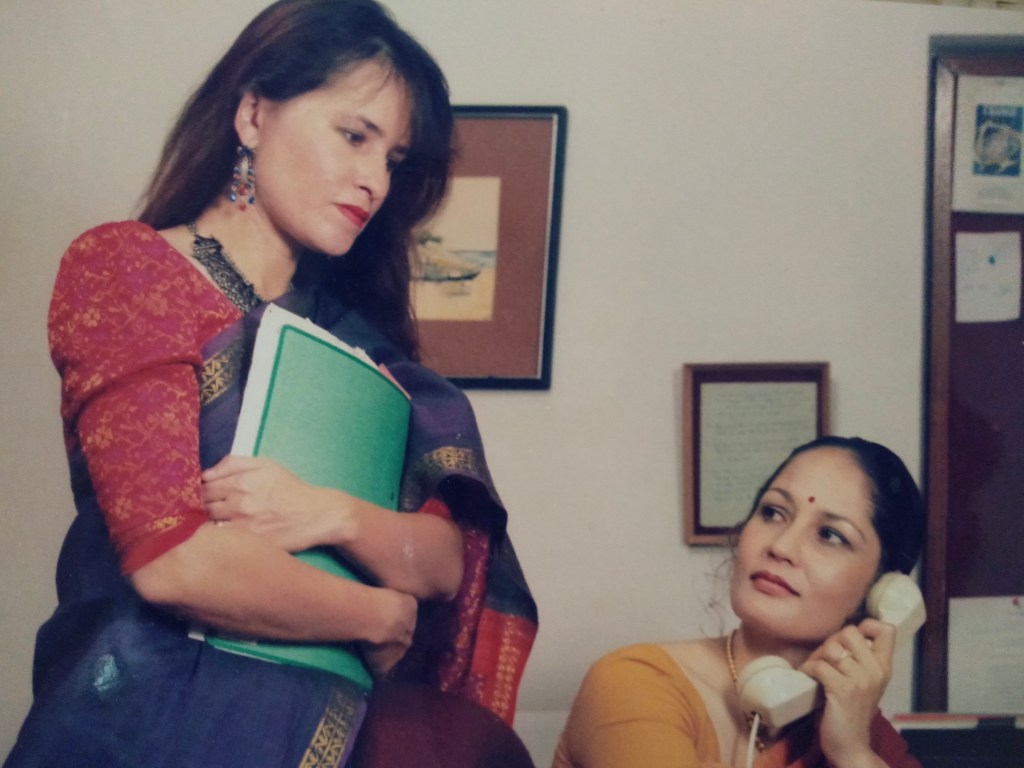
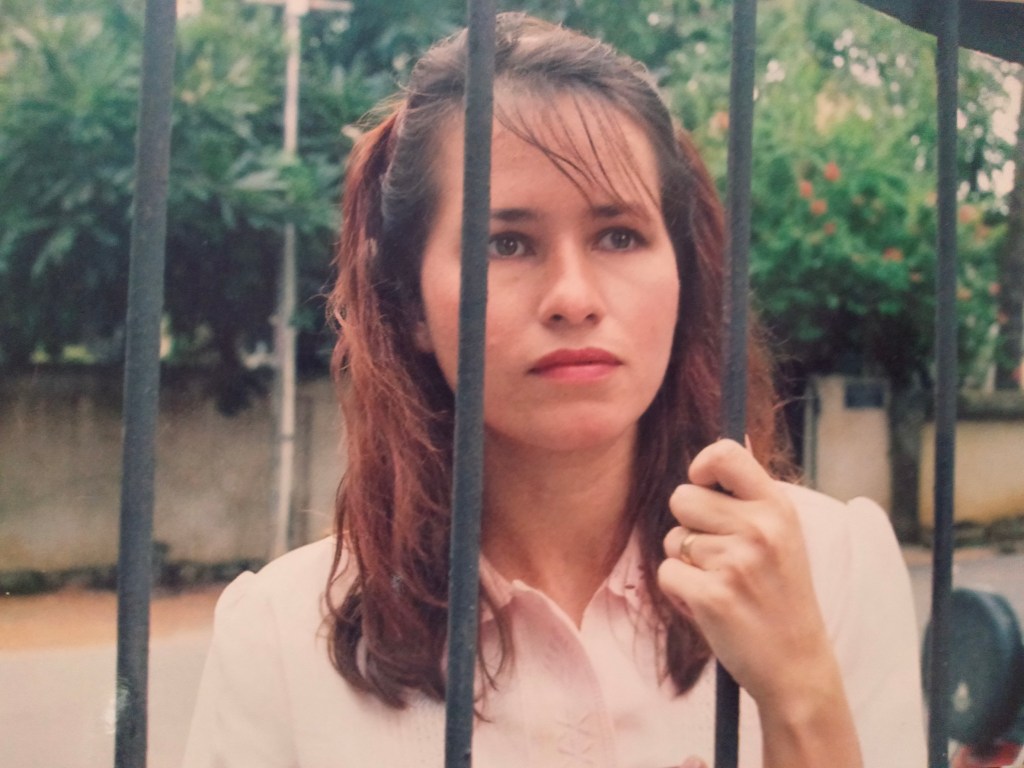
Leslie CarvalhoPhotos provided by Ratnottama Sengupta
It seems like only the other day. The International Film Festival of India, IFFI, 1998 was on. Along with a colleague, I was seated on the steps outside Siri Fort I auditorium connected to a long corridor going to Siri 2. Someone introduced Leslie Carvalho. “Aha! The young filmmaker from Mangalore?” I responded. “There’s a write up on you in The Times of India today. It says there’s a lot of expectation from The Outhouse.”
The “delightfully sweet” film had lived up to the expectation of the critics. It was bestowed the Aravindan Puraskaram, presented by the Kerala Chalachitra Film Society to commemorate the iconic Malayalam director, and the first Gollapudi Srinivas award, another national level award to recognise filmmakers marking their debut in Indian cinema. So I was not surprised to meet him next as a co-member of the jury for the National Film Awards 2000.
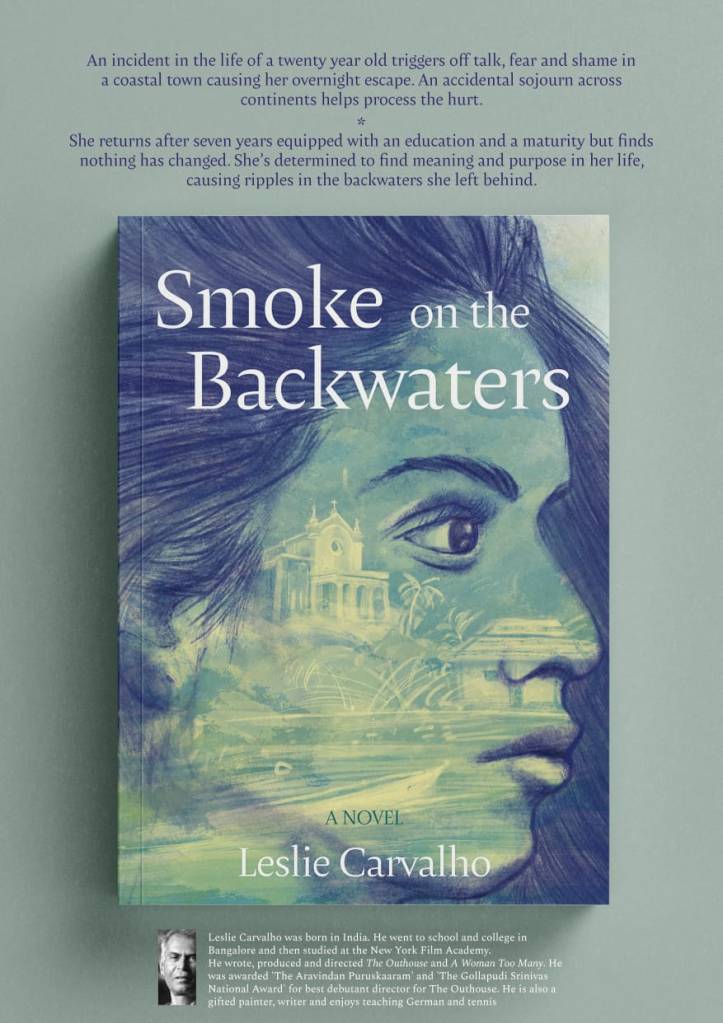
The Tennis coach who is also a German language teacher with a passion for painting has now published his first novel, Smoke on the Backwaters. It centres on Rosa, a twenty-year-old from Mangalore, who is forced to flee overnight because of the storm of gossip, fear and shame unleashed by a single incident in her life. Her unexpected journey across continents becomes a path of healing. Seven years later, armed with education and maturity, she returns home, determined to pursue her purpose in life. But how much had the town she left altered from its old ways?
RS: Leslie, before we talk Backwaters, can we briefly revisit The Outhouse? From where did you derive its content? And what was your compulsion for choosing that subject?
Provided by Ratnottama Sengupta
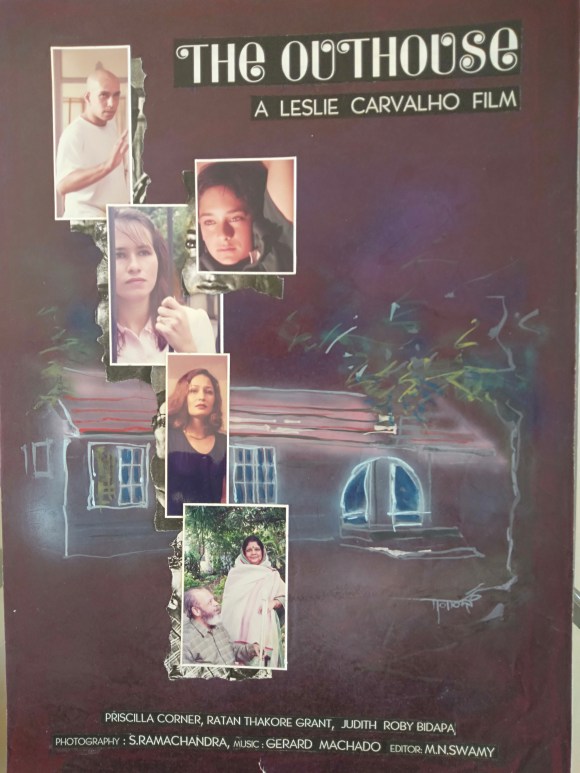
LC: The Outhouse was a simple, linear narrative about moving on in life despite the odds. A young mother’s need to gain economic independence to supplement the family income; the help she received from her financially independent sister; a kind hearted Bengali landlady’s generosity which causes stress and violence in the Anglo-Indian couple’s day to day life, and how it affects the two children growing up.
RS: Why did you choose this subject as your debut vehicle? If you were to travel in a time machine, would you choose a ‘mainstream’ subject?
LC: I chose this subject as my debut vehicle as I had seen quite a bit of violence in the Anglo- Indian community in the Lingarajapuram area of Bangalore I grew up in.
I was itching to make a movie after my six-month course at the New York Film Academy. As I was working on a very tight budget, I just stuck to what was taught — to keep it simple, straightforward and just tell a story using the various tools of cinema — in short, to make it cinematic.
If I were to go back in time, I don’t think I would have chosen a ‘mainstream subject’. I derived immense satisfaction along with the cast and crew as we felt we were working on something we were passionate about. We all felt drawn towards the characters, the story and the theme of the film.
RS: How did you get interested in cinema? And what were the problems you faced while filming The Outhouse – in terms of funding, casting, shooting location, distribution?
LC: I grew up watching Tamil, Kannada, Hindi, a couple of Konkani and lots of Hollywood films. My mother tailored clothes at home, and she taught a whole lot of women stitching. They were fans of Tamil cinema, especially of Sivaji Ganesan, MGR, and the heroes of Kannada cinema, Dr. Rajkumar and Vishnuvardhan. She also enjoyed the Hindi films of Rajesh Khanna, Dharmendra, Hema Malini, Amitabh Bachchan, Sanjeev Kumar, Jaya Bhaduri and Rekha — that is the popular cinema.
And my father, being an Army person, took us to see English films, like The Ten Commandments, The Bible, Hatari, To Sir, With Love[1]. Also, St. Germain’s School where I studied, screened English films every Friday afternoon in the Hall, from spools off a projector that made a jarring sound. It was an amazing experience — black and white Charlie Chaplin, Laurel & Hardy films and also Patton with all the bad words. Later, when in college, we would bunk classes to watch most of the popular Hindi and English movies.
At the New York Film Academy, I was exposed to an entire range of the world’s best in cinema. Satyajit Ray, Akira Kurosawa, Ingmar Bergman, Antonioni, John Ford, William Wyler, Fellini, Jean Renoir… And I watched a whole lot of films on the American Movie Chain (AMC). There I discovered all of Spencer Tracy’s films and fell in love with his sense of timing and under playing. It was also a time when I discovered Guru Dutt and marveled at his brand of filmmaking from Pyaasa, Kaagaz Ke Phool, Chaudhvin Ka Chand, Sahib Biwi Aur Ghulam to Aar Paar and Mr & Mrs 55[2].
It is hard to believe I began the shoot for The Outhouse on September 18, 1996, and completed it in 14 days – on October 1. After we went through the rushes, we required two more shots to link the gaps. Since I was on a shoestring budget of a few lakh rupees, I had rehearsals with the cast for close to three months. I doff my hat to them in gratitude as 90% of the film was canned on first takes. I could not afford retakes, and I worked with a brilliant cameraman, S Ramachandra, who was very supportive and encouraging. He shot most of B V Karanth, Girish Karnad, and Girish Kasaravalli films as well as the popular tele-serial Malgudi Days[3]. A number of first-time directors like myself, had benefitted immensely by his generosity and patience.
Since it was an independent film, whatever little finance I had, I sunk into the film. And then it took me a year to complete post-production for lack of finance.
I was particular about the casting. I wanted the Anglo-Indian look, feel, mannerisms, costume, interiors to be authentic. I met each cast member and spoke to them at length about the vision I had for my film. Almost all of them were from the Bangalore English Theatre, and all of them were cooperative. Moreover, Cooke Town is a quaint little place with many English bungalows and outhouses. After some struggle, I found one on Milton Street which suited my story perfectly.
After The Outhouse was selected for the Indian Panorama in IFFI ’98 and received the two national awards, I just walked into Plaza Theatre on MG Road in Bangalore and met the owner, Mr Ananthanarayan. He had heard about the film and asked me to meet the distributor, Nitin Shah of Hansa Pictures in Gandhi Nagar, the biggest distributor of English films. He put it on for a noon show for three weeks while Fire was on for the matinee and evening shows. The distributor then put it in Mangalore and Udupi for a week. And when I received the Gollapudi Srinivas National Award in Chennai, Aparna Sen was one of the honoured guests. She saw a small portion of the film and said that she would speak to Mr Ansu Sur to screen it at Nandan in Kolkata — founded by Satyajit Ray to help screen small independent films. A theatre owner in Kolkata recommended a person who took the film to the North East. It was also screened in parts of Kerala.
Coincidentally, this April 30th, The Outhouse will be screened in the leafy neighbourhood of Cooke Town next to the outhouse where the film was shot.
Still from The Outhouse, provided by Ratnottama Sengupta
RS: In the last 50 years we have seen films by directors like Aparna Sen, Ajay Kar, Anjan Dutt. Even before these, Ray had touched upon Anglo Indians in Mahanagar. These are all films made in Kolkata. Is it because this is the erstwhile capital of the Raj?
LC: Many of the films on Anglo-Indians were based in Calcutta. It was the influence of the British Raj and its culture that was so much a part of their long history of ruling there. Of course their influence was in other parts of the country as well like Madras, Hyderabad, Bangalore, Whitefield and Kolar Gold Fields, the railway colonies all over the country, the hill stations, and many other cities which has pockets of Anglo-Indians.
RS: I remember one Hindi film, Julie that had an Anglo-Indian protagonist. How has the community been projected in popular culture? Was it lopsided or biased?
LC: Throughout our film history Anglo-Indians have played bit roles here and there. Some significant roles came their way in Bhowani Junction, the teleserial Queenie, 36 Chowrighee Lane, Bow Barracks Forever, Bada Din, Cotton Mary, The Outhouse, Saptapadi, Mahanagar, Julie, and Calcutta I’m Sorry[4].
Some of the characterisations have been quite biased; some not well fleshed out; some in passing fleeting moments of drunkenness, prostitution. The song and dance sequences have not helped the community, sadly.
RS:What led you to writing? The screenplay for The Outhouse?
LC: I wrote the screenplay of The Outhouse on plain A4 sheets of paper, on both sides. This is not done but I did it to save on cost. I gave the screenplay to my cinematographer S. Ramachandra, and in his generosity he understood my purpose. I went by what was taught at the New York Film Academy. Of course, I had to combine all the elements to make it whole. The idea of the screenplay came to me while I was at the film school in 1995.
RS: What was the trigger for writing Smoke in the Backwaters?
LC: As an artist, filmmaker, and writer, I have tried to combine all the elements of story-telling – fact and fiction — keeping in mind the flow of ideas, pace and momentum to engage and interest my audience and readers.
I remember beginning to write the novel two decades ago when my mother — who studied in Kannada medium — said, “I hope you will write it in simple English so I can read it too.”
And I wanted it to be reader friendly with regard to the font size, the brightness of the paper, the spacing, the clarity and the size of the book. I was lucky my publisher ‘Anglo-Ink’ was supportive and combined well to find that centre.
Provided by Ratnottama Sengupta
RS: How are you marketing the book? Through Litfests? Bookstore readings? Airport bookstalls? A H Wheelers?
LC: Since Anglo-Ink is a small-time publisher, we’ve had a dream launch in my hometown Bangalore at the Catholic Club. My book seller is Bookworm on Church Street in the heart of Bangalore and for people in Cooke Town it is in The Lightroom’ library.
We are looking at launches in various cities as well, through book readings, LitFests, Airport book stalls, AH Wheelers, readings at schools and colleges.
Since a major portion of the novel is set in Germany, we are looking at translating it into German. I hope to get it translated in a few Indian languages as well.
RS:Since the sunset decade of 1900s, Anglo Indians have been migrating to Australia and Canada. What triggered this migration? Economics or politics?
LC: The migration of Anglo-Indians was inevitable. It was bound to happen for reasons more than one, be it political, economic or social. First under the ‘Whites Only’ policy, many fair skinned Anglo-Indians migrated — the brown and dark skinned were left behind. Slowly they opened up and even they left. Some felt they would adapt better to a western culture, and have adopted their new country as their homeland.
RS:You were a big support for me when my son joined NLSUI in 2000. Again, when I curated Anadi, the exhibition of paintings by Contemporary and indigenous artists from MP and Chhattisgarh. Bangalore has since become an international megalopolis. How has life changed for the locals?
LC: Bangalore has changed dramatically and drastically. The change was bound to happen because of its growing prominence of an International City. The IT industry brought jobs, slowly other industries, started picking up from real estate, fashion, digital technology and social media platforms, start-ups, academics, sports, games, recreational and tourism.
The moderate climate was a huge bonus that attracted people from all over. Bangalore has always been cordial, encouraging and accommodative of people from all over through their mild manners, hospitality and gentleness.
Today Bangalore is unrecognisable. Still, some pockets retain that old world charm of neat, clean and green Bengaluru from the old Pensioners Paradise of Bangalore.
.
[1]The Ten Commandments (1956), The Bible (1966), Hatari (1962), To Sir, with Love (1967)
[2]Pyaasa (Thirsty, 1957), Kaagaz Ke Phool (Paper flowers, 1959), Chaudhvin Ka Chand (The Full Moon, 1960), Sahib Biwi Aur Ghulam (The Master, the Wife and the Slave, 1962), Aar Paar (This shore or that, 1954), Mr &Mrs 55 (1955).
[4]Bhowani Junction (1956), TV miniseries Queenie (1987), 36 Chowrighee Lane (1981), Bow Barracks Forever (2004), Bada Din (1998), Cotton Mary (1999), Saptapadi (Seven Steps, 1981), Mahanagar (The Big City, 1963), Julie (1975), and Calcutta I’m Sorry (2019)
Ratnottama Sengupta, formerly Arts Editor of The Times of India, teaches mass communication and film appreciation, curates film festivals and art exhibitions, and translates and write books. She has been a member of CBFC, served on the National Film Awards jury and has herself won a National Award.
.
PLEASE NOTE: ARTICLES CAN ONLY BE REPRODUCED IN OTHER SITES WITH DUE ACKNOWLEDGEMENT TO BORDERLESS JOURNAL
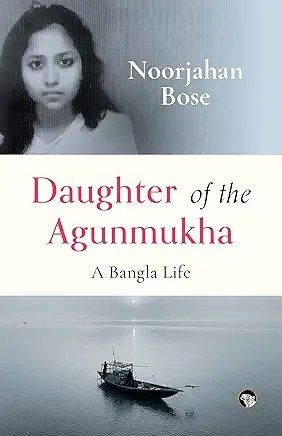
This memoir recounts the journey of a young woman from a small island in Bangladesh who discovers the works of Tagore, Marx, and de Beauvoir, ultimately emerging as a prominent advocate for feminist causes.
Noorjahan Bose is a feminist author, social advocate, and activist resides between the United States and Bangladesh. She is the founder of two organizations based in the US aimed at empowering South Asian women: Ashiyanaa (previously known as ASHA) and Samhati. Rebecca Whittington serves as a literary translator specialising in Tamil, Bangla, and Hindi.
The narrative of Daughter of the Agunmukha[1] intricately weaves the life story of Noorjahan Bose, a remarkable woman whose journey is marked by resilience, courage, and an unwavering quest for freedom. Born in 1938 in a rural area of what is now Bangladesh, Noorjahan’s early life was deeply intertwined with the rhythms of nature and the struggles of her family, who were farmers living in close proximity to the tumultuous River Agunmukha, ominously referred to as the Fire Mouth River. This river, with its fierce currents and unpredictable nature, serves as a powerful metaphor for the challenges Noorjahan would face throughout her life.
From a young age, Noorjahan was thrust into a world of hardship and trauma. She endured sexual abuse at the hands of male relatives, a harrowing experience that left deep emotional scars. Compounding her struggles was the influence of her mother, who, having been a child bride herself, was often constrained by the societal norms and expectations of their time. Despite her own limitations, Noorjahan’s mother became a beacon of hope and creativity in her life. She instilled in Noorjahan a sense of joy and the importance of self-expression, encouraging her to explore her talents and dreams even in the face of adversity.
As Noorjahan grew older, her thirst for knowledge and personal freedom became increasingly evident. Education, however, was not easily accessible to her. The societal barriers and gender discrimination prevalent in her community posed significant obstacles to her academic pursuits. Yet, with the unwavering support of her mother and the encouragement of local activists who recognised her potential, Noorjahan began to carve out a path for herself. These activists, driven by a vision of social justice and equality, played a crucial role in empowering her to challenge the status quo.
Emboldened by her experiences and the solidarity she found in progressive movements, Noorjahan’s journey took her beyond the borders of her village. She became an advocate for women’s rights, using her voice to speak out against the injustices faced by women in her community and beyond. Her activism not only transformed her own life but also inspired countless others to join the fight for equality and empowerment.
As she traveled the globe, Noorjahan encountered diverse cultures and perspectives, each enriching her understanding of the world and deepening her commitment to social change. Her experiences abroad further fueled her passion for education and advocacy, leading her to collaborate with international organisations dedicated to uplifting marginalised communities.
Noorjahan’s life has been marked by significant hardships, beginning with the anguish of Partition, followed by the loss of her husband when she was merely 18 and expecting a child. Additionally, she faced the relentless threat of cyclones that jeopardised her family’s home and means of survival. Despite these challenges, her bravery is evident throughout her memoir. She advocated for the rights of the Bangla language in East Pakistan, navigated the tumultuous period of Bangladesh’s Liberation War (1971), and entered into a marriage that transcends her family’s religious boundaries.
This poignant and compelling narrative encapsulates a profound journey of trauma, loss, resilience, and empowerment.
Bhaskar Parichha is a journalist and author of Cyclones in Odisha: Landfall, Wreckage and Resilience, Unbiased, No Strings Attached: Writings on Odisha and Biju Patnaik – A Political Biography. He lives in Bhubaneswar and writes bilingually. Besides writing for newspapers, he also reviews books on various media platforms.
.
PLEASE NOTE: ARTICLES CAN ONLY BE REPRODUCED IN OTHER SITES WITH DUE ACKNOWLEDGEMENT TO BORDERLESS JOURNAL
It’s again that time of the year when we have fun spooking each other with stories of ghosts and haunting. While festivals of light1 and darkness vie with each other for a spot on the same date, observances to pay our respects to our forefathers follow at their heels, some before and some after.
In this selection, we bring to you narratives that could be dark, strange or funny or all of these … a selection of poetry, fiction and non-fiction from around the world. Enjoy the reads!
The Ghosts of Hogshead: Paul Mirabile wanders into the realm of the supernatural dating back to the Potato Famine of Ireland in the 1800s. Clickhere to read.
Nagmati: Prafulla Roy’s long story based on strange folk beliefs has been translated from Bengali as Snake Maiden by Aruna Chakravarti. Click here to read.
From Public Domain
.
Deepavali or festival of lights is on October 31st this year along with Kali Puja and Halloween. October 30th is Bhooth Chaturdashi, or Indian Festival of Ghosts while All Saints’ Day and all Souls’ Day are observed at the start of November. Early October hosted Pitri Paksha, observances for apeasing forefathers in India. ↩︎
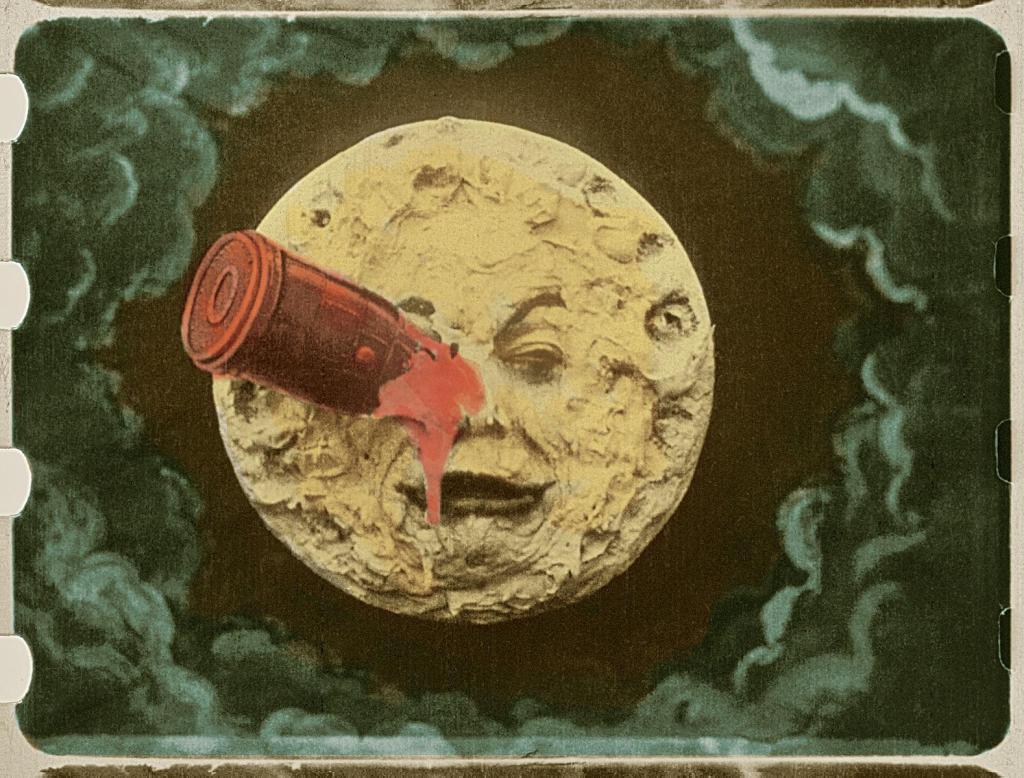
From A Trip to the Moon, a 1902 film by Georges Méliès (1861-1938). From Public Domain
A teacher lost all her life savings, around RM 200,000, to spammers. Over 400 children were rescued from orphanages in two states from sexual predators in Malaysia. Stories like these are not ground-breaking anymore but happen on a daily basis. The worrying trend of late is that these are no isolated incidents perpetrated by individual wackos with ill intents. It is, in fact, a well-organised, well-lubricating establishment with vast tentacles lurking all over the globe.
The brains behind all these schemes are super intelligent, erudite people who can judge what is good and what is evil. They are also aware of what is beneficial and what is detrimental and brings misery. Yet, these same people wilfully devise newer schemes to prey on people’s weaknesses year after year.
They know how every action has an equal and opposite reaction. They understand what goes around comes around. Yet, without an iota of guilt, they carry on life.
Is the lure of materialism too strong to resist? Is the power that money yields too compelling that it becomes an addiction? Is this business a quicksand too strong to extricate one out of? Like a politician trapped in a quagmire that needs to feed his cronies, perhaps this scamming business is multilayered and needs to be fed at many levels, from mafias to enforcement units.
Only the conscientious person worries and regrets any of their deeds. He will have sleepless nights pondering and regretting his actions. He would fear its implications or pursuant legal ramifications. He would shudder to visualise how it hurt his reputation or embarrass his family.
So, when people say humanity lives in each of us and that there is still goodness in the world, are they correct? Are we all innately evil and only conditioned to behave in a particular way because our wise ancestors told us so?
Have we developed a consciousness so advanced that we can justify all our devious actions? We say the people who lost their hard-earned savings can afford to lose some. It is all part and parcel of the circle of life’s ups and downs, karma, warts and all. It is a zero-sum game. One party loses for the other to live. Life is not fair, and we have to live with it. Nature is hostile and humans are part of nature. Our duty, first and foremost, is that we are obliged to take care of ourselves and our own at all costs. In the meantime, the conscientious brood over the evil that is spewed throughout the world. They make their lives purpose to correct the balance. They yearn for equality and social justice and lose valuable sleep over it.
Meanwhile, fraudsters and psychopaths cheat without an iota of guilt. They justify all their crimes. In fact, they feel entitled to do what they do and obtain inner gratification from their manipulations. On the other hand, the conscientious ones constantly assess and reassess their actions, aiming to do the correct thing. These thinkers carry much guilt and regret. They consider their own actions and try to do the ‘right’ thing.
This topic is nothing new. It was tackled by the legendary Tamil philosopher-poet Valluvar[1]. His origin is hazy, but many parties claim him to be part of their tradition. He was probably a Jain-Hindu poet. His short couplets are recited daily by most primary schoolchildren in Tamil schools. These couplets generally talk about righteousness, love and wealth. He sarcastically comments in one of his lines (Kural #1072), “Blessed are the cheats who do not think about good and bad.”
[1] Dated to have lived between 4th and 5th century BC
Farouk Gulsara is a daytime healer and a writer by night. After developing his left side of his brain almost half his lifetime, this johnny-come-lately decided to stimulate the non-dominant part of his remaining half. An author of two non-fiction books, Inside the twisted mind of Rifle Range Boy and Real Lessons from Reel Life, he writes regularly in his blogRifle Range Boy.
.
PLEASE NOTE: ARTICLES CAN ONLY BE REPRODUCED IN OTHER SITES WITH DUE ACKNOWLEDGEMENT TO BORDERLESS JOURNAL
“Limitless and immortal, the waters are the beginning and end of all things on earth.” -- Heinrich Zimmer, German Indologist and linguist
Little Varshita has an inborn affinity for proximity to water bodies. A June-born Cancerian, she eagerly looks forward to short walks along the Marina Beach in Chennai – the second-largest urban beach in the world. Five-and-a-half years old now, she is a prodigy eagerly looking forward to starting school next year. Whether her genius owes itself to nature or nurture or both, is difficult to say. It can be mentioned here that both her parents are teachers. She also possesses a very high emotional intelligence for her age. Perhaps there is a connection here to the aforementioned affinity for proximity to water bodies. Perhaps not.
“We were there two days ago, Varshita. Can we go tomorrow instead?” Her father Ramesh who wants to watch a cricket match on television at home, smilingly attempts to dissuade her.
“Okay, no problem, Appa. Can I watch Animal Planet then this evening? If they show fish and crabs and whales and sharks and dolphins and orcas and octopuses and squids and seals and penguins….and….my-aunties?”
“Your aunties? Are Periyamma[2] and Aththai[3] going to be seen swimming, on Animal Planet?” Ramesh asks with a wink and a smile, eagerly expecting a response from Varshita.
“Noooo…M.A.N.A.T.E.E.S…” She hurls a pillow playfully at Ramesh, realising that he is pulling her leg.
“Ah, I see! Those creatures which are also called sea-cows.”
“Are they also called sea-cows, Appa? I did not know that. Now I do. But I knew sea-lions.” Ramesh is happy that he has invested in his daughter’s knowledge bank. Perhaps, his sister and sister-in-law are not going to be very happy if Varshita decides to share the joke with them. His sister especially does not have a sense of humour.
“Do not share this joke with your aunties, Varshita.”
“I promise, but in return you have to take me to the beach three times next week,” she says matter-of-factly.
“Done! Good girl!”
Varshita looks at Ramesh and knows that she has somehow gotten her way, tactfully. Little girls wiser than men; cleverer too, thinks Ramesh, recalling the Leo Tolstoy story about Akulya and Malasha[4], he had read in school in the ninth grade.
.
The waters of the Bay of Bengal are calm. Waves, longing for contact with the littoral sands, swoosh against the shore. Even though there are many people there on the beach, they seem to be observing silence in deference to the Sea-God. Varshita tends to speak less when out on these walks. She watches Mother Nature intently, listens carefully to Her sounds, and once in a while her curiosity leads her to ask a carefully-thought-out question. Ramesh does his best to reply, and whenever he is not able to find an answer instantly, he makes it a point to put the question on the back-burner, give it serious thought, and get back to Varshita with the answer. At times, that is even a day or two later. Once in a while, there are unanswerable questions hurled at him. Being a senior lecturer at the Indian Institute of Technology, he is used to this practice. After all, his daughter is also his student – a special one at that.
“Appa, is it okay to throw a chocolate wrapper into the water?”
“No, Varshita. It is not. One must not pollute the environment.”
“But then why are there so many things lying around here? That is bad, right?”
“Yes, it is. Very much so. But maybe, people will learn not to do so, and when you are an adult, you will see that the beach is perfectly clean.”
She looks up, nods and smiles.
“Appa, when the waves come and take all these things into the sea, what happens to them?”
“ A good question, Varshita. Many things which you see lying here are harmful to the animals which live in the water. All the animals you like seeing in the Animal Planet.”
“I will not throw anything, Appa, when I come here with you to walk.”
Ramesh and Varshita do a high-five, and Ramesh tells her that he is very proud of her.
The blue sky starts turning grey and some clouds float in. Precisely at that moment, Varshita sees a little girl with a sack on her back, and a stick in her hand, bending down and picking up a plastic bottle.
“Appa, what is she doing?”
“She is doing a very good thing. People throw things, and this little girl is collecting them, so that they do not get dragged into the sea to cause harm to the animals living in it. There are many people like her in our city. They are poor, yes. But we have to be thankful to them for what they do for us.”
It starts drizzling, and Ramesh tells Varshita that they have to head home. She keeps looking sideways at the little girl with the sack, as they walk away from the sea. Unanswered questions, for sure, start piling up in that four-and-a-half-year-old brain of hers.
.
Rains reign in Chennai for the next three days. Varshita knows that she cannot compel Ramesh to take her out to the beach for a walk. Ramesh however remembers the promise, and keeps checking the weather forecast every day. On Thursday, he tells Varshita that it is going to be sunny for four days at a stretch.
“So, can we go the beach tomorrow, the day after and the day after the day after?”
He chuckles, realising that his daughter remembers the promise in letter and spirit.
“Why are you laughing?”
“Because I am happy to go to the beach three evenings in a row with you. We must also ask Amma[5]to come along.” He winks, and they do a high-five.
“Yes, that will be fun. But Amma is afraid of the waves.”
“We will help her to get over her fear. But you must convince her to come with us.”
“Yes! I take on that challenge,” she says.
Ramesh’s wife Megha works as a school-teacher. She picks up Varshita daily from the kindergarten on her way back home from school. “Amma, are you interested in coming to the beach tomorrow evening with me and Appa?’
Megha looks at Varshita and studies the expression on her face. She realises that the last time she was out with Ramesh and her for a walk on Marina Beach, was over a month ago. She agrees.
“You do not seem really interested,” says Varshita.
Megha is taken aback. “How can you say that?”
“It is written all over your face,” Varshita says.
Megha bursts out laughing. “Well, whatever is written on my face, I will join you both tomorrow. That is a promise.”
“Yes!” Varshita does a V-sign this time.
.
Friday evening happens to be just the perfect time to be out on Marina Beach. Yes, there are some stray clouds, but they do not seem to be in a mood to discharge their content in Chennai. Some other place is destined to receive rainfall from them.
Megha, Ramesh and Varshita buy three ice-creams, and walk down closer to the shore. Megha spreads a large plastic sheet, and they sit down on it. Varshita remembers the little girl with the sack on her back she had seen on the previous weekend and starts looking around. Call it intuition or what you will, she spots her about 50 metres away. The girl spots a big plastic bottle floating on the water, but is a bit wary of the waves advancing to the shore.
“Appa, can I go and help her to retrieve that plastic bottle? I like getting my feet wet in the water.”
Megha glares at Ramesh and nods her head from left to right, signalling to him that he must not give in to Varshita’s request. Ramesh winks at Megha. “I will go with her. Do not worry.”
The father-daughter duo walks towards the girl, and Ramesh tells Varshita to go and talk to her. She is as tall as Varshita is, and may perhaps be a little older than her. Not more than six years old, for sure.
“You want to get that bottle?”
“Yes, but I am afraid of the waves.”
“I will get it for you. Wait here.”
Varshita looks at Ramesh, who gives her the thumbs-up sign. The little girl notices that and smiles.
Varshita takes off her slippers, and leaves them beside her father. “Take care of them, Captain, till I come back.”
Courtesy: G Venkatesh
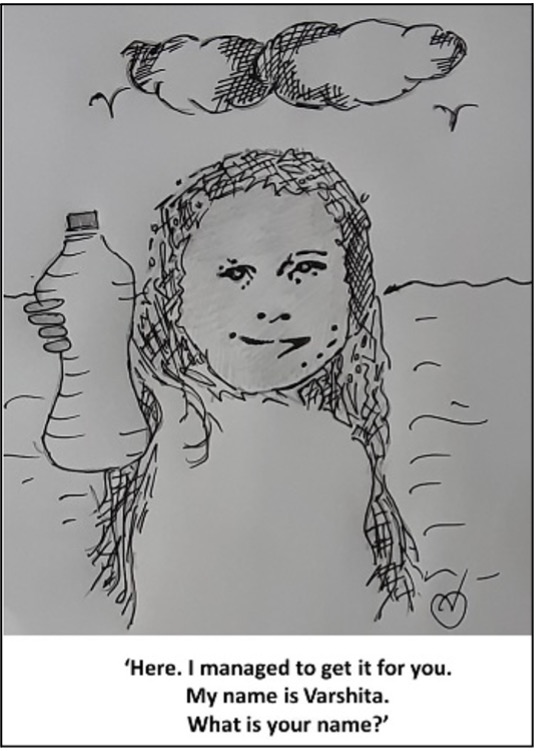
Laughing aloud, she wades two metres into the sea when the nearest incoming wave is still a few metres away. She retrieves the bottle, turns and walks up to the girl, and says, “Here. I managed to get it for you. It was easy. My name is Varshita. What is your name?”
The girl smiles gratefully, accepts the bottle, and drops it into her sack. “My name is Mary. You are not afraid of the waves, Varshita?”
“I used to be.” She points to Ramesh and continues, “Appa told me not to be. He said that we must be careful, not afraid. But you know what, Amma is still afraid.”
“You visit the beach daily, Varshita?”
“Appa and I like to walk here sometimes. I love the sea. How about you?”
Mary looks into the distance. “I do not know if I love the sea or not. I just come here to look for things like these.”
“What do you do with them? Appa says that we must be thankful to all of you who clean up the beaches. He says that you help to stop damage being done to the fish.”
Mary smiles weakly. “You see my Amma there,” she points to a woman with a bigger sack hunting for treasures, about 100 metres away. “I will give these to Amma. Then my Amma and Appa will sell these and get money. Then we buy food and eat.”
Varshita listens intently, as she always does. “You like ice-cream, Mary?”
“Yes, I ate an ice-cream long ago. On Christmas Day.”
“Wait here,” says Varshita. She runs to where Ramesh is guarding her slippers, puts them on, and runs to her mother. “Amma, can I give my ice-cream to Mary over there? I just helped her to get that plastic bottle.”
“I saw you doing that, dear. I am so proud of you. Yes, you can give her your ice-cream. It is melting away slowly. Ask her to eat it quickly.”
Varshita grabs the ice-cream cone and runs towards Mary with a cherubic smile of her face. “Here, Mary. Your second ice-cream.”
“Have you eaten?”
“I will eat Amma’s. She usually does not eat her ice-cream and ends up giving it to me.”
“Will you be coming tomorrow, Varshita?”
“Yes, that is the plan. And the day after tomorrow also.”
“At this time?”
“Yes, and you?”
“I am not sure. I go with Amma wherever she goes. If she chooses to come here, it will be at this time.”
“What is that you are wearing around your neck?” Varshita asks, pointing to the little crucifix.
“Oh, this one. This is Jesus. Our God. I got this on the same day I ate my first ice-cream.”
Mary’s mother is calling out to her from a distance. “I am so happy that you got me the bottle and then gave me your ice-cream. You are a good person. Can we be friends?”
Varshita smiles cutely, and extends her hand for a handshake. Mary reciprocates, puts her little sack on her right shoulder, holds the stick in the right hand and the ice-cream in the left, and hurriedly walks towards her mother.
“Eat the ice-cream quickly. It will melt away,” shouts Varshita.
“Yes, I will,” Mary shouts back.
.
The next day, Mary’s mother decides to take her to a stretch of the beach further away. The day after that, Varshita feels a little unwell and the trip to the beach is called off. The two girls never meet each other again in Chennai.
But as we already know, God’s ways are mysterious. Many years pass, before they meet again in Bengaluru in a public school. One in her capacity as the mother of a girl named Sarah, and the other in her capacity as Sarah’s science teacher.
The van suddenly went quiet. Night had fallen and our driver was negotiating the bends and turns in the road carefully. The yellow fog lights cut through the mists lighting up the dense forests on both sides. We were in Idukki district in the western ghats of the southern Indian state of Kerala. This region is called the high ranges. Areas above 600 m in height from the mean sea level in the central Travancore region of Kerala have rich biodiversity and a cooler climate. The weather was beginning to get colder.
We were ill prepared for the cold as we were students from Thrissur in the plains, where it was always hot and sticky. The road continued over the top of a dam. The security officer wanted to talk to us in person before letting us through. We boldly rushed out in our slippers and lungis[1] only to return at double the speed to the warmth of the van. It was freezing outside. The short but intense exposure to the cold may have frozen many vital organs. During winter, the temperatures here can dip to around 4 degrees Celsius once the sun goes down.
We were on a college trip to Idukki while studying for our undergraduate medical (MBBS) course. We had visited Thekkady and Peeramede and planned to spend the night in the hill station of Munnar. The trip was long and tiring as we drove through the mist along winding roads. The night in the hotel was freezing but we managed with the clothes we had, and the blankets provided by the hotel. The steaming tea with cardamom was the highlight of the morning. We hungrily gulped down several cups to chase away the cold.
I eventually completed my MBBS and got an offer to work at a hospital in the high ranges. The place was Ellakkal at a height of about 1100 to 1200 m. The road diverted from the main highway to Munnar at a place called Pallivasal, the site of one of the earliest hydropower stations in Kerala. The village is also known as the gateway to Munnar. The area had a mix of Malyali and Tamil culture. Many poor families from Travancore had migrated to Idukki in search of land and better prospects. Tamil families had migrated too. The nearest village to Ellakkal was Kunchithanny (little water in Tamil). I had seen a similar system of naming places after water in Nepal. There was Kalopani (black water), Ratopani (red water), Ghorepani (where horses are watered) and Tadapani (far water) among others.
St Xavier’s hospital where I was working was situated up an incline from the main road. The location was spectacular. The hospital was established in the 1960s and was once the only source of medical care for a large region but now several clinics and hospitals had been established in towns and villages. The view across the valley was breathtaking. In the evening the mist slowly moved down the valley eventually reaching the river far below. The thickly forested green hills draped in thick white mist that slowly cleared as the Sun gained in strength was the highlight of my mornings! The hospital was run by the Medical Sisters of St Joseph and owned several acres of land on the hill. They grew coffee and cardamom and other spices. My quarters were a newly constructed annexe to an old house situated halfway up the hill. The view from the veranda was spectacular. I used to spend my afternoons and evenings drinking in the magnificent views and reading my books and magazines. The hospital still exists and provides affordable health care to the people.
Dr Rodney Sebastian, the other doctor at the hospital had graduated from Kottayam Medical College. He was from the high ranges and a devout Christian. Many evenings there were prayer meetings at the hospital and people from the neighbourhood participated. The convent for the nuns was nearby. There was an old nun who was fond of gardening. Flowers grew well in the rich soil and the cool, moist climate. Multi-coloured roses were the highlight of the garden. There was a priest (Father) who lived on the other side of the hill next to the church. The deep phut-phut of his Enfield Bullet as he rode to the hospital was distinct. This heavy motorbike has a solid presence and is stable to drive on rough roads and undulating terrain. My cousin brother used to also ride one.
In the mid-1990s there was no internet and no mobile phones. The hospital had a landline. We lived more in the moment. Letters were still an important means of communication. My mother used to say that the arrival of a letter was as good as the arrival of a person. I have not posted a letter for a long time now choosing to go with email, voice chat, Skype and WhatsApp. During those days these were, however, all in the future. I never imagined the changes that would happen during the next two decades when I began working at Ellakkal.
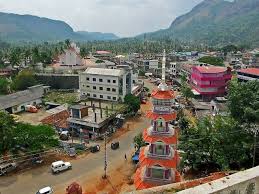
Iduppi townEllakkal WaterfallFrom Public domain
We mostly had outpatients though we did admit people. Most of the admissions were for fever. Leptospirosis[2] was common. We also had X-ray facilities, and we sutured many wounds mostly caused by farm injuries. We did not handle surgeries and deliveries. We did not have any intensive care units and our lab investigations were basic.
We used to occasionally drop in to meet a doctor couple, Dr Verghese at Kunchithanny. His clinic was named John’s clinic, and he was called Dr Johnson by the locals. We knew some quacks, that is unqualified self-styled doctors, also practised in this area. The nearest big town was Adimali Adimali had a movie theatre, and a huge rock dominated the town. There were tribal settlements on top of the rock. The tribals were a deprived community. Long distance buses as local transport was something peculiar to the high ranges. The buses started from the town of Ernakulam over a hundred kilometres away and reached the high ranges through Kothamangalam. The buses had glass windows and were comfortable. Ellakkal was on the route to Rajakkad (literally the King’s Forest). There were many places named after rocks (para in Malayalam). Poopara (Flower rock), Santhanpara, Chaturangapara viewpoint were the most prominent.
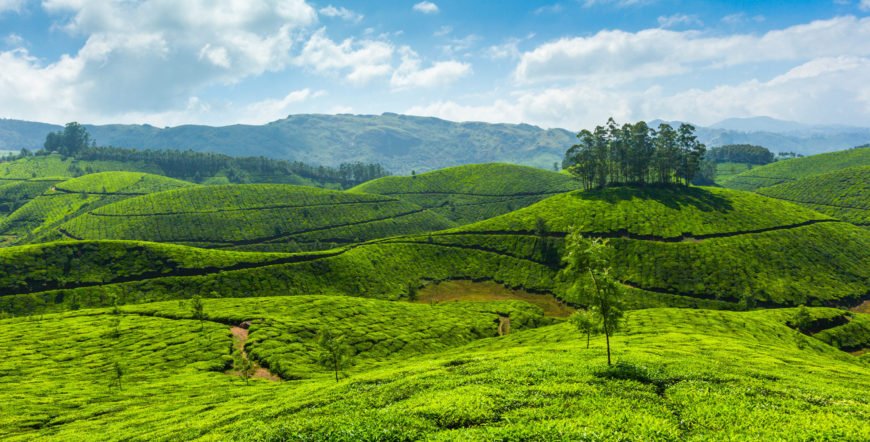
Munnar was famous for heavy, dense white fogs that were almost opaque. The place was covered by a heavy mist most afternoons and evenings. The mist began a few kilometres from the town. Drinking cups of cardamom flavoured tea in the cold mist was a highlight of my visits to the place. The restaurant also served crisp dosas. We went on a trip to the Eravikulam National Park which took a lot of planning as both of us (Rodney and I) would be away from the hospital for over eight hours. Some of our local friends accompanied us. The route was through rolling Kanan Devan hills and expansive tea gardens.
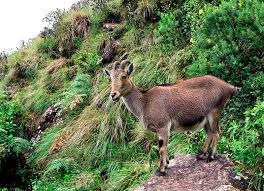
Nilgiri Tahr. From Public Domain
The hills are owned by Tata Tea, and they grow the famous Kanan Devan brand of tea. I used to remember their advertisements starring the megastar, Mohan Lal. The park is famous for the Nilgiri Tahr. I remember it also for the leeches. We were badly set upon by them and the bites bled for over twelve hours. Once I also took a bus ride with my cousin to Maraiyur near the Tamil Nadu border. The route was through spawling tea estates. Maraiyur was an end of the Road Town those days. The place was famous for sandalwood. The security checks were strict to ensure people did not decamp with a few thousands of rupees worth of sandalwood in their pockets.
I visited Ellakkal once more after I left toward the end of the last century. The ensuing three decades must have brought about a lot of change to this spice garden. Tourism has boomed and Idukki district is a prime tourist destination. Internet has made steady advances and cable TV is now common. Several resorts have opened, and the roads have improved. They have opened a hospital called Morningstar. The pace of life has quickened with all the city folks coming to escape from their hectic city lives. Someone once said about Munnar and I quote, “In Munnar, time slows down, allowing us to savour every moment, appreciate the present, and find joy in
[2] A blood infection caused by contaminated water and soil
.
Dr. P Ravi Shankar is a faculty member at the IMU Centre for Education (ICE), International Medical University, Kuala Lumpur, Malaysia. He enjoys traveling and is a creative writer and photographer.
.
PLEASE NOTE: ARTICLES CAN ONLY BE REPRODUCED IN OTHER SITES WITH DUE ACKNOWLEDGEMENT TO BORDERLESS JOURNAL
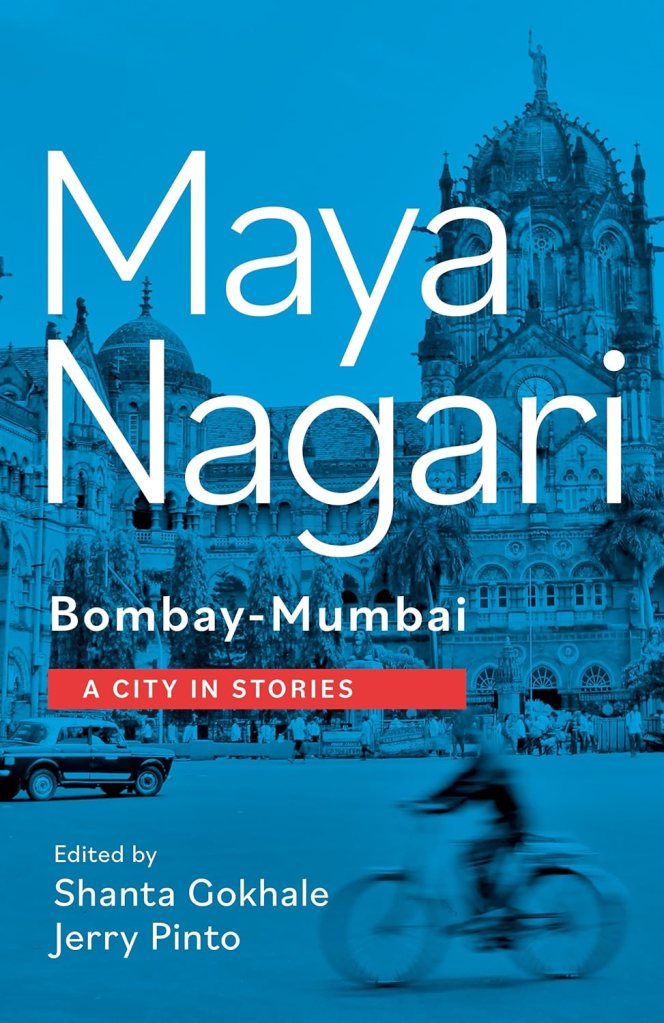
Title: Maya Nagari: Bombay-Mumbai A City in Stories
Editors: Shanta Gokhale, Jerry Pinto
Publisher:Speaking Tiger Books
The very mention of the name Mumbai (or Bombay) brings to our minds a great city in India where the thriving metropolis grows at a rapid speed because people not only flock here from different parts of the country to make quick bucks and survive against all odds, but also because the film industry of Bollywood has also established it as a city of dreams, one that never sleeps and instead creates a mirage-of-sorts — an illusion, rightly labelled by the editors of this anthology as ‘Maya Nagari’. Edited by Shanta Gokhale and Jerry Pinto, this book, comprising twenty-one short stories about Mumbai takes the road less taken to create a non-uniform image of the metropolis. In tune with its multicultural and multilingual nature, we have stories about the city that is a sea of people and speaks at least a dozen languages. There are stories translated from Marathi, Urdu, Gujarati, Tamil, Hindi, Kannada, Malayalam, and stories written originally in English. Among the writers are legends and new voices—Baburao Bagul, Ismat Chughtai, Pu La Deshpande, Ambai,Urmila Pawar, Mohan Rakesh, Saadat Hasan Manto, Ambai, Jayant Kaikini, Bhupen Khakhar,Shripad Narayan Pendse, Manasi, Krishan Chander, Udayan Thakker, Cyrus Mistry, Vilas Sarang, Jayant Pawar, Tejaswini Apte-Rahm and Anuradha Kumar.
As Jerry Pinto clearly states in the introduction, the stories can be read as we like, we can begin with the first story or the last, or any story in between. The observant reader might notice that he and the other editor Shanta Gokhale have deliberately chosen not to organise the material according to chronology, or geography. This is partly because they believe that the city lives in several time zones and spaces at once, as does India, but also because there is something essentially chaotic about its nature. So, he says, “the stories echo and bounce off each other, they do not collide, but there is a Brownian motion to these patterns” and he hopes to let the readers find it. Here, Mumbai is stripped of its twinkle; it is deglamourised to reveal how it’s the quotidian that lends the city its character—warmth and hostility alike and as inhabitants of the city the editors call ‘home,’ they hope a narrative will emerge.
In the twenty-one stories of this collection, there is the city that labours in the mills and streets, and the city that sips and nibbles in five-star lounges, the city of Ganapati, Haji Malang and the Virgin Mary. What binds the stories together is ‘human muscle’ – the desperate attempts of men and women of all classes and castes to survive in this heartless city amid all odds.
The stories are of different lengths and written in different narrative styles. Of the five or six stories translated by Shanta Gokhale herself from Marathi, one is struck by the excessive length of the so called ‘short’ stories. The very first one “Oh! The Joy of Devotion” by Jayant Pawar, forty-five pages in length, narrates in detail about the Ganapati festival and how it is related to the fate of the local people. Pu La Deshpande’s story “A Cultural Moment is Born”, set in the 1940s, tells stories of people living in chawls [slums] and how they spend their cultural days. Another very long story translated by Gokhale called “The Ramsharan Story” tells us about the rise and fall of a bus conductor by the name of Ramsharan who turns out to become a union leader. Baburao Bagul’s “Woman of the Street”, written originally in Marathi and translated by Gokhale again, tells the story of Girija, a sex-worker trying to collect money to cure her son in the village. The story ends on a disturbing note, as it reaffirms the relativity of success.
Once again, Krishan Chander’s story “The Children of Dadar Bridge” translated from Hindustani by Jerry Pinto is so long that it qualifies to be called a sort of novella. In this powerful story God comes to earth to a chawl and offers food to the first-person narrator. Then, impersonating as a small and innocent child, and along with the child narrator, he moves around different places in the city to witness its activities firsthand — we get to know about behind the scene affairs that take place in the film studios, about satta[1] dens, about bribery, local dons who arm-twist every new hawker to carry on their business after receiving their weekly cut money and more. In “Civic Duty and Physics Practicals”, Malayalam writer Manasi reveals the different experiences one comes across living in a society defined by power equations. Issues of hooliganism, superstition, illegal colonies, corruption, intimidation and violence are explored in a single story where the narrator is struggling, for days, with blaring speakers at a wedding nearby, even as her son tries hard to prepare for his upcoming exams. The story soon takes a dark turn where power trumps over consideration for fellow human beings.
A very powerful story written by Ambai in Tamil called “Kala Ghora Chowk” deals with issues of Marxist ideology, trade unions and the fate of a raped woman called Rosa. Anuradha Kumar’s “Neera Joshi’s Unfinished Book” tells us the life story of one woman who “made the city” and the perennial problems of displaced mill workers when the closed mills give way to high-rise buildings. Some of the stories are of course written in a lighter vein, though they also depict different problems related to city life. As the title of Vilas Sarang’s story “An Afternoon Among the Rocks” suggests, it narrates the plight of a couple trying to make love in the deserted seashore and how they get hijacked by a smuggler! In “The Flat on the Fifth Floor”, Mohan Rakesh writes about two sisters who meet the narrator after one failed love affair. A moving picture of the closing down of cinema halls in Mumbai comes out very beautifully in the Kannada story “Opera House” by Jayant Kaikini, especially narrating the plight of one of the sweepers working there when the declaration of permanent closure is pasted everywhere. Tejaswini Apte-Rahm’s “Mili” tells the story of a man who meets his ex-girlfriend after five years.
Though it is not possible to give the details of each and every story included in this anthology in this review, one must mention some of the stories that were originally written in English. Cyrus Mistry’s “Percy” about a young and lonely Parsi boy is so compelling that it was even made into a Gujarati motion-picture. “House Cleaning” by Jerry Pinto tells the story of a woman cleaner and his son, who talks about the reality of street dwellers. Eunice de Souza’s “Rina of Queen’s Diamonds” is not a straightforward narration at all but offers a collage of different vignettes of life in Bombay.
Though most of the stories portray the seamier side of life and in some ways de-glamourise Mumbai, at the same time they also portray how human resilience can combat all sorts of odds, and the city can be revealed only through shared experiences. Thus, each of the twenty-one stories in this collection tells a different tale of Mumbai, Bombay, Momoi, Bambai, Manbai and many others. As the editors have rightly pointed out at the beginning of their introduction, “You cannot catch a city in words. You cannot catch a city at all.” They felt that “it is not meant to be caught…this city resists even more because it was not designed at all; it just happened and it keeps on happening.” Thus, the four-hundred plus pages of this anthology Maya-Nagari remains a book to be treasured and read now at leisure and also at any time in the future.
When I was growing up, the radio was the musical score constantly playing in the background. Blaring between Tamil movie songs and radio dramas were news of the hour and current issue discussions. The things that got imprinted on my impressionable mind as I was transforming from a teenager to a young adult were about violence, wars and bombings. I remember about the war in Vietnam as it was close to home. For every peace talk and the end of war announcement, there would pop up another bombing and a barrage of casualties. My simple mind wondered when the war would end, but it never did. It went on for so long that they had a Tamil film in 1970 named Vietnam Veedu (House of Vietnam), referring to a household forever in family feuds and turmoil.
Along with the war in Vietnam, people came by boat to the shores of Malaysia. The then leaders, in the late 1970s, dealing with a poor economic climate as they were reeling from a devastating racial riot, were not so cordial with their arrival. Malaysia went into the bad books of the international arena when the Marines were issued a ‘shoot-at-sight’ order on Vietnamese boat people by the then Deputy Prime Minister, Mahathir Muhammad. The refugees were eventually placed in barb-wired concentration camps-like holding centres. The last of the boat people left Malaysia in 2005. Even today, many former refugees who had started life anew elsewhere return to Pulau Bidong to perform ancestral worship or to remind themselves and their descendants of the hell they escaped.
Just as I thought Malaysia had seen the last of the people displaced from their homes gracing their shores, Malaysia had to play host to economic refugees from Myanmar, the ethnic Myanmarese and the Rohingyas. And the cycle of not wanting to spend the country’s precious resources and accepting them on humanitarian grounds continues to date.
My ever optimist friend is dreaming of a utopia on Earth. Her idea of utopia is one where people are kind to each other, not hurling grenades or aiming intercontinental missiles at each other and accepting each other’s citizens with open arms. In fact, in her world, there would be borders. She dreams of a world where people are happy, able to enjoy the fruit of their existence, a world where there is no destruction of Mother Earth and none of the species of plants and animals go extinct. She envisages a space where everyone communicates with one another with kindness without hurting their psyche. The search is still on, where people do not look at each other with scorn and suspicion and are willing to accept another as a fellow sibling from a common mother. She dreams of a borderless world where heart, mind and territories are a continual flow of ideas and messages for the betterment of humankind. Unfortunately, despite all the strides the world has seemingly made, she remains unhappy and is getting more discontent by the day.
“Why is there so much hate? Why is there war after all the wisdom we have supposedly learnt as evidenced by our scientific advancements?” she asks. “Are we just developing creative ways to annihilate each other until the whole race reaches the point of no return?”
I see our newspapers and digital media. I became convinced that humans are evil and anthropocentric. They do not bother about other living beings. They are only interested in fending for themselves, fattening themselves, usurping treasures and fattening their coffers, and rapaciously wanting to leave a legacy for their descendants to savour to eternity. In typical situations, the world can accommodate all of Man’s needs, but not their greed.
Innately, I reminisce about the times when I was young, trees were tall, the air was clean, and adults were trustworthy. We long to go back to those innocent days.
Upon closer scrutiny, we realise we were presented with a false image of serenity. Beneath the surface of sobriety, even then, trenches were built to gun down brothers and chemical factories to neutralise them biologically. We think we are in the worst of times, but historians differ. Our current era is the most peaceful and safest throughout our existence. The chance of an average man in the current time, unlike his ancestors, to be directly involved or affected physically by wars is quite remote.
Our ancestors did not need the media to know the world’s plight because it often happened at their doorstep. The swords carved out people’s fate line, not consensus or democracy.
Life is cyclical. Peace and chaos have alternated all through our history. Like a phoenix, we keep rising from the rubble of destruction only to be broken to smithereens. Torrents of events around us bear testimony to this fact. It has been like this since time immemorial.
There was a time when Angkor Wat was the talk of travellers who could not stop praising man’s colossal achievement. With mind-binding engineering marvels, it testified to what the human mind could think next. Then, it got lost in the folly of human activities, only to be discovered as an ancient relic by passing foreigners.
Isfahan, an essential stop along the Silk Road, was once hailed as heaven on Earth with the highest level of culture. People with exquisite taste for art, literature, music and architecture made it their second home. Babur, who established the Mughal Dynasty, never synced with India as he felt the Indians were less cultured than the Persians because of what he was exposed to in the Safavid capital. Isfahan’s own glory brought its destruction.
All through Man’s sojourn on Earth, it has been anything but peaceful. The funny thing is that, amid all the destruction, we still managed to bring up our humanity and the science that would save us from extinction. In spite and amidst all the mayhem, we kept famine at bay, found cures for many infectious diseases and sent rockets to the moon and beyond. Paradoxically, the science that saved us becomes a thorn in our progress. From muskets to rifles to intercontinental missiles to the press of a red button, it is becoming easier to plan out our destruction.
So, the world has never been peaceful, and humans have not been kind. What can we do about it? Do you brood at our shortsightedness, or are we like Sisyphus? Knowing pretty well that, Sisyphus destined for life with the punishment of pushing a boulder up a hill only to see it roll down and for him to repeat the whole exercise again and again, he can take two paths. He can perform the task without thinking, like an automaton, go mad and die, or the alternative is finding simple pleasures in the seemingly mundane task. He could challenge himself to do it faster, explore newer routes to roll the boulder or experiment with various tools to aid in his task.
We continue doing our bit for humanity, knowing very well that it is just a drop in the ocean. Our efforts to promote peace and brotherhood will trigger small pockets of change and hopefully snowball into something earth-shattering for a good reason.
War, hardship and tragedy are bound to continue. It is too intertwined in our DNA. Many are even convinced that for seismic changes to occur, we need jolts and uncertainties. All these wars may be part of our search for a perfect system to pave Earth’s peace. A war to end all wars? Now, where have we heard that one before?
All through its existence, the Universe has seen it all before. If one were to believe Graham Hancock, the documentary maker or a pseudo-historian as some may call him, then one would be convinced that the world has experienced all these and even greater things before, only to lose everything because of human greed. Some other belief systems are confident that time does not go in a linear fashion but rather in a cyclical fashion. All that is happening today gives the Universe a deja vu.
.
Farouk Gulsara is a daytime healer and a writer by night. After developing his left side of his brain almost half his lifetime, this johnny-come-lately decided to stimulate the non-dominant part of his remaining half. An author of two non-fiction books, Inside the twisted mind of Rifle Range Boy and Real Lessons from Reel Life, he writes regularly in his blog, Rifle Range Boy.
.
PLEASE NOTE: ARTICLES CAN ONLY BE REPRODUCED IN OTHER SITES WITH DUE ACKNOWLEDGEMENT TO BORDERLESS JOURNAL









 Borderless