Poems of Longing by Jibananada Das homes two of his poems translated from Bengali by Professor Fakrul Alam. Clickhereto read.
Four cantos from Ramakanta Rath’sSri Radha, translated from Odiya by the late poet himself, have been excerpted from his full length translation. Clickhere to read.
Naramsetti Umamaheswararao takes us back to school. Click here to read.
Conversation
Ratnottama Sengupta talks to filmmaker and author Leslie Carvalhoabout his old film, The Outhouse, that will be screened this month and his new book, Smoke on the Backwaters. Clickhere to read.
Offerings during Qing Ming Jie, a festival honouring ancestorsSongkran(Thai New Year) CelebrationsFestivals in April: From Public Domain
April is a month full of celebrations around the world. Asia hosts a spray of New Year festivities. Then there are festivals like Qing Ming Jie, Good Friday and Easter. All these are in a way reminders of our past. And yet, we critique things as old fashioned! So, where does tradition end and ‘outdated’ or ‘outmoded’ start? Meanwhile we continue to celebrate these festivals with joy but what happens to those who have lost their home, family and their living due to war or climate disasters? Can they too join in with the joie de vivre? Can we take our celebrations to them to give solace in some way?
In our April issue, we have stories from climate and conflict-ridden parts of the world. From Bangkok, Amy Sawitta Lefevre gives an eyewitness account of the March 28th Earthquake that originated in Myanmar. While in her city, the disaster was managed, she writes: “I’m also thinking of all the children in Myanmar who are sleeping in the open, who lost loved ones, who are feeling scared and alone, with no one to reassure them.” As news reels tell us, in Myanmar there have been thousands of casualties from the earthquake as well as shootings by the army.
From another troubled region, Pakistan, Zeeshan Nasir gives a heartrending narrative about climate change, which also dwells on the human suffering, including increase in underage marriages.
Human suffering can be generated by rituals and customs too. For instance, if festivals dwell on exclusivity, they can hurt those who are left out of the celebrations. Odbayar Dorje muses along those lines on Mongolian traditions and calls for inclusivity and the need to change norms. On the other hand, Devraj Singh Kalsi hums with humour as he reflects on social norms and niceties and hints at the need for change in a light-hearted manner. Farouk Gulsara makes us laugh with the antics of his spoilt pet cat. And Suzanne Kamata dwells on her animal sightings in Kruger National Park with her words and camera while Meredith Stephens takes us sailing on stormy seas… that too at night.
Art is brought into focus by Ratnottama Sengupta who introduces artist Haren Thakur with his adaptation of tribal styles that has been compared to that of Paul Klee (1879-1940). She also converses with filmmaker Leslie Carvalho, known for his film The Outhouse, and his new novel, Smoke on the Backwaters. Both of these have a focus on the Anglo-Indian community in India. Also writing on Indian film trends of the 1970s is Tamara Raza. Bhaskar Parichha pays tribute to the late Ramakanta Rath (1934-2025), whose powerful and touching poetry, translated from Odia by the poet himself, can be found in our translations section.
We have an excerpt from Professor Fakrul Alam’s unpublished translation of Tagore’sRed Oleanders. It’s a long play and truly relevant for our times. Somdatta Mandal shares with us her translation of Tagore’s essay called ‘The Classification in Society’, an essay where the writer dwells on the need for change in mindsets of individuals that make up a community to move forward. A transcreation of a poem by Tagore for his birthday in 1935 reflects the darkness he overcame in his own life. Two poems expressive of longings by Jibananada Das have been translated from Bengali by Professor Alam aswell. From Balochistan, we have an excerpt from the first Balochi novel, Nazuk, written by the late Syad Zahoor Shah Hashmi and rendered into English by Fazal Baloch. Among contemporaries, we have a short story by Bitan Chakraborty translated from Bengali by Kiriti Sengupta, a poignant story that reflects on gaps in our society. And a Korean poem by Ihlwha Choi rendered to English by the poet himself.
This issue has been made possible because of support from all of you. Huge thanks to the team, all our contributors and readers. Thanks to Sohana Manzoor for her fabulous artwork. Do pause by our contents page as all the content could not be covered here.
Perhaps, world events leave a sense of pensiveness in all of us and an aura of insecurity. But, as Scarlett O’ Hara of Gone with the Wind[2] fame says, “After all, tomorrow is another day.”
Looking forward to a new day with hope, let’s dream of happier times filled with sunshine and change.
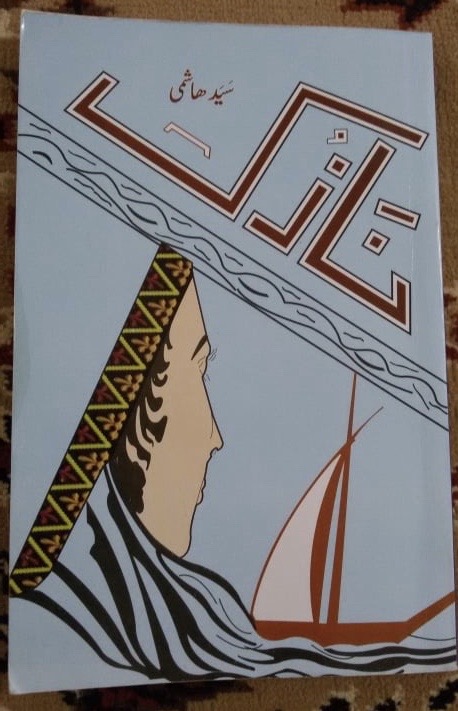
This is first chapter of the first Balochi novel that was published in 1976. It has been translated into Urdu and Persian. The narrative depicts everyday life and experiences of the people living around the coastal area of Makkuran especially Gwadar and its surroundings.
The cover of Nazuk. provided by Fazal Baloch.
For about a week, the weather had been pleasant, with a cool wind blowing across the sea—a true blessing for the fishermen. A calm sea meant loss for them, while a rough sea spelled devastation. Over the past few days, the fleet of fishing boats had been returning to the shore with plenty of catch.
The sun had completed three-quarters of its journey, racing through the sky like a messenger in haste in the final quarter. Its burning rays were yielding to the soothing coolness of the approaching evening. The long, serene shadows stretching behind the houses provided an ideal setting for a public gathering.
Away from the shore, an old voyager boat, anchored in the red sands, stood tall like a pyramid—a symbol of the unshakable bond between the boundless sea and its people. Who could say how many joyful and sad years the sea’s companions had spent navigating across its waters on that very boat? Though the sea often rocked their boat like a cradle, not once had these brave sons of the ocean furrowed their brows in fear or discontent.
The fleeting morning shadows soon vanished to the unknown but the evening shadows lingered longer, creeping towards the damp sands of the shore and eventually reaching the water, as if embodying the spirit of the giant old boat longing for the sea’s embrace to soothe its heart.
The shadow it cast offered an ideal venue for one of the biggest public gatherings in the evening. At times, it seemed as if people sitting on its plank were aboard the boat chatting to pass their time on a deep-sea trip. The cool breeze blew across reflected the pleasant weather at sea.
The wind had cooled the sands of the shore, making them so comfortable that those who lay on them forgot the comfort of even the most luxurious mattresses and cushions. Men, women, and children all came to enjoy themselves, especially today, which was more crowded than usual as it was Friday and no one had ventured into the sea for fishing the night before, giving the fishermen a day off.
For those who lived around the sea, there were only two vocations: fishing or navigating across the sea on a boat. And everyone acknowledged that sea navigation was one of the most cherished vocations in the world. Thanks to these navigations and explorations, humans had even set foot on the moon.
Navigation in the sea made fishermen exceptionally skilled and resourceful. They sailed from one country to another, learning about different lands and their people. Some sailors, despite being illiterate, exhibited such remarkable knowledge that even the learned were left in awe.
On the right, in front of a small roadside hotel, people sat on benches, sipping tea and chatting with each other. Some distance away, a group had gathered around a tall and smart man, listening intently to him. Let’s draw closer. Oh! He is Captain Naguman, moving his lips and hands alike. With his hands, he fidgets with a rope, perhaps knitting a net, while with his lips, he narrates the story of the First World War so enthusiastically as if he were a part of it himself. At that moment, someone called out from behind: “Captain! Hey Captain Naguman!”
Naguman turned around, shaking his head annoyingly, and said, “This jinxed fellow never lets me speak properly.”
“Captain! Hey Captain Naguman!”
The call came from inside the hotel’s kitchen, and from his voice, the Captain recognised him.
“Abdul is really a cursed man! Look how he disturbed the Captain in the middle of his speech,” someone said with rage.
“Exactly. He always jumps in during my speech,” Naguman turned somewhat dismayed.
“Hey Captain! Would you like tea? A cup of tea?” Abdul’s voice reached their ears again.
“If you’re going to give him a cup of tea, then bring it, you the cursed scoundrel,” someone whispered, and the Captain replied loudly, “Yes, bring it.”
Abdul immediately came and placed the cup before the Captain. He too sat down to listen. A few people from the audience cast side-glances at Abdul. The Captain smiled, sipped his tea, and resumed his speech, “Listen, you blind fishermen! Just in a single day, over a hundred planes swarmed in like locusts…”
A little farther away, a few women and children were sitting. Children were playing with the sands. The first woman was busy weaving a net, and the second one was keenly observing her. The third one was still pondering about what to do or say. The second woman said with great lament: “Mamma Papi didn’t help me weave a net. At least I could have moved my otherwise idle hands,” lamented the first woman.
“Move your hands or make some money?” replied the third woman, as if she had been waiting for the perfect moment to speak.
Papi raised her experienced eyes slightly, smiled gently, and stopped weaving the net and glanced around. When she was sure that nobody was looking at them, she retorted in a hushed tone, “The ‘Young Man’ wouldn’t let you bother yourself with work, dear Mahbalok!”
“Waiy waiy! Mamma Papi, don’t defame me,” Mahbalok said slowly, taken by surprise.
“Mamma Papi! Mamma Papi! Look there. He’s coming right here,” the third woman hastily whispered. No sooner had she uttered these words, Mahbalok became so edgy that she almost broke into a sprint.
But Mamma Papi let out a hearty laugh, then she threw the spool of thread and half-woven net on the ground. With both her hands, she held Mahbalok’s shoulders and said: “What happened to you, the cursed woman? Where are you going? Look, you’re even getting fooled by this little Hajok. I’ve had enough with you. You’re almost out of your mind,” exclaimed one of the women.
“Hajok! May the lord of the sea curse you! I’ve never seen such a jinxed woman in my entire life. Mamma Papi, by God, my heart almost sank,” Mahbok tried to maintain her unsteady breath.
“Waiy Mahbok! Hajok is your neighbor and best friend,” remarked Mamma Papi.
“By God, Mahbok, don’t tease me again. I wouldn’t like it,” Mahbok was yet to come to herself.
“It’s alright. Don’t open your basket-like mouth. Men are looking at us,” Papi warned them.
Rows of boats lined up along the arched shore, resembling horses ready for a race. It seemed as if riders had tightly held the reins and were waiting for the whistle to be blown. A few boys were playing tag behind those boats and yawls. On the left, some nets were placed on a plank.
“Come! They taste like halwa. Come! They’re fresh and hot,” Zalya shouted as if warning those who couldn’t get any that they’d only have to blame themselves. And it did the trick. In a moment, people swarmed around her cauldron. A while later, a young man and his friend called out to her:
“O, Mamma Zalya! Send us half a rupee worth of Mat, please.”
“Pindi, my son! I don’t have that much left. They’re barely worth twenty-five paisa.”
“It’s alright. Leave it.” Then he turned to his friend and said, “We’ll go to the bazaar and have tea with biscuits.”
Pindi and his friend Guli got up and made their way towards the bazaar. Two young men were playing Liddi. The game seemed to absorb to the duo as if it were the greatest challenge of their lives.
“Jalu! Jalu! Come on, boy. Pass this net to your uncle. Every day these blind fishermen return it damaged. They’ve spent their entire lives at sea, yet they can’t keep the net away from the rocks,” an old man, while weaving a net, turned to a boy sitting next to him.
“Jalu, my son! Go and get me your uncle Shahdost’s net.”
“Uncle, let me finish my peanuts first,” the boy replied indifferently.
“I’ll keep your peanuts. Get me the net first, then you can eat your peanuts.”
The boy slipped the peanuts into his pocket and scurried off. He returned almost panting and threw the net with a thud before his uncle.
He closely examined the net to determine the nature of the damage. Startled, he suddenly blurted out, “Such a new net! They have damaged it terribly,” he mumbled in anger. “They’re blind in both eyes. Neither do they know how to properly cast the net nor do they know how to untangle it.”
The sea was crowded. A few boys were playing tip-cat, and some other people were watching and enjoying the game. It’s played differently in different areas, but the version played in the coastal area is distinct. Some other boys were playing hopscotch. Two young boys were drawing sketches of fish, boats, and yawls in the sand with knife-like-sharp fish bones. A little farther away, a few young men were playing bazari. Two young men looked at them and tempted them, “You blind men! Is this the time to play this game? You’re flaunting your skills. We’ll challenge you to a match. Come tonight at the sands of Kala Teembok. We’ll show you how it’s played and won.”
A few girls were playing with beads, and some others were collecting salps[1]. It is believed that when you bury them in the ground, after seven days they will turn into beads provided no boy sees you burying them. On the seventh day, when they fail to unearth any beads, they wouldn’t turn dismayed. But at that moment, one of the girls would claim, “You know, Mami is a… he had been following us. He secretly watched us behind the wall. Thus, we couldn’t get beads.”
“Today I will complain to her mother,” the second girl replied.
“Anok! Anok! It’s better not to visit his mother.”
“Why, Jani?”
“Yesterday his father severely thrashed his mother… “
“Ah! But why?”
“You know Sayaki, the carpenter? She had visited his house.”
“May God keep us away from…”
Far in the distance, a woman called out, “Sharok! Come on, dear, look after the baby. I’ll be back from the bazaar just in a while.” Sharok, who was playing with beads, strode towards her mother. The youngest of them took all the beads from the girls, dismantled the holes, and chanted, “The game is over. Yes, it is all over.”
Two younger girls cried out, “Give us back our beads!” But by the time their sobbing subsided, she had already gone home. Determined, the two girls began digging through the holes again, hoping to find a bead hidden somewhere. However, there was nothing. Disappointed, they stood up and walked to the sea to wash their hands. Spotting other girls collecting salps nearby, they joined in, clinging to the hope that by the next Friday, the salps might somehow transform into beads.
The sun descended lower, casting the shore in hues of orange and gold. By sunset, the beach was nearly deserted, save for the men gathered around, engrossed in Naguman’s tale of the German War.
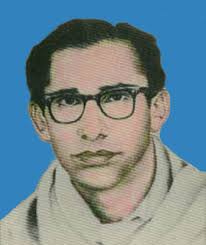
Sayad Zahoor Shah Hashumi (1926-78) is known as the pioneer of modern Balochi literature. He was simultaneously a poet, fiction writer, critic, linguist and a lexicographer par excellence. Though he left undeniable marks on various genres of Balochi literature, poetry remained his mainstay. With his enormous imagination and profound insight he laid the foundation of a new school of Balochi poetry especially Balochi ghazal which mainly emphasises on the purity of language and simplicity of poetic thoughts. This school of poetry subsequently attracted a wide range of poets to its fold. He also authored the first ever Balochi novel ‘Nazuk’ and compiled the first comprehensive Balochi-to-Balochi dictionary containing over twenty thousand words and hundreds of pictorial illustrations.
Fazal Baloch is a Balochi writer and translator. He has translated many Balochi poems and short stories into English. His translations have been featured in Pakistani Literature published by Pakistan Academy of Letters and in the form of books and anthologies. Baloch has the translation rights of this novel.
PLEASE NOTE: ARTICLES CAN ONLY BE REPRODUCED IN OTHER SITES WITH DUE ACKNOWLEDGEMENT TO BORDERLESS JOURNAL
Translations bridge borders — borders drawn by languages. We have showcased translations in multiple languages. Paying a tribute to all the greats, we invite you to savour a small selection of our translations.
Click here to check out our collection of Tagore’s writings translated to English. With translations by Aruna Chakravarty, Fakrul Alam, Radha Chakravarty, Somdatta Mandal and many more.
The witch is Aruna Chakravarti’s translation of a short story by renowned writer, Tarasankar Bandopadhyay . The original story titled, Daini, was first published in 1940 in Probashi magazine in Bengali. Click here to read.
A huge thank-you to all our contributors and readers across the world.
Borderless Journal has contributors from all the marked areas in the world map.
Borderless Journalwas launched on March 14th, 2020, exactly one year ago, with eight published pieces from four countries. Today, we celebrate our journal’s year-old existence with more than six hundred publications online from 31 countries across the world. All this would not have been possible without the commitment of some very gifted writers. So, we have made a couple of additions to our ‘About Us’ — Writers in Residence and the Children’s Section Facilitator. We did this to express our gratitude to these excellent writers and the Children’s Section Facilitator, Archana Mohan of Bookosmia, for contributing pro bono to Borderless, selflessly and generously with words that enriched our journal. We plan to continue pro bono with goodwill as our only profit, giving our readers free, unpaid, advertisement-free access to excellent works.
In this first year, not only has our content grown but we have moved forward in our attempt to be a repository of quality writing in the virtual world. Translations of greats like Saratchandra Chatterjee, Tarashankar Bandopadhyay, Rabindranath Tagore, Bijan Najdi, Syad Zahoor Shah Hashmi and Nabendu Ghosh nestle along with writings by the moderns. We have published works by winners of the Sahitya Akademi award and the Pushcart along with that of novices. Our oldest contributor was born in 1924 and the youngest, in our young persons’ selections, was four years old.
Values and issues taken up by writers across time have often been similar. At Borderless, we look for writing that breaks borders, not so much of techniques but of issues that affect our civilisation. We want to create a flood of positive values that will deluge the world’s negatives, help to usher in an era of development, tolerance, love and peace. We are often told that this is unrealistic. But when have ideals and utopias ever been based on realism? And yet they changed the world over a period of time. We would not have the wheel or the fire if cave dwellers had not imagined them. Borderless hopes to walk untrodden paths. Our journal also aspires to respond to the calls made by youngsters for a better Earth, to explore and store samples of human excellence for posterity, and to support attempts to improve the future of our species.
As a part of our celebrations, we are also announcing two books, constructed with selected content from Borderless. Bookosmia is bringing out a book from the children’s section, thanks to both Nidhi Mishra and Archana Mohan. For our adult contributors and readers, we are also announcing a second book stocked with some of the gems we have collected over the year. We are in conversation with a publisher. Once that is finalised, we will announce the book on social media.
This month, we had given the theme of ‘as mad as a March hare’ and aliens were invited to contribute. That resulted in some fantastic poetry from Rhys Hughes and Vatsala Radhakeesoon and also from one of our Contributing Editors, Michael R. Burch. Rhys has given us a funny story poem about an alien who tickles our sensibilities. Our poetry section only improves with Michael’s touch. We have poetry again from Pushcart winner Jared Carter, Tom Merrill, Ihlwa Choi, and new writers like Vijayalakshmi Harish and Shraddha Arora.
We carry a translation of a well-known poet from Nepal, Krishna Bajgai. Aditya Shankar translated a Malayalam poem about violence against women by young Krispin George. It is a powerful poem and an excellent translation that sets the tone for the month hosting the International Women’s Day. That the protest is voiced by men is also significant, especially in a world where margins need to blend into a single united shout against all injustices. While the poem critiques a crime, the translated prose shows how despite violations and oppressions, humankind have progressed.
A short story by Tagore’s sister, Swarnakumari Devi (1855-1932), one of the first female editors of the Tagore family journal and one of the earliest progressive women of the nineteenth century, has been translated by Chaitali Sengupta. Juxtaposed to the story by Swarnakumari Devi which was perceived as an act of defiance against the voicelessness imposed on women in a patriarchal set up, we have an unusual reflection translated by the noted filmmaker and journalist, Ratnottama Sengupta. Written in Bengali by Sandhya Sinha (1928-2016) the piece, while being an in-depth analysis of Arabian Nights, is an emphasis on how women progressed within the century to become independent, intellectual, thinking entities beyond the bounds set on them by outmoded norms. Thus, while the prose showcases how much women have progressed, the poetry contribution by young Krispin George and Aditya Shankar reflects how men and women are now united in their struggle for justice. We have indeed come far from the biases inherent in Rudyard Kipling’s poem, ‘Mandalay’, which was written after Swarnakumari Devi had already started writing and working against such divisive mindsets. Historically, we have moved forward.
A literary essay by Mike Smith tries to explore a new paradigm. He ponders if a short fiction by the first émigré Nobel Laureate from Russia, Ivan Bunin, could have been a precursor to flash fiction. We have experimented with a photo essay by Penny and Michael Wilkes. Some lovely photographs of the sea can also be found in the slice of life sent to us from Australia by Meredith Stephens. In Travels with the Backpacking Granny, Sybil Pretious takes the readers to the slopes of the Kiliminjaro with her 63-year-old self. Devraj Singh Kalsi in Musings of the Copywriter gives us his perception of creativity and madness – which you might say go hand-in-hand when you think of Vincent Van Gogh cutting off his ear and F Scott Fitzgerald who along with his wife, Zelda, suffered from depression. Kalsi gives the subject a satirical twist to explore if insanity can be substituted as medals of honour by a writer instead of ‘bits of metal’ that subscribe to more conventional concepts of fame and sanity. It is a fun read!
One of my favourite essays is by Debraj Mookerjee, who has shown how when West meets East, greatness blooms. He takes on giants like Tagore, Tolstoy, Emerson and many more. Reflecting the thoughts of one of these giants mentioned in the essay, is a book on the socio-political thoughts of Tagore where the author, Bidyut Sarkar, who is also the Vice Chancellor of Vishva-Bharati University and an erudite scholar, states: “Tagore stayed away from the hurly-burly of national politics. Despite sharing the nationalistic condemnation of the colonizer, Tagore never allowed this restrictive vision to cloud his concern for human emancipation.” Bhaskar Parichha has done an excellent review of the book.
Sutputra Radheye’s poetry collection from the Delhi Slam has been reviewed by Rakhi Dalal and Suzanne Kamata’s Indigo Girlhas been reviewed by Gracy Samjetsabam. Indigo Girl is a novel that breaks cultural borders and norms to find love through a part-Japanese-part-American’s journey, with lessons learnt from a survivor of the Tohoku Tsunami in March 2011, where more than 15,500 died, a disaster that also led to the Fukushima nuclear plant melt down. The economic losses were estimated at $235 billion and people continue to be impacted by the decade-old disaster to this date. Indigo Girl, thus, is a celebration of mankind’s survival against multiple odds. It builds bridges across differences and disasters, a story of hope and friendships, values cherished in a borderless world.
We have an interesting excerpt from a book I really enjoyed, a collection of short stories that challenge man-made constructs, A Sense of Timeand Other Stories. The author whom we interviewed, Anuradha Kumar, has 31 books with publishers like Hachette India to her credit, plus two Commonwealth awards and more. The other interview also stretches geographical bounds drawn by politicians. An American translator who lives in Thailand and translates from Japanese to English, Avery Fischer Udagawa, speaks to about her journey. Finding literature and bridging borders with translations is a recurrent theme in Borderless.
A number of stories that again look for the unusual can be found in this issue. I would like to mention an interesting one from Jessie Michael of Malaysia exploring blind beliefs, ‘Orang Minyak or The Ghost‘, while Sunil Sharma gives us a story that I will let you explore yourself. Sara’s Selections, showcasing a selection of writing from Bookosmia, adds to our oeuvre.
As usual, I have mentioned a few but not all of our content, which remains tempting.
I hope all of you will continue to enhance our writing and publishing experience by patronising our site and reading us regularly. Please do share our posts with your friends and family. We continue a family-friendly journal.
Again, a huge thanks and warm congratulations to the Borderless team and to all our fabulous contributors. We value each one of your pieces. Thank you.
To all our readers, welcome to our world and thanks for being with us and inspiring us to aspire for more. We have readership from more than 130 countries across the world.
By Sayad Zahoor Shah Hashumi translated by Fazal Baloch
This is a chapter from Nazuk, the first novel written in Balochi language. It was first published in 1976 and has been translated into Urdu and Persian. It depicts everyday life and experiences of the people living around the coastal area of Makkuran especially Gwadar and its surroundings.
.
.
The old man fell ill and stayed in bed for around eight days. He recuperated later, but remained quite frail and weak for a few more days. Nazuk looked after him like her father. Whenever she did him a favour, she would recall her father. But she was surprised to notice that sometimes the old man would slide into deep thoughts, and tears stream down from his eyes.
When he finally regained his strength, he expressed his desire to leave for his home but Nazuk did not let him go. She said: “Look uncle! I am a woman and alone with my two children. I don’t have anybody to chat with to while away the night. Ever since you have arrived, I feel like my father has returned. I would rather be glad to see you here. We would live like father and daughter and share our grief and sorrows with each other. From today onward you are my father and I am your daughter”.
The old man’s eyes welled up. He held and kissed Nazuk’s hand and broke out crying madly. Nazuk was astonished. After having consoled and comforted him she said: “Father! I am going to ask you something but don’t mince your words.”
“Come on my daughter. If I wouldn’t tell you the truth, then who would you think I am going to?”
“It’s alright. Whenever I speak to you, all of a sudden, your eyes well up. Why?”
“Yes my daughter. It is a long tale. I had a daughter whose name too was Nazuk. But she was pitilessly forced to die.”
“How did it happen?”
“Ah! I don’t know how to begin the story, daughter. Whenever, I look at you, I recall my poor daughter and can’t hold back my tears. I had never been as poor as I am now. Once I owned three boats. One I rowed myself and for the remaining two I hired two sailors. I was in fine fettle then. One night I was asleep when the anguished cries of a woman joggled me awake. It was coming from my neighbor’s house. I knew her husband had gone to fishing at sea. I jumped over the wall and found someone trying to make advances at her. It was dark and I couldn’t see his face clearly.
“I grabbed him from his waist and lifted him up and slammed him on the ground. He held his breath right there and I assumed he was dead but a moment later he beguiled me and sprinted out of the door. Some receding footfalls followed him. I knew he was not alone. I lit the lamp. The woman’s shirt was in tatters. I asked her about the man but she feigned ignorance. She also pleaded with me not to mention this incident to her husband otherwise he would divorce her. I assumed she knew the man but was afraid to disclose his identity. Till this day I haven’t shared her story with anybody.
“Six month later, one night, one of my sailors woke me up. He told me that he had docked my boat somewhere on the shore but it had disappeared. We went there and exhaustively searched for it but all our efforts ended up in smoke. Someone had stolen it. Six month later, they repeated the cycle and stole my second boat. Each time I went to village’s elder, Shugrullah. He was at a loss himself that nothing had been stolen from anybody but only me. His son Gazabek, who was sitting there, said: “You might have wronged someone and now they are paying you back.”
“I didn’t say a word. Nor I was offended by his remarks. But I lamented that I had been robbed of my two boats without any reason.
“A few months later Shugrullah’s brother invited all the sailors at the launching ceremony of his boat. One by one all the fishermen, were turning up at the seashore. Shugrullah’s son was lashing everybody with a whip to move quickly. He walked over to me and without any warning whipped me. And I without any delay lifted him up in the air and hurled him on the ground. For a moment he held his breath right there on the ground and a while later he sprinted off. I assumed he was the very man who had broken into our neighbor’s house on that distant night. When I grabbed him I felt the same plump body in my arms. His follow through further convinced me that he was the very man who had stolen my boats. Though I never accused him in public, between the lines I tried to throw hunches at Shugrullah. But as poor’s truth is always taken as a lie, everybody castigated me instead. Thus I kept quiet. It was followed by another tragedy. May God let nobody witnesses such doom. I wonder if you know, Gazabek enticed my young and innocent daughter Nazuk.”
“Father! Should I ask you something?” “Yes daughter.” “Well, what is your relationship with Zaruk?” “Zaruk? Her aunt was my wife. But why are you asking this question?” “It means your daughter Nazuk was Zaruk’s cousin who died at childbirth. It all happened because of Gazabek.”
“Yes, my daughter,” the old man broke into tears.
“Now I know it is the tragedy with your daughter that often makes you cry. From today onward I am your Nazuk, your daughter and you are in place of my father. No doubt God is great. Gazabek and his family will have to pay for the wrongs they have done to you.”
For a whole year the old man stayed with Nazuk. She looked after him like her late daughter. When the old man fell ill, he would anxiously grumble, “O God how long will it take your millstones to grind? The revenge you extract after I am dead will not bring me any relief.”
As luck would have it, the next day news spread that last night a thief broke into Gazabek’s house and cleverly left without leaving any trace behind. Next night everybody was on the alert yet he hoodwinked them and broke in again. When the old man received the news, he desperately called out Nazuk.
“Nazuk! Come on Nazal! Come on my mother!”
Nazuk hurried towards the old man and asked him anxiously: “Yes Abba I am here. Tell me what’s the matter?”
“Nazuk my daughter! I wouldn’t lament at all if God takes my life at any moment now.”
“What are you talking of? What happened?” “Hey! Don’t you know what happened?” “No. Tell me what is the matter ?” “Daughter! Gazabek’s family has been dishonoured. A woman in his house is having a secret affair with a man.”
“That’s not fair father. The man who forced himself must have been only a thief.” “No my mother! He was not a thief but a shrewd man and Gazabek was well aware of everything but lacked the courage to reveal anything. Indeed your millstones grind late but they grind fine. Thank you, O Holy Lord!”
A few days later the old man was summoned by God’s glory.
.
PLEASE NOTE: ARTICLES CAN ONLY BE REPRODUCED IN OTHER SITES WITH DUE ACKNOWLEDGEMENT TO BORDERLESS JOURNAL.IT CANNOT BE REPRODUCED IN FULL ON FACEBOOK OR ANY OTHER SOCIAL MEDIA — PLEASE DO USE THE ONLINE LINK ON SOCIAL MEDIA.
.
Sayad Zahoor Shah Hashumi (1926-78) is known as the pioneer of modern Balochi literature. He was simultaneously a poet, fiction writer, critic, linguist and a lexicographer par excellence. Though he left undeniable marks on various genres of Balochi literature, poetry remained his mainstay. With his enormous imagination and profound insight he laid the foundation of a new school of Balochi poetry especially Balochi ghazal which mainly emphasises on the purity of language and simplicity of poetic thoughts. This school of poetry subsequently attracted a wide range of poets to its fold. He also authored the first ever Balochi novel ‘Nazuk’ and compiled the first comprehensive Balochi-to-Balochi dictionary containing over twenty thousand words and hundreds of pictorial illustrations.
Fazal Baloch is a Balochi writer and translator. He has translated several Balochi poems and short stories into English. His translations have been featured in Pakistani Literature published by Pakistan Academy of Letters in 2017 and Silence Between the Notes — the first ever anthology of Partition Poetry published by Dhauli Books India in 2018. His upcoming works of translation include Why Does the Moon Look So Beautiful? (Selected Balochi Short Stories by Naguman) and God and the Blind Man (Selected Balochi Short Stories by Minir Ahmed Badini).





 Borderless