Categories
Tribute

The Eternal Sleep of Kumbhakarna

By Farouk Gulsara

I reported to Kuala Pilah[1]District Hospital on 11th August 1989. Just having passed out from medical school a year earlier, followed by a year of housemanship training, I was rearing to go. Like Dr. David Livingstone, who explored the interior of Africa to treat the needy (and convert them), I thought I would change the world.

1989 Kuala Pilah District Hospital was a secondary 100-bedded hospital with a resident Obstetrician-Gynaecologist, a few medical officers and a functioning operating theatre. Many seriously ill patients who needed tertiary care were transferred to a general hospital about 40km away.  

The hospital administrator was pleasantly surprised to meet me. He thought I would join the team when the rest of the doctors reported on the first of the month. Truth be told, I was down with a case of occupational hazard. I was down with chicken pox after delivering a mother with the disease. I had to extend my training ten days after exhausting my annual leave.

After the cursory formalities, I was given time off to help settle in. The hospital did not have any accommodation facilities for its staff. They only had a vacant but rundown wooden attap house just outside the hospital. It had all the basic amenities, electricity and water supply. I thought I would use it temporarily before getting better accommodation elsewhere. That is when I was introduced to CK. CK was to be my housemate. 

CK was working as an anaesthetic medical officer in the hospital. He was a year senior to me in service and was training to be an anaesthetic specialist. He alternated with another medical officer trained in anaesthesia to do daily calls in the Kuala Pilah District Hospital. 

CK walked in when I was talking to the hospital administrator, Dr Teng. 

“Oh yes. This is Dr. CK. He can be your housemate,” Dr Teng said. He will move into a new place once he gets one.”

“I think I’ll stay with CK and probably share his new place,” I said, “…that is if he is okay with sharing.”

CK was a lovable chap with a smiling face and an approachable demeanour. Slightly chubby, he resembled a cuddly teddy bear. His affable charm put everyone at ease, which helped him in his career as an anaesthetist. I later found that, understandably, the one thing he loved in his life was his food. He would later jokingly say that his paunch was an asset for him in his job. It helped to stabilise patients’ heads when he was intubating them. 

A tall Minangkabau roof. From Public Domain

Before the phrase ‘living out of a suitcase’ became vogue, I was already living that life. Uprooting from point A to point B meant shoving everything into a couple of suitcases into the car’s boot, and off I went. My needs were few. 

My stay was at an old wooden house built with a tall Minangkabau-styled roof. At any time of the day, it was cool. A cool breeze constantly swept through the length of the house. The tall ceiling helped. Despite its location in the heart of Kuala Pilah town, it was eerily quiet. The only noise one hears is the squeaking of its wooden floor when someone walks. As mentioned, the home had modern electricity and water supplies. The quarters pleasantly surprised me with a newly installed telephone line. 

It was a time before digital mobile devices came into existence. All we had were landlines and pagers. Telephones were essential to medical treatment as they remained the only way to track down doctors on the go, from ward to ward, in a compound with single-story buildings. It was comical to see musical chairs at play. Sometimes calling someone is like playing ‘Whac-a-Mole’. One calls Ward B only to be told the doctor has gone to Ward A, which has just been called. In emergencies, if a doctor could not be tracked down, a runner (literally the most agile of the staff) would run from point to point to hunt the doctor down. The public announcement system was available but would forever be under repair, and the person holding the key to the audio room would be AWOL[2]

As CK was the anaesthetic medical officer (MO) on call, attending cases that needed surgery, he did not need to sleep in the hospital. He could return to his quarters (the one I was to share) after midnight to retire for the night. He would typically hang around the hospital before leaving for his quarters when the coast was clear.

Now, CK was a heavy sleeper. Like Kumbhakarna[3], he was one of those who could sleep through a nuclear holocaust. The only thing that CK woke up to was a telephone ringing—the first ring at that! No, the bleep of the pager would not do.

Later that evening, after meeting around the new colleagues, CK and I walked to a nearby food court for dinner. The char koay teow[4] stall there later became our favourite hunting ground for dinner for the next year while we were there in Kuala Pilah. 

Ah Chong, the char koay teow seller, who had known CK for his regular patronage, ran out. Ah Chong was born and bred in Kuala Pilah. He ran Kuala Pilah’s famous halal char koay teow stall and took a keen interest in every little gossip around town. A simple-looking man whose wardrobe probably had two types of garments — white pagoda tee-shirts and black knee-length trousers — must probably be one of the wealthiest men in Kuala Pilah. 

“Hello, boss. What happened early this morning, ah? So much commotion, with lights, honking and ambulance sirens. What happened? A bus accident or something like that? I think the whole of Kuala Pilah got up!”

CK sheepishly told Ah Chong, “No, nothing. The hospital just wanted to contact me.” Ah Chong left to prepare our dish.

After Ah Chong left our table, CK started to chuckle.

“You know what he is talking about?” asked CK.

“No.” I shrugged.

“The day I arrived here, I knew I would be on-call. And I took the quarters to stay before getting a proper house. Teng, the administrator, told me to do calls on the third day I arrived.” CK started. “I told Teng he needed to install the telephone line at the quarters immediately as they may need to contact me after late.” 

“Teng told me he will get it done next week. He said, “You know, these small towns, they do things slowly.”

“I told him I was doing calls and that I am a deep sleeper. The only thing that wakes me up is the sound of a phone ringing.”

“But he said he would get it done as soon as possible.”

“Yesterday, I was on call. I don’t know why; maybe it was because it was the start of the hungry ghost month or something, and the wards were eerily quiet. There were no cases after 4pm.”

“I was at the doctors’ lounges watching TV and dosed off. Can you imagine there were bed bugs on the settee cushion?”

“I started scratching and scratching like a monkey on heat. I left for the quarters, telling the Operation Theatre (OT) staff to contact me if needed.”

“I left close to midnight. As luck would have it, a mother came in just as I left, after being in labour at home since morning. Our friend, Morrison, thought she needed a Caesarian Section. They paged me. Twice. No reply. So, Wahab, the OT attendant, ran to the quarter.”

“Wahab came to the quarters’ gate. He was just too shy to come in. So, he started calling for me. I must have been in my deepest sleep state. I guess I was just too tired yesterday. Too tired, not doing any work.”

“After a few times, he started throwing pebbles at my window. No response. Then he ran back to the nurse to tell the situation. The OT nurse, now in desperate mode, called the ambulance driver. She thought the ambulance driver, being good at raising the alarm, could raise me from a dead sleep!”

“What?” I exclaimed. I had no clue in which direction this story was going.

“Now, the ambulance driver is a smart man. He knew it was 4 o’clock on a Tuesday morning. He can’t simply turn on the ambulance siren at full blast. People had to go to work the next morning. He had to answer if any of the townfolks were to complain.” 

“He brought the ambulance near the quarters, parked it facing the main gate and turned on the high beam. No reply. Then he flickered it repeatedly. All were quiet in the rooms.”

“Then the genius thought, why not turn on the beacon? So, up came the stroboscopic red light twirling around town, waking everybody!”

“He was not prepared for what came next. Lights from nearby shophouses started flickering, too. Soon, he could see silhouettes of people drawing their curtains, trying to figure out the commotion. One by one, everyone was up!”

“Still, I was sleeping, it seemed. As a last measure, before calling the police, the driver started blaring the siren!”

“Luckily, I got up. As an instinct, I saw my pager and the numerous messages there.”

“I ran out like the Merry Melodies cartoon character. I got the shock of my life when I came out to the gate. Outside, to greet me were the uncles and aunties, with their sarongs[5]and nighties, all with blurry eyes trying to make sense of the pandemonium. I could see through the windows that the lights were on. People were craning their necks trying to see all the excitement — lights, ambulance lights, siren and crowd.”

“KP is a peaceful town. I think people never get more excitement in their lives. Ever.”

“Anyway, the surgery went fine and baby too.”

That was how our first day started. A few days after that episode, we moved to a single-storey house some 10 minutes from the hospital. Filled with quirky moments like that and many more, we got embroiled in our respective works. A year flew past by. CK went on to be a consultant anaesthetist a few years later. We have been in contact since.

One October morning, 2024, I heard CK was found slouched in the bathroom. He had an apparent coronary event. Nothing could arouse CK this time, not even the 1,000 elephants who allegedly walked over Kumbhakarna to wake him up. 

.

[1] Kuala Pilah is the second in the State of Negeri Sembilan, Malaysia. It is 36 km from the state capital, Seremban, and 101 km from Kuala Lumpur.

[2] Absent without official leave

[3] In Ramayana, Ravana’s (the king who abducted Sita) brother is Kumbhakarna. An intellectual and physically menacing prince was tricked into receiving the boon of sloth. He remained asleep for six months, just to get up, eat and sleep again. Legend has it that he could only be awakened by having 1,000 elephants walking over him.

[4] A popular stir-fried flat rice noodle dish of Southern Chinese origin

[5] A loose cloth wrapped around the lower body, worn by men and women of the Malay Archipelago.

Farouk Gulsara is a daytime healer and a writer by night. After developing his left side of his brain almost half his lifetime, this johnny-come-lately decided to stimulate the non-dominant part of his remaining half. An author of two non-fiction books, Inside the twisted mind of Rifle Range Boy and Real Lessons from Reel Life, he writes regularly in his blog, Rifle Range Boy.

.

PLEASE NOTE: ARTICLES CAN ONLY BE REPRODUCED IN OTHER SITES WITH DUE ACKNOWLEDGEMENT TO BORDERLESS JOURNAL

Click here to access the Borderless anthology, Monalisa No Longer Smiles

Click here to access Monalisa No Longer Smiles on Kindle Amazon International

Categories
Interview Review

The Subliminal World of Radha Chakravarty’s Poetry

In conversation with Radha Chakravarty about her debut poetry collection, Subliminal, published by Hawakal Publishers

Radha Chakravarty

Words cross porous walls
In the house of translation—
Leaf cells breathe new air.

We all know of her as a translator par excellence. But did you know that Radha Chakravarty has another aspect to her creative self? She writes poetry. Chakravarty’s poetry delves into the minute, the small objects of life and integrates them into a larger whole for she writes introspectively. She writes of the kantha — a coverlet made for a baby out of soft old sarees, of her grandmother’s saree, a box to store betel leaves… Her poetry translates the culture with which she grew up to weave in the smaller things into the larger framework of life:

Fleet fingers, fashioning
silent fables, designed to swaddle
innocent infant dreams, shielding
silk-soft folds of newborn skin
from reality’s needle-pricks,
abrasive touch of life in the raw.

--'Designs in Kantha’

She has poignant poems about what she observes her in daily life:

At the traffic light she appears 
holding jasmine garlands
selling at your car window for the price
of bare survival, the promise
of a love she never had, her eyes
emptied of the fragrance
of a spring that, for her, never came.

--‘Flower Seller’

Some of her strongest poems focus on women from Indian mythology. She invokes the persona of Sita and Ahalya — and even the ancient legendary Bengali woman astrologer and poet, Khona. It is a collection which while exploring the poet’s own inner being, the subliminal mind, takes us into a traditional Bengali household to create a feeling of Bengaliness in English. At no point should one assume this Bengaliness is provincial — it is the same flavour that explores Bosphorus and Mount Everest from a universal perspective and comments independently on the riots that reft Delhi in 2020… where she concludes on the aftermath— “after love left us    and hate filled the air.”

The poems talk to each other to create a loose structure that gives a glimpse into the mind of the poetic persona — all the thoughts that populate the unseen crevices of her being.

In Subliminal, her debut poetry book, Radha Chakravarty has brought to us glimpses of her times and travels from her own perspective where the deep set tones of heritage weave a nostalgic beam of poetic cadences. Chakravarty’s poems also appear in numerous journals and anthologies. She has published over 20 books, including translations of major Bengali writers such as Rabindranath Tagore, Bankim Chandra Chatterjee, Mahasweta Devi and Kazi Nazrul Islam, anthologies of South Asian writing, and several critical monographs. She has co-edited The Essential Tagore (Harvard and Visva-Bharati), named ‘Book of the Year’ 2011 by Martha Nussbaum.

In this conversation, Radha Chakravarty delves deeper into her poetry and her debut poetry book, Subliminal.

Your titular poem ‘Subliminal’ is around advertisements on TV. Tell us why you opted to name your collection after this poem.

Most of the poems in Subliminal are independent compositions, not planned for a pre-conceived anthology. But when I drew them together for this book, the title of the poem about TV advertisements appeared just right for the whole collection, because my poetry actually delves beneath surfaces to tease out the hidden stories and submerged realities that drive our lives. And very often, those concealed truths are startlingly different from outward appearances. I think much of my poetry derives its energy from the tensions between our illusory outer lives and the realities that lurk within. In ‘Memories of Loss’, for example, I speak of beautiful things that conceal painful stories:

In a seashell held to the ear
the murmur of a distant ocean

In the veins of a fallen leaf
the hint of a lost green spring

In the hiss of logs in the fire,
the sighing of wind in vanished trees

In the butterfly’s bold, bright wings,
The trace of silken cocoon dreams

So, when and why did you start writing poetry?

I can’t remember when I started. I think I was always scribbling lines and fragments of verse, without taking them seriously. Poetry for me was the mode for saying the unsayable, expressing what one was not officially expected to put down in words. In a way, I was talking to myself, or to an invisible audience. Years later, going public with my poems demanded an act of courage. The confidence to actually publish my poems came at the urging of friends who were poets. Somehow, they assumed, or seemed to know from reading my published work in other forms, that I wrote poetry too.

Did being a translator of great writers have an impact on your poetry? How?

Yes, definitely. In particular, translating Tagore’s Shesher Kabita (as Farewell Song), his verses for children, the lush, lyrical prose of Bankimchandra Chatterjee (Kapalkundala) and the stylistic experiments of contemporary Bengali writers from India and Bangladesh (in my books Crossings: Stories from India and Bangladesh, Writing Feminism: South Asian Voices, Writing Freedom: South Asian Voices and Vermillion Clouds) sensitised me to the way poetic language works, and how the idiom, rhythm and resonances change when you translate from one language to another. Translating poetry has its challenges, but it also refined my own work as a poet. Let me share a few lines of poetry from Farewell Song, my translation of Tagore’s novel Shesher Kabita:

Sometime, when you are at ease, 
When from the shores of the past,
The night-wind sighs, in the spring breeze,
The sky steeped in tears of fallen bakul flowers,
Seek me then, in the corners of your heart,
For traces left behind. In the twilight of forgetting,
Perhaps a glimmer of light will be seen,
The nameless image of a dream.
And yet it is no dream,
For my love, to me, is the truest thing …

What writers, artists or musicians have impacted your poetry?

For me, writing is closely associated with the love for reading. Intimacy with beloved texts, and interactions with poets from diverse cultures during my extensive travels, has proved inspirational.

Poetry is also about the art of listening. As a child I loved the sound, rhythm and vivacity of Bengali children’s rhymes in the voice of my great-grandmother Renuka Chakrabarti. She has always been a figure of inspiration for me, a literary foremother who dared to aspire to the world of words at a time when women of her circle were not allowed to read and write. A child bride married into a family of erudite men, and consumed by curiosity about the forbidden act of reading, she took to hiding under her father-in-law’s four-poster bed and trying to decipher the alphabet from newspapers. One day he caught her in the act. Terrified, she crept out from her hiding place, and confessed to the ‘crime’ of trying to read. Things could have gone badly for her, but her father-in-law was an enlightened individual. He understood her craving to learn, and promised that he would teach her to read and write. Under his tutelage, and through her own passion for learning, she became an erudite woman, equally proficient in English and Bengali, an accomplished but unpublished poet whose legacy I feel I have inherited. Subliminal is dedicated to her.

As a child I absorbed both Bengali and English poetry through my pores because in our home, poetry, and music were all around me. I was inspired by Tagore and Nazrul, but also by modern Bengali poets such as Jibanananda Das, Sankho Ghosh and Shamsur Rahman. In my college days, as a student of English Literature, I loved the poetry of Shakespeare, Donne, Yeats, T. S. Eliot and the Romantics.

Later, I discovered the power of women’s poetry: Emily Dickinson, Sylvia Plath and Adrienne Rich, to name a few. I am fascinated by the figure of Chandrabati, the medieval Bengali woman poet who composed her own powerful version of the Ramayana. Art and music provide a wellspring of inspiration too, for poetry can have strong visual and aural dimensions.

You translate from Bengali into English. How is the process of writing poetry different from the process of translation, especially as some of your poetry is steeped in Bengaliness, almost as if you are translating your experiences for all of us?

Translation involves interpreting and communicating another author’s words for readers in another language. Writing poetry is about communicating my own thoughts, emotions and intuitions in my own words. Translation requires adherence to a pre-existing source text. When writing poetry, there is no prior text to respond to, only the text that emerges from one’s own act of imagination. That brings greater freedom, but also a different kind of challenge. Both literary translation and the composition of poetry are creative processes, though. Mere linguistic proficiency is not enough to bring a literary work or a translated text to life.

English is not our mother tongue. And yet you write in it. Can you explain why?

Having grown up outside Bengal, I have no formal training in Bengali. I was taught advanced Bengali at home by my grandfather and acquired my deep love for the language through my wide exposure to books, music, and performances in Bengali, from a very early age. I was educated in an English medium school. At University too, I studied English Literature. Hence, like many others who have grown up in Indian cities, I am habituated to writing in English. I translate from Bengali, but write and publish in English, the language of my education and professional experience. Bengali belongs more to my personal, more intimate domain, less to my field of public interactions.

Both Bengali and English are integral to my consciousness, and I guess this bilingual sensibility often surfaces in my poetry. In many poems, such as ‘The Casket of Secret Stories,’ ‘The Homecoming’ or ‘In Search of Shantiniketan’, Bengali words come in naturally because of the cultural matrix in which such poems are embedded. ‘The Casket of Secret Stories’ is inspired by vivid childhood memories of my great-grandmother’s  daily ritual of rolling paan, betel leaves stuffed with fragrant spices, and arranging them in the metal box, her paaner bata[1]. When she took her afternoon nap, my cousins and I would steal and eat the forbidden paan from the box, and pretend innocence when she woke up and found all her paan gone. Of course, from our red-stained teeth and lips, she understood very well who the culprits were. But she never let on that she knew. It was only later, after I grew up, that I realised what the paan ritual signified for the housebound women of her time:

In the delicious telling,
bright red juice trickling
from the mouth, staining
tongue and teeth, savouring
the covert knowledge
of what life felt like in dark corners
of the home’s secluded inner quarters,
what the world on the outside looked like
from behind veils, screens,
barred windows and closed courtyards
where women’s days began and ended,
leaving for posterity
this precious closed kaansha* casket,
redolent with the aroma of lost stories

*Bronze

But I don’t agree that all my poetry is steeped in Bengali. In fact, in most of my poems, Bengali expressions don’t feature at all, because the subjects have a much wider range of reference. As a globe trotter, I have written about different places and journeys between places.

Take ‘Still’, which is about Mount Everest seen from Nagarkot in Nepal. Or ‘Continental Drift’, about the Bosphorus ferry that connects Asia with Europe. Such poems reflect a global sensibility. My poems on the Pandemic are not coloured by specific Bengali experiences. They have a universal resonance. I contributed to Pandemic: A Worldwide Community Poem (Muse Pie Press, USA), a collaborative effort to which poets from many different countries contributed their lines. It was a unique composition that connected my personal experience of the Pandemic with the diverse experiences of poets from other parts of the world. The poem was nominated for the Pushcart Prize. I guess my poems explore the tensions between rootedness and a global consciousness.

What are the themes and issues that move you?

I tend to write about things that carry a strong personal charge, but also connect with general human experience. My poems are driven by basic human emotions, memory, desire, associations, relationships, and also by social themes and issues. Specific events, private or public, often trigger poems that widen out to ask bigger questions arising from the immediate situation.

Sometimes, poetry can also become for me what T. S. Eliot calls an “escape from personality,” where one adopts a voice that is not one’s own and assume a different identity. ‘The Wishing Tree’ and the sequence titled ‘Seductions’ work as “mask” poems, using voices other than my own. This offers immense creative potential, similar to creating imaginary characters in works of fiction.

There are a lot of women-centred poems in Subliminal. Consider, for example, ‘Designs in Kantha’, ‘Alien’, ‘River/Woman’, ‘That Girl’, ‘The Severed Tongue’ and ‘Walking Through the Flames’. These poems deal with questions of voice and freedom, the body and desire, and the legacy of our foremothers. Some of them are drawn from myth and legend, highlighting the way women tend to be represented in patriarchal discourses.

The natural world and our endangered planet form another thematic strand. I am fascinated by the hidden layers of the psyche, and the unexpected things we discover when we probe beneath the surface veneer of our exterior selves. My poems are also driven by a longing for greater connectivity across the borders that separate us, distress at the growing hatred and violence in our world, and an awareness of the powerful role that words can play in the way we relate to the universe. ‘Peace Process’, ‘After the Riot’ and ‘Borderlines’ express this angst.

How do you use the craft of poetry to address these themes?

Poetry is the art of compression, of saying a lot in very few words. Central to poetry is the image. A single image can carry a welter of associations and resonances, creating layers of meaning that would require many words of explanation in prose. Poems are not about elaborations and explanations. They compel the reader to participate actively in the process of constructing meaning. Reading poetry can become a creative activity too. Poems are also about sound, rhythm and form. I often write “in form” because the challenge of working within the contours of a poetic genre or form actually stretches one’s creative resources. In Subliminal, I have experimented with some difficult short forms, such as the Fibonacci poem, the Skinny, and the sonnet. Take, for instance, the Skinny poem called ‘Jasmine’:

Remember the scent of jasmine in the breeze?
Awakening
tender
memories
bittersweet,
awakening
buried
dormant
desires,
awakening,
in the breeze, the forgotten promise of first love. Remember?

The last two lines of the poem use the same words as the beginning, but to tell a different story. The form demands great economy.

I pay attention to the sound, and even when writing free verse, I care about the rhythm.  Endings are important. Many of my poems carry a twist in the final lines. I mix languages. Bengali words keep cropping up in my English poems.

Are your poems spontaneous or pre-meditated?

The first attempt is usually spontaneous, but then comes the process of rewriting and polishing, which can be very demanding. Some poems come fully formed and require no revision, but generally, I tend to let the first draft hibernate for some time, before looking at it afresh with a critical eye. Often, the final product is unrecognisable.

Which is your favourite poem in this collection and why? Tell us the story around it.

It is hard to choose just one poem. But let us consider ‘Designs in Kantha’, one of my favourites. Maybe the poem is important to me because of the old, old associations of the embroidered kantha with childhood memories of the affection of all the motherly women who enveloped us with their loving care and tenderness. Then came the gradual realisation, as I grew into a woman, of all the intense emotions, the hidden lives that lay concealed between those seemingly innocent layers of fabric. The kantha is a traditional cultural object, but it can also be considered a fabrication, a product of the creative imagination, a story that hides the real, untold story of women’s lives in those times. Behind the dainty stitches lie the secret tales of these women from a bygone era. My poem tries to bring those buried emotions to life.

As a critic, how would you rate your own work?

I think I must be my own harshest critic. Given my academic training, it is very hard to silence that little voice in your head that is constantly analysing your creative work even as you write. To publish one’s poetry is an act of courage. For once your words enter the public domain, they are out of your hands. The final verdict rests with the readers.

Are you planning to bring out more books of poems/ translations? What can we expect from you next?

More poems, I guess. And more translations. Perhaps some poems in translation. My journey has taken so many unpredictable twists and turns, I can never be quite sure of what lies ahead. That is the fascinating thing about writing.

Thank you for giving us your time.

[1] Container for holding Betel leaves or paan

(The online interview has been conducted through emails and the review written by Mitali Chakravarty.)

Click here to read poems from Subliminal.

PLEASE NOTE: ARTICLES CAN ONLY BE REPRODUCED IN OTHER SITES WITH DUE ACKNOWLEDGEMENT TO BORDERLESS JOURNAL. 

Click here to access the Borderless anthology, Monalisa No Longer Smiles

Click here to access Monalisa No Longer Smiles on Kindle Amazon International
Categories
Review

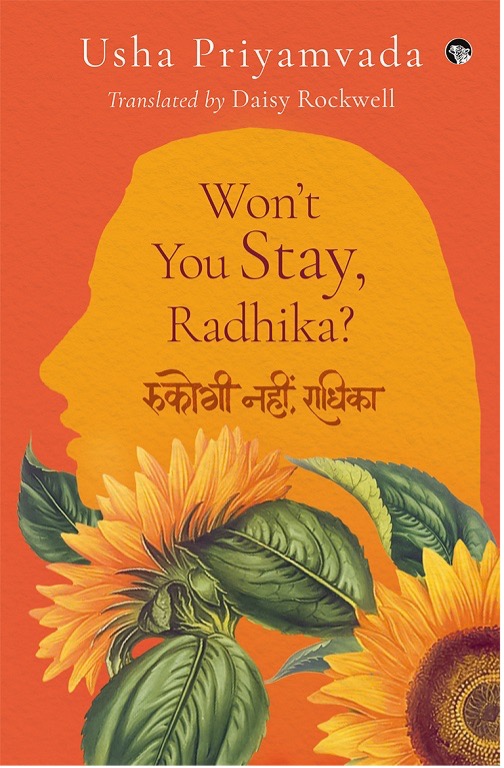
Won’t You Stay, Radhika?

Book Review by Somdatta Mandal

Title: Won’t You Stay, Radhika?

Author: Usha Priyamvada

Translator: Daisy Rockwell

Publisher: Speaking Tiger Books

In an essay written several years ago, the India-born Canadian author Uma Parameswaran had defined the plight of diasporic people by using the mythic metaphor of ‘Trishanku’ borrowed from the Ramayana where this character wanted to go to heaven alive but denied entry there, he was sent back and since then resided neither on earth nor in heaven but was suspended forever in an illusory middle space in-between. The state of diasporic individuals is somewhat similar; they are neither here nor there, and the present novel under review, published way back in 1967, brings out the angst of one such individual who, like the author Usha Priyamvada, herself went for higher studies to the United States and became the usual victim of culture shock. The only difference is that in real life Priyamvada stayed back in America and spent her long teaching career in universities there, whereas the protagonist of her novel Won’t You Stay, Radhika? went there only for a couple of years.

The storyline of the novel, originally written in Hindi, is rather simple. After her widowed father marries a younger woman called Vidya, Radhika’s world falls apart. She feels betrayed—the emotional and intellectual bond that she had forged with her father since the early death of her mother breaks with that sudden marriage. This is because their bond was not just emotional, but intellectual, as Radhika helped her father with his art history writing. To escape the unbearable situation at home—the growing rift between her and her father—Radhika fought for her personal freedom. Finding a simple way to avenge her father, she moved to Chicago along with an American teacher called Dan to pursue her master’s in fine arts. By leaving her father and going to live with Dan, Radhika had acquired several years of experience and matured quickly. But her living with Dan had only been a means to an end.

She returned to India two years later, burdened by a sense of alienation and homesickness, only to realise that while nothing had changed in her country, everything had. A growing sense of despair engulfed her. She started wondering whether she had a home anywhere. The family that she had longed to be reunited with barely acknowledged her arrival. The sense of belonging was missing, leaving her in ‘an emotional state of in-between-ness, of universal unbelonging’. As days pass, Radhika is paralysed with ennui, which is not just boredom. She avoids people, romance, family, as she lies still, or wanders listlessly through her neighbourhood. This sense of unbelonging tinges all her relationships—romantic or filial. So, she lies listlessly on her takht[1], bored, immobile, and uninspired.

This is not to say that Radhika is without love interests in the novel; after all there are three men in her life. She does not always feel detached from these men; there are many situations in the novel when we as readers feel that she has overcome her ambivalence or boredom or ennui, that she will start living a more meaningful life, but nothing positive takes place in the end. She seems to jell well with Akshay for a while and thinks probably she might marry him as there is no room in her life for a playboy. She wants a partner, someone steady, generous, someone who will accept her with all her flaws. But though she has great respect for him, she finally decides not to fall into the traditional trap of marriage. Akshay, like a traditional Indian male, also cannot subconsciously stop thinking about Radhika’s past. He feels confused as the more he wants to steer clear of Radhika, the more he feels she looms over his life. He also keeps on thinking about her past affairs with other men.

The other gentleman with whom Radhika had developed a relationship was Manish, who was diametrically opposite in nature to Akshay. They knew each other for a long time in many different contexts. Manish had also desired her, but Radhika had kept him at a distance. After several indecisive moments, she openly turned down his marriage proposal too, stating that she didn’t want to get involved again. Though she felt warmed by Manish’s touch, she did not turn to look at him. But Manish decided to wait till such time she changed her mind and voluntarily went to him. This ambivalence continues till the end of the novel, which Priyamvada leaves rather open-ended.

Though the title of the novel refers to a particular scene in the end when Radhika goes to meet her father once again and he wants his daughter to stay with him like before, that question mark hovers over the entire work: What will you do Radhika? Will you get up off the takht? Will this ennui ever come to an end? She was surprised at how her emotions had become so dull that she felt very little at all.

An extraordinary chronicler of the inner lives of the urban Indian woman, Usha Priyamvada is a pioneering figure in modern Hindi literature. Won’t You Stay, Radhika? written so many years ago, expertly explores the stifling and narrow-minded social ideals that continue to trap so many Indian women in the complex web of individual freedom, and social and familial obligation. A sense of alienation is also famous not only as a hallmark of Hindi literature of the 1960s, where it is usually traced to urbanization and the breakdown of traditional family structures, but also finds representation in Indian English novels too. Here one is reminded of Anita Desai’s famous novel Cry, the Peacock, published in 1963, that also delves deep into human emotion by focusing on topics like existential depression, psychological discontent, and the fragility of sanity as expressed through the female protagonist Maya. Though the theme of incompatibility and lack of understanding in marital life is one of the main themes of Desai’s novel, one notices a similarity of dealing with trapped feminine psyche in both the novels. Of course, reading the story of Priyamvada so many decades later, it seems nothing has changed in the Indian context and the situation in which the characters find themselves is equally true even today.

Before concluding, one must specifically put in a word of appreciation for the translation as well as the translator. On the first impression one is surely bound to think whether an American writer is the appropriate choice for translating a novel in Hindi. Apart from holding a PhD in South Asian literature from the University of Chicago and writing her doctoral dissertation on the Hindi author Upendranath Ashk, Daisy Rockwell has over the years to her credit translations of several Hindi authors including Usha Priyamvada’s debut novel Fifty-five Pillars, Red Walls (2021). But what brought her into limelight was her translation of Geetanjali Shree’s Tomb of Sand (2018) which became the first novel translated from an Indian language to win the International Booker Prize in 2022.  Thus, apart from bringing this poignant Hindi novel to a new set of readers fifty-five years later, Rockwell’s expertise in translation makes one feel that this is not translated text at all. Though not a mystery thriller, her narrative skill makes the novel a definite page-turner and one will surely be tempted to finish reading it as fast as possible.

.

[1] Bed

Somdatta Mandal, an academic critic and a translator, is a former Professor of English at Visva-Bharati, Santiniketan, India.

PLEASE NOTE: ARTICLES CAN ONLY BE REPRODUCED IN OTHER SITES WITH DUE ACKNOWLEDGEMENT TO BORDERLESS JOURNAL

Click here to access the Borderless anthology, Monalisa No Longer Smiles

Click here to access Monalisa No Longer Smiles on Kindle Amazon International
Categories
Review

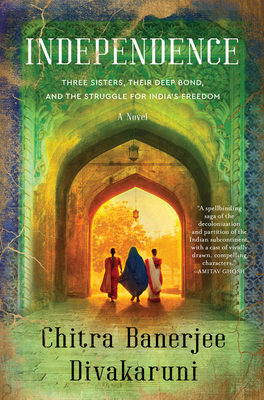
Independence by Chitra Banerjee Divakaruni

By Somdatta Mandal

Title: Independence

Author:  Chitra Banerjee Divakaruni

Publisher: Harper Collins 

Over the last two or three decades, the Indian American writer, Chitra Banerjee Divakaruni, has managed to carve a niche for herself by regaling in stories of cross-cultural issues prevalent in India and the United States with special emphasis on experiences of diasporic immigrant women. Though most of her stories are women-centric, with time one notices a gradual tectonic shift in her selection of themes. Initially she would write on problems of immigration and culture clash plaguing Indians in the New World. In Palace of Illusions, she went back to the Indian epic and narrated the story of the Mahabharata told from Draupadi’s point of view. In her novel The Forest of Enchantments, she brought Sita at the centre of the epic narrative The Ramayana and accorded her parity with Ram, revealing her innate strength. Then she took recourse to Indian history and rebuilt the story of Maharaja Ranjit’s Singh’s empire in Punjab narrating it from the viewpoint of Rani Jindan Kaur, his last wife as one of the most fearless women of the nineteenth century. Apart from the available historical data, she filled in The Last Queen by imagining many things Jindan would have said and done and thus painted a complete picture of a woman from all perspectives. A perfect blending of fact with fiction, the novel interested all categories of readers, serious and casual alike.

Now with Independence, Divakaruni widens her canvas to tell us the story of a doctor’s family and his three daughters against the freedom movement in India, particularly Bengal, beginning from August 1946 till the epilogue in 1954. The story of India’s independence is narrated through the eyes of three sisters, each of whom is uniquely different, with her own desires and flaws. They live in a rural village Ranipur and right at the beginning of the novel, which is divided into five parts and an epilogue, the author manages to give us the idyllic ambience of the place in very selective poetic language:

    “Here is a river like a slender silver chain, here is a village bordered by green gold rice-fields, here is a breeze smelling of sweet water-rushes, here is the marble balcony of a grand old mansion with guards at its iron gates and servants transporting trays of delicacies up the stairs, here are a man and a woman on carved teak chairs. Here is the country that contains them all.
     “The river is Sarasi, the village is Ranipur in Bengal, the mansion belongs to Somnath Chaudhury, zamindar. He is playing chess with Priya, daughter of his best friend, Nabakumar Ganguly. The country is India, the year is 1946, the month is August.
      “Everything is about to change."

Doctor Nabakumar Ganguly is an idealist and with his practice in their native village Ranipur, where the family resides, he also treats patients in a slum region in Calcutta. He is highly regarded but earns little as he refuses to charge patients without sufficient means. His wife Bina complains about this but supplements the family income by making exquisite quilts for sale and gifting them to those in need. Among the three daughters, Priya is intelligent and idealistic, and resolved to follow in her father’s footsteps she wants to become a doctor, though society frowns on it. She is fortunate to have the support of zamindar Somnath Chowdhury, her father’s best friend. The eldest daughter Deepa is very beautiful and is determined to make a marriage that will bring her family joy and status. The third daughter, Jamini, is devout, sharp-eyed, and a talented quiltmaker, with deeper passions than she reveals.

Theirs is a home of love and safety, a refuge from the violent events taking shape in the nation. This idyllic setting changes rapidly, as the violence of Direct Action Day in August 1946 takes Nabakumar’s life and introduces fear and a communal bitterness in the once largehearted Bina’s veins. Soon their neighbours turn against them, bringing the events of their country closer to home. Deepa is estranged from her mother and eventually isolated on the other side of the border in what becomes East Pakistan, when she falls in love with Raza, a Youth Leader at the Muslim League. As Priya is determined to pursue her career goal, her attempts to get into medical school in India are thwarted by a gender bias, and she finds herself at a college in America. But due to several reasons she cannot complete her degree there and comes back to India to run the clinic where her father worked. And Jamini attempts to hold her family together, even as she secretly longs for the handsome Amit, her sister’s fiancé. When India is partitioned, the sisters find themselves separated from one another, afraid of what will happen to not only themselves, but also each other. It is only then that they understand what it means to be independent, and the price one must pay for it.

After a lot of twists and turns to the story, including smuggling of arms and rescue mission on the Ichhamati River dividing the two Bengals, Amit shot to death, by the time we come to the Epilogue it is 1954 where we learn about Deepa’s daughter Sameera, Jamini’s son Tapan, Deepa managing the zamindari estate and Manorama and Somnath eager to find a suitable match for Priya when she tells them that she is happy as she is now. Feminism, communal amity, empathy, and self-growth are among the requisite qualities Divakaruni identifies for both a country and a human being to be truly independent. Though set in households more than seventy years ago, towards the end we still find some hope. The Postscript to the story is rather interesting as it comes even after the epilogue. It reads thus:

   “Here is a river. Here is a wind rising. Here is a village. Here is the year.
   “The river is time, ebbing, flooding. The wind is memory, it can carry flowers, it can carry flames. The village is the world, and you are at its centre. The year is now.
   “What will you do with it? What will you do?”

As a Professor of Creative Writing in an American university, Divakaruni has gained the expertise of playing her cards well – her narrative technique in each of her novels and short story anthologies preaches what she teaches – the saleability and marketability of a book in this electronic age should be of utmost concern. Like her earlier novel The Oleander Girl, which seemed to have been written as a sort of film script in mind, (incidentally two other novels are being made into motion pictures at the moment), Independence too seems to follow suit with the right amount of ingredients necessary for promoting the book to different kinds of readers and in different forms as well. One is therefore taken by surprise to find a QR code even before the Contents page which tells us to “Listen to the soundtrack for Independence. A playlist of songs that inspired the freedom movement.” For her Western readers, Divakaruni managed to blend history and fiction very well where along with the fictitious characters we get to read about Mahatma Gandhi and the Noakhali riots, Sarojini Naidu, Nehru and others as they played their parts in the freedom movement. Here we find Priya actively engaged in conversation with Sarojini who gives a letter of recommendation to Bidhan Chandra Roy to help Priya to run a clinic.

One praiseworthy aspect of the novel is how Divakaruni manages to give us details of the streets and sounds of Calcutta – the Calcutta of the 1950s with her double decker buses, the shops at New Market, the quaint little restaurants with curtained cubicles to maintain privacy in a public place – all brought back from memory of the city in which she was born and brought up. The novel is also full of translations of several patriotic songs in Bangla which the swadeshis sang during that period. Several lines from Tagore’s songs are also interspersed to express the moods of characters – a technique used by Divakaruni in some of her earlier fiction as well. The exoticism of India, especially rural Bengal of the time is deftly portrayed through many other incidents of killing and looting at different regions of undivided Bengal. As for her Indian readers we are given the story of Priya’s brief stay in America to study medicine at the Woman’s Medical College in Philadelphia where along with her homesickness, we have Arthur, a lovelorn American doctor, who lends her support and patiently waits for her to come back to him as “his heart has been empty” without her.

Despite such manipulations to the story to bring in as wide a canvas as possible, including sufficient examples of Hindu-Muslim amity and hatred as well, the novel remains a page-turner no doubt and can be recommended for its lucid and racy style of narration, something that Chitra Banerjee Divakaruni excels in.

Somdatta Mandal, author, critic, and translator, is former Professor of English at Visva-Bharati, Santiniketan, India.

PLEASE NOTE: ARTICLES CAN ONLY BE REPRODUCED IN OTHER SITES WITH DUE ACKNOWLEDGEMENT TO BORDERLESS JOURNAL

Click here to access the Borderless anthology, Monalisa No Longer Smiles

Click here to access Monalisa No Longer Smiles on Kindle Amazon International
Categories
Interview Review

The Oldest Love Story – In Conversation with Editor Rinki Roy

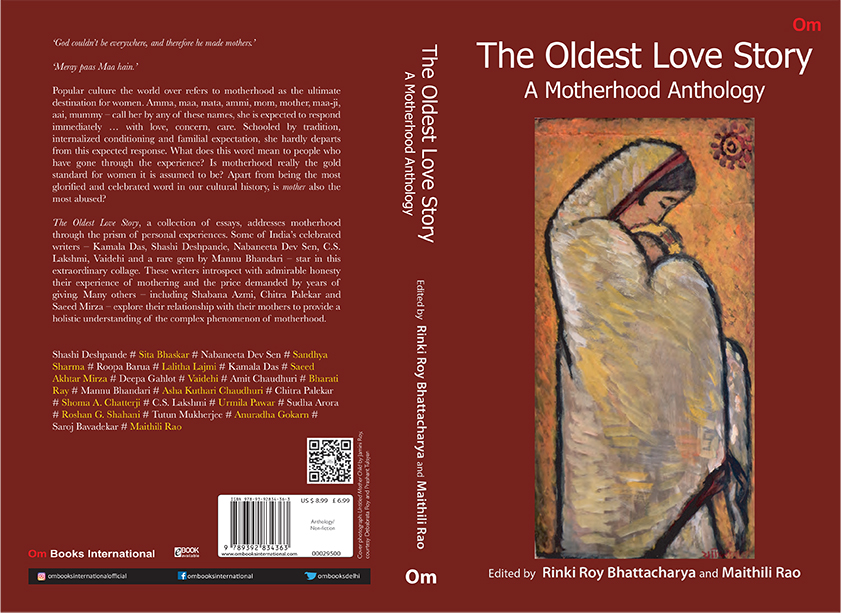
The Oldest Love Story, edited and curated by Rinki Roy and Maithili Rao published by Om Books International, 2022, carries multiple voices across cultures on a most ancient bond and nurtures pertinent questions and observation, which hope to redefine the role.

‘Antara 1’

Antara rising from primordial waters
As the first sun, forever new, forever old,
You made me the universe.
History and prehistory filed through me hand in hand 
In gradual evolution.
Antara, because of you
I have earned the right to enter
The tenfold halls of my foremothers.
Clutching your baby hands in my fist,
I have made the future a debtor to me
Antara, in an instant you have filled all time
By your grace I am coeval with the Earth today.

-- Nabanita Dev Sen, The Oldest Love Story(2022)

The Oldest Love Story, curated by two eminent authors and journalists, Rinki Roy Bhattacharya and Maithili Rao, is an anthology that not only describes a human’s first love, their mother, and their lives, but also explores the social and psychological outcomes and ramifications of motherhood with powerful narratives from multiple writers. They range from eminent names like the late Nabanita Dev Sen, Shashi Deshpande, Kamala Das to Bollywood personalities like Shabana Azmi and Saeed Mirza and contemporary names like Amit Chaudhuri or Maithili Rao herself.

The anthology has narratives clubbed into three sections: ‘Being a Mother: Rewards and Regrets’, ‘Outliers’, ‘Our Mothers: Love, Empathy and Ambivalence’. The headings are descriptive of the content of each section. These real-life narratives, some of which include translations by editors Roy and Rao among others, make for interesting and fresh perspectives of the age-old story that is as natural as water or air. More than two dozen diverse voices as well as Roy’s powerful “Preface” and Rao’s exhaustive “Introduction” paint motherhood in new colours, giving it an iridescence that glitters with varied shades. Stories of what mothers faced — bringing up a child with Down’s syndrome, a child who drove his roommate to suicide and yet another daughter who marries a man old enough to be her father — bring us close to issues we face in today’s world.

One of the most interesting and unusual aspects of this book is at the end of each essay is a takeaway from the narrative where the writers write about themselves. This is not a biography but a description of the writers’ perception about their mother or what they learnt from their experience of motherhood. The most interesting takeaway is given by Shabana Azmi, who wrote of her dynamic mother Shaukat Kaifi (1926-2019).

“I am cut from the same cloth as her. But who am I?

“I would say I’m a woman, an Indian, a wife, an actress, a Muslim, an activist, etc. My being Muslim is only one aspect of my identity but today it seems as though a concerted effort is being made to compress identity into the narrow confines of the religion one was born into, at the absence of all other aspects. This is not the truth about India. India’s greatest truth is her composite culture.

“The Kashmiri Hindu and the Kashmiri Muslim have much more in common with each other because of their ‘Kashmiriyat’ than a Kashmiri Muslim and a Muslim from Tamil Nadu in spite of them sharing a common religion. To me, my cultural identity is much stronger than my religious identity.”

And she concludes: “My mother taught me that identity must not be a melting pot in which individual identities are submerged. It should be a beautiful mosaic in which each part contributes to a larger whole.”

Major social issues are taken up in multiple narratives. Mirza used the epistolary technique to describe how his mother discarded her burqa forever in Pre-Partition India.

“You were emerging from the hall of the Eros theatre and were about to wear your burqa in the foyer when Baba popped the question to you.

“‘Begum, do you really want to wear it?’

“You told me you paused for a moment, and then you shook your head. And that was that. The rest, as they say, is history.

“I am trying to imagine that moment. The year was 1938 and you had been wearing a burqa ever since you were thirteen years old.”

Mannu Bhandari’s spine-chilling narrative of her mother, a child bride around the time when Mirza’s mother shed her burqa, shows a young girl punished and abused for accidentally tearing her sari. It showcases a conservative, abusive culture where women turn on women. An extreme contrast to the bold maternal outlook described by Mirza or Azmi, the narrative highlights the reason why women need to protest against accepting familial abuse bordering on criminality. That these three mothers lived around the same time period in different cultures and regions of India only goes to enhance the large diaspora of beliefs, customs and cultures within one country.

Dalit writer, Urmila Pawar’s reasserts her mother’s belief, “A woman is a wife for only a while/ She is a mother all her life.” “Screams Buried in the Walls” by Sudha Arora dwells on the abuse borne by women to pander to societal norms. Narratives of abuse of women who could not stand up to social malpractices seem to have turned into lessons on what not to do for daughters who condemn patriarchal norms for the suffering their mothers faced.

On the other hand, Shashi Deshpande tells us: “Motherhood becomes a monster that devours both her and her young; or, when the children go away, there is an emptiness which is filled with frustration and despair. I have been saved from this because of my work. My children no longer need me, but my life does not seem empty.” While Shashi Deshpande found her catharsis by writing her stories, Deepa Gahlot, justifies her stance of remaining unmarried and childless by espousing a voice against motherhood.  She contends that the only reason to perceive motherhood as a viable alternative would be propagation of the species. But concludes with an interesting PS: “Does it even make sense to bring a child into such an ugly, nasty, brutal world?” As one hears of senseless violence, wars and mass shootings in the news, Gahlot’s words strike a chord. She has actually researched into the subject to draw her conclusions. But one would wonder how would humankind propagate then — out of test tubes in a bleak scenario like Aldous Huxley’s Brave New World (1932)? Would humans really want such an inhuman existence?

I would rather go with Dev Sen’s outlook. While she emoted on motherhood in her poems on her daughter Antara, she has given a powerful prose narrative elucidating her own perspective. Antara, the daughter to who these poems are addressed, has given a beautiful takeaway on her mother at the end of Dev Sen’s narrative. Despite being abandoned by her husband, Amartya Sen, who later became a Nobel laureate, Dev Sen not only fulfilled herself as a woman and a mother but threw out an inspiring statement that well sums up motherhood for some: “[C]ould I do anything to make this planet worthy for my kids?”

Rinki Roy Bhattacharya, one of the editors of this sparkling collection and author of a number of books, especially on the legendary film maker, her father, Bimal Roy (1909-1966), had published an earlier collection on a similar theme called, Janani (Mother, 2006). She agreed to tell us more about the making of this meaty and gripping anthology, The Oldest Love Story.

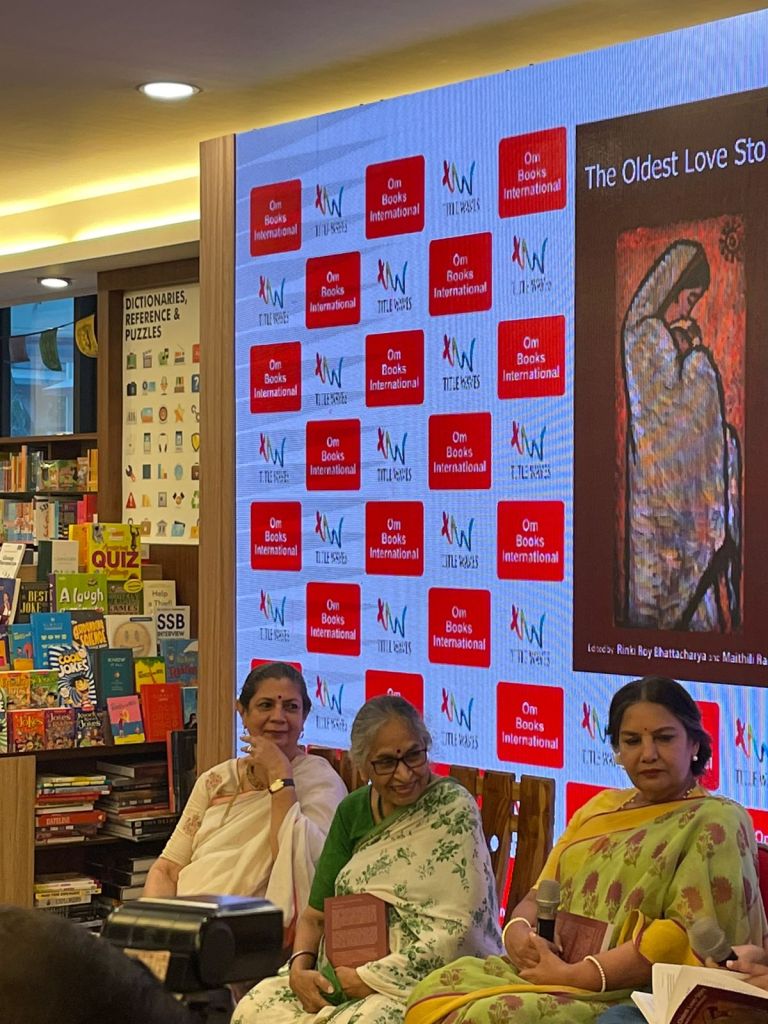
Editor Rinki Roy Bhattacharya at the book launch in Mumbai. Photo sourced by Rinki Roy

Motherhood as a concept that is ancient, natural, and yet, not fully understood nor explored. What made you think of coming up with this collection that highlights not only stories of mothers and how it influenced women but also discusses the process of being a mother?

The present collection, titled “The Oldest love Story” goes back several decades. This is mentioned in my preface. It began when I woke up to the fact that I was redundant as a mother. By the time the children had grown up one-by-one and left home. I began to explore the situation with other women to understand, why we give so much importance to motherhood? Foolishly, I felt. Motherhood as a concept is indeed natural but taken for granted. I have a problem with that. My maid, Laxmi, is a classic example of a mother who is exploited to the hilt by her children. She is blind to their exploitation and refuses any change that will help her live with comfort or dignity. As if women are just mothers and nothing else?

Was it a personal need or one that you felt had to be explored given the current trend towards the issue where women are protesting the fact that looking after children saps them of individuality? Can you please explain?

I answered this issue as have others in this book. The deep resentment that follows after raising kids who then go away to find greener pastures, is an extremely common, and collective experience for most parents. Particularly in the Indian context. Parents cannot let go. The main reason, I think is, the parent’s fear. The fear of who will light the funeral pyre if not the son? In the event of not having a son,  a close male relative takes over. Do you see the gender bias, the patriarchal assumption? Daughters are not considered legitimate enough to light the pyre?! Yet it is daughters who care for elderly parents in most cases.

This is not the case in Europe, nor the West, where children are expected to become independent very early. In fact, European teenagers seize their independence at the earliest opportunity. It is the expected thing, and no one resents that inevitable shift.

You had an earlier collection called Janani (Mother). Did that have an impact on this book?

I am glad you referred to Janani, published by Sage books in 2006. That collection is the cornerstone of our new book. In this collection, we have included eight extraordinary essays from Janani. We have retained, for example, Kamala Das and Shashi Deshpande to name two. And guess what we discovered out of the blue? In the oldest love story, we have several Sahitya Akademi winners amongst our writers, including these stalwarts. This raises our book to a huge literary stature.

How was it to work jointly on a book with Maithili Rao? Did you both have the same vision for the book?

Working with Maithili was fantastic, and it was great fun. She is the most generous of people and shares without fuss. Ours was a good partnership. I could not have produced this book without Maithili. She has been and continues to be a rock.

You have done many translations for the book. Why is it we did not find an essay from you as we did from Maithili Rao?

Yes, I did. I helped fine-tune Mannu Bhandari’s story It ranks as one of my personal favourites. Her narrative is beautifully visual. I find it cinematic. I also translated Sudha Arora’s poignant essay. Sudha is a noted Hindi writer. It was, however, difficult for me to write my personal story. But the hope is, our next reprint will carry a story I wrote on my son Aditya’s birthday in 2021. In this I have given graphic details of how childbirth robs women of their dignity in the so-called natural process of birthing children. My essay is entertaining and somewhat satirical in style.

You have written a beautiful preface to the book, reflecting your own experience with your children. Were you, like the other writers, impacted by your mother?

I take that as a compliment. Yes, I wrote a heartfelt preface. My relationship with my mother, admittedly, was a strained one. Our age difference was just eighteen years…whatever the reason, I have not been able to fathom or pinpoint it. So, I thought it was best to refrain from the troubled territory.

Would you say that Bollywood had some bearing on the book as a number of writers are from within the industry? Also, your father, the eminent Bimal Roy, made a movie called Maa in 1952. If so how. Please explain.

I do not see any bearing from Bollywood. The fact we have eminent personalities from the world of cinema, for example, Shabana Azmi, Saeed Mirza, and Lalita Lazmi do not make it a Bollywood-driven work. My father, Bimal Roy’s Bombay debut was with a film called Maa. Apparently, Maa was inspired by a Hollywood film titled Over the Hills. The main protagonist was an elderly mother of two sons. Maa bared a socially relevant issue, elder abuse, that has been globally recognised and is prevalent. My father’s empathy for the elderly is well documented in this fictional account. In day-to-day life, my father supported the elderly. His widowed aunt in Benaras was maintained by him. His brothers were educated and helped by his generosity. Compassion was his second nature. From him, I learned that a silent, discreet way to support others is the best way to reach out.

There are so many women in the anthology who reiterated the huge impact their mothers had on them, and they were quite critical of their ‘patriarchal’ fathers. Do you think this is true for all women? At a personal level, did your father or mother have a similar impact on you?

I am glad to hear that these woman are critical of their patriarchal fathers…while most women tend to overlook the patriarchal aspect. In general, women tend to ignore or even neglect, their mothers. In my case, it was distinct. My cultural upbringing was instilled by my father’s secular and inclusive vision and social values. These played a decisive part. Much more than my mother, who was a gifted photographer. My parents, by the way, were a made for each other couple. Rarest of rare in the movie industry. My father is my mentor. If you contemplate his well-loved films, let us take Sujata [1959], for one. I have yet to see another film that speaks so eloquently of social boycott. It is not just the caste issue of Sujata, which doubtless is the main thrust. It is the combined forces of class, caste, and gender that play havoc with human relationships as portrayed compassionately in this work.

Yes, Sujata is indeed a beautiful film and your book has taken up many of the issues shown in the movie through the voice of mothers, whether it is caste or religion. Was this intentional or was it something that just happened?

The voices of our contributors in the book are of individuals who write with exemplary honesty and spontaneously. Nothing is contrived in their writings. We did not brief our writers to take up any specific issue. They wrote from the heart.

One of the trends that emerged from my reading of the book was that educated and affluent mothers through the ages had it easier than child brides and less educated mothers, whose children also reacted with more vehemence, looking for a better world for themselves. Do you feel my observation has some credence? Please comment on it.

I do not agree entirely. Bearing children, and raising them in our complex, the confusing socio-economic culture is a challenging matter for all mothers. For all parents in fact. Child brides are subjected to it more intensely than others. There are no shortcuts, nor ready-made answers.

There is an essay against motherhood in this anthology. Do you agree with the author that it is a redundant institution and can be replaced by test-tube babies? Do you not think that could lead to a re-enactment of what Aldous Huxley depicted in Brave New World

I think, you mean Deepa Gahlot’s essay. This was from the earlier collection. Deepa is entitled to her views. As are others. I think many younger women would agree with Deepa. Balancing motherhood with one’s professional life is a knotty business. I know women who have opted for one or the other to do full justice to it.

Yes, it was Deepa Gahlot’s essay. As you have rightly pointed out in your preface, motherhood can be interpreted variously. What do you see as the future of motherhood in India, and in the world?

Motherhood, remains subjective. Interpreted differently in each case. Every childbirth is a different experience. It may be life-threatening. A case to note is my dear friend Smita Patil’s. She died giving birth. But, I doubt women will stop being mothers, or abandon stereotypical mothering options that live up to that Deewar [Wall, 1975] dialogue: “Mere paas maa hain [I do not have a mother]”. There is a change, a shift, nonetheless, it is slow. Women are afraid to rock this entrenched image of motherhood. At least in India. I know successful women filled with guilt that they failed to be good mothers.

Well, that is certainly a perspective that needs thought.What books and music impact your work?

I read both Bangla and English. After leaving Calcutta where I read the children’s Ramayana, Raj Kahini, or stories by Tagore and Sukumar Ray. But there was an interruption when I got into an English medium school. Culturally I moved out of Bengal. During that phase, my mother introduced me to Agatha Christie. I was 12 years perhaps…I devoured her works. And I still do. Christie fascinates me.

I fell in love with the piano and began to learn it. As a result, Chopin, Mozart, and Liszt were my musical inspirations. I also learned Rabindra sangeet and Manipuri dance in Calcutta…. there was no dearth of cultural grooming. We are especially fortunate that our parents enjoyed the best in performing arts. Pandit Sivakumar Sharma, the great santoor maestro who just passed away, played at home. Sitara Devi danced for private programs. We were wrapped in a rich tapestry of culture.

What is your next project? Are you writing/ curating something new?

I am a compulsive writer, always itching to write.  I believe that writers do not age…they mature and get better. Currently, I am compiling non-fiction episodes about some of the most celebrated artists from Indian cinema who I was privileged to meet…the collection may be titled, Brief Encounters. Writing keeps me creatively busy. Before I sign off, we have to thank our editor Shantanuray Chaudhuri for his unconditional support to make this book a reality. He has been marvellous.

Thank you for taking our work seriously.

Thank you for giving us your time and answering the questions

From Left to Right: Rinki Roy, Maithili Rao and Shabana Azmi at the Mumbai book Launch in June 2022. Photo sourced by Rinki Roy

(This is an online interview conducted by Mitali Chakravarty.)

PLEASE NOTE: ARTICLES CAN ONLY BE REPRODUCED IN OTHER SITES WITH DUE ACKNOWLEDGEMENT TO BORDERLESS JOURNAL

Categories
Poetry

Poetry of Michael Madhusudan Dutt

Ratnottama Sengupta translates Bengali poet Michael Madhusudan Dutt’s Bijoya Doushami (the last day of the festival of Durga Puja when the Goddess is supposed to return to her own home from her visit to her parents). This poem is a lament of Durga’s mother, who addresses her daughter as ‘Sati’ in the poem.

Bust of Michael Madhusudan Dutt at his memorial in Jessore, Bangladesh. Courtesy: Creative Commons

Michael Madhusudan Dutt (1824-1873) was a poet and dramatist who was a prominent precursor to Rabindranath Tagore. In his youth, he converted to Christianity (1843) and wrote in English and later turned to writing in Bengali. A product of Western education and the Bengal renaissance, he challenged the traditional literary systems. Multi-lingual and cognisant of several Indian and European languages, including Bengali, Tamil, Sanskrit, Greek and Latin, Meghnadbadh Kavya (1861) was his most important composition, an epic on the Ramayana theme and a tribute to Milton’s Paradise Lost. His repertoire includes Sarmistha (1858), based on an episode of the ancient Mahabharta, Brajangana (1861), a cycle of lyrics on the Radha- Krishna theme; and Birangana (1862), a set of 21 epistolary poems on the model of Ovid’s Heroides and much more.

DEPARTURE

“Do not, O night sky, leave
tonight, with your lot of stars --
Once you go, blissful night,
So will my heartbeat!
Once the merciless sun is up
in the East,
The apple of my eye will lose her shine!

“Full twelve months she shed true tears
before Uma came home. What a balm!
In mere three days, tell me
Oh starry-tressed,
can one have a fill
of delight?
The golden glow of brass lamps
has driven afar darkness
within and without.
Words, the sweetest of creation!
have circled my ears.

“Darkness twice as thick, I know
will engulf this homestead
once you blow out this lamp...” 
Entreated the Queen of Girish,
at the close of the ninth night...

Ratnottama Sengupta, formerly Arts Editor of The Times of India, teaches mass communication and film appreciation, curates film festivals and art exhibitions, and translates and write books. She has been a member of CBFC, served on the National Film Awards jury and has herself won a National Award. 

.

PLEASE NOTE: ARTICLES CAN ONLY BE REPRODUCED IN OTHER SITES WITH DUE ACKNOWLEDGEMENT TO BORDERLESS JOURNAL

Categories
Bhaskar's Corner

Fakir Mohan: A Tribute

By Bhaskar Parichha

Fakir Mohan Senapati. Courtesy: Creative Commons

The 19th century Oriya novelist Fakir Mohan Senapati was a most oblique writer — he hardly said or meant anything in a straightforward manner. Much of his work is ironical and satirical, and of course irony and satire work through indirection, by way of the meaningful glance rather than the plainspoken word. Yet irony, while aiming to surprise, can sometimes be applied too predictably, and then it becomes as unsubtle as the more homespun narrative mode it disdains. Thankfully, this is not the case with Senapati: he worked with a very light and delicate hand.

-Chandrahas Choudhury (Author of ‘My Country is Literature–Adventures in the Reading Life’)

Father of modern Odia literature, Fakir Mohan Senapati’s birth anniversary is around the festival of Makar Sankranti (mid-January) every year. There are a bevy of festivals by various names celebrated across India during this period.

As a novelist, short story writer, poet, philosopher, social reformer and forerunner of Odia nationalism, Senapati (1843-1918) played a foremost role in establishing the distinct Odia identity. But for his sweat over a lifetime, Odia — which is today India’s sixth Classical language — wouldn’t have survived the onslaught by adjoining vernaculars. The life of Fakir Mohan is undeniably the story of the “resurgence” in Odia literature. He protected the Odia language from near extinction.  

Mallikashpur village of Balasore district neighbouring West Bengal is where Senapati began his formal education — when he was nine years old. Since he could not pay for his tutoring, he is said to have even worked at his teacher’s house to pay the fee. Balasore’s Mission School was his Alma Mater, and he went to become a teacher where he served until 1871. Still later, he rose to become the headteacher. Around this time, he started teaching Odia to the Balasore Collector John Beames. 

Fakir Mohan learnt English all by himself with the help of a dictionary. He readto read several famous classics — Arabian Nights, Robinson Crusoe, the English Bible, and Bengal Peasant Life by Lal Behari De — he started learning English at twenty-three. Fakir Mohan’s instinctive wisdom was recognised even by foreigners. 

The early life of Fakir Mohan was one of courage and dexterity.  His accomplishments were amazing. A multi-tasker, Fakir Mohan, even worked as a labourer in a port. He ventured into the wood and paper business having worked in a press only to become an editor. Besides being a teacher, Fakir Mohan became a dewan of Athagarh and later of Tekkali in Srikakulam district of Andhra Pradesh.

In the second phase of his life, Fakir Mohan worked as administrator in the princely states of Nilgiri, Dampada, Dhenkanal, Daspalla, Pallahara and Keonjhar. As a manager, Fakir Mohan was very efficient and successful. During Keonjhar Praja Meli (people’s agitation against the feudal lord), he escaped cleverly writing a symbolic letter to the king. 

Mayadhar Mansingh, another celebrated, Odia called Fakir Mohan the ‘Thomas Hardy of Odisha’. He had the ability and expertise in whatever arena he laid his hand on. These prodigious abilities were reflected in his later-day writings as well. Although Senapati translated from Sanskrit, wrote poetry, and tried numerous forms of literature, he is known primarily as the father of modern Odia fiction. His four novels, written between 1897 and 1915, mirror the socio-cultural conditions of Odisha during the eighteenth and the nineteenth centuries.

The time in which Fakir Mohan lived was the darkest period in the history of modern Odisha. The infamous ‘Naanka’ Famine of 1866 — which one third of the region’s population — hurt the economic and social condition of Odisha beyond recovery. The deprivation during this period has been documented in many of his stories and novels. In course of time, he emerged as a novelist of rare caliber not only in Odia but also in a pan-Indian setting.

Senapati’s Rebati (1898) – recently translated into thirty-six Indian and foreign languages — is widely recognised as the first Odia short story. It is the tale of a young innocent girl ‘Rebati’ whose desire for education in the context of a backward conservative society went beyond the ordinary. The village where the protagonist lived was hit by the killer epidemic, cholera. Rebati’s grandmother – the last survivor — believed that it was the craving for education that brought misfortune to the family. In fact, ‘Rebati’ was one of the earliest stories in the realm of world pandemic literature.

‘Randipua Ananta’ is a story of a very notorious, errant youth who in the end transforms himself. While the flood water entered the village through a hole of the river-embankment, Ananta pulled the wooden door of his house and covered the hole standing as the supporting pillar and asked villagers to pile soil onto it. Gradually, his body heaped-up up and at last he was buried. Ananta dedicated his life to the welfare of the village and was a rare character in the Odia short story genre. 

Dak Munshi (The PostMaster), ‘Sabhya Zamindar‘ (The Educated Feudal Lord), ‘Patent Medicine’, ‘Adharma Bitta‘ (The Ill-gotten Money) are the other famous stories for which Senapati is known far and wide. But, it is the   three novels — Chha Mana Atha Guntha  (Six and a third Acres,1902), Mamu (Maternal Uncle, 1913)and Prayaschita (Penance, 1915) — which have made  Senapati immortal because they explored the realities of community life in its manifold dimensions.

Chha Mana Atha Guntha is the first Indian novel to deal with the exploitation of landless peasantry by the feudal system. The importance of this novel is that it was written much before the October revolution and even before the emergence of Marxist ideas in India. Set in Orissa in the 1830s, it is about village politics, caste oppression, social malpractices, and land-grabbing under the zamindari system in colonial Odisha. Both a literary work and a historical document this novel provided a unique ‘view from below’ of Indian village life under colonial rule. Ten years after this novel came Mamu.

Prayaschita was the last of Fakir Mohan Senapati’s  ‘trilogy of crime and justice’ novels — to use the epithet coined by the eminent Senapati scholar John Boulton. It was published just three years before the death of Fakir Mohan. The novel is unique because it sheds light on Senapati’s increasingly dark and tragic perception of colonialism. The novel was a defender of the traditional values and the Hindu way of life which the writer saw was gravely threatened by an alien value system of the British which had made huge inroads into Indian society.

Lachhama is another novel by Senapati dealing with the anarchic conditions of Odisha in the wake of Maratha invasions during the eighteenth century. It narrates the historical romance of Rajput lady Lachhama and her husband Badal Singh, in the backdrop of the political disturbances between the Mughals and Marathas to gain supremacy in Odisha. The story is set in a period of early advent of the British in India during which Nawab Alivardi Khan was Governor of Bengal. The depiction of love, honor, courage and revenge of the woman protagonist Lachamma is significant.

Fakir Mohan also wrote the first-ever autobiography in Odia – Atma Jeevan Charita. It gives a socio-cultural account of Odisha along with the novelist’s own life spanning over half a century and makes for prodigious reading.

Senapati wrote a long poem, Utkal Bhramanam, in 1892. Literally meaning Tour of Odisha, this poem is not a travelogue but a commentary on the state of affairs of that time, written satirically. He has also translated the Mahabharata, the Gita, the Ramayana and Boudhavatar Kavya into simple Odia verse.

Fakir Mohan’s innovative technique, ineradicable characters, humour, imaginativeness, and the insights into the rural milieu had few parallels. His contribution to Odia language and its revival was immense.  

Senapati was a great genius, a versatile personality and an ardent literary artist who breathed his last on June 14, 1918, when Odisha hadn’t become a separate province for which Senapati fought relentlessly. He is unsurpassed and commands great respect among the authors. In the words of Dr. J.V. Boulton, Fakir Mohan is the Gorky of Odisha. The  Dhammapada estate conferred on him the enviable title Saraswati. He was also endowed with the title of Katha Samrat (Emperor of Fiction) and is rightly called Vyasakavi

His fiction and short stories reflected the theme of social realism, societal reform, and preservation of cultural values. Fakir Mohan dedicated his whole life to the development of the native language in the late 19th and changed the course of Odia literature.

Fakir Mohan is to Odia what Prem Chand is to Hindi and Rabindranath Tagore is to Bengali literature.

.

Bhaskar Parichha is a journalist and author of UnbiasedNo Strings Attached: Writings on Odisha and Biju Patnaik – A Political Biography. He lives in Bhubaneswar and writes bilingually. Besides writing for newspapers, he also reviews books on various media platforms.

.

PLEASE NOTE: ARTICLES CAN ONLY BE REPRODUCED IN OTHER SITES WITH DUE ACKNOWLEDGEMENT TO BORDERLESS JOURNAL

Categories
Editorial

Colours of the Sky

A riot of colours starts the day
with happiness, vibrancy and hope,
dispelling the winter of discontent
with whispers of new lores…
Courtesy: Sohana Manzoor

Devi (The Goddess) is a 1960 Satyajit Ray film, based on a story by a writer called Prabhat Kumar Mukhopadhyay, that showcases nineteenth century India, where the silence of a young girl who is deified, wreaks havoc in her home, village and life. In an interview, Satyajit Ray contended that the film was to make people rethink ‘messiahdom’. The exact words he used to state this was that the film was against ‘religious dogmatism’ as the film and story literally dealt with the deification of a young bride. Tagore had similarly questioned blind deification in a number of his poems and plays. These (as Ray spelt out in his interview) did not address religion per se but malpractices, among them, the tendency to worship an idol to a point where flaws are justified, accepted and emulated. Satyajit Ray and Tagore were both Brahmos — which can be seen as a reform movement. These two were not criticising religion but talking of rising above gawky hero worship to think logically and arrive at logical conclusions. When we talk of characters from the Ramayana, the Mahabharata, other mythologies or substitute the adulated with stars, writers, politicians and businessmen who run huge concerns, we tend to idolise them. But these were and are all characters with flaws, whether fictitious or real. We can well learn from their mistakes, rather than deify and worship them to justify bad behaviour by quoting instances from lives of past legends or prominent persons in the current world.

Akbar Barakzai, a poet exiled from Balochistan, talks in a similar vein in his interview. You can see it in his poetry too — some of which can be found translated by Fazal Baloch in our pages. Barakzai talks of transcending barriers we draw for ourselves in the real world, of writing with honesty and sincerity. He has shared vignettes of his life as he changed countries to continue his work. Baloch has also brought to us another excellent poet in translation, Munir Momin. A major poem by Nazrul (the ‘bidrohi kobi’), ‘Bidrohi or Rebel’ has wound its way to our pages translated by Professor Fakrul Alam. We are honoured and grateful that Prof Alam chose to share this excellent translation with us. We have more translations: Jibonananda’s ‘Motorcar’(1934) by Rakibul Hasan Khan, a Korean translation by Ihlwha Choi, another short story from Nepal and Tagore’s powerful poem,Morichika or Mirage’, which is a wake-up call for the inert affluent who hold themselves aloof from common masses. We have also interviewed a major prose translator of Tagore, Professor Somdatta Mandal. With much to share on Santiniketan, Nabanita Deb Sen and many interesting anecdotes, Mandal talks of her extensive work with her translations spanning many more writers from the past.

We have a colourful ensemble this time almost as vibrant as the autumnal colours that have invaded nature in some parts of the Northern Hemisphere. Michael R Burch has given us beautiful poems on autumn, including the autumn of life. We have a poem in a similar vein by George Freek whose work continues influenced by Liu Yong (1719-1805), an influential minister and calligrapher in the Qing Dynasty. Ryan Quinn Flanagan touches on Leonardo Da Vinci’s Mona Lisa in his poetry. Rhys Hughes has given us humour in both his poetry and his column. Our other humorist, Devraj Singh Kalsi has given us darker, more caustic black humour in his narrative. We have lovely photographs from Penny Wilkes with her verses in Nature’s Musings. It is amazing the way she photographs birds in flight. Stories from Malaysia, Bangladesh, India and America add to the richness of our oeuvre. Sunil Sharma has given us an avant-garde telling of Odysseus’s voyage in the modern world, transcending the borders of time and ethnicity.

A well-known senior journalist, Ratnottama Sengupta, has also travelled through time to give us a recall of her experience at the 35th Cairo Film Festival one November, nine years ago. Her narrative about the time that the Shariat law was adopted by Egypt reminds me of the way things moved in Afghanistan few months ago and what is even more stunning is the way in which organisations dubbed extremists earlier are allowed to run countries now. Is it really not yet time to get rid of messiahs and look for one world?

We conclude our travels in Burma with John Herlihy and his friend, Peter, this month. And start a column with Candice Louisa Daquin, The Observant Immigrant. Her essays always draw much discussion. An experienced psychotherapist, she has looked into our value systems. We have books excerpts from Arundhathi Subramaniam’s Women Who Wear Only Themselves and CJ Fentiman’s award winning book, The Cat with Three Passports. Himadri Lahiri has done an in-depth review of Somdatta Mandal’s ‘Kobi’ and ‘Rani’: Memoirs and Correspondences of Nirmalkumari Mahalanobis and Rabindranath Tagore. It is amazing how much we can learn about a person from their letters. Suzanne Kamata has shared her review of Iain Maloney’s Life is Elsewhere/ Burn Your Flags. Reviewed by Meenakshi Malhotra, Shylashri Shankar’s Turmeric Nation: A Passage Through India’s Tastes, sounds like an erudite read that spans thousands of years of history. Anita Agnihotri’s Mahanadi –The Tale of a River, translated from Bengali by Nivedita Sen, has been reviewed by Bhaskar Parichha. The narrative sounds like a powerful voice weaving together the lores around the river.

Do pause by and find many more authors who dot our November edition. As usual, naming each one will keep you away from our delectable reads for longer. We thank all our readers for their continued patronage, and I would like to thank my fabulous team who are now even providing visuals to brighten our pages. A huge thanks to Sohana Manzoor and Sybil Pretious, who write as well as they paint. Thanks to all our wonderful contributors for making Borderless a reality.

Wish you all sunshine and laughter!

Best,

Mitali Chakravarty

Borderless Journal