Ratnottama Sengupta muses on her encounter with the writings of eminent artist and writer, Dhruba Esh, and translates one his many stories, Amiyashankar Go Back Home from Bengali. Click here to read.
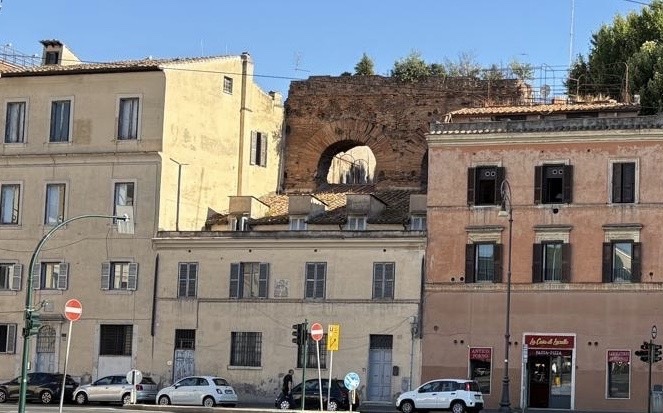
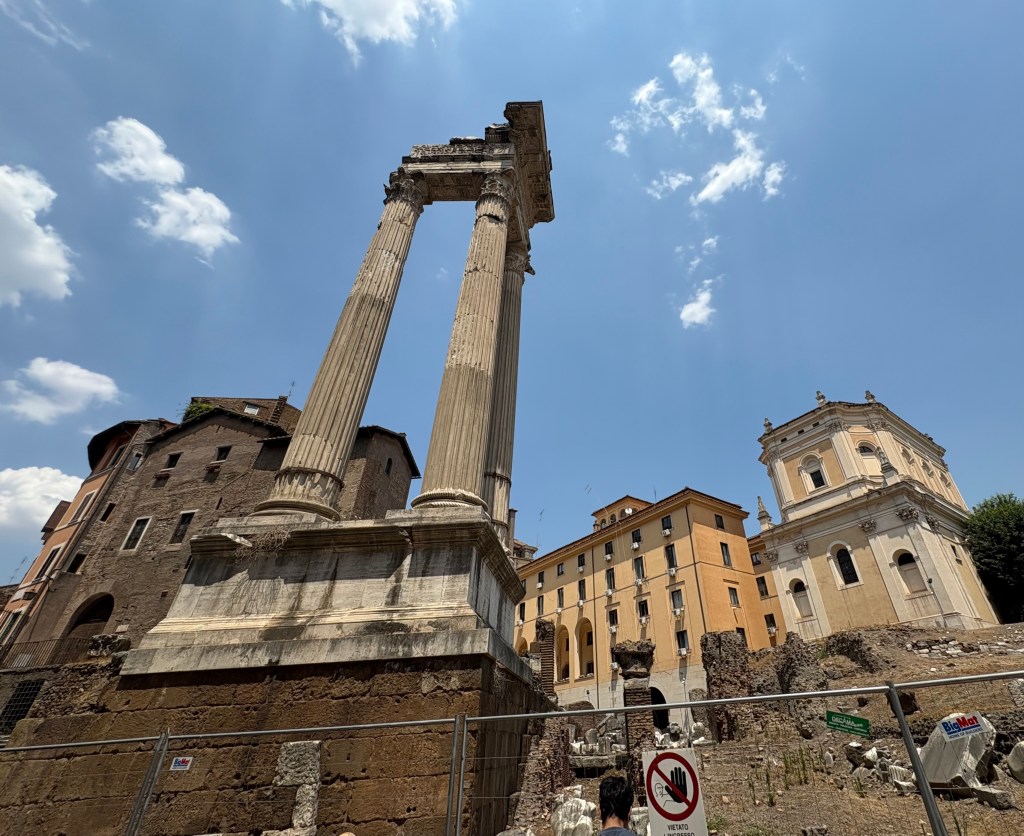
All around us, we hear of disasters. Often, we try to write of these as Tagore seems to do in the above lines. However, these lines follow after he says he draws solace and inspiration from a ‘serene lotus’, pristine and shining with vibrancy. He gazes at it while looking for that still point which helps him create an impact with words. That is perhaps what we can hope to do too — wait for a morning where clarity will show us the path to express not just what we see, but to find a way to heal and help. Finding parallels in great writings of yore to our own attempts at recreating the present makes us realise that perhaps history is cyclical. In Rome, new structures rear up against thousand-year walls, reflecting how the past congeals into the present.
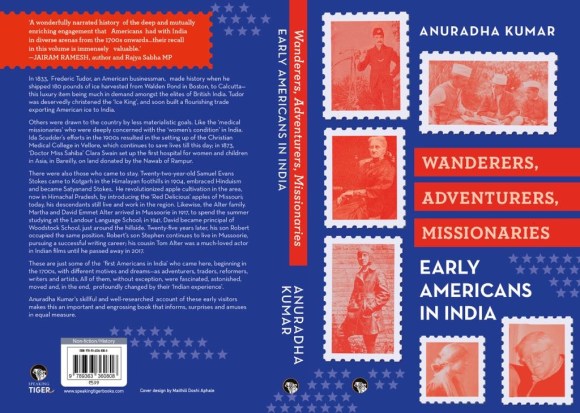
Congealing the past into our present in this July’s issue are stories of American migrants — like Tom Alter’s family who made India their home — by Anuradha Kumar in her new non-fiction Wanderers, Adventurers, Missionaries: Early Americans in India. We feature this book with a review and an interview with the author where she tells us how and why she chose to write on these people. We have more people writing of their own wanderings. Mohul Bhowmick wanders into Cambodia and makes friends over a local sport while Prithvijeet Sinha strolls by the banks of the River Gomti in Lucknow. Meredith Stephens not only takes us to the Prime Meridien in Greenwich but also to Carnarvon which houses a science and technology centre in Australia. Devraj Singh Kalsi wanders with humour to discover gastronomical inspiration and hopes for sweeter recompense.
Taking up the theme of cli-fi, Rajat Chaudhuri’s Wonder Tales for a Warming Planetseems to bring hope by suggesting adapting to changing climes. Rakhi Dalal tells us in her review: “It dares to approach the climate crisis through the lens of empathy and imagination rather than panic or guilt. In doing so, Rajat Chaudhuri gives us what many adult climate narratives fail to deliver—a reason to believe that another world is not only possible but already being imagined by the young. All we need to do is listen.” Bhaskar Parichha has discussed the autobiography of a meteorologist and Distinguished University Professor at George Mason University, Jagadish Shukla. In A Billion Butterflies: A Life in Climate and Chaos Theory, he claims Shukla has “revolutionised monsoon forecasting.” Somdatta Mandal has written about Dilip K Das’s Epidemic Narratives: The Cultural Construction of Infectious Disease Outbreaks in India. And Gower Bhat reviews Neha Bansal’s best-selling poetry collection, Six of Cups.
With that, we wind up the contents of this month’s issue. Do pause by our content’s page to check it out in more details.
This month’s edition would not have been possible without all our contributors, our fabulous team and especially Sohana Manzoor’s artwork. Huge thanks to all of them and to our wonderful readers who make it worthwhile for us to write and publish. Do write in to us if you have any feedback. Five years ago, we chose to become a monthly from a daily… We have come a long way from then and grown to host writers from more than forty countries and readers from almost all over the world. For this, we owe you all – for being with us and encouraging us to find fresh pastures.
Probhatey (In the Morning) was published as a part of Rabindranath Tagore’s collection called Kheya (Ferry) published in 1906.
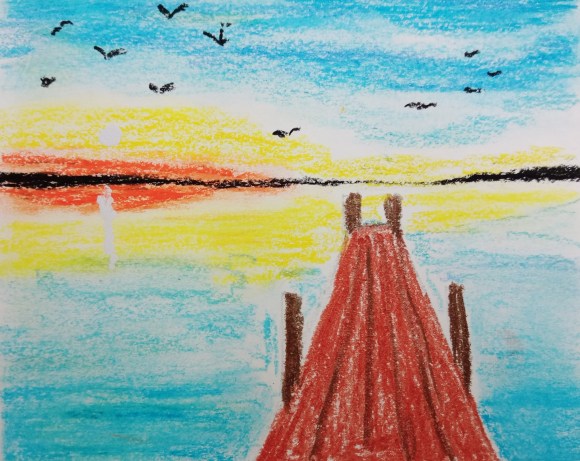
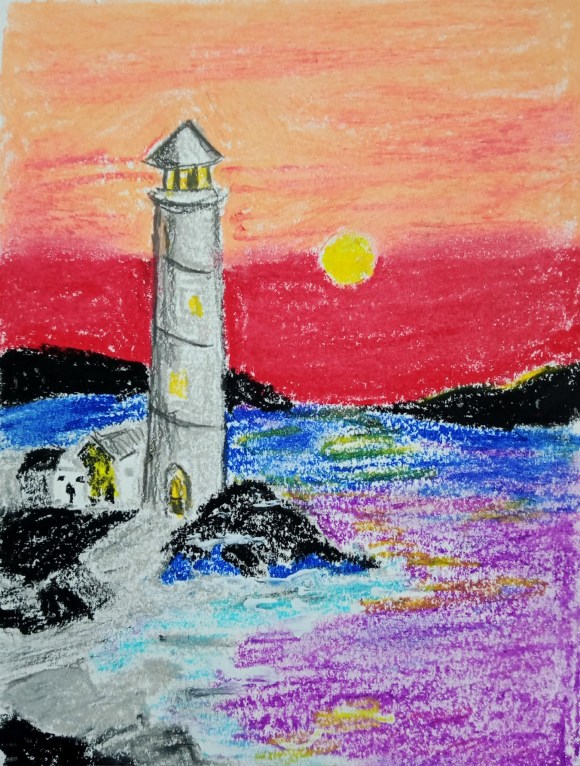
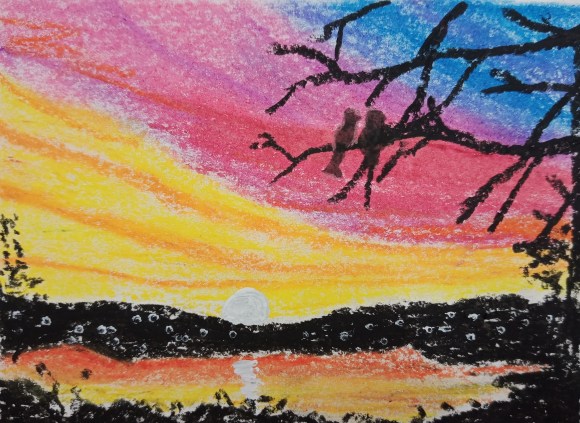
Art by Sohana Manzoor
      IN THE MORNING

 The heavy downpour
               Of one night
   Has filled the lake in my home
              To the brim.
        When I look, I see
     Deep blue waters overflow.
Where is its shore? Where is its bottom?
        Where does it turn?
  With one downpour, see the lake
          Is filled to the brim.


    Last night, who could imagine
            This would happen!
      The rain poured incessantly
            In the deep dark night.
     In the midnight of this monsoon,
     While I lay in a lamp less room,
            I heard the wind howl
                 As if in distress —
                  Who knew then
                This would happen!


  Amidst this outpouring of teardrops,
            I found today
           A serene lotus
        Presiding the scene.
   O tell me, when O when did it bloom,
          Pristine among multitudes
             Shining with vibrancy,
             Bringing solace to me
            In the midst of this abyss
                   Of despondency!


Today, sitting alone, I ponder
          Gazing at the site.
       I see the treasures torn
  From the chest by the tragic night.
       I can see the heartbreak,
    Hear the wailing, the awakening,
          I write from my heart
          Of the raging tempest.
    I gaze at the treasures torn
 From the chest by the stormy night.
This poem has been translated from Bengali by Mitali Chakravartywith editorial input from Sohana Manzoor.
.
PLEASE NOTE: ARTICLES CAN ONLY BE REPRODUCED IN OTHER SITES WITH DUE ACKNOWLEDGEMENT TO BORDERLESS JOURNAL
A review of Anuradha Kumar’s Wanderers, Adventurers, Missionaries: Early Americans in India (Speaking Tiger Books) and an interview with the author
Migrants and wanderers — what could be the differences between them? Perhaps, we can try to comprehend the nuances. Seemingly, wanderers flit from place to place — sometimes, assimilating bits of each of these cultures into their blood — often returning to their own point of origin. Migrants move countries and set up home in the country they opt to call home as did the family the famous Indian actor, Tom Alter (1950-2017).
Anuradha Kumar’s Wanderers, Adventurers, Missionaries: Early Americans in India captures the lives and adventures of thirty such individuals or families — including the Alter family — that opted to explore the country from which the author herself wandered into Singapore and US. Born in India, Kumar now lives in New Jersey and writes. Awarded twice by the Commonwealth Foundation for her writing, she has eight novels to her credit. Why would she do a whole range of essays on wanderers and migrants from US to India? Is this book her attempt to build bridges between diverse cultures and seemingly diverse histories?
As Kumar contends in her succinct introduction, America and India in the 1700s were similar adventures for colonisers. In the Empire Podcast, William Dalrymple and Anita Anand do point out that the British East India company was impacted in the stance it had to colonisers in the Sub-continent after their experience of the American Revolution. And America and India were both British colonies. They also were favourites of colonisers from other European cultures. Just as India was the melting pot of diverse communities from many parts of the world — even mentioned by Marco Polo (1254-1324) in The Kingdom of India — America in the post-Christopher Columbus era (1451-1546) provided a similar experience for those who looked for a future different from what they had inherited. The first one Kumar listed is Nathaniel Higginson (1652-1708), a second-generation migrant from United Kingdom, who wandered in around the same time as British administrator Job Charnock (1630-1693) who dreamt Calcutta after landing near Sutanuti[1].
Kumar has bunched a number of biographies together in each chapter, highlighting the commonality of dates and ventures. The earliest ones, including Higginson, fall under ‘Fortune Seekers From New England’. The most interesting of these is Fedrick Tudor (1783-1864), the ice trader. Kumar writes: “In Calcutta, Dwarkanath Tagore, merchant and patron of the arts (Rabindranath Tagore’s grandfather), expressed an interest to involve himself in ice shipping, but Tudor’s monopoly stayed for some decades more. Tagore was part of the committee in Calcutta along with Kurbulai Mohammad, scion of a well-established landed family in Bengal, to regulate ice supply.”
Also associated with the Tagore family, was later immigrant Gertrude Emerson Sen (1890-1982, married to Boshi Sen). She tells us, “Tagore wrote Foreword to Gertrude Emerson’s Voiceless India, set in a remote Indian village and published in 1930. Nobel Laureate Rabindranath Tagore called Emerson’s efforts, ‘authentic’.” She has moved on to quote Tagore: “The author did not choose the comfortable method of picking up information from behind lavish bureaucratic hospitality, under a revolving electric fan, and in an atmosphere of ready-made social opinions…She boldly took in on herself unaided to enter a region of our life, all but unexplored by Western tourists, which had one great advantage, in spite of its difficulties, that it offered no other path to the writer, but that of sharing the life of the people.’” Kumar writes of an Afro-American scholar, called Merze Tate who came about 1950-51 and was also fascinated by Santiniketan as were some others.
Another name that stuck out was Sam Higginbottom, who she described as “the Farmer Missionary” for he was exactly that and started an agricultural university in Allahabad. Around the same time as Tagore started Sriniketan (1922), Higginbottom was working on agricultural reforms in a different part of India. In fact, Uma Dasgupta mentions in A History of Sriniketan: Rabindranath Tagore’s Pioneering work in Rural Reconstruction that Lord Elimhurst, who helped set up the project, informed Tagore that “another Englishman” was doing work along similar lines. Though as Kumar has pointed out, Higginbottom was a British immigrant to US — an early American — and returned to Florida in 1944.
There is always the grey area where it’s difficult to tie down immigrants or wanderers to geographies. One such interesting case Kumar dwells on would be that of Nilla Cram Cook, who embraced Hinduism, becoming in-the process, ‘Nilla Nagini Devi’, as soon as she reached Kashmir with her young son, Sirius. She shuttled between Greece, America and India and embraced the arts, lived in Gandhi’s Wardha ashram and corresponding with him, went on protests and lived like a local. Her life mapped in India almost a hundred years ago, reads like that of a free spirit. At a point she was deported living in an abject state and without slippers. Kumar tells us: “Her work according to Sandra Mackey combined ‘remarkable cross-cultural experimentation’ and ‘dazzling entrepreneurship.’”
The author has written of artists, writers, salesmen, traders (there’s a founder/buyer of Tiffany’s), actors, Theosophists, linguists fascinated with Sanskrit, cyclists — one loved the Grand Trunk Road, yet another couple hated it — even a photographer and an indentured Afro-American labourer. Some are missionaries. Under ‘The Medical Missionaries: The Women’s Condition’, she has written of the founders of Vellore Hospital and the first Asian hospital for women and children. Some of them lived through the Revolt of 1857; some through India’s Independence Movement and with varied responses to the historical events they met with.
Kumar has dedicated the book to, “…all the wanderers in my family who left in search of new homes and forgot to write their stories…” Is this an attempt to record the lives of people as yet unrecorded or less recorded? For missing from her essays are famous names like Louis Fischer, Webb Miller — who were better known journalists associated with Gandhi and spent time with him. But there are names like Satyanand Stokes and Earl and Achsah Brewster, who also met Gandhi. Let’s ask the author to tell us more about her book.
Anuradha Kumar
What made you think of doing this book? How much time did you devote to it?
These initially began as essays for Scroll; short pieces about 1500-1600 words long. And the beginnings were very organic. I wrote about Edwin Lord Weeks sometime in 2015. But the later pieces, most of them, were part of a series.
I guess I am intrigued by people who cross borders, make new lives for themselves in different lands, and my editors—at Scroll and Speaking Tiger Books—were really very encouraging.
After I’d finished a series of pieces on early South Asians in America, I wanted to look at those who had made the journey in reverse, i.e., early Americans in India, and so the series came about, formally, from December 2021 onward. I began with Thomas Stevens, the adventuring cyclist and moved onto Gertrude Emerson Sen, and then the others. So, for about two years I read and looked up accounts, old newspapers, writings, everything I possibly could; I guess that must mean a considerable amount of research work. Which is always the best thing about a project like this, if I might put it that way.
What kind of research work? Did you read all the books these wanderers had written?
Yes, in effect I did. The books are really old, by which I mean, for example, Bartolomew Burges’ account of his travels in ‘Indostan’ written in the 1780s have been digitized and relatively easy to access. I found several books on Internet Archive, or via the interlibrary loan system that connects libraries in the US (public and university). I looked up old newspapers, old magazine articles – loc.gov, archive.org, newspapers.com, newspaperarchive.com, hathitrust.org and various other sites that preserve such old writings.
You do have a fiction on Mark Twain in India. But in this book, you do not have very well-known names like that of Twain. Why?
Not Twain, but I guess some of the others were well-known, many in their own lifetime. Satyanand Stokes’ name is an easily recognisable still especially in India, and equally familiar is Ida Scudder of the Vellore Medical College, and maybe a few others like Gertrude Sen, and Clara Swain too. I made a deliberate choice of selecting those who had spent a reasonable amount of time in India, at least a year (as in the case of Francis Marion Crawford, the writer, or a few months like the actor, Daniel Bandmann), and not those who were just visiting like Mark Twain or passing through. This made the whole endeavour very interesting. When one has spent some years in a foreign land, like our early Americans in India, one arguably comes to have a different, totally unique perspective. These early Americans who stayed on for a bit were more ‘accommodating’ and more perceptive about a few things, rather than supercilious and cursory.
And it helped that they left behind some written record. John Parker Boyd, the soldier who served the Nizam as well as Holkar in Indore in the early 1800s, left behind a couple of letters of complaint (when he didn’t get his promised reward from the East India Company) and even this sufficed to try and build a complete life.
How do these people thematically link up with each other? Do their lives run into each other at any point?
Yes, I placed them in categories thanks to an invaluable suggestion by Dr Ramachandra Guha, the historian. I’d emailed him and this advice helped give some shape to the book, else there would have been just chapters following each other. And their lives did overlap; several of them, especially from the 1860s onward, did work in the same field, though apart from the medical missionaries, I don’t think they ever met each other – distances were far harder to traverse then, I guess.
What is the purpose of your book? Would it have been a response to some book or event?
I was, and am, interested in people who leave the comforts of home to seek a new life elsewhere, even if only for some years. Travelling, some decades ago, was fraught with risk and uncertainty. I admire all those who did it, whether it was for the love of adventure, or a sense of mission. I wanted to get into their shoes and see how they felt and saw the world then.
Is this because you are a migrant yourself? How do you explain the dedication in your book?
I thought of my father, and his cousins, all of whom grew up in what was once undivided Bengal. Then it became East Pakistan one day and then Bangladesh. Suddenly, borders became lines they could never cross, and they found new borders everywhere, new divisions, and new homes to settle down in. They were forced to learn anew, to always look ahead, and understand the world differently.
When I read these accounts by early travellers, I sort of understood the sense of dislocation, desperation, and sheer determination my father, his cousins felt; maybe all those who leave their homes behind, unsure and uncertain, feel the same way.
You have done a number of non-fiction for children. And also, historical fiction as Aditi Kay. This is a non-fiction for adults or all age groups? Do you feel there is a difference between writing for kids and adults?
I’d think this is a book for someone who has a sense of history, of historical movements, and change, and time periods. A reader with this understanding will, I hope, appreciate this book.
About the latter half of your question, yes of course there is a difference. But a good reader enters the world the writer is creating, freely and fearlessly, and I am not sure if age decides that.
You have written both fiction and non-fiction. Which genre is more to your taste? Elaborate.
I love anything to do with history. Anything that involves research, digging into things, finding out about lives unfairly and unnecessarily forgotten. The past still speaks to us in many ways, and I like finding out these lost voices.
What is your next project? Do you have an upcoming book? Do give us a bit of a brief curtain raiser.
The second in the Maya Barton-Henry Baker series. In this one, Maya has more of a lead role than Henry. It’s set in Bombay in the winter of 1897, and the plague is making things scary and dangerous. In this time bicycles begin mysteriously vanishing… and this is only half the mystery!
The story of Hawakal Publishers, based on a face-to-face tête-à-tête, and an online conversation with founder Bitan Chakrabortywith his responses in Bengali translated by Kiriti Sengupta. Clickhere to read.
Sonar Tori(Golden Boat) is the titular poem of Tagore’s book of the same name. This celebrated collection was first published in 1894.
Art by Rabindranath Tagore. From Public domain
Amidst dense clouds and heavy downpour,
Without any hope of respite, I sit on the shore.
        Many sheaves of rice are piled in droves,
                 Housed in straw-built stores.
The river's edge is like a razor as the water flows,
                    Torrential and ferocious.
While the rice was being cut, it started to pour.

         I have a small field, and I work alone.
    The water sways on all sides and overflows.
           On the other shore’s horizon,
                     I see etched
              A village under the shadow of trees
                 Covered in misty morning clouds.
   On this shore, I am alone in this small field.

Someone is singing and rowing to this side.
    Looks like, I might know her.
           Without glancing around,
            She rows past in full sail.
            The waves helplessly
                  Part to give way—
      Looks like, I might know her.

Oh where do you row, to which foreign land?
       Come to me in your boat.
            Go wherever you want,
              Give to whoever you desire,
                      Only, do take
                       With a smile,
            My golden crop from this shore.

 Take as much as you wish into your boat.
      Is there anymore? — There’s none left.
                           By the river,
               I stashed into the boat
              All that I had done in my life
                  In bundles —
Now, please be merciful and take me along.

I have no place. The boat is too small.
It is filled with my crop of golden paddy.
                 Surrounded by heavy
                  Monsoon clouds,
                  I stayed by the
                     Lonely shore —
Whatever I had was taken away by the golden boat.
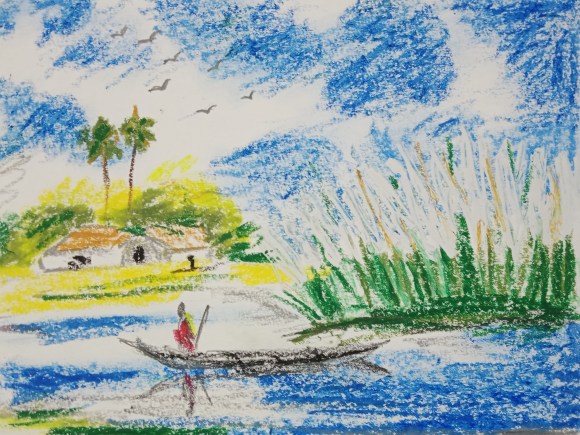
Art by Sohana
This poem has been translated from Bengali by Mitali Chakravartywith editorial input from Sohana Manzoor.
.
PLEASE NOTE: ARTICLES CAN ONLY BE REPRODUCED IN OTHER SITES WITH DUE ACKNOWLEDGEMENT TO BORDERLESS JOURNAL
In Did He Ever?,Rhys Hughes gives fun-filled verses on Lafcadio Hearn, a bridge between the East and West from more than a hundred years ago. Clickhere to read.
Dolly Narang muses on Satyajit Ray’s world beyond films and shares a note by the maestro and an essay on his art by the eminent artist, Paritosh Sen. Clickhere to read.
Poetry, prose — all art forms — gather our emotions into concentrates that distil perhaps the finest in human emotions. They touch hearts across borders and gather us all with the commonality of feelings. We no longer care for borders drawn by divisive human constructs but find ourselves connecting despite distances. Strangers or enemies can feel the same emotions. Enemies are mostly created to guard walls made by those who want to keep us in boxes, making it easier to manage the masses. It is from these mass of civilians that soldiers are drawn, and from the same crowds, we can find the victims who die in bomb blasts. And yet, we — the masses — fight. For whom, for what and why? A hundred or more years ago, we had poets writing against wars and violence…they still do. Have we learnt nothing from the past, nothing from history — except to repeat ourselves in cycles? By now, war should have become redundant and deadly weapons out of date artefacts instead of threats that are still used to annihilate cities, humans, homes and ravage the Earth. Our major concerns should have evolved to working on social equity, peace, human welfare and climate change.
One of the people who had expressed deep concern for social equity and peace through his films and writings was Satyajit Ray. This issue has an essay that reflects how he used art to concretise his ideas by Dolly Narang, a gallery owner who brought Ray’s handiworks to limelight. The essay includes the maestro’s note in which he admits he considered himself a filmmaker and a writer but never an artist. But Ray had even invented typefaces! Artist Paritosh Sen’s introduction to Ray’s art has been included to add to the impact of Narang’s essay. Another person who consolidates photography and films to do pathbreaking work and tell stories on compelling issues like climate change and helping the differently-abled is Vijay S Jodha. Ratnottama Sengupta has interviewed this upcoming artiste.
Reflecting the themes of welfare and conflict, Prithvijeet Sinha’s essay takes us to a monument in Lucknow that had been built for love but fell victim to war. Some conflicts are personal like the ones of Odbayar Dorj who finds acceptance not in her hometown in Mongolia but in the city, she calls home now. Jun A. Alindogan from Manila explores social media in action whereas Eshana Sarah Singh takes us to her home in Jakarta to celebrate the Chinese New Year! Farouk Gulsara looks into the likely impact of genetic engineering in a world already ripped by violence and Devraj Singh Kalsi muses on his source of inspiration, his writing desk. Meredith Stephens tells the touching story of a mother’s concern for her child in Australia and Suzanne Kamata exhibits the same concern as she travels to Happy Village in Japan to meet her differently-abled daughter and her friends.
As these real-life narratives weave commonalities of human emotions, so do fictive stories. Some reflect the need for change. Fiona Sinclair writes a layered story set in London on how lived experiences define differences in human perspectives while Parnika Shirwaikar explores the need to learn to accept changes set in her part of the universe. Spandan Upadhyay explores the spirit of the city of Kolkata as a migrant with a focus on social equity. Both Paul Mirabile and Naramsetti Umamaheswararao write stories around childhood, one set in Europe and the other in Asia.
Do pause by our contents page for this issue and enjoy the reads. We are ever grateful to our ever-growing evergreen readership some of whom have started sharing their fabulous narratives with us. Thanks to all our readers and contributors. Huge thanks to our wonderful team without whose efforts we could not have curated such valuable content and thanks specially to Sohana Manzoor for her art. Thank you all for making a whiff of an idea a reality!
Asha or Hope is a poem from Tagore’s collection, Kalpana (Imagination, 1900).
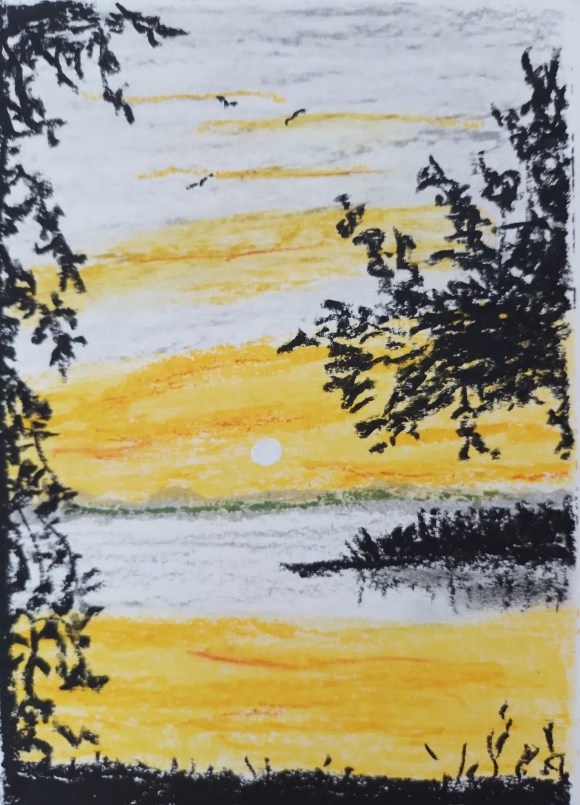
Art by Sohana Manzoor
HOPE

When the sun set on my life,
You welcomed me, O mother of mine.
Opening the doors of your inner sanctum,
You planted a kiss on my temples,
Lit a timeless lamp at my bedside. My neck
Was with a string of thorny blooms decked
To honour my songs. It hurt, it burnt —
Till taking off the wreath, you plucked
Each thorn off with your own hands,
Washed the dust. That garland —
With blooms now clean and white —
You draped on me as your eternal child.
My eyes opened as tears streamed.
I woke up to find it was only a dream!
This poem has been translated from Bengali by Mitali Chakravartywith editorial input from Sohana Manzoor.
.
PLEASE NOTE: ARTICLES CAN ONLY BE REPRODUCED IN OTHER SITES WITH DUE ACKNOWLEDGEMENT TO BORDERLESS JOURNAL
Poems of Longing by Jibananada Das homes two of his poems translated from Bengali by Professor Fakrul Alam. Clickhereto read.
Four cantos from Ramakanta Rath’sSri Radha, translated from Odiya by the late poet himself, have been excerpted from his full length translation. Clickhere to read.
Naramsetti Umamaheswararao takes us back to school. Click here to read.
Conversation
Ratnottama Sengupta talks to filmmaker and author Leslie Carvalhoabout his old film, The Outhouse, that will be screened this month and his new book, Smoke on the Backwaters. Clickhere to read.




 Borderless