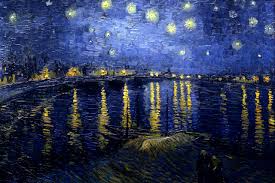
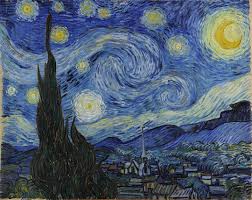
Paintings by Vincent van Gogh (1853-1890). From Public Domain
THE BLESSING OF AFTER-RAIN

The rain has stopped.
The sky is clearing.
It’s too late for the sun
but the moon,
full and glowing gold,
does what it can
to illuminate the world.
I step outside,
breathe the newly minted air,
look up to where the stars,
in various states of gleaming,
declare the universe open
for heads titled backward,
eyes wide enough
to encompass everything up there.
I must thank the rain for this.
So much in life is intensified
by time spent with its opposite.


CHORUS

Birds sing a chorus.
And the wind orchestrates.
We shimmer in the throat of song,
the finches that come by daily,
the occasional red-winged blackbird,
the mourning doves whose grief is purely ornamental
for don't they hog the meatiest of seeds at the feeder,
and aren't their wings wide and light enough
to ride the praise and silence of our breath.
John Grey is an Australian poet, US resident. His latest books are Between Two Fires, Covert and Memory Outside The Head are available through Amazon. His upcoming work will be in Haight-Ashbury Literary Journal, Amazing Stories and River and Sout.
.
PLEASE NOTE: ARTICLES CAN ONLY BE REPRODUCED IN OTHER SITES WITH DUE ACKNOWLEDGEMENT TO BORDERLESS JOURNAL
Ranu Bhattacharyya takes us back to Dhaka of the 1930s… and a world where the two Bengals interacted as one with her migration story. Click here to read.
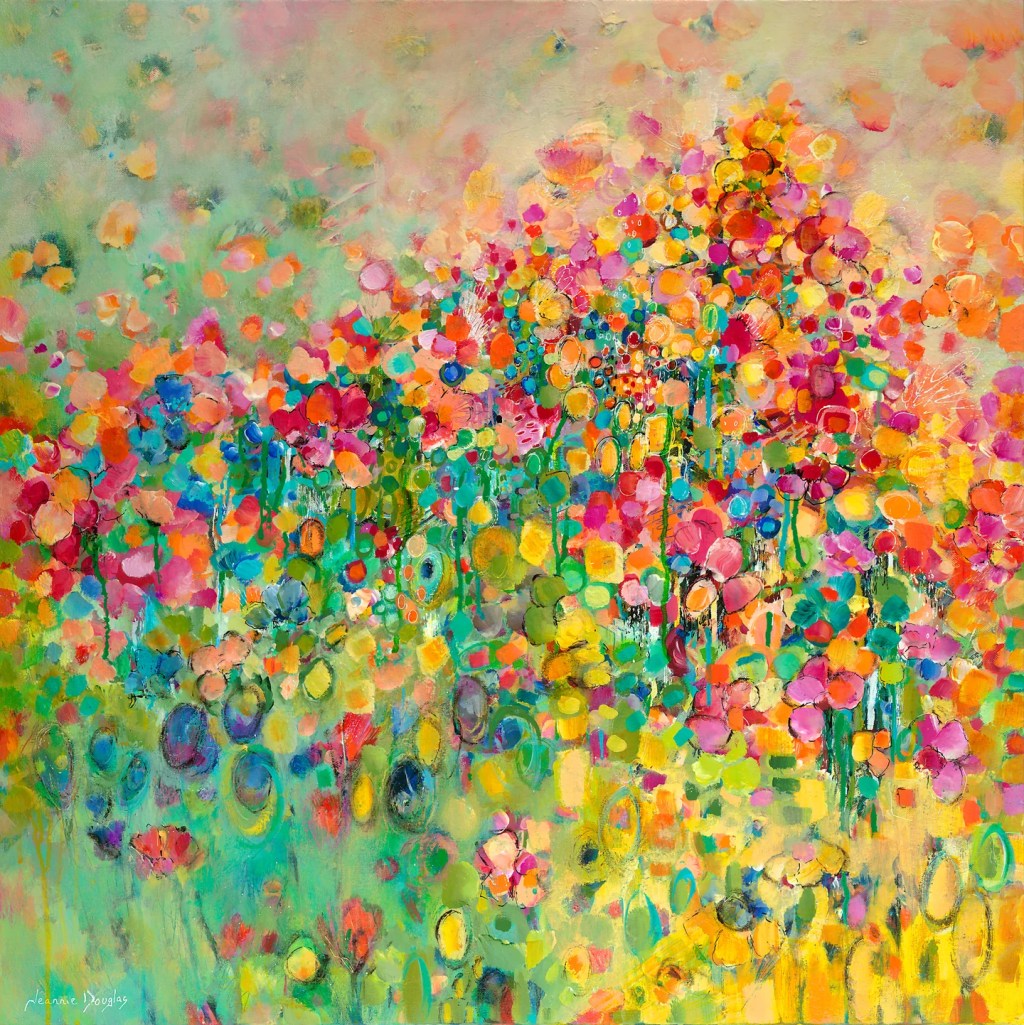
A Pop of Happiness by Jeanie Douglas. From Public Domain
Happiness is a many splendored word. For some it is the first ray of sunshine; for another, it could be a clean bill of health; and yet for another, it would be being with one’s loved ones… there is no clear-cut answer to what makes everyone happy. In Harry Potter and the Half Blood Prince (JK Rowling, 2005), a sunshine yellow elixir induces euphoria with the side effects of excessive singing and nose tweaking. This is of course fantasy but translate it to the real world and you will find that happiness does induce a lightness of being, a luminosity within us that makes it easier to tackle harder situations. Playing around with Rowling’s belief systems, even without the potion, an anticipation of happiness or just plain optimism does generate a sense of hope for better times. Harry tackles his fears and dangers with goodwill, friends and innate optimism. When times are dark with raging wars or climate events that wreck our existence, can one look for a torch to light a sense of hope with the flame of inborn resilience borne of an inner calm, peace or happiness — call it what you will…?
It is hard to gauge the extreme circumstances with which many of us are faced in our current realities, especially when the events spin out of control. In this issue, along with the darker hues that ravage our lives, we have sprinklings of laughter to try to lighten our spirits. In the same vein, externalising our emotions to the point of absurdity that brings a smile to our lips is Rhys Hughes’ The Sunset Suite, a book that survives on tall tales generated by mugs of coffee. In one of the narratives, there is a man who is thrown into a bubbling hot spring, but he survives singing happily because his attacker has also thrown in packs of tea leaves. This man loves tea so much that he does not scald, drown or die but keeps swimming merrily singing a song. While Hughes’ stories are dark, like our times, there is an innate cheer that rings through the whole book… Dare we call it happiness or resilience? Hughes reveals much as he converses about this book, squonks and stranger facts that stretch beyond realism to a fantastical world that has full bearing on our very existence.
A powerful essay by Binu Mathew on the climate disaster at Wayanad, a place that earlier had been written of as an idyllic getaway, tells us how the land in that region has become more prone to landslides. The one on July 30th this year washed away a whole village! Farouk Gulsara has given a narrative about his cycling adventure through the state of Kashmir with his Malaysian friends and finding support in the hearts of locals, people who would be the first to be hit by any disaster even if they have had no hand in creating the catastrophes that could wreck their lives, the flora and the fauna around them. In the wake of such destructions or in anticipation of such calamities, many migrate to other areas — like Ranu Bhattacharya’s ancestors did a bit before the 1947 Partition violence set in. A younger migrant, Chinmayi Goyal, muses under peaceful circumstances as she explores her own need to adapt to her surroundings. G Venkatesh from Sweden writes of his happy encounter with local children in the playground. And Snigdha Agrawal has written of partaking lunch with a bovine companion – it can be intimidating having a cow munching at the next table, I guess! Devraj Singh Kalsi has given a tongue-in-cheek musing on how he might find footing as a godman. Suzanne Kamata has given a lovely summery piece on parasols, which never went out of fashion in Japan!
Radha Chakravarty, known for her fabulous translations, has written about the writer she translated recently, Nazrul. Her essay includes a poem by Tagore for Nazrul. Professor Fakrul Alam has translated two of Nazrul’s songs of parting and Sohana Manzoor has rendered his stunning story Shapuray (Snake Charmer) into English. Fazal Baloch has brought to us poetry in English from the Sulaimani dialect of Balochi by Allah Bashk Buzdar, and a Korean poem has been self-translated by the poet, Ihlwha Choi. The translations wind up with a poem by Tagore, Olosh Shomoy Dhara Beye (Time Flows at an Indolent Pace), showcasing how the common man’s daily life is more rooted in permanence than evanescent regimes and empires.
Fiction brings us into the realm of the common man and uncommon situations, or funny ones. A tongue-in-cheek story set in the Midwest by Joseph Pfister makes us laugh. Farhanaz Rabbani has given us a beautiful narrative about a girl’s awakening. Paul Mirabile delves into the past using the epistolary technique highlighting darker vignettes from Christopher Columbus’s life. We have book excerpts from Maaria Sayed’s From Pashas to Pokemonand Nazes Afroz’s translation of Syed Mujtaba Ali’sShabnamwith both the extracts and Rabbani’s narratives reflecting the spunk of women, albeit in different timescapes…
When migrations are out of choice, with multiple options to explore, they take on happier hues. But when it is out of a compulsion created by manmade disasters — both wars and climate change are that — will the affected people remain unscarred, or like Potter, bear the scar only on their forehead and, with Adlerian calm, find happiness and carpe diem?
Do pause by our current issue which has more content than mentioned here as some of it falls outside the ambit of our discussion. This issue would not have been possible without an all-out effort by each of you… even readers. I would like to thank each and every contributor and our loyal readers. The wonderful team at Borderless deserve much appreciation and gratitude, especially Manzoor for her wonderful artwork. I invite you all to savour this August issue with a drizzle of not monsoon or April showers but laughter.
May we all find our paths towards building a resilient world with a bright future.
It's over a hundred. Trees droop close to melting. Air-conditioners whirr and whine. The electrical grid sputters close to blackout.
Air is slow to get around and some climate skeptic in a row house on Broadway wipes his brow, unpeels his shirt, thinks maybe this really is the hottest it's ever been.
In my house, with every window open, I imagine a crystal blue stream cascading down from mountains. Even in my mind, it turns to steam in an instant.
LET ME TELL YOU ABOUT THE MOUNTAIN
It was gold up there and my head could see clear to the next state and to the people I knew in childhood.
Forget the wind and the soughing boughs and the cold rocks and the clotted dry grass -- there were sounds like bells ringing and steps that penetrated clouds.
It was like a table set for me. And lit by one candle, one sun.
I approached gods fit to worship and they thanked me for my kind words but then directed me to deities even greater.
When I reached the peak, the sky was a wide blue altar. I climbed so high just so I could drop to my knees.
John Grey is an Australian poet, US resident, recently published in New World Writing, North Dakota Quarterlyand Lost Pilots. His latest books are Between Two Fires, Covert and Memory Outside The Head are available through Amazon.
.
PLEASE NOTE: ARTICLES CAN ONLY BE REPRODUCED IN OTHER SITES WITH DUE ACKNOWLEDGEMENT TO BORDERLESS JOURNAL
The description in ‘Hot Dry Summers’ is not of hell but what is perceived as happening on certain parts of Earth due to global warming or climate change. Forest fires. Nearer the equator, the storms have become harsher with lightning strikes that seem to connect the Earth to the sky. Trees get uprooted as the soil is softened from excessive rain. Sometimes, they fall on passers-by killing or injuring them. There is no rain in some places, forest fires or flooding in others… The highest temperatures touched 55 degrees Celsius this year. Instead of worrying about losing our homes lodged on land masses to the oceans that continue to rise, becoming dark heat absorbers due to loss of white ice cover, we persistently fight wars, egged on by differences highlighting divisive constructs. It feels strange that we are witness to these changes which seem to be apocalyptic to doomsday sayers. Are they right? Our flora, fauna and food will also be impacted by global climate change. How will we survive these? Will we outlive these as a species?
Poetry in our translations’ section travels to Balochistan, from where a Hafeez Rauf translated from Balochi by Fazal Baloch, talks of burning tyres, again conflicts. It takes on a deeper hue as Ihlwha Choi translates his poignant poem from Korean, reflecting on the death of his mother. We have a translation of Tagore’s less popular poem, Mrityu[1], reflecting on the same theme. His reflections on his wife’s death too have been translated by Professor Fakrul Alam who has also shared a song of Nazrul, written and composed on the death of Tagore. Another lesser-known poet but brilliant nonetheless, Nirendranath Chakraborty, has been translated for us by Debali Mookerjea-Leonard. And what a tremendous poem it is when the person called Amalkanti wanted to be sunshine! We have a story too — ‘Speech Matters’ by Naramsetti Umamaheswararao translated by Johny Takkedasila.
Our stories as usual travel around the world — from Holland (by Paul Mirabile) to Hyderabad (by Mohul Bhowmick) and with a quick pause at Bangalore (by Anagha Narasimha). Travels in the real world are part of our non-fiction. Sai Abhinay Penna takes to a the second largest mangrove forest in the world and Ravi Shankar to Colombo. Madhuri Bhattachrya gives us a glimpse of an Indian summer and Snigdha Aggrawal explores the impact of climate change in her part of the world. Farouk Gulsara actually writes his reflections at a traffic junction. And it reads droll…
We have an in memoriam by Keith Lyons on Morgan Spurlock, the documentary maker who ate McDonald fare for a month and then made a film on it. We have two tributes to two legends across time. Wayne F Burke has given a brief piece on the iconic illustrator, Norman Rockwell. And Aruna Chakravarti, the queen of historic fiction who brought the Tagore family alive for us in her two very well researched novels, Jorasanko and Daughters of Jorasanko, has given us a fabulous tribute to Tagore on the not-so common aspects of him.
Suzanne Kamata, the novelist who does a column from Japan for us normally, has spoken to us about her new novel, Cinnamon Beach, which overrides multiple manmade constructs. It’s an interesting read from someone who lives her life across multiple cultures and transcends many boundaries.
This is a bumper issue, and it is difficult to convey the vibrant hues of words that colour this edition. Please do pause by our contents page for a more comprehensive look.
This issue would not have been possible without all our fabulous contributors and a wonderful, dedicated team. We are delighted that Rakhi Dalal — who has done many reviews and shares her poetry with us in this issue — has agreed to be a writer-in-residence with us. A huge thanks to all of you, and especially Sohana Manzoor for her artwork. I am truly grateful to our readers for popularising our efforts to put together an online space with free and vibrant reads.
I would like to end with a few lines that gives me hope despite climate change, wars and doomsday predictions.
There’s more to life, he says to me, than what you choose to see.
It’s dark out as the cat takes up residence on the sill of a wide open window. The sparrows in the trees outside don’t notice him or, more likely, just don’t care having established that he’s a house cat, too domesticated, too set in his ways, too lazy to chase prey. But then the cat yawns and the sun rises. So he’s still powerful in that respect. POINT REYES
Early May, the waystation mudflats are inundated with sandpipers, godwits and a squabble of long-billed dowitchers, all Arctic bound.
Grebe flocks wheel relentlessly over the ponds before settling, as one, to feast.
Inland, small herds of deer and tule elk feed.
Cliffs provide a rookery for heron and their pine-tops are full of screeching young.
Here, life is a quirk of its own clear fate. Its joy is not to dabble but sustain.
A GARDEN IN SNOW
Brushing away snow, she uncovers the stone dog. And its hare companion, solid, steadfast, despite the bitterness of winter.
Only the garden succumbs to the heartless weather: sunflowers slaughtered, dahlias defeated, tulips trampled, rose-bushes ripped raw. If there’s any fight left in them, it eludes her gloved fingers.
Early March, and it’s like looking in on children. Some are still robust. Most are memories.
John Grey is an Australian poet, US resident, recently published in New World Writing, North Dakota Quarterly and Lost Pilots. His latest books are Between Two Fires, Covert and Memory Outside The Head are available through Amazon.
.
PLEASE NOTE: ARTICLES CAN ONLY BE REPRODUCED IN OTHER SITES WITH DUE ACKNOWLEDGEMENT TO BORDERLESS JOURNAL
In Cherry Blossom Forecast, Suzanne Kamata brings the Japanese ritual of cherry blossom viewing to our pages with her camera and words. Clickhere to read.
Where the mind is without fear … Where the world has not been broken up into fragments … Where the clear stream of reason has not lost its way … Where the mind is led forward by thee Into ever-widening thought and action…
As we complete the fourth year of our virtual existence in the clouds and across borders, the world has undergone many changes around us, and it’s not only climate change (which is a huge challenge) but much more. We started around the time of the pandemic — in March 2020 — as human interactions moved from face-to-face non-virtual interactions to virtual communication. When the pandemic ended, we had thought humanity would enter a new age where new etiquettes redefining our social norms would make human existence as pandemic proof as possible. But before we could define new norms in the global context, takeovers and conflicts seem to have reft countries, regions and communities apart. Perhaps, this is a time when Borderless Journalcan give a voice to all those who want to continue living as part of a single species in this world — where we can rise above our differences to find commonalities that make us human and part of the larger stream of humanity, that has been visualised by visionaries like Tagore or John Lennon — widely different cultural milieus but looking for the same things — humankind living together in harmony and moving towards a world without violence, without hate, without rancour and steeped in goodwill and love.
Talking of positive values does not make sense in a world that seems to be veering towards darkness… Many say that humankind is intrinsically given to feelings of anger, hate, division, lust, shame and violence. But then we are just as much inclined towards happiness, fun, love, being respectful and peaceful. Otherwise, would we be writing about these? These are inherited values that have also come down to us from our forefathers and some have been evolving towards embalming or healing with resilience, with kindness and with an open mind.
If you wake up before sunrise, you will notice the sky is really an unredeemable dark. Then, it turns a soft grey till the vibrant colours of the sun paint the horizon and beyond, dousing with not just lively shades but also with a variety of sounds announcing the start of a new day. The darkest hours give way to light. Light is as much a truth as darkness. Both exist. They come in phases in the natural world, and we cannot choose but live with the choices that have been pre-made for us. But there are things we can choose — we can choose to love or hate. We can choose resilience or weakness. We can choose our friends. We can choose our thoughts, our ideas. In Borderless, we have a forum which invites you to choose to be part of a world that has the courage to dream, to imagine. We hope to ignite the torch to carry on this conversation which is probably as old as humanity. We look forward to finding new voices that are willing to move in quest of an impractical world, a utopia, a vision — from which perhaps will emerge systems that will give way to a better future for our progeny.
In the last four years, we are happy to say we have hosted writers from more than forty different nationalities and our readers stretch across almost the whole map of the world. We had our first anthology published less than one and a half years ago, focussing more on writing from established pens. Discussions are afoot to bring out more anthologies in hardcopy with more variety of writers.
In our fourth anniversary issue, we not only host translations by Professor Fakrul Alam of Nazrul, by Somdatta Mandal of Tagore’s father, Debendranath Tagore, but also our first Mandarin translation of a twelfth century Southern Song Dynasty poet, Ye Shao-weng, by Rex Tan, a journalist and writer from Malaysia. From other parts of Asia, Dr Haneef Sharif’s Balochi writing has been rendered into English by Fazal Baloch and Ihlwha Choi has transcreated his own poetry from Korean to English. Tagore’s Phalgun or Spring, describing the current season in Bengal, adds to the variety in our translated oeuvre.
Devraj Singh Kalsi has explored darker shades of humour in his conversation with God while Suzanne Kamata has ushered in the Japanese spring ritual of gazing at cherry blossoms in her column with photographs and narrative. Keith Lyons takes us to the beautiful Fiordlands of New Zealand, Ravi Shankar to Malaysia and Mohul Bhowmick trapezes from place to place in Sri Lanka. Farouk Gulsara has discussed the elusiveness of utopia — an interesting perspective given that we look upto ideals like these in Borderless. I would urge more of you to join this conversation and tell us what you think. We did have Wendy Jones Nakashini start a discussion along these lines in an earlier issue.
I would want to thank our dedicated team from the bottom of my heart. Without them, we could not have brought out two issues within three weeks for we were late with our February issue. A huge thanks to them for their writing and to Sohana Manzoor for her art too. Thanks to our wonderful reviewers who have been with us for a number of years, to all our mentors and contributors without who this journal could not exist. Huge thanks to all our fabulous loyal readers. Devoid of their patronage these words would dangle meaninglessly and unread. Thank you all.
Wish you a wonderful spring as Borderless Journal starts out on the fifth year of its virtual existence! We hope you will be part of our journey throughout…
Enjoy the reads in this special anniversary issue with more content than highlighted here, and each piece is a wonderful addition to our oeuvre!
It was two hours before I returned home to load up the rest of my stuff into the back of the van.
It was three days before I showed up for a home-cooked dinner.
It was a week before I struggled through that familiar front door with my laundry.
And three months before, the big lie – “My landlord promised my apartment to his son and new daughter-in-law” when the truth was, I couldn’t hack it on my own.
It was two years before, I really did leave home.
It was the first but not the last time, I said “Finally.”
BATTLE LINES
Your house abuts your neighbors’. And they brawl incessantly, in words and sometimes in deed. Hands over ears don’t help. Their hardness, their selfishness, their cruelty towards each other, penetrates everything in their way.
The husband beats his wife. She thrashes the boy. The boy screams at his sister. The sister smashes things against her bedroom wall.
You live alone in loneliness. Their closeness chafes into rage. They can't merely sob like you. They all have to take life out on somebody.
The violence quietens down eventually. Explosions retreat into shame. You even hear some sighs of regret, a hug here and there.
You don’t pity them. You’re too busy pitying yourself. You can’t remember the last time you had someone to make up to.
LISTEN UP
We, always the lesser of the two in a relationship, need a more explicit way to establish our equality
than a limp stance or an emaciated smile. We, who live in a constant state of ambush,
or underfoot, or mostly outside looking in, must find, within ourselves, louder voices,
stronger cuss words, eyes that bulge with anger rather than the kind that retreat deep in their sockets.
I recommend doing this in front of a full-length mirror. You’d be surprised how much you can terrify yourself.
AN OLD MAN’S LAST HIKE
How far I’ve come, the road beyond won’t tell me. Up ahead, it’s more of a trail but, thankfully, it winds its way through forests, to rivers and the wide, clear lake they drain into.
It doesn’t even matter if I make it to the waters, anyplace now, from the field of wildflowers to the sturdy trunks of ancient trees, is a place of comfort for old bodies.
My blood can spur on the new shoots, my flesh, grow moss and mushrooms, my bones, replenish the limestone hills, my darkness, free the light.
MY PARENTS’ GRAVES
He’s buried in a small country graveyard, his rough slab also interred but in long grass not earth.
Her ashes lie beneath a smooth slab of granite. in a field that surrounds a city crematorium.
His coffin, her remains. are a hundred miles apart.
She was fifty years a widow in life and is still a widow in death.
John Grey is an Australian poet, US resident, recently published in New World Writing, North Dakota Quarterly and Lost Pilots. His latest books, Between Two Fires, Covert and Memory Outside The Head are available through Amazon. He has writing upcoming in California Quarterly, Seventh Quarry, La Presa and Doubly Mad.
PLEASE NOTE: ARTICLES CAN ONLY BE REPRODUCED IN OTHER SITES WITH DUE ACKNOWLEDGEMENT TO BORDERLESS JOURNAL






 Borderless