Categories
Slices from Life

The Night Shift to Nouméa

Sailing Adventures by Meredith Stephens

The moonlit sail

It was my turn to do the shift from midnight to two o’clock in the morning. I hastily arose and donned a thick coat.

“Put the personal location beacon (PLB) in your pocket,” Alex instructed me.

He retrieved the PLB and zipped it into my right coat pocket. I wondered what I would do if I were thrust into the sea as the boat lurched to the side. Would I recall the instructions and be able to hold onto it, unfasten it, push the alert button, and hold its antenna above the water until help came?

“Put your life jacket on too,” urged Alex.

I fiddled around with the life jacket and worked out where to put my arms through. I clinched the buckle across my chest and passed the strap though my legs, attaching it underneath the buckle.

“You need to tether too,” Alex added.

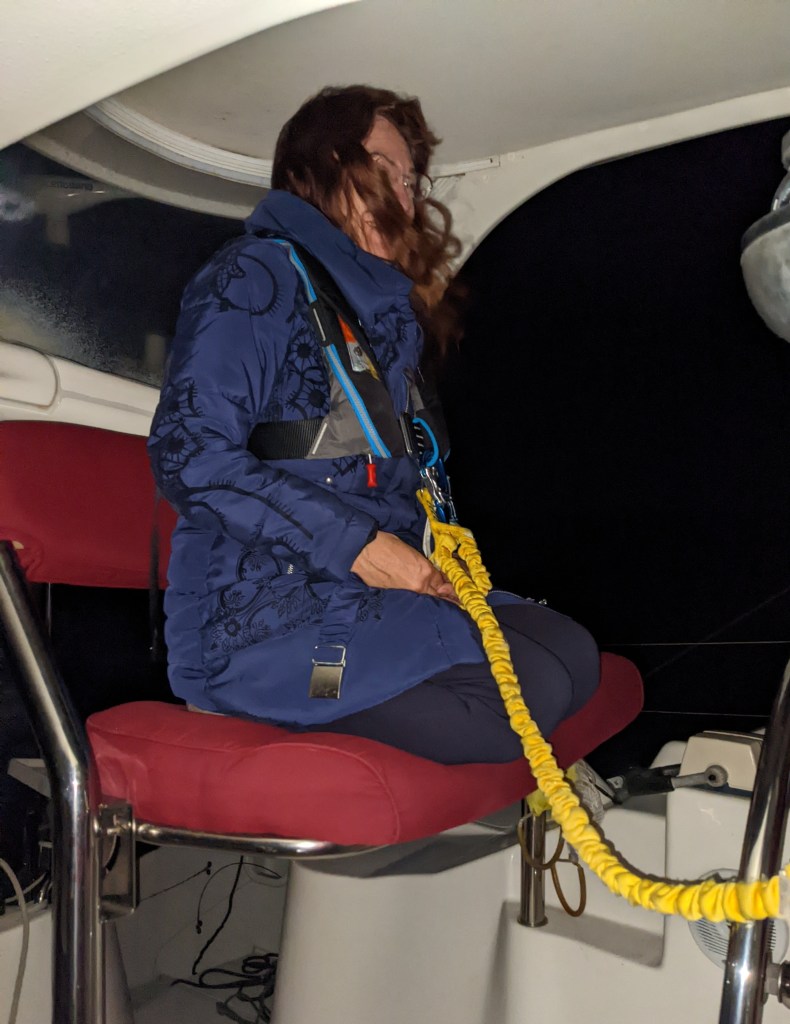
Tethered to the helm

I was so sleepy I was afraid the lurching of the boat might hurl me into the ocean. Alex attached one end of the bright yellow tether to my life jacket and the other to a clasp under the helm.

Alex sat next to me at the helm to check the instruments, and then retreated to bed. I had two hours to monitor the Automatic Identification System and radar for obstacles, and to scan the horizon for lights of other vessels. I couldn’t tell where the sea ended and where the sky started, but I tried to peer through the blackness around the gennaker[1] immediately in front of me while I periodically glanced down to the instruments.

I let my mind wander to reflect on my past in a dreamlike state. Gradually, I got used to holding my posture erect at the helm, as the vessel rocked across the waves. Because the motion reminded me of riding a horse, I sat deep in the saddle, as I had been taught in my youth. Eventually two hours passed, and I was glad it was not three, as it had been during our night sailing on a previous trip. Fellow crew member Luke appeared to relieve me, and I returned to bed, only to find slumber elusive as the boat crashed through the waves. Eventually the seas calmed, and the boat resumed to a slow canter, and I fell into a pleasurable sleep, like a child in a cradle.

The next morning, I was the last to rise, and languished reading a book in my bed as I heard the banter of my fellow sailors — Alex, Luke and Leo — in the saloon above. I eventually roused myself and greeted the others. The conversation turned to night sailing.

“It was so dark at four am this morning that I couldn’t see the horizon,” observed Leo.

“The boat was sluggish last night because the speed dropped to one knot at times,” Luke informed me.

Oh no! Had I sacrificed those two hours for nothing?  Alex assured me that we’d averaged 5.8 knots (11 km/h).

Then Luke looked up.

“There’s a hole in the gennaker!” he exclaimed.

Alex searched for sail tape and then the three of them moved to the deck to attend to the hole. The tape seemed to hold up and the sail was deftly repaired.

Luke attending to the gennaker

“We’re now ten degrees off our desired course,” observed Alex.

“I think that’s fine,” affirmed Luke. “We still have lots of ocean to cover.”

Over the next two days, our boat speed averaged 6.8 knots and we covered 326 nautical miles (604 km). Alex and Luke scrutinised the satellite weather forecasts several times a day, adjusting our course to take advantage of wind changes.

On our fourth day, Alex announced, “At this rate, we’ll arrive at Nouméa in the middle of the night. I think we should slow down.”

Slow down? Surely not! Five days is quite long enough, I mused.

The days and nights blurred, but we persevered sailing over the Coral Sea to reach Nouméa. I was assigned to speak in French to announce our arrival to the port. The last time I’d stayed in a Francophone country was as an au pair in Paris thirty-six years ago, so I was nervous to use my rusty French, particularly in front of the crew. I took hold of the VHF radio and announced the name of our vessel, Arriba, using the phrases from the French sailing handbook to no avail. Every few minutes I repeated the phrases but was met with silence. Was my French incomprehensible?

We arrived in the evening of day six, five days and ten hours after departing from Australia. Having failed to contact the port earlier in the day, we anchored at a suitable distance from the shore in Baie de L’Orphelinat. As a foreign vessel, we flew our bright yellow quarantine flag above the flag of our host country, France. Flying the host country’s flag, far from being a nicety, is a centuries-old maritime tradition that indicates that sailors come in peace.

Quarantine flag above the host country’s flag

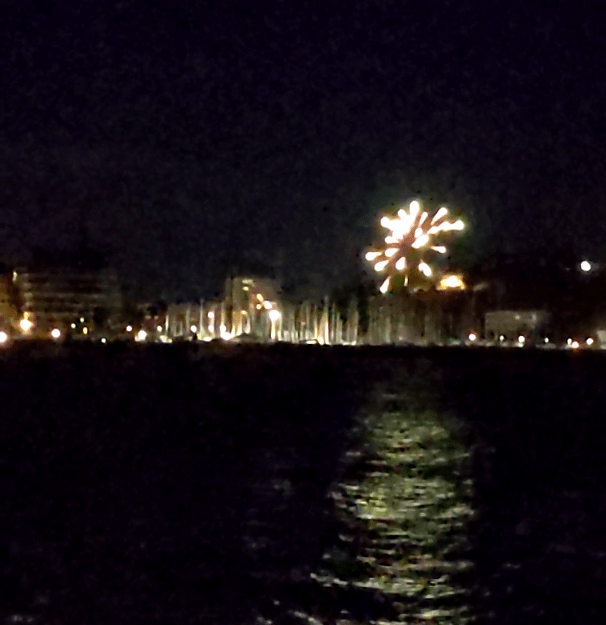
After so many days and nights at sea I was excited and relieved to see land. I looked to the shoreline and noticed fireworks erupting from the hills. Was this a special welcome for our Australian vessel? After safely anchoring, Alex retrieved the sparkling Tasmanian wine we had saved for the celebration of arriving at port. He stood at the bow, exultant, and made a speech, as he uncorked the bubbly wine. It made a large popping sound and then splashed into the ocean. Alex filled our glasses, and we toasted our arrival in Nouméa.

Fireworks over Nouméa.

The next day we made our way to the marina to complete the customs and immigration formalities. Stepping onto the pontoon, I was greeted by a fellow boatie walking back through the gates with a baguette under his arm. Instead of it being excessively wrapped in plastic or even a paper bag, it was wrapped in a slim piece of wrapping paper just where it was designed to be held. Of course, Francophones require their morning baguette, even if they are staying in a marina.

We made our way along the pontoon to the dock. The only trouble was that we could not open the pontoon gate from the inside. Some local children playing on the rocks lining the marina noticed our trouble and called out to us, directing us to the button to open the gates. We followed their instructions and stepped on to New Caledonian soil for the first time. After sailing for five days and nights we would not be deterred by a mere button to a gate. We soon found the marina office and were treated with utmost politeness and warmth by the officers we came into contact with. We were perturbed as to why our attempts to announce our arrival the previous day had been ignored, and then we realised. We had arrived on the 14th of July, Bastille Day, France’s national holiday, and the office must have been closed.

[1] The gennaker, or screecher, is a large flying headsail, i.e., a sail flown in front of the mast.

Alex & Meredith in Nouméa

(Photographs provided by Meredith Stephens)

Meredith Stephens is an applied linguist from South Australia. Her work has appeared in Transnational Literature, The Muse, The Font – A Literary Journal for Language Teachers, The Journal of Literature in Language Teaching, The Writers’ and Readers’ Magazine, Reading in a Foreign Language, and in chapters in anthologies published by Demeter Press, Canada.

PLEASE NOTE: ARTICLES CAN ONLY BE REPRODUCED IN OTHER SITES WITH DUE ACKNOWLEDGEMENT TO BORDERLESS JOURNAL

Click here to access the Borderless anthology, Monalisa No Longer Smiles

Categories
Stories

Little Billy

By Paul Mirabile

Little Billy was a timid, quiet boy of thirteen going on fourteen. He kept to himself both at home and at school. Because he was the only child, little Billy’s mother, unemployed, pampered him to such an extent that he sought refuge in outdoor activities such as tree-fort and cabin constructions in the back garden, chemical experiments with dead animals conducted in his hand-built cabins, tunnel-burrowing under trees or fences, this last activity much to the dismay of his parents. As to his father, well, his work kept him long hours away from home, so the boy hardly ever saw him besides at their late evening dinners, or on the week-ends when he wasn’t busy ‘on the road’.

Little Billy loved to read. Not those ‘childish’ stories imposed by the school programme and taught unenthusiastically by his teachers, which he never read in spite of the spot tests that his teacher would surprise the pupils with, and which he would invariably fail. No, not those boring scrawls. He indulged in true literature: the adventures and exploits of explorers in the wilds of Africa or in the depths of Asia, especially the marvellously written tales by Jules Verne, his literary hero …

Billy’s schoolmates despised his taciturn attitude in class. The more rambunctious boys indulged in creating the usual chaos during recreation when he would sit under a tree and listen to the birds or meditate on his future chemical experiments whilst his schoolmates fought, spat or cursed. Yet he was no snob; he just had nothing to share with his classmates; his adventurous dreams only bored the boys who preferred wrestling and football, and the girls who preferred wrestlers and footballers.

Little Billy filled his time and soul with adventure and constructive projects to escape his mother’s irksome babying and his father’s coerced absence. Twice his imagination materialised into daring escapes from home. The first took him about thirty kilometres or so from his neighbourhood, peddling on his little bicycle as fast as his little legs could, growing more excited as he traversed unknown territories where woods, villages and hamlets passed before his giddy eyes like a magical phantasmagoria. The police, having been phoned by Billy’s hysterical mother because he hadn’t come home for lunch or dinner, finally caught up with him late at night, seated on a grassy hillock, munching apples that he had pinched from a nearby orchard. Everyone believed that Billy simply had lost his way. Little Billy, however, felt he had been on an adventure, and to have absconded for the first time, conferred upon him a powerful and secret aura …

His second escapade was more daring: the absconder hitch-hiked and walked into regions where the folk spoke in accents very much distinct than his own. They even addressed him in strange dialects, using words he had never heard, neither at home nor at school. And how exciting it was neither to understand nor to communicate with the individuals whom he met! Three days later, dirty, hungry and clothes be-spotted with mud and rainwater, little Billy stood before his tall frowning father, who, although never having raised a hand to the child, scolded him with uproarious words and frenzied gestures. As to his distraught mother, there is no need to go into detail: her sobs and sighs, albeit somewhat theatrical, rose higher to in crescendo than the father’s roars.

Henceforth, little Billy decided to limit his adolescent élan to constructing a duplex tree-fort in the large oak tree at the back of his spacious garden. As to the wood required for such a project, the ingenious boy strolled into the many construction sites that surrounded their neighbourhood, negotiated with the workers for spare wood, nails and screws. They liked this little bugger, combative and imaginative, so they plied him, without cost, with large boards of plywood for flooring and roofing and cut, oaken beams for the supporting frames. As to the tools, these the he procured from his father’s garden tool-shed.

Little Billy set to work immediately, choosing four sturdy branches of that leafy oak tree, one branch slightly higher than the other, which allowed him to build one level at a time. Once the lower level had been finished (it took him a mere three days), the energetic builder went on to build the second level of his duplex, connected by a three-rung ladder made from the oak beams that he sawed to measure between the thick limbs with his father’s electric saw. His fort proved to be rather high off the ground, and although he shimmied up the branches like a monkey, Billy preferred a more elaborate ascent: he found two long pieces of rope, made six knots in them at half metre intervals and used the legs of chairs as rungs, which he pushed through the loops of the knots and tightened; chairs that he found thrown out as rubbish in the streets of his neighbourhood. Little Billy took pride in his tree-fort, and spent much time there reading, writing or meditating …

With the arrival of winter, however, he had to abandon his fort, open to strong, glacial winds, and began to devise a plan to build a cabin. It would be a sturdy cabin with a floor, a roof (flat of course), three windows and a door. Again the kind workers provided him the material for his project and his father, the tools. He built it in less than a month in spite of the cold and frost, which obliged him to make a floor several centimetres off the frozen earth. The door proved a bit dodgy : he bought three hinges with his pocket money, screwed them into the oaken frame of his entrance and into a large piece of plywood which he cut to fit the rectangular entrance. The fit was far from perfect; that is, the door could not be closed correctly. But that didn’t matter, he was only a little boy! Billy dispensed with a door-knob and simply sawed a hole in the plywood big enough to put two fingers through. He did the same for the three square windows, the first sawed out next to the door and the other two on the opposing sides of the cabin. He did not fit them out with sheets of pane as they were expensive and his father refused to give him money for those. Finally, to complete his happy home, he laid out several spare rolls of rug to keep his feet warm during the winter months that his father had stored away in the tool-shed. His cabin became cozy and comfortable, out of bounds to his parents; after all, it was Billy’s own private universe, his intimate recluse from the world. His father only asked him not to dig any more tunnels !

Inside, on the rickety table he had also made by himself, he conducted all sorts of experiments: dissecting frogs and fish, concocting chemical potions made his clothes stink (much to the consternation of his mother) and into which he threw frogs’ legs or fish eyes, or any other animal parts that he happened to come across on his daily late afternoon or evening jaunts.

Alas, during that very harsh winter, a terrible snow storm flattened his cabin completely; it lay wrecked, buried under tons of dirty grey snow until the early Spring rains exposed the tragic ruins.

But Billy was not a boy to be put out by such unforeseen discomfitures. The undaunted Billy, when the snows of winter had completely melted, set out to build a boat! Yes, a real boat, made of wood, big enough for three or four adults, with a real bow and deck and cabin, on top of which he would lay or sit on the ‘bridge’, bathing in the sun, reading Jules Verne or writing his memoirs.

So he again pleaded with the workers to supply him with oaken beams for the hull, large planks of plywood for the siding, bottom, deck and bridge to bridge securely the sides of the boat. The workers, amused by this boy’s inventiveness, even furnished him with a special putty to caulk the seams of his boat to make her perfectly watertight. Billy was all agog … So too were the workers!

Little Billy threw his heart and soul into his boat-building under the back deck of the house; he felt at the height of his creative powers, and by early Spring he had completed it: his dream boat. He painted the hull a bright marine blue and christened the boat ‘Captain Nemo’ painted in bold green letters, after the hero of his favourite Jules Verne adventure. He relinquished the task of providing a helm, tiller and rudder which would have required engineering skills beyond his ability; after all, Billy’s boat was a simple boat. However, with a long pole or paddle it could always been poled or paddled if he so desired. On the other hand, he carpeted the cabin located under the ‘bridge’ with the rolls that remained of his father’s thick, blue carpet. Since he had managed to secure his rickety table under the collapsed wreckage of what was once his back garden cabin, he placed that in the cabin of his boat and even built a little chair for it, a bit wobbly, but none the less, usable for what would a table be without its chair, and a boat-cabin without both ? Finally he bought a notebook which served as a logbook.

Now the reader at this point may ask him or herself in what waters would this boat be floated, and how would it be hauled into those, up till now, undisclosed waters? It goes without saying that the ingenious Billy had answers to both those questions, for if he didn’t, why would he have built a boat in the first place? The answer to the first question is quite simple. Many years ago next to Billy’s house had been dug a huge sump, surrounded by a high, wire fence, and whose waters rose very high during the winter and spring. As to the second question, the

And it floated! Yes, Billy’s marvellously made boat really floated! He tugged, hauled and pulled it down the slope of his garden, through the rent in the high wire fence, then down again to the dirty brown sump waters. There he tied it to a stake in the soft soil and stepped back to admire his work. He especially appraised the little ladder he had made that led from the fore-deck to the ‘bridge’ (Billy did not have the engineering know-how to make a stairway), and gloated over the two curves of the bow, joined so perfectly to a nice pointy fit, a bow whose nice fit was thoroughly achieved thanks to his father’s timely and skilful assistance  …

Tiny ripples spun round the beautifully painted hull caused by a soft wind. They lapped against the bold green letters of ‘Captain Nemo‘. Billy frowned: he had painted the name a bit too low on the hull! Ah well, he could afford himself a bit of self-indulgence, he hadn’t taken into consideration the weight of the boat and her submersion level. His face, however, lightened up as the rays of the sun grew stronger and stronger. The weeping willows that lined the high wire fence swooned to the gentle breezes and to little Billy’s face beaming with joy. How he revelled in several instants of self-vanity! Who could blame him?

He took a cursory glance up at his house ; his parents who had gone out to shop had not as yet returned. So much the better! Smiling a mischievous smile, he untied the rope, jumped aboard and let the warm zephyrs of early springtide guide his lovely boat further and further from the sloping shore of the sump. It was her maiden voyage… He went below into the cabin and peeked out of the two portholes (without glass), picked up his logbook and chair, then climbed the make-shift ladder to the ‘bridge’. There he sat in the sun, listening to the silence of the sump, sizing up its largeness.

The branches of the weeping willows brushed lazily against the high wire fence, the birds chirped merrily here and there, some pecking at the dirt around the tree-roots. Billy’s boat, and this goes without saying, had neither outboard motor nor masts for sails: she just drifted on her own, erring aimlessly, like his thoughts, like his lively imagination had always drifted and erred from adventure to adventure … book to book … page to page … word to word … Adventures upon the high seas, atop the highest of mountains, across the hottest of deserts. Fabulous tales of a thousand and one days and nights that no one, neither parents nor teachers, could ever deprive him of, divest him of, dispossess him of …

The sun warmed his cheery, glowing cheeks as he read and wrote to the rhythm of his wanderings. His mind slipped from the scummy waters of the sump to the high swells of some very distant sea … The swells rose to titanic heights, then crashed into a myriad ripples upon some remote sandy island strand. Just then Billy’s drifting mind was brusquely interrupted by cries and shouts. They were coming from inside the sump, near the rent in the fence.

There stood Mr. and Mrs. Wimbly, his next-door neighbours, waving their chubby arms frantically, crying out to him. Mr. Wimbly had even begun to descend precariously the steep slope of the sump to the waters. He stood at the edge, hands now cupped around his mouth, hollering words that he could not understand. Mrs. Wimbly raced recklessly back and forth on the grassy walk-way between the high wire fence and the slopes of the sump. Little Billy shook his head: Was all this real or just an hallucination?

At first he ignored their cries and wild gestures, concentrating on his reading and writing ; after all the Wimblys weren’t his parents! But soon other neighbours began to pour into the sump, or materialise on the other side of the high wire fence, under the weeping willows, their twisted, purple faces swelled in torment, their piercing shrills drowning the musical chirping of the birds. There was fat Mrs. Holly shaking her pudgy fist, chiding him with names that he was taught never to pronounce either in public or at home. How dare the old cow address him with such ugly words. And there, Mr. Rogers, red-faced, his jowls bouncing up and down from so much hooting and hallooing!

Other neighbours, too, came running, all upset, jumping about like puppets on strings, waving at him, scolding him. He stood up and frowned …

Then a sudden strange sensation chilled him to the bone and which made him forget all the ongoing bedlam: He felt that his boat had stopped moving, in spite of the wind that had suddenly picked up, and that the sloping sides of the sump appeared to rise higher and higher, slowly, very slowly, whilst the clouds, too, were rising higher and higher in the deep blue of the sky … rising slowly away from him. Something was terribly wrong. He climbed down from the ‘bridge’ and was about to step down into the cabin when he fell back in horror: black waters were streaming over his lovely carpet, tossing his little table from side to side. The starboard side of his boat had burst from the seams of its framework. Billy froze in utter incomprehension: How could this be? The boat had been properly caulked! His beautiful boat …  Months of love and labour …

Coming to himself quickly, little Billy climbed back up to the ‘bridge’. There he stood, half baffled, half defiant! From his sinking position he glimpsed through tear-stained eyes the stamping of feet and the pointing of fingers of so many neighbours, known or unknown. Their cries and shouts rose to incredible crescendos. He had no idea how to overcome this predicament, and it suddenly struck him that he had never learned to swim … The sump waters were very deep after the winter months. He prayed that they wouldn’t be so deep where his boat was irretrievably disappearing, for there was nothing else to be done, no one came to his succour, everyone just jumped and ran about like a pack of wild animals.

Then little Billy heard a familiar cry: It was his mother’s! She had come home, noted all the fuss round the sump and had found the rent in the fence. Now there, at the edge of the slanting slope, she was tearing at her hair, writhing in agony, her hysterical screams drowned out all the others that were drumming through his tiny head without respite. His father suddenly came into view, there, at the foot of the slope, he was descending towards the waters and appeared to jump in and swim towards the now stricken boat … swimming and swimming towards his only child with long and powerful breast-strokes … But no … this was an hallucination: Billy’s father did not know how to swim, and in any case it was too late; little Billy’s beautiful dream boat sank rapidly below the scummy dark waters, dragged down by its weighty load. The last vision that his father and mother had of this hallucinating scene was their son’s outstretched hands clutching his logbook … A few seconds later, out from the suction of the whirlpool, Billy’s little red captain’s cap popped up and floated there, aimlessly, a flotsam of engulfed dreams and sunken aspirations …

His mother collapsed. His father howled with outstretched hands, then fell lamely to his knees …

Sometime afterwards the police arrived on the scene equipped with rubber rafts. They spent hours scouring the waters, mainly because the benumbed neighbours could not decide exactly where the boat had gone under; Billy’s cap having since waded to the other side of the sump. Finally, however, a frogman brought up little Billy’s limp, lifeless body to the surface. As to his boat, it remained at the bottom of those dirty brown waters, a memorial to the boy’s ardent dreams, like the Titanic, never to be disturbed in its final resting place. And although the waters do subside during the hot summer months, there it remains to this day, lying upon its cracked and scorched, lunar-like bed, rotting yet recognisable, a ghostly vision that no hand should ever touch besides that of its hapless creator and captain.

Soon, the ill-fated ghost-boat drew many mourners from the region and beyond. They gathered round the sump to pray or look on in sorrow. Some threw flowers over the fence. (The rent had been repaired.) The sump appeared to have become some sort of pilgrimage site, attracting hundreds and hundreds of people, even foreigners came to vent their curiosity! The mayor of the town, a rather unscrupulous blighter, brought up in one of the town meetings that perhaps the municipality should charge a small fee for entry into the ‘pilgrimage site’! This proposal was over-ruled as bad taste and cynical.

As to little Billy, he was buried at the town cemetery on the bright, warm day of his fourteenth birthday, a funeral without clamour or commotion. Only his parents and close relatives attended the church service and the walk to his final burial plot.

Little Billy’s parents, due to all the fanfare that their son’s cadaverous hulk had aroused, have since moved to another region without sharing their new address with any one …

Courtesy: Creative Commons

.

Paul Mirabile is a retired professor of philology now living in France. He has published mostly academic works centred on philology, history, pedagogy and religion. He has also published stories of his travels throughout Asia, where he spent thirty years.

.

PLEASE NOTE: ARTICLES CAN ONLY BE REPRODUCED IN OTHER SITES WITH DUE ACKNOWLEDGEMENT TO BORDERLESS JOURNAL

Click here to access the Borderless anthology, Monalisa No Longer Smiles

Categories
The Observant Immigrant

The Immigrant’s Dilemma

By Candice L. Daquin

Courtesy: Creative Commons

I have been an immigrant to a new country three times: from France to England, England to Canada and then, Canada to America. Being an immigrant is often a highly positive experience. We may have greater opportunities, we seek our dreams, we grow them. On the other hand, immigration for those of us who have gone through the process, is not easy. It is expensive, time-consuming, nail-biting and often lonely. It is said that those who immigrate ‘successfully’ do so because of familial support and/or because their children reap the benefits of their sacrifice.

Whilst there are too many stories to condense any one feature of immigration, we can only talk of our own experiences and somehow in understanding that, perhaps stay open enough to understand others. We can come together through that collective understanding.

As a psychotherapist, I work with many immigrants. I see clients daily who were born elsewhere and sometimes struggle to acculturate in their new-found country. Where I live, near the border between Mexico and America, we have a multitude of immigrants from Mexico, central and south America as well as from around the world, coming through the borders, seeing asylum and a better life.

Consequently, there can be a high degree of racism in rebuke for the startling numbers of immigrants passing through our city. I can drive down a road and see people lined on the street much as you would see in other countries, begging and homeless. Our resources are stretched and one option chosen by the Governor of Texas was to bus immigrants and asylum seekers to other states in the US. Initially this was considered a racist, insensitive act that treated people like cattle. When you look at it closer, you can see it was perhaps these things but also a desperate plea for other states to understand the overwhelming nature of immigration for border states and share in the expense.

It is easy for a non-border state to believe the border should be effectively kept open and all immigrants allowed in. but when it’s on your door step it can be challenging. Most people in Texas care about immigrants but also experience some of the downsides of too many immigrants at once. In El Paso, people froze to death sleeping on the streets, houses were broken into, the situation was dire and extreme and locals didn’t have enough resources to manage. Shipping immigrants who wish to go to other states, to those states, might appear cruel, but also makes sense, if it’s consensual. Whilst many of the Texan Governors decisions have been quite possibly racist and prejudicial, this choice was in part to show other states how dire the situation is.

Why are there so many asylum seekers right now? As President Biden announced the lifting of closed borders to asylum seekers, the numbers attempting to come into America increased exponentially. Under the Trump administration, the Department of Homeland Security (DHS) called the “Remain in Mexico” policy (officially, the Migrant Protection Protocols) caused immigration to be somewhat halted. The original reason countries like America accepted asylum seekers goes back to WW II where the Jews who survived ethnic cleansing had nowhere to live and were essentially stateless. The right to seek asylum was incorporated into international law following the atrocities of World War II. Congress adopted key provisions of the Geneva Refugee Convention (including the international definition of a refugee) into U.S. immigration law when it passed the Refugee Act of 1980.

The laws that exist now were enacted to protect them and ensure stateless people were never again turned away in droves. The creation of Israel was in part the consequence of WW2 and the abuse against the Jews. It could be argued any issues with Israel are directly linked to the ethnic cleansing the Jews experienced and their subsequent statelessness. Laws endeavoring to protect future people from such experiences are what we now use in our handling of asylum seekers. “When Congress finally eliminated the racial provisions in U.S. immigration and nationality law in the 1940s and 1950s, generations of federal practice and procedure did not instantly disappear without a trace. Over the years, other government agencies had developed their own racial classification systems, often partially borrowed from INS experience, and such systems could take on lives of their own.”

The downside to this is, the world has dramatically changed since the 1940s (2,307M versus over 7 million today). the population is growing at a heady rate and thus, even if a small percent of people seek asylum from any one country, it is huge in comparison to previous numbers. Department of Homeland Security  statistics show that from Biden’s Inauguration Day through May 2022—just 16 months and change—about 1.05 million migrants were apprehended on the southwestern border and then released into the US. With every year, the worlds population swells and with it, a strain on resources. ‘Affluent’ countries such as America, may literally speaking have the resources to help asylum seekers but the reality for many asylum seekers is quite different once they are in-country. According to Census Bureau statistics, immigrants’ share of the U.S. population rose more from 1990 to 2010 than during any other 20-year period since these figures were first recorded in 1850—from 7.9 percent to 12.9 percent

What constituted poverty in their country of origin may be considerably lower than what money they can earn in America, if indeed such earnings can be made at all. The social welfare system protects asylum seekers by giving them somewhere to live and a stipend until they are able to find work but what of those who do not possess the necessary skills? Not to mention the dearth of certain jobs. Immigrants wishing to live in the cities, may find work is only available in the agricultural parts of America and not earn enough to live on without language and education in a city. Likewise, they must contend with crime, safety issues and making the meager money they receive, stretch to pay for themselves and their families. What might seem initially like a lot of money, in comparison to their home-countries, is quickly devoured by the more expensive living expenses of America.

Immigrants who move to America or other developed countries, on a visa rather than asylum, may fare better. But note how many PhD’s are driving cabs or serving in restaurants. Underemployment is a phenomenon whereby those who are educated, are working at a lower level than that education would typically warrant. For their children there may be greater opportunities but for many first-generation immigrants, the adjustment and opportunities are restricted. Doctors in their own countries, they find American prohibitions on accepting foreign transcripts and learning, despite the low quality of American education in comparison to many other countries. It’s almost if you were being subjective about it, like having to pay the price for immigration.

When I immigrated to Canada, I found many who possessed PhDs and advanced education were unable to find work. There was some push back from locals who resented skilled workers and felt all immigrants should ‘know their place’ and take the dregs work. This is something you really don’t believe will happen to you when you are very educated, and get a skilled worker visa, but it’s a reality, perhaps less spoken about because it makes the host country look unkind. But go beyond the shiny posters about immigration and speak to the people and you will find it’s not uncommon.

Immigration is necessary for many reasons, not least the Western world ageing and requiring new blood because of declining birth rates. But the Western world wants immigrants to do the work they don’t want to do just as much as they may appear to want immigrants to ‘succeed’ and for every Doctor and PhD who was an immigrant, there are plenty who find themselves no better off through immigration. That’s a sacrifice worth making when you have no other choices or you hope your children will inherit the American Dream but if you have no children and you’re sold a false dream, then it can be disheartening if not crushing. There are 11 million recent immigrants in transition, best estimates predict, who labour in American fields, construction and kitchens, as well as American classrooms, detention centers and immigration courts.

What we hear less about, is how many immigrants leave. And how many suffer silently, having fallen between the gaps, into anything but the American Dream. What can be done about this? Should we impose immigration restrictions not out of cruelty but an understanding that a host country is ill equipped to deal with mass influxes and that the original reasons for the laws have evolved/changed as our population has grown? Should we insist other states take some responsibility for asylum seekers? As well as demand other countries pitch in more? And understand that what may look racist, is in fact a more realistic approach than flinging open the border and allowing everyone to come in at once?

It is an interesting dilemma and one that won’t be decided any time soon. The racists and extreme economic conservatives will battle against the diametric opposite liberals who believe all should inherit the opportunity a country like America holds. Both sides are too extreme in that they don’t consider the reality. The reality is racism should not and cannot endure in a country like America where soon ‘brown skin’ will be the majority and old racist ways are being challenged. But equally, being so ‘woke’ that you don’t see the fall out of idealistic policies, isn’t the answer either. In tandem with an identity politics that emphasises the subnational, a too progressive project may place global concerns above national interests. Hence, the oft repeated slogan “global problems require global solutions.”

Speak to the people. Many times, people criticise me for living in Texas. They assume I’m one of the ‘bad guys’ without understanding Texas is made up of a huge diverse population. Within that diversity are many Latinos who don’t want mass unchecked immigration any more than the racists, but for radically different reasons. Things aren’t as simple as they seem in a Twitter comment. There are many complex considerations that must be taken into account to ensure the best outcome not only for asylum seekers but those who already live in-country. There are answers, but they won’t come from knee jerk reactions or entrenched thinking on either side.

What we do know today, is people are literally dying to come into America and with them, perhaps some unchecked terrorists sneak in, just as they did before 9/11. In order to protect everyone and ensure things are done legally and safely, immigration must have some controls and should be funded accordingly, without any one state taking the majority of the strain. Many Texans are quite the reverse from what you’d imagine, if you subscribe to stereotypes. Maybe the problem is we should really get rid of stereotypes and try knowing who people really are before we judge en mass. Houston has one of the highest Indian communities in the world. All cities within Texas have absorbed huge numbers of immigrants from around the world. Let’s think less of ‘them and us’ and more about truly doing what will be best for those seeking to come into a country and begin a new life. Immigration is a conundrum, but if we work together, instead of apart, we can find answers.

.

Candice Louisa Daquin is a Psychotherapist and Editor, having worked in Europe, Canada and the USA. Daquins own work is also published widely, she has written five books of poetry, the last published by Finishing Line Press called Pinch the Lock. Her website is www thefeatheredsleep.com

.

PLEASE NOTE: ARTICLES CAN ONLY BE REPRODUCED IN OTHER SITES WITH DUE ACKNOWLEDGEMENT TO BORDERLESS JOURNAL.

Click here to access the Borderless anthology, Monalisa No Longer Smiles

Categories
Essay

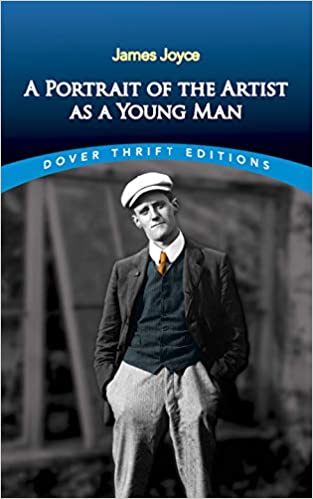
Ivory Ivy & Stephen Dedalus

Reflections by Paul Mirabile on James Joyce’s Stephen Dedalus who found fruition in A Portrait of the Artist as a Young Man (1916) & a key role in the 1922 classic, Ulysees

You have a queer name, Dedalus,” says Brother Michael to Stephen Dedalus, the hero of A Portrait of an Artist as a Young Man in the first chapter. Strange perhaps, but quite significant for this tale : Daidalos in Greek means ‘architect, wiseman, artist, craftsman’[1]. He was the universal artist in Greek mythology, the ingenious Athenian architect, who exiled to Crete, designed the labyrinth within which the terrible Minotaur was kept, a complex formation which analogues Dedalus’ intricate or labyrinth-like thinking patterns. A formidable name, thus, for Joyce’s protagonist, one in fact that evokes many of the author’s own traits.

James Joyce (1882-1941) once remarked that a male artist (writer, painter, musician) generally inherits many effeminate attributes from his mother (or from other female figures of the family), and as he matures and grows conscious of them, exploits them to create. Effeminate characteristics in a male engenders a sensitivity that overshadows the ‘virility’ of the father. This is certainly the case with Stephen Dedalus in our story, and perhaps too with James Joyce.

In chapter one, Stephen’s leanings towards his mother appear to be projections of Joyce’s, although the reader should be aware that A Portrait of an Artist as a Young Man, published in 1916, is not an autobiography per se. However, Stephen’s word-associations and flashbacks dissociate, and concomitantly link the ‘masculinity’ of his boarding school surroundings with happy memories which depict his mother and her daily gestures and occupations. There is little doubt that these depictions were drawn from Joyce’s own experiences during his boarding school years.

Stephen felt lonely at the boarding school, studying and playing with boys who were tough, hardened by their fathers’ stern discipline and rough language, many of whom were footballers, pranksters or schemers. He had been brought up by his mother. She never taught him to play football, be a prankster or a schemer. Should that have been his father’s task ? His mother would never have taught him to rub rosin in his hands to harden them against flogging. Fleming, a school comrade, did, and you can be sure that his father had counselled him on that point. When Stephen was flogged along with Fleming, we are witness to the differences in their domestic upbringing : Stephen describes his flogger Father Dolan with great vividness ”looking through his glasses”, those same glasses that were seen through by his father in the first passage at the beginning of chapter one. Had Father Dolan — his ‘brotherly’ father– a ‘tough’ man indeed, misunderstood the scorn that young Stephen’s artistic propensities led him to experience?

Perhaps it is the lack of sympathy and understanding on the part of the father-figures he encounters throughout life that transports Stephen into a lonely, private world dominated by the mother-figure. When he is ill in the infirmary he is quick to address a letter to his mother ; his mother who smells ”nicer” than his father. Joyce, the narrator, also informs us that she played the piano, whereas the father did not …

The boys at the school teased him because he would kiss his mother every night before going to bed, something quite normal for him, yet ”girlish” for the boys. And even if they did kiss their mothers they would never have admitted it in front of the other boys, a habit that their fathers probably told them not to disclose when at school. Stephen had no ‘official training’ in these delicate matters by his father.

He discovered this lack of ‘manliness’ in him through his sensitive, perceptive insight into all that he felt, heard, smelt and observed. His mother’s sensitive world was an innate attribute, one that he consciously cultivated in a creative fashion, examining all that took place, criticising what he felt had been unjust or false. In fact, the opening chapter draws a suggestive parallel of Stephen’s (Joyce’s?) life as an artist and his inner relationship with his mother (and his father to a certain extent) as if she were an inseparable ally on his path to artistic glory.

”He longed to be home and lay on his mother’s lap,” grieves the narrator, defending the downcast Stephen, for indeed the boarding school proved terribly trying for him, violent in many ways, even physically violent by the flogging administered by the brothers and the fights against his comrades. Stephen would reminisce : ”She was a nice mother but she was not so nice when she cried.” Did this prevent him from crying when flogged by the brothers or humiliated by the boys ?

Stephen opens chapter one by recounting what his father had told him when he was a baby. But his father’s language is a child’s, spoken exactly as a child would. On the contrary, Stephen’s childish attempts at communication : too many pronouns, the repetition of a song sung by Betty Byrne : “O, the green wothe botheth … ,” his insight into the ages of his immediate family : “[T]hey were older than his father and mother but Uncle Charles was older than Dante,” and his eventual intellectual developments and abandonment of a Jesuit education due to a very severe and masculine environment, all bespeak a precociousness of character inherited from his mother, which did not prevent him, however, from showing great respect for his father.

At the end of chapter two, he stumbles across a prostitute. Stephen is greatly distressed. He is drawn towards this female but, ”His lips would not end to kiss her. He wanted to be held firmly in her arms, to be caressed slowly, slowly.‘ Like his mother would do ? This being said, the poor, lonely Stephen yielded to the prostitute’s charms …

Stephen’s love for his mother is deep: when he ‘exiles’ himself to Paris to study medicine in the first chapter of Ulysses (1922) he receives a letter that his mother has taken to bed very ill. He returns quickly, but refuses to kneel at her bedside and pray for her : ” ‘You could have knelt down, damn it, Kinch, when your dying mother asked you,’ Buck Mulligan said.”[2] Buck even accuses him of killing his mother: “He kills his mother but he can’t wear grey trousers.”[3] It goes without saying that Stephen did not kill his mother ; he deeply regretted her death. However, this disgraceful act towards her pleadings is explained by the fact that to kneel down on both knees represents a Church rite, ”the Jesuit strain in him”[4]. The tortured Stephen disavows this ‘ecclesiastical’ gesture, this gesture of absolute obedience before authority. It were as if at that difficult moment his confused state of mind confounded the love of a mother and the hate of a Jesuit institution that Stephen (and Joyce) bore. It is true that the severity and pain of his seminary years had all but deadened the youth’s love for his mother. However, if he did feel a disliking at his mother’s bedside for those few moments, they should not be interpreted as hate for her, but rather as a transient absence of love. He will be redeemed of this absence of love by the love of languages, especially his ‘mother’ tongue, in spite of the sorrow he bore within him like some original sin.

Born from the mother, the mother breathes into her child the force and the will to live. Wrought from the womb, the child bathes in the sounds, accents and musical rhythms of his or her mother: the lullabies and nursery songs, the praises and reproaches. And a day will come when he or she must be weaned, and although the umbilical cord is cut the cultural cord continues to nourish the child, of which language is the most vital nourishment.

It is the mother tongue that motivates Dedalus/Joyce to desire his language … and the Others’ languages ! The desire to possess or master English, Italian, French, German, Norwegian, Latin and Greek. A polyglot’s desire to penetrate the womb of the Other out of which all languages have been wrought.

Throughout A Portrait of an Artist as a Young Man Joyce is very methodical in developing Stephen’s acumen in word usage. The hero’s pursuit of intellectual ‘purity’ oftentimes turns him into a pedantic perfectionist correcting a word used outside its proper context with the person whom he is addressing. This preoccupation with perfection in proper word usage is only natural for someone who studies languages and realises that verbal force can be a veritable weapon. A word, above all other linguistic features, can be an instrument of puissance and persuasion when wielded with accuracy and precision. Stephen’s effort to instrumentalise English and use it to overpower his ‘opponent’ is manifest in his attempts to seek the word which best fits the circumstances of his daily human intercourse.

In chapter one, even at an early age, Stephen is asking himself ethnico-linguistic questions, making word comparisons when used in idiomatic expressions. For example, ”that was a belt round his pocket. And belt was also to give a fellow a belt.” (page 9) Stephen’s extraordinary memory focuses in and captures the moment the word or expression is used from which he could then make his point :”Go and fight your match. Give Cecil Thunder a belt.”

He knew this was not a ‘nice’ word, as his mother had told him, but one which belonged to a certain class of people. The youngster would soon come to accept these ‘not nice words’ however, comprise the very beauty of language, their social realism and above all their power to persuade! These idiomatic expressions were surely not learnt from his mother; they were acquired from his daily brushes with the many folds of social commerce.

In the same chapter he utters to himself the word ‘wine’ ; it immediately gives him the image of ”… dark purple because the grapes were dark purple that grow in Greece…” (page 43). Uttering a word and conjuring up its ‘topographic image’ also developed his intricate word-image analogies.

Stephen Dedalus hears: ” You are McGlade’s suck. Suck was a queer word,” reports the narrator. Stephen learns the meaning of this word by observing dirty water going down the drain in a wash-bowl; it made a sound like a suck, and he resumes : “The sound was ugly.” Here he devises an ‘aural relationship’ to word signification which one may define as an ‘onomatopoeic analogy’.

Similar word-image associations emerge in the boy’s mind with expressions such as ‘Tower of Ivory’ and ‘House of Gold’ spoken by his father, and whose precise significance escaped his young mind. It would take some time before he understood their semantic impact. The occasion occurred when he stole a glance at the cool, soft ‘ivory-like’ hands of a girl, and at ”her fair hair streaking behind her like gold in the sun.” And he concluded : “By thinking things you could understand them.” In other words by ‘visual analogical’ efforts Stephen could relate to and grasp the meaning of words.

The first chapter of the book represents a young boy beginning his intellectual-linguisitc voyage, and as the story unfolds and Stephen’s mental capacities become more and more meticulous and keener, his discernment into word usage becomes more demanding when speaking to his peers or to elders.

The second chapter deals with his mental and physical vicissitudes : his father sells the house. The family moves to Dublin. Stephen goes to college. These changes affect his way of thinking, for he is a boy who is already conscious of his detachment from the rest of his schoolmates. He excelled in essay writing and was good in Latin. Stephen’s remark concerning his friend Heron is worthy of mention. Stephen ruminated over the fact that Heron, like the bird, had the same bird-like features. The name Heron suited the boy’s features quite nicely : ‘Vincent Heron had a bird’s face as well as a bird’s name. A shock of pale hair lay on his forehead like a ruffled crest.His forehead too was ”narrow and bony” and he possessed ”a hooked nose.” (page 70) Again, Stephen’s capacity to ‘see’ and associate, analogically, words, or as he says their ”logical parallel”, marks a perspicacious penchant for conjoining the signifier with the signified. In the case of Heron: the name fitted the face. For Heron indeed was the perfect heron.

On page 83, again, whilst attending a seminar in the anatomy theatre, Stephen found the word foetus carved into a desk. This made him suddenly concentrate deeply on the meaning of this odd word. Did it portray reality, a raw and life-like reality, beyond all formal study and ‘higher’ education ? Did this word represent mankind in both its primitive and highest stages ? Did it not evoke the image of the mother … his mother ? Indeed fœtus remained in Stephen’s thoughts for the entire day. He wrestled with it, coming to the conclusion that a word is what man is : ” in the outer world a trace of what he had deemed till then a brutish and individual malady of his own mind.” The words brutish and malady are significant inasmuch as they actually do go far beyond the formal education that Stephen was pursuing. In fact, fœtus provoked yet another urge in the need for reality in language, which his studies in Latin certainly strengthened by discovering the origins of words and their semantic impact on human communication ; they taught him to train his mind to think in terms of precision, brevity and beauty. However, Stephen’s plunge into reality was more often forged outside the sacred walls of that ‘manly’ institution, amongst his myriad frequenting with the world of words uttered by the ‘womanly’ creatures of the whore-filled Dublin streets. This remarkable double-life, in chapter three, manifests itself sharply when Stephen is torn from those ‘womanly’ streets and is plunged into a ‘manly’ Jesuit retreat, where by the force of many well-delivered Hell-fire sermons a multitude of salacious temptations put his semantic perspicacity to trial.

In the Jesuit homilies or sermons during mass, the power of word usage is fully revealed to our heroic hero. So powerful is this usage that he confesses his previous dealings with prostitutes to a father confessor after listening to the ravings of a Jesuit concerning Judgement Day, death, hell, brimstone, fire and other Catholic-contrived image-filled words. The barrage of religiously-orientated words left him reeling in disbelief, which in turn obliged him to ‘believe’ the meanings of all the words which resonated clearly in his mind: judgement, death, soul and heaven. Yet, where were their true meanings? Were they what Stephen really thought them to be, or were they the Jesuit brothers’ invention, forcing themselves upon his young mind? Indeed, the answer becomes clear at the end of the book: Stephen sought his own definitions, his own knowledge, not the knowledge delivered from the books or the sermons of erudite Jesuit priests and brothers. Every word preached were weighed carefully to suit the disposition of the students, to create an ambiance of need, of weakness; a weakness to be satisfied in the pure thought and ‘word’ of God. Every ‘priestly’ word declaimed during mass weighed heavy upon Stephen’s mind. It only lightened when our hero was able to ‘think it through’ and not fall into an abominable, guilt-riddled contempt of himself.

A decisive step in Stephen’s life occurs in chapter four. Instead of accepting a career as a novice, then as a Jesuit priest, he strides out into the world on his own, knowing well his method of attaining knowledge would never have found favour in the eyes of the Jesuit brothers. To give an example, during a long conversation with a Jesuit priest, Stephen again scrutinises word usage. The priest mentions his journey to Brussels. He remarks that the people there wear ‘jupes[5]‘, and when they ride bicycles, it makes them look ridiculous. The mention of this foreign word causes Stephen to smile : ”The vowel was so modified as to be indistinct”. Stephen’s thought was obviously an attack against the priest’s pronunciation of the French word, an attack that went far beyond this one priest to humiliate the Jesuit institution as a whole. The word ‘jupe’ also emitted an olfactory sensation ; a perfumed fragrance. Stephen says that when articles of clothing were mentioned he could actually smell perfume. Here again we read another indication of a word’s power upon Stephen’s mind, whether it be aural, visual or olfactory ; that is, the ‘femininity’ of the image-sensation overrides the ‘masculine’ pronunciation of the word.  The loquacious priest’s voice faded into the background as Stephen’s innate linguistic conscious rose to the surface : ”As the priest spoke, Stephen’s mind erred : ‘The echoes of certain expressions used in Clongrowes[6] (his boarding school) sounded in remote caves of his mind. At this point he was interrupted …”’ Stephen’s linguistic prowess acts like an etymological Time Machine, now straining back in intellectual pleasure, now fixed in the present which creates a spiral movement to his thought patterns. Chapter four ends with this beautiful passage which depicts the young artist’s sagacious ability to put into motion that spiral rhythm. I shall quote the passage in full.

”He drew forth a phrase from his treasure and spoke it softly to himself.

 “-A day of dappled seaborne clouds-

“The phrase and the day and the scene harmonised in a chord. Words. Was it their colours ? He allowed them to glow and fade, hue after hue ; sunrise gold, the russet and green of apple orchards, azure of waves, the grey fringed fleece of clouds. No, it was not their colours ; it was the poise and balance of the period itself. Did he then love the rhythmic rise and fall of words better than their association of legend and colour ? Or was it that being as weak of sight as he was shy of mind, he drew less pleasure from the reflection of the glowing sensible world through the prism of a language many coloured and richly storied than from the contemplation of an inner world of individual emotions mirrored perfectly in a lucid supple periodic prose ?”

Here the past has been contracted into Stephen’s present circumstances: And no doubt, Joyce’s, too.

“Bous Stephaneforos!” mock his comrades. Yet, Stephen took great pleasure in the distorted orality of his name: did not ‘Bous’ in Greek mean ‘cow’ or ‘bull’ and his first name ‘Stephen’, ‘crown’? He was indeed the ‘crowned bull’! The ‘engarlanded bull’! ”His strange name seemed to him a prophecy. […] He would forge a legend, his name a symbol of the artist forging anew in his workshop out of the sluggish matter of the earth a new soaring imperishable being?” Was Stephen not the sacred bull of distant mythological or legendary heroes? Could he also be the victorious bull in the Irish epic tale the Tain Bo Cuailngy ? Whatever bull it be, Stephen knew his Destiny would be a glorious one, bathed in golden aura. Did his comrades know it?

Chapter five opens with Stephen’s acute criticism when reading poetry; certain verses arrest his attention: “Whoever heard of ivy whining on a wall ? And what about ivory ivy ? […] The word now shone bright in his brain, clearer and brighter than any ivory sawn from the mottled tusks of elephants’. Perhaps this poetic oddity of ‘ivy’ reminded him of the ‘Tower of Ivory’ that his father had mentioned, and recalled, too, those of the girl’s soft hands. Could analogical processes elicit such linguistic associations ? In Stephen’s case they certainly did.

Chapter five also initiates the beginning of Stephen’s literary career, his life as an artist, dedicated to ”putting words on paper”. Although the spiral rhythm of his mind abets him in his linguistic and poetic quests, he realises, too, that words belong to the epochs in which they were couched. Whilst reading Ben Jonson: ”He thought : ‘The language in which we are speaking is his before it is mine. How different are the words home, Christ, ale, master on his lips and mine ! I cannot speak or write these words without unrest of spirit. His language, so familiar and so foreign, will always be for me an acquired speech. I have not made or accepted its words. My voice holds them at bay. My soul frets in the shadow of his language.’”

How perspicacious Stephen has become at the end of his formal education : He understands that words of past literature, however potent or poetic, are acquired speech, whereas his present tongue, his ‘mother’ tongue, is innate. It would seem that once again he refutes the authoritative voice of the past, its literary ‘fixedness’, its stringent rules which must be acquired — as if these usages were quite artificial, dead — museum pieces for show and admiration. Stephen strains towards the future … towards horizonless linguistic freedom: His own invented Discourse because now innate (his mother’s), now acquired in the daily social practice of language production or creation.  

Indeed his comments on word usage reflect a growing intellectual acumen, and permits us to comprehend fully his overpowering knowledge of ‘innate’ language. Stephen defines beauty and art in this chapter, surpassing Artistotle and Thomas d’Aquinas (or so he believes!). He rebukes his father’s ”curious idea of gender‘ ; Mr. Dedulas calls his son ”a lazy bitch”. Stephen muses mockingly: ”he has a curious idea of gender if he thinks a bitch is masculine” (page 259). A snippy remark aimed at his father’s linguistic ignorance, which in fact represents a critique of authority : the church … the father-image … the Jesuit priest. Only art will triumph. Art as a spiral cadence of an alternating succession of static and kinetic energies that leads us ”to action, to do”. Static energy holds or arrests our attention, as do words said by others that arrest Stephen’s attention. Kinetic energy thrusts words into our present circumstances which in turn sends them hurtling into the future. For example, further on in the chapter, Stephen is speaking with a Jesuit priest about his decision to take leave of the school ; the word ‘funnel’ is brought up in their conversation pertaining to the pouring of oil into a lamp. Stephen is quick to point out that funnel is out of place here, and that the word ‘tundish’ should be employed in this function. The priest confessed that he had no idea that the word existed and promised Stephen that he would look it up. Stephen insisted on its semantic veracity as if the priest did not take him ‘on his word’.

It is at this moment in the book where Stephen’s expanding linguistic knowledge runs parallel to his diminishing reverence towards those who had educated him.

Again on page 227 we read the word tundish, only this time written in Stephen’s diary : ”… that tundish has been on my mind for a long time. I looked it up and find it English and good old blunt English too. Damn the dean of studies and his funnel! What did he come here for to teach us his own language or to learn it from us? Damn him one way or the other!”

This plain-spoken critique and rejection of authority, and Stephen’s meticulous manner, had made him a better man than even his mentors. Is our hero then a self-sufficient snob ? An overweening upstart ? A pompous prig ? No doubt he can be characterised by all three … Yet, his passion for language spurred him on to become the artist he longed to be after experimenting with the tools of empiricism, since language, being both innate (the mother) and acquired (schooling/social intercourse), can only be learnt with the tools with which it had been forged. Language is human ; it is an integral part of humanity and not the sole property of an authoritative elite.

Stephen plunged into the complex world of word usage at all levels, a sort of socio-linguistic adventure and scrutiny, and like his narrator, James Joyce, emerged from it in all his ‘graphic’ self : The young writer-artist who rebelled against ‘good grammar’, refusing to put hyphens between nouns, or nouns and qualifying adjectives to create compound words ; it was his way of rebelling against prescribed grammar ; that is, against authority. Here is a short list of the ‘rebels’ taken at random : “moocow, hornpipe, terrorstricken, softhue, priestridden, seventyseven, seventysix, whitegrey, granduncle, strangelooking, deathwound, ironingroom, slateblue, rainladen, priestlike, darkplumaged, carriagelamps, suddenwoven (anger), freshfaced, hollowsounding, curtainrings, etc.” The long ligatured or hyphen-less words contrast greatly with Joyce’s use of short, choppy, racy, sentences; sentences devoid of detail. The characters are description less. ‘Literary’ or Dickension-type interpolated clauses are rare (he ejaculated, she ruminated, etc.). Joyce oftentimes has recourse to the simple ”he/she said”.

The rhythm of writing is a flux of Stephen’s verbal consciousness or series of dialogues with brief, curt responses or questions. We are no longer reading ‘classical’ literature but not exactly something that Joyce will experiment in Ulysses or in Finnegans Wake (1939). Something perhaps unfamiliar, estranged from the reading habits of the early twentieth century reader, not the story-plot, but the form in which the story-plot has been cast. It were as if Joyce turned to the languages of the Other in order to express both his own mother tongue and a discourse of his own, embedded within that mother tongue. As if the mature writer-artist in trespassing the rules of ‘good’ English grammar, not only trespassed the authority of the ‘father-figure’, be it his father, Father Dolan or any Jesuit priest, but also instituted an invented discourse which distanced him from the mother tongue (the mother?) only to come back to it in a creative attempt to strike out on his own.

There is no doubt that Stephen Dedalus/ James Joyce is indeed the ”prince of words” …[7]

James Joyce. Courtesy: Creative Commons

Bibliography

Joyce, James, A Portrait of an Artist as a Young Man (Penguin Modern Classics, London, England) 1931.

Joyce, James, Ulysses (Yilin Press, Nanjing, China) 1996.

Burgess, Anthony, Re Joyce Here comes Everyone, (W.W. Norton Company, London England) 1965.

[1]    The verbal form in Greek of the proper name is ‘daidallo’ ‘to work, adorn’, the nominal form ‘daidalon‘ ‘a work of art’ and the adjectival form ‘daidalos’ ‘cunning’. These forms have given the French noun ‘dédale‘ ‘maze, labyrinth’.

[2]    Ulysses, Yilin Press, Nanjing, 1996, page 4.

[3]    Ulysses, page 5.

[4]    Ulysses, page 8.

[5] A short coat in English, skirt in French

[6]    Located thirty kilometres from Dublin.

[7]    Anthony Burgess, Re Joyce. Here comes Everybody. Faber and Faber, 1963.

Paul Mirabile is a retired professor of philology now living in France. He has published mostly academic works centred on philology, history, pedagogy and religion. He has also published stories of his travels throughout Asia, where he spent thirty years.

.

PLEASE NOTE: ARTICLES CAN ONLY BE REPRODUCED IN OTHER SITES WITH DUE ACKNOWLEDGEMENT TO BORDERLESS JOURNAL

Click here to access the Borderless anthology, Monalisa No Longer Smiles

Categories
Contents

Borderless, November 2022

Art by Sohana Manzoor

Editorial

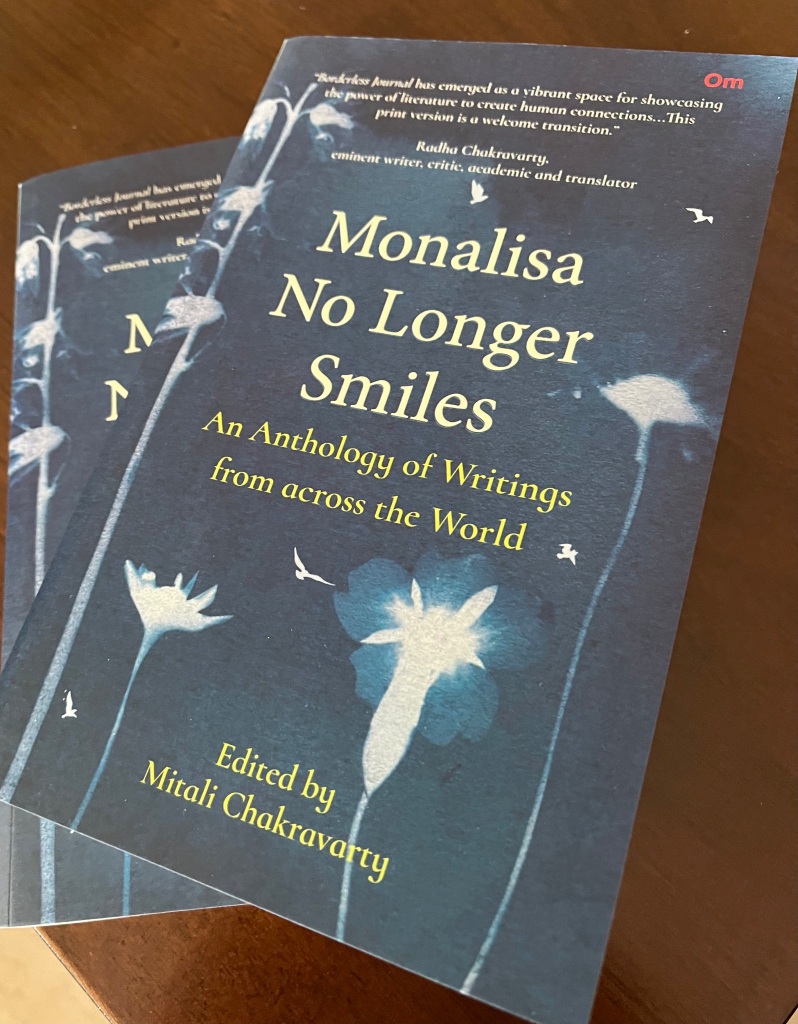
We did it! … Announcing our first anthology … Monalisa No Longer Smiles… Click here to read.

Conversations

Suchen Christine Lim, an iconic writer from Singapore in conversation about her latest book, Dearest Intimate. Click here to read.

Blazing trails, as well as retracing the footsteps of great explorers, Christopher Winnan, a travel writer, delves into the past, and gazes into the future while conversing with Keith Lyons. Click here to read.

Translations

Rows of Betelnut Trees by My Window by Nazrul has been translated from Bengali by Professor Fakrul Alam. Click here to read.

A Day in the Life of the Pink Man is a story by Shankhadeep Bhattacharya, translated from Bengali by Rituparna Mukherjee. Click here to read.

The Clay Toys and The Two Boys is a story by Haneef Shareef, translated from Balochi by Fazal Baloch. Click here to read.

Saturday Afternoon is a poem by Ihlwha Choi, translated from Korean by the poet himself. Click here to read.

Tagore’s poem, Tomar Shonkho Dhulay Porey (your conch lies in the dust), has been translated from Bengali by Mitali Chakravarty as The Conch Calls. Click here to read.

Poetry

Click on the names to read

Jared Carter, Asad Latif, Rhys Hughes, Alpana, Mimi Bordeaux, Saranyan BV, Luis Cuauhtémoc Berriozábal, Quratulain Qureshi, Jim Bellamy, Sourav Sengupta, Ron Pickett, Davis Varghese, Ryan Quinn Flanagan, Jonathan Chan, Terry Trowbridge, Amrita Sharma, George Freek, Gayatri Majumdar, Michael R Burch

Poets, Poetry and Rhys Hughes

In Infinite Tiffin, Rhys Hughes gives an unusual short story centring around food and hunger. Click here to read.

Musings/Slices from Life

The Scream & Me

Prithvijeet Sinha writes of how Edvard Munch’s painting, The Scream, impacts him. Click here to read.

A Fine Sunset

Mike Smith travels with a book to a Scottish beach and walks in the footsteps of a well-know novelist. Click here to read.

The Death of a Doctor

Ravi Shankar mourns the loss of a friend and muses on mortality in his experience. Click here to read.

My Contagious Birthday Party

Meredith Stephens writes of her experience of Covid. Click here to read.

Dim Memories of the Festival of Lights

Farouk Gulsara takes a nostalgic trip to Deepavali celebrations in Malaysia. Click here to read.

Musings of a Copywriter

In Strumming Me Softly with His Guitar…, Devraj Singh Kalsi talks of his friends’s adventure with the guitar. Click here to read.

Notes from Japan

In Therese Schumacher and Nagayoshi Nagai: A Love Story, Suzanne Kamata introduces us to one of the first German women married to a Japanese scientist and their love story. Click here to read.

Essays

My Favourite Book by Fakrul Alam

The essay is a journey into Fakrul Alam’s evolution as a translator. Click here to read.

The Ultimate Genius of Kishore Kumar

Shantanu Ray Chaudhuri, an eminent film critic, writes on the legend of Kishore Kumar. Click here to read.

T.S Eliot’s The Waste Land: Finding Hope in Darkness

Dan Meloche muses on the century-old poem and its current relevance. Click here to read.

The Observant Immigrant

In Piano Board Keys, Candice Louisa Daquin talks of biracial issues. Click here to read.

Stories

The Funeral Attendee

Ravi Prakash shares the story of the life of a migrant in rural India. Click here to read.

A Letter I can Never Post

Monisha Raman unravels the past in a short narrative using the epistolary technique. Click here to read.

Red Moss at the Abbey of Saint Pons

Paul Mirabile takes us to St Pons Abbey in France in the fifteenth century. Click here to read.

You have lost your son!

Farhanaz Rabbani gives a light story with a twist that shuttles between Dhaka and Noakhali. Click here to read.

Book Excerpts

An Excerpt from Manoranjan Byapari’s How I Became a Writer: An Autobiography of a Dalit, translated from Bengali by Anurima Chanda. Click here to read.

An excerpt from Evening with a Sufi: Selected Poems by Afsar Mohammad, translated from Telugu by Afsar Mohammad & Shamala Gallagher. Click here to read.

Book Reviews

Reba Som has reviewed Aruna Chakravarti’s Through the Looking Glass: Stories. Click here to read.

Somdatta Mandal has reviewed Shehan Karunatilaka’s The Birth Lottery and Other Surprises. Click here to read.

Basudhara Roy has reviewed Afsar Mohammad’s Evening with a Sufi: Selected Poems, translated from Telugu by Afsar Mohammad and Shamala Gallagher. Click here to read.

Bhaskar Parichha has reviewed Rahul Ramagundam’s The Life and Times of George Fernandes. Click here to read.

Borderless Journal Anthology

Click here to access the Borderless anthology, Monalisa No Longer Smiles

Categories
Editorial

We Did It!

That good things happen despite darkness, despite prognostications of doom, that light glimmers hope if you strive to focus on your strength in hard times is borne true both in fiction and in life. Perhaps, we cannot get back the old ways (but is that what we want?) but new paths emerge. Old gives way to new. And while trying to gather pearls of human excellence — borne not of awards or degrees but of bringing out the best, the kindest, the most loving in human hearts — we managed to create with a team an outstanding anthology. Woven with the writings of old and new — we created a tapestry together that the editor in chief of our publishing house said was “classy, literary, engaging and international”. That one of the oldest and most reputed publishing houses in India with bookshops countrywide took it on was also an unusual event! We are truly grateful to Om Books International, Shantanu Ray Chaudhuri and Jyotsna Mehta along with all our writers and readers who made our anthology a reality, and to Radha Chakravarty and Fakrul Alam for the kind words they bestowed on our effort.

Click here to access the Borderless anthology, Monalisa No Longer Smiles

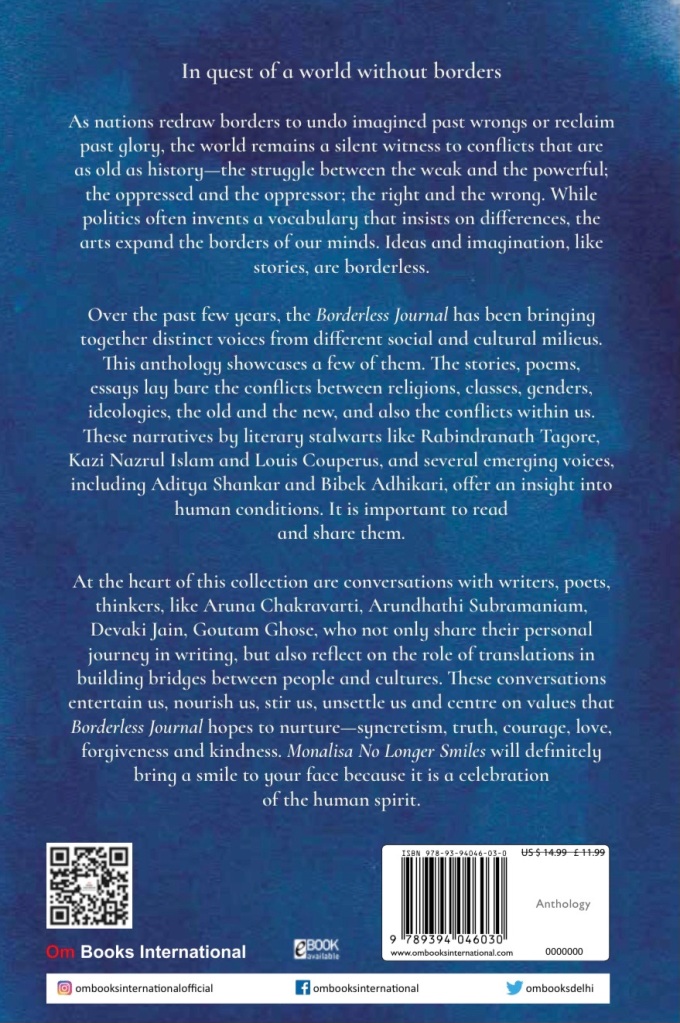
Please greet our first anthology, Monalisa No Longer Smiles, with love and friendship. It could be the perfect Christmas gift in the spirit of the season! And as the blurb says, “it will definitely bring a smile to your face because it is a celebration of the human spirit.”

The anthology is different from our journal in as much as it has a sample of an eclectic collection that has been honed with further editing and has some new features. Most of the writing is from our first year and showcases our ethos, except for Lesya’s poetry and interview. Lesya Bakun from Ukraine is still on the run, looking for a refuge — she cannot return home like you or I can. Her family is scattered across number of countries. Her cousin, who was guarding the factory at Azovstal, was taken prisoner. We included her story in the anthology hoping to create global empathy for refugees as the numbers will increase not only due to war but also due to climate change.

The reason we felt a hardcopy anthology was a good idea was because nothing beats the joy of having a bunch of interesting reads in the warmth of your hands (especially where internet cannot reach or is unavailable). In any case, books with the feel of paper, the rustling whispers which carry voices of leaves can never be replaced as Goutam Ghose had also said in his interview which is now part of our anthology.

And that is why we celebrate more books… this time we feature Singaporean prima donna of literature, Suchen Christine Lim, with her new book Dearest Intimate, a novel that spans more than hundred years including the harrowing Japanese invasion during World War II. She shared sound advice with writers: “Suffering is good for the writer. It will deepen lived experience and expand the heart’s empathy.” And perhaps that is what is echoed through the experiences of the other writer interviewed on our pages by Keith Lyons. This is a writer who not only brought out his own books but was a regular contributor of travel pieces for Frommer’s and National Geographic traveling to unexplored destinations — Christopher Winnan. Another writer Lyon had interviewed recently, Steve Carr, has passed on. We would like to convey our heartfelt condolences to his family and friends.

We have a number of books that have been reviewed. Reba Som reviewed Aruna Chakravarti’s Through the Looking Glass: Stories that span eras spread across time. Somdatta Mandal has reviewed Shehan Karunatilaka’s The Birth Lottery and Other Surprises and Bhaskar Parichha, Rahul Ramagundam’s The Life and Times of George Fernandes. Basudhara Roy has written of Afsar Mohammad’s Evening with a Sufi: Selected Poems, translated from Telugu by the poet and Shamala Gallagher, verses that again transcend borders and divides. We have an excerpt from the same book and another from Manoranjan Byapari’s How I Became a Writer: An Autobiography of a Dalit, translated from Bengali by Anurima Chanda.

More translations from Bengali, Balochi and Korean enrich our November edition. Fazal Baloch has translated a story by Haneef Shareef and Rituparna Mukherjee by Shankhadeep Bhattacharya. We have the translation of an inspirational Tagore poem helping us find courage (Shonkho Dhulaye Pore or ‘the conch lies in the dust’). Another such poem by Nazrul has been rendered in English from Bengali by Professor Fakrul Alam. He has also shared an autobiographical musing on how he started translating Tagore’s Gitabitan, which also happens to be his favourite book. More discussion on the literary persona of TS Eliot and the relevance of his hundred year old poem — ‘The Waste Land’ by Dan Meloche adds variety to our essay section.

Evoking the genius of another outstanding artiste, Kishore Kumar, who happened to pen thought provoking dialogues in some films, is Shantanu Ray Chaudhuri’s essay, review of a recent book on the legendary actor-singer and an interview with the authors. Infringing the boundaries of literary with popular culture and art and integrating all forms into a wholistic bundle has been part of our ethos. In that spirit we have a musing by Prithvijeet Sinha on Edvard Munch’s famous painting called Scream. We have non-fiction from Australia spanning Meredith Stephens’s recent brush with Covid, Mike Smith visits a Scottish beach in the footsteps of a novelist, Ravi Shankar has given us a poignant piece for a late friend and Candice Lousia Daquin talks of the existence of bi-racial biases. In contrast, Suzanne Kamata sent a narrative that bridges divides showcasing a German wife of a Japanese scientist that draws us to conclude that biases erode over time to create an acceptance of bi-racial people. Devraj Singh Kalsi brings in humour with his funny narrative about a guitarist. Rhys Hughes writes in a lighter vein on Indian cuisine in his column and spouts more funny poetry bordering on the absurd.

Jared Carter has shared beautiful poetry on murmuration in birds and we have touching verses from Asad Latif for a little girl he met on a train — reminiscent of Tagore’s poem Hide and Seek (Lukochuri). Michael R Burch has given us poems setting sombre but beautiful notes for the season. We host more poetry by Luis Cuauhtémoc Berriozábal, Quratulain Qureshi, Jim Bellamy, Gayatri Majumdar, Ryan Quinn Flanagan, Alpana, Jonathan Chan, Saranyan BV, George Freek and many more. We have stories from around the world: India, France and Bangladesh.

Gathering all of your thoughts in strings of words from all corners of the world, we present to you the bumper November issue of Borderless Journal . Thank you all for sharing your thoughts with us. Thanks to Sohana Manzoor for her fantastic painting and more thanks to the whole Borderless team for seeing this issue through. We would not have been able to do the anthology or these issues without each one of you — writers and readers.

Thank you all from the bottom of my heart.

There is always hope for a new tomorrow!

Mitali Chakravarty

borderlessjournal.com

Click here to access the Borderless anthology, Monalisa No Longer Smiles

Categories
The Observant Immigrant

We had Joy, We had Fun…

By Candice Louisa Daquin

Courtesy: Creative Commons

Heortology (the study of festivals) has expanded beyond its initial Christian focus to embrace all festivals and their enduring appeal and necessity in our human culture. Festivals remind us to celebrate, and celebration is a positive experience. The very idea of festivals is ancient. No existing history book is old enough to document when the first festival took place or what its origins were, but it’s a safe bet they had some kind of worship element attached. Modern festivals often also land on old pagan holidays, whilst others are more obvious in their origins. Many who attend festivals have no idea of their origins but go for entirely celebratory reasons. We have learned a lot about the history of varied festivals but another question to consider is: Why are humans drawn to festivals and what do they provide us?

Imagine the ancient world. As much as we think we know now, they knew a tremendous amount also, considering their lack of modern resources. This may well be down to the ‘necessity is the mother of invention’ paradigm. Or that we severely underestimate our ancient ancestors, in our egocentric belief the modern world knows best. Just as we underestimate the knowledge of animals and their abilities to survive. Perhaps we could even say, we have lost the art of survival and wouldn’t know how to, if our computers were offline and our cars did not work and the supermarkets were empty.

What we do know, is the ancients were able to amass a great deal of knowledge, despite seemingly not having easy access like we do today, with our modern telescopes and technology. They had to understand mathematics and science at the very core, to establish theorems on the universe and our place in it. Whilst many were later corrected, it is surprising how many ancient scientists, mathematicians and philosophers, got it right. Almost against all odds. It is fair then to say, we dismiss the richness of the ancient world, and imagine everyone lived ignorant lives, which was not the case. When ignorance did reign, it did so deliberately, with the quashing of knowledge by various religious groups, and resulting periods of ‘dark ages’.

The ancient world was in touch with what it means to be human. Being human isn’t knowing how to work your iPhone or microwave. It’s not having a huge house, with a swimming pool and driving a Lexus. Nor is it eternal youth, fame and glory. Being human is about surviving — just as it is with any animal. When we then add an awareness of our own being, which it is argued, not all animals understand, then we become the modern human we recognise today. A being who has the choice, the ability to reflect and learn, and a tendency to seek beyond themselves. In seeking beyond oneself, we find an innate or shaped desire for ‘more’ and that ‘more’ has often come in the guise of a God-head or spirituality of some kind.

Whether we believe humans are prone to worshipping gods or being spiritual, because Gods actually exists or we just have a propensity to create them, is immaterial. The outcome is the same. The God gene hypothesis proposes that human spirituality is influenced by heredity and that a specific gene, called vesicular monoamine transporter 2 (VMAT2), predisposes humans towards spiritual or mystic experiences, perhaps that is what is at work? In essence a transmitter in our brain that makes it more likely we will believe in God (and could explain why some people do so fervently, whilst others do not). Or perhaps we may find meaning in believing in a spirituality beyond the temporal world. But what we do know is, as long as humans evolved from their primate ancestors, they have formed meaning around some kind of spiritual observance and festivals were tied to this worship.

Why do we do this? We are born part of something (a family) but are also separate (an individual). Perhaps festivals and what they represent, is the coming together of all things: Nature. The seasons. Marking time (birth and death). Marking passages (fertility, menstruation, maturity, marriage, children, dying). These are the cornerstones of meaning, with or without God. I say without God, because for many, their notions of God are tied to nature, so it’s more the world around them than specific deities. For others, it’s the manifold destinies of humanity, or history of deities. But whatever the reason there is a sense of coming together in celebration of being alive, and acknowledging that life. A festival in that sense, irrespective of its actual purpose (the harvest, pagan holidays, etc.) is a ‘fest’ of life. Maybe this is why we can have such a happy time being part of it.

Growing up, neither of my parents liked festivals. They thought they were silly. I remember a street festival I went to as a child, for Fête du Travail (Labour Day) in France. I dressed up as princess and the frog (taking my toy Kermit with me) and felt an excitement like I had never felt before. The throngs of people and other children, the food, the smells, the magicians, the shows and the things to see. It was like walking through a market of treasures. I couldn’t understand why neither of my parents liked this; to me, it felt like a jewel had opened. But for some, festivities are synonymous with rituals and a degree of adherence to religion, even when it’s not. And rather than entering into the spirit of it and enjoying it, they feel what it represents is part of social control.

In France, like many countries, festivals abound. The national Fête du Citron (Menton Lemon Festival) draws crowds from around the world, as does the film screening: Festival de Cannes –near where I grew up — and Fête des Lumières (festival of lights, in Lyon). More traditional festivals include Défilé du 14 Juillet (Bastille Day). In the Middle Ages in France, on Midsummer’s Day, at the end of June, people would celebrate one last party (fête de la Saint-Jean or St. John’s Day). Bonfires would mark this longest day and young men would jump over the flames. This also happened on the first Sunday of Lent (le Dimanche de la Quadragésime), where fires are lit to dance around before carrying lit torches. Religion dominated many of the Autumn/Winter festivals historically.

In France, Christmas, is marked over twelve days with the Feast of the Innocents, the Feast of the Fools, New Year’s Eve and culminates in the Feast of the Kings with its traditional galette des Rois. Events include Candlemas (Chandeleur) with its candlelight process. Likewise, many Christian societies have some celebration connected to Easter (Pâques, in French)) or its Pagan roots. In France (and New Orleans in America) these include Shrove Tuesday (typically Mardi-Gras in America), marking the last feast day before Lent, and many others until Pentecost Sunday. My favorite ‘fest’ was Shrove Tuesday (also known as Fat Tuesday or Pancake Day, in other countries) because my grandma would make pancakes, despite our being Jewish. The notion was to eat before Christian Lent and a period of fasting, which has much in common with Muslim beliefs too (unsurprisingly since God is one in the Jewish, Christian and Muslim faiths). In America, they serve fish options every Friday for much the same reason.

Far more impressive and immersive festivals occur in India, with Hinduism celebrating among the highest number of festival days in the world. Over 50 festivals are celebrated throughout India by people of different cultures and religions. These Indian festivals form an integral part of the rich heritage of the country. The ancient Hindu festival of Spring, colors and love known as Holi is one. “Holi is considered as one of the most revered and celebrated festivals of India and it is celebrated in almost every part of the country. It is also sometimes called as the ‘festival of love’ as on this day people get to unite together forgetting all resentments and all types of bad feeling towards each other.” Holi is celebrated on the last full moon in the lunar month of Phalgun, the 12th month in the Hindu calendar (which corresponds to February or March in the Gregorian calendar).

With social media, more of the world have been granted access to the visual beauty of Holi – “This ancient tradition marks the end of winter and honors the triumph of good over evil. Celebrants’ light bonfires, throw colourful powder called gulal, eat sweets, and dance to traditional folk music.” One of the most popular legends in Hindu mythology says the Holi festival marks Lord Vishnu’s triumph over King Hiranyakashyapu, who killed anyone who disobeyed him or worshipped other gods. With coloured powder thrown on people as part of the celebration, many countries now celebrate Holi just as Indians may celebrate Halloween or Día de Muertos. The crossover effect may seem to dismiss the individualistic cultural value and smack of appropriation but, in reality, it’s more a sign of respecting other cultures, learning about them, and celebrating with them.

Mexico, which I live near to now, celebrates over 500 festivals yearly and consequently is one of the most festive cultures in the world. In San Antonio, TX, where I currently live, we celebrate many of these fiestas, alongside American ones. The most popular being Día de Muertos, Día de la Virgen de Guadalupe, Cinco de Mayo and Día de la Candelaria, (like the French Candlemas, celebrated after Three Kings Day, which is a bigger holiday than Christmas in Mexico). The variables in cultures are fascinating. In San Antonio, we get a huge influx of Mexican tourists over Christmas because they aren’t home celebrating as they do so a few days later. We have a fiesta in San Antonio that is much like those in Mexico, due to our large Mexican population and it’s heartening to see the merging of the two.

As a child I celebrated the Jewish Pilgrim Festivals—Pesaḥ (Passover), Shavuot (Feast of Weeks, or Pentecost), and Sukkoth (Tabernacles)—and the High Holidays—Rosh Hashana (New Year) and Yom Kippur (Day of Atonement). But I attended a school that celebrated all faiths so we also celebrated Ramadan, the Muslim sacred month of fasting, akin to Christian Lent. Growing up, my friends of all faiths, celebrated Eid-ul-Fitr or simply Eid which is among the religious festivals for the Muslim community, marking the end of Ramadan. This festival is celebrated on the day after seeing the night crescent moon with devotees offering prayers at mosques and then feasting with their near and dear ones.

We would also celebrate Kwanzaa, which is a worldwide celebration of African culture, running from December 26 to January 1, culminating in a communal feast called Karamu. Its creator was a major figure in the black power movement in America, “Maulana Karenga created Kwanzaa in 1966 during the aftermath of the Watts riots as a specifically African-American holiday. Karenga said his goal was to ‘give black people an alternative to the existing holiday of Christmas, and give black people an opportunity to celebrate themselves and their history, rather than simply imitate the practice of the dominant society.’”

Are we socially controlled when we attend festivals? Given we have a choice, I would say no. Someone who chooses to be part of something, isn’t signing up for life, they’re passing through. Since my childhood I have been lucky enough to have attended many festivals in many countries. For me it is a reaffirming experience, seeing people from all walks of life come together in happiness. I like nothing better than dressing up and meeting with others and walking through streets thronged with people. Be they carnivals, even political events, there is an energy that you rarely feel anywhere else.

The May Pole festival, believed to have started in Roman Britain around 2,000 years ago, when soldiers celebrated the arrival of spring by dancing around decorated trees thanking their goddess Flora, is an especially interesting festival because it is still practiced almost as in ancient times. The ribbons and floral garlands that adorned it represent feminine energy and the beauty of the ritual is enduringly something to behold.

Likewise, another event ‘Guy Fawkes Night’ is steeped in ritual and British history, with much symbolism in the burning of straw dummies that are meant to represent Guy Fawkes thrown onto bonfires. However, the act of throwing a dummy on the fire to represent a person, has also been done since the 13th century to drive away evil spirits. What most people seem to take away from Guy Fawkes Night are the abundant fireworks in a beautiful night sky, alongside children and families holding sparklers and eating horse chestnuts in the cold, wrapped up in mittens. It’s a ritual that is beloved and a chance to ‘be festive’ even if it’s not a specific festival. As much as anything, it marks time, another year, another November, and gives wonderful memories. If we didn’t mark time or have those memories, we’d still have others, but there is an ease with festivals because they do it for us, unconsciously.

Young collegiates often attend festivals that involve dancing and sometimes drugs. Again, this is not a modern occurrence but has been going on for years, as rites of entering adulthood. The desire of the young to get out and meet others and dance and enjoy life, is primeval, and possibly a part of who we are as humans, marking a potent stage in our lives. Recently I went to a birthday party at a night club. I observed the diverse throngs of party goers and reveled in that abundant diversity. In just one night I saw: Pakistani women in saris, Japanese girls in anime costumes with ears, a pagan woman with huge, curled bull horns and floor length leather dress, Jamaican families in neon shorts and t-shirts, transgender wearing spandex dresses and big wigs, Hispanic Westsider’s filled with tattoos, and gold necklaces, Lesbian and gay couples holding hands. Old couples in sensible church clothes including one old black man with a pork pie hat and a waist coat.

I thought of all the diversity that had attended this club to dance the night away. All ages, all genders and backgrounds and ethnicities, and I thought how wonderful it was that one place could hold them all. In many ways this is the essence of a festival, especially nowadays where anyone can attend most festivals. Years previous, they were segregated by subject. Only those followers of that subject usually attended and you could be harmed if you tried to attend and were an outsider. The advantage we have today is we are more accepting of outsiders and when you attend festivals today, you see a wide range of people. Maybe this is the best opportunity we have to put down our differences and celebrate our similarities.

When I lived in Canada, I loved the homage paid to different seasons in varied outdoor festivals, where shaking off the lethargy of Winter, Canadians would celebrate with fairgrounds, amusements, shows and food among other things. It was like a period of renewal. Likewise, during my time in England, the Notting Hill Carnival, celebrated the Afro Caribbean culture, so essential and entrenched in English culture, with gorgeous street displays and floats, as well as some of the best music around. The idea of welcoming everyone into the fold, helps to remove any tensions between cultures and promote a feeling of unity, whilst not denying the unique properties of those cultures and ensuring they are promoted in their adopted countries. It may be idealistic and not entirely accurate, but it’s a better step than ignoring those myriad cultures exist.

As Halloween and Día de Muertos is fast approaching, I am thinking of how many of my neighbours attend these parties, despite some of them being from very conservative churches. Just last year, we all sat outside in the green spaces and had a mini fireworks display. I sat next to my little 4-year-old neighbour and watched her face as the older kids, dressed in all sorts of costumes, shrieked at the fireworks, and ran around with neon bangles, throwing glow powder at each other. I saw how inculcated we are, since childhood, but despite this I truly believe festivities are in our hearts, even if we weren’t introduced to them at an early age. Children mark their growing up by the events of their lives and it’s not just their birthday they celebrate but the touchstones of their respective culture and nowadays, many other cultures.

My Egyptian grandfather used to tell me about the Nile festival which celebrated the flooding of the river and the replenishing of life in Egypt. Without the Nile, Egypt couldn’t exist, and the ancients knew this. They employed methods to enhance the flooding and gave thanks for it. Gratitude like this can be found in many celebrations, including the American Thanksgiving (although this is a double-edged sword, given the history of genocide of the Native Americans by European pilgrims and invaders) and Harvest throughout the world. A celebration of life through food with music, is at the core of the human ability to endure and overcome hardship. More recently many of us celebrated healthcare workers by singing out of our windows and putting messages of thanks in our windows. We do this because it symbolizes essential parts of our lives, without which we would suffer.

Owing to its melting pot past, Egypt celebrates the Coptic Orthodox Christmas, the more ancient Abu Simbel Sun Festival that is akin to the Egyptian Sun God Ra (who in turn was one inspiration for the Christian God many years later), Sham Ennessim, the national festival marking the beginning of spring, as it originates from the ancient Egyptian Shemu festival, Ramadan and the Muslim Eid al-Adha (honoring the willingness of Ibrahim (Abraham) to sacrifice his son Ismail (Ishmael) as an act of obedience to Allah’s command). As a Jew, my grandfather’s family celebrated Passover, the festival celebrating the Jews Exodus from Egypt, despite our family still living there! Nowadays it is no longer safe to live in Egypt as a Jew but the memory of all people’s experiences is preserved through ancient festivals and events, marking our shared history.

Before the advent of mass-produced entertainment, festivals were also a highlight in any village or town, because they were entertainment. Traveling theatres and shows for children, even book sellers and traders of items not commonly found locally, could be bartered or purchased at such events and it was almost a spilling out from the market square economy that kept such villages alive. Perhaps evolving from our natural tendency to barter for things we want, we evolved to invite others from outside to come for specific events to gain greater reach. With this trading and bartering, came the accoutrements such as eating, drinking, dancing. Not only did this increase diversity and knowledge of foods and drinks from other locales, but brought people who may otherwise not meet, together into a camaraderie.

Sharing stories is also part of festivals, by way of theatre, or more improvised scenarios. It is at our heart to pass on oral knowledge and we haven’t lost that desire. We may do this now via YouTube more than face to face (which is a shame), but the desire to get out and talk directly, is innate, as evidenced by how many people have done just that since Covid 19 restrictions are eased. Religion, folklore, ritual and a desire for escapism, alongside our desire to celebrate things or others (saints, gods, seasons, harvest) are all reasons why festivals endure. Just like children will instinctively dance when music is played, maybe it is our innate nature to enjoy festivals because they foster inter-relationships we all crave to some degree. We may be diverse and believe different things, but we can also come together and respect the perspectives of others. Never more so than through our shared love of celebration.

.

Candice Louisa Daquin is a Psychotherapist and Editor, having worked in Europe, Canada and the USA. Daquins own work is also published widely, she has written five books of poetry, the last published by Finishing Line Press called Pinch the Lock. Her website is www thefeatheredsleep.com

.

PLEASE NOTE: ARTICLES CAN ONLY BE REPRODUCED IN OTHER SITES WITH DUE ACKNOWLEDGEMENT TO BORDERLESS JOURNAL.

Categories
Stories

The Phosphorescent Sea

By Paul Mirabile

The ship hauled anchor then glid smoothly over the placid, thick black waters. Overhead, thousands of stars studded the midnight sky. Most of the passengers chose to sleep but not Reuven, who at starboard, leaning heavily on the railing, inhaled and exhaled that nocturnal air of sea lust he nurtured, yearned and desired. Reuven had walked the decks of so many ships at night. He slept restlessly during the day. For it was at night that the treasures of the sea beckoned him with their illuminating allure, whose phosphorescent radiance touched and tugged at his heart as he attempted to pry open the lid of that still undiscovered treasure hidden unfathomed within him.

The ship rocked ever so gently as he peered into the inky depths. Deeper and deeper Reuven sought to probe, to sound, to err amongst the phantoms. But as night advanced, and the air grew cooler and he had to stop. His lungs were at the point of bursting. He gasped for air. He had failed once again, panting breathlessly. It was only the first white ray of the morning that he returned to the surface, throbbing with anguish, shivering with cold, smelling of brine.

He would have to exercise himself more strenuously, discipline his breathing rhythms, purify his heart further in order to attain … to attain what ? The un-pried trove ? The entrance to the azure cave whose lithic cavities and chambers would deliver him to the heart of his ‘Quest’ ? “But all three are One !” he murmured to the morning light. “All three are decidedly One, I’m sure of it.” He concluded.

But was he absolutely sure ? Since the nineteen-seventies how many years, how many vessels, how many dives into the oceans and seas of the world had he waited, ridden out, taken in in search of the seemingly unattainable? How many nights aboard the rocking and rolling bridges, under the brilliant or luminous less skies had he held his breath and made the vital plunge ? At times, he felt that he had ‘touched’ something : shoals of darting fish, a school of breaching dolphins, curious at this interloper, a lone blue or white whale ready to swallow him up like Jonas, yet hesitant due to the urgency of the diver’s dive downwards, and perhaps also to the oddity of such a ‘mouthful’. Once a soft, silken squid touched him with its suction-cupped tentacles. This touch sent icy chills through his body. Other odd phantoms that wiggled through the depths eyed him with their bulging, bulbous eyes rolling in their protruding orbits as they rubbed noses with him. Alas, this was the furthest he had sounded: the crushing coldness of the sea enveloped his body, and his lungs, aching, failed him once again. His lungs and his will ! This lack of intestinal fortitude and energy in overcoming the frigid deep would bring tears to his red, fatigued eyes …

“How many plunges would it then take ? How many crossings and trials ? Confrontations with the phantoms of the deep ? Were these uncanny and oftentimes terrifying creatures the guardians of the cherished trove ? Were they responsible for my lack of will … my shortage of breath … my fear of limits ? But is not the tracing of a limit a means of surmounting it ?

“I class these plunges as voyages. They are extraordinary. Extraordinary because beyond what I may call ordinary reality. For this extraordinary reason I believe my will retracts, my lungs fail, my fear reaches an acme of indescribable terror. Yet, I persevere. No treasure chest is easily discovered and its lid pried open. This knowledge I acknowledge, and in doing so, have hurried half the way by overcoming the consensus of a sole vision of reality. For I have come to understand that the treasure I have so desperately sought lies not in an ordinary vision of things, but within them, through them, over and under them. There lies the treasure I am speaking about. There in a land or space of the ‘Other Reality’,” wrote the dauntless diver in his logbook.

“And this space exists ! I have plunged into it, but have been thwarted in my attempts to reach ‘the bottom’, if that is all possible. The ‘bottom’ where lies the treasure …”

And so many years passed. Many decks paced. Many plunges plunged. Many expectancies sunk …

“It was on this particular cargo vessel as we left Southhampton for Cape Town that my efforts would prevail …or I believed would prevail. At the equator, one very still and humid night, the waters of the Atlantic were as thick as molasses, as calm as a pond in a wooded glen, as black as pitch. I leaned at the railing, quite alone at  late hours of the night. I peered down into this uncanny oceanic instant and a sentiment of great excitement crept up upon me …

“It was the instant expected : I plunged anew …

“As I slowly descended the stillness of the cool waters, the titillating sensation of my kindling blood awakened a contrast that my mind found difficult to organise. It were as if my subjective make-up, my ‘personal space’ lay exposed to the various living entities that either obstructed my way, obliging me to circumvent them, or rushed towards me as if to scrutinise this alien interloper that had trespassed their ‘personal space’. It was not an uncomfortable feeling at all, but the collision of the two ‘personal spaces’ seemed to meld into an ‘impersonal one’, drawing me now out of my self now drawing them into me. Beautiful crimson corals provided the backdrop of this alternating movement, aglow with bulbous branch tips that undulated at my approach ; its branches were aswarm with sponges, molluscs, star fish, sea urchins and sea spiders. The coral quivered and quaked under their continual agitation, a silent and stunning quavering as I passed them by, several detaching themselves to examine the diver! Yet, they kept at a reasonable distance, hardly inhospitable, even friendly, my ‘human aura’ perhaps attracting them as they slid through the myriad incandescent branches …

“I felt so relieved that these fellow creatures welcomed my presence amongst them, and I thanked them for not upsetting my rhythmic breathing as I descended. I broke through layers of soft, silent, swishy beds of seagrass of the most viridian green. Nothing stirred within them; only the strong current of waters tossed them to and fro — like the sea vessel that I had long since abandoned — or so it seemed. Here at these depths ,Time had lost its tick-tock humdrum. It had become Space.

“Gradually the waters became terribly cold. My heart was palpitating. At these inky depths, no ray of the sun penetrated. No sound, human or other, pervaded. Now the queerest of creatures swam in the wake of my vertical drop, glaring at me either through tubular eyes that swivelled or through telescopic ones with lenses. They appeared amiable, in spite of the fact that I had disturbed their environment. They meant me no harm, even a giant squid, terrifying creature, who had made a bee-line towards me, stopped a short distance away. The creature began to feel my body with the many suction cups that padded its lengthy tentacles. I imagine it was verifying whether I were friend or foe. After several minutes, it let me pass, its beady eyes encrusted in its bulbous mantle fixed on me as I drifted deeper into colder waters, waters that were compressing my body and soul more and more.

“The darkness became truly frightening. My drop slowed down as if the waters were solidifying, gripping me in some viscid, glutinous substance. An image from the past darted through my mind : it was in the Pacific, I had encountered the terrible phantom of the abyss and had skirted that danger, miraculously. All of a sudden I was shaken out of my reminiscence by many spots of soft ochre-yellow light that sluggishly trudged their way towards me : I believe they were lantern fish flashing upon their prey. They swarmed around me, training their luminous photophore organs into my face. What an unusual prey they had stumbled upon! So huge. So unappetising. So unlike their daily diet. I think I was dealing with a viperfish, whose enormous dagger-like teeth shone under the softness of its lantern organ. And there, to the left, swimming as speedily as the thickness would allow it, a humpback angelfish, an ugly beast indeed with its deadly spiked teeth ready to devour me. Both of them eyed me, until at length turned against themselves. The turbulence of the waters blurred my vision, thousands and thousands of bubbles jolted and jostled me from left to right, dragged me downwards, helplessly caught in the vortex of this bellicose maelstrom. When the tempest had abated, peace and darkness reigned once again. Regaining my composure, I ventured a peek upwards: nothing …

“Heavier and heavier my body weighed, lighter and lighter my head as I plummeted to deeper depths, quite unknown to me. I became estranged from my Self … from my human identity. I had never experienced such uncanny emotions in my former marine voyages. It were as if my body had blended into the environment, had become one with it, whereas my mind, quite lucid, refused to yield to this inhuman ‘It’. Was my body detaching itself away from my mind ? How could that be ? They are inextricably connected … or so I thought … How many hours now beneath the ocean ? How many days ? Would I have both the physical and mental strength to weather the fathomless Deep … the soundless ‘It’ ? To overcome the abyss ? To reach the treasured Depth ? Yes, I must advance wither : Had I any other chance ? It was too late to turn back … Yet I had to surface at some time …

“Ah ! Now what is this ? I’ve seen that bugger before in picture-books – the black swallower. This phantom of the deep can be a deadly adversary with its bloated, distensible belly that even swallows small whales. It’s coming straight at me and I have nothing to defend myself, only prayers, only a thought of the Absolute One whom I seek with firm resolution. And there, a blazing light burns through the thickness. Either it too is headed for me or for the charging black swallower. It’s the pelican eel that was going into battle against the other, brandishing a large photophore at the end of its tail to attract the terrible black swallower away from me. Its enormous mouth has dropped open and in a jiffy the unprepared black swallower existed no longer, gobbled up within the grinding cavity. The spot lights of the eel flashed on and off as it struggled to digest such a crude repast. All this emotion caused my heart to beat faster and faster … my chest ached and swelled. My breathing became more and more erratic, almost uncontrollable. As I witnessed these turbulent events a rather metaphysical thought crossed my mind : Are all these creatures not traces, imprints, vestiges of His Presence ? Are they not, in the chilliest depths of the deep, enigmatic signs, obscure indeed, even frightening, of my communication … no, of my communion with Him, however ugly, gruesome or hostile their appearance be to me ? They are the true signs that I am on the right road : the Royal Road …

“My eyelids no longer obeyed their nerve commands to remain on the alert. I wished to sleep. To lay down and doze off for a while … a long while. I’ve had enough. I’ve come too far and my quest has come to nothing. I long to see the light of day, to savour earthly creatures, to breathe an unsalty air.  I yearned to return to humankind. To the colours and sounds of life … Yet, I’m still alive, or at least I believe I am alive, albeit everything I touch has no feeling. A numbness has settled into my drifting body ; so light, so weary, so empty … a floating debris from an embattled, erring vessel …

“The debris floats into the crevice of a sponge-like lithic palisade. I am penetrating some sort of  grotto, drifting in an airless, soundless world, tugged along horizontally as if a strong current were tossing and rocking me gently from one wall to the other. The haze that had veiled my eyes slowly lifts, and I discern a phosphorescent glow of myriad colours. The colours played upon my sensations without disturbing the numbness that had seized my body. At last, the ‘Separate Reality’? The twilight of gleams and glimpses ? Of undulating figures or phantoms that emerge in my mind when I feel myself entwined within the fumes of sleep ?

“But I am fully awake to my novel surroundings: A purple haze has crept into this grotto, chandelier-like stalactites hang in series of threes, all perfectly symmetric in their sponge-like textures and forms. I reach out to touch them but I felt nothing, my arm balancing heavily in some sort airless vacuum. Gigantic stalagmites studded with bulging, knotty boles and prominent tumours soared high into empty chambers like frothy fairy chimneys, dripping colours of blue and green, fading fast as they penetrate the darkened upper cavities. And away I drift, billows of silken lithic walls roll by. I serpentine like a snake through this intestinal gallery, chamber to chamber, passageway to passageway, the air or water current conducting me deeper into intermittent contrasts of sapphire flush, ultramarine malachite and pall blackness. Air or water current ? My body breathes ‘normally’, although I cannot ‘feel’ the air through my nostrils or throat. Have I transcended the conditioned reality ? Have I identified myself with this unknown alienness … reached the ‘Separate Reality of the Divine One’? The Absolute One is indeed known to us naturally, but will I be able to recognise him ?

“Nothing moves: no fish, no reptiles. I myself cannot move, yet beyond the inertness of my corporality something enlightens me upon the marvels of this cavernous world. All beauty does have a sense of the physical. Alas, I am quite unable to participate ‘corporally’ in that sensation, for I possess at these very moments none. A tulle-like curtain is drawn before my eyes; but on each side of me what an enchanting view of so many enfiladed pillars, like ossified soldiers on guard duty. Are they real ? Am I dreaming them ? I must say, however, that in spite of my benumbed state, I do feel this polychromic beauty. A sort of conscious feeling of a penetration of colours and configurations that leaves trails and traces as I sail by them, or better put, as they engulf me then expel me further into the never-ending warren of passageways and chambers.

“Ah ! Wonders of wonders ! Here and there I discern mural drawings of the most exquisite artistic stamp : aurochs, bisons, horses, hands with thick thumbs, tiny ochre-coloured men shooting arrows … Perhaps these regions were inhabited by creatures like myself. Prehistoric or primitive artists carving out their visions of reality, real or imagined.

“Am I then dead to this forlorn world ? To mine ? Am I passing into the Other World ? Is this where the quest has brought me … to the end … or to the beginning ? The phosphorescence glows of melding colours: blues slipping into turquoise, greens into shades of violent. Slashing amber yellows drip into rushes of rusty reds, which in turn suddenly explode into large patches of black shutting out all until bursts of dulcet rose and bright orange bring tears to my half-closed eyes. This I sense but without a sense of being separate from it all.

“Yes, there is something eerie about this voyage, something uncommon. From one of the arched, vaulted chambers a shower of arrow-like sparks falls upon me ; yet I feel nothing. I speed through a maze of silver and gold. I circumvent a sulphurous gauze of stalagmites of the most confounding shapes: pillars whose capitals overflow with spongy tendrils and drooping pistils, sprouting mushrooms, swollen menhirs, frozen standing stones and other awesome monoliths coated with red damask, crustacean Moorish arches, spiky gold steeples and then the passage cleaves into opaque chambers, odourless, soundless, fraught with the feeling of hopelessness. From one of the greenish Moorish arches, I see a stone mouse hanging by its tail, or so it appeared, and from another, silken silvery threads of  weird waning, waxing waterfalls.

“Here, afloat, I am spinning through a wondrous world quite impervious to its smells and touches, yet moved by it as if it were sheltered within me. Sheltered by the commotion of colours and the seductive shapes, the endless erring of the same patches of pitch black, exposed to the sudden bursts of iridescent colours, I turn and turn and turn in circles ever wider.

“The momentous moment has it arrived? The Great Encounter — I mean between myself and the Absolute. No, impossible, why all this turning and turning ? Why the intermittent snatches of blackness that smother the chromatic bursts of phosphorescent hope ? Why am I not able to voice or move within the vortex of the revelation ? And the sacred trove ? Am I not worthy of it ?

“My heart bursts with melancholic joy. Pangs of glee spill out … I sense the midst of mellow musings rising like a curtain; the lid has opened, and the image of the Invisible One has come upon me … I gasp in awesome delight:  No more angry, reddening suns will henceforth set upon me…”

*

After several hours of searching the sailors finally found Reuven’s bloated body floating in the ocean. The crew and passengers had been searching for him since his disappearance on deck after midnight. The doctor aboard concluded that his lungs had burst. His body was filled with water and microscopic sea creatures.

When the cargo ship ported at Cape Town, the captain reported the incident to the police. A certain Reuven Whaler had apparently fallen overboard during their route, and not having been seen by either crew or passenger, had drowned. When the police enquired whether he might have committed suicide, the captain shrugged his shoulders. When asked about a possible murder, the good captain turned red and vehemently denied any possible attempt of murder, premeditated or not!

In spite of the captain’s affirmative disposition against any sort of mischief aboard his vessel, all the crew members and passengers were subject to long interrogations: No one was permitted to disembark for two or three days until the coroner’s inquest had been completed and delivered to the police aboard the ship. The inquest stated that the aforementioned passenger, Reuven Whaler, forty-nine years of age, had drowned by accident off the coast of Gabon. As he had no family or close relatives, no further enquiries were made.

Reuven’s death thus remained somewhat veiled in mystery. Whether his body was buried or thrown back into the sea is anyone’s guess …

Now the readers may be curious to know how is it that I have come to relate these incidents given the fact that Reuven vanished one balmy night off the coast of Africa quite alone. How is it that I can account with such precision and emotion his ‘plunge’. Fortunately I was Reuven’s cabin mate aboard that cargo vessel, and when his body was discovered, before the captain arrived to check his cabin belongings, I quickly recuperated the logbook that he had been keeping and hid it in my belongings. I do not consider it as a theft, but as a keepsake … a testimony to Reuven’s ardent quest for the Absolute.

Paul Mirabile is a retired professor of philology now living in France. He has published mostly academic works centred on philology, history, pedagogy and religion. He has also published stories of his travels throughout Asia, where he spent thirty years.

.

PLEASE NOTE: ARTICLES CAN ONLY BE REPRODUCED IN OTHER SITES WITH DUE ACKNOWLEDGEMENT TO BORDERLESS JOURNA

Categories
Stories

The Hatchet Man

By Paul Mirabile

Courtesy: Creative Commons

Tonight, in accordance with what I generally find necessary to record, I have mustered the courage to give full account of the singular events that have befallen friends and neighbours. These nightly entries have drained me of energy and patience, produced unusual sounds in my home, like those caused by nests of bees or wasps. Unusual too, the grotesque belief that loneliness and long periods of silence and speaking to one’s self, will give rise to hallucinations or other such aural phenomena. Be that as it may.

In the edition of the May ninth 1973 Daily Mirror, I came across an article which reported a most daring escape made from the Mental Hospital not far from our quiet neighbourhood. In 1968, the escapee had been accused of excoriating the flesh of a sixty-year old widow, so it read. What inflamed the imagination of the good people of our village was the way in which he had let himself in. Knocking at the door he introduced himself as a salesman for an encyclopaedia publishing house. The unsuspecting woman let the killer in and even offered him a cup of coffee. Her husband had died a very long ago, so it was supposed that she must have had an urgent longing to speak to someone. After conversing with her at some length, he casually revealed his hideous companion, an axe, and buried it deep within her brain, so the autopsy showed. He then proceeded to excoriate the poor woman. This odious account he willingly, and I add here, with over-excessive enthusiasm, declared to the authorities shortly after his capture. Owing to the savage and cynical nature of the crime, the monster was committed to the mental institution, and there interred for life …

Quite understandably his flight created a disturbance in our village neighbourhood. The twisted-minded beast was no doubt lurking about the wood surrounding our tranquil homes. The police stated that they had discovered fresh footprints leading from pockets of underbrush in our general direction. They have identified these footprints as his ! He had found an asylum during the hunt, and now was in search for new prey. His bloody doings would not stop at one …

Some time passed before the police gave up hope of locating the mad murderer. No one had seen him nor had my neighbours made any attempt to form a squad of vigilantes to ferret him out of his lair. I, as usual, sat behind my desk as I am doing at present, gazing half dreamily upon my scribbled notes, regarding the affair rather apathetically.

Five nights ago whilst lethargically reading through my writings as was my wont, a scream tore through the stillness of an unusually still night. Looking up from my writings, I imagined a sulking figure dragging itself over a rooftop just opposite my home through the parted serge curtains of my bay window. I state emphatically that the hour was late, and that perhaps my eyes had grown weary. Thinking it was merely my imagination, I returned to my work at hand.

The following morning to my astonishment, the papers reported a grotesque killing during the late hours of the night only six houses from that of my own ! In fact, it was someone with whom I was acquainted. My blood ran cold. He had been found beheaded. Chunks of flesh had been hacked out of his neck and torso. A hatchet undoubtedly was used for this gruesome purpose. What proved singularly frightful was that the unfortunate victim had been having coffee with his killer. Two cups of half-drunk coffee were discovered unmolested on a small, sitting-room settee. As to how the murderer entered, it can only be assumed that his victim let him in. The state of the house was in ruin. Nothing, however, had been stolen. A clear case of premeditated murder, so the police concluded.

This of course brought myriads of police to our quiet street where investigations were carried out with much fanfare and discomfiture. I was visited several times, the police sniffing about my home like a pack of retrievers. The chief inspector questioned me as if I were the criminal.

Did he think I was deflecting his attention from something important to their investigation ? Did he suspect me of foul play ? Of complicity ? He had those shifty pink rabbit’s eyes of a police inspector ! In spite of this ferreting and harassment, I said nothing. He casually flickered the ashes of his pipe in a seashell which I kept on my writing-table, thinking it, no doubt, an ash-tray, then left without a word, a master mustering his hounds. You may ask why I divulged not a word about that phantom on the rooftop. This I have asked myself, and even now at my desk writing this entry, I have no rational answer …

That evening (of the murder), I uneasily noted that my mind had been wandering from its normal systematic chain of thoughts. I was continually straining my eyes to envisage that evil phantom dancing on the roof opposite my home. Suddenly, and I assert my eyes did not deceive me, there it pranced again, sweeping haphazardly from shingle to shingle … from chimney to chimney, brandishing something metallic which glittered in the blue moonlight high overhead. And in one emblazoned second, I believe he gaped at me, mouth open, eyes ablaze! Yes, I am sure of it! And in that one terrible moment I noted that he possessed the same facial features as me: flattened head, black, beady eyes, pug nosed, curled lips. He vanished, darting out of the moonbeams … Throwing down my pen, I clutched at my hair ; my head churned out a series of chilling, bizarre scenes. The uncanny resemblance unsettled me, even alarmed me.  I finally lay on my canopy falling into a troubled, dreamless sleep.

How stunned I was the next morning when I read in the morning papers that my next door neighbour had been brutally butchered, ostensibly by the workings of the same maniac. The killing was identical, as was the means by which the killer entered the house. The police searched frantically. House to house inspections had been ordered and carried out. Again the hounds rummaged through my household belongings in the most disrespectful manner; had they snickered at the scones and boiled eggs I failed to remove from the kitchen table, crushing the shells that lay scattered on the floor under their muddy boots ? They had some cheek. And as they went about their sordid ‘duty’, the chief inspector eyed me with a strange mixture of pomposity and wariness, twitching his pipe inside his mouth from left to right and right to left, his nostrils quivering.

I felt my knees stiffen under that glare. Yet, I dared not return his pinkish rabbit stare, nor divulge my visions of the fleeing phantom. They finally left, then scoured the wooded area with dogs. I heard the howls and barks and yells of the chase. If I’m not mistaken they searched the surrounding woods and glens for days ; alas, the escapee was nowhere to be found. Many of my neighbours began to leave. To tell the truth, I felt no immediate danger, although I was quite naturally disturbed. Dull depictions flooded my thoughts of a hatchet-wielding man breaking down my door. And evening after evening, as darkness mantled the clusters of woods and lonely streets and lanes, icy droplets of fear gripped my heart ; I had seen this maniac, yet said nothing. Knocks rattled my door. Upon answering it, there was no one. Hornet-like droning and bee-like buzzing rattled the drums of my ears. Was it my imagination ? Could fear stir the mind to such heights of fancy ?

And so it was as four or five more nights passed. Two more murders had been reported in an adjacent neighbourhood, notched on the helve of the maniac’s gory weapon. I was in a quandary. Why did this evanescent shadow haunt my nocturnal solitude ? Why did he pertinaciously dance before my window ? Why hadn’t he knocked casually at my front door ? God if I knew. And why hadn’t I been to the police to notify them of this moonlit macabre rite ? Did the killer mock my terror … my  timid reluctance to act ? Did he embrace me as his tacit witness … his accomplice ?

Yes, why hadn’t I gone to the police ? The words are so difficult to express ; they wretch themselves from my pen. How then would they sound, sputtered to the police, or to that pipe-wielding inspector ? Oddly enough, though, I always remained calm. And even as his crazed figure  sauntered under the silver moonlight, I sat stoic, placid, squeezing my pen until my fingers and knuckles turned pale white …

The night of the double murder occurred a week ago. Since then the killer appears to have ceased his bloody onslaught. Perhaps he has been apprehended, or cornered in some distant wooded recluse like a wild animal. I haven’t seen him, and I must confess, on several occasions I’ve actually stepped out my door on to the porch to listen more attentively ; to see him more clearly ; to call out to him, discharging my savage, commingled phantasies and fears …

That night, as I toyed pointlessly with my writing tool, I fixed my bloodshot eyes to that hellish cornice of the roof opposite my house, a roof long since abandoned by its two or three occupants. Nothing. No one. I’ve wondered from time to time if the lunatic had really caught sight of me glaring at him in his frantic flights, my eyes pinned on his as he glided from rooftop to rooftop as if floating puppet-like in mid-air. All this had me chilled. It was unusually damp. My study felt damp and mildewy from insufficient heating. I hear footsteps coming up the street, hollow in the thick night. They halted.

I detect a slight rustling sound outside on my porch, like crispy leaves cracking under a booted foot. Why I write all this down just now is indeed troubling. A faint dizziness has sharpened my aural perceptions. And as I continue to write, in spite of myself, the porch door was opening, slowly … patiently as if the creaking wished not to intrude upon those sleeping at this late hour. And still I scribbled line after line.

There was someone knocking at my front door. I was chuckling as only a deranged man would when sensing foul play afoot, yet patiently waiting for it to strike ! And again, my pen continued to dictate to me. I was completely taken up by my writing. Is it because it mirrored the indelible mark of my solitude … my banal existence ?

There it was again that knocking. Should I answer it ? Perhaps it’s the old codger wanting a cup of hot coffee ! What a shuddering, stupid thought. No, probably some drunkard who noticed my light … or a neighbour in distress, no, better yet, the pipe-twitching inspector hoping to catch me off guard. Yes, I’m sure it’s that snooping blighter. God how my nerves were at an edge! And that tapping and rapping at my chamber door … Some late visitor entreating an entry? Ha ! Who could it be for Heaven’s sake ? Him ? Yes, him ? Rotten luck mate, I hadn’t a grain of coffee to offer him. That blasted door … If only I had a pistol … No, in the kitchen … the cleaver ! I fetched it and decided to see who fared better ! Hatchet against cleaver … I was sorry for the old sod — no coffee that night but a taste of my cleaver. To the kitchen. That hammering was driving me daft ; he’d wake up the whole damn neighbourhood … or what was left of it … First my cleaver, then the door … then to the rooftops … to the rooftops …

Paul Mirabile is a retired professor of philology now living in France. He has published mostly academic works centred on philology, history, pedagogy and religion. He has also published stories of his travels throughout Asia, where he spent thirty years.

.

PLEASE NOTE: ARTICLES CAN ONLY BE REPRODUCED IN OTHER SITES WITH DUE ACKNOWLEDGEMENT TO BORDERLESS JOURNAL

Categories
Essay

Freedom is another word for… Zohra Sehgal

Ratnottama Sengupta gives a glimpse of the life of a woman impacted by the Partition, spirited enough to be a celebrated performer and to have a compelling saga written on her life posthumously, Zohra: A Biography in Four Acts by Ritu Menon, published by Speaking Tiger Books. This feature is based on the book and Sengupta’s own personal interactions with the aging Zohra Sehgal.

Zohra Sehgal. Photo provided by Ratnottama Sengupta

Zohra Sehgal[1] mirrors, in a strange kind of way, the story of the Indian subcontinent.

Born a Khan in 1912, raised in purdah by the Nawabs of Rampur in palaces and mansions in Lucknow and Dehradun, educated in Queen Mary’s College of Lahore; trained in Western  dance in pre-Hitler Germany; whirling through the globe and basking in limelight as the dancing partner of the phenomenal Uday Shankar; setting up her own dance school with husband Kameshwar Segal in pre-Partition Lahore; rising to carve a niche for herself as a member of Prithvi Theatres; dominating the screen as a nonagenarian cast against the legendary Amitabh Bachchan… Sahibzadi bestowed with an impulse to find her way in the world, made of her life what she would.

So, was it all sunshine and moonlight in the life of the lady who, when she turned 100, had the wit to say, “You are looking at me now, when I am old and ugly… You should have seen me when I was young and ugly…”? No. She had seen the failure of Uday Shankar Cultural Centre in Almora; the closure of her own dance school in Lahore. She’d relocated to Bombay and be a less appreciated ‘side-kick’ to her ‘prettier’ younger sister in Prithvi Theatres. She performed in makeshift stages more often than in the Opera House; traveled in third class compartments with the troupe, slept on trunks, washed her own clothes. She had to worry about providing for her children and their father. She had to cope with the whimsicality, alcoholism, depression and finally, the suicide of her husband… But the caravan of misfortunes never dampened her spirit. “If I were to be reborn, I’ll be back as a blue-eyed, five feet five, 36-24-36,” she could repartee with humorist Khushwant Singh.

But then, much of the tragedy unfolded around the Independence cum Partition at Midnight. And I thank Ritu Menon’s ‘A Biography in Four Acts’ for lifting the curtain on this side of Zohra Segal – the phenomenon I had the good fortune to know through the years we spent in Delhi’s Alaknanda area.

Zohra’s father, Mohammed Mumtazullah Khan had descended from Maulvi Ghulam Jilani Khan, the warrior chieftain of a clan of the Yusufzai tribe[2] and a religious scholar of repute who came to the Mughal court in Delhi possibly in 1754. Along with infantry and cavalry and the title of Khan Saheb he was given Chitargaon Pargana in Bihar, but since the British rulers were taking over Bengal and Bihar, he fled to Rohilkhand and joined the Rohilla chieftains who survived the battle against the Nawab of Awadh and rose to become Nawab of Rampur.

Zohra’s mother, on the other hand, descended from Najibuddaulah, another Rohilla Pathan[3]  in the service of Ahmad Shah Abdali and the Mughals, who founded Najibabad in 1740 and received the hereditary title of Nawab. By 1760, the tract of land he ruled included Dehradun, Najibabad, Meerut, Muzaffarnagar, Badayun, Bijnor and Bulandshahar. After 1887 his descendents, being incharge of the Regency Council that looked after the affairs of the Nawabs, set up schools to teach English, impart western education, encourage education of girls…

So, like many of India’s Muslim royalty and landed gentry, the Mumtazullahs were largely liberal, often westernised, and mostly secular. Their daughters, educated in English medium schools, went on to become hightly qualified professionals, including as ophthalmologist or Montessori teacher. Their sons went abroad for further studies, as did Zohra’s betrothed Mahmud — her maternal uncle’s son who went to school in England, graduated from Oxford, became a Communist, married a comrade and distributed all his inherited land in Moradabad to the peasants. Her elder sister Hajra married Z A Ahmed, an alumni of the London School of Economics who, as a committed communist, organised railway coolies, press workers, farmers and underground members of the then CPI[4].

Yet, even for such a family it was unusual to send the daughter to a boarding school — Queen Mary College, founded in 1908 — in a distant city like the cosmopolitan Lahore. It was a purdah school for girls from aristocratic families from where Zohra matriculated in 1929. By then she had imbibed the secular, broadminded values of her mostly-British teachers, and of an education that placed equal emphasis on physical activities – sports, to be precise. Here Zohra was initiated into both, art and acting – two passions of Uday Shankar who proved providential in her life.

It wasn’t so surprising then, that after matriculating, she set out on an arduous, even hazardous, overland trip across Afghanistan, Iraq, Turkey and Middle East, with a kindred spirit: her strong willed maternal uncle Memphis who, being a maverick much like Zohra herself, endorsed all her unconventional choices. He enrolled her in Mary Wigman Tanz Schule in Dresden; he financed her stay as too her owning a teeny-weeny car so she wouldn’t have to travel by train! None of this, however, ruled out her performing Namaz five times a day or reading the Koran. Years later, it was he who unreservedly stood by her decision to marry Kameshwar Sehgal when her own family was wary of the choice. And they spent their honeymoon in his house ‘Nasreen’ – now well-known as Welham Girls’ School. Built by an Irishman on five acres of land, it had pointed roofs, gables and half-timbering with extensive lawns, gravel pathways and exotic trees…

Young Zohra. Photo provided by Ratnottama Sengupta

‘Can you dance?’ Mary Wigman had asked Zohra. It wasn’t to her disadvantage that her sheltered childhood did not have the scope for that. A radical artiste herself, Wigman had rejected formal technique in favour of improvisation although Zohra had to master theories, alongside choreography and dramatic pieces that entailed limbering up exercises for the whole body, from fingertips and wrists to arms and shoulder, neck, head, back, chest, hips, knees, legs, toes… There were no mirrors: the training did not allow them to look at themselves while composing since, Wigman held, “consciousness and awareness should proceed from within rather than from an external image.”

All this was different from the grammar of classical Indian dancing – and by the end of her third year, when Hitler was hovering on the horizon, she was nimble on her toes dancing foxtrot, waltz, polka and tango. When she returned to Dehradun, she enjoyed a newfound freedom that expressed itself in cutting all her silk burqas to make petticoats and blouses!

Zohra delighted in the adventure of travel, in discovering new places and people. She sought out travel agents, pored over brochures, spotted packages to travel with groups, by trains or buses, walked with friends, rucksacks on their back and sandwiches in their pocket, to Norway, Austria, Hungary, Switzerland, France. This was the time when Uday Shankar and Simkie – Simone Barbier[5] – were crisscrossing Europe. These stars of the Uday Shankar Dance Company were rapturously received by audiences who were mesmerised by the oriental exotica that had little to do with classical or folk dances of India. Instead, it offered romance and sensuousness wrapped in myth and mysticism. The blithe Adonis and his graceful energy cast a spell with his ‘physical beauty,’ ‘transcendental expression,’ ‘grandness’ and ‘command of muscles’. The ‘deep charm of the indescribable nobility’ of his dance became the face of ‘the rare yet mysterious personality of Modern India.”

When she joined Shankar in Calcutta as he prepared to tour Rangoon, Singapore, Moulmein and Kuala Lumpur, Zohra not only learnt to apply western make-up on an Indian face. She had to adapt if not unlearn her training at Wigman’s, to discipline her body and rehearse, rehearse and rehearse. For, at Shankar’s, there was no rule or theory. Instead, there were parties and dinners, meetings with the Viceroy and the Governor of Bengal, driving fast cars and boating, ballroom dances and cabarets too! If Zohra reveled in this, she also soon imbibed the almost religious atmosphere of Shankar’s performances that required them to travel regardless of the time of day or night and be in the theatre well before the hour in order to shed every thought other than the dance — one in which movements radiated from a concept and merged back into it.  

Most of all, Shankar’s physical beauty and creative iconoclasm proved irresistible, and Zohra happily succumbed to the dancer and his stage lights. She saw how his unorthodox dance imagination reveled in sensuality and she marveled at its potential. None in India then was experimenting with form and movement nor choreographing for an ensemble. And then, Shankar was using a unique orchestra of violin, sitar, piano, sarod, gongs, drums and cymbals. The musicians composed for the dance, the dancers in glittering costumes moved on dazzling sets to their music. This transported audiences to unexplored aesthetic heights and conquered the world.

With Shankar, Zohra performed in Palestine, Syria, Iraq, Egypt, Greece, the Balkans, Czechoslovakia, Italy, Switzerland. Belgium, Holland, Poland, Italy, France. By now, the company included Allauddin Khan[6], Ravi Shankar, Kathakali artiste Madhavan Nair, and Zohra’s younger sister Uzra. Names, all, that would go on to shine long after Shankar set up the Almora Dance Centre – modeled after Dartington Hall, a country estate in Devon, UK that promoted forestry, agriculture and education too, besides the arts. Before that, however, Zohra toured America performing love duets with Shankar, in New York, Chicago, Boston, Philadelphia. Wherever they went, they were greeted by applause and bouquets, photographs, reviews and receptions. Besotted audiences treated them like rockstars and on one occasion Pearl S Buck presented ‘the princess’ an autographed copy of The Good Earth.

On a subsequent visit to Bali with Shankar, she had the heady experience of romance and passionate discovery – of the splendours of dance and music on the island as much as her very being. The magnetic field that was Shankar aroused her senses thrilling awareness of her body. And on her return to India, she met Rabindranath in Santiniketan…

*

When the Uday Shankar Cultural Centre opened in 1940 at Almora, there were only ten students. As its repertoire kept growing, so did its popularity. Soon they were joined by Nehru’s nieces, Nayantara[7] and Chandralekha[8]; Guru Dutt who would one day become a celluloid maestro; Shanta Kirnan — later Gandhi — who’d shine on stage; Sundari Bhavnani who’d become Shridharani, the founder of Delhi’s Triveni Kala Sangam; and Shiela Bharat Ram, of the industrial family, who gained stardom as Baba Allauddin Khan’s disciple. Classes in technique combined with training under gurus of Kathakali, Bharatanatyam and Manipuri — Sankaran Namboodiri, Kandappa Pillai, Amoebi Singh — and to music by Shankar’s brother Ravi, and Baba’s son, Ali Akbar.

Zohra, besides assisting Shankar just like Simkie, also prepared a five-year course for the learners to improvise intricate movements. If theories of Shankar’s art gave form to his dreams, Zohra also learnt the importance of walking elegantly, suppleness of facial expression, and relaxation of mood, prior to dancing. The training evoked in his dancers the consciousness of the body as a whole. A body that moved in space to form patterns of intrinsic beauty.

Kameshwar Segal, a Rossetti-like boy, slim and fair with curly locks, slender hands and feet, fitted right into the scenario. The great grandson of one of the dewans – prime ministers – of the then princely state of Indore, he was well versed in Urdu and Hindustani besides his mother tongue, Punjabi. Soon he was a painter, set designer, light designer, mask-maker, handyman. Though Zohra, being involved with Shankar, had decided never to marry, she admired Kameshwar’s ingenuity, loved his humour and responded to his banter. Soon he proposed to his teacher. Zohra, senior to him by eight years, was aware of the odds against them. Yet she responded, perhaps because by now, the air in Almora was thick with romance and its byproduct, jealousy. Besides Simkie, so far recognised as his prime dance partner, there was Amala Nandi, whom Shankar would garland as his life partner. Simkie herself settled down with Prabhat Ganguly; Rajendra Shankar married Lakshmi Shankar, and Ravi Shankar married Baba’s daughter, Annapurna.

Uzra, who had met Hameed Butt in Calcutta, also married the same year – 1942 – as Zohra. But, unlike Uzra she had to reconcile with a vegetarian, orthodox Hindu family of Radha Soami sect. Surprisingly, her uneducated mother-in-law welcomed the alliance more readily than Zohra’s own father who was used to the interfaith marriages of his own communist sons but didn’t wish for either Zohra or Kameshwar to convert. Jawaharlal Nehru was to attend the civil wedding which took place on 14 August 1942, in Feroze Gandhi[9]’s mother’s house in Allahabad, Zohra had learnt from his secretary. Her brother-in-law being Nehru’s secretary, the future prime minister of India had even shared that he would gift them Persian rugs. But two days before that the Quit India Movement[10] started, and Jawaharlal Nehru was jailed.  Zohra, ever her sprightly self, had revealed her own story to me: “My brother received him on his release, and the first thing he asked was ‘Where is the young couple?’ I asked my brother, ‘Why didn’t you ask him where are the Persian rugs?’”

*

However, the dream wedding may have been the peak moment of happiness in the life of Kameshwar and Zohra. There on the WW2 gained in intensity, transportation became difficult, food and money too got scarce. In a couple of years, Shankar downed the shutters at Almora and went on to film his dream project, Kalpana. Simkie soon left India never to return. Sachin Shankar set up his ballet unit in Bombay. But before that, when Zohra put her all into starting Zoresh Dance School in Lahore of 1943, Kameshwar staked his claim as director.

Photo provided by Ratnottama Sengupta

When the school was inundated with students, she was forced into motherhood. When she returned to the stage, they went on a national tour with boxes and curtains from Lahore to Amritsar, Bareilly, Dehradun, Meerut, Lucknow, Allahabad, Patna, Asansol and Calcutta. Artistically a huge success, the school, however, left the coffers dry. More importantly, at the end of the Big War in 1945, Britain didn’t rule the waves and India was restive. The Muslim League was at loggerheads with the Congress, equations between the Hindus and Muslims had soured, their Muslim friends were looking at them with misgivings. Lahore clearly was not an ideal place for a couple like them. Kameshwar and Zohra relocated to Bombay, where Uzra and Hameed had set up home.

But in the city of celluloid dreams Zohra did not stand a chance in cinema. Not only was she short, somewhat plump, not quite a beauty; in cinema, a nachnewali was merely a nautch girl. In fact, she did not ever dance on stage again. She re-invented her fluidity of movement and expression to make her mark as a choreographer in Prithvi Theatres where her sister was already a leading lady. Eventually, in mid-1950s she choreographed for a few films such as Navketan’s Nau Do Gyarah and Guru Dutt’s CID.

Their bungalow on Pali Hill – a neighbourhood that was home to British, Catholic and Parsi families — was surrounded with Uma and Chetan Anand, his brothers Dev and Goldie, Balraj and Damayanti Sahni, Meena Kumari, Dilip Kumar, the Kapoors… Frequent visitors included Guru Dutt, Raj Khosla, Mohan Segal, Geeta Dutt, Nasir Khan[11], writers Sahir Ludhianvi, Sardar Jafri, Vishwamitra Adil, Amita Malik, composers S D Burman, and Ravi Shankar … Names that would in the next decade become Bollywood royalty.

Cinema was of course the big thing in Bombay of 1940s. Bombay Talkies had already heralded glory days with titles like Achhut Kanya (1936, untouchable maiden), Kangan(1939, Bangles), Bandhan (Ties, 1940), Jhoola(Swing, 1941), Sikandar(Alexander the Great, 1941). Devika Rani, Ashok Kumar, Leela Chitnis, Sohrab Modi, Prithviraj Kapoor were stars who would soon be joined by Punjabis from Lahore such as K L Saigal, Jagdish Sethi, B R Chopra, F C Mehra. Partition wasn’t a certainty yet, in the city of the political beliefs of Right and Left, mixed with industrialists and progressive writers and struggling artistes, the cry for freedom had created a ferment of ideas and the house resounded with scripts, arguments, reading, dancing, painting. K A Abbas, Sajjad Zaheer, Sadat Hasan Manto, Ismat Chughtai, Shahid Lateef[12] – they would associate with Utpal Dutt, Ritwik Ghatak, Salil Chowdhury, Hamid Sayani, Ebrahim Alkazi, Balraj Sahni and Prithviraj Kapoor[13], to pledge that they would present the crisis of the times through the medium of theatre.

*

Prithviraj[14], although a superstar on screen, believed that theatre should proliferate every city, not temples and mosques. Instead, he urged, “spend on theatres that would become centres for cultural education.” After the first election, when he was nominated to the Rajya Sabha in 1952, he’d said, “In that temple called theatre, a Hindu, Muslim, Christian, Jew, Parsi and Sikh all come together. No one cares whether it’s a pandit or a mulla [15]sitting next to them. Communists sit with communalists, to laugh together and cry together. It would be the biggest temple for the benefit of the nation.”

Such a person could not reconcile to the Partition of the subcontinent. It meant, in his own words, that “You will turn me out of Peshawar, and leave my unfortunate Muslim brethren here in the lurch, with their roots uprooted from the soil!” His protest took the shape of four plays that started in 1945 by underscoring the folly of dividing lives on religious basis.

The quartet began with Deewar (Wall), an original play thoroughly contemporary in its politics and communicating its message in a language everyman could follow. The Partition was symbolised by two brothers who, egged on by the foreign wife of one brother – played by Zohra – insist on dividing their ancestral home into two halves by erecting a wall. At a time when Jinnah was raising his pitch for a Muslim nation, the play interpolated the dialogue with speeches by him, Gandhi and Macaulay. So prescient was the message that the British government refused to allow the performance without a green signal from the Muslim League, despite the go-ahead by its CID and the IG Police.

Eventually, despite objection by certain Urdu papers, the play continued to play till 1947 with the peasants pulling down the wall in the climax. In reality, though, the Radcliffe Line concretised the division on the midnight of 14/ 15 August, unleashing bloodshed and misery for millions. On that fateful day, the play was exempted from Entertainment Tax for one full year. Deewar was performed 712 times between 1945 and 1959, until Prithvi Theatres folded up.

The secular credentials of the company is summed up in one practise: The actors began their days with voice production handled by Prithviraj himself, and singing rehearsed by the music director Ram Gangoli. And what did they sing? The base tones were practised by singing Allah Hu! While the high pitches intoned Ram! Ram!

In another expression of his secularism, after the Direct Action Day[16] riots unleashed on August 16th by Jinnah’s demand for Pakistan, leaving 5000 dead and 15000 homeless in Calcutta alone, Prithviraj drove through the city in an open truck with Uzra and Zohra on either side. However, this Hindu-Muslim amity resulted in death threats for them.

And on the eve of Independence, the entire company gathered in the compound of Prithvi Theatres, unfurled the Indian Tricolour, sang Vande Mataram, then took out a procession. Zohra danced with abandon on the streets of Bombay, while Prithviraj’s son Raj Kapoor played the drum. The euphoria did not last: at a personal level Kameshwar was annoyed; on a larger level, death and destruction stalked the streets and the country was engulfed in the horror of untold violence.

Prithviraj’s immediate response was to stage Pathan, the story of two friends – a Muslim Pathan and a Hindu Dewan. When Tarachand dies, Sher Khan promises to look after his son as his own. Local feuds result in a revenge killing where Vazir is implicated. When tribal custom demands an eye for an eye, Khan sacrifices his own son, Bahadur. And when this scene was enacted, there would be no dry eye in the auditorium. Uzra and, in particular, Zohra immersed herself in the play along with Raj and Shammi, the two sons of Prithviraj, who played the two boys. Raj, then only 23, also travelled to Peshawar to design and redesign to perfection the single set of the play. The play was staged 558 times between 1947 and 1960, when curtain fell on Prithvi Theatres.

When rehearsals for the play were on, so was rioting in the cities and towns across India. Prithviraj would, without fail, visit the affected mohallas[17]and hold peace processions. The one dialogue that resonated long after the play ceased to be staged is still pertinent: “Do you want that Hindus should sacrifice their lives for Muslims and the Muslims should not sacrifice their lives for Hindus? Why should they not when they know they belong to one country, eat the same food, drink the same water, and breathe in the same air? Knowing this, you still raise this hateful question of Hindu-Muslim?”

Prithviraj truly believed that religion does not make for conflict, only the abuse of religion, turning it into the handmaiden of vandals, created conflict. “And it is the responsibility of art to present the true aspect of reality.” So, his next production, Ghaddar (Traitor) covered the period from Khilafat Movement to 1947 to deal with the question of the four million Muslims who had remained in India. If they were traitors, who had they betrayed – Islam or Pakistan? Prithviraj as Ashraf and Uzra as his wife join Muslim League but remain staunch nationalists. Shattered by the violence unleashed in Punjab after August 15, he vows to stay back and serve his motherland. He is therefore shot dead by a ‘friend’ Muslim Leaguer.

Zohra loved the cameo she played of a maidservant who refuses to go to Pakistan. Fully identifying with the sentiments of the character — whom she crafted after the family retainers in her mother’s home — she would add extempore dialogue, and these endeared her to the audiences. She was deeply pained that the Partition created personal loss in her family as many of her own people moved across while she, married to a Hindu, never even considered it. But, in covering the thirty-year span of the play she had to enact an old woman – and “feeling old from within” was against the grain of the ever-exuberant lady who, even at 102, would go to bed with a smile on her lips as she whispered to her long dead husband, “Wait just a little longer Kameshwar, I’m on my way to be with you…”

As with Deewar, Ghaddar too faced problems with censor board clearance. The chief minister of Bombay asked Prithviraj to approach the Central government. Sardar Patel introduced him to Nehru, who sent him to Maulana Azad. The Education and Culture minister not only gave him a letter of clearance but also a 50 percent reduction in train fare for all cultural troupes. But the Muslims boycotted the play; Muslim Leaguers in Cochin threatened to burn down the theatre; and some crazy elements wanted to shoot Prithviraj. When he invited people from Bhendi Bazar to watch the play, they concluded that, “People who have been shown as Ghaddar deserve to be shown as traitors.”

Meanwhile the entire population of villages — where their neighbours were their community, their family — were being uprooted in Punjab and Bengal. They were going crazy trying to decide, “To go or to stay?”  People who didn’t know any borders were figuring out if, by crisscrossing the imaginary line, they would remain Indians or become Pakistanis. Would they forego their lifestyle by going or ditch their religion by staying? The questions assumed frightening proportion as two of Zohra’s brother, one of her sisters, and even her dearest Uzra relocated themselves in Lahore and Karachi.

However, the real tragedy in all this for Zohra was that Kameshwar had distanced himself from her. Never having found a foothold for himself in Bombay, he had taken to alcoholism, substance support, and perhaps occult activities. Her touring with the Theatre did not make matters easy. But the need to put food on the table combined with the draw of footlights, and acting became Zohra’s calling and, yes, her second nature.

Ahooti (Sacrifice), Prithvi’s final play in the Partition Quartet, was the story of Janki, who is abducted and raped on the eve of her wedding. She’s rescued by Mohammed Shafi and reconciled with her father in a relief camp. But when the family moves to Bombay, she is subjected to slander, and although her fiancee is willing to marry her, his father forbids that, compelling her to commit suicide. The story mirrored the life of countless ‘Partition widows’ – on either side of the border — who have found place in literature and, much later, in films like Shahid-e-Mohabbat Buta Singh(The Sacrificing Lover, Buta Singh, 1991) and Gadar:Ek Prem katha (Rebellion: A Love Story, 2001)too. The published estimates of the number of women abducted by the governments of both the fledgling countries put the figure at 50,000 Muslim women in India and 33,000 non-Muslim women in Pakistan. The enormity of the problem led the two governments to enter into an agreement to locate, recover and restore all such women to their respective families. But what of the women who had, in the meantime, acquired a new family?

In the original script it was to be the story of a mother and daughter but since Uzra had left the country, Prithviraj rewrote it as the story of a father and his daughter. Zohra did not have her heart in the play: first, becaue Uzra was not there; then, because her original role had been altered. Here too, she discerned Prithviraj’s self-indulgence. The play opened in 1949 to tepid reception and dull reviews that dubbed it ‘boring’. But the Deputy Genral of Bombay Police was moved by the girl’s plight and offered his services to help all such women. Prithviraj introduced him to one refugee whose daughter had been separated in the chaos of fleeing – and within days the daughter was found and restored to him. That is not all: at the end of the play the larger-than-life personality would stand with shawl spread out to collect any donation dropped into it, to help the relief work. Such was the emotional response that women even dropped their jewellery in the shawl – which Prithviraj soon requested them to desist from doing.

The Partition Quartet was to first perhaps to see where the rhetoric of religious difference can lead, the contest over territory can entail, the violence and violations that can result. Whatever the quantum of success or criticism they earned, they certainly provoked debate and affected political discourse that still hasn’t lost its sting. Zohra’s heart would swell with pride when Prithviraj rose to address conventions; call on people to turn his moves into a movement for peace. Through him she found herself performing in Punjab’s Firozpur jail, for prisoners who sat with hands and feet in chain… and she also got to witness the hanging of a man scheduled for the next dawn.

All this changed Zohra in a fundamental way: she shed her arrogance; she learnt to respect the dignity of everyone she worked with; she understood the transformative power of theatre. And perhaps she came to love her country, her people, her roots a little more.


[1] Born Sahibzadi Zohra Mumtaz Khan Begum (1912-2014)

[2] From the Afghanistan-Pakistan region.

[3] Pathans of Afghan origin who migrated to Uttar Pradesh in the 1700-1800CE

[4] Communist Party of India

[5] A famous French dancer in Uday Shankar’s troupe

[6] Allaudin Khan(1862-1972)

[7] Nayantara Sahgal

[8] Chandralekha Mehta

[9] Feroze Gandhi (1912-1960), Prime Minister Indira Gandhi’s husband and son-in-law of Nehru

[10] The Quit India Movement started on 8th August 1942

[11] All film stars

[12] Writers

[13] Film stars, directors, composers

[14] Prithviraj Kapoor(1906-1972)

[15] Hindu or a Muslim priest

[16] 16th August, 1946

[17] Colonies

Ratnottama Sengupta, formerly Arts Editor of The Times of India, teaches mass communication and film appreciation, curates film festivals and art exhibitions, and translates and write books. She has been a member of CBFC, served on the National Film Awards jury and has herself won a National Award. Ratnottama Sengupta has the rights to translate her father, Nabendu Ghosh.

.

PLEASE NOTE: ARTICLES CAN ONLY BE REPRODUCED IN OTHER SITES WITH DUE ACKNOWLEDGEMENT TO BORDERLESS JOURNAL