Categories
Essay

The Comet’s Trail: Remembering Kazi Nazrul Islam

By Radha Chakravarty    
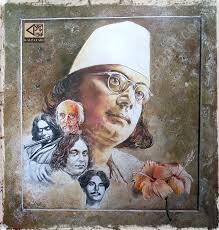
 

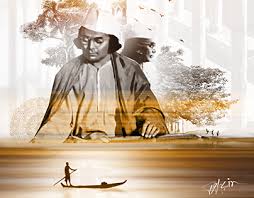
The abiding image of Kazi Nazrul Islam (1899-1976) is that of the “Rebel Poet,” who defines himself as a fiery comet streaking across the firmament, emblazoning in the sky a message of revolutionary change. Unlike Rabindranath Tagore, Nazrul was not born into social and intellectual privilege. He has been described, in fact, as “the ‘other’ of the elite Kolkata bhadralok”.[1] Born in Churulia village in the Bardhaman district of Bengal, Nazrul was the son of the head of a mosque, studied in an Islamic school, and during his youth, joined a Leto group, a travelling band of local performers. When in high school, he was recruited into the British army, and served in Karachi. Even after he returned to Bengal as a young poet who had already acquired fame and repute, he remained something of an outsider to the intellectually sophisticated world of the literati. It was from this position of an outsider that he fashioned his own image as the bidrohi or ‘Rebel poet’ who challenged the structures of the political, social, cultural and literary establishment with the sheer force of his iconoclastic writings.

Though best known as a poet, composer and revolutionary, Nazrul’s oeuvre also includes novels, essays, stories, editorials and journalistic pieces on a remarkable variety of topics. He was also a lyricist and composer, creator of the iconic genre called “Nazrulgeeti”. Nazrul’s brilliant literary career lasted from 1919 to 1942, when illness brought it to a sudden end. During this short span of time, he wrote on an amazing range of subjects, including politics, nationalism, social change, religion, communalism, education, philosophy, nature, love, aesthetics, literature and music. He saw it as his mission to arouse public awareness about pressing issues, and to jolt them out of their complacency and general apathy. Remembering Nazrul on the 48th anniversary of his death, it is daunting to think about his extraordinary legacy, but also a timely moment to reflect upon his significance for our own times.

In his political stance, Nazrul argued passionately in favour of armed struggle for total independence from colonial rule, rejecting the Gandhian path to advocate a freedom won via armed resistance. The trope of violence recurs in his writings. Yet his apparent espousal of the principle of destruction springs from a utopian dream of constructive change. “Reform can be brought about, not through evolution, but through an outright bloody revolution,” he says in the essay ‘World Literature Today’. “We shall transform the world completely, in form and substance, and remake it, from scratch. Through our endeavours, we shall produce new creation, as well as new creators”.[2]

Nazrul’s ideas on education counter the colonial pattern, advocating instead a curriculum that draws on indigenous contexts and models. He feels that the new education policy should emphasise empathy, inclusiveness and heterogeneity, with a special focus on psychological and emotional development. “It is our desire that our system of education should be such that it progressively makes our life-spirit awakened and alive,” he says in ‘A National Education’, adding: “… We would rather produce daredevils than spineless young men.” [3]

Inclusiveness and acceptance of heterogeneities are central to Nazrul’s vision. During his stint as a soldier in Karachi in his young days, he became interested in Marxist thought. The influence of this line of thinking can be felt in his emphasis on economic egalitarianism, and his passionate support of the cause of the downtrodden peasantry, particularly in his journal Langal. Following the 1926 riots in Kolkata, he expresses his anguish at the communal antagonism between Hindus and Muslims, critiquing different forms of orthodoxy in both religions. In the poem ‘Samyabadi (Egalitarian)’ [4], he declares:

I sing the song of equality—
Where all divisions vanish and barriers dissolve,
Where Hindu-Buddhist-Muslim-Christian
merge and become one …

Nazrul was also a supporter of women’s rights. In his poetry, he speaks of equality between men and women. In ‘Nari (Woman)’ he argues: “If man keeps woman captive, then in ages to come, / He will languish in a prison of his own making”.[5]

Not surprisingly, Nazrul’s fearless, unconventional attitude aroused hostility in many quarters. His bold, outspoken magazine Dhumketu enraged the British. The journal was banned, and Nazrul condemned to rigorous imprisonment. At his trial in 1923, he delivered a resounding rejoinder in his speech ‘Rajbandir Jabanbandi (Deposition of a Political Prisoner)’.  He remained a thorn in the flesh for the British administration because of his revolutionary views. Nazrul’s religious views also raised many hackles. He married Ashalata Sengupta, or Pramila, who belonged to the Brahmo Samaj. This antagonised conservative Hindus as well as orthodox Muslims.

Nazrul’s success as a writer, especially Rabindranath Tagore’s appreciation of his work, also caused jealousy among contemporary writers. For Tagore had dedicated his play Basanta to Nazrul, and also sent a telegram to him when he was in prison, exhorting him to give up his hunger strike. In 1922, Tagore had written a poem addressed to Nazrul, which appeared in successive issues of the journal Dhumketu[6]:

Come, O shining comet! Blaze
Across the darkness, with your fiery trail.
Upon the fortress-top of evil days,
Let your victory-pennant sail.
What if the forehead of the night
Bear misfortune’s sinister sign?
Awaken, with your flashing light,
All who lie comatose, supine.

Rabindranath Tagore’s recognition of Nazrul’s talent created a lot of envy in literary circles. In 1926-27, parodies of Nazrul’s poetry started appearing in Shanibarer Chithi, a journal published by the Tagore circle. It came to be rumoured that Tagore had not liked Nazrul’s use of the Persianate word khoon (blood) instead of the Sanskritised word rakta, in his composition ‘Kandari Hushiar’. This gave rise to a controversy that became known as khooner mamla (the bloody affair), which drew a strong reaction from a deeply perturbed Nazrul, in the shape of an essay ‘Boror Piriti Balir Baandh” (A Great Man’s Love is a Sandbank)’, in which he blamed Tagore’s followers for the entire misunderstanding. The situation was resolved through the mediation of friends, and relations between Tagore and Nazrul remained cordial. When Tagore died in 1941, Nazrul broadcast a moving elegy, “Robi-Hara”, on Calcutta Radio.

In some ways, Nazrul was ahead of his time. Not many people know that he was aware of environmental issues and the threat of climate change, pressing problems in our own times. In ‘The Day of Annihilation’, he writes in a prophetic vein, of global warming, dissolving ice-caps and a changing ecology, cautioning his readers that if humans exploit the planet, we will eventually be responsible for the destruction of life on earth.

In Nazrul’s life and writings, we encounter the constant pull of contraries. His consciousness was simultaneously rooted in local culture, and infused with a broad transnational spirit. He felt inspired by movements in other parts of the world, such as the Turkish Revolution, the Irish Revolution and the Russian Revolution. In the essay ‘Bartaman Viswasahitya (World Literature Today)’, we discover his awareness about literary developments across the globe. In his political writings he espouses the path of violence, but he also composes exquisitely tender love songs, devotional songs drawing on both Hindu and Muslim imagery, and songs about the beauty of nature.

Nazrul’s style is a volatile mix of colloquial, idiomatic expressions, formal Bengali, Sanskrit and Persianate vocabulary, a smattering of English, and multiple registers of language. His polyglot sensibility also surfaces in his practice as a translator. He translated Omar Khayyam and Hafez from Persian into Bengali. His translations from Arabic into Bengali include 38 verses of the Qu’ran, part of the Mirasun Nagmat (a treatise on Hindustani classical music) and some poems. He translated Whitman’s ‘O Pioneer’ from English into Bengali. He is also known for his innovative ghazals in Bengali.

In 1942, Nazrul suddenly lost his speech. His illness brought his literary life to an abrupt end. All the same, the impact of his writings continued to be felt. In the Bangladesh Liberation War of 1971, the freedom fighters adopted Nazrul’s music as a source of inspiration. He was later declared the National Poet of Bangladesh. Today, while Nazrul’s poems and songs continue to delight and inspire, the true extent of his achievement remains in shadow. It is time for a comprehensive reappraisal of this much underestimated literary genius, because his writings have so much to offer us in our present world.

[1] The Collected Short Stories of Kazi Nazrul Islam, ed. Syed Manzoorul Islam and Kaustav Chakraborty (Hyderabad: Orient Blackswan, 2024), p. xviii. Bhadralok translates to gentleman

[2] Kazi Nazrul Islam, Selected Essays, translated by Radha Chakravarty (New Delhi: Penguin Random House, 2024), p. 137.

[3]  Kazi Nazrul Islam, Selected Essays, trans. Radha Chakravarty (2024), p. 60.

[4] Translation by Radha Chakravarty

[5] Translation by Radha Chakravarty

[6] The Essential Tagore, ed. Fakrul Alam and Radha Chakravarty. Cambridge, Massachusetts: Harvard University Press, 2011, pp. 115-116; Translation mine.

Radha Chakravarty is a writer, critic, and translator. She has published 23 books, including poetry, translations of major Bengali writers, anthologies of South Asian literature, and critical writings on Tagore, translation and contemporary women’s writing. She was nominated for the Crossword Translation Award 2004.

.

PLEASE NOTE: ARTICLES CAN ONLY BE REPRODUCED IN OTHER SITES WITH DUE ACKNOWLEDGEMENT TO BORDERLESS JOURNAL

Click here to access the Borderless anthology, Monalisa No Longer Smiles

Click here to access Monalisa No Longer Smiles on Kindle Amazon International

Categories
Editorial

Where Have All the Sunflowers Gone?

Only when the cries of the wretched of the earth will stop renting the skies,
Only when the oppressor’s bloody sword will cease smearing battlefields,
			A rebel, weary of war,
			Only then I won’t stir.
…
I’m the ever-rebellious hero--
	Soaring over the world, all alone, head forever held high!

--  Rebel or 'Bidrohi' (1922) by Nazrul, translated by Fakrul Alam
Borderless: Digital Art by Ayaan Ghoshal
These fragments I have shored against my ruins
…
Datta. Dayadhvam. Damyata.         
 Shantih shantih shantih

-- Wasteland (1922) by TS Eliot

These lines reiterate values we would do well to live by in a war-torn, dissension-worn world where the need for a rebel to recreate a humane society that lives with values such as peace, generosity, acceptance, tolerance, compassion and restraint — is a felt need. The two great poems made history by remaining as popular a hundred years after they were written — ‘The Rebel’ by Nazrul and TS Eliot’s ‘Wasteland’. Nazrul defined a rebel as an iconoclast who breaks norms to find peace, justice and love for all, to move towards the creation of an ideal world. TS Eliot quoted from the Upanishads and ended with redemption coming with giving (giver perhaps denoted generosity), compassion and restraint. Despite the wisdom of these great poets and seers, war still continues a reality. The values remain neglected not just in as we see in conflicts, like the one in Ukraine that destroys lives, property and nature with intolerance towards differences, but also in our personal lives. Tagore also reiterated the same need for stepping out of personal, social, economic and political insularity. We carry a translation of a song that echoed this need while inviting participation in his ecstasy. He wrote:

Why do you sit in isolation,
Dwelling on self-centred issues? 

Tagore had not only written of the negative impact of isolation from the world but he led by example, building institutions that could lead the world towards pacifism with acceptance of diversity and inclusiveness. Sriniketan and Santiniketan were created to move towards these ideals. Many of the people he influenced or who studied in Santiniketan made history, like Prime Minister Indira Gandhi, Satyajit Ray; many added to the sense of inclusiveness, like Mahasweta Devi, who other than her enormous work to integrate different cultures, also wrote a memoir about Santiniketan in Bengali. Radha Chakravarty, nominated for the Crossword Translation Award (2004) for In the Name of the Mother by Mahasweta Devi, has translated this memoir, a narrative which brings us close to Tagore’s ideals of the whole world being a family. How wonderful it would be if the world were open to such ideals and would behave like a global family and not go to war!  Mahasweta Devi, Our Santiniketan, which has been reviewed by Meenakshi Malhotra, reiterates Tagore’s vision of a planet living in harmony with the flora and fauna.

Bhaskar Parichha has reviewed another non-fiction by Ashok Kumar Pandey, Why They Killed Gandhi; Unmasking the Ideology and the Conspiracy. Parichha writes: “The finest point about this book is its storytelling…” The book review brings to mind in the midst of a war and violence that Gandhi had tried to erase this mindless destruction of lives, nature and cities with Ahimsa or non-violence. Will we ever rise up to it? Perhaps… We see strains of recognising the negative impact of insular outlook in writings like that of Temsula Ao, a Sahitya Akademi Award winner, according to Indrashish Banerjee who has reviewed her new book, The Tombstone in My Garden: Stories from Nagaland. Keith Lyons has reviewed Asian Anthology: New Writing Vol. 1: Stories by Writers from Around the World, edited by Ivy Ngeow, an exotic medley of Asian stories, one of which has been excerpted as well.

We are privileged to carry another excerpt from Ruskin Bond’s Friends in Wild Places: Birds, Beasts and Other Companions, a hilarious story about a pet tiger adopted by the legendary writer’s grandfather. What is amazing about Ruskin Bond’s writing is the love and compassions for all creatures great and small that colours the tongue-in-cheek humour he rolls out to his readers. If only we could think like Bond, there would be no wars. His writing, I feel, transcends political borders or ‘isms’, and laces with love and compassion tales of menageries of monkeys, snakes, mongoose, humans of different denominations. This excerpt is a treat we are giving Borderless Journal as the journal completes two years of its existence. We are truly grateful to Speaking Tiger for sharing this excerpt with us. But our celebrations this time are sombre as the war rages with incoherence accompanied by heart-breaking ravages.

The refrain from Ukraine has been taken up by Ratnottama Sengupta as she takes us through the past and present experiences of the devastated country, bringing in the views of the legendary folk singer and pacifist, Pete Seeger (1919-2014), who she had interviewed over a span of four days. The writer of ‘Where have all the Flowers Gone?’, a song based on an Ukrainian folk song, Seeger said, “The point is not to ask for yourself alone — one has to ask for everybody: Either we all are going to make it over the rainbow or nobody is going to make it.” Candice Louisa Daquin has also pondered on the justification of war, contextualising it with the current one along with her essay on the paradox of modern linguistic communication.

We have an exhaustive essay on the legendary Satyajit Ray’s creations by Anasuya Bhar. Malhotra has pondered at exclusivity reinforcing divisions, margins and borders to plague humankind, against the backdrop of the Women’s Month, March. Highlighting women in writing, we have interviewed two female writers, one from Nepal and another from Bangladesh. Sangita Swechcha lives in UK but her writing, till now largely in Nepali, often pines for her home embedded in the Himalayas whereas, an expat, Neeman Sobhan, shuttles between Bangladesh and Italy with the affluence and assurance of a privileged background.

Finding a way to override lack of privileges, deprivation and violence, are the youngsters of Nithari on the outskirts of Delhi where less than two decades ago other than poverty, savage criminality devastated the local populace. These youngsters transcended the suffering over time with help from volunteering NGOs to create narratives that amaze with their inventiveness and confidence. Tanveer Hussain from Nithari, self-motivated and self-made from a young age, asks questions that would be relevant for all humankind in a letter to God. It has been translated from Hindustani by Vritika Thareja of pandies’. This edition’s translations include Professor Fakrul Alam’s mellifluous rendition of Jibanananda Das’s poetry from Bengali to English, Ihlwha Choi’s Korean poetry and a Balochi poem by Munir Momin rendered in English by Fazal Baloch. Baloch had earlier translated poems by Akbar Barakzai, a great poet who departed on 7th March, depriving the world of yet another powerful writer who imbibed hope of a better future in his poetry. We are privileged to have hosted the translations of some of his poems and his last interview.

Another well-known poetic voice from Singapore, Kirpal Singh, has given us poignant poetry that can be applied to the situation that is leading to the wreck of Ukraine. Anasuya Bhar has  poetry, one of which despite being in the ilk of Nazrul’s great poem, ‘Rebel or Bidrohi’, questions gently mainly social constructs that obstruct the flow of harmony. Ryan Quinn Flanagan has pondered on the acceptance of a changed world. We have humour from Rhys Hughes in poetry and wonderful poems by Michael R Burch on spring. Jay Nicholls shares the last of her dozen Pirate poems as Blacktarn sails the lemon seas to fight pollution. Luis Cuauhtémoc Berriozábal, George Freek, Sutputra Radheye, Mike Smith, Shaza Khan and many more have contributed a wealth of beautiful lines. Penny Wilkes has captured storms and seas with photographs and text and Rhys has surprised us with some strange, bizarre tales in his column.

We have musings from around the world. San Lin Tun, Meredith Stephens, Erwin Coombs, G Venkatesh have all brought in flavours of multiple cultures. Devraj Singh Kalsi has spoken of a book fair he visited in a semi-sardonic tone. He has also given us a short story as has Farah Ghuznavi – a truly borderless story which takes place in an aeroplane, in the sky where all borders collapse. We have more stories from Balochistan, US and India.

Suzanne Kamata continues writing on Japan as she  introduces us to an Australian film maker who is making films in Japan and in Japanese, called Felicity Tillack. Cultures are perhaps truly crossing borders as we can see Kenny Peavy, an environmentalist who moved from US to Indonesia start a new column with us called ‘Mission Earth’. We hope, like Tagore or Rousseau, he will help to revive our felt need to live with nature, acknowledge the nurture that we get from the planet to live in harmony with it and on it.

At the end of twenty-four months of existence – that sounds better than a mere two years— we are happy to host a melange of writers from across the borders and be the meeting grounds of writers and readers from across continents. I am truly thankful to all of you for helping concretise an ideal. Huge thanks to all the writers, artists, photographers and the readers for the contribution of their time, effort and love. And thanks to our fabulous team who continue to support the journal unwaveringly. I would also like to thank Sohana for the lovely visuals she generously shares with us. A special thanks also to young Ayaan Ghoshal for his digital art where hands reach out to support a truly borderless world.

As usual, all the content has not been covered here, I invite you all to enjoy our March edition of Borderless Journal.

At the start of the third year of our existence, let us march onwards towards renewed hope – maybe the Ukraine experience will take us closer to a war-free world with an awakening of a felt need for peace and compassion in a planet without borders.

In quest of a peaceful, humane world, I invite you all to continue being part of this journey.  

Mitali Chakravarty

Borderless Journal