Five poems by Pravasini Mahakudahave been translated to English from Odia by Snehaprava Das. Click here to read.
A Poet in Exileby Dmitry Blizniuk has been translated from Ukranian by Sergey Gerasimov. Click hereto read.
Kalponik or Imaginedby Tagore has been translated from Bengali by Mitali Chakravarty. Click hereto read.
Pandies Corner
Songs of Freedom: The Seven Mysteries of Sumona’s Life is an autobiographical narrative by Sumona (pseudonym), translated from Hindustani by Grace M Sukanya. These stories highlight the ongoing struggle against debilitating rigid boundaries drawn by societal norms, with the support from organisations like Shaktishalini and Pandies. Click here to read.
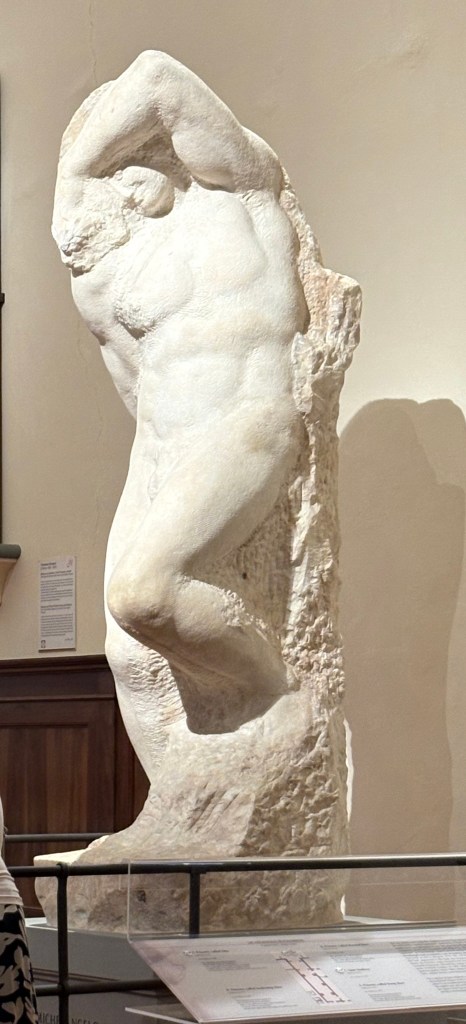
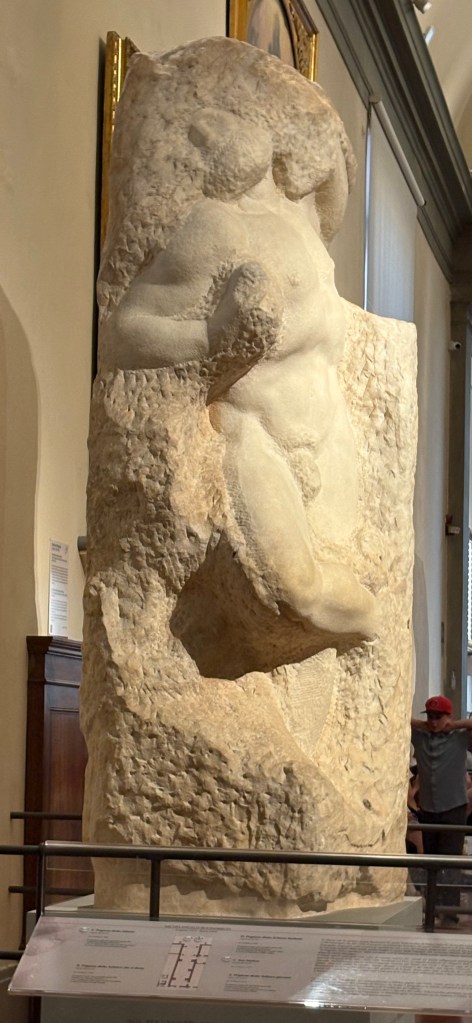
Incomplete statues of Michelangelo in Accademia Gallery, Florence
In the Accademia Gallery, Florence, are housed incomplete statues by Michelangelo that were supposed to accompany his sculpture of Moses on the grand tomb of Pope Julius II. The sculptures despite being unfinished, incomplete and therefore imperfect, evoke a sense of power. They seem to be wresting forcefully with the uncarved marble to free their own forms — much like humanity struggling to lead their own lives. Life now is comparable to atonal notes of modern compositions that refuse to fall in line with more formal, conventional melodies. The new year continues with residues of unending wars, violence, hate and chaos. Yet amidst all this darkness, we still live, laugh and enjoy small successes. The smaller things in our imperfect existence bring us hope, the necessary ingredient that helps us survive under all circumstances.
Imperfections, like Michelangelo’s Non-finito statues in Florence, or modern atonal notes, go on to create vibrant, relatable art. There is also a belief that when suffering is greatest, arts flourish. Beauty and hope are born of pain. Will great art or literature rise out of the chaos we are living in now? One wonders if ancient art too was born of humanity’s struggle to survive in a comparatively younger world where they did not understand natural forces and whose history we try to piece together with objects from posterity. Starting on a journey of bringing ancient art from her part of the world, Ratnottama Sengupta shares a new column with us from this January.
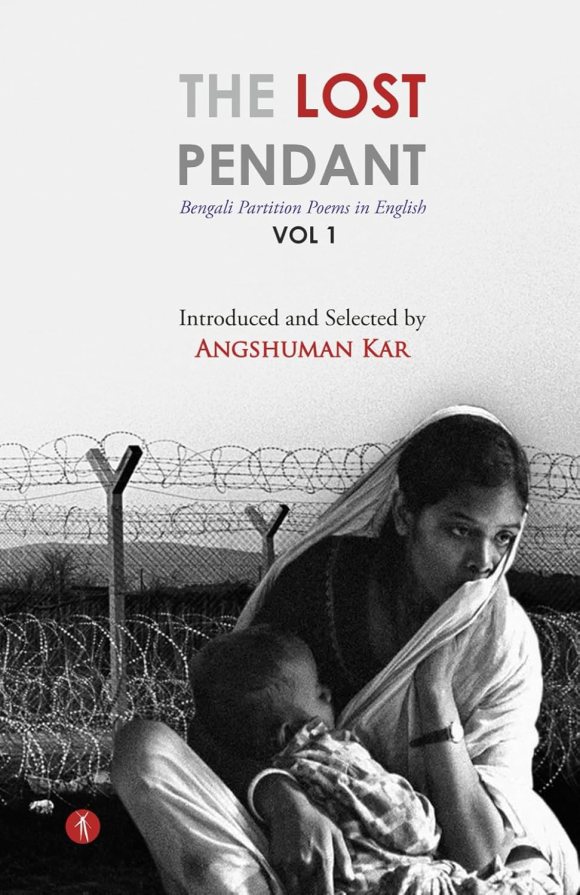
Drenched in struggles of the past is also Showkat Ali’s The Struggle: A Novel, translated from Bengali by V. Ramaswamy and Mohiuddin Jahangir. It has been reviewed by Somdatta Mandal who sees it a socio-economic presentation of the times. We also carry an excerpt from the book as we do for Anuradha Marwah’s The Higher Education of Geetika Mehendiratta. Marwha’s novel has been reviewed by Meenakshi Malhotra who sees it as a bildungsroman and a daring book. Bhaskar Parichha has brought to us a discussion on colonial history about Rakesh Dwivedi’s Colonization Crusade and Freedom of India: A Saga of Monstrous British Barbarianism around the Globe. Udita Banerjee has also delved into history with her exploration of Angshuman Kar’s The Lost Pendant, a collection of poems written by poets who lived through the horrors of Partition and translated from Bengali by multiple poets. One of the translators, Rajorshi Patranabis, has also discussed his own book of supernatural encounters, Whereabouts of the Anonymous: Exploration of the Invisible. A Wiccan by choice, Patranbis claims to have met with residual energies or what we in common parlance call ghosts and spoken to many of them. He not only clicked these ethereal beings — and has kindly shared his photos in this feature — but also has written a whole book about his encounters, including with the malevolent spirits of India’s most haunted monument, the Bhangarh Fort.
Bringing us an essay on a book that had spooky encounters is Farouk Gulsara, showing how Dickens’ A Christmas Carolrevived a festival that might have got written off. We have a narrative revoking the past from Larry Su, who writes of his childhood in the China of the 1970s and beyond. He dwells on resilience — one of the themes we love in Borderless Journal. Karen Beatty also invokes ghosts from her past while sharing her memoir. Rick Bailey brings in a feeling of mortality in his musing while Keith Lyons, writes in quest of his friend who mysteriously went missing in Bali. Let’s hope he finds out more about him.
Charudutta Panigrahi writes a lighthearted piece on barbers of yore, some of whom can still be found plying their trade under trees in India. Randriamamonjisoa Sylvie Valencia dwells on her favourite place which continues to rejuvenate and excite while Prithvijeet Sinha writes about haunts he is passionate about, the ancient monuments of Lucknow. Gulsara has woven contemporary lores into his satirical piece, involving Messi, the footballer. Bringing compassionate humour with his animal interactions is Devraj Singh Kalsi, who is visited daily by not just a bovine visitor, but cats, monkeys, birds and more — and he feeds them all. Suzanne Kamata takes us to Kishi, brought to us by both her narrative and pictures, including one of a feline stationmaster!
We've run away from the simmering house
like milk that is boiling over. Now I'm single again.
The sun hangs behind a ruffled up shed,
like a bloody yolk on a cold frying pan
until the nightfall dumps it in the garbage…

('A Poet in Exile', by Dmitry Blizniuk, translated from Ukranian by Sergey Gerasimov)
In translations, we have Professor Fakrul Alam’s rendition of Nazrul’s mellifluous lyrics from Bengali. Isa Kamari has shared four more of his Malay poems in English bringing us flavours of his culture. Snehaparava Das has similarly given us flavours of Odisha with her translation of Pravasini Mahakuda’s Odia poetry. A taste of Balochistan comes to us from Fazal Baloch’s rendition of Sayad Hashumi’s Balochi quatrains in English. Tagore’s poem ‘Kalponik’ (Imagined) has been rendered in English. This was a poem that was set to music by his niece, Sarala Devi.
After a long hiatus, we are delighted to finally revive Pandies Corner with a story by Sumona translated from Hindustani by Grace M Sukanya. Her story highlights the ongoing struggle against debilitating rigid boundaries drawn by societal norms. Sumana has assumed a pen name as her story is true and could be a security risk for her. She is eager to narrate her story — do pause by and take a look.
In fiction, we have a poignant narrative about befriending a tramp by Ross Salvage, and macabre and dark one by Mary Ellen Campagna, written with a light touch. It almost makes one think of Eugene Ionesco. Jonathan B. Ferrini shares a heartfelt story about used Steinway pianos and growing up in Latino Los Angeles. Rajendra Kumar Roul weaves a narrative around compassion and expectations. Naramsetti Umamaheswararao gives a beautiful fable around roses and bees.
With that, we come to the end of a bumper issue with more than fifty peices. Huge thanks to all our fabulous contributors, some of whom have not just written but shared photographs to illustrate the content. Do pause by our contents page and take a look. My heartfelt thanks to our fabulous team for their output and support, especially Sohana Manzoor who does our cover art. And most of all huge thanks to readers whose numbers keep growing, making it worth our while to offer our fare. Thank you all.
Here’s wishing all of you better prospects for the newborn year and may we move towards peace and sanity in a world that seems to have gone amuck!
The Lost Pendant brings together poems translated from Bengali by translators such as Himalaya Jana, Mandakranta Sen, Rajorshi Patronobish, Sanjukta Dasgupta, Angshuman Kar, and Souva Chattopadhyay. Through these compelling translations, the volume makes a significant intervention in Partition literature, arriving at a moment when revisiting the lingering spectres of the event has become especially urgent. The Partition of India in 1947, which divided the subcontinent into India and Pakistan, resulted in one of the largest mass migrations in history and left enduring scars of displacement, violence, and fractured identities. As the editor, writer and academic, Angshuman Kar, notes in the book’s introduction how Partition remains a 78-year-old wound that continues to bleed.
The anthology showcases poetry from the eastern parts of the subcontinent, chiefly Bengal, Assam, and Bangladesh, featuring works by 41 poets from India and Bangladesh. Kar does not simply compile these poems but thoughtfully curates them to reveal several critical nuances. He invokes the concept of “buoyant memory,” introduced in his earlier work, Divided: Partition Memoirs from Two Bengals, to depict how “forgetting the past is impossible for the direct victims of Partition.” He also draws attention to the disproportionate representation of upper-caste Hindu Bengali poets, in contrast to the relative invisibility of Muslims and those from marginalised communities. This imbalance extends to gender as well, with a noticeable disparity between male and female poets in the collection.
The book is structured in two parts, respectively featuring poets from India and Bangladesh. The Indian section is notably larger and presents a wide range of emotions, reflecting both the immediate trauma of Partition and its long-lasting reverberations over the years. Many of the poems in this section express a deep nostalgia for a lost homeland. For instance, Alokeranjan Dasgupta’s ‘Exile’ evokes memories of abandoned spaces. Similarly, Ananda Sankar Rai’s ‘The Far Side’ laments the estrangement from what was once familiar. He writes, “Once it was a province, now an alien land / where you must enter passport in hand.” Basudeb Deb’s ‘Picture of My Father’ constructs a powerful portrait of the nation through the figure of the father: “Swadeshi movement war sirens famine flood / Riot and partition written in the wrinkles on his forehead.” After the father’s death, only a walking stick remains. The poem draws a powerful parallel between the futility of the father’s dismissive words, “This country is not a pumpkin that you can cut it in one blow”, and the uselessness of the walking stick after his passing. This object comes to embody the spirit of the deceased father, “just another old toy”, offering a stark commentary on how individuals became pawns in the hands of the state.
Several poets in the anthology focus intensely on the experiences of refugees, capturing both their suffering and the complexities of their identities. In ‘The Refugee Mystery’, Binoy Majumdar laments the loss of linguistic roots, noting how “the Bangals now speak the dialect of Kolkata all the time, having forgotten the dialects of Barishal and Faridpur / The Moslems of Dhaka are heard singing and speaking in the radio with the lilt of Uluberia.” His reflections emphasise the deep connection between language and social identity. This theme finds a resonance in Sunil Gangopadhyay’s poem ‘That Day’, where he writes, “On one side they named the waters Pani / on the other side–Jol.” Through this simple yet evocative contrast, Gangopadhyay underscores how a shared concept can be articulated through divergent linguistic expressions in India and Bangladesh, which become subtle yet potent markers of socio-linguistic divisions. Such poems provoke profound questions: Can the adoption of a new dialect truly redefine one’s identity? How does one navigate the tension between past and present linguistic selves, and is reconciliation even possible?
Viewed through the intertwined lenses of faith and suffering, poetry often functions as a repository of collective memory and a means of resilience. In this regard, Devdas Acharya’s three poems present a poignant exploration of the lived experiences of refugees in post-Partition India. A recurring and haunting image emerges in his work: a grieving father, who has recently lost a child to hunger, standing before a deity symbolically embodied by a swadeshi leader. This image encapsulates both the profound deprivation endured by displaced communities and their simultaneous reliance on unshaken faith. Despite the magnitude of loss, what sustained many refugees was a deeply rooted belief system that imbued their suffering with meaning.
By foregrounding the gendered dimensions of violence, Partition poetry exposes how women’s bodies became contested sites of power and trauma. In “She, on the Platform of a Station”, Krishna Dhar powerfully captures the plight of women during Partition. She writes, “Chased from the other side of the border, escaping fire and the fangs and tongues of wolves, one day she arrived,” evoking the image of a refugee woman doubly marginalised– “devastated by Partition” and simultaneously “dodging the eyes of the hyenas.” Here, the metaphorical wolves and hyenas represent predatory men who treated women’s bodies as extensions of territorial conquest. Kar points out in the introduction that very few women wrote poetry about their Partition experiences, largely because they were already engaged in the broader struggle for gender equality. While women’s memoirs on Partition exist, poetry by women addressing these themes, particularly from the 1970s, is strikingly limited. This absence is significant, as women’s experiences are crucial to understanding how deeply gendered the space of the subcontinent was during and after Partition.
Following independence, conflicts often emerged within the nation, revolving around issues of region, language, religion, and ethnicity. In ‘The Diary of a Refugee’, Shaktipada Brahmachari reflects on his sense of belonging across borders, juxtaposing his memories of a past home in Bengal with his present life in Assam. He writes, “The world is my home now, in Bangla my love I spell–Prafulla and Vrigu are the cousins of my heart,” referencing two leaders of the Asom Gana Parishad. While refugees in Assam experienced a more complex form of marginalisation due to ethno-linguistic differences, Brahmachari portrays a gradual process of acceptance, where both the homeland he left and the land he adopted come to hold emotional significance.
Across the border in Bangladesh, the theme of displacement persists. In “Leaving Home”, Jasimuddin asserts, “this land is for Hindus and Muslims,” calling on educators to return and “build the broken schools once more…we will find out our beloved brother, whom I lost,” a poignant appeal for reconciliation and return of Hindu families displaced by Partition. The motifs of memory and loss recur throughout most of these poems, a trope common between both the nations. This sense of finality is further echoed in Binod Bera’s lament: “Our nation is now three, all three are independent, and love lives an alien existence.” The emotional chasm created by Partition, and the subsequent loss of mutual affection, renders any notion of return futile.
The collection deserves commendation for its ambitious effort to recover voices from Bengali literature and render them accessible to a global readership beyond linguistic boundaries, through gripping translations. It is the first-ever translated collection of Bengali Partition poetry that captures the angst of the original poems with perfect nuance. The very title, The Lost Pendant, merits particular attention, for it resonates with themes of liminality and the fractured sense of identity experienced by the refugee poet Nirmalyo Bhushan Bhattacharya, better known by his pseudonym, Majnu Mostafa. Born in Khulna, Bangladesh, yet spending much of his life in Krishnanagar, India, Bhattacharya embodies the dislocation and dual belonging of Partition’s afterlives. As Kar insightfully observes, the choice of pseudonym can be read as a deliberate act of defiance, “a strategy to cross the boundaries set up by religious politics and fundamentalism–a move much needed in the subcontinent of our times.” In this sense, The Lost Pendant is not merely an anthology but a work of cultural recuperation as it attempts to resurrect poets whose voices risked erasure, while simultaneously protecting their oeuvres from the twin threats of historical amnesia and linguistic inaccessibility.
.
Udita Banerjee is an Assistant Professor of English at VIT-AP University. Her work has previously been published in platforms such as Outlook Weekender, Borderless Journal, Indian Review, and Poems India.
PLEASE NOTE: ARTICLES CAN ONLY BE REPRODUCED IN OTHER SITES WITH DUE ACKNOWLEDGEMENT TO BORDERLESS JOURNAL
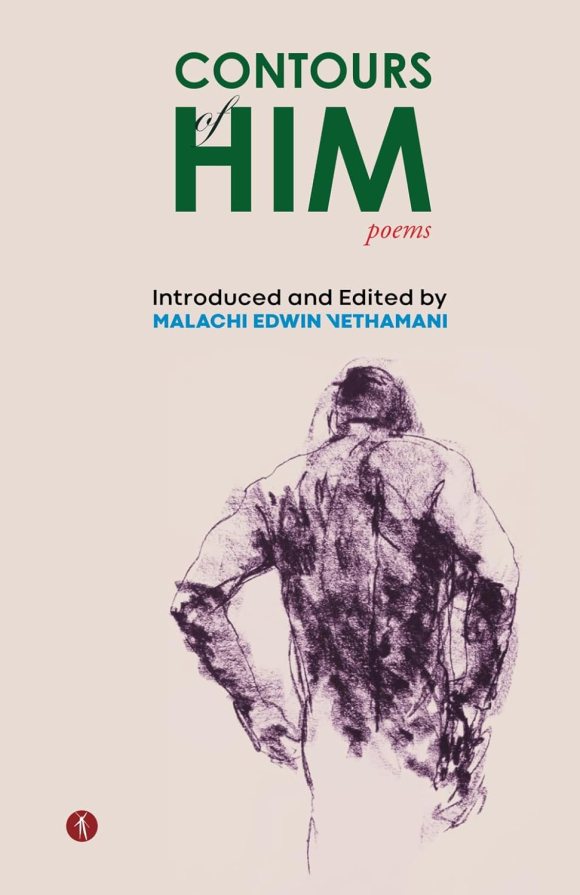
Contours of Him: Poems has been edited and introduced by Malachi Edwin Vethamani, a Malyasian academic of repute. The book has a rich assemblage of poetical voices — from both men and women — representing the contours and nuances of the many aspects and shades of masculinity. The poems explore the male body as a symbol of identity, art, and humanity, delving into themes of masculinity, strength, vulnerability, and beauty. It also examines the male body and psyche as the site of hurt and wounding. The book features poems that scrutinise the male form revealing or concealing it to explore these themes.
The focus on corporeality or the somatic coexists with the psychological in many poems in the anthology. Childhood innocence and curiosity coexist and yield to what could be viewed as growing pains or the challenges of maturation and understanding. There are several poems on the father-son theme, with poems that express homage to the father. Christina Yin’s prose poem ‘To My Father’ and Gopal Lahiri’s ‘My Ideal Man’ are cases in point. Sudeep Sen in the poem, ‘Baba/Father’, captures the enormous vacuum left by the loss of the father as Sen completes the elaborate death rituals as the eldest son of his dead father, performed as per brahminical prescriptions. In a gnomic and nuanced vein, Vethamani , the editor of the anthology, gives his take on father-son intimacies.
This book examines the contours of the male body and psyche at different stages of life and could be viewed as a psycho-somatic exploration of masculinity across diverse cultures. It also explores the strength and fragility of the male physique, occasionally dipping into cultural repertoires of male archetypes, human and divine. At the same time, it acknowledges societal expectations from men and their concomitant cultural insecurities, particularly regarding their identity and the search for acceptance.
A common motif in many of the poems is about the unwitting and unwillingly borne burden and baggage of masculinity. The protagonists/personae of many of these poems seem to be conscious that masculinity is but a performance, involving the display of muscles and embodying a certain swag. Yet this definition of and expectation from men within patriarchies, can be a cage and straitjacket which binds, restricts and confines the human being. If patriarchies bind women, men are not exempt from it either. It is this theme that resonates(among others) in Angshuman Kar’s poem called ‘Tears’: “When mountains cry, rivers are born/From a woman’s tears, pearls have always been born/And when mothers cry, dormant volcanoes awaken…No one in the world knows/why a strong man cries/or why, when he does/he looks so sacred and beautiful.”
The predominant focus, however, is on corporeality that has led to the exploration of its many aspects of the body in the poems. The many facets locates the male body along a spectrum of materiality, vulnerability, relationality and the transcendental possibilities of the body. In recent years, there have been a plethora of poems by women discussing corporeality in multiple registers, exploring female subjectivity, desire and sexuality. Focus on the psychosomatic aspects of the gendered body has led to numerous explorations and analyses of femininity, on being/becoming women, on trans-identities. Many poems have been written on the human-divine aspect of the female body. Kamala Das and others (including Pakistani women poets) have written evocatively about the transgressive desires and the many hungers of the female body .
Voices from the global south recording the voices of men was perhaps the need of the moment. The anthology includes a few poems on masculinity as a construct, especially focusing on the male body through various lenses — vulnerability, performance, shame, violence, and transformation. These poems offer a critical lens rather than idealising masculinity, exposing its social constructions and internal contradictions. They also highlight the relational nature of masculinity which are often traditionally embedded within family structures in South Asia. There are glimpses of guilt in Arthur Neong’s poem, “At this juncture of age, I feel like a teenager again,” where the persona/speaker seems keen to shed and slough off the burdens of masculinity and be in an escapist mode. He writes “At times I go to my wife for a little reprieve/Yet eyes open, think of ways to cheat”. Some of the poems read like love poems, like David C.E. Tneh’s poem, ‘Crossings’, that memorialises his dead friend. Tneh writes: “between the shared spaces and/ private moments come a synergy of collective memories/that I have of you.”
A writer writing on the female body once referred to it as a story discussed by men. Similarly, the anthology at hand discusses the contours of male corporeality and affect. The anxieties of masculinity, of literally not measuring up, pepper these poems and forms one of the vital themes of this anthology. Occasionally, a kind of narcissism creeps in, often giving way to musing or self-introspection. After voicing the common masculine concerns(and anxieties) of corporeal self-consciousness, the poet Kiriti Sengupta declares:
“I don’t look at veiled people anymore.
It is either my age or my hormones.
I now look beyond the flesh, bone and keratin.”
In the last revelatory line, there is a movement towards transcendence: “I have been told /the finer body dwells undressed.”
In a different context but similar vein, Sandeep Kumar Mishra in ‘The Canvas of Form’ writes, “The naked body, stripped of all pretence,/Breathes honesty, raw beauty, fragile strength.” The profundity of the closing lines is inescapable: “The body, bared, is neither shame nor pride/But speaks of histories, of fears ,of love. It tells of burdens carried, joys embraced/And in its stillness, whispers human truth.”
Much canonical poetry, including that of the famed icon of modernist poetry, T.S.Eliot, writing a century ago, display a preoccupation with masculine anxieties in his iconic ‘The Love Song of Alfred J Prufrock’. The effete personae/protagonist , immortalised in the eponymous poem, Felix Cheong writes of ‘Middling Age’ that it’s “So unbecoming to have become so old? You’d sooner wear the ends of your frailty rolled”, lines echoing T.S.Eliot’s The Love Song of Alfred J Prufock, “I will wear the bottoms of my trousers rolled.”
From Justin Baldoni’s Man Enough to Shyam Selvadurai’s Funny Boy, there are many coming of age stories in our cultural landscape-on book lists and bestseller lists. While the sociology of sex and gender has long been a part of sociology and social psychology, the growth and development of a field of knowledge –gender studies– in the last four decades or so, has thrown into relief the fact that if femininity is a construct, so is masculinity.
Meenakshi Malhotra is Professor of English Literature at Hansraj College, University of Delhi, and has been involved in teaching and curriculum development in several universities. She has edited two books on Women and Lifewriting, Representing the Self and Claiming the I, in addition to numerous published articles on gender, literature and feminist theory. Her most recent publication is The Gendered Body: Negotiation, Resistance, Struggle.
.
PLEASE NOTE: ARTICLES CAN ONLY BE REPRODUCED IN OTHER SITES WITH DUE ACKNOWLEDGEMENT TO BORDERLESS JOURNAL
Nazrul’s Jonomo, Jonomo Gelo(Generations passed) has been translated from Bengali by Professor Fakrul Alam. Click here to read and listen to a rendition by the famed Feroza Begum.
Ajit Cour‘s short story, Nandu, has been translated from Punjabi by C Christine Fair. Click here to read.
The Scarecrowby Anwar Sahib Khan has been translated from Balochi by Fazal Baloch. Click here to read.
Naramsetti Umamaheswararao moulds children’s perspectives. Click here to read.
Notes from Japan
In American Wife,Suzanne Kamata gives a short story set set in the Obon festival in Japan. Click here to read.
Conversation
Neeman Sobhan, author of Abiding City: Ruminations from Rome, discusses shuttling between multiple cultures and finding her identity in words. Click here to road.
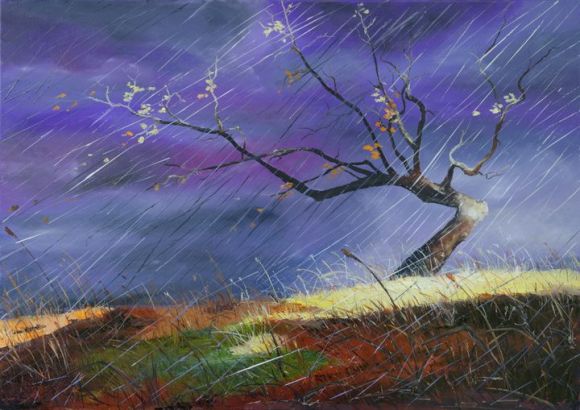
Storm in purple by Arina Tcherem. From Public Domain
If we take a look at our civilisation, there are multiple kinds of storms that threaten to annihilate our way of life and our own existence as we know it. The Earth and the human world face twin threats presented by climate change and wars. While on screen, we watch Gaza and Ukraine being sharded out of life by human-made conflicts over constructs made by our own ‘civilisations’, we also see many of the cities and humankind ravaged by floods, fires, rising sea levels and global warming. Along with that come divides created by economics and technology. Many of these themes reverberate in this month’s issue.
From South Australia, Meredith Stephens writes of marine life dying due to algal growth caused by rising water temperatures in the oceans — impact of global warming. She has even seen a dead dolphin and a variety of fishes swept up on the beach, victims of the toxins that make the ocean unfriendly for current marine life. One wonders how much we will be impacted by such changes! And then there is technology and the chatbot taking over normal human interactions as described by Farouk Gulsara. Is that good for us? If we perhaps stop letting technology take over lives as Gulsara and Jun A. Alindogan have contended, it might help us interact to find indigenous solutions, which could impact the larger framework of our planet. Alindogan has also pointed out the technological divide in Philippines, where some areas get intermittent or no electricity. And that is a truth worldwide — lack of basic resources and this technological divide.
On the affluent side of such divides are moving to a new planet, discussions on immortality — Amortals[1] by Harari’s definition, life and death by euthanasia. Ratnottama Sengupta brings to us a discussion on death by choice — a privilege of the wealthy who pay to die painlessly. The discussion on whether people can afford to live or die by choice lies on the side of the divide where basic needs are not an issue, where homes have not been destroyed by bombs and where starvation is a myth, where climate change is not wrecking villages with cloudbursts. In Kashmir, we can find a world where many issues exist and violences are a way of life. In the midst of such darkness, a bit of kindness and more human interactions as described by Gower Bhat in ‘The Man from Pulwama’ goes some way in alleviating suffering. Perhaps, we can take a page of the life of such a man. In the middle of all the raging storms, Devraj Singh Kalsi brings in a bit of humour or rather irony with his strange piece on his penchant for syrups, a little island removed from conflicts which seem to rage through this edition though it does raise concerns that affect our well-being.
Parichha has also reviewed a book by another contemporary Odia woman author, Snehaprava Das. The collection of short stories is called Keep it Secret. Madhuri Kankipati has discussed O Jungio’s The Kite of Farewells: Stories from Nagaland and Somdatta Mandal has written about Chhimi Tenduf-La’s A Hiding to Nothing, a novel by a global Tibetan living in Sri Lanka with the narrative between various countries. We have an interview with a global nomad too, Neeman Sobhan, who finds words help her override borders. In her musing on Ostia Antica, a historic seaside outside Rome, Sobhan mentions how the town was abandoned because of the onset of anopheles mosquitos. Will our cities also get impacted in similar ways because of the onset of global ravages induced by climate change? This musing can be found as a book excerpt from Abiding City: Ruminations from Rome, her book on her life as a global nomad. The other book excerpt is by a well-known writer who has also lived far from where he was born, MA Aldrich. His book,From Rasa to Lhasa: The Sacred Center of the Mandala is said to be “A sweeping, magnificent biography—which combines historical research, travel-writing and discussion of religion and everyday culture—Old Lhasa is the most comprehensive account of the fabled city ever written in English.”
With that, we come to our fiction section. This time we truly have stories from around the globe with Suzanne Kamata sending a story set in the Bon festival that’s being celebrated in Japan this week for her column. From there, we move to Taiwan with C. J. Anderson-Wu’s narrative reflecting disappearances during the White Terror (1947-1987), a frightening period for people stretched across almost four decades. Gigi Gosnell writes of the horrific abuse faced by a young Filipino girl as the mother works as a domestic helper in Dubai. Paul Mirabile gives us a cross-cultural narrative about a British who opts to become a dervish. While Hema R touches on women’s issues from within India, Sahitya Akademi Award Winner, Naramsetti Umamaheshwararao, writes a story about children.
With such hope growing out of a neolithic burial chamber, maybe there is hope for life to survive despite all the bleakness we see around us. Maybe, with a touch of magic and a sprinkle of realism – our sense of hope, faith and our ability to adapt to changes, we will survive for yet another millennia.
We wind up our content for the August issue with the eternal bait for our species — hope. Huge thanks to the fantastic team at Borderless and to all our wonderful writers. Truly grateful to Sohana Manzoor for her artwork and many thanks to all our wonderful readers for their time…
It is clear that English is employed here not as a language on loan, but as the rich, spluttering resource of the marrow and the bloodstream.-- Arundhathi Subramaniam.
At the outset, let me make a candid statement. I am a very prosaic person, someone who in her long teaching career and academic writing as well as translation, has never ventured to write poetry myself. I might seem like the odd woman out, but somehow, I have been closely following the recent trends in which Indian Poetry in English has been rapidly spreading its wings and with new volumes being published every other day, it is now a force to be reckoned with.
Tomb of Henry Louis Vivian Derozio at the South Park Street Cemetery, Kolkata.
Recapitulating literary history briefly, it is well known that Indian English Poetry (or often called Anglophone poetry in India) is the oldest form of Indian English literature. Beginning roughly from 1850 to 1900, it went through the ‘imitative’ phase when Indian poets were primarily ‘romantic’ and tried to imitate the British masters. Beginning with Derozio[1], many poets of the time — namely Rabindranath Tagore, Sri Aurobindo, Sarojini Naidu, Michael Madhusudan Dutt, Toru Dutt — were also Bengalis by birth. The poetry written between 1900 to 1947 belonged to the ‘assimilative’ period and often questions were asked why the poets didn’t write in their ‘own’ languages. Post-independence poetry was primarily experimental, and when we come to contemporary Indian English poetry, we find it becoming wholly urban and middle-class. The poets are realistic and intellectually critical in the expression of their individualised experience. They go in for precision at all levels and do not stick to one genre but experiment with multiple poetic forms.
Interestingly, I realised that a whole host of Indian English poets writing at present (some have several volumes of poetry published already, whereas others have just given birth to one or two), but coincidentally many of them happen to be Bengalis — Bashabi Fraser, Sudeep Sen, Kiriti Sengupta, Sanjukta Dasgupta, Mitali Chakravarty, Angshuman Kar, Shyamasri Maji, Basudhara Roy,Radha Chakravarty, and others. It is not a complete list at all, and what makes this study more interesting is that except for a couple of them, all these poets come from an English literature background. It is also not a coincidence that most of them teach English as their profession. So, whether it be personal lyrics, free verse, memories, experiences, observations, or even translation, the English muse therefore gives them the impetus to experiment with all forms, and at the same time helps them to move away from themes like nationalism, nature, Indian culture, love etc. that dominated Indian English Poetry in earlier times.
Bashabi Fraser receiving her CBE (2021 The Queen’s New Year Honours) from Prince Charles, now King Charles III.
Bashabi Fraser is an Indian-born Bengali and a Scottish academic, editor, translator, and writer. She is a Professor Emerita of English and Creative Writing at Edinburgh Napier University. Fraser’s work traverse continents in bridge-building literary projects. She was appointed a Commander of the Order of the British Empire (CBE) in the 2021 New Year Honours for services to education, culture and cultural integration in Scotland, in particular for her projects linking Scotland and India. Among her several volumes of poetry the Bengal and Bengali connection comes out in volumes like From the Ganga to the Tay: a poetic conversation between the Ganges and the Tay (2009), Letters to My Mother and Other Mothers (2015), My Mum’s Sari (2019), and Lakshmi’s Footprints and Paisely Patterns: Perspectives on Scoto-Indian Literary and Cultural Interrelations (2023). Fraser has worked extensively on a project about the Bengal Partition and the angst resulting from this divide expresses itself in the following poem.
This Border
Can shadow lines on the earth’s surface divide language and literature, rituals and customs, rivers…and memories?

There was a time when you and I
Chased the same butterfly
Climbed the same stolid trees
With the fearless expertise
That children take for granted
Before their faith is daunted
Do you remember how we balanced a wheel
Down dusty paths with childish zeal
Do you remember the ripples that shivered
As we ducked and dived in our river
Do you remember what we shared
Of love and meals, and all we dared
Together – without fears
Because we were one
In all those years
Before we knew that butterflies
Were free to share our separate skies
That they could cross with graceful ease
To alight on stationary trees
On either side of this strange line
That separates yours from mine
For whose existence we rely
Entirely on our inward eye
This border by whose callous side
Our inert wheel lies stultified
This border that cuts like a knife
Through the waters of our life
Slicing fluid rivers with
The absurdity of a new myth
That denies centuries
Of friendships and families
This border that now decrees
One shared past with two histories
This border that now decides
The sky between us as two skies
This border born of blood spilt free
Makes you my friend, my enemy.
Another well-established poet is Sudeep Sen who studied in New Delhi and in the United States and is a global citizen, so to say. Sudeep’s literary output is enormous and some of the titles of his volumes of poetry have subtle references to Indianness and Bengaliness embedded in them as well. Mention may be made of volumes like Leaning Against the Lamp-Post (1983), The Man in the Hut (1986), Kali in Ottava Rima (1992), Postmarked India: New & Selected Poems (1997), and several others. Though he might not do it consciously, his Bengaliness remains embedded in his psyche.
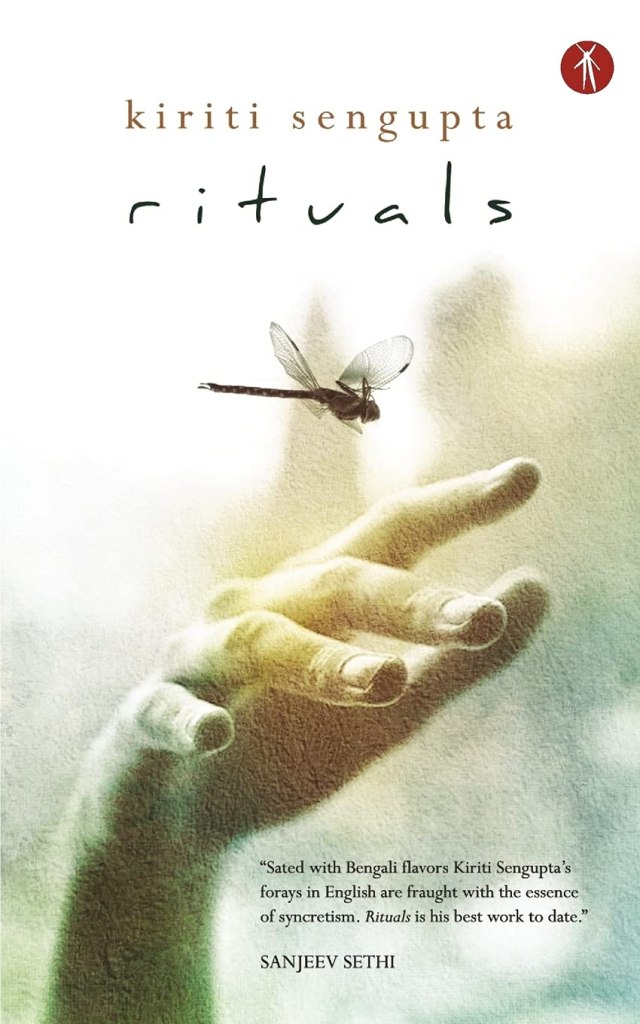
Kiriti Sengupta who has been awarded the Rabindranath Tagore Literary Prize (2018) for his contribution to literature, is a poet, editor, translator, and publisher. What is more significant is that along with Bitan Chakraborty, he mans the publishing house Hawakal, which has already carved a niche for itself as the largest publisher of Indian Poetry in English. Several poets mentioned in this essay have seen their creations see the light of the day through Hawakal Publishers and they have done yeomen service in this regard. As an established poet, Sengupta has several volumes of poetry to his credit. His collection from 2019, called Rituals, is very different from the work readers usually read in that there is a narrative thread in many poems that is not there simply to tell a story but to ultimately present a meditation on an aspect of life and the modern world that they haven’t considered before. “Fleeing the house and leaving the doors ajar. Is it perversion or fallacy?”
In an earlier volume entitled Solitary Stillness (2018), Sengupta does not give away the traits that have pervaded his poetry, he has not forgotten his Bengali roots, and has once again drawn his poetry on the canvas of the time that has been rooted in Calcutta. As he elaborates upon this point in his professional website, here, he makes a reference to Lapierre, and indeed, the ‘city of joy’ tag sounds fake just as we read that particular poem, which is so natural, that it almost appears to have been spoken by a resident of a city, one who is not a poet. According to him, that person who complains about water logging or that person for whom any tag of romanticism about the city is bourgeois, it is nothing but a label that’s needed to promote consumerism.
Mitali Chakravarty, the indefatigable editor of Borderless Journal, wrote to me saying that she is happy I feel she belongs to Bengal, “I call myself a Bengali and a human”. Though a non-resident Bengali, her perception of her own work and Bengali cultural identity is clearly revealed in a poem published in The Daily Star (Bangladesh)[2].
Confused

I am mixed up – cannot help
English and Bengali under my belt

I can read a bit of Hindi
Cannot understand much of French
A little Chinese …low class, they said…
I am mixed up – cannot help
English and Bengali under my belt

I grew up thinking I will find a way
But now pidgin is all that I can say
I write in English – the language borrowed from the West
The language that taught us or brought us unrest
The language that through The Raj spread
Importing Nationalism in its tread
I am mixed-up – cannot help
English and Bengali under my belt

But my life is that of the non-English
A probashi Bengali at best

People say I am not typical, not quite the right type
A mixed-up Bengali – I said
Culture is something I dread at every tread
Because what Culture I have is mine
- Not of a Race, a Country or Religion –
Human Being is the only race to which I belong

Help protect my home, the Earth – its every drop, its every stone

In a world of 7.7 billion, can I be alone?
I am mixed up – cannot help
English and Bengali under my belt
Though she has been writing poetry for a long time, Mitali’s first poetry collection, Flight of the Angsana Oriole: Poemswas published by Hawakal only in October 2023. In the ‘Introduction’ to this volume, she states that her random collection of poems “are sometimes of the past” as she knew it and “sometimes of the present. And sometimes in quest of a future or a dream that she hopes will go to create a more hopeful future than the world presents to us currently.” The poems in this volume are personal; some talk of her journey through life, the world as she sees it, some even influenced by her travels across the world. She further states: “Inherent in each line is not just the influence of my experiences in many countries but the nurturing I had in India, where I was born, educated and spent the first two decades of my earthly existence.” So, poems like ‘Death of Lalon’, ‘Shivratri’, ‘Kali Rise’, ‘Shraddha‘ [last respects] and a few others do convey the subconscious Bengaliness embedded in her psyche, irrespective of where she physically resides now.
Radha Chakravarty, a prolific writer and translator, Former Professor of Comparative Literature and Translation Studies at Ambedkar University, Delhi, has recently joined the bandwagon of Indian Poetry in English with her debut collection of poems Subliminal published by Hawakal Publishers in 2023. In a detailed interview given to Mitali Chakravarty for the March issue of Borderless Journal[3], she tells us about her aims and ambitions as a poet and how most of the poems in Subliminal are independent compositions, not planned for pre-conceived anthology.
My poetry actually delves beneath surfaces to tease out the hidden stories and submerged realities that drive our lives. And very often, those concealed
truths are startlingly different from outward appearances. I think much of my poetry derives its energy from the tensions between our illusory outer lives and the realities that lurk within.
Many of Radha Chakravarty’s poems express the feeling of Bengaliness in different perspectives. We read about the typically soft quilt called kantha in Bengali in the poem ‘Designs in Kantha‘ thus:
Sewn into soft, worn layers,
forgotten fabric of grandmother tales –
patterns of the past,
secret memories, hidden designs,
intriguing patterns in silk strands
dyed in delicate dreamy shades—
embroidered storylines
in exquisite, dainty kantha-stitch.
When Mitali Chakravarty asks her why she writes in English though it isn’t her mother tongue, she answers:
Having grown up outside Bengal, I have no formal training in Bengali. I was taught advanced Bengali at home by my grandfather and acquired my deep love for the language through my wide exposure to books, music, and performances in Bengali, from a very early age. I was educated in an English medium school. At University too, I studied English Literature. Hence, like many others who have grown up in Indian cities, I am habituated to writing in English. I translate from Bengali, but write and publish in English, the language of my education and professional experience. Bengali belongs more to my personal, more intimate domain, less to my field of public interactions….
Both Bengali and English are integral to my consciousness, and I guess this bilingual sensibility often surfaces in my poetry. In many poems, such as ‘The Casket of Secret Stories,’ ‘The Homecoming’ or ‘In Search of Shantiniketan’, Bengali words come in naturally because of the cultural matrix in which such poems are embedded.
Of course, the poet also mentions that all her poetry is not steeped in Bengali. In fact, in most of her poems, Bengali expressions don’t feature at all, because the subjects have a much wider range of reference. As a globe trotter, Radha has written about different places and journeys between places.
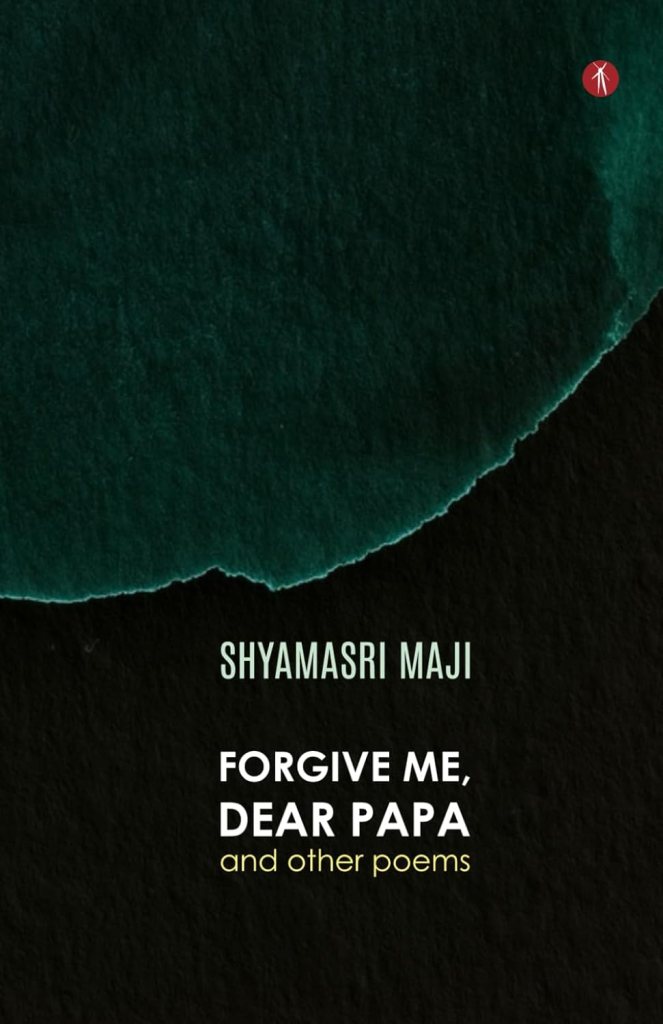
Another debut book of poems that Hawakal Publishers brought to light in December 2023 entitled Forgive Me, Dear Papa and other poems is written by Shyamasri Maji, an Assistant Professor of English teaching at Durgapur Women’s College, West Bengal. Dedicating this collection of poems to her “incurably romantic self,” Maji feels that “being ‘romantic’ in this context is being imaginative, reflective, puerile, rebellious and emotional.” The poems are a mixed bag, belonging to different thematic issues. Some focus on a woman’s radical views on the gender hierarchies in our society, in some nature plays the role of mediator between the narrator and the world, the idea of loss of love, which is closely linked with thoughts of death, while a few poems also represent an interpersonal dialogue between the self and the other. Some of Maji’s poems focus on the role of memory whereas some are experimental in the sense that they portray a woman’s comprehension of a man’s thoughts. Stressing upon the fluidity of identities, she shows how love, pain, pandemic, separation and grief affect all human beings irrespective of an individual’s gender and sexual orientation.
Six books of published poems and twenty-five years of creative journey has been a consistent exploration by the poet Sanjukta Dasgupta as she tries to find the path of freedom from among the misleading mesmeric mazes that threaten and stifle both sense and sensibility. As a woman poet with a strong feminist stance, Dasgupta admits in an online interview given to Basudhara Roy[4]:
Though I read Bangla poetry since my schooldays, I wrote my poems in English. It was an unconscious choice. Much later I learnt that I should have been embarrassed about writing in English rather than in my home language, my mother tongue Bangla. The poems written in English kept on being born on the page with embarrassing regularity.
Writing poetry is an irrepressible urge for me. It is, in a way, far more intense than the biological labour pain. This labour pain of creativity leaves me restless till the words are born on the page. But the creative process allows endless revisions; a biological production is largely about acceptance, neither revision nor deletion are considered ethical practices. In the case of poetry, it is not about choice, it is a compulsion which is intense and gratifying and multiple revisions often lead to the emergence of the perfect product.
The title of Dasgupta’s poetry book Lakshmi Unbound (Chitrangi, 2017) is very significant. Lakshmi being an intrinsic part of the fabric of Bengali culture, the radicality and dissidence of the idea of ‘Alakshmi[6]’ will require no explanation to a Bengali reader.
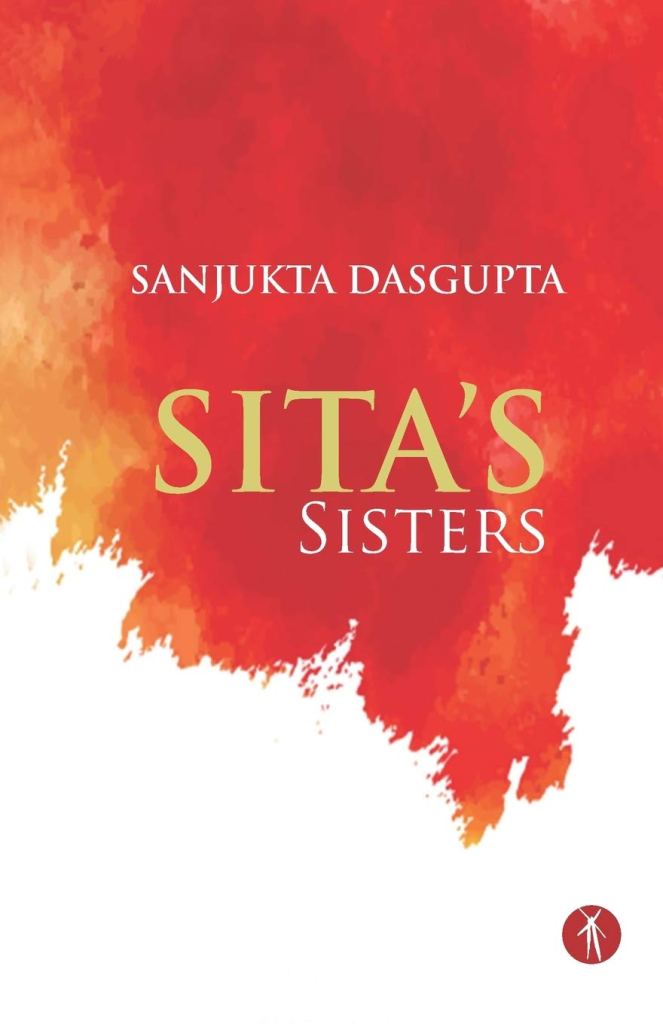
She thinks the core agenda in Lakshmi Unbound is a defiant, determined search for freedom. So, it is not just deconstruction, it is an endeavour to call attention to the need to destabilize the deep-rooted stereotypes that have controlled the minds and mobility of women. In Sita’s Sisters (Hawakal, 2019), she crafts a revisionist feminist mythology by taking up familiar figures like Sita, Lakshmi, Kali, Mira and attempts to free these mythic figures from their claustrophobic space so that they can be re-invented in sync with the contemporary times.
Residing in Jamshedpur, in the state of Jharkhand, Basudhara Roy is an established poet and has several books and publications to her credit. In her own website, is stated: “Committed to an undying affair with words, Basudhara finds in poetry an epistemological and existential skylight. She writes because she feels she must test words on her tongue, pulse, moods, agitation, abstraction and satire. She is convinced that words can change the world and hence, she works at them in her own culinary way – washing, peeling, grating, pounding, baking, sautéing, kneading, roasting, often flaming them for what they might yield.”
The following poem from Stitching a Home (Red River, 2021) considers the eternal problem of a woman that plagues women writers a lot.
The Right Kind of Woman

The right kind of woman will
inspire affection, regard, trust.
Not promiscuity, never lust.

Bred by a mother equally right,
she knows to avert her eyes to
innuendoes, telling smiles.

In crowded buses, shops, streets,
she knows to shut tight, bud-like,
relinquish space, circumscribe limbs.

Above all, she knows the prudence
of holding her tongue, of choosing
silence’s worth over wordy rebellion.

Schooled to surrender in dark
rooms, she knows, unasked, to
feign desire, moan, stifle, sigh on cue.

On her forehead, she had a
third eye to emit fire, take sides,
rake storms. Last night, its lid rusted

with disuse fell out, and the right kind
of woman laughed herself to death
over all she had left undone, unsaid.
“Writing poetry is an isolation exercise” says Angshuman Kar, an established Bengali poet who by profession is also an English Professor at a university in West Bengal. His book of poems Wound is the Shelter (Hawakal, June 2023) is unique and different from the other volumes discussed here because the poems are all translated by the poet himself from his original Bengali poems. In the ‘Introduction’, Kar tells us that authors who translate themselves often seem to be unhappy about the task of translating their own works. The Marathi poet Arun Kolkatkar likens it to incest, — “like making love to your own daughters.” Critics of translation studies have both supported and criticised self-translation. Those who support it argue that the author knows their work the best and hence s/he is the best translator of their own work. Those who oppose self-translation argue that the author-translator takes too much liberty while translating his/her own work; thus, the translation hardly remains faithful to the original. In such a situation Kar says, “Without being critical, I must say that I love self-translation. I enjoy translating my own work, I love committing incest. It makes me a better poet…. As a self-translator, I find incest healthy. It makes me a better poet – il miglior fabbro.“
Coming to the individual poems in Wound is the Shelter, it need not be reiterated that most of them portray universal feelings but at the same time are seeped in Bengali culture as well. In “My Poems” Kar talks about Jungle Mahal, the three districts of West Bengal that are full of jungles; in “World,” he writes about blooms of a sal tree and shiuli flowers; in “Memory Card” he talks about a bus ride to reach his maternal uncle’s house in Bankura from where he went to the studio to take a family photograph — “Grandma in the middle/On either side we – three brothers, two sisters and a cousin”. In “Father” he mentions how his father’s bereavement fades with time and how his portrait adorns the wooden throne in which gods and goddesses are kept and he stands with Kali, Shiva and Durga. In “Neelkantha” he refers to Shiva; in “Park” he states how man forgets grief when he comes to a park, “That is why in a city as sad and lonely as Kolkata the number of parks is always high.” The five-part poem “Tiger” is also very powerful, “there is a tiger inside every human being” he states. Kar also mentions about the mask of a demon of Chhou dance of Purulia, the aal path in paddy fields, the Chandi mandap[7] of a small village, the man called Bhagaban Das who labours in a factory, and the man called Shubhasis Babu who rents him cars, whose voice he hears but has not seen him. Thus, even in his transcreated poems, Kar’s Bengaliness expresses itself overtly.
It is not possible to analyse the poems of each of the Bengali poets that I have mentioned above within the purview of this single essay, and so I have just selected a few of them (especially the poets who have one or two volumes to their credit at present). As mentioned earlier, though Bengali by birth, all the poets rendering their emotions in English, do often consciously or unconsciously express multicultural elements, Bengali cultural nuances, and idiomatic force in their poems. As the trend for providing glossary is passe now, much is left to the readers’ imagination, but still certain occasional Bengali words and phrases make their poems even more appealing.
After sharing my random thoughts about Indian Poetry in English in general and selectively mentioning a few Indian English poets who also happen to be Bengali and often unconsciously exude a sort of Bengaliness in some of their poems, without attempting to sound rather parochial, I wholeheartedly wish to see more volumes of their poetry being published in future. I conclude by quoting a very salient observation made by Arundhathi Subramaniam who is not wholly optimistic about the situation, but believes that despite hurdles in publishing, the voices of Indian poets writing in English would be heard [8]:
Despite the clunky discourse that continues to hover around it, however, Indian poetry in English endures, even flourishes, seventy years after Independence. Publishers may be few and far between, the royalties meagre, the critical climate thick with indifference or theoretical bluster, and the poets themselves bewildered by disputes over their identity, even their existence. But poetry, in its mysteriously resilient fashion, continues to be written, shared and discussed (if sometimes with more passion than discernment). … I am not ecstatic about the state of Indian poetry in English. (But then I am not ecstatic about poetry; only, at times, about poems.) What I do know is that Indian poetry in English is alive. And like all things alive, it engages, it annoys, it provokes, it excites. On several occasions, it has given me the jolt of wonder for which I turn to poetry in the first place.
Considering the slightly mellow tone in Subramaniam’s observation, I personally feel Indian English Poetry has become a significant force in the literary arena at present and will grow stronger with time. Seasoned poets who have several volumes of poetry published already, as well as the fresher ones whose debut volumes promise a lot more to come in future, can all look forward to seeing their ‘spontaneous overflow of powerful emotions’ in print and carry on the legacy of Indian Poetry in English to newer heights. And sure enough, the sub-genre of Bengali Indian English poetry can be researched in greater details in future.
.
[1] Henry Louis Vivian Derozio (1809–1831), poet and assistant headmaster of Hindu College, Calcutta, a radical thinker and started the Young Bengal Movement.







 Borderless