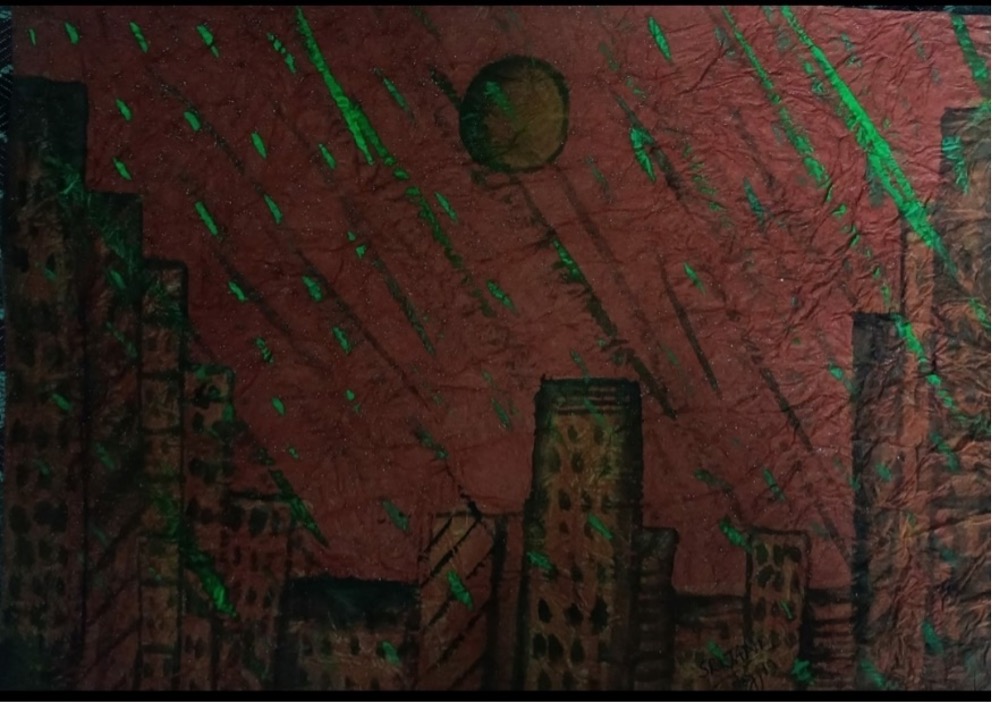
In the deep, deep, dark woods, The youth is lost. In the vast sky, The red-yellowish moon is sublime; Twisted -- Tangled -- Twice told tales Of yellowish noon of last summer -- Lascivious rippling of Mirth, dancing in the heart Of passers-by -- Today’s dunce is tomorrow’s poet. Philosophers smile at words of the prophets. The city of dreamers, The city of blue nights, The city of fascism, The city of silent cries, The city of dew drops, The city of lost souls, Hunchbacks, bird catchers -- Are making this city their homes; Insomniacs start listening to Lunatic melodies Of the unseen microcosms, Buds bloom between Two skyscrapers Made of debris And Of chaos.
Srijani Dutta is a post graduate from Visva Bharati University. She has published in Parcham, Contemporary Literary Review India, Story Mirror, EKL review journal, Setu, Plato’s cave, The Antonym etc. Her paintings have been published in Borderless Journal, Creative chromosomes, Rappahannock review, Fourth River Journal.
.
PLEASE NOTE: ARTICLES CAN ONLY BE REPRODUCED IN OTHER SITES WITH DUE ACKNOWLEDGEMENT TO BORDERLESS JOURNAL
Title: The Collected Short Stories of Kazi Nazrul Islam
Editors: Syed Manzoorul Islam and Kaustav Chakraborty
Publisher: Orient Blackswan
He dons many mantles. Kazi Nazrul Islam (1899 – 1976), the national poet of Bangladesh, was a prolific Bengali poet, revolutionary, essayist, journalist, editor, activist and composer of songs. The very mention of his name conjures up the figure of a fiery iconoclast who fought against the structures of oppression and orthodoxy in society to bring about progress and change. In fact, his self-styled image as the volatile bidrohior ‘rebel poet’ overshadows his other literary achievements and that is how ordinary people still remember him.
This unique volume presents all twenty of Kazi Nazrul Islam’s short stories for the first time in English translation. Done by different hands, they feature rich imagery, evocative landscapes, references to music, classical poetry, folktales and more. The prominent characteristics of these stories are simplicity, vivacity and emotionality. They have been sourced from different anthologies. The first six stories are from the collection Harvest of Sorrow1. The opening story of the collection titled “Harvest of Sorrow”, is a collage of tales narrated by the three characters: Dara, Bedoura and Saiful Mulk. Dara, located in Iran’s Golestan, narrates his tale of love, separation and devotion to his motherland through a series of reminiscences. After that, we hear the same set of events narrated from Bedoura’s perspective. Then follows the account narrated by Saiful Mulk, portrayed as a sinner who tempted Bedoura into losing her virginity. Overcome by guilt, he joins the freedom struggle where he encounters Dara. What follows is a tale of redemption loss and transcendence of physical love to a more spiritual kind of love. “Hena”, the second story of the collection, is narrated by Sohrab, and its theme is also love and war – both internal and external battle. “In the Relentless Rain” is basically a story of love between strangers. The author doesn’t provide us the names of the lovers – rather both are addressed as dark-skinned. The next story, “Half Asleep”, is divided into two parts: Azhar’s story and Pari’s story. Azhar’s story is mainly about his sacrifices and why he favours detachment from the sensuousness. His renunciation of carnal pleasures towards attaining greater contentment ends his relationship with Pari, whose marriage he arranges with one of his friends. He ensures that Pari remains confined within the household structure. By making Pari assert that she will not betray her role as a loving wife without pretending to erase the love that she has for her former lover, Nazrul offers a critique of the conventional notion of ‘loyalty’ of wives to serve their husbands. The first-person narrator of “Insatiate Desire” soliloquizes on a saga of disunited love where the narrator falls in love with his childhood friend, feigns disinterest in her when her marriage is arranged to another man, and characterises his own actions as stemming from the most noble impulses. The final piece of the volume, “Letter from a Political Prisoner”, is an epistolary story of a political prisoner who has also been diagnosed with fatal tuberculosis. The story is addressed to the lady of his dreams, Manashi, who does not seem to have reciprocated his love.
The title story of the next section is from an anthology of the same name, The Agony of the Destitute2. The story centres around the glorification of war but in the process, it also raises questions related to war and gender. In sharp contrast to the narrator-protagonist of this narrative who detaches himself from domesticity to join the war, the protagonist of the very next story, “Autobiography of a Vagabond” suffers a tragic end to his domestic life and thereafter joins the army and eventually dies while fighting in Baghdad. “Meher Negar”, the third story of this section, is another tale of war and conflicts in love. Yusuf Khan, the protagonist, is a Pathan from the mountains of Waziristan who meets Meher Negar (whose actual name is Gulshan) after reaching a distant land to learn music. Later he joins the War of Independence for Afghanistan. Unable to forget her, he visits Meher Negar one last time only to discover that she is no more. As an allegorical piece of writing, “Evening Star” is about a man’s love for a distant beloved that is ultimately futile because of the probable demise of the beloved.
“Rakshasi” is written in the language spoken by the Bagdi community of the Birbhum district in West Bengal in which the speaker Bindi is a woman who complains to her friend about how society has stigmatized her as a demoness because she has killed her husband to save him from abandoning her and getting remarried to a notorious girl.“Salek” is a short moral story where, through a series of events, a dervish (later revealed to be Hafiz) shows an arrogant Kazi the path to salvation; the former becomes the latter’s salek or the one who shows the way. In “The Widow”, Begum, the narrator, speaks of her sorrowful youth, her happy married life and the miseries of her widowhood to her friend Salima. The story challenge multiple stereotypes that are often associated with the women of South Asia. The concluding tale of this volume is titled “The Restless Traveller” which is an impressionistic story centered round the urge towards finding freedom by restless youth.
The four stories that comprise the third volume of Nazrul’s stories and the next section, called The Shiuli Mala3, speak about Nazrul’s ecological sensitivity. The opening story “The Lotus-Cobras” is about Zohra and her human and non-human intimacies. As the editors rightly point out, “In the portrayal of Zohra’s attachment with her serpent sons, Nazrul seems to be very close to the essence of posthumanism where radical posthuman subjectivity is understood on the basis of an intersectional ethics of plurality”. “The King of the Djinns” is a tragicomic story about how Alla-Rakha, the protagonist, resorts to a series of tricks to get married to Chan Bhanu, the woman he desires. “The Volcano” deals with the disaster that is caused by the sudden eruption of repressed anger and egotistic pride in Sabur, the humble, helpful and uncomplaining protagonist of the story. It is a study of the anxiety of manliness. “The Shiuli Mala”, the concluding story of this section, is a testimony to Nazrul’s love for the trope of separated lovers or unrequited love. Set in Shillong, it primarily deals with a platonic and disunited love between Azhar, a well-known chess player, and Shiuli, the daughter of another brilliant chess player, Professor Chowdhury. Structured as a flashback, Azhar narrates the story to his friends who are part of a regular chess adda.
Two unanthologised stories end the collection. “Letter from a Lost Boy” is an epistolary account of a boy who writes to his mother about some incidents in his life that have occurred since he had left her until the time of his return. The story is a critique of child marriage and the consequent early widowhood that brings never-ending misery in the life of a woman. “The Hawk-Cuckoo from the Woods” tells the story of a marital discord between Dushasan Mitra and his wife Romola. Their friction widens after Romola becomes too attached to an injured hawk-cuckoo and her husband feels agitated by her gradual disconnect from their conjugal life. The story ends with Romola flaying her husband for throwing the bird away, finding and hugging the dying bird to her heart and plunging into the waters of the Padma.
All these twenty stories invite the reader to re-evaluate the ‘rebel poet’ as an empathetic humanitarian who also excelled in human relationships. Nazrul is essentially multilingual – he uses Hindi, Urdu, Arabic and Persian words along with Bangla. This book is the outcome of a project sponsored by the Nazrul Centre for Social and Cultural Studies, Kazi Nazrul University, Asansol, West Bengal. The volume is a transnational, collaborative labour of love bringing together the editors and translators from Bangladesh and India. Most of them are academics and have taken up the challenge to translate the stories, which in their infinite variety, is indeed a difficult task. The stories are accompanied by a timeline of Nazrul’s life and a detailed critical introduction that not only provides foundational context for the stories, but also highlights Nazrul’s attempt to counter majoritarianism and various hegemonies by dismantling hierarchies and celebrating intimate pluralities. In fact, at the end of their introduction, the editors Syed Manzoorul Islam and Kaustav Chakraborty ask two very pertinent questions. “In which category can we place Nazrul? Is there a need to formulate a different category altogether in order to position him?” The answers of course lie with the readers of the translated stories to decide. All said and done, this volume of short stories is strongly recommended for all classes of readers who are keen to discover the multi-faceted genius of Kazi Nazrul Islam and who could not earlier savour their uniqueness because they were only written in Bangla.
Byathar Daan (Harvest of Sorrows) published in March 1922 ↩︎
Rikter Bedon (Agony of the Destitute) published in January 1925 ↩︎
Shiuli Mala (Garland of Jasmines) published in October 1931 ↩︎
Somdatta Mandal, critic, academic and translator, is a former Professor of English at Visva-Bharati University, Santiniketan, India.
PLEASE NOTE: ARTICLES CAN ONLY BE REPRODUCED IN OTHER SITES WITH DUE ACKNOWLEDGEMENT TO BORDERLESS JOURNAL
Narrative by Debendranath Tagore, translated from Bengali by Somdatta Mandal
Note from the Translator
Debendranath, Father of Rabindranath Tagore
Born to Dwarkanath Tagore in Shelaidah, Debendranath Tagore (15 May 1817 – 19 January 1905) was a Hindu philosopher and religious reformer. One of the founders of the Brahmo religion in 1848, his journey in the role of ‘Maharshi’, the great ascetic, was an attempt to spread the Brahmo faith and he travelled extensively to various places, especially in different parts of the Himalayas like Mussourie, Shimla, Kashmir, and Dalhousie. He even constructed a house in Bakrota called ‘The Snow Dawn’ where he used to reside for months. Although Debendranath was deeply spiritual, he managed to continue to maintain his worldly affairs — he did not renounce his material possessions, as some Hindu traditions prescribed, but instead continued to enjoy them in a spirit of detachment. His considerable material property included estates spread over several districts in Bengal. Debendranath was a master of the Upanishads and played no small role in the education and cultivation of the faculties of his sons.
In his memoir, Jeevan Smriti [Memories of Life], Rabindranath also narrates in detail about his trip with his father in the Himalayas when he was just eleven years old. Debendranth founded the Tattwabodhini Patrika (1843) as a mouthpiece of the Brahmo Samaj and apart from his autobiography, wrote several other prose pieces which also reveal his wanderlust.
Among the two entries included here, we have ‘Moulmein Bhraman’ which is an interesting travel piece narrating his sojourn in Burma in September/October 1850. In the Chaitra 1817 Saka issue of Tattwabodhini Patrika, a travelogue ‘Mori Bhraman’ narrating Debendranath’s trip to Mori was published. Interestingly, as a prologue to this piece Sri Chintamani Chattopadhyay tells us that he was so enamoured after listening to Debendranath’s oral narration of the trip undertaken 28 years earlier, that he decided to transcribe it for the satisfaction of the readers.
Moulmein Bhraman (Travel to Moulmein)
After a year, the splendour of autumn revealed once again and the desire to travel blossomed in my mind. I could not make up my mind where to go for a trip this time. I thought I would make a trip on the river and so went to the bank of the Ganges to look for a suitable boat. I saw that several khalasis — dockyard workers – of a huge steamer were busy at their work. It seemed that this steamer would soon set sail.
“When would this steamer go to Allahabad?” I asked them.
In reply they said, “Within two or three days this will venture into the sea.”
On hearing that this steamer would go to the sea, I thought that this was the easiest way my desire for a sea journey could be fulfilled. I went to the captain instantly and rented a cabin and in due time boarded that steamer to begin my sea journey.
I had never seen the blue colour of the sea water before. I kept on watching the beautiful sights by day and night amid the continuous bright blue waves and remained immersed in the glory of the eternal spirit. After entering the sea and swaying with the waves for one night, the ship dropped anchor at three o’clock the next afternoon. In front of us, I saw a stretch of white sand and something that looked like human habitation. So, I took a boat and went to see it. As I was wandering about the place, I saw a few Bengali men from Chittagong with charms around their necks coming towards me. I asked them, “How come you are here? What do you do?”
“We do business here. We have procured the idol of Goddess Durga in this month of Ashwin[1],” they replied.
I was really surprised to hear that they celebrate Durga puja here in Khaekfu town of Burma. Durga puja was celebrated even here!
From there, I came back to the ship and started towards Moulmein. When the ship left the sea and entered the Moulmein River, I remembered the scene of leaving Gangasagar Island and going into the Ganges River. But this river did not offer any such good scenery. The water was muddy and full of crocodiles; no one bathed in it. The ship came and dropped anchor at Moulmein. Here a Madrasi resident called Mudeliar came and greeted me[2]. He came on his own and introduced himself. He was a high-level government official and a true gentleman. He took me to his house, and I remained a guest there and accepted his hospitality for the few days I stayed at Moulmein. I stayed very comfortably in his house.
The streets in the city of Moulmein were wide and clean. The shops that lined both sides of the street selling different kinds of things were all manned by women. I bought a box, and some very fine silk clothes from them. Going around the marketplace I went to the fish market at one time. I saw big fish for sale displayed on huge tables.
“What are these big fish called?”
They replied, “Crocodiles.” So, the Burmese ate crocodiles; they spoke verbally about ahimsa and the Buddhist religion, but their stomachs were filled with crocodiles!
One evening when I was wandering on the wide streets of Moulmein, I saw a man walking towards me. When he came close, I understood that he was a Bengali. I was quite surprised to see a Bengali there. From where did this Bengali arrive across the ocean? It seemed there were no places where Bengalis did not go. I asked him, “From where have you come?”
“I was in trouble and so came here,” he replied.
Instantly I understood his trouble[3]. I asked him further, “How many years of trouble?”
“Seven years,” he replied again.
“What did you do?”
“Nothing much. I just duplicated some papers of a company. Now my term is over, but I cannot go home because I do not have the money.”
I offered to give him the passage money. But how will he go home? He had set up a business, had got married, and was living quite comfortably. Would he ever go back to our country to show his shameful black face there?
Mudeliar told me that there was a mountain cave here which people went to visit[4]. If I wished he would accompany me there. I agreed. On the first moon night[5], he brought a long boat during the high tide. There was a wooden cabin in the centre of that boat. That night, Mudeliar, I, the captain of the ship and seven or eight other people boarded the boat and it left at two o’clock at night. We sat up for the whole night in that boat. The foreigners kept on singing English songs and requested me to sing Bengali songs. So, I kept on singing Brahma-sangeet occasionally. No one understood anything. They did not like them and went on laughing. We travelled for about twenty-seven miles that night and reached our destination at four o’clock in the morning.
Our boat reached the shore. Everything was still dark. On the shore I saw a cottage full of trees and creepers from which light was coming out. I got curious and ventured alone to that unknown place in the darkness. On reaching there I found it was a tiny cottage. Inside several bald-headed priests in yellow ochre robes were placing candles in different parts of the room. I was quite surprised to see people resembling the priests of Kashi[6] here. How did they come here? Later I came to know that they were the leaders of the Buddhist monks and known as Phungis. I hid myself and observed them playing with the lamps but suddenly one of them saw me and took me inside. They gave me a mat to sit on and water to wash my feet. I had come to their house, so this was their way of entertaining guests. According to the Buddhists, serving guests was a sacred act.
I returned to the boat at early dawn. The sun rose. Mudeliar and the other invited guests came and joined us. This made us fifty in number. Mudeliar fed all of us there. He had arranged for several elephants; about two or four people got on each elephant and proceeded towards the dense jungle. There were small hills all around and in between was that dense forest. There was no other way of travelling here except on elephant back. We reached the entrance of the cave in the mountain around three o’clock in the afternoon.
We descended from the back of the elephants and started to walk in the jungle where the undergrowth was waist high. The entrance to the cave was small; we had to crawl in. After crawling in a little we could stand up straight. It was very slippery inside and we kept on slipping and falling. So, we started walking very cautiously. It was pitch dark inside. Though it was three in the afternoon it seemed like three at night. I was scared that if we lost our way in the tunnel, we would not be able to come out. We would then have to wander inside the cave for the whole day. So, wherever I went, I kept an eye on the faint light at the entrance of the cave. All the fifty of us spread ourselves in various parts of the cave and everyone had sulfur powder in their hands. Then each person put a little sulfur powder in the little holes in the cave next to where he was standing.
After everyone’s place was defined, the captain lit his share of the sulfur powder. Instantly each one of us lit matches and ignited our portion. Now the cave was lit simultaneously at fifty different places like fireworks, and we could see the inside clearly. What a huge cave it was! On looking up to the ceiling our vision could not gauge its height. We saw the different natural formations that had been caused by rainwater seepage inside and were really surprised.
Later, we came out and had a picnic in the forest and then came back to Moulmein. On our way back we heard different musical instruments being played together. Locating that sound, we went forward and saw a few Burmese people dancing with all kinds of gestures of their bodies. Our captain and the foreigners also joined them and started to dance in a similar manner. They found great pleasure. A Burmese lady was standing at the entrance of her house. She watched the mimicry of the foreigners and went and whispered something in the men’s ears. They stopped their singing and dancing immediately, and all of them suddenly left the scene and disappeared somewhere. The captain went on entreating them to resume their dance, but they did not listen. It was amazing to see how much hold the Burmese women had over their men.
We came back to Moulmein. I went to meet a high-level Burmese official at his house. He received me very politely. There was a huge room and in its four corners sat four young women stitching something.
One of the girls instantly came and handed me a round box full of betel leaves. On opening it I found it to contain different condiments. This was the local Buddhist custom of receiving guests. He then gifted me some excellent saplings resembling the Ashok flower. I had brought them home and planted them in my garden, but they did not survive despite great care. The fruit of this tree is very popular with the Burmese. If someone had sixteen rupees then he would spend the entire amount to buy that fruit. We disliked their favourite fruit because of its smell[8].
Mori Bhraman (Travel to Murree)
On the 10th of Pous, 1789 Saka[9], I abandoned all work and ventured in full earnest to go for a tour in the west. I did not decide where I would go. Just as a confined river feels overjoyed when released, I too left home with equal enthusiasm. Two servants accompanied me. One was a Punjabi Sikh called Gour Singh, the other was Kashi Singh, an Odiya Kshatri. At that time the train went only up to Delhi.
Upon arriving at Delhi, I found out that there was no other way to go except by mail coach. So, I booked a seat on it. My destination was Punjab. The horses of the coach in which I travelled up to a place near Sutlej were not steady. Because of them the coach swayed on both sides. I feared that it might topple, and it did tilt on one side and fell down on the ground.
I got out of the coach through its panel and shouted at the driver in the topmost voice – “You made me fall down, the body is hurt in many places and the nose is bleeding.” The driver had assumed that I had already died under the pressure of the carriage. Feeling assured after hearing my voice he replied, “Baancha to – at least you are alive.” My servant brought some water from a nearby well. I washed my nose. It was almost evening by then. Seeing a rest house nearby, I spent the night there.
Early next morning, I boarded the mail carriage again. It crossed the huge bridge upon the river Sutlej. Upon looking down I saw that the water had a tremendous current. I had never seen such a large bridge before. The wind was blowing fiercely. The strange sound of the waves hitting one another created great pleasure in my mind.
After that I reached an inn near the Beas River. Having our lunch there, I boarded the coach again at four in the afternoon. It was almost evening; we hadn’t progressed far when all of a sudden, a heavy storm rose. The road was just along the river. Sand started blowing to form clouds and cover the surroundings. Nothing was visible in front of us. Sand filled our nostrils and the coach could hardly move. I couldn’t decide where to go and take shelter. We found a settlement a little further ahead. Seeing a two-storied house I got off the coach and spent the night there. The storm continued unabated till three o’clock at night. As soon as it stopped, I boarded the coach again.
In this manner, travelling from one inn to another, I ultimately reached Amritsar. Earlier when I had gone to Shimla, I had spent a few days with great pleasure in Amritsar in an old, dilapidated house located next to a narrow sewer line. Immediately upon reaching Amritsar, I went looking for that beloved house.
I came next to the sewage line but saw that the house did not exist anymore. There wasn’t even a sign of it anywhere. This was an example that nothing was permanent in our lives.
I came back from there in a depressed mood. I rented a small single storied hut next to the road. As a traveller on the road, I stayed there amid the dust in that small room quite stoically but with great excitement. I cannot express in words how much I enjoyed living in such seclusion. The room wasn’t much taller than the road. Unknown travellers would stop by and speak to me in a manner as if we had been acquainted before. I was also happy to interact with them. One of them was a devotee of Hafiz and I too became an admirer. He did not want to leave me and became an earnest friend of mine.
Days went by in this manner. One day a Brahmo gentleman called Shibchandra babu came from the Brahmo Samaj at Lahore. He said that he had been sent by the Brahmos there once they heard that I was here, and I had to go to Lahore. Seeing his eagerness I started for Lahore. Babu Nabinchandra Roy had arranged for my accommodation beforehand in a house located next to a wide road at Anarkali. Once I reached there, the Brahmos came and surrounded me with devotion. During my stay in Lahore, I even had to deliver a lecture in Hindi.
From there the Brahmos arranged for my stay inside a garden. Surrounded by lime trees, the dwelling house was in the middle. With only two servants accompanying me, who was going to cook for me? I developed diarrhoea after eating the hard rotis that were served. Soon, I was also attacked by malaria. The Brahmos informed a Muslim doctor, and he came and saw me. I did not take the medicines prescribed by him. My own medicine was powdered Myrobalan and I took that. The next day there was a lot of emission of blood. I became weak; wanting fresh air I went up to the first floor. There I felt the tremendous heat of the sun and my head started reeling. The very next moment I fainted. Upon hearing this news, two Brahmos came and started feeding me sugar cane and I regained my consciousness after their nursing.
The body was in a miserable condition. The next day I sat wondering where I could go in such a state and that too without a cook. How could I return home in the heat of summer? As I was feeling tense thinking about it and could not decide what to do, my heart suddenly said, “Go to Murree.”
Thinking this to be a god-sent instruction I started preparing to go to Murree. The local Brahmos came to meet me at around two in the afternoon. My body was still very weak, and I didn’t have the energy to even talk much. They asked me what I wanted to do now, and I told them that I had decided to go to Murree and would begin my journey that day itself. After they left, Nabin babu and a few other Brahmos came.
I told them, “I want to go to Murree today so please arrange for a coach.”
They sent Gour Singh and arranged a mail carriage for me. Nabin babu asked me what I would eat on the way. He then gave me two bottles of pomegranate juice. After the coach arrived, I had the two big trunks loaded on its roof and got inside with the two bottles of juice as sustenance. Two servants sat on the roof of the coach. Despite my objection, the Brahmos dismantled the horses and started pulling the coach by themselves. I had to persuade them to stop. The coachmen attached the horses again and started moving.
After travelling a little I realised that the coach was swaying too much, and it was also not strong enough. The Sikh Gour Singh who was sitting on top was very strong, and there were two heavy trunks; if the roof collapsed on my head, there would be nothing I could do. I started feeling scared. Travelling in this manner, I reached a dak bungalow. It was a great relief and I felt that my life was saved. After eating there, I boarded the coach again. Gradually I came to the Jhelum. Gour Singh’s house was located there. He stopped the coach and was pleased to call his relatives and introduce me to them.
In this manner I arrived at Rawalpindi, which was situated in the Murree valley. From this point the road went up and down. Many broken wheels lay scattered here and there as proof of this dangerous road. I became scared on seeing them and kept wondering what would happen to me if the wheels of this unstable coach also broke. But by God’s grace, we overcame all these various hurdles and safely reached another dak bungalow[10]. As soon as I arrived there, the local Bengali gentlemen came to meet me. The pain in my body and the strain of travel made it difficult for me to speak. A gentleman called Dwarik babu started taking special care of me. He went here and there looking for a house, and at last went and requested a Parsi gentleman to allow me to stay in his garden.
I stayed in that garden and a Punjabi doctor came to see me. I told him that milk was my only food, but I could not digest that milk very well. I asked him for some medicines that would help me to digest that milk and was slightly relieved with what he gave me. I had become very weak. At night when I went to bed, I felt that I would not be able to get up the next day.
When Dwarik babu came the following day, I told him that I wanted to go to Murree. He told me that there were still no shops and markets at Murree, and I would find it difficult to stay there. But I went on pestering him. So having no other way he arranged for two basket carriages called dulis that would take me to Murree. I went in one duli and my luggage was put in the other one, while the servants went walking. I reached Murree after three days and a lot of hardship.
It was situated at a height of 7,500 feet. The bearers asked me where I wanted to go, and I told them to take me to the place where the sahibs usually landed. They took me to a huge house which was totally deserted and not a single human being was around.
I told them, “Why did you bring me here? Take me to a bungalow where people are staying.”
So, they took me to another bungalow. But the people there told me that it was a club house and not a place for travellers to stay. So, I could not put up there. I told the bearers to take me back to that same uninhabited house where they had taken me at first. They got annoyed and went back there and said that they would not go anywhere else. They placed my duli under a tree in front of that house. Looking up I saw the sky overcast with clouds. Here in the hills, it doesn’t take long for clouds to gather and rain. I was worried and wondered where to go now. I asked the bearers to take me inside and they carried the duli up to the verandah. I got down and inspected the house. There was no one anywhere. I selected a room and again asked the bearers to bring all by bedding from the carriage and spread it out near the wall so that I could sit up and take some rest. They did that and the very next moment quickly disappeared with their dulis.
A little later it started raining. The servants had not reached till then. Through the windowpanes, I could see that a heavy storm was raging outside. The leafless branches of all the big trees were fiercely swaying and big hailstones started hitting the windowpanes as if they would break them, but nothing happened. I kept on thinking that if I arrived here a little late then I would surely have died inside the duli in this severe hailstorm.
After a while the two servants came shivering. With the cold, the rain, and the hailstorm, they were in very bad shape. After wringing their clothes, they came near me. I told Gour Singh to look for a bearer or the caretaker of this hotel and bring him to me.
So he went and got the chowkidar. I asked him to fetch the furniture for the room, but he said he couldn’t do that till he received orders from the master. I threatened him that if he did not bring the furniture out under my orders and if his owner got to know about it, then he would be instantly dismissed from his job. The man got scared and then brought out a charpoi. I spread out my bedding on that cot and lay down. That night Gour Singh brought me a roti and some water. I could neither eat that hard roti nor drink the ice-cold water of Murree. So, I spent the night without any food. In the morning, I sent Gour Singh to fetch some milk and kept on counting the hours until his return.
It was eight o’clock and still there was no sign of Gour Singh. Those eight hours seemed like eight days. At last, he came back at 9 am with some buffalo milk. Upon drinking it, I found it to be diluted with water and tasteless. I could not digest that milk, and nothing remained in my stomach. The milk just passed out as it was. I covered myself with layers of blankets and shawls and went to sleep in the charpoi in that tremendously cold weather.
While I was lying down, I saw a shivering sahib entering my room. I realised how extremely cold it was outside when I found his teeth were chattering. He lit a fire in the next room and because of that I felt a bit comfortable.
The next day Gour Singh brought such diluted buffalo milk once again. I drank it but again the milk went out of my body as it is. Having starved for three nights I felt almost half-dead on the third night. I laid down quite comfortably on the charpoi with all the warm clothes layered upon my body and did not feel any pain. I felt as if someone like my mother was sitting near my head. I was breathing and along with that breath I saw my friend, Sajuja, also looking at me. Breathing in and out in that manner I spent the whole night doing easy yoga and cannot describe how happy I felt.
Soon the night was over, and it was morning. Once again Gour Singh brought that kind of diluted buffalo milk. I drank it. How strange! I digested the milk that day. Since pure milk was unavailable here, I told Gour Singh that it would be nice if he went looking for a cow. So, he went to Rawalpindi and bought a small cow for thirty rupees. He said that she gave ten seers of milk per day. Now milk has become my staple diet.
After drinking that milk my body became a little stronger. I had been staying in Bekereya Hotel from the beginning but now I decided that it was not feasible to continue staying there any longer. So, I went to look for a rented house. I went up the hill in that extremely weak condition and found an empty house. But it was so cold there that I did not find it suitable. A little lower from that point I found another house and liked it. I rented it for nine hundred rupees and started staying there. The next day the postal peon brought me a letter from my nephew Gnanendranath. I opened it with excitement, and he had included a Brahma-sangeet which read thus:
Gao rey tahar naam
Rochito jaar visvadhaam.
Dayar jaar nahi biram
Jharey abitito dhaarey.

[Sing His name/He who has created this world/Whose blessings endless/Falls continuously on earth]
I had already received His blessings to get back my life from the verge of death; the same blessings that were referred to in this song made me feel excited and my heart leaped with joy. This sort of a letter, and at such a time! How strange! How strange!
In this new house I managed to get a cook. He prepared green moong dal for me, and I liked its taste. It was sufficient for my lunch. After a long time, I felt satiated after an afternoon meal. As my health started improving, I gradually began to increase the quantity of my milk consumption. Early in the morning after the upasana was over, they brought the cow in front of me, and I would immediately send a bowl for the cow to be milked before my eyes. The bowl of milk was brought to me; I drank it and sent the bowl back. The cow would then be milked again, and I would once again drink from the bowl. This procedure was repeated several times and after drinking four or five bowls of milk, I would go for a walk in the mountains. Walking in the fresh cool breeze and under the direct rays of the morning sun, I wandered here and there and then came home. Instantly I would have tea, chocolate, and milk. During lunch I would drink milk again, and in the evening, and before going to bed. In this manner, I would drink about ten seers of milk each day and whatever was left over was made into butter to be consumed with rotis the next morning.
Within seven days, I regained my strength and, feeling exuberated started travelling in the mountains. I started singing songs praising the grace of our creator and there was no end to those songs. For a long time, I had been cherishing dreams of visiting Kashmir and it seemed that our creator would now fulfill it. So, I started enquiring about how to go to Kashmir. By the beginning of May, Murree became full of people and the place took a new look with the red uniform of the British soldiers and the fanciful clothes of the other British men and women. Deserting its shabby look, even nature filled up the place with varieties of flowers. After staying in Murree for three months, I heartily began my journey to Kashmir on the 4th of September.
[ Excerpted from Wanderlust: Travels of the Tagore Family. Translated and Edited by Somdatta Mandal. Kolkata: Visva-Bharati, 2014]
[2] Sri Murugesam Mudeliar was the then Commissariat contractor of the military outpost at Moulmein.
[3] The fact was that the man had been banished here. Usually, political prisoners were interned in Moulmein prior to 1848. But after 1848 Port Blair in the Andaman Islands was made the new place for banishment and imprisonment. This narrative is dated 1850.
[4] The local name of this famous cave was Kha-yon-gu, and Farm Cave in English. It was situated in the northeast part of Moulmein town and was approachable through the Ataran River.
Title: Common Yet Uncommon: 14 Memorable Stories from Daily Life
Author: Sudha Murty
Publisher: Penguin Books
For those who have not listened to her humorous and motivational talks and seen her bright and smiling face on social media platforms and talk shows, Sudha Murty is an educator, author and philanthropist who is the chairperson of Infosys Foundation. She is married to the co-founder of Infosys, N. R. Narayana Murthy. Writing both in Kannada and English, she has authored collections of short stories, travelogues, technical books, non-fiction stories, novels, and children’s books. The present volume under review, as the sub-title rightly claims, are simple yet memorable stories from daily life.
In the ‘Preface’, the author tells us that she has written her stories based upon her personal experiences of a particular region in northern Karnataka where she was born and raised in a middle-class family and has chosen this area as the setting for this book since it is her homeland. She says: “The river Tungabhadra divides Karnataka into two parts – North and South. The northern part of Karnataka has its peculiar history…. There was an amalgamation of cultures, languages and food habits…. By and large, the people here are open-minded and outspoken, much like the flat and open land that Mother Nature has bestowed on them.”
Growing up in a small town with a distinct culture, she is well-versed with the customs of its community, though she herself has immensely changed with time.
Written in Sudha Murty’s inimitable style, Common Yet Uncommon is an invigorating picture of everyday life where the foibles and strange behaviour of ordinary people are charmingly depicted. In the fourteen tales that make up the collection, Murty delves into her memories of childhood, life in her hometown, and the people she’s crossed paths with. These and the other “unembellished” characters who populate the pages of this book do not possess wealth or fame. According to her, they are outspoken, transparent, and magnanimous and are not polished in their speech or appearance. The crude veneer is no testimony to their unparalleled love and affection. Yet, each one is unique. Their stories are tales of unvarnished humans, with faults and big hearts. But she has learnt something from each of them and they have left an indelible impression on her mind.
The title of each story is simple and tells us about fourteen unique characters who have nothing in common. They are “mutually exclusive but collectively exhaustive”. But in all of them, Sudha Murty herself appears as Nalini –- fondly called Nali by several –- who keeps on peeping in and out of every chapter, sometimes as a young girl, sometimes as a young adult and sometimes as a married woman.
In ‘Bundle Bindu’, she portrays the character of a man called Bindu who “had a knack for exaggerating”, but whatever knowledge of history and love for Kannada that she inculcated was not from the history teachers at her school but because of Bindu’s lessons. So, she considers him one of the most influential people from her childhood. ‘Jayant the Shopkeeper’ describes the failed business acumen of the protagonist and how many people would gather at his shop in the morning to drink tea, read the newspaper, and leave without buying anything. Later, after investing his entire savings, Jayant’s new shop called Modern Gift Centre also closed permanently within three months of its inauguration. Thus, he had no other option but to go and look after his son’s house and his child in Bangalore.
The next story, called ‘Jealous Janaki’, talks about an extremely assertive woman who was like a military commander and who “loved gossip, rumourmongering, misunderstandings, looking down on people and passing sharp remarks”. ‘Ganga the Unadaptable’ tells us how the beautiful Ganga would reject marriageable boys for different things and ultimately continued a spinster. In ‘Hema the Woman Friday’, Murty finds Hema to be one of the best philanthropists she had ever met as philanthropy doesn’t always mean giving money but helping others without expecting anything in return. A strange sort of husband-and-wife relationship comes out in a story called ‘Not Made for Each Other’, where one need not express his or her love only through words, but emotions prevail even in quietude. ‘Selfish Suman’ describes the activities of a woman who always remained “within the circumference of me, myself and mine” and one who only looked out for her advantage in any situation.
‘Adventurous Bhagirathi’ chronicles the worldly-wise acumen of a woman brought up in a joint family whose prime asset was the balance of her mind and ‘Miser Jeevraj’, relates the story of a man who had always thought that money gave him an edge, and his wife and children would listen to him because of it. As time passed, Jeevraj became lonely and in the end, he realized that money is required in life, but it is not everything. ‘Amba the Super Chef’ tells the story of a man who realised his wife’s worth only after she became ill with typhoid and could no longer make different dishes in different seasons and take care of his health. In ‘Sharada the Fortunate’, we read the story of a widow who chanced to meet an earlier rejected suitor, marry him in strange circumstances during a pilgrimage, and lead a new life once again with a new identity. ‘Chami the Charmer’ describes another woman protagonist who believed in making a strategy for everything in life and follow it. The final interesting story entitled ‘Lunch Box Nalini’ is narrated in the first person by the author herself and begins like this:
“I am Nalini Kulkarni. Elders have always called me Nali – a typical shortening of the name in North Karnataka. Here, Anand becomes Andya and Mandakini becomes Mandi. No wonder, the transition from Nalini to Nali was effortless.
Until now, I have peeped into everyone’s life and written about their characters. Now let me talk about myself – the best way to joke is not at someone else’s expense but at your own.
But how did lunch box get affixed to my name, you may wonder.”
The rest of the story is told in an extremely humorous manner of how her lost lunch box ultimately managed to find a groom for herself.
Testament to the unique parlance of a small town, Common Yet Uncommon speaks a universal language of what it means to be human. Reading these simple stories, one is instantly reminded of R.K. Narayan’s inimitable style and glorification of the common man. “Each character in these stories is a pearl. I am just the thread that weaves into this necklace, which I owe to my people and my land,” admits the author. A must read for everyone who loves to indulge in light-hearted reading and the spontaneous narrative style of Sudha Murty.
.
Somdatta Mandal, author, critic, and translator, is a former professor of English at Visva-Bharati University, Santiniketan, India.
PLEASE NOTE: ARTICLES CAN ONLY BE REPRODUCED IN OTHER SITES WITH DUE ACKNOWLEDGEMENT TO BORDERLESS JOURNAL
‘Why does education in love not feature in today’s curriculum?’
— Mahasweta Devi, Our Santiniketan(Translated by Radha Chakravarty, 2022, Seagull Books)
As the world celebrates Valentine’s Day, one pauses to think how far commercialisation has seeped in over time that the very concept of a tender emotion was questioned by Tina Turner in a song called, “What’s love got to do with it” nearly four decades ago.
This was written even before Mahasweta Devi (1926-2016) published a nostalgic memoir of 1930’s Santiniketan in Bengali in 2001. She raised her pen to ask the very pertinent question that is quoted above. Why is education in love not a part of our curriculum anymore? She was reminiscing about her days in Santiniketan where children were brought up with rigorous academics while discipline was coloured with love and affection. They nurtured a love for nature in students too. This has become a rarity for many and perhaps needs to be revived as the Earth struggles to continue habitable for humankind. In the process of educating students to love and give, Santiniketan threw up many greats like the writer herself. We are delighted to host an excerpt from the start of Our Santiniketan translated beautifully by Radha Chakravarty.
Santiniketan was only the very visible part of a huge project taken on by Tagore (1861-1941). The other part now united with Santiniketan under the banner of Visva Bharati University is Sriniketan, a group of villages where Tagore experimented with raising consciousness and standards of villagers to integrate them into a larger world. He brought in new techniques in agriculture and crafts into the villages under this programme involving many prominent scientists, artists and humanists. And the project has blossomed. Did you know Tagore thought of himself as an NGO and his ‘life work’ he felt was developing villages (Sriniketan) and educating young minds to build a world where borders of knowledge, poverty and ignorance could be smoothened?
He wrote: “I alone cannot take responsibility for the whole of India. But even if two or three villages can be freed from the shackles of helplessness and ignorance, an ideal for the whole of India would be established.
“Fulfill this ideal in a few villages only, and I will say that these few villages are my India. And only if that is done, will India be truly ours.”
All this can be found in a book called A History of Sriniketan (Niyogi Books), written by Uma Das Gupta, a major authority on Tagore who moved from Oxford to Santiniketan and made Tagore’s work in these two institutions her own life’s work. We have featured her and her book in our interview/review section.
Raised out of such ashes of poverty that Tagore sought to dispel, are youngsters from the village of Nithari, where ceaseless efforts by volunteers of organisations like Saksham and pandies’ has given a new lease for life to those who have been exposed to violations, violence, divides, poverty and deprivation. One of them, Sharad Kumar, now studying to be an engineer, kicks off our new section called Pandies’ Corner with his story in Hindustani translated by a volunteer, Grace M Sukanya. His story learns from history and shows rather than tells.
A similar approach to view the present through lenses focussed on the past at a much grander scale has been taken by Shazi Zaman, an author and journalist, who has stepped into the Anglophone world with the transcreation of his own novel from Hindi to English, Akbar, A Novel of History (Speaking Tiger Books). He has brought to the fore how in days when sectarian violence based on religions killed, Akbar (1542-1605) tried to create a new path that would lead to peace so that he could rule over an empire united by administration and not broken by contentious religious animosities which often led to wars. In his interview, he tells us of the relevance of the Great Mughal in a period of history that was torn by divides, divisions so deep that they continue to smoulder to this day and date. That history repeats itself is evident though our living standards seem to improve over time. Bhaskar Parichha’s review of Growing up Jewish in India: Synagogues, Customs, and Communities from the Bene Israel to the Art of Siona Benjamin, edited by Ori Z. Soltes, also reinforces these divides and amalgamations in the modern context. The other books that have been reviewed include The Best of Travel Writing of Dom Moraes: Under Something of a Cloudby Indrashish Banerjee, and Gracy Samjetsabam has introduced us to an intriguing murder mystery in Masala and Murder by Patrick Lyons.
Translations have thrown up interesting colours this time with a Tamil story by a Sahitya Akademi winning writer, S Ramakrishnan, translated on our pages by B Chandramouli, one from Korean by Ihlwha Choi and of course a transcreation of Tagore’s songs where he sings of the meeting of horizons. A beautiful poem by eminent Balochi poet Atta Shad (1939-1997) has been translated by Fazal Baloch. We are again privileged to host an original translation of Jibananda Das(1899-1954) by Professor Fakrul Alam. We also managed to get permission to share some of Professor Alam’s fabulous translations of Jibananada Das from UPL (United Press Limited) and are starting it out by excerpting two of his poems on Banalata Sen, which were till now restricted to readership who only had access to the hardcopy. Rakibul Hasan Khan has given us an essay on these translations. An interesting essay on Satyajit Ray (1921-1992) by Rebanata Gupta and personalised tribute to the first Booker Prize winner from New Zealand, Keri Hulme (1947-2021), by Keith Lyons, who had many non-literary encounters with the sequestered author, add to the richness of our oeuvre.
Ratnottama Sengupta has also paid a moving tribute to the music legend, Lata Mangeshkar, who died at the age of 92 on 6th February, 2022. The choral symphony of multiple voices that hums through the paean recreating the larger than life presence of Lata reinforces that her lilting voice will stay embedded in many hearts and lives forever. Her perfect honing of musical skills delivered with the right emotions make her an epitome of human excellence. She gave the best of herself to the world.
Wrapped in more dry humour is Devraj Singh Kalsinarrative on why he does not want pets. Meredith Stephens, on the contrary loves pets and sails the seas of West Australia with her camera, words, seals and dolphins. Luke PG Draper also speaks for animals — for the intrusion of pollutants that harm creatures like whales in his short story. Hop all over the world with Ravi Shankar breaking nightly fasts with food from different cultures. More colour is brought in by Suzanne Kamata who starts a new column, Notes from Japan — introducing us to Japanese sensation, Masaki Nakagawa, who has sung his way to hearts with Lativian songs that he loves, so much so that he got to perform at the Japanese coronation and has pictures with the Latvian President.
The time has come to let you discover the mysterious pieces that have not been mentioned here in the February edition — and there are many.
Before I wind up till the next month, I would like to thank our fabulous team who make this journal possible. Keith Lyons has now become part of that team and has graciously joined our editorial board. Sohana Manzoor and Sybil Pretious deserve a special kudos for their fabulous artwork. Our grateful, heartfelt thanks to all our wonderful contributors and readers who keep the journal alive.




 Borderless