Kalponik (Imagined) was written by Tagore in 1897 and published in his collection called Kolpona (Imagination) in 1900.
Art by Sohana
IMAGINED

I yearn  only for dreams sown
         In the breeze’s sigh —
That is why in despair I gather
         Wishful thoughts nigh.
The ferry of hope has lost its path
In the shady corners of the Earth.
   Fictitious images lose themselves
             Wafting high.

Nothing  emerges from my scattered
           Desires' streams.
No one  joins me to
     Pursue my distant dreams.
       I play with flames alone
       I sit on my own. At the end
       Of the day, I see my dreams
                 Turn to ashes.
I yearn  only for dreams sown
          In the breeze’s sigh.
The poem was set to music by his niece Sarala Devi. Click here to hear it performed as a song by contemporary artiste, Srabani Sen.
.
This poem has been translated from Bengali by Mitali Chakravarty with editorial input by Sohana Manzoor
.
PLEASE NOTE: ARTICLES CAN ONLY BE REPRODUCED IN OTHER SITES WITH DUE ACKNOWLEDGEMENT TO BORDERLESS JOURNAL
It has been a strange year for all of us. Amidst the chaos, bloodshed and climate disasters, Borderless Journal seems to be finding a footing in an orphaned world, connecting with writers who transcend borders and readers who delight in a universe knit with the variety and vibrancy of humanity. Like colours of a rainbow, the differences harmonise into an aubade, dawning a world with the most endearing of human traits, hope.
A short round up of this year starts with another new area of focus — a section with writings on environment and climate. Also, we are delighted to add we now host writers from more than forty countries. In October, we were surprised to see Borderless Journal listed on Duotrope and we have had a number of republications with acknowledgement — the last request was signed off this week for a republication of Ihlwha Choi’s poem in an anthology by Hatchette US. We have had many republications with due acknowledgment in India, Bangladesh, Pakistan and UK too among other places. Our team has been active too not just with words and art but also with more publications from Borderless. Rhys Hughes, who had a play performed to a full house in Wales recently, brought out a whole book of his photo-poems from Borderless. Bhaskar Parichha has started an initiative towards another new anthology from our content — Odia poets translated by Snehaprava Das. We are privileged to have all of you — contributors and readers — on board. And now, we invite you to savour some of our fare published in Borderless from January 2025 to December 2025. These are pieces that embody the spirit of a world beyond borders…
I Am Not My Mother: Gigi Baldovino Gosnell gives a story of child abuse set in Philippines where the victim towers with resilience. Click here to read.
Persona: Sohana Manzoor wanders into a glamorous world of expats. Click here to read.
In American Wife, Suzanne Kamata gives a short story set set in the Obon festival in Japan. Click here to read.
Sandy Cannot Write: Devraj Singh Kalsi takes us into the world of advertising and glamour. Click here to read.
Reminiscences from a Gallery: The Other Ray: Dolly Narang muses on Satyajit Ray’s world beyond films and shares a note by the maestro and an essay on his art by the eminent artist, Paritosh Sen. Click here to read.
A discussion of Jaladhar Sen’s The Travels of a Sadhu in the Himalayas, translated from Bengali by Somdatta Mandal, with an online interview with the translator. Click here to read.
Gower Bhat discusses the advent of coaching schools in Kashmir for competitive exams for University exams, which seem to be replacing real schools. Clickhere to read.
In winters, birds migrate. They face no barriers. The sun also shines across fences without any hindrance. Long ago, the late Nirendranath Chakraborty (1924-2018) wrote about a boy, Amalkanti, who wanted to be sunshine. The real world held him back and he became a worker in a dark printing press. Dreams sometimes can come to nought for humanity has enough walls to keep out those who they feel do not ‘belong’ to their way of life or thought. Some even war, kill and violate to secure an exclusive existence. Despite the perpetuation of these fences, people are now forced to emigrate not only to find shelter from the violences of wars but also to find a refuge from climate disasters. These people — the refuge seekers— are referred to as refugees[1]. And yet, there are a few who find it in themselves to waft to new worlds, create with their ideas and redefine norms… for no reason except that they feel a sense of belonging to a culture to which they were not born. These people are often referred to as migrants.
At the close of this year, Keith Lyons brings us one such persona who has found a firm footing in New Zealand. Setting new trends and inspiring others is a writer called Harry Ricketts[2]. He has even shared a poem from his latest collection, Bonfires on the Ice. Ricketts’ poem moves from the personal to the universal as does the poetry of another migrant, Luis Cuauhtémoc Berriozábal, aspiring to a new, more accepting world. While Tulip Chowdhury — who also moved across oceans — prays for peace in a war torn, weather-worn world:
I plant new seeds of dreams for a peaceful world of tomorrow.
Fiction in this issue reverberates across the world with Marc Rosenberg bringing us a poignant telling centred around childhood, innocence and abuse. Sayan Sarkar gives a witty, captivating, climate-friendly narrative centred around trees. Naramsetti Umamaheswararao weaves a fable set in Southern India.
A story by Nasir Rahim Sohrabi from the dusty landscapes of Balochistan has found its way into our translations too with Fazal Baloch rendering it into English from Balochi. Isa Kamari translates his own Malay poems which echo themes of his powerful novels, A Song of the Wind (2007) and Tweet(2017), both centred around the making of Singapore. Snehaprava Das introduces Odia poems by Satrughna Pandab in English. While Professor Fakrul Alam renders one of Nazrul’s best-loved songs from Bengali to English, Tagore’s translated poem Jatri (Passenger) welcomes prospectives onboard a boat —almost an anti-thesis of his earlier poem ‘Sonar Tori’ (The Golden Boat) where the ferry woman rows off robbing her client.
We have plenty of non-fiction this time starting with a tribute to Jane Austen (1775-1817) by Meenakshi Malhotra. Austen turns 250 this year and continues relevant with remakes in not only films but also reimagined with books around her novels — especially Pride and Prejudice (which has even a zombie version). Bhaskar Parichha pays a tribute to writer Bibhuti Patnaik. Ravi Varmman K Kanniappan explores ancient Sangam Literature from Tamil Nadu and Ratnottama Sengupta revisits an art exhibition that draws bridges across time… an exploration she herself curated.
Farouk Gulsara — with his dry humour — critiques the growing dependence on artificial intelligence (or the lack of it). Devraj Singh Kalsi again shares a spooky adventure in a funny vein.
We have a spray of colours from across almost all the continents in our pages this time. A bumper issue again — for which all of the contributors have our heartfelt thanks. Huge thanks to our fabulous team who pitch in to make a vibrant issue for all of us. A special thanks to Sohana Manzoor for the fabulous artwork. And as our readers continue to grow in numbers by leap and bounds, I would want to thank you all for visiting our content! Introduce your friends too if you like what you find and do remember to pause by this issue’s contents page.
Wish all of you happy reading through the holiday season!
Jatri (Passenger) was a part of Tagore’s collection, Khanika (moments), published in 1900.
Art by Sohana Manzoor
PASSENGER

 There’s place on my ferry.
You are alone. You have
      Only one bundle of paddy.
It may be a bit crammed,
But not that heavily jammed.
My ferry could be
  A bit overloaded —
      But you don’t have to leave.
            There’s a place for you!

    Come, come to my boat!
If your feet are dusty,
     Let them be mud-coated.
Your body is like a creeper.
Your eyes are restless.
Your garb’s blue-green,
       Flowing like water —
          There’ll always be place for you —
                      Come, come to my boat!


             There are many passengers.
      Their destinations are varied.
         They are all strangers.
You’ll also for a while
Sit on my ferry
Till the end of the ride.
          A denial will make no difference —
             If you want to come, join us.
                  There are many passengers.

   Where’s your jetty?
Where’s the store
    For your paddy?
If you do not state,
What will be our fate?
I’ll have to ponder
         At the end of the ride —
             Where’s your shore,
                   Where’s your home?
*The interesting thing about this poem is that it seems to be complete reversal of the poem Sonar Tori(Golden Boat), published in 1894, with the ferryman welcoming passengers aboard, whereas in the earlier poem, the ferry woman sails off with the bundle of paddy belonging to another, leaving her passenger behind.
This poem has been translated from Bengali by Mitali Chakravarty with editorial input by Sohana Manzoor
.
PLEASE NOTE: ARTICLES CAN ONLY BE REPRODUCED IN OTHER SITES WITH DUE ACKNOWLEDGEMENT TO BORDERLESS JOURNAL
Festivals are affirmations of joy and love that bind humanity with their sense of hope even in a world torn by violence and climate change. As the end of the year approaches, we invite you to savour flavours of festivals past and, a few, yet to come, before the cycle starts again in the new year. The colours of celebrations are vibrant and varied as shades of nature or the skies.
We have new years spread out over the year, starting with January, moving on to the Chinese New Year around February, the Bengali new year in April to festivals of environment, light, darkness as in Wiccan beliefs, Tagore’s birth, more conventional ones like Deepavali, Eid, Durga Puja and Christmas. People celebrate in different ways and for different reasons. What we have also gathered is not only the joie de vivre but also the sadness people feel when celebrations are muted whether due to the pandemic, wars or for social reasons. In some cases, we indulge in excesses with funny results! And there are of course festivals of humanity … as celebrated by the bauls — the singing mendicants of Bengal — who only recognise the religion of love, compassion and kindness.
Ramakanta Rath’sSri Radha celebrating the love of Radha and Krishna have been translated from Odiya by the late poet himself, have been excerpted from his full length translation. Click here to read.
Bijoya Doushumi, a poem on the last day of Durga Puja, by the famous poet, Michael Madhusudan Dutt, has been translated from Bengali by Ratnottama Sengupta. Click here to read.
A Clean Start: Suzanne Kamata tells us how the Japanese usher in a new year. Click here to read.
Shanghai in Jakarta: Eshana Sarah Singh takes us to Chinese New Year celebrations in Djakarta. Click here to read.
Cherry Blossom Forecast: Suzanne Kamata brings the Japanese ritual of cherry blossom viewing to our pages with her camera and words. Clickhere to read.
Pohela Boisakh: A Cultural Fiesta: Sohana Manzoor shares the Bengali New Year celebrations in Bangladesh with interesting history and traditions that mingle beyond the borders. Clickhere to read.
The New Year’s Boon: Devraj Singh gives a glimpse into the projection of a new normal created by God. Click here to read.
A Musical Soiree: Snigdha Agrawal recalls how their family celebrated Tagore’s birth anniversary. Click here to read.
An Alien on the Altar! Snigdha Agrawal writes of how a dog and lizard add zest to Janmashtami (Krishna’s birthday) festivities with a dollop of humour. Click here to read
Memories of Durga Puja : Fakrul Alam recalls the festivities of Durga Puja in Dhaka during his childhood. Click hereto read.
KL Twin Towers near Kolkata?: Devraj Singh Kalsi visits the colours of a marquee hosting the Durga Puja season with its spirit of inclusivity. Click here to read.
Hold the roast turkey please Santa: Celebrating the festive season off-season with Keith Lyons from New Zealand, where summer solstice and Christmas fall around the same time. Click here to read.
Odbayar Dorj writes of celebrating the start of the new school year in Mongolia and of their festivals around teaching and learning. Click here to read.
Naramsetti Umamaheswararao gives a story set in a village in Andhra Pradesh. Clickhere to read.
Feature
A conversation withAmina Rahman, owner of Bookworm Bookshop, Dhaka, about her journey from the corporate world to the making of her bookstore with a focus on community building. Clickhereto read.
The idea of spring heralds hope even when it’s deep winter. The colours of spring bring variety along with an assurance of contentment and peace. While wars and climate disasters rage around the world, peace can be found in places like the cloistered walls of Sistine Chapel where conflicts exist only in art. Sometimes, we get a glimpse of peace within ourselves as we gaze at the snowy splendour of Himalayas and sometimes, in smaller things… like a vernal flower or the smile of a young child. Inner peace can at times lead to great art forms as can conflicts where people react with the power of words or visual art. But perhaps, what is most important is the moment of quietness that helps us get in touch with that inner voice giving out words that can change lives. Can written words inspire change?
Our featured bookstore’s owner from Bangladesh, Amina Rahman, thinks it can. Rahman of Bookworm, has a unique perspective for she claims, “A lot of people mistake success with earning huge profits… I get fulfilment out of other things –- community health and happiness and… just interaction.” She provides books from across the world and more while trying to create an oasis of quietude in the busy city of Dhaka. It was wonderful listening to her views — they sounded almost utopian… and perhaps, therefore, so much more in synch with the ideas we host in these pages.
Our content this month are like the colours of the rainbow — varied and from many countries. They ring out in different colours and tones, capturing the multiplicity of human existence. The translations start with Professor Fakrul Alam’s transcreation of Nazrul’s Bengali lyrics in quest of the intangible. Isa Kamari translates four of his own Malay poems on spiritual quest, while from Balochi, Fazal Baloch bring us Munir Momin’s esoteric verses in English. Snehprava Das’s translation of Rohini K.Mukherjee poetry from Odia and S.Ramakrishnan’s story translated from Tamil by B.Chandramouli also have the same transcendental notes. Tagore’s playful poem on winter (Sheeth) mingles a bit for spring, the season welcomed by all creatures great and small.
We have good news to share —Borderless Journal has had the privilege of being listed on Duotrope – which means more readers and writers for us. We are hugely grateful to all our readers and contributors without who we would not have a journal. Thanks to our wonderful team, especially Sohana Manzoor for her fabulous artwork.
Hope you have a wonderful month as we move towards the end of this year.
Sheeth or Winter was first published in 1909 in Tagore’s collection called Shishu (Children). The poem looks forward to winter giving way to spring using simple but eloquent verses.
Art by Sohana Manzoor
The bird says, “I will leave.”
     The flower says, “I will not bloom.”
The breeze merely says,
       “I will not flit across the woods.”
Young shoots do not look up,
   Instead, sprouts shrivel to shed.
Dusty bamboos loom
     To paint an untimely dusk.
Why do the birds migrate?
        Why do flowers not bloom?
Why has the agile breeze
    stopped romping in the woods?
The heartless winter
        Has a bleak outlook.
Wrinkled and harsh,
       She imparts hard lessons.
The gleaming moonlit night,
        The fresh fragrance of flowers,
The youthful sport of breeze,
      The cacophony of leaves —
All these she looks upon as sins,
       She thinks in nature,
The knowledgeable only sit
       Still like a picture.
That is why the bird bids “goodbye”.
     The flower says, “I’ll not bloom.”
The breeze merely says,
       “I’ll not run across the woods.”
But when Hope says, “Spring’ll come,”
        The flower says, “I’ll bloom.”
The bird says, “I’ll sing.”
         The moon says, “I’ll smile.”
The newly-fledged spring
       Has just started to awake.
He smiles at whatever he sees.
       He plays with everything.
His heart is full of hope.
          Unaware of his own desires,
His being runs hither and thither
         Looking for kindred spirits.
Flowers bloom, so does the child.
         Birds sing, so does he.
He hugs the caressing breeze
         To play vernal games.
That’s why when I hear, “Spring’ll come,”
    The flower says, “I’ll bloom.”
The bird says, “I’ll sing.”
         The moon says, “I’ll smile.”
Winter, why did you come here?
       Your home is in the north —
Birds do not sing there,
       Flowers do not bloom on trees.
Your home is a snowy desert
        That’s dark and lifeless —
Sit there alone, O knowledgeable,
         Spend your days contemplating.
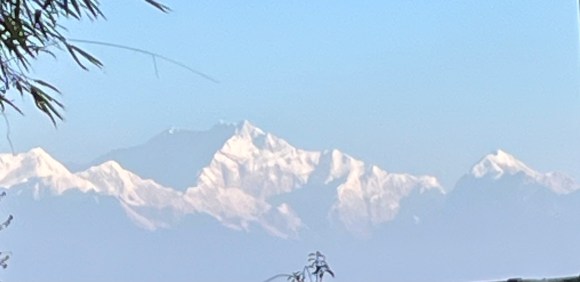
Snowy Kanchenjunga photographed from Darjeeling, West Bengal, in winters.
This poem has been translated from Bengali by Mitali Chakravarty with editorial input by Sohana Manzoor
.
PLEASE NOTE: ARTICLES CAN ONLY BE REPRODUCED IN OTHER SITES WITH DUE ACKNOWLEDGEMENT TO BORDERLESS JOURNAL
Nazrul’s Musafir, Mochh re Aankhi Jol(O wayfarer, wipe your tears) has been translated from Bengali by Professor Fakrul Alam.
Art by Sohana Manzoor
O wayfarer! Wipe your tears,
Return only with yourself.
The flower blooming on its own
Shed all by itself.
O foolish one! So hapless is your state,
Will you now build your nest in water?
Thirsts are not quenched here
For this is no lake to allay thirsts.
Will the bokul that didn’t bloom in monsoon
Blossom when it’s winter?
On this path forever, errors shed
Covering the grove of frustration.
Oh poet! You’ve illuminated many lamps
With your own light
But your own revered Krishna hasn’t come
To light up the darkness pervading your world.
A rendition of the lyrics by Feroza Begum (1930-2014) in original Bengali
Born in united Bengal, long before the Partition, Kazi Nazrul Islam(1899-1976) was known as the Bidrohi Kobi, or “rebel poet”. Nazrul is now regarded as the national poet of Bangladesh though he continues a revered name in the Indian subcontinent. In addition to his prose and poetry, Nazrul wrote about 4000 songs.









 Borderless