Categories
Slices from Life

Heatwave & Tagore

Once more, Ratnottama Sengupta explores the contemporariness of Tagore ….

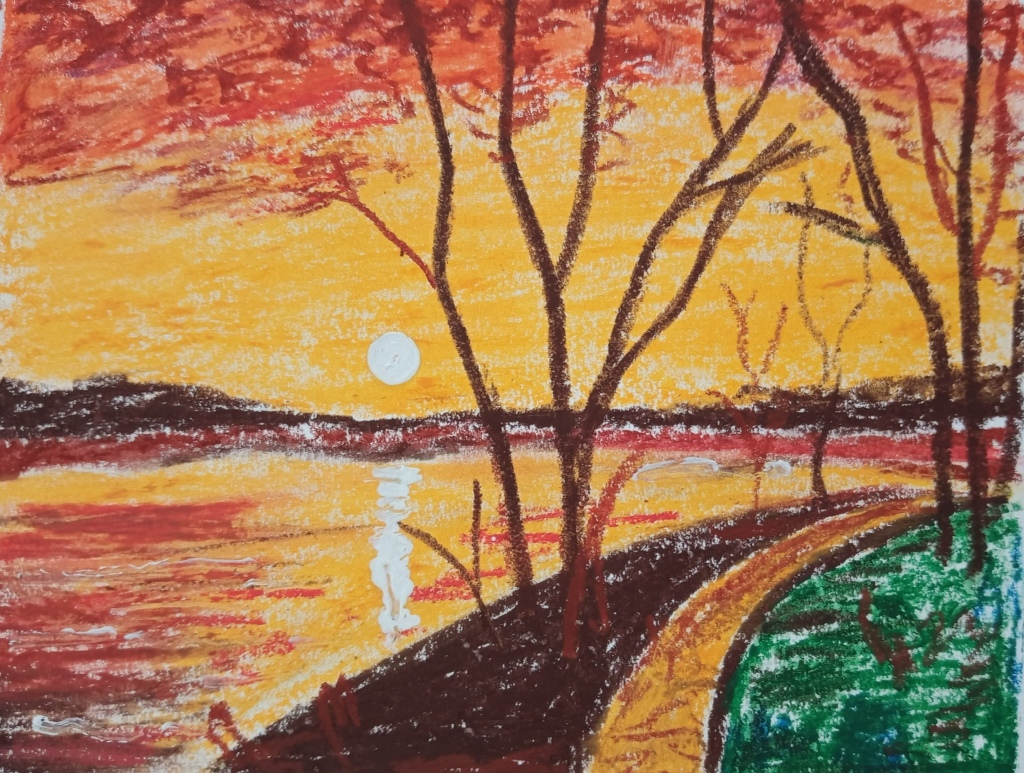
The continuing heatwave in Kolkata that has defied the geographical reality of Kaal Baisakhi — the norwester that brings relief to sun-scorched beings — prompted me to continuously hum this Tagore song in Brindavani Sarang Raag, written in 1922.

Darun Agni Baaney Re... 
(Shafts of Fire)


Shafts of fire pour thirst on us --
Sleepless nights, long scorching days,
No respite in sight!
On withered branches,
A listless dove wails
Droopy doleful notes...
No fear, no scare,
My gaze is fixed on the sky,
For you will come in the
Form of a storm,
And shower rain on scorched souls.

And as I kept singing the song first penned in Santiniketan, I marvelled at the creativity of the giant whose words are true to this very day, more than 100 years later!

Kaal Baisakhi, the nor’wester known in Assam as bordoisila, is a localised rainfall and thunderstorm event which occurs in the Indian states of West Bengal, Bihar, Jharkhand, Odisha, Tripura, and Assam as well as in Bangladesh during the summer month of Baisakh (April 15-May 14). This first month of the Bengali calendar also saw the birth of Rabindranath Tagore. These storms generally occur in the afternoon or just before sunset, when thick dark black clouds appear over the sky and then bring gale-speed wind with torrential rain, often with hail, but spanning only a short period of time.

Kalbaisakhi

Tagore’s love for Nature had compelled him to set up in Santiniketan open air classrooms, where students would learn sitting on the ground in the bower, under trees where birds would chirp and gentle breeze would caress their tired brows.

And, his involvement also expressed itself in the 293 songs he wrote in the segment titled Prakriti (nature) Parjaay. There are songs about nature in general. But he himself further classified the songs under subsections — Upa parjaay — that focus on the six seasons: grishma (summer), barsha (Monsoon), sharat( early autumn), hemanta (late autumn or early winter), sheet (winter), basanta (spring). 

Tagore clearly was taken up by the wild beauty of monsoon with its dark clouds and thunderous showers. For, he wrote 150 songs on the drops of nectar from the heavens, while summer elicited a tenth of this number! If this is half the number celebrating sharat, the festive season of Durga Puja, it is thrice the number dedicated to hemanta, the confluence of autumn and winter.

I take heart in the fact that Grishma subsection includes Chokkhe aamar trishna, Ogo trishna aamar bakkho jurey… [1]

Thirst fills my eyes, Dear, 
Thirsty is my heart too...
I'm a rain-starved day of Baisakh
Burnt by the sun, heat stroked.
There's a storm brewing
In the ovenated air..
It sweeps my mind into the distance.
It rips me of my veil.
The blossom that lit up the garden
Has withered and fallen.
Who has reined in the stream
Imprisoned in heartless stone
At the peak of suffering?

And then, when it rained? The torrents poured balm on the angry burns. The fleet-footed lightning seared the heart of the cloud-covered darkness and extracted the nectar-like flow…

It assured us that no hardship lasts forever. It reiterated faith in the eternal words, “This too shall pass!” And, for me? It confirmed Tagore’s words that “You will come in the form of a storm and shower rain on scorched souls…”

Tagore lives on, 163 years after he came. In his words. In his imagery. In his empathy with every human situation…

[1] Thirst fills my eyes, Dear, /Thirsty is my heart too…

Ratnottama Sengupta, formerly Arts Editor of The Times of India, teaches mass communication and film appreciation, curates film festivals and art exhibitions, and translates and write books. She has been a member of CBFC, served on the National Film Awards jury and has herself won a National Award. 

.

PLEASE NOTE: ARTICLES CAN ONLY BE REPRODUCED IN OTHER SITES WITH DUE ACKNOWLEDGEMENT TO BORDERLESS JOURNAL

Click here to access the Borderless anthology, Monalisa No Longer Smiles

Click here to access Monalisa No Longer Smiles on Amazon International
Categories
Contents

Borderless April, 2024

Art by Sohana Manzoor

Editorial

April Showers… Click here to read.

Translations

Baraf Pora (Snowfall) by Rabindranath Tagore, gives a glimpse of his first experience of snowfall in Brighton and published in the Tagore family journal, Balak (Children), has been translated from Bengali by Somdatta Mandal. Click here to read.

Himalaya Jatra ( A trip to Himalayas) by Tagore, has been translated from his Jibon Smriti (1911, Reminiscenses) by Somdatta Mandal from Bengali. Click here to read.

Bhumika (Introduction) by Tagore has been translated from Bengali by Ratnottama Sengupta. Click here to read.

The Fire-grinding Quern by Manzur Bismil has been translated from Balochi by Fazal Baloch. Click here to read.

The Tobacco Lover by Ihlwha Choi has been translated from Korean by the poet himself. Click here to read.

Pochishe Boisakh (25th of Baisakh) by Tagore(1922), has been translated from Bengali by Mitali Chakravarty. Click here to read.

Pandies Corner

Songs of Freedom: Dear Me… is an autobiographical narrative by Ilma Khan, translated from Hindustani by Janees. These narrations highlight the ongoing struggle against debilitating rigid boundaries drawn by societal norms, with the support from organisations like Shaktishalini and pandies’. Click here to read.

Poetry

Click on the names to read the poems

Michael Burch, Kirpal Singh, Scott Thomas Outlar, Nusrat Jahan Esa, George Freek, Snigdha Agrawal, Phil Wood, Pramod Rastogi, Stuart McFarlane, Ahmad Al-Khatat, Shamik Banerjee, Ryan Quinn Flanagan, Lisa Sultani, Jenny Middleton, Kumar Bhatt, Rhys Hughes

Poets, Poetry & Rhys Hughes

In The Desk, Rhys Hughes writes of his writerly needs with a speck of humour. Click here to read.

Musings/Slices from Life

Heatwave & Tagore

Ratnottama Sengupta relates songs of Tagore to the recent heatwave scorching Kolkata. Click here to read.

The Older I get, the More Youthful Feels Tagore

Asad Latif gives a paean in prose to the evergreen lyrics of Tagore. Click here to read.

No Film? No Problem

Ravi Shankar takes us through a journey of cameras and photography, starting with black and white films. Click here to read.

Musings of a Copywriter

In Witches and Crafts: A Spook’s Tale, Devraj Singh Kalsi finds a ghostly witch in his library. Click here to read.

Notes from Japan

In Of Peace and Cheese, Suzanne Kamata gives us a tongue in cheek glimpse of photo-modelling mores. Click here to read.

Essays

Discovering Rabindranath and My Own Self

Professor Fakrul Alam muses on the impact of Tagore in his life. Click here to read.

The Lyric Temper

Jared Carter explores the creative soul of poets through varied times and cultures. Click here to read.

Bengaliness and Recent Trends in Indian English Poetry: Some Random Thoughts

Somdatta Mandal browses over multiple Bengali poets who write in English. Click here to read.

Stories

Hope is the Waking Dream of a Man

Shevlin Sebastian gives a vignette of life of an artist in Mumbai. Click here to read.

Viceregal Lodge

Lakshmi Kannan explores patriarchal mindsets. Click here to read.

The Thirteen-Year Old Pyromaniac

Paul Mirabile gives a gripping tale about a young pyromaniac. Click here to read.

Conversation

Ratnottama Sengupta in conversation about Kitareba, a contemporary dance performance on immigrants, with Sudarshan Chakravorty, a choreographer, and founder of the Sapphire Dance Company. Click here to read.

Book Excerpts

An excerpt from Jessica Mudditt’s Once Around the Sun – From Cambodia to Tibet. Click here to read.

An excerpt from Bhaskar Parichha’s Biju Patnaik: The Rainmaker of Opposition Politics. Click here to read.

Book Reviews

Meenakshi Malhotra reviews Mahasweta Devi: Writer, Activist, Visionary, edited by Radha Chakravarty. Click here to read.

Basudhara Roy reviews Out of Sri Lanka: Tamil, Sinhala and English Poetry from Sri Lanka and its Diasporas, edited by Vidyan Ravinthiran, Seni Seneviratne, Shash Trevett. Click here to read.

Swagata Chatterjee reviews Sanjukta Dasgupta’s Ekalavya Speaks. Click here to read.

Bhaskar Parichha reviews Bhang Journeys: Stories, Histories, Trips and Travels by Akshaya Bahibala. Click here to read.

.

Click here to access the Borderless anthology, Monalisa No Longer Smiles

Click here to access Monalisa No Longer Smiles on Amazon International
Categories
Tagore Translations

Snow & Petals of Parijat

Travel writing by Tagore: Translation by Somdatta Mandal

In 1885, under Jnanadanandini’s1 editorial venture, a children’s magazine called Balak was published from the Tagore household in Calcutta. It contained different writings of the young Rabindranath, who would handle a lot of things for the publication. This magazine was later merged with Bharati and edited by his elder sister, Swarnakumari Devi. Among the different entries that Rabindranath contributed for Balak are two interesting travel pieces. One travelogue published in Vol. 3, Ashar 1292 B.S. (July-August 1885) called “Das Diner Chhuti” (Ten Days’ Holiday) narrates his trip to Hazaribagh that year along with his nephew and niece during their school holidays. The second one called “Baraf Pora” (Snowfall) describes his first experience of snowfall in England in the winter of 1878 when he was living in Brighton along with his brother Satyendranath’s family2.

Rabindranth Tagore (1861-1941) in England
Baraf Pora (Snowfall)

The outlines of pictures gradually blur out of the mind; the shadows of all that we see every day come ahead and crowd it, replacing the things we had seen a few days earlier. We cannot clearly understand where the earlier images get lost in the melee.

I went to England in the year 1878 A.D. That was about seven years ago. At that time, I was young too. I can remember overall what I had seen in England, but all her pictures are no longer clear in my mind. I cannot match one line with another. A kind of mist has already descended on my memories of England. The pictures must be brought out occasionally and aired in the sun. That is why I have brought out my memories in the sunlight today.

It was the middle of October when I reached England. I didn’t feel it to be too cold then. We stayed in Brighton. It was sunny in Brighton then. Happy with the sunshine, all men, both young and old, had come in hordes to the seashore. The sick and the elderly people moved in pushcarts with one or two young girls or any other member of the family accompanying them. The ladies were dressed up in different kinds of clothing with umbrellas over their heads. Small boys dragged iron wheels and ran along with them. Some ladies sat on the seashore with open umbrellas over their heads. Some were busy following the movement of the waves and collecting different kinds of seashells. An Italian beggar was moving around playing an organ. Vegetable and milk vendors were returning after supplying their products in different houses. A man and a woman were riding their own horses on the pathway and the dressed up stable boys were following them. Some schoolmasters were walking with a big group of boys following them; on the other hand, each schoolmistress had a whole trail of schoolgirls following her. They had come to enjoy the sea breeze, or if not, at least the sunshine. Quite often we would run around the grassy fields near the seashore. Though the age was not conducive for running around, we didn’t mind because no one suitable was present there to criticise us for our out-of-the-way behaviour. The best time for our outing was ten or eleven o’clock in the morning. Whatever it might be, the seaside was celebrating the festival of sunshine when we reached Brighton.

As the days went by, the cold started increasing. The mud on the streets froze in the cold weather. The dew on the grass would freeze too and it seemed as if someone had scattered lime powder everywhere. On waking up in the morning I found that ice crystals had formed different designs on the windowpane. Sometimes I also found one or two sparrows that had died in the cold lying on the road. The few yellow leaves remaining on the trees also fell down, leaving the lean bare branches behind. The small little robin birds came to the glass windows with reliable hearts begging for bits of bread. Everyone assured us that we would soon witness snowfall. 

Christmas was almost approaching. It was biting cold on a moonlit night. The doors and the windows of the room were all shut tight with the curtains drawn over them. The gas was burning. A fire was lit to warm up the place. After dinner we were all around the fireplace busy chatting. The two young boys attacked me. Despite having plenty of proof, I do not want to mention here that they never behaved politely with me. They have grown up now, they even read Balak; so, I do not want to write about them and then make my life more miserable answering their questions. A few days later they will also learn to protest. Because I would not be able to counter them, I remained quiet. You readers can guess whatever you like about their behaviour – I will not volunteer to take any responsibility on my shoulders.

Everyone was sitting warm enough when suddenly we got the news of the snowfall. As all our doors were shut, we did not know when it began. All of us including the children ran outside to see the beautiful sight. The cold seemed to have frozen the moonlight in layers and stuck on the streets, on the grass, the bare branches, the sloped slate roofs. There was no one on the street. All the houses in front of us had their doors and windows shut. The night and quietness, the moonlight and the snow all blended to create a wonderful scene! The children (and I too) picked up the snow on the grass and turned it into little balls. As soon as we brought them in, they melted into water.

For me this was the first night of snowfall. After this I have seen snowfall several times. But describing it is not easy, especially after so many years. I was walking on the street covering myself entirely in black woolen clothes. The sky was grey. Little flakes of snow were falling all around like quinine powder. It did not fall like raindrops – it came in lightly as if flying or dancing. It came and touched your clothes lightly; you could dust and collect them. The wheels of cars left their marks on the soft white layers of snow. One also felt sad to leave dirty and muddied shoe imprints on the white layer of snow. It seemed as if the petals of the parijat flower were falling from the sky. Snow also got stuck on the black dresses and black umbrellas of the pedestrians.

It was wonderful to watch how everything got covered with snow gradually. At first, it fell merely like some white streaks on the streets. There was a small plot of land in front of our house. It had a few saplings and creepers – no leaves on the shrubs but just bare branches. Those branches were still not covered with snow, so it was a mixture of green and white. The saplings seemed to be freezing in the cold. Their clothes were gone; wearing white funeral clothes of snow, the sap in their veins also seemed to be freezing. The black slate roof of the house was gradually turning grey and then white.  Soon the streets were also covered with snow – the small saplings got buried in it. The snow also piled up on the narrow windowsill. The noses of the few pedestrians on the street turned blue, their faces shriveled in the cold. Far off at a distance, the church steeple was faintly visible like a white ghost in the sky.

It is very difficult now in this hot and humid summer month to even imagine how cold it was. I remember how after taking a cold-water bath in the morning my hands would become so numb that I could not find the handkerchief in my pocket. There was no limit to the amount of warm clothes on my body. Despite the thick shoes and socks, the soles of my feet would become cold in no time. Even after getting inside a bundle of blankets at night, I would be worried how I would turn on the other side because whenever I turned, I would get a shock. We heard the story about four fishermen who had gone out to fish in the sea. When a ship came near their boat, they saw that the four of them had already frozen to death. The coachman who was sleeping on his carriage at night had also died. The water in the pipes often froze and caused the pipes to burst. Snow had covered up the River Thames. The lake inside Hyde Park was also frozen. Hundreds of people wore a kind of iron shoes and skated over that lake every day.

This skating was a wonderful affair. Hundreds of people wearing skating shoes turned and bent and twisted and glided over that hard lake. The way people skated was like the way a boat moved with its sail. With the body slightly tilted on one side, one could float easily on the ground. No effort was needed to step forward – one did not have to quarrel with the ground or defeat it with each footstep.

Trying to bring back the winter of England to our country even through our imagination is futile. The heat here rises very quickly, melts like the snow and cannot be grasped. It is not sufficiently welcomed within the blankets and quilts here. 

  1. Eldest sister-in-law of Tagore ↩︎
  2. Elder brother of Rabindranath Tagore and ↩︎

Rabindranath Tagore (1861 to 1941) was a brilliant poet, writer, musician, artist, educator – a polymath. He was the first Nobel Laureate from Asia. His writing spanned across genres, across global issues and across the world. His works remains relevant to this day.

Somdatta Mandal is a critic and translator and a former Professor of English at Visva-Bharati, Santiniketan, India.

.

PLEASE NOTE: ARTICLES CAN ONLY BE REPRODUCED IN OTHER SITES WITH DUE ACKNOWLEDGEMENT TO BORDERLESS JOURNAL

Click here to access the Borderless anthology, Monalisa No Longer Smiles

Click here to access Monalisa No Longer Smiles on Amazon International
Categories
Essay

Discovering Rabindranath and My Own Self

Musings by Professor Fakrul Alam

Apnake jana amar phurabe na/Ei Janare shongo tomai chena/

There will be no end to my discovery of myself/And this discovery keeps coming with my discovery of you

On the one hand, Rabindranath Tagore [1861-1941] has been with me almost all my life. On the other, I only began to discover that I had Rabindranath so centrally in me relatively late in my life. In fact, I have now realised that the process of discovering the way he has been embedded in me is part of the process of discovering my own self in the course of the life that I have been leading till now.  Indeed, at this stage of my life, it seems to me that there will be no end to my discovery of the way Rabindranath has become part of my consciousness since I feel that there will be no end to discovering myself till I lose consciousness once and for all. The one thing I can say with certainty, using his words but in my translation is “There will be no end to my discovery of myself.”  For sure, this process of discovering myself endlessly keeps happening with my continuing discovery of Rabindranath.

Surely, the process through which Rabindranath had become embedded in me began in childhood. However, I did not encounter his work in my (English medium) textbooks since I did not learn Bengali in school for a while. How then did I come to remember poems such as “Tal gach ek paye dariye/shob gach chareea/ Uki mare akaashe” (Palmrya tree, Standing on one foot/Exceeding all other trees/Winking at the sky”) or “Amader Choto Nadi chole bnake bnake” (“Our little river keeps winding its way”). How do I remember these opening lines even now? And why do I still associate such palm trees and winding little rivers with these lines even now whenever I am in the Bangladeshi countryside? Surely, it must have been my mother who planted Rabindranath in me in my seed time so that he would become embedded in my unconscious, only to surface in my consciousness decades later. It is surely no coincidence that she taught me Bengali and made me learn Rabindranath’s poems indirectly.

 As a boy growing up at a time when the radio was the main source of entertainment in middle-class Bengali houses, my siblings and I were made to listen to Rabindra Sangeet in our house by my father, who felt that he had to share his favourite songs and singers in the musical genre with us, whether we wanted to listen to them or not. Of course, at that age I would have much rather not listen to those solemn-sounding, soulful songs, and whenever I could put my hands on the radio dials, I would listen to English popular music on Radio Ceylon. My favourite singers were Pat Boone, Elvis Presley, Cliff Richards and—a little later—the Beatles. In school, when we were not playing or talking about sports or girls, we boys would be discussing the pop music we heard on Radio Ceylon. By the end of the 60s, we would be talking about the English thrillers and comedies we saw on Dhaka television. What place could Rabindranath have in one’s life then? If Rabindranath had been placed in my innermost self by my mother through her reading of his poems to us children or my father through his addiction to Rabindra Sangeet, for the moment he was getting occluded deep inside me and, it would now seem, all but forgotten!

But from the middle of the 1960s, our lives in Dhaka began to change as the claims of Pakistan on us East Pakistanis started to loosen, little by little. It was a time when in neighbourhoods and on streets, processions would come out singing gonosangeet—literally songs of the people, but in effect music of protest and patriotism.  First, the Six Points Movement and then the Agartala Conspriacy case were on everyone’s lips and East Pakistanis everywhere were becoming activists in one way or the other. There was no escaping songs like “Shonar Bangla” (“Golden Bengal”) or “Banglar mati, banglar jol, banglar baiuo, banglar phol/Punno houk”” ( “Let the land, the waters, the air and fruits of Bengal be blessed…) and “Bartho Praner Aborjona Purea Phele Agun Jalo” (“Burn the frustrated soul’s detritus and light up a flame”). In my school where we boys now studied “Advanced English” and “Easy Bengali”. There was no way we could have learned enough Bengali to read Rabindranath or Nazrul in the original in any sustained attempt, but how could we escape the call from such songs and poems like Nazrul’s “Bidrohi” (“The Rebel”) or the call from the streets to protest and even burn for our emancipation?  At home, three of my four sisters would be practicing Rabindra Sangeet regularly, since this was what my parents wanted them to do, and so there would be no evading Rabindranath’s songs at home for this reason as well, but I was more interested in friends and sports than staying home and so I would hear the songs only in snatches at this time.

By the end of the decade though, Rabindranath was everywhere in our lives since becoming Bengali became first and being a Pakistani only came later. Even on Dhaka Television, Rabindranath’s songs and dance numbers were being aired fairly regularly then. Outside, one could get to see his plays and dance dramas being performed every now and then in functions and cultural events all over the city. He would soon become an important part of Pohela Boisakh, which itself would become instantly popular amongst us all almost as soon as Chhayanaut[1] organised the first event in Balda Garden as the decade came to a close.  But while Rabindranath was everywhere around me all of a sudden, I was still not reading him at all, preferring English thrillers and westerns initially, and later, when I became a “serious” reader from college onwards, contemporary classics of English and European literature available in English editions.

In the early seventies, however, you could not be in Bangladesh without imbibing Rabindranath at least a little, for there was a process of osmosis at work at this time. Glued as we were to Swadhin Bangla Betar Kendro[2] during our Liberation War[3], we kept listening to his patriotic songs on our radios; the promise of Shonar Bangla seemed alive and possible then. The years after liberation, my generation was exposed to Rabindranath in new ways; we would get to hear and view singers like Kanika, Debobroto and Suchitra Mitra on stage in Dhaka; their songs became freely available in tapes in our shops; and Satyajit Ray’s film version of Rabindranath’s fiction and Ray’s documentary on him became staples of Dhaka’s film societies. I was finally growing up intellectually and was hungry for culture, and so how could I have escaped the poet’s works totally at this time?

But the Rabindranath that I was imbibing thus was almost entirely coming to me aurally and visually. Because he was becoming embedded in my consciousness through songs and the silver screen as well as television, he still inhabited the surface of my consciousness. And I was certainly not making any conscious bid to savor him. The seventies and the eighties were, in fact, decades when I was becoming an even more “serious” student of English literature than before and getting “advanced” degrees in my subject and acquiring expertise for my teaching career; where would I get the time to read Rabindranath then? As an expatriate student for six years in Canada and as a visiting faculty member for two years in the USA, I would be getting small doses of Rabindranath in those countries through the songs I kept hearing in the cassettes I had brought along of my favorite singers and in the occasional film versions of his work that I would get to see because of campus film societies, and I suppose nostalgia played a part in my yearning for him then, but I had no time to spare for him and not enough exposure to his works to let his ideas and his achievement resonate in me in any way.

To sum up my encounters with Rabindranath till then, I was discovering Rabindranath in small doses all the time and experiencing him directly here and there, but my knowledge was all very superficial and my understanding of him too limited. And nothing much had happened that would allow me to tap into the unconscious where all the memories of poems and songs by him I had first come across through my parents’ enthusiasm for his works were hidden.

“Dekha hoi nai chokkhu melia/Ghor hoite shudhu dui pa felia”/

“I haven’t seen with my eyes wide open/what was there only a stride or two away from my house”

In the 1980s, I became smitten by theory, especially the works of Edward Said, and suddenly questions of postcoloniality, ideology, power and location became all-important for my understanding of literature. I was coming around to the belief that I could not be a good and truly advanced student of English literature in Bangladesh, let alone a good teacher of the subject here, unless I sensitised myself to my roots and look at the world around me. And now I remembered some lines I had been hearing since childhood without realising their relevance for me and everyone else around us then: “Dekha hoi nai chokkhu melia/Ghor hoite shudhu dui pa felia” (“I haven’t seen with my eyes wide open/What was there only a stride or two away from my house”). Rabindranath had been all around me and yet I had not opened my eyes wide enough to learn from him. I had not read his works with any kind of sensitised attention at all and I had not been able to arrive at any kind of appreciation of his achievements except the smug sense of self-satisfaction at the thought that this Bengali had once won the Nobel Prize.

Towards the end of the 1990s, for the first time really, I plunged into Rabindranath and found—to quote Dryden on Chaucer— “here was God’s plenty”. Having opened my eyes to him I realized that there was so much to him than one could take in at any one time. He had once said in a song about the infinite contained in the finite and I now thought, “How appropriate of him!” He had said in one of his most famous poems, “Balaka[4]” about how one must not succumb to stasis and how the essence of life is motion and I thought, “how inspirational!” He had written in a song about viewing the Ultimate Truth through music and I thought “Exactly!” He had looked on in amazement in a starry night at how humans have a place in the cosmos (Akaash Bhora Surjo Tara[5]) and I thrilled at the idea now. He made me see the monsoonal kadam flower that I had passed every year without blinking an eye as immensely lovely. Every poem that I read enlightened me, every song lent my soul harmony, every short story or novel took me to eternal truths about human relationships. Who would not learn from a man who had been given some of the highest honors the world has offered any human being, when he says with such unambiguous humility, “Mor nam ei bole khati houk/Aami tomaderi lok…” Let this be my claim to fame/I am all yours/This is how I would like to be introduced.” And so I kept reading him in between teaching and writing, finding him an endless source of inspiration, creativity and wisdom. I strove to learn about nature, the universe, people, relationships, beauty and the dark side of humans through his works.  And soon I felt compelled to translate some of them.  

Rabindranath, then, opened my eyes not only to the world I lived in but also helped me discover my own self as a product of forces that had taken our nation past 1947 to true liberation. He helped root me in Bengali and Bangladesh as never before, making me discover myself not merely as a Bengali but as a citizen of the world, a product of a certain history but also of the history of mankind. My discovery of him and my place in the world was furthered by the work I did in co-authoring The Essential Tagore and authoring a collection of essays on diverse aspects of his work.

But Rabindranath truly contains multitudes. What I now realise is that it is impossible to discover him fully in one life, especially when one embarks on the process of discovery so late in life. By now, therefore, I have despaired of knowing the whole man and feel I will get to know only parts of him. But I also know whatever I read of him will enlighten me and make me know myself better in every way than before. And so I’ll keep reading him and translating him, if only to know him and myself better in the days left for me!  

[1] Centre for promotion of Bengali Culture established in 1961

[2] Free Bengal Radio Centre

[3] 1971 Bangladesh was liberated from Pakistan.

[4] Swans

[5] The Star-Studded Sky

.

Fakrul Alam is an academic, translator and writer from Bangladesh. He has translated works of Jibonananda Das and Rabindranath Tagore into English and is the recipient of Bangla Academy Literary Award (2012) for translation and SAARC Literary Award (2012).

PLEASE NOTE: ARTICLES CAN ONLY BE REPRODUCED IN OTHER SITES WITH DUE ACKNOWLEDGEMENT TO BORDERLESS JOURNAL

Click here to access the Borderless anthology, Monalisa No Longer Smiles

Click here to access Monalisa No Longer Smiles on Amazon International
Categories
Essay

Bengaliness and Recent Trends in Indian English Poetry: Some Random Thoughts

By Somdatta Mandal

It is clear that English is employed here not as a language on loan, but as the rich, spluttering resource of the marrow and the bloodstream.-- Arundhathi Subramaniam.

At the outset, let me make a candid statement. I am a very prosaic person, someone who in her long teaching career and academic writing as well as translation, has never ventured to write poetry myself. I might seem like the odd woman out, but somehow, I have been closely following the recent trends in which Indian Poetry in English has been rapidly spreading its wings and with new volumes being published every other day, it is now a force to be reckoned with.

Tomb of Henry Louis Vivian Derozio at the South Park Street Cemetery, Kolkata.

Recapitulating literary history briefly, it is well known that Indian English Poetry (or often called Anglophone poetry in India) is the oldest form of Indian English literature. Beginning roughly from 1850 to 1900, it went through the ‘imitative’ phase when Indian poets were primarily ‘romantic’ and tried to imitate the British masters. Beginning with Derozio[1], many poets of the time — namely Rabindranath Tagore, Sri Aurobindo, Sarojini Naidu, Michael Madhusudan Dutt, Toru Dutt — were also Bengalis by birth. The poetry written between 1900 to 1947 belonged to the ‘assimilative’ period and often questions were asked why the poets didn’t write in their ‘own’ languages. Post-independence poetry was primarily experimental, and when we come to contemporary Indian English poetry, we find it becoming wholly urban and middle-class. The poets are realistic and intellectually critical in the expression of their individualised experience. They go in for precision at all levels and do not stick to one genre but experiment with multiple poetic forms.

Interestingly, I realised that a whole host of Indian English poets writing at present (some have several volumes of poetry published already, whereas others have just given birth to one or two), but coincidentally many of them happen to be Bengalis — Bashabi Fraser, Sudeep Sen, Kiriti Sengupta, Sanjukta Dasgupta, Mitali Chakravarty, Angshuman Kar, Shyamasri Maji, Basudhara Roy, Radha Chakravarty, and others. It is not a complete list at all, and what makes this study more interesting is that except for a couple of them, all these poets come from an English literature background. It is also not a coincidence that most of them teach English as their profession. So, whether it be personal lyrics, free verse, memories, experiences, observations, or even translation, the English muse therefore gives them the impetus to experiment with all forms, and at the same time helps them to move away from themes like nationalism, nature, Indian culture, love etc. that dominated Indian English Poetry in earlier times.

Bashabi Fraser receiving her CBE (2021 The Queen’s New Year Honours) from Prince Charles, now King Charles III.

Bashabi Fraser is an Indian-born Bengali and a Scottish academic, editor, translator, and writer. She is a Professor Emerita of English and Creative Writing at Edinburgh Napier University. Fraser’s work traverse continents in bridge-building literary projects. She was appointed a Commander of the Order of the British Empire (CBE) in the 2021 New Year  Honours for services to education, culture and cultural integration in Scotland, in particular for her projects linking Scotland and India. Among her several volumes of poetry the Bengal and Bengali connection comes out in volumes like From the Ganga to the Tay: a poetic conversation between the Ganges and the Tay (2009), Letters to My Mother and Other Mothers (2015), My Mum’s Sari (2019), and Lakshmi’s Footprints and Paisely Patterns: Perspectives on Scoto-Indian Literary and Cultural Interrelations (2023). Fraser has worked extensively on a project about the Bengal Partition and the angst resulting from this divide expresses itself in the following poem.

This Border
Can shadow lines on the earth’s surface divide language and literature, rituals and customs, rivers…and memories?

There was a time when you and I
Chased the same butterfly
Climbed the same stolid trees
With the fearless expertise
That children take for granted
Before their faith is daunted
Do you remember how we balanced a wheel
Down dusty paths with childish zeal
Do you remember the ripples that shivered
As we ducked and dived in our river
Do you remember what we shared
Of love and meals, and all we dared
Together – without fears
Because we were one
In all those years
Before we knew that butterflies
Were free to share our separate skies
That they could cross with graceful ease
To alight on stationary trees
On either side of this strange line
That separates yours from mine
For whose existence we rely
Entirely on our inward eye
This border by whose callous side
Our inert wheel lies stultified
This border that cuts like a knife
Through the waters of our life
Slicing fluid rivers with
The absurdity of a new myth
That denies centuries
Of friendships and families
This border that now decrees
One shared past with two histories
This border that now decides
The sky between us as two skies
This border born of blood spilt free
Makes you my friend, my enemy.

Another well-established poet is Sudeep Sen who studied in New Delhi and in the United States and is a global citizen, so to say. Sudeep’s literary output is enormous and some of the titles of his volumes of poetry have subtle references to Indianness and Bengaliness embedded in them as well. Mention may be made of volumes like Leaning Against the Lamp-Post (1983), The Man in the Hut (1986), Kali in Ottava Rima (1992), Postmarked India: New & Selected Poems (1997), and several others. Though he might not do it consciously, his Bengaliness remains embedded in his psyche.

Kiriti Sengupta who has been awarded the Rabindranath Tagore Literary Prize (2018) for his contribution to literature, is a poet, editor, translator, and publisher. What is more significant is that along with Bitan Chakraborty, he mans the publishing house Hawakal, which has already carved a niche for itself as the largest publisher of Indian Poetry in English. Several poets mentioned in this essay have seen their creations see the light of the day through Hawakal Publishers and they have done yeomen service in this regard. As an established poet, Sengupta has several volumes of poetry to his credit. His collection from 2019, called Rituals, is very different from the work readers usually read in that there is a narrative thread in many poems that is not there simply to tell a story but to ultimately present a meditation on an aspect of life and the modern world that they haven’t considered before. “Fleeing the house and leaving the doors ajar. Is it perversion or fallacy?”

In an earlier volume entitled Solitary Stillness (2018), Sengupta does not give away the traits that have pervaded his poetry, he has not forgotten his Bengali roots, and has once again drawn his poetry on the canvas of the time that has been rooted in Calcutta. As he elaborates upon this point in his professional website, here, he makes a reference to Lapierre, and indeed, the ‘city of joy’ tag sounds fake just as we read that particular poem, which is so natural, that it almost appears to have been spoken by a resident of a city, one who is not a poet. According to him, that person who complains about water logging or that person for whom any tag of romanticism about the city is bourgeois, it is nothing but a label that’s needed to promote consumerism.

Mitali Chakravarty, the indefatigable editor of Borderless Journal, wrote to me saying that she is happy I feel she belongs to Bengal, “I call myself a Bengali and a human”. Though a non-resident Bengali, her perception of her own work and Bengali cultural identity is clearly revealed in a poem published in The Daily Star (Bangladesh)[2].

Confused

I am mixed up – cannot help
English and Bengali under my belt

I can read a bit of Hindi
Cannot understand much of French
A little Chinese …low class, they said…
I am mixed up – cannot help
English and Bengali under my belt

I grew up thinking I will find a way
But now pidgin is all that I can say
I write in English – the language borrowed from the West
The language that taught us or brought us unrest
The language that through The Raj spread
Importing Nationalism in its tread
I am mixed-up – cannot help
English and Bengali under my belt

But my life is that of the non-English
A probashi Bengali at best

People say I am not typical, not quite the right type
A mixed-up Bengali – I said
Culture is something I dread at every tread
Because what Culture I have is mine
- Not of a Race, a Country or Religion –
Human Being is the only race to which I belong

Help protect my home, the Earth – its every drop, its every stone

In a world of 7.7 billion, can I be alone?
I am mixed up – cannot help
English and Bengali under my belt

Though she has been writing poetry for a long time, Mitali’s first poetry collection, Flight of the Angsana Oriole: Poems was published by Hawakal only in October 2023. In the ‘Introduction’ to this volume, she states that her random collection of poems “are sometimes of the past” as she knew it and “sometimes of the present. And sometimes in quest of a future or a dream that she hopes will go to create a more hopeful future than the world presents to us currently.” The poems in this volume are personal; some talk of her journey through life, the world as she sees it, some even influenced by her travels across the world. She further states: “Inherent in each line is not just the influence of my experiences in many countries but the nurturing I had in India, where I was born, educated and spent the first two decades of my earthly existence.” So, poems like ‘Death of Lalon’, ‘Shivratri’, ‘Kali Rise’, ‘Shraddha‘ [last respects] and a few others do convey the subconscious Bengaliness embedded in her psyche, irrespective of where she physically resides now.

Radha Chakravarty, a prolific writer and translator, Former Professor of Comparative Literature and Translation Studies at Ambedkar University, Delhi, has recently joined the bandwagon of Indian Poetry in English with her debut collection of poems Subliminal published by Hawakal Publishers in 2023. In a detailed interview given to Mitali Chakravarty for the March issue of Borderless Journal[3], she tells us about her aims and ambitions as a poet and how most of the poems in Subliminal are independent compositions, not planned for pre-conceived anthology.

My poetry actually delves beneath surfaces to tease out the hidden stories and submerged realities that drive our lives. And very often, those concealed
truths are startlingly different from outward appearances. I think much of my poetry derives its energy from the tensions between our illusory outer lives and the realities that lurk within.

Many of Radha Chakravarty’s poems express the feeling of Bengaliness in different perspectives. We read about the typically soft quilt called kantha in Bengali in the poem ‘Designs in Kantha‘ thus:

Sewn into soft, worn layers,
forgotten fabric of grandmother tales –
patterns of the past,
secret memories, hidden designs,
intriguing patterns in silk strands
dyed in delicate dreamy shades—
embroidered storylines
in exquisite, dainty kantha-stitch.

When Mitali Chakravarty asks her why she writes in English though it isn’t her mother tongue, she answers:

Having grown up outside Bengal, I have no formal training in Bengali. I was taught advanced Bengali at home by my grandfather and acquired my deep love for the language through my wide exposure to books, music, and performances in Bengali, from a very early age. I was educated in an English medium school. At University too, I studied English Literature. Hence, like many others who have grown up in Indian cities, I am habituated to writing in English. I translate from Bengali, but write and publish in English, the language of my education and professional experience. Bengali belongs more to my personal, more intimate domain, less to my field of public interactions….
Both Bengali and English are integral to my consciousness, and I guess this bilingual sensibility often surfaces in my poetry. In many poems, such as ‘The Casket of Secret Stories,’ ‘The Homecoming’ or ‘In Search of Shantiniketan’, Bengali words come in naturally because of the cultural matrix in which such poems are embedded.

 Of course, the poet also mentions that all her poetry is not steeped in Bengali. In fact, in most of her poems, Bengali expressions don’t feature at all, because the subjects have a much wider range of reference. As a globe trotter, Radha has written about different places and journeys between places.

Another debut book of poems that Hawakal Publishers brought to light in December 2023 entitled Forgive Me, Dear Papa and other poems is written by Shyamasri Maji, an Assistant Professor of English teaching at Durgapur Women’s College, West Bengal. Dedicating this collection of poems to her “incurably romantic self,” Maji feels that “being ‘romantic’ in this context is being imaginative, reflective, puerile, rebellious and emotional.” The poems are a mixed bag, belonging to different thematic issues. Some focus on a woman’s radical views on the gender hierarchies in our society, in some nature plays the role of mediator between the narrator and the world, the idea of loss of love, which is closely linked with thoughts of death, while a few poems also represent an interpersonal dialogue between the self and the other. Some of Maji’s poems focus on the role of memory whereas some are experimental in the sense that they portray a woman’s comprehension of a man’s thoughts. Stressing upon the fluidity of identities, she shows how love, pain, pandemic, separation and grief affect all human beings irrespective of an individual’s gender and sexual orientation.

Six books of published poems and twenty-five years of creative journey has been a consistent exploration by the poet Sanjukta Dasgupta as she tries to find the path of freedom from among the misleading mesmeric mazes that threaten and stifle both sense and sensibility. As a woman poet with a strong feminist stance, Dasgupta admits in an online interview given to Basudhara Roy[4]:

Though I read Bangla poetry since my schooldays, I wrote my poems in English. It was an unconscious choice. Much later I learnt that I should have been embarrassed about writing in English rather than in my home language, my mother tongue Bangla. The poems written in English kept on being born on the page with embarrassing regularity.

She further states in the same interview[5]:

Writing poetry is an irrepressible urge for me. It is, in a way, far more intense than the biological labour pain. This labour pain of creativity leaves me restless till the words are born on the page. But the creative process allows endless revisions; a biological production is largely about acceptance, neither revision nor deletion are considered ethical practices. In the case of poetry, it is not about choice, it is a compulsion which is intense and gratifying and multiple revisions often lead to the emergence of the perfect product.

The title of Dasgupta’s poetry book Lakshmi Unbound (Chitrangi, 2017) is very significant. Lakshmi being an intrinsic part of the fabric of Bengali culture, the radicality and dissidence of the idea of ‘Alakshmi[6]’ will require no explanation to a Bengali reader.

She thinks the core agenda in Lakshmi Unbound is a defiant, determined search for freedom.  So, it is not just deconstruction, it is an endeavour to call attention to the need to destabilize the deep-rooted stereotypes that have controlled the minds and mobility of women. In Sita’s Sisters (Hawakal, 2019), she crafts a revisionist feminist mythology by taking up familiar figures like Sita, Lakshmi, Kali, Mira and attempts to free these mythic figures from their claustrophobic space so that they can be re-invented in sync with the contemporary times. 

Residing in Jamshedpur, in the state of Jharkhand, Basudhara Roy is an established poet and has several books and publications to her credit. In her own website, is stated: “Committed to an undying affair with words, Basudhara finds in poetry an epistemological and existential skylight. She writes because she feels she must test words on her tongue, pulse, moods, agitation, abstraction and satire. She is convinced that words can change the world and hence, she works at them in her own culinary way – washing, peeling, grating, pounding, baking, sautéing, kneading, roasting, often flaming them for what they might yield.”

The following poem from Stitching a Home (Red River, 2021) considers the eternal problem of a woman that plagues women writers a lot.

The Right Kind of Woman

The right kind of woman will
inspire affection, regard, trust.
Not promiscuity, never lust.

Bred by a mother equally right,
she knows to avert her eyes to
innuendoes, telling smiles.

In crowded buses, shops, streets,
she knows to shut tight, bud-like,
relinquish space, circumscribe limbs.

Above all, she knows the prudence
of holding her tongue, of choosing
silence’s worth over wordy rebellion.

Schooled to surrender in dark
rooms, she knows, unasked, to
feign desire, moan, stifle, sigh on cue.

On her forehead, she had a
third eye to emit fire, take sides,
rake storms. Last night, its lid rusted

with disuse fell out, and the right kind
of woman laughed herself to death
over all she had left undone, unsaid.

“Writing poetry is an isolation exercise” says Angshuman Kar, an established Bengali poet who by profession is also an English Professor at a university in West Bengal. His book of poems Wound is the Shelter (Hawakal, June 2023) is unique and different from the other volumes discussed here because the poems are all translated by the poet himself from his original Bengali poems. In the ‘Introduction’, Kar tells us that authors who translate themselves often seem to be unhappy about the task of translating their own works. The Marathi poet Arun Kolkatkar likens it to incest, — “like making love to your own daughters.” Critics of translation studies have both supported and criticised self-translation. Those who support it argue that the author knows their work the best and hence s/he is the best translator of their own work. Those who oppose self-translation argue that the author-translator takes too much liberty while translating his/her own work; thus, the translation hardly remains faithful to the original. In such a situation Kar says, “Without being critical, I must say that I love self-translation. I enjoy translating my own work, I love committing incest. It makes me a better poet…. As a self-translator, I find incest healthy. It makes me a better poet – il miglior fabbro.

Coming to the individual poems in Wound is the Shelter, it need not be reiterated that most of them portray universal feelings but at the same time are seeped in Bengali culture as well. In “My Poems” Kar talks about Jungle Mahal, the three districts of West Bengal that are full of jungles; in “World,” he writes about blooms of a sal tree and shiuli flowers; in “Memory Card” he talks about a bus ride to reach his maternal uncle’s house in Bankura from where he went to the studio to take a family photograph — “Grandma in the middle/On either side we – three brothers, two sisters and a cousin”. In “Father” he mentions how his father’s bereavement fades with time and how his portrait adorns the wooden throne in which gods and goddesses are kept and he stands with Kali, Shiva and Durga. In “Neelkantha” he refers to Shiva; in “Park” he states how man forgets grief when he comes to a park, “That is why in a city as sad and lonely as Kolkata the number of parks is always high.” The five-part poem “Tiger” is also very powerful, “there is a tiger inside every human being” he states. Kar also mentions about the mask of a demon of Chhou dance of Purulia, the aal path in paddy fields, the Chandi mandap[7] of a small village, the man called Bhagaban Das who labours in a factory, and the man called Shubhasis Babu who rents him cars, whose voice he hears but has not seen him. Thus, even in his transcreated poems, Kar’s Bengaliness expresses itself overtly.

It is not possible to analyse the poems of each of the Bengali poets that I have mentioned above within the purview of this single essay, and so I have just selected a few of them (especially the poets who have one or two volumes to their credit at present). As mentioned earlier, though Bengali by birth, all the poets rendering their emotions in English, do often consciously or unconsciously express multicultural elements, Bengali cultural nuances, and idiomatic force in their poems. As the trend for providing glossary is passe now, much is left to the readers’ imagination, but still certain occasional Bengali words and phrases make their poems even more appealing.

After sharing my random thoughts about Indian Poetry in English in general and selectively mentioning a few Indian English poets who also happen to be Bengali and often unconsciously exude a sort of Bengaliness in some of their poems, without attempting to sound rather parochial, I wholeheartedly wish to see more volumes of their poetry being published in future. I conclude by quoting a very salient observation made by Arundhathi Subramaniam who is not wholly optimistic about the situation, but believes that despite hurdles in publishing, the voices of Indian poets writing in English would be heard [8]:

Despite the clunky discourse that continues to hover around it, however, Indian poetry in English endures, even flourishes, seventy years after Independence. Publishers may be few and far between, the royalties meagre, the critical climate thick with indifference or theoretical bluster, and the poets themselves bewildered by disputes over their identity, even their existence. But poetry, in its mysteriously resilient fashion, continues to be written, shared and discussed (if sometimes with more passion than discernment). … I am not ecstatic about the state of Indian poetry in English. (But then I am not ecstatic about poetry; only, at times, about poems.) What I do know is that Indian poetry in English is alive. And like all things alive, it engages, it annoys, it provokes, it excites. On several occasions, it has given me the jolt of wonder for which I turn to poetry in the first place.

Considering the slightly mellow tone in Subramaniam’s observation, I personally feel Indian English Poetry has become a significant force in the literary arena at present and will grow stronger with time. Seasoned poets who have several volumes of poetry published already, as well as the fresher ones whose debut volumes promise a lot more to come in future, can all look forward to seeing their ‘spontaneous overflow of powerful emotions’ in print and carry on the legacy of Indian Poetry in English to newer heights. And sure enough, the sub-genre of Bengali Indian English poetry can be researched in greater details in future.

.

[1] Henry Louis Vivian Derozio (1809–1831), poet and assistant headmaster of Hindu College, Calcutta, a radical thinker and started the Young Bengal Movement.

[2] Published in November, 2019. See http://www.thedailystar.net

[3] https://borderlessjournal.com/2024/03/14/the-subliminal-world-of-radha-chakravartys-poetry/

[4] https://lucywritersplatform.com/2022/05/12/sanjukta-dasgupta-in-conversation-with-basudhara-roy/

[5] Ibid.

[6] Alakshmi is one who is opposite of Lakshmi, a goddess who embodies prosperity and well being.

[7] Chandi Temple

[8] Subramaniam, Arundhathi. “Beyond the Hashtag: Exploring Contemporary Indian Poetry in English.” Indian Writing In English Online, 6 May 2022, https://indianwritinginenglish.uohyd.ac.in/beyond-the-hashtag-exploring-contemporary-indian-poetry-in-english-by-arundhathi-subramaniam/.

Somdatta Mandal, critic and translator, is a former Professor of English from Visva-Bharati University, Santiniketan, India.

.

PLEASE NOTE: ARTICLES CAN ONLY BE REPRODUCED IN OTHER SITES WITH DUE ACKNOWLEDGEMENT TO BORDERLESS JOURNAL

Click here to access the Borderless anthology, Monalisa No Longer Smiles

Click here to access Monalisa No Longer Smiles on Kindle Amazon International

Categories
Tagore Translations

A Trip to the Himalayas by Rabindranath Tagore

‘Himalaya Jatra’ (A trip to the Himalayas) has been excerpted from Jibon Smriti[1] and translated by Somdatta Mandal.

Jibon Smriti by Rabindranath Tagore (1861-1941)

After my head was shaved for the upanayan (sacred thread) ceremony, I was seriously troubled thinking how I would go to school. However serious attraction the European boys had towards the bovine race; they did not have that much respect for the Brahmins. So even if they did not throw anything over the shaven head, they would surely make fun of it.

While I was worried with such thoughts, I got a call one day from the room on the second floor. Father asked me whether I would like to go with him to the Himalayas. If I could shout the words “Yes I do” at a sky-rendering tone, then the feelings of my heart would have been suitably expressed. Where was the Bengal Academy and where the Himalayas!

Before leaving, Father assembled everyone in the house and according to his tradition did the upasana – the traditional prayers. After paying obeisance to all the elders I entered the coach along with Father. At my age, this was the first time that clothes had been tailored for me. Father had personally ordered the colour and the quality of the fabric. A round velvet cap with design in zari [2] was also made for me. I held that in my hand because I felt reluctant to wear it on my shaven head. As soon as I entered the coach, Father ordered, “Wear it on the head.” He did not leave any scope for untidiness and so I had to wear that cap over my shameful head. In the train, I would take it off whenever I got an opportunity to do so but that did not escape Father’s notice. So, I had to keep it in its right place.

Right from youth to maturity, all the ideas and work of my father were always perfect. He could not leave anything hazy in his mind and could not do any work in a haphazard manner. For him his duty towards others and the duty of others towards him were defined very clearly. By nature, we are an easy-going people and not concerned when we deviate a little here and there. So, we were always very scared and alert about our behaviour towards him. Though it did not cause any serious damage, he felt hurt if there was any deviation from his agenda. Before making any resolution, he would mentally visualise everything clearly in all its details. So, for any occasion he would plan where each object should be placed, who would be placed in which position, who would be entrusted with which responsibility and to what extent there would be no deviation from that on any account. After the work was complete, he would gather reports from different people. Then he would compare each description and by putting them together in his mind, tried to see everything clearly. In this respect he did not possess our national character at all. There was no chance for the minutest deviation in his resolutions, thoughts, behaviour and performance. For this reason, for all the days I was with him on this trip to the Himalayas, I had plenty of freedom on the one hand but on the other, all my behaviour was determined in such a manner that it could not be transgressed. When he declared a holiday then he would not prevent one doing anything for any reason whatsoever; when he fixed some rules then he didn’t leave any scope for minute lapses.

Before our journey to the Himalayas commenced, we were supposed to stay for some days at Bolpur. Satya had gone there some time back with his parents. No nineteenth century child from any respectable household would ever believe his travel accounts. But we had not yet learnt to decipher the demarcating line between possible and impossible acts. Even Krittibas or Kashiram Das could not help us in this matter. The colourful children’s books and magazines with pictures in them did not warn us beforehand about the difference between fact and fiction. We had to learn the hard way that there was strict discipline in the world.

Satya[3] had told me that boarding the train was a dangerous act and one could not do it if one did not have special abilities for it. There was no way to save oneself if one slipped and fell. Also, when the train would start moving after that, they would need to assemble all the strength in the body and force themselves to sit down otherwise they would be pushed in such a strong manner that everyone would just get thrown out, scattered, and lost. So, I was quite scared when I reached the station. But when I got onto the train so easily, I started doubting whether the actual part of the boarding was yet to take place. After that when the train started to move very smoothly then I became demoralized that there was no sign of danger.

As the train kept on moving rows of green trees, blue bordered fields and shady villages ran past on both sides like a flood of mirages. We reached Bolpur in the evening. As soon as I got inside the palanquin, I closed my eyes. I wanted to discover all the surprises that Bolpur had in store for me only the next morning when I would open my eyes again. If I got a hint of it in this hazy unclear evening, then I would miss the charm of total happiness the next morning.

Early next morning, I came and stood outside with a tremble in my heart. The erstwhile traveller had told me that Bolpur was different from all other places in the world because though there was no roof over the pathway leading from the main house to the kitchen one would not have to face any rain or sunshine. So, I started looking for that strange path. Readers please do not be surprised to know that I have not found that path to date.

Being a city-bred boy, I had never seen paddy fields before and had painted rosy pictures about shepherd boys in my imagination after reading about them in books. Satya had told me that the fields around Bolpur were full of paddy and playing every day with the shepherd boys was a daily affair. The main aspect of this game was to collect rice from the fields, cook it and sit down with them to share that meal.

I looked desperately on all sides. Where were the paddy fields in this desert land? There might be a few shepherd boys in some field somewhere but there was no way to identify them. It did not take long to regret what I could not see because what I saw was enough for me. There was no control by the servants here. The only line of control was the blue line on the horizon which nature had demarcated and so there was no deterrent for me to roam about freely.

Even though I was quite small, Father did not prevent me from moving about freely on my own. At some places in the meadows of Bolpur the sandy topsoil on the ground had eroded in the monsoon rain and below that level created small caves, rivers, streams, and tiny hillocks full of red gravel and different kinds of stones. It was a complete geographical world for young children. The hillocks and pits here were known as the Khoai. From here I collected different kinds of stones in my pockets and took them to Father. He never made fun of this childish effort even for a single day. He would express interest and say, “How nice! From where did you get them?” I would reply, “There are thousands of stones like this. I can bring them for you every day.” He would then say, “That would be nice. Why don’t you decorate this hill with those stones?”

Earlier an attempt had been made to dig a pond but was left midway because the soil was very hard. Part of the soil from that incomplete hole was heaped up on the southern side like a hill. Father would sit there on a wooden stool early every morning for his upasana. The sun would rise from the eastern horizon in front of him. He would encourage me to decorate that hill with those stones. When I left Bolpur I felt very sad because I could not carry that huge collection of stones along with me. I had not realised then that there was a responsibility and cost for carrying any sort of burden. I could not even claim the ownership and maintain relationship with them just because I had saved them. Even today I sometimes fail to realise it. If God then listened to my sincerest prayers and blessed me with a boon, “From now on you will go on bearing the weight of these stones forever,” I would not be able to laugh and make fun of it as I am doing now.

There was a place in the Khoai where water had seeped through the soil and accumulated in a deep hole. This water would sometimes overflow and trickle very slowly through the sand. Near the mouth of that hole, I found many small fish that dared to swim against the flow of that water. I went and told Father, “I have seen a very beautiful stream, and it would be nice if we could get our drinking and bathing water from there.” He added to the excitement by saying, “Is that so? It will be good then.” and then decided to bring water from there just to award a prize to the discoverer.

I would roam around the hillocks and pits of Khoai at any time of the day and would look for discovering something extraordinary. I was Livingstone in this tiny unknown land. It seemed like land on the opposite side of a binocular. The rivers and the hillocks were so small, the scattered wild berry and wild date palm trees were equally stunted. The fish that I had discovered in that tiny river were equally small and of course there was no need to mention that the discoverer was small as well.

To develop my alertness, Father would give me two or four annas to keep and I had to account for it. He also entrusted me with winding his expensive gold watch regularly. He did not think that there was a possibility of damage; his mission was to teach me a sense of responsibility. When he went out for a walk in the morning he used to take me along. If he met a beggar on the way he would instruct me to give him alms. At the end when it was time to submit the accounts, I could never tally the amount received and spent. One day when my funds extended, he said, “I think I will have to appoint you as cashier; money grows in your hands.” I would take great care to wind his watch regularly. But the amount of care was perhaps a little more than required because very soon the watch had to be sent to Calcutta for repair.

When I grew up later, I remembered those days when I had to submit all accounts to him. At that time, he used to live on Park Street.  I had to read the accounts to him every second or third day of the month. He could not read anything by himself then. I had to compare the accounts of last month and last year and place them in front of him. First, he heard the big figures and calculated them mentally. If he had any doubts in his mind, I would have to read out the smaller expenses. Sometimes it had also happened that I had evaded some sections of the accounts which did not tally so that he would not get annoyed but somehow it could never be suppressed. He would sketch the complete accounts in his mind and could detect wherever there were lapses. For this reason, those two days were full of anxiety for me. I have already mentioned how it was his habit to frame a clear picture in his mind – whether it was accounts or any natural scenery or arranging for any celebration. He had not seen the new mandir (prayer hall) and many other things at Santiniketan, but he got the details from different people who went there and then collated the picture in his mind. He had an extraordinary memory and power of assessment. So, once he had something in his mind it could never be erased.

Father had identified certain slokas[4] he liked from the Bhagavad Gita and asked me to copy them along with their Bengali translations. I was an ordinary boy at home, so I basked in the glory of that very serious task assigned to me. In the meantime, I had done away with that tattered blue exercise book and collected a bound Lett’s Diary. To maintain the prestige of a poet my attention was now focused on keeping proper notebooks and other external manifestations. Apart from writing poetry, in my own imagination I tried to establish myself as a poet. For this reason, whenever I wrote poems in Bolpur I would stretch my legs and sit below the small coconut palm tree at the end of the garden and love to fill up my notebooks. This felt quite poetic. Sitting on that grassless stony bed in the heat of the sun I had composed a heroic poem called ‘Prithvirajer Parajoy’ (The Defeat of Prithviraj). Despite having such heroic rasas, that poem could not be saved from destruction. Like its elder sister, the blue notebook, that bound Lett’s Diary also got lost in oblivion.

 Starting from Bolpur we went to Sahebgunj, Danapur, Allahabad, Kanpur, and other places. After halting at some of them, we finally reached Amritsar. On the way one incident remains clearly etched in my mind. The train had halted at some big station. A ticket checker came to verify our tickets and after looking at me once he suspected something but did not dare to mention it. After some time, another checker arrived, and both stood uneasy for some time near the door and then left. The third time probably the station master himself arrived. He checked my half-ticket and asked Father, “Isn’t this boy above twelve years?” Father replied, “No.” I was eleven years old then but had more intelligence compared to my age. Then the station master said, “You will have to pay full fare for him.” My father’s eyes glowed in rage. He took out some notes from his box and gave them. When they deducted the fare and returned the change, Father took the money and threw it on the platform which made a jingling sound on the stone and was scattered everywhere. The station master was ashamed and left immediately. That Father would be lying for such a petty thing just to save money was something that made him bow his head in shame.

I remember the gurdwara[5] in Amritsar like a dream. On several mornings I would walk along with Father to that Sikh temple in the middle of the lake. There worship would go on throughout the day. My father went and sat among the Sikh worshippers and would suddenly start singing the hymns along with them. Listening to this song of praise being sung by an outsider, they got excited and got up to welcome him. On our way back we were given pieces of sugar candy and halwa.

Once, Father invited one of the singers of the gurdwara to our house just to listen to his bhajans[6]. The singer would probably be happy even with the lesser amount of money that was given to him. As a result, there were so many enthusiasts willing to come and sing at our house that a strict arrangement had to be made to prevent their entry. Unable to enter the house, they started attacking us on the street. Every morning, Father would take me along with him for his morning walk. During that time singers with tambourines on their shoulders would suddenly appear from nowhere. Just as a bird gets startled when it sees someone with a gun on his shoulders and thinks he is a hunter, so we would also get scared whenever we saw the tip of a tambourine at a distance. But the prey had become so clever that the sound of the tambourine was merely an empty one; it would chase us far away and couldn’t capture us.

In the evening Father would sit in the verandah in front of the garden. I was then called to sing Brahmasangeet[7] for him. The moon would rise, and moonlight infiltrated through the leaves of the trees and fell on the verandah while I sang a song in the raga Behag:

Without you Lord who is our saviour
Who is our support in this dark world?

I can still recollect that picture – Father sitting quietly in the evening with his head bent low, listening to the song with his palms folded on his lap.

I had mentioned before how Father had heard from Srikantha babu and laughed at the two spiritual poems which I had composed. I could take revenge for that much later when I grew older. Let me mention it here. Once I had composed several songs to be sung at the Maghotsav celebrations in the morning and evening. One song among them was worded, “I cannot see you, but you are there in all our eyes.” Father was then staying at Chinsurah and Jyoti dada and I were summoned there. He asked Jyoti dada to sit at the harmonium and asked me to sing all the new songs one by one. He even asked me to repeat some songs. After that he said, “If the king of this land knew the language of this country and could appreciate her literature, he would reward the poet. Since there is no such possibility for the king to do so, I will have to perform that duty.” Saying these words, he handed me a cheque for five hundred rupees.

Father wanted to teach me English and had carried with him several volumes of the series called Peter Parley’s Tales. Among them he selected for me the biography of Benjamin Franklin. He had thought that the biography could be read like a story, and I would benefit from it. But he realised his mistake soon. Benjamin Franklin was surely an intelligent man, but his religious worldview pained Father. At times while reading the text, he would become very annoyed with the extremely materialistic knowledge and advice of Franklin and could not stop without protesting it. 

Except for learning Mugdhabodh by heart, I had not learnt any Sanskrit before this. Father started teaching me directly from the second volume of Rijupath and along with it asked me to memorize the word formation from Upakramanika. The way we had been taught Bengali helped us in our learning of Sanskrit. He encouraged me to learn Sanskrit right from the beginning. I would reverse all the words I had learnt and created complex sentences on my own by adding grammatical notes wherever I felt like. In this manner I transformed the language of the gods to the language of the demons. But Father did not make fun of my weird boldness even for a day. Besides that, he would explain to me many things about astronomy verbally from the simplified English text of Proctor. I would write them down in Bengali.

Among the books Father carried with him for his own reading I noticed one book in particular. This was Gibbon’s Rome bound in ten or twelve volumes. From their appearance, they did not seem to have any entertainment value. I used to think that since I was a child I had no choice and was forced to read many things but if Father wished he could easily avoid reading this book. Then why this sorrow?

We stayed in Amritsar for about a month. Towards the end of Chaitra [mid-April], we started our journey from there towards the hills of Dalhousie. In Amritsar, time did not seem to pass, and the call of the Himalayas was making me restless. While we were climbing the mountains in a sort of litter used in the hills, the entire region was full of different kinds of seasonal crops which grew in layers on the mountain slopes and looked very beautiful. We would have milk and bread and then leave early in the morning and take a rest at dak bungalows in the afternoon. My eyes did not rest for the whole day; I feared that I might miss noticing something. When we reached a corner of the mountain at the turn of the road, the bearers would put down our basket carriage and take rest under the dense shade of the trees that bent down with the weight of their leaves; a place where one or two streams leapt down over the mossy black stones that resembled playful daughters of the sages sitting at the feet of old meditating ascetics. I would covetously keep on thinking why they did not leave us there as it would be nice to stay at such a place.

Getting acquainted with something new always has its advantages. Till then the mind does not know that there are many more places like that. Once you get to know it, the mind starts saving its attentive powers but when it sees that everything is very rare then it does away with its stinginess and pays full attention to it. Now on some days when I walk on the streets of Calcutta, I imagine that I am a foreigner. Then I can imagine that there are plenty of things to see, but we don’t see them because we don’t have a mind to value them. That is the reason why people go abroad to satiate their visual hunger.

Father had entrusted me with his small cash box for safekeeping. There was no reason to think that I was the most suitable person for that job. A lot of money was kept there to be spent during our travels. He could have been more assured if he gave it to Kishori Chatterjee, but he had a special reason for handing it over to me. One day after reaching a dak bungalow, I had left that box on the table in the room and Father had chided me for that. After reaching the dak bungalow Father would sit on a bench outside. When it was evening and the stars shone brightly in the clear mountain sky, Father would teach me how to identify the planets and the stars and would discuss astronomy.

Our house in Bakrota was on the highest peak of a mountain. Though it was the month of Baisakh, it was very cold. The snow had not melted at many places on the road, especially where the sunlight did not fall directly. Father did not apprehend any danger here and so did not prevent me from wandering in the mountains at my own free will. There was a big pine forest in the valley near our house. I went alone to that forest quite frequently along with my metal-headed stick. The trees along with their shadows stood like giants and were many hundred years old. But they could not even speak a word when a small human child roamed among them. I would get a special touch from those trees as soon as I entered the shadow of the forest. It seemed to have the coldness of a reptile. The light and shade that fell on the dry leaves seemed like various lines drawn on the body of a huge prehistoric reptile.

Sketch of the house ‘The Snow Dawn’ at Bakrota. Photo provided by Somdatta Mandal

My bedroom was right at the end of the house. Lying on my bed at night I could see the faint light of the planets and the brightness of the snow on the mountain peaks through the windows. I don’t know at what hour of the night it was when I saw Father in a red shawl walking silently with a candle in his hand. He was going to the glass-enclosed verandah outside to sit and pray. After another bout of sleep Father shook me and asked me to wake up. The darkness of the night had not gone away completely. That time was fixed for me to learn by heart the “naroh, narou, narah” grammar from the Upakramanika. Getting out of the warm blankets in that cold weather was indeed a sad beginning.

At sunrise, Father finished drinking a bowl of milk after his morning prayers and then made me sit beside him. He would pray once more by chanting mantras from the Upanishads. After that he took me out for a walk. I could not compete with him. I would stop somewhere in the middle of the path and climb up through a short cut to go back to our house.

After Father came back, I had to study English for about an hour. After that a cold-water bath was scheduled at ten o’clock and there was no respite from this. The servants did not dare to mix some hot water against his orders. Father encouraged me by telling me stories about how he used to bathe in intolerably cold water in his younger days.

Drinking milk was another trial for me. Father drank plenty of milk. I wasn’t sure whether I inherited this strength of drinking milk from him or not, but I have mentioned earlier the reason why my eating and drinking habits went in a completely opposite direction. But I had to drink the milk along with him. I had to beg the servants and they took pity on me by filling up the bowl with less milk and more froth.

After lunch Father sat down once again to teach me but it was impossible to keep my eyes open as the spoilt morning sleep would take its revenge now. I would just doze off to sleep. Seeing my condition, Father would let me go but then the sleep would instantly run away. After that it was the turn of the mountains. On some afternoons I would take my stick and walk alone from one mountain to another. Father never expressed his anxiety over it. Till the end of my life, I have seen that he never wanted to restrain our independence. I did a lot of things that were against his taste or will, and if he so wished he could have scolded and prevented me from doing it. But he never did that. He would wait and see whether I performed all my duties from the core of my heart. He did not accept that we followed truth and beauty only as external manifestations; he knew that if we moved away from truth, we could return to it once again but if we were forced to accept truth through false discipline then it would block the path of our return.

At the beginning of my youth, I had the fancy that I would travel by bullock cart on the Grand Trunk Road and go up to Peshawar. No one approved of my proposal and cited various reasons against it. But when I went and told Father about it, he said, “This is a very good idea. Travelling by train is not real travel at all.” Then he narrated tales of how he travelled to different places on foot or in a horse carriage. He never for once mentioned that it would be difficult or dangerous for me to travel in that way.

On another occasion when I was newly appointed as the secretary of the Adi Samaj, I went to his house at Park Street and told him, “I do not like this idea that only Brahmins can become Acharyas at the Adi Brahmo Samaj and non-Brahmins cannot do so.” He then told me, “All right try and bring a remedy to this if you can.” After I received his permission, I realised that I did not have the power to do so. I could only see the deficiency but was unable to create something wholeheartedly. Where was my strength to do so? Where was the ingredient with which I could break something and rebuild something else? He knew that until the right person came forward, it was better to follow the old rules, but he did not discourage me by mentioning any such problem. Just as he had given me the freedom to roam around in the mountains alone, in a similar way he gave me the freedom to find the right path on my own. He was not scared that I would commit mistakes, did not express his doubts so that I would suffer. He just held the ideals of life in front of us but did not use the rod of discipline.

I would often spend time with Father talking about things at home. As soon as I received any letter from home I would go and show it to him. I am sure he got a lot of information from me about things that he did not have the possibility of getting from anyone else. He would also let me read the letters he received from Baro dada and Mejo dada, my elder brothers. In this manner I also learnt the art of writing letters and he knew that I also needed to learn all these external ways and manners as well.

I still remember that in one of Mejo dada’s letters he had used a phrase which meant that he was slogging at his workplace with a rope tied around his neck. Father repeated a few of those words and asked me the meaning of it. He did not approve of my explanation and offered a different meaning to it. But I had such impertinence that I was unwilling to accept it and argued with him for a long time. If it was anyone else, he would surely have scolded me and asked me to stop, but Father listened to all my protests with patience and then tried to make me understand.

Father even told me many funny stories which included stories about the whims of the rich people in those days. Since the border of the sari or dhoti would hurt their delicate skin, some of these fanciful people would tear the border off and then wear the cloth. Since the milkman used to mix water with the milk, a servant was appointed to look after it. Then another inspector was appointed to keep an eye on that servant. In this way the number of inspectors went on increasing while the colour of the milk turned paler and gradually became as crystal clear as water. When asked for an explanation the milkman replied that if the number of inspectors went on increasing then there would be no other way but to add snails, mussels, and prawns in the milk. I really enjoyed listening to this story when I heard it from him for the first time.

After several months passed by in this manner, Father sent me back to Calcutta along with his assistant Kishori Chatterjee.

.

[1] An early translation of Tagore’s Jibonsmriti (1911, Memories of Life), entitled My Reminiscences, had been done by Surendranath Tagore in 1916 and was reprinted in 1990 by Mitra and Ghosh Publishers, Calcutta. The translation of this particular section has been done by Somdatta Mandal from the original Bengali text.

[2] Gold or silver embroidery

[3] Satyaprasad Gangopadhyay was the son of his eldest sister, Soudamini Devi, and was a sincere student and brilliant in academics.

[4] Chants

[5] A Sikh temple

[6] Hymns

[7] The songs sung by the people of the Brahmo faith and popularised by Tagore’s father, Debendranath Tagore.

Rabindranath Tagore (1861 to 1941) was a brilliant poet, writer, musician, artist, educator – a polymath. He was the first Nobel Laureate from Asia. His writing spanned across genres, across global issues and across the world. His works remains relevant to this day.

Somdatta Mandal is a critic and translator and a former Professor of English at Visva-Bharati, Santiniketan, India.

.

PLEASE NOTE: ARTICLES CAN ONLY BE REPRODUCED IN OTHER SITES WITH DUE ACKNOWLEDGEMENT TO BORDERLESS JOURNAL

Click here to access the Borderless anthology, Monalisa No Longer Smiles

Click here to access Monalisa No Longer Smiles on Amazon International
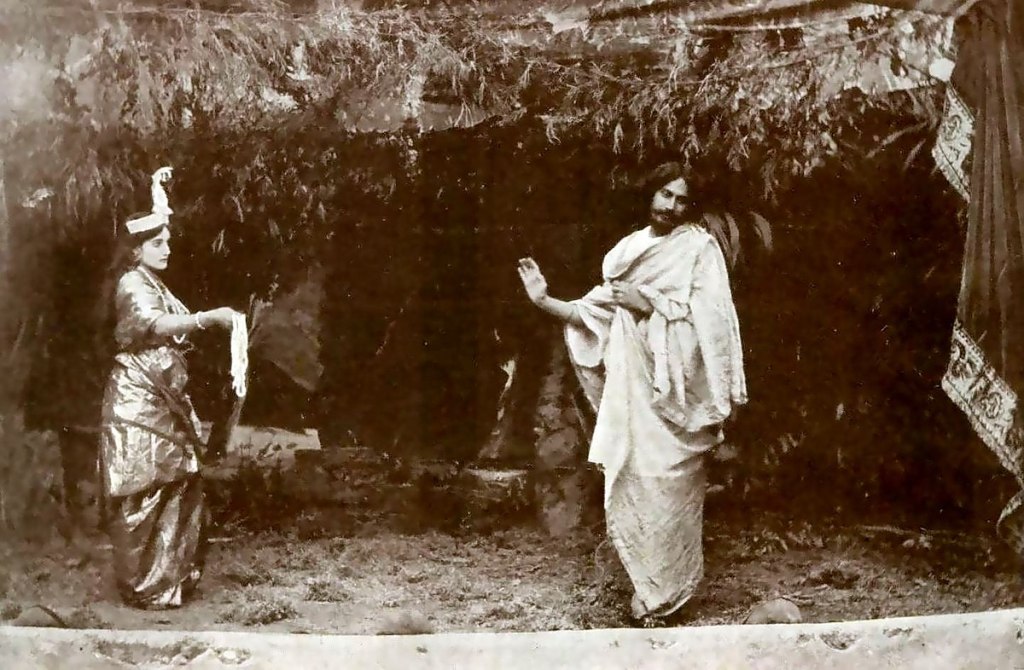
Categories
Musings

The Older I get, the More Youthful Feels Tagore

By Asad Latif

Rabindranath Tagore (1861-1941)

Tagore would have been 163 years old this year. In fact, he is that old this year. That is because he did not die in 1941. When poets pass away, they merely pretend to die, leaving  mortals to bear the weight of their non-passage. In my case, at the age of 66, the happy punishment for being a Bengali is to be tied to a childhood spent in the lap of Tagore’s poems. That lap gets younger as I grow older.

I remember listening to Phagun, haoai haoai[1], Tagore’s ode to the winds of spring, on the radio in the attic of my ancestral village home in West Bengal’s Hooghly district. My  home bordered a vast, circular expanse of agricultural land contoured by villages that included mine. Sitting in the third-storey attic, next to a terrace that overlooked the fields, I was transformed by the song. It turned vision into movement. The song’s opening lines speak of the poet making the gift of his carefree and untamed soul to the flow of the eager spring winds. Those lines might have added that Tagore had cast my soul as well to his winds. I leapt out of myself: I gladly yielded to my capture by the elements. I looked out, imagining that the spring winds would carry me across the vast fields into the homes and lives of the people who were participating in the rituals of spring, one of which was Tagore’s song itself.  

 There were many other songs in the same vein that accompanied me into youth. Among them were  Tomar khola hawa[2], where Tagore welcomes a fresh gush of wind to his waiting sails and promises the elements no regret even if his boat sinks; and Nil Digante[3], where the blue horizon catches fire from the rioting colours of flowers and even the sun asks for itself in the brightness of the earth. Such were the poetic conceits that lent the urgency of understanding to the passage of my youthful days. To lead the imaginative life was to consign oneself to the youthfulness of Tagore.

 My spring is over: Those days have passed, taking a happy Tagore with them. Now, what appeal to me are his sombre songs that deal with mortality and the divine. Tai tomar ananda amar por [4] is an outstanding example of what I would call the Late Tagore in me. Essentially, Tagore says to God: “You are the Creator only because I am the created.”  Can you imagine the degree of self-certainty that allows a human to address God so fearlessly? I do not share Tagore’s devout hubris but I listen to that song over and over again to reassure myself that my days have not been useless because they have been inhabited by God-created hours. And, of course, with Jokhon porbe na more payer chinho[5], Tagore turns death itself into a romance with the endless interplay of time and space that defines life. I stand redeemed by his lines.

But I am growing old. I am not conveyed out of myself by the spring poems any more: I prefer to age, as wildly as health and imagination allow me to, within myself. Tagore accompanies me still, but what confounds me is how young he remains even in his constancy to the maturity of my withering years.

 Phagun, haoai haoai: Tagore is exulting in the colours of this spring, this very year, even as I accept my autumnal steps to the final winter.  

[1] The Spring Breeze

[2] The Free-flowing Breeze

[3] The Blue Horizon

[4] What will be your joy post my creation?

[5] When my footsteps will not fall…

Asad Latif is a Singapore-based journalist. He can be contacted at badiarghat@borderlesssg1

PLEASE NOTE: ARTICLES CAN ONLY BE REPRODUCED IN OTHER SITES WITH DUE ACKNOWLEDGEMENT TO BORDERLESS JOURNAL

Click here to access the Borderless anthology, Monalisa No Longer Smiles

Click here to access Monalisa No Longer Smiles on Amazon International
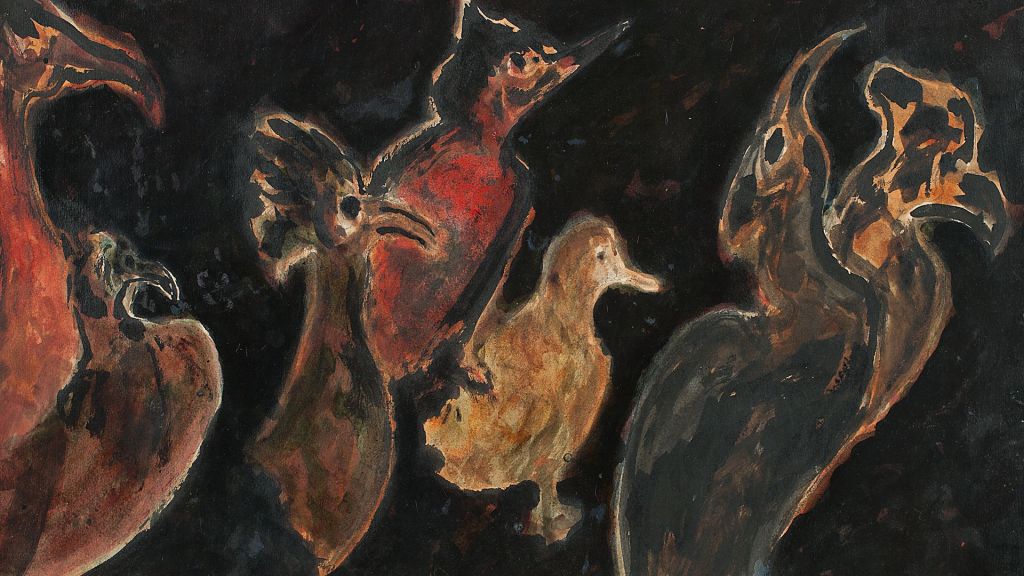
Categories
Tagore Translations

Bhumika By Rabindranath Tagore

Lyrics by Tagore, translation from Bengali by Ratnottama Sengupta

Bhumika or Introduction’ is the first song of Tagore’s collection called Mahua, published in 1929.

The lyrics written in Bengali by Tagore
Ask me not, which song
I have gifted to whom, when...
It's lying on the wayside
For the one who can
Own it with love.

Have you heard my words?
Have you pressed them to your heart?
I know not your name…
I offer you these
Musings of mine.

Painting by Tagore

Rabindranath Tagore (1861-1941) was a brilliant poet, writer, musician, artist, educator – a polymath. He was the first Nobel Laureate from Asia. His writing spanned across genres, across global issues and across the world. His works remains relevant to this day.

Ratnottama Sengupta, formerly Arts Editor of The Times of India, teaches mass communication and film appreciation, curates film festivals and art exhibitions, and translates and write books. She has been a member of CBFC (Certified Board of Film Certification), served on the National Film Awards jury and has herself won a National Award. 

.

PLEASE NOTE: ARTICLES CAN ONLY BE REPRODUCED IN OTHER SITES WITH DUE ACKNOWLEDGEMENT TO BORDERLESS JOURNAL

Click here to access the Borderless anthology, Monalisa No Longer Smiles

Click here to access Monalisa No Longer Smiles on Amazon International
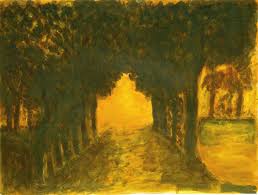
Categories
Contents

Borderless, March 2024

Art by Sohana Manzoor

Editorial

‘If Winter Comes, Can Spring be Far Behind…’ Click here to read.

Translations

Travels of Debendranath Tagore are narratives translated from Bengali by Somdatta Mandal. Click here to read.

The Yellow Flower, a narrative by Haneef Sharif, has been translated by Fazal Baloch from Balochi. Click here to read.

Ye Shao-weng’s poetry ( 1100-1150) has been translated from Mandarin by Rex Tan. Click here to read.

Nazrul’s Amamai Nahi Go Bhalobashleo (Even if you don’t love me) has been translated by Professor Fakrul Alam from Bengali. Click here to read.

Rough Stone by Ihlwha Choi has been translated from Korean to English by the poet himself. Click here to read.

Phalgun or Spring by Rabindranath Tagore has been translated from Bengali by Mitali Chakravarty. Click here to read.

Conversations

A discussion with Radha Chakravarty on her new book, Subliminal, and a brief review of the book. Click here to read.

Jagari Mukherjee interviews Rajorshi Patranabis, discussing his new book, Checklist Anomaly and Wiccan philosophy. Click here to read.

Poetry

Click on the names to read the poems

Rhys Hughes, Alpana, Ron Pickett, Shamik Banerjee, Stuart McFarlean, Baisali Chatterjee Dutt, John Grey, Shahalam Tariq, Jim Murdoch, Kumar Ghimire, Peter Magliocco, Saranyan BV, Rex Tan, Samina Tahreem, Luis Cuauhtémoc Berriozábal

Poets, Poetry & Rhys Hughes

In Lines for Loons, Loonies and Such-like, Rhys Hughes shares a rare treat. Click here to read.

Musings/Slices from Life

The Elusive Utopia?

Farouk Gulsara discusses the ideal of a perfect world. Click here to read.

Serenading Sri Lanka

Mohul Bhowmick backpacks in Sri Lanka with a camera. Click here to read.

Musings of a Copywriter

In A Conversation with God, Devraj Singh Kalsi has a bargaining chip. Click here to read.

Notes from Japan

In Cherry Blossom Forecast, Suzanne Kamata brings the Japanese ritual of cherry blossom viewing to our pages with her camera and words. Click here to read.

Stories

Prison Break

C.J.Anderson-Wu gives a poignant flash fiction. Click here to read.

Terrace

Rakhi Pande relates a strange tale from Goa. Click here to read.

The Temple-going Snake

Devraj Singh Kalsi almost creates a fable but not quite. Click here to read.

Monsoon Arc

K.S. Subramaniam shows the human spirit pitched against the harshness of monsoon storms. Click here to read.

Felipe Jimenez’s Quest of the Unheard

Paul Mirabile travels to Spain of Goya’s times with an imaginary friend who takes after perhaps, Don Quixote? Click here to read.

Essays

Where the Rice is Blue and Dinosaurs Roar…

Ravi Shankar takes us on a tour of a Malaysian town. Click here to read.

Conquering Fears: Bowing to the Mountains 

Keith Lyons tells us of his challenging hike in New Zealand. Click here to read.

Book Excerpts

An excerpt from Out of Sri Lanka: Tamil, Sinhala and English Poetry from Sri Lanka and its Diasporas edited by Vidyan Ravinthiran, Seni Seneviratne and Shash Trevett. Click here to read.

An excerpt from Rajat Chaudhuri’s Spellcasters. Click here to read.

Book Reviews

Somdatta Mandal reviews Ilse Kohler-Rollefson’s Camel Karma: Twenty Years Among India’s Camel Nomads. Click here to read.

Rakhi Dalal reviews Anuradha Kumar’s The Kidnapping of Mark Twain: A Bombay Mystery. Click here to read.

Bhaskar Parichha reviews Mafia Raj: The Rule of Bosses in South Asia by Lucia Michelutti, Ashraf Hoque, Nicolas Martin, David Picherit, Paul Rollier, Clarinda Still. Click here to read.

.

Click here to access the Borderless anthology, Monalisa No Longer Smiles

Click here to access Monalisa No Longer Smiles on Amazon International
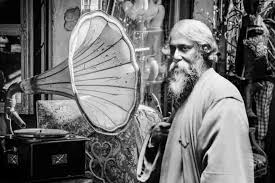
Categories
Editorial

‘If Winter Comes, Can Spring be Far Behind…’

Where the mind is without fear

Where the world has not been broken up into fragments

Where the clear stream of reason has not lost its way

Where the mind is led forward by thee
Into ever-widening thought and action…

— ‘Where the Mind is without Fear’ (1910), by Rabindranath Tagore

As we complete the fourth year of our virtual existence in the clouds and across borders, the world has undergone many changes around us, and it’s not only climate change (which is a huge challenge) but much more. We started around the time of the pandemic — in March 2020 — as human interactions moved from face-to-face non-virtual interactions to virtual communication. When the pandemic ended, we had thought humanity would enter a new age where new etiquettes redefining our social norms would make human existence as pandemic proof as possible. But before we could define new norms in the global context, takeovers and conflicts seem to have reft countries, regions and communities apart. Perhaps, this is a time when Borderless Journal can give a voice to all those who want to continue living as part of a single species in this world — where we can rise above our differences to find commonalities that make us human and part of the larger stream of humanity, that has been visualised by visionaries like Tagore or John Lennon — widely different cultural milieus but looking for the same things — humankind living together in harmony and moving towards a world without violence, without hate, without rancour and steeped in goodwill and love.  

Talking of positive values does not make sense in a world that seems to be veering towards darkness… Many say that humankind is intrinsically given to feelings of anger, hate, division, lust, shame and violence. But then we are just as much inclined towards happiness, fun, love, being respectful and peaceful. Otherwise, would we be writing about these? These are inherited values that have also come down to us from our forefathers and some have been evolving towards embalming or healing with resilience, with kindness and with an open mind.  

If you wake up before sunrise, you will notice the sky is really an unredeemable dark. Then, it turns a soft grey till the vibrant colours of the sun paint the horizon and beyond, dousing with not just lively shades but also with a variety of sounds announcing the start of a new day. The darkest hours give way to light. Light is as much a truth as darkness. Both exist. They come in phases in the natural world, and we cannot choose but live with the choices that have been pre-made for us. But there are things we can choose — we can choose to love or hate. We can choose resilience or weakness. We can choose our friends. We can choose our thoughts, our ideas. In Borderless, we have a forum which invites you to choose to be part of a world that has the courage to dream, to imagine. We hope to ignite the torch to carry on this conversation which is probably as old as humanity. We look forward to finding new voices that are willing to move in quest of an impractical world, a utopia, a vision — from which perhaps will emerge systems that will give way to a better future for our progeny.

In the last four years, we are happy to say we have hosted writers from more than forty different nationalities and our readers stretch across almost the whole map of the world. We had our first anthology published less than one and a half years ago, focussing more on writing from established pens. Discussions are afoot to bring out more anthologies in hardcopy with more variety of writers.

In our fourth anniversary issue, we not only host translations by Professor Fakrul Alam of Nazrul, by Somdatta Mandal of Tagore’s father, Debendranath Tagore, but also our first Mandarin translation of a twelfth century Southern Song Dynasty poet, Ye Shao-weng, by Rex Tan, a journalist and writer from Malaysia. From other parts of Asia, Dr Haneef Sharif’s Balochi writing has been rendered into English by Fazal Baloch and Ihlwha Choi has transcreated his own poetry from Korean to English. Tagore’s Phalgun or Spring, describing the current season in Bengal, adds to the variety in our translated oeuvre.

An eminent translator who has brought out her debut poetry book, Radha Chakravarty, has conversed about her poetry and told us among other things, how translating to English varies from writing for oneself. A brief overview of her book, Subliminal, has been provided. Our other interviewee, Rajorshi Patranabis — interviewed by Jagari Mukherjee — has written poetry from a Wiccan perspective — poetry on love — for he is a Wiccan. We have poetry by Luis Cuauhtémoc Berriozábal, Jim Murdoch, Alpana, Baisali Chatterjee Dutt, John Grey, Shahalam Tariq, Saranyan BV, Rex Tan, Ron Pickett with poetry on the season and many more. Humour is brought into poetry with verses woven around a funny sign by Rhys Hughes . His column this month hosts a series of shorter poems — typically in Hughes’ own unique style.

Devraj Singh Kalsi has explored darker shades of humour in his conversation with God while Suzanne Kamata has ushered in the Japanese spring ritual of gazing at cherry blossoms in her column with photographs and narrative. Keith Lyons takes us to the beautiful Fiordlands of New Zealand, Ravi Shankar to Malaysia and Mohul Bhowmick trapezes from place to place in Sri Lanka. Farouk Gulsara has discussed the elusiveness of utopia — an interesting perspective given that we look upto ideals like these in Borderless. I would urge more of you to join this conversation and tell us what you think. We did have Wendy Jones Nakashini start a discussion along these lines in an earlier issue.

We have stories from around the world: C.J.Anderson-Wu from Taiwan, Paul Mirabile from France, Rakhi Pande, Kalsi and K.S. Subramaniam from India. Our book excerpts are from Out of Sri Lanka: Tamil, Sinhala and English Poetry from Sri Lanka and its Diasporas edited by Vidyan Ravinthiran, Seni Seneviratne and Shash Trevett and a Cli-fi book that is making waves, Rajat Chaudhauri’s Spellcasters. Mandal has also reviewed for us Ilse Kohler-Rollefson’s Camel Karma: Twenty Years Among India’s Camel Nomads. Bhaskar Parichha has discussed Mafia Raj: The Rule of Bosses in South Asia by Lucia Michelutti, Ashraf Hoque, Nicolas Martin, David Picherit, Paul Rollier, Clarinda Still — a book written jointly by multiple academics. Rakhi Dalal in her review of Anuradha Kumar’s The Kidnapping of Mark Twain: A Bombay Mystery has compared the novel to an Agatha Christie mystery!

I would want to thank our dedicated team from the bottom of my heart. Without them, we could not have brought out two issues within three weeks for we were late with our February issue. A huge thanks to them for their writing and to Sohana Manzoor for her art too. Thanks to our wonderful reviewers who have been with us for a number of years, to all our mentors and contributors without who this journal could not exist. Huge thanks to all our fabulous loyal readers. Devoid of their patronage these words would dangle meaninglessly and unread. Thank you all.

Wish you a wonderful spring as Borderless Journal starts out on the fifth year of its virtual existence! We hope you will be part of our journey throughout…

Enjoy the reads in this special anniversary issue with more content than highlighted here, and each piece is a wonderful addition to our oeuvre!

Mitali Chakravarty

borderlessjournal.com

Click here to access the content page for the March 2024 Issue.

.

READ THE LATEST UPDATES ON THE FIRST BORDERLESS ANTHOLOGY, MONALISA NO LONGER SMILES, BY CLICKING ON THIS LINK.